EP1069468A1 - Ein Verfahren zur Herstellung lichtunempfindlicher Silberfettsäuresalzkörner und ein Apparat dafür - Google Patents
Ein Verfahren zur Herstellung lichtunempfindlicher Silberfettsäuresalzkörner und ein Apparat dafür Download PDFInfo
- Publication number
- EP1069468A1 EP1069468A1 EP00115242A EP00115242A EP1069468A1 EP 1069468 A1 EP1069468 A1 EP 1069468A1 EP 00115242 A EP00115242 A EP 00115242A EP 00115242 A EP00115242 A EP 00115242A EP 1069468 A1 EP1069468 A1 EP 1069468A1
- Authority
- EP
- European Patent Office
- Prior art keywords
- fatty acid
- water
- silver salt
- solution
- acid silver
- Prior art date
- Legal status (The legal status is an assumption and is not a legal conclusion. Google has not performed a legal analysis and makes no representation as to the accuracy of the status listed.)
- Granted
Links
- 235000014113 dietary fatty acids Nutrition 0.000 title claims abstract description 177
- 239000000194 fatty acid Substances 0.000 title claims abstract description 177
- 229930195729 fatty acid Natural products 0.000 title claims abstract description 177
- 150000004665 fatty acids Chemical class 0.000 title claims abstract description 141
- GGCZERPQGJTIQP-UHFFFAOYSA-N sodium;9,10-dioxoanthracene-2-sulfonic acid Chemical compound [Na+].C1=CC=C2C(=O)C3=CC(S(=O)(=O)O)=CC=C3C(=O)C2=C1 GGCZERPQGJTIQP-UHFFFAOYSA-N 0.000 title claims abstract description 138
- 238000000034 method Methods 0.000 title claims abstract description 70
- XLYOFNOQVPJJNP-UHFFFAOYSA-N water Substances O XLYOFNOQVPJJNP-UHFFFAOYSA-N 0.000 claims abstract description 119
- 238000002156 mixing Methods 0.000 claims abstract description 114
- -1 fatty acid alkali metal salt Chemical class 0.000 claims abstract description 88
- 239000000203 mixture Substances 0.000 claims abstract description 60
- 229910052783 alkali metal Inorganic materials 0.000 claims abstract description 51
- 239000003960 organic solvent Substances 0.000 claims abstract description 50
- FOIXSVOLVBLSDH-UHFFFAOYSA-N Silver ion Chemical compound [Ag+] FOIXSVOLVBLSDH-UHFFFAOYSA-N 0.000 claims abstract description 41
- 238000006243 chemical reaction Methods 0.000 claims abstract description 26
- 239000002904 solvent Substances 0.000 claims abstract description 26
- 239000007788 liquid Substances 0.000 claims description 107
- 238000003756 stirring Methods 0.000 claims description 24
- 238000001816 cooling Methods 0.000 claims description 19
- 239000002270 dispersing agent Substances 0.000 claims description 12
- 238000007599 discharging Methods 0.000 claims description 6
- 239000011541 reaction mixture Substances 0.000 claims description 6
- 239000006185 dispersion Substances 0.000 abstract description 121
- 238000000576 coating method Methods 0.000 abstract description 51
- 239000011248 coating agent Substances 0.000 abstract description 50
- 239000000243 solution Substances 0.000 description 132
- SQGYOTSLMSWVJD-UHFFFAOYSA-N silver(1+) nitrate Chemical compound [Ag+].[O-]N(=O)=O SQGYOTSLMSWVJD-UHFFFAOYSA-N 0.000 description 60
- 229910052709 silver Inorganic materials 0.000 description 47
- 239000004332 silver Substances 0.000 description 47
- 238000002360 preparation method Methods 0.000 description 37
- 239000000463 material Substances 0.000 description 32
- BQCADISMDOOEFD-UHFFFAOYSA-N Silver Chemical compound [Ag] BQCADISMDOOEFD-UHFFFAOYSA-N 0.000 description 29
- 239000000047 product Substances 0.000 description 27
- OKKJLVBELUTLKV-UHFFFAOYSA-N Methanol Chemical compound OC OKKJLVBELUTLKV-UHFFFAOYSA-N 0.000 description 24
- 239000007864 aqueous solution Substances 0.000 description 23
- HEMHJVSKTPXQMS-UHFFFAOYSA-M Sodium hydroxide Chemical compound [OH-].[Na+] HEMHJVSKTPXQMS-UHFFFAOYSA-M 0.000 description 21
- 239000010410 layer Substances 0.000 description 21
- 239000007787 solid Substances 0.000 description 21
- 239000012153 distilled water Substances 0.000 description 18
- 229910001961 silver nitrate Inorganic materials 0.000 description 18
- 239000002585 base Substances 0.000 description 16
- 108010010803 Gelatin Proteins 0.000 description 15
- 239000000839 emulsion Substances 0.000 description 15
- 229920000159 gelatin Polymers 0.000 description 15
- 239000008273 gelatin Substances 0.000 description 15
- 235000019322 gelatine Nutrition 0.000 description 15
- 235000011852 gelatine desserts Nutrition 0.000 description 15
- 229920002451 polyvinyl alcohol Polymers 0.000 description 15
- 230000008569 process Effects 0.000 description 15
- DKGAVHZHDRPRBM-UHFFFAOYSA-N Tert-Butanol Chemical compound CC(C)(C)O DKGAVHZHDRPRBM-UHFFFAOYSA-N 0.000 description 14
- UKMSUNONTOPOIO-UHFFFAOYSA-N docosanoic acid Chemical compound CCCCCCCCCCCCCCCCCCCCCC(O)=O UKMSUNONTOPOIO-UHFFFAOYSA-N 0.000 description 14
- 150000001875 compounds Chemical class 0.000 description 13
- 239000003638 chemical reducing agent Substances 0.000 description 12
- 238000004519 manufacturing process Methods 0.000 description 12
- 239000011734 sodium Substances 0.000 description 12
- 239000004372 Polyvinyl alcohol Substances 0.000 description 11
- 235000019422 polyvinyl alcohol Nutrition 0.000 description 11
- CVYDEWKUJFCYJO-UHFFFAOYSA-M sodium;docosanoate Chemical compound [Na+].CCCCCCCCCCCCCCCCCCCCCC([O-])=O CVYDEWKUJFCYJO-UHFFFAOYSA-M 0.000 description 11
- 239000012295 chemical reaction liquid Substances 0.000 description 10
- IOLCXVTUBQKXJR-UHFFFAOYSA-M potassium bromide Chemical compound [K+].[Br-] IOLCXVTUBQKXJR-UHFFFAOYSA-M 0.000 description 10
- 229920001577 copolymer Polymers 0.000 description 9
- 239000011241 protective layer Substances 0.000 description 9
- 239000004576 sand Substances 0.000 description 9
- QAOWNCQODCNURD-UHFFFAOYSA-N Sulfuric acid Chemical compound OS(O)(=O)=O QAOWNCQODCNURD-UHFFFAOYSA-N 0.000 description 8
- MCMNRKCIXSYSNV-UHFFFAOYSA-N Zirconium dioxide Chemical compound O=[Zr]=O MCMNRKCIXSYSNV-UHFFFAOYSA-N 0.000 description 8
- 239000003513 alkali Substances 0.000 description 8
- 229940116224 behenate Drugs 0.000 description 8
- UKMSUNONTOPOIO-UHFFFAOYSA-M behenate Chemical compound CCCCCCCCCCCCCCCCCCCCCC([O-])=O UKMSUNONTOPOIO-UHFFFAOYSA-M 0.000 description 8
- 239000011230 binding agent Substances 0.000 description 8
- 239000000498 cooling water Substances 0.000 description 8
- 238000001914 filtration Methods 0.000 description 8
- 239000002002 slurry Substances 0.000 description 8
- 150000007524 organic acids Chemical class 0.000 description 7
- 239000002245 particle Substances 0.000 description 7
- 230000003068 static effect Effects 0.000 description 7
- LYCAIKOWRPUZTN-UHFFFAOYSA-N Ethylene glycol Chemical compound OCCO LYCAIKOWRPUZTN-UHFFFAOYSA-N 0.000 description 6
- KFZMGEQAYNKOFK-UHFFFAOYSA-N Isopropanol Chemical compound CC(C)O KFZMGEQAYNKOFK-UHFFFAOYSA-N 0.000 description 6
- 150000001340 alkali metals Chemical class 0.000 description 6
- 238000011161 development Methods 0.000 description 6
- 238000001035 drying Methods 0.000 description 6
- 239000000975 dye Substances 0.000 description 6
- 230000000694 effects Effects 0.000 description 6
- 239000004816 latex Substances 0.000 description 6
- 229920000126 latex Polymers 0.000 description 6
- 230000035945 sensitivity Effects 0.000 description 6
- 239000000344 soap Substances 0.000 description 6
- 239000000126 substance Substances 0.000 description 6
- 235000021357 Behenic acid Nutrition 0.000 description 5
- 239000011324 bead Substances 0.000 description 5
- 229940116226 behenic acid Drugs 0.000 description 5
- 238000002425 crystallisation Methods 0.000 description 5
- 230000008025 crystallization Effects 0.000 description 5
- 230000018109 developmental process Effects 0.000 description 5
- 238000010586 diagram Methods 0.000 description 5
- 230000001603 reducing effect Effects 0.000 description 5
- 239000002174 Styrene-butadiene Substances 0.000 description 4
- 238000005054 agglomeration Methods 0.000 description 4
- 230000002776 aggregation Effects 0.000 description 4
- 230000001276 controlling effect Effects 0.000 description 4
- 238000003851 corona treatment Methods 0.000 description 4
- 230000003247 decreasing effect Effects 0.000 description 4
- 238000011033 desalting Methods 0.000 description 4
- 238000005516 engineering process Methods 0.000 description 4
- 238000005259 measurement Methods 0.000 description 4
- XNGIFLGASWRNHJ-UHFFFAOYSA-N phthalic acid Chemical compound OC(=O)C1=CC=CC=C1C(O)=O XNGIFLGASWRNHJ-UHFFFAOYSA-N 0.000 description 4
- 239000002243 precursor Substances 0.000 description 4
- 230000005070 ripening Effects 0.000 description 4
- 239000012266 salt solution Substances 0.000 description 4
- 150000003839 salts Chemical class 0.000 description 4
- NDVLTYZPCACLMA-UHFFFAOYSA-N silver oxide Chemical compound [O-2].[Ag+].[Ag+] NDVLTYZPCACLMA-UHFFFAOYSA-N 0.000 description 4
- 238000003860 storage Methods 0.000 description 4
- 229920003048 styrene butadiene rubber Polymers 0.000 description 4
- 238000000967 suction filtration Methods 0.000 description 4
- VZCYOOQTPOCHFL-UHFFFAOYSA-N trans-butenedioic acid Natural products OC(=O)C=CC(O)=O VZCYOOQTPOCHFL-UHFFFAOYSA-N 0.000 description 4
- 238000000108 ultra-filtration Methods 0.000 description 4
- KANAPVJGZDNSCZ-UHFFFAOYSA-N 1,2-benzothiazole 1-oxide Chemical compound C1=CC=C2S(=O)N=CC2=C1 KANAPVJGZDNSCZ-UHFFFAOYSA-N 0.000 description 3
- ZWEHNKRNPOVVGH-UHFFFAOYSA-N 2-Butanone Chemical compound CCC(C)=O ZWEHNKRNPOVVGH-UHFFFAOYSA-N 0.000 description 3
- QCDWFXQBSFUVSP-UHFFFAOYSA-N 2-phenoxyethanol Chemical compound OCCOC1=CC=CC=C1 QCDWFXQBSFUVSP-UHFFFAOYSA-N 0.000 description 3
- CWIYBOJLSWJGKV-UHFFFAOYSA-N 5-methyl-1,3-dihydrobenzimidazole-2-thione Chemical compound CC1=CC=C2NC(S)=NC2=C1 CWIYBOJLSWJGKV-UHFFFAOYSA-N 0.000 description 3
- XZMCDFZZKTWFGF-UHFFFAOYSA-N Cyanamide Chemical compound NC#N XZMCDFZZKTWFGF-UHFFFAOYSA-N 0.000 description 3
- IMROMDMJAWUWLK-UHFFFAOYSA-N Ethenol Chemical compound OC=C IMROMDMJAWUWLK-UHFFFAOYSA-N 0.000 description 3
- MHAJPDPJQMAIIY-UHFFFAOYSA-N Hydrogen peroxide Chemical compound OO MHAJPDPJQMAIIY-UHFFFAOYSA-N 0.000 description 3
- DGAQECJNVWCQMB-PUAWFVPOSA-M Ilexoside XXIX Chemical compound C[C@@H]1CC[C@@]2(CC[C@@]3(C(=CC[C@H]4[C@]3(CC[C@@H]5[C@@]4(CC[C@@H](C5(C)C)OS(=O)(=O)[O-])C)C)[C@@H]2[C@]1(C)O)C)C(=O)O[C@H]6[C@@H]([C@H]([C@@H]([C@H](O6)CO)O)O)O.[Na+] DGAQECJNVWCQMB-PUAWFVPOSA-M 0.000 description 3
- OFOBLEOULBTSOW-UHFFFAOYSA-N Propanedioic acid Natural products OC(=O)CC(O)=O OFOBLEOULBTSOW-UHFFFAOYSA-N 0.000 description 3
- YXFVVABEGXRONW-UHFFFAOYSA-N Toluene Chemical compound CC1=CC=CC=C1 YXFVVABEGXRONW-UHFFFAOYSA-N 0.000 description 3
- 239000002253 acid Substances 0.000 description 3
- 229920006318 anionic polymer Polymers 0.000 description 3
- 239000006227 byproduct Substances 0.000 description 3
- 229910052799 carbon Inorganic materials 0.000 description 3
- 230000003197 catalytic effect Effects 0.000 description 3
- 238000007865 diluting Methods 0.000 description 3
- 238000011156 evaluation Methods 0.000 description 3
- 239000011976 maleic acid Substances 0.000 description 3
- 239000011259 mixed solution Substances 0.000 description 3
- 229960005323 phenoxyethanol Drugs 0.000 description 3
- 239000011941 photocatalyst Substances 0.000 description 3
- 239000000049 pigment Substances 0.000 description 3
- 229920003229 poly(methyl methacrylate) Polymers 0.000 description 3
- 229920000642 polymer Polymers 0.000 description 3
- 239000004926 polymethyl methacrylate Substances 0.000 description 3
- NLKNQRATVPKPDG-UHFFFAOYSA-M potassium iodide Chemical compound [K+].[I-] NLKNQRATVPKPDG-UHFFFAOYSA-M 0.000 description 3
- 238000001556 precipitation Methods 0.000 description 3
- 229910052708 sodium Inorganic materials 0.000 description 3
- APSBXTVYXVQYAB-UHFFFAOYSA-M sodium docusate Chemical compound [Na+].CCCCC(CC)COC(=O)CC(S([O-])(=O)=O)C(=O)OCC(CC)CCCC APSBXTVYXVQYAB-UHFFFAOYSA-M 0.000 description 3
- 238000005406 washing Methods 0.000 description 3
- QPFMBZIOSGYJDE-UHFFFAOYSA-N 1,1,2,2-tetrachloroethane Chemical compound ClC(Cl)C(Cl)Cl QPFMBZIOSGYJDE-UHFFFAOYSA-N 0.000 description 2
- PAWQVTBBRAZDMG-UHFFFAOYSA-N 2-(3-bromo-2-fluorophenyl)acetic acid Chemical compound OC(=O)CC1=CC=CC(Br)=C1F PAWQVTBBRAZDMG-UHFFFAOYSA-N 0.000 description 2
- ZCYVEMRRCGMTRW-UHFFFAOYSA-N 7553-56-2 Chemical compound [I] ZCYVEMRRCGMTRW-UHFFFAOYSA-N 0.000 description 2
- CSCPPACGZOOCGX-UHFFFAOYSA-N Acetone Chemical compound CC(C)=O CSCPPACGZOOCGX-UHFFFAOYSA-N 0.000 description 2
- KAKZBPTYRLMSJV-UHFFFAOYSA-N Butadiene Chemical compound C=CC=C KAKZBPTYRLMSJV-UHFFFAOYSA-N 0.000 description 2
- FERIUCNNQQJTOY-UHFFFAOYSA-N Butyric acid Chemical compound CCCC(O)=O FERIUCNNQQJTOY-UHFFFAOYSA-N 0.000 description 2
- OKTJSMMVPCPJKN-UHFFFAOYSA-N Carbon Chemical compound [C] OKTJSMMVPCPJKN-UHFFFAOYSA-N 0.000 description 2
- 229920002134 Carboxymethyl cellulose Polymers 0.000 description 2
- LFQSCWFLJHTTHZ-UHFFFAOYSA-N Ethanol Chemical compound CCO LFQSCWFLJHTTHZ-UHFFFAOYSA-N 0.000 description 2
- VZCYOOQTPOCHFL-OWOJBTEDSA-N Fumaric acid Chemical compound OC(=O)\C=C\C(O)=O VZCYOOQTPOCHFL-OWOJBTEDSA-N 0.000 description 2
- GRYLNZFGIOXLOG-UHFFFAOYSA-N Nitric acid Chemical compound O[N+]([O-])=O GRYLNZFGIOXLOG-UHFFFAOYSA-N 0.000 description 2
- 239000004793 Polystyrene Substances 0.000 description 2
- ZLMJMSJWJFRBEC-UHFFFAOYSA-N Potassium Chemical compound [K] ZLMJMSJWJFRBEC-UHFFFAOYSA-N 0.000 description 2
- 206010070834 Sensitisation Diseases 0.000 description 2
- 229920002125 Sokalan® Polymers 0.000 description 2
- 229920002472 Starch Polymers 0.000 description 2
- PPBRXRYQALVLMV-UHFFFAOYSA-N Styrene Chemical compound C=CC1=CC=CC=C1 PPBRXRYQALVLMV-UHFFFAOYSA-N 0.000 description 2
- KKEYFWRCBNTPAC-UHFFFAOYSA-N Terephthalic acid Chemical compound OC(=O)C1=CC=C(C(O)=O)C=C1 KKEYFWRCBNTPAC-UHFFFAOYSA-N 0.000 description 2
- RTAQQCXQSZGOHL-UHFFFAOYSA-N Titanium Chemical compound [Ti] RTAQQCXQSZGOHL-UHFFFAOYSA-N 0.000 description 2
- 150000001241 acetals Chemical class 0.000 description 2
- 230000002411 adverse Effects 0.000 description 2
- 239000003945 anionic surfactant Substances 0.000 description 2
- 230000009286 beneficial effect Effects 0.000 description 2
- XSCHRSMBECNVNS-UHFFFAOYSA-N benzopyrazine Natural products N1=CC=NC2=CC=CC=C21 XSCHRSMBECNVNS-UHFFFAOYSA-N 0.000 description 2
- 230000015572 biosynthetic process Effects 0.000 description 2
- 239000001768 carboxy methyl cellulose Substances 0.000 description 2
- 235000010948 carboxy methyl cellulose Nutrition 0.000 description 2
- 150000001732 carboxylic acid derivatives Chemical class 0.000 description 2
- 239000008112 carboxymethyl-cellulose Substances 0.000 description 2
- 229920002301 cellulose acetate Polymers 0.000 description 2
- 239000000084 colloidal system Substances 0.000 description 2
- 230000001143 conditioned effect Effects 0.000 description 2
- 238000007796 conventional method Methods 0.000 description 2
- 239000013078 crystal Substances 0.000 description 2
- KCIDZIIHRGYJAE-YGFYJFDDSA-L dipotassium;[(2r,3r,4s,5r,6r)-3,4,5-trihydroxy-6-(hydroxymethyl)oxan-2-yl] phosphate Chemical compound [K+].[K+].OC[C@H]1O[C@H](OP([O-])([O-])=O)[C@H](O)[C@@H](O)[C@H]1O KCIDZIIHRGYJAE-YGFYJFDDSA-L 0.000 description 2
- 238000009826 distribution Methods 0.000 description 2
- POULHZVOKOAJMA-UHFFFAOYSA-N dodecanoic acid Chemical compound CCCCCCCCCCCC(O)=O POULHZVOKOAJMA-UHFFFAOYSA-N 0.000 description 2
- 230000001804 emulsifying effect Effects 0.000 description 2
- 230000007613 environmental effect Effects 0.000 description 2
- 239000007789 gas Substances 0.000 description 2
- 238000010438 heat treatment Methods 0.000 description 2
- XMHIUKTWLZUKEX-UHFFFAOYSA-N hexacosanoic acid Chemical compound CCCCCCCCCCCCCCCCCCCCCCCCCC(O)=O XMHIUKTWLZUKEX-UHFFFAOYSA-N 0.000 description 2
- IPCSVZSSVZVIGE-UHFFFAOYSA-N hexadecanoic acid Chemical compound CCCCCCCCCCCCCCCC(O)=O IPCSVZSSVZVIGE-UHFFFAOYSA-N 0.000 description 2
- FUZZWVXGSFPDMH-UHFFFAOYSA-N hexanoic acid Chemical compound CCCCCC(O)=O FUZZWVXGSFPDMH-UHFFFAOYSA-N 0.000 description 2
- 239000012456 homogeneous solution Substances 0.000 description 2
- 230000002209 hydrophobic effect Effects 0.000 description 2
- 238000003384 imaging method Methods 0.000 description 2
- 235000019239 indanthrene blue RS Nutrition 0.000 description 2
- 230000016507 interphase Effects 0.000 description 2
- 238000011835 investigation Methods 0.000 description 2
- 229910052740 iodine Inorganic materials 0.000 description 2
- 239000011630 iodine Substances 0.000 description 2
- VZCYOOQTPOCHFL-UPHRSURJSA-N maleic acid Chemical compound OC(=O)\C=C/C(O)=O VZCYOOQTPOCHFL-UPHRSURJSA-N 0.000 description 2
- 239000011159 matrix material Substances 0.000 description 2
- 229910052751 metal Inorganic materials 0.000 description 2
- 239000002184 metal Substances 0.000 description 2
- 229910021645 metal ion Inorganic materials 0.000 description 2
- 229910017604 nitric acid Inorganic materials 0.000 description 2
- 230000002093 peripheral effect Effects 0.000 description 2
- 229920000728 polyester Polymers 0.000 description 2
- 229920002223 polystyrene Polymers 0.000 description 2
- 229910052700 potassium Inorganic materials 0.000 description 2
- 239000011591 potassium Substances 0.000 description 2
- 238000006479 redox reaction Methods 0.000 description 2
- 230000002829 reductive effect Effects 0.000 description 2
- 230000001105 regulatory effect Effects 0.000 description 2
- 230000008313 sensitization Effects 0.000 description 2
- 238000010008 shearing Methods 0.000 description 2
- ADZWSOLPGZMUMY-UHFFFAOYSA-M silver bromide Chemical compound [Ag]Br ADZWSOLPGZMUMY-UHFFFAOYSA-M 0.000 description 2
- ZUNKMNLKJXRCDM-UHFFFAOYSA-N silver bromoiodide Chemical compound [Ag].IBr ZUNKMNLKJXRCDM-UHFFFAOYSA-N 0.000 description 2
- 229910001923 silver oxide Inorganic materials 0.000 description 2
- AYKOTYRPPUMHMT-UHFFFAOYSA-N silver;hydrate Chemical compound O.[Ag] AYKOTYRPPUMHMT-UHFFFAOYSA-N 0.000 description 2
- 230000003595 spectral effect Effects 0.000 description 2
- 239000008107 starch Substances 0.000 description 2
- 235000019698 starch Nutrition 0.000 description 2
- 239000004094 surface-active agent Substances 0.000 description 2
- 150000003498 tellurium compounds Chemical class 0.000 description 2
- ZMZDMBWJUHKJPS-UHFFFAOYSA-N thiocyanic acid Chemical compound SC#N ZMZDMBWJUHKJPS-UHFFFAOYSA-N 0.000 description 2
- 230000036962 time dependent Effects 0.000 description 2
- 239000010936 titanium Substances 0.000 description 2
- 229910052719 titanium Inorganic materials 0.000 description 2
- 229920002554 vinyl polymer Polymers 0.000 description 2
- 229910052725 zinc Inorganic materials 0.000 description 2
- ZUHDZBHELIKKKH-UHFFFAOYSA-N (2,3,4,5,6-pentafluorophenyl)-diphenyl-selanylidene-$l^{5}-phosphane Chemical compound FC1=C(F)C(F)=C(F)C(F)=C1P(=[Se])(C=1C=CC=CC=1)C1=CC=CC=C1 ZUHDZBHELIKKKH-UHFFFAOYSA-N 0.000 description 1
- WRIDQFICGBMAFQ-UHFFFAOYSA-N (E)-8-Octadecenoic acid Natural products CCCCCCCCCC=CCCCCCCC(O)=O WRIDQFICGBMAFQ-UHFFFAOYSA-N 0.000 description 1
- 229920002818 (Hydroxyethyl)methacrylate Polymers 0.000 description 1
- HYZJCKYKOHLVJF-UHFFFAOYSA-N 1H-benzimidazole Chemical compound C1=CC=C2NC=NC2=C1 HYZJCKYKOHLVJF-UHFFFAOYSA-N 0.000 description 1
- SMZOUWXMTYCWNB-UHFFFAOYSA-N 2-(2-methoxy-5-methylphenyl)ethanamine Chemical compound COC1=CC=C(C)C=C1CCN SMZOUWXMTYCWNB-UHFFFAOYSA-N 0.000 description 1
- JAHNSTQSQJOJLO-UHFFFAOYSA-N 2-(3-fluorophenyl)-1h-imidazole Chemical compound FC1=CC=CC(C=2NC=CN=2)=C1 JAHNSTQSQJOJLO-UHFFFAOYSA-N 0.000 description 1
- GOXQRTZXKQZDDN-UHFFFAOYSA-N 2-Ethylhexyl acrylate Chemical compound CCCCC(CC)COC(=O)C=C GOXQRTZXKQZDDN-UHFFFAOYSA-N 0.000 description 1
- NIXOWILDQLNWCW-UHFFFAOYSA-N 2-Propenoic acid Natural products OC(=O)C=C NIXOWILDQLNWCW-UHFFFAOYSA-N 0.000 description 1
- RPWDFMGIRPZGTI-UHFFFAOYSA-N 2-[1-(2-hydroxy-3,5-dimethylphenyl)-3,5,5-trimethylhexyl]-4,6-dimethylphenol Chemical compound C=1C(C)=CC(C)=C(O)C=1C(CC(C)CC(C)(C)C)C1=CC(C)=CC(C)=C1O RPWDFMGIRPZGTI-UHFFFAOYSA-N 0.000 description 1
- DLTXRGFRPZKYNS-UHFFFAOYSA-N 2-methylpropan-1-ol;2,2,4-trimethylpentane-1,3-diol Chemical compound CC(C)CO.CC(C)C(O)C(C)(C)CO DLTXRGFRPZKYNS-UHFFFAOYSA-N 0.000 description 1
- LQJBNNIYVWPHFW-UHFFFAOYSA-N 20:1omega9c fatty acid Natural products CCCCCCCCCCC=CCCCCCCCC(O)=O LQJBNNIYVWPHFW-UHFFFAOYSA-N 0.000 description 1
- TUQAKXMNDMTCFO-UHFFFAOYSA-N 3-heptyl-4-phenyl-1h-1,2,4-triazole-5-thione Chemical compound CCCCCCCC1=NNC(=S)N1C1=CC=CC=C1 TUQAKXMNDMTCFO-UHFFFAOYSA-N 0.000 description 1
- ZVQSBCUQKBVLLA-UHFFFAOYSA-N 4-phenyl-3-(tribromomethylsulfonyl)-5-tridecyl-1,2,4-triazole Chemical compound CCCCCCCCCCCCCC1=NN=C(S(=O)(=O)C(Br)(Br)Br)N1C1=CC=CC=C1 ZVQSBCUQKBVLLA-UHFFFAOYSA-N 0.000 description 1
- OVBJAABCEPSUNB-UHFFFAOYSA-N 6-propan-2-ylphthalazine Chemical compound C1=NN=CC2=CC(C(C)C)=CC=C21 OVBJAABCEPSUNB-UHFFFAOYSA-N 0.000 description 1
- QSBYPNXLFMSGKH-UHFFFAOYSA-N 9-Heptadecensaeure Natural products CCCCCCCC=CCCCCCCCC(O)=O QSBYPNXLFMSGKH-UHFFFAOYSA-N 0.000 description 1
- 229920002126 Acrylic acid copolymer Polymers 0.000 description 1
- DPUOLQHDNGRHBS-UHFFFAOYSA-N Brassidinsaeure Natural products CCCCCCCCC=CCCCCCCCCCCCC(O)=O DPUOLQHDNGRHBS-UHFFFAOYSA-N 0.000 description 1
- OWNRRUFOJXFKCU-UHFFFAOYSA-N Bromadiolone Chemical compound C=1C=C(C=2C=CC(Br)=CC=2)C=CC=1C(O)CC(C=1C(OC2=CC=CC=C2C=1O)=O)C1=CC=CC=C1 OWNRRUFOJXFKCU-UHFFFAOYSA-N 0.000 description 1
- BMTAFVWTTFSTOG-UHFFFAOYSA-N Butylate Chemical compound CCSC(=O)N(CC(C)C)CC(C)C BMTAFVWTTFSTOG-UHFFFAOYSA-N 0.000 description 1
- LSPHULWDVZXLIL-UHFFFAOYSA-N Camphoric acid Natural products CC1(C)C(C(O)=O)CCC1(C)C(O)=O LSPHULWDVZXLIL-UHFFFAOYSA-N 0.000 description 1
- FEWJPZIEWOKRBE-JCYAYHJZSA-N Dextrotartaric acid Chemical compound OC(=O)[C@H](O)[C@@H](O)C(O)=O FEWJPZIEWOKRBE-JCYAYHJZSA-N 0.000 description 1
- URXZXNYJPAJJOQ-UHFFFAOYSA-N Erucic acid Natural products CCCCCCC=CCCCCCCCCCCCC(O)=O URXZXNYJPAJJOQ-UHFFFAOYSA-N 0.000 description 1
- 229920000084 Gum arabic Polymers 0.000 description 1
- 229920000663 Hydroxyethyl cellulose Polymers 0.000 description 1
- 239000004354 Hydroxyethyl cellulose Substances 0.000 description 1
- WOBHKFSMXKNTIM-UHFFFAOYSA-N Hydroxyethyl methacrylate Chemical compound CC(=C)C(=O)OCCO WOBHKFSMXKNTIM-UHFFFAOYSA-N 0.000 description 1
- 229920002153 Hydroxypropyl cellulose Polymers 0.000 description 1
- 229920000271 Kevlar® Polymers 0.000 description 1
- 239000005639 Lauric acid Substances 0.000 description 1
- 235000021353 Lignoceric acid Nutrition 0.000 description 1
- CQXMAMUUWHYSIY-UHFFFAOYSA-N Lignoceric acid Natural products CCCCCCCCCCCCCCCCCCCCCCCC(=O)OCCC1=CC=C(O)C=C1 CQXMAMUUWHYSIY-UHFFFAOYSA-N 0.000 description 1
- OYHQOLUKZRVURQ-HZJYTTRNSA-N Linoleic acid Chemical compound CCCCC\C=C/C\C=C/CCCCCCCC(O)=O OYHQOLUKZRVURQ-HZJYTTRNSA-N 0.000 description 1
- 206010027146 Melanoderma Diseases 0.000 description 1
- VVQNEPGJFQJSBK-UHFFFAOYSA-N Methyl methacrylate Chemical compound COC(=O)C(C)=C VVQNEPGJFQJSBK-UHFFFAOYSA-N 0.000 description 1
- 229910002651 NO3 Inorganic materials 0.000 description 1
- NHNBFGGVMKEFGY-UHFFFAOYSA-N Nitrate Chemical compound [O-][N+]([O-])=O NHNBFGGVMKEFGY-UHFFFAOYSA-N 0.000 description 1
- 239000005642 Oleic acid Substances 0.000 description 1
- ZQPPMHVWECSIRJ-UHFFFAOYSA-N Oleic acid Natural products CCCCCCCCC=CCCCCCCCC(O)=O ZQPPMHVWECSIRJ-UHFFFAOYSA-N 0.000 description 1
- 235000021314 Palmitic acid Nutrition 0.000 description 1
- 229920002230 Pectic acid Polymers 0.000 description 1
- ISWSIDIOOBJBQZ-UHFFFAOYSA-N Phenol Chemical compound OC1=CC=CC=C1 ISWSIDIOOBJBQZ-UHFFFAOYSA-N 0.000 description 1
- 206010034972 Photosensitivity reaction Diseases 0.000 description 1
- 229930182556 Polyacetal Natural products 0.000 description 1
- 239000004952 Polyamide Substances 0.000 description 1
- 239000004721 Polyphenylene oxide Substances 0.000 description 1
- 229920001328 Polyvinylidene chloride Polymers 0.000 description 1
- 241000978776 Senegalia senegal Species 0.000 description 1
- 229910021607 Silver chloride Inorganic materials 0.000 description 1
- 235000021355 Stearic acid Nutrition 0.000 description 1
- QAOWNCQODCNURD-UHFFFAOYSA-L Sulfate Chemical compound [O-]S([O-])(=O)=O QAOWNCQODCNURD-UHFFFAOYSA-L 0.000 description 1
- FEWJPZIEWOKRBE-UHFFFAOYSA-N Tartaric acid Natural products [H+].[H+].[O-]C(=O)C(O)C(O)C([O-])=O FEWJPZIEWOKRBE-UHFFFAOYSA-N 0.000 description 1
- 229910001069 Ti alloy Inorganic materials 0.000 description 1
- SJOOOZPMQAWAOP-UHFFFAOYSA-N [Ag].BrCl Chemical compound [Ag].BrCl SJOOOZPMQAWAOP-UHFFFAOYSA-N 0.000 description 1
- COTCLZIUSPWWJJ-UHFFFAOYSA-M [Na+].[O-]S(=O)=S Chemical compound [Na+].[O-]S(=O)=S COTCLZIUSPWWJJ-UHFFFAOYSA-M 0.000 description 1
- 239000000205 acacia gum Substances 0.000 description 1
- 235000010489 acacia gum Nutrition 0.000 description 1
- DHKHKXVYLBGOIT-UHFFFAOYSA-N acetaldehyde Diethyl Acetal Natural products CCOC(C)OCC DHKHKXVYLBGOIT-UHFFFAOYSA-N 0.000 description 1
- 230000009471 action Effects 0.000 description 1
- 239000000783 alginic acid Substances 0.000 description 1
- 235000010443 alginic acid Nutrition 0.000 description 1
- 229920000615 alginic acid Polymers 0.000 description 1
- 229960001126 alginic acid Drugs 0.000 description 1
- 150000004781 alginic acids Chemical class 0.000 description 1
- 125000000129 anionic group Chemical group 0.000 description 1
- 229910000410 antimony oxide Inorganic materials 0.000 description 1
- 238000013459 approach Methods 0.000 description 1
- 239000012298 atmosphere Substances 0.000 description 1
- 238000005311 autocorrelation function Methods 0.000 description 1
- 230000005540 biological transmission Effects 0.000 description 1
- 238000007664 blowing Methods 0.000 description 1
- LSPHULWDVZXLIL-QUBYGPBYSA-N camphoric acid Chemical compound CC1(C)[C@H](C(O)=O)CC[C@]1(C)C(O)=O LSPHULWDVZXLIL-QUBYGPBYSA-N 0.000 description 1
- 239000005018 casein Substances 0.000 description 1
- BECPQYXYKAMYBN-UHFFFAOYSA-N casein, tech. Chemical compound NCCCCC(C(O)=O)N=C(O)C(CC(O)=O)N=C(O)C(CCC(O)=N)N=C(O)C(CC(C)C)N=C(O)C(CCC(O)=O)N=C(O)C(CC(O)=O)N=C(O)C(CCC(O)=O)N=C(O)C(C(C)O)N=C(O)C(CCC(O)=N)N=C(O)C(CCC(O)=N)N=C(O)C(CCC(O)=N)N=C(O)C(CCC(O)=O)N=C(O)C(CCC(O)=O)N=C(O)C(COP(O)(O)=O)N=C(O)C(CCC(O)=N)N=C(O)C(N)CC1=CC=CC=C1 BECPQYXYKAMYBN-UHFFFAOYSA-N 0.000 description 1
- 235000021240 caseins Nutrition 0.000 description 1
- 239000003093 cationic surfactant Substances 0.000 description 1
- 229920002678 cellulose Polymers 0.000 description 1
- 239000000919 ceramic Substances 0.000 description 1
- 230000008859 change Effects 0.000 description 1
- ZUIVNYGZFPOXFW-UHFFFAOYSA-N chembl1717603 Chemical compound N1=C(C)C=C(O)N2N=CN=C21 ZUIVNYGZFPOXFW-UHFFFAOYSA-N 0.000 description 1
- 238000003889 chemical engineering Methods 0.000 description 1
- 239000003795 chemical substances by application Substances 0.000 description 1
- OIDPCXKPHYRNKH-UHFFFAOYSA-J chrome alum Chemical compound [K]OS(=O)(=O)O[Cr]1OS(=O)(=O)O1 OIDPCXKPHYRNKH-UHFFFAOYSA-J 0.000 description 1
- 238000003776 cleavage reaction Methods 0.000 description 1
- 239000000805 composite resin Substances 0.000 description 1
- 239000000356 contaminant Substances 0.000 description 1
- 239000002826 coolant Substances 0.000 description 1
- 238000007334 copolymerization reaction Methods 0.000 description 1
- 230000000593 degrading effect Effects 0.000 description 1
- 238000003745 diagnosis Methods 0.000 description 1
- 238000000502 dialysis Methods 0.000 description 1
- 238000010790 dilution Methods 0.000 description 1
- 239000012895 dilution Substances 0.000 description 1
- 208000028659 discharge Diseases 0.000 description 1
- 238000002296 dynamic light scattering Methods 0.000 description 1
- 238000004945 emulsification Methods 0.000 description 1
- 229920006351 engineering plastic Polymers 0.000 description 1
- DPUOLQHDNGRHBS-KTKRTIGZSA-N erucic acid Chemical compound CCCCCCCC\C=C/CCCCCCCCCCCC(O)=O DPUOLQHDNGRHBS-KTKRTIGZSA-N 0.000 description 1
- FARYTWBWLZAXNK-WAYWQWQTSA-N ethyl (z)-3-(methylamino)but-2-enoate Chemical compound CCOC(=O)\C=C(\C)NC FARYTWBWLZAXNK-WAYWQWQTSA-N 0.000 description 1
- 230000001747 exhibiting effect Effects 0.000 description 1
- 238000007667 floating Methods 0.000 description 1
- 239000012530 fluid Substances 0.000 description 1
- 238000005243 fluidization Methods 0.000 description 1
- NBVXSUQYWXRMNV-UHFFFAOYSA-N fluoromethane Chemical compound FC NBVXSUQYWXRMNV-UHFFFAOYSA-N 0.000 description 1
- 238000009472 formulation Methods 0.000 description 1
- 239000001530 fumaric acid Substances 0.000 description 1
- 230000006870 function Effects 0.000 description 1
- 239000011521 glass Substances 0.000 description 1
- 239000003365 glass fiber Substances 0.000 description 1
- 150000004820 halides Chemical class 0.000 description 1
- 229910052736 halogen Inorganic materials 0.000 description 1
- 150000002367 halogens Chemical class 0.000 description 1
- 238000009998 heat setting Methods 0.000 description 1
- 235000019447 hydroxyethyl cellulose Nutrition 0.000 description 1
- 239000001863 hydroxypropyl cellulose Substances 0.000 description 1
- 235000010977 hydroxypropyl cellulose Nutrition 0.000 description 1
- 229920003088 hydroxypropyl methyl cellulose Polymers 0.000 description 1
- 239000001866 hydroxypropyl methyl cellulose Substances 0.000 description 1
- 235000010979 hydroxypropyl methyl cellulose Nutrition 0.000 description 1
- UFVKGYZPFZQRLF-UHFFFAOYSA-N hydroxypropyl methyl cellulose Chemical compound OC1C(O)C(OC)OC(CO)C1OC1C(O)C(O)C(OC2C(C(O)C(OC3C(C(O)C(O)C(CO)O3)O)C(CO)O2)O)C(CO)O1 UFVKGYZPFZQRLF-UHFFFAOYSA-N 0.000 description 1
- VKOBVWXKNCXXDE-UHFFFAOYSA-N icosanoic acid Chemical compound CCCCCCCCCCCCCCCCCCCC(O)=O VKOBVWXKNCXXDE-UHFFFAOYSA-N 0.000 description 1
- 230000003993 interaction Effects 0.000 description 1
- 150000002500 ions Chemical class 0.000 description 1
- 230000001678 irradiating effect Effects 0.000 description 1
- QXJSBBXBKPUZAA-UHFFFAOYSA-N isooleic acid Natural products CCCCCCCC=CCCCCCCCCC(O)=O QXJSBBXBKPUZAA-UHFFFAOYSA-N 0.000 description 1
- 235000015110 jellies Nutrition 0.000 description 1
- 239000008274 jelly Substances 0.000 description 1
- 239000004761 kevlar Substances 0.000 description 1
- 229960004232 linoleic acid Drugs 0.000 description 1
- 238000002844 melting Methods 0.000 description 1
- 230000008018 melting Effects 0.000 description 1
- 239000012528 membrane Substances 0.000 description 1
- 239000007769 metal material Substances 0.000 description 1
- LVHBHZANLOWSRM-UHFFFAOYSA-N methylenebutanedioic acid Natural products OC(=O)CC(=C)C(O)=O LVHBHZANLOWSRM-UHFFFAOYSA-N 0.000 description 1
- WQEPLUUGTLDZJY-UHFFFAOYSA-N n-Pentadecanoic acid Natural products CCCCCCCCCCCCCCC(O)=O WQEPLUUGTLDZJY-UHFFFAOYSA-N 0.000 description 1
- RKISUIUJZGSLEV-UHFFFAOYSA-N n-[2-(octadecanoylamino)ethyl]octadecanamide Chemical compound CCCCCCCCCCCCCCCCCC(=O)NCCNC(=O)CCCCCCCCCCCCCCCCC RKISUIUJZGSLEV-UHFFFAOYSA-N 0.000 description 1
- RODAXCQJQDMNSH-UHFFFAOYSA-N n-[4-(diethylamino)-6-(hydroxyamino)-1,3,5-triazin-2-yl]hydroxylamine Chemical compound CCN(CC)C1=NC(NO)=NC(NO)=N1 RODAXCQJQDMNSH-UHFFFAOYSA-N 0.000 description 1
- 229920005615 natural polymer Polymers 0.000 description 1
- 239000002736 nonionic surfactant Substances 0.000 description 1
- QIQXTHQIDYTFRH-UHFFFAOYSA-N octadecanoic acid Chemical compound CCCCCCCCCCCCCCCCCC(O)=O QIQXTHQIDYTFRH-UHFFFAOYSA-N 0.000 description 1
- OQCDKBAXFALNLD-UHFFFAOYSA-N octadecanoic acid Natural products CCCCCCCC(C)CCCCCCCCC(O)=O OQCDKBAXFALNLD-UHFFFAOYSA-N 0.000 description 1
- ZQPPMHVWECSIRJ-KTKRTIGZSA-N oleic acid Chemical compound CCCCCCCC\C=C/CCCCCCCC(O)=O ZQPPMHVWECSIRJ-KTKRTIGZSA-N 0.000 description 1
- 230000003287 optical effect Effects 0.000 description 1
- 239000007800 oxidant agent Substances 0.000 description 1
- 238000010979 pH adjustment Methods 0.000 description 1
- LCLHHZYHLXDRQG-ZNKJPWOQSA-N pectic acid Chemical compound O[C@@H]1[C@@H](O)[C@@H](O)O[C@H](C(O)=O)[C@@H]1OC1[C@H](O)[C@@H](O)[C@@H](OC2[C@@H]([C@@H](O)[C@@H](O)[C@H](O2)C(O)=O)O)[C@@H](C(O)=O)O1 LCLHHZYHLXDRQG-ZNKJPWOQSA-N 0.000 description 1
- 150000002978 peroxides Chemical class 0.000 description 1
- 229920006287 phenoxy resin Polymers 0.000 description 1
- 239000013034 phenoxy resin Substances 0.000 description 1
- WVDDGKGOMKODPV-ZQBYOMGUSA-N phenyl(114C)methanol Chemical compound O[14CH2]C1=CC=CC=C1 WVDDGKGOMKODPV-ZQBYOMGUSA-N 0.000 description 1
- 230000036211 photosensitivity Effects 0.000 description 1
- 230000000704 physical effect Effects 0.000 description 1
- 229920001467 poly(styrenesulfonates) Polymers 0.000 description 1
- 229920002037 poly(vinyl butyral) polymer Polymers 0.000 description 1
- 229920002401 polyacrylamide Polymers 0.000 description 1
- 239000004584 polyacrylic acid Substances 0.000 description 1
- 229920002647 polyamide Polymers 0.000 description 1
- 229920000515 polycarbonate Polymers 0.000 description 1
- 239000004417 polycarbonate Substances 0.000 description 1
- 229920000647 polyepoxide Polymers 0.000 description 1
- 239000010318 polygalacturonic acid Substances 0.000 description 1
- 238000006116 polymerization reaction Methods 0.000 description 1
- 229920006324 polyoxymethylene Polymers 0.000 description 1
- 229920006380 polyphenylene oxide Polymers 0.000 description 1
- 229920002635 polyurethane Polymers 0.000 description 1
- 239000004814 polyurethane Substances 0.000 description 1
- 239000011118 polyvinyl acetate Substances 0.000 description 1
- 229920002689 polyvinyl acetate Polymers 0.000 description 1
- 229920000915 polyvinyl chloride Polymers 0.000 description 1
- 239000004800 polyvinyl chloride Substances 0.000 description 1
- 229920000036 polyvinylpyrrolidone Polymers 0.000 description 1
- 239000001267 polyvinylpyrrolidone Substances 0.000 description 1
- 235000013855 polyvinylpyrrolidone Nutrition 0.000 description 1
- 238000004321 preservation Methods 0.000 description 1
- 239000003755 preservative agent Substances 0.000 description 1
- 230000002335 preservative effect Effects 0.000 description 1
- 230000003449 preventive effect Effects 0.000 description 1
- 238000012545 processing Methods 0.000 description 1
- 230000035755 proliferation Effects 0.000 description 1
- 230000010349 pulsation Effects 0.000 description 1
- 238000010298 pulverizing process Methods 0.000 description 1
- 238000000746 purification Methods 0.000 description 1
- 238000011084 recovery Methods 0.000 description 1
- 238000011160 research Methods 0.000 description 1
- 239000011347 resin Substances 0.000 description 1
- 229920005989 resin Polymers 0.000 description 1
- 238000000518 rheometry Methods 0.000 description 1
- 230000007017 scission Effects 0.000 description 1
- 239000004065 semiconductor Substances 0.000 description 1
- 150000003378 silver Chemical class 0.000 description 1
- HKZLPVFGJNLROG-UHFFFAOYSA-M silver monochloride Chemical compound [Cl-].[Ag+] HKZLPVFGJNLROG-UHFFFAOYSA-M 0.000 description 1
- 229940006186 sodium polystyrene sulfonate Drugs 0.000 description 1
- BJWBFXNBFFXUCR-UHFFFAOYSA-M sodium;3,3,5,5-tetramethyl-2-(2-phenoxyethoxy)hexane-2-sulfonate Chemical compound [Na+].CC(C)(C)CC(C)(C)C(C)(S([O-])(=O)=O)OCCOC1=CC=CC=C1 BJWBFXNBFFXUCR-UHFFFAOYSA-M 0.000 description 1
- BZHOWMPPNDKQSQ-UHFFFAOYSA-M sodium;sulfidosulfonylbenzene Chemical compound [Na+].[O-]S(=O)(=S)C1=CC=CC=C1 BZHOWMPPNDKQSQ-UHFFFAOYSA-M 0.000 description 1
- 239000007962 solid dispersion Substances 0.000 description 1
- 238000007711 solidification Methods 0.000 description 1
- 230000008023 solidification Effects 0.000 description 1
- 229910001220 stainless steel Inorganic materials 0.000 description 1
- 239000008117 stearic acid Substances 0.000 description 1
- 239000004575 stone Substances 0.000 description 1
- 239000011115 styrene butadiene Substances 0.000 description 1
- 150000003464 sulfur compounds Chemical class 0.000 description 1
- 229920001059 synthetic polymer Polymers 0.000 description 1
- 229920003002 synthetic resin Polymers 0.000 description 1
- 239000000057 synthetic resin Substances 0.000 description 1
- 239000011975 tartaric acid Substances 0.000 description 1
- 235000002906 tartaric acid Nutrition 0.000 description 1
- 150000003509 tertiary alcohols Chemical class 0.000 description 1
- TUNFSRHWOTWDNC-HKGQFRNVSA-N tetradecanoic acid Chemical compound CCCCCCCCCCCCC[14C](O)=O TUNFSRHWOTWDNC-HKGQFRNVSA-N 0.000 description 1
- 230000008719 thickening Effects 0.000 description 1
- ANRHNWWPFJCPAZ-UHFFFAOYSA-M thionine Chemical compound [Cl-].C1=CC(N)=CC2=[S+]C3=CC(N)=CC=C3N=C21 ANRHNWWPFJCPAZ-UHFFFAOYSA-M 0.000 description 1
- DWWMSEANWMWMCB-UHFFFAOYSA-N tribromomethylsulfonylbenzene Chemical compound BrC(Br)(Br)S(=O)(=O)C1=CC=CC=C1 DWWMSEANWMWMCB-UHFFFAOYSA-N 0.000 description 1
- 239000002699 waste material Substances 0.000 description 1
- 239000003799 water insoluble solvent Substances 0.000 description 1
- 239000003021 water soluble solvent Substances 0.000 description 1
- 239000003232 water-soluble binding agent Substances 0.000 description 1
- 239000002492 water-soluble polymer binding agent Substances 0.000 description 1
- 235000020681 well water Nutrition 0.000 description 1
- 239000002349 well water Substances 0.000 description 1
- 239000008256 whipped cream Substances 0.000 description 1
Images

Classifications
-
- G—PHYSICS
- G03—PHOTOGRAPHY; CINEMATOGRAPHY; ANALOGOUS TECHNIQUES USING WAVES OTHER THAN OPTICAL WAVES; ELECTROGRAPHY; HOLOGRAPHY
- G03C—PHOTOSENSITIVE MATERIALS FOR PHOTOGRAPHIC PURPOSES; PHOTOGRAPHIC PROCESSES, e.g. CINE, X-RAY, COLOUR, STEREO-PHOTOGRAPHIC PROCESSES; AUXILIARY PROCESSES IN PHOTOGRAPHY
- G03C1/00—Photosensitive materials
- G03C1/494—Silver salt compositions other than silver halide emulsions; Photothermographic systems ; Thermographic systems using noble metal compounds
- G03C1/498—Photothermographic systems, e.g. dry silver
- G03C1/49809—Organic silver compounds
-
- B—PERFORMING OPERATIONS; TRANSPORTING
- B01—PHYSICAL OR CHEMICAL PROCESSES OR APPARATUS IN GENERAL
- B01J—CHEMICAL OR PHYSICAL PROCESSES, e.g. CATALYSIS OR COLLOID CHEMISTRY; THEIR RELEVANT APPARATUS
- B01J19/00—Chemical, physical or physico-chemical processes in general; Their relevant apparatus
- B01J19/18—Stationary reactors having moving elements inside
- B01J19/1806—Stationary reactors having moving elements inside resulting in a turbulent flow of the reactants, such as in centrifugal-type reactors, or having a high Reynolds-number
-
- B—PERFORMING OPERATIONS; TRANSPORTING
- B01—PHYSICAL OR CHEMICAL PROCESSES OR APPARATUS IN GENERAL
- B01J—CHEMICAL OR PHYSICAL PROCESSES, e.g. CATALYSIS OR COLLOID CHEMISTRY; THEIR RELEVANT APPARATUS
- B01J4/00—Feed or outlet devices; Feed or outlet control devices
- B01J4/02—Feed or outlet devices; Feed or outlet control devices for feeding measured, i.e. prescribed quantities of reagents
-
- C—CHEMISTRY; METALLURGY
- C07—ORGANIC CHEMISTRY
- C07C—ACYCLIC OR CARBOCYCLIC COMPOUNDS
- C07C51/00—Preparation of carboxylic acids or their salts, halides or anhydrides
- C07C51/41—Preparation of salts of carboxylic acids
- C07C51/412—Preparation of salts of carboxylic acids by conversion of the acids, their salts, esters or anhydrides with the same carboxylic acid part
-
- B—PERFORMING OPERATIONS; TRANSPORTING
- B01—PHYSICAL OR CHEMICAL PROCESSES OR APPARATUS IN GENERAL
- B01F—MIXING, e.g. DISSOLVING, EMULSIFYING OR DISPERSING
- B01F2215/00—Auxiliary or complementary information in relation with mixing
- B01F2215/04—Technical information in relation with mixing
- B01F2215/0413—Numerical information
- B01F2215/0436—Operational information
- B01F2215/0463—Numerical power values
-
- B—PERFORMING OPERATIONS; TRANSPORTING
- B01—PHYSICAL OR CHEMICAL PROCESSES OR APPARATUS IN GENERAL
- B01F—MIXING, e.g. DISSOLVING, EMULSIFYING OR DISPERSING
- B01F2215/00—Auxiliary or complementary information in relation with mixing
- B01F2215/04—Technical information in relation with mixing
- B01F2215/0413—Numerical information
- B01F2215/0436—Operational information
- B01F2215/0468—Numerical pressure values
-
- B—PERFORMING OPERATIONS; TRANSPORTING
- B01—PHYSICAL OR CHEMICAL PROCESSES OR APPARATUS IN GENERAL
- B01F—MIXING, e.g. DISSOLVING, EMULSIFYING OR DISPERSING
- B01F2215/00—Auxiliary or complementary information in relation with mixing
- B01F2215/04—Technical information in relation with mixing
- B01F2215/0413—Numerical information
- B01F2215/0436—Operational information
- B01F2215/0472—Numerical temperature values
-
- B—PERFORMING OPERATIONS; TRANSPORTING
- B01—PHYSICAL OR CHEMICAL PROCESSES OR APPARATUS IN GENERAL
- B01F—MIXING, e.g. DISSOLVING, EMULSIFYING OR DISPERSING
- B01F2215/00—Auxiliary or complementary information in relation with mixing
- B01F2215/04—Technical information in relation with mixing
- B01F2215/0413—Numerical information
- B01F2215/0436—Operational information
- B01F2215/0477—Numerical time values
-
- B—PERFORMING OPERATIONS; TRANSPORTING
- B01—PHYSICAL OR CHEMICAL PROCESSES OR APPARATUS IN GENERAL
- B01F—MIXING, e.g. DISSOLVING, EMULSIFYING OR DISPERSING
- B01F2215/00—Auxiliary or complementary information in relation with mixing
- B01F2215/04—Technical information in relation with mixing
- B01F2215/0413—Numerical information
- B01F2215/0436—Operational information
- B01F2215/0481—Numerical speed values
-
- B—PERFORMING OPERATIONS; TRANSPORTING
- B01—PHYSICAL OR CHEMICAL PROCESSES OR APPARATUS IN GENERAL
- B01F—MIXING, e.g. DISSOLVING, EMULSIFYING OR DISPERSING
- B01F27/00—Mixers with rotary stirring devices in fixed receptacles; Kneaders
- B01F27/05—Stirrers
- B01F27/11—Stirrers characterised by the configuration of the stirrers
- B01F27/112—Stirrers characterised by the configuration of the stirrers with arms, paddles, vanes or blades
- B01F27/1125—Stirrers characterised by the configuration of the stirrers with arms, paddles, vanes or blades with vanes or blades extending parallel or oblique to the stirrer axis
-
- B—PERFORMING OPERATIONS; TRANSPORTING
- B01—PHYSICAL OR CHEMICAL PROCESSES OR APPARATUS IN GENERAL
- B01J—CHEMICAL OR PHYSICAL PROCESSES, e.g. CATALYSIS OR COLLOID CHEMISTRY; THEIR RELEVANT APPARATUS
- B01J2219/00—Chemical, physical or physico-chemical processes in general; Their relevant apparatus
- B01J2219/00049—Controlling or regulating processes
- B01J2219/00051—Controlling the temperature
- B01J2219/00074—Controlling the temperature by indirect heating or cooling employing heat exchange fluids
- B01J2219/00087—Controlling the temperature by indirect heating or cooling employing heat exchange fluids with heat exchange elements outside the reactor
- B01J2219/00094—Jackets
Definitions
- the present invention relates to a method for preparing non-photosensitive fatty acid silver salt grains used for composing a photothermographic material, and an apparatus for implementing the method.
- a strong need for reducing the volume of waste process solution has arisen in recent medical field from viewpoints of environmental preservation and space saving.
- a technology related to a photosensitive photothermographic material for medical diagnosis and photographic purposes has been desired, the material being such that affording efficient light exposure with a laser image setter or laser imager, and providing a black image with high resolution and sharpness.
- Such photosensitive photothermographic material can provide the user with a more simple and environment-conscious image producing system using no solution-base process chemical.
- Such photosensitive material contains an reducible non-photosensitive silver source (e.g., organic acid silver salt), a catalytic amount of photocatalyst (e.g., silver halide) and a reducing agent for silver, all of which being generally dispersed in an organic binder matrix. While the photosensitive material is stable at the room temperature, it will produce silver through a redox reaction between the reducible silver source (which serves as an oxidizing agent) and the reducing agent when heated to a high temperature (80°C or above, for example) after light exposure. The redox reaction is promoted by a catalytic action of the latent image produced by the light exposure. That is, the silver generated by the reaction of the reducible silver within the exposed area provides a black spot, which makes a contrast with the non-exposed area and is recognizable as an image.
- an reducible non-photosensitive silver source e.g., organic acid silver salt
- a catalytic amount of photocatalyst e.g., silver halide
- the silver source employed by such system generally refers to a silver salt of a fatty acid, and a variety of methods for producing thereof have been known.
- the methods include such that preparing an organic acid silver salt in a concomitant solution of water and water-insoluble solvent as disclosed for example in JP-A-49-93310 (the code "JP-A” as used herein means an "unexamined published Japanese patent application"), JP-A-49-94619 and JP-A-53-68702; such that preparing an organic acid silver salt in an aqueous solution as disclosed in JP-A-53-31611, JP-A-54-4117 and JP-A-54-46709; and such that preparing an organic acid silver salt in an organic solvent as disclosed in JP-A-57-186745, JP-A-47-9432 and U.S.
- the organic acid silver salt is obtained by dissolving a fatty acid into water under heating to a temperature of the melting point thereof or above, adding sodium hydroxide or an alkali metal salt under vigorous stirring, and further adding silver nitrate to convert an alkali soap into a silver soap.
- the alkali soap forms micell in the aqueous solution, which appears as a milky liquid.
- the conversion reaction from such micellar state to silver salt however, often suffers from a problem in production stability.
- use of a mixed solution of water and alcohol as a solvent is disclosed in JP-A-55-40607.
- the alkali soap shows alkalinity as its name suggests, and is prepared under a high pH environment.
- Adding silver nitrate to an alkali solution not only produces silver oxide as a by-product but also results in an undesirable production of silver nucleus by an action of a trace amount of contaminant which inevitably generates during the production and exhibits a high reducing activity under such high-pH environment.
- Such by-product is quite disadvantageous in that degrading property of the photothermographic material and in particular in that causing undesirable fog. From this viewpoint, a method for obtaining a homogeneous solution to suppress the generation of the by-product is disclosed in JP-A-55-40607, in which fog still remains unsolved.
- JP-A-9-127643 disclosed is a method for producing silver salt based on simultaneous measuring and addition of an alkali metal salt solution and silver nitrate solution, and is specified as simultaneous addition of aqueous sodium behenate solution and isopropyl alcohol. While the method is successful in at least lowering the high pH during the reaction to the medium range and thereby in suppressing the generation amount of silver oxide, fog still cannot totally be cleared due to a weak reducibility of isopropyl alcohol.
- preparation of fatty acid silver salt needs particular accounts such that eliminating as possible reducible substances during the formation of fatty acid silver salt, controlling the grain size and controlling the grain form, where all of them cannot be satisfied at a time by the conventional method.
- a photosensitive layer thereof is often formed by coating a coating liquid containing an organic solvent such as toluene, methyl ethyl ketone or methanol.
- an organic solvent such as toluene, methyl ethyl ketone or methanol.
- JP-A-49-52626 and JP-A-53-116144 disclose cases using gelatin as a binder.
- JP-A-50-151138 a case using polyvinyl alcohol as a binder is described.
- JP-A-60-61747 A case with a combined use of gelatin and polyvinyl alcohol is found in JP-A-60-61747.
- the photosensitive layer using a water-soluble polyvinyl acetal as a binder is described in JP-A-58-28737.
- a water-soluble binder allows the photosensitive layer to be formed with a water-base coating liquid and is beneficial from environmental and economic viewpoints.
- the water-soluble polymer binder is, however, less compatible with the fatty acid silver salts, which will fail in obtaining a coated film with a surface quality agreeable to the practical use, will result in brownish to yellowish tone of the silver image after the development afar from intrinsically preferable black tone, and will result in increased fog.
- a photothermographic material whose property being significantly degraded and commercially unsuccessful.
- the fatty acid silver salt In order to obtain practically agreeable quality of the coated surface using the water-base coating liquid containing a fatty acid silver salt, the fatty acid silver salt must be kept in a finely dispersed state in the water-base solution without causing agglomeration. Discovery of a method for finely dispersing the fatty acid silver salt is thus desired.
- One method generally accepted relates to such that producing a hydrophobic grain dispersion of a fatty acid silver salt, separating the grain therefrom by filtration to obtain a solid matter, and re-dispersing the solid matter after being mixed with a dispersing agent as described by D. Kloosterboer in Imaging Processes and Materials, Neblette's 8th ed., edited by Sturge, V. Walworth and A. Shepp, p.279, (1989).
- Fine dispersion operation of the fatty acid silver salt can be effected by mechanical dispersion in the presence of a dispersing agent using a known pulverizing means (e.g., high-speed mixer, homogenizer, high-speed impact mill, banbury mixer, homomixer, kneader, ball mill, vibration ball mill, epicyclic ball mill, attritor, sand mill, bead mill, colloid mill, jet mill, roller mill, trommel and high-speed stone mill).
- a known pulverizing means e.g., high-speed mixer, homogenizer, high-speed impact mill, banbury mixer, homomixer, kneader, ball mill, vibration ball mill, epicyclic ball mill, attritor, sand mill, bead mill, colloid mill, jet mill, roller mill, trommel and high-speed stone mill.
- JP-B-7-119953 (the code "JP-B” as used herein means an "examined Japanese Patent Publication")
- JP-A-8-137044 and JP-A-8-238848 disclose methods such that finely dispersing the fatty acid silver salt by pressure treatment.
- the methods relate to an organic solvent-base dispersion and stand on a concept different from solving the foregoing problem.
- JP-A-9-127643 disclosed is a method such that obtaining a dispersion of the fatty acid silver salt by simultaneous measuring and addition of an alkali metal salt solution and silver nitrate solution, and then directly desalting the dispersion by dialysis or ultra-filtration.
- This method is preferable at least in that the primary grain obtained in the crystallization process of the fatty acid silver salt can be incorporated as intact into the photosensitive layer without being crushed.
- the method still suffers from problems in agglomeration of the grains under a condition of high salt concentration, and in thickening during concentration of the dispersion, which makes the method difficult to be accepted as a measure for obtaining a practical coating liquid.
- Another problem resides in that vigorous stirring is required when the alkali metal salt solution and silver nitrate solution are mixed in order to obtain a fine and monodisperse grains of the fatty acid silver salt.
- a solution of a fatty acid alkali metal salt dissolved at a high temperature will instantaneously deposit crystal due to abrupt cooling upon the addition, a slow dilution speed and moderate fluidization will undesirably result in large and coarse grains.
- Raising the stirring speed during the addition into a tank in which a gas/liquid interphase is formed causes entrainment of the air.
- the fatty acid silver salt grains are strongly hydrophobic and will adhere on the surface of the entrained air bubbles, which not only prevents bubble rupture but also causes agglomeration of adjacent grains on the surface of the bubbles.
- the liquid such entraining the air appears like a whipped cream, and for the case of desalting the by-produced salt through ultra-filtration, this will significantly degrade the handling property, and the agglomerated grains will clog the filtration membrane.
- Temperature of the reaction liquid after the reaction between the silver ion-containing solution and the solution of a fatty acid alkali metal salt is preferably kept around the room temperature, since too high temperature will result in growth of the grains by a physical ripening process. Whereas, the temperature needs be kept at 50°C or above to obtain a stable solution of an alkali metal salt of a long-chained fatty acid, so that it is necessary to ensure a rapid heat exchange so as to cancel the heat introduced with the added liquid. In this point, a measure for providing a jacket vessel to a tank or the like suffers from a problem in that a heat-exchangeable area reduces as volume of the reaction liquid increases.
- the present inventors found after extensive investigations for achieving the above object that excellent non-photosensitive fatty acid silver salt grains can be obtained by mixing and reacting a silver ion-containing aqueous solution with a solution of a fatty acid alkali metal salt within a closed mixing means.
- the "closed mixing means” as described herein refers to a means such that the inner space of which being filled with the liquids to be mixed, and having substantially no air phase, or in other words, having no gas/liquid interphase.
- the present invention is to provide a method for preparing non-photosensitive fatty acid silver salt grains having the step of reacting a silver ion-containing solution, the solvent of which being water, or a mixture of water and an organic solvent, with a solution of a fatty acid alkali metal salt, solvent of which being water, an organic solvent, or a mixture of water and an organic solvent, to obtain a fatty acid silver grain; in which the reaction is proceeded by mixing the silver ion-containing solution and the solution of the alkali metal salt of the fatty acid within a closed mixing means.
- non-photosensitive fatty acid silver salt grains of the present invention it is preferable to further charge water, or a mixture of water and an organic solvent into the closed mixing means. It is particularly preferable that the water or the mixture contains a dispersing agent. It is also preferable to circularly feed back at least a part of a reacted mixture obtained after the reaction to the closed mixing means. It is still also preferable to cool the reacted mixture obtained after the reaction.
- the present invention is to provide also an apparatus for preparing a non-photosensitive fatty acid silver salt grains having; a first feed means for feeding a silver ion-containing solution, the solvent of which being water or a mixture of water and an organic solvent, to a closed mixing means described later; a second feed means for feeding a solution of a fatty acid alkali metal salt, solvent of which being water, an organic solvent, or a mixture of water and an organic solvent, to the closed mixing means; a third feed means for feeding water, or a mixture of water and an organic solvent to the closed mixing means; and the closed mixing means for mixing matters fed from the first feed means, the second feed means and the third feed means, and discharging a liquid containing non-photosensitive fatty acid silver salt grains. It is preferable that the apparatus additionally has a cooling means for cooling the liquid containing non-photosensitive fatty acid silver salt grains discharged from the closed mixing means.
- the present invention is to provide still also an apparatus for preparing non-photosensitive fatty acid silver salt grains having; a first feed means for feeding a silver ion-containing solution, the solvent of which being water or a mixture of water and an organic solvent, to a closed mixing means described later; a second feed means for feeding a solution of a fatty acid alkali metal salt, solvent of which being water, an organic solvent, or a mixture of water and an organic solvent, to the closed mixing means; the closed mixing means for mixing matters fed from the first feed means, the second feed means and a third feed means described next, and discharging a liquid containing non-photosensitive fatty acid silver salt grains; and the third feed means for feeding back at least a part of the liquid containing non-photosensitive fatty acid silver salt grains discharged from the closed mixing means to said closed mixing means.
- the apparatus preferably has a cooling means for cooling the liquid containing non-photosensitive fatty acid silver salt grains discharged from the closed mixing means.
- the closed mixing means is preferably a mixing apparatus having rotating blades in a closed vessel.
- a linear velocity at the outermost periphery portion of such rotating blades is preferably 1 to 50 m/second, and a stirring power of such mixing apparatus is preferably 0.1 to 10 kW per liter of a reaction mixture.
- the method for preparing the non-photosensitive fatty acid silver salt grains of the present invention is such that having the step of reacting a silver ion-containing solution, the solvent of which being water or a mixture of water and an organic solvent, with a solution of a fatty acid alkali metal salt, solvent of which being water, an organic solvent, or a mixture of water and an organic solvent, to obtain fatty acid silver salt grains; and in which the reaction is proceeded by mixing the silver ion-containing solution and the solution of the alkali metal salt of the fatty acid within a closed mixing means. It is also allowable to provide a plurality of such closed mixing means in parallel in the present invention.
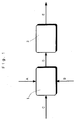
- Fig. 1 shows a schematic diagram showing a method for preparing the non-photosensitive fatty acid silver salt grains of the present invention.
- Symbol 1 is used for a mixing apparatus which is closed and filled with the liquids, and 2 for a heat exchanger.
- "A” is a symbol for a silver ion-containing solution
- "B” for a solution of a fatty acid alkali metal salt
- "C” for water or a mixture of water and an organic solvent, or a reaction mixture containing the non-photosensitive fatty acid silver salt grains obtained after the reaction.
- These liquids are joined within the mixing appratus to prepare the reaction mixture "D" containing fatty acid silver salt grains, which is then fed to a heat exchanger 2 to be cooled.
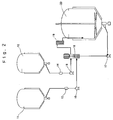
- Fig. 2 shows one embodiment relating the method for preparing the non-photosensitive fatty acid silver salt grains.
- Symbols 11 and 12 in the figure represent tanks for storing under predetermined temperatures the silver ion-containing solution and the solution of the fatty acid alkali metal salt, respectively.
- Symbols 13 and 14 represent flow meters for measuring flow rates of these liquids fed via pumps 15 and 16 to a liquid-filled closed mixing apparatus 18.
- a pump 17 for feeding the obtained dispersion of the fatty acid silver salt grains back to the liquid-filled mixing apparatus 18.
- the liquid after completion of the reaction within the mixing apparatus 18 is introduced into a heat exchanger 19, and is rapidly cooled and introduced into tank 20 for the obtained mixture.
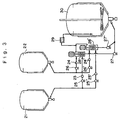
- Fig. 3 shows another embodiment relating the method for preparing the non-photosensitive fatty acid silver salt grains of the present invention.
- Symbols 21 and 22 in the figure represent tanks for storing under predetermined temperatures the silver ion-containing solution and the solution of the fatty acid alkali metal salt, respectively.
- Symbols 23, 23', 24 and 24' represent flow meters for measuring flow rates of these liquids fed via pumps 25, 25', 26 and 26' to liquid-filled closed mixing apparatus 28 and 28'.
- pumps 27 and 27' for feeding the obtained dispersions of the fatty acid silver salt grains back to the mixing apparatus 28 and 28'.
- the method for preparing the non-photosensitive fatty acid silver salt grains of the present invention may use a single closed mixing apparatus or two or more closed mixing apparatus in parallel. In the latter, the solutions can be supplied to each closed mixing apparatus in equal amount.
- Fig. 4 shows one embodiment relating the method for preparing the non-photosensitive fatty acid silver salt grains according to the present invention.
- Symbols 31 and 32 in the figure represent tanks for storing under predetermined temperatures the silver ion-containing solution and the solution of the fatty acid alkali metal salt, respectively.
- Symbols 41 in the figure represent tanks for storing under predetermined temperatures water, or a mixture of water and an organic solvent, which may contain a dispersing agent.
- Symbols 33, 34 and 42 represent flow meters for measuring flow rates of these liquids fed via pumps 35, 36 and 37 to a liquid-filled closed mixing apparatus 38. The liquid after completion of the reaction within the mixing apparatus 38 is introduced into a heat exchanger 39, and is rapidly cooled and introduced into tank 40 for the obtained mixture.
- the silver ion-containing solution and the solution of the fatty acid alkali metal salt can be prepared and stored under predetermined temperature in the tank for storing. Alternatively, the solutions can be introduced into the tank after preparation and stored under predetermined temperature.
- heat exchanger there is no specific limitation on types of the heat exchanger, and beneficial examples thereof include a shell-and-tube heat exchanger, heat pipe exchanger, double-pipe exchanger, coil-in-box cooler, cascade cooler and spiral plate exchanger.
- a flow meter for measuring the silver ion-containing solution is preferably an electromagnetic flow meter or mass flow meter having a measurement error of 1% or below and a time constant of less than one second.
- Preferable pumps include those capable of feed-back control based on the obtained measurement values from the above flow meter (for example, rotary pump, sanitary pump, gear pump, Mono pump, plunger pump and diaphragm pump), or those capable of affording a stable discharge with a quantitative error below 1% (for example, gear pump, Mono pump, plunger pump and diaphragm pump). Those with a pulsation factor of less than 5% are preferable.
- the silver ion-containing solution used in the present invention preferably has a pH value of 1 to 6, and more preferably 1.5 to 4.
- An arbitrary acid or base can be added for further pH adjustment.
- Silver ion concentration of the silver ion-containing solution used in the present invention may arbitrarily be selected, where a preferable range as expressed in molar concentration is from 0.03 to 6.5 mol/L, and more preferably 0.1 to 5 mol/L.
- At least one of the silver ion-containing solution, the alkali metal salt solution of the fatty acid and a solution preliminarily provided in the reaction field must contain an organic solvent in an amount so that the alkali metal salt of the fatty acid can fully be dissolved to give a substantially transparent solution, rather than forming string-like aggregates or micells. While single use of an organic solvent is also allowable, use of a mixed solution with water is more preferable.
- the organic solvent used in the present invention may be of any type so far as having water solubility and above-described properties, whereas those adversely affecting photographic properties are not preferable.
- Preferable examples of such solvent include water-miscible alcohol and acetone, and more preferable examples relate to tertiary alcohol having a carbon number of 4 to 6.
- the fatty acid composing the alkali metal salt of the fatty acid is such that being capable of generating a silver salt which is relatively stable against the light, but can produce silver image when heated at 80°C or higher in the presence of light-exposed photocatalyst (e.g., latent image of photosensitive silver halide) and a reducing agent.
- the fatty acid is preferably a long-chained fatty carboxylic acid specifically having a carbon number of 10 to 30, more preferably 12 to 26.
- the fatty carboxylic acid include cerotic acid, lignoceric acid, behenic acid, erucic acid, arachidinic acid, stearic acid, oleic acid, lauric acid, caproic acid, myristic acid, palmitic acid, maleic acid, fumaric acid, tartaric acid, linolic acid, butyric acid, camphoric acid and mixtures thereof.
- the alkali metal composing the alkali metal salt of the fatty acid used in the present invention is typified as sodium or potassium.
- the alkali metal salt of the fatty acid can be obtained by adding NaOH or KOH to the fatty acid, in which it is preferable to limit an amount of use of the alkali metal less than that of the fatty acid so that a part of the fatty acid will remain unreacted.
- the amount of the remaining fatty acid is 3 to 50 mol% relative to the total fatty acid, and preferably 3 to 30 mol%. It is also allowable in the preparation to add an excessive amount of an alkali and then add acid such as nitric acid or sulfuric acid to neutralize the excessive portion of the alkali.
- the silver-ion containing solution, the solution containing the fatty acid alkali metal salt; or the solution pre-charged in the closed mixing apparatus to which two above solutions will be charged may be added with a dispersing agent such as, for example, a compound expressed by the general formula (1) of JP-A-62-65035, a water-soluble N-heterocyclic compound having a solubility-expressing group as disclosed in JP-A-62-150240, an inorganic peroxide as disclosed in JP-A-50-101019, a sulfur compound as disclosed in JP-A-51-78319, a disulfide compound as disclosed in JP-A-57-643 and hydrogen peroxide.
- a dispersing agent such as, for example, a compound expressed by the general formula (1) of JP-A-62-65035, a water-soluble N-heterocyclic compound having a solubility-expressing group as disclosed in JP-A-62-150240, an inorganic peroxide as disclosed in J
- the solution of the fatty acid alkali metal salt preferably contains the organic solvent in an amount of 3 to 70 vol% of water volume, and preferably 5 to 50 vol%. Since an optimum solvent volume can vary depending on the reaction temperature, it is preferable to determine the optimum volume in a trial-and-error manner.
- Concentration of the fatty acid alkali metal salt used in the present invention is preferably 5 to 50 wt%, more preferably 7 to 45 wt%, and still more preferably 10 to 40 wt%.
- a desired fatty acid silver salt can be prepared by simultaneously adding the silver ion-containing solution and the solution of fatty acid alkali metal salt to the closed mixing means.
- the silver ion-containing solution in precedence is more preferable.
- Temperature of the silver-ion containing solution or the solution of the fatty acid alkali metal salt may appropriately be selected in order to obtain desired grains.
- the temperature of the silver-ion containing solution is preferably selected to 5 to 60°C, and more preferably 5 to 40°C, for the purpose of ensuring stability of the liquid.
- the temperature of the solution of the fatty acid alkali metal salt is preferably 50 to 90°C, and more preferably 60 to 85°C, for the purpose of keeping a certain temperature required for avoiding crystallization or solidification of the alkali soap.
- Tanks for storing these solutions are preferably equipped with means for maintaining such a temperature.
- the apparatus used for producing the silver salt there is no particular limitation on the apparatus used for producing the silver salt.
- the closed mixing apparatus used in the present invention a variety of available models include those of bulk stirring type using anchor wing or paddle wing; emulsifying dispersion type such as dissolver and homogenizer; static mixing apparatus such as static mixer and sluzer mixer; and those based on combination of two these types.
- the solvent preliminarily charged in the reaction vessel is typically water, where also available is a mixed solution of water and an organic solvent same as that used in the silver ion-containing solution or the solution of fatty acid alkali metal salt.
- Typical materials meeting these requirements include stainless steels (e.g., SUS304 and SUS316); titanium or titanium alloys; metal materials covered , for example, with glass lining, ceramic or fluorocarbon resin; composite resins reinforced with glass fiber or Kevlar; and engineering plastics such as polyacetal and modified polyphenylene oxide.
- Order of the addition of the silver ion-containing solution (liquid “A”) and the solution of a fatty acid alkali metal salt (liquid “B”) may be any one of such that adding both liquids "A” and “B” in the same closed mixing apparatus; such that adding either one of which in the upper stream side of the closed mixing apparatus and adding the other in the closed mixing apparatus; and such that adding both liquids "A” and "B” in the upper stream side of the closed mixing apparatus.
- liquids "A” and "B” it is also allowable to add a third liquid in the same closed mixing apparatus; where the third liquid being water, a mixture of water and an organic solvent used in the silver ion-containing solution and the solution of a fatty acid alkali metal salt, or a reaction liquid in which the non-photosensitive fatty acid silver salt grains are already produced. It is further allowable to add any two liquids from the liquids "A”, “B” and “C” in the upper stream side of the closed mixing apparatus in an arbitrary order and to add the remaining liquid in the closed mixing apparatus; or to add three all liquids in the upper stream side of the closed mixing apparatus.
- the closed mixing apparatus can be composed of a plurality of units connected in series, and the individual unit can contain one or two liquids (for example, a first unit contains the liquid “A” and a second unit in the next stage contains the liquid “B"; or both of the first and second units contain both liquids "A” and “B”; or the first unit contains the liquid “A” and the second unit contains the liquids "A” and "B”).
- duration of the addition of the silver ion-containing solution and the solution of the fatty acid alkali metal salt is arbitrarily selected, and the addition can be effected at a constant rate, or in a accelerated or decelerated mode according to an arbitrary time function.
- Possible methods for rapidly cooling temperature of the liquid obtained after the reaction between the silver ion-containing solution and the solution of the fatty acid alkali metal salt include such that previously cooling liquids to be fed to the mixing apparatus, such liquids being any one of the silver ion-containing solution, water, a mixture of water and an organic solvent, or the reaction liquid containing the fatty acid silver salt grains; such that cooling the mixing apparatus per se; and such that providing a heat exchanger between the mixing apparatus and the tanks.
- the liquid temperature obtained after the reaction between the silver ion-containing solution and the solution of fatty acid alkali metal salt is preferably 5 to 70°C, more preferably 10 to 50°C, and still more preferably 20 to 45°C.
- the cooling rate is preferably such that ensuring a desired temperature within 0.05 to 10 seconds, more preferably 0.05 to 5 seconds, and still more preferably 0.05 to 1 seconds after both liquids are joined.
- Fatty acid alkali metal salt particles thus prepared is introduced into the tank for storing the obtained mixture.
- the mixture is preferably mixed with stirring to homogenate the mixture in the tank.
- the mixing means in the tank a variety of available models include those of bulk stirring type using anchor wing or paddle wing; emulsifying dispersion type such as dissolver and homogenizer; static mixing apparatus such as static mixer and sluzer mixer; and those based on combination of two these types.
- Sphere-equivalent diameter of the fatty acid silver salt grains prepared in the present invention is preferably 0.1 to 0.8 ⁇ m, and more preferably 0.1 to 0.6 ⁇ m.
- Long edge/short edge ratio of the grain is preferably 1 to 4, more preferably 1 to 3, and still more preferably 1 to 2.
- Aspect ratio of the grain [grain size (circle-equivalent diameter) of the major plane/grain thickness] is preferably 2 to 30, and more preferably 2 to 15.
- Grain thickness is preferably 0.01 to 0.20 ⁇ m, and more preferably 0.01 to 0.15 ⁇ m.
- the grains satisfying the above requirements preferably account for 30 to 100% of the projected area of the total grains, more preferably 50 to 100%, and still more preferably 70 to 100%.
- Particle size distribution of the organic silver salt is preferably of monodisperse as possible.
- Coefficient of variation of the grain size of the fatty acid silver salt grain is preferably 20% or below, more preferably 18% or below, and still more preferably 15% or below, where the coefficient of variation is defined as a value obtained by dividing a standard deviation of a grain diameter by the grain diameter and then multiplied by 100.
- An exemplary procedure for the measurement include irradiating laser light to the fatty acid silver salt dispersed in a solution; deriving an autocorrelation function with respect to the time-dependent fluctuation in the scattered light intensity; and thereby obtaining grain size (volume weighted mean diameter), which is known as the dynamic light scattering method.
- a water-soluble dispersing agent can be added to the silver ion-containing solution, the solution of the fatty acid alkali metal salt or the reaction liquid in the present invention.
- the dispersing agent can be contained in the reaction liquid in the process of producing the fatty acid silver salt grains; in a separately prepared solution; or in the finished liquid after the fatty acid silver salt grains are produced.
- the dispersing agent can be of any type so far as it can disperse the generated fatty acid silver salt grains, and specific examples thereof can be referred to those used for the fatty acid silver salt described later.
- the fatty acid silver salt grains available in the present invention will have a form of solid microgram dispersion assisted by the dispersing agent so as to achieve a small grain size and an agglomeration-free nature.
- Such status can be judged by comparing TEM (transmission electron microscope) photographs of the grains taken before water washing and after the dispersion.
- the grains produced according to the method of the present invention are preferably such that the projected area of which being not altered by 30% or more, more preferably 20% or more, and still more preferably 10% or more, when the average grain sizes before the water washing and after the dispersion are compared.
- the dispersion is preferably effected by converting a water-base dispersion of the fatty acid silver salt into a high-pressure and high-speed flow, which is followed by an abrupt pressure drop.
- the dispersion contains substantially no photosensitive silver salt during the dispersion, since presence of the photosensitive silver salt during the dispersion may increase fog and significantly lower the sensitivity.
- a content of the photosensitive silver salt in the water-base dispersion to be dispersed is 0.1 mol% or less relative to 1 mol of the organic acid silver salt contained therein, without any intentional addition of the photosensitive silver salt.
- Dispersion apparatus and technologies available for implementing the above dispersion in the present invention are detailed, for example, in "Bunsankei Reoroji to Bunsanka Gijutsu (Dispersed System Rheology and Dispersion Technology)", by Toshio Kajiuchi and Hiroki Usui, 1991, issued by Sinzansha Shuppan, p.357-403; "Kagaku Kogaku no Sinpo (Advances in Chemical Engineering) Vol . 24", ed. Tokai Section, The Society of Chemical Engineers, 1990, issued by Maki Shoten, p.184-185.
- a dispersion method employed in the present invention is such that feeding the water-base dispersion containing at least fatty acid silver salt into a piping while being pressurized with a high-pressure pump or the like, allowing the dispersion to pass through a narrow slit, and then causing an abrupt pressure drop to the dispersion thereby completing a fine dispersion.
- an uniform and effective dispersion is generally considered to be effected by dispersion forces such as (a) "shearing force” generated when dispersoid passes through a narrow gap under a high pressure and at a high speed, and (b) "cavitation force” generated when the dispersoid is released from the high pressure state to the normal pressure state.
- Galling homogenizer has long been known as such kind of dispersion apparatus, in which a pressure-fed solution to be dispersed is converted into a high-speed flow at a narrow gap on a cylinder surface, then rushed to be collided with the peripheral wall, thereby allowing emulsification or dispersion assisted by the impact force.
- Operating pressure is, in general, selected in a range from 100 to 600 kg/cm 2 , and flow rate in a range several to 30 m/second.
- Recent new developments for enabling the dispersion at a still higher pressure range typically include Microfluidizer (product of Microfluidex International Corporation), and Nanomizer (product of Tokushu Kika Kogyo Co., Ltd.).
- the flow rate is preferably from 200 to 600 m/sec, more preferably from 300 to 600 m/sec
- the pressure difference at the pressure drop is preferably from 900 to 3000 kg/cm 2 , and more preferably from 1500 to 3000 kg/cm 2 .
- the number of repetition of the process is selectable as required. While this is generally selected as once to as much as 10 times, once to as much as 3 times is preferred from the viewpoint of productivity.
- Raising the temperature of such water-base dispersion under high pressure is undesirable from the viewpoint of dispersibility and photographic properties, that is, raising the temperature above 90°C tends to result in increased grain size and increased fogging. It is thus preferable in the present invention to provide a cooling step before the conversion into the high-pressure, high-speed flow and/or after the pressure drop, to maintain the temperature of the water-base dispersion within a range from 5 to 90°C, more preferably from 5 to 80°C, and still more preferably 5 to 65°C. Providing such cooling step is particularly effective when the dispersion is proceeded under the pressure as high as 1500 to 3000 kg/cm 2 .
- a cooler is properly selected, depending on the required capacity of heat exchange, from those being equipped with a double pipe or triple pipe as combined with a static mixer; shell-and-tube heat exchanger; and coiled heat exchanger.
- the diameter, wall thickness and material of the pipe are properly be selected, considering the operating pressure, so as to improve the efficiency of the heat exchange.
- Coolants available for the cooler is selectable, depending on the required amount of heat exchange, from well water at 20°C; cold water at 5 to 10°C fed from a chiller; and, as requested, ethylene glycol/water at -30°C.
- the dispersing agent can be properly selected from, for example, synthetic anionic polymers such as polyacrylic acid, copolymers of acrylic acid, maleic acid copolymers, maleic acid monoester copolymers and acryloylmethylpropanesulfonic acid copolymers; semisynthetic anionic polymers such as carboxymethylated starch and carboxymethylcellulose; anionic polymers such as alginic acid and pectic acid; anionic surfactants such as disclosed in JP-A-52-92716 and WO 88/04794; compounds disclosed in JP-A-9-179243; known anionic, nonionic and cationic surfactants; other known polymers such as polyvinyl alcohol, polyvinylpyrrolidone, carboxymethyl cellulose, hydroxypropyl cellulose, and hydroxypropylmethyl cellulose; naturally occurring polymers such as gelatin and the like.
- synthetic anionic polymers such as polyacrylic acid, copolymers of acrylic acid, maleic acid copolymers, male
- a concentration of the dispersing agent is preferably 1 to 30 wt% of the fatty acid silver salt, and more preferably 3 to 20 wt%.
- the produced dispersion can be stored under stirring in order to prevent precipitation of the micrograms during storage, or stored in a highly viscous state by producing hydrophilic colloid (e.g., jelly state formed with gelatin). Further, it may be added with a preservative in order to prevent germ proliferation during the storage.
- hydrophilic colloid e.g., jelly state formed with gelatin
- the fatty acid silver salt dispersion obtained by the present invention comprises at least a fatty acid silver salt and water. While there is no specific limitation on the ratio of the fatty acid silver salt and water, it is important to select the ratio so as to ensure an efficient film formation, considering rheological characteristics required for the stable coating, and the production speed depending on the dry moisture content.
- the fatty acid silver salt preferably accounts for 10 to 50 wt% of the total dispersion, and more preferably 10 to 30 wt%.
- a metal ion selected from the group consisting of Ca, Mg, Ce, Al, Zn and Ba in a form of a water-soluble salt other than halide. More specifically, the addition in a form of a nitrate or sulfate is preferable.
- the metal ion selected from the group consisting of Ca, Mg, Ce, Al, Zn and Ba can be added at any time provided that it is immediately before the coating. That is, it may be added to the solution used for preparing the fatty acid silver salt or may preliminarily added in the reaction liquid; may be added during or immediately after the production of the fatty acid silver salt; or may be added before or after the preparation of the coating liquid.
- An amount addition of the metal is preferably 10 -3 to 10 -1 mol per mol of the fatty acid silver salt, and more preferably 5 ⁇ 10 -3 to 5 ⁇ 10 -2 mol.
- a preferable apparatus relates to such that having a first feed means for feeding a silver ion-containing solution, the solvent of which being water or a mixture of water and an organic solvent, to a closed mixing means described later; a second feed means for feeding a solution of a fatty acid alkali metal salt, solvent of which being water, an organic solvent, or a mixture of water and an organic solvent, to the closed mixing means; a third feed means for feeding water, or a mixture of water and an organic solvent to the closed mixing means; and the closed mixing means for mixing matters fed from the first feed means, the second feed means and the third feed means, and discharging a liquid containing non-photosensitive fatty acid silver salt grains.
- the apparatus is additionally provided with a cooling means for cooling the liquid containing non-photosensitive fatty acid silver salt grains discharged from the closed mixing means (Fig. 4).
- Another preferable apparatus for implementing the preparation method of the present invention relates to such that having a first feed means for feeding a silver ion-containing solution, the solvent of which being water or a mixture of water and an organic solvent, to a closed mixing means described later; a second feed means for feeding a solution of a fatty acid alkali metal salt, solvent of which being water, an organic solvent, or a mixture of water and an organic solvent, to the closed mixing means; the closed mixing means for mixing matters fed from the first feed means, the second feed means and a third feed means described next, and discharging a liquid containing non-photosensitive fatty acid silver salt grains; and the third feed means for feeding at least a part of the liquid containing non-photosensitive fatty acid silver salt grains discharged from the closed mixing means back to said closed mixing means.
- the apparatus is additionally provided with a cooling means for cooling the liquid containing non-photosensitive fatty acid silver salt grains discharged from the closed mixing means (Fig. 2).
- a dispersion of the non-photosensitive fatty acid silver salt grains having a desired concentration can be prepared in the tank 20 by properly regulating the volume of the solution containing non-photosensitive fatty acid silver salt grains fed from the third feed means to the closed mixing apparatus.
- the concentration of the dispersion of the non-photosensitive fatty acid silver salt grains in the tank 20 becomes higher as the number of repetition of the circulation with the aid of the third feed means increases, so that a proper selection of the circulation conditions can afford a dispersion having a desired concentration.
- the concentration can be regulated, not only by adjusting such circulation conditions, but also by adjusting conditions for withdrawing the prepared dispersion. Thus a desired dispersion can efficiently be obtained by properly selecting the above conditions while sustaining the continuous operation.
- the tank (symbol 20 in Fig. 2, and symbol 40 in Fig. 4) accepting the produced dispersion of the fatty acid silver salt grains may further be provided with a mixing means such as a stirrer for homogenizing the content, a heat exchange means such as a jacket vessel, a liquid temperature measuring means, a level sensor for controlling the liquid volume, and an optional means for measuring physical properties such as pH, electric conductivity and viscosity.
- a mixing means such as a stirrer for homogenizing the content
- a heat exchange means such as a jacket vessel
- a liquid temperature measuring means such as a level sensor for controlling the liquid volume
- an optional means for measuring physical properties such as pH, electric conductivity and viscosity.
- thermally processed image forming material composable with the non-photosensitive fatty acid silver salt prepared according to the method of the present invention will further be detailed.
- the thermally processed image forming material preferably contains, as dispersed within a binder matrix, the above fatty acid silver salt as a reducible silver salt, and a reducing agent for reducing silver ions.
- a catalytic amount of a photocatalyst (preferably a photosensitive silver halide) is optionally used to provide photosensitivity.
- a toning agent for controlling color tone of silver image may be used as requested.
- fatty acid silver salt can be used in a desired amount, a preferable range thereof is from 0.1 to 5 g/m 2 , and more preferably 1 to 3 g/m 2 .
- the reducing agent is an arbitrary substance capable of reducing silver ion into metal silver, and is preferably an organic substance. Specific examples of the reducing agent are disclosed in the paragraphs [0043] to [0045] of JP-A-11-65021, and line 34 on page 7 to line 12 on page 18 of European Laid-Open Patent Publication No. 0803764A1.
- An amount of addition of the reducing agent in the present invention is preferably 0.01 to 5.0 g/m 2 , and more preferably 0.1 to 3.0 g/m 2 , and in other words, it is preferably contained elsewhere on the image producing layer side in an amount of 5 to 50 mol% per mole of silver, and more preferably 10 to 40 mol%.
- the reducing agent is preferably contained in the image recording layer.
- composition of the photosensitive silver halide available for the present invention, and examples of which include silver chloride, silver chlorobromide, silver bromide, silver iodobromide and silver iodochlorobromide.
- the halogen composition distribution within the silver halide grains may be uniform, or may change stepwise or continuously.
- Silver halide grains with a core/shell structure may also be used preferably.
- An amount of addition of the photosensitive silver halide as expressed in an amount of silver per 1 m 2 of photosensitive material is preferably 0.03 to 0.6 g/m 2 , more preferably 0.05 to 0.4 g/m 2 , and still more preferably 0.1 to 0.4 g/m 2 .
- the binder used in the layer containing the fatty acid silver salt of the present invention may be an arbitrary polymer, and is transparent or semi-transparent, colorless in general, and can be made of natural polymer, synthetic resin, polymer and copolymer and other film-forming media.
- Examples thereof include gelatin, gum arabic, poly(vinyl alcohol), hydroxyethylcellulose, cellulose acetate, cellulose acetate butylate, poly(vinylpyrrolidone), casein, starch, poly(acrylic acid), poly(methyl methacrylate), poly(vinyl chloride), poly(methacrylic acid), copoly(styrene-maleic anhydride), copoly(styrene-acrylonitrile), copoly(styrene-butadiene), polyvinyl acetals [such as poly(vinylformal) and poly(vinylbutyral)], polyesters, polyurethanes, phenoxy resin, poly(vinylidene chloride), polyepoxides, polycarbonates, poly(vinyl acetate), cellulose esters and polyamides.
- the binder may also be formed by coating from water, organic solvent or emulsion.
- An amount of the total binder of the image recording layer is preferably 0.2 to 30 g/m 2 , and more preferably 1 to 15 g/m 2 .
- JP-A-10-62899 JP-A-10-268465, JP-A-11-52509, JP-A-11-352625 to 352627, JP-A-11-349591, JP-A-12-7683, JP-A-12-72711, European Laid Open Patent Publication Nos. 0803764A1 and 0962812A1.
- the obtained PET was pelletized, dried at 130°C for 4 hours, melted at 300°C, extruded from a T-die and rapidly cooled, to obtain a unstretched film so as to have a thickness after heat setting of 175 ⁇ m.
- the film was then longitudinally stretched 3.3 times at 110°C using rollers different in the peripheral speed and then transversely stretched 4.5 times at 130°C using a tenter. Subsequently, the film was heat-set at 240°C for 20 seconds, and then relaxed by 4% in the transverse direction at the same temperature. Thereafter, a portion chucked by the tenter was slit off and the film was knurled at the both edges and then taken up. Thus, a rolled support of 175 ⁇ m thick was fabricated.
- the undercoating liquid "A” was coated using a bar coater with a wet coated amount of 5 ml/m 2 and was allowed to dry at 180°C for 5 minutes.
- the film thickness after the drying was approx. 0.3 ⁇ m.
- the undercoating liquid "B” was coated using a bar coater with a wet coated amount of 5 ml/m 2 and then dried at 180°C for 5 minutes to achieve a dry film thickness of 0.3 ⁇ m, and further thereon the undercoating liquid "C” was coated using a bar coater with a wet coated amount of 3 ml/m 2 and then dried at 180°C for 5 minutes to achieve a dry film thickness of 0.03 ⁇ m.
- a bar coater with a wet coated amount of 3 ml/m 2 was coated using a bar coater with a wet coated amount of 3 ml/m 2 and then dried at 180°C for 5 minutes to achieve a dry film thickness of 0.03 ⁇ m.
- a reaction vessel containing 6,350 ml of distilled water and 300 ml of tert-butanol was kept at 30°C, and an entire volume of the aqueous silver nitrate solution was added at a constant flow rate over 60 minutes, and 7 minutes after, an entire volume of the sodium behenate solution was added at a constant flow rate over 62 minutes (the last 9-minute period was dedicated to the single addition of the sodium behenate solution).
- the mixture was allowed to stand for 20 minutes under stirring, and then cooled to 25°C.
- the solid content was separated by suction filtration, and then washed with water until electric conductivity of the filtered water decreased as low as 30 ⁇ S/cm.
- the obtained solid content was stored in a form of a wet cake without drying.
- the preliminarily dispersed solution was dispersed once using a dispersion apparatus (Micro Fluidizer M-110S-EH, manufactured by Micro Fluidex International Corporation, equipped with G10Z interaction chamber manufactured by Mizuho Kogyo K.K.) under a pressure of 1,600 kg/cm 2 , to obtain the dispersion "A" of the fatty acid silver salt grains.
- a dispersion apparatus Micro Fluidizer M-110S-EH, manufactured by Micro Fluidex International Corporation, equipped with G10Z interaction chamber manufactured by Mizuho Kogyo K.K.
- the temperature control was effected so as to regulate an inlet temperature at 5°C, and outlet temperature at 30°C.
- Dispersion "B” was prepared using a small-sized crystallization equipment as shown in Fig. 4. While stirring in a tank 32 a mixture of 876 g of behenic acid (Edenor C22-85R, product of Henkel Corporation), 4,230 ml of distilled water and 1,200 ml of tert-butanol at 75°C, added thereto was 492 ml of a 5N aqueous NaOH solution over 5 minutes, and was then allowed to react for 60 minutes to obtain sodium behenate solution. Independently, 2,062 ml of aqueous solution containing 404 g of silver nitrate (pH 4.0) was prepared and kept in a tank 31 at 10°C.
- An average temperature of the content of the tank 40 was 35°C, when a cooling water of 10°C was supplied to a jacket of the tank 40 at 20 L/minute while ceasing supply of cooling water to the heat exchanger 39.
- the mixture was allowed to stand for 20 minutes under stirring, and then cooled to 25°C.
- the solid content was separated by suction filtration, and then washed with water until electric conductivity of the filtered water decreased as low as 30 ⁇ S/cm.
- the obtained solid content was stored in a form of a wet cake without drying.
- Dispersion "C” was prepared using the small-sized crystallization equipment as shown in Fig. 4. While stirring in the tank 32 a mixture of 876 g of behenic acid (Edenor C22-85R, product of Henkel Corporation), 4,230 ml of distilled water and 1,200 ml of tert-butanol at 75°C, added thereto was 492 ml of a 5N aqueous NaOH solution over 5 minutes, and was then allowed to react for 60 minutes to obtain sodium behenate solution.
- behenic acid Edenor C22-85R, product of Henkel Corporation
- the mixture was allowed to stand for 20 minutes under stirring, and then cooled to 25°C.
- the solid content was separated by suction filtration, and then washed with water until electric conductivity of the filtered water decreased as low as 30 ⁇ S/cm.
- the obtained solid content was stored in a form of a wet cake without drying.
- Dispersion “D” was prepared similarly to the dispersion “C” except that 6,000 ml of a 4 vol% aqueous tert-butanol solution was stored in a tank 41 and fed at a constant flow rate of 98 ml/minute.
- Dispersion “E” was prepared similarly to the dispersion “C” except that 6,000 ml of a 1 wt% aqueous polyvinyl alcohol (PVA-205, product of Kuraray Co., Ltd.) solution was stored in a tank 41 and fed at a constant flow rate of 98 ml/minute.
- PVA-205 polyvinyl alcohol
- Dispersion "F” was prepared using the small-sized crystallization equipment as shown in Fig. 2. While stirring in the tank 12 a mixture of 876 g of behenic acid (Edenor C22-85R, product of Henkel Corporation), 4,230 ml of distilled water and 1,200 ml of tert-butanol at 75°C, added thereto was 492 ml of a 5N aqueous NaOH solution over 5 minutes, and was then allowed to react for 60 minutes to obtain sodium behenate solution. Independently, 2,062 ml of aqueous solution containing 404 g of silver nitrate (pH 4.0) was prepared and kept in a tank 11 at 10°C.
- the tank 20 was pre-charged with 6,000 ml of pure water, which was circulated at a flow rate of 1,000 ml/minute via the pump 17. While rotating a mixing blade of a closed mixing apparatus 18 (Pipeline Mixer Model LR-I, product of Mizuho Kogyo K.K.) at 10,000 rpm, the above aqueous silver nitrate solution was fed at a constant flow rate of 29 ml/minute, and 5 seconds after, the sodium behenate solution was fed at a constant flow rate of 98 ml/minute, which were then sent via an heat exchanger 19 to a tank 20 and stocked.
- a closed mixing apparatus 18 Personal Organic Mixer Model LR-I, product of Mizuho Kogyo K.K.
- An average temperature of the content of the tank 20 was 30°C, when a cooling water of 10°C was supplied both to a jacket of the tank 20 and the heat exchanger 19 at 20 L/minute. The mixture was allowed to stand for 20 minutes under stirring, and then cooled to 25°C. The solid content was separated by suction filtration, and then washed with water until electric conductivity of the filtered water decreased as low as 30 ⁇ S/cm. The obtained solid content was stored in a form of a wet cake without drying.
- Dispersion "G” was prepared similarly to the dispersion “B” except that a cooling water of 5°C was fed to the heat exchanger 39, thereby to attain an average temperature of the content of the tank 40 of 30°C.
- Dispersion "H” was prepared similarly to the dispersion “F” except that a cooling water of 5°C was fed to the heat exchanger 19, thereby to attain an average temperature of the content of the tank 20 of 25°C.
- the slurry was then transferred to a vessel of a dispersion apparatus (1/4 G Sand Grinder Mill, product of Aimex, Ltd.) together with 800 g of zirconia bead with an average diameter of 0.5 mm and dispersed for 5 hours, thereby to obtain the dispersion of the organic polyhalogen compound.
- Organic polyhalogen compound grains contained in thus obtained dispersion were found to have an average grain size of 0.74 ⁇ m.
- Solution "b1" obtained by dissolving 32.6 g of potassium bromide in water and diluting it up to 200 ml was also added by the controlled double jet method. After that, 30 ml of a 3.5 wt% aqueous hydrogen peroxide solution was added, and 336 ml of a 3 wt% aqueous solution of benzimidazole was further added.
- Solution “a1” was further diluted with distilled water to 317.5 ml to obtain solution “a2”, and solution “b1” was further added with dipotassium hexachloroiridate so as to attain a final concentration thereof of 1 ⁇ 10 -4 mol per mol of silver and diluted with distilled water up to 400 ml, which is a doubled volume of "b1", thereby to obtain solution "b2".
- an entire volume of solution "a2” was added to the mixture by the controlled double jet method at a constant flow rate over 10 minutes while keeping pAg at 8.1.
- Solution “b2” was also added by the controlled double jet method.
- the mixture was added with 50 ml of a 0.5% methanol solution of 2-mercapto-5-methylbenzimidazole, the pAg of which was raised to 7.5 with silver nitrate, the pH of which was then adjusted to 3.8 with an 1N sulfuric acid, stopped stirring, subjected to precipitation/desalting/washing processes, added with 3.5 g of deionized gelatin, the pH and pAg thereof were adjusted to 6.0 and 8.2, respectively, with an 1N sodium hydroxide, thereby to obtain the silver halide emulsion.
- Grains in the resultant silver halide emulsion were found to be pure silver bromide grains with an average sphere-equivalent diameter of 0.031 ⁇ m and a sphere-equivalent coefficient of variation of 11%. Grain size and so forth were determined based on an average diameter of 1,000 grains under electron microscopic observation. Ratio of [100] plane of such grains was determined as 85% based on the method of Kubelka-Munk.
- the above emulsion was then heated to 50°C under stirring, added with 5 ml of a 0.5 wt% methanol solution of N,N'-dihydroxy-N'', N''-diethylmelamine and 5 ml of a 3.5 wt% methanol solution of phenoxyethanol, and one minute after, sodium benzenethiosulfonate was added in an amount of 3 ⁇ 10 -5 mol per mol of silver.
- Spectral Sensitization Dye 1 aqueous gelatin solution
- Tellurium Compound was added in an amount of 5 ⁇ 10 -5 mol per mol of silver, which was followed by ripening for 50 minutes.
- 2-mercapto-5-methylbenzimidazole was added in an amount of 1 ⁇ 10 -3 mol per mol of silver, then the temperature of which was lowered to complete the chemical ripening, thereby to obtain the silver halide emulsion 1.
- silver iodobromide grain (cubic grain having an 8 wt% iodine-containing core, an average iodine content of 2 wt%, an average grain size of 0.05 ⁇ m, a coefficient of variation of the projected area of 8% and an (100) plane ratio of 88%).
- silver halide grain was heated to 60°C, added with 85 ⁇ mol/mol Ag of sodium thiosulfonate, 1.1 ⁇ 10 -5 mol of 2, 3, 4, 5, 6-pentafluorophenyldiphenylphosphine selenide, 1.5 ⁇ 10 -5 mol of Tellurium Compound, 3.5 ⁇ 10 -8 mol of chloroauric acid and 2.7 ⁇ 10 -4 mol of thiocyanic acid, ripened for 120 minutes, rapidly cooled to 40°C, added with 1 ⁇ 10 -4 mol of Spectral Sensitization Dye 1 and 5 ⁇ 10 -4 mol of 2-mercapto-5-methylbenzimidazole, and rapidly cooled to 30°C, thereby to obtain a silver halide emulsion 2.
- Viscosity of the coating liquid for the emulsion layer was measured using a B-type viscometer (manufactured by Tokyo Keiki K.K.) at 40°C, and was found to be 85 mPa ⁇ s.
- Viscosities of the coating liquid measured under shearing velocities of 0.1, 1, 10, 100 and 1000 (1/second) at 25°C using RFS Fluid Spectrometer were 1500, 220, 70, 40 and 20 mPa ⁇ s, respectively.
- the above SBR latex purified by ultrafiltration was obtained by diluting ten times the SBR latex [-St(68)-Bu(29)-AA(3)-, numerals are for polymerization ratio] with distilled water, and by purifying the diluted product by filtration using an UF-purification module FS03-FC-FUY03A1 (product of Daicen Membrane-Systems Ltd.) until the ion conductivity of the filtered water dropped to 1.5 mS/cm.
- the resultant latex concentration was found to be 40 wt%.
- the latex solution thus obtained was found to have an average particle size of 0.1 ⁇ m at 45% concentration, an electric conductivity of 4.2 mS/cm, and pH of 8.2.
- a coating liquid for the intermediate layer was prepared by mixing 772 g of a 10 wt% aqueous solution of polyvinyl alcohol PVA-205 (product of Kuraray Co., Ltd.), 226 g of a 27.5 wt% solution of methyl methacrylate / styrene/2-ethylhexylacrylate /hydroxyethyl methacrylate/acrylic acid copolymer latex (copolymerization ratio by weight of 59/9/26/5/1), 2 ml of a 5 wt% aqueous solution of Aerosol OT (American Cyanamide Corporation), 4 g of benzyl alcohol, 1 g of 2,2,4-trimethyl-1,3-pentanediol monoisobutylate and 10 mg of benzoisothiazolinone, which was then fed to a coating die so as to attain a coating amount of 5 ml/m 2 .
- PVA-205 product of Kuraray Co., Ltd
- Viscosity of the coating liquid measured at 40°C using a B-type viscometer was found to be 21 mPa ⁇ s.
- inert gelatin Eighty grams of inert gelatin was dissolved in water, and added thereto were 138 ml of a 10 wt% methanol solution of phthalic acid, 28 ml of an 1N sulfuric acid, 5 ml of a 5 wt% aqueous solution of Aerosol OT (American Cyanamide Corporation) and 1 g of phenoxyethanol, and was further added with water to adjust a total weight to 1,000 g, thereby to obtain a coating liquid, which was then fed to a coating die so as to attain a coating amount of 10 ml/m 2 .
- Viscosity of the coating liquid measured at 40°C using a B-type viscometer was found to be 17 mPa ⁇ s.
- Aerosol OT American Cyanamide Corporation
- the mixture was added with 445 ml of an aqueous solution containing 4 wt% chrome alum and 0.67% of phthalic acid using a static mixer immediately before the coating, and was then fed to a coating die so as to attain a coating amount of 10 ml/m 2 .
- Viscosity of the coating liquid measured at 40°C using a B-type viscometer was found to be 9 mPa ⁇ S.
- Basic Precursor Compound Sixty-four grams of Basic Precursor Compound, 10 g of surfactant DEMOL-N (product of KAO Corporation), and 246 ml of distilled water were mixed, and the mixture was bead-dispersed using a sand mill (1/4-gallon Sand Grinder Mill manufactured by AIMEX Corporation) to obtain a solid microgram dispersion of the Basic Precursor Compound with an average particle size of 0.2 ⁇ m.
- sand mill (1/4-gallon Sand Grinder Mill manufactured by AIMEX Corporation
- the coating liquid for the antihalation layer and the coating liquid for the back side protective layer were simultaneously coated in a stacked manner, so as to attain a coated amount of solid content of 0.04 g/m 2 for the former, and a coated amount of gelatin of 1 g/m 2 for the latter, respectively.
- the coated films were then dried to obtain a back layer for preventing halation.
- an emulsion layer, an intermediate layer, a first protective layer and a second protective layer were formed in this order by the simultaneous multi-layer coating based on the slide hopper coating method, thereby to obtain samples of the photothermographic materials.
- the coating was effected at a speed of 100 m/min while keeping a gap between the tip of the coating die and the support at 0.18 mm, and keeping a pressure in a reduced pressure chamber lower by 392 Pa than the atmospheric pressure.
- the coated liquid was cooled by flowing air with a dry-bulb temperature of 18 °C and a wet-bulb temperature of 12°C at an average wind velocity of 7 m/sec for 30 seconds, and then further dried in a helical floating drying zone by blowing wind with a dry-bulb temperature of 30 °C and a wet-bulb temperature of 18°C at a blow-out wind velocity from the slit of 20 m/sec for 200 seconds.
- the photothermographic materials "A” to "H” were cut into 30.5 cm ⁇ 25.4 cm pieces, four corners of which were cut off by 0.5 cm, and were allowed to stand for a day under a condition of 25°C/50% RH.
- the pieces were then enclosed in two bags made of a moisture-proof material by tens, and the bags were then allowed to stand in an oven at 50°C and in a refrigerator at 4°C, respectively.
- Individual photosensitive materials were then exposed and heat-developed in a similar manner as in the evaluation of the photographic property, where a density at a non-exposed area (Dmin) was assumed to represent fog value.
- the dispersions "B” to “H” prepared according to the present invention were found to have in general smaller average grain sizes. While not adhering to any kind of theory, this may be because air bubbles cannot be entrained in the liquid and thus allowed was a low-temperature charging. Other excellent effects such as improved photographic activity and sensitivity were also obtained in the present invention since the atmosphere in which the reaction liquids were placed was strictly controlled. This successfully reduces a coating amount of the organic acid silver salt and allows a silver-saving formulation and designing.
- the third component other than silver nitrate and sodium behenate was varied. Adding such third component at low temperatures successfully reduced the average grain size and could further improve the rise in the filtration pressure and rate of increase in fog.
- the present invention can provide the dispersion of the fatty acid silver salt grains excellent in dispersion stability and coating property.
- the photothermographic material composed therewith is excellent in fog-preventive property even after the storage, and also excellent in image stability and light transmissivity after the heat development.
Landscapes
- Chemical & Material Sciences (AREA)
- Organic Chemistry (AREA)
- Engineering & Computer Science (AREA)
- Chemical Kinetics & Catalysis (AREA)
- Oil, Petroleum & Natural Gas (AREA)
- Materials Engineering (AREA)
- Physics & Mathematics (AREA)
- General Physics & Mathematics (AREA)
- Non-Silver Salt Photosensitive Materials And Non-Silver Salt Photography (AREA)
- Organic Low-Molecular-Weight Compounds And Preparation Thereof (AREA)
- Colloid Chemistry (AREA)
Applications Claiming Priority (2)
| Application Number | Priority Date | Filing Date | Title |
|---|---|---|---|
| JP20208199 | 1999-07-15 | ||
| JP20208199 | 1999-07-15 |
Publications (2)
| Publication Number | Publication Date |
|---|---|
| EP1069468A1 true EP1069468A1 (de) | 2001-01-17 |
| EP1069468B1 EP1069468B1 (de) | 2006-11-22 |
Family
ID=16451656
Family Applications (1)
| Application Number | Title | Priority Date | Filing Date |
|---|---|---|---|
| EP00115242A Expired - Lifetime EP1069468B1 (de) | 1999-07-15 | 2000-07-13 | Ein Verfahren zur Herstellung lichtunempfindlicher Silberfettsäuresalzkörner und ein Apparat dafür |
Country Status (4)
| Country | Link |
|---|---|
| US (2) | US6472546B1 (de) |
| EP (1) | EP1069468B1 (de) |
| AT (1) | ATE346325T1 (de) |
| DE (1) | DE60031917T2 (de) |
Cited By (4)
| Publication number | Priority date | Publication date | Assignee | Title |
|---|---|---|---|---|
| EP1168068A3 (de) * | 2000-06-29 | 2002-12-18 | Fuji Photo Film Co., Ltd. | Verfahren und Vorrichtung zur Herstellung von Körnern eines Silbersalzes einer organischen Säure und Verfahren zur Herstellung wärmeentwickelter Bildaufzeichnungsmaterialien |
| US6613504B2 (en) * | 2000-07-14 | 2003-09-02 | Fuji Photo Film Co., Ltd. | Producing method of fatty acid silver salt and photothermographic image-recording material |
| CN108057398A (zh) * | 2017-12-25 | 2018-05-22 | 东南新材料(杭州)有限公司 | 一种聚酯共混改性剂连续添加装置及其添加方法 |
| CN109096095A (zh) * | 2018-08-23 | 2018-12-28 | 中国乐凯集团有限公司 | 一种长链脂肪酸银盐微晶制备方法及其应用 |
Families Citing this family (10)
| Publication number | Priority date | Publication date | Assignee | Title |
|---|---|---|---|---|
| US20070122755A1 (en) * | 1999-10-26 | 2007-05-31 | Yasuhiro Yoshioka | Heat developable photosensitive material including a combination of specified reducing agents |
| US20070254249A1 (en) * | 1999-10-26 | 2007-11-01 | Fujifilm Corporation | Photothermographic material |
| US20060234170A1 (en) * | 1999-10-26 | 2006-10-19 | Makoto Ishihara | Thermally developable photosensitive material |
| US20070134603A9 (en) * | 2000-10-26 | 2007-06-14 | Yasuhiro Yoshioka | Photothermographic material |
| US8343243B2 (en) * | 2009-03-31 | 2013-01-01 | General Electric Company | Method and apparatus for blending lignite and coke slurries |
| TWI537331B (zh) | 2015-04-21 | 2016-06-11 | 王式禹 | 水溶性抗菌壓克力高分子銀鹽 |
| CN105062584A (zh) * | 2015-07-13 | 2015-11-18 | 新疆天智辰业化工有限公司 | 一种掺配焦炭废弃物制取煤气化水煤浆的配制方法 |
| CN105062585A (zh) * | 2015-07-13 | 2015-11-18 | 新疆天智辰业化工有限公司 | 煤气化水煤浆 |
| JP7523274B2 (ja) * | 2019-07-30 | 2024-07-26 | 花王株式会社 | トナー用樹脂粒子分散液の製造方法 |
| CN113121005B (zh) * | 2021-05-21 | 2024-01-05 | 江苏理工学院 | 一种以含铬废水治理废气的方法 |
Citations (4)
| Publication number | Priority date | Publication date | Assignee | Title |
|---|---|---|---|---|
| JPS5331611A (en) * | 1976-09-06 | 1978-03-25 | Fuji Photo Film Co Ltd | Preparation of fatty acid silver salt |
| EP0508006A1 (de) * | 1988-05-03 | 1992-10-14 | Unilever Plc | Verfahren zur Herstellung von Seifen-Acylisethionatgemischen |
| EP0887701A1 (de) * | 1997-06-26 | 1998-12-30 | Fuji Photo Film Co., Ltd. | Verfahren zur Herstellung einer Giesslösung für ein photoempfindliches Bildaufzeichnungsmaterial und photothermographische Materialien |
| EP0902005A2 (de) * | 1997-09-11 | 1999-03-17 | Nof Corporation | Feine Metallseifenteilchen, Verfahren zu ihrer Herstellung und ihre Verwendung |
Family Cites Families (5)
| Publication number | Priority date | Publication date | Assignee | Title |
|---|---|---|---|---|
| JPS6014010B2 (ja) * | 1978-09-14 | 1985-04-11 | 旭化成株式会社 | 有機銀塩の製造法 |
| US5891616A (en) | 1995-07-18 | 1999-04-06 | Agfa-Gevaert | Process for producing a suspension of particles containing an organic silver salt for use in the production of thermographic and photothermographic materials |
| EP0803763B1 (de) | 1996-04-22 | 2002-10-23 | Agfa-Gevaert | Kassette für photostimulierbare Radiographie |
| JPH11212208A (ja) * | 1997-11-19 | 1999-08-06 | Fuji Photo Film Co Ltd | ハロゲン化銀写真感光材料 |
| EP0962812A1 (de) | 1998-06-03 | 1999-12-08 | Fuji Photo Film Co., Ltd. | Wässrige Dispersion von Silberfettsäuresalzteilchen, Verfahren zur Redispergierung von Silberfettsäuresalzteilchen, photothermographisches lichtempfindliches Material und Verfahren zu dessen Herstellung |
-
2000
- 2000-07-13 AT AT00115242T patent/ATE346325T1/de not_active IP Right Cessation
- 2000-07-13 EP EP00115242A patent/EP1069468B1/de not_active Expired - Lifetime
- 2000-07-13 DE DE60031917T patent/DE60031917T2/de not_active Expired - Lifetime
- 2000-07-17 US US09/617,836 patent/US6472546B1/en not_active Expired - Fee Related
-
2002
- 2002-08-14 US US10/217,517 patent/US6818190B2/en not_active Expired - Fee Related
Patent Citations (4)
| Publication number | Priority date | Publication date | Assignee | Title |
|---|---|---|---|---|
| JPS5331611A (en) * | 1976-09-06 | 1978-03-25 | Fuji Photo Film Co Ltd | Preparation of fatty acid silver salt |
| EP0508006A1 (de) * | 1988-05-03 | 1992-10-14 | Unilever Plc | Verfahren zur Herstellung von Seifen-Acylisethionatgemischen |
| EP0887701A1 (de) * | 1997-06-26 | 1998-12-30 | Fuji Photo Film Co., Ltd. | Verfahren zur Herstellung einer Giesslösung für ein photoempfindliches Bildaufzeichnungsmaterial und photothermographische Materialien |
| EP0902005A2 (de) * | 1997-09-11 | 1999-03-17 | Nof Corporation | Feine Metallseifenteilchen, Verfahren zu ihrer Herstellung und ihre Verwendung |
Cited By (7)
| Publication number | Priority date | Publication date | Assignee | Title |
|---|---|---|---|---|
| EP1168068A3 (de) * | 2000-06-29 | 2002-12-18 | Fuji Photo Film Co., Ltd. | Verfahren und Vorrichtung zur Herstellung von Körnern eines Silbersalzes einer organischen Säure und Verfahren zur Herstellung wärmeentwickelter Bildaufzeichnungsmaterialien |
| US6737231B2 (en) | 2000-06-29 | 2004-05-18 | Fuji Photo Film Co., Ltd. | Method and apparatus for preparing grains of silver salt of organic acid and method for producing thermally processed image recording material |
| US7195865B2 (en) | 2000-06-29 | 2007-03-27 | Fuji Photo Film Co., Ltd. | Method and apparatus for preparing grains of silver salt of organic and method for producing thermally processed image recording material |
| US6613504B2 (en) * | 2000-07-14 | 2003-09-02 | Fuji Photo Film Co., Ltd. | Producing method of fatty acid silver salt and photothermographic image-recording material |
| CN108057398A (zh) * | 2017-12-25 | 2018-05-22 | 东南新材料(杭州)有限公司 | 一种聚酯共混改性剂连续添加装置及其添加方法 |
| CN109096095A (zh) * | 2018-08-23 | 2018-12-28 | 中国乐凯集团有限公司 | 一种长链脂肪酸银盐微晶制备方法及其应用 |
| CN109096095B (zh) * | 2018-08-23 | 2021-08-06 | 乐凯医疗科技有限公司 | 一种长链脂肪酸银盐微晶制备方法及其应用 |
Also Published As
| Publication number | Publication date |
|---|---|
| EP1069468B1 (de) | 2006-11-22 |
| US6818190B2 (en) | 2004-11-16 |
| DE60031917T2 (de) | 2007-03-15 |
| DE60031917D1 (de) | 2007-01-04 |
| US6472546B1 (en) | 2002-10-29 |
| US20030023103A1 (en) | 2003-01-30 |
| ATE346325T1 (de) | 2006-12-15 |
Similar Documents
| Publication | Publication Date | Title |
|---|---|---|
| US6472546B1 (en) | Method for preparing non-photosensitive fatty acid silver salt grains and an apparatus for preparing the same | |
| US6413712B1 (en) | Photothermographic material | |
| EP1094362A1 (de) | Verfahren zur Herstellung von Silbersalzen organischer Säure und diese verwendendes photothermographisches Material | |
| JPH02167817A (ja) | ハロゲン化銀粒子形成装置 | |
| JP3947648B2 (ja) | 非感光性脂肪酸銀塩粒子の調製方法および調製装置 | |
| JP4299400B2 (ja) | 熱現像画像形成材料 | |
| JP2002049118A (ja) | 有機酸銀塩粒子の調製方法および調製装置 | |
| EP1063566B1 (de) | Verfahren zur Herstellung von nicht-photoempfindlichen Silberfettsäuresalzteilchen | |
| EP1069469B1 (de) | Thermisch entwickelbares Bilderzeugungsmaterial | |
| JP2001100358A (ja) | 白黒熱現像感光材料及びその製造方法 | |
| EP1168068B1 (de) | Verfahren und Vorrichtung zur Herstellung von Körnern eines Silbersalzes einer organischen Säure und Verfahren zur Herstellung wärmeentwickelter Bildaufzeichnungsmaterialien | |
| JP2001042472A (ja) | 熱現像感光材料 | |
| JP4008153B2 (ja) | 熱現像感光材料 | |
| JP2003522975A (ja) | カルボン酸銀ナノ粒子用のリン酸エステル表面改質剤 | |
| JP3907844B2 (ja) | 熱画像形成材料の製造方法 | |
| JP4057737B2 (ja) | 感熱または熱現像記録材料及びその製造方法 | |
| JP2008249764A (ja) | 熱現像感光材料 | |
| JP2001194744A (ja) | 熱現像画像記録材料 | |
| JP4248297B2 (ja) | ハロゲン化銀写真乳剤の製造方法 | |
| JP2001033907A (ja) | 熱現像画像記録材料 | |
| JP2008090217A (ja) | 銀塩光熱写真ドライイメージング材料および銀塩光熱写真ドライイメージング材料の製造方法 | |
| JP4021586B2 (ja) | 熱現像感光材料 | |
| JP2002006442A (ja) | 有機酸銀塩の製造方法および熱現像画像記録材料 | |
| JP2001100361A (ja) | 熱現像感光材料の製造方法 | |
| JP2000072779A (ja) | 有機酸塩エマルジョンの製造方法、製造装置及び有機銀塩分散物 |
Legal Events
| Date | Code | Title | Description |
|---|---|---|---|
| PUAI | Public reference made under article 153(3) epc to a published international application that has entered the european phase |
Free format text: ORIGINAL CODE: 0009012 |
|
| AK | Designated contracting states |
Kind code of ref document: A1 Designated state(s): AT BE CH CY DE DK ES FI FR GB GR IE IT LI LU MC NL PT SE |
|
| AX | Request for extension of the european patent |
Free format text: AL;LT;LV;MK;RO;SI |
|
| 17P | Request for examination filed |
Effective date: 20010710 |
|
| AKX | Designation fees paid |
Free format text: AT BE CH CY DE DK ES FI FR GB GR IE IT LI LU MC NL PT SE |
|
| 17Q | First examination report despatched |
Effective date: 20040812 |
|
| GRAP | Despatch of communication of intention to grant a patent |
Free format text: ORIGINAL CODE: EPIDOSNIGR1 |
|
| GRAS | Grant fee paid |
Free format text: ORIGINAL CODE: EPIDOSNIGR3 |
|
| GRAA | (expected) grant |
Free format text: ORIGINAL CODE: 0009210 |
|
| AK | Designated contracting states |
Kind code of ref document: B1 Designated state(s): AT BE CH CY DE DK ES FI FR GB GR IE IT LI LU MC NL PT SE |
|
| PG25 | Lapsed in a contracting state [announced via postgrant information from national office to epo] |
Ref country code: AT Free format text: LAPSE BECAUSE OF FAILURE TO SUBMIT A TRANSLATION OF THE DESCRIPTION OR TO PAY THE FEE WITHIN THE PRESCRIBED TIME-LIMIT Effective date: 20061122 Ref country code: LI Free format text: LAPSE BECAUSE OF FAILURE TO SUBMIT A TRANSLATION OF THE DESCRIPTION OR TO PAY THE FEE WITHIN THE PRESCRIBED TIME-LIMIT Effective date: 20061122 Ref country code: NL Free format text: LAPSE BECAUSE OF FAILURE TO SUBMIT A TRANSLATION OF THE DESCRIPTION OR TO PAY THE FEE WITHIN THE PRESCRIBED TIME-LIMIT Effective date: 20061122 Ref country code: BE Free format text: LAPSE BECAUSE OF FAILURE TO SUBMIT A TRANSLATION OF THE DESCRIPTION OR TO PAY THE FEE WITHIN THE PRESCRIBED TIME-LIMIT Effective date: 20061122 Ref country code: FI Free format text: LAPSE BECAUSE OF FAILURE TO SUBMIT A TRANSLATION OF THE DESCRIPTION OR TO PAY THE FEE WITHIN THE PRESCRIBED TIME-LIMIT Effective date: 20061122 Ref country code: CH Free format text: LAPSE BECAUSE OF FAILURE TO SUBMIT A TRANSLATION OF THE DESCRIPTION OR TO PAY THE FEE WITHIN THE PRESCRIBED TIME-LIMIT Effective date: 20061122 Ref country code: IT Free format text: LAPSE BECAUSE OF FAILURE TO SUBMIT A TRANSLATION OF THE DESCRIPTION OR TO PAY THE FEE WITHIN THE PRESCRIBED TIME-LIMIT;WARNING: LAPSES OF ITALIAN PATENTS WITH EFFECTIVE DATE BEFORE 2007 MAY HAVE OCCURRED AT ANY TIME BEFORE 2007. THE CORRECT EFFECTIVE DATE MAY BE DIFFERENT FROM THE ONE RECORDED. Effective date: 20061122 |
|
| REG | Reference to a national code |
Ref country code: GB Ref legal event code: FG4D |
|
| REG | Reference to a national code |
Ref country code: CH Ref legal event code: EP |
|
| REG | Reference to a national code |
Ref country code: IE Ref legal event code: FG4D |
|
| REF | Corresponds to: |
Ref document number: 60031917 Country of ref document: DE Date of ref document: 20070104 Kind code of ref document: P |
|
| PG25 | Lapsed in a contracting state [announced via postgrant information from national office to epo] |
Ref country code: SE Free format text: LAPSE BECAUSE OF FAILURE TO SUBMIT A TRANSLATION OF THE DESCRIPTION OR TO PAY THE FEE WITHIN THE PRESCRIBED TIME-LIMIT Effective date: 20070222 Ref country code: DK Free format text: LAPSE BECAUSE OF FAILURE TO SUBMIT A TRANSLATION OF THE DESCRIPTION OR TO PAY THE FEE WITHIN THE PRESCRIBED TIME-LIMIT Effective date: 20070222 |
|
| PG25 | Lapsed in a contracting state [announced via postgrant information from national office to epo] |
Ref country code: ES Free format text: LAPSE BECAUSE OF FAILURE TO SUBMIT A TRANSLATION OF THE DESCRIPTION OR TO PAY THE FEE WITHIN THE PRESCRIBED TIME-LIMIT Effective date: 20070305 |
|
| RAP2 | Party data changed (patent owner data changed or rights of a patent transferred) |
Owner name: FUJIFILM CORPORATION |
|
| PG25 | Lapsed in a contracting state [announced via postgrant information from national office to epo] |
Ref country code: PT Free format text: LAPSE BECAUSE OF FAILURE TO SUBMIT A TRANSLATION OF THE DESCRIPTION OR TO PAY THE FEE WITHIN THE PRESCRIBED TIME-LIMIT Effective date: 20070423 |
|
| NLT2 | Nl: modifications (of names), taken from the european patent patent bulletin |
Owner name: FUJIFILM CORPORATION Effective date: 20070314 |
|
| NLV1 | Nl: lapsed or annulled due to failure to fulfill the requirements of art. 29p and 29m of the patents act | ||
| REG | Reference to a national code |
Ref country code: CH Ref legal event code: PL |
|
| EN | Fr: translation not filed | ||
| PLBE | No opposition filed within time limit |
Free format text: ORIGINAL CODE: 0009261 |
|
| STAA | Information on the status of an ep patent application or granted ep patent |
Free format text: STATUS: NO OPPOSITION FILED WITHIN TIME LIMIT |
|
| 26N | No opposition filed |
Effective date: 20070823 |
|
| GBPC | Gb: european patent ceased through non-payment of renewal fee |
Effective date: 20070713 |
|
| PG25 | Lapsed in a contracting state [announced via postgrant information from national office to epo] |
Ref country code: FR Free format text: LAPSE BECAUSE OF FAILURE TO SUBMIT A TRANSLATION OF THE DESCRIPTION OR TO PAY THE FEE WITHIN THE PRESCRIBED TIME-LIMIT Effective date: 20070713 Ref country code: GR Free format text: LAPSE BECAUSE OF FAILURE TO SUBMIT A TRANSLATION OF THE DESCRIPTION OR TO PAY THE FEE WITHIN THE PRESCRIBED TIME-LIMIT Effective date: 20070223 Ref country code: MC Free format text: LAPSE BECAUSE OF NON-PAYMENT OF DUE FEES Effective date: 20070731 |
|
| PG25 | Lapsed in a contracting state [announced via postgrant information from national office to epo] |
Ref country code: GB Free format text: LAPSE BECAUSE OF NON-PAYMENT OF DUE FEES Effective date: 20070713 |
|
| PG25 | Lapsed in a contracting state [announced via postgrant information from national office to epo] |
Ref country code: IE Free format text: LAPSE BECAUSE OF NON-PAYMENT OF DUE FEES Effective date: 20070713 |
|
| PG25 | Lapsed in a contracting state [announced via postgrant information from national office to epo] |
Ref country code: FR Free format text: LAPSE BECAUSE OF FAILURE TO SUBMIT A TRANSLATION OF THE DESCRIPTION OR TO PAY THE FEE WITHIN THE PRESCRIBED TIME-LIMIT Effective date: 20061122 |
|
| PG25 | Lapsed in a contracting state [announced via postgrant information from national office to epo] |
Ref country code: LU Free format text: LAPSE BECAUSE OF NON-PAYMENT OF DUE FEES Effective date: 20070713 Ref country code: CY Free format text: LAPSE BECAUSE OF FAILURE TO SUBMIT A TRANSLATION OF THE DESCRIPTION OR TO PAY THE FEE WITHIN THE PRESCRIBED TIME-LIMIT Effective date: 20061122 |
|
| PGFP | Annual fee paid to national office [announced via postgrant information from national office to epo] |
Ref country code: DE Payment date: 20100616 Year of fee payment: 11 |
|
| PG25 | Lapsed in a contracting state [announced via postgrant information from national office to epo] |
Ref country code: DE Free format text: LAPSE BECAUSE OF NON-PAYMENT OF DUE FEES Effective date: 20120201 |
|
| REG | Reference to a national code |
Ref country code: DE Ref legal event code: R119 Ref document number: 60031917 Country of ref document: DE Effective date: 20120201 |