EP1069204A1 - Cible pour la pulvérisation cathodique de Cu/Cr - Google Patents
Cible pour la pulvérisation cathodique de Cu/Cr Download PDFInfo
- Publication number
- EP1069204A1 EP1069204A1 EP00305425A EP00305425A EP1069204A1 EP 1069204 A1 EP1069204 A1 EP 1069204A1 EP 00305425 A EP00305425 A EP 00305425A EP 00305425 A EP00305425 A EP 00305425A EP 1069204 A1 EP1069204 A1 EP 1069204A1
- Authority
- EP
- European Patent Office
- Prior art keywords
- powder
- ppm
- oxygen content
- blended
- pressing
- Prior art date
- Legal status (The legal status is an assumption and is not a legal conclusion. Google has not performed a legal analysis and makes no representation as to the accuracy of the status listed.)
- Withdrawn
Links
Images
Classifications
-
- C—CHEMISTRY; METALLURGY
- C23—COATING METALLIC MATERIAL; COATING MATERIAL WITH METALLIC MATERIAL; CHEMICAL SURFACE TREATMENT; DIFFUSION TREATMENT OF METALLIC MATERIAL; COATING BY VACUUM EVAPORATION, BY SPUTTERING, BY ION IMPLANTATION OR BY CHEMICAL VAPOUR DEPOSITION, IN GENERAL; INHIBITING CORROSION OF METALLIC MATERIAL OR INCRUSTATION IN GENERAL
- C23C—COATING METALLIC MATERIAL; COATING MATERIAL WITH METALLIC MATERIAL; SURFACE TREATMENT OF METALLIC MATERIAL BY DIFFUSION INTO THE SURFACE, BY CHEMICAL CONVERSION OR SUBSTITUTION; COATING BY VACUUM EVAPORATION, BY SPUTTERING, BY ION IMPLANTATION OR BY CHEMICAL VAPOUR DEPOSITION, IN GENERAL
- C23C14/00—Coating by vacuum evaporation, by sputtering or by ion implantation of the coating forming material
- C23C14/22—Coating by vacuum evaporation, by sputtering or by ion implantation of the coating forming material characterised by the process of coating
- C23C14/34—Sputtering
-
- C—CHEMISTRY; METALLURGY
- C23—COATING METALLIC MATERIAL; COATING MATERIAL WITH METALLIC MATERIAL; CHEMICAL SURFACE TREATMENT; DIFFUSION TREATMENT OF METALLIC MATERIAL; COATING BY VACUUM EVAPORATION, BY SPUTTERING, BY ION IMPLANTATION OR BY CHEMICAL VAPOUR DEPOSITION, IN GENERAL; INHIBITING CORROSION OF METALLIC MATERIAL OR INCRUSTATION IN GENERAL
- C23C—COATING METALLIC MATERIAL; COATING MATERIAL WITH METALLIC MATERIAL; SURFACE TREATMENT OF METALLIC MATERIAL BY DIFFUSION INTO THE SURFACE, BY CHEMICAL CONVERSION OR SUBSTITUTION; COATING BY VACUUM EVAPORATION, BY SPUTTERING, BY ION IMPLANTATION OR BY CHEMICAL VAPOUR DEPOSITION, IN GENERAL
- C23C14/00—Coating by vacuum evaporation, by sputtering or by ion implantation of the coating forming material
- C23C14/22—Coating by vacuum evaporation, by sputtering or by ion implantation of the coating forming material characterised by the process of coating
- C23C14/34—Sputtering
- C23C14/3407—Cathode assembly for sputtering apparatus, e.g. Target
- C23C14/3414—Metallurgical or chemical aspects of target preparation, e.g. casting, powder metallurgy
-
- B—PERFORMING OPERATIONS; TRANSPORTING
- B22—CASTING; POWDER METALLURGY
- B22F—WORKING METALLIC POWDER; MANUFACTURE OF ARTICLES FROM METALLIC POWDER; MAKING METALLIC POWDER; APPARATUS OR DEVICES SPECIALLY ADAPTED FOR METALLIC POWDER
- B22F1/00—Metallic powder; Treatment of metallic powder, e.g. to facilitate working or to improve properties
- B22F1/09—Mixtures of metallic powders
-
- B—PERFORMING OPERATIONS; TRANSPORTING
- B22—CASTING; POWDER METALLURGY
- B22F—WORKING METALLIC POWDER; MANUFACTURE OF ARTICLES FROM METALLIC POWDER; MAKING METALLIC POWDER; APPARATUS OR DEVICES SPECIALLY ADAPTED FOR METALLIC POWDER
- B22F2998/00—Supplementary information concerning processes or compositions relating to powder metallurgy
- B22F2998/10—Processes characterised by the sequence of their steps
Definitions
- This invention relates to the fabrication of low-oxygen copper/chromium sputter targets for use in physical vapor deposition of thin films.
- sputter targets used in the semiconductor industry and more particularly sputter targets used in physical vapor deposition (PVD) of thin films onto complex integrated circuits
- PVD physical vapor deposition
- the sputter target must have high-purity and high-density.
- Cu/Cr thin films are commonly used as the adhesion/barrier layer in flip-chip bonding to form the interconnection between the semiconductor chip and the substrate, such as an aluminum bonding pad or ceramic base.
- the Cu/Cr film is deposited between a Cu layer and a Cr layer.
- the Cu layer adheres the solder, typically 90Pb/10Sn, to the chip, whereas the Cr bonds to the Al pad or ceramic base.
- the inventors of the present invention have discovered that the fine powder size distribution used in Cu/Cr targets is a large contributing factor to the high oxygen content in the pressed sputter target blanks, and that oxygen in the Cu/Cr layer contributed via target sputtering is detrimental to the integrity of the film, and results in an increase in the percentage of chip defect.
- the sputter targets currently produced which have an average oxygen content of about 3000 ppm, generate defects in about 3% of the semiconductor chips, on average.
- the Cu/Cr sputter targets fabricated by hot-pressing or hot-isostatic-pressing fine particle size powders have proved unreliable for use in complex integrated circuits.
- the present invention provides a Cu/Cr sputter target having a density of at least about 90% of theoretical density and an oxygen content less than about 1000 ppm, and preferably less than 900 ppm.
- This high-density, low-oxygen Cu/Cr sputter target is fabricated by (a) blending a Cu powder having a controlled powder size in the range of about 20 ⁇ m to about 150 ⁇ m and an oxygen content preferably less than about 1200 ppm with a Cr powder having a controlled powder size in the range of about 20 ⁇ m to about 150 ⁇ m and an oxygen content preferably less than about 600 ppm, and a total oxygen content in the blended powder preferably less than 900 ppm and more preferably less than 800 ppm; and (b) pressing the powder for at least about 1 hour to a density of at least 90% of theoretical density.
- the pressed Cu/Cr target has an oxygen content less than about 1000 ppm, preferably less than 900 ppm, and the thin films deposited therefrom have about
- the blended powder is hot-isostatic-pressed at a temperature of about 950°C to about 1050°C and a pressure of about 10 ksi to about 40 ksi for about 1 hour to about 5 hours.
- the blended powder is hot-uniaxial-pressed at a temperature of about 950°C to about 1050°C and a pressure of about 1 ksi to about 4 ksi for about 1 hour to about 8 hours.
- the powder Prior to hot-uniaxial-pressing, the powder may be heated to about 250°C-300°C for about 1-4 hours in a hydrogen-purged vacuum hot-pressing chamber.
- a Cu/Cr sputter target is fabricated having an oxygen content less than about 1000 ppm and a density of at least 90% of theoretical density.
- the oxygen content of Cu/Cr sputter targets may be decreased to less than about 1000 ppm, and preferably less than 900 ppm.
- the defect generation is decreased to about 0%.
- a Cu powder having particles in the size range of about 20 ⁇ m to about 150 ⁇ m and an oxygen content preferably less than about 1200 ppm
- a Cr powder is provided having particles in the size range of about 20 ⁇ m to about 150 ⁇ m and an oxygen content preferably less than about 600 ppm.
- the total oxygen content of the blended powder is preferably less than about 900 ppm, and more preferably less than about 800 ppm.
- the larger powder size distribution is largely responsible for the low oxygen content of the particles, and so control of the powder size will likewise control oxygen content.
- the powder size distribution of the present invention will allow for a uniform blending between the copper and chromium powders and will enable a density of higher than 90% to be achieved in a pressed sputter target blank.
- the powders are weighed in a glove box, preferably filled with argon gas or other suitable inert gas.
- the final sputter target is a 50Cu/50Cr sputter target, although this may vary depending on the requirements for the thin film.
- a 1200 ppm oxygen-containing Cu powder will contribute 600 ppm oxygen to the total oxygen content of the blended powder
- a 400 ppm oxygen-containing Cr powder will contribute 200 ppm oxygen, for a total oxygen content of 800 ppm in the blended powder.
- a 1000 ppm oxygen-containing Cu powder will contribute 500 ppm oxygen to the total oxygen content of the blended powder, and a 600 ppm oxygen-containing Cr powder will contribute 300 ppm oxygen, also for a total oxygen content of 800 ppm in the blended powder.
- Controlling to less than about 800-900 ppm oxygen in the blended powder allows for up to about 100-200 ppm oxygen to be contributed during processing of the powder into the final pressed sputter target before reaching 1000 ppm. Excess of 1000 ppm oxygen in the final pressed sputter target will likely increase defect generation in the thin film to some value above 0%.
- the powders are loaded into a blending can, preferably within the argon filled glove box, and sealed in the can with blending media, such as pure copper or pure chromium slugs.
- the sealed can is then vibrated to blend the powders, preferably for at least about 3 hours.
- the blending media breaks up any agglomerates that have formed in the powders.
- the blended Cu/Cr powder is removed from the blending can and separated from the blending media, such as by using a sieve, preferably still within the argon filled glove box.
- the blended powder is then pressed for at least one hour at a temperature between about 950°C to about 1050°C to a density of at least 90% of theoretical density.
- the larger powder size distribution does not affect the sintering behavior of the powder, and thus, there is no significant change in the density of the pressed blank as compared to targets made with fine particle size distributions of less than 20 ⁇ m.
- the pressed sputter target has an oxygen content less than about 1000 ppm, more preferably less than about 900 ppm, and typically within the range of 600 ppm to 900 ppm.
- the pressing technique is preferably either hot-uniaxial-pressing or hot-isostatic-pressing (HIPing).
- the powder When using the hot-uniaxial-pressing technique to press the blended powder, the powder is pressed using an inert gas or vacuum hot-pressing machine at a temperature of about 950°C to about 1050°C and a pressure of about 1 ksi to about 4 ksi for about 1-8 hours.
- the hot-uniaxial-pressing machine typically uses graphite die molds, although other materials may be used.
- the inert gas is preferably argon or nitrogen.
- the powder When using the hot-isostatic-pressing technique to press the blended powder, the powder is pressed at a temperature of about 950°C to about 1050°C and a pressure of about 10 ksi to about 40 ksi for about 1-5 hours.
- the HIPing method requires the use of an evacuated and sealed capsule for containing the powder material during pressing.
- the capsule material must be capable of substantial deformation because the HIPing method uses high pressure to achieve about a 50-70% volume reduction.
- the capsule material must have a melting point higher than the HIPing temperature.
- any material of sufficiently high melting point that can withstand the degree of deformation caused by the HIPing process is suitable for the present invention. Suitable materials may include, for example, beryllium, cobalt, copper, iron, molybdenum, nickel, titanium or steel.
- the pressed target blank can then be machined to final dimensions using known techniques, such as electro-discharge machining, water-jet cutting or a regular mechanical lathe.
- the sputter targets fabricated by this process have a density higher than 90% of theoretical density, achieved despite the use of the larger particle size starting powder.
- the combination of the blending and pressing processes together with a controlled particle size starting powder between 20 ⁇ m and 150 ⁇ m produces a highly dense, low-oxygen content Cu/Cr sputter target. This high-density and low oxygen content reduces defect generation in the thin films sputtered from the Cu/Cr targets of the present invention.
- the copper and chromium powders of controlled size and oxygen content are blended as discussed above, and then loaded into a graphite die mold in a vacuum hot-uniaxial-pressing chamber.
- the chamber is then purged with hydrogen, at 50 sccm to 150 sccm.
- the blended powder is then heated to about 250°C to about 300°C and held at that temperature for about 1 to about 4 hours without external applied pressure.
- the hot-uniaxial-pressing chamber is then evacuated to less than about 10 -5 mTorr and the powder is heated to a temperature of about 950°C to about 1050°C while simultaneously applying a pressure of about 1 ksi to about 3 ksi.
- the powder is held at the temperature and pressure for about 1 to about 8 hours to ensure that the pressed blank density is at least 90% of theoretical density.
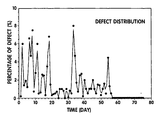
- the Figure demonstrates the lack of consistency of thin films produced by these prior art targets, most likely attributed to varying content of oxygen in the targets.
- low oxygen Cu/Cr sputter targets of the present invention having an oxygen content less than 900 ppm were used to deposit Cu/Cr thin films, and numerous of these thin films were again tested each day to determine the percentage of defects in the thin films.
- the low oxygen targets of the present invention consistently produced thin films with 0% defect generation.
- the present invention provides Cu/Cr sputter targets having a density of at least 90% of theoretical density and an oxygen content of less than about 900 ppm by controlling the particle size of the starting copper and chromium powders to between 20 ⁇ m and 150 ⁇ m and hot pressing the blended powders.
- the thin films produced from the sputter targets of the present invention generate 0% defects and thus meet the high reliability requirements for thin films on completed integrated circuits.
Landscapes
- Chemical & Material Sciences (AREA)
- Chemical Kinetics & Catalysis (AREA)
- Engineering & Computer Science (AREA)
- Materials Engineering (AREA)
- Mechanical Engineering (AREA)
- Metallurgy (AREA)
- Organic Chemistry (AREA)
- Powder Metallurgy (AREA)
- Physical Vapour Deposition (AREA)
Applications Claiming Priority (2)
| Application Number | Priority Date | Filing Date | Title |
|---|---|---|---|
| US09/353,503 US6299831B1 (en) | 1999-07-14 | 1999-07-14 | High performance Cu/Cr sputter targets for semiconductor application |
| US353503 | 1999-07-14 |
Publications (1)
| Publication Number | Publication Date |
|---|---|
| EP1069204A1 true EP1069204A1 (fr) | 2001-01-17 |
Family
ID=23389402
Family Applications (1)
| Application Number | Title | Priority Date | Filing Date |
|---|---|---|---|
| EP00305425A Withdrawn EP1069204A1 (fr) | 1999-07-14 | 2000-06-28 | Cible pour la pulvérisation cathodique de Cu/Cr |
Country Status (5)
| Country | Link |
|---|---|
| US (1) | US6299831B1 (fr) |
| EP (1) | EP1069204A1 (fr) |
| JP (1) | JP4689011B2 (fr) |
| KR (1) | KR100726103B1 (fr) |
| TW (1) | TW478043B (fr) |
Cited By (3)
| Publication number | Priority date | Publication date | Assignee | Title |
|---|---|---|---|---|
| CN102747326A (zh) * | 2011-04-21 | 2012-10-24 | 鸿富锦精密工业(深圳)有限公司 | 镀膜件的制备方法及由该方法制得的镀膜件 |
| CN102747332A (zh) * | 2011-04-21 | 2012-10-24 | 鸿富锦精密工业(深圳)有限公司 | 镀膜件的制备方法及由该方法制得的镀膜件 |
| EP4241901A1 (fr) * | 2022-03-10 | 2023-09-13 | Tosoh Corporation | Corps fritté en chrome, procédé de production de corps fritté en chrome, cible de pulvérisation et procédé de production de substrat avec film de chrome |
Families Citing this family (12)
| Publication number | Priority date | Publication date | Assignee | Title |
|---|---|---|---|---|
| US8273222B2 (en) * | 2006-05-16 | 2012-09-25 | Southwest Research Institute | Apparatus and method for RF plasma enhanced magnetron sputter deposition |
| US8206646B2 (en) * | 2006-12-22 | 2012-06-26 | Praxair Tecnology, Inc. | Method for consolidating and diffusion-bonding powder metallurgy sputtering target |
| US20080210555A1 (en) * | 2007-03-01 | 2008-09-04 | Heraeus Inc. | High density ceramic and cermet sputtering targets by microwave sintering |
| US20080236738A1 (en) * | 2007-03-30 | 2008-10-02 | Chi-Fung Lo | Bonded sputtering target and methods of manufacture |
| US8277617B2 (en) * | 2007-08-14 | 2012-10-02 | Southwest Research Institute | Conformal magnetron sputter deposition |
| US8747631B2 (en) * | 2010-03-15 | 2014-06-10 | Southwest Research Institute | Apparatus and method utilizing a double glow discharge plasma for sputter cleaning |
| US10297429B2 (en) | 2012-01-25 | 2019-05-21 | Jx Nippon Mining & Metals Corporation | High-purity copper-chromium alloy sputtering target |
| KR101628554B1 (ko) * | 2014-12-03 | 2016-06-08 | 현대자동차주식회사 | 대량 생산성 및 저마찰 특성이 우수한 표면처리 방법 |
| CN117403087A (zh) * | 2023-10-19 | 2024-01-16 | 长春工业大学 | 一种tc4增强铜基复合材料及其制备方法 |
| US20250327171A1 (en) * | 2024-04-19 | 2025-10-23 | Honeywell International Inc. | Cobalt-tantalum alloy sputtering target assembly and method of making |
| US20250327172A1 (en) * | 2024-04-19 | 2025-10-23 | Honeywell International Inc. | Cobalt-titanium alloy sputtering target assembly and method of making |
| WO2025222018A1 (fr) * | 2024-04-19 | 2025-10-23 | Honeywell International Inc. | Ensemble cible de pulvérisation cathodique en alliage cobalt-niobium et procédé de fabrication |
Citations (2)
| Publication number | Priority date | Publication date | Assignee | Title |
|---|---|---|---|---|
| JPH01309961A (ja) * | 1988-06-07 | 1989-12-14 | Hitachi Metals Ltd | Cr−Cuターゲット材およびターゲット材の製造方法 |
| WO1997012074A2 (fr) * | 1995-09-14 | 1997-04-03 | Tosoh Smd, Inc. | PROCEDE DE FABRICATION DE CIBLES DE PULVERISATION CATHODIQUE Cr-Me |
Family Cites Families (3)
| Publication number | Priority date | Publication date | Assignee | Title |
|---|---|---|---|---|
| JP3458871B2 (ja) * | 1995-03-31 | 2003-10-20 | 日立金属株式会社 | クロムタ−ゲットおよびその製造方法 |
| JPH1031942A (ja) * | 1996-07-17 | 1998-02-03 | Toshiba Corp | 真空遮断器用接点材料およびその製造方法 |
| JP3710022B2 (ja) * | 1997-07-28 | 2005-10-26 | 日立金属株式会社 | 電極膜形成用Cu系スパッタリングターゲットおよびその製造方法 |
-
1999
- 1999-07-14 US US09/353,503 patent/US6299831B1/en not_active Expired - Lifetime
-
2000
- 2000-06-12 TW TW089111414A patent/TW478043B/zh not_active IP Right Cessation
- 2000-06-28 EP EP00305425A patent/EP1069204A1/fr not_active Withdrawn
- 2000-07-13 KR KR1020000040147A patent/KR100726103B1/ko not_active Expired - Fee Related
- 2000-07-13 JP JP2000212149A patent/JP4689011B2/ja not_active Expired - Fee Related
Patent Citations (2)
| Publication number | Priority date | Publication date | Assignee | Title |
|---|---|---|---|---|
| JPH01309961A (ja) * | 1988-06-07 | 1989-12-14 | Hitachi Metals Ltd | Cr−Cuターゲット材およびターゲット材の製造方法 |
| WO1997012074A2 (fr) * | 1995-09-14 | 1997-04-03 | Tosoh Smd, Inc. | PROCEDE DE FABRICATION DE CIBLES DE PULVERISATION CATHODIQUE Cr-Me |
Non-Patent Citations (1)
| Title |
|---|
| PATENT ABSTRACTS OF JAPAN vol. 014, no. 106 (C - 0694) 27 February 1990 (1990-02-27) * |
Cited By (4)
| Publication number | Priority date | Publication date | Assignee | Title |
|---|---|---|---|---|
| CN102747326A (zh) * | 2011-04-21 | 2012-10-24 | 鸿富锦精密工业(深圳)有限公司 | 镀膜件的制备方法及由该方法制得的镀膜件 |
| CN102747332A (zh) * | 2011-04-21 | 2012-10-24 | 鸿富锦精密工业(深圳)有限公司 | 镀膜件的制备方法及由该方法制得的镀膜件 |
| EP4241901A1 (fr) * | 2022-03-10 | 2023-09-13 | Tosoh Corporation | Corps fritté en chrome, procédé de production de corps fritté en chrome, cible de pulvérisation et procédé de production de substrat avec film de chrome |
| US12392025B2 (en) | 2022-03-10 | 2025-08-19 | Tosoh Corporation | Method for producing chromium sintered body, method for producing sputtering target, and method for producing substrate with chromium film |
Also Published As
| Publication number | Publication date |
|---|---|
| KR100726103B1 (ko) | 2007-06-12 |
| US6299831B1 (en) | 2001-10-09 |
| TW478043B (en) | 2002-03-01 |
| JP4689011B2 (ja) | 2011-05-25 |
| JP2001073127A (ja) | 2001-03-21 |
| KR20010039716A (ko) | 2001-05-15 |
Similar Documents
| Publication | Publication Date | Title |
|---|---|---|
| US6328927B1 (en) | Method of making high-density, high-purity tungsten sputter targets | |
| TW573036B (en) | Method of making high density sputtering targets | |
| US6299831B1 (en) | High performance Cu/Cr sputter targets for semiconductor application | |
| US6010583A (en) | Method of making unreacted metal/aluminum sputter target | |
| EP1948376B1 (fr) | Procedes de fabrication de cibles et de plaques de pulverisation en titane molybdene | |
| US5306569A (en) | Titanium-tungsten target material and manufacturing method thereof | |
| US5618397A (en) | Silicide targets for sputtering | |
| US6042777A (en) | Manufacturing of high density intermetallic sputter targets | |
| EP2270252B1 (fr) | Cible fritté et procédé de fabrication d'un matériau fritté | |
| EP0616045B1 (fr) | Cibles de pulvérisation en siliciure et procédé pour leur fabrication | |
| WO1992018657A1 (fr) | Procedes de production de cibles de pulverisation cathodique en tungstene et titane et cibles ainsi produites | |
| US5896553A (en) | Single phase tungsten-titanium sputter targets and method of producing same | |
| CN116695076B (zh) | 一种AlZr复合靶材及其制备方法和应用 | |
| JP2757287B2 (ja) | タングステンターゲットの製造方法 | |
| JP4634567B2 (ja) | タングステンスパッタリングターゲットの製造方法 | |
| JP3792007B2 (ja) | スパッタリングターゲットの製造方法 | |
| JPH1150242A (ja) | 電極膜形成用Cu系スパッタリングターゲットおよびその製造方法ならびにCu系電極膜 | |
| JP3280054B2 (ja) | 半導体用タングステンターゲットの製造方法 | |
| JP2001295035A (ja) | スパッタリングターゲットおよびその製造方法 | |
| US5886269A (en) | Substrate and heat sink for a semiconductor and method of manufacturing the same | |
| JPH04160104A (ja) | タングステンターゲットの製造方法 | |
| JPH11176769A (ja) | スパッタリングターゲットおよび銅配線膜 | |
| JPH051371A (ja) | スパツタリング用ターゲツト材 | |
| JPH02170969A (ja) | ターゲット材の製造方法 |
Legal Events
| Date | Code | Title | Description |
|---|---|---|---|
| PUAI | Public reference made under article 153(3) epc to a published international application that has entered the european phase |
Free format text: ORIGINAL CODE: 0009012 |
|
| AK | Designated contracting states |
Kind code of ref document: A1 Designated state(s): DE FR GB IT NL |
|
| AX | Request for extension of the european patent |
Free format text: AL;LT;LV;MK;RO;SI |
|
| 17P | Request for examination filed |
Effective date: 20010629 |
|
| AKX | Designation fees paid |
Free format text: DE FR GB IT NL |
|
| 17Q | First examination report despatched |
Effective date: 20040527 |
|
| STAA | Information on the status of an ep patent application or granted ep patent |
Free format text: STATUS: THE APPLICATION IS DEEMED TO BE WITHDRAWN |
|
| 18D | Application deemed to be withdrawn |
Effective date: 20140103 |