EP1065679A2 - Weichmagnetischer Dünnfilm und diesen Film umfassender Magnetkopf - Google Patents
Weichmagnetischer Dünnfilm und diesen Film umfassender Magnetkopf Download PDFInfo
- Publication number
- EP1065679A2 EP1065679A2 EP00113565A EP00113565A EP1065679A2 EP 1065679 A2 EP1065679 A2 EP 1065679A2 EP 00113565 A EP00113565 A EP 00113565A EP 00113565 A EP00113565 A EP 00113565A EP 1065679 A2 EP1065679 A2 EP 1065679A2
- Authority
- EP
- European Patent Office
- Prior art keywords
- atom
- magnetic
- soft magnetic
- thin film
- thin
- Prior art date
- Legal status (The legal status is an assumption and is not a legal conclusion. Google has not performed a legal analysis and makes no representation as to the accuracy of the status listed.)
- Pending
Links
Images


Classifications
-
- G—PHYSICS
- G11—INFORMATION STORAGE
- G11B—INFORMATION STORAGE BASED ON RELATIVE MOVEMENT BETWEEN RECORD CARRIER AND TRANSDUCER
- G11B5/00—Recording by magnetisation or demagnetisation of a record carrier; Reproducing by magnetic means; Record carriers therefor
- G11B5/127—Structure or manufacture of heads, e.g. inductive
- G11B5/31—Structure or manufacture of heads, e.g. inductive using thin films
-
- H—ELECTRICITY
- H01—ELECTRIC ELEMENTS
- H01F—MAGNETS; INDUCTANCES; TRANSFORMERS; SELECTION OF MATERIALS FOR THEIR MAGNETIC PROPERTIES
- H01F10/00—Thin magnetic films, e.g. of one-domain structure
- H01F10/08—Thin magnetic films, e.g. of one-domain structure characterised by magnetic layers
- H01F10/10—Thin magnetic films, e.g. of one-domain structure characterised by magnetic layers characterised by the composition
- H01F10/12—Thin magnetic films, e.g. of one-domain structure characterised by magnetic layers characterised by the composition being metals or alloys
- H01F10/13—Amorphous metallic alloys, e.g. glassy metals
- H01F10/131—Amorphous metallic alloys, e.g. glassy metals containing iron or nickel
-
- G—PHYSICS
- G11—INFORMATION STORAGE
- G11B—INFORMATION STORAGE BASED ON RELATIVE MOVEMENT BETWEEN RECORD CARRIER AND TRANSDUCER
- G11B5/00—Recording by magnetisation or demagnetisation of a record carrier; Reproducing by magnetic means; Record carriers therefor
- G11B5/127—Structure or manufacture of heads, e.g. inductive
- G11B5/1274—Structure or manufacture of heads, e.g. inductive with "composite" cores, i.e. cores composed in some parts of magnetic particles and in some other parts of magnetic metal layers
-
- G—PHYSICS
- G11—INFORMATION STORAGE
- G11B—INFORMATION STORAGE BASED ON RELATIVE MOVEMENT BETWEEN RECORD CARRIER AND TRANSDUCER
- G11B5/00—Recording by magnetisation or demagnetisation of a record carrier; Reproducing by magnetic means; Record carriers therefor
- G11B5/127—Structure or manufacture of heads, e.g. inductive
- G11B5/187—Structure or manufacture of the surface of the head in physical contact with, or immediately adjacent to the recording medium; Pole pieces; Gap features
- G11B5/1875—"Composite" pole pieces, i.e. poles composed in some parts of magnetic particles and in some other parts of magnetic metal layers
- G11B5/1877—"Composite" pole pieces, i.e. poles composed in some parts of magnetic particles and in some other parts of magnetic metal layers including at least one magnetic thin film
- G11B5/1878—"Composite" pole pieces, i.e. poles composed in some parts of magnetic particles and in some other parts of magnetic metal layers including at least one magnetic thin film disposed immediately adjacent to the transducing gap, e.g. "Metal-In-Gap" structure
Definitions
- the present invention relates to a soft magnetic thin film for use in a magnetic head for recording/reproducing information with respect to a high coercive-force magnetic recording medium, such as an evaporated tape. More particularly, the present invention relates to a microcrystal deposition soft magnetic thin film having both high saturation magnetic flux density and a satisfactory soft magnetic characteristic and a magnetic head incorporating the soft magnetic thin film.
- the foregoing magnetic recording medium is exemplified by a so-called evaporated tape incorporating a non-magnetic support member which is directly coated with, for example, a ferromagnetic metal material.
- the magnetic head must incorporate a core made of a material having a high saturation magnetic flux density and a high magnetic permeability.
- the MIG magnetic head incorporates a sub-core material made of ferrite. Moreover, a main core material is formed on the ferrite layer, the main core material being constituted by a thin metal magnetic film exhibiting a high saturation magnetic flux density. That is, the gap portion is constituted by the thin metal magnetic film.
- the MIG magnetic head is a satisfactory magnetic head to recording/reproduce information with respect to an evaporated tape.
- the magnetic head of the foregoing type permits a satisfactory recording/reproducing process to be performed with respect to a recording medium, such as the evaporated tape, having large coercive force because the recording density has considerably been raised in recent years. Therefore, the magnetic head must be made of a metal magnetic material in order to incorporate a sufficient large recording magnetic field. Moreover, a satisfactory soft magnetic characteristic is required even in a high frequency region.
- the thin microcrystal metal magnetic film mainly composed of Fe has been started as a substitute for the conventional metal magnetic material of the magnetic head.
- the reason for this lies in that the thin microcrystal metal magnetic film has a high saturation magnetic flux density and an excellent soft magnetic characteristic.
- the Fe-base thin microcrystal metal magnetic film has a structure that microcrystal having a composition like pure iron constitutes substantially the overall volume of the thin film. Therefore, the foregoing thin film suffers from unsatisfactory corrosion resistance. Thus, there arises a problem in that the reliability of a device incorporating the foregoing Fe-base thin microcrystal metal magnetic film deteriorates.
- an object of the present invention is to provide a soft magnetic thin film which is capable of overcoming the foregoing problems experienced with the conventional technique and which has a high saturation magnetic flux density, an excellent soft magnetic characteristic and sufficient corrosion resistance and a reliable magnetic head incorporating the soft magnetic thin film.
- the inventors of the present invention has detected a fact that substitution of a Fe-Ru-Ga-Si alloy exhibiting satisfactory corrosion resistance for the portion of a thin microcrystal metal magnetic film serving as a core realizes a high saturation magnetic flux density, a satisfactory soft magnetic characteristic and sufficient corrosion resistance.
- a soft magnetic thin film comprising: a material expressed by a composition formula Fe a Si b Ta c Ru d Ga e N f (where each of a, b, c, d, e and f is a value indicating the atom% of the corresponding element), wherein the composition ranges are as follows:
- a magnetic head comprising: a magnetic core which forms a closed magnetic passage; and a magnetic gap formed in the closed magnetic passage, wherein at least a portion of the magnetic core is constituted by the soft magnetic thin film.
- the soft magnetic thin film having the above-mentioned composition is constituted by the thin microcrystal metal magnetic film, the soft magnetic thin film according to the present invention has a high saturation magnetic flux density and an excellent soft magnetic characteristic. Moreover, satisfactory corrosion resistance can be realized because the Fe - Ru - Ga - Si alloy is substituted for the portion which serves as the core.
- the soft magnetic thin film according to the present invention is mainly composed of Fe, Si, Ta, Ru, Ga and N.
- the soft magnetic thin film comprising: a material expressed by a composition formula Fe a Si b Ta c Ru d Ga e N f (where each of a, b, c, d, e and f is a value indicating the atom% of the corresponding element), wherein the composition ranges are as follows:
- the soft magnetic thin film according to the present invention is manufactured by using a target having a composition in the form that N is omitted from the foregoing composition.
- a RF or DC magnetron sputtering is performed in an argon gas atmosphere containing 50 mol% to 20 mol% nitrogen. Then, heat treatment is performed at 450°C to 600°C so that a soft magnetic characteristic is realized.
- Tables 1 to 4 show compositions of soft magnetic thin films manufactured by the RF magnetron sputtering processes performed in the argon gas atmosphere containing 10 mol% nitrogen, the compositions being compositions from which nitrogen has been omitted. Moreover, Tables 1 to 4 show coercive force Hc, saturation magnetic flux density Bs and permeability ⁇ Hard realized in a direction of the hard axis after the soft magnetic thin films have been allowed to stand at 550°C for one hour.
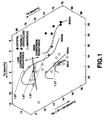
- Fig. 1 shows a graph formed by plotting data shown in Table 1 such that attention is focused on the atomic fraction of each of Fe and Ta.
- composition fraction of each soft magnetic thin film is expressed such that nitrogen is omitted lies in that the analytical accuracy of nitrogen is unsatisfactory as compared with those of the other elements.
- the composition is expressed such that the sum of the atomic fractions of component elements except for nitrogen is 100 %.
- the atomic fraction of the nitrogen with which the soft magnetic characteristic can be realized satisfies a range from 5 % to 12 %.
- Ta is an element which enhances amorphous formation in a film which must be formed. The reason why a satisfactory soft magnetic characteristic cannot be obtained in a region in which the atomic fraction of Ta is 5 % to 7 % lies in that an amorphous structure before heat treatment required for the thin microcrystal deposition type soft magnetic thin film is not formed in the foregoing region.
- Fig. 2 is a graph formed by plotting ratios of quantities of saturation magnetization changed due to immersion of all of the thin magnetic films shown in Tables 1 to 4 in 0.5 N NaCl solution for 200 hours with respect to the atomic fraction of Fe.
- Fig. 3 shows change in the saturation magnetic flux density and the saturation magnetostrictiion constant caused by the sum of the atomic fraction of Si and that of Fe.
- the foregoing composition ratio (the sum) satisfies a range from 0.15 to 0.17 to make the saturation magnetic flux density to be 1.3 T or higher and to make the saturation magnetostrictiion constant to be 1 ⁇ 10 -6 or smaller.
- composition range is translated into about 4.5 ⁇ a/b ⁇ 6.0 in the composition formula Fe a Si b Ta c Ru d Ga e N f .
- Si is an element which is able to contribute to forming an amorphous structure before heat treatment. Therefore, an influence of reduction in the atomic fraction of Ta can somewhat be compensated by raising the atomic fraction of Si.
- the saturation magnetic flux density Bs of Ru is not reduced considerably with respect to enlargement of addition. Moreover, Ru is effective in improving corrosion resistance.
- Table 1 a soft magnetic characteristic of Hc ⁇ 80A/m can be obtained in a wide atomic fraction range of 0 atom% to 11 atom%. To realize higher saturation magnetic flux density, it is preferable that the atom% is 5 atom% or lower.
- Ga is an element with which the magnetic anisotropy can be reduced and the corrosion resistance can be improved.
- Table 1 a soft magnetic characteristic of Hc ⁇ 80A/m can be obtained in an atom% range of 0 atom% to 5 atom%.
- the atomic fraction is 3 atom% or lower.
- the soft magnetic thin film is expressed by a composition formula as Fe a Si b Ta c Ru d Ga e N f (where each of a, b, c, d, e and f is a value indicating the atom% of the corresponding element), the composition ranges satisfy:
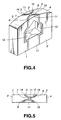
- the magnetic head according to the present invention has a structure that a magnetic gap g is formed at substantially the central portion of the surface which is brought into contact with the recording medium.
- a pair of right and left half bodies 1 and 2 of a magnetic core which are manufactured individually are joined to each other such that the magnetic gap g is formed between the half bodies 1 and 2 of the magnetic core. Therefore, the surfaces for forming the magnetic gap g are abutted against each other.
- the half bodies 1 and 2 of the magnetic core incorporate bases 3 and 4, which are sub-cores, and thin metal magnetic films 5 and 6 which are main core portions.
- the bases 3 and 4 are made of magnetic oxide material, such as Mn-Zn ferrite or Ni-Zn ferrite.
- the bases 3 and 4 serve as sub-core portions for constituting a closed magnetic passage in association with the thin metal magnetic films 5 and 6.
- Circular-arc track-width limiting grooves 7, 8, 9 and 10 for limiting the track width Tw of the magnetic gap g are formed in the surfaces of the bases 3 and 4 opposite to the surfaces for forming the magnetic gap g.
- the track-width limiting grooves 7, 8, 9 and 10 are formed in a direction of the depth from portions adjacent to the two ends of the magnetic gap g.
- Each of the track-width limiting grooves 7, 8, 9 and 10 is filled with non-magnetic material 11, such as glass.
- a groove 12 for a coil wire is formed in a surface of either of the bases 3 and 4 (the base 4 in this embodiment).
- the groove 12 has a substantially rectangular side shape to limit the depth of the magnetic gap g and permit winding of a wire to form a coil (not shown). Note that the groove 12 for the coil wire may similarly be formed in the base 3 as well as the base 4.
- the thin metal magnetic films 5 and 6 serve as the main core portion for constituting the closed magnetic passage in association with the bases 3 and 4.
- the thin metal magnetic films 5 and 6 are formed in the opposite surfaces of the bases 3 and 4 in a direction from a front gap portion to a back gap portion. Therefore, the opposite surfaces of the thin metal magnetic films 5 and 6 serve as the surfaces of the half bodies 1 and 2 of the magnetic core for forming the magnetic gap g.
- the thin metal magnetic films 5 and 6 are formed on the surface of the inside portions of the track-width limiting grooves 7, 8, 9 and 10 as well as the opposite surfaces of the bases 3 and 4.
- the thin metal magnetic films 5 and 6 may be formed on the overall surface of the inside portion of the groove 12 for the coil wire or at least a portion of the same.
- MIG heads incorporating soft magnetic thin films each having the composition expressed as Fe a Si b Ta c Ru d Ga e N f were manufactured to evaluate the characteristics.
- the thin metal magnetic films 5 and 6 were manufactured by using a target containing Fe by 74.0 atom%, Si by 15.0 atom%, Ru by 2.5 atom%, Ga by 1.0 atom% and Ta by 7.5 atom%. Then, DC sputtering was performed in an argon atmosphere to which 10 mol% nitrogen was added. The coercive force Hc of each of the manufactured soft magnetic thin films was 15 A/m. The saturation magnetic flux density Bs was 1.35 T. The permeability ⁇ Hard in the direction of the hard axis was 3200. If the thin metal magnetic film is directly formed on each of the bases 3 and 4, a diffusion reaction takes place between ferrite and the thin magnetic film. Thus, a pseudo gap is undesirably formed. Therefore, it is preferable that the thin metal magnetic film is formed through a reaction preventive film.
- the recording/reproducing characteristics were compared with those of the foregoing MIG head.
- Fig. 6 shows results of measurement of an overwriting characteristic by using a magnetic recording medium having coercive force of 132 kA/m and incorporating a magnetic layer, the thickness of which was 0.53 ⁇ m.
- Fig. 7 shows results of dependency of the reproduction output on the frequency.
- the MIG head incorporating the soft magnetic thin film according to the present invention has an excellent overwriting characteristic because the head incorporates the soft magnetic thin film which exhibits a high saturation magnetic flux density. Moreover, high reproduction outputs can be obtained in the overall frequency range owing to the satisfactory soft magnetic characteristic. Thus, similar recording/reproducing characteristics to those of the MIG head incorporating the thin microcrystal deposition-type metal magnetic film containing Fe as the core thereof can be realized.
- the MIG heads having the three types of the soft magnetic thin films were immersed in 0.5 N NaCl solution for one hour. Then, each surface on which the magnetic recording medium slid was observed. As a result, the MIG head incorporating the thin microcrystal deposition-type metal magnetic film containing Fe as the core thereof encountered corrosion of the surface of the soft magnetic thin film. On the other hand, the MIG head incorporating the soft magnetic thin film according to the present invention was free from corrosion similarly to the crystal-type soft magnetic thin film. As a result, satisfactory reliability was realized.
- the soft magnetic thin film according to the present invention exhibits a high saturation magnetic flux density and excellent soft magnetic characteristics. Moreover, sufficient corrosion resistance can be realized.
- provision of the soft magnetic thin film according to the present invention for the magnetic head enable a magnetic head excellent in the recording/reproducing characteristic and reliably.
Landscapes
- Engineering & Computer Science (AREA)
- Manufacturing & Machinery (AREA)
- Power Engineering (AREA)
- Magnetic Heads (AREA)
- Thin Magnetic Films (AREA)
Applications Claiming Priority (2)
| Application Number | Priority Date | Filing Date | Title |
|---|---|---|---|
| JP11182562A JP2001015338A (ja) | 1999-06-28 | 1999-06-28 | 軟磁性薄膜及びこれを用いた磁気ヘッド |
| JP18256299 | 1999-06-28 |
Publications (2)
| Publication Number | Publication Date |
|---|---|
| EP1065679A2 true EP1065679A2 (de) | 2001-01-03 |
| EP1065679A3 EP1065679A3 (de) | 2001-05-16 |
Family
ID=16120453
Family Applications (1)
| Application Number | Title | Priority Date | Filing Date |
|---|---|---|---|
| EP00113565A Pending EP1065679A3 (de) | 1999-06-28 | 2000-06-27 | Weichmagnetischer Dünnfilm und diesen Film umfassender Magnetkopf |
Country Status (4)
| Country | Link |
|---|---|
| EP (1) | EP1065679A3 (de) |
| JP (1) | JP2001015338A (de) |
| KR (1) | KR100724013B1 (de) |
| CN (1) | CN1145145C (de) |
Family Cites Families (1)
| Publication number | Priority date | Publication date | Assignee | Title |
|---|---|---|---|---|
| US5858548A (en) * | 1994-08-12 | 1999-01-12 | Hitachi, Ltd. | Soft magnetic thin film, and magnetic head and magnetic recording device using the same |
-
1999
- 1999-06-28 JP JP11182562A patent/JP2001015338A/ja not_active Abandoned
-
2000
- 2000-06-27 KR KR1020000035585A patent/KR100724013B1/ko not_active Expired - Fee Related
- 2000-06-27 EP EP00113565A patent/EP1065679A3/de active Pending
- 2000-06-28 CN CNB001193376A patent/CN1145145C/zh not_active Expired - Fee Related
Also Published As
| Publication number | Publication date |
|---|---|
| EP1065679A3 (de) | 2001-05-16 |
| CN1145145C (zh) | 2004-04-07 |
| CN1279463A (zh) | 2001-01-10 |
| KR100724013B1 (ko) | 2007-05-31 |
| KR20010007538A (ko) | 2001-01-26 |
| JP2001015338A (ja) | 2001-01-19 |
Similar Documents
| Publication | Publication Date | Title |
|---|---|---|
| US6599646B2 (en) | Magnetic recording medium | |
| KR970002825B1 (ko) | 연자성 박막 | |
| EP0360055B1 (de) | Weichmagnetischer Film mit hoher magnetischer Flussdichte sowie Magnetkopf | |
| CN1070278A (zh) | 磁性记录介质及其制造方法 | |
| EP0466159B1 (de) | Zusammengesetzter Magnetkopf | |
| US5432645A (en) | Magnetic head-forming thin film | |
| JP2698814B2 (ja) | 軟磁性薄膜 | |
| US5029032A (en) | Magnetic head for high density recording | |
| EP1065679A2 (de) | Weichmagnetischer Dünnfilm und diesen Film umfassender Magnetkopf | |
| JPH08288138A (ja) | 軟磁性薄膜及びそれを用いた磁気ヘッド | |
| US6510023B1 (en) | Magnetic head for high coercive force magnetic recording medium | |
| JP3164736B2 (ja) | 薄膜磁気ヘッド | |
| JP3517067B2 (ja) | 磁気ヘッド | |
| JPH08115507A (ja) | 磁気ヘッド | |
| JP3232592B2 (ja) | 磁気ヘッド | |
| JPS62159313A (ja) | 磁気記憶装置 | |
| JP3213997B2 (ja) | 磁気ヘッド | |
| JP2798315B2 (ja) | 複合磁気ヘッド | |
| JPH01116905A (ja) | 磁気ヘッド | |
| JP2001143214A (ja) | 磁気ヘッド | |
| KR940008644B1 (ko) | 자기 헤드용 비정질 자성 합금 박막 | |
| JPH0477369B2 (de) | ||
| JPH04252006A (ja) | 耐食軟磁性膜及びこれを用いた磁気ヘッド | |
| JP2001110011A (ja) | 軟磁性薄膜及びこれを用いた磁気ヘッド | |
| JPH01176303A (ja) | 磁気ヘッド |
Legal Events
| Date | Code | Title | Description |
|---|---|---|---|
| PUAI | Public reference made under article 153(3) epc to a published international application that has entered the european phase |
Free format text: ORIGINAL CODE: 0009012 |
|
| AK | Designated contracting states |
Kind code of ref document: A2 Designated state(s): DE FR GB |
|
| AX | Request for extension of the european patent |
Free format text: AL;LT;LV;MK;RO;SI |
|
| PUAL | Search report despatched |
Free format text: ORIGINAL CODE: 0009013 |
|
| AK | Designated contracting states |
Kind code of ref document: A3 Designated state(s): AT BE CH CY DE DK ES FI FR GB GR IE IT LI LU MC NL PT SE |
|
| AX | Request for extension of the european patent |
Free format text: AL;LT;LV;MK;RO;SI |
|
| 17P | Request for examination filed |
Effective date: 20011016 |
|
| AKX | Designation fees paid |
Free format text: DE FR GB |
|
| 17Q | First examination report despatched |
Effective date: 20040812 |
|
| STAA | Information on the status of an ep patent application or granted ep patent |
Free format text: STATUS: EXAMINATION IS IN PROGRESS |