EP1063540A2 - Optische Linse sowie Verfahren zu deren Herstellung - Google Patents
Optische Linse sowie Verfahren zu deren Herstellung Download PDFInfo
- Publication number
- EP1063540A2 EP1063540A2 EP00111955A EP00111955A EP1063540A2 EP 1063540 A2 EP1063540 A2 EP 1063540A2 EP 00111955 A EP00111955 A EP 00111955A EP 00111955 A EP00111955 A EP 00111955A EP 1063540 A2 EP1063540 A2 EP 1063540A2
- Authority
- EP
- European Patent Office
- Prior art keywords
- plastic
- layer
- lens
- lens according
- lenses
- Prior art date
- Legal status (The legal status is an assumption and is not a legal conclusion. Google has not performed a legal analysis and makes no representation as to the accuracy of the status listed.)
- Granted
Links
Classifications
-
- G—PHYSICS
- G02—OPTICS
- G02B—OPTICAL ELEMENTS, SYSTEMS OR APPARATUS
- G02B1/00—Optical elements characterised by the material of which they are made; Optical coatings for optical elements
- G02B1/04—Optical elements characterised by the material of which they are made; Optical coatings for optical elements made of organic materials, e.g. plastics
- G02B1/041—Lenses
-
- G—PHYSICS
- G02—OPTICS
- G02B—OPTICAL ELEMENTS, SYSTEMS OR APPARATUS
- G02B1/00—Optical elements characterised by the material of which they are made; Optical coatings for optical elements
- G02B1/10—Optical coatings produced by application to, or surface treatment of, optical elements
-
- G02B1/105—
-
- G—PHYSICS
- G02—OPTICS
- G02B—OPTICAL ELEMENTS, SYSTEMS OR APPARATUS
- G02B1/00—Optical elements characterised by the material of which they are made; Optical coatings for optical elements
- G02B1/10—Optical coatings produced by application to, or surface treatment of, optical elements
- G02B1/14—Protective coatings, e.g. hard coatings
Definitions
- the present invention relates to optical, preferably ophthalmic lenses, with a body made of Plastic, especially for eyeglass lenses as well Process for their production.
- CR 39 a copolymer of diethylene glycol and Bisallyl carbonate, is a special plastic for optical lenses, especially glasses, the good one has optical properties.
- the refractive index is 1,498 with an Abbe number of 58.
- the Abbe number is a very important material property because it is the describes optical dispersion. Only when paying off the glasses wearer is usually larger than 40 do not observe any annoying color rings.
- CR 39 has a very high density of 1.32 g / cm 3 , which is particularly noticeable in glass weights up to - 6 diopters.
- Processability is also a disadvantage of CR 39.
- CR 39 must be produced using a casting process that is typical for non-thermoplastic plastics and subsequent UV curing. For this purpose, the casting resin is poured into a mold consisting of two ground silicate glasses, which are held together by a ring, and then cured by UV light.
- Polycarbonate as a plastic for eyeglass lenses has a density of 1.20 g / cm 3 and a refractive index of 1.568 compared to CR 39.
- a round lens with a diameter of 55 mm and a thickness of -8 diopters made of polycarbonate has a weight of 12.0 g.
- a lens with an identical CR 39 strength has a weight of 15.8 g.
- the Abbe number of only 30.0 is a major disadvantage of polycarbonate, so that the use of polycarbonate is considerably restricted.
- thermoplastics which have a density less than 1.20 g / cm 3 , a refractive index greater than 1,500 and an Abbe number above 40 in order to meet the requirements for spectacle lenses.
- plastics with a density of less than 1.2 g / cm 3 are the known polyolefins, polyethylene, polypropylene and their copolymers. However, these materials are partially crystalline materials and therefore do not have sufficient transparency for ophthalmic applications.
- Poly-4-methylpentene-1 ( PMP "from Mitsui Petrochemical), on the other hand, has sufficient transparency and low density, but the optical properties are far from sufficient, for example the refractive index at 600 nm is much too low at 1.4655 (H. Domininghaus, Die Kunststoffe and their properties, 1992, page 162).
- optical lenses especially ophthalmic Lentils
- plastic body to provide the excellent optical Have properties.
- Another object of the invention was to provide a To provide lens whose weight at a predetermined diopter is as low as possible.
- the lenses should protect against sweat, grease, Resistant to solvents in cleaning substances etc. his.
- the plastic cycloolefinic polymers includes and the plastic body with a transparent coated with corrosion-resistant coating, the at least two layers, one towards the plastic nifty inner matching layer and one Fat protection layer, is included, an optical, especially an ophthalmic lens with a body Plastic, especially for glasses, for Provided both excellent optical Properties as well as high resistance to Has corrosion.
- the subject of the invention is an optical lens that can be used everywhere there can where optical lenses can be used, e.g. B. at Lenses, cameras, optical devices or glasses.
- Ophthalmic is a particularly preferred area of application.
- Plastic used has cycloolefinic polymers on.
- Cycloolefinic polymers are part of the Invention Polymers Using Cyclic Olefins, especially polycyclic olefins are available.
- Cyclic olefins include, for example, monocyclic ones Olefins, such as cyclopentene, cyclopentadiene, cyclohexene, Cycloheptene, cyclooctene and alkyl derivatives of these monocyclic olefins with 1 to 3 carbon atoms, such as methyl, ethyl or propyl, such as Methylcyclohexene or dimethylcyclohexene, and Acrylate and / or methacrylate derivatives of these monocyclic compounds.
- Olefins such as cyclopentene, cyclopentadiene, cyclohexene, Cycloheptene, cyclooctene and alkyl derivatives of these monocyclic olefins with 1 to 3 carbon atoms, such as methyl, ethyl or propyl, such as Methylcyclohexene or dimethylcyclohexene,
- Bridged, polycyclic are preferred Olefin compounds.
- This polycyclic Olefin compounds can double bond both in Show ring, it is bridged polycyclic cycloalkenes, as well as in side chains.
- These are vinyl derivatives, Allyloxycarboxyderivate and (meth) acryloxyderivate of polycyclic cycloalkane compounds.
- This Compounds can furthermore be alkyl, aryl or Have aralkyl substituents.
- Exemplary polycyclic compounds are, without being restricted thereby, bicyclo [2.2.1] hept-2-ene (norbornene), bicyclo [2.2.1] hept-2,5-diene (2,5-norbornadiene), ethyl -bicyclo [2.2.1] hept-2-ene (ethyl norbornene), ethylidene bicyclo [2.2.1] hept-2-ene (ethylidene-2-norbornene), phenylbicyclo [2.2.1] hept-2-ene, bicyclo [4.3 .0] nona-3,8-diene, tricyclo [4.3.0.1 2,5 ] -3-decene, tricyclo [4.3.0.1 2,5 ] -3,8-decen- (3,8-dihydrodicyclopentadiene), tricyclo [4.4.0.1 2.5 ] -3-undecene, tetracyclo [4.4.0.1 2.5 ,
- the cycloolefinic polymers are used of at least one of the previously described cycloolefinic compounds, especially the polycyclic hydrocarbon compounds manufactured.
- the cycloolefinic polymers further olefins be used with the aforementioned cycloolefinic monomers are copolymerized can. These include Ethylene, propylene, isoprene, Butadiene, methylpentene, styrene and vinyl toluene.
- the preparation of the cycloolefinic polymers can be based on known way, such as in the Japanese patents 11818/1972, 43412/1983, 1442/1986 and 19761/1987 and the Japanese Publication No. 75700/1975, 129434/1980, 127728/1983, 168708/1985, 271308/1986, 221118/1988 and 180976/1990 and in European patent applications EP-A-0 6 610 851, EP-A-0 6 485 893, EP-A-0 6 407 870 and EP-A-0 6 688 801.
- the cycloolefinic polymers can, for example using aluminum compounds, Vanadium compounds, tungsten compounds or Boron compounds as a catalyst in a solvent be polymerized.
- cycloolefinic To obtain polymers by radical polymerization, taking light or an initiator as a radical generator is used. This applies in particular to the Acryloyl derivatives of cycloolefins and / or cycloalkanes. This type of polymerization can be used both in solution and also take place in substance.
- a polycyclic olefin of the formula I, II, III or IV, preferably a cycloolefin of the formula I or III, is particularly preferably used to produce the plastic material according to the invention, wherein R 1 , R 2 , R 3 , R 4 , R 5 , R 6 , R 7 and R 8 are the same or different and represent a hydrogen atom or a C 1 -C 8 alkyl radical, the same radicals in the different formulas can have different meanings, polymerized.
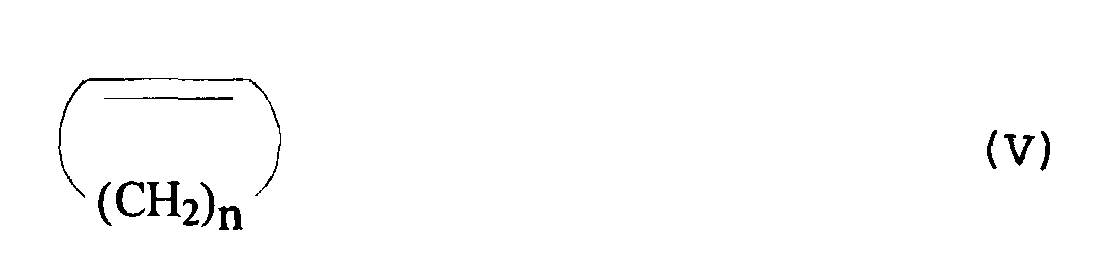
- n is a number from 2 to 10 is used.
- Another comonomer is an acyclic 1-olefin of the formula VI, wherein R 9 , R 10 , R 11 and R 12 are the same or different and represent a hydrogen atom or a C 1 -C 8 alkyl radical. Ethylene or propylene are preferred.
- Copolymers of polycyclic olefins of formula I and III manufactured are in an amount of 0.1-100% by weight, the monocyclic Olefin (V) in an amount of 0 - 99 wt .-% and that acyclic 1-olefin (VI) in an amount of 0-99.9 % By weight based on the total amount of Monomers used.
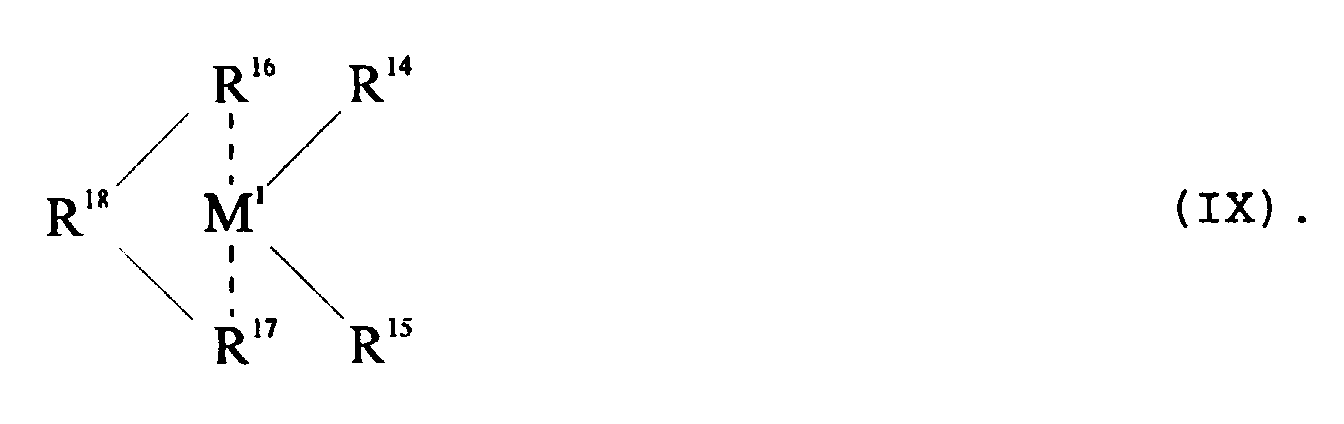
- catalysts consist of an aluminoxane of the formula VII for the linear type and / or of formula VIII for cyclic type and at least one metallocene of the formula IX
- M 1 is a metal from the group titanium, zirconium, hafnium, vanadium, niobium and tantalum, preferably zirconium and hafnium.
- R 14 and R 15 are identical or different and represent a hydrogen atom, a C 1 -C 10 , preferably C 1 -C 3 alkyl group, a C 1 -C 10 , preferably C 1 -C 3 alkoxy group, a C 6 - C 10 , preferably C 6 -C 8 aryl group, a C 6 -C 10 , preferably C 6 -C 8 aryloxy group, a C 2 -C 10 , preferably a C 2 -C 4 alkenyl group, a C 7 -C 40 , preferably C 7 -C 10 arylalkyl group, a C 7 -C 40 , preferably C 7 -C 12 alkylaryl group, a C 8 -C 40 , preferably C 8 -C 40
- C 16 and C 17 are the same or different and mean a mono- or polynuclear hydrocarbon radical which can form a sandwich structure with the central atom M 1 .
- R 16 and R 17 are either both indenyl or tetrahydroindenyl or R 16 fluorenyl and R 17 cyclopentadienyl.
- Metallocenes which are preferably used are rac-dimethylsilyl-bis- (1-indenyl) zirconium dichloride, rac-dimethylgermyl-bis- (1-indenyl) zirconium dichloride, rac-phenylmethylsilyl-bis- (1-indenyl) -zirconium dichloride, rac-phenylvinylsilyl-bis- (1-indenyl) -zirconium dichloride, 1-silycylobutyl-bis- (1'-indenyl) -zirconium dichloride, rac-ethylene-bis- (1-indenyl) zirconium dichloride, rac-diphenyl-bis- (1-indenyl) hafnium dichloride, rac-phenylmethylsilyl-bis- (1-indenyl) hafnium dichloride, rac-dimethylsilyl-bis- (1-indenyl) haf
- the cocatalyst is an aluminoxane of formula VII for the linear type and / or of formula VIII for the cyclic type.
- R 13 represents a C 1 -C 6 alkyl group, preferably methyl, ethyl or isobutyl, butyl or neopentyl, or phenyl or benzyl. Methyl is preferred.
- n is an integer from 2 to 50, preferably 50 to 40.
- the preparation of the aluminoxane is known from the literature.
- the concentration of the aluminoxane in the solution is in the range from approximately 1% by weight to the saturation limit, preferably from 5-30% by weight, based in each case on the total solution.
- the metallocene can be used in the same concentration, but it is preferably used in an amount of about 10 -4 -1 mol per mol of aluminoxane.
- the polymerization is carried out in one for the Ziegler low pressure process common inert Performed solvents, for example in a aliphatic or cycloaliphatic Hydrocarbon; as such, for example Butane, pentane, hexane, heptane, isooctane, cyclohexane, Called methylcyclohexane.
- a petrol or. hydrogenated diesel oil fraction carefully selected from Oxygen, sulfur compounds and moisture has been released. It is also useful Toluene.
- the monomer to be polymerized can also used as a solvent or as a suspending agent become.
- a solvent or as a suspending agent become.
- norbones such Bulk polymerizations at a temperature above 45 ° C carried out.
- the molecular weight of the polymer can be regulated in a known manner; is preferred used hydrogen.
- the polymerization is carried out in solution, in suspension or in the gas phase continuously or discontinuously one or more stages at a temperature of -78 ° C to 150 ° C, preferably -20 ° C to 80 ° C, carried out.
- the Pressure is 0.5 to 64 bar and is either by the gaseous olefins or with the aid of inert gas receive.
- the metallocene compound is used in a concentration, based on the transition metal, of 10 -3 to 10 -7 , preferably 10 -5 to 10 -6 mol, transition metal per dm 3 reactor volume.
- the aluminoxane is used in a concentration of 10 -4 to 10 -1 , preferably 10 -4 to 2 x 10 -2 mol per dm 3 reactor volume, based on the content of aluminum. In order to combine the polymerization properties of different metallocenes, it is possible to use mixtures of several metallocenes.
- a plastic material according to the invention can be a polymer also have other polymers.
- the alloys (Blends) can be made in melt or in solution become.
- the alloys each have one for certain applications favorable combination of properties of the components.
- the other polymers with the cycloolefinic polymers to be miscible. Miscible means within the scope of the invention that none Cloudiness occurs and the Abbe number of the mixture does not is less than 40.
- the amount in which these polymers match those previously mentioned cycloolefinic polymers are mixed can, is limited to the fact that none impermissibly high turbidity. Without this is intended to result in a restriction Proportion of cycloolefinic polymers in the Plastic body at least 50 wt .-%, preferred at least 80 wt .-% and very particularly preferably more than 95 wt .-%, based on the total amount of Polymers.
- the Change refractive index By adding other polymers, the Change refractive index. Furthermore, this can both workability and durability of the lenses are affected.
- the plastics according to the invention contain the usual additives. This includes including antistatic agents, antioxidants, Mold release agents, lubricants, dyes, Flow improvers, fillers, Light stabilizers and organic Phosphorus compounds, such as phosphites or phosphonates, Pigments, weathering agents and plasticizers.
- Additives are particularly preferred Antioxidant. These connections are the Expert familiar per se. Exemplary for one A large number of possible additives of this type are called:
- Plastics that meet the above requirements are sufficient, can also be obtained commercially become.
- Commercially available are, for example, ®Topas varieties, available from Ticona and ®Zeonor types by Nippon Zeon.
- the plastic body can be made from the aforementioned Polymers for example by casting processes as well be made by injection molding. Here are Injection molding in general because of their Economy preferred. These procedures are well known.
- the ophthalmic lens according to the invention has a transparent, corrosion-resistant coating on that at least two layers, one to plastic facing inner matching layer and one Fat protection layer.
- the matching layer is used in particular to seal the porous structure of the cycloolefinic polymers, wherein an extremely smooth interface is obtained. How previously mentioned is the porosity of plastic bodies from cycloolefinic polymers for turbidity responsible by exposure to fats or Solvents occurs. This layer must be used at least be transparent.
- a particularly preferred embodiment of the Matching layer has at least 5% by weight of carbon, particularly preferably at least 10% by weight of carbon and very particularly preferably at least 25% by weight Carbon, based on the total weight of these Layer on.
- Particularly preferred embodiments of lenses according to the invention have matching layers, the at least 500 nm, preferably more than 600 nm and are very particularly preferably more than 700 nm thick.
- each is a fat protection layer Suitable material that has the required properties the transparency and firmness towards fats and Has solvents.
- the Layer thickness of the fat protection layer is preferably at least 100 nm and very particularly preferably more than 150 nm. This layer protects the plastic body as well as the underlying inner layer in particular before cloudiness due to fat, sweat and Detergents.
- the two layers can be right next to each other, the transition from the matching layer to Fat protection layer either take place abruptly, i.e. it there are two layers, for example with different carbon content, before (Step function), or over the layer thickness as "Gradient" can be run continuously, so that the two different layers even better can be anchored together.
- the gradient can, for example, refer to the Obtain the carbon content of the individual layers, whereby this decreases from the plastic body towards the outside. Accordingly, this results in the two-layer Structure of the barrier layer from the carbon content of the two outer layers. With this layer structure refer to the preferred values given above of the carbon content on the two outer layers the continuously changing barrier layer without that this should result in a restriction.
- the Layer thickness of the barrier layer slightly compared to that abrupt transition can be reduced.
- the coating can have additional layers exhibit that are known per se in the professional world. These include anti-reflective coatings, Coatings to prevent fogging of the lenses and scratch protection layers.
- the coating of lenses according to the invention, the at least one matching layer and one grease protection layer includes, in any way known in the art and Way as long as they do the above described requirements are sufficient.
- CVD processes are particularly suitable (Chemical Vapor Deposition), whereby under these so-called plasma processes are preferred. This is generally done at reduced pressure Coating by irradiating a decomposable gas generated. Irradiation can be both continuous and also take place pulsed, the latter method, too Called PICVD (Plasma Pulse CVD), very special is appropriate.
- the PICVD process is described, for example, in Journal of the ceramic society of Japan, 99 (10), 894-902 (1991) described, including the coating of domed Surfaces is disclosed (cf. WO 95/26427).
- the PICVD procedure is usually used for continuous flow of coating gases that the Plasma stimulating electromagnetic radiation pulsed fed, with each pulse a thin Layer (typically about 1 nm, monolayer range) on the Precipitates substrate. After every power pulse follows a pulse pause, so that high coating speeds without significant temperature exposure of the substrate are possible. For making one In particular, the amount and duration of the layer Power impulses as well as the duration of the impulse pause crucial.
- the pulse height is in a PICVD process a measure of performance. It corresponds to the Pulse power, d. H. the product of generator voltage and generator current during the pulse duration.
- the amount the power that is actually in the plasma Coupled depends on a number of Parameters, e.g. B. the dimensioning of component and the reactor.
- the PICVD process is powered by AC pulses a frequency between 50 kHz and 300 gigahertz performed, frequencies of approximately 2.45 gigahertz are particularly preferred. Usually under Applying a pressure in the range of 0.001 to about 10 millibars, preferably 0.1 to 2 millibars coated.
- Matching layer As particularly suitable materials for the production of Matching layer have vaporizable connections proven to be organic under irradiation Polymers, such as polyethylene, polybutylene, Polypropylene, parylene and polystyrene can be obtained can. For example, by irradiating Paracyclophane a parylene film can be generated.
- the fat protection layer are in particular volatile substances suitable, for example under Addition of oxygen, nitrogen or gases, which Exposure to oxygen or nitrogen, inorganic layers, such as oxides, Nitrides and / or oxide nitride compounds of silicon, Form titanium, aluminum, tin and tantalum without that this should result in a restriction.
- inorganic layers such as oxides, Nitrides and / or oxide nitride compounds of silicon, Form titanium, aluminum, tin and tantalum without that this should result in a restriction.
- gases or gas mixtures which are able to form an adaptation layer as well as a fat protection layer are very particularly preferred.
- gases or gas mixtures which are able to form an adaptation layer as well as a fat protection layer are very particularly preferred.
- gases or gas mixtures which are able to form an adaptation layer as well as a fat protection layer.
- gases or gas mixtures include, among others, hexamethylsiloxane (HMDSO), hexamethylsilazane (HMDS), tetraethoxysilane (TEOS), tetramethoxysilane, tetramethylsilane, tetraisopropyl orthotitanate (TIPT), or trimethylaluminum, which can be mixed with oxygen to form a fat-resistant layer.
- these substances also contain metal or semimetal atoms which are able to form fat-resistant oxide layers. If, for example, a mixture of oxygen and hexamethyldisiloxane is used for the coating, it is possible
- the flow rate of the gas in the PICVD process is generally chosen so that the gas can be regarded as stationary during the pulse. Accordingly, the mass flows are generally in the range from 1 to 200 standard cm 3 / minute, preferably in the range from 5 to 100 standard cm 3 / minute.
- the transparency of plastic lenses according to the invention is given by particularly low turbidity values, such as these can be determined in accordance with ASTM D 1003.
- the lenses are anti-corrosion, especially through fat, sweat and / or Solvents, such as for cleaning the Eyeglass lenses used are resistant. This can for example, by determining the puts optical lenses in cyclohexane for about 30 minutes.
- the Lenses can be used in areas where they are exposed to a strong solvent load as is the case with glasses, for example is.
- the plastic lenses can also be colored be used, for example, to wear sunglasses receive.
- the plastic lenses according to the invention have preferably a refractive index greater than 1.49, in particular greater than 1.52.
- the Abbe number of the lenses is preferably greater than 40, particularly preferably greater than 50 and very particularly preferably greater than 55.
- the density of the coated plastic lens is generally less than 1.5 g / cm 3 , preferably less than 1.3 g / cm 3 and particularly preferably less than 1.1 g / cm 3 , without the aforementioned technical information, such as the Abbe number or the refractive index should have a restricting effect.
- the first layer (matching layer) was obtained with an O 2 mass flow of 100 standard cm 3 / min and an HMDSO mass flow of 30 standard cm 3 / min. A layer thickness of 600 nm was generated.
- the second layer (fat protection layer) was obtained with an O 2 mass flow of 100 standard cm 3 / min and an HMDSO mass flow of 10 standard cm 3 / min. A layer thickness of 300 nm was generated.
- the substrate thus obtained was then used Cyclohexane tested for corrosion resistance.
- the lens was filled with cyclohexane Given a beaker. After 30 minutes, the lens removed and dried.
- the haze was determined by the coated lens visually compared with an uncoated lens has been.
- the lens was in front of a white paper examined with the help of a lamp. It also showed the coated lens also no interference fringes, how this was determined with a Waldmann lamp.
- a lens made from ®TOPAS 5013 was coated with varnish coated by this in a commercially available Mixture was dipped.
- the coating had one Thickness of approx. 1 ⁇ m.
- the substrate is fat-resistant, but the transparency of the material does not meet the requirements, since the with the Dip coating coated lens severe cloudiness in the visual comparison to the uncoated material shows.
- a lens made from ®TOPAS 5013 was used with reactive silicon silanized, with a layer thickness of about 10 microns was obtained.
- the substrate thus obtained showed noticeable cloudiness and is therefore Production of spectacle lenses is not suitable.
- a lens made from ®TOPAS 5013 was used with Silver metallized, the layer thickness 400 nm scam. It was found that the substrate is fat-resistant, but the transparency of the material does not meet the requirements.
- a lens made from ®TOPAS 5013 was coated with gold metallized, the layer thickness being 400 nm. It it was found that the substrate was fat resistant is, but the transparency of the material is not that Requirements are sufficient.
- a lens made from ®TOPAS 5013 was coated with a Plasma CVD process coated, the performance in Contrary to example 1 not pulsed but continuously by irradiation with a frequency of 13.56 MHz was fed.
- the service used was chosen so that it was the same as in Example 1 coupled power corresponded.
- the remaining Parameters such as pressure, temperature and mass flows of the Gases corresponded to the values selected in example 1, where two layers, i.e. a 600 nm thick Matching layer and a 300 nm thick grease protection layer, were generated.
- the substrate thus obtained was then used Cyclohexane tested for corrosion resistance.
Landscapes
- Physics & Mathematics (AREA)
- General Physics & Mathematics (AREA)
- Optics & Photonics (AREA)
- Surface Treatment Of Optical Elements (AREA)
- Eyeglasses (AREA)
- Coating Of Shaped Articles Made Of Macromolecular Substances (AREA)
- Compositions Of Macromolecular Compounds (AREA)
Abstract
Description

- Erfindungsgemäße Linsen haben hohe Abbezahlen und hohe Brechungsindizes.
- Die Herstellung von Kunststoffkörpern der erfindungsgemäßen Linsen kann durch einfache thermoplastische Verfahren mit hoher Geschwindigkeit und hoher Automatisierbarkeit, wie beispielsweise Spritzguß, erfolgen.
- Die Linsen der vorliegenden Erfindung sind gegen Fette und Reinigungsmittel, wie beispielsweise Ethanol und Isopropanol, unempfindlich.
- Das Gewicht der erfindungsgemäßen Linsen ist bei vorgegebener Form sehr gering.
- Zur Herstellung der Linsen können an sich bekannte Verfahren eingesetzt werden.




- Impulsdauer:
- 0,01 bis 10 Millisekunden, insbesondere 0,1 und 2 Millisekunden;
- Impulspause:
- 1 bis 1000 Millisekunden, insbesondere 5 bis 500 Millisekunden; und
- Impulshöhe:
- 10 bis 100 000 Watt.
- Frequenz:
- 2,54 GHz
- Impulspause:
- 90 ms
- Impulsdauer:
- 1 ms
- Impulshöhe:
- 45% des Maximalwertes eines 6 kW-Magnetrons
- Prozeßdruck:
- 0,3 mbar
- Substrattemperatur:
- 30°C
Claims (9)
- Optische Linse mit einem Körper aus Kunststoff, insbesondere für Brillengläser, dadurch gekennzeichnet, daß der Kunststoff cycloolefinische Polymere umfaßt und der Kunststoffkörper mit einer transparenten gegen Korrosion beständigen Beschichtung überzogen ist, die mindestens zwei Schichten, nämlich eine zum Kunststoff hin gewandte innere Anpaßschicht und eine Fettschutzschicht, aufweist.
- Linse gemäß Anspruch 1, dadurch gekennzeichnet, daß die Anpaßschicht mindestens 5 Gew.-% Kohlenstoff aufweist.
- Linse gemäß Anspruch 1 oder 2, dadurch gekennzeichnet, daß die Anpaßschicht eine Dicke von mindestens 500 nm aufweist.
- Linse gemäß einem der Ansprüche 2 bis 3, dadurch gekennzeichnet, daß die Fettschutzschicht einen Kohlenstoffgehalt kleiner als 5 Gew.-% aufweist.
- Linse gemäß einem oder mehreren der vorhergehenden Ansprüche, dadurch gekennzeichnet, daß die Fettschutzschicht eine Dicke von mindestens 100 nm aufweist.
- Linse gemäß einem oder mehreren der vorhergehenden Ansprüche, dadurch gekennzeichnet, daß der Brechungsindex größer 1,49, insbesondere größer 1,52 ist.
- Linse gemäß einem oder mehreren der vorhergehenden Ansprüche, dadurch gekennzeichnet, daß die Ahbezahl größer als 50 ist.
- Verfahren zur Herstellung einer Linse gemäß einem oder mehreren der vorhergehenden Ansprüche, dadurch gekennzeichnet, daß man einen Körper aus Kunststoff, der cycloolefinische Polymere umfaßt, mit einer transparenten gegen Korrosion beständigen Beschichtung überzieht.
- Verfahren gemäß Anspruch 8, dadurch gekennzeichnet, daß man die Beschichtung durch Plasma-CVD-Verfahren, insbesondere Plasma-Impuls-CVD-Verfahren aufbringt.
Applications Claiming Priority (2)
| Application Number | Priority Date | Filing Date | Title |
|---|---|---|---|
| DE19928888 | 1999-06-24 | ||
| DE19928888A DE19928888A1 (de) | 1999-06-24 | 1999-06-24 | Ophthalmische Linse sowie Verfahren zu deren Herstellung |
Publications (3)
| Publication Number | Publication Date |
|---|---|
| EP1063540A2 true EP1063540A2 (de) | 2000-12-27 |
| EP1063540A3 EP1063540A3 (de) | 2002-01-02 |
| EP1063540B1 EP1063540B1 (de) | 2010-11-17 |
Family
ID=7912341
Family Applications (1)
| Application Number | Title | Priority Date | Filing Date |
|---|---|---|---|
| EP00111955A Expired - Lifetime EP1063540B1 (de) | 1999-06-24 | 2000-06-16 | Optische Linse sowie Verfahren zu deren Herstellung |
Country Status (5)
| Country | Link |
|---|---|
| US (1) | US6379004B1 (de) |
| EP (1) | EP1063540B1 (de) |
| JP (1) | JP3602035B2 (de) |
| AT (1) | ATE488778T1 (de) |
| DE (2) | DE19928888A1 (de) |
Families Citing this family (9)
| Publication number | Priority date | Publication date | Assignee | Title |
|---|---|---|---|---|
| TW593450B (en) * | 2001-03-21 | 2004-06-21 | Hoya Corp | Transparent molded articles, optical components, plastic lenses and preparation method thereof |
| US20040101636A1 (en) * | 2001-03-29 | 2004-05-27 | Markus Kuhr | Method for producing a coated synthetic body |
| WO2004063795A1 (ja) * | 2003-01-10 | 2004-07-29 | Menicon Co., Ltd. | 安全性の高いシリコーン含有眼用レンズ材料およびその製造方法 |
| MY137817A (en) * | 2003-09-26 | 2009-03-31 | Lubrizol Advanced Mat Inc | A transparent thermoplastic blend of a cycloolefin copolymer and a thermoplastic polyurethane |
| CN1871291B (zh) * | 2003-09-26 | 2011-01-12 | 路博润高级材料公司 | 环烯烃共聚物和热塑性聚氨酯的透明热塑性共混物 |
| JP3544972B1 (ja) * | 2003-12-12 | 2004-07-21 | マイルストーン株式会社 | 撮像レンズ |
| JP5840823B2 (ja) * | 2007-03-30 | 2016-01-06 | 株式会社朝日ラバー | レンズ及びそれを有する照明器具 |
| WO2015177586A1 (en) * | 2014-05-20 | 2015-11-26 | Essilor International (Compagnie Generale D'optique) | Optical lens coated with a patterned removable film and method for edging such a lens |
| JP7650689B2 (ja) | 2020-03-23 | 2025-03-25 | 三井化学株式会社 | 光学部品の製造方法 |
Citations (1)
| Publication number | Priority date | Publication date | Assignee | Title |
|---|---|---|---|---|
| EP0682061A1 (de) | 1992-12-28 | 1995-11-15 | Nippon Zeon Co., Ltd. | Gegenstand mit harten beschichtigung und verfahren zur seiner herstellung |
Family Cites Families (7)
| Publication number | Priority date | Publication date | Assignee | Title |
|---|---|---|---|---|
| JPS60163901A (ja) * | 1984-02-04 | 1985-08-26 | Japan Synthetic Rubber Co Ltd | プラズマ重合処理方法 |
| DE3922546A1 (de) | 1989-07-08 | 1991-01-17 | Hoechst Ag | Verfahren zur herstellung von cycloolefinpolymeren |
| CA2065092A1 (en) * | 1991-04-05 | 1992-10-06 | Masayoshi Kurisu | Curable coating resin composition and information recording medium using the same |
| JP3140150B2 (ja) * | 1992-02-07 | 2001-03-05 | ティーディーケイ株式会社 | 被覆形成方法および光ディスク |
| JPH06273701A (ja) * | 1993-01-25 | 1994-09-30 | Japan Synthetic Rubber Co Ltd | 眼鏡レンズ |
| US5905129A (en) * | 1994-09-30 | 1999-05-18 | Nippon Zeon Co., Ltd. | Ring-opening polymer hydrogenation products |
| EP0914926B1 (de) * | 1997-11-07 | 2002-09-11 | Rohm And Haas Company | Verfahren und Vorrichtung zum Formen einer Kunststoffplatte |
-
1999
- 1999-06-24 DE DE19928888A patent/DE19928888A1/de not_active Ceased
-
2000
- 2000-06-16 AT AT00111955T patent/ATE488778T1/de active
- 2000-06-16 DE DE50016028T patent/DE50016028D1/de not_active Expired - Lifetime
- 2000-06-16 EP EP00111955A patent/EP1063540B1/de not_active Expired - Lifetime
- 2000-06-23 US US09/599,731 patent/US6379004B1/en not_active Expired - Fee Related
- 2000-06-26 JP JP2000191930A patent/JP3602035B2/ja not_active Expired - Lifetime
Patent Citations (1)
| Publication number | Priority date | Publication date | Assignee | Title |
|---|---|---|---|---|
| EP0682061A1 (de) | 1992-12-28 | 1995-11-15 | Nippon Zeon Co., Ltd. | Gegenstand mit harten beschichtigung und verfahren zur seiner herstellung |
Also Published As
| Publication number | Publication date |
|---|---|
| JP3602035B2 (ja) | 2004-12-15 |
| JP2001042101A (ja) | 2001-02-16 |
| EP1063540B1 (de) | 2010-11-17 |
| US6379004B1 (en) | 2002-04-30 |
| EP1063540A3 (de) | 2002-01-02 |
| ATE488778T1 (de) | 2010-12-15 |
| DE19928888A1 (de) | 2001-01-11 |
| DE50016028D1 (de) | 2010-12-30 |
Similar Documents
| Publication | Publication Date | Title |
|---|---|---|
| EP0683797B1 (de) | Verfahren zur herstellung von cycloolefincopolymeren mit niedriger schmelzeviskosität und niedriger optischer dämpfung | |
| EP0690078B1 (de) | Cycloolefinpolymere | |
| EP0485893B1 (de) | Massepolymerisation mit speziellen Metallocenkatalysatoren zur Herstellung von Cycloolefinpolymeren | |
| EP0610851B1 (de) | Verfahren zur Herstellung von Cycloolefincopolymeren | |
| EP0729977B1 (de) | Metallocen und Katalysator | |
| EP0501370B1 (de) | Verfahren zur Herstellung von Cycloolefin(co)polymeren mit enger Molekulargewichtsverteilung | |
| EP0844077B1 (de) | Biaxial orientierte Folie aus cycloolefinischen Polymeren, Verfahren zu ihrer Herstellung und ihre Verwendung | |
| DE3853843T2 (de) | Zyklisch-olefinische statische Copolymere, olefinische statische Copolymere und Verfahren zur Herstellung von zyklisch-olefinischen statischen Copolymeren. | |
| EP0610843B1 (de) | Verfahren zur Herstellung von Cycloolefinpolymeren | |
| EP1063540B1 (de) | Optische Linse sowie Verfahren zu deren Herstellung | |
| EP0610814A2 (de) | Teilkristalline Cycloolefin-Copolymer-Folie | |
| DE4425408A1 (de) | Cycloolefinpolymere | |
| CH434751A (de) | Verfahren zur Polymerisierung von Kohlenwasserstoffen, welche die Gruppe CH2=CH- aufweisen | |
| DE3743321A1 (de) | 1-olefinpolymerwachs und verfahren zu seiner herstellung | |
| DE19827327A1 (de) | Siegelbare Mehrschichtfolie aus einem Propen-Terpolymeren | |
| DE10260067A1 (de) | Beschichtungsmittel zur Herstellung von umformbaren Kratzfestbeschichtungen mit schmutzabweisender Wirkung, kratzfeste umformbare schmutzabweisende Formkörper sowie Verfahrn zu deren Herstellung | |
| DE10201110A1 (de) | Behälter für Parenteralia/Injectabila und Verfahren zur Herstellung sowie Verwendung | |
| DE69814991T2 (de) | Copolymere aus alpha-olefin und cycloolefin und verfahren zu ihrer herstellung | |
| DE19539093A1 (de) | Metallisierte Polyolefinfolie | |
| DE19652338A1 (de) | Verfahren zur Herstellung eines Cycloolefincopolymers | |
| DE3835044A1 (de) | Verfahren zur herstellung von cycloolefinpolymeren | |
| DE29911047U1 (de) | Ophthalmische Linse | |
| EP1177096B1 (de) | Verwendung von MEHRSCHICHTBEHÄLTERN MIT VERBESSERTER HAFTUNG ZWISCHEN DEN POLYMERSCHICHTEN UND HERVORRAGENDEN BARRIEREEIGENSCHAFTEN | |
| EP1187866B1 (de) | Verfahren zur herstellung von mikrostrukturierten bauteilen | |
| CH690511A5 (de) | Optisches Bauteil und Verfahren zum Herstellen eines solchen. |
Legal Events
| Date | Code | Title | Description |
|---|---|---|---|
| PUAI | Public reference made under article 153(3) epc to a published international application that has entered the european phase |
Free format text: ORIGINAL CODE: 0009012 |
|
| AK | Designated contracting states |
Kind code of ref document: A2 Designated state(s): AT BE CH CY DE DK ES FI FR GB GR IE IT LI LU MC NL PT SE |
|
| AX | Request for extension of the european patent |
Free format text: AL;LT;LV;MK;RO;SI |
|
| RIN1 | Information on inventor provided before grant (corrected) |
Inventor name: KUHR, MARKUS, DR. Inventor name: MOEHL, WOLFGANG, DR. Inventor name: BORENS, MANFRED Inventor name: SPALLEK, MICHAEL, DR. Inventor name: WALTHER, MARTEN, DR. |
|
| PUAL | Search report despatched |
Free format text: ORIGINAL CODE: 0009013 |
|
| AK | Designated contracting states |
Kind code of ref document: A3 Designated state(s): AT BE CH CY DE DK ES FI FR GB GR IE IT LI LU MC NL PT SE |
|
| AX | Request for extension of the european patent |
Free format text: AL;LT;LV;MK;RO;SI |
|
| RIC1 | Information provided on ipc code assigned before grant |
Free format text: 7G 02B 1/10 A, 7G 02B 1/04 B, 7C 08J 7/04 B |
|
| 17P | Request for examination filed |
Effective date: 20020326 |
|
| RAP1 | Party data changed (applicant data changed or rights of an application transferred) |
Owner name: SCHOTT GLAS Owner name: CARL ZEISS STIFTUNG TRADING AS SCHOTT GLASWERKE |
|
| AKX | Designation fees paid |
Free format text: AT BE CH CY DE DK ES FI FR GB GR IE IT LI LU MC NL PT SE |
|
| 17Q | First examination report despatched |
Effective date: 20041104 |
|
| RAP1 | Party data changed (applicant data changed or rights of an application transferred) |
Owner name: SCHOTT AG |
|
| RAP1 | Party data changed (applicant data changed or rights of an application transferred) |
Owner name: SCHOTT AG |
|
| 17Q | First examination report despatched |
Effective date: 20041104 |
|
| GRAP | Despatch of communication of intention to grant a patent |
Free format text: ORIGINAL CODE: EPIDOSNIGR1 |
|
| RAP1 | Party data changed (applicant data changed or rights of an application transferred) |
Owner name: BARBERINI GMBH |
|
| GRAS | Grant fee paid |
Free format text: ORIGINAL CODE: EPIDOSNIGR3 |
|
| GRAA | (expected) grant |
Free format text: ORIGINAL CODE: 0009210 |
|
| AK | Designated contracting states |
Kind code of ref document: B1 Designated state(s): AT BE CH CY DE DK ES FI FR GB GR IE IT LI LU MC NL PT SE |
|
| REG | Reference to a national code |
Ref country code: GB Ref legal event code: FG4D Free format text: NOT ENGLISH |
|
| REG | Reference to a national code |
Ref country code: CH Ref legal event code: EP |
|
| REG | Reference to a national code |
Ref country code: IE Ref legal event code: FG4D |
|
| REF | Corresponds to: |
Ref document number: 50016028 Country of ref document: DE Date of ref document: 20101230 Kind code of ref document: P |
|
| REG | Reference to a national code |
Ref country code: NL Ref legal event code: VDEP Effective date: 20101117 |
|
| PG25 | Lapsed in a contracting state [announced via postgrant information from national office to epo] |
Ref country code: FI Free format text: LAPSE BECAUSE OF FAILURE TO SUBMIT A TRANSLATION OF THE DESCRIPTION OR TO PAY THE FEE WITHIN THE PRESCRIBED TIME-LIMIT Effective date: 20101117 Ref country code: SE Free format text: LAPSE BECAUSE OF FAILURE TO SUBMIT A TRANSLATION OF THE DESCRIPTION OR TO PAY THE FEE WITHIN THE PRESCRIBED TIME-LIMIT Effective date: 20101117 Ref country code: NL Free format text: LAPSE BECAUSE OF FAILURE TO SUBMIT A TRANSLATION OF THE DESCRIPTION OR TO PAY THE FEE WITHIN THE PRESCRIBED TIME-LIMIT Effective date: 20101117 Ref country code: PT Free format text: LAPSE BECAUSE OF FAILURE TO SUBMIT A TRANSLATION OF THE DESCRIPTION OR TO PAY THE FEE WITHIN THE PRESCRIBED TIME-LIMIT Effective date: 20110317 Ref country code: CY Free format text: LAPSE BECAUSE OF FAILURE TO SUBMIT A TRANSLATION OF THE DESCRIPTION OR TO PAY THE FEE WITHIN THE PRESCRIBED TIME-LIMIT Effective date: 20101117 |
|
| REG | Reference to a national code |
Ref country code: IE Ref legal event code: FD4D |
|
| PG25 | Lapsed in a contracting state [announced via postgrant information from national office to epo] |
Ref country code: GR Free format text: LAPSE BECAUSE OF FAILURE TO SUBMIT A TRANSLATION OF THE DESCRIPTION OR TO PAY THE FEE WITHIN THE PRESCRIBED TIME-LIMIT Effective date: 20110218 |
|
| PG25 | Lapsed in a contracting state [announced via postgrant information from national office to epo] |
Ref country code: IE Free format text: LAPSE BECAUSE OF FAILURE TO SUBMIT A TRANSLATION OF THE DESCRIPTION OR TO PAY THE FEE WITHIN THE PRESCRIBED TIME-LIMIT Effective date: 20101117 Ref country code: ES Free format text: LAPSE BECAUSE OF FAILURE TO SUBMIT A TRANSLATION OF THE DESCRIPTION OR TO PAY THE FEE WITHIN THE PRESCRIBED TIME-LIMIT Effective date: 20110228 |
|
| PG25 | Lapsed in a contracting state [announced via postgrant information from national office to epo] |
Ref country code: DK Free format text: LAPSE BECAUSE OF FAILURE TO SUBMIT A TRANSLATION OF THE DESCRIPTION OR TO PAY THE FEE WITHIN THE PRESCRIBED TIME-LIMIT Effective date: 20101117 |
|
| PLBE | No opposition filed within time limit |
Free format text: ORIGINAL CODE: 0009261 |
|
| STAA | Information on the status of an ep patent application or granted ep patent |
Free format text: STATUS: NO OPPOSITION FILED WITHIN TIME LIMIT |
|
| 26N | No opposition filed |
Effective date: 20110818 |
|
| PGFP | Annual fee paid to national office [announced via postgrant information from national office to epo] |
Ref country code: FR Payment date: 20110729 Year of fee payment: 12 |
|
| PGFP | Annual fee paid to national office [announced via postgrant information from national office to epo] |
Ref country code: GB Payment date: 20110721 Year of fee payment: 12 Ref country code: DE Payment date: 20110826 Year of fee payment: 12 |
|
| REG | Reference to a national code |
Ref country code: DE Ref legal event code: R097 Ref document number: 50016028 Country of ref document: DE Effective date: 20110818 |
|
| PGFP | Annual fee paid to national office [announced via postgrant information from national office to epo] |
Ref country code: IT Payment date: 20110726 Year of fee payment: 12 |
|
| BERE | Be: lapsed |
Owner name: BARBERINI G.M.B.H. Effective date: 20110630 |
|
| REG | Reference to a national code |
Ref country code: CH Ref legal event code: PL |
|
| PG25 | Lapsed in a contracting state [announced via postgrant information from national office to epo] |
Ref country code: BE Free format text: LAPSE BECAUSE OF NON-PAYMENT OF DUE FEES Effective date: 20110630 |
|
| PG25 | Lapsed in a contracting state [announced via postgrant information from national office to epo] |
Ref country code: LI Free format text: LAPSE BECAUSE OF NON-PAYMENT OF DUE FEES Effective date: 20110630 Ref country code: CH Free format text: LAPSE BECAUSE OF NON-PAYMENT OF DUE FEES Effective date: 20110630 |
|
| REG | Reference to a national code |
Ref country code: DE Ref legal event code: R082 Ref document number: 50016028 Country of ref document: DE Representative=s name: MAI DOERR BESIER PATENTANWAELTE, DE Ref country code: DE Ref legal event code: R082 Ref document number: 50016028 Country of ref document: DE Representative=s name: MAI DOERR BESIER EUROPEAN PATENT ATTORNEYS - E, DE |
|
| REG | Reference to a national code |
Ref country code: AT Ref legal event code: MM01 Ref document number: 488778 Country of ref document: AT Kind code of ref document: T Effective date: 20110616 |
|
| PG25 | Lapsed in a contracting state [announced via postgrant information from national office to epo] |
Ref country code: AT Free format text: LAPSE BECAUSE OF NON-PAYMENT OF DUE FEES Effective date: 20110616 |
|
| GBPC | Gb: european patent ceased through non-payment of renewal fee |
Effective date: 20120616 |
|
| PG25 | Lapsed in a contracting state [announced via postgrant information from national office to epo] |
Ref country code: IT Free format text: LAPSE BECAUSE OF NON-PAYMENT OF DUE FEES Effective date: 20120616 |
|
| REG | Reference to a national code |
Ref country code: FR Ref legal event code: ST Effective date: 20130228 |
|
| REG | Reference to a national code |
Ref country code: DE Ref legal event code: R119 Ref document number: 50016028 Country of ref document: DE Effective date: 20130101 |
|
| PG25 | Lapsed in a contracting state [announced via postgrant information from national office to epo] |
Ref country code: FR Free format text: LAPSE BECAUSE OF NON-PAYMENT OF DUE FEES Effective date: 20120702 Ref country code: GB Free format text: LAPSE BECAUSE OF NON-PAYMENT OF DUE FEES Effective date: 20120616 Ref country code: DE Free format text: LAPSE BECAUSE OF NON-PAYMENT OF DUE FEES Effective date: 20130101 Ref country code: MC Free format text: LAPSE BECAUSE OF NON-PAYMENT OF DUE FEES Effective date: 20110630 |
|
| PG25 | Lapsed in a contracting state [announced via postgrant information from national office to epo] |
Ref country code: LU Free format text: LAPSE BECAUSE OF NON-PAYMENT OF DUE FEES Effective date: 20110616 |