EP1059527A2 - Prüfverfahren für das Verhalten von Wasserstoff in einer Metallprobe sowie Messapparatur zur Durchführung des Prüfverfahrens - Google Patents
Prüfverfahren für das Verhalten von Wasserstoff in einer Metallprobe sowie Messapparatur zur Durchführung des Prüfverfahrens Download PDFInfo
- Publication number
- EP1059527A2 EP1059527A2 EP00111620A EP00111620A EP1059527A2 EP 1059527 A2 EP1059527 A2 EP 1059527A2 EP 00111620 A EP00111620 A EP 00111620A EP 00111620 A EP00111620 A EP 00111620A EP 1059527 A2 EP1059527 A2 EP 1059527A2
- Authority
- EP
- European Patent Office
- Prior art keywords
- hydrogen
- metal sample
- measuring apparatus
- solid electrolyte
- voltage
- Prior art date
- Legal status (The legal status is an assumption and is not a legal conclusion. Google has not performed a legal analysis and makes no representation as to the accuracy of the status listed.)
- Withdrawn
Links
Images

Classifications
-
- G—PHYSICS
- G01—MEASURING; TESTING
- G01N—INVESTIGATING OR ANALYSING MATERIALS BY DETERMINING THEIR CHEMICAL OR PHYSICAL PROPERTIES
- G01N27/00—Investigating or analysing materials by the use of electric, electrochemical, or magnetic means
- G01N27/26—Investigating or analysing materials by the use of electric, electrochemical, or magnetic means by investigating electrochemical variables; by using electrolysis or electrophoresis
- G01N27/403—Cells and electrode assemblies
- G01N27/406—Cells and probes with solid electrolytes
- G01N27/411—Cells and probes with solid electrolytes for investigating or analysing of liquid metals
- G01N27/4112—Composition or fabrication of the solid electrolyte
- G01N27/4114—Composition or fabrication of the solid electrolyte for detection of gases other than oxygen
Definitions
- the invention is based on the object Measuring method and a measuring apparatus for checking the Behavior of water in metal samples to create that is universally applicable, more precise measurement results than provides known methods, is easy to use and even at elevated temperatures also above 100 ° C is applicable.
- the one suitable for performing the procedure Measuring apparatus has an alternating voltage generator, that on two sides of at least one of these sides metal sample provided with a solid electrolyte Electrodes is connected and its AC frequency over a certain interval is changeable, the means for applying at least the side with the solid electrolyte the metal sample with hydrogen and finally one Evaluation unit for the frequency-dependent relationship of the voltage applied to the metal sample and that caused by the Metal sample flowing current includes that from the Frequency at which the smallest phase shift of Voltage and current are available, a parameter for the Runtime of the hydrogen through the metal sample determined.
- the test method according to the invention and the measuring apparatus according to the invention are based on the knowledge that a characteristic variable for the behavior of hydrogen in metal samples exposed to hydrogen, to which an AC voltage is applied, is the frequency ⁇ 0 with the smallest phase shift of voltage and current.
- This frequency can be identified not only by the smallest phase angle, but also by the frequency-dependent impedance curve for the metal sample, which has a turning point here. These criteria correspond to one another or are related to one another.
- This peculiar behavior of the metal sample with regard to the diffusion of the hydrogen into the metal sample under the influence of the AC voltage with changing frequency can perhaps be explained by the fact that the transport of the hydrogen diffused into the sample within the sample depends on the concentration gradient on the sides of the metal sample, where the AC voltage is present.
- the change in frequency should be due to a Shortest possible measurement time based on high frequencies done at low frequencies.
- the frequency interval for the measurement is preferably in the range of the expected reciprocal passage time and should be at least a decade higher and lower Frequencies include, the higher frequencies the Do not significantly increase the measuring time.
- the Solid electrolyte facing away from the electrode with a hydrogen-containing gas or a hydrogen-containing Electrolyte solution in one with constant Hydrogen concentration filled room his.
- the constant hydrogen concentration can be achieve in a simple way that the room an inlet and outlet for the hydrogen-containing gas or connected to the hydrogen-containing electrolyte is. In this way, the room can keep up with fresh gas or a fresh electrolyte desired hydrogen concentration can be flushed.
- a regulated Heating device for the solid electrolyte and / or the Metal sample provided.
- the gas can also be used as an option be heated.
- the free sides of the metal sample and / or the Hydrogen-containing electrolyte can be used in another Be enclosed with one hydrogen-containing gas with a higher Hydrogen concentration than the room or the Rooms filled with the electrodes. This will achieved that before starting the measurement Equilibrium state of the dissolved in the metal sample Form of hydrogen present is quickly achieved.
- the contact area of the solid electrolyte on the metal sample can be many times smaller than the surface of the metal sample facing the solid electrolyte.
- the ratio of the radius of the contact surface to the thickness of the metal sample is preferred 0.2.
- This catalyst layer has the task of making contact resistance for the protons at the transition from the solid electrolyte to the metal sample reduce. This increases the risk of recombination of hydrogen protons to molecular hydrogen in Area of the boundary layer between solid electrolyte and Avoided metal sample. The hydrogen can then in the Diffuse gas space.
- the electrodes Possibilities. They preferably consist of a porous material that has no dissolved hydrogen records.
- the material can act as a catalyst in the conversion of molecular hydrogen into atomic Act hydrogen.
- a solid electrolyte / porous electrode then results Three phase boundary where the molecular present Hydrogen is converted to atomic hydrogen, the releasing an electron as a proton over the proton-conducting solid electrolyte in the metal sample reached.
- a particularly suitable catalyst material Platinum.
- the electrode cannot consist of one porous material exist in the dissolved atomic Hydrogen is present, which is then at the interface Electrode / solid electrolyte with the release of an electron Protons are converted and into the metal sample diffuses. Such electrodes do not need to be porous his.
- the room filled with hydrogen at the electrode of the protons flowing off compensated for hydrogen loss.
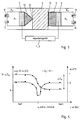
- the measuring apparatus shown in Figure 1 comprises an impedance device consisting of an alternating voltage generator 1 and an evaluation unit 2, two electrodes 3, 4, one of which electrodes 3 lie flat against the outside of a solid electrolyte 5, the inside of which is on a partial surface of one side of a side metal sample 6 to be examined is present.
- the other electrode 4 bears on a partial surface of the other side of the metal sample 6.
- the free side of the electrode 3 lies in a first space R 1 with a feed line 7 and a discharge line 8.
- the space R 1 is flushed with a hydrogen-containing gas or an electrolyte solution via the feed and discharge line 7, 8. This makes it possible to keep the concentration and possibly the temperature of the hydrogen-containing gas or electrolyte constant in this space R 1 .
- a constant temperature can be achieved with little outlay on equipment, for example with a regulated heating device.
- the areas of the metal sample 6 which are left free by the electrode 4 are in a third space R 3 which is filled with a hydrogen-containing gas of a higher concentration than the space R 1 .
- the rooms R 2 and R 3 can be joined together to form a room.
- FIG. 1 While in the embodiment of FIG. 1 a solid electrolyte 5 is provided only on one side of the metal sample 6, the embodiment of FIG. 2 is constructed symmetrically with respect to the metal sample 6. This means that a further solid electrolyte 9 is arranged between the electrode 4 and the metal sample 6 and the exposed side of the electrode 4 lies in a fourth space R 4 , which is flushed with a hydrogen-containing gas or electrolyte via a feed line 10 and a discharge line 11 becomes.
- the hydrogen concentration and possibly the temperature in this space R 4 is preferably kept constant like that in the space R 1 .
- the areas of the metal sample 6 which are left free from the solid electrolyte 5 are located in a second space R 2 which is filled with hydrogen-containing gas of a higher concentration than the space R 1 .
- the embodiment of Figure 3 differs of that of Figure 2 in that the solid electrolyte 15 as Micro contact is formed.
- the electrodes 3, 4 either consist of a porous Material that does not absorb dissolved hydrogen, however as a catalyst in the implementation of molecular Hydrogen acts in atomic hydrogen, or from one Material in which hydrogen is in dissolved form. Platinum, for example, is suitable as a catalyst.
- the mechanism of action at the interface Electrode / solid electrolyte depends on that for the electrodes 3, 4 selected material.
- the outer spaces R 2 , R 3 in which the free sides of the metal sample 6 lie are filled with a hydrogen-containing gas. This should result in an equilibrium state for dissolved hydrogen in the entire volume of the metal sample 6. This speeds up the actual testing of the metal sample 6 for the behavior of hydrogen.
- the spaces R 1 , R 4 are filled with a hydrogen-containing medium, in particular gas.
- the concentration of hydrogen and possibly the temperature in rooms R 1 , R 4 are kept constant by constant supply and discharge.
- the impedance device 1, 2 is switched on and an AC voltage with constant amplitude is applied via the electrodes 3, 4.
- the frequency ⁇ of this alternating voltage is changed from higher frequencies to lower frequencies.
- the change takes place continuously, which is not only to be understood as a linear change.
- a concentration gradient of the hydrogen protons present here occurs at the solid electrolyte 5, 9, 15 and metal sample 6 boundary layer, which migrate more or less deeply into the metal sample 6 as a function of the voltage and frequency. Because of the alternating polarity of the applied AC voltage at the electrodes 3, 4, the protons penetrating into the metal sample 6 from one side cover a certain distance in the metal sample 6 and reverse when the polarity changes. So you make an oscillating movement.
- protons can diffuse into the metal sample 6 from both sides, at a certain frequency ⁇ o there is an inflection point for the curve of the frequency-dependent impedance Z of the metal sample and a smallest value for the phase angle ⁇ of current / voltage. It has been found that with a symmetrical construction of the measuring apparatus, this value is reached when the protons have traveled halfway through the thickness of the metal sample 6 from both sides. This means that the reciprocal of this measured frequency ⁇ 0 is the transit time t 0 of the protons that they need to cross the metal sample. If the thickness x of the metal sample 6 is known, various characteristic values, such as diffusion coefficient or solubility for hydrogen in the metal sample, can then be determined.
- the reciprocal of the Frequency is equal to the time the protons travel for traversing the total thickness of the metal sample depend on the structure of the measuring apparatus.
- the reciprocal is equal to the term because that of one Proton diffusing exactly to the center and hike back what is the total thickness of the sample corresponds.
- the protons migrate through the asymmetrical structure on the other hand, twice the distance in one period (outward + Way back). This means that the term for the Cross the metal sample equal to half the reciprocal is.
Landscapes
- Chemical & Material Sciences (AREA)
- Life Sciences & Earth Sciences (AREA)
- Health & Medical Sciences (AREA)
- Physics & Mathematics (AREA)
- Chemical Kinetics & Catalysis (AREA)
- Electrochemistry (AREA)
- Molecular Biology (AREA)
- Analytical Chemistry (AREA)
- Biochemistry (AREA)
- General Health & Medical Sciences (AREA)
- General Physics & Mathematics (AREA)
- Immunology (AREA)
- Pathology (AREA)
- Investigating Or Analyzing Materials By The Use Of Electric Means (AREA)
- Investigating And Analyzing Materials By Characteristic Methods (AREA)
Abstract
Description


- Figur 1
- eine Meßapparatur mit einem bezüglich der zu untersuchenden Metallprobe unsymmetrischen Aufbau,
- Figur 2
- eine Meßapparatur mit einem bezüglich der zu untersuchenden Metallprobe symmetrischen Aufbau,
- Figur 3
- eine Meßapparatur mit einem bezüglich der zu
untersuchenden Metallprobe unsymmetrischen
Aufbau in einer zu Figur 1 abgewandelten
Ausführung
und - Figur 4
- ein Bode-Diagramm für den Phasenwinkel von Spannung und Strom an bzw. in der Metallprobe sowie deren Impedanz beim Messen mit einer Meßapparatur der Figuren 1 bis 3.
Claims (21)
- Prüfverfahren für das Verhalten von Wasserstoff in einer Metallprobe mit folgenden Merkmalen:a) An die mindestens auf einer Seite mit einem protonenleitenden Festelektrolyten versehene Metallprobe wird unter Einschluß des Festelektrolyten eine Wechselspannung angelegt.b) Gleichzeitig werden mindestens die Seite mit dem Festelektrolyten und die Probe mit Wasserstoff beaufschlagt.c) Während die Frequenz der Wechselspannung über ein bestimmtes Intervall stetig verändert wird, wird aus der Beziehung der anliegenden Spannung und des durch die Metallprobe fließenden Stroms als Kenngröße für die Bestimmung der Laufzeit des Wasserstoffes durch die Metallprobe die Frequenz ermittelt, bei der die Phasenverschiebung von Spannung und Strom am kleinsten ist.
- Prüfverfahren nach Anspruch 1,
dadurch gekennzeichnet, daß die Beaufschlagung der der Metallprobe abgewandten Seite mit einem wasserstoffhaltigen Gas oder einer wasserstoffhaltigen Elektrolytlösung erfolgt. - Prüfverfahren nach Anspruch 1 oder 2,
dadurch gekennzeichnet, daß die Wasserstoffkonzentration konstant gehalten wird. - Prüfverfahren nach einem der Ansprüche 1 bis 3,
dadurch gekennzeichnet, daß die Veränderung der Frequenz ausgehend von hohen Frequenzen zu niedrigen Frequenzen erfolgt. - Prüfverfahren nach einem der Ansprüche 1 bis 4,
dadurch gekennzeichnet, daß die Amplitude der Wechselspannung konstant gehalten wird. - Prüfverfahren nach einem der Ansprüche 1 bis 5,
dadurch gekennzeichnet, daß der Festelektrolyt und/oder die Metallprobe auf die gewünschte Meßtemperatur erwärmt werden. - Prüfverfahren nach Anspruch 1 oder 2 und einem der Ansprüche 3 bis 6,
dadurch gekennzeichnet, daß das Gas und/oder der wasserstoffhaltige Elektrolyt erwärmt werden. - Meßapparatur für die Ermittlung des Verhaltens von Wasserstoff in einer Metallprobe (6) mit einem Wechselspannungsgenerator (1), der an zwei Seiten der mindestens an einer dieser Seiten mit einem Festelektrolyten (5, 9, 15) versehenen Metallprobe (6) über Elektroden (3, 4) angeschlossen ist und dessen Wechselspannungsfrequenz über ein bestimmtes Intervall veränderbar ist, mit Mitteln (R1, R4) zur Beaufschlagung mindestens der mit dem Festelektrolyten (5, 9, 15) bestückten Seite der Metallprobe (6) mit Wasserstoff und mit einer Auswerteeinheit (2) für die frequenzabhängige Beziehung der an der Metallprobe (6) anliegenden Spannung und des durch die Metallprobe (6) fließenden Stroms, die aus der Frequenz ν, bei der die kleinste Phasenverschiebung α von Spannung und Strom vorliegt, eine Kenngröße für die Laufzeit des Wasserstoffs durch die Metallprobe (6) ermittelt.
- Meßapparatur nach Anspruch 8,
dadurch gekennzeichnet, daß mindestens die dem jeweiligen Festelektrolyten (5, 9, 15) abgewandte Seite der Elektrode (3, 4) in einem mit einem wasserstoffhaltigen Gas oder einer wasserstoffhaltigen Elektrolytlösung mit konstanter Wasserstoffkonzentration gefüllten Raum (R1, R4) untergebracht ist. - Meßapparatur nach Anspruch 8 oder 9,
dadurch gekennzeichnet, daß der Raum (R1, R4) an einer Zu- und Ableitung (7, 8, 10, 11) für das wasserstoffhaltige Gas oder den wasserstoffhaltigen Elektrolyten angeschlossen ist. - Meßapparatur nach einem der Ansprüche 8 bis 10,
dadurch gekennzeichnet, daß eine geregelte Heizeinrichtung für den Festelektrolyten und/oder die Metallprobe vorgesehen ist. - Meßapparatur nach einem der Ansprüche 8 bis 10,
dadurch gekennzeichnet, daß eine geregelte Heizeinrichtung für das wasserstoffhaltige Gas oder den Elektrolyten vorgesehen ist. - Meßapparatur nach einem der Ansprüche 7 bis 11,
dadurch gekennzeichnet, daß die freien Seiten der Metallprobe (6) in einem weiteren Raum (R2, R3) eingeschlossen sind, der mit einem wasserstoffhaltigen Gas mit einer höheren wasserstoffkonzentration als in dem anderen Raum beziehungsweise den anderen Räumen (R1, R4) mit den Elektroden (3, 4) gefüllt ist. - Meßapparatur nach einem der Ansprüche 7 bis 12,
dadurch gekennzeichnet, daß zwischen den Festelektrolyten (5, 9, 15) und der Metallprobe (6) ein Katalysator (12, 13) vorgesehen ist. - Meßapparatur nach einem der Ansprüche 7 bis 13,
dadurch gekennzeichnet, daß die Elektroden (3, 4) aus einem porösen Material bestehen, das keinen gelösten Wasserstoff aufnimmt. - Meßapparatur nach Anspruch 15,
dadurch gekennzeichnet, daß das poröse Material als Katalysator bei der Umsetzung von molekularem Wasserstoff in atomaren Wasserstoff wirkt. - Meßapparatur nach Anspruch 16,
dadurch gekennzeichnet, daß das Material Platin ist. - Meßapparatur nach einem der Ansprüche 7 bis 16,
dadurch gekennzeichnet, daß die Kontaktfläche des Festelektrolyten (15) an der der Metallprobe (6) zugewandten Seite um ein Vielfaches kleiner ist als die zugewandte Seite der Metallprobe (6). - Meßapparatur nach einem der Ansprüche 7 bis 18,
dadurch gekennzeichnet, daß das Verhältnis von Radius der Kontaktfläche zur Dicke der Metallprobe0,2 ist.
- Meßapparatur nach einem der Ansprüche 7 bis 19,
dadurch gekennzeichnet, daß die Kontaktierung der Metallprobe (6) mit dem Wechselspannungsgenerator (1) auf beiden Seiten gleich aufgebaut und damit symmetrisch ist. - Meßapparatur nach einem der Ansprüche 7 bis 20,
dadurch gekennzeichnet, daß die Kontaktierung der Metallprobe (6) mit dem Wechselspannungsgenerator (1) einen asymmetrischen Aufbau hat.
Applications Claiming Priority (2)
| Application Number | Priority Date | Filing Date | Title |
|---|---|---|---|
| DE1999126331 DE19926331C2 (de) | 1999-06-09 | 1999-06-09 | Prüfverfahren für das Verhalten von Wasserstoff in einer Metallprobe sowie Meßapparatur zur Durchführung des Prüfverfahrens |
| DE19926331 | 1999-06-09 |
Publications (2)
| Publication Number | Publication Date |
|---|---|
| EP1059527A2 true EP1059527A2 (de) | 2000-12-13 |
| EP1059527A3 EP1059527A3 (de) | 2005-02-16 |
Family
ID=7910698
Family Applications (1)
| Application Number | Title | Priority Date | Filing Date |
|---|---|---|---|
| EP00111620A Withdrawn EP1059527A3 (de) | 1999-06-09 | 2000-05-31 | Prüfverfahren für das Verhalten von Wasserstoff in einer Metallprobe sowie Messapparatur zur Durchführung des Prüfverfahrens |
Country Status (2)
| Country | Link |
|---|---|
| EP (1) | EP1059527A3 (de) |
| DE (1) | DE19926331C2 (de) |
Family Cites Families (1)
| Publication number | Priority date | Publication date | Assignee | Title |
|---|---|---|---|---|
| DE19805194C2 (de) * | 1998-02-10 | 2003-03-06 | Thyssenkrupp Stahl Ag | Prüfverfahren für das Wasserstoffverhalten von Metallproben sowie Meßapparatur zur Durchführung des Verfahrens |
-
1999
- 1999-06-09 DE DE1999126331 patent/DE19926331C2/de not_active Expired - Fee Related
-
2000
- 2000-05-31 EP EP00111620A patent/EP1059527A3/de not_active Withdrawn
Also Published As
| Publication number | Publication date |
|---|---|
| DE19926331A1 (de) | 2000-12-28 |
| DE19926331C2 (de) | 2001-12-13 |
| EP1059527A3 (de) | 2005-02-16 |
Similar Documents
| Publication | Publication Date | Title |
|---|---|---|
| DE69535008T2 (de) | Messverfahren zur Bestimmung der NOx Konzentration in einem Gas | |
| DE60035017T2 (de) | Wasserstoffgassensor | |
| EP0241751A2 (de) | Verfahren zum kontinuierlichen Überwachen von gasförmigen Bestandteilen in Gasgemischen, ausgenommen O2 | |
| DE2448320A1 (de) | Zellenanalysevorrichtung | |
| EP0471684B1 (de) | Schaltung und verfahren zum messen einer die kapazitäts-spannungs-charakteristik eines kapazitiven elementes beeinflussenden grösse | |
| DE2750161A1 (de) | Detektor fuer brennbare gase | |
| DE19780491B4 (de) | CO-Gassensor und Verfahren zur Messung der Konzentration von CO-Gas | |
| CH650338A5 (de) | Verfahren zur identifizierung der bestandteile eines stoffes, der mindestens einen hoch-dielektrischen bestandteil enthaelt und vorrichtung zur durchfuehrung des verfahrens. | |
| DE69730585T2 (de) | Verfahren zum Verbessern der Selektivität eines eine Polymerschicht aufweisenden Gassensors | |
| DE2536394C2 (de) | Detektor für in einem Chromatographen getrennte Proben | |
| DE19926331C2 (de) | Prüfverfahren für das Verhalten von Wasserstoff in einer Metallprobe sowie Meßapparatur zur Durchführung des Prüfverfahrens | |
| DE3884447T2 (de) | In-situ-Überwachung der Korrosionsrate von polarisierten oder unpolarisierten Metallen. | |
| DE10112786A1 (de) | In einer Abgasanlage einer Brennkraftmaschine einsetzbares Gasmeßelement | |
| EP0262582B1 (de) | Verfahren zur Bestimmung des Konzentrationsverhältnisses von Lithiumionen zu Natriumionen und Vorrichtung zur Durchführung dieses Verfahrens | |
| DE102005047443A1 (de) | Gassensor | |
| DE69318933T2 (de) | Verfahren zur Feststellung von wesentlichen Bestandteilen in andere mitniedersetzende Bestandteile enthaltenden Plattierungsbädern | |
| DE19850720A1 (de) | Verfahren zur Regelung der Brennstoffkonzentration in einem Alkohol oder Ether als Brennstoff und Wasser enthaltenden Brennstoffgemisch einer Brennstoffzelle und Brennstoffzellensystem | |
| DE2454339A1 (de) | Vorrichtung zur relativen messung der konzentration einer probe in einem fluid | |
| WO1993012418A2 (de) | System-apparatur und verfahren zur bestimmung von wasserspuren in festen und flüssigen substanzen | |
| EP0645615A1 (de) | Photoelektrische methode zur sedimentationsanalyse homogener disperser systeme | |
| EP0858600B1 (de) | Verfahren und vorrichtung zur analyse von flüchtigen substanzen in gasen | |
| DE3239850C2 (de) | ||
| DE102019004191A1 (de) | Gassensor und verfahren zur herstellung eines gassensors | |
| DE2255180C3 (de) | Einrichtung zum Messen der Radioaktivität einer mit radioaktivem Kohlenstoff und Tritium doppelt markierten Substanz im Durchfluß mit einem Verbrennungsofen und nachgeschaltetem Gasdurchflußzählrohr | |
| DE19806476C1 (de) | Verfahren und Meßvorrichtung zum Bestimmen des volumetrischen Dampfgehalts |
Legal Events
| Date | Code | Title | Description |
|---|---|---|---|
| PUAI | Public reference made under article 153(3) epc to a published international application that has entered the european phase |
Free format text: ORIGINAL CODE: 0009012 |
|
| AK | Designated contracting states |
Kind code of ref document: A2 Designated state(s): AT BE CH CY DE DK ES FI FR GB GR IE IT LI LU MC NL PT SE |
|
| AX | Request for extension of the european patent |
Free format text: AL;LT;LV;MK;RO;SI |
|
| RIN1 | Information on inventor provided before grant (corrected) |
Inventor name: MITTELSTAEDT, HORST, DR.RER.NAT., DIPL.-CHEM. Inventor name: BREMES, HANS-GERD, DIPL.-CHEM. Inventor name: WIEMHOEFER, HANS-DIETER,PROF.DR.RER.NAT.,DIPL.-CH Inventor name: WIENSTROEER, STEFAN, DR.RER.NAT., DIPL.-CHEM. Inventor name: WALDOEFNER, KARL-HEINZ Inventor name: NAZIKKOL, CETIN, DR.RER.NAT., DIPL.-CHEM. |
|
| RAP1 | Party data changed (applicant data changed or rights of an application transferred) |
Owner name: THYSSENKRUPP STAHL AG |
|
| PUAL | Search report despatched |
Free format text: ORIGINAL CODE: 0009013 |
|
| RIC1 | Information provided on ipc code assigned before grant |
Ipc: 7G 01N 33/20 B Ipc: 7G 01N 27/411 A |
|
| AK | Designated contracting states |
Kind code of ref document: A3 Designated state(s): AT BE CH CY DE DK ES FI FR GB GR IE IT LI LU MC NL PT SE |
|
| AX | Request for extension of the european patent |
Extension state: AL LT LV MK RO SI |
|
| STAA | Information on the status of an ep patent application or granted ep patent |
Free format text: STATUS: THE APPLICATION IS DEEMED TO BE WITHDRAWN |
|
| 18D | Application deemed to be withdrawn |
Effective date: 20041201 |