EP1040938A1 - Heat-sensitive sheet for stencil printing - Google Patents
Heat-sensitive sheet for stencil printing Download PDFInfo
- Publication number
- EP1040938A1 EP1040938A1 EP00302756A EP00302756A EP1040938A1 EP 1040938 A1 EP1040938 A1 EP 1040938A1 EP 00302756 A EP00302756 A EP 00302756A EP 00302756 A EP00302756 A EP 00302756A EP 1040938 A1 EP1040938 A1 EP 1040938A1
- Authority
- EP
- European Patent Office
- Prior art keywords
- sheet
- heat
- printing
- film
- porous support
- Prior art date
- Legal status (The legal status is an assumption and is not a legal conclusion. Google has not performed a legal analysis and makes no representation as to the accuracy of the status listed.)
- Withdrawn
Links
Images

Classifications
-
- B—PERFORMING OPERATIONS; TRANSPORTING
- B32—LAYERED PRODUCTS
- B32B—LAYERED PRODUCTS, i.e. PRODUCTS BUILT-UP OF STRATA OF FLAT OR NON-FLAT, e.g. CELLULAR OR HONEYCOMB, FORM
- B32B27/00—Layered products comprising a layer of synthetic resin
- B32B27/12—Layered products comprising a layer of synthetic resin next to a fibrous or filamentary layer
-
- B—PERFORMING OPERATIONS; TRANSPORTING
- B32—LAYERED PRODUCTS
- B32B—LAYERED PRODUCTS, i.e. PRODUCTS BUILT-UP OF STRATA OF FLAT OR NON-FLAT, e.g. CELLULAR OR HONEYCOMB, FORM
- B32B27/00—Layered products comprising a layer of synthetic resin
- B32B27/36—Layered products comprising a layer of synthetic resin comprising polyesters
-
- B—PERFORMING OPERATIONS; TRANSPORTING
- B32—LAYERED PRODUCTS
- B32B—LAYERED PRODUCTS, i.e. PRODUCTS BUILT-UP OF STRATA OF FLAT OR NON-FLAT, e.g. CELLULAR OR HONEYCOMB, FORM
- B32B5/00—Layered products characterised by the non- homogeneity or physical structure, i.e. comprising a fibrous, filamentary, particulate or foam layer; Layered products characterised by having a layer differing constitutionally or physically in different parts
- B32B5/02—Layered products characterised by the non- homogeneity or physical structure, i.e. comprising a fibrous, filamentary, particulate or foam layer; Layered products characterised by having a layer differing constitutionally or physically in different parts characterised by structural features of a fibrous or filamentary layer
- B32B5/022—Non-woven fabric
-
- B—PERFORMING OPERATIONS; TRANSPORTING
- B41—PRINTING; LINING MACHINES; TYPEWRITERS; STAMPS
- B41N—PRINTING PLATES OR FOILS; MATERIALS FOR SURFACES USED IN PRINTING MACHINES FOR PRINTING, INKING, DAMPING, OR THE LIKE; PREPARING SUCH SURFACES FOR USE AND CONSERVING THEM
- B41N1/00—Printing plates or foils; Materials therefor
- B41N1/24—Stencils; Stencil materials; Carriers therefor
-
- B—PERFORMING OPERATIONS; TRANSPORTING
- B32—LAYERED PRODUCTS
- B32B—LAYERED PRODUCTS, i.e. PRODUCTS BUILT-UP OF STRATA OF FLAT OR NON-FLAT, e.g. CELLULAR OR HONEYCOMB, FORM
- B32B2262/00—Composition or structural features of fibres which form a fibrous or filamentary layer or are present as additives
- B32B2262/02—Synthetic macromolecular fibres
- B32B2262/0276—Polyester fibres
-
- B—PERFORMING OPERATIONS; TRANSPORTING
- B32—LAYERED PRODUCTS
- B32B—LAYERED PRODUCTS, i.e. PRODUCTS BUILT-UP OF STRATA OF FLAT OR NON-FLAT, e.g. CELLULAR OR HONEYCOMB, FORM
- B32B2367/00—Polyesters, e.g. PET, i.e. polyethylene terephthalate
-
- Y—GENERAL TAGGING OF NEW TECHNOLOGICAL DEVELOPMENTS; GENERAL TAGGING OF CROSS-SECTIONAL TECHNOLOGIES SPANNING OVER SEVERAL SECTIONS OF THE IPC; TECHNICAL SUBJECTS COVERED BY FORMER USPC CROSS-REFERENCE ART COLLECTIONS [XRACs] AND DIGESTS
- Y10—TECHNICAL SUBJECTS COVERED BY FORMER USPC
- Y10S—TECHNICAL SUBJECTS COVERED BY FORMER USPC CROSS-REFERENCE ART COLLECTIONS [XRACs] AND DIGESTS
- Y10S428/00—Stock material or miscellaneous articles
- Y10S428/913—Material designed to be responsive to temperature, light, moisture
-
- Y—GENERAL TAGGING OF NEW TECHNOLOGICAL DEVELOPMENTS; GENERAL TAGGING OF CROSS-SECTIONAL TECHNOLOGIES SPANNING OVER SEVERAL SECTIONS OF THE IPC; TECHNICAL SUBJECTS COVERED BY FORMER USPC CROSS-REFERENCE ART COLLECTIONS [XRACs] AND DIGESTS
- Y10—TECHNICAL SUBJECTS COVERED BY FORMER USPC
- Y10T—TECHNICAL SUBJECTS COVERED BY FORMER US CLASSIFICATION
- Y10T428/00—Stock material or miscellaneous articles
- Y10T428/24—Structurally defined web or sheet [e.g., overall dimension, etc.]
- Y10T428/24802—Discontinuous or differential coating, impregnation or bond [e.g., artwork, printing, retouched photograph, etc.]
-
- Y—GENERAL TAGGING OF NEW TECHNOLOGICAL DEVELOPMENTS; GENERAL TAGGING OF CROSS-SECTIONAL TECHNOLOGIES SPANNING OVER SEVERAL SECTIONS OF THE IPC; TECHNICAL SUBJECTS COVERED BY FORMER USPC CROSS-REFERENCE ART COLLECTIONS [XRACs] AND DIGESTS
- Y10—TECHNICAL SUBJECTS COVERED BY FORMER USPC
- Y10T—TECHNICAL SUBJECTS COVERED BY FORMER US CLASSIFICATION
- Y10T428/00—Stock material or miscellaneous articles
- Y10T428/249921—Web or sheet containing structurally defined element or component
- Y10T428/249953—Composite having voids in a component [e.g., porous, cellular, etc.]
- Y10T428/249987—With nonvoid component of specified composition
-
- Y—GENERAL TAGGING OF NEW TECHNOLOGICAL DEVELOPMENTS; GENERAL TAGGING OF CROSS-SECTIONAL TECHNOLOGIES SPANNING OVER SEVERAL SECTIONS OF THE IPC; TECHNICAL SUBJECTS COVERED BY FORMER USPC CROSS-REFERENCE ART COLLECTIONS [XRACs] AND DIGESTS
- Y10—TECHNICAL SUBJECTS COVERED BY FORMER USPC
- Y10T—TECHNICAL SUBJECTS COVERED BY FORMER US CLASSIFICATION
- Y10T428/00—Stock material or miscellaneous articles
- Y10T428/31—Surface property or characteristic of web, sheet or block
-
- Y—GENERAL TAGGING OF NEW TECHNOLOGICAL DEVELOPMENTS; GENERAL TAGGING OF CROSS-SECTIONAL TECHNOLOGIES SPANNING OVER SEVERAL SECTIONS OF THE IPC; TECHNICAL SUBJECTS COVERED BY FORMER USPC CROSS-REFERENCE ART COLLECTIONS [XRACs] AND DIGESTS
- Y10—TECHNICAL SUBJECTS COVERED BY FORMER USPC
- Y10T—TECHNICAL SUBJECTS COVERED BY FORMER US CLASSIFICATION
- Y10T428/00—Stock material or miscellaneous articles
- Y10T428/31504—Composite [nonstructural laminate]
- Y10T428/31786—Of polyester [e.g., alkyd, etc.]
Definitions
- the present invention relates to a heat-sensitive sheet for stencil printing. More specifically, the invention relates to a heat-sensitive sheet for stencil printing which causes no jamming in a stencil printing apparatus during feeding and no wrinkle at the time of winding around or loaded on a printing drum, and is not elongated even when a large number of sheets of paper are printed, and thus sharp printed images can be obtained.
- a heat-sensitive sheet for stencil printing was not necessarily satisfactory in definition or sharpness of printed images, particularly in evenness of its solid parts. While various causes can be adduced for such circumstance, a condition ascribable to the fibers which constitute the support can be mentioned as one of the causes.
- tissue paper thin paper which is conventionally used as the porous support in a stencil sheet and composed of natural fibers has defects as follows:
- Definition of images is improved by thinning the diameter of fibers in the porous support or reducing the basis weight of the paper or fabric.
- there occur such problems that runnability of the sheet is lowered to cause jamming in the printing apparatuses during feeding, and that wrinkles occur on the sheet when an unperforated or perforated sheet is wound around and loaded a printing drum, and the wrinkles degrade the quality of printing.
- the sheet is elongated (elongation at printing) or wrinkles occur on the sheet (wrinkles at printing) and thus reproducibility of a manuscript in printed papers is lowered when a number of papers are printed.
- a stencil sheet having a specific tensile strength and flexural rigidity that is, a specified tenacity and stiffness
- another stencil sheet having a specific wet elongation when the sheets is stretched under a certain load (Laid-open Japanese Patent Publication No. Hei 5-104875) have been proposed.
- the sheet has the strength and rigidity (stiffness) described above, the effect of preventing the wrinkle occurrence when the sheet is wound around a printing drum is low, and the sheet is not thoroughly satisfied even as to the wrinkle occurrence at printing.
- An aim of the present invention is to solve the problems in the prior art described above.
- Another object of the present invention is to provide a heat-sensitive sheet for stencil printing which sheet is excellent in runnability, occurrence of wrinkles on the sheet when the sheet is wound around a drum of a printing apparatus is efficiently prevented, elongation of the sheet is repressed and occurrence of wrinkles on the sheet can be prevented when a large number of papers are printed, and thus printed papers having a sharp images excellent in reproducibility of a manuscript can be obtained.
- the present invention is concerned with a heat-sensitive sheet for stencil printing comprising a laminate of a thermoplastic resin film and a porous support mainly composed of synthetic fibers which sheet has a wet tensile strength in the machine direction (longitudinal direction) of 200 gf/cm or higher, a KES bending rigidity B value in the machine direction or cross direction (lateral direction) of 0.02 g ⁇ cm 2 /cm or higher, and a PPS smoothness determined when a film is pressed against the surface of the porous support of the sheet of 0.9 ⁇ m or higher.
- Fig. 1 is a schematic illustration of the portion for perforating a heat-sensitive stencil sheet in a stencil printing apparatus.
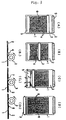
- Fig. 2 is a schematic illustration of the mechanism by which wrinkles are formed on the sheet when a perforated heat-sensitive stencil sheet is wound around a printing drum.
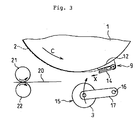
- Fig. 3 is a schematic illustration of a part of printing portion in a stencil printing apparatus.
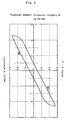
- Fig. 4 is a graph showing a M-K curve used in the determination of KES flexural rigidity of a heat-sensitive stencil sheet.
- Fig. 1 is to schematically illustrate particularly the portion for perforating a stencil sheet in a stencil printing apparatus.
- a read sensor reads the light and shade corresponding to the diagrams and letters in the manuscript as digital signals, and the signals are transmitted to thermal head 10.
- stencil sheet 2 set on a holder is fed up to thermal head 10 with feeding roller 11, and then perforated by the heat of thermal head 10 to form a perforated stencil sheet.
- Front end portion of the perforated stencil sheet 2 is held by clamp portion 9 and then wound around printing drum 1.
- Ink is squeezed out from the inside of printing drum 1 and transferred to a printing paper through perforated portions of the sheet 2 to complete printing. Printing paper is fed in synchronization with the rotation of printing drum 1, and a necessary number of sheets are continuously printed.
- Fig. 1, 3 is a press roller and 13 is a cutter.
- Tension is applied on stencil sheet 2 toward the running direction in a printing apparatus. Accordingly, when the strength of stencil sheet 2 is insufficient or the sturdiness of the sheet is insufficient, a distortion occurs on a running stencil sheet, and thus wrinkles sometimes occur on the sheet in the machine direction when the sheet is wound around a printing drum. Besides, even when the strength of stencil sheet 2 is sufficient and the sheet is stiff, wrinkles sometimes occur at the time when the sheet is wrapped on a printing drum as described below.
- the front end of stencil sheet 2 is held by clamp portion 9 to place the sheet on printing drum 1 ((A)).
- stencil sheet 2 is placed on printing drum 1 such that printing surface 6, that is, the layer of a thermoplastic resin film becomes the upper surface of the sheet.
- the stencil sheet 2 is wound around the outer surface of printing drum 1 by the rotation of the printing drum 1 while being pressed with press roller 3, and finally whole printing surface 6 is placed on the drum ((B), (C), (D)). While the sheet is wound around the printing drum, not-contact portion 5 at which the stencil sheet 2 does not contact with the printing drum and has a air layer between the stencil sheet 2 and printing drum 1 exists at the other end of the placed stencil sheet 2.
- FIG. 3 is a schematic illustration of a part of printing portion in a representative stencil printing apparatus.
- printing drum 1 is provided with clamp portion 9 having fixed part 12 fixed at a part of the perimeter of the drum, and movable part 14 which is connected to the fixed portion by a hinge and can be opened and closed with the hinge being its axis. They are designed such that stencil sheet 2 is fed with a sheet feeding device to opened clamp portion 9, and the front end of the sheet is clamped with clamp portion 9.
- pressing device 15 for printing paper 20 is placed below printing drum 1, pressing device 15 for printing paper 20 is placed.
- Printing paper 20 is fed by the rotation of a pair of paper feeding rollers 21, 22 to a printing position at a predetermined timing, synchronized with a rotation of stencil sheet 2 placed on printing drum 1 as shown by arrow C.
- Supporting arm 17 is moved up and down with the axis 16 being its center by a member such as a cam (not shown in the drawing) for moving the arm up and down, synchronized with the feeding of the paper, and the printing paper 20 is pressed against the stencil sheet 2 by free rotation type press roller 3 supported by the arm to conduct printing.
- Printing drum 1 and pressing device 15 are set up on a frame (not shown in the drawing).
- press roller 3 is not rotated at the moment when the roller was pressed to a stencil sheet in such printing portion, a force in the direction opposite to that of the rotation of printing drum 1 is applied on printing paper 20 and the stencil sheet 2 in turn as shown by arrow X to cause elongation of the stencil sheet 2. Further, when running speed of printing paper 20 fed with paper feeding rollers 21, 22 becomes slower than the rotational speed of printing drum 1, a back tension is applied on printing paper 20. Even such a condition becomes a cause of producing elongation of stencil sheet 2.
- a printing paper exerts the stencil sheet an external stress which is caused by the back tension of paper feeding rollers and acts as a force to elongate the stencil sheet, and a press roller also exerts the sheet a resisting force, and thus the stencil sheet is elongated.
- the heat-sensitive stencil sheet of the present invention is adjusted, from the viewpoints described above, such that PPS smoothness of the surface of the porous support contacting with a printing drum is higher than a certain value and the sheet has a specific strength, occurrence of wrinkles on the sheet when the sheet is wound around a printing drum can be prevented, elongation of the sheet when a large number of paper sheets are printed is repressed, occurrence of wrinkles at the time of printing can be prevented, reproducibility of diagrams and letters on a manuscript in printed papers is excellent, and definition of images in printed portions is not reduced.
- PPS smoothness of the surface of the porous support in a heat-sensitive stencil sheet is 0.9 ⁇ m or higher, preferably 1.1 ⁇ m or higher, and more desirably 1.7 ⁇ m or higher.
- PPS smoothness means smoothness determined by air-leak method using Parker Print-Surf type paper smoothness tester (produced by Messmer Buchel Co. Ltd.), and PPS smoothness in the present invention means the value determined when a film having a thickness of 0.1 to 10 ⁇ m and a PPS smoothness of 0.0 ⁇ m is pressed against the surface of the porous support of a stencil sheet.
- the film used for determination of the smoothness is not specifically limited as long as the film has a thickness mentioned above and a surface smoothness of 0.0 ⁇ m, usually a film of a thermoplastic resin used for producing the heat-sensitive stencil sheet is employed.
- a film of a thermoplastic resin used for producing the heat-sensitive stencil sheet is employed.
- the upper limit of PPS smoothness of the surface of the porous support is not specifically limited, it is desirably adjusted to be lower than 8.0 ⁇ m from the viewpoint of the smoothness of the surface of the film of a stencil sheet.
- KES flexural rigidity B value of a stencil sheet in the machine or cross direction is 0.02 g ⁇ cm 2 /cm or higher and preferably 0.03 to 0.10 g ⁇ cm 2 /cm.
- the KES flexural rigidity B value is lower than 0.02 g ⁇ cm 2 /cm, stiffness of the stencil sheet is insufficient, wrinkles are readily occur when the sheet is wound around a printing drum and thus printing quality is degraded.
- machine direction means the running direction of a heat-sensitive stencil sheet when it is fed to a printing apparatus or the direction to which the sheet wound around a printing drum is rotated.
- Kawabata's Evaluation System for Fabrics which system was devised by Professor Kawabata at Kyoto University and has widely been used as a method for determining hand feeling of woven or knitted fabrics in terms of a physical quantity.
- wet tensile strength of a stencil sheet in the machine direction is 200 gf/cm or higher and preferably 300 gf/cm or higher.
- wet tensile strength of the sheet in the mechanical direction is lower than 200 gf/cm, strength of a stencil sheet is insufficient and running of the sheet sometimes can not smoothly be conducted since a tension is applied on the sheet in its running direction in a printing apparatus. In an extreme case, tearing of the sheet occurs, or wrinkles sometimes occur on the sheet due to insufficient strength of the sheet when the sheet is wound around a printing drum.
- Heat-sensitive sheet for stencil printing of the present invention can be obtained by laminating a thermoplastic resin film and a porous support mainly composed of synthetic fibers.
- thermoplastic resin film used in the present invention a known film comprising a polyester, polyamide, polypropylene, polyethylene, polyvinyl chloride, polyvinylidene chloride, or their copolymer can be used, but a polyester film is especially preferable from the viewpoint of sensitivity to perforation.
- polyester used for the thermoplastic resin film a polyethylene terephthalate, copolymer of ethylene terephthalate with ethylene isophthalate, polyethylene-2,6-naphthalate, polyhexamethylene terephthalate, and copolymer of hexamethylene terephthalate with 1,4-cyclohexanedimethylene terephthalate can be mentioned.
- the thermoplastic resin film can be prepared by a known T-die extrusion method, inflation method, or the like, and a stretched film, particularly, biaxially stretched film is preferable.
- the film can be obtained, for instance, by extruding a polymer through a T-die extrusion method on a cast drum to prepare an unstretched film, stretching the unstretched film with a group of heated rollers in the machine direction, feeding the film to a tenter or the like, and further stretching it in the cross direction.
- Unstretched film having a desired thickness can be prepared by adjusting the slit width of an orifice, amount of a polymer to be extruded, and the number of revolution of a cast drum.
- the film can be stretched at a desired stretching ratio by adjusting the rotational speed of a group of heated rollers and changing the preset width of a tenter.
- thermoplastic resin film Flame retardant, thermal stabilizer, antioxidant, UV absorber, antistatic agent, pigment, dye, organic lubricant such as aliphatic acid ester and wax, anti-foaming agent such as polysiloxane, and the likes can be added to the thermoplastic resin film, when necessary.
- Thickness of the thermoplastic resin film is suitably decided depending on the sensitivity and others required of the stencil sheet, and usually adjusted to 0.1 to 10 ⁇ m, preferably 0.1 to 5 ⁇ m, and more desirably 0.1 to 3 ⁇ m.
- thickness of the film exceeds 10 ⁇ m, perforatability sometimes reduces, but when it is less than 0.1 ⁇ m, the film forming stability occasionally lowers.
- porous support used in the present invention and mainly composed of synthetic fibers, a paper prepared by a wet paper-making method, nonwoven fabric, woven fabric, or gauze screen from short fibers mainly comprising synthetic fibers can be used, but the nonwoven fabric is preferable.
- synthetic fibers known fibers of, for example, a polyester, polyamide, polyphenylenesulfide, polyacrylonitrile, polypropylene, polyethylene, or their copolymer is used. These synthetic fibers may be used in one kind of fibers, or two or more kind of fibers. Alternatively, the fibers may comprise natural fibers or regenerated cellulose fibers. However, polyester fibers are preferable from the viewpoint of thermal stability at the time of perforation. Even when two or more kind of fibers are used, the fibers preferably comprise at least 60 % by weight of polyester fibers.
- polyester used for the synthetic fibers polyethylene terephthalate, polyethylene naphthalate, polycyclohexane-dimethylene terephthalate, and copolymer of ethylene terephthalate with ethylene isophthalate can be mentioned.
- a flame retardant, thermal stabilizer, antioxidant, UV absorber, antistatic agent, pigment, dye, organic lubricant such as aliphatic acid ester and wax, and anti-foaming agent such as polysiloxane can be blended, when necessary.
- nonwoven fabric one prepared by a known direct melt spinning method such as a flash spinning method, melt blow spinning method, and spun bond method is used.
- the nonwoven fabric is prepared through a melt blow spinning method by blowing heated air from the circumference of a spinneret when a melted polymer is extruded through the spinneret to make the extruded polymer into fine fibers by the heated air, and then collecting the fibers on a net conveyer arranged at a suitable position taking advantage of the air to form a web.
- the web is sucked together with the heated air by a suction device provided at the net conveyer, and collected before individual fibers are completely solidified. That is, the web is collected in the state wherein the fibers are melt-adhered to one another. Extent of melt-adhesion of the fibers can be adjusted by suitably establish the distance between the spinneret and the net conveyer. Besides, basis weight of the web and fiber diameter of a single fiber can be optionally adjusted by properly controlling the amount of a polymer to be extruded, temperature of the heated air, flow rate of the heated air, and moving speed of the conveyer.
- Fibers spun by a melt blow method are thinned by the pressure of heated air and solidified in not-oriented or low-oriented state. Thickness of fibers is not uniform, and a web is formed in the state where thick fibers and thin fibers are properly dispersed. Polymer extruded from a spinneret is solidified in the state of a low crystallinity close to amorphous, since the polymer is rapidly cooled from a melted state to that in the atmosphere at room temperature.
- the surface of fibers which constitute the nonwoven fabric may be subjected to a chemical treatment by an acid, alkali, or the like, corona treatment, and low temperature plasma treatment, when necessary.
- average diameter of fibers in the porous support is preferably 2 to 15 ⁇ m.
- the average fiber diameter is smaller than 2 ⁇ m, wrinkles are liable to occur on a stencil sheet and unperforated portions are ready to be caused at the time of perforation, but when it exceeds 15 ⁇ m, unevenness is apt to be caused in passing of the ink.
- Fiber basis weight (Metsuke) of the porous support is usually 2 to 30 g/m 2 , preferably 2 to 20 g/m 2 , and more desirably 5 to 15 g/m 2 .
- basis weight exceeds 30 g/m 2 , passability of an ink reduces and definition of images lowers, but when the basis weight is lower than 2 g/m 2 , a strength sufficient as the support sometimes can not be obtained.
- Laminating of a thermoplastic resin film and porous support to integrate them can be performed by adhesion using an adhesive (binder) under conditions wherein sensitivity of the thermoplastic resin film to perforation is not reduced, or by adhering the thermoplastic resin film and porous support under heating without using an adhesive.
- an adhesive binder
- the adhesive one of vinyl acetate type, acrylic type, vinyl chloride-vinyl acetate copolymer type, polyester type, and polyurethane type are used.
- an adhesive of UV curing type a mixture of a polyester type acrylate, urethane type acrylate, epoxy type acrylate, or polyol type acrylate with a photopolymerization initiator may be used.
- an adhesive comprising, as a main component, an urethane type acrylate is particularly preferable.
- thermoplastic resin film and porous support by heat-adhesion without using an adhesive.
- Heat-adhesion is usually performed by "heat-pressing" in which the thermoplastic resin film and porous support are directly stuck to each other while being heated. While the method for the "heat-pressing” is not specifically limited, heat pressing with a heated roller is especially preferable from the viewpoint of processability.
- Adhesion temperature is preferably between 80 and 170°C and more preferably 100 to 150°C.
- thermoplastic resin film and nonwoven fabric are integrated and can satisfactorily be stretched without separating by co-stretching them under a heat-adhered condition.
- a reticulated nonwoven fabric preferable as the support can be formed since fibers in the nonwoven fabric are stretched at this time in the state wherein they are melt-adhered to one another at their interlocking or connecting points.
- thermoplastic resin film and porous support are directly fixed to each other and can be integrated without using an adhesive by stretching them integratedly.
- Method of co-stretching is not specifically limited, but a biaxial stretching is preferable, and it may be either a consecutive or simultaneous biaxial stretching.
- a consecutive biaxial stretching it is general to stretch in the order of machine direction and then cross direction, but it may be performed in the reverse order.
- Stretching ratio is not specifically limited and it is properly prescribed depending on the type of a thermoplastic resin to be used, perforation sensitivity required of a stencil sheet, and the like. However, about 2 to 8 times each in the machine direction and cross direction are usually suitable. Besides, it may be restretched in the machine, cross, or simultaneously machine and cross directions, after the biaxial stretching. Further, it is preferable to heat treating the sheet after the biaxial stretching. Heat treating temperature at this time is not specifically limited and it is properly selected depending on the type of a thermoplastic resin to be used. However, a temperature of 80 to 260°C and a period of time of 0.5 to 60 seconds are usually suitable.
- Crystallinity of fibers in a nonwoven fabric is preferably 20 % or higher and desirably 25 % or higher in particular.
- Relation between the melting point (Tm 1 ) of a thermoplastic resin film and the melting point (Tm 2 ) of a nonwoven fabric is preferably Tm 1 ⁇ Tm 2.
- Peeling strength of a laminated and integrated thermoplastic film and porous support is preferably 1 g/25 mm or higher, more preferably 3 g/25 mm, and still more desirably 5 g/25 mm or higher.
- peeling strength is lower than 1 g/25 mm, peeling of a thermoplastic resin film from a porous support sometimes occurs when a stencil sheet is fed to a printing apparatus.
- a releasing agent is preferably coated on the surface of the film which constitutes the sheet in the present invention to form a layer of the releasing agent.
- Coating of a releasing agent may be conducted at any one of a step prior to or after a biaxial stretching which is conducted after the unstretched film and unstretched nonwoven fabric described above were heat-adhered, a step between the first stretching and second stretching in a biaxial stretching, and a separate step after winding up. From the effect of preventing sticking, it is especially preferable to coat prior to stretching. While a method for coating a releasing agent is not specifically limited, it is preferable to coat by using a roll coater, gravuer coater, reverse coater, or bar (rod) coater.
- a known agent comprising a silicone oil, silicone resin, fluorine type resin, or surface active agent can be used.
- additives such as an antistatic agent, a heat resisting agent, an antioxidant, organic particles, inorganic particles, and a pigment can be mixed to the releasing agent.
- various additives for example, a dispersing agent, surface active agent, antiseptic agent, and defoaming agent may be added to a coating solution of the releasing agent for the purpose of improve the dispersibility.
- Thickness of the layer of the releasing agent is preferably 0.005 to 0.4 ⁇ m and more desirably 0.01 to 0.4 ⁇ m from the viewpoint of runnability of a stencil sheet at the time of perforation and stain resistance of the thermal head.
- PPS smoothness of the surface of the porous support of a sample stencil sheet was determined by employing a Parker Print-Surf Roughness Tester ME-90 (produced by Messmer Buchel Co., Ltd.) at a clamping pressure of 500 KPa using a hard ⁇ backing while a thermoplastic film is being pressed against the surface of the porous support of the sheet such that wrinkles are not formed on the film. Determinations were carried out for optional 5 portions of the sample, the average value of the 5 determination values was calculated, and the average value thus obtained was assumed to be PPS smoothness of the surface of the porous support of a sample stencil sheet.
- thermoplastic film As the thermoplastic film, the same film having a film thickness of 2 ⁇ m as that used for a stencil sheet was employed. In this time, PPS smoothness of the film itself was 0.0 ⁇ m.
- KES bending rigidity B value of a sample heat-sensitive stencil sheet was determined by employing a pure bending characteristic tester (JTC-1) (produced by Japan Seiki Seisakusho (precision machine manufacturing) Co., Ltd.) according to the following procedures:
- a heat-sensitive stencil sheet was cut by a single-edged razor to collect 10 sample sheets of 10 cm wide and 10 cm long.
- Average value of bending rigidity B value of 10 sample sheets was calculated and the average value thus obtained was assumed to be flexural rigidity B value.
- Heat-sensitive stencil sheet was cut by a single-edged razor to collect 10 sample sheets of 15 mm wide and 150 mm long. Next, the sample sheet was immersed in water so that the sheet became hydrophilic. The sheet was stretched until it ruptured by employing a "Universal Tester: Autograph AGS-Type D" (produced by Shimadzu Corp.) at a testing rate of 10 mm/min with the length of the test sheet being 100 mm, and the wet tensile strength was calculated by dividing the load at the time of 2 % (2 mm) elongation by the width of the sample sheet. Average value of the wet tensile strength of 10 sample sheets was calculated and the average value thus obtained was assumed to be wet tensile strength in the machine direction.
- Optional 10 portions of a nonwoven fabric in a sample heat-sensitive stencil sheet were photographed by an electron microscope (SEM) to obtain 10 photographs. Diameter of fibers in the 10 photographs were measured in such a manner that the diameter of optional 15 fibers per one photograph were measured to obtain diameter of 150 fibers in total, and the average fiber diameter was calculated.
- SEM electron microscope
- Weight of a heat-sensitive stencil sheet was measured by a precision balance and converted into the weight per m 2 . Weight corresponding to that of the film was deducted from the converted weight and the weight thus obtained was assumed to be the fiber basis weight.
- Heat-sensitive stencil sheet prepared was fed to a "Risograph" GR377 (produced by RISO KAGAKU CORPORATION), run toward a printing drum while being subjected to a blank perforation (printing ratio: 0 %) and grid pattern perforation (printing ratio: 50 %), and wound around the drum.
- a "Risograph" GR377 produced by RISO KAGAKU CORPORATION
- Heat-sensitive stencil sheet prepared was fed to a "Risograph" GR377 (produced by RISO KAGAKU CORPORATION), a grid pattern perforation was conducted, and then printing was carried out. Distance between optional 2 points in the top to bottom direction in a printed paper was measured, and the degree of change of 1000th printed paper sheet to the first printed paper sheet was calculated.
- Heat-sensitive stencil sheet prepared was fed to a "Risograph" GR377 (produced by RISO KAGAKU CORPORATION), a grid pattern perforation was conducted, and then printing was carried out. After 1000 paper sheets were printed, conditions of the sheet on the printing drum were visually inspected and evaluated by the following criteria:
- the nonwoven fabric described above was placed on the unstretched film, fed to a heating roller, and pressed at a roller temperature of 80°C to prepare a laminated sheet.
- This laminated sheet was stretched 3.5 times in the flowing direction between heated rollers at 90°C, fed to a tenter type stretching machine and stretched 4 times in the width direction at 95°C, and heat treated in the tenter at 160°C.
- Wax type releasing agent was coated on the surface of the film at the entrance portion of the tenter by using a gravure coater such that the weight of the releasing agent after drying became 0.1 g/m 2 to prepare a heat-sensitive stencil sheet.
- the sheet thus obtained had a fiber basis weight of 11 g/m 2 , average diameter of fibers in the support of 6.0 ⁇ m, and a thickness of the thermoplastic resin film of 1.5 ⁇ m.
- PPS smoothness determined when a thermoplastic film was pressed against the surface of the support of the sheet was 1.52 ⁇ m
- wet tensile strength in the machine direction of the sheet was 310 gf/cm
- KES bending rigidity B value in the machine and cross directions were 0.059 g ⁇ cm 2 /cm and 0.049 g ⁇ cm 2 /cm, respectively.
- Heat-sensitive stencil sheet was prepared in the same manner as in Example 1 with the exception that a nonwoven fabric having a basis weight of 120 g/m 2 and average fiber diameter of 8.4 ⁇ m was used in place of the nonwoven fabric in Example 1.
- the sheet thus obtained had a fiber basis weight of 11 g/m 2 , average diameter of fibers in the support of 4.2 ⁇ m, and a thickness of the thermoplastic resin film of 1.5 ⁇ m.
- PPS smoothness determined when a thermoplastic film was pressed against the surface of the support of the sheet was 0.93 ⁇ m
- wet tensile strength in the machine direction of the sheet was 302 gf/cm
- KES bending rigidity B value in the machine and cross directions were 0.064 g ⁇ cm 2 /cm and 0.051 g ⁇ cm 2 /cm, respectively.
- Heat-sensitive stencil sheet was prepared in the same manner as in Example 1 with the exception that a nonwoven fabric having a basis weight of 80 g/m 2 and average fiber diameter of 12.2 ⁇ m was used in place of the nonwoven fabric in Example 1.
- the sheet thus obtained had a fiber basis weight of 7 g/m 2 , average diameter of fibers in the support of 6.1 ⁇ m, and a thickness of the thermoplastic resin film of 1.5 ⁇ m.
- PPS smoothness determined when a thermoplastic film was pressed against the surface of the support of the sheet was 1.58 ⁇ m
- wet tensile strength in the machine direction of the sheet was 203 gf/cm
- KES bending rigidity B value in the machine and cross directions were 0.025 g ⁇ cm 2 /cm and 0.023 g ⁇ cm 2 /cm, respectively.
- Heat-sensitive stencil sheet was prepared in the same manner as in Example 1 with the exception that a nonwoven fabric having a basis weight of 80 g/m 2 and average fiber diameter of 7.0 ⁇ m was used in place of the nonwoven fabric in Example 1.
- the sheet thus obtained had a fiber basis weight of 7 g/m 2 , average diameter of fibers in the support of 3.5 ⁇ m, and a thickness of the thermoplastic resin film of 1.5 ⁇ m.
- PPS smoothness determined when a thermoplastic film was pressed against the surface of the support of the sheet was 0.91 ⁇ m
- wet tensile strength in the machine direction of the sheet was 211 gf/cm
- KES bending rigidity B value in the machine and cross directions were 0.028 g ⁇ cm 2 /cm and 0.024 g ⁇ cm 2 /cm, respectively.
- Polyester film was provided by forming a single film in advance such that the film thickness became 1.7 ⁇ m at stretching.
- Porous support prepared from natural fibers and synthetic fibers (polyester fibers) by using a wet papermaking process and having a basis weight of 10.5 g/m 2 was stuck on the film described above through a polyvinyl acetate resin in a coating amount of 0.8 g/m 2 , and then a silicone type releasing agent was coated on the film surface to prepare a heat-sensitive stencil sheet.
- PPS smoothness determined when a thermoplastic film was pressed against the surface of the support of the sheet thus obtained was 1.74 ⁇ m
- wet tensile strength in the machine direction of the sheet was 350 gf/cm
- KES bending rigidity B value in the machine and cross directions were 0.028 g ⁇ cm 2 /cm and 0.021 g ⁇ cm 2 /cm, respectively.
- Heat-sensitive stencil sheet was prepared in the same manner as in Example 1 with the exception that a nonwoven fabric having a basis weight of 60 g/m 2 and average fiber diameter of 13.0 ⁇ m was used in place of the nonwoven fabric in Example 1.
- the sheet thus obtained had a fiber basis weight of 5 g/m 2 , average diameter of fibers in the support of 6.5 ⁇ m, and a thickness of the thermoplastic resin film of 1.5 ⁇ m.
- PPS smoothness determined when a thermoplastic film was pressed against the surface of the support of the sheet was 1.63 ⁇ m
- wet tensile strength in the machine direction of the sheet was 154 gf/cm
- KES bending rigidity B value in the machine and cross directions were 0.021 g ⁇ cm 2 /cm and 0.020 g ⁇ cm 2 /cm, respectively.
- Heat-sensitive stencil sheet was prepared in the same manner as in Example 1 with the exception that a nonwoven fabric having a basis weight of 80 g/m 2 and average fiber diameter of 6.0 ⁇ m was used in place of the nonwoven fabric in Example 1.
- the sheet thus obtained had a fiber basis weight of 7 g/m 2 , average diameter of fibers in the support of 3.0 ⁇ m, and a thickness of the thermoplastic resin film of 1.5 ⁇ m.
- PPS smoothness determined when a thermoplastic film was pressed against the surface of the support of the sheet was 0.72 ⁇ m
- wet tensile strength in the machine direction of the sheet was 210 gf/cm
- KES bending rigidity B value in the machine and cross directions were 0.030 g ⁇ cm 2 /cm and 0.026 g ⁇ cm 2 /cm, respectively.
- Nonwoven fabric having a basis weight of 80 g/m 2 and an average fiber diameter of 8.2 ⁇ m was prepared in the same manner as in Example 1.
- Heat-sensitive stencil sheet was prepared in the same manner as in Example 1 with the exception that nonwoven fabric described above was used and stretched in the flowing direction at 100°C.
- the sheet thus obtained had a fiber basis weight of 7 g/m 2 , average diameter of fibers in the support of 4.1 ⁇ m, and a thickness of the thermoplastic resin film of 1.5 ⁇ m.
- PPS smoothness determined when a thermoplastic film was pressed against the surface of the support of the sheet was 0.93 ⁇ m
- wet tensile strength in the machine direction of the sheet was 232 gf/cm
- KES bending rigidity B value in the machine and cross directions were 0.017 g ⁇ cm 2 /cm and 0.012 g ⁇ cm 2 /cm, respectively.
- Heat-sensitive stencil sheet was prepared in the same manner as in Example 1 with the exception that a nonwoven fabric having a basis weight of 120 g/m 2 and average fiber diameter of 6.0 ⁇ m was used in place of the nonwoven fabric in Example 1.
- the sheet thus obtained had a fiber basis weight of 11 g/m 2 , average diameter of fibers in the support of 3.0 ⁇ m, and a thickness of the thermoplastic resin film of 1.5 ⁇ m.
- PPS smoothness determined when a thermoplastic film was pressed against the surface of the support of the sheet was 0.71 ⁇ m
- wet tensile strength in the machine direction of the sheet was 340 gf/cm
- KES bending rigidity B value in the machine and cross directions were 0.070 g ⁇ cm 2 /cm and 0.055 g ⁇ cm 2 /cm, respectively.
- the heat-sensitive sheet for stencil printing of the present invention has a wet tensile strength in the machine direction of 200 gf/cm or higher, KES flexural rigidity in the machine or cross direction of 0.02 g ⁇ cm 2 /cm, and a PPS smoothness at the porous support side of the sheet of 0.9 ⁇ m or higher, wrinkles do not occur on the sheet at the time of winding the sheet around a printing drum, elongation of the sheet when a large number of paper sheets are printed is repressed, occurrence of wrinkles on the sheet at the time of printing can be prevented, and reproducibility of a manuscript in printed paper sheets is excellent.
Landscapes
- Engineering & Computer Science (AREA)
- Textile Engineering (AREA)
- Laminated Bodies (AREA)
- Printing Plates And Materials Therefor (AREA)
Applications Claiming Priority (2)
| Application Number | Priority Date | Filing Date | Title |
|---|---|---|---|
| JP11096065A JP2000280644A (ja) | 1999-04-02 | 1999-04-02 | 感熱孔版印刷用原紙 |
| JP9606599 | 1999-04-02 |
Publications (1)
| Publication Number | Publication Date |
|---|---|
| EP1040938A1 true EP1040938A1 (en) | 2000-10-04 |
Family
ID=14155035
Family Applications (1)
| Application Number | Title | Priority Date | Filing Date |
|---|---|---|---|
| EP00302756A Withdrawn EP1040938A1 (en) | 1999-04-02 | 2000-03-31 | Heat-sensitive sheet for stencil printing |
Country Status (3)
| Country | Link |
|---|---|
| US (1) | US6326078B1 (enExample) |
| EP (1) | EP1040938A1 (enExample) |
| JP (1) | JP2000280644A (enExample) |
Families Citing this family (1)
| Publication number | Priority date | Publication date | Assignee | Title |
|---|---|---|---|---|
| JP2008156789A (ja) * | 2006-12-25 | 2008-07-10 | Teijin Ltd | ポリエチレンナフタレート短繊維不織布及びその製造方法 |
Citations (7)
| Publication number | Priority date | Publication date | Assignee | Title |
|---|---|---|---|---|
| JPH0867080A (ja) * | 1994-08-30 | 1996-03-12 | Toray Ind Inc | 感熱孔版用原紙 |
| JPH0921092A (ja) * | 1995-06-30 | 1997-01-21 | Nippon Paper Ind Co Ltd | 印刷用紙及びその製造法 |
| JPH10171148A (ja) * | 1996-12-10 | 1998-06-26 | Mitsubishi Paper Mills Ltd | 湿式電子写真用転写紙 |
| JPH10324074A (ja) * | 1997-05-23 | 1998-12-08 | Toray Ind Inc | 感熱孔版印刷用原紙 |
| EP0983868A1 (en) * | 1998-09-01 | 2000-03-08 | Riso Kagaku Corporation | Heat-sensitive stencil sheet |
| EP0985545A1 (en) * | 1998-09-10 | 2000-03-15 | Riso Kagaku Corporation | Stencil sheet and method for perforating the same |
| EP0987124A1 (en) * | 1998-09-14 | 2000-03-22 | Riso Kagaku Corporation | Heat-sensitive stencil sheet |
-
1999
- 1999-04-02 JP JP11096065A patent/JP2000280644A/ja active Pending
-
2000
- 2000-03-31 US US09/540,348 patent/US6326078B1/en not_active Expired - Lifetime
- 2000-03-31 EP EP00302756A patent/EP1040938A1/en not_active Withdrawn
Patent Citations (7)
| Publication number | Priority date | Publication date | Assignee | Title |
|---|---|---|---|---|
| JPH0867080A (ja) * | 1994-08-30 | 1996-03-12 | Toray Ind Inc | 感熱孔版用原紙 |
| JPH0921092A (ja) * | 1995-06-30 | 1997-01-21 | Nippon Paper Ind Co Ltd | 印刷用紙及びその製造法 |
| JPH10171148A (ja) * | 1996-12-10 | 1998-06-26 | Mitsubishi Paper Mills Ltd | 湿式電子写真用転写紙 |
| JPH10324074A (ja) * | 1997-05-23 | 1998-12-08 | Toray Ind Inc | 感熱孔版印刷用原紙 |
| EP0983868A1 (en) * | 1998-09-01 | 2000-03-08 | Riso Kagaku Corporation | Heat-sensitive stencil sheet |
| EP0985545A1 (en) * | 1998-09-10 | 2000-03-15 | Riso Kagaku Corporation | Stencil sheet and method for perforating the same |
| EP0987124A1 (en) * | 1998-09-14 | 2000-03-22 | Riso Kagaku Corporation | Heat-sensitive stencil sheet |
Non-Patent Citations (4)
| Title |
|---|
| PATENT ABSTRACTS OF JAPAN vol. 1996, no. 07 31 July 1996 (1996-07-31) * |
| PATENT ABSTRACTS OF JAPAN vol. 1997, no. 05 30 May 1997 (1997-05-30) * |
| PATENT ABSTRACTS OF JAPAN vol. 1998, no. 11 30 September 1998 (1998-09-30) * |
| PATENT ABSTRACTS OF JAPAN vol. 1999, no. 03 31 March 1999 (1999-03-31) * |
Also Published As
| Publication number | Publication date |
|---|---|
| US6326078B1 (en) | 2001-12-04 |
| JP2000280644A (ja) | 2000-10-10 |
Similar Documents
| Publication | Publication Date | Title |
|---|---|---|
| US6326078B1 (en) | Heat-sensitive sheet for stencil printing | |
| EP0987124B1 (en) | Heat-sensitive stencil sheet | |
| EP1063102B1 (en) | Stencil sheet | |
| EP0985545A1 (en) | Stencil sheet and method for perforating the same | |
| EP0806303B1 (en) | A heat-sensitive stencil sheet and a method of manufacturing it | |
| JP4647341B2 (ja) | 感熱孔版原紙用ポリエステル繊維紙 | |
| JP3355750B2 (ja) | 感熱孔版用原紙の製造方法 | |
| EP0985544A1 (en) | Heat-sensitive stencil sheet | |
| JPH0867080A (ja) | 感熱孔版用原紙 | |
| JP3418352B2 (ja) | 孔版原紙及び孔版印刷方法 | |
| JP7292151B2 (ja) | 感熱孔版原紙用支持体及び感熱孔版原紙 | |
| JPH09272272A (ja) | 感熱孔版印刷用原紙 | |
| JPH09142054A (ja) | 感熱孔版印刷用原紙 | |
| JP3329144B2 (ja) | 感熱孔版印刷用原紙 | |
| JPH03193445A (ja) | 多層様支持体を用いた感熱孔版印刷用原紙 | |
| JPH0867081A (ja) | 感熱孔版用原紙 | |
| JP2000071638A (ja) | 感熱孔版原紙 | |
| JP2001130162A (ja) | 感熱孔版印刷用原紙 | |
| JPH09136492A (ja) | 感熱孔版印刷用原紙 | |
| JP3039292B2 (ja) | 感熱孔版印刷用原紙 | |
| JP3518990B2 (ja) | ロール状感熱孔版原紙 | |
| JP4186326B2 (ja) | 感熱孔版印刷用原紙およびその製造方法 | |
| JP2000355065A (ja) | 印刷原紙 | |
| JP2003211863A (ja) | 孔版原紙 | |
| JPH0976656A (ja) | 感熱孔版印刷用原紙 |
Legal Events
| Date | Code | Title | Description |
|---|---|---|---|
| PUAI | Public reference made under article 153(3) epc to a published international application that has entered the european phase |
Free format text: ORIGINAL CODE: 0009012 |
|
| AK | Designated contracting states |
Kind code of ref document: A1 Designated state(s): DE FR GB |
|
| AX | Request for extension of the european patent |
Free format text: AL;LT;LV;MK;RO;SI |
|
| 17P | Request for examination filed |
Effective date: 20010108 |
|
| AKX | Designation fees paid |
Free format text: DE FR GB |
|
| 17Q | First examination report despatched |
Effective date: 20010627 |
|
| STAA | Information on the status of an ep patent application or granted ep patent |
Free format text: STATUS: THE APPLICATION IS DEEMED TO BE WITHDRAWN |
|
| 18D | Application deemed to be withdrawn |
Effective date: 20011009 |