EP1040863A2 - Vefahren zum Entfernen von NOx und SOx aus einem Abgas - Google Patents
Vefahren zum Entfernen von NOx und SOx aus einem Abgas Download PDFInfo
- Publication number
- EP1040863A2 EP1040863A2 EP00302031A EP00302031A EP1040863A2 EP 1040863 A2 EP1040863 A2 EP 1040863A2 EP 00302031 A EP00302031 A EP 00302031A EP 00302031 A EP00302031 A EP 00302031A EP 1040863 A2 EP1040863 A2 EP 1040863A2
- Authority
- EP
- European Patent Office
- Prior art keywords
- exhaust gas
- ozone
- contaminants
- gas stream
- set forth
- Prior art date
- Legal status (The legal status is an assumption and is not a legal conclusion. Google has not performed a legal analysis and makes no representation as to the accuracy of the status listed.)
- Granted
Links
Images


Classifications
-
- F—MECHANICAL ENGINEERING; LIGHTING; HEATING; WEAPONS; BLASTING
- F23—COMBUSTION APPARATUS; COMBUSTION PROCESSES
- F23J—REMOVAL OR TREATMENT OF COMBUSTION PRODUCTS OR COMBUSTION RESIDUES; FLUES
- F23J15/00—Arrangements of devices for treating smoke or fumes
- F23J15/006—Layout of treatment plant
-
- B—PERFORMING OPERATIONS; TRANSPORTING
- B01—PHYSICAL OR CHEMICAL PROCESSES OR APPARATUS IN GENERAL
- B01D—SEPARATION
- B01D53/00—Separation of gases or vapours; Recovering vapours of volatile solvents from gases; Chemical or biological purification of waste gases, e.g. engine exhaust gases, smoke, fumes, flue gases, aerosols
- B01D53/34—Chemical or biological purification of waste gases
- B01D53/46—Removing components of defined structure
- B01D53/60—Simultaneously removing sulfur oxides and nitrogen oxides
-
- F—MECHANICAL ENGINEERING; LIGHTING; HEATING; WEAPONS; BLASTING
- F01—MACHINES OR ENGINES IN GENERAL; ENGINE PLANTS IN GENERAL; STEAM ENGINES
- F01N—GAS-FLOW SILENCERS OR EXHAUST APPARATUS FOR MACHINES OR ENGINES IN GENERAL; GAS-FLOW SILENCERS OR EXHAUST APPARATUS FOR INTERNAL-COMBUSTION ENGINES
- F01N2240/00—Combination or association of two or more different exhaust treating devices, or of at least one such device with an auxiliary device, not covered by indexing codes F01N2230/00 or F01N2250/00, one of the devices being
- F01N2240/38—Combination or association of two or more different exhaust treating devices, or of at least one such device with an auxiliary device, not covered by indexing codes F01N2230/00 or F01N2250/00, one of the devices being an ozone (O3) generator, e.g. for adding ozone after generation of ozone from air
-
- F—MECHANICAL ENGINEERING; LIGHTING; HEATING; WEAPONS; BLASTING
- F23—COMBUSTION APPARATUS; COMBUSTION PROCESSES
- F23J—REMOVAL OR TREATMENT OF COMBUSTION PRODUCTS OR COMBUSTION RESIDUES; FLUES
- F23J2215/00—Preventing emissions
- F23J2215/10—Nitrogen; Compounds thereof
-
- F—MECHANICAL ENGINEERING; LIGHTING; HEATING; WEAPONS; BLASTING
- F23—COMBUSTION APPARATUS; COMBUSTION PROCESSES
- F23J—REMOVAL OR TREATMENT OF COMBUSTION PRODUCTS OR COMBUSTION RESIDUES; FLUES
- F23J2215/00—Preventing emissions
- F23J2215/20—Sulfur; Compounds thereof
-
- F—MECHANICAL ENGINEERING; LIGHTING; HEATING; WEAPONS; BLASTING
- F23—COMBUSTION APPARATUS; COMBUSTION PROCESSES
- F23J—REMOVAL OR TREATMENT OF COMBUSTION PRODUCTS OR COMBUSTION RESIDUES; FLUES
- F23J2219/00—Treatment devices
- F23J2219/40—Sorption with wet devices, e.g. scrubbers
-
- Y—GENERAL TAGGING OF NEW TECHNOLOGICAL DEVELOPMENTS; GENERAL TAGGING OF CROSS-SECTIONAL TECHNOLOGIES SPANNING OVER SEVERAL SECTIONS OF THE IPC; TECHNICAL SUBJECTS COVERED BY FORMER USPC CROSS-REFERENCE ART COLLECTIONS [XRACs] AND DIGESTS
- Y02—TECHNOLOGIES OR APPLICATIONS FOR MITIGATION OR ADAPTATION AGAINST CLIMATE CHANGE
- Y02A—TECHNOLOGIES FOR ADAPTATION TO CLIMATE CHANGE
- Y02A50/00—TECHNOLOGIES FOR ADAPTATION TO CLIMATE CHANGE in human health protection, e.g. against extreme weather
- Y02A50/20—Air quality improvement or preservation, e.g. vehicle emission control or emission reduction by using catalytic converters
Definitions
- This invention relates to a process for separating contaminants from the exhaust gases generated from combustion of fossil fuels, incineration, furnaces or gas streams of chemical processes, and more particularly, to the removal of nitrogen and sulfur oxides from an exhaust gas stream.
- Nitrogen oxides (NO x ) and sulfur oxides (SO x ) are the main air pollutants found in the flue gases from combustion sources and chemical plants.
- the systems for removal of SO x gases by dry or wet scrubbing have reached an advanced stage of development.
- Other processes based on regenerative adsorbents are also available. Dry technologies are based on adsorption and wet technologies are based on absorption.
- Dry processes generally utilize catalytic decomposition or adsorption, while wet processes normally utilize absorption technology.
- a majority of the dry flue gas treatment (FGT) processes utilize catalytic decomposition or homogeneous decomposition at high temperatures. Dry flue gas treatment processes are normally carried out after the combustion process. Sometimes CaO/CaCO 3 is added in the fluidized bed during the combustion process.
- the major dry processes for NO x removal are: selective catalytic reduction (SCR) with NH 3 , selective (non-catalytic) reduction with NH 3 , non-selective catalytic reduction, and adsorption.
- wet processes are usually added downstream of all equipment prior to entering the stack.
- the major wet processes for NO x removal are: absorption with liquid phase oxidation, absorption with liquid phase reduction, and gas phase oxidation followed by absorption.
- U.S. Patent Nos. 3,473,298, 4,681,744, and 4,799,941 disclose processes and devices where exhaust gases are first chilled with direct sprays and thereafter solid contaminants and water soluble substances are removed from the gases by contacting with the water sprays in a spray chamber. The water combines with water soluble gases, such as SO x , contained in the gases to form sulfurous and sulfuric acids, which are collected with the water spray in a chamber.
- U.S. Patent No. 3,881,004 discloses recovery of nitric acid by scrubbing a tail gas with an acid or an alkaline solution which minimizes the discharge of nitrogen oxides to the atmosphere.
- U.S. patents disclose NO x either oxidized or reduced, preceding or following absorption in a liquid solution along with SO x .
- Representative U.S. patents disclosing the state of the art include the following.
- U.S. Patent No. 4,011,298 discloses removal of NO x by first oxidizing with ozone and absorbing in acidic solution containing iron compound.
- U.S. Patent Nos. 4,541,999 and 4,564,510 disclose oxidation of NO x to NO 2 by addition of ozone followed by reaction with ammonia forming nitrite and nitrate on absorption and oxidation with air to form nitrate during desulfurization process.
- U.S. Patent No. 4,107,271 discloses use of iodide solution and ozone.
- U.S. Patent No. 3,957,949 discloses use of ozone to convert NO x to NO 2 and absorbing in reactive medium like sodium chlorite.
- U.S. Patent No. 3,997,415 discloses reduction of NO x and SO x by irradiation of gas stream.
- U.S. Patent No. 4,971,777 discloses oxidation of NO x containing gas stream with help of organic compounds in the temperature range 300-900°C then absorbing with ammonia.
- 4,119,702 discloses oxidation of NO with ozone, H 2 O 2 , chlorine dioxide and nitrogen dioxide followed by reduction with urea.
- U.S. Patent No. 4,035,470 discloses a process wherein NO x containing gases are first oxidized with ozone and chlorine dioxide and then absorbed by sulfite, sulfide, polysulfide or thiosulfate of alkali or alkaline earth metals.
- U.S. Patent Nos. 4,999,167; 5,206,002 and 5,316,737 disclose lowering the flue gas temperature near ambient temperature range, i.e 125°F, before mixing with ozone for NO x abatement. The oxidized contaminants are absorbed in water, or alkaline medium for removal of NO x .
- NO is relatively inactive, and at low concentrations, its removal from gas steam is difficult and inefficient. It is also known that NO can be oxidized with many different chemical oxidants to form NO 2 . With an oxidant, such as ozone, NO 2 is further oxidized to N 2 O 5 , which not only enhances reactivity but also solubility several fold resulting in ease in removal by absorption or adsorption with or without chemical reaction.
- an oxidant such as ozone
- a disadvantage experienced with the prior art processes, as disclosed above, is either incomplete oxidation or mixing excessive oxidant in an absorption medium where ozone is wastefully consumed.
- the temperature of flue gas is reduced to near ambient 125°F before mixing ozone and the required residence time is provided to convert NO x to N 2 O 5 with stoichiometric quantities of ozone.
- lowering temperature reduces the rate of oxidation of NO.
- ozone and NO x are both depleted to extinction in the oxidation chamber, the rate of oxidation decreases significantly.
- lowering temperature by recovering heat may not be option when low temperature heat has no gainful use.
- NO x and SO x must be removed simultaneously but independently of one another.
- the process must not be dependent upon capital intensive equipment.
- the process must not cause scaling or lose performance with time.
- the abatement process must not produce secondary emissions or hazardous products and must be operable in a wide temperature range.
- the process must also be applicable for varying compositions of NO x while at the same time reduce the content of the contaminants in the exhaust gases to the required levels as prescribed by air quality regulations.
- An improved emission system is therefore required that not only brings the content of the contaminants in the exhaust gases into compliance with regulated air quality standards, but also has the capability to meet future standards.
- a process for removing nitrogen oxides and sulfur oxides from an exhaust gas stream that includes the steps of directing an exhaust gas stream containing contaminants including nitrogen oxides and sulfur oxides at an elevated temperature from a process system to an exhaust duct.
- the exhaust gas stream is conveyed through the exhaust duct.
- the exhaust gas is mixed with ozone in stoichiometric excess in a molar ratio in the range between about 0.2 to 2.8 moles of ozone to each mole of nitrogen oxide.
- the exhaust gas is maintained in contact with the ozone for a preselected period of time to convert the nitrogen oxides to equimolar amounts of NO 2 and NO 3 to form N 2 O 5 .
- a reagent liquid is introduced into the exhaust gas stream to transform N 2 O 5 and SO 2 therein to dilute acids of HNO 3 , H 2 SO 3 , and H 2 SO 4 .
- the dilute acids of HNO 3 , H 2 SO 3 , and H 2 SO 4 are absorbed into liquid water.
- the dilute acids are converted to salts, including nitrates, sulfites and sulfates for removal from the exhaust gas stream. Thereafter, the exhaust gas stream is discharged substantially free of nitrogen oxides and sulfur oxides from the exhaust duct.
- the present invention is directed to a process for removing nitrogen oxides from an exhaust gas stream that includes the steps of directing an exhaust gas stream containing nitrogen oxide contaminants at an elevated temperature from a process system to an exhaust duct.
- the exhaust gas stream is conveyed through the exhaust duct.
- Ozone in stoichiometric excess is mixed with the exhaust gas to oxidize the nitrogen oxide contaminants to convert nitrogen oxides in the exhaust gas stream to equimolar ratios of NO 2 and NO 3 .
- NO 2 and NO 3 are transformed in the presence of ozone to N 2 O 5 .
- a reagent liquid is mixed with the exhaust gas stream to convert N 2 O 5 to dilute acids of nitrogen and to neutralize the acids to nitrogen salts. Thereafter, the exhaust gas stream is discharged substantially free of nitrogen oxide contaminants from the exhaust duct.
- the present invention is directed to a process for removing contaminants from an exhaust gas stream that includes the steps of directing an exhaust gas stream containing contaminants at an elevated temperature to an exhaust duct.
- the exhaust gas stream is conveyed through the exhaust duct.
- the contaminants are mixed with an oxidant in stoichiometric excess to oxidize the contaminants in the exhaust gas.
- the oxidized contaminants and unreacted oxidant in the exhaust gas are mixed with a liquid reagent.
- the oxidized contaminants and unreacted oxidant are absorbed into the liquid reagent for removal from the exhaust gas.
- the exhaust gas is discharged substantially free of the contaminants and oxidant from the exhaust duct.
- the present invention is directed to a process for removing nitrogen and sulfur oxides from an exhaust stream that includes the steps of directing an exhaust gas stream containing contaminants, including nitrogen oxides and sulfur oxides at an elevated temperature from a process stream to an exhaust duct.
- the exhaust gas stream is conveyed through the exhaust duct.
- Ozone in stoichiometric excess is mixed with the exhaust gas in a molar ratio in the range between about 0.2 to 2.8 moles of ozone to each mole of nitrogen oxides to convert the nitrogen oxides to eqimolar amounts of NO 2 and NO 3 .
- the contaminants in the exhaust gas stream are oxidized to increase the absorbability of the nitrogen oxides and sulfur oxides in water.
- the exhaust gas is maintained in contact with an excess amount of ozone for a preselected period of time.
- the residence time of the exhaust gas in contact with ozone is monitored to ensure substantially complete conversion of the nitrogen oxides in the exhaust gas to either N 2 O 5 or eqimolar proportions of NO 2 and NO 3 with a marginal amount of unreacted ozone remaining in contact with the exhaust gas.
- the sulfur oxides, excess ozone, oxidized contaminants containing N 2 O 5 and eqimolar quantities of NO 2 and NO 3 are admixed with a reagent spray to convert N 2 O 5 , NO 2 and NO 3 and sulfur oxides to dilute acids including HNO 3 , H 2 SO 3 and H 2 SO 4 .
- the admixture of the reagent spray containing the dilute acids, including HNO 3 , H 2 SO 3 , and H 2 SO 4 and excess ozone are absorbed into liquid water.
- the dilute acids are converted to salts including nitrates, sulfites, and sulfates for removal from the exhaust gas stream.
- the ozone dissolved in the reagent is converted into oxygen with sulfite. Thereafter, the exhaust gas stream is discharged at about ambient temperature substantially free of the contaminants from the exhaust duct.
- a principal aim of the present invention is to provide a process for reducing the content of contaminants, such as NO x and SO x , from exhaust gases to a level required by air quality standards while at the same time providing the capability of removing substantially all of the contaminants from the gases emitted from a combustion exhaust stream, chemical process, or process stream of manufacturing chemicals in the temperature range of 40 to 325°F without causing any secondary emissions of oxidant.
- contaminants such as NO x and SO x
- Another aim of the present invention is to provide a process for treating emissions from a combustion or chemical process that increases the absorption of contaminants, such as NO x and SO x emissions, into a solution to remove the contaminants from the exhaust gas or process gas.
- a further aim of the present invention is to provide a process for converting dilute nitrogen and sulfur acids to selected nitrates, sulfites and sulfates in solution and treating them, if necessary, prior to disposal of the solution.
- An additional aim of the present invention is to provide an improved process for economically removing nitrogen and sulfur oxides from streams of gaseous combustion products or other gaseous process streams so that the content of the nitrogen and sulfur oxides is reduced to a level acceptable within air and water quality control standards.
- NO x and SO x removal apparatus generally designated by the numeral 10 that is utilized with fired process heaters or fossil fueled boilers, such as a packaged firetube or water-tube boiler.
- the boiler may be of the type associated with utility power plants or those designed to generate as little as 2 million BTU/hr. fuel input energy to the boiler.
- the apparatus 10 is used as a polishing system to remove NO x and SO x contaminants from exhaust streams treated by other methods which are unable to achieve removal levels that are attainable by the present invention.
- NO x and SO x removal costs are optimized by incorporating the apparatus 10 downstream of a selected pollution abatement process.
- Example dry flue gas treatment processes adaptable tor use with the present invention include selective catalytic reduction (SCR) and selective non-catalytic reduction (SNCR).
- Example wet processes include absorption with liquid phase oxidation, absorption with liquid phase reduction, and gas phase oxidation followed by absorption. With both wet and dry processes, the apparatus 10 is added downstream of all equipment prior to entering the stack. In this manner, the present invention is used to supplement conventional abatement equipment to achieve lower ppm levels of NO x and NO x in exhaust gas emissions not otherwise attainable by conventional equipment.
- a flue gas stream from multiple utility boilers is directed at a flow rate of 6.2 million lbs/hr through a stack or exhaust duct 12.
- the duct 12 is connected to a supply duct 14 which includes a fan 16 that diverts the combustion exhaust gases from the stack 12 into the supply duct 14.
- the supply duct 14 is provided with a damper 18 positioned upstream of the fan 16 to seal off the duct 14 and permit the exhaust gases to be emitted from the duct 12, if desired.
- the fan 16 diverts the exhaust gases from the duct 14 at an elevated temperature through a duct system 20 to a static mixer 122.
- the present invention is adaptable for use with a wide variety of boilers or chemical processes including gas fired boilers, major process boilers, liquor recovery boilers, as well as smaller fired process heaters, process steam boilers, furnaces, gaseous process streams and nitric acid plants.
- gas fired boilers major process boilers, liquor recovery boilers, as well as smaller fired process heaters, process steam boilers, furnaces, gaseous process streams and nitric acid plants.
- the temperature of the boiler exhaust gases flowing through the exhaust duct 12 is in the range between about 220°F to 325° F.
- the fan 16 conveys the exhaust gas stream from the exhaust duct 12 and supply duct 14 through duct system 20 to static mixer 22 at a temperature range of approximately 40°F to 325°F.
- the static mixer 22 has flue gas inlets 24 and 26.
- the inlet 24 is connected to duct system 20, and inlet 26 is connected to an ozone generator 28 via duct 30.
- the fan 16 is also operable to effect mixing of ozone.
- Ozone generator 28 receives through conduit 32 a gas feed stream which can be dried air, oxygen or mixture of air and oxygen.
- the fluid stream supplied by the generator 28 to the static mixer 22 is 1% to 20% by weight ozone.
- the flue gas is mixed with ozone (O 3 ) and conveyed through conduit 34 to a reaction chamber 36 where the exhaust gas contaminants are oxidized.
- O 3 ozone
- NO x , SO x , CO and other contaminants are oxidized by the presence of ozone.
- the exhaust gas conveyed to chamber 36 comprises approximately 95% NO and 5% NO 2 .
- the reactions that take place in chamber 36 to transform NO to NO 2 , NO 3 and N 2 O 5 include the following: NO + O 3 ⁇ NO 2 + O 2 NO 2 + O 3 ⁇ NO 3 + O 2 NO 3 + NO 2 ⁇ N 2 O 5 2 O 3 ⁇ 3 O 2 SO 2 + O 3 ⁇ SO 3 CO + O 3 ⁇ CO 2 N 2 O 5 + H 2 O(g) ⁇ HNO 3 (g)
- Reaction (1) involving oxidation of NO to NO 2 is almost instantaneous. Between reactions (2) and (3), reaction (2) is slower than reaction (3). The rate of oxidation of NO 2 to NO 3 increases with increase in the temperature.
- N 2 O 5 decomposes at a temperature over 120°F.
- U.S. Patent No. 5,206,002 discloses lowering the temperature to 125°F, prior to admixing the ozone and converting NO x to N 2 O 5 .
- U.S. Patent Nos. 4,247,321; 4,541,999 and 4,564,510 provide for mixing ozone at higher temperatures but without providing enough residence time for oxidation of NO x in the gas phase.
- ozone is directly introduced into the scrubber, which leads to formation of nitrite in the scrubber.
- N 2 O 5 absorption results in selective formation of nitrate. Presence of nitrite in nitrate is undesirable for use in fertilizer.
- ozone is mixed at temperatures between about 40°F to 325°F for a preselected residence time in the reaction chamber 36 to convert the nitrogen oxides in the exhaust gas stream to equimolar amounts of NO 2 and NO 3 to form N 2 O 5 in the reaction chamber 36.
- ozone is mixed in stoichiometric excess with the exhaust gas in a molar ratio in the range between about 0.2 to 2.8 moles of ozone to each mole of nitrogen oxide.
- reaction (4) ozone decomposes at a temperature in the range between about 220°F to 325°F. Therefore, the dimensions of the reaction chamber 36 are selected to allow the NO x in the gaseous exhaust stream to occupy a preselected residence time which is sufficiently long to oxidize NO x to higher order oxides and to consume substantially all of the ozone with minimum decomposition.
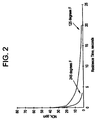
- FIG. 2 there is graphically illustrated data representing the quantity of NO x removed from the exhaust gas emitted from a gas fired boiler. Flue gas at a temperature in the range of 125°F to 130°F required approximately 20 seconds after mixing with ozone to reduce NO x levels to 2 ppm in the treated exhaust gas stream.
- the second set of data points on the graph illustrates NO x removal at approximately 245 °F with an increase in ozone feed by 7 percent to achieve the preferred level of oxidation within 3 to 4 seconds of residence time in the reaction chamber 36.
- ozone in addition to NO x , carbon monoxide and SO 2 are partially oxidized to carbon dioxide and sulfur trioxide reaction in the chamber 36, a small quantity of ozone also decomposes forming oxygen at the temperature range between about 220°F to 325°F.
- the required molar ratio mainly depends on the ratio of NO to NO 2 , concentration of NO x and the extent of NO x removal.
- the ozone to NO x molar ratio is preferably in the range between about 0.2 to 2.8.
- the treated contaminants are introduced into a combination spray/absorption generally designated by the numeral 38.
- the temperature of the treated gas stream is lowered. This is accomplished as illustrated in Figure 1 by diverting the treated exhaust gas from duct 40 to conduit 44 by closing valve 41 in duct 40 for flow to a heat exchanger or economizer 42.
- the treated exhaust gas enters the economizer 42 at a temperature of up to about 325°F.
- the economizer 42 includes a cooling tube 46 that extends in a serpentine path within the economizer.
- the tube 46 is equipped with cooling fins, as well known in the art.
- Heat is transferred in the economizer 42 to water in the tube 46.
- the water is heated in the tube and is conveyed from the economizer 42 to a tank (not shown).
- a tank not shown
- the economizer 42 also serves to partially scrub or absorb contaminants contained in the treated exhaust gas. This is accomplished by moisture in the exhaust gas condensing on the surface of the tube 46 and also on the fins mounted on the tube 46. Condensation of moisture on the tube 46 and the tube fins progressively lowers the temperature of the exhaust gas below the dew point of the exhaust gas.
- the condensate passes from the economizer 42 through an outlet 48 to a condensate collector 50 for subsequent holding and treatment in tank 51.
- the economizer 42 to lower the temperature of the treated exhaust gases and to partially scrub and aid in the absorption of contaminants remaining in the treated exhaust gases is selective.
- the economizer 42 in another embodiment is bypassed by opening valve 41 so that the treated exhaust gas from the reaction chamber 36 is fed directly to the absorption chamber 38.
- One advantage in utilizing the economizer 42 to lower the exhaust gas temperature and condense the water vapor in the exhaust gas is to achieve maximum efficiency in the separation of the contaminants from the exhaust gas stream in the absorption chamber.
- the treated exhaust gas which may be cooled to about ambient temperature as above described, is conveyed through a duct system 52 to the absorption chamber 38.
- the chamber 38 includes two sections or subchambers. In a first chamber generally designated by the numeral 54 the exhaust gas stream is treated with a reagent liquid, preferably by spray. In a second chamber generally designated by the numeral 56 the exhaust gas stream is scrubbed.
- Chamber 54 includes an array of spray nozzles 58 connected to a spray header 60.
- Spray header 60 receives a reagent solution, such as water, from a tank 62 through a pump 64.
- the exhaust gas stream is quenched and cooled by the reagent or water sprays.
- the NO x and SO x are absorbed into the sprayed liquid to form nitrogen and sulfur oxy acids.
- the dilute acids in situ are converted into nitrates, sulfites and sulfates in presence of caustic soda in accordance with the following reactions.
- lime or lime stone slurry is used; and calcium salts are formed.
- Concentrated reagents are supplied from a chemical metering and storage tank 66 into recirculation tank 62.
- Make-up water through valve 68 maintains a constant resettable level of solution in tank 62 and an excess of solution is diverted to the holding and treatment tank 70 through valve 72.
- the reagent solution is maintained at a suitable concentration by controlling the rate of spent solution diverted to the holding and treatment tank 70.
- a packed scrubber, or a venturi scrubber, or plate column with or without ultra sonics or lime injected dry scrubber is used as an absorption chamber.
- a heat exchanger is incorporated in the absorption chamber 54 to bring down the temperature of the gas and used as an absorption chamber. Provisions are also made to recover heat from the chamber 54 when operated with a heat exchanger.
- the exhaust gas stream entering the absorption chamber 54 also contains unreacted ozone.
- ozone is absorbed in circulating liquid. Solubility of ozone in water is very low limiting removal by absorption.
- SO 2 is present in the gas phase, sulfite is formed in situ in the circulating liquid. The sulfite readily reacts with ozone forming sulfate as indicated by reaction (14) below, enhancing the absorption of ozone several fold. Accordingly, the present invention advantageously incorporates the phenomena in depleting unreacted ozone from the exhaust gas stream and the use of scrubbing chamber 56.
- the treated contaminants from the chamber 58 are introduced through connecting duct 74 into a second or spray/absorption chamber 56 having spray nozzles or a liquid distributor system 76 connected to a spray header 78.
- Spray header 78 receives a reagent solution, (ozone scavenger), such as aqueous sodium sulfite solution, from a tank 80 through a pump 82.
- a reagent solution such as aqueous sodium sulfite solution
- Treated gas free from contaminants and oxidant is exhausted from the chamber 56 through stack 84.
- the reagent solution is replenished periodically or continuously with fresh charge of ozone scavenger.
- the absorption chamber 56 for destroying ozone is replaced with a catalyst chamber (not shown) that uses a catalyst such as MnO 2 .
- Further ozone slip is eliminated by extracting from the ducts before mixing with ozone a small amount of untreated exhaust gas containing NO x and introducing it into the scrubber chamber 56. The NO x in the untreated gas promptly reduces any ozone present in the treated gas.
- FIG. 3 there is graphically illustrated data from a slip stream test conducted on an exhaust gas stream emitted from a coal fired boiler of a power plant.
- the temperature of the gas stream was in the range between about 240-250 °F.
- the level NO x was in the range between about 250-300 ppm.
- One set of data points represents the condition where the ozone is introduced in the oxidation or reaction chamber 36.
- a second set of data points represents the condition where ozone is introduced in the duct system 52 downstream of the oxidation or reaction chamber 36 before the exhaust gas stream enters the absorption chamber 38. In the case when oxidation time was inadequate, less NO x removal was observed for identical amounts of ozone added.
- the optimum residence time of the exhaust gas in the reaction chamber 36 is dependent upon the initial concentration of contaminants, the temperature, and the molar ratios of O 3 /NO x .
- the level of NO x in the treated gas is desired to be less than 10 ppm, ozone is required in excess of the stoichiometric amount required to oxidize the NO and NO 2 .
- the presence of excess ozone in the exhaust gas stream may result in some unreacted ozone entering the absorption chamber. Ozone solubility in an aqueous medium is limited.
- SO 2 is present in the gas phase, sulfite or sulfurous acid formed in the absorption chamber 54 may aid in destroying ozone.
- the provision of the scrubber chamber 56 serves to prevent emission of ozone to the atmosphere.
- an exhaust gas flow with 300 ppm by volume of NO x at 245°F requires up to 2 to 3 seconds residence time in the reaction chamber 36 at an O 3 /NO x ratio of 1.68 in presence of 600-700 ppm of SO 2 and 100-200 ppm of CO.
- One of the advantages of optimized residence time in reaction chamber 36 is that only a marginal excess amount of ozone enters scrubbing section 56.
- Wet ozone is very corrosive.
- Ozone in the scrubber converts sulfite to sulfate.
- introduction of excessive amount of ozone in an aqueous media to convert sulfite to sulfate is wasteful.
- Ozone also undergoes decomposition in an aqueous medium when pH is alkaline.
- lime or lime stone slurry is used, SO 2 absorption results in formation of calcium sulfite.
- Ozone further converts to calcium sulfate. Calcium sulfate is relatively more difficult to handle in wet scrubbing as it forms abrasive scales.
- the removal of SO x is highly dependent upon the pH of the reagent.
- the pH of the reagent has very little effect on NO x removal.
- SO x removal is decreased with lowering the reagent pH below 8.5 while NO x removal is not affected for a reagent pH in the range of 3 -12.
- CO 2 is also absorbed in alkali or alkaline earth metal solutions forming precipitates of carbonate and other co-salts.
- use of reagent for CO 2 removal is wasteful and undesired. These precipitates have tendency to form scales.
- NO x removal in accordance with the present invention when conducted at a pH below 7 resulted in the descaling of the scrubbing chamber 56.
- the exhaust gas is emitted from the stack 84 into the atmosphere at a ppm level that meets the air quality standards established by such public agencies as the E.P.A. or California's South Coast Air Quality Management District.
- the emissions from the stack 84 contain less than 2 ppm of NO x contaminants.
- the exhaust gas is emitted at a relatively low temperature due to the wet scrubbing.
- the present invention removes nitrogen oxides from a steel strip pickling line using nitric acid as the pickling agent.
- the NO/NO 2 mixture to be removed consists of 3 moles of NO 2 to every mole of NO with the exhaust gas stream maintained at 180 °F.
- the NOx is converted to equimolar amounts of NO 2 and NO 3 . With a molar ratio of 0.75 to 1 of ozone to NO x 95% of the NO x is removed from the exhaust gas stream exiting the scrubbing chamber from the stack 84.
Landscapes
- Engineering & Computer Science (AREA)
- Chemical & Material Sciences (AREA)
- Health & Medical Sciences (AREA)
- General Engineering & Computer Science (AREA)
- Biomedical Technology (AREA)
- Environmental & Geological Engineering (AREA)
- Mechanical Engineering (AREA)
- Analytical Chemistry (AREA)
- General Chemical & Material Sciences (AREA)
- Oil, Petroleum & Natural Gas (AREA)
- Chemical Kinetics & Catalysis (AREA)
- Treating Waste Gases (AREA)
- Solid-Sorbent Or Filter-Aiding Compositions (AREA)
Applications Claiming Priority (2)
| Application Number | Priority Date | Filing Date | Title |
|---|---|---|---|
| US09/268,385 US6162409A (en) | 1999-03-15 | 1999-03-15 | Process for removing Nox and Sox from exhaust gas |
| US268385 | 1999-03-15 |
Publications (3)
| Publication Number | Publication Date |
|---|---|
| EP1040863A2 true EP1040863A2 (de) | 2000-10-04 |
| EP1040863A3 EP1040863A3 (de) | 2000-10-25 |
| EP1040863B1 EP1040863B1 (de) | 2006-12-27 |
Family
ID=23022763
Family Applications (1)
| Application Number | Title | Priority Date | Filing Date |
|---|---|---|---|
| EP00302031A Expired - Lifetime EP1040863B1 (de) | 1999-03-15 | 2000-03-14 | Vefahren zum Entfernen von NOx und SOx aus einem Abgas |
Country Status (9)
| Country | Link |
|---|---|
| US (1) | US6162409A (de) |
| EP (1) | EP1040863B1 (de) |
| AT (1) | ATE349263T1 (de) |
| AU (1) | AU768213B2 (de) |
| CA (1) | CA2300489C (de) |
| DE (1) | DE60032533T2 (de) |
| ES (1) | ES2277817T3 (de) |
| NZ (1) | NZ503419A (de) |
| ZA (1) | ZA200001325B (de) |
Cited By (12)
| Publication number | Priority date | Publication date | Assignee | Title |
|---|---|---|---|---|
| WO2001091885A3 (en) * | 2000-05-30 | 2002-03-28 | Kinetic Biosystems Inc | Method and apparatus for wet gas scrubbing |
| WO2006003169A1 (en) * | 2004-07-01 | 2006-01-12 | Bcp Engineering S.R.L. | Polluted air cleaner and relative purifying process |
| WO2015092547A3 (en) * | 2013-12-16 | 2015-09-24 | Linde Aktiengesellschaft | Methods for removing contaminants from exhaust gases |
| CN105980035A (zh) * | 2013-12-16 | 2016-09-28 | 琳德股份公司 | 用于从废气中除去污染物的方法 |
| NO20150574A1 (en) * | 2015-05-08 | 2016-11-09 | Yara Int Asa | Reduction of nox emission during fertilizer production |
| WO2016180676A1 (en) | 2015-05-08 | 2016-11-17 | Yara International Asa | Reduction of nox emissions by effluent gases from fertilizer production with ozone injection and wet scrubbing |
| EP2945730A4 (de) * | 2013-01-16 | 2016-12-21 | Linde Ag | Verfahren zum entfernen von verunreinigungen aus abgasen |
| ES2649058A1 (es) * | 2016-07-08 | 2018-01-09 | Condorchem Envitech, S.L. | Procedimiento de producción de fertilizante químico cristalizado a partir del tratamiento y transformación de la emisión de gases procedente de la combustión en plantas de generación de energía termoeléctrica |
| WO2018092041A1 (en) * | 2016-11-15 | 2018-05-24 | 8 Rivers Capital, Llc | Removal of impurities from a process stream by contacting it with an oxidant and with an aqueous stream |
| EP3453445A1 (de) * | 2017-09-11 | 2019-03-13 | Bing Ji Dong | Mehrstufige luftreinigungsvorrichtung für kohlegefeuertes stromkraftwerk |
| CN111036075A (zh) * | 2019-12-30 | 2020-04-21 | 紫金铜业有限公司 | 一种用于处理高浓度氮氧化物烟气的方法 |
| EP4467229A1 (de) * | 2023-05-26 | 2024-11-27 | Linde GmbH | Verbessertes nox-entfernungsverfahren |
Families Citing this family (58)
| Publication number | Priority date | Publication date | Assignee | Title |
|---|---|---|---|---|
| GB9801023D0 (en) * | 1998-01-19 | 1998-03-18 | Johnson Matthey Plc | Combatting air pollution |
| US6447437B1 (en) * | 2000-03-31 | 2002-09-10 | Ut-Battelle, Llc | Method for reducing CO2, CO, NOX, and SOx emissions |
| US6506351B1 (en) * | 2000-08-11 | 2003-01-14 | The Boc Group, Inc. | Removal of nitrogen oxides from gas streams |
| US6793903B1 (en) * | 2001-03-08 | 2004-09-21 | The United States Of America As Represented By The Administrator Of The National Aeronautics And Space Administration | High temperature decomposition of hydrogen peroxide |
| JP4616497B2 (ja) * | 2001-04-04 | 2011-01-19 | 大阪瓦斯株式会社 | 脱硫装置及び脱硫方法 |
| US6474271B1 (en) * | 2001-04-26 | 2002-11-05 | General Electric Company | Method and apparatus for reducing emission of nitrogen oxides from a combustion system |
| US20040062697A1 (en) * | 2002-10-01 | 2004-04-01 | Airborne Pollution Control Inc. | Flue gas purification method |
| US6897661B2 (en) * | 2003-03-14 | 2005-05-24 | Steris Inc. | Method and apparatus for detection of contaminants in a fluid |
| US6992494B2 (en) * | 2003-03-14 | 2006-01-31 | Steris Inc. | Method and apparatus for monitoring the purity and/or quality of steam |
| US6960921B2 (en) | 2003-03-14 | 2005-11-01 | Steris Inc. | Method and apparatus for real time monitoring of metallic cation concentrations in a solution |
| US6946852B2 (en) * | 2003-03-14 | 2005-09-20 | Steris Inc. | Method and apparatus for measuring concentration of a chemical component in a gas mixture |
| US6927582B2 (en) * | 2003-03-14 | 2005-08-09 | Steris Inc. | Method and apparatus for monitoring the state of a chemical solution for decontamination of chemical and biological warfare agents |
| US6930493B2 (en) * | 2003-03-14 | 2005-08-16 | Steris Inc. | Method and apparatus for monitoring detergent concentration in a decontamination process |
| US6933733B2 (en) | 2003-03-14 | 2005-08-23 | Steris Inc. | Method and apparatus for measuring the concentration of hydrogen peroxide in a fluid |
| US6909972B2 (en) * | 2003-06-06 | 2005-06-21 | Steris Inc. | Method and apparatus for formulating and controlling chemical concentrations in a solution |
| US6917885B2 (en) * | 2003-06-06 | 2005-07-12 | Steris Inc. | Method and apparatus for formulating and controlling chemical concentration in a gas mixture |
| AU2003277193A1 (en) * | 2003-07-09 | 2005-02-25 | Belco Technologies Corporation | WET SCRUBBING APPARATUS AND METHOD FOR CONTROLLING NOx EMISSIONS |
| JP4264643B2 (ja) * | 2003-09-18 | 2009-05-20 | 日立造船株式会社 | 劣化触媒の再生方法 |
| US7303735B2 (en) * | 2003-10-17 | 2007-12-04 | The Boc Group, Inc. | Process for the removal of contaminants from gas streams |
| US20050214189A1 (en) * | 2004-03-29 | 2005-09-29 | Balingit Ronald F | Dry scrubber/collector |
| US7404938B2 (en) * | 2004-05-11 | 2008-07-29 | The United States Of America As Represented By The Administrator Of The National Aeronautics And Space Administration | Emission control system |
| US7431886B2 (en) * | 2004-09-24 | 2008-10-07 | Steris Corporation | Method of monitoring operational status of sensing devices for determining the concentration of chemical components in a fluid |
| US7514053B2 (en) * | 2005-04-21 | 2009-04-07 | Envirosolv Energy Llc | Method for removing sulfur dioxide, mercury, and nitrogen oxides from a gas stream |
| US20070154374A1 (en) * | 2006-01-05 | 2007-07-05 | Envirosolv Energy Llc | Method for removing sulfur dioxide and other acid gases, mercury, and nitrogen oxides from a gas stream with the optional production of ammonia based fertilizers |
| US20070154373A1 (en) * | 2006-01-05 | 2007-07-05 | Envirosolv Energy Llc | Methods for regenerating oxidants used for removing pollutants from a gas stream |
| JP4453700B2 (ja) * | 2006-12-28 | 2010-04-21 | トヨタ自動車株式会社 | 内燃機関の排気ガス浄化装置 |
| JP2008163871A (ja) * | 2006-12-28 | 2008-07-17 | Toyota Motor Corp | 内燃機関の排気ガス浄化装置 |
| JP4497158B2 (ja) * | 2006-12-28 | 2010-07-07 | トヨタ自動車株式会社 | 内燃機関の排気ガス浄化装置 |
| US8402755B2 (en) * | 2008-07-30 | 2013-03-26 | General Electric Company | Gas turbine combustor exhaust gas spray cooling for NOx control using selective catalytic reductions |
| KR101094672B1 (ko) * | 2009-03-17 | 2011-12-20 | 한국과학기술연구원 | 오존과 촉매 하이브리드 시스템을 이용한 질소산화물의 처리방법 및 처리장치 |
| US7862787B1 (en) * | 2009-06-22 | 2011-01-04 | Cannon Boiler Works, Inc. | Heat recovery device for a boiler |
| JP5099150B2 (ja) * | 2010-02-26 | 2012-12-12 | 株式会社デンソー | 排気浄化装置の異常診断装置 |
| US8574521B2 (en) | 2010-09-29 | 2013-11-05 | Linde Aktiengesellschaft | Gas stream purification apparatus and method |
| US9272908B2 (en) | 2010-09-29 | 2016-03-01 | Linde Aktiengesellschaft | Gas stream purification apparatus |
| US8795620B2 (en) * | 2011-02-15 | 2014-08-05 | Ati Properties, Inc. | Systems and methods for recovering nitric acid from pickling solutions |
| US8784762B2 (en) * | 2011-02-15 | 2014-07-22 | Ati Properties, Inc. | Treatment of NOx-containing gas streams |
| US20130183219A1 (en) | 2011-07-25 | 2013-07-18 | Gene H. Irrgang | Methods for reducing nitrogen oxides emissions |
| EP2659947A1 (de) | 2012-04-30 | 2013-11-06 | Linde Aktiengesellschaft | Verfahren und Vorrichtung zum Entfernen von Verunreinigungen aus Abgasen |
| US9694317B2 (en) | 2012-05-03 | 2017-07-04 | Altira Technology Fund V L.P. | Multi-pollutant abatement device and method |
| US9440188B2 (en) | 2012-10-15 | 2016-09-13 | Linde Aktiengesellschaft | Method for removing contaminants from exhaust gases |
| PT2719440T (pt) | 2012-10-15 | 2017-06-26 | Linde Ag | Método para remover contaminantes de gases de exaustão por adição de ozono |
| JP6178141B2 (ja) * | 2013-07-11 | 2017-08-09 | 公立大学法人大阪府立大学 | 排ガス処理方法および排ガス処理装置 |
| CN105451862B (zh) * | 2013-07-11 | 2019-04-16 | 公立大学法人大阪府立大学 | 废气处理方法和废气处理装置 |
| CA2924760A1 (en) | 2013-09-25 | 2015-05-21 | Linde Aktiengesellschaft | Methods for treating waste gas streams from incineration processes |
| US9895659B2 (en) * | 2014-09-24 | 2018-02-20 | Linde Aktiengesellschaft | Methods for removing contaminants from exhaust gases |
| EP3012011A1 (de) | 2014-10-21 | 2016-04-27 | Linde Aktiengesellschaft | Verfahren und vorrichtung zum teilweisen entfernen von verunreinigungen aus prozessgasen durch ozonzugabe |
| US9764281B2 (en) | 2015-12-18 | 2017-09-19 | Cannon Technology, Inc. | Process for the removal of contaminants from flue gas streams |
| US10065151B2 (en) | 2015-12-21 | 2018-09-04 | Linde Aktiengesellschaft | Methods for removing contaminants from gas streams |
| CN115105934B (zh) * | 2016-06-21 | 2024-08-02 | 秦皇岛玻璃工业研究设计院有限公司 | 一种用于玻璃熔窑烟气脱硝设备的氧化室及脱硝氧化剂 |
| FI128556B (en) * | 2017-04-04 | 2020-08-14 | Valmet Technologies Oy | METHOD OF GAS FLOW TREATMENT AND EMISSIONS MANAGEMENT SYSTEM |
| CN107694314B (zh) * | 2017-10-18 | 2024-08-06 | 大唐南京发电厂 | 一种分级氧化吸收式烟气脱硫脱硝的系统及工艺 |
| CN109876618A (zh) * | 2019-04-11 | 2019-06-14 | 大连海事大学 | 一种烟气污染物去除系统及方法 |
| CN110743313A (zh) * | 2019-10-29 | 2020-02-04 | 中国华能集团有限公司 | 一种烟气低温吸附脱硝方法 |
| EP3875167A1 (de) | 2020-03-06 | 2021-09-08 | Linde GmbH | Verbessertes nox-beseitigungsverfahren |
| CN112090255B (zh) * | 2020-10-10 | 2025-01-10 | 河北建投能源科学技术研究院有限公司 | 一种移动式燃煤启动锅炉多种污染物协同脱除系统及方法 |
| CN114432852B (zh) * | 2020-10-16 | 2023-05-09 | 中国石油化工股份有限公司 | 含硝废气的处理系统 |
| CN112354337A (zh) * | 2020-11-09 | 2021-02-12 | 太原市润民环保节能有限公司 | 一种低温烟气高效脱硫脱硝脱白一体化设备 |
| CN115178070B (zh) * | 2022-07-19 | 2023-06-30 | 江苏寅胜环保能源工程有限公司 | 可热循环自供能的脱硫除硝系统及方法 |
Family Cites Families (8)
| Publication number | Priority date | Publication date | Assignee | Title |
|---|---|---|---|---|
| JPS5643771B2 (de) * | 1973-12-18 | 1981-10-15 | ||
| JPS513367A (en) * | 1974-06-28 | 1976-01-12 | Tokyo Electric Power Co | Nenshohaigasuchuno chitsusosankabutsuno jokyohoho |
| DE3220403C1 (de) * | 1982-05-29 | 1983-11-17 | Buckau-Walther AG, 4048 Grevenbroich | Verfahren zum Entfernen von sauren Komponenten und Stickoxyden aus Abgasen |
| DE3735391A1 (de) * | 1987-10-19 | 1989-04-27 | Steinmueller Gmbh L & C | Verfahren zur entfernung von no(pfeil abwaerts)x(pfeil abwaerts) und gegebenenfalls so(pfeil abwaerts)2(pfeil abwaerts) aus abgasen |
| US5206002A (en) * | 1991-08-29 | 1993-04-27 | Cannon Boiler Works, Inc. | Process for removing nox and sox from exhaust gas |
| US5553555A (en) * | 1994-04-28 | 1996-09-10 | Dasibi Environmental Corporation | System and method for flue gas purification for thermal power units |
| WO1996032182A1 (en) * | 1995-04-11 | 1996-10-17 | B.C.P. S.R.L. | Apparatus for the purification of polluted air and related purification process |
| AU7020998A (en) * | 1997-04-23 | 1998-11-13 | Enviro-Energy Products, Inc. | Heat recovery and pollution abatement device |
-
1999
- 1999-03-15 US US09/268,385 patent/US6162409A/en not_active Expired - Lifetime
-
2000
- 2000-03-13 CA CA002300489A patent/CA2300489C/en not_active Expired - Lifetime
- 2000-03-14 EP EP00302031A patent/EP1040863B1/de not_active Expired - Lifetime
- 2000-03-14 AU AU22273/00A patent/AU768213B2/en not_active Expired
- 2000-03-14 AT AT00302031T patent/ATE349263T1/de active
- 2000-03-14 DE DE60032533T patent/DE60032533T2/de not_active Expired - Lifetime
- 2000-03-14 ES ES00302031T patent/ES2277817T3/es not_active Expired - Lifetime
- 2000-03-15 ZA ZA200001325A patent/ZA200001325B/xx unknown
- 2000-03-15 NZ NZ503419A patent/NZ503419A/en not_active IP Right Cessation
Cited By (13)
| Publication number | Priority date | Publication date | Assignee | Title |
|---|---|---|---|---|
| WO2001091885A3 (en) * | 2000-05-30 | 2002-03-28 | Kinetic Biosystems Inc | Method and apparatus for wet gas scrubbing |
| WO2006003169A1 (en) * | 2004-07-01 | 2006-01-12 | Bcp Engineering S.R.L. | Polluted air cleaner and relative purifying process |
| EP2945730A4 (de) * | 2013-01-16 | 2016-12-21 | Linde Ag | Verfahren zum entfernen von verunreinigungen aus abgasen |
| CN105980035A (zh) * | 2013-12-16 | 2016-09-28 | 琳德股份公司 | 用于从废气中除去污染物的方法 |
| WO2015092547A3 (en) * | 2013-12-16 | 2015-09-24 | Linde Aktiengesellschaft | Methods for removing contaminants from exhaust gases |
| NO20150574A1 (en) * | 2015-05-08 | 2016-11-09 | Yara Int Asa | Reduction of nox emission during fertilizer production |
| WO2016180676A1 (en) | 2015-05-08 | 2016-11-17 | Yara International Asa | Reduction of nox emissions by effluent gases from fertilizer production with ozone injection and wet scrubbing |
| ES2649058A1 (es) * | 2016-07-08 | 2018-01-09 | Condorchem Envitech, S.L. | Procedimiento de producción de fertilizante químico cristalizado a partir del tratamiento y transformación de la emisión de gases procedente de la combustión en plantas de generación de energía termoeléctrica |
| WO2018092041A1 (en) * | 2016-11-15 | 2018-05-24 | 8 Rivers Capital, Llc | Removal of impurities from a process stream by contacting it with an oxidant and with an aqueous stream |
| EP3453445A1 (de) * | 2017-09-11 | 2019-03-13 | Bing Ji Dong | Mehrstufige luftreinigungsvorrichtung für kohlegefeuertes stromkraftwerk |
| CN109482051A (zh) * | 2017-09-11 | 2019-03-19 | 董炳吉 | 用于燃煤火力发电厂的空气净化装置 |
| CN111036075A (zh) * | 2019-12-30 | 2020-04-21 | 紫金铜业有限公司 | 一种用于处理高浓度氮氧化物烟气的方法 |
| EP4467229A1 (de) * | 2023-05-26 | 2024-11-27 | Linde GmbH | Verbessertes nox-entfernungsverfahren |
Also Published As
| Publication number | Publication date |
|---|---|
| EP1040863A3 (de) | 2000-10-25 |
| EP1040863B1 (de) | 2006-12-27 |
| AU768213B2 (en) | 2003-12-04 |
| NZ503419A (en) | 2001-10-26 |
| ZA200001325B (en) | 2001-02-19 |
| CA2300489A1 (en) | 2000-09-15 |
| US6162409A (en) | 2000-12-19 |
| CA2300489C (en) | 2006-09-05 |
| AU2227300A (en) | 2000-09-21 |
| DE60032533D1 (de) | 2007-02-08 |
| ATE349263T1 (de) | 2007-01-15 |
| DE60032533T2 (de) | 2007-10-25 |
| ES2277817T3 (es) | 2007-08-01 |
Similar Documents
| Publication | Publication Date | Title |
|---|---|---|
| US6162409A (en) | Process for removing Nox and Sox from exhaust gas | |
| CA2760777C (en) | Combustion flue gas nox treatment | |
| US5171552A (en) | Dry processes for treating combustion exhaust gas | |
| US9884290B2 (en) | Flue-gas purification and reclamation system and method thereof | |
| CN101352646B (zh) | 一种利用紫外光双重作用的烟气脱硝方法 | |
| CA2077121C (en) | Process for removing nox and sox from exhaust gas | |
| CN110860196B (zh) | 一种水泥烟气的脱硫脱硝系统 | |
| US20170173525A1 (en) | Process for the removal of contaminants from flue gas streams | |
| CN103100294A (zh) | 臭氧氧化法脱除烟气中氮氧化合物的方法 | |
| CN112403154A (zh) | 一种烟气多污染物协同净化工艺及装置 | |
| CN114738770A (zh) | 一种废焦油废气废水的焚烧处理方法及其系统 | |
| CN111359398B (zh) | 一种烟气脱硝脱白的方法 | |
| CN120838154B (zh) | 一种低温燃煤烟气脱硫脱硝系统和方法 | |
| CN111921356B (zh) | 一种链条炉排燃煤锅炉烟气治理装置及方法 | |
| KR101097442B1 (ko) | 소각로 배출가스 처리시설의 건식공정장치 | |
| CN121819552A (zh) | 一种基于化学链燃烧的烟气超低排放系统及方法 | |
| CN120506662A (zh) | 一种垃圾焚烧烟气净化方法与系统 | |
| PL188483B1 (pl) | Suchy sposób oczyszczania spalin | |
| JPH0698266B2 (ja) | 燃焼排ガスの処理方法およびその装置 | |
| PL188482B1 (pl) | Suchy sposób oczyszczania spalin | |
| PL188485B1 (pl) | Suchy sposób oczyszczania spalin |
Legal Events
| Date | Code | Title | Description |
|---|---|---|---|
| PUAI | Public reference made under article 153(3) epc to a published international application that has entered the european phase |
Free format text: ORIGINAL CODE: 0009012 |
|
| PUAL | Search report despatched |
Free format text: ORIGINAL CODE: 0009013 |
|
| AK | Designated contracting states |
Kind code of ref document: A2 Designated state(s): AT BE CH CY DE DK ES FI FR GB GR IE IT LI LU MC NL PT SE |
|
| AX | Request for extension of the european patent |
Free format text: AL;LT;LV;MK;RO;SI |
|
| AK | Designated contracting states |
Kind code of ref document: A3 Designated state(s): AT BE CH CY DE DK ES FI FR GB GR IE IT LI LU MC NL PT SE |
|
| AX | Request for extension of the european patent |
Free format text: AL;LT;LV;MK;RO;SI |
|
| 17P | Request for examination filed |
Effective date: 20010417 |
|
| AKX | Designation fees paid |
Free format text: AT BE CH CY DE DK ES FI FR GB GR IE IT LI LU MC NL PT SE |
|
| 17Q | First examination report despatched |
Effective date: 20040507 |
|
| GRAP | Despatch of communication of intention to grant a patent |
Free format text: ORIGINAL CODE: EPIDOSNIGR1 |
|
| GRAS | Grant fee paid |
Free format text: ORIGINAL CODE: EPIDOSNIGR3 |
|
| GRAA | (expected) grant |
Free format text: ORIGINAL CODE: 0009210 |
|
| AK | Designated contracting states |
Kind code of ref document: B1 Designated state(s): AT BE CH CY DE DK ES FI FR GB GR IE IT LI LU MC NL PT SE |
|
| PG25 | Lapsed in a contracting state [announced via postgrant information from national office to epo] |
Ref country code: DK Free format text: LAPSE BECAUSE OF FAILURE TO SUBMIT A TRANSLATION OF THE DESCRIPTION OR TO PAY THE FEE WITHIN THE PRESCRIBED TIME-LIMIT Effective date: 20061227 |
|
| REG | Reference to a national code |
Ref country code: GB Ref legal event code: FG4D |
|
| REG | Reference to a national code |
Ref country code: IE Ref legal event code: FG4D |
|
| REF | Corresponds to: |
Ref document number: 60032533 Country of ref document: DE Date of ref document: 20070208 Kind code of ref document: P |
|
| REG | Reference to a national code |
Ref country code: GR Ref legal event code: EP Ref document number: 20070400611 Country of ref document: GR |
|
| REG | Reference to a national code |
Ref country code: CH Ref legal event code: NV Representative=s name: MICHELI & CIE INGENIEURS-CONSEILS |
|
| REG | Reference to a national code |
Ref country code: SE Ref legal event code: TRGR |
|
| PG25 | Lapsed in a contracting state [announced via postgrant information from national office to epo] |
Ref country code: PT Free format text: LAPSE BECAUSE OF FAILURE TO SUBMIT A TRANSLATION OF THE DESCRIPTION OR TO PAY THE FEE WITHIN THE PRESCRIBED TIME-LIMIT Effective date: 20070528 |
|
| ET | Fr: translation filed | ||
| REG | Reference to a national code |
Ref country code: ES Ref legal event code: FG2A Ref document number: 2277817 Country of ref document: ES Kind code of ref document: T3 |
|
| PLBE | No opposition filed within time limit |
Free format text: ORIGINAL CODE: 0009261 |
|
| STAA | Information on the status of an ep patent application or granted ep patent |
Free format text: STATUS: NO OPPOSITION FILED WITHIN TIME LIMIT |
|
| 26N | No opposition filed |
Effective date: 20070928 |
|
| PG25 | Lapsed in a contracting state [announced via postgrant information from national office to epo] |
Ref country code: MC Free format text: LAPSE BECAUSE OF NON-PAYMENT OF DUE FEES Effective date: 20070331 |
|
| PG25 | Lapsed in a contracting state [announced via postgrant information from national office to epo] |
Ref country code: CY Free format text: LAPSE BECAUSE OF FAILURE TO SUBMIT A TRANSLATION OF THE DESCRIPTION OR TO PAY THE FEE WITHIN THE PRESCRIBED TIME-LIMIT Effective date: 20061227 |
|
| REG | Reference to a national code |
Ref country code: FR Ref legal event code: PLFP Year of fee payment: 17 |
|
| REG | Reference to a national code |
Ref country code: FR Ref legal event code: PLFP Year of fee payment: 18 |
|
| REG | Reference to a national code |
Ref country code: FR Ref legal event code: PLFP Year of fee payment: 19 |
|
| PGFP | Annual fee paid to national office [announced via postgrant information from national office to epo] |
Ref country code: LU Payment date: 20190225 Year of fee payment: 20 |
|
| PGFP | Annual fee paid to national office [announced via postgrant information from national office to epo] |
Ref country code: IT Payment date: 20190326 Year of fee payment: 20 Ref country code: CH Payment date: 20190314 Year of fee payment: 20 Ref country code: DE Payment date: 20190226 Year of fee payment: 20 Ref country code: FI Payment date: 20190311 Year of fee payment: 20 Ref country code: GB Payment date: 20190313 Year of fee payment: 20 Ref country code: IE Payment date: 20190311 Year of fee payment: 20 |
|
| PGFP | Annual fee paid to national office [announced via postgrant information from national office to epo] |
Ref country code: SE Payment date: 20190311 Year of fee payment: 20 Ref country code: AT Payment date: 20190226 Year of fee payment: 20 Ref country code: FR Payment date: 20190213 Year of fee payment: 20 Ref country code: BE Payment date: 20190116 Year of fee payment: 20 Ref country code: GR Payment date: 20190213 Year of fee payment: 20 Ref country code: NL Payment date: 20190313 Year of fee payment: 20 |
|
| PGFP | Annual fee paid to national office [announced via postgrant information from national office to epo] |
Ref country code: ES Payment date: 20190401 Year of fee payment: 20 |
|
| REG | Reference to a national code |
Ref country code: DE Ref legal event code: R071 Ref document number: 60032533 Country of ref document: DE |
|
| REG | Reference to a national code |
Ref country code: NL Ref legal event code: MK Effective date: 20200313 |
|
| REG | Reference to a national code |
Ref country code: GB Ref legal event code: PE20 Expiry date: 20200313 |
|
| REG | Reference to a national code |
Ref country code: BE Ref legal event code: MK Effective date: 20200314 |
|
| REG | Reference to a national code |
Ref country code: IE Ref legal event code: MK9A |
|
| PG25 | Lapsed in a contracting state [announced via postgrant information from national office to epo] |
Ref country code: GB Free format text: LAPSE BECAUSE OF EXPIRATION OF PROTECTION Effective date: 20200313 |
|
| REG | Reference to a national code |
Ref country code: SE Ref legal event code: EUG |
|
| REG | Reference to a national code |
Ref country code: FI Ref legal event code: MAE |
|
| REG | Reference to a national code |
Ref country code: ES Ref legal event code: FD2A Effective date: 20200721 |
|
| PG25 | Lapsed in a contracting state [announced via postgrant information from national office to epo] |
Ref country code: IE Free format text: LAPSE BECAUSE OF EXPIRATION OF PROTECTION Effective date: 20200314 |
|
| REG | Reference to a national code |
Ref country code: AT Ref legal event code: MK07 Ref document number: 349263 Country of ref document: AT Kind code of ref document: T Effective date: 20200314 |
|
| PG25 | Lapsed in a contracting state [announced via postgrant information from national office to epo] |
Ref country code: ES Free format text: LAPSE BECAUSE OF EXPIRATION OF PROTECTION Effective date: 20200315 |