EP1037642B9 - Modifizierte polysaccharide mit veränderter biologischer erkennung - Google Patents
Modifizierte polysaccharide mit veränderter biologischer erkennung Download PDFInfo
- Publication number
- EP1037642B9 EP1037642B9 EP98962025A EP98962025A EP1037642B9 EP 1037642 B9 EP1037642 B9 EP 1037642B9 EP 98962025 A EP98962025 A EP 98962025A EP 98962025 A EP98962025 A EP 98962025A EP 1037642 B9 EP1037642 B9 EP 1037642B9
- Authority
- EP
- European Patent Office
- Prior art keywords
- starch
- polysaccharide
- modified
- dextran
- oxidized
- Prior art date
- Legal status (The legal status is an assumption and is not a legal conclusion. Google has not performed a legal analysis and makes no representation as to the accuracy of the status listed.)
- Expired - Lifetime
Links
- 229920001282 polysaccharide Polymers 0.000 title claims abstract description 127
- 239000005017 polysaccharide Substances 0.000 title claims abstract description 127
- 150000004676 glycans Chemical class 0.000 title claims abstract description 124
- 230000001747 exhibiting effect Effects 0.000 title 1
- 238000000034 method Methods 0.000 claims abstract description 33
- 229920002472 Starch Polymers 0.000 claims description 124
- 239000008107 starch Substances 0.000 claims description 120
- 235000019698 starch Nutrition 0.000 claims description 107
- 229920002307 Dextran Polymers 0.000 claims description 66
- 238000007254 oxidation reaction Methods 0.000 claims description 52
- 239000000203 mixture Substances 0.000 claims description 50
- 230000003647 oxidation Effects 0.000 claims description 48
- 239000002738 chelating agent Substances 0.000 claims description 39
- JQWHASGSAFIOCM-UHFFFAOYSA-M sodium periodate Chemical compound [Na+].[O-]I(=O)(=O)=O JQWHASGSAFIOCM-UHFFFAOYSA-M 0.000 claims description 30
- 239000003814 drug Substances 0.000 claims description 29
- 230000009467 reduction Effects 0.000 claims description 27
- 125000002887 hydroxy group Chemical group [H]O* 0.000 claims description 24
- 239000011541 reaction mixture Substances 0.000 claims description 23
- 239000012279 sodium borohydride Substances 0.000 claims description 19
- 229910000033 sodium borohydride Inorganic materials 0.000 claims description 19
- UBQYURCVBFRUQT-UHFFFAOYSA-N N-benzoyl-Ferrioxamine B Chemical compound CC(=O)N(O)CCCCCNC(=O)CCC(=O)N(O)CCCCCNC(=O)CCC(=O)N(O)CCCCCN UBQYURCVBFRUQT-UHFFFAOYSA-N 0.000 claims description 18
- 229960000958 deferoxamine Drugs 0.000 claims description 18
- 230000002792 vascular Effects 0.000 claims description 14
- 239000008194 pharmaceutical composition Substances 0.000 claims description 9
- 230000001590 oxidative effect Effects 0.000 claims description 7
- 241000124008 Mammalia Species 0.000 claims description 5
- 230000008569 process Effects 0.000 claims description 5
- 230000004071 biological effect Effects 0.000 abstract description 17
- FZWBNHMXJMCXLU-BLAUPYHCSA-N isomaltotriose Chemical compound O[C@@H]1[C@@H](O)[C@H](O)[C@@H](CO)O[C@@H]1OC[C@@H]1[C@@H](O)[C@H](O)[C@@H](O)[C@@H](OC[C@@H](O)[C@@H](O)[C@H](O)[C@@H](O)C=O)O1 FZWBNHMXJMCXLU-BLAUPYHCSA-N 0.000 description 61
- 230000002829 reductive effect Effects 0.000 description 49
- XLYOFNOQVPJJNP-UHFFFAOYSA-N water Substances O XLYOFNOQVPJJNP-UHFFFAOYSA-N 0.000 description 47
- LFQSCWFLJHTTHZ-UHFFFAOYSA-N Ethanol Chemical compound CCO LFQSCWFLJHTTHZ-UHFFFAOYSA-N 0.000 description 42
- 239000000243 solution Substances 0.000 description 39
- 238000006243 chemical reaction Methods 0.000 description 37
- 238000003756 stirring Methods 0.000 description 33
- 229920000881 Modified starch Polymers 0.000 description 31
- 235000019426 modified starch Nutrition 0.000 description 31
- 230000004048 modification Effects 0.000 description 30
- 238000012986 modification Methods 0.000 description 30
- 229940079593 drug Drugs 0.000 description 28
- 239000004368 Modified starch Substances 0.000 description 27
- 239000011521 glass Substances 0.000 description 23
- 238000002474 experimental method Methods 0.000 description 22
- 239000000706 filtrate Substances 0.000 description 22
- KHIWWQKSHDUIBK-UHFFFAOYSA-N periodic acid Chemical compound OI(=O)(=O)=O KHIWWQKSHDUIBK-UHFFFAOYSA-N 0.000 description 21
- 239000000047 product Substances 0.000 description 21
- 241001465754 Metazoa Species 0.000 description 18
- 229920000642 polymer Polymers 0.000 description 18
- 238000002360 preparation method Methods 0.000 description 18
- 230000015556 catabolic process Effects 0.000 description 16
- 238000006731 degradation reaction Methods 0.000 description 16
- 239000004382 Amylase Substances 0.000 description 14
- 102000013142 Amylases Human genes 0.000 description 14
- 108010065511 Amylases Proteins 0.000 description 14
- 235000019418 amylase Nutrition 0.000 description 14
- 230000029087 digestion Effects 0.000 description 13
- WQZGKKKJIJFFOK-GASJEMHNSA-N Glucose Natural products OC[C@H]1OC(O)[C@H](O)[C@@H](O)[C@@H]1O WQZGKKKJIJFFOK-GASJEMHNSA-N 0.000 description 12
- 239000008103 glucose Substances 0.000 description 12
- VEXZGXHMUGYJMC-UHFFFAOYSA-M Chloride anion Chemical compound [Cl-] VEXZGXHMUGYJMC-UHFFFAOYSA-M 0.000 description 11
- VEXZGXHMUGYJMC-UHFFFAOYSA-N Hydrochloric acid Chemical compound Cl VEXZGXHMUGYJMC-UHFFFAOYSA-N 0.000 description 11
- 239000012528 membrane Substances 0.000 description 11
- 239000000843 powder Substances 0.000 description 11
- 239000012634 fragment Substances 0.000 description 9
- NNTOJPXOCKCMKR-UHFFFAOYSA-N boron;pyridine Chemical compound [B].C1=CC=NC=C1 NNTOJPXOCKCMKR-UHFFFAOYSA-N 0.000 description 7
- 150000003839 salts Chemical class 0.000 description 7
- XEEYBQQBJWHFJM-UHFFFAOYSA-N Iron Chemical compound [Fe] XEEYBQQBJWHFJM-UHFFFAOYSA-N 0.000 description 6
- 150000001299 aldehydes Chemical group 0.000 description 6
- 125000003277 amino group Chemical group 0.000 description 6
- 238000003776 cleavage reaction Methods 0.000 description 6
- 238000005227 gel permeation chromatography Methods 0.000 description 6
- 230000007017 scission Effects 0.000 description 6
- ZNZYKNKBJPZETN-WELNAUFTSA-N Dialdehyde 11678 Chemical compound N1C2=CC=CC=C2C2=C1[C@H](C[C@H](/C(=C/O)C(=O)OC)[C@@H](C=C)C=O)NCC2 ZNZYKNKBJPZETN-WELNAUFTSA-N 0.000 description 5
- 239000008280 blood Substances 0.000 description 5
- 210000004369 blood Anatomy 0.000 description 5
- 230000036765 blood level Effects 0.000 description 5
- 230000008859 change Effects 0.000 description 5
- 238000009472 formulation Methods 0.000 description 5
- -1 starch or dextran Chemical class 0.000 description 5
- 241000700159 Rattus Species 0.000 description 4
- FAPWRFPIFSIZLT-UHFFFAOYSA-M Sodium chloride Chemical compound [Na+].[Cl-] FAPWRFPIFSIZLT-UHFFFAOYSA-M 0.000 description 4
- 230000002009 allergenic effect Effects 0.000 description 4
- 102000004139 alpha-Amylases Human genes 0.000 description 4
- 108090000637 alpha-Amylases Proteins 0.000 description 4
- 229940024171 alpha-amylase Drugs 0.000 description 4
- 230000000694 effects Effects 0.000 description 4
- 210000003191 femoral vein Anatomy 0.000 description 4
- 239000007800 oxidant agent Substances 0.000 description 4
- 239000003058 plasma substitute Substances 0.000 description 4
- QTBSBXVTEAMEQO-UHFFFAOYSA-N Acetic acid Chemical class CC(O)=O QTBSBXVTEAMEQO-UHFFFAOYSA-N 0.000 description 3
- IAYPIBMASNFSPL-UHFFFAOYSA-N Ethylene oxide Chemical compound C1CO1 IAYPIBMASNFSPL-UHFFFAOYSA-N 0.000 description 3
- 206010059484 Haemodilution Diseases 0.000 description 3
- 206010020751 Hypersensitivity Diseases 0.000 description 3
- 239000002262 Schiff base Substances 0.000 description 3
- 150000004753 Schiff bases Chemical class 0.000 description 3
- 208000030961 allergic reaction Diseases 0.000 description 3
- 230000009286 beneficial effect Effects 0.000 description 3
- 239000006227 byproduct Substances 0.000 description 3
- 150000001720 carbohydrates Chemical class 0.000 description 3
- KRKNYBCHXYNGOX-UHFFFAOYSA-N citric acid Chemical class OC(=O)CC(O)(C(O)=O)CC(O)=O KRKNYBCHXYNGOX-UHFFFAOYSA-N 0.000 description 3
- 230000003247 decreasing effect Effects 0.000 description 3
- 238000009826 distribution Methods 0.000 description 3
- 230000029142 excretion Effects 0.000 description 3
- 229910052742 iron Inorganic materials 0.000 description 3
- 230000004044 response Effects 0.000 description 3
- 238000012453 sprague-dawley rat model Methods 0.000 description 3
- 230000001225 therapeutic effect Effects 0.000 description 3
- 238000002560 therapeutic procedure Methods 0.000 description 3
- KIUKXJAPPMFGSW-DNGZLQJQSA-N (2S,3S,4S,5R,6R)-6-[(2S,3R,4R,5S,6R)-3-Acetamido-2-[(2S,3S,4R,5R,6R)-6-[(2R,3R,4R,5S,6R)-3-acetamido-2,5-dihydroxy-6-(hydroxymethyl)oxan-4-yl]oxy-2-carboxy-4,5-dihydroxyoxan-3-yl]oxy-5-hydroxy-6-(hydroxymethyl)oxan-4-yl]oxy-3,4,5-trihydroxyoxane-2-carboxylic acid Chemical compound CC(=O)N[C@H]1[C@H](O)O[C@H](CO)[C@@H](O)[C@@H]1O[C@H]1[C@H](O)[C@@H](O)[C@H](O[C@H]2[C@@H]([C@@H](O[C@H]3[C@@H]([C@@H](O)[C@H](O)[C@H](O3)C(O)=O)O)[C@H](O)[C@@H](CO)O2)NC(C)=O)[C@@H](C(O)=O)O1 KIUKXJAPPMFGSW-DNGZLQJQSA-N 0.000 description 2
- GLDQAMYCGOIJDV-UHFFFAOYSA-N 2,3-dihydroxybenzoic acid Chemical compound OC(=O)C1=CC=CC(O)=C1O GLDQAMYCGOIJDV-UHFFFAOYSA-N 0.000 description 2
- 229920002261 Corn starch Polymers 0.000 description 2
- 229920001612 Hydroxyethyl starch Polymers 0.000 description 2
- 235000019759 Maize starch Nutrition 0.000 description 2
- AFVFQIVMOAPDHO-UHFFFAOYSA-N Methanesulfonic acid Chemical class CS(O)(=O)=O AFVFQIVMOAPDHO-UHFFFAOYSA-N 0.000 description 2
- NBIIXXVUZAFLBC-UHFFFAOYSA-N Phosphoric acid Chemical class OP(O)(O)=O NBIIXXVUZAFLBC-UHFFFAOYSA-N 0.000 description 2
- 239000002253 acid Substances 0.000 description 2
- 239000012736 aqueous medium Substances 0.000 description 2
- 230000008901 benefit Effects 0.000 description 2
- LKDRXBCSQODPBY-ARQDHWQXSA-N beta-D-fructopyranose Chemical compound OC[C@@]1(O)OC[C@@H](O)[C@@H](O)[C@@H]1O LKDRXBCSQODPBY-ARQDHWQXSA-N 0.000 description 2
- 239000002775 capsule Substances 0.000 description 2
- 125000003178 carboxy group Chemical group [H]OC(*)=O 0.000 description 2
- 238000007385 chemical modification Methods 0.000 description 2
- 239000002872 contrast media Substances 0.000 description 2
- 238000007796 conventional method Methods 0.000 description 2
- 238000001514 detection method Methods 0.000 description 2
- 238000005538 encapsulation Methods 0.000 description 2
- 230000006862 enzymatic digestion Effects 0.000 description 2
- 229920002674 hyaluronan Polymers 0.000 description 2
- 229960003160 hyaluronic acid Drugs 0.000 description 2
- 229940050526 hydroxyethylstarch Drugs 0.000 description 2
- 238000001727 in vivo Methods 0.000 description 2
- 238000001802 infusion Methods 0.000 description 2
- 238000001990 intravenous administration Methods 0.000 description 2
- MVZXTUSAYBWAAM-UHFFFAOYSA-N iron;sulfuric acid Chemical compound [Fe].OS(O)(=O)=O MVZXTUSAYBWAAM-UHFFFAOYSA-N 0.000 description 2
- JVTAAEKCZFNVCJ-UHFFFAOYSA-N lactic acid Chemical class CC(O)C(O)=O JVTAAEKCZFNVCJ-UHFFFAOYSA-N 0.000 description 2
- LKDRXBCSQODPBY-UHFFFAOYSA-N laevosan Natural products OCC1(O)OCC(O)C(O)C1O LKDRXBCSQODPBY-UHFFFAOYSA-N 0.000 description 2
- 238000002356 laser light scattering Methods 0.000 description 2
- 230000000670 limiting effect Effects 0.000 description 2
- 230000004807 localization Effects 0.000 description 2
- 210000004072 lung Anatomy 0.000 description 2
- 238000005259 measurement Methods 0.000 description 2
- 239000000162 organ preservation solution Substances 0.000 description 2
- 239000001254 oxidized starch Substances 0.000 description 2
- 235000013808 oxidized starch Nutrition 0.000 description 2
- 230000002688 persistence Effects 0.000 description 2
- 230000000144 pharmacologic effect Effects 0.000 description 2
- 230000037452 priming Effects 0.000 description 2
- 102000004169 proteins and genes Human genes 0.000 description 2
- 108090000623 proteins and genes Proteins 0.000 description 2
- 238000006722 reduction reaction Methods 0.000 description 2
- 239000011780 sodium chloride Substances 0.000 description 2
- 239000007787 solid Substances 0.000 description 2
- 239000007858 starting material Substances 0.000 description 2
- 238000007920 subcutaneous administration Methods 0.000 description 2
- 239000013589 supplement Substances 0.000 description 2
- 238000013268 sustained release Methods 0.000 description 2
- 239000012730 sustained-release form Substances 0.000 description 2
- 238000012360 testing method Methods 0.000 description 2
- 231100000331 toxic Toxicity 0.000 description 2
- 230000002588 toxic effect Effects 0.000 description 2
- PUWVNTVQJFSBDH-UHFFFAOYSA-N (2S-cis)-N,N'-[(3,6-dioxopiperazine-2,5-diyl)di-3,1-propanediyl]bis[N-hydroxyacetamide] Natural products CC(=O)N(O)CCCC1NC(=O)C(CCCN(O)C(C)=O)NC1=O PUWVNTVQJFSBDH-UHFFFAOYSA-N 0.000 description 1
- 229940082044 2,3-dihydroxybenzoic acid Drugs 0.000 description 1
- JKMHFZQWWAIEOD-UHFFFAOYSA-N 2-[4-(2-hydroxyethyl)piperazin-1-yl]ethanesulfonic acid Chemical compound OCC[NH+]1CCN(CCS([O-])(=O)=O)CC1 JKMHFZQWWAIEOD-UHFFFAOYSA-N 0.000 description 1
- SZIFAVKTNFCBPC-UHFFFAOYSA-N 2-chloroethanol Chemical compound OCCCl SZIFAVKTNFCBPC-UHFFFAOYSA-N 0.000 description 1
- 206010067484 Adverse reaction Diseases 0.000 description 1
- 206010002091 Anaesthesia Diseases 0.000 description 1
- 208000033399 Anaphylactic responses Diseases 0.000 description 1
- 206010003497 Asphyxia Diseases 0.000 description 1
- UXVMQQNJUSDDNG-UHFFFAOYSA-L Calcium chloride Chemical compound [Cl-].[Cl-].[Ca+2] UXVMQQNJUSDDNG-UHFFFAOYSA-L 0.000 description 1
- FEWJPZIEWOKRBE-JCYAYHJZSA-N Dextrotartaric acid Chemical class OC(=O)[C@H](O)[C@@H](O)C(O)=O FEWJPZIEWOKRBE-JCYAYHJZSA-N 0.000 description 1
- 102000004190 Enzymes Human genes 0.000 description 1
- 108090000790 Enzymes Proteins 0.000 description 1
- TZXKOCQBRNJULO-UHFFFAOYSA-N Ferriprox Chemical compound CC1=C(O)C(=O)C=CN1C TZXKOCQBRNJULO-UHFFFAOYSA-N 0.000 description 1
- SXRSQZLOMIGNAQ-UHFFFAOYSA-N Glutaraldehyde Chemical compound O=CCCCC=O SXRSQZLOMIGNAQ-UHFFFAOYSA-N 0.000 description 1
- 239000007995 HEPES buffer Substances 0.000 description 1
- 241000282412 Homo Species 0.000 description 1
- 206010065973 Iron Overload Diseases 0.000 description 1
- 239000002616 MRI contrast agent Substances 0.000 description 1
- 206010027439 Metal poisoning Diseases 0.000 description 1
- QPCDCPDFJACHGM-UHFFFAOYSA-N N,N-bis{2-[bis(carboxymethyl)amino]ethyl}glycine Chemical compound OC(=O)CN(CC(O)=O)CCN(CC(=O)O)CCN(CC(O)=O)CC(O)=O QPCDCPDFJACHGM-UHFFFAOYSA-N 0.000 description 1
- FEWJPZIEWOKRBE-UHFFFAOYSA-N Tartaric acid Chemical class [H+].[H+].[O-]C(=O)C(O)C(O)C([O-])=O FEWJPZIEWOKRBE-UHFFFAOYSA-N 0.000 description 1
- 235000011054 acetic acid Nutrition 0.000 description 1
- 230000006838 adverse reaction Effects 0.000 description 1
- 125000003158 alcohol group Chemical group 0.000 description 1
- 125000003172 aldehyde group Chemical group 0.000 description 1
- 230000029936 alkylation Effects 0.000 description 1
- 238000005804 alkylation reaction Methods 0.000 description 1
- 208000026935 allergic disease Diseases 0.000 description 1
- 230000000172 allergic effect Effects 0.000 description 1
- 230000004075 alteration Effects 0.000 description 1
- 229910000147 aluminium phosphate Inorganic materials 0.000 description 1
- 238000010640 amide synthesis reaction Methods 0.000 description 1
- 150000001408 amides Chemical class 0.000 description 1
- 150000001412 amines Chemical class 0.000 description 1
- 230000037005 anaesthesia Effects 0.000 description 1
- 230000002052 anaphylactic effect Effects 0.000 description 1
- 230000036783 anaphylactic response Effects 0.000 description 1
- 239000003125 aqueous solvent Substances 0.000 description 1
- 208000010668 atopic eczema Diseases 0.000 description 1
- 229920000249 biocompatible polymer Polymers 0.000 description 1
- 229920002988 biodegradable polymer Polymers 0.000 description 1
- 239000004621 biodegradable polymer Substances 0.000 description 1
- 230000015572 biosynthetic process Effects 0.000 description 1
- 239000001110 calcium chloride Substances 0.000 description 1
- 229910001628 calcium chloride Inorganic materials 0.000 description 1
- 235000014633 carbohydrates Nutrition 0.000 description 1
- 125000002915 carbonyl group Chemical group [*:2]C([*:1])=O 0.000 description 1
- 239000003638 chemical reducing agent Substances 0.000 description 1
- 239000003795 chemical substances by application Substances 0.000 description 1
- 235000015165 citric acid Nutrition 0.000 description 1
- 238000000576 coating method Methods 0.000 description 1
- 239000000084 colloidal system Substances 0.000 description 1
- 150000001875 compounds Chemical class 0.000 description 1
- 238000013270 controlled release Methods 0.000 description 1
- 238000001816 cooling Methods 0.000 description 1
- 239000002577 cryoprotective agent Substances 0.000 description 1
- 229960001425 deferoxamine mesylate Drugs 0.000 description 1
- IDDIJAWJANBQLJ-UHFFFAOYSA-N desferrioxamine B mesylate Chemical compound [H+].CS([O-])(=O)=O.CC(=O)N(O)CCCCCNC(=O)CCC(=O)N(O)CCCCCNC(=O)CCC(=O)N(O)CCCCCN IDDIJAWJANBQLJ-UHFFFAOYSA-N 0.000 description 1
- 229940119744 dextran 40 Drugs 0.000 description 1
- 238000007865 diluting Methods 0.000 description 1
- 230000003292 diminished effect Effects 0.000 description 1
- 150000002009 diols Chemical class 0.000 description 1
- 208000037265 diseases, disorders, signs and symptoms Diseases 0.000 description 1
- 208000035475 disorder Diseases 0.000 description 1
- PZZHMLOHNYWKIK-UHFFFAOYSA-N eddha Chemical compound C=1C=CC=C(O)C=1C(C(=O)O)NCCNC(C(O)=O)C1=CC=CC=C1O PZZHMLOHNYWKIK-UHFFFAOYSA-N 0.000 description 1
- 230000002497 edematous effect Effects 0.000 description 1
- 230000008030 elimination Effects 0.000 description 1
- 238000003379 elimination reaction Methods 0.000 description 1
- 239000003480 eluent Substances 0.000 description 1
- 230000007515 enzymatic degradation Effects 0.000 description 1
- 229940088598 enzyme Drugs 0.000 description 1
- 230000024924 glomerular filtration Effects 0.000 description 1
- 239000008187 granular material Substances 0.000 description 1
- 230000002363 herbicidal effect Effects 0.000 description 1
- 239000004009 herbicide Substances 0.000 description 1
- 238000010166 immunofluorescence Methods 0.000 description 1
- 239000012535 impurity Substances 0.000 description 1
- 238000000338 in vitro Methods 0.000 description 1
- 238000011534 incubation Methods 0.000 description 1
- 229940090441 infed Drugs 0.000 description 1
- 238000002347 injection Methods 0.000 description 1
- 239000007924 injection Substances 0.000 description 1
- 239000002917 insecticide Substances 0.000 description 1
- 238000007918 intramuscular administration Methods 0.000 description 1
- 238000007912 intraperitoneal administration Methods 0.000 description 1
- 238000010253 intravenous injection Methods 0.000 description 1
- 239000004310 lactic acid Chemical class 0.000 description 1
- 235000014655 lactic acid Nutrition 0.000 description 1
- 230000002045 lasting effect Effects 0.000 description 1
- 230000005923 long-lasting effect Effects 0.000 description 1
- 231100000053 low toxicity Toxicity 0.000 description 1
- 238000004519 manufacturing process Methods 0.000 description 1
- 238000013160 medical therapy Methods 0.000 description 1
- 230000004060 metabolic process Effects 0.000 description 1
- 229940098779 methanesulfonic acid Drugs 0.000 description 1
- MGFYIUFZLHCRTH-UHFFFAOYSA-N nitrilotriacetic acid Chemical compound OC(=O)CN(CC(O)=O)CC(O)=O MGFYIUFZLHCRTH-UHFFFAOYSA-N 0.000 description 1
- 231100000252 nontoxic Toxicity 0.000 description 1
- 230000003000 nontoxic effect Effects 0.000 description 1
- 235000016709 nutrition Nutrition 0.000 description 1
- 210000000496 pancreas Anatomy 0.000 description 1
- 238000007911 parenteral administration Methods 0.000 description 1
- 239000002245 particle Substances 0.000 description 1
- 235000011007 phosphoric acid Nutrition 0.000 description 1
- 230000036470 plasma concentration Effects 0.000 description 1
- 150000004804 polysaccharides Polymers 0.000 description 1
- 230000002685 pulmonary effect Effects 0.000 description 1
- 229960003581 pyridoxal Drugs 0.000 description 1
- 239000011674 pyridoxal Substances 0.000 description 1
- 230000001698 pyrogenic effect Effects 0.000 description 1
- 239000002994 raw material Substances 0.000 description 1
- 230000000717 retained effect Effects 0.000 description 1
- PUWVNTVQJFSBDH-RYUDHWBXSA-N rhodotorulic acid Chemical compound CC(=O)N(O)CCC[C@@H]1NC(=O)[C@H](CCCN(O)C(C)=O)NC1=O PUWVNTVQJFSBDH-RYUDHWBXSA-N 0.000 description 1
- 239000002904 solvent Substances 0.000 description 1
- 241000894007 species Species 0.000 description 1
- 238000010186 staining Methods 0.000 description 1
- 239000011550 stock solution Substances 0.000 description 1
- 239000000725 suspension Substances 0.000 description 1
- 238000003786 synthesis reaction Methods 0.000 description 1
- 239000011975 tartaric acid Chemical class 0.000 description 1
- 235000002906 tartaric acid Nutrition 0.000 description 1
- 231100000419 toxicity Toxicity 0.000 description 1
- 230000001988 toxicity Effects 0.000 description 1
- 238000010792 warming Methods 0.000 description 1
Images


Classifications
-
- C—CHEMISTRY; METALLURGY
- C08—ORGANIC MACROMOLECULAR COMPOUNDS; THEIR PREPARATION OR CHEMICAL WORKING-UP; COMPOSITIONS BASED THEREON
- C08B—POLYSACCHARIDES; DERIVATIVES THEREOF
- C08B37/00—Preparation of polysaccharides not provided for in groups C08B1/00 - C08B35/00; Derivatives thereof
- C08B37/0006—Homoglycans, i.e. polysaccharides having a main chain consisting of one single sugar, e.g. colominic acid
- C08B37/0009—Homoglycans, i.e. polysaccharides having a main chain consisting of one single sugar, e.g. colominic acid alpha-D-Glucans, e.g. polydextrose, alternan, glycogen; (alpha-1,4)(alpha-1,6)-D-Glucans; (alpha-1,3)(alpha-1,4)-D-Glucans, e.g. isolichenan or nigeran; (alpha-1,4)-D-Glucans; (alpha-1,3)-D-Glucans, e.g. pseudonigeran; Derivatives thereof
- C08B37/0021—Dextran, i.e. (alpha-1,4)-D-glucan; Derivatives thereof, e.g. Sephadex, i.e. crosslinked dextran
-
- A—HUMAN NECESSITIES
- A61—MEDICAL OR VETERINARY SCIENCE; HYGIENE
- A61K—PREPARATIONS FOR MEDICAL, DENTAL OR TOILETRY PURPOSES
- A61K31/00—Medicinal preparations containing organic active ingredients
- A61K31/70—Carbohydrates; Sugars; Derivatives thereof
- A61K31/715—Polysaccharides, i.e. having more than five saccharide radicals attached to each other by glycosidic linkages; Derivatives thereof, e.g. ethers, esters
- A61K31/716—Glucans
- A61K31/718—Starch or degraded starch, e.g. amylose, amylopectin
-
- A—HUMAN NECESSITIES
- A61—MEDICAL OR VETERINARY SCIENCE; HYGIENE
- A61K—PREPARATIONS FOR MEDICAL, DENTAL OR TOILETRY PURPOSES
- A61K31/00—Medicinal preparations containing organic active ingredients
- A61K31/70—Carbohydrates; Sugars; Derivatives thereof
- A61K31/715—Polysaccharides, i.e. having more than five saccharide radicals attached to each other by glycosidic linkages; Derivatives thereof, e.g. ethers, esters
- A61K31/716—Glucans
- A61K31/721—Dextrans
-
- A—HUMAN NECESSITIES
- A61—MEDICAL OR VETERINARY SCIENCE; HYGIENE
- A61K—PREPARATIONS FOR MEDICAL, DENTAL OR TOILETRY PURPOSES
- A61K47/00—Medicinal preparations characterised by the non-active ingredients used, e.g. carriers or inert additives; Targeting or modifying agents chemically bound to the active ingredient
- A61K47/50—Medicinal preparations characterised by the non-active ingredients used, e.g. carriers or inert additives; Targeting or modifying agents chemically bound to the active ingredient the non-active ingredient being chemically bound to the active ingredient, e.g. polymer-drug conjugates
- A61K47/51—Medicinal preparations characterised by the non-active ingredients used, e.g. carriers or inert additives; Targeting or modifying agents chemically bound to the active ingredient the non-active ingredient being chemically bound to the active ingredient, e.g. polymer-drug conjugates the non-active ingredient being a modifying agent
- A61K47/54—Medicinal preparations characterised by the non-active ingredients used, e.g. carriers or inert additives; Targeting or modifying agents chemically bound to the active ingredient the non-active ingredient being chemically bound to the active ingredient, e.g. polymer-drug conjugates the non-active ingredient being a modifying agent the modifying agent being an organic compound
-
- A—HUMAN NECESSITIES
- A61—MEDICAL OR VETERINARY SCIENCE; HYGIENE
- A61K—PREPARATIONS FOR MEDICAL, DENTAL OR TOILETRY PURPOSES
- A61K47/00—Medicinal preparations characterised by the non-active ingredients used, e.g. carriers or inert additives; Targeting or modifying agents chemically bound to the active ingredient
- A61K47/50—Medicinal preparations characterised by the non-active ingredients used, e.g. carriers or inert additives; Targeting or modifying agents chemically bound to the active ingredient the non-active ingredient being chemically bound to the active ingredient, e.g. polymer-drug conjugates
- A61K47/51—Medicinal preparations characterised by the non-active ingredients used, e.g. carriers or inert additives; Targeting or modifying agents chemically bound to the active ingredient the non-active ingredient being chemically bound to the active ingredient, e.g. polymer-drug conjugates the non-active ingredient being a modifying agent
- A61K47/54—Medicinal preparations characterised by the non-active ingredients used, e.g. carriers or inert additives; Targeting or modifying agents chemically bound to the active ingredient the non-active ingredient being chemically bound to the active ingredient, e.g. polymer-drug conjugates the non-active ingredient being a modifying agent the modifying agent being an organic compound
- A61K47/547—Chelates, e.g. Gd-DOTA or Zinc-amino acid chelates; Chelate-forming compounds, e.g. DOTA or ethylenediamine being covalently linked or complexed to the pharmacologically- or therapeutically-active agent
-
- A—HUMAN NECESSITIES
- A61—MEDICAL OR VETERINARY SCIENCE; HYGIENE
- A61K—PREPARATIONS FOR MEDICAL, DENTAL OR TOILETRY PURPOSES
- A61K47/00—Medicinal preparations characterised by the non-active ingredients used, e.g. carriers or inert additives; Targeting or modifying agents chemically bound to the active ingredient
- A61K47/50—Medicinal preparations characterised by the non-active ingredients used, e.g. carriers or inert additives; Targeting or modifying agents chemically bound to the active ingredient the non-active ingredient being chemically bound to the active ingredient, e.g. polymer-drug conjugates
- A61K47/51—Medicinal preparations characterised by the non-active ingredients used, e.g. carriers or inert additives; Targeting or modifying agents chemically bound to the active ingredient the non-active ingredient being chemically bound to the active ingredient, e.g. polymer-drug conjugates the non-active ingredient being a modifying agent
- A61K47/56—Medicinal preparations characterised by the non-active ingredients used, e.g. carriers or inert additives; Targeting or modifying agents chemically bound to the active ingredient the non-active ingredient being chemically bound to the active ingredient, e.g. polymer-drug conjugates the non-active ingredient being a modifying agent the modifying agent being an organic macromolecular compound, e.g. an oligomeric, polymeric or dendrimeric molecule
- A61K47/61—Medicinal preparations characterised by the non-active ingredients used, e.g. carriers or inert additives; Targeting or modifying agents chemically bound to the active ingredient the non-active ingredient being chemically bound to the active ingredient, e.g. polymer-drug conjugates the non-active ingredient being a modifying agent the modifying agent being an organic macromolecular compound, e.g. an oligomeric, polymeric or dendrimeric molecule the organic macromolecular compound being a polysaccharide or a derivative thereof
-
- C—CHEMISTRY; METALLURGY
- C08—ORGANIC MACROMOLECULAR COMPOUNDS; THEIR PREPARATION OR CHEMICAL WORKING-UP; COMPOSITIONS BASED THEREON
- C08B—POLYSACCHARIDES; DERIVATIVES THEREOF
- C08B31/00—Preparation of derivatives of starch
- C08B31/18—Oxidised starch
-
- C—CHEMISTRY; METALLURGY
- C08—ORGANIC MACROMOLECULAR COMPOUNDS; THEIR PREPARATION OR CHEMICAL WORKING-UP; COMPOSITIONS BASED THEREON
- C08B—POLYSACCHARIDES; DERIVATIVES THEREOF
- C08B31/00—Preparation of derivatives of starch
- C08B31/18—Oxidised starch
- C08B31/185—Derivatives of oxidised starch, e.g. crosslinked oxidised starch
Definitions
- Hydroxyethylation of starch using ethylene oxide or 2-chloroethanol has been common practice for production of colloidal plasma volume expanders. These processes have numerous disadvantages including employing highly toxic ethylene oxide, difficulty in controlling the extent of hydroxyethylation, inability to select among starch hydroxyl groups, toxic by products, and high cost.
- hydroxyethylation with ethylene oxide occurs at any hydroxylic site, including sites that have already been hydroxyethylated, and with solvent, residual water, and impurities or side products in the reaction mixture.
- Lack of selectivity among sites on the starch molecule requires extensive hydroxyethylation of the starch, although modification of certain specific sites offers a greater degree of protection from enzymatic degradation.
- Preferred polysaccharides for modification according to the present invention include starch and/or dextran.
- An oxidized and reduced starch preferably exhibits a longer vascular half-life than unmodified starch, slower degradation by amylase than unmodified starch, and/or slower clearance from an animal than unmodified starch.
- An oxidized and reduced soluble dextran preferably exhibits reduced allergenicity compared to dextran.
- the greater the extent of oxidation of the polysaccharide the greater the vascular half-life, the slower the degradation, the slower the clearance, and/or the smaller the allergenicity.
- the hydroxyl groups are vicinal hydroxyl groups, and oxidation is accomplished employing periodate.
- about 30% to about 60% of all, or of a class of, hydroxyl groups on a polysaccharide can be oxidized and reduced to slow the rate at which the modified polysaccharide is degraded, digested, or cleared from an animal compared to the unmodified polysaccharide.
- about 20% to about 80% of all, or of a class of, hydroxyl groups on a polysaccharide can be oxidized and reduced to reduce the allergenicity of the modified polysaccharide compared to the unmodified polysaccharide.
- the vascular half life or plasma residence time of a polysaccharide-drug conjugate may be controlled by selection of appropriate degree of polysaccharide oxidation.
- this invention provides a method for selecting controlled pharmacokinetics or sustained release of the drug.
- the degree of polysaccharide oxidation is selected for desired vascular half-life or release rate providing optimum effectiveness for each different polysaccharide-drug conjugate system and specific clinical indication.
- periodate with starch is rapid (reaction goes to completion in a matter of minutes), specific for cleaving the bond between vicinal hydroxyl groups, and stoichiometric. Therefore the degree of oxidation of the starch molecule is homogeneous and easily controlled.
- the hydroxyl groups oxidized are vicinal hydroxyl groups, and oxidation is accomplished employing periodate.
- oxidation/reduction of starch limits the rate at which it is digested by amylase. Higher degrees of oxidation of the starch molecule result in slower rates of digestion. Similarly, it has been demonstrated that oxidation/reduction of starch slows the rate at which it is cleared from an animal. Higher degrees of oxidation of the starch molecule result in slower rates of clearance.
- a desired rate of digestion or clearance can be obtained. For example, as few as about 20% or as many as 90% of all, or of a class of, hydroxyl groups on a starch can be oxidized and reduced to alter biological properties, such as its rate of digestion or clearance from an animal.
- the resulting oxidized and reduced starch can be employed in methods and compositions that currently employ conventional starches, such as hydroxyethyl starch.
- Such methods and compositions include a colloidal plasma volume expander, for hemodilution, a priming solution for a heart/lung bypass machine, a donor organ preservation solution, and the like.
- the present method and modified starch provide control of the degree of oxidation of the starch, so that the modification of the starch can be selected to provide the optimum vascular half life for each of these different uses.
- the starch to be modified can be a component of a starch-drug conjugate, or the modified starch can be employed to form a starch-drug conjugate.
- Circumstances in which control of the rate of degradation of a starch conjugate can alter the effect of the conjugate or the drug released include: 1) The drug-starch conjugate is not pharmacologically active, but after cleavage of the backbone the fragments of the drug-starch conjugate become pharmacologically active. 2) The drug-starch conjugate is active, and upon cleavage the fragments (active or not) are rapidly excreted. 3) Both the drug-starch conjugate and fragments are pharmacologically active but increased residence time and localization or compartmentalization of the starch-drug conjugate and fragments results from modification. 4) The pharmacological profile of the active conjugated to the polymer changes upon cleavage of the starch backbone. 5) Encapsulation of drug within a polymeric shell of starch results in control of release of drug from the capsule, and degradation of the shell is altered by modification of the starch.
- Chemical modification of dextran can reduce, minimize, or eliminate an allergenic reaction to native dextran, to dextran derived conjugates, or to dextran containing formulations, which are experienced in some humans (and other warm blooded species).
- the anaphylactic response can be severe enough to cause death, as noted in the Physicians Desk Reference product information for "INFeD" (Page 2478, Edition 51, 1997 ).
- Dextran has been used for many years for various medical therapies and compositions, including plasma volume expansion, and hemodilution. Dextran is often preferred to other colloids used for plasma volume expansion due in part to the ability of the manufacturer to control properties such as viscosity, average molecular weight and molecular weight range, rate of excretion/elimination, and degree of branching, and the like.
- the present invention offers yet another property of dextran that can be modified and controlled to increase the usefulness of dextran, dextran formulations, and dextran conjugates.
- Oxidation of the dextran molecule to produce dialdehyde-dextran, followed by a reduction step produces a modified dextran, an oxidized and reduced dextran, which diminishes or eliminates an allergic response to dextran.
- hydroxyl groups on a dextran can be oxidized and reduced to alter its biological properties.
- the hydroxyl groups are vicinal hydroxyl groups, and oxidation is accomplished employing periodate.
- about 20% to about 80% of all, or of a class of, hydroxyl groups on a dextran can be oxidized and reduced to reduce the allergenicity of the modified dextran compared to the dextran before oxidation and reduction.
- Modification of a polysaccharide can be carried out by dissolving the polysaccharide, such as starch or dextran, in an aqueous medium at a concentration of approximately 100 g/L. While stirring, a suitable oxidizing agent, preferably periodate, preferably a solution of NaIO 4 , NaIO 4 solid, or HIO 4 , is added to oxidize the polysaccharide, such as starch or dextran. The amount of oxidizing agent, such as NaIO 4 , used will control the amount of oxidation or modification of the polysaccharide, such as starch or dextran.
- a suitable oxidizing agent preferably periodate, preferably a solution of NaIO 4 , NaIO 4 solid, or HIO 4
- the oxidized and reduced polysaccharide such as oxidized and reduced starch or oxidized and reduced dextran
- the aldehyde functional groups on the oxidized polysaccharide can be conjugated to a drug, a chelator, or another active moiety to produce a conjugate.
- Covalently binding a chelator, or other molecule, to a polysaccharide has been discovered to be advantageous for several reasons.
- binding to the polysaccharide can alter the distribution of the chelator, or other molecule, in the patient.
- the conjugate of a chelator and polysaccharide is retained in the circulation to a greater degree than the chelator alone. Additional advantageous features of a conjugate can include altered biodistribution, diminished toxicity, increased stability of the chelator, or other molecule, in solution, formulations and plasma, and greater efficacy of the chelator, or other molecule.
- the oxidized and reduced polysaccharide is sufficiently stable to carry the chelator, or other molecule, in the patient for a sufficient time that it is effective for the desired biological or therapeutic purpose.
- the polysaccharide is sufficiently well-tolerated and non-toxic (e.g. nonallergenic) that the patient has no unacceptable adverse reactions to the treatment.
- One preferred way to form conjugates of a chelator, or other molecule, with a polysaccharide or oxidized polysaccharide is to bind an amino group, such as a terminal amino group of deferoxamine, to the polysaccharide or oxidized polysaccharide.
- an amino group such as a terminal amino group of deferoxamine
- Such an amino group can form a covalent bond with a carboxyl group on a polysaccharide to form an amide linkage.
- an amino group of the chelator, or other molecule will form a covalent bond with an aldehyde moiety.
- the amine on the chelator, or other molecule reacts with the aldehyde to form a Schiff base, and the Schiff base is reduced in a second reaction to yield more stable covalent linkage.
- Aldehydic groups can be introduced into the polysaccharide by known techniques, e.g. by the oxidation of carbohydrates or other diols to dialdehydes with sodium metaperiodate. See, for example, M.B. Wilson, et al. in Immunofluorescence and Related Staining Techniques, W.
- the terminal amino group on a chelator, or other molecule can also be bonded to an amino group on the polymer directly, by the use of a dialdehyde linking agent such as glutaraldehyde, followed by reduction, e.g., with sodium borohydride.
- a dialdehyde linking agent such as glutaraldehyde
- More preferred chelator conjugates are prepared by covalently bonding deferoxamine to a pharmaceutically-acceptable polysaccharide or oxidized polysaccharide.
- Methods for the preparation of deferoxamine N-[5-[3[(5-aminopentyl) hydroxycarbamoyl] propionamido]pentyl]-3-[[5-(N-hydroxyacetamido) pentyl] carbamoyl]propionohydroxamic acid
- deferoxamine N-[5-[3[(5-aminopentyl) hydroxycarbamoyl] propionamido]pentyl]-3-[[5-(N-hydroxyacetamido) pentyl] carbamoyl]propionohydroxamic acid
- its pharmaceutically-acceptable salts have been disclosed, e.g., by Prelog et al., in Helv. Chim. Acta., 45,
- Such salts include the acid addition salts of methane sulfonic acid, phosphoric acid, acetic acid, lactic acid, tartaric acid, citric acid, and the like.
- chelators include 2,3-dihydroxybenzoic acid, DTPA, rhodotorulic acid, cholylhydroxamic acid, ethylene diamine-N,N'-bis(2-hydroxyphenylacetic acid), isoniazid-pyridoxal hydrozone, 1,2-dimethyl-3-hydroxypyrid-4-one and nitrilotriacetate. These chelators can be used alone or in combination.
- Methods for preparing chelator conjugates include the methods described in U.S. Patent Nos. 4,863,964 , 5,217,998 , and 5,268,165 , and in U.S. Patent Application Serial No. 08/911,991 , to be issued as U.S. Patent No. 5,847,110 on December 8, 1998 , the disclosures of which are incorporated herein by reference.
- the mole ratios of chelator or other molecule to polysaccharide attainable by reactions with carboxyl or carbonyl groups can vary widely, depending on factors such as the number of reactive groups on the polymer, steric hindrance, rate and extent of Schiff base or amide formation, and the like. More than one molecule of chelator or other molecule can be attached to each molecule of polysaccharide. As an example, about 0.7 g of deferoxamine can be bonded to about 2.5 g of reacted Dextran 40, via reaction of the deferoxamine with aldehyde groups introduced into the dextran, followed by reduction.
- the oxidized and reduced polysaccharide can be delivered by a variety of routes effective to gain circulating and local levels sufficient to provide the desired biological or therapeutic effect. Typical routes of administration would be parenteral, such as intravenous or subcutaneous.
- the oxidized and reduced polysaccharide is preferably administered as a solution or suspension in an aqueous solvent that is compatible with administration to patients such as animals, mammals or humans.
- a preferred pharmaceutical composition is non-pyrogenic.
- oxidized and reduced polysaccharide is administered, as solutions, parenterally, such as by intramuscular, intraperitoneal, subcutaneous, intraocular, or intravenous injection or infusion, or via buccal, oral, pulmonary, rectal or vaginal routes.
- the appropriate dose will be adjusted in accord with appropriate clinical factors in the treating physician's judgment including: the disorder to be treated; the patient or patient's age, size and weight; the mode of administration; properties of the particular oxidized and reduced polysaccharide, and the like.
- the native starch employed was unmodified degraded waxy maize starch (MW 126,000), which was obtained from Laevosan (Linz, Austria) and is Lot 43572, PN 1021B. All water used for preparation of these modified polysaccharides was depyrogenated water, and all other vessels/utensils were depyrogenated prior to use. When possible, reactions and work-ups were performed in the laminar flow hood to preserve purity of these solutions, for intravenous and other parenteral administration. Reactions were performed at ambient room temperature and cooling was applied in some cases to prevent warming of the reaction mixture.
- the resulting solution was diafiltered against water until the filtrate conductivity reaches 58 ⁇ S.
- the pH of the solution was then adjusted to 6.3 with HCl, and polymer concentration was adjusted to 102 g/L. Finally the chloride concentration was adjusted to 154 mM.
- the solution was then sterile filtered into glass vials, stoppered and stored at 4 °C. This yielded approximately 192 mL of modified starch product in which approximately 28% of the glucose sub-units were modified.
- Modified starch products prepared above in Experiments 2, 3 and 4 of Example 1 were examined for rate of digestion by ⁇ -amylase using gel permeation chromatography with refractive index and laser light scattering detection.
- a solution of ⁇ -amylase (Sigma A-6255, Lot 33H8075, from porcine pancreas, Type 1-A DFP treated, 30 mg protein/mL, 790 units/mg protein) was prepared by diluting the stock solution 1:50 with 0.9% aqueous NaCl solution.
- the digestion samples were prepared in a glass test tube in the following manner: Into the tube were placed 0.5 mL of 0.9% aqueous NaCl, 0.1 mL of 50 mM CaCl 2 , 0.1 mL HEPES (pH 7), and 10 ⁇ L of ⁇ -amylase solution (prepared above) and mixed well.
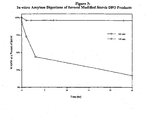
- Figure 1 illustrates a plot of the change in the Weight Average Molecular Weight (WAMW) as a function of time for each of the modified starch products. These data are given in Table 1.
- Table 1 - - Change in WAMW Over Time As a Percentage of Initial WAMW Time (hr) 222 mM NaIO 4 (36% Modified) 278mM NaIO 4 (45% Modified) 334 mM NaIO 4 (54% Modified) 0.00 100% 100% 100% 100% 0.08 94% 93% 99% 3.00 69% 84% 97% 7.00 57% 78% 95% 24.00 38% 59% 89%
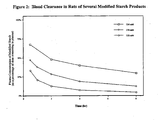
- Figure 2 shows a plot of the average blood levels of modified starch as a function of time. These data are provided in Table 2.
- DFO-starch conjugates prepared above in Experiments 3 and 4 of Example 4 were examined for rate of digestion by ⁇ -amylase using gel permeation chromatography with refractive index and laser light scattering detection.
- the digestion samples were prepared in a manner similar to the procedure outline in Example 2.
- the digested samples were injected on the GPC column for measurement of the sample molecular weight distribution.
- Figure 3 provides a plot of the change in the Weight Average Molecular Weight (WAMW) as a function of time for each of the modified starch products. These data are given in Table 3. Table 3 - - Decrease in Weight Average Molecular Weight Upon Incubation with Amylase Expressed as a Percentage of Initial WAMW Time (hr) 150 mM NaIO 4 ( ⁇ 24% Modified) 550mM NaIO 4 ( ⁇ 89% Modified) 0.00 100.0% 100.0% 0.08 91.0% n/a 1 72.7% 95.6% 2 n/a 95.6% 3 43.7% n/a 7 n/a 95.6% 23 n/a 95.6% 25 17.0% n/a 168 n/a 95.6% n/a - not available
- Figure 4 shows a plot of the average blood levels of DFO-Starch conjugate as a function of time.
- Experiments 1 and 2 employed starch having a molecular weight of 46,000.
- Experiments 3-7 employed starch having a molecular weight of 126,000. These data are provided in Table 4.
- Dextran modification was carried out by a slight modification of the method described in Example 1 for oxidizing starch. Briefly, dextran was dissolved in an aqueous medium at a concentration of approximately 100 g/L and while stirring, then was added a solution of NaIO 4 (or NaIO 4 in solid form) to oxidize the dextran. The amount of NaIO 4 used controlled the amount of dextran oxidation. The reaction mixture was then purified to remove salts from the oxidation reaction. Next, the resultant dialdehyde groups (formed by the oxidation reaction) were reduced to alcohol groups using NaBH 4 . Finally the reaction mixture was again purified to remove salts from the reaction mixture. The "modified dextran" was then ready for formulation or further modification.
- Oxidized and reduced dextran was administered i.v. to Sprague-Dawley rats at a dosage of 40 mL/kg over 30 minutes. About 100% of the vicinal hydroxyls on the dextran had been oxidized with periodate and reduced. A very minor allergic reaction was observed as demonstrated by slight inflation of the front paw pads (but not rear paw pads). After dosing the animal fully recovered from anesthesia.
Landscapes
- Health & Medical Sciences (AREA)
- Chemical & Material Sciences (AREA)
- Life Sciences & Earth Sciences (AREA)
- Medicinal Chemistry (AREA)
- General Health & Medical Sciences (AREA)
- Engineering & Computer Science (AREA)
- Veterinary Medicine (AREA)
- Animal Behavior & Ethology (AREA)
- Epidemiology (AREA)
- Public Health (AREA)
- Pharmacology & Pharmacy (AREA)
- Materials Engineering (AREA)
- Biochemistry (AREA)
- Molecular Biology (AREA)
- Chemical Kinetics & Catalysis (AREA)
- Polymers & Plastics (AREA)
- Organic Chemistry (AREA)
- Bioinformatics & Cheminformatics (AREA)
- Polysaccharides And Polysaccharide Derivatives (AREA)
- Medicinal Preparation (AREA)
- Measuring Or Testing Involving Enzymes Or Micro-Organisms (AREA)
- Peptides Or Proteins (AREA)
Claims (9)
- Modifiziertes Polysaccharid, erhältlich durch ein Verfahren zum Oxidieren und Reduzieren von wasserlöslichem Polysaccharid, wobei das Verfahren die folgenden Schritte einschließt:- Oxidieren des Polysaccharids mit NaIO4 und- Reduzieren des Gemischs mit NaBH4, undwobei 20 bis 90% an benachbarten Hydroxygruppen des Polysaccharids oxidiert worden sind.
- Modifiziertes Polysaccharid nach Anspruch 1, wobei dem Reaktionsgemisch unter Bildung eines Konjugats des oxidierten Polysaccharids ein Chelatbildner zugesetzt wird.
- Modifiziertes Polysaccharid nach Anspruch 1 oder 2, wobei es sich bei dem wasserlöslichen Polysaccharid im Verfahren um Stärke oder Dextran handelt.
- Modifiziertes Polysaccharid nach einem der Ansprüche 1 bis 3, wobei 20 bis 80% der Hydroxygruppen oxidiert worden sind.
- Modifiziertes Polysaccharid nach einem der Ansprüche 1 bis 4, wobei 30 bis 60% der Hydroxygruppen oxidiert worden sind.
- Modifiziertes Polysaccharid nach Anspruch 2, wobei der Chelatbildner Deferoxamin umfasst.
- Modifiziertes Polysaccharid nach einem der Ansprüche 1 bis 6, wobei der Oxidations- und Reduktionsgrad der löslichen Stärke zum Bereitstellen einer längeren Gefäßhalbwertszeit wirksam ist.
- Modifiziertes Polysaccharid nach einem der Ansprüche 1 bis 7 zur Verwendung als ein Medikament, das in den Kreislauf des Säugers verabreicht wird.
- Arzneimittel, umfassend das in einem der Ansprüche 1 bis 7 definierte modifizierte Polysaccharid und ein pharmazeutisch verträgliches Vehikulum.
Applications Claiming Priority (5)
| Application Number | Priority Date | Filing Date | Title |
|---|---|---|---|
| US6907997P | 1997-12-09 | 1997-12-09 | |
| US69079P | 1997-12-09 | ||
| US6909597P | 1997-12-11 | 1997-12-11 | |
| US69095P | 1997-12-11 | ||
| PCT/US1998/026132 WO1999029328A1 (en) | 1997-12-09 | 1998-12-09 | Modified polysaccharides exhibiting altered biological recognition |
Publications (3)
| Publication Number | Publication Date |
|---|---|
| EP1037642A1 EP1037642A1 (de) | 2000-09-27 |
| EP1037642B1 EP1037642B1 (de) | 2009-03-18 |
| EP1037642B9 true EP1037642B9 (de) | 2010-10-13 |
Family
ID=26749664
Family Applications (1)
| Application Number | Title | Priority Date | Filing Date |
|---|---|---|---|
| EP98962025A Expired - Lifetime EP1037642B9 (de) | 1997-12-09 | 1998-12-09 | Modifizierte polysaccharide mit veränderter biologischer erkennung |
Country Status (12)
| Country | Link |
|---|---|
| US (1) | US6479468B1 (de) |
| EP (1) | EP1037642B9 (de) |
| JP (1) | JP4435412B2 (de) |
| AT (1) | ATE425758T1 (de) |
| AU (1) | AU761784B2 (de) |
| BR (1) | BR9813465A (de) |
| CA (1) | CA2314716C (de) |
| DE (1) | DE69840673D1 (de) |
| DK (1) | DK1037642T3 (de) |
| ES (1) | ES2325005T3 (de) |
| TR (1) | TR200001682T2 (de) |
| WO (1) | WO1999029328A1 (de) |
Families Citing this family (9)
| Publication number | Priority date | Publication date | Assignee | Title |
|---|---|---|---|---|
| US6780852B2 (en) | 1997-12-09 | 2004-08-24 | Bo E. Hedlund | Modified polysaccharides exhibiting altered biological recognition |
| US20030236224A1 (en) * | 1997-12-09 | 2003-12-25 | Hedlund Bo E. | Modified polysaccharides exhibiting altered biological recognition |
| WO2002026240A2 (en) | 2000-09-26 | 2002-04-04 | Sidney Kimmel Cancer Center | Inhibition of antigen presentation with poorly catabolized polymers |
| EP1707632A1 (de) * | 2005-04-01 | 2006-10-04 | Bayer CropScience GmbH | Phosphorylierte waxy-Kartoffelstärke |
| US7709001B2 (en) * | 2005-04-08 | 2010-05-04 | Wyeth Llc | Multivalent pneumococcal polysaccharide-protein conjugate composition |
| US8974799B2 (en) | 2009-09-30 | 2015-03-10 | Novartis Ag | Conjugation of Staphylococcus aureus type 5 and type 8 capsular polysaccharides |
| CN108430458B (zh) * | 2015-10-26 | 2022-05-10 | 哈佛学院院长等 | 还原和氧化的多糖及其使用方法 |
| ES3051396T3 (en) * | 2017-06-13 | 2025-12-29 | Merz Pharma Gmbh & Co Kgaa | Mixing nozzle, application device, kit and method using the mixing nozzle or application device |
| JP7166300B2 (ja) * | 2017-07-06 | 2022-11-07 | バイエル、アクチエンゲゼルシャフト | 雑草防除装置 |
Family Cites Families (12)
| Publication number | Priority date | Publication date | Assignee | Title |
|---|---|---|---|---|
| GB977694A (en) * | 1959-12-23 | 1964-12-09 | Chugai Pharmaceutical Co Ltd | Starch derivatives |
| FR1315047A (fr) | 1960-10-11 | 1963-01-18 | Ciba Geigy | Procédé de préparation d'acides trihydroxamiques à longue chaîne |
| JPS5634701A (en) * | 1979-08-29 | 1981-04-07 | Meito Sangyo Kk | Beta-1,3-glucan, its preparation and use |
| US4419365A (en) | 1981-12-21 | 1983-12-06 | Ciba-Geigy Corporation | Method of treating Alzheimer's disease |
| US5217998A (en) | 1985-07-02 | 1993-06-08 | Biomedical Frontiers, Inc. | Composition for the stabilization of deferoxamine to chelate free ions in physiological fluid |
| US4863964A (en) | 1985-07-02 | 1989-09-05 | Biomedical Frontiers, Inc. | Method for the stabilization of deferoxamine to chelate free ions in physiological fluid |
| US4863961A (en) * | 1985-11-25 | 1989-09-05 | G. D. Searle & Co. | Tetraenyl prostaglandins |
| US4987253A (en) | 1988-09-19 | 1991-01-22 | University Of Florida | Method for the synthesis of desferrioxamine B and analogs thereof |
| US5268165A (en) | 1990-10-16 | 1993-12-07 | Biomedical Frontiers, Inc. | Polymer-deferoxamine-ferric iron adducts for use in magnetic resonance imaging |
| US5493053A (en) | 1994-12-21 | 1996-02-20 | University Of Florida Research Foundation, Inc. | Method for preparing desferrioxamine B and homologs thereof |
| US5811510A (en) * | 1995-04-14 | 1998-09-22 | General Hospital Corporation | Biodegradable polyacetal polymers and methods for their formation and use |
| US5847110A (en) | 1997-08-15 | 1998-12-08 | Biomedical Frontiers, Inc. | Method of reducing a schiff base |
-
1998
- 1998-12-09 EP EP98962025A patent/EP1037642B9/de not_active Expired - Lifetime
- 1998-12-09 AT AT98962025T patent/ATE425758T1/de not_active IP Right Cessation
- 1998-12-09 WO PCT/US1998/026132 patent/WO1999029328A1/en not_active Ceased
- 1998-12-09 ES ES98962025T patent/ES2325005T3/es not_active Expired - Lifetime
- 1998-12-09 DK DK98962025T patent/DK1037642T3/da active
- 1998-12-09 AU AU17197/99A patent/AU761784B2/en not_active Ceased
- 1998-12-09 BR BR9813465-5A patent/BR9813465A/pt not_active Application Discontinuation
- 1998-12-09 TR TR2000/01682T patent/TR200001682T2/xx unknown
- 1998-12-09 JP JP2000523997A patent/JP4435412B2/ja not_active Expired - Fee Related
- 1998-12-09 DE DE69840673T patent/DE69840673D1/de not_active Expired - Lifetime
- 1998-12-09 CA CA002314716A patent/CA2314716C/en not_active Expired - Fee Related
- 1998-12-09 US US09/555,994 patent/US6479468B1/en not_active Expired - Lifetime
Also Published As
| Publication number | Publication date |
|---|---|
| EP1037642A1 (de) | 2000-09-27 |
| ATE425758T1 (de) | 2009-04-15 |
| JP2001525369A (ja) | 2001-12-11 |
| WO1999029328A1 (en) | 1999-06-17 |
| AU761784B2 (en) | 2003-06-12 |
| CA2314716A1 (en) | 1999-06-17 |
| DK1037642T3 (da) | 2009-07-06 |
| JP4435412B2 (ja) | 2010-03-17 |
| EP1037642B1 (de) | 2009-03-18 |
| CA2314716C (en) | 2009-02-03 |
| US6479468B1 (en) | 2002-11-12 |
| BR9813465A (pt) | 2002-01-22 |
| TR200001682T2 (tr) | 2001-02-21 |
| AU1719799A (en) | 1999-06-28 |
| ES2325005T3 (es) | 2009-08-21 |
| DE69840673D1 (de) | 2009-04-30 |
Similar Documents
| Publication | Publication Date | Title |
|---|---|---|
| AU2010277438B2 (en) | Glycopolysialylation of non-blood coagulation proteins | |
| KR20120073196A (ko) | 비혈액 응고 단백질의 글리코폴리시알화 | |
| US10772968B2 (en) | Glycopolysialylation of non-blood coagulation proteins | |
| HUT71586A (en) | Process for producing lyp0philized polyalkyene oxide modified protein and polypeptide complexes with cyclodextrin | |
| US3937821A (en) | Plasma substitute including artificial starch and method for the preparation thereof | |
| JPH10504347A (ja) | 水溶性ポリエン複合体 | |
| EP1037642B9 (de) | Modifizierte polysaccharide mit veränderter biologischer erkennung | |
| Molteni | [22] Dextran and inulin conjugates as drug carriers | |
| US6780852B2 (en) | Modified polysaccharides exhibiting altered biological recognition | |
| US20030236224A1 (en) | Modified polysaccharides exhibiting altered biological recognition | |
| AU711200B2 (en) | Polymyxin conjugates | |
| JPH02231078A (ja) | ヒアルロン酸修飾スーパーオキシドジスムターゼ | |
| US20220296685A1 (en) | Uricase Derivative Co-conjugated With Fatty acid-linked PEG and optionally, Alkoxy PEG | |
| EP1339749B1 (de) | Verfahren zur herstellung verbesserter dextran- hemoglobin konjugate | |
| JPH09124512A (ja) | 肝臓ターゲティングのための水溶性の薬物−プルラン結合体製剤 | |
| US7932377B2 (en) | Complexing of medicinal substances with high-molecular carriers and injection and infusion solutions containing said complexes | |
| JP2997848B2 (ja) | N―アセチルキトオリゴ糖とマイトマイシン類の複合体及び抗腫瘍剤 | |
| JPH04103538A (ja) | 制癌剤副作用抑制剤 | |
| JPH02231076A (ja) | デキストラン修飾スーパーオキシドジスムターゼ | |
| JPH02231077A (ja) | ヘパリン修飾スーパーオキシドジスムターゼ | |
| JP2003292457A (ja) | 抗腫瘍剤 | |
| HK1230101A1 (en) | Glycopolysialylation of proteins other than blood coagulation proteins | |
| CA2422908A1 (en) | Dextran-hemoglobin conjugates as blood substitutes | |
| MXPA97009003A (en) | Cojugados de polimix |
Legal Events
| Date | Code | Title | Description |
|---|---|---|---|
| PUAI | Public reference made under article 153(3) epc to a published international application that has entered the european phase |
Free format text: ORIGINAL CODE: 0009012 |
|
| 17P | Request for examination filed |
Effective date: 20000710 |
|
| AK | Designated contracting states |
Kind code of ref document: A1 Designated state(s): AT BE CH CY DE DK ES FI FR GB GR IE IT LI LU MC NL PT SE |
|
| AX | Request for extension of the european patent |
Free format text: AL PAYMENT 20000710;LT PAYMENT 20000710;LV PAYMENT 20000710;MK PAYMENT 20000710;RO PAYMENT 20000710;SI PAYMENT 20000710 |
|
| 17Q | First examination report despatched |
Effective date: 20030211 |
|
| GRAP | Despatch of communication of intention to grant a patent |
Free format text: ORIGINAL CODE: EPIDOSNIGR1 |
|
| RIC1 | Information provided on ipc code assigned before grant |
Ipc: A61K 47/48 20060101ALI20080625BHEP Ipc: A61K 31/715 20060101AFI20080625BHEP |
|
| GRAS | Grant fee paid |
Free format text: ORIGINAL CODE: EPIDOSNIGR3 |
|
| GRAA | (expected) grant |
Free format text: ORIGINAL CODE: 0009210 |
|
| AK | Designated contracting states |
Kind code of ref document: B1 Designated state(s): AT BE CH CY DE DK ES FI FR GB GR IE IT LI LU MC NL PT SE |
|
| AX | Request for extension of the european patent |
Extension state: AL LT LV MK RO SI |
|
| REG | Reference to a national code |
Ref country code: GB Ref legal event code: FG4D |
|
| REG | Reference to a national code |
Ref country code: CH Ref legal event code: EP |
|
| REG | Reference to a national code |
Ref country code: IE Ref legal event code: FG4D |
|
| REF | Corresponds to: |
Ref document number: 69840673 Country of ref document: DE Date of ref document: 20090430 Kind code of ref document: P |
|
| REG | Reference to a national code |
Ref country code: SE Ref legal event code: TRGR |
|
| REG | Reference to a national code |
Ref country code: CH Ref legal event code: PFA Owner name: BIOMEDICAL FRONTIERS, INC. Free format text: BIOMEDICAL FRONTIERS, INC.#HENNEPIN BUSINESS CENTER, 1095 TENTH AVENUE S.E.#MINNEAPOLIS, MN 55414 (US) -TRANSFER TO- BIOMEDICAL FRONTIERS, INC.#1087 10TH AVENUE SE#MINNEAPOLIS, MN 55414 (US) Ref country code: CH Ref legal event code: NV Representative=s name: ING. MARCO ZARDI C/O M. ZARDI & CO. S.A. |
|
| REG | Reference to a national code |
Ref country code: DK Ref legal event code: T3 |
|
| RAP2 | Party data changed (patent owner data changed or rights of a patent transferred) |
Owner name: BIOMEDICAL FRONTIERS, INC. |
|
| REG | Reference to a national code |
Ref country code: GR Ref legal event code: EP Ref document number: 20090401538 Country of ref document: GR |
|
| PG25 | Lapsed in a contracting state [announced via postgrant information from national office to epo] |
Ref country code: FI Free format text: LAPSE BECAUSE OF FAILURE TO SUBMIT A TRANSLATION OF THE DESCRIPTION OR TO PAY THE FEE WITHIN THE PRESCRIBED TIME-LIMIT Effective date: 20090318 |
|
| REG | Reference to a national code |
Ref country code: ES Ref legal event code: FG2A Ref document number: 2325005 Country of ref document: ES Kind code of ref document: T3 |
|
| LTIE | Lt: invalidation of european patent or patent extension |
Effective date: 20090318 |
|
| PG25 | Lapsed in a contracting state [announced via postgrant information from national office to epo] |
Ref country code: AT Free format text: LAPSE BECAUSE OF FAILURE TO SUBMIT A TRANSLATION OF THE DESCRIPTION OR TO PAY THE FEE WITHIN THE PRESCRIBED TIME-LIMIT Effective date: 20090318 |
|
| NLT2 | Nl: modifications (of names), taken from the european patent patent bulletin |
Owner name: BIOMEDICAL FRONTIERS, INC. Effective date: 20090708 |
|
| PG25 | Lapsed in a contracting state [announced via postgrant information from national office to epo] |
Ref country code: BE Free format text: LAPSE BECAUSE OF FAILURE TO SUBMIT A TRANSLATION OF THE DESCRIPTION OR TO PAY THE FEE WITHIN THE PRESCRIBED TIME-LIMIT Effective date: 20090318 |
|
| PG25 | Lapsed in a contracting state [announced via postgrant information from national office to epo] |
Ref country code: PT Free format text: LAPSE BECAUSE OF FAILURE TO SUBMIT A TRANSLATION OF THE DESCRIPTION OR TO PAY THE FEE WITHIN THE PRESCRIBED TIME-LIMIT Effective date: 20090826 |
|
| PLBE | No opposition filed within time limit |
Free format text: ORIGINAL CODE: 0009261 |
|
| STAA | Information on the status of an ep patent application or granted ep patent |
Free format text: STATUS: NO OPPOSITION FILED WITHIN TIME LIMIT |
|
| 26N | No opposition filed |
Effective date: 20091221 |
|
| REG | Reference to a national code |
Ref country code: NL Ref legal event code: V1 Effective date: 20100701 |
|
| EUG | Se: european patent has lapsed | ||
| PG25 | Lapsed in a contracting state [announced via postgrant information from national office to epo] |
Ref country code: MC Free format text: LAPSE BECAUSE OF NON-PAYMENT OF DUE FEES Effective date: 20100701 |
|
| REG | Reference to a national code |
Ref country code: DK Ref legal event code: EBP |
|
| PG25 | Lapsed in a contracting state [announced via postgrant information from national office to epo] |
Ref country code: NL Free format text: LAPSE BECAUSE OF NON-PAYMENT OF DUE FEES Effective date: 20100701 Ref country code: IE Free format text: LAPSE BECAUSE OF NON-PAYMENT OF DUE FEES Effective date: 20091209 |
|
| PG25 | Lapsed in a contracting state [announced via postgrant information from national office to epo] |
Ref country code: DK Free format text: LAPSE BECAUSE OF NON-PAYMENT OF DUE FEES Effective date: 20100104 |
|
| REG | Reference to a national code |
Ref country code: ES Ref legal event code: FD2A Effective date: 20110324 |
|
| PG25 | Lapsed in a contracting state [announced via postgrant information from national office to epo] |
Ref country code: LU Free format text: LAPSE BECAUSE OF NON-PAYMENT OF DUE FEES Effective date: 20091209 |
|
| PG25 | Lapsed in a contracting state [announced via postgrant information from national office to epo] |
Ref country code: SE Free format text: LAPSE BECAUSE OF NON-PAYMENT OF DUE FEES Effective date: 20091210 |
|
| PG25 | Lapsed in a contracting state [announced via postgrant information from national office to epo] |
Ref country code: ES Free format text: LAPSE BECAUSE OF NON-PAYMENT OF DUE FEES Effective date: 20110310 |
|
| PG25 | Lapsed in a contracting state [announced via postgrant information from national office to epo] |
Ref country code: ES Free format text: LAPSE BECAUSE OF NON-PAYMENT OF DUE FEES Effective date: 20091210 Ref country code: CY Free format text: LAPSE BECAUSE OF FAILURE TO SUBMIT A TRANSLATION OF THE DESCRIPTION OR TO PAY THE FEE WITHIN THE PRESCRIBED TIME-LIMIT Effective date: 20090318 |
|
| REG | Reference to a national code |
Ref country code: ES Ref legal event code: NF2A Effective date: 20120314 |
|
| PGRI | Patent reinstated in contracting state [announced from national office to epo] |
Ref country code: ES Effective date: 20120314 |
|
| REG | Reference to a national code |
Ref country code: ES Ref legal event code: PC2A Owner name: THERAPURE BIOPHARMA INC. Effective date: 20131023 |
|
| REG | Reference to a national code |
Ref country code: FR Ref legal event code: PLFP Year of fee payment: 18 |
|
| PGFP | Annual fee paid to national office [announced via postgrant information from national office to epo] |
Ref country code: CH Payment date: 20151217 Year of fee payment: 18 Ref country code: GR Payment date: 20151228 Year of fee payment: 18 Ref country code: GB Payment date: 20151229 Year of fee payment: 18 |
|
| PGFP | Annual fee paid to national office [announced via postgrant information from national office to epo] |
Ref country code: FR Payment date: 20151224 Year of fee payment: 18 Ref country code: ES Payment date: 20151229 Year of fee payment: 18 |
|
| PGFP | Annual fee paid to national office [announced via postgrant information from national office to epo] |
Ref country code: IT Payment date: 20151223 Year of fee payment: 18 Ref country code: DE Payment date: 20151217 Year of fee payment: 18 |
|
| REG | Reference to a national code |
Ref country code: DE Ref legal event code: R119 Ref document number: 69840673 Country of ref document: DE |
|
| REG | Reference to a national code |
Ref country code: CH Ref legal event code: PL |
|
| GBPC | Gb: european patent ceased through non-payment of renewal fee |
Effective date: 20161209 |
|
| REG | Reference to a national code |
Ref country code: FR Ref legal event code: ST Effective date: 20170831 |
|
| PG25 | Lapsed in a contracting state [announced via postgrant information from national office to epo] |
Ref country code: LI Free format text: LAPSE BECAUSE OF NON-PAYMENT OF DUE FEES Effective date: 20161231 Ref country code: CH Free format text: LAPSE BECAUSE OF NON-PAYMENT OF DUE FEES Effective date: 20161231 Ref country code: FR Free format text: LAPSE BECAUSE OF NON-PAYMENT OF DUE FEES Effective date: 20170102 Ref country code: GR Free format text: LAPSE BECAUSE OF NON-PAYMENT OF DUE FEES Effective date: 20170707 Ref country code: IT Free format text: LAPSE BECAUSE OF NON-PAYMENT OF DUE FEES Effective date: 20161209 |
|
| PG25 | Lapsed in a contracting state [announced via postgrant information from national office to epo] |
Ref country code: DE Free format text: LAPSE BECAUSE OF NON-PAYMENT OF DUE FEES Effective date: 20170701 Ref country code: GB Free format text: LAPSE BECAUSE OF NON-PAYMENT OF DUE FEES Effective date: 20161209 |
|
| PG25 | Lapsed in a contracting state [announced via postgrant information from national office to epo] |
Ref country code: ES Free format text: LAPSE BECAUSE OF FAILURE TO SUBMIT A TRANSLATION OF THE DESCRIPTION OR TO PAY THE FEE WITHIN THE PRESCRIBED TIME-LIMIT Effective date: 20091210 |
|
| PGRI | Patent reinstated in contracting state [announced from national office to epo] |
Ref country code: ES Effective date: 20120314 |
|
| PG25 | Lapsed in a contracting state [announced via postgrant information from national office to epo] |
Ref country code: ES Free format text: THE PATENT HAS BEEN ANNULLED BY A DECISION OF A NATIONAL AUTHORITY Effective date: 20091210 |
|
| PGRI | Patent reinstated in contracting state [announced from national office to epo] |
Ref country code: ES Effective date: 20120314 |