EP1035141A1 - Perlpolymerisate mit enger Teilchengrössenverteilung - Google Patents
Perlpolymerisate mit enger Teilchengrössenverteilung Download PDFInfo
- Publication number
- EP1035141A1 EP1035141A1 EP00103464A EP00103464A EP1035141A1 EP 1035141 A1 EP1035141 A1 EP 1035141A1 EP 00103464 A EP00103464 A EP 00103464A EP 00103464 A EP00103464 A EP 00103464A EP 1035141 A1 EP1035141 A1 EP 1035141A1
- Authority
- EP
- European Patent Office
- Prior art keywords
- methacrylate
- formula
- monomer
- methyl
- bead polymers
- Prior art date
- Legal status (The legal status is an assumption and is not a legal conclusion. Google has not performed a legal analysis and makes no representation as to the accuracy of the status listed.)
- Withdrawn
Links
- 229920000642 polymer Polymers 0.000 title claims abstract description 64
- 239000002245 particle Substances 0.000 title claims abstract description 33
- 238000009826 distribution Methods 0.000 title claims abstract description 19
- 239000011324 bead Substances 0.000 title claims description 45
- 239000000178 monomer Substances 0.000 claims abstract description 48
- PPBRXRYQALVLMV-UHFFFAOYSA-N Styrene Chemical compound C=CC1=CC=CC=C1 PPBRXRYQALVLMV-UHFFFAOYSA-N 0.000 claims abstract description 14
- 125000001997 phenyl group Chemical group [H]C1=C([H])C([H])=C(*)C([H])=C1[H] 0.000 claims abstract description 4
- 238000002360 preparation method Methods 0.000 claims abstract description 3
- 239000000203 mixture Substances 0.000 claims description 14
- 238000000034 method Methods 0.000 claims description 13
- 239000000758 substrate Substances 0.000 claims description 13
- 239000003999 initiator Substances 0.000 claims description 12
- UFHFLCQGNIYNRP-UHFFFAOYSA-N Hydrogen Chemical compound [H][H] UFHFLCQGNIYNRP-UHFFFAOYSA-N 0.000 claims description 9
- 125000002496 methyl group Chemical group [H]C([H])([H])* 0.000 claims description 9
- SOGAXMICEFXMKE-UHFFFAOYSA-N Butylmethacrylate Chemical compound CCCCOC(=O)C(C)=C SOGAXMICEFXMKE-UHFFFAOYSA-N 0.000 claims description 8
- 238000012674 dispersion polymerization Methods 0.000 claims description 8
- VVQNEPGJFQJSBK-UHFFFAOYSA-N Methyl methacrylate Chemical compound COC(=O)C(C)=C VVQNEPGJFQJSBK-UHFFFAOYSA-N 0.000 claims description 7
- 125000004432 carbon atom Chemical group C* 0.000 claims description 6
- 239000001257 hydrogen Substances 0.000 claims description 6
- 229910052739 hydrogen Inorganic materials 0.000 claims description 6
- 229920006163 vinyl copolymer Polymers 0.000 claims description 6
- 238000007641 inkjet printing Methods 0.000 claims description 5
- 239000000463 material Substances 0.000 claims description 5
- RUMACXVDVNRZJZ-UHFFFAOYSA-N 2-methylpropyl 2-methylprop-2-enoate Chemical compound CC(C)COC(=O)C(C)=C RUMACXVDVNRZJZ-UHFFFAOYSA-N 0.000 claims description 4
- BAPJBEWLBFYGME-UHFFFAOYSA-N Methyl acrylate Chemical compound COC(=O)C=C BAPJBEWLBFYGME-UHFFFAOYSA-N 0.000 claims description 4
- SUPCQIBBMFXVTL-UHFFFAOYSA-N ethyl 2-methylprop-2-enoate Chemical compound CCOC(=O)C(C)=C SUPCQIBBMFXVTL-UHFFFAOYSA-N 0.000 claims description 4
- BOQSSGDQNWEFSX-UHFFFAOYSA-N propan-2-yl 2-methylprop-2-enoate Chemical compound CC(C)OC(=O)C(C)=C BOQSSGDQNWEFSX-UHFFFAOYSA-N 0.000 claims description 4
- NHARPDSAXCBDDR-UHFFFAOYSA-N propyl 2-methylprop-2-enoate Chemical compound CCCOC(=O)C(C)=C NHARPDSAXCBDDR-UHFFFAOYSA-N 0.000 claims description 4
- MZGMQAMKOBOIDR-UHFFFAOYSA-N 2-[2-(2-hydroxyethoxy)ethoxy]ethyl 2-methylprop-2-enoate Chemical compound CC(=C)C(=O)OCCOCCOCCO MZGMQAMKOBOIDR-UHFFFAOYSA-N 0.000 claims description 2
- WDQMWEYDKDCEHT-UHFFFAOYSA-N 2-ethylhexyl 2-methylprop-2-enoate Chemical compound CCCCC(CC)COC(=O)C(C)=C WDQMWEYDKDCEHT-UHFFFAOYSA-N 0.000 claims description 2
- YXYJVFYWCLAXHO-UHFFFAOYSA-N 2-methoxyethyl 2-methylprop-2-enoate Chemical compound COCCOC(=O)C(C)=C YXYJVFYWCLAXHO-UHFFFAOYSA-N 0.000 claims description 2
- DOYKFSOCSXVQAN-UHFFFAOYSA-N 3-[diethoxy(methyl)silyl]propyl 2-methylprop-2-enoate Chemical compound CCO[Si](C)(OCC)CCCOC(=O)C(C)=C DOYKFSOCSXVQAN-UHFFFAOYSA-N 0.000 claims description 2
- UDWIZRDPCQAYRF-UHFFFAOYSA-N 3-[diethoxy(methyl)silyl]propyl prop-2-enoate Chemical compound CCO[Si](C)(OCC)CCCOC(=O)C=C UDWIZRDPCQAYRF-UHFFFAOYSA-N 0.000 claims description 2
- LZMNXXQIQIHFGC-UHFFFAOYSA-N 3-[dimethoxy(methyl)silyl]propyl 2-methylprop-2-enoate Chemical compound CO[Si](C)(OC)CCCOC(=O)C(C)=C LZMNXXQIQIHFGC-UHFFFAOYSA-N 0.000 claims description 2
- MCDBEBOBROAQSH-UHFFFAOYSA-N 3-[dimethoxy(methyl)silyl]propyl prop-2-enoate Chemical compound CO[Si](C)(OC)CCCOC(=O)C=C MCDBEBOBROAQSH-UHFFFAOYSA-N 0.000 claims description 2
- URDOJQUSEUXVRP-UHFFFAOYSA-N 3-triethoxysilylpropyl 2-methylprop-2-enoate Chemical compound CCO[Si](OCC)(OCC)CCCOC(=O)C(C)=C URDOJQUSEUXVRP-UHFFFAOYSA-N 0.000 claims description 2
- XDQWJFXZTAWJST-UHFFFAOYSA-N 3-triethoxysilylpropyl prop-2-enoate Chemical compound CCO[Si](OCC)(OCC)CCCOC(=O)C=C XDQWJFXZTAWJST-UHFFFAOYSA-N 0.000 claims description 2
- XDLMVUHYZWKMMD-UHFFFAOYSA-N 3-trimethoxysilylpropyl 2-methylprop-2-enoate Chemical compound CO[Si](OC)(OC)CCCOC(=O)C(C)=C XDLMVUHYZWKMMD-UHFFFAOYSA-N 0.000 claims description 2
- KBQVDAIIQCXKPI-UHFFFAOYSA-N 3-trimethoxysilylpropyl prop-2-enoate Chemical compound CO[Si](OC)(OC)CCCOC(=O)C=C KBQVDAIIQCXKPI-UHFFFAOYSA-N 0.000 claims description 2
- DIVUSAVKQOLTNR-UHFFFAOYSA-N 4-methoxybutyl 2-methylprop-2-enoate Chemical compound COCCCCOC(=O)C(C)=C DIVUSAVKQOLTNR-UHFFFAOYSA-N 0.000 claims description 2
- IAXXETNIOYFMLW-COPLHBTASA-N [(1s,3s,4s)-4,7,7-trimethyl-3-bicyclo[2.2.1]heptanyl] 2-methylprop-2-enoate Chemical compound C1C[C@]2(C)[C@@H](OC(=O)C(=C)C)C[C@H]1C2(C)C IAXXETNIOYFMLW-COPLHBTASA-N 0.000 claims description 2
- XYLMUPLGERFSHI-UHFFFAOYSA-N alpha-Methylstyrene Chemical compound CC(=C)C1=CC=CC=C1 XYLMUPLGERFSHI-UHFFFAOYSA-N 0.000 claims description 2
- GTBGXKPAKVYEKJ-UHFFFAOYSA-N decyl 2-methylprop-2-enoate Chemical compound CCCCCCCCCCOC(=O)C(C)=C GTBGXKPAKVYEKJ-UHFFFAOYSA-N 0.000 claims description 2
- LNCPIMCVTKXXOY-UHFFFAOYSA-N hexyl 2-methylprop-2-enoate Chemical compound CCCCCCOC(=O)C(C)=C LNCPIMCVTKXXOY-UHFFFAOYSA-N 0.000 claims description 2
- 229940119545 isobornyl methacrylate Drugs 0.000 claims description 2
- HMZGPNHSPWNGEP-UHFFFAOYSA-N octadecyl 2-methylprop-2-enoate Chemical compound CCCCCCCCCCCCCCCCCCOC(=O)C(C)=C HMZGPNHSPWNGEP-UHFFFAOYSA-N 0.000 claims description 2
- NZIDBRBFGPQCRY-UHFFFAOYSA-N octyl 2-methylprop-2-enoate Chemical compound CCCCCCCCOC(=O)C(C)=C NZIDBRBFGPQCRY-UHFFFAOYSA-N 0.000 claims description 2
- UUEVFMOUBSLVJW-UHFFFAOYSA-N oxo-[[1-[2-[2-[2-[4-(oxoazaniumylmethylidene)pyridin-1-yl]ethoxy]ethoxy]ethyl]pyridin-4-ylidene]methyl]azanium;dibromide Chemical compound [Br-].[Br-].C1=CC(=C[NH+]=O)C=CN1CCOCCOCCN1C=CC(=C[NH+]=O)C=C1 UUEVFMOUBSLVJW-UHFFFAOYSA-N 0.000 claims description 2
- -1 acrylate ester Chemical class 0.000 abstract description 7
- 229920001577 copolymer Polymers 0.000 abstract description 5
- NIXOWILDQLNWCW-UHFFFAOYSA-M Acrylate Chemical compound [O-]C(=O)C=C NIXOWILDQLNWCW-UHFFFAOYSA-M 0.000 abstract description 2
- BLRPTPMANUNPDV-UHFFFAOYSA-N Silane Chemical group [SiH4] BLRPTPMANUNPDV-UHFFFAOYSA-N 0.000 abstract description 2
- 239000006185 dispersion Substances 0.000 abstract description 2
- 125000001160 methoxycarbonyl group Chemical group [H]C([H])([H])OC(*)=O 0.000 abstract description 2
- 229910000077 silane Inorganic materials 0.000 abstract description 2
- 125000000217 alkyl group Chemical group 0.000 abstract 1
- OKKJLVBELUTLKV-UHFFFAOYSA-N Methanol Chemical compound OC OKKJLVBELUTLKV-UHFFFAOYSA-N 0.000 description 18
- 239000002904 solvent Substances 0.000 description 18
- XLYOFNOQVPJJNP-UHFFFAOYSA-N water Substances O XLYOFNOQVPJJNP-UHFFFAOYSA-N 0.000 description 18
- 229910001868 water Inorganic materials 0.000 description 18
- 238000006116 polymerization reaction Methods 0.000 description 15
- LFQSCWFLJHTTHZ-UHFFFAOYSA-N Ethanol Chemical compound CCO LFQSCWFLJHTTHZ-UHFFFAOYSA-N 0.000 description 12
- 238000004132 cross linking Methods 0.000 description 11
- ZMXDDKWLCZADIW-UHFFFAOYSA-N N,N-Dimethylformamide Chemical compound CN(C)C=O ZMXDDKWLCZADIW-UHFFFAOYSA-N 0.000 description 9
- WYURNTSHIVDZCO-UHFFFAOYSA-N Tetrahydrofuran Chemical compound C1CCOC1 WYURNTSHIVDZCO-UHFFFAOYSA-N 0.000 description 8
- 230000002378 acidificating effect Effects 0.000 description 8
- 239000001267 polyvinylpyrrolidone Substances 0.000 description 7
- 229920000036 polyvinylpyrrolidone Polymers 0.000 description 7
- 235000013855 polyvinylpyrrolidone Nutrition 0.000 description 7
- CSCPPACGZOOCGX-UHFFFAOYSA-N Acetone Chemical compound CC(C)=O CSCPPACGZOOCGX-UHFFFAOYSA-N 0.000 description 6
- WEVYAHXRMPXWCK-UHFFFAOYSA-N Acetonitrile Chemical compound CC#N WEVYAHXRMPXWCK-UHFFFAOYSA-N 0.000 description 6
- 239000002270 dispersing agent Substances 0.000 description 6
- 238000003756 stirring Methods 0.000 description 6
- IJGRMHOSHXDMSA-UHFFFAOYSA-N Atomic nitrogen Chemical compound N#N IJGRMHOSHXDMSA-UHFFFAOYSA-N 0.000 description 4
- VEXZGXHMUGYJMC-UHFFFAOYSA-N Hydrochloric acid Chemical compound Cl VEXZGXHMUGYJMC-UHFFFAOYSA-N 0.000 description 4
- 150000001298 alcohols Chemical class 0.000 description 4
- 239000011230 binding agent Substances 0.000 description 4
- 229920002678 cellulose Polymers 0.000 description 4
- 238000000576 coating method Methods 0.000 description 4
- 238000006460 hydrolysis reaction Methods 0.000 description 4
- 238000004519 manufacturing process Methods 0.000 description 4
- 239000011049 pearl Substances 0.000 description 4
- 238000010557 suspension polymerization reaction Methods 0.000 description 4
- OZAIFHULBGXAKX-UHFFFAOYSA-N 2-(2-cyanopropan-2-yldiazenyl)-2-methylpropanenitrile Chemical compound N#CC(C)(C)N=NC(C)(C)C#N OZAIFHULBGXAKX-UHFFFAOYSA-N 0.000 description 3
- ZWEHNKRNPOVVGH-UHFFFAOYSA-N 2-Butanone Chemical compound CCC(C)=O ZWEHNKRNPOVVGH-UHFFFAOYSA-N 0.000 description 3
- QTBSBXVTEAMEQO-UHFFFAOYSA-N Acetic acid Chemical compound CC(O)=O QTBSBXVTEAMEQO-UHFFFAOYSA-N 0.000 description 3
- XEKOWRVHYACXOJ-UHFFFAOYSA-N Ethyl acetate Chemical compound CCOC(C)=O XEKOWRVHYACXOJ-UHFFFAOYSA-N 0.000 description 3
- WSFSSNUMVMOOMR-UHFFFAOYSA-N Formaldehyde Chemical compound O=C WSFSSNUMVMOOMR-UHFFFAOYSA-N 0.000 description 3
- 229910008051 Si-OH Inorganic materials 0.000 description 3
- 229910002808 Si–O–Si Inorganic materials 0.000 description 3
- 229910006358 Si—OH Inorganic materials 0.000 description 3
- HEMHJVSKTPXQMS-UHFFFAOYSA-M Sodium hydroxide Chemical compound [OH-].[Na+] HEMHJVSKTPXQMS-UHFFFAOYSA-M 0.000 description 3
- YXFVVABEGXRONW-UHFFFAOYSA-N Toluene Chemical compound CC1=CC=CC=C1 YXFVVABEGXRONW-UHFFFAOYSA-N 0.000 description 3
- 239000002253 acid Substances 0.000 description 3
- 238000006243 chemical reaction Methods 0.000 description 3
- 238000001035 drying Methods 0.000 description 3
- 230000007062 hydrolysis Effects 0.000 description 3
- 229920000126 latex Polymers 0.000 description 3
- VLKZOEOYAKHREP-UHFFFAOYSA-N n-Hexane Chemical compound CCCCCC VLKZOEOYAKHREP-UHFFFAOYSA-N 0.000 description 3
- 239000011118 polyvinyl acetate Substances 0.000 description 3
- 229920002689 polyvinyl acetate Polymers 0.000 description 3
- 238000004062 sedimentation Methods 0.000 description 3
- 239000000243 solution Substances 0.000 description 3
- 125000006850 spacer group Chemical group 0.000 description 3
- YLQBMQCUIZJEEH-UHFFFAOYSA-N tetrahydrofuran Natural products C=1C=COC=1 YLQBMQCUIZJEEH-UHFFFAOYSA-N 0.000 description 3
- 0 *N*O[N+](N=N)[O-] Chemical compound *N*O[N+](N=N)[O-] 0.000 description 2
- IAAUSMWGRGLOEK-UHFFFAOYSA-N 2-methyl-3-(3-trimethoxysilylpropoxy)prop-2-enoic acid Chemical compound CO[Si](OC)(OC)CCCOC=C(C)C(O)=O IAAUSMWGRGLOEK-UHFFFAOYSA-N 0.000 description 2
- 108010010803 Gelatin Proteins 0.000 description 2
- KFZMGEQAYNKOFK-UHFFFAOYSA-N Isopropanol Chemical compound CC(C)O KFZMGEQAYNKOFK-UHFFFAOYSA-N 0.000 description 2
- LRHPLDYGYMQRHN-UHFFFAOYSA-N N-Butanol Chemical compound CCCCO LRHPLDYGYMQRHN-UHFFFAOYSA-N 0.000 description 2
- IMNFDUFMRHMDMM-UHFFFAOYSA-N N-Heptane Chemical compound CCCCCCC IMNFDUFMRHMDMM-UHFFFAOYSA-N 0.000 description 2
- NBIIXXVUZAFLBC-UHFFFAOYSA-N Phosphoric acid Chemical compound OP(O)(O)=O NBIIXXVUZAFLBC-UHFFFAOYSA-N 0.000 description 2
- 239000004372 Polyvinyl alcohol Substances 0.000 description 2
- QAOWNCQODCNURD-UHFFFAOYSA-N Sulfuric acid Chemical compound OS(O)(=O)=O QAOWNCQODCNURD-UHFFFAOYSA-N 0.000 description 2
- DKGAVHZHDRPRBM-UHFFFAOYSA-N Tert-Butanol Chemical compound CC(C)(C)O DKGAVHZHDRPRBM-UHFFFAOYSA-N 0.000 description 2
- 125000001931 aliphatic group Chemical group 0.000 description 2
- 239000011260 aqueous acid Substances 0.000 description 2
- 238000009835 boiling Methods 0.000 description 2
- 239000001913 cellulose Substances 0.000 description 2
- 239000011248 coating agent Substances 0.000 description 2
- 239000008199 coating composition Substances 0.000 description 2
- 150000001875 compounds Chemical class 0.000 description 2
- 239000004815 dispersion polymer Substances 0.000 description 2
- 238000001914 filtration Methods 0.000 description 2
- 239000008273 gelatin Substances 0.000 description 2
- 229920000159 gelatin Polymers 0.000 description 2
- 235000019322 gelatine Nutrition 0.000 description 2
- 235000011852 gelatine desserts Nutrition 0.000 description 2
- ZXEKIIBDNHEJCQ-UHFFFAOYSA-N isobutanol Chemical compound CC(C)CO ZXEKIIBDNHEJCQ-UHFFFAOYSA-N 0.000 description 2
- 229910052757 nitrogen Inorganic materials 0.000 description 2
- 229920000847 nonoxynol Polymers 0.000 description 2
- SNQQPOLDUKLAAF-UHFFFAOYSA-N nonylphenol Chemical class CCCCCCCCCC1=CC=CC=C1O SNQQPOLDUKLAAF-UHFFFAOYSA-N 0.000 description 2
- 239000003960 organic solvent Substances 0.000 description 2
- 125000004430 oxygen atom Chemical group O* 0.000 description 2
- 229920003229 poly(methyl methacrylate) Polymers 0.000 description 2
- 229920000139 polyethylene terephthalate Polymers 0.000 description 2
- 239000005020 polyethylene terephthalate Substances 0.000 description 2
- 239000004926 polymethyl methacrylate Substances 0.000 description 2
- 229920002451 polyvinyl alcohol Polymers 0.000 description 2
- BDERNNFJNOPAEC-UHFFFAOYSA-N propan-1-ol Chemical compound CCCO BDERNNFJNOPAEC-UHFFFAOYSA-N 0.000 description 2
- 239000011541 reaction mixture Substances 0.000 description 2
- 239000004094 surface-active agent Substances 0.000 description 2
- HGXJDMCMYLEZMJ-UHFFFAOYSA-N (2-methylpropan-2-yl)oxy 2,2-dimethylpropaneperoxoate Chemical compound CC(C)(C)OOOC(=O)C(C)(C)C HGXJDMCMYLEZMJ-UHFFFAOYSA-N 0.000 description 1
- LNAZSHAWQACDHT-XIYTZBAFSA-N (2r,3r,4s,5r,6s)-4,5-dimethoxy-2-(methoxymethyl)-3-[(2s,3r,4s,5r,6r)-3,4,5-trimethoxy-6-(methoxymethyl)oxan-2-yl]oxy-6-[(2r,3r,4s,5r,6r)-4,5,6-trimethoxy-2-(methoxymethyl)oxan-3-yl]oxyoxane Chemical compound CO[C@@H]1[C@@H](OC)[C@H](OC)[C@@H](COC)O[C@H]1O[C@H]1[C@H](OC)[C@@H](OC)[C@H](O[C@H]2[C@@H]([C@@H](OC)[C@H](OC)O[C@@H]2COC)OC)O[C@@H]1COC LNAZSHAWQACDHT-XIYTZBAFSA-N 0.000 description 1
- OXYKVVLTXXXVRT-UHFFFAOYSA-N (4-chlorobenzoyl) 4-chlorobenzenecarboperoxoate Chemical compound C1=CC(Cl)=CC=C1C(=O)OOC(=O)C1=CC=C(Cl)C=C1 OXYKVVLTXXXVRT-UHFFFAOYSA-N 0.000 description 1
- RYHBNJHYFVUHQT-UHFFFAOYSA-N 1,4-Dioxane Chemical compound C1COCCO1 RYHBNJHYFVUHQT-UHFFFAOYSA-N 0.000 description 1
- LGJCFVYMIJLQJO-UHFFFAOYSA-N 1-dodecylperoxydodecane Chemical compound CCCCCCCCCCCCOOCCCCCCCCCCCC LGJCFVYMIJLQJO-UHFFFAOYSA-N 0.000 description 1
- MDPFMNDCSZZZIZ-UHFFFAOYSA-N 2,2,4,4,7,7,9,9-octamethyldecane-3,8-dione Chemical compound CC(C)(C)C(=O)C(C)(C)CCC(C)(C)C(=O)C(C)(C)C MDPFMNDCSZZZIZ-UHFFFAOYSA-N 0.000 description 1
- OHVNEQDNPSQOOT-UHFFFAOYSA-N 2,5-dimethylhexan-2-yl 7,7-dimethyloctaneperoxoate Chemical compound CC(C)CCC(C)(C)OOC(=O)CCCCCC(C)(C)C OHVNEQDNPSQOOT-UHFFFAOYSA-N 0.000 description 1
- RAWISQFSQWIXCW-UHFFFAOYSA-N 2-methylbutan-2-yl 2,2-dimethyloctaneperoxoate Chemical compound CCCCCCC(C)(C)C(=O)OOC(C)(C)CC RAWISQFSQWIXCW-UHFFFAOYSA-N 0.000 description 1
- AQKYLAIZOGOPAW-UHFFFAOYSA-N 2-methylbutan-2-yl 2,2-dimethylpropaneperoxoate Chemical compound CCC(C)(C)OOC(=O)C(C)(C)C AQKYLAIZOGOPAW-UHFFFAOYSA-N 0.000 description 1
- XYFRHHAYSXIKGH-UHFFFAOYSA-N 3-(5-methoxy-2-methoxycarbonyl-1h-indol-3-yl)prop-2-enoic acid Chemical compound C1=C(OC)C=C2C(C=CC(O)=O)=C(C(=O)OC)NC2=C1 XYFRHHAYSXIKGH-UHFFFAOYSA-N 0.000 description 1
- QTBSBXVTEAMEQO-UHFFFAOYSA-M Acetate Chemical compound CC([O-])=O QTBSBXVTEAMEQO-UHFFFAOYSA-M 0.000 description 1
- OMPJBNCRMGITSC-UHFFFAOYSA-N Benzoylperoxide Chemical compound C=1C=CC=CC=1C(=O)OOC(=O)C1=CC=CC=C1 OMPJBNCRMGITSC-UHFFFAOYSA-N 0.000 description 1
- RVAODKONZNSUAH-UHFFFAOYSA-N CCC(C)(C)OOC(=O)CCCCCCCC(=O)OC(C)(C)CC Chemical compound CCC(C)(C)OOC(=O)CCCCCCCC(=O)OC(C)(C)CC RVAODKONZNSUAH-UHFFFAOYSA-N 0.000 description 1
- VEXZGXHMUGYJMC-UHFFFAOYSA-M Chloride anion Chemical compound [Cl-] VEXZGXHMUGYJMC-UHFFFAOYSA-M 0.000 description 1
- ZAMOUSCENKQFHK-UHFFFAOYSA-N Chlorine atom Chemical compound [Cl] ZAMOUSCENKQFHK-UHFFFAOYSA-N 0.000 description 1
- 239000001856 Ethyl cellulose Substances 0.000 description 1
- ZZSNKZQZMQGXPY-UHFFFAOYSA-N Ethyl cellulose Chemical compound CCOCC1OC(OC)C(OCC)C(OCC)C1OC1C(O)C(O)C(OC)C(CO)O1 ZZSNKZQZMQGXPY-UHFFFAOYSA-N 0.000 description 1
- IAYPIBMASNFSPL-UHFFFAOYSA-N Ethylene oxide Chemical group C1CO1 IAYPIBMASNFSPL-UHFFFAOYSA-N 0.000 description 1
- SXRSQZLOMIGNAQ-UHFFFAOYSA-N Glutaraldehyde Chemical compound O=CCCCC=O SXRSQZLOMIGNAQ-UHFFFAOYSA-N 0.000 description 1
- 229920002153 Hydroxypropyl cellulose Polymers 0.000 description 1
- DGAQECJNVWCQMB-PUAWFVPOSA-M Ilexoside XXIX Chemical compound C[C@@H]1CC[C@@]2(CC[C@@]3(C(=CC[C@H]4[C@]3(CC[C@@H]5[C@@]4(CC[C@@H](C5(C)C)OS(=O)(=O)[O-])C)C)[C@@H]2[C@]1(C)O)C)C(=O)O[C@H]6[C@@H]([C@H]([C@@H]([C@H](O6)CO)O)O)O.[Na+] DGAQECJNVWCQMB-PUAWFVPOSA-M 0.000 description 1
- WHNWPMSKXPGLAX-UHFFFAOYSA-N N-Vinyl-2-pyrrolidone Chemical compound C=CN1CCCC1=O WHNWPMSKXPGLAX-UHFFFAOYSA-N 0.000 description 1
- 239000004698 Polyethylene Substances 0.000 description 1
- 239000004793 Polystyrene Substances 0.000 description 1
- KWYUFKZDYYNOTN-UHFFFAOYSA-M Potassium hydroxide Chemical compound [OH-].[K+] KWYUFKZDYYNOTN-UHFFFAOYSA-M 0.000 description 1
- 239000002174 Styrene-butadiene Substances 0.000 description 1
- XTXRWKRVRITETP-UHFFFAOYSA-N Vinyl acetate Chemical compound CC(=O)OC=C XTXRWKRVRITETP-UHFFFAOYSA-N 0.000 description 1
- JUIBLDFFVYKUAC-UHFFFAOYSA-N [5-(2-ethylhexanoylperoxy)-2,5-dimethylhexan-2-yl] 2-ethylhexaneperoxoate Chemical compound CCCCC(CC)C(=O)OOC(C)(C)CCC(C)(C)OOC(=O)C(CC)CCCC JUIBLDFFVYKUAC-UHFFFAOYSA-N 0.000 description 1
- 239000013543 active substance Substances 0.000 description 1
- 239000003513 alkali Substances 0.000 description 1
- 125000003545 alkoxy group Chemical group 0.000 description 1
- 229910000147 aluminium phosphate Inorganic materials 0.000 description 1
- 239000007864 aqueous solution Substances 0.000 description 1
- 239000003125 aqueous solvent Substances 0.000 description 1
- 238000000149 argon plasma sintering Methods 0.000 description 1
- 235000019400 benzoyl peroxide Nutrition 0.000 description 1
- MTAZNLWOLGHBHU-UHFFFAOYSA-N butadiene-styrene rubber Chemical compound C=CC=C.C=CC1=CC=CC=C1 MTAZNLWOLGHBHU-UHFFFAOYSA-N 0.000 description 1
- 150000007942 carboxylates Chemical class 0.000 description 1
- 238000005266 casting Methods 0.000 description 1
- 239000003054 catalyst Substances 0.000 description 1
- 239000000460 chlorine Substances 0.000 description 1
- 229910052801 chlorine Inorganic materials 0.000 description 1
- 239000012539 chromatography resin Substances 0.000 description 1
- 238000009833 condensation Methods 0.000 description 1
- 230000005494 condensation Effects 0.000 description 1
- 238000006482 condensation reaction Methods 0.000 description 1
- BLCKNMAZFRMCJJ-UHFFFAOYSA-N cyclohexyl cyclohexyloxycarbonyloxy carbonate Chemical compound C1CCCCC1OC(=O)OOC(=O)OC1CCCCC1 BLCKNMAZFRMCJJ-UHFFFAOYSA-N 0.000 description 1
- 238000000354 decomposition reaction Methods 0.000 description 1
- 125000005442 diisocyanate group Chemical group 0.000 description 1
- 230000000694 effects Effects 0.000 description 1
- 125000001301 ethoxy group Chemical group [H]C([H])([H])C([H])([H])O* 0.000 description 1
- 229920001249 ethyl cellulose Polymers 0.000 description 1
- 235000019325 ethyl cellulose Nutrition 0.000 description 1
- 239000011888 foil Substances 0.000 description 1
- 239000000499 gel Substances 0.000 description 1
- 229910052736 halogen Inorganic materials 0.000 description 1
- 150000002367 halogens Chemical class 0.000 description 1
- 238000010438 heat treatment Methods 0.000 description 1
- 239000012456 homogeneous solution Substances 0.000 description 1
- 229920001519 homopolymer Polymers 0.000 description 1
- 229930195733 hydrocarbon Natural products 0.000 description 1
- 150000002430 hydrocarbons Chemical class 0.000 description 1
- 125000002887 hydroxy group Chemical group [H]O* 0.000 description 1
- 239000001863 hydroxypropyl cellulose Substances 0.000 description 1
- 235000010977 hydroxypropyl cellulose Nutrition 0.000 description 1
- 238000010191 image analysis Methods 0.000 description 1
- 238000011065 in-situ storage Methods 0.000 description 1
- 239000002563 ionic surfactant Substances 0.000 description 1
- 150000002500 ions Chemical class 0.000 description 1
- 229960004592 isopropanol Drugs 0.000 description 1
- 229920002521 macromolecule Polymers 0.000 description 1
- FPYJFEHAWHCUMM-UHFFFAOYSA-N maleic anhydride Chemical compound O=C1OC(=O)C=C1 FPYJFEHAWHCUMM-UHFFFAOYSA-N 0.000 description 1
- 238000005259 measurement Methods 0.000 description 1
- 150000002734 metacrylic acid derivatives Chemical class 0.000 description 1
- 125000000956 methoxy group Chemical group [H]C([H])([H])O* 0.000 description 1
- 229920000609 methyl cellulose Polymers 0.000 description 1
- 239000001923 methylcellulose Substances 0.000 description 1
- 235000010981 methylcellulose Nutrition 0.000 description 1
- 239000011259 mixed solution Substances 0.000 description 1
- QYZFTMMPKCOTAN-UHFFFAOYSA-N n-[2-(2-hydroxyethylamino)ethyl]-2-[[1-[2-(2-hydroxyethylamino)ethylamino]-2-methyl-1-oxopropan-2-yl]diazenyl]-2-methylpropanamide Chemical compound OCCNCCNC(=O)C(C)(C)N=NC(C)(C)C(=O)NCCNCCO QYZFTMMPKCOTAN-UHFFFAOYSA-N 0.000 description 1
- 239000012454 non-polar solvent Substances 0.000 description 1
- 239000002736 nonionic surfactant Substances 0.000 description 1
- 125000000864 peroxy group Chemical group O(O*)* 0.000 description 1
- JRKICGRDRMAZLK-UHFFFAOYSA-L peroxydisulfate Chemical compound [O-]S(=O)(=O)OOS([O-])(=O)=O JRKICGRDRMAZLK-UHFFFAOYSA-L 0.000 description 1
- JAMNHZBIQDNHMM-UHFFFAOYSA-N pivalonitrile Chemical compound CC(C)(C)C#N JAMNHZBIQDNHMM-UHFFFAOYSA-N 0.000 description 1
- 229920003023 plastic Polymers 0.000 description 1
- 239000004033 plastic Substances 0.000 description 1
- 239000002985 plastic film Substances 0.000 description 1
- 229920006255 plastic film Polymers 0.000 description 1
- 239000004417 polycarbonate Substances 0.000 description 1
- 229920000515 polycarbonate Polymers 0.000 description 1
- 229920000728 polyester Polymers 0.000 description 1
- 229920000573 polyethylene Polymers 0.000 description 1
- 229920002223 polystyrene Polymers 0.000 description 1
- 235000019422 polyvinyl alcohol Nutrition 0.000 description 1
- USHAGKDGDHPEEY-UHFFFAOYSA-L potassium persulfate Chemical compound [K+].[K+].[O-]S(=O)(=O)OOS([O-])(=O)=O USHAGKDGDHPEEY-UHFFFAOYSA-L 0.000 description 1
- 235000019394 potassium persulphate Nutrition 0.000 description 1
- 239000002002 slurry Substances 0.000 description 1
- 239000011734 sodium Substances 0.000 description 1
- 229910052708 sodium Inorganic materials 0.000 description 1
- 235000011152 sodium sulphate Nutrition 0.000 description 1
- WQQPDTLGLVLNOH-UHFFFAOYSA-M sodium;4-hydroxy-4-oxo-3-sulfobutanoate Chemical compound [Na+].OC(=O)CC(C([O-])=O)S(O)(=O)=O WQQPDTLGLVLNOH-UHFFFAOYSA-M 0.000 description 1
- 239000007787 solid Substances 0.000 description 1
- 239000011877 solvent mixture Substances 0.000 description 1
- 239000007921 spray Substances 0.000 description 1
- 239000007858 starting material Substances 0.000 description 1
- 239000011115 styrene butadiene Substances 0.000 description 1
- 229920003048 styrene butadiene rubber Polymers 0.000 description 1
- 239000000126 substance Substances 0.000 description 1
- WYKYCHHWIJXDAO-UHFFFAOYSA-N tert-butyl 2-ethylhexaneperoxoate Chemical compound CCCCC(CC)C(=O)OOC(C)(C)C WYKYCHHWIJXDAO-UHFFFAOYSA-N 0.000 description 1
- PFBLRDXPNUJYJM-UHFFFAOYSA-N tert-butyl 2-methylpropaneperoxoate Chemical compound CC(C)C(=O)OOC(C)(C)C PFBLRDXPNUJYJM-UHFFFAOYSA-N 0.000 description 1
- VEQHTYHLJYNSTG-UHFFFAOYSA-N tert-butyl 9-tert-butylperoxy-9-oxononanoate Chemical compound CC(C)(C)OOC(=O)CCCCCCCC(=O)OC(C)(C)C VEQHTYHLJYNSTG-UHFFFAOYSA-N 0.000 description 1
- BWSZXUOMATYHHI-UHFFFAOYSA-N tert-butyl octaneperoxoate Chemical compound CCCCCCCC(=O)OOC(C)(C)C BWSZXUOMATYHHI-UHFFFAOYSA-N 0.000 description 1
Classifications
-
- C—CHEMISTRY; METALLURGY
- C08—ORGANIC MACROMOLECULAR COMPOUNDS; THEIR PREPARATION OR CHEMICAL WORKING-UP; COMPOSITIONS BASED THEREON
- C08F—MACROMOLECULAR COMPOUNDS OBTAINED BY REACTIONS ONLY INVOLVING CARBON-TO-CARBON UNSATURATED BONDS
- C08F220/00—Copolymers of compounds having one or more unsaturated aliphatic radicals, each having only one carbon-to-carbon double bond, and only one being terminated by only one carboxyl radical or a salt, anhydride ester, amide, imide or nitrile thereof
- C08F220/02—Monocarboxylic acids having less than ten carbon atoms; Derivatives thereof
- C08F220/10—Esters
- C08F220/12—Esters of monohydric alcohols or phenols
-
- B—PERFORMING OPERATIONS; TRANSPORTING
- B41—PRINTING; LINING MACHINES; TYPEWRITERS; STAMPS
- B41M—PRINTING, DUPLICATING, MARKING, OR COPYING PROCESSES; COLOUR PRINTING
- B41M5/00—Duplicating or marking methods; Sheet materials for use therein
- B41M5/50—Recording sheets characterised by the coating used to improve ink, dye or pigment receptivity, e.g. for ink-jet or thermal dye transfer recording
- B41M5/52—Macromolecular coatings
- B41M5/5254—Macromolecular coatings characterised by the use of polymers obtained by reactions only involving carbon-to-carbon unsaturated bonds, e.g. vinyl polymers
-
- C—CHEMISTRY; METALLURGY
- C08—ORGANIC MACROMOLECULAR COMPOUNDS; THEIR PREPARATION OR CHEMICAL WORKING-UP; COMPOSITIONS BASED THEREON
- C08F—MACROMOLECULAR COMPOUNDS OBTAINED BY REACTIONS ONLY INVOLVING CARBON-TO-CARBON UNSATURATED BONDS
- C08F212/00—Copolymers of compounds having one or more unsaturated aliphatic radicals, each having only one carbon-to-carbon double bond, and at least one being terminated by an aromatic carbocyclic ring
- C08F212/02—Monomers containing only one unsaturated aliphatic radical
- C08F212/04—Monomers containing only one unsaturated aliphatic radical containing one ring
- C08F212/06—Hydrocarbons
- C08F212/08—Styrene
-
- B—PERFORMING OPERATIONS; TRANSPORTING
- B41—PRINTING; LINING MACHINES; TYPEWRITERS; STAMPS
- B41M—PRINTING, DUPLICATING, MARKING, OR COPYING PROCESSES; COLOUR PRINTING
- B41M5/00—Duplicating or marking methods; Sheet materials for use therein
- B41M5/50—Recording sheets characterised by the coating used to improve ink, dye or pigment receptivity, e.g. for ink-jet or thermal dye transfer recording
- B41M5/52—Macromolecular coatings
- B41M5/529—Macromolecular coatings characterised by the use of fluorine- or silicon-containing organic compounds
Definitions
- the invention relates to crosslinked bead polymers with an average particle size of greater than 10 and less than or equal to 50 ⁇ m and a narrow particle size distribution Process for their production, their use for the production of flat substrates, said flat substrates and their use as recording material for ink jet printing.
- Spherical polymers with an average particle size of 1 to 50 ⁇ m are used in many ways, e.g. as a spacer for film materials, as a carrier for catalysts or biologically active substances, as calibration substances for Light scattering measurements or as starting materials for chromatography resins and ion exchangers.
- polymers are used for this if possible uniform particle size desired (hereinafter referred to as "monodisperse").
- EP-A 417539 and US-A-5,646,210 likewise disclose bead polymers described with a particle size of less than 10 microns with Si-O-Si groups are networked.
- the 90% value ( ⁇ (90)) is defined so that 90 vol% of the particles are smaller Have diameter as this value.
- the monomers of the formula I are methyl methacrylate, methyl acrylate, styrene and ⁇ -methylstyrene. Methyl methacrylate and styrene are preferred.
- the monomers of Formula (I) can be used alone or as mixtures.
- R 4 preferably denotes an aliphatic, in particular branched or unbranched, or cycloaliphatic radical. R 4 can also be interrupted by one or more oxygen atoms. One or more monomers of the formula (II) can be used.
- Examples of monomers of the formula II are: ethyl methacrylate, n-propyl methacrylate, iso-propyl methacrylate, n-butyl methacrylate, iso-butyl methacrylate, n-hexyl methacrylate, 2-ethylhexyl methacrylate, n-octyl methacrylate, n-decyl methacrylate, Stearyl methacrylate, methoxyethyl methacrylate, methoxybutyl methacrylate, iso-bornyl methacrylate and triethylene glycol monomethacrylate.
- Ethyl methacrylate is preferred, n-propyl methacrylate, iso-propyl methacrylate, n-butyl methacrylate and iso-butyl methacrylate.
- R 6 in formula III preferably denotes a C 2 -C 8 -alkyl radical which can also be interrupted by one or more oxygen atoms.
- the hydrolyzable group X is a group which forms an OH group with water with the liberation of HX.
- X preferably represents halogen, in particular chlorine, alkoxy, in particular C 1 -C 4 -alkoxy, such as methoxy and ethoxy, and carboxylate, in particular acetate.
- Examples of the compounds of the formula (III) are: ⁇ -methacryloxypropyltrimethoxysilane, ⁇ -methacryloxypropyl-triethoxysilane, ⁇ -methacryloxypropyl-methyldimethoxysilane, ⁇ -methacryloxypropyl-methyldiethoxysilane, ⁇ -acryloxypropyl-trimethoxysilane, ⁇ -acryloxypropyl-triethoxysilane, ⁇ -acryloxypropyl-methyl-dimethoxysilane, ⁇ -acryloxypropyl-methyl-diethoxysilane.
- the bead polymers according to the invention have a particle size distribution, expressed by the quotient of the 90% value and the 10% value of less than or equal to 2.0, in particular less than or equal to 1.5.
- the above monomers are preferably submerged in a solvent Polymerized using an initiator.
- the solvent preferably consists predominantly of non-aqueous solvents, such as dioxane, acetone, acetonitrile, dimethylformamide and alcohols.
- Lower alcohols are preferred, in particular methanol, ethanol, n-propanol, iso-propanol, n-butanol, iso-butanol and tert-butanol.
- Mixtures of different solvents especially mixtures of different Alcohols.
- the alcohols can also contain up to 50% by weight of water, preferably up to Contain 25% by weight of water.
- solvent mixtures can also non-polar solvents, especially hydrocarbons, such as hexane, heptane and toluene can be used in proportions of up to 50% by weight.
- the process according to the invention is preferably carried out in the presence of a high molecular weight Dispersant carried out.
- high molecular weight dispersants are soluble in the solvent used suitable natural and synthetic macromolecular compounds, in particular those with a weight average molecular weight of 5,000 to 500,000, preferably from 10,000 to 100,000 g / mol.
- suitable natural and synthetic macromolecular compounds include those with a weight average molecular weight of 5,000 to 500,000, preferably from 10,000 to 100,000 g / mol.
- suitable natural and synthetic macromolecular compounds include those with a weight average molecular weight of 5,000 to 500,000, preferably from 10,000 to 100,000 g / mol.
- suitable natural and synthetic macromolecular compounds in particular those with a weight average molecular weight of 5,000 to 500,000, preferably from 10,000 to 100,000 g / mol.
- suitable natural and synthetic macromolecular compounds include those with a weight average molecular weight of 5,000 to 500,000, preferably from 10,000 to 100,000 g / mol.
- suitable natural and synthetic macromolecular compounds include those with a weight average molecular weight of 5,000 to 500,000
- ionic and non-ionic surfactants can also be used be used.
- Suitable surfactants are e.g. Sulfosuccinic acid sodium salt, Methyltricaprylammonium chloride or ethoxylated nonylphenols. Prefers become ethoxylated nonylphenols with 4 to 20 ethylene oxide units.
- the surfactants can be used in amounts of 0.1 to 2 wt.% based on the solvent become.
- Aliphatic peroxyesters are also well suited as initiators. Examples are tert-butyl peroxy acetate, tert-butyl peroxy isobutyrate, tert-butyl peroxypivalate, tert-butyl peroxy octoate, tert-butyl peroxy-2-ethylhexanoate, tert-butyl peroxy neodecanoate, tert-amylperoxypivalate, tert.amylperoxyoctoate, tert.amylperoxy-2-ethylhexanoate, tert-amylperoxyneodecanoate, 2,5-bis (2-ethylhexanoylperoxy) -2,5-dimethylhexane, 2,5-dipivaloyl-2,5-dimethylhexane, 2,5-bis (2-neodecanoylperoxy) -2,5-d
- the initiators are generally preferred in amounts of 0.05 to 6.0% by weight 0.2 to 4.0% by weight, based on the monomer mixture, applied.
- the polymerization temperature generally depends on the decomposition temperature of the initiator, and according to the boiling point of the solvent and is typically in the range of 50 to 150 ° C, preferably 60 to 120 ° C. It is advantageous at the boiling point of the solvent with constant stirring to polymerize a grid stirrer. There will preferably be low stirring speeds applied. With 4 liter laboratory reactors, the stirring speed is a grid stirrer, for example 100 to 250 rpm, preferably 100 rpm.
- the polymerization time is generally several hours, e.g. 2 to 30 hours.
- Silane monomer units are converted in the course of further production in such a way that that the hydrolyzable groups at least in part by the hydrolysis reaction are split off and the resulting Si-OH groups by the Condensation reaction of the Si-OH group can be converted to Si-O-Si bridges.
- the vinyl copolymer in the course of the polymerization from the polar, non-aqueous polymerization medium fails, but it can also in a another process variant, the polymer is first obtained by filtration are, whereby the polymerization medium can be recycled, whereupon in a separate second step, the filtered polymer with acid or alkaline Water is treated for crosslinking.
- the amount of acidic or alkaline Except for the setting of the pH value mentioned, water is not critical since at least partial hydrolysis and crosslinking required a small amount There is always enough water.
- adding acid or alkaline water to the polymerization batch has a ratio of up to 10% by weight of acidic or alkaline water, based on the polymerization batch, proven.
- the hydrolysis and crosslinking can take place at a temperature of 0 to 50 ° C, preferably at room temperature.
- the response time is, mainly depending on the batch quantity, a time of Set from 15 minutes to a few hours.
- the crosslinking reaction takes place in situ, for example, so that a separate crosslinking step by adding aqueous acid or alkali necessary is.
- the crosslinking reaction and the degree of crosslinking ultimately obtained can analytically in a simple manner by determining the solubility in a good Solvents, for example tetrahydrofuran / ethyl acetate or dimethylformamide, are tracked or controlled.
- the polymers have a gel content, measured in tetrahydrofuran at 25 ° C, of 90% and more.
- the shape, size and particle diameter distribution of the bead polymer are not changed in the crosslinking reaction.
- crosslinked bead polymers obtained according to the invention have to the conventional uncrosslinked bead polymers, significantly higher temperature and solvent resistance.
- the temperature resistance of the invention crosslinked bead polymers are characterized in that their shape itself remains unchanged after heating at 250 ° C for several hours.
- the bead polymers of the invention are in solvents such as e.g. Acetone, Tetrahydrofuran, dimethylformamide, methyl ethyl ketone, acetonitrile, insoluble.
- solvents such as e.g. Acetone, Tetrahydrofuran, dimethylformamide, methyl ethyl ketone, acetonitrile, insoluble.
- the invention further relates to the use of the bead polymers according to the invention for application on a flat substrate.
- foils made of plastic such as Polyester, polycarbonate, cellulose esters, polyvinyl acetate, especially polyethylene terephthalate (PET), preferably those used for overhead projectors.
- PET polyethylene terephthalate
- Suitable substrates are uncoated and in particular coated Cellulose or polyethylene based papers.
- the bead polymers according to the invention are preferably applied to the flat substrate in an amount of 0.01 to 2, in particular 0.05 to 1 g / m 2 .
- the application can take place, for example, by means of a coating composition containing binder, which contains the bead polymers according to the invention.
- binder which contains the bead polymers according to the invention.
- Polymer latices for example styrene-butadiene latices or acrylate latices, may be mentioned as binders.
- Hydrophilic binders such as gelatin, polyvinyl alcohol, polyvinyl pyrrolidone and cellulose esters are particularly suitable.
- the applied coating can be hardened by a post-treatment. Formaldehyde and glutardialdehyde are particularly suitable for hardening gelatin layers.
- Polyvinyl alcohol coatings can be hardened with the aid of diisocyanates.
- the amount of binder can be, for example, 1 to 50 g / m 2 , preferably 5 to 30 gm 2 .
- the flat substrates according to the invention in particular plastic films and coated papers have in particular as recording material in ink-jet printing particularly high wiping fastness of the images produced.
- the invention further relates to the use of the flat sheet according to the invention Substrates as recording material for ink jet printing.
- the finished polymer dispersion was cooled to room temperature and inside 200 g of 1N HCl were added dropwise over 30 minutes.
- the acidic reaction mixture was stirred for 3 h at room temperature and the bead polymer was by sedimentation isolated.
- the bead polymers were washed with methanol and water and dried at 70 ° C in a drying cabinet.
- the particle sizes of the bead polymers obtained are listed in Table 1.
- the insoluble fraction of the bead polymer was determined as follows:
- the monomer mixtures used and the particle sizes of the bead polymers are listed in Table 2.
- the insoluble fraction of the bead polymers was determined in accordance with the procedure described in Examples 1-5.
Landscapes
- Chemical & Material Sciences (AREA)
- Chemical Kinetics & Catalysis (AREA)
- Health & Medical Sciences (AREA)
- Medicinal Chemistry (AREA)
- Polymers & Plastics (AREA)
- Organic Chemistry (AREA)
- Addition Polymer Or Copolymer, Post-Treatments, Or Chemical Modifications (AREA)
- Ink Jet (AREA)
- Coating Of Shaped Articles Made Of Macromolecular Substances (AREA)
- Polymerisation Methods In General (AREA)
Abstract
Perlpolymerisate mit einer mittleren Teilchengröße von größer als 10 und kleiner
gleich 50 µm und einer Teilchengrößenverteilung ausgedrückt durch das Verhältnis
des 90%-Wertes (Ø (90)) und des 10%-Wertes (Ø (10)) der Volumenverteilung von
kleiner 2,0, aufgebaut aus

- R1
- Wasserstoff oder Methyl und
- R2
- Phenyl oder -COOCH3 bedeuten,
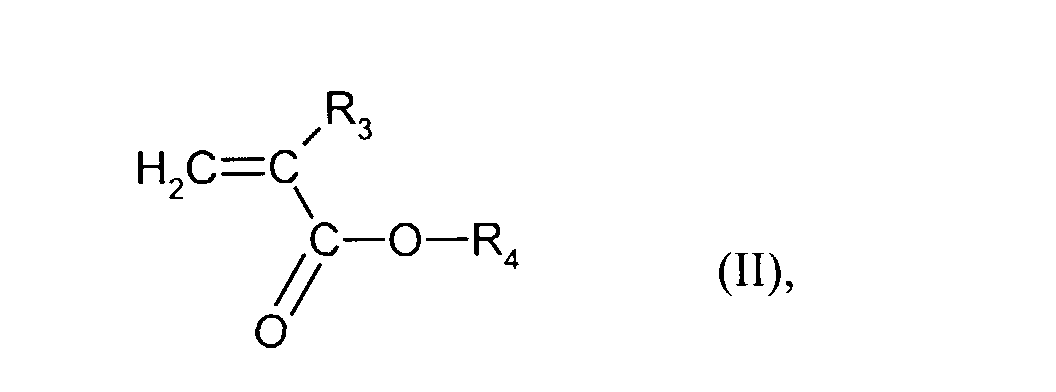
- R3
- Wasserstoff oder Methyl bedeutet und
- R4
- Für einen Rest mit 2 bis 20 C-Atomen steht,
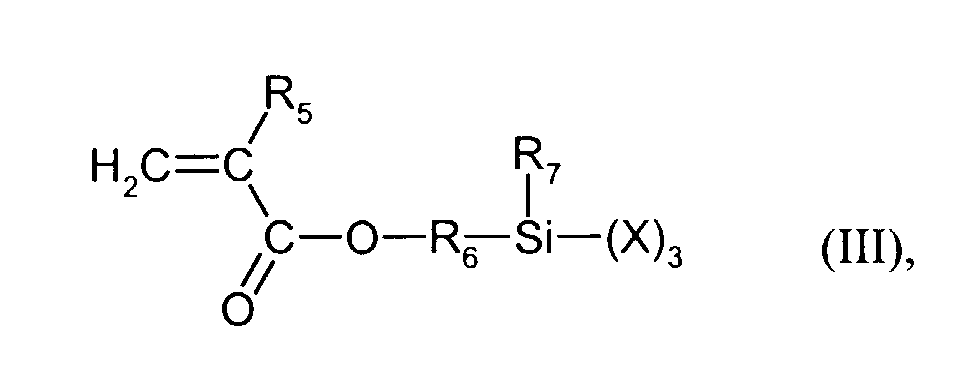
- R5
- Wasserstoff oder Methyl bedeutet,
- R6
- für einen zweiwertigen Rest mit 2 bis 8 C-Atomen steht,
- R7
- ein Alkylrest mit 1 bis 4 C-Atomen bedeutet
und - X
- für eine hydrolisierbare Gruppe steht,
Description
Die Erfindung betrifft vernetzte Perlpolymerisate mit einer mittleren Teilchengröße
von größer als 10 und kleiner gleich 50 µm und enger Teilchengrößenverteilung, ein
Verfahren zu deren Herstellung, deren Verwendung zur Herstellung flächiger Substrate,
besagte flächige Substrate sowie deren Verwendung als Aufzeichnungsmaterial
für den Ink-Jet-Druck.
Kugelförmige Polymerisate mit einer mittleren Teilchengröße von 1 bis 50 µm
werden vielfältig angewendet, z.B. als Abstandhalter für Filmmaterialien, als Träger
für Katalysatoren oder biologisch aktive Substanzen, als Eichsubstanzen für
Lichtstreuungsmessungen oder als Ausgangsmaterialien für Chromatographieharze
und Ionenaustauscher. Im allgemeinen werden hierfür Polymerisate mit möglichst
einheitlicher Teilchengröße gewünscht (im folgenden "monodispers" genannt).
Mit Perlpolymerisaten ausgestattete Aufzeichnungsträger für den Ink-Jet-Druck sind
beispielsweise aus US-A-5.714 425 bekannt.
Homopolymerisate wie z.B. Polymethylmethacrylat lassen sich als Perlpolymerisate
mit Teilchengrößen von 0,5 bis 10 µm durch Dispersionspolymerisation erzeugen.
Ein geeignetes Verfahren wird beispielsweise in EP-A 610 522 beschrieben. Bei der
Dispersionspolymerisation wird ein Lösungsmittel, in dem die verwendeten
Monomere löslich, das gebildete Polymerisat aber unlöslich ist, eingesetzt. Die
Dispersionspolymerisation liefert in der Regel hohe Ausbeuten an kugelförmiger
Perlpolymerisate mit enger Teilchengrößenverteilung. Es hat sich allerdings gezeigt,
daß es schwierig ist, größere Teilchen, insbesondere Teilchen mit einem Durchmesser
von mehr als 7,5 µm durch Dispersionspolymerisation zu erzeugen. Ein
weiteres Kennzeichen ist, daß die Teilchengrößenverteilung mit steigender Teilchengröße
deutlich breiter wird. Aus EP-A 610 522 geht hervor, daß die Dispersionspolymerisation
von Methylmethacrylat mit Styrol als Comonomer zu kleineren Perlen
mit deutlich breiterer Teilehengrößenverteilung führt als die Homopolymerisation
von Methylmethacrylat.
Gemäß US-A 4,614,708 konnten kugelförmige Copolymerisate aus Methylmethacrylat
und anderen Methacrylatestern nur bis zu einer Teilchengröße von 5 µm
durch Dispersionspolymerisation hergestellt werden.
In der EP-A 417539 bzw. US-A-5.646.210 werden ebenfalls Perlpolymerisate allerdings
mit einer Teilchengröße von kleiner als 10 µm beschrieben, die mit Si-O-Si-Gruppen
vernetzt sind.
Perlpolymerisate mit einer Teilchengröße von ca. 10 bis 200 µm können durch
Suspensionspolymerisation erhalten werden. Unter dem Begriff Suspensionspolymerisation
wird ein Verfahren verstanden, bei dem ein Monomer oder ein monomerhaltiges
Gemisch, das einen im Monomeren löslichen Initiator enthält, in einer mit
dem Monomeren im wesentlichen nicht mischbaren Phase, die ein Dispergiermittel
enthält, in Form von Tröpfchen, gegebenenfalls im Gemisch mit kleinen, festen
Partikeln, zerteilt und durch Temperaturerhöhung unter Rühren ausgehärtet wird.
Weitere Einzelheiten der Suspensionspolymerisation werden beispielsweise in H.
Greens "Polymerization Processes", in: Ullmanns Encyclopedia of Industrial
Chemistry, Bd. A21, 5. Aufl. ( B. Elvers, S. Hawkins, G. Schulz, Hrsg.), VCH,
Weinheim 1992, S. 363-373 beschrieben.
Ein Nachteil der Suspensionspolymerisation ist die breite Teilehengrößenverteilung
der erzeugten Perlpolymerisate. Dieses ist insbesondere bei der Verwendung als
Abstandhalter sehr nachteilig.
Für viele Anwendungen werden darüber hinaus Perlpolymerisate mit guter Temperatur- und guter Lösemittelbeständigkeit gewünscht. Diese Eigenschaften sind beispielsweise
dann von großer Bedeutung, wenn die Perlpolymerisate als Abstandhalter
bei erhöhter Temperatur oder in Anwesenheit von Lösungsmittel auf ein
Substrat aufgebracht werden sollen. Übliche Polymethylmethacrylat-Perlpolymerisate
oder Polystyrol-Perlpolymerisate versagen unter diesen Bedingungen.
Nach den Methoden des Standes der Technik sind temperatur- und lösungsmittelstabile
Perlpolymerisate mit einer mittleren Teilchengröße von größer 10 bis 50 µm
und enger Teilchengrößenverteilung nicht zugänglich. Aufgabe der vorliegenden
Erfindung war es daher, solche Perlpolymerisate bereitzustellen.
Unter Perlpolymerisat wird im Rahmen der vorliegenden Erfindung ein kugelförmiges
Polymerisat verstanden.
Gegenstand der Erfindung sind nun Perlpolymerisate mit einer mittleren Teilchengröße
von größer als 10 und kleiner gleich 50 µm und einer Teilchengrößenverteilung
ausgedrückt durch das Verhältnis des 90%-Wertes (Ø (90)) und des 10%-Wertes
(Ø (10)) der Volumenverteilung von kleiner 2,0, aufgebaut aus
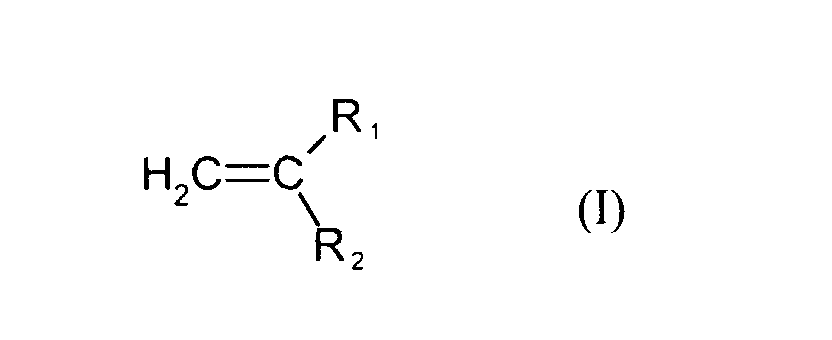
- R1
- Wasserstoff oder Methyl und
- R2
- Phenyl oder -COOCH3 bedeuten,
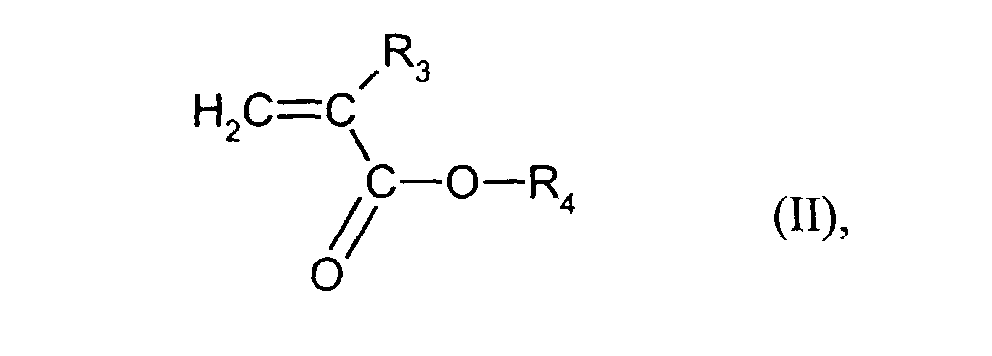
- R3
- Wasserstoff oder Methyl bedeutet und
- R4
- für einen Rest mit 2 bis 20 C-Atomen steht, und

- R5
- Wasserstoff oder Methyl bedeutet,
- R6
- für einen zweiwertigen Rest mit 2 bis 8 C-Atomen steht,
- R7
- ein Alkylrest mit 1 bis 4 C-Atomen bedeutet
und - X
- für eine hydrolisierbare Gruppe steht,
Zur Bestimmung der mittleren Teilehengröße (Ø) und der Teilchengrößenverteilung
wird die Bildanalyse angewendet. Als Maß für die Breite der Teilchengrößenverteilung
der erzeugten kugelförmigen Vinylcopolymerisate wird das Verhältnis aus dem
90%-Wert (Ø (90)) und dem 10%-Wert (Ø (10)) der Volumenverteilung gebildet.
Enge Teilehengrößenverteilung im Sinne der Erfindung bedeutet
Ø (90)/Ø (10) ≤ 2,0, bevorzugt Ø (90)/Ø (10) ≤ 1,5.
Der 90%-Wert (Ø (90)) ist so definiert, daß 90 Vol-% der Teilchen einen kleineren
Durchmesser als diesen Wert aufweisen. Entsprechend gilt für den 10 %-Wert (Ø
(10)), daß 10 Vol-% der Teilchen einen kleineren Durchmesser als diesen aufweisen.
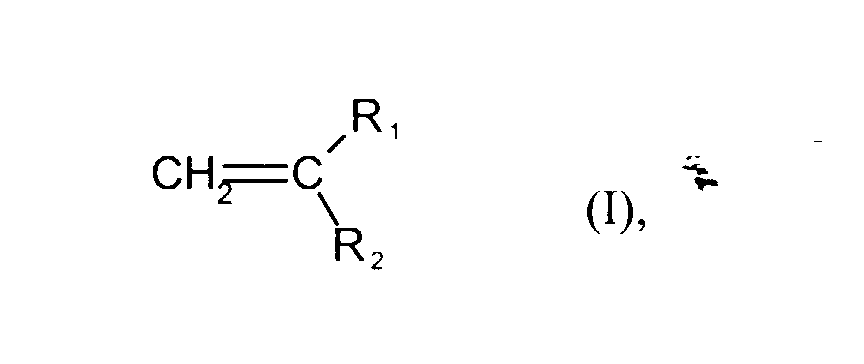
Die Monomere der Formel I sind Methylmethacrylat, Methylacrylat, Styrol und α-Methylstyrol.
Bevorzugt sind Methylmethacrylat und Styrol. Die Monomere der
Formel (I) können allein oder als Mischungen eingesetzt werden.
In den Monomeren der Formel (II) bedeutet R4 vorzugsweise einen aliphatischen,
insbesondere verzweigt oder unverzweigt, oder cycloaliphatischen Rest. R4 kann
auch durch ein oder mehrere Sauerstoffatome unterbrochen sein. Es können ein oder
mehrere Monomere der Formel (II) eingesetzt werden.
Als Beispiele für Monomere der Formel II seien genannt: Ethylmethacrylat, n-Propylmethacrylat,
iso-Propylmethacrylat, n-Butylmethacrylat, iso-Butylmethacrylat,
n-Hexylmethacrylat, 2-Ethylhexylmethacrylat, n-Octylmethacrylat, n-Decylmethacrylat,
Stearylmethacrylat, Methoxyethylmethacrylat, Methoxybutylmethacrylat,
iso-Bornylmethacrylat und Triethylenglycolmonomethacrylat. Bevorzugt sind Ethylmethacrylat,
n-Propylmethacrylat, iso-Propylmethacrylat, n-Butylmethacrylat und
iso-Butylmethacrylat.
R6 in Formel III bedeutet vorzugsweise einen C2- bis C8-Alkylrest, der ebenfalls
durch ein oder mehrere Sauerstoffatome unterbrochen sein kann.
Die hydrolisierbare Gruppe X ist eine Gruppe, die mit Wasser unter Freisetzung von
H X eine OH-Gruppe bildet. X steht vorzugsweise für Halogen, insbesondere Chlor,
Alkoxy, insbesondere C1-C4-Alkoxy, wie Methoxy und Ethoxy sowie Carboxylat,
insbesondere Acetat.
Beispiele für die Verbindungen nach Formel (III) sind: γ-Methacryloxypropyl-trimethoxysilan,
γ-Methacryloxypropyl-triethoxysilan, γ-Methacryloxypropyl-methyldimethoxysilan,
γ-Methacryloxypropyl-methyldiethoxysilan, γ-Acryloxypropyl-trimethoxysilan,
γ-Acryloxypropyl-triethoxysilan, γ-Acryloxypropyl-methyl-dimethoxysilan,
γ-Acryloxypropyl-methyl-diethoxysilan.
Die erfindungsgemäßen Perlpolymerisate weisen eine Teilchengrößenverteilung,
ausgedrückt durch den Quotienten aus dem 90 %-Wert und dem 10 %-Wert von
kleiner gleich 2,0, insbesondere kleiner gleich 1,5 auf.
Die Erfindung betrifft weiterhin ein Verfahren zur Herstellung der erfindungsgemäßen
Perlpolymerisate, bei dem ein Monomerengemisch enthaltend


wobei die Reste R1 bis R7 und X die oben angegebenen Bedeutungen haben,
durch Dispersionspolymerisation unter Verwendung eines Initiators polymerisiert wird.
Vorzugsweise ist das Verfahren dadurch gekennzeichnet, daß die Monomeren der
Formeln I bis III in einem organischen oder wäßrig-organischen Lösungsmittel in
Gegenwart wenigstens eines Dispergiermittels und eines Initiators polymerisiert
werden und im Falle, daß man in einem organischen Lösungsmittel polymerisiert, im
Anschluß daran das Polymerisat mit Wasser noch versetzt wird.
Bei dem erfindungsgemäßen Verfahren zur Herstellung von Vinylcopolymerisaten
werden die oben genannten Monomeren vorzugsweise in einem Lösungsmittel unter
Verwendung eines Initiators polymerisiert.
Das Lösungsmittel besteht vorzugsweise überwiegend aus nichtwäßrigen Lösungsmitteln,
wie Dioxan, Aceton, Acetonitril, Dimethylformamid und Alkoholen.
Bevorzugt sind niedere Alkohole, insbesondere Methanol, Ethanol, n-Propanol, iso-Propanol,
n-Butanol, iso-Butanol und tert.-Butanol. Gut geeignet sind auch
Mischungen verschiedener Lösungsmittel, insbesondere Mischungen verschiedener
Alkohole. Die Alkohole können auch bis zu 50 Gew.% Wasser, bevorzugt bis zu
25 Gew.% Wasser enthalten. Bei Verwendung von Lösungsmittelgemischen können
auch unpolare Lösungsmittel, insbesondere Kohlenwasserstoffe, wie Hexan, Heptan
und Toluol in Anteilen bis zu 50 Gew.% mitverwendet werden.
Das Verhältnis von Monomer zu Lösungsmittel beträgt vorzugsweise 1 : 1 bis 1 : 20,
insbesondere 1 : 3 bis 1 : 10.
Das erfindungsgemäße Verfahren wird vorzugsweise in Anwesenheit eines hochmolekularen
Dispergiermittel durchgeführt.
Als hochmolekulare Dispergiermittel sind im verwendeten Lösungsmittel lösliche
natürliche und synthetische makromolekulare Verbindungen geeignet, insbesondere
solche mit einem als Gewichtsmittel bestimmten mittleren Molekulargewicht von
5 000 bis 500 000, vorzugsweise von 10 000 bis 100 000 g/mol. Beispiele sind Cellulosederivate,
wie Methylcellulose, Ethylcellulose, Hydroxypropylcellulose, Polyvinylacetat,
teilverseiftes Polyvinylacetat, Polyvinylpyrrolidon, Copolymerisate aus
Vinylpyrrolidon und Vinylacetat, sowie Copolymerisate aus Styrol und Maleinsäureanhydrid.
Polyvinylpyrrolidon ist bevorzugt. Der Gehalt an hochmolekularem Dispergiermittel
beträgt vorzugsweise 0,1 bis 20 Gew.%, insbesondere 0,2 bis
10 Gew.%, bezogen auf das Lösungsmittel.
Zusätzlich zu den Dispergiermitteln können auch ionische und nicht ionische Tenside
eingesetzt werden. Geeignete Tenside sind z.B. Sulfobernsteinsäure-Natriumsalz,
Methyltricaprylammoniumchlorid oder ethoxylierte Nonylphenole. Bevorzugt
werden ethoxylierte Nonylphenole mit 4 bis 20 Ethylenoxideinheiten. Die Tenside
können in Mengen von 0,1 bis 2 Gew.% bezogen auf das Lösungsmittel verwendet
werden.
Für das erfindungsgemäße Verfahren geeignete Initiatoren sind Verbindungen, die
bei Temperaturerhöhung freie Radikale bilden. Beispielhaft seien genannt: Peroxyverbindungen
wie Dibenzoylperoxid, Dilaurylperoxid, Bis-(p-chlorbenzoyl)peroxid,
Dicyclohexylperoxydicarbonat und tert.-Amylperoxy-2-ethylhexan, des weiteren
Azoverbindungen wie 2,2'-Azobis(isobutyronitril) und 2,2'-Azobis(2-methylisobutyronitril).
Sofern das Lösungsmittel einen Wasseranteil enthält, ist auch Natrium- oder
Kaliumperoxydisulfat als Initiator geeignet.
Gut als Initiatoren geeignet sind auch aliphatische Peroxyester. Beispiele hiefür sind
tert.-Butylperoxyacetat, tert.-Butylperoxyisobutyrat, tert.-Butylperoxypivalat, tert.-Butylperoxyoctoat,
tert.-Butylperoxy-2-ethylhexanoat, tert.-Butylperoxyneodecanoat,
tert.-Amylperoxypivalat, tert.-Amylperoxyoctoat, tert.-Amylperoxy-2-ethylhexanoat,
tert.-Amylperoxyneodecanoat, 2,5-Bis(2-ethylhexanoylperoxy)-2,5-dimethylhexan,
2,5-Dipivaloyl-2,5-dimethylhexan, 2,5 -Bis(2-neodecanoylperoxy)-2,5-dimethylhexan,
Di-tert.-butylperoxyazelat und Di-tert.-amylperoxyazelat.
Die Initiatoren werden im allgemeinen in Mengen von 0,05 bis 6,0 Gew.%, vorzugsweise
0,2 bis 4,0 Gew.%, bezogen auf das Monomergemisch, angewendet.
Die Polymerisationstemperatur richtet sich im allgmeinen nach der Zerfallstemperatur
des Initiators, sowie nach der Siedetemperatur des Lösungsmittels und liegt
typischerweise im Bereich von 50 bis 150°C, vorzugsweise 60 bis 120°C. Es ist
vorteilhaft, bei der Siedetemperatur des Lösungsmittels unter ständigem Rühren mit
einem Gitterrührer zu polymerisieren. Es werden vorzugsweise niedrige Rührgeschwindigkeiten
angewendet. Bei 4 Liter-Laborreaktoren beträgt die Rührgeschwindigkeit
eines Gitterrührers beispielsweise 100 bis 250 U/min, bevorzugt 100 U/min.
Die Polymerisationszeit beträgt im allgemeinen mehrere Stunden, z.B. 2 bis
30 Stunden.
Die in die erfindungsgemäßen Vinylcopolymerisate zunächst einpolymersierten
Silanmonomereinheiten werden im Verlaufe der weiteren Herstellung so umgewandelt,
daß die hydrolysierbaren Gruppen zumindest teilweise durch die Hydrolysereaktion
abgespalten werden und die entstehenden Si-OH-Gruppen durch die
Kondensationsreaktion der Si-OH-Gruppe zu Si-O-Si-Brücken umgewandelt werden.
Nach der Beendigung der Polymerisation kann das erhaltene Perlpolymerisat mit
saurem oder alkalischem Wasser behandelt werden, um die Vernetzung in der oben
beschriebenen Weise über Si-OH-Gruppen und deren Kondensation zu Si-O-Si-Gruppen
zu bewirken bzw. zu vervollständigen. Hierzu kann saures oder alkalisches
Wasser zum Polymerisationsansatz gegeben werden und nach erfolgter Vernetzung
das Vinylcopolymerisat durch Filtration oder besonders vorteilhaft durch Sedimentation
mit Hilfe einer Zentrifuge oder eines Dekanters gewonnen und gewaschen
werden. Da das Vinylcopolymerisat im Verlaufe der Polymerisation aus dem
polaren, nichtwäßrigen Polymerisationsmedium ausfällt, kann es jedoch auch in einer
anderen Verfahrensvariante zunächst durch Filtration das Polymerisat gewonnen
werden, wobei das Polymerisationsmedium rezyklisiert werden kann, woraufhin in
einem getrennten zweiten Schritt das abfiltrierte Polymerisat mit saurem oder alkalischem
Wasser zur Vernetzung behandelt wird.
Saures bzw. alkalisches Wasser sind hierbei wäßrige Säuren oder Laugen, beispielsweise
wäßrige Salzsäure, Schwefelsäure, Essigsäure oder Phosphorsäure, wäßrige
Natronlauge oder Kalilauge. Das saure bzw. alkalische Wasser wird vorzugsweise in
einer solchen Menge zum Polymerisationsansatz oder zum abfiltrierten Polymerisat
gegeben, daß der Polymerisationsansatz bzw. die Aufschlämmung des abfiltrierten
Polymerisats in diesem Wasser einen pH-Wert von -1 bis 3, bevorzugt 0 bis 2, bzw.
von 11 bis 14, bevorzugt von 12 bis 13 hat. In bevorzugter Weise wird eine saure
Hydrolyse und Vernetzung vorgenommen. Die Menge des sauren bzw. alkalischen
Wassers ist außer der Einstellung des genannten pH-Wertes nicht kritisch, da die zur
mindestens teilweisen Hydrolyse und Vernetzung erforderliche geringe Menge
Wasser stets ausreichend vorhanden ist. Bei der Variante der Zugabe von saurem
bzw. alkalischem Wasser zum Polymerisationsansatz hat sich ein Verhältnis von bis
zu 10 Gew.% saurem bzw. alkalischem Wasser, bezogen auf den Polymerisationsansatz,
bewährt. Die Hydrolyse und Vernetzung können bei einer Temperatur von 0
bis 50°C, bevorzugt bei der Raumtemperatur, erfolgen.
Als Reaktionszeit wird, hauptsächlich abhängig von der Ansatzmenge, eine Zeit von
15 Minuten bis zu einigen Stunden angesetzt.
Bei der Verwendung eines wasserhaltigen polaren Mediums und Persulfat als
Initiator findet die Vernetzungsreaktion beispielsweise in situ statt, so daß ein
separater Vernetzungsschritt durch Zugabe von wäßriger Säure oder Lauge nicht
notwendig ist.
Die Vernetzungsreaktion und der letztendlich erhaltene Vernetzungsgrad können
analytisch in einfacher Weise durch die Bestimmung der Löslichkeit in einem guten
Lösungsmittel, beispielsweise Tetrahydrofuran/Essigsäureethylester oder Dimethylformamid,
verfolgt bzw. kontrolliert werden. Die Polymerisate besitzen einen Gelgehalt,
gemessen in Tetrahydrofuran bei 25°C, von 90% und mehr.
Die Form, Größe und Teilchendurchmesserverteilung des Perlpolymerisats werden
bei der Vernetzungsreaktion nicht verändert.
Die erfindungsgemäß erhaltenen vernetzten Perlpolymerisate besitzen im Gegensatz
zu den herkömmlichen unvernetzten Perlpolymerisaten wesentlich höhere Temperatur- und Lösungsmittelbeständigkeit. Die Temperaturbeständigkeit der erfindungsgemäßen
vernetzten Perlpolymerisate ist dadurch gekenzeichnet, daß deren Form selbst
nach mehrstündigem Erhitzen bei 250°C unverändert bleibt.
Die erfindungsgemäße Perlpolymere sind in Lösungsmitteln, wie z.B. Aceton,
Tetrahydrofuran, Dimethylformamid, Methylethylketon, Acetonitril, unlöslich.
Die Erfindung betrifft weiterhin die Verwendung der erfindungsgemäßen Perlpolymerisate
zum Auftragen auf ein flächiges Substrat.
Als flächige Substrate sind vorzugsweise zu nennen: Folien aus Kunststoff wie
Polyester, Polycarbonat, Celluloseester, Polyvinylacetat, insbesondere Polyethylenterephthalat
(PET), vorzugsweise solche zur Verwendung für Overhead-Projektoren.
Weitere geeignete Substrate sind unbeschichtete und insbesondere beschichtete
Papiere auf Cellulose- oder Polyethylenbasis.
Die erfindungsgemäßen Perlpolymerisate werden vorzugsweise in einer Menge von
0,01 bis 2, insbesondere von 0,05 bis 1 g/m2 auf das flächige Substrat aufgetragen.
Die Auftragung kann beispielsweise mittels einer binderhaltigen Beschichtungsmasse,
die die erfindungsgemäßen Perlpolymerisate enthält, erfolgen. Als Binder
sind Polymerlatices, beispielsweise Styrol-butadienlatices oder Acrylatlatices zu
nennen. Besonders gut geeignet sind hydrophile Binder wie Gelatine, Polyvinylalkohol,
Polyvinylpyrrolidon und Celluloseester. Sofern gewünscht, kann die aufgetragene
Beschichtung durch eine Nachbehandlung gehärtet werden. Zur Härtung von
Gelatineschichten eignet sich besonders Formaldehyd und Glutardialdehyd,
Beschichtungen aus Polyvinylalkohol können mit Hilfe von Diisocyanaten gehärtet
werden. Die Menge an Bindemittel kann beispielsweise 1 bis 50 g/m2, vorzugsweise
5 bis 30 gm2 betragen.
Die Auftragung der Beschichtungsmasse erfolgt aus vorzugsweise wäßriger Lösung
oder Dispersion mit anschließender Trocknung. Als Beschichtungstechniken
kommen alle, bekannten Beschichtungsverfahren in Frage, insbesondere Gießen,
Rakeln, Sprühen und Tauchen.
Die Erfindung betrifft weiterhin flächige Substrate mit den erfindungsgemäßen
Perlpolymerisaten auf ihrer Oberfläche.
Die erfindungsgemäßen flächigen Substrate, insbesondere Kunststoff-Folien und
beschichteten Papiere weisen insbesondere als Aufzeichnungsmaterial im Ink-Jet-Druck
besonders hohe Wischechtheiten der hergestellten Images auf.
Die Erfindung betrifft weiterhin die Verwendung der erfindungsgemäßen flächigen
Substrate als Aufzeichnungsmaterial für den Ink-Jet-Druck.
In einem mit einem Gitterrührer ausgerüsteten 4 L-Reaktor wurden 2 400 g
Methanol, 180 g Polyvinylpyrrolidon (PVP) und 300 g Monomergemisch bestehend
aus Methylmethacrylat, einem Monomer der Formel II (Tabelle 1) und einem
Monomer der Formel III (Trimethoxysilylpropyloxymethacrylat) zu einer homogenen
Lösung gemischt. Unter Stickstoff wurde diese Lösung innerhalb einer Stunde
bei einer Rührgeschwindigkeit von 100 U/min auf 55°C aufgeheitzt und mit 3 g 2,2'-Azobis(isobutyronitril)
gelöst in 117 g Methanol versetzt. Die Polymerisationsmischung
wurde weitere 20 Stunden bei 55°C und 100 U/min gerührt. Anschließend
wurde die fertige Polymerdispersion auf Raumtemperatur abgekühlt und innerhalb
von 30 Minuten wurden 200 g 1n-HCl dazugetropft. Die sauere Reaktionsmischung
wurde 3 h bei Raumtemperatur gerührt und das Perlpolymerisat wurde durch Sedimentation
isoliert. Die Perlpolymerisate wurden mit Methanol und Wasser gewaschen
und bei 70°C im Trockenschrank getrocknet.
Die Teilchengrößen der erhaltenen Perlpolymerisate sind in der Tabelle 1 aufgeführt.
Der unlösliche Anteil der Perlpolymerisate wurde folgendermaßen ermittelt:
Es wurde 2 g des jeweiligen vernetzten Perlpolymerisats, das bereits mit Ethanol
bzw. Methanol und Wasser gewaschen und getrocknet wurde, mit 10 mL THF versetzt
und bei Raumtemperatur 10 Stunden gerührt wurde. Anschließend wurde das
Polymerisat abfiltriert und zurückgewogen. Der unlösliche Anteil ergab sich aus dem
Verhältnis des zurückgewogenen zum eingesetzten Polymerisats.
Perlpolymerisate mit einem hohen unlöslichen Anteil sind hochvernetzt. Sie sind
temperaturstabil und lösemittelbeständig.
| vernetzte Methylmethacrylat-Copolymerisate als Beispiele | ||||||
| Beispiel | 1 | 2 | 3 | 4 | 5 | 6 |
| Monomer 1 | ||||||
| Monomer 1 [g] | 210 | 165 | 240 | 260 | 216 | 250 |
| Monomer II | ||||||
| Monomer II [g] | 90 | 120 | 60 | 40 | 90 | 30 |
| Monomer III | ||||||
| Monomer III [g] | 15 | 15 | 15 | 15 | 9 | 20 |
| Ø [µm] | 21,62 | 41,90 | 28,71 | 16,29 | 16,21 | 16.01 |
| Ø(10) [µm] | 18,20 | 31,73 | 21,84 | 14,40 | 14,20 | 13,40 |
| Ø(90) [µm] | 27,26 | 60,29 | 35,28 | 17,56 | 19,37 | 16,75 |
| Ø(90)/Ø(10) | 1,40 | 1,9 | 1,6 | 1,21 | 1,36 | 1,25 |
| Unlöslicher Anteil [%] | 96,7 | 97,3 | 95,3 | 88 | 93 | 94 |
Die Polymerisationen, Vernetzung und Aufarbeitungen wurden in gleicher Weise
wie in Beispielen 1-5 durchgeführt. In einem mit einem Gitterrührer ausgerüsteten 4
L-Reaktor wurden 2 500 g Ethanol, 54 g Polyvinylpyrrolidon (PVP) und 300 g
Monomergemisch bestehend aus Styrol, einem Monomer der Formel II (Tabelle 1)
und einem Monomer der Formel III (Trimethoxysilylpropyloxymethacrylat) zu einer
homogenen Lösung gemischt. Unter Stickstoff wurde diese Lösung innerhalb einer
Stunde bei einer Rührgeschwindigkeit von 100 U/min auf 70°C aufgeheitzt und mit
3,75 g 2,2'-Azobis(isobutyronitril) gelöst in 75 g Methanol versetzt. Die Polymerisationsmischung
wurde weitere 15 Stunden bei 70°C und 100 U/min gerührt. Anschließend
wurde die fertige Polymerdispersion auf Raumtemperatur abgekühlt und
innerhalb von 30 Minuten wurden 200 g 1n-HCl dazugetropft. Die sauere Reaktionsmischung
wurde 3 h bei Raumtemperatur gerührt und das Perlpolymerisat wurde
durch Sedimentation isoliert. Die Perlpolymerisate wurden mit Ethanol und Wasser
gewaschen und bei 70°C im Trockenschrank getrocknet.
Die eingesetzten Monomergemische und die Teilchengrößen der Perlpolymerisate
sind in Tabelle 2 aufgelistet. Der unlöslicher Anteil der Perlpolymerisaten wurde entsprechend
der in den Beispielen 1-5 beschriebenen Arbeitsweise ermittelt.

Claims (8)
- Perlpolymerisate mit einer mittleren Teilchengröße von größer als 10 und kleiner gleich 50 µm und einer Teilchengrößenverteilung ausgedrückt durch das Verhältnis des 90%-Wertes (Ø (90)) und des 10%-Wertes (Ø (10)) der Volumenverteilung von kleiner 2,0, aufgebaut ausa) 50 bis 97,5, vorzugsweise 55 bis 90 Gew.-% wenigstens eines Monomeren der Formel (I)worin

- R1
- Wasserstoff oder Methyl und
- R2
- Phenyl oder -COOCH3 bedeuten,
b) 2 bis 49,5, vorzugsweise 5 bis 40 Gew-% wenigstens eines Monomeren der Formel (II)worin
- R3
- Wasserstoff oder Methyl bedeutet und
- R4
- für einen Rest mit 2 bis 20 C-Atomen steht, und
c) 0,5 bis 40, vorzugsweise 1 bis 20 Gew.-% eines Monomeren der Formel (III)worin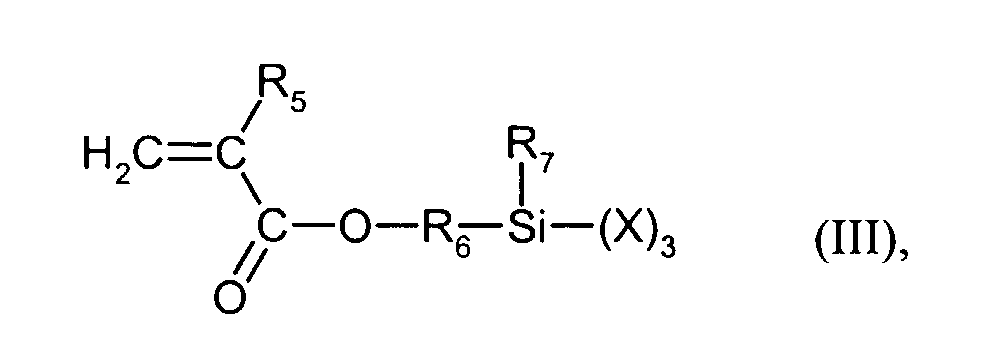
- R5
- Wasserstoff oder Methyl bedeutet,
- R6
- für einen zweiwertigen Rest mit 2 bis 8 C-Atomen steht,
- R7
- ein Alkylrest mit 1 bis 4 C-Atomen bedeutet
und - X
- für eine hydrolisierbare Gruppe steht,
- Perlpolymerisate gemäß Anspruch 1, dadurch gekennzeichnet, daß als Monomere der Formel (I) Methylmethacrylat, Methylacrylat, Styrol und α-Methylstyrol in Frage kommen.
- Perlpolymerisate gemäß Anspruch 1, dadurch gekennzeichnet, daß als Monomere der Formel (II) in Frage kommen: Ethylmethacrylat, n-Propylmethacrylat, iso-Propylmethacrylat, n-Butylmethacrylat, iso-Butylmethacrylat, n-Hexylmethacrylat, 2-Ethylhexylmethacrylat, n-Octylmethacrylat, n-Decylmethacrylat, Stearylmethacrylat, Methoxyethylmethacrylat, Methoxybutylmethacrylat, iso-Bornylmethacrylat und Triethylenglycolmonomethacrylat; bevorzugt sind Ethylmethacrylat, n-Propylmethacrylat, iso-Propylmethacrylat, n-Butylmethacrylat und iso-Butylmethacrylat.
- Perlpolymerisate gemäß Anspruch 1, dadurch gekennzeichnet, daß als Monomere der Formel (III) in Frage kommen: γ-Methacryloxypropyl-trimethoxysilan, γ-Methacryloxypropyl-triethoxysilan, γ-Methacryloxypropylmethyl-dimethoxysilan, γ-Methacryloxypropyl-methyldiethoxysilan, γ-Acryloxypropyl-trimethoxysilan, γ-Acryloxypropyl-triethoxysilan, γ-Acryloxypropyl-methyl-dimethoxysilan, γ-Acryloxypropyl-methyl-diethoxysilan.
- Verfahren zur Herstellung der Perlpolymerisate gemäß Anspruch 1, dadurch gekennzeichnet, daß man ein Monomerengemisch enthaltenda) 50 bis 97,5, vorzugsweise 55 bis 90 Gew.-% wenigstens eines Monomeren der Formel (I)
 b) 2 bis 49,5, vorzugsweise 5 bis 40 Gew.-% wenigstens eines Monomeren der Formel (II)und
 c) 0,5 bis 40, vorzugsweise 1 bis 20 Gew.-% wenigstens eines Monomeren der Formel (III)jeweils bezogen auf die Gesamtmenge des Vinylcopolymerisates,
wobei die Reste R1 bis R7 und X die in Anspruch 1 angegebenen Bedeutungen haben,
durch Dispersionspolymerisation unter Verwendung eines Initiators polymerisiert. - Verwendung der Perlpolymerisate gemäß Anspruch 1 zum Auftragen auf ein flächiges Substrat.
- Flächige Substrate, die Perlpolymerisate gemäß Anspruch 1 auf ihrer Oberfläche tragen.
- Verwendung der flächigen Substrate gemäß Anspruch 7 als Aufzeichnungsmaterial für den Ink-Jet-Druck.
Applications Claiming Priority (2)
| Application Number | Priority Date | Filing Date | Title |
|---|---|---|---|
| DE19911061 | 1999-03-12 | ||
| DE1999111061 DE19911061A1 (de) | 1999-03-12 | 1999-03-12 | Perlpolymerisate mit einger Teilchengrößenverteilung |
Publications (1)
| Publication Number | Publication Date |
|---|---|
| EP1035141A1 true EP1035141A1 (de) | 2000-09-13 |
Family
ID=7900745
Family Applications (1)
| Application Number | Title | Priority Date | Filing Date |
|---|---|---|---|
| EP00103464A Withdrawn EP1035141A1 (de) | 1999-03-12 | 2000-02-29 | Perlpolymerisate mit enger Teilchengrössenverteilung |
Country Status (3)
| Country | Link |
|---|---|
| EP (1) | EP1035141A1 (de) |
| JP (1) | JP2000297124A (de) |
| DE (1) | DE19911061A1 (de) |
Cited By (2)
| Publication number | Priority date | Publication date | Assignee | Title |
|---|---|---|---|---|
| WO2001057097A1 (de) * | 2000-02-04 | 2001-08-09 | Bayer Aktiengesellschaft | Nicht-wässrige polymersuspensionen mit stark dilatantem fliessverhalten |
| WO2005005156A1 (en) * | 2003-07-07 | 2005-01-20 | 3M Innovative Properties Company | Rewritable and erasable writing sheet |
Families Citing this family (1)
| Publication number | Priority date | Publication date | Assignee | Title |
|---|---|---|---|---|
| CN105131164A (zh) * | 2015-09-18 | 2015-12-09 | 北京化工大学 | 一步分散聚合制备雪人、哑铃、树莓状或核-壳结构的单分散聚合物微球的方法 |
Citations (3)
| Publication number | Priority date | Publication date | Assignee | Title |
|---|---|---|---|---|
| EP0417539A2 (de) * | 1989-09-09 | 1991-03-20 | Bayer Ag | Vernetzte Perlpolymerisate und ihre Herstellung |
| EP0698625A1 (de) * | 1994-08-24 | 1996-02-28 | Agfa-Gevaert N.V. | Verfahren zur Herstellung von polymeren Teilchen als Abstandshalter |
| DE19757494A1 (de) * | 1997-01-17 | 1998-07-23 | Basf Ag | Verfahren zur Herstellung einer wäßrigen Polymerisatdispersion |
-
1999
- 1999-03-12 DE DE1999111061 patent/DE19911061A1/de not_active Withdrawn
-
2000
- 2000-02-29 EP EP00103464A patent/EP1035141A1/de not_active Withdrawn
- 2000-03-03 JP JP2000058901A patent/JP2000297124A/ja active Pending
Patent Citations (3)
| Publication number | Priority date | Publication date | Assignee | Title |
|---|---|---|---|---|
| EP0417539A2 (de) * | 1989-09-09 | 1991-03-20 | Bayer Ag | Vernetzte Perlpolymerisate und ihre Herstellung |
| EP0698625A1 (de) * | 1994-08-24 | 1996-02-28 | Agfa-Gevaert N.V. | Verfahren zur Herstellung von polymeren Teilchen als Abstandshalter |
| DE19757494A1 (de) * | 1997-01-17 | 1998-07-23 | Basf Ag | Verfahren zur Herstellung einer wäßrigen Polymerisatdispersion |
Cited By (2)
| Publication number | Priority date | Publication date | Assignee | Title |
|---|---|---|---|---|
| WO2001057097A1 (de) * | 2000-02-04 | 2001-08-09 | Bayer Aktiengesellschaft | Nicht-wässrige polymersuspensionen mit stark dilatantem fliessverhalten |
| WO2005005156A1 (en) * | 2003-07-07 | 2005-01-20 | 3M Innovative Properties Company | Rewritable and erasable writing sheet |
Also Published As
| Publication number | Publication date |
|---|---|
| DE19911061A1 (de) | 2000-09-14 |
| JP2000297124A (ja) | 2000-10-24 |
Similar Documents
| Publication | Publication Date | Title |
|---|---|---|
| DE3785995T2 (de) | Dispersionen von Kern-Schale-Teilchen. | |
| DE3516781C2 (de) | ||
| DE3851132T2 (de) | Polymerteilchen und ihre Herstellung. | |
| DE1520119C3 (de) | Verfahren zur Herstellung einer stabilen Dispersion eines Additionspolymeren in einer organischen Flüssigkeit | |
| EP0009179B1 (de) | Verfahren zur Herstellung leicht dispergierbarer Titandioxidpigmente | |
| DE3834638C2 (de) | ||
| DE2760188C2 (de) | ||
| AT397251B (de) | Sequenz-erzeugte polymerteilchen, wässrige dispersionen von sequenz-erzeugten polymerteilchen, verfahren zur herstellung von sequenz-erzeugten polymerteilchen und verwendung von sequenz-erzeugten polymerteilchen | |
| EP0639590A2 (de) | Verfahren zur Herstellung monodisperser Poly(meth)acrylat- Teilchen | |
| WO2009153162A1 (de) | Verfahren zur herstellung einer wässrigen polymerisatdispersion | |
| EP0011190B1 (de) | Füllstoffhaltige, vernetzte Perlpolymerisate | |
| DE3524197C2 (de) | ||
| EP0417539B1 (de) | Vernetzte Perlpolymerisate und ihre Herstellung | |
| DE69601613T2 (de) | Makromonomere mit hohem Säuregehalt und Verfahren zu deren Herstellung | |
| EP0025979B1 (de) | Wässrige Lösung oder Dispersion eines Styrol/Maleinsäureanhydrid-Copolymers, Verfahren zu ihrer Herstellung und ihre Verwendung | |
| DE3622566C2 (de) | ||
| EP1954632A1 (de) | Nanopartikel | |
| DE19911061A1 (de) | Perlpolymerisate mit einger Teilchengrößenverteilung | |
| DE69809885T2 (de) | Selbstaktivierte polymerpartikel mit enger grössenverteilung und verfahren zu ihrer herstellung | |
| DE3427441A1 (de) | Kornaehnliches polymer und verfahren zu dessen herstellung | |
| DE10061544A1 (de) | Weiche, momodisperse, kugelförmige Perlpolymerisate | |
| WO2011061004A1 (de) | Substanzpolymerisation von (meth)acrylat-copolymeren, die im wässrig-alkalischen löslich sind | |
| DE3935716C2 (de) | Magnetische Überzugszusammensetzung und magnetisches Aufzeichnungsmedium | |
| DE3248602A1 (de) | Acrylharze mit geringer wasseraufnahme | |
| EP0313849B1 (de) | Verdickungsmittel für physikalisch trocknende Anstrich- und Beschichtungsstoffe und Verfahren zur Herstellung der Verdickungsmittel |
Legal Events
| Date | Code | Title | Description |
|---|---|---|---|
| PUAI | Public reference made under article 153(3) epc to a published international application that has entered the european phase |
Free format text: ORIGINAL CODE: 0009012 |
|
| AK | Designated contracting states |
Kind code of ref document: A1 Designated state(s): DE FR GB IT |
|
| AX | Request for extension of the european patent |
Free format text: AL;LT;LV;MK;RO;SI |
|
| 17P | Request for examination filed |
Effective date: 20010313 |
|
| AKX | Designation fees paid |
Free format text: DE FR GB IT |
|
| 17Q | First examination report despatched |
Effective date: 20031212 |
|
| STAA | Information on the status of an ep patent application or granted ep patent |
Free format text: STATUS: THE APPLICATION IS DEEMED TO BE WITHDRAWN |
|
| 18D | Application deemed to be withdrawn |
Effective date: 20040423 |