EP1035093A2 - Metathese in Gegenwart ionischer Flüssigkeiten - Google Patents
Metathese in Gegenwart ionischer Flüssigkeiten Download PDFInfo
- Publication number
- EP1035093A2 EP1035093A2 EP00103339A EP00103339A EP1035093A2 EP 1035093 A2 EP1035093 A2 EP 1035093A2 EP 00103339 A EP00103339 A EP 00103339A EP 00103339 A EP00103339 A EP 00103339A EP 1035093 A2 EP1035093 A2 EP 1035093A2
- Authority
- EP
- European Patent Office
- Prior art keywords
- compounds
- ammonium
- radicals
- catalysts
- metathesis
- Prior art date
- Legal status (The legal status is an assumption and is not a legal conclusion. Google has not performed a legal analysis and makes no representation as to the accuracy of the status listed.)
- Granted
Links
Classifications
-
- C—CHEMISTRY; METALLURGY
- C07—ORGANIC CHEMISTRY
- C07F—ACYCLIC, CARBOCYCLIC OR HETEROCYCLIC COMPOUNDS CONTAINING ELEMENTS OTHER THAN CARBON, HYDROGEN, HALOGEN, OXYGEN, NITROGEN, SULFUR, SELENIUM OR TELLURIUM
- C07F7/00—Compounds containing elements of Groups 4 or 14 of the Periodic Table
- C07F7/02—Silicon compounds
- C07F7/08—Compounds having one or more C—Si linkages
- C07F7/0803—Compounds with Si-C or Si-Si linkages
- C07F7/0825—Preparations of compounds not comprising Si-Si or Si-cyano linkages
- C07F7/083—Syntheses without formation of a Si-C bond
-
- C—CHEMISTRY; METALLURGY
- C07—ORGANIC CHEMISTRY
- C07B—GENERAL METHODS OF ORGANIC CHEMISTRY; APPARATUS THEREFOR
- C07B37/00—Reactions without formation or introduction of functional groups containing hetero atoms, involving either the formation of a carbon-to-carbon bond between two carbon atoms not directly linked already or the disconnection of two directly linked carbon atoms
- C07B37/10—Cyclisation
-
- C—CHEMISTRY; METALLURGY
- C07—ORGANIC CHEMISTRY
- C07C—ACYCLIC OR CARBOCYCLIC COMPOUNDS
- C07C269/00—Preparation of derivatives of carbamic acid, i.e. compounds containing any of the groups, the nitrogen atom not being part of nitro or nitroso groups
- C07C269/06—Preparation of derivatives of carbamic acid, i.e. compounds containing any of the groups, the nitrogen atom not being part of nitro or nitroso groups by reactions not involving the formation of carbamate groups
-
- C—CHEMISTRY; METALLURGY
- C07—ORGANIC CHEMISTRY
- C07C—ACYCLIC OR CARBOCYCLIC COMPOUNDS
- C07C6/00—Preparation of hydrocarbons from hydrocarbons containing a different number of carbon atoms by redistribution reactions
- C07C6/02—Metathesis reactions at an unsaturated carbon-to-carbon bond
- C07C6/04—Metathesis reactions at an unsaturated carbon-to-carbon bond at a carbon-to-carbon double bond
-
- C—CHEMISTRY; METALLURGY
- C07—ORGANIC CHEMISTRY
- C07D—HETEROCYCLIC COMPOUNDS
- C07D207/00—Heterocyclic compounds containing five-membered rings not condensed with other rings, with one nitrogen atom as the only ring hetero atom
- C07D207/02—Heterocyclic compounds containing five-membered rings not condensed with other rings, with one nitrogen atom as the only ring hetero atom with only hydrogen or carbon atoms directly attached to the ring nitrogen atom
- C07D207/18—Heterocyclic compounds containing five-membered rings not condensed with other rings, with one nitrogen atom as the only ring hetero atom with only hydrogen or carbon atoms directly attached to the ring nitrogen atom having one double bond between ring members or between a ring member and a non-ring member
- C07D207/20—Heterocyclic compounds containing five-membered rings not condensed with other rings, with one nitrogen atom as the only ring hetero atom with only hydrogen or carbon atoms directly attached to the ring nitrogen atom having one double bond between ring members or between a ring member and a non-ring member with only hydrogen atoms, hydrocarbon or substituted hydrocarbon radicals, directly attached to ring carbon atoms
-
- C—CHEMISTRY; METALLURGY
- C07—ORGANIC CHEMISTRY
- C07D—HETEROCYCLIC COMPOUNDS
- C07D225/00—Heterocyclic compounds containing rings of more than seven members having one nitrogen atom as the only ring hetero atom
- C07D225/02—Heterocyclic compounds containing rings of more than seven members having one nitrogen atom as the only ring hetero atom not condensed with other rings
-
- C—CHEMISTRY; METALLURGY
- C07—ORGANIC CHEMISTRY
- C07D—HETEROCYCLIC COMPOUNDS
- C07D307/00—Heterocyclic compounds containing five-membered rings having one oxygen atom as the only ring hetero atom
- C07D307/02—Heterocyclic compounds containing five-membered rings having one oxygen atom as the only ring hetero atom not condensed with other rings
- C07D307/26—Heterocyclic compounds containing five-membered rings having one oxygen atom as the only ring hetero atom not condensed with other rings having one double bond between ring members or between a ring member and a non-ring member
- C07D307/28—Heterocyclic compounds containing five-membered rings having one oxygen atom as the only ring hetero atom not condensed with other rings having one double bond between ring members or between a ring member and a non-ring member with only hydrogen atoms, hydrocarbon or substituted hydrocarbon radicals, directly attached to ring carbon atoms
-
- C—CHEMISTRY; METALLURGY
- C07—ORGANIC CHEMISTRY
- C07C—ACYCLIC OR CARBOCYCLIC COMPOUNDS
- C07C2531/00—Catalysts comprising hydrides, coordination complexes or organic compounds
- C07C2531/16—Catalysts comprising hydrides, coordination complexes or organic compounds containing coordination complexes
- C07C2531/24—Phosphines
-
- C—CHEMISTRY; METALLURGY
- C07—ORGANIC CHEMISTRY
- C07C—ACYCLIC OR CARBOCYCLIC COMPOUNDS
- C07C2601/00—Systems containing only non-condensed rings
- C07C2601/12—Systems containing only non-condensed rings with a six-membered ring
- C07C2601/16—Systems containing only non-condensed rings with a six-membered ring the ring being unsaturated
Definitions
- the present invention relates to a method for producing cyclic and / or polymeric compounds by metathesis of starting materials that have at least two functional Groups in the form of substituted or unsubstituted alkene or alkyne units contain.
- Metathesis is a mutual transalkylidation of alkenes and alkynes in the presence of catalysts. Such reactions are used in a large number of technically important processes. An overview of this can be found in: M. Schuster, S. Blechert, Angew. Chem . 1997 , 109 , 2124 and S. Armstrong, J. Chem. Soc., Perkin Trans. 1 , 1998 , 371.
- the metathesis reactions include the oligomerization and polymerization of acyclic dienes (ADMET) and the synthesis of carbo- and heterocycles of different ring sizes by ring closing metathesis (RCM, ring closing metathesis).
- ACMET oligomerization and polymerization of acyclic dienes
- RCM ring closing metathesis
- crossed metatheses of different alkenes are known (Brümmer, O. et al. Chem. Eur. J. 1997 , 3 , 441).
- Ionic liquids are salts or mixtures of salts, which are liquid in a wide temperature range.
- the advantage of ionic liquids is that they don't mix with aliphatic hydrocarbons.
- EP-B-448445 describes the use of ionic liquids for dimerization described by unsubstituted monoolefins using nickel chloride.
- the disadvantage here is the use of organoaluminium halide, especially the pyrophoric dichloroethyl aluminum, for the production of ionic liquid.
- US-A-5525567 describes the use of ionic liquids for disproportionation of unsubstituted monoolefins using tungsten catalysts.
- an organoaluminium halide is mandatory, preferred the pyrophoric dichloroethyl aluminum, for the production of the ionic liquid used.
- EP-A-882691 describes the use of ionic liquids for dimerization of unsubstituted monoolefins using nickel chloride.
- pyrophoric dichloroethyl aluminum also used here disadvantageous that the excess of the Lewis acid aluminum chloride in the ionic liquid an acid reaction mixture is formed.
- the object of the present invention was to provide a universally applicable method for the metathesis of starting materials which have at least two functional groups in the form of Contain alkene or alkyne units to provide that using ionic liquids is carried out.
- the procedure should also be for substituted Alkenes or alkynes can be used.
- the present invention relates to the production carbo- or heterocyclic compounds with ring sizes ⁇ 5 ring members, including medium (8 to 11 ring links) and large ( ⁇ 12 ring links) Rings and / or the preparation of polymeric compounds, which are Homopolymers, copolymers or block copolymers can act.
- the ring closure reaction is in competition with Polymerization. If this reaction is carried out with starting materials which have at least two contain functional groups in the form of alkene or alkyne units, so arise Mixtures of cyclic compounds and polymers.
- cyclic compounds are accomplished by performing the Reaction in organic solvents at high dilution or through the The addition of larger volumes of ionic liquids favors. This is especially true for the production of medium (8 to 11 ring links) and large ( ⁇ 12 ring links) Wrestling.
- Educts are preferably used in the process according to the invention which, in addition to at least one of the functional groups involved in the metathesis reaction further substituents which are inert in the metathesis reaction and / or a Heteroatom included.
- substituents or heteroatoms can be independent can be selected from: branched or unbranched alkyl radicals, aromatic or non-aromatic carbocyclic rings, carboxylic acids, esters, ethers, epoxides, Silyl ethers, thioethers, thioacetals, anhydrides, imines, silylenol ethers, Ammonium salts, amides, nitriles, perfluoroalkyl groups, mixed dialkyl groups, Alkynes, alkenes, halogens, alcohols, ketones, aldehydes, carbamates, carbonates, Urethanes, sulfonates, sulfones, sulfonamides, nitro groups, organ
- ⁇ , ⁇ -dienes are particularly preferred as starting materials used the at least one other, which is inert in the metathesis reaction may contain behavioral substituents and / or a heteroatom.
- These substituents or heteroatoms can be chosen independently from branched ones or unbranched alkyl radicals, aromatic or non-aromatic carbocyclic Rings, carboxylic acids, esters, ethers, epoxies, silyl ethers, thioethers, thioacetals, Anhydrides, imines, silyl enol ethers, ammonium salts, amides, nitriles, perfluoroalkyl groups, mixed dialkyl groups, alkynes, alkenes, halogens, alcohols, Ketones, aldehydes, carbamates, carbonates, urethanes, sulfonates, sulfones, sulfonamides, Nitro groups, organosilane units,
- cyclic compounds of the general formula (II) in which R, R 1 , R 2 and n have the meaning given above and the double bond can also be substituted by at least one radical R, and also obtain polymeric products.
- Educts are very particularly preferred for the process according to the invention Diallylamine or 3-amino-1,7-octadiene, particularly preferred in their N-carboxymethyl-protected Form or 1,7-octadiene, 10-undecenoyl allylamide, 1,4-bis-oxypropen-2-yl-butyn-2 or 10-undecenoic acid buten-4-yl ester used.
- starting materials can also be used in the process according to the invention become.
- the starting materials can be added to the reaction medium as a mixture are or added to the reaction medium sequentially.
- Catalysts or catalyst precursors are used for the process according to the invention
- Transition metal carbenes or transition metal compounds that are among the Reaction conditions form transition metal carbenes or transition metal salts in Compound used with an alkylating agent, these catalysts can be both ionic and non-ionic.
- the catalysts can be used in isolated form or in situ in the reaction medium are generated from catalyst precursors.
- the amounts of catalyst required for the method used according to the invention are generally from 0.001 to 15 mol%, based on the starting materials.
- the method according to the invention is preferred with 0.1 to 12 mol% of catalyst, particularly preferably based on 0.5 to 9 mol% on the starting materials.
- the ionic liquids used for the process according to the invention are Salts or salt mixtures in a temperature range from -20 ° C to 300 ° C are liquid.
- Ionic liquids are preferably used for the process according to the invention, the aluminum halides in combination with at least one quaternary Ammonium halide and / or at least one quaternary phosphonium halide contain.
- Heterocyclic quaternary ammonium compounds are particularly preferred Compounds containing at least one nitrogen atom are used. These are for example pyridinium compounds or imidazolium compounds
- Aluminum chloride in are very particularly preferred as ionic liquids Combination with 1-methyl-3-butylimidazolium chloride, 1-methyl-3-ethylimidazolium chloride, N-butylpyridinium chloride and / or tetrabutylphosphonium chloride are used.
- Ionic liquids are preferably used for the process according to the invention, that from a combination of aluminum halide and quaternary ammonium halides and / or quaternary phosphonium halides in a molar ratio (0.6 - 1): 1 exist.
- the molar ratio of aluminum halide to quaternary Ammonium halide and / or quaternary phosphonium halide should never be greater than 1, otherwise an excess of Lewis acid in the reaction mixture is present. This acidic reaction mixture leads to deactivation of the transition metal carbene catalysts.
- Ionic liquids are also preferred for the process according to the invention used the ammonium hexafluorophosphate, ammonium tetrafluoroborate, Contain ammonium tosylate, or ammonium hydrogen sulfate or from ammonium hexafluorophosphate, Ammonium tetrafluoroborate, ammonium tosylate or ammonium bisulfate consist.
- Particularly preferred ionic liquids are pyridinium hexafluorophosphate, 1-methyl-3-butylhexafluorophosphate, pyridinium tetrafluoroborate, pyridinium hydrogen sulfate or N-butylpyridinium hexafluorophosphate used.
- Combinations can also be used as ionic liquids in the process according to the invention of aluminum halide with mixtures of quaternary ammonium halides and / or quaternary phosphonium halides and mixtures of Ammonium hexafluorophosphates, ammonium tetrafluoroborates, ammonium tosylates or ammonium bisulfates can be used.
- the process according to the invention can be carried out in the presence of one or more Additives, preferably a solvent, are carried out, for example an easier separation of the products from the ionic liquid and the catalyst located therein is possible.
- Additives preferably a solvent
- an easier separation of the products from the ionic liquid and the catalyst located therein is possible.
- an additive and the ionic liquids result in a heterogeneous catalytic system if ionic catalysts or catalysts that are preferred in the ionic Dissolve liquid, be used.
- the ionic phase that contains the catalyst simply from the additive with the one in it reaction product located can be separated.
- the catalyst in the ionic Liquid can be used for further metathesis reactions without intermediate cleaning steps be used.
- Such additives can be selected, for example, from: phosphorus compounds, amines, perfluorinated compounds, metal alkoxides and organic solvents.
- Halogenated hydrocarbons such as dichloromethane, trichloromethane, carbon tetrachloride, 1,2 dichloroethane, trichloroethane, aromatic compounds such as benzene, toluene, xylene, cumene, halobenzenes, alkanes such as pentane, hexane, cyclohexane, esters such as tert .-Butyl methyl ester or acetoacetic ester, ethers such as diethyl ether, tetrahydrofuran, dimethoxyethane, amides such as dimethylformamide, antioxidants such as hydroquinones, acetone, dimethyl carbonate or alcohols.
- C 5 -C 20 -alkanes, ethers or halogenated hydrocarbons are preferably used as additives for the process according to the invention.
- Pentane, n-hexane, methyl tert -butyl ether or dichloromethane are very particularly preferably used in the process according to the invention.
- the process according to the invention is preferred at pressures in the range from 0.1 to 10 bar carried out, particularly preferably at atmospheric pressure.
- the invention can also be used for negative pressures up to 0.01 bar and positive pressures up to 100 bar.
- the method according to the invention is usually in a temperature range from -20 ° C to 200 ° C, preferably from 0 ° C to 150 ° C, very particularly preferably from 20 ° C to 100 ° C.
- the cyclic compounds which can be prepared by the process according to the invention or polymers can be further cleaned and processed using standard methods become.
- the catalyst in the ionic liquid can be used without intermediate cleaning steps be used for further metathesis reactions.
- the organic phase was pipetted off and the phase of the ionic liquids was washed twice with 2 ml of hexane each time. The combined hexane phases were concentrated. Finally, the mixture was filtered through a very short silica gel column (0.2 cm), washed once with 1 ml of acetonitrile and concentrated. The catalyst dissolved in the ionic liquid is available for further reaction with substrate in hexane. Yield: 74 mg of N-carboxymethyl-3,4,5,6-tetrahydroaniline (0.48 mmol, 96% of theory).
- the organic phase was pipetted off and the phase of the ionic liquids was washed twice with 2 ml each of pentane.
- the combined pentane phases were concentrated.
- it was filtered through a very short silica gel column (0.2 cm), washed once with 1 ml of pentane and concentrated.
- the yield of tetrahydrobenzene was determined by gas chromatography (internal standard: tetradecane) and was 99% of theory.
Landscapes
- Chemical & Material Sciences (AREA)
- Organic Chemistry (AREA)
- Chemical Kinetics & Catalysis (AREA)
- Organic Low-Molecular-Weight Compounds And Preparation Thereof (AREA)
- Catalysts (AREA)
- Low-Molecular Organic Synthesis Reactions Using Catalysts (AREA)
- Other In-Based Heterocyclic Compounds (AREA)
- Pyrrole Compounds (AREA)
- Polyoxymethylene Polymers And Polymers With Carbon-To-Carbon Bonds (AREA)
Abstract
Description
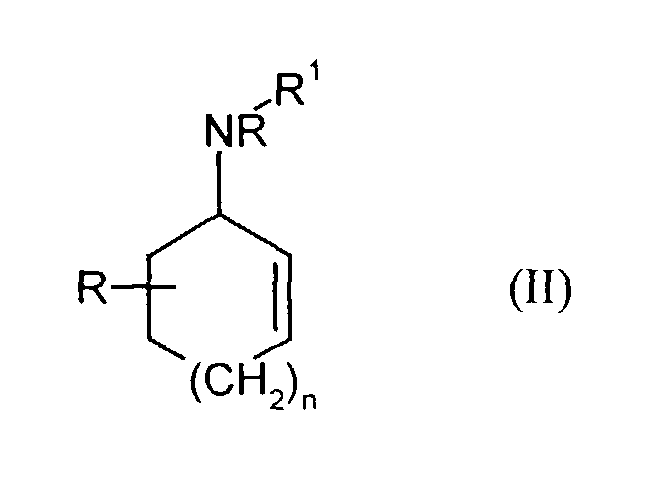
- R
- ein organischer Substituent, bevorzugt Wasserstoff, gegebenenfalls anelliertes Aryl, Alkyl, CN, COOR2 oder Halogen ist,
- R1
- tert.-Butyl, P(R)2, P(R2)2, COR, SO2PhR, COOR oder CONRR2 ist,
- R2
- Alkyl oder Phenyl ist,
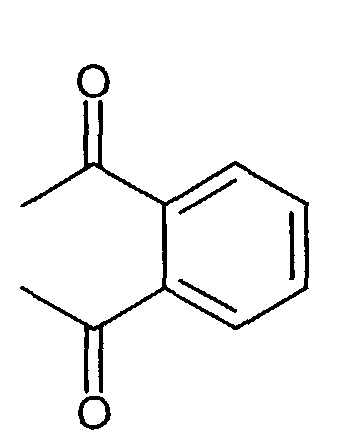
besagte α,ω-Diene auch an jeder anderen Position im Molekül, mit Ausnahme der α-Stellung, mindestens einen weiteren Substituenten R tragen können.

- n
- die Zahl 1,2,3 oder 4, bevorzugt 1 oder 2, besonders bevorzugt 1 bedeutet.

- R3 bis R7
- sind unabhängig voneinander wählbare Reste aus Wasserstoff, C1-C20 Alkyl, C3-C8 Cycloalkyl, C2-C20 Alkenyl, C2-C20 Alkinyl, C6-C18 Aryl, C1-C20 Carboxylat, C1-C20 Alkoxy, C2-C20 Alkenyloxy, C2-C20 Alkinyloxy, C6-C18 Aryloxy, C2-C20 Alkoxycarbonyl, C1-C20 Alkylthio, C1-C20 Alkylsulfonyl oder C1-C20 Alkylsulfinyl, N-Aryl; jeweils wahlweise substituiert mit C1-C12 Alkyl, Perfluoralkyl, Halogen, C1-C5 Alkoxy oder C6-C18 Aryl. Die Reste R3 bis R7 können in cyclischen Verbindungen miteinander verknüpft vorliegen.
- X1 bis X3
- sind unabhängig voneinander wählbare anionische Liganden, insbesondere F-, Cl-, Br-, CN-, SCN-, R3O-, R3R4N-, (R3-R7)-Allyl-, (R3-R7)-Cyclopentadienyl-, wobei die Reste R3 bis R7 die bereits genannte Definition erfüllen.
- L1 bis L3
- sind unabhängig voneinander wählbare neutrale Liganden insbesondere CO, CO2, R3NCO, R3R4C=CR5R6, R3C≡CR4, R3R4C=NR5, R3C≡N, R3OR4, R3SR4, NR3R4R5, PR3R4R5, AsR3R4R5, SbR3R4R5, wobei die Reste R3 bis R5 die bereits genannte Definition erfüllen.


Ausbeute: 77 mg N-Carboxymethyl-3,4,5,6-tetrahydroanilin (0.49 mmol, 99% der Theorie).

Ausbeute: 74 mg N-Carboxymethyl-3,4,5,6-tetrahydroanilin (0.48 mmol, 96% der Theorie).
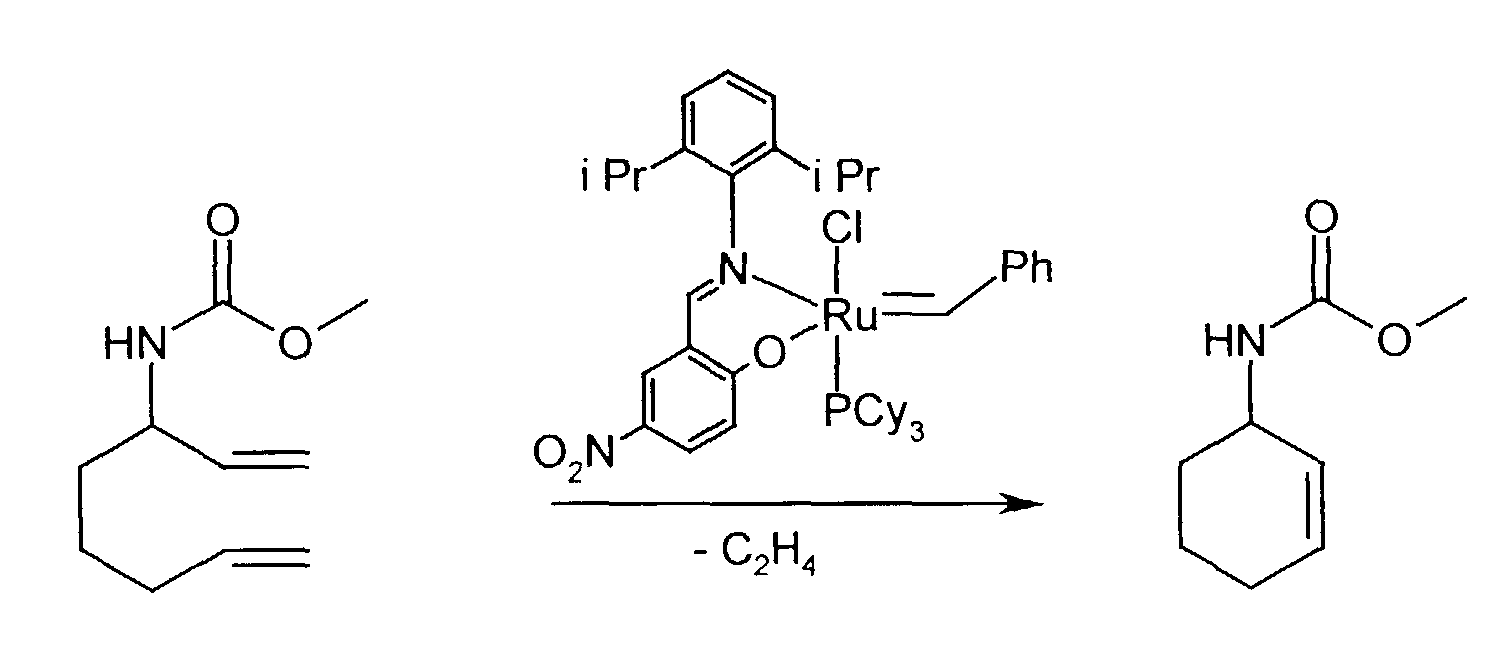
Ausbeute: 77 mg N-Carboxymethyl-3,4,5,6-tetrahydroanilin (0.49 mmol, 98% der Theorie).

Die Ausbeute an Tetrahydrobenzol wurde durch Gaschromatographie bestimmt (interner Standard: Tetradecan) und betrug 99% der Theorie.

Gaschromatographisch wurde ein Gehalt von 32% an gewünschtem Tetrahydrobenzol ermittelt. Dieses Ergebnis wurde in einer anschließenden zweiten Metathesereaktion unter Verwendung derselben ionischen Phase wieder erreicht.


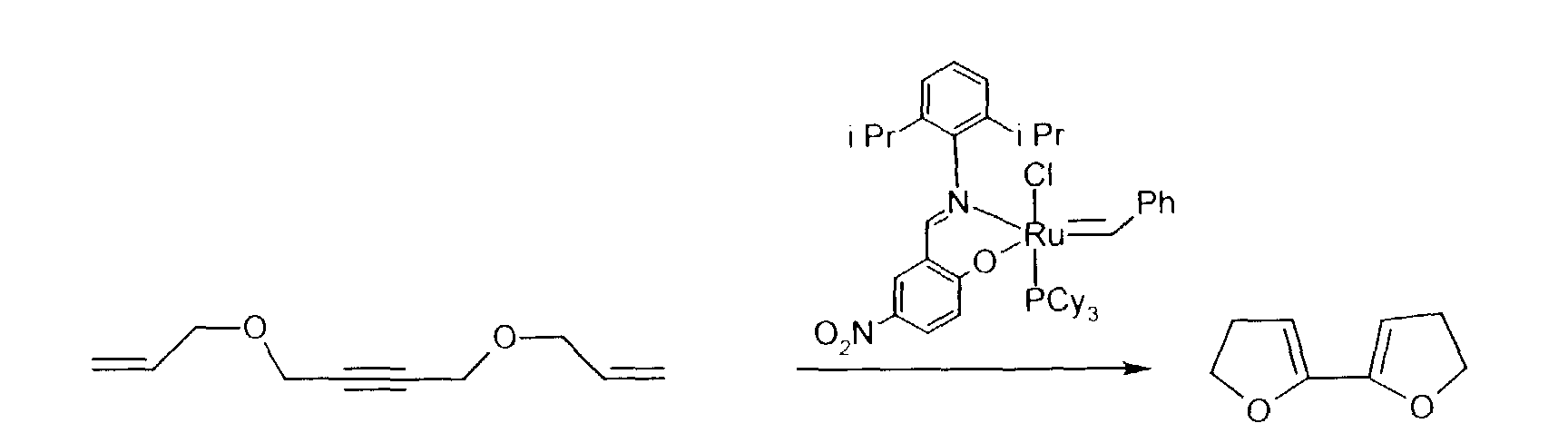
Ausbeute: 120 mg 3,3'-Bis-2,5-dihydrofuranyl (87% der Theorie).
Claims (16)
- Verfahren zur Herstellung cyclischer und/oder polymerer Verbindungen durch Metathese von Edukten, die mindestens zwei funktionelle Gruppen in Form von substituierten oder unsubstituierten Alken- oder Alkineinheiten enthalten, in Gegenwart von einem oder mehreren homogen oder heterogen vorliegenden Katalysatoren, dadurch gekennzeichnet, daß die Metathese in Gegenwart von ionischen Flüssigkeiten durchgeführt wird und daß als Katalysatoren Übergangsmetallcarbene oder Übergangsmetallverbindungen, die unter den Reaktionsbedingungen Übergangsmetallcarbene bilden oder Übergangsmetallsalze in Verbindung mit einem Alkylierungsmittel verwendet werden.
- Verfahren nach Anspruch 1, dadurch gekennzeichnet, daß es sich bei den polymeren Verbindungen um Homopolymere, Copolymeren oder Block-Copolymere handelt.
- Verfahren nach Anspruch 1, dadurch gekennzeichnet, daß es sich bei den cyclischen Verbindungen um carbo- oder heterocyclische Verbindungen mit Ringgrößen ≥ 5 Ringgliedern handelt.
- Verfahren gemäß einem oder mehreren der vorangegangenen Ansprüche 1 bis 3, dadurch gekennzeichnet, daß die Edukte neben den an der Metathesereaktion beteiligten funktionellen Gruppen mindestens einen weiteren, sich in der Metathesereaktion inert verhaltenden Substituenten und/oder ein Heteroatom enthalten.
- Verfahren nach Anpruch 4, dadurch gekennzeichnet, daß die genannten Substituenten oder Heteroatome unabhängig gewählt werden aus: verzweigte oder unverzweigte Alkylreste, aromatische oder nicht-aromatische carbocyclische Ringe, Carbonsäuren, Ester, Ether, Epoxide, Silylether, Thioether, Thioacetale, Anhydride, Imine, Silylenolether, Ammoniumsalze, Amide, Nitrile, Perfluoralkyl-Gruppen, gem.-Dialkyl-Gruppen, Alkine, Alkene, Halogene, Alkohole, Ketone, Aldehyde, Carbamate, Carbonate, Urethane, Sulfonate, Sulfone, Sulfonamide, Nitro-Gruppen, Organosilan-Einheiten, Metallzentren, sauerstoff-, stickstoff-, schwefel-, phosphorhaltige Heterocyclen.
- Verfahren gemäß Anspruch 5, dadurch gekennzeichnet, daß als Edukte α,ω-Diene eingesetzt werden, die mindestens einen weiteren, sich in der Metathesereaktion inert verhaltenden Substituenten und/oder ein Heteroatom enthalten können, wobei diese Substituenten oder Heteroatome unabhängig gewählt werden können aus verzweigte oder unverzweigte Alkylreste, aromatische oder nicht-aromatische carbocyclische Ringe, Carbonsäuren, Ester, Ether, Epoxide, Silylether, Thioether, Thioacetale, Anhydride, Imine, Silylenolether, Ammoniumsalze, Amide, Nitrile, Perfluoralkyl-Gruppen, gem.-Dialkyl-Gruppen, Alkine, Alkene, Halogene, Alkohole, Ketone, Aldehyde, Carbamate, Carbonate, Urethane, Sulfonate, Sulfone, Sulfonamide, Nitro-Gruppen, Organosilan-Einheiten, Metallzentren, sauerstoff-, stickstoff-, schwefel-, phosphorhaltige Heterocyclen.
- Verfahren gemäß Anspruch 6, dadurch gekennzeichnet, daß α,ω-Diene, die in α-Stellung zu einer Doppelbindung einen Substituenten NRR1 tragen, eingesetzt werden, wobei
- R
- ein organischer Substituent, bevorzugt Wasserstoff, gegebenenfalls anelliertes Aryl, Alkyl, CN, COOR2 oder Halogen ist,
- R1
- tert.-Butyl, P(R)2, P(R2)2, COR, SO2PhR, COOR oder CONRR2 ist,
- R2
- Alkyl oder Phenyl ist,
bedeuten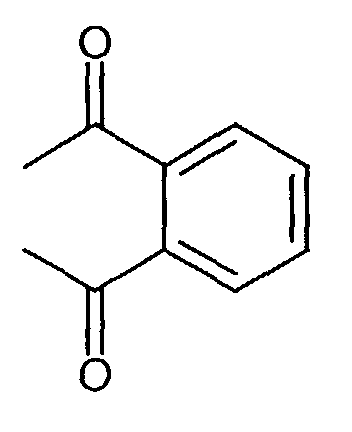
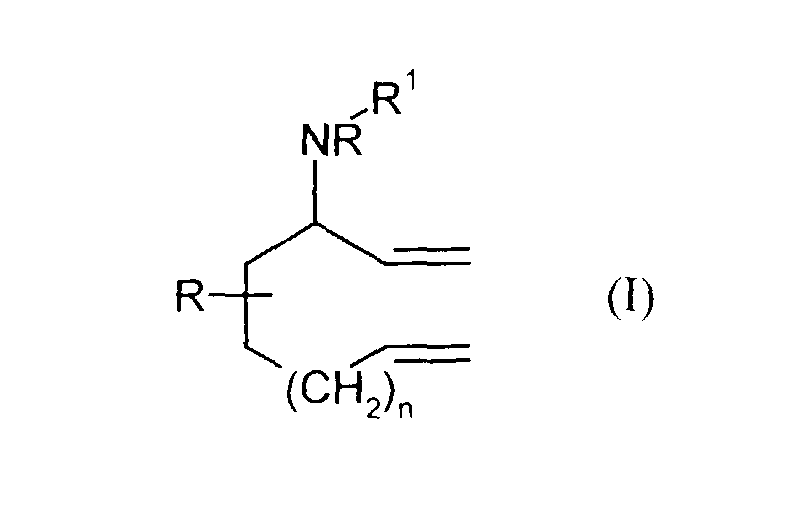
und besagte α,ω-Diene auch an jeder anderen Position im Molekül, mit Ausnahme der α-Stellung, mindestens einen weiteren Substituenten R tragen können. - Verfahren gemäß Anspruch 7, dadurch gekennzeichnet, daß α,ω-Diene der allgemeinen Formel (I) eingesetzt werdenin welcher R, R1 und R2 die in Anspruch 7 genannte Bedeutung haben und n die Zahl 1,2,3 oder 4, bevorzugt 1 oder 2, besonders bevorzugt 1 bedeutet.
- Verfahren gemäß Anspruch 7, dadurch gekennzeichnet, daß als α,ω-Diene Diallylamin oder 3-Amino-1,7-octadien, besonders bevorzugt in ihrer N-Carboxymethyl-geschützten Form oder 1,7-Octadien, 10-Undecenoyl-allylamid, 1,4-Bis-oxypropen-2-yl-butin-2 oder 10-Undecensäure-buten-4-yl-ester eingesetzt werden.
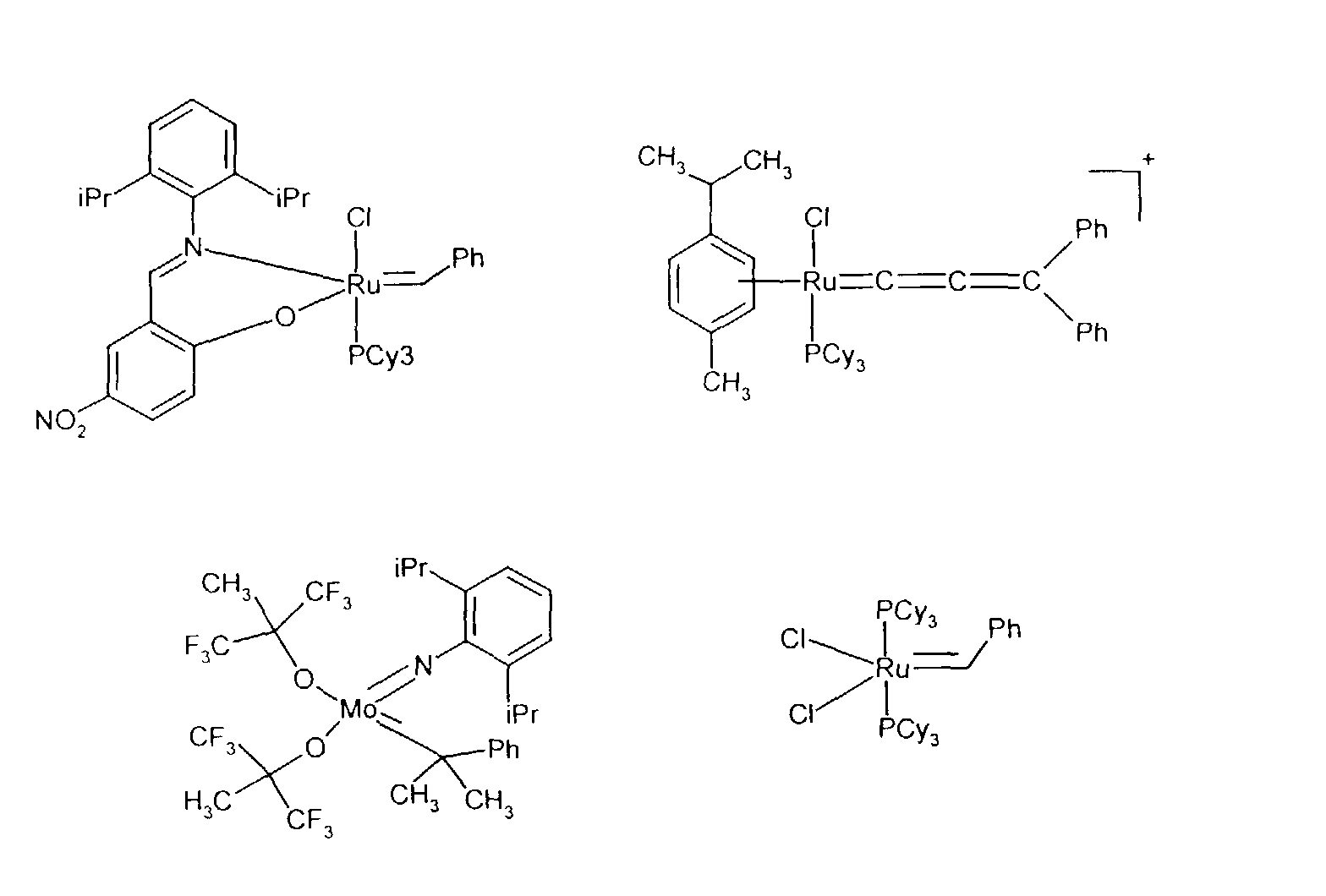
- Verfahren gemäß einem oder mehreren der vorangegangenen Ansprüche 1 bis 9, dadurch gekennzeichnet, daß als Katalysatoren Verbindungen der allgemeinen Formel (III) bis (VI) eingesetzt werden können, wobei M Ruthenium oder Osmium bedeutetund
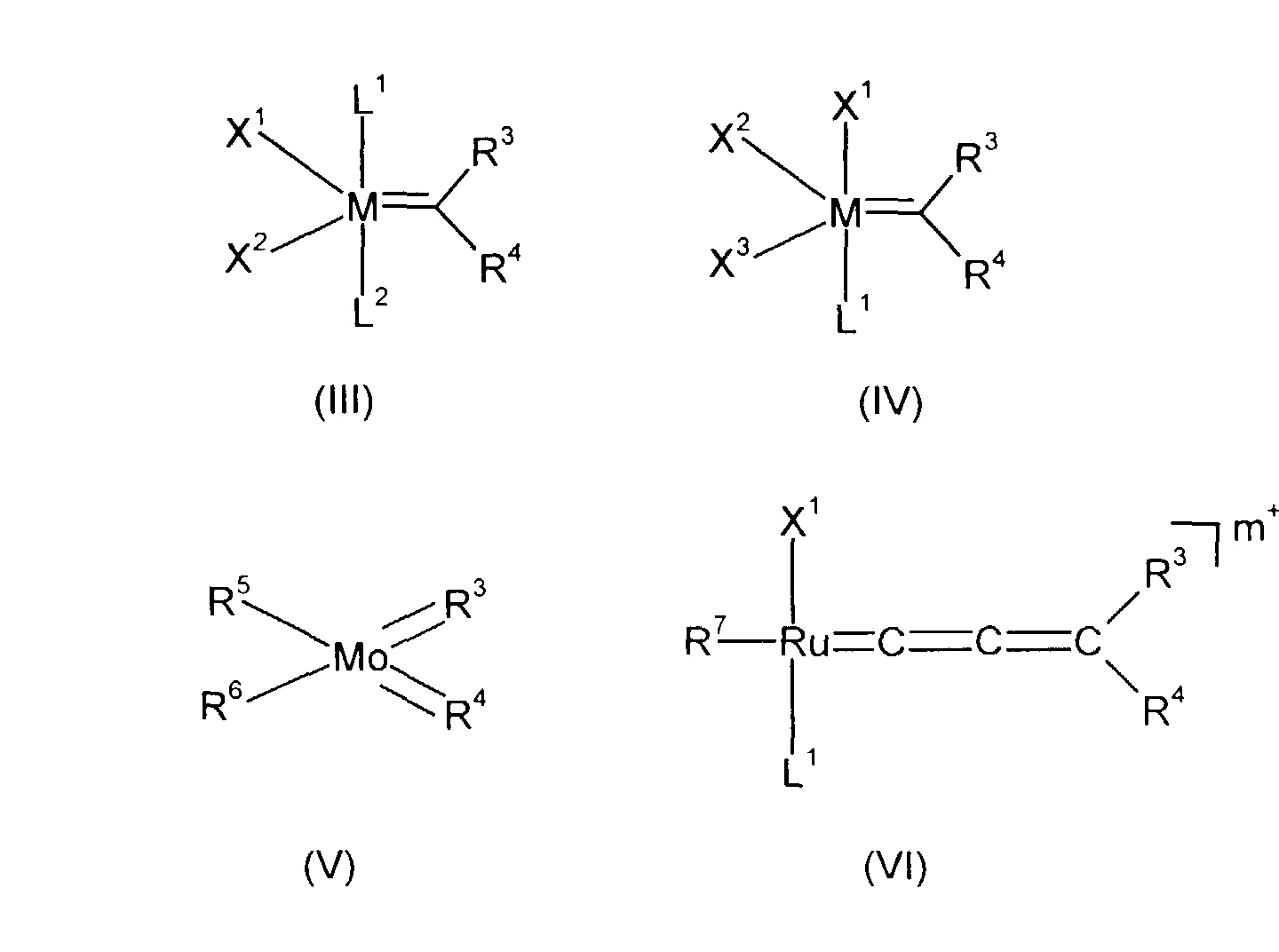
- R3 bis R7
- unabhängig voneinander wählbare Reste sind aus: Wasserstoff, C1-C20 Alkyl, C3-C8 Cycloalkyl, C2-C20 Alkenyl, C2-C20 Alkinyl, C6-C18 Aryl, C1-C20 Carboxylat, C1-C20 Alkoxy, C2-C20 Alkenyloxy, C2-C20 Alkinyloxy, C6-C18 Aryloxy, C2-C20 Alkoxycarbonyl, C1-C20 Alkylthio, C1-C20 Alkylsulfonyl oder C1-C20 Alkylsulfinyl, N-Aryl; jeweils wahlweise substituiert mit C1-C12 Alkyl, Perfluoralkyl, Halogen, C1-C5 Alkoxy oder C6-C18 Aryl, wobei R3 bis R7 auch in cyclischen Verbindungen miteinander verknüpft vorliegen können,
- X1 bis X3
- unabhängig voneinander wählbare anionische Liganden sind, insbesondere F-, Cl-, Br-, CN-, SCN-,R3O-, R3R4N-, (R3-R7)-Allyl-, (R3-R7)-Cyclopentadienyl-, wobei die Reste R3 bis R7 die bereits genannte Definition erfüllen,
- L1 bis L3
- unabhängig voneinander wählbare neutrale Liganden sind, insbesondere CO, CO2, R3NCO, R3R4C=CR5R6, R3C≡CR4, R3R4C=NR5, R3C≡N, R3OR4, R3SR4, NR3R4R5, PR3R4R5, AsR3R4R5, SbR3R4R5, wobei die Reste R3 bis R5 die bereits genannte Definition erfüllen
m 1 oder 2 ist. - Verfahren nach Anspruch 10, dadurch gekennzeichnet, daß als Katalysatoren oder Katalysatorvorstufen Verbindungen der allgemeinen Formel (III) und/oder (IV) mit L1 und L2 = PR3R4R5 verwendet werden, wobei R3 bis R5 den oben genannten Definitionen entsprechen, ganz besonders bevorzugte Reste sind dabei Aryl oder Alkyl, insbesondere sekundäre Alkylreste oder Cycloalkylreste.
- Verfahren nach Anspruch 11, dadurch gekennzeichnet, daß als Katalysatoren folgende Verbindungen eingesetzt werden:

- Verfahren nach einem oder mehreren der vorangegangenen Ansprüchen 1 bis 12, dadurch gekennzeichnet, daß als ionische Flüssigkeiten Ammoniumhexafluorophosphat, Ammoniumtetrafluoroborat, Ammoniumtosylat oder Ammoniumhydrogensulfat eingesetzt werden oder Salzmischungen eingesetzt werden, die Aluminiumhalogenide in Kombination mit mindestens einem quartären Ammoniumhalogenid und/oder mindestens einem quartärem Phosphoniumhalogenid enthalten.
- Verfahren nach Anspruch 13, dadurch gekennzeichnet, daß als ionische Flüssigkeiten Pyridiniumhexafluorophosphat, Pyridiniumtetrafluoroborat, Pyridiniumhydrogensulfat, 1-Methyl-3-butylimidazoliumhexafluorophosphat oder Kombinationen von Aluminiumchlorid mit 1-Methyl-3-butylimidazoliumchlorid, 1-Methyl-3-ethylimidazoliumchlorid, N-Butylpyridiniumchlorid und/oder Tetrabutylphosphoniumhalogenid verwendet werden.
- Verfahren nach einem oder mehreren der vorangegangenen Ansprüche 1 bis 14, dadurch gekennzeichnet, daß als ionische Flüssigkeiten auch Kombinationen von Aluminiumhalogenid mit Mischungen von quartären Ammoniumhalogeniden und/oder quartären Phosphoniumhalogeniden, sowie Mischungen von Ammoniumhexafluorophosphat, Ammoniumtetrafluoroborat, Ammoniumtosylat oder Ammoniumhydrogensulfat eingesetzt werden können.
- Verfahren nach einem oder mehreren der vorangegangenen Ansprüche 1 bis 15, dadurch gekennzeichnet, daß das Reaktionsmedium zusätzlich ein oder mehrere Additive enthält, die unabhängig gewählt werden aus: Phosphorverbindungen, Amine, perfluorierte Verbindungen, Metallalkoxide oder organischen Lösungsmitteln.
Applications Claiming Priority (4)
| Application Number | Priority Date | Filing Date | Title |
|---|---|---|---|
| DE19909600A DE19909600A1 (de) | 1999-03-05 | 1999-03-05 | Verfahren zur Synthes alpha-substituierte Ringsysteme |
| DE19909600 | 1999-03-05 | ||
| DE19927912 | 1999-06-18 | ||
| DE19927912A DE19927912A1 (de) | 1999-06-18 | 1999-06-18 | Metathese in Gegenwart ionischer Flüssigkeiten |
Publications (3)
| Publication Number | Publication Date |
|---|---|
| EP1035093A2 true EP1035093A2 (de) | 2000-09-13 |
| EP1035093A3 EP1035093A3 (de) | 2001-01-24 |
| EP1035093B1 EP1035093B1 (de) | 2003-09-10 |
Family
ID=26052196
Family Applications (1)
| Application Number | Title | Priority Date | Filing Date |
|---|---|---|---|
| EP00103339A Expired - Lifetime EP1035093B1 (de) | 1999-03-05 | 2000-02-21 | Metathese in Gegenwart ionischer Flüssigkeiten |
Country Status (5)
| Country | Link |
|---|---|
| US (1) | US6756500B1 (de) |
| EP (1) | EP1035093B1 (de) |
| JP (1) | JP2000256218A (de) |
| AT (1) | ATE249404T1 (de) |
| DE (1) | DE50003601D1 (de) |
Cited By (3)
| Publication number | Priority date | Publication date | Assignee | Title |
|---|---|---|---|---|
| EP1346768A3 (de) * | 2002-03-22 | 2004-01-21 | Haldor Topsoe A/S | Verfahren zur Paraffinisomerisierung und dafür geeignete katalytische Zusammensetzung, enthaltend eine ionische Flüssigkeit und ein Metallsalz-Additiv |
| EP1810961A1 (de) * | 2006-01-24 | 2007-07-25 | Institut Français du Pétrole | Verfahren zur gleichzeitigen Produktion von Olefinen und Diestern oder Disäuren mittels Homometathese von ungesättigten Fettkörpern in nichtwässrigen, ionischen Flüssigkeiten |
| WO2013098052A2 (en) | 2011-12-28 | 2013-07-04 | Lanxess Deutschland Gmbh | Metathesis of nitrile rubbers in the presence of transition metal complex catalysts |
Families Citing this family (5)
| Publication number | Priority date | Publication date | Assignee | Title |
|---|---|---|---|---|
| NL1021362C2 (nl) * | 2001-08-31 | 2003-08-05 | Inst Francais Du Petrole | Katalysator- en oplosmiddelsamenstelling en katalysewerkwijzen waarbij deze samenstelling wordt toegepast. |
| FR2878246B1 (fr) * | 2004-11-23 | 2007-03-30 | Inst Francais Du Petrole | Procede de co-production d'olefines et d'esters par ethenolyse de corps gras insatures dans des liquides ioniques non-aqueux |
| DE102005002336A1 (de) * | 2005-01-17 | 2006-07-20 | Boehringer Ingelheim Pharma Gmbh & Co. Kg | Verfahren zur Durchführung von kontinuierlichen Olefin-Ringschluss-Metathesen in komprimiertem Kohlendioxid |
| FR2896498B1 (fr) * | 2006-01-24 | 2008-08-29 | Inst Francais Du Petrole | Procede de co-production d'olefines et de diesters ou de diacides a partir de corps gras insatures. |
| CN107537576B (zh) * | 2017-06-22 | 2020-07-07 | 沈阳工业大学 | 硅烷偶联分子筛与复盐离子液体的固载化催化剂 |
Family Cites Families (7)
| Publication number | Priority date | Publication date | Assignee | Title |
|---|---|---|---|---|
| US5110885A (en) * | 1990-01-03 | 1992-05-05 | University Of Florida | Method for polymerizing acyclic dienes |
| FR2659871B1 (fr) | 1990-03-20 | 1992-06-05 | Inst Francais Du Petrole | Composition liquide non aqueuse a caractere ionique et son utilisation comme solvant. invention de mm. yves chauvin, dominique commereuc, isabelle guibard, andre hirschauer, helene olivier, lucien saussine. |
| EP1253156A3 (de) | 1992-04-03 | 2004-01-07 | California Institute Of Technology | Hochwirksame Ruthenium- oder Osmium- Metall-Carben-Komplexe für Olefinmetathesereaktionen, und deren Herstellung und Verwendung |
| US5312940A (en) | 1992-04-03 | 1994-05-17 | California Institute Of Technology | Ruthenium and osmium metal carbene complexes for olefin metathesis polymerization |
| FR2715328B1 (fr) | 1994-01-26 | 1996-04-12 | Inst Francais Du Petrole | Composition catalytique et procédé pour la disproportion des oléfines. |
| FR2763869B1 (fr) * | 1997-05-27 | 1999-07-16 | Inst Francais Du Petrole | Procede et installation pour realiser une reaction sur une charge organique, telle que la dimerisation ou la metathese, en presence d'une phase polaire contenant un catalyseur |
| DE19840108A1 (de) * | 1998-09-03 | 2000-03-09 | Bayer Ag | Verfahren zur Synthese alpha-substituierter Ringsysteme |
-
2000
- 2000-02-18 JP JP2000041175A patent/JP2000256218A/ja active Pending
- 2000-02-21 AT AT00103339T patent/ATE249404T1/de not_active IP Right Cessation
- 2000-02-21 EP EP00103339A patent/EP1035093B1/de not_active Expired - Lifetime
- 2000-02-21 DE DE50003601T patent/DE50003601D1/de not_active Expired - Fee Related
- 2000-02-25 US US09/514,023 patent/US6756500B1/en not_active Expired - Fee Related
Cited By (8)
| Publication number | Priority date | Publication date | Assignee | Title |
|---|---|---|---|---|
| EP1346768A3 (de) * | 2002-03-22 | 2004-01-21 | Haldor Topsoe A/S | Verfahren zur Paraffinisomerisierung und dafür geeignete katalytische Zusammensetzung, enthaltend eine ionische Flüssigkeit und ein Metallsalz-Additiv |
| US7053261B2 (en) | 2002-03-22 | 2006-05-30 | Haldor Topsoe A/S | Process for paraffin hydrocarbon isomerization and composite catalyst therefore |
| EP1810961A1 (de) * | 2006-01-24 | 2007-07-25 | Institut Français du Pétrole | Verfahren zur gleichzeitigen Produktion von Olefinen und Diestern oder Disäuren mittels Homometathese von ungesättigten Fettkörpern in nichtwässrigen, ionischen Flüssigkeiten |
| FR2896500A1 (fr) * | 2006-01-24 | 2007-07-27 | Inst Francais Du Petrole | Procede de co-production d'olefines et de diesters ou de diacides par homometathese de corps gras insatures dans des liquides ioniques non-aqueux. |
| US7754904B2 (en) | 2006-01-24 | 2010-07-13 | Institut Francais Du Petrole | Process for co-producing olefins and diesters or diacids by homomethathesis of unsaturated fats in non-aqueous ionic liquids |
| NO338391B1 (no) * | 2006-01-24 | 2016-08-15 | Inst Francais Du Petrole | Fremgangsmåte for ko-produsering av olefiner og diestere eller disyrer ved homometatese av umettet fett i ikke-vandige ioniske væsker |
| WO2013098052A2 (en) | 2011-12-28 | 2013-07-04 | Lanxess Deutschland Gmbh | Metathesis of nitrile rubbers in the presence of transition metal complex catalysts |
| WO2013098052A3 (en) * | 2011-12-28 | 2013-08-22 | Lanxess Deutschland Gmbh | Metathesis of nitrile rubbers in the presence of transition metal complex catalysts |
Also Published As
| Publication number | Publication date |
|---|---|
| EP1035093B1 (de) | 2003-09-10 |
| US6756500B1 (en) | 2004-06-29 |
| ATE249404T1 (de) | 2003-09-15 |
| JP2000256218A (ja) | 2000-09-19 |
| DE50003601D1 (de) | 2003-10-16 |
| EP1035093A3 (de) | 2001-01-24 |
Similar Documents
| Publication | Publication Date | Title |
|---|---|---|
| EP0975622B1 (de) | Selektive olefinmetathese von bi- oder polyfunktionellen substraten in komprimiertem kohlendioxid als reaktionsmedium | |
| DE69806053T2 (de) | Hochwirksame kationische ruthenium und osmiumkomplexe für die metathesereaktionen | |
| DE69733830T2 (de) | Synthese von ruthenium- oder osmium-metathesekatalysatoren | |
| EP1031553B1 (de) | Verfahren zur Herstellung von substituierten Olefinen | |
| EP2260047B2 (de) | Verfahren zur herstellung von ruthenium-carben-komplexen | |
| DE20320324U1 (de) | Rutheniumkomplexe als (Prä)Katalysatoren für Metathesereaktionen | |
| EP1053215B1 (de) | Verfahren zur darstellung makrocyclischer produkte durch ringschliessende diin-metathese | |
| WO1999058538A1 (de) | Kationische rutheniumkomplexe, ihre herstellung und ihre verwendung | |
| EP1990348A2 (de) | Schwefelhaltige Metathesekatalysatoren | |
| EP1035093B1 (de) | Metathese in Gegenwart ionischer Flüssigkeiten | |
| EP1841518A1 (de) | Verfahren zur durchführung von kontinuierlichen olefin-ringschluss-metathesen in komprimiertem kohlendioxid | |
| DE19533331A1 (de) | Peroxogruppenhaltige Metallkomplexe mit Aminoxid- oder Phosphanoxid-Liganden als Epoxidierungskatalysatoren | |
| DE19716231A1 (de) | Olefinmetathese in komprimiertem Kohlendioxid | |
| EP0691334B1 (de) | Verfahren zur Herstellung von 2,5-Dihydrofuran | |
| DE19712388A1 (de) | Verfahren zur Synthese von aromatisch substituierten Olefinen | |
| DE19927912A1 (de) | Metathese in Gegenwart ionischer Flüssigkeiten | |
| EP0949256B1 (de) | Verfahren zur Herstellung von Isochroman-3-onen | |
| DE10241555A1 (de) | Verfahren zur Durchführung chemischer Reaktionen in der Flüssigphase in Gegenwart eines Katalysators und eines 1,3-substituierten Imidazoliumsalzes | |
| EP0915076B1 (de) | Verfahren zur Herstellung von trans-(R,R)-Actinol | |
| EP2899189B1 (de) | Verfahren zur katalytischen Herstellung ungesättigter Aldehyde | |
| DE19706648A1 (de) | Verfahren zur Herstellung von aromatischen Nitrilen | |
| WO1999010356A1 (de) | Verfahren zur herstellung von rutheniumkomplexen | |
| DE19720798A1 (de) | Selektive Olefinmetathese von bi- oder polyfunktionellen Substraten in komprimiertem Kohlendioxid als Reaktionsmedium | |
| DE1810185B2 (de) | Nickel (0)-katalysatoren, Verfahren zu deren Herstellung und deren Verwendung zur Oligomerisation von Butadien | |
| DE60118994T2 (de) | Verfahren zur Herstellung von kondensierten Cyclopentadienen, 1,3 disubstituierte Derivate und diese enthaltende Metallocen-artige Verbindungen |
Legal Events
| Date | Code | Title | Description |
|---|---|---|---|
| PUAI | Public reference made under article 153(3) epc to a published international application that has entered the european phase |
Free format text: ORIGINAL CODE: 0009012 |
|
| AK | Designated contracting states |
Kind code of ref document: A2 Designated state(s): AT BE CH CY DE DK ES FI FR GB GR IE IT LI LU MC NL PT SE |
|
| AX | Request for extension of the european patent |
Free format text: AL;LT;LV;MK;RO;SI |
|
| PUAL | Search report despatched |
Free format text: ORIGINAL CODE: 0009013 |
|
| AK | Designated contracting states |
Kind code of ref document: A3 Designated state(s): AT BE CH CY DE DK ES FI FR GB GR IE IT LI LU MC NL PT SE |
|
| AX | Request for extension of the european patent |
Free format text: AL;LT;LV;MK;RO;SI |
|
| 17P | Request for examination filed |
Effective date: 20010724 |
|
| AKX | Designation fees paid |
Free format text: AT BE CH CY DE DK ES FI FR GB GR IE IT LI LU MC NL PT SE |
|
| 17Q | First examination report despatched |
Effective date: 20020222 |
|
| GRAH | Despatch of communication of intention to grant a patent |
Free format text: ORIGINAL CODE: EPIDOS IGRA |
|
| GRAS | Grant fee paid |
Free format text: ORIGINAL CODE: EPIDOSNIGR3 |
|
| GRAA | (expected) grant |
Free format text: ORIGINAL CODE: 0009210 |
|
| AK | Designated contracting states |
Kind code of ref document: B1 Designated state(s): AT BE CH CY DE DK ES FI FR GB GR IE IT LI LU MC NL PT SE |
|
| PG25 | Lapsed in a contracting state [announced via postgrant information from national office to epo] |
Ref country code: IT Free format text: LAPSE BECAUSE OF FAILURE TO SUBMIT A TRANSLATION OF THE DESCRIPTION OR TO PAY THE FEE WITHIN THE PRESCRIBED TIME-LIMIT;WARNING: LAPSES OF ITALIAN PATENTS WITH EFFECTIVE DATE BEFORE 2007 MAY HAVE OCCURRED AT ANY TIME BEFORE 2007. THE CORRECT EFFECTIVE DATE MAY BE DIFFERENT FROM THE ONE RECORDED. Effective date: 20030910 Ref country code: IE Free format text: LAPSE BECAUSE OF FAILURE TO SUBMIT A TRANSLATION OF THE DESCRIPTION OR TO PAY THE FEE WITHIN THE PRESCRIBED TIME-LIMIT Effective date: 20030910 Ref country code: CY Free format text: LAPSE BECAUSE OF FAILURE TO SUBMIT A TRANSLATION OF THE DESCRIPTION OR TO PAY THE FEE WITHIN THE PRESCRIBED TIME-LIMIT Effective date: 20030910 Ref country code: FI Free format text: LAPSE BECAUSE OF FAILURE TO SUBMIT A TRANSLATION OF THE DESCRIPTION OR TO PAY THE FEE WITHIN THE PRESCRIBED TIME-LIMIT Effective date: 20030910 |
|
| REG | Reference to a national code |
Ref country code: GB Ref legal event code: FG4D Free format text: NOT ENGLISH |
|
| REG | Reference to a national code |
Ref country code: CH Ref legal event code: NV Representative=s name: E. BLUM & CO. PATENTANWAELTE Ref country code: CH Ref legal event code: EP |
|
| GBT | Gb: translation of ep patent filed (gb section 77(6)(a)/1977) | ||
| REF | Corresponds to: |
Ref document number: 50003601 Country of ref document: DE Date of ref document: 20031016 Kind code of ref document: P |
|
| REG | Reference to a national code |
Ref country code: IE Ref legal event code: FG4D Free format text: GERMAN |
|
| PG25 | Lapsed in a contracting state [announced via postgrant information from national office to epo] |
Ref country code: SE Free format text: LAPSE BECAUSE OF FAILURE TO SUBMIT A TRANSLATION OF THE DESCRIPTION OR TO PAY THE FEE WITHIN THE PRESCRIBED TIME-LIMIT Effective date: 20031210 Ref country code: GR Free format text: LAPSE BECAUSE OF FAILURE TO SUBMIT A TRANSLATION OF THE DESCRIPTION OR TO PAY THE FEE WITHIN THE PRESCRIBED TIME-LIMIT Effective date: 20031210 Ref country code: DK Free format text: LAPSE BECAUSE OF FAILURE TO SUBMIT A TRANSLATION OF THE DESCRIPTION OR TO PAY THE FEE WITHIN THE PRESCRIBED TIME-LIMIT Effective date: 20031210 |
|
| PG25 | Lapsed in a contracting state [announced via postgrant information from national office to epo] |
Ref country code: PT Free format text: LAPSE BECAUSE OF FAILURE TO SUBMIT A TRANSLATION OF THE DESCRIPTION OR TO PAY THE FEE WITHIN THE PRESCRIBED TIME-LIMIT Effective date: 20031218 |
|
| PG25 | Lapsed in a contracting state [announced via postgrant information from national office to epo] |
Ref country code: ES Free format text: LAPSE BECAUSE OF FAILURE TO SUBMIT A TRANSLATION OF THE DESCRIPTION OR TO PAY THE FEE WITHIN THE PRESCRIBED TIME-LIMIT Effective date: 20031221 |
|
| PG25 | Lapsed in a contracting state [announced via postgrant information from national office to epo] |
Ref country code: AT Free format text: LAPSE BECAUSE OF NON-PAYMENT OF DUE FEES Effective date: 20040221 Ref country code: LU Free format text: LAPSE BECAUSE OF NON-PAYMENT OF DUE FEES Effective date: 20040221 |
|
| PG25 | Lapsed in a contracting state [announced via postgrant information from national office to epo] |
Ref country code: BE Free format text: LAPSE BECAUSE OF NON-PAYMENT OF DUE FEES Effective date: 20040228 Ref country code: MC Free format text: LAPSE BECAUSE OF NON-PAYMENT OF DUE FEES Effective date: 20040228 |
|
| REG | Reference to a national code |
Ref country code: IE Ref legal event code: FD4D |
|
| ET | Fr: translation filed | ||
| PLBE | No opposition filed within time limit |
Free format text: ORIGINAL CODE: 0009261 |
|
| STAA | Information on the status of an ep patent application or granted ep patent |
Free format text: STATUS: NO OPPOSITION FILED WITHIN TIME LIMIT |
|
| BERE | Be: lapsed |
Owner name: *BAYER A.G. Effective date: 20040228 |
|
| 26N | No opposition filed |
Effective date: 20040614 |
|
| PGFP | Annual fee paid to national office [announced via postgrant information from national office to epo] |
Ref country code: NL Payment date: 20060205 Year of fee payment: 7 |
|
| REG | Reference to a national code |
Ref country code: GB Ref legal event code: 732E |
|
| PGFP | Annual fee paid to national office [announced via postgrant information from national office to epo] |
Ref country code: FR Payment date: 20060220 Year of fee payment: 7 |
|
| PGFP | Annual fee paid to national office [announced via postgrant information from national office to epo] |
Ref country code: CH Payment date: 20060301 Year of fee payment: 7 |
|
| PGFP | Annual fee paid to national office [announced via postgrant information from national office to epo] |
Ref country code: DE Payment date: 20070215 Year of fee payment: 8 |
|
| PG25 | Lapsed in a contracting state [announced via postgrant information from national office to epo] |
Ref country code: LI Free format text: LAPSE BECAUSE OF NON-PAYMENT OF DUE FEES Effective date: 20070228 Ref country code: CH Free format text: LAPSE BECAUSE OF NON-PAYMENT OF DUE FEES Effective date: 20070228 |
|
| NLS | Nl: assignments of ep-patents |
Owner name: LANXESS DEUTSCHLAND GMBH Effective date: 20070305 |
|
| REG | Reference to a national code |
Ref country code: CH Ref legal event code: PL |
|
| GBPC | Gb: european patent ceased through non-payment of renewal fee |
Effective date: 20070221 |
|
| NLV4 | Nl: lapsed or anulled due to non-payment of the annual fee |
Effective date: 20070901 |
|
| REG | Reference to a national code |
Ref country code: FR Ref legal event code: ST Effective date: 20071030 |
|
| PG25 | Lapsed in a contracting state [announced via postgrant information from national office to epo] |
Ref country code: NL Free format text: LAPSE BECAUSE OF NON-PAYMENT OF DUE FEES Effective date: 20070901 |
|
| PG25 | Lapsed in a contracting state [announced via postgrant information from national office to epo] |
Ref country code: GB Free format text: LAPSE BECAUSE OF NON-PAYMENT OF DUE FEES Effective date: 20070221 Ref country code: FR Free format text: LAPSE BECAUSE OF NON-PAYMENT OF DUE FEES Effective date: 20070228 |
|
| PGFP | Annual fee paid to national office [announced via postgrant information from national office to epo] |
Ref country code: GB Payment date: 20060215 Year of fee payment: 7 |
|
| REG | Reference to a national code |
Ref country code: FR Ref legal event code: TP |
|
| PG25 | Lapsed in a contracting state [announced via postgrant information from national office to epo] |
Ref country code: DE Free format text: LAPSE BECAUSE OF NON-PAYMENT OF DUE FEES Effective date: 20080902 |