EP1990348A2 - Schwefelhaltige Metathesekatalysatoren - Google Patents
Schwefelhaltige Metathesekatalysatoren Download PDFInfo
- Publication number
- EP1990348A2 EP1990348A2 EP08103339A EP08103339A EP1990348A2 EP 1990348 A2 EP1990348 A2 EP 1990348A2 EP 08103339 A EP08103339 A EP 08103339A EP 08103339 A EP08103339 A EP 08103339A EP 1990348 A2 EP1990348 A2 EP 1990348A2
- Authority
- EP
- European Patent Office
- Prior art keywords
- compounds
- sulfur
- alkyl
- ligand
- radicals
- Prior art date
- Legal status (The legal status is an assumption and is not a legal conclusion. Google has not performed a legal analysis and makes no representation as to the accuracy of the status listed.)
- Withdrawn
Links
- NINIDFKCEFEMDL-UHFFFAOYSA-N Sulfur Chemical compound [S] NINIDFKCEFEMDL-UHFFFAOYSA-N 0.000 title claims abstract description 13
- 238000005649 metathesis reaction Methods 0.000 title claims description 10
- 239000003054 catalyst Substances 0.000 title description 20
- 239000005864 Sulphur Substances 0.000 title 1
- -1 Olefin metal complex Chemical class 0.000 claims abstract description 35
- 239000003446 ligand Substances 0.000 claims abstract description 22
- 229910052717 sulfur Inorganic materials 0.000 claims abstract description 16
- 239000011593 sulfur Substances 0.000 claims abstract description 12
- 125000004122 cyclic group Chemical group 0.000 claims abstract description 6
- 230000007935 neutral effect Effects 0.000 claims abstract description 5
- 125000000217 alkyl group Chemical group 0.000 claims abstract description 4
- 229910052751 metal Inorganic materials 0.000 claims abstract description 4
- 239000002184 metal Substances 0.000 claims abstract description 4
- 229910052799 carbon Inorganic materials 0.000 claims abstract description 3
- 238000002360 preparation method Methods 0.000 claims abstract description 3
- 125000003107 substituted aryl group Chemical group 0.000 claims abstract description 3
- 150000001875 compounds Chemical class 0.000 claims description 28
- 150000003254 radicals Chemical class 0.000 claims description 21
- 238000006243 chemical reaction Methods 0.000 claims description 18
- XYFCBTPGUUZFHI-UHFFFAOYSA-N Phosphine Chemical compound P XYFCBTPGUUZFHI-UHFFFAOYSA-N 0.000 claims description 14
- 125000004432 carbon atom Chemical group C* 0.000 claims description 10
- 229910000073 phosphorus hydride Inorganic materials 0.000 claims description 7
- 125000004430 oxygen atom Chemical group O* 0.000 claims description 5
- 150000003871 sulfonates Chemical class 0.000 claims description 5
- OKTJSMMVPCPJKN-UHFFFAOYSA-N Carbon Chemical compound [C] OKTJSMMVPCPJKN-UHFFFAOYSA-N 0.000 claims description 4
- ZMZDMBWJUHKJPS-UHFFFAOYSA-M Thiocyanate anion Chemical compound [S-]C#N ZMZDMBWJUHKJPS-UHFFFAOYSA-M 0.000 claims description 4
- 125000002577 pseudohalo group Chemical group 0.000 claims description 4
- 150000003573 thiols Chemical class 0.000 claims description 4
- 229910019142 PO4 Inorganic materials 0.000 claims description 3
- 150000001408 amides Chemical class 0.000 claims description 3
- 125000000129 anionic group Chemical group 0.000 claims description 3
- 150000004649 carbonic acid derivatives Chemical class 0.000 claims description 3
- 238000009396 hybridization Methods 0.000 claims description 3
- 239000001257 hydrogen Substances 0.000 claims description 3
- 229910052739 hydrogen Inorganic materials 0.000 claims description 3
- 235000021317 phosphate Nutrition 0.000 claims description 3
- 229920006395 saturated elastomer Polymers 0.000 claims description 3
- 229940124530 sulfonamide Drugs 0.000 claims description 3
- 150000003456 sulfonamides Chemical class 0.000 claims description 3
- 150000003457 sulfones Chemical class 0.000 claims description 3
- 125000004434 sulfur atom Chemical group 0.000 claims description 3
- 150000003555 thioacetals Chemical class 0.000 claims description 3
- 150000003568 thioethers Chemical class 0.000 claims description 3
- WLPUWLXVBWGYMZ-UHFFFAOYSA-N tricyclohexylphosphine Chemical compound C1CCCCC1P(C1CCCCC1)C1CCCCC1 WLPUWLXVBWGYMZ-UHFFFAOYSA-N 0.000 claims description 3
- 125000003903 2-propenyl group Chemical group [H]C([*])([H])C([H])=C([H])[H] 0.000 claims description 2
- XFXPMWWXUTWYJX-UHFFFAOYSA-N Cyanide Chemical compound N#[C-] XFXPMWWXUTWYJX-UHFFFAOYSA-N 0.000 claims description 2
- ABLZXFCXXLZCGV-UHFFFAOYSA-N Phosphorous acid Chemical class OP(O)=O ABLZXFCXXLZCGV-UHFFFAOYSA-N 0.000 claims description 2
- RYYWUUFWQRZTIU-UHFFFAOYSA-N Thiophosphoric acid Chemical class OP(O)(S)=O RYYWUUFWQRZTIU-UHFFFAOYSA-N 0.000 claims description 2
- 150000004703 alkoxides Chemical class 0.000 claims description 2
- 150000001449 anionic compounds Chemical class 0.000 claims description 2
- 150000007942 carboxylates Chemical class 0.000 claims description 2
- XLJMAIOERFSOGZ-UHFFFAOYSA-M cyanate Chemical compound [O-]C#N XLJMAIOERFSOGZ-UHFFFAOYSA-M 0.000 claims description 2
- 125000000058 cyclopentadienyl group Chemical group C1(=CC=CC1)* 0.000 claims description 2
- 150000002019 disulfides Chemical class 0.000 claims description 2
- 150000002023 dithiocarboxylic acids Chemical class 0.000 claims description 2
- ZSWFCLXCOIISFI-UHFFFAOYSA-N endo-cyclopentadiene Natural products C1C=CC=C1 ZSWFCLXCOIISFI-UHFFFAOYSA-N 0.000 claims description 2
- 150000004820 halides Chemical class 0.000 claims description 2
- 125000000623 heterocyclic group Chemical group 0.000 claims description 2
- 125000004435 hydrogen atom Chemical group [H]* 0.000 claims description 2
- ZMZDMBWJUHKJPS-UHFFFAOYSA-N hydrogen thiocyanate Natural products SC#N ZMZDMBWJUHKJPS-UHFFFAOYSA-N 0.000 claims description 2
- 150000004679 hydroxides Chemical class 0.000 claims description 2
- 239000012948 isocyanate Substances 0.000 claims description 2
- 150000002513 isocyanates Chemical class 0.000 claims description 2
- 150000002540 isothiocyanates Chemical class 0.000 claims description 2
- HZVOZRGWRWCICA-UHFFFAOYSA-N methanediyl Chemical compound [CH2] HZVOZRGWRWCICA-UHFFFAOYSA-N 0.000 claims description 2
- 238000000034 method Methods 0.000 claims description 2
- 150000002891 organic anions Chemical class 0.000 claims description 2
- 150000002989 phenols Chemical class 0.000 claims description 2
- 150000003013 phosphoric acid derivatives Chemical class 0.000 claims description 2
- WSANLGASBHUYGD-UHFFFAOYSA-N sulfidophosphanium Chemical class S=[PH3] WSANLGASBHUYGD-UHFFFAOYSA-N 0.000 claims description 2
- 150000003467 sulfuric acid derivatives Chemical class 0.000 claims description 2
- 150000007970 thio esters Chemical class 0.000 claims description 2
- 150000003558 thiocarbamic acid derivatives Chemical class 0.000 claims description 2
- 125000005323 thioketone group Chemical group 0.000 claims description 2
- ONCCWDRMOZMNSM-FBCQKBJTSA-N compound Z Chemical compound N1=C2C(=O)NC(N)=NC2=NC=C1C(=O)[C@H]1OP(O)(=O)OC[C@H]1O ONCCWDRMOZMNSM-FBCQKBJTSA-N 0.000 claims 1
- 229910052762 osmium Inorganic materials 0.000 abstract description 2
- 229910052707 ruthenium Inorganic materials 0.000 abstract description 2
- JRZJOMJEPLMPRA-UHFFFAOYSA-N olefin Natural products CCCCCCCC=C JRZJOMJEPLMPRA-UHFFFAOYSA-N 0.000 abstract 2
- YMWUJEATGCHHMB-UHFFFAOYSA-N Dichloromethane Chemical compound ClCCl YMWUJEATGCHHMB-UHFFFAOYSA-N 0.000 description 39
- 239000000243 solution Substances 0.000 description 25
- XEKOWRVHYACXOJ-UHFFFAOYSA-N Ethyl acetate Chemical compound CCOC(C)=O XEKOWRVHYACXOJ-UHFFFAOYSA-N 0.000 description 18
- XKRFYHLGVUSROY-UHFFFAOYSA-N Argon Chemical compound [Ar] XKRFYHLGVUSROY-UHFFFAOYSA-N 0.000 description 12
- YXFVVABEGXRONW-UHFFFAOYSA-N Toluene Chemical compound CC1=CC=CC=C1 YXFVVABEGXRONW-UHFFFAOYSA-N 0.000 description 12
- 238000005481 NMR spectroscopy Methods 0.000 description 11
- 125000004209 (C1-C8) alkyl group Chemical group 0.000 description 10
- HEDRZPFGACZZDS-MICDWDOJSA-N Trichloro(2H)methane Chemical compound [2H]C(Cl)(Cl)Cl HEDRZPFGACZZDS-MICDWDOJSA-N 0.000 description 10
- WYURNTSHIVDZCO-UHFFFAOYSA-N Tetrahydrofuran Chemical compound C1CCOC1 WYURNTSHIVDZCO-UHFFFAOYSA-N 0.000 description 8
- FJKIXWOMBXYWOQ-UHFFFAOYSA-N ethenoxyethane Chemical compound CCOC=C FJKIXWOMBXYWOQ-UHFFFAOYSA-N 0.000 description 8
- 230000000694 effects Effects 0.000 description 7
- 238000006798 ring closing metathesis reaction Methods 0.000 description 7
- 238000003756 stirring Methods 0.000 description 7
- 229910052786 argon Inorganic materials 0.000 description 6
- 238000002330 electrospray ionisation mass spectrometry Methods 0.000 description 6
- 125000005842 heteroatom Chemical group 0.000 description 6
- VLKZOEOYAKHREP-UHFFFAOYSA-N n-Hexane Chemical compound CCCCCC VLKZOEOYAKHREP-UHFFFAOYSA-N 0.000 description 6
- 101100519284 Cercospora nicotianae PDX1 gene Proteins 0.000 description 5
- 229910021591 Copper(I) chloride Inorganic materials 0.000 description 5
- RTZKZFJDLAIYFH-UHFFFAOYSA-N Diethyl ether Chemical compound CCOCC RTZKZFJDLAIYFH-UHFFFAOYSA-N 0.000 description 5
- 101100277598 Sorghum bicolor DES3 gene Proteins 0.000 description 5
- 230000015572 biosynthetic process Effects 0.000 description 5
- OXBLHERUFWYNTN-UHFFFAOYSA-M copper(I) chloride Chemical compound [Cu]Cl OXBLHERUFWYNTN-UHFFFAOYSA-M 0.000 description 5
- 229910052736 halogen Inorganic materials 0.000 description 5
- 150000002367 halogens Chemical class 0.000 description 5
- 229910052757 nitrogen Inorganic materials 0.000 description 5
- 229910052760 oxygen Inorganic materials 0.000 description 5
- 239000002904 solvent Substances 0.000 description 5
- 101150073238 sor1 gene Proteins 0.000 description 5
- 238000003786 synthesis reaction Methods 0.000 description 5
- LFQSCWFLJHTTHZ-UHFFFAOYSA-N Ethanol Chemical compound CCO LFQSCWFLJHTTHZ-UHFFFAOYSA-N 0.000 description 4
- VYPSYNLAJGMNEJ-UHFFFAOYSA-N Silicium dioxide Chemical compound O=[Si]=O VYPSYNLAJGMNEJ-UHFFFAOYSA-N 0.000 description 4
- 125000004429 atom Chemical group 0.000 description 4
- 239000000460 chlorine Substances 0.000 description 4
- 239000000741 silica gel Substances 0.000 description 4
- 229910002027 silica gel Inorganic materials 0.000 description 4
- 125000006552 (C3-C8) cycloalkyl group Chemical group 0.000 description 3
- UHOVQNZJYSORNB-UHFFFAOYSA-N Benzene Chemical compound C1=CC=CC=C1 UHOVQNZJYSORNB-UHFFFAOYSA-N 0.000 description 3
- OKKJLVBELUTLKV-UHFFFAOYSA-N Methanol Chemical compound OC OKKJLVBELUTLKV-UHFFFAOYSA-N 0.000 description 3
- FAPWRFPIFSIZLT-UHFFFAOYSA-M Sodium chloride Chemical compound [Na+].[Cl-] FAPWRFPIFSIZLT-UHFFFAOYSA-M 0.000 description 3
- 238000005865 alkene metathesis reaction Methods 0.000 description 3
- 125000003118 aryl group Chemical group 0.000 description 3
- QVGXLLKOCUKJST-UHFFFAOYSA-N atomic oxygen Chemical compound [O] QVGXLLKOCUKJST-UHFFFAOYSA-N 0.000 description 3
- 238000004440 column chromatography Methods 0.000 description 3
- 150000001923 cyclic compounds Chemical class 0.000 description 3
- 125000004475 heteroaralkyl group Chemical group 0.000 description 3
- 125000001072 heteroaryl group Chemical group 0.000 description 3
- 239000012074 organic phase Substances 0.000 description 3
- 125000002524 organometallic group Chemical group 0.000 description 3
- 229910052698 phosphorus Inorganic materials 0.000 description 3
- 238000006116 polymerization reaction Methods 0.000 description 3
- 238000007152 ring opening metathesis polymerisation reaction Methods 0.000 description 3
- 239000000725 suspension Substances 0.000 description 3
- 229910052723 transition metal Inorganic materials 0.000 description 3
- 150000003624 transition metals Chemical class 0.000 description 3
- 238000005160 1H NMR spectroscopy Methods 0.000 description 2
- UGPQFYISFDNTAZ-UHFFFAOYSA-N 2-propan-2-ylsulfanylbenzaldehyde Chemical compound CC(C)SC1=CC=CC=C1C=O UGPQFYISFDNTAZ-UHFFFAOYSA-N 0.000 description 2
- CHFNTLOTIFQVGQ-UHFFFAOYSA-N 2-propan-2-ylsulfanylbenzoic acid Chemical compound CC(C)SC1=CC=CC=C1C(O)=O CHFNTLOTIFQVGQ-UHFFFAOYSA-N 0.000 description 2
- IJGRMHOSHXDMSA-UHFFFAOYSA-N Atomic nitrogen Chemical compound N#N IJGRMHOSHXDMSA-UHFFFAOYSA-N 0.000 description 2
- WKBOTKDWSSQWDR-UHFFFAOYSA-N Bromine atom Chemical compound [Br] WKBOTKDWSSQWDR-UHFFFAOYSA-N 0.000 description 2
- 238000006952 Enyne metathesis reaction Methods 0.000 description 2
- VEXZGXHMUGYJMC-UHFFFAOYSA-N Hydrochloric acid Chemical compound Cl VEXZGXHMUGYJMC-UHFFFAOYSA-N 0.000 description 2
- OFBQJSOFQDEBGM-UHFFFAOYSA-N Pentane Chemical compound CCCCC OFBQJSOFQDEBGM-UHFFFAOYSA-N 0.000 description 2
- 125000002252 acyl group Chemical group 0.000 description 2
- 150000001299 aldehydes Chemical class 0.000 description 2
- 150000001336 alkenes Chemical class 0.000 description 2
- 150000003863 ammonium salts Chemical class 0.000 description 2
- 150000005840 aryl radicals Chemical class 0.000 description 2
- 125000005135 aryl sulfinyl group Chemical group 0.000 description 2
- GDTBXPJZTBHREO-UHFFFAOYSA-N bromine Substances BrBr GDTBXPJZTBHREO-UHFFFAOYSA-N 0.000 description 2
- 229910052794 bromium Inorganic materials 0.000 description 2
- SBCXXCUHJQSEFQ-UHFFFAOYSA-N diethyl 2-(2-methylprop-2-enyl)-2-prop-2-enylpropanedioate Chemical compound CCOC(=O)C(CC=C)(CC(C)=C)C(=O)OCC SBCXXCUHJQSEFQ-UHFFFAOYSA-N 0.000 description 2
- 125000000449 nitro group Chemical group [O-][N+](*)=O 0.000 description 2
- 239000001301 oxygen Substances 0.000 description 2
- 125000005010 perfluoroalkyl group Chemical group 0.000 description 2
- 150000004714 phosphonium salts Chemical class 0.000 description 2
- 239000000047 product Substances 0.000 description 2
- 239000002516 radical scavenger Substances 0.000 description 2
- 229910052710 silicon Inorganic materials 0.000 description 2
- 239000007787 solid Substances 0.000 description 2
- 125000001424 substituent group Chemical group 0.000 description 2
- SGSZXIXKYVZHJR-UHFFFAOYSA-N 1-ethenyl-2-propan-2-ylsulfanylbenzene Chemical compound CC(C)SC1=CC=CC=C1C=C SGSZXIXKYVZHJR-UHFFFAOYSA-N 0.000 description 1
- CTWZZXCGXIAJHI-UHFFFAOYSA-N 1-ethenyl-2-propan-2-ylsulfinylbenzene Chemical compound CC(C)S(=O)C1=CC=CC=C1C=C CTWZZXCGXIAJHI-UHFFFAOYSA-N 0.000 description 1
- 238000001644 13C nuclear magnetic resonance spectroscopy Methods 0.000 description 1
- YBYIRNPNPLQARY-UHFFFAOYSA-N 1H-indene Natural products C1=CC=C2CC=CC2=C1 YBYIRNPNPLQARY-UHFFFAOYSA-N 0.000 description 1
- NAMYKGVDVNBCFQ-UHFFFAOYSA-N 2-bromopropane Chemical compound CC(C)Br NAMYKGVDVNBCFQ-UHFFFAOYSA-N 0.000 description 1
- GEELWVBXFNWHPL-UHFFFAOYSA-N 2-propan-2-ylsulfinylbenzaldehyde Chemical compound CC(C)S(=O)C1=CC=CC=C1C=O GEELWVBXFNWHPL-UHFFFAOYSA-N 0.000 description 1
- 125000003682 3-furyl group Chemical group O1C([H])=C([*])C([H])=C1[H] 0.000 description 1
- 125000004575 3-pyrrolidinyl group Chemical group [H]N1C([H])([H])C([H])([H])C([H])(*)C1([H])[H] 0.000 description 1
- 125000001397 3-pyrrolyl group Chemical group [H]N1C([H])=C([*])C([H])=C1[H] 0.000 description 1
- 125000001541 3-thienyl group Chemical group S1C([H])=C([*])C([H])=C1[H] 0.000 description 1
- CZFFQPOZMMLBRV-UHFFFAOYSA-N 4-ethenyl-5,5-diphenyl-2h-furan Chemical compound C=CC1=CCOC1(C=1C=CC=CC=1)C1=CC=CC=C1 CZFFQPOZMMLBRV-UHFFFAOYSA-N 0.000 description 1
- 125000000339 4-pyridyl group Chemical group N1=C([H])C([H])=C([*])C([H])=C1[H] 0.000 description 1
- ADLVDYMTBOSDFE-UHFFFAOYSA-N 5-chloro-6-nitroisoindole-1,3-dione Chemical compound C1=C(Cl)C([N+](=O)[O-])=CC2=C1C(=O)NC2=O ADLVDYMTBOSDFE-UHFFFAOYSA-N 0.000 description 1
- ZCYVEMRRCGMTRW-UHFFFAOYSA-N 7553-56-2 Chemical compound [I] ZCYVEMRRCGMTRW-UHFFFAOYSA-N 0.000 description 1
- ZAMOUSCENKQFHK-UHFFFAOYSA-N Chlorine atom Chemical compound [Cl] ZAMOUSCENKQFHK-UHFFFAOYSA-N 0.000 description 1
- XDTMQSROBMDMFD-UHFFFAOYSA-N Cyclohexane Chemical compound C1CCCCC1 XDTMQSROBMDMFD-UHFFFAOYSA-N 0.000 description 1
- PXGOKWXKJXAPGV-UHFFFAOYSA-N Fluorine Chemical compound FF PXGOKWXKJXAPGV-UHFFFAOYSA-N 0.000 description 1
- UFHFLCQGNIYNRP-UHFFFAOYSA-N Hydrogen Chemical compound [H][H] UFHFLCQGNIYNRP-UHFFFAOYSA-N 0.000 description 1
- ZOKXTWBITQBERF-UHFFFAOYSA-N Molybdenum Chemical compound [Mo] ZOKXTWBITQBERF-UHFFFAOYSA-N 0.000 description 1
- 241000589614 Pseudomonas stutzeri Species 0.000 description 1
- QAOWNCQODCNURD-UHFFFAOYSA-L Sulfate Chemical compound [O-]S([O-])(=O)=O QAOWNCQODCNURD-UHFFFAOYSA-L 0.000 description 1
- 238000007295 Wittig olefination reaction Methods 0.000 description 1
- 125000000641 acridinyl group Chemical group C1(=CC=CC2=NC3=CC=CC=C3C=C12)* 0.000 description 1
- 150000001345 alkine derivatives Chemical class 0.000 description 1
- 125000004183 alkoxy alkyl group Chemical group 0.000 description 1
- 125000003545 alkoxy group Chemical group 0.000 description 1
- 125000004414 alkyl thio group Chemical group 0.000 description 1
- 125000001118 alkylidene group Chemical group 0.000 description 1
- 150000001412 amines Chemical class 0.000 description 1
- 125000005428 anthryl group Chemical group [H]C1=C([H])C([H])=C2C([H])=C3C(*)=C([H])C([H])=C([H])C3=C([H])C2=C1[H] 0.000 description 1
- 239000008346 aqueous phase Substances 0.000 description 1
- 239000007864 aqueous solution Substances 0.000 description 1
- 239000012300 argon atmosphere Substances 0.000 description 1
- 125000004391 aryl sulfonyl group Chemical group 0.000 description 1
- 125000005110 aryl thio group Chemical group 0.000 description 1
- 125000004104 aryloxy group Chemical group 0.000 description 1
- QHORRKSZGBYGPH-UHFFFAOYSA-L benzylidene(dichloro)ruthenium Chemical compound Cl[Ru](Cl)=CC1=CC=CC=C1 QHORRKSZGBYGPH-UHFFFAOYSA-L 0.000 description 1
- 235000010290 biphenyl Nutrition 0.000 description 1
- 239000004305 biphenyl Substances 0.000 description 1
- MCQRPQCQMGVWIQ-UHFFFAOYSA-N boron;methylsulfanylmethane Chemical compound [B].CSC MCQRPQCQMGVWIQ-UHFFFAOYSA-N 0.000 description 1
- 150000004657 carbamic acid derivatives Chemical class 0.000 description 1
- BVKZGUZCCUSVTD-UHFFFAOYSA-N carbonic acid Chemical class OC(O)=O BVKZGUZCCUSVTD-UHFFFAOYSA-N 0.000 description 1
- 230000003197 catalytic effect Effects 0.000 description 1
- 238000006555 catalytic reaction Methods 0.000 description 1
- 229910052801 chlorine Inorganic materials 0.000 description 1
- 238000001816 cooling Methods 0.000 description 1
- 239000013078 crystal Substances 0.000 description 1
- 125000001995 cyclobutyl group Chemical group [H]C1([H])C([H])([H])C([H])(*)C1([H])[H] 0.000 description 1
- 125000000113 cyclohexyl group Chemical group [H]C1([H])C([H])([H])C([H])([H])C([H])(*)C([H])([H])C1([H])[H] 0.000 description 1
- 125000001511 cyclopentyl group Chemical group [H]C1([H])C([H])([H])C([H])([H])C([H])(*)C1([H])[H] 0.000 description 1
- 125000001559 cyclopropyl group Chemical group [H]C1([H])C([H])([H])C1([H])* 0.000 description 1
- SNOPMSXDMMRDGF-UHFFFAOYSA-N diethyl 3-methylcyclopent-3-ene-1,1-dicarboxylate Chemical compound CCOC(=O)C1(C(=O)OCC)CC=C(C)C1 SNOPMSXDMMRDGF-UHFFFAOYSA-N 0.000 description 1
- KPUWHANPEXNPJT-UHFFFAOYSA-N disiloxane Chemical class [SiH3]O[SiH3] KPUWHANPEXNPJT-UHFFFAOYSA-N 0.000 description 1
- 150000002148 esters Chemical class 0.000 description 1
- 125000001495 ethyl group Chemical group [H]C([H])([H])C([H])([H])* 0.000 description 1
- 239000000706 filtrate Substances 0.000 description 1
- 229910052731 fluorine Inorganic materials 0.000 description 1
- 239000011737 fluorine Substances 0.000 description 1
- 125000000524 functional group Chemical group 0.000 description 1
- 125000003187 heptyl group Chemical group [H]C([*])([H])C([H])([H])C([H])([H])C([H])([H])C([H])([H])C([H])([H])C([H])([H])[H] 0.000 description 1
- 150000002390 heteroarenes Chemical class 0.000 description 1
- 125000004051 hexyl group Chemical group [H]C([H])([H])C([H])([H])C([H])([H])C([H])([H])C([H])([H])C([H])([H])* 0.000 description 1
- 150000002466 imines Chemical class 0.000 description 1
- 125000003454 indenyl group Chemical group C1(C=CC2=CC=CC=C12)* 0.000 description 1
- 239000011261 inert gas Substances 0.000 description 1
- 239000011630 iodine Substances 0.000 description 1
- 229910052740 iodine Inorganic materials 0.000 description 1
- 125000000959 isobutyl group Chemical group [H]C([H])([H])C([H])(C([H])([H])[H])C([H])([H])* 0.000 description 1
- 125000001449 isopropyl group Chemical group [H]C([H])([H])C([H])(*)C([H])([H])[H] 0.000 description 1
- 150000002576 ketones Chemical class 0.000 description 1
- DLEDOFVPSDKWEF-UHFFFAOYSA-N lithium butane Chemical compound [Li+].CCC[CH2-] DLEDOFVPSDKWEF-UHFFFAOYSA-N 0.000 description 1
- 125000002496 methyl group Chemical group [H]C([H])([H])* 0.000 description 1
- LSEFCHWGJNHZNT-UHFFFAOYSA-M methyl(triphenyl)phosphanium;bromide Chemical compound [Br-].C=1C=CC=CC=1[P+](C=1C=CC=CC=1)(C)C1=CC=CC=C1 LSEFCHWGJNHZNT-UHFFFAOYSA-M 0.000 description 1
- 239000000203 mixture Substances 0.000 description 1
- 229910052750 molybdenum Inorganic materials 0.000 description 1
- 239000011733 molybdenum Substances 0.000 description 1
- 125000004573 morpholin-4-yl group Chemical group N1(CCOCC1)* 0.000 description 1
- MZRVEZGGRBJDDB-UHFFFAOYSA-N n-Butyllithium Substances [Li]CCCC MZRVEZGGRBJDDB-UHFFFAOYSA-N 0.000 description 1
- 125000004108 n-butyl group Chemical group [H]C([H])([H])C([H])([H])C([H])([H])C([H])([H])* 0.000 description 1
- 125000004123 n-propyl group Chemical group [H]C([H])([H])C([H])([H])C([H])([H])* 0.000 description 1
- 125000001624 naphthyl group Chemical group 0.000 description 1
- 150000002825 nitriles Chemical class 0.000 description 1
- 125000004433 nitrogen atom Chemical group N* 0.000 description 1
- 125000002347 octyl group Chemical group [H]C([*])([H])C([H])([H])C([H])([H])C([H])([H])C([H])([H])C([H])([H])C([H])([H])C([H])([H])[H] 0.000 description 1
- 238000006384 oligomerization reaction Methods 0.000 description 1
- 150000001282 organosilanes Chemical group 0.000 description 1
- 239000008188 pellet Substances 0.000 description 1
- 125000001147 pentyl group Chemical group C(CCCC)* 0.000 description 1
- 125000004934 phenanthridinyl group Chemical group C1(=CC=CC2=NC=C3C=CC=CC3=C12)* 0.000 description 1
- 125000005561 phenanthryl group Chemical group 0.000 description 1
- 125000001997 phenyl group Chemical group [H]C1=C([H])C([H])=C(*)C([H])=C1[H] 0.000 description 1
- ZUOUZKKEUPVFJK-UHFFFAOYSA-N phenylbenzene Natural products C1=CC=CC=C1C1=CC=CC=C1 ZUOUZKKEUPVFJK-UHFFFAOYSA-N 0.000 description 1
- NBIIXXVUZAFLBC-UHFFFAOYSA-K phosphate Chemical compound [O-]P([O-])([O-])=O NBIIXXVUZAFLBC-UHFFFAOYSA-K 0.000 description 1
- 239000010452 phosphate Substances 0.000 description 1
- 125000002467 phosphate group Chemical group [H]OP(=O)(O[H])O[*] 0.000 description 1
- 150000003003 phosphines Chemical class 0.000 description 1
- 125000004943 pyrimidin-6-yl group Chemical group N1=CN=CC=C1* 0.000 description 1
- 125000002943 quinolinyl group Chemical group N1=C(C=CC2=CC=CC=C12)* 0.000 description 1
- 239000011541 reaction mixture Substances 0.000 description 1
- 230000002000 scavenging effect Effects 0.000 description 1
- 125000002914 sec-butyl group Chemical group [H]C([H])([H])C([H])([H])C([H])(*)C([H])([H])[H] 0.000 description 1
- 230000035945 sensitivity Effects 0.000 description 1
- 239000011780 sodium chloride Substances 0.000 description 1
- 150000003440 styrenes Chemical class 0.000 description 1
- 230000009469 supplementation Effects 0.000 description 1
- 125000000999 tert-butyl group Chemical group [H]C([H])([H])C(*)(C([H])([H])[H])C([H])([H])[H] 0.000 description 1
- YLQBMQCUIZJEEH-UHFFFAOYSA-N tetrahydrofuran Natural products C=1C=COC=1 YLQBMQCUIZJEEH-UHFFFAOYSA-N 0.000 description 1
- NBOMNTLFRHMDEZ-UHFFFAOYSA-N thiosalicylic acid Chemical compound OC(=O)C1=CC=CC=C1S NBOMNTLFRHMDEZ-UHFFFAOYSA-N 0.000 description 1
- 229940103494 thiosalicylic acid Drugs 0.000 description 1
- WFKWXMTUELFFGS-UHFFFAOYSA-N tungsten Chemical compound [W] WFKWXMTUELFFGS-UHFFFAOYSA-N 0.000 description 1
- 229910052721 tungsten Inorganic materials 0.000 description 1
- 239000010937 tungsten Substances 0.000 description 1
- 150000003673 urethanes Chemical class 0.000 description 1
- XLYOFNOQVPJJNP-UHFFFAOYSA-N water Substances O XLYOFNOQVPJJNP-UHFFFAOYSA-N 0.000 description 1
Images

Classifications
-
- C—CHEMISTRY; METALLURGY
- C07—ORGANIC CHEMISTRY
- C07F—ACYCLIC, CARBOCYCLIC OR HETEROCYCLIC COMPOUNDS CONTAINING ELEMENTS OTHER THAN CARBON, HYDROGEN, HALOGEN, OXYGEN, NITROGEN, SULFUR, SELENIUM OR TELLURIUM
- C07F15/00—Compounds containing elements of Groups 8, 9, 10 or 18 of the Periodic Table
- C07F15/0006—Compounds containing elements of Groups 8, 9, 10 or 18 of the Periodic Table compounds of the platinum group
- C07F15/0046—Ruthenium compounds
Definitions
- the present invention relates to novel transition metal complexes of the formula (I) a process for the preparation of these transition metal complexes, and the use of the transition metal complexes as catalysts in metathesis reactions.
- Metathesis is a chemical reaction in which formal substituents are exchanged at double or triple bonds.
- the metathesis reactions include the oligomerization and polymerization of acyclic dienes (ADMET) or the polymerization of cyclic olefins (ROMP) as well as the synthesis of cyclic compounds of different sizes by ring-closing metathesis (RCM).
- ADMET oligomerization and polymerization of acyclic dienes
- RPM cyclic olefins
- RCM ring-closing metathesis
- CM cross-metatheses of different alkenes
- Enyne metathesis metathesis of alkenes with alkynes
- M is Ru or Os, preferably Ru, L and L ', independently of one another or different, represent a neutral electron donor
- X1 and X2 are the same or different and represent an anionic ligand
- R is hydrogen, cyclic, straight-chain or branched-chain alkyl radicals, or represents optionally substituted aryl radicals
- Z represents a sulfur-containing unit coordinating directly with the metal
- A is a bridge which covalently connects the unit Z to the carbene carbon
- n is the number 0 or 1, preferably 0.
- the olefin metathesis with the complex compounds of the invention is characterized by low activity at room temperature and in particular rapid increase in activity with increase in temperature.
- the compounds of the invention can thereby be used as thermoschaltbare catalysts.
- the complex compounds of the invention are air-stable compounds and have remarkable thermal stability, with respect to the catalysts of the prior art, not significantly lower activity.
- the complex compounds according to the invention for L have saturated or unsaturated NHC (N-heterocyclic carbenes) as ligands.
- NHC N-heterocyclic carbenes
- Such ligands are exemplified in the following literature ( DE 19815275 and T. Weskamp, WC Shadowman, M. Spiegler, WA Herrmann Angew. Chem. 1998, 110, 263-2633 ; DE 19902439 and T. Weskamp, FJ Kohl, W. Hieringer, D. Gleich, WA Herrmann Angew. Chem., 1999, 111, 2573-2576 ; EP1180108 ).
- the above-mentioned sulfur-containing unit Z are preferably radicals from the series: thiol, thioether, thioacetals, disulfides, dithiocarboxylic acids, thioesters, thioketones, thioaldehydes, thiocarbamates, thiourethanes, phosphine sulfides, Thiophosphates, thiophosphonates, sulfonates, sulfones, sulfonamides or sulfur-containing heterocycles, wherein it must be ensured that the compound ZM, preferably Z-Ru, is formed via the sulfur atom or an oxygen atom located on the sulfur. This will preferably be the case when the coordinating ring closure between the sulfur or the oxygen atom and the metal atom forms a 5-, 6- or 7-membered ring.
- bridging moiety A the person skilled in the art can in principle use a radical which is suitable for the present purpose, a carbon skeleton which consists of 2 to 4 carbon atoms is preferred, a C 2 bridge is particularly preferred, where appropriate both Atoms may have an sp 2 hybridization and the residue advantageously forms part of a 3-, 4-, 5-, 6-, 7- or 8-membered ring system.
- the ring systems just mentioned may optionally have one or more heteroatoms. As such, in particular oxygen, sulfur or nitrogen atoms.
- they may be further unsaturated and may also be of an aromatic nature.
- X1 and X2 are preferably inorganic or organic anions from the group of halides, especially F -, Cl -, Br - (, pseudohalides, hydroxides, alkoxides or amides RO -, R 2 N - ), Phenols, thiols, thiophenols, carboxylates, carbonates, sulfonates, sulfates, phosphates and phosphonates, allyl, and cyclopentadienyl, wherein among the pseudohalides preferably cyanide, rhodanide, cyanate, isocyanate, thiocyanate and isothiocyanate is understood, wherein the radicals R is the meet below definition.
- Y, R, R 'and R 1 to R 4 are independently selectable radicals from the group consisting of hydrogen, (C 1 -C 8 ) -alkyl, (C 1 -C 8 ) -alkoxy, (C 6 -C 18 ) - Aryloxy, HO- (C 1 -C 8 ) -alkyl, (C 2 -C 8 ) -alkoxyalkyl, (C 6 -C 18 ) -aryl, (C 7 -C 19 ) -aralkyl, (C 3 -C 18 ) Heteroaryl, (C 4 -C 19 ) heteroaralkyl, (C 1 -C 8 ) alkyl (C 6 -C 18 ) aryl, (C
- radicals R 'and R 1 to R 4 can independently of one another mean: (Cyclo) alkylthio, (hetero) arylthio, alkyl / arylsulfonylalkyl / arylsulfinyl, each optionally substituted with (C 1 -C 8 ) alkyl, (C 1 -C 8 ) alkoxy, (C 6 -C 18 ) aryloxy , HO- (C 1 -C 8 ) -alkyl, (C 2 -C 8 ) -alkoxyalkyl, (C 6 -C 18 ) -aryl, perfluoroalkyl, Halogen, (C 1 -C 8 ) -acyloxy, (C 1 -C 8 ) -acyl (C 1 -C 8 ) -alkoxycarbonyl, (C 1 -C 8 ) -alkylsulfonyl or (C 1 -C 8
- R 1 to R 4 may also represent a nitro group, sulfate, amine, ammonium salt, phosphate and phosphonium salt.
- the radicals R ' can be linked to one another or more of the radicals R 1 to R 4 in cyclic compounds.
- the radical R 1 can also be linked to the radical Y to form a (hetero) cyclic compound.
- the compounds according to the invention are preferably prepared by exchange reaction of the phosphine ligand in compounds of the formula (IV) by ligands of the formula (V) wherein the radicals and indices have the abovementioned meanings and PR 3 is a phosphine ligand, preferably tricyclohexylphosphane.
- the compounds according to the invention in particular those of the formula (I) and (II), of compounds of the formula (VI) are preferably prepared in a solvent, particularly preferably in toluene, benzene, tetrahydrofuran or dichloromethane, very particularly preferably in dichloromethane.
- the reaction preferably takes place in the presence of compounds capable of scavenging phosphines, more preferably in the presence of CuCl 2 and CuCl, most preferably in the presence of CuCl. In this case, it is preferable to work in the presence of equimolar amounts or of an excess of phosphine scavenger, based on compounds of the formula (IV).
- CuCl is used as the phosphine scavenger, it is particularly preferable to use from 1 to 1.5 equivalents. It preferably 0.9 to 3 equivalents of the compounds of the formula (V), based on compounds of the formula (IV) are used, more preferably 1 to 2 equivalents.
- the reaction is preferably carried out at temperatures of 20 to 80 ° C, more preferably at temperatures of 30 to 50 ° C.
- the reaction is preferably carried out under an inert gas such as nitrogen or argon.
- the compounds (I) according to the invention in particular those of the formula (II) and (III) can be used as catalysts in metathesis reactions. They can be used, for example, in ring-closing metathesis. Most preferably, they are used in ROMP and ADMET polymerization reactions.
- alkyl radicals are (C 1 -C 8 ) -alkyl radicals, such as, for example, methyl, ethyl, n-propyl, isopropyl, n-butyl, isobutyl, sec-butyl, tert-butyl, pentyl, hexyl, heptyl or octyl, including all their binding isomers.
- the radical (C 1 -C 8 ) -alkoxy corresponds to the radical (C 1 -C 8 ) -alkyl, with the proviso that it is bonded to the molecule via an oxygen atom.
- (C 2 -C 8 ) alkoxyalkyl residues in which the alkyl chain is interrupted by at least one oxygen function, whereby two oxygen atoms can not be linked together.
- the number of carbon atoms indicates the total number of carbon atoms contained in the radical.
- a (C 3 -C 5 ) -alkylene bridge is a carbon chain with three to five carbon atoms, which chain is bound to the molecule under consideration via two different carbon atoms.
- the radicals described in the preceding paragraphs may be monosubstituted or polysubstituted by halogens and / or N, O, P, S, Si atom-containing radicals. These are in particular alkyl radicals of the abovementioned type which have one or more of these heteroatoms in their chain or which are bonded to the molecule via one of these heteroatoms.
- (C 3 -C 8 ) -cycloalkyl is meant cyclopropyl, cyclobutyl, cyclopentyl, cyclohexyl or cycloheptyl radicals, etc. These may be substituted with one or more halogens and / or N, O, P, S, Si atom-containing radicals and / or N, O, P, S atoms in the ring such.
- a (C 3 -C 8 ) -cycloalkyl (C 1 -C 8 ) -alkyl radical denotes a cycloalkyl radical as described above which is bonded to the molecule via an alkyl radical as indicated above.
- (C 1 -C 8 ) -Acyloxy in the context of the invention means an alkyl radical as defined above with max. 8 C atoms, which is bound to the molecule via a COO function.
- (C 1 -C 8 ) acyl means in the context of the invention an alkyl radical as defined above with max. 8 C atoms, which is bound to the molecule via a CO function.
- an aryl radical is meant in particular a (C 6 -C 18 ) -aryl radical which is an aromatic radical having 6 to 18 C atoms.
- these include compounds such as phenyl, naphthyl, anthryl, phenanthryl, biphenyl radicals or systems of the type described above, such as, for example, indenyl systems which are optionally halogenated with (C 1 -C 8 ) -alkyl, ( C 1 -C 8 ) -alkoxy, NH 2 , NH (C 1 -C 8 ) -alkyl, N ((C 1 -C 8 ) -alkyl) 2 , OH, CF 3 , NH (C 1 -C 8 ) Acyl, N ((C 1 -C 8 ) -acyl) 2 , (C 1 -C 8 ) -acyl, (C 1 -C 8 ) -acyloxy.
- a (C 7 -C 19 ) -aralkyl radical is a (C 6 -C 18 ) -aryl radical bonded to the molecule via a (C 1 -C 8 ) -alkyl radical.
- a (C 3 -C 18 ) -heteroaryl radical denotes a five-, six- or seven-membered aromatic ring system comprising 3 to 18 C atoms, which heteroatoms such.
- radicals are considered, such as 1-, 2-, 3-furyl, such as 1-, 2-, 3-pyrrolyl, 1-, 2-, 3-thienyl, 2-, 3-, 4-pyridyl, 2-, 3-, 4-, 5-, 6-, 7-indolyl, 3-, 4-, 5-pyrazolyl, 2-, 4-, 5-imidazolyl, acridinyl, quinolinyl, phenanthridinyl, 2-, 4- , 5-, 6-pyrimidinyl.
- the radical may be substituted by the same radicals as the abovementioned aryl radical.
- heteroaralkyl is meant a heteroaromatic system corresponding to the (C 7 -C 19 ) aralkyl radical.
- Suitable halogens are fluorine, chlorine, bromine and iodine.
- N, N-diallyl-p-toluenesulfonamide (0.350 mmol, 84 mg) in 17.5 ml of toluene was mixed with 5 mol% of the catalyst (0.018 mmol) SR1 from Example 5a under argon and stirred at 80 ° C. 200 ⁇ L of an aliquot of reaction solution was added to 500 ⁇ L of 2M ethyl vinyl ether solution in methylene chloride and analyzed by GC. After 24 h, 51% conversion to the desired Np-toluenesulfonyl-2,5-dihydropyrrole was found.
- Figure 2 RCM of N, N-diallyl-p-toluenesulfonamide in the presence of 5 mol% complex SOR1 in methylene chloride at room temperature.
Landscapes
- Chemical & Material Sciences (AREA)
- Organic Chemistry (AREA)
- Organic Low-Molecular-Weight Compounds And Preparation Thereof (AREA)
- Pyrrole Compounds (AREA)
- Catalysts (AREA)
- Low-Molecular Organic Synthesis Reactions Using Catalysts (AREA)
Abstract
Description
- Die vorliegende Erfindung betrifft neue Übergangsmetallkomplexe der Formel (I),

- Unter Metathese versteht man eine chemische Reaktion bei der formal Substituenten an Doppel- bzw. Dreifachbindungen ausgetauscht werden. Zu den Metathesereaktionen zählen die Oligomerisation und Polymerisation von acyclischen Dienen (ADMET) oder Polymerisation von zyklischen Olefinen (ROMP) sowie die Synthese von zyklischen Verbindungen unterschiedlicher Größen durch Ringschlussmetathese (RCM). Darüber hinaus sind gekreuzte Metathesen unterschiedlicher Alkene (CM) und Metathese von Alkenen mit Alkinen (Enyne Metathese) bekannt. Zahlreiche, grundlegende Arbeiten haben wesentlich zum Verständnis dieser übergangsmetallkatalysierten Reaktion beigetragen (Übersicht siehe: Handbook of Metathesis, Ed. R.H. Grubbs, WILEY-VCH, Weinheim, 2003).
Für die Olefin-Metathese steht eine Vielzahl an Katalysatorsystemen zur Verfügung. Speziell durch Arbeiten von Schrock wurden Alkylidenkomplexe des Molybdäns und Wolframs als erste wohldefinierte Katalysatoren eingeführt. (J.S. Murdzek, R.R. Schrock, Organometallics, 1987, 6, 1373-1374). Als nachteilig stellte sich jedoch die hohe Empfindlichkeit dieser Komplexe heraus. In jüngster Zeit haben sich die Ruthenium-Alkylidenkomplexe mit Phosphanliganden etabliert (P. Schwab et al. Angew. Chem. Int. Ed. Engl. 1995, 34, 2039-2041; P. A. van der Schaaf et al. J. Organometallic Chem. 2000, 606, 65-74). Diese Komplexe besitzen eine hohe Toleranz gegenüber polaren funktionellen Gruppen und sind Luft- und Wasserstabil. Durch die Einführung von N-heterocyclischen Carbenen (NHC) als Liganden konnte nicht nur die Aktivität dieser Systeme weiter gesteigert, sondern auf Grund der wesentlich variablen Ligandensphäre auch neuartige Steuermöglichkeiten für die Umsetzungen zugänglich gemacht werden (DE 19815275 und T. Weskamp, W.C. Schattenmann, M. Spiegler, W.A. Herrmann Angew. Chem. 1998, 110, 263-2633). Eine weitere deutliche Steigerung der katalytischen Aktivität erreicht man durch Ergänzung mit einem koordinativ labilerem Liganden (DE 19902439 und T. Weskamp, F. J. Kohl, W. Hieringer, D. Gleich, W. A. Herrmann Angew. Chem., 1999, 111, 2573-2576). Repräsentative Beispiele stellen die Komplexe A und B dar.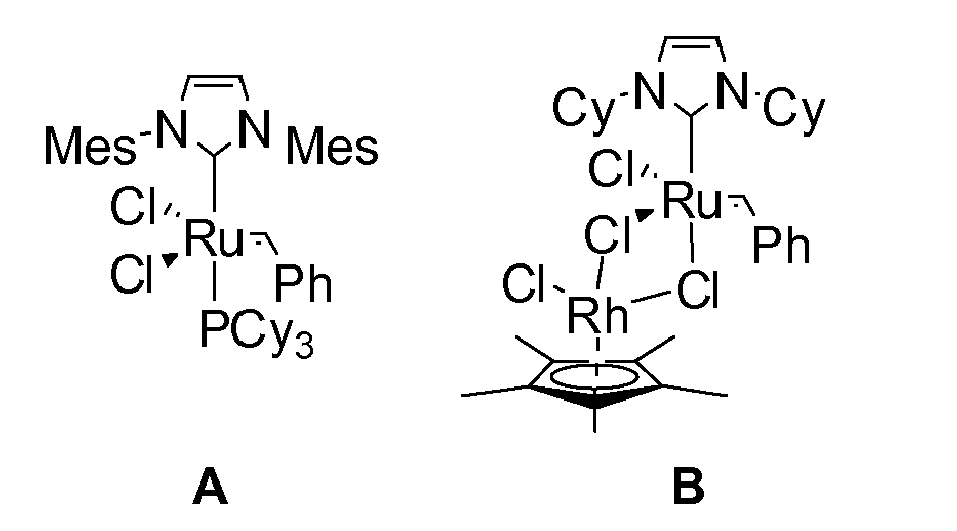
- In Gessler et al. (Tetrahedron Lett. 2000, 41, 9973-9976) und in Garber et al. (J. Am. Chem. Soc. 2000, 122, 8168-8179) sind Rutheniumkomplexe beschrieben, welche neben einem N-heterocyclischen Carben-Liganden einen Isopropoxybenzyliden-Liganden aufweisen. Diese so genannten "grünen" Katalysatoren besitzen eine höhere Stabilität und können ggf. recycliert werden.
- Das Patent
WO 9900397 WO 2005094345 beschrieben.
- Es sind einige Beispiele für Metathesekatalysatoren mit schwefelhaltigen Einheiten in der Seitenkette in der Literatur beschrieben worden (Komplex H in P. A. van der Schaaf et al. J. Organometallic Chem. 2000, 606, 65-74, Komplex J1 in Patent
CN 2005100803792 
- Nichtsdestotrotz bestand weiterhin Bedarf an neuen Katalysatorsystemen für die Olefin-Metathese, welche stabil sind und zudem eine hohe ggf. steuerbare Aktivität zeigen und als alternative zu den existierenden Katalysatoren benutzt werden können. Insbesondere sollten die Katalysatoren ganzheitlich betrachtet den Katalysatoren des Standes der Technik vom ökonomischen und/oder ökologischen Standpunkt aus betrachtet überlegen sein.
- Überraschenderweise wurden nun Verbindungen der Formel(I) gefunden

M für Ru oder Os steht, vorzugsweise für Ru,
L und L' unabhängig voneinander gleich oder verschieden für einen neutralen Elektronendonor stehen,
X1 und X2 gleich oder verschieden sind und für einen anionischen Liganden stehen,
R für Wasserstoff, cyclische, geradkettige oder verzweigtkettige Alkylreste, oder für ggf. substituierte Arylreste steht,
Z für eine schwefelhaltige direkt am Metall koordinierende Einheit steht, und
A eine Brücke, welche die Einheit Z mit dem Carben-Kohlenstoff kovalent verbindet, und n die Zahl 0 oder 1, bevorzugt 0 bedeutet.
Die Olefin-Metathese mit den erfindungsgemäßen Komplexverbindungen zeichnet sich durch geringe Aktivität bei Raumtemperatur und insbesondere schnelle Aktivitätssteigerung mit Erhöhung der Temperatur aus. Die erfindungsgemäßen Verbindungen können dadurch als thermoschaltbare Katalysatoren verwendet werden. Darüber hinaus sind die erfindungsgemäßen Komplexverbindungen luftstabile Verbindungen und besitzen bemerkenswerte Thermostabilität, bei gegenüber den Katalysatoren des Standes der Technik nicht wesentlich geringerer Aktivität. - Durch Variation der neutralen Elektronendonorliganden L und L' kann die Aktivität und Selektivität der Komplexe weiterhin gezielt gesteuert werden. Vorzugsweise besitzen die erfindungsgemäßen Komplexverbindungen für L gesättigte oder ungesättigte NHC (N-heterocyclische Carbene) als Liganden. Diese zeichnen sich neben ihrer Variationsvielfalt zur Modellierung der Ligandensphäre insbesondere durch Bereitstellung von hohen Katalysatoraktivitäten aus. Derartige Liganden sind in folgender Literatur beispielhaft erwähnt (
DE 19815275 und T. Weskamp, W.C. Schattenmann, M. Spiegler, W.A. Herrmann Angew. Chem. 1998, 110, 263-2633;DE 19902439 und T. Weskamp, F. J. Kohl, W. Hieringer, D. Gleich, W. A. Herrmann Angew. Chem., 1999, 111, 2573-2576;EP1180108 ). L' kann L oder die inWO9951344 - In den erfindungsgemäßen Komplexverbindungen handelt es sich bei der oben genannten schwefelhaltigen Einheit Z vorzugsweise um Reste aus der Reihe: Thiol, Thioether, Thioacetale, Disulfide, Dithiocarbonsäuren, Thioester, Thioketone, Thioaldehyde, Thiocarbamate, Thiourethane, Phosphinsulfide, Thiophosphate, Thiophosphonate, Sulfonate, Sulfone, Sulfonamide oder schwefelhaltige Heterocyclen, wobei gewährleistet sein muss, dass die Verbindung Z-M, vorzugsweise Z-Ru, über das Schwefelatom oder ein am Schwefel befindliches Sauerstoffatom gebildet wird. Das wird vorzugsweise dann der Fall sein, wenn der koordinierende Ringschluss zwischen dem Schwefel oder dem Sauerstoffatom und dem Metallatom einen 5-, 6- oder 7-Ring bildet.
- Für den verbrückenden Molekülteil A kann der Fachmann im Prinzip einen ihm für den vorliegenden Zweck in Frage kommenden Rest verwenden, bevorzugt ist ein Kohlenstoffgerüst, welches aus 2 bis 4 Kohlenstoffatomen besteht, besonders bevorzugt ist eine C2-Brücke, wobei ggf. beide C-Atome eine sp2-Hybridisierung aufweisen können und der Rest vorteilhafterweise einen Teil eines 3-, 4-, 5-, 6-, 7- oder 8 gliedrigen Ringsystems bildet. Die eben angesprochenen Ringsysteme können gegebenenfalls ein oder mehrere Heteroatome aufweisend. Als solche kommen insbesondere Sauerstoff-, Schwefel- oder Stickstoff-Atome. Sie können über die oben beschriebene sp2-Hybridisierung hinaus weiter ungesättigt sowie gegebenenfalls aromatischer Natur sein. Sie können einfach oder mehrfach mit weiteren Resten, insbesondere solchen ausgewählt aus der Gruppe bestehend aus (C1-C8)-Alkyl, (C1-C8) -Alkoxy, (C6-C18)-Aryloxy, HO-(C1-C8)-Alkyl, (C2-C8)-Alkoxyalkyl, (C6-C18)-Aryl, (C7-C19)-Aralkyl, (C3-C18)-Heteroaryl, (C4-C19)-Heteroaralkyl, (C1-C8) -Alkyl- (C6-C18) -Aryl, (C1-C8) -Alkyl- (C3-C18) -Heteroaryl, (C3-C8)-Cycloalkyl, (C1-C8)-Alkyl-(C3-C8)-Cycloalkyl, (C3-C8)-Cycloalkyl-(C1-C8)-Alkyl substituiert sein.
Darüber hinaus können die Ringsysteme auch einen oder mehrere Substituenten aufweisen, insbesondere solchen ausgewählt aus der Gruppe bestehend aus Halogen, Hydroxy, Carbonsäuren, Ester, Silylether, Thioether, Thioacetale, Imine, Silylenolether, Ammoniumsalze, Amide, Nitrile, Perfluoralkyl-Gruppen, Ketone, Aldehyde, Carbamate, Carbonate, Urethane, Sulfonate, Sulfone, Sulfonamide, Nitro-Gruppen, Organosilan-Einheiten " Phosphon- und Phosphat-Gruppe, und Phosphoniumsalze. - In den erfindungsgemäßen Komplexverbindungen handelt es sich bei den anionischen Liganden X1 und X2 vorzugsweise um anorganischen oder organischen Anionen aus der Reihe Halogenide, insbesondere F-, Cl-, Br-, Pseudohalogenide, Hydroxide, Alkoxide oder Amide (RO-, R2N-), Phenole, Thiole, Thiophenole, Carboxylate, Carbonate, Sulfonate, Sulfate, Phosphate und Phosphonate, Allyl, und Cyclopentadienyl stehen, wobei unter den Pseudohalogeniden vorzugsweise Cyanid, Rhodanid, Cyanat, Isocyanat, Thiocyanat und Isothiocyanat verstanden wird, wobei die Reste R die unten genannte Definition erfüllen.
- Ganz besonders bevorzugt sind Komplexverbindungen der allgemeinen Formel (II) und (III).

X1 und X2 nehmen die oben angegebenen Reste an,
Y, R, R' und R1 bis R4 sind unabhängig voneinander wählbare Reste aus der Gruppe Wasserstoff, (C1-C8) -Alkyl, (C1-C8) -Alkoxy, (C6-C18) -Aryloxy, HO- (C1-C8) -Alkyl, (C2-C8) -Alkoxyalkyl, (C6-C18) -Aryl, (C7-C19) -Aralkyl, (C3-C18) -Heteroaryl, (C4-C19) -Heteroaralkyl, (C1-C8) -Alkyl- (C6-C18) -Aryl, (C1-C8) -Alkyl- (C3-C18) -Heteroaryl, (C3-C8) -Cycloalkyl, (C1-C8) -Alkyl- (C3-C8) -Cycloalkyl, (C3-C8) -Cycloalkyl- (C1-C8) -Alkyl . Außerdem können die Reste R' und R1 bis R4 unabhängig voneinander bedeuten:
(Cyclo)Alkylthio, (Hetero)Arylthio, Alkyl/Arylsulfonyl Alkyl/Arylsulfinyl, jeweils wahlweise substituiert mit (C1-C8) -Alkyl, (C1-C8) -Alkoxy, (C6-C18) -Aryloxy, HO- (C1-C8) - Alkyl, (C2-C8) -Alkoxyalkyl, (C6-C18)-Aryl, Perfluoralkyl, Halogen, (C1-C8) -Acyloxy, (C1-C8) -Acyl (C1-C8) -Alkoxycarbonyl, (C1-C8) -Alkylsulfonyl oder (C1-C8) -Alkylsulfinyl, (C6-C18) -Arylsulfonyl oder (C6-C18)-Arylsulfinyl.
R1 bis R4 können ebenfalls eine Nitro-Gruppe, Sulfat, Amin, Ammoniumsalz, Phospat und Phosphoniumsalz bedeuten.
Die Reste R' können mit einem oder mehreren der Reste R1 bis R4 in cyclischen Verbindungen miteinander verknüpft vorliegen. Auch der Rest R1 kann mit dem Rest Y unter Ausbildung einer (hetero)cyclischen Verbindung miteinander verknüpft sein. - Die erfindungsgemäßen Verbindungen, insbesondere die der Formel (I) und(II) werden vorzugsweise durch Austauschreaktion des Phosphanliganden in Verbindungen der Formel (IV) durch Liganden der Formel (V) hergestellt

- Die Herstellung der erfindungsgemäßen Verbindungen, insbesondere die der Formel (I) und (II) aus Verbindungen der Formel(VI) erfolgt vorzugsweise in einem Lösungsmittel, besonders bevorzugt in Toluol, Benzol, Tetrahydrofuran oder Dichlormethan, ganz besonders bevorzugt in Dichlormethan. Die Umsetzung findet vorzugsweise in Gegenwart von Verbindungen statt, die in der Lage sind, Phosphane abzufangen, besonders bevorzugt in Gegenwart von CuCl2 und CuCl, ganz besonders bevorzugt in Gegenwart von CuCl. Dabei wird vorzugsweise in Gegenwart von äquimolaren Mengen bzw. eines Überschusses an Phosphanfänger, bezogen auf Verbindungen der Formel (IV), gearbeitet. Wird als Phosphanfänger CuCl eingesetzt, so werden besonders bevorzugt 1 bis 1,5 Äquivalente eingesetzt. Es werden vorzugsweise 0,9 bis 3 Äquivalente der Verbindungen der Formel(V), bezogen auf Verbindungen der Formel(IV) eingesetzt, besonders bevorzugt 1 bis 2 Äquivalente. Die Umsetzung erfolgt vorzugsweise bei Temperaturen von 20 bis 80°C, besonders bevorzugt bei Temperaturen von 30 bis 50°C. Die Umsetzung wird vorzugsweise unter Inertgas wie beispielsweise Stickstoff oder Argon durchgeführt.
- Die erfindungsgemäßen Verbindungen (I), insbesondere die der Formel (II) und (III) können als Katalysatoren in Metathesereaktionen eingesetzt werden. Sie können beispielsweise in Ringschluss-Metathesen eingesetzt werden. Besonders bevorzugt werden sie in ROMP und ADMET-Polymerisationsreaktionen eingesetzt.
- Als Alkylreste sind anzusehen insbesondere (C1-C8)-Alkylreste, wie z.B. Methyl, Ethyl, n-Propyl, Isopropyl, n-Butyl, Isobutyl, sec-Butyl, tert-Butyl, Pentyl, Hexyl, Heptyl oder Octyl samt aller ihrer Bindungsisomeren.
Der Rest (C1-C8) -Alkoxy entspricht dem Rest (C1-C8) -Alkyl mit der Maßgabe, dass dieser über ein Sauerstoffatom an das Molekül gebunden ist.
Als (C2-C8)-Alkoxyalkyl sind Reste gemeint, bei denen die Alkylkette durch mindestens eine Sauerstoffunktion unterbrochen ist, wobei nicht zwei Sauerstoffatome miteinander verbunden sein können. Die Anzahl der Kohlenstoffatome gibt die Gesamtzahl der im Rest enthaltenen Kohlenstoffatome an. Eine (C3-C5)-Alkylenbrücke ist eine Kohlenstoffkette mit drei bis fünf C-Atomen, wobei diese Kette über zwei verschiedene C-Atome an das betrachtete Molekül gebunden ist.
Die in den vorangehenden Absätzen beschriebenen Reste können einfach oder mehrfach mit Halogenen und/oder N-, O-, P-, S-, Si-atomhaltigen Resten substituiert sein. Dies sind insbesondere Alkylreste der oben genannten Art, welche eines oder mehrere dieser Heteroatome in ihrer Kette aufweisen bzw. welche über eines dieser Heteroatome an das Molekül gebunden sind. - Unter (C3-C8)-Cycloalkyl versteht man Cyclopropyl, Cyclobutyl, Cyclopentyl, Cyclohexyl bzw. Cycloheptylreste etc. Diese können mit einem oder mehreren Halogenen und/oder N-, O-, P-, S-, Si-atomhaltige Reste substituiert sein und/oder N-, O-, P-, S-Atome im Ring aufweisen, wie z. B. 1-, 2-, 3-, 4-Piperidyl, 1-, 2-, 3-Pyrrolidinyl, 2-, 3-Tetrahydrofuryl, 2-, 3-, 4-Morpholinyl.
- Ein (C3-C8)-Cycloalkyl-(C1-C8)-Alkylrest bezeichnet einen wie oben dargestellten Cycloalkylrest, welcher über einen wie oben angegebenen Alkylrest an das Molekül gebunden ist.
- (C1-C8)-Acyloxy bedeutet im Rahmen der Erfindung einen wie oben definierten Alkylrest mit max. 8 C-Atomen, welcher über eine COO-Funktion an das Molekül gebunden ist.
- (C1-C8)-Acyl bedeutet im Rahmen der Erfindung einen wie oben definierten Alkylrest mit max. 8 C-Atomen, welcher über eine CO-Funktion an das Molekül gebunden ist.
- Unter einem Arylrest wird insbesondere ein (C6-C18)-Arylrest verstanden, welcher ein aromatischer Rest mit 6 bis 18 C-Atomen ist. Insbesondere zählen hierzu Verbindungen wie Phenyl-, Naphthyl-, Anthryl-, Phenanthryl-, Biphenylreste oder an das betreffende Molekül annelierte Systeme der vorbeschriebenen Art, wie z.B. Indenylsysteme, welche ggf. mit Halogen, (C1-C8) -Alkyl, (C1-C8) -Alkoxy, NH2, NH (C1-C8) -Alkyl, N((C1-C8)-Alkyl)2, OH, CF3, NH (C1-C8) -Acyl, N ((C1-C8) -Acyl)2, (C1-C8) -Acyl, (C1-C8) -Acyloxy substituiert sein können.
- Ein (C7-C19)-Aralkylrest ist ein über einen (C1-C8) -Alkylrest an das Molekül gebundener (C6-C18)-Arylrest.
- Ein (C3-C18)-Heteroarylrest bezeichnet im Rahmen der Erfindung ein fünf-, sechs- oder siebengliedriges aromatisches Ringsystem aus 3 bis 18 C-Atomen, welches Heteroatome wie z. B. Stickstoff, Sauerstoff oder Schwefel im Ring aufweist. Als solche Heteroaromaten werden insbesondere Reste angesehen, wie 1-, 2-, 3-Furyl, wie 1-, 2-, 3-Pyrrolyl, 1-, 2-, 3-Thienyl, 2-, 3-, 4-Pyridyl, 2-, 3-, 4-, 5-, 6-, 7-Indolyl, 3-, 4-, 5-Pyrazolyl, 2-, 4-, 5-Imidazolyl, Acridinyl, Chinolinyl, Phenanthridinyl, 2-, 4-, 5-, 6-Pyrimidinyl. Dieser Rest kann mit den gleichen Resten substituiert sein wie der oben genannte Arylrest.
- Unter einem (C4-C19) -Heteroaralkyl wird ein dem (C7-C19)-Aralkylrest entsprechendes heteroaromatisches System verstanden.
- Als Halogene (Hal) kommen Fluor, Chlor, Brom und Iod in Frage.
-

- Zu einer Suspension von Thiosalicylsäure (16.7 g; 109 mmol; Fluka) und Isopropylbromid (20.0 g; 163 mmol) in Ethanol (125 mL) wurden KOH-Plätzchen (17.3 g; 433 mmol) unter kräftigem Rühren langsam zugegeben. Nach 6 h Rühren wurde die Reaktionsmischung in Wasser-Eis Mischung (1200 mL) gegossen und mit konzentrierte Salzsäure (ca. 50 ml) sauer gestellt. Das ausgefallene Produkt wurde abfiltriert, mit 50% wässrigem Ethanol (2 x 100 mL) gewaschen und im Vakuum getrocknet. Ausbeute 6.4 g (30 %).
IR (film): ν 3084, 3058, 2962, 2924, 2865, 1828, 1625, 1588, 1463, 1365, 1243, 1197, 1155, 1049, 991, 912, 769, 746 cm-1; 1H NMR (200 MHz, DMSO-d6) δ 1.74-1.82 (d, 6H, J = 2.2 Hz), 4.02-4.12 (septet, 1H, J = 6.6 Hz), 7.70 (m, 1H), 7.66-7.72 (m, 1H), 7.95-8.00 (m, 2H), 8.36-8.42 (m, 1H); 13C NMR (50 MHz, DMSO-d6) δ 22.4, 35.3, 124.6, 128.3, 131.1, 132.1, 140.3, 167.2, 205.6; MS (EI) m/z (rel intensity) 196 (21, [M]+.), 154(13), 137(11), 136(100), 108(21), 69(8), 43(13), 41(13), 39(12) ; HRMS (EI): calcd for [M]+. (C7H12O2S): 196. 05580; found 196.05604. -

- Zu einer Lösung von 2-(Isopropylthio)benzoesäure (0.98 g, 5 mmol) in THF (10 mL) wurde Boran-Dimethylsulfid Komplex (0.8 mL, 8 mmol) bei 3 °C unter Argon und kräftigem rühren zugetropft. Nach 30 min Nachrühren im Eis-Bad wurde die Reaktion für weitere 24 h bei RT stehen gelassen. Methanol (1.5 mL) wurde vorsichtig zugegeben und die Reaktionslösung im Vakuum eingeengt. Der Rückstand wurde in Diethylether (50 ml) aufgenommen, mit gesättigter K2CO3-Lösung und NaCl-Lösung gewaschen. Wässrige Lösungen wurden zusätzlich mit Ether extrahiert, die vereinigten organischen Phasen über MgSO4 getrocknet, filtriert und das Lösungsmittel im Vakuum entfernt. Der Rückstand wurde in Dichlormethan (30 ml) aufgenommen, mit PCC (1.20 g, 5.6 mmol) vorsichtig versetzt und bei Raumtemperatur 36 h gerührt. Der Rückstand nach Lösungsmittel Entfernung wurde durch Säulenchromatography an Kieselgel (Hexan : Ethylacetat (10:1) gereinigt. Ausbeute 0.69 g. (76%) .
IR (film): ν 3686, 3601, 3362, 3063, 2968, 2929, 2867, 2744, 1950, 1692, 1648, 1587, 1559, 1460, 1442, 1383, 1368, 1287, 1242, 1195, 1156, 1128, 1073, 1062, 1052, 1039, 931, 879, 845, 825, 777, 679, 660, 635, 509 cm-1; 1H NMR (200 MHz, CDCl3) δ 1.30-1.40 (d, 6H, J = 6.6 Hz), 3.38-3.48 (septet, 1H, J = 6.8 Hz), 7.25-7.60 (m, 3H), 7.84-7.92 (m, 1H), 10.54 (d, 1H, J = 0.63 Hz); 13C NMR (50 MHz, CDCl3) δ 22.9, 38.8, 126.7, 130.1, 132.4, 133.8, 135.8, 140.3, 191.9; MS (EI) m/z (rel intensity) 180(66, [M]+.), 165(18), 138(49), 137(100), 110 (35), 109(41), 104 (57), 69 (11), 66 (11), 65 (26), 43 (25), 41 (19), 39 (17) ; HRMS (EI): calcd for [M]+. (C10H120S): 180. 07122; found 180.07148. -
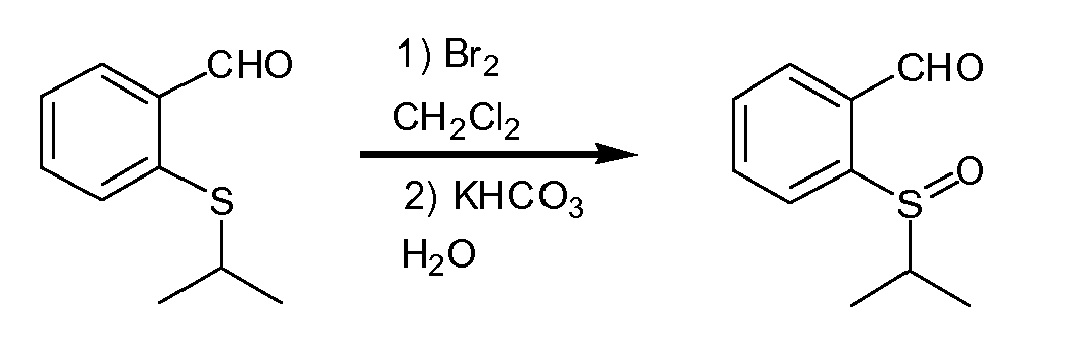
- Eine Lösung von 2-(Isopropylthio)benzaldehyd (0.33 g, 1.83 mmol) in Dichloromethan (10 mL) wurde mit wässrige KHCO3-Lösung (1.18g in 10 mL H2O) versetzt. Unter kräftigem Rühren wurde eine Lösung von Brom (0.310g, 1.93 mmol) in Dichloromethan (1.5 mL) zugetropft. Nach 20 min Nachrühren wurde eine Spatelspitze von Na2SO3 zugegeben und die organisch Phase abgetrennt, mit gesättigter NaCl-Lösung gewaschen und über M9SO4 getrocknet, filtriert und das Lösungsmittel im Vakuum entfernt. Der Rückstand wurde durch Säulenchromatographie an Kieselgel (Hexan : Ethylacetat (3:1 bis 1:1) gereinigt. Das Produkt fiel als gelbliches Öl an. Ausbeute 0.304 g, (85%).
IR (film): ν 3447, 2963, 2917, 2864, 2738, 1702, 1628, 1607, 1482, 1439, 1380, 1264, 1227, 1183, 1158, 1121, 1105, 1037, 992, 950, 932, 852, 803, 751, 697, 635, 593, 578, 535, 506, 446, 418 cm-1; 1H NMR (200 MHz, CDCl3) δ 0.86-0.94 (d, 3H, J = 6.8 Hz), 1.50-1.56 (d, 3H, J = 7.1 Hz), 2.90-3.10 (septet, 1H, J = 6.8 Hz), 7.60-8.00 (m, 1H), 8.16-8.22 (m, 1H), 10.01-10.06 (d, 1H J = 0.63 Hz); 13C NMR (50 MHz, CDCl3) δ 21.7, 38.2, 124.4, 130.5, 133.9, 135.2, 144.9, 198.5; MS (EI) m/z (rel intensity) 180(66, [M]+.), 165(18), 138(49), 137(100), 110 (35), 109(41), 104(57), 69(11), 66(11), 65(26), 43(25), 41 (19), 39 (17) ; HRMS (EI): calcd for [M] +. (C7H1002S): 178. 08162; found 178.08148. - Zu einer Suspension von Methyltriphenylphosphonium Bromid (0.690 g, 1.93 mmol, Aldrich) in 8 mL THF wurde n-BuLi (1.5 M, 1.4 mL, 2.07 mmol) bei -78 °C unter einer Argonatmosphäre zugetropft. Die gelbe Reaktionslösung wurde innerhalb von 1 h auf Raumtemperatur erwärmt. Nach erneutem Abkühlen auf -78°C wurde eine Lösung des entsprechenden Aldehyds (1.39 mmol) in THF (5 mL) gegeben, danach langsam auf Raumtemperatur erwärmt und 1 h bei dieser Temperatur nachgerührt. Nach Zugabe einer gesättigten NH4Cl-Lösung wurde die wässrige Phase mit Ethylacetat extrahiert (4 x 20 mL). Die vereinigten organischen Phasen wurden über MgSO4 getrocknet und das Lösungsmittel im Vakuum entfernt. Der Rückstand wurde durch Säulenchromatographie an Kieselgel (Cyclohexan : Ethylacetat (2:8) gereinigt.
- 4a. 2-Isopropylthio-1-vinylbenzol

IR (film): ν 3084, 3058, 2962, 2924, 2865, 1828, 1625, 1588, 1463, 1365, 1243, 1197, 1155, 1049, 991, 912, 769, 746 cm-1; 1H NMR (500 MHz, CDCl3) δ 1.26 (d, 6H, J = 6.7 Hz), 3.24-3.33 (septet, 1H, J = 6.7 Hz), 5.30 (dd, 1H, J = 1.2, 11 Hz), 5. 67 (dd, 1H, J = 1.2, 17.5 Hz), 7.18-7.27 (m, 2H), 7.35 (dd, 1H, J = 11, 17.5 Hz), 7.42-7.47 (m, 1H), 7. 52-7. 57 (m, 1H); 13C NMR (125 MHz, CD3CCD3) δ 23.1, 38.8, 115.3, 125.9, 127.5, 127.9, 133.8, 133.9, 135.3, 140.2; MS (EI) m/z (rel intensity) 178 (9, [M]+·) , 136(10), 135(100), 134(14), 91(18), 77(2), 65 (1), 43 (2) ; HRMS (EI): calcd for [M]+· (C11H14S) : 178. 08162; found 178.08148. -

IR (film): ν 3686, 3603, 3411, 2982, 2933, 2870, 2543, 2049, 1969, 1940, 1856, 1727, 1628, 1606, 1562, 1465, 1440, 1414, 1384, 1366, 1193, 1158, 1125, 1069, 1024, 990, 956, 926, 891, 875, 638, 582, 549, 506 cm-1; 1H NMR (400 MHz, CDCl3) δ 1.06 (d, 3H, J = 7.0 Hz), 1.3 (d, 3H, J = 7.0 Hz), 2.83-2.93 (septet, 1H, J = 7.1 Hz), 5.41 (dd, 1H, J = 0.83, 11 Hz), 5. 77 (dd, 1H, J = 0.96, 17.3 Hz), 6.93-7.02 (q, 1H, J = 11 Hz), 7.44-7.58 (m, 2H), 7.86-7.89 (m, 1H, J = 11, 17.5 Hz); 13C NMR (100 MHz, CDCl3) δ 13.1, 17.1, 53.2, 117.8, 124.8, 125.7, 128.3, 130.7, 131.6, 135.9, 139.8; MS (EI) m/z (rel intensity) 194 (4, [M]+.), 152(13), 137(10), 136(11), 135(100), 134(11), 91(21), 77(11), 51(7), 45(8), 43(11), 41(9), 39(8); HRMS (EI): calcd for [M]+. (C11H14OS): 194. 07654; found 194.07703. - Zu einer Suspension von Kupfer(I)chlorid (13 mg, 0.12 mmol) und Tricyclohexylphosphan[1,3-bis(2,4,6-trimethylphenyl)-4,5-dihydrimidazol-2-yliden][benzyliden]ruthenium(IV)dichlorid (102 mg; 0.12 mmol) in 2 mL Dichlormethan wurde eine Lösung des entsprechenden Styrolderivats (0.132 mmol) in 3 mL Dichlormethan gelöst zugegeben. Nach 20 min Rühren bei 40°C wurde die Reaktionslösung im Vakuum eingeengt. Der Rückstand wurde in 20 ml Ethylacetat aufgenommen und über eine Pasteurpipette mit Kieselgel filtriert. Das Filtrat wurde wieder im Vakuum eingeengt und der Rückstand mit sehr wenig Ethylacetat und kaltem Pentan gewaschen.
-

- Grünes mikrokristallines Feststoff, Ausbeute 86 %.
IR (film): ν 2952, 2908, 2862, 1606, 1479, 1420, 1382, 1262, 1154, 1055, 1033, 863, 843, 798, 742 cm-1; 1H NMR (500 MHz, CDCl3) δ 0. 99 (d, 6H, J = 6. Hz), 2.37 (s, 6H), 2.48 (s, 12H), 3. 18 (septet, 1H, J = 6.6 Hz), 4.14 (s, 4H), 6.73 (d, 1H, J = 7.5 Hz), 7.03 (s, 4H), 7.11-7.20 (m, 1H); 7.40-7.52 (m, 2H), 17.33 (s, 1H); 13C NMR (125 MHz, CD3COCD3) δ 19.5, 21.0, 51.7, 121.8, 123.3, 129.3, 129.4, 133.6, 136.4, 138.1, 138.6, 140.0, 140.3, 156.2, 162.0, 210.0, 285.7;
MS (EI) m/z (rel intensity) 642 (8, [M]+·) , 530 (10), 528 (18), 527(14), 526(13), 525(10), 305(40), 304(100), 303(91), 289 (19), 287(10), 166 (25), 163(12), 159(12), 158(22), 149 (19), 146(12), 145 (14), 144 (13), 135(14), 124(32), 91(45), 77(15), 71(11), 57(14), 55(12), 45(10), 44(46), 43(33), 42(12), 41 (35), 40 (31), 39 (20), 38 (15), 36 (46) ; HRMS (EI) : calcd for [M]+· (C31 H38N2 35Cl2 S 102Ru): 642. 11762; found 642.11634.
Abb. 1 : Kristallstruktur von Komplex SR1. -

- Hell-grünes mikrokristallines Feststoff, Ausbeute 72 %:
IR (film): ν 3447, 2963, 2917, 2738, 1702, 1628, 1607, 1482, 1439, 1380, 1264, 1227, 1183, 1158, 1121, 1105, 1037, 992, 950, 932, 852, 803, 751, 697, 635, 593, 578, 535, 506, 446, 418 cm-1; 1H NMR (500 MHz, CDCl3) δ 1.05 (q, 6H, J = 6.7 Hz), 2.29 (m, 3H), 2.35-2.45 (m, 12H), 2.55 (s, 3H), 3.61 (septet, 1H, J = 6.7 Hz), 4.15 (s, 4H), 6.74 (d, 1H, J = 7.6 Hz), 6.95-7.05 (m, 4H), 7.34 (m, 1H), 7. 65 (m, 1H) 7.72-7.78 (m, 1H), 16.81 s, 1H); 13C NMR (125 MHz, CDCl3) δ 21.0, 51.7, 121.0, 127.5, 128.9, 129.4, 129.6, 129.7, 133.9, 135.4, 138.1, 138.5, 138.9, 139.0, 156.2, 207.2, 301.3; MS (ESI; m/z): 658 [M - Cl + CH3CN]+. -

- Eine Lösung von N,N-Diallyl-p-toluolsulfonamid (0.350 mmol, 84 mg) in 17.5 ml Toluol wurde mit 5 Mol% der Katalysator (0.018 mmol) SR1 aus der Beispiel 5a unter Argon versetzt und bei 80°C gerührt. 200 µL einer Aliquote Reaktionslösung wurden zu 500 µL von 2M Ethyl-vinyl-ether Lösung in Methylenchlorid zugegen und Mittels GC analysiert. Nach 24 h wurde 51% Umsatz zum gewünschten N-p-Toluolsulfonyl-2,5-dihydropyrrol festgestellt.
- Eine Lösung von N,N-Diallyl-p-toluolsulfonamid (0.350 mmol, 84 mg) in 17.5 ml Dichlormethan wurde mit 5 Mol% der Katalysator (0.018 mmol) SOR1 aus der Beispiel 5b unter Argon versetzt und bei Raumtemperatur gerührt. 200 µL einer Aliquote Reaktionslösung wurden zu 500 µL von 2M Ethyl-vinyl-ether Lösung in Methylenchlorid zugegen und Mittels GC analysiert. Der Verlauf der Reaktion ist in der
Abbildung 2 dargestellt. -
Abbildung 2 : RCM von N,N-Diallyl-p-toluolsulfonamid in Gegenwart von 5 Mol% Komplex SOR1 in Methylenchlorid bei Raumtemperatur. -

- Eine Lösung von Diethyl-2-allyl-2-(2-methylallyl)malonat (0.350 mmol) in 17.5 ml Toluol wurde mit 1 Mol% des Katalysator (0.0035 mmol) SOR1 aus Beispiel 5b unter Argon versetzt und bei 80°C gerührt. 200 µL der Reaktionslösung wurden zu 500 µL von 2M Ethyl-vinyl-ether Lösung in Methylenchlorid zugegen und Mittels GC analysiert. Nach 1 h wurde 99% Umsatz zum gewünschten 4,4-Bis(ethoxycarbonyl)-1-methylcyclopenten festgestellt.
-

- Eine Lösung von 3-Allyloxy-3,3-diphenylpropin (0.350 mmol) in 17.5 ml Toluol wurde mit 5 Mol% der Katalysator (0.018 mmol) SR1 aus der Beispiel 5a unter Argon versetzt und bei 80°C gerührt. 200 µL der Reaktionslösung wurden zu 500 µL von 2M Ethyl-vinyl-ether Lösung in Methylenchlorid zugegeben und Mittels GC analysiert. Nach 1 h wurde 99% Umsatz zum gewünschten 3-Ethenyl-2,5-dihydro-2,2-diphenylfuran festgestellt.
Claims (7)
- Verbindungen der Formeln(I),

M für Ru, Os steht
L und L' unabhängig voneinander gleich oder verschieden für einen neutralen Elektronendonor stehen,
X1 und X2 gleich oder verschieden sind und für einen anionischen Liganden stehen,
R für Wasserstoff, einen cyclischen, geradkettigen oder verzweigtkettigen Alkyl- oder ggf. substituierten Arylrest steht,
Z für eine schwefelhaltige direkt am Metall koordinierende Einheit steht, und
A eine Brücke, welche die Einheit Z mit dem Carben-Kohlenstoff kovalent verbindet, und n die Zahl 0 oder 1, bevorzugt 0 bedeutet. - Verbindungen nach Anspruch 1,
dadurch gekennzeichnet, dass
L ein gesättigter oder ungesättigter NHC-Ligand ist. - Verbindungen nach Anspruch 1 und/oder 2,
dadurch gekennzeichnet, dass
Z eine Einheit enthaltend Thiol, Thioether, Thioacetale, Disulfide, Dithiocarbonsäuren, Thioester, Thioketone, Thioaldehyde, Thiocarbamate, Thiourethane, Phosphinsulfide, Thiophosphate, Thiophosphonate, Sulfonate, Sulfone, Sulfonamide oder schwefelhaltige Heterocyclen ist, wobei gewährleistet sein muss, dass die Verbindung Z-Ru über das Schwefelatom oder ein am Schwefel befindliches Sauerstoffatom gebildet wird. - Verbindung nach einem der vorherigen Ansprüche,
dadurch gekennzeichnet, dass
der Molekülteil A eine C2-Brücke bildet, in der beide C-Atome eine sp2-Hybridisierung aufweisen. - Verbindung nach einem oder mehreren der vorhergehenden Ansprüche,
dadurch gekennzeichnet, dass
es sich bei X1 und X2 um anorganische oder organische Anionen aus der Reihe Halogenide, insbesondere F-, Cl-, Br-, Pseudohalogenide, Hydroxide, Alkoxide oder Amide, Phenole, Thiole, Thiophenole, Carboxylate, Carbonate, Sulfonate, Sulfate, Phosphate und Phosphonate, Allyl-, und Cyclopentadienyl- stehen, wobei unter den Pseudohalogeniden vorzugsweise Cyanid, Rhodanid, Cyanat, Isocyanat, Thiocyanat und Isothiocyanat verstanden wird. - Verfahren zur Herstellung von Verbindungen nach Anspruch 1,
dadurch gekennzeichnet, dass
man die Verbindungen durch Austauschreaktion des Phosphanliganden in Verbindungen der Formel (IV) durch Liganden der Formel (V) hergestellt
- Verwendung der Verbindungen nach Anspruch 1 in Metathesereaktionen.
Applications Claiming Priority (1)
| Application Number | Priority Date | Filing Date | Title |
|---|---|---|---|
| DE102007020694A DE102007020694A1 (de) | 2007-05-03 | 2007-05-03 | Schwefelhaltige Metathesekatalysatoren |
Publications (2)
| Publication Number | Publication Date |
|---|---|
| EP1990348A2 true EP1990348A2 (de) | 2008-11-12 |
| EP1990348A3 EP1990348A3 (de) | 2008-11-26 |
Family
ID=39717576
Family Applications (1)
| Application Number | Title | Priority Date | Filing Date |
|---|---|---|---|
| EP08103339A Withdrawn EP1990348A3 (de) | 2007-05-03 | 2008-04-02 | Schwefelhaltige Metathesekatalysatoren |
Country Status (5)
| Country | Link |
|---|---|
| US (1) | US8183382B2 (de) |
| EP (1) | EP1990348A3 (de) |
| JP (1) | JP2008273971A (de) |
| CN (1) | CN101298462B (de) |
| DE (1) | DE102007020694A1 (de) |
Families Citing this family (13)
| Publication number | Priority date | Publication date | Assignee | Title |
|---|---|---|---|---|
| US8513151B2 (en) | 2007-09-20 | 2013-08-20 | Ben-Gurion University Of The Negev Research And Development Authority | Sulfur chelated ruthenium compounds useful as olefin metathesis catalysts |
| JP5787751B2 (ja) | 2008-04-08 | 2015-09-30 | エボニック デグサ ゲーエムベーハーEvonik Degussa GmbH | ルテニウムカルベン錯体を製造するための方法 |
| JP5314753B2 (ja) * | 2008-05-22 | 2013-10-16 | リミテッド・ライアビリティ・カンパニー・”ユナイテッド・リサーチ・アンド・デベロップメント・センター” | ジシクロペンタジエンのメタセシス重合触媒、その製造方法および重合方法 |
| BR112013014029B1 (pt) * | 2010-12-16 | 2021-07-20 | F. Hoffmann-La Roche Ag | Processo para a preparação de derivados de tiol aromático por hidrogenação de dissulfetos |
| JP5674059B2 (ja) * | 2011-01-24 | 2015-02-25 | 国立大学法人名古屋大学 | ルテニウム錯体を含む水素移動反応用触媒及び水素移動反応物の製造方法 |
| PL216649B1 (pl) * | 2011-06-06 | 2014-04-30 | Univ Warszawski | Nowe kompleksy rutenu, sposób ich wytwarzania oraz zastosowanie w reakcji metatezy olefin |
| CN104169322B (zh) | 2012-03-16 | 2016-08-31 | 日本瑞翁株式会社 | 开环易位聚合物氢化物的制造方法及树脂组合物 |
| WO2017087710A2 (en) | 2015-11-18 | 2017-05-26 | Provivi, Inc. | Production of fatty olefin derivatives via olefin metathesis |
| JP6737885B2 (ja) | 2015-11-18 | 2020-08-12 | プロヴィヴィ インコーポレイテッド | 昆虫フェロモンの生成のための微生物及び関連する化合物 |
| EP3464311A4 (de) | 2016-06-06 | 2020-03-18 | Provivi, Inc. | Halb-biosynthetische herstellung von fettalkoholen und fettaldehyden |
| WO2018150379A2 (en) | 2017-02-17 | 2018-08-23 | Provivi, Inc. | Synthesis of pheromones and related materials via olefin metathesis |
| WO2018191373A1 (en) * | 2017-04-12 | 2018-10-18 | Materia, Inc. | Synthesis and characterization of metathesis catalysts |
| CN110914442B (zh) | 2017-05-17 | 2025-02-18 | 普罗维维股份有限公司 | 用于产生昆虫信息素及相关化合物的微生物 |
Citations (5)
| Publication number | Priority date | Publication date | Assignee | Title |
|---|---|---|---|---|
| WO1999000397A1 (en) | 1997-06-27 | 1999-01-07 | Ciba Specialty Chemicals Holding Inc. | Ruthenium and osmium catalysts |
| DE19815275A1 (de) | 1998-04-06 | 1999-10-07 | Aventis Res & Tech Gmbh & Co | Alkylidenkomplexe des Rutheniums mit N-heterozyklischen Carbenliganden und deren Verwendung als hochaktive, selektive Katalysatoren für die Olefin-Metathese |
| DE19902439A1 (de) | 1999-01-22 | 2000-08-03 | Aventis Res & Tech Gmbh & Co | Homo- und heterobimetallische Alkylidenkomplexe des Rutheniums mit N-heterocyclischen Carbenliganden und deren Anwendung als hochaktive, selektive Katalysatoren für die Olefin-Metathese |
| EP1180108A2 (de) | 1999-05-24 | 2002-02-20 | California Institute Of Technology | Imidazolidin enthaltende metallcarben-katalysatoren für die metathese |
| WO2005094345A2 (en) | 2004-03-29 | 2005-10-13 | California Institute Of Technology | Latent, high-activity olefin metathesis catalysts containing an n-heterocyclic carbene ligand |
Family Cites Families (4)
| Publication number | Priority date | Publication date | Assignee | Title |
|---|---|---|---|---|
| WO2002014376A2 (en) * | 2000-08-10 | 2002-02-21 | Trustees Of Boston College | Recyclable metathesis catalysts |
| US20060152672A1 (en) | 2003-07-08 | 2006-07-13 | Koninklijke Philips Electronics N.V. | Sunglasses with adaptable transmissivity |
| EP1543875A1 (de) * | 2003-12-04 | 2005-06-22 | Boehringer Ingelheim Pharma GmbH & Co. KG | Neuer Metathese Ruthenium-Katalysator |
| CN1907992B (zh) | 2005-07-04 | 2012-03-28 | 赞南科技(上海)有限公司 | 钌络合物配体、钌络合物、固载钌络合物催化剂及其制备方法和用途 |
-
2007
- 2007-05-03 DE DE102007020694A patent/DE102007020694A1/de not_active Withdrawn
-
2008
- 2008-04-02 EP EP08103339A patent/EP1990348A3/de not_active Withdrawn
- 2008-04-24 US US12/109,092 patent/US8183382B2/en not_active Expired - Fee Related
- 2008-04-29 CN CN2008100956077A patent/CN101298462B/zh not_active Expired - Fee Related
- 2008-04-30 JP JP2008118437A patent/JP2008273971A/ja active Pending
Patent Citations (6)
| Publication number | Priority date | Publication date | Assignee | Title |
|---|---|---|---|---|
| WO1999000397A1 (en) | 1997-06-27 | 1999-01-07 | Ciba Specialty Chemicals Holding Inc. | Ruthenium and osmium catalysts |
| DE19815275A1 (de) | 1998-04-06 | 1999-10-07 | Aventis Res & Tech Gmbh & Co | Alkylidenkomplexe des Rutheniums mit N-heterozyklischen Carbenliganden und deren Verwendung als hochaktive, selektive Katalysatoren für die Olefin-Metathese |
| WO1999051344A1 (de) | 1998-04-06 | 1999-10-14 | Aventis Research & Technologies Gmbh & Co. Kg | Alkylidenkomplexe des rutheniums mit n-heterozyklischen carbenliganden; verwendung als hochaktive, selektive katalysatoren für die olefin-metathese |
| DE19902439A1 (de) | 1999-01-22 | 2000-08-03 | Aventis Res & Tech Gmbh & Co | Homo- und heterobimetallische Alkylidenkomplexe des Rutheniums mit N-heterocyclischen Carbenliganden und deren Anwendung als hochaktive, selektive Katalysatoren für die Olefin-Metathese |
| EP1180108A2 (de) | 1999-05-24 | 2002-02-20 | California Institute Of Technology | Imidazolidin enthaltende metallcarben-katalysatoren für die metathese |
| WO2005094345A2 (en) | 2004-03-29 | 2005-10-13 | California Institute Of Technology | Latent, high-activity olefin metathesis catalysts containing an n-heterocyclic carbene ligand |
Non-Patent Citations (9)
| Title |
|---|
| "Handbook of Metathesis", 2003, WILEY-VCH |
| GARBER ET AL., J. AM. CHEM. SOC., vol. 122, 2000, pages 8168 - 8179 |
| GESSLER ET AL., TETRAHEDRON LETT., vol. 41, 2000, pages 9973 - 9976 |
| J.S. MURDZEK; R.R. SCHROCK, ORGANOMETALLICS, vol. 6, 1987, pages 1373 - 1374 |
| M. BIENIEK ET AL., J. ORGANOMET. CHEM., vol. 691, 2006, pages 5289 |
| P. A. VAN DER SCHAAF ET AL., J. ORGANOMETALLIC CHEM., vol. 606, 2000, pages 65 - 74 |
| P. SCHWAB ET AL., ANGEW. CHEM. INT. ED. ENGL., vol. 34, 1995, pages 2039 - 2041 |
| T. WESKAMP ET AL., ANGEW. CHEM., vol. 110, 1998, pages 263 - 2633 |
| T. WESKAMP ET AL., ANGEW. CHEM., vol. 111, 1999, pages 2573 - 2576 |
Also Published As
| Publication number | Publication date |
|---|---|
| US8183382B2 (en) | 2012-05-22 |
| DE102007020694A1 (de) | 2008-11-06 |
| CN101298462A (zh) | 2008-11-05 |
| JP2008273971A (ja) | 2008-11-13 |
| EP1990348A3 (de) | 2008-11-26 |
| US20080275247A1 (en) | 2008-11-06 |
| CN101298462B (zh) | 2012-10-31 |
Similar Documents
| Publication | Publication Date | Title |
|---|---|---|
| DE102007020694A1 (de) | Schwefelhaltige Metathesekatalysatoren | |
| EP2260047B2 (de) | Verfahren zur herstellung von ruthenium-carben-komplexen | |
| KR100569918B1 (ko) | 루테늄 또는 오스뮴 복분해 촉매의 합성방법 | |
| DE69806053T2 (de) | Hochwirksame kationische ruthenium und osmiumkomplexe für die metathesereaktionen | |
| RS50334B (sr) | Rutenijumski kompleksi kao (pred)-katalizatori metateznih reakcija | |
| WO2011117571A1 (en) | Ruthenium complexes for use in olefin metathesis | |
| DE19820652A1 (de) | Kationische Rutheniumkomplexe, Verfahren zu ihrer Herstellung und ihre Verwendung | |
| WO1993015089A1 (de) | Diphosphinliganden | |
| Shi et al. | Chiral diphenylthiophosphoramides: a new class of chiral ligands for the silver (I)-promoted enantioselective allylation of aldehydes | |
| EP1414833B1 (de) | Neue übergangsmetall-komplexe und deren einsatz in übergangsmetall-katalysierten reaktionen | |
| CA2478482A1 (en) | Metalorganic catalysts for chemo-, regio- and stereoselective reactions, and corresponding precursors | |
| Durap et al. | A new efficient bis (phosphinite)-ruthenium (II) catalyst system for the asymmetric transfer hydrogenation of aromatic ketones | |
| EP0345653B1 (de) | Übergangsmetallkomplexe | |
| EP1035093B1 (de) | Metathese in Gegenwart ionischer Flüssigkeiten | |
| EP1371657A1 (de) | Übergangsmetall-Komplexe und deren Einsatz in Übergangsmetallkatalysierten Reaktionen | |
| DE60206262T2 (de) | Neues verfahren zur herstellung von metall-carben-komplexen | |
| EP1394190B1 (de) | Metathesekatalysatoren | |
| DE102004039277A1 (de) | Am Zentralatom substituierte, immoblisierbare Ruthenium(II)-Katalysatoren, Verfahren zu deren Herstellung und Verwendung | |
| DE60214689T2 (de) | Optisch aktive alkenylphosphinsäureester und verfahren zu deren herstellung | |
| EP2403842A1 (de) | Chirale disulfonimide | |
| Imazaki et al. | Ruthenium-catalyzed reaction of alkenyl triflates with zinc thiolates | |
| DE102004012438A1 (de) | Verfahren zur Herstellung von enantiomerenangereicherten Ferrocenylliganden | |
| WO2011042675A1 (fr) | Nouvelles phosphines p-chirales, bicycliques et configurationnellement stables, leur procede de preparation et leurs utilisations | |
| Gonzalez et al. | Synthesis and Reactivity of (q6-Arene)(phosphino enolato) ruthenium (II) Complexes, Their Coupling Reaction with Phenylacetylene, and Thermal Rearrangement to a Phosphametallacyclopropane. X-ray Crystal Structures of (Ru [q3-CH= C (P h) CH (PP h2) C (But)= O](p-cymene))(PFs), of | |
| WO2008101683A2 (de) | Fe(-ii)-katalysatorsysteme |
Legal Events
| Date | Code | Title | Description |
|---|---|---|---|
| PUAI | Public reference made under article 153(3) epc to a published international application that has entered the european phase |
Free format text: ORIGINAL CODE: 0009012 |
|
| PUAL | Search report despatched |
Free format text: ORIGINAL CODE: 0009013 |
|
| 17P | Request for examination filed |
Effective date: 20080402 |
|
| AK | Designated contracting states |
Kind code of ref document: A2 Designated state(s): AT BE BG CH CY CZ DE DK EE ES FI FR GB GR HR HU IE IS IT LI LT LU LV MC MT NL NO PL PT RO SE SI SK TR |
|
| AX | Request for extension of the european patent |
Extension state: AL BA MK RS |
|
| AK | Designated contracting states |
Kind code of ref document: A3 Designated state(s): AT BE BG CH CY CZ DE DK EE ES FI FR GB GR HR HU IE IS IT LI LT LU LV MC MT NL NO PL PT RO SE SI SK TR |
|
| AX | Request for extension of the european patent |
Extension state: AL BA MK RS |
|
| 17Q | First examination report despatched |
Effective date: 20090415 |
|
| AKX | Designation fees paid |
Designated state(s): AT BE BG CH CY CZ DE DK EE ES FI FR GB GR HR HU IE IS IT LI LT LU LV MC MT NL NO PL PT RO SE SI SK TR |
|
| STAA | Information on the status of an ep patent application or granted ep patent |
Free format text: STATUS: THE APPLICATION IS DEEMED TO BE WITHDRAWN |
|
| 18D | Application deemed to be withdrawn |
Effective date: 20140207 |