EP0988353B1 - Organometallic complexes - Google Patents
Organometallic complexes Download PDFInfo
- Publication number
- EP0988353B1 EP0988353B1 EP98924488A EP98924488A EP0988353B1 EP 0988353 B1 EP0988353 B1 EP 0988353B1 EP 98924488 A EP98924488 A EP 98924488A EP 98924488 A EP98924488 A EP 98924488A EP 0988353 B1 EP0988353 B1 EP 0988353B1
- Authority
- EP
- European Patent Office
- Prior art keywords
- complex
- aromatic
- optionally substituted
- aryl
- mmol
- Prior art date
- Legal status (The legal status is an assumption and is not a legal conclusion. Google has not performed a legal analysis and makes no representation as to the accuracy of the status listed.)
- Expired - Lifetime
Links
- 125000002524 organometallic group Chemical group 0.000 title claims description 16
- 239000003446 ligand Substances 0.000 claims description 31
- 125000003118 aryl group Chemical group 0.000 claims description 30
- 229910052751 metal Inorganic materials 0.000 claims description 28
- 239000002184 metal Substances 0.000 claims description 28
- 239000000463 material Substances 0.000 claims description 22
- 239000001257 hydrogen Substances 0.000 claims description 16
- 229910052739 hydrogen Inorganic materials 0.000 claims description 16
- 238000000034 method Methods 0.000 claims description 13
- 125000003226 pyrazolyl group Chemical group 0.000 claims description 11
- 229910052736 halogen Inorganic materials 0.000 claims description 9
- 229910052747 lanthanoid Inorganic materials 0.000 claims description 9
- 150000002602 lanthanoids Chemical class 0.000 claims description 8
- 229910052771 Terbium Inorganic materials 0.000 claims description 7
- 125000003710 aryl alkyl group Chemical group 0.000 claims description 7
- 125000004122 cyclic group Chemical group 0.000 claims description 7
- 150000002367 halogens Chemical class 0.000 claims description 7
- 229910052693 Europium Inorganic materials 0.000 claims description 6
- 239000011541 reaction mixture Substances 0.000 claims description 6
- 125000002023 trifluoromethyl group Chemical group FC(F)(F)* 0.000 claims description 6
- -1 trispyrazolylborate anions Chemical class 0.000 claims description 6
- UFHFLCQGNIYNRP-UHFFFAOYSA-N Hydrogen Chemical compound [H][H] UFHFLCQGNIYNRP-UHFFFAOYSA-N 0.000 claims description 5
- 125000003342 alkenyl group Chemical group 0.000 claims description 5
- 125000000304 alkynyl group Chemical group 0.000 claims description 5
- 125000005843 halogen group Chemical group 0.000 claims description 5
- 125000000623 heterocyclic group Chemical group 0.000 claims description 5
- 229910021645 metal ion Inorganic materials 0.000 claims description 5
- 229910052684 Cerium Inorganic materials 0.000 claims description 4
- 229910052691 Erbium Inorganic materials 0.000 claims description 4
- 229910052688 Gadolinium Inorganic materials 0.000 claims description 4
- 229910002651 NO3 Inorganic materials 0.000 claims description 4
- NHNBFGGVMKEFGY-UHFFFAOYSA-N Nitrate Chemical compound [O-][N+]([O-])=O NHNBFGGVMKEFGY-UHFFFAOYSA-N 0.000 claims description 4
- 125000002837 carbocyclic group Chemical group 0.000 claims description 4
- 125000004051 hexyl group Chemical group [H]C([H])([H])C([H])([H])C([H])([H])C([H])([H])C([H])([H])C([H])([H])* 0.000 claims description 4
- 239000011159 matrix material Substances 0.000 claims description 4
- VLTRZXGMWDSKGL-UHFFFAOYSA-M perchlorate Inorganic materials [O-]Cl(=O)(=O)=O VLTRZXGMWDSKGL-UHFFFAOYSA-M 0.000 claims description 4
- 125000004169 (C1-C6) alkyl group Chemical group 0.000 claims description 3
- 229910052779 Neodymium Inorganic materials 0.000 claims description 3
- 229910052772 Samarium Inorganic materials 0.000 claims description 3
- 229910052775 Thulium Inorganic materials 0.000 claims description 3
- 150000001875 compounds Chemical class 0.000 claims description 3
- 150000004820 halides Chemical class 0.000 claims description 3
- VLTRZXGMWDSKGL-UHFFFAOYSA-N perchloric acid Chemical compound OCl(=O)(=O)=O VLTRZXGMWDSKGL-UHFFFAOYSA-N 0.000 claims description 3
- ZOXJGFHDIHLPTG-UHFFFAOYSA-N Boron Chemical group [B] ZOXJGFHDIHLPTG-UHFFFAOYSA-N 0.000 claims description 2
- 125000003545 alkoxy group Chemical group 0.000 claims description 2
- 125000004453 alkoxycarbonyl group Chemical group 0.000 claims description 2
- 125000003282 alkyl amino group Chemical group 0.000 claims description 2
- 125000004448 alkyl carbonyl group Chemical group 0.000 claims description 2
- 125000005196 alkyl carbonyloxy group Chemical group 0.000 claims description 2
- 125000002947 alkylene group Chemical group 0.000 claims description 2
- 229910052796 boron Inorganic materials 0.000 claims description 2
- 229910052799 carbon Inorganic materials 0.000 claims description 2
- 125000003178 carboxy group Chemical group [H]OC(*)=O 0.000 claims description 2
- 150000001768 cations Chemical class 0.000 claims description 2
- 125000004093 cyano group Chemical group *C#N 0.000 claims description 2
- 239000012634 fragment Substances 0.000 claims description 2
- 125000004438 haloalkoxy group Chemical group 0.000 claims description 2
- 150000002431 hydrogen Chemical class 0.000 claims description 2
- 125000004356 hydroxy functional group Chemical group O* 0.000 claims description 2
- 150000002500 ions Chemical class 0.000 claims description 2
- 125000000449 nitro group Chemical group [O-][N+](*)=O 0.000 claims description 2
- 125000004433 nitrogen atom Chemical group N* 0.000 claims description 2
- 125000002924 primary amino group Chemical group [H]N([H])* 0.000 claims description 2
- 238000000638 solvent extraction Methods 0.000 claims description 2
- 150000001721 carbon Chemical group 0.000 claims 1
- 125000004435 hydrogen atom Chemical group [H]* 0.000 claims 1
- 125000006574 non-aromatic ring group Chemical group 0.000 claims 1
- YMWUJEATGCHHMB-UHFFFAOYSA-N Dichloromethane Chemical compound ClCCl YMWUJEATGCHHMB-UHFFFAOYSA-N 0.000 description 64
- 239000000047 product Substances 0.000 description 35
- 239000000203 mixture Substances 0.000 description 33
- 239000007787 solid Substances 0.000 description 33
- 239000000243 solution Substances 0.000 description 21
- 239000002904 solvent Substances 0.000 description 21
- 239000010410 layer Substances 0.000 description 15
- 238000003756 stirring Methods 0.000 description 9
- 230000037361 pathway Effects 0.000 description 8
- 239000002244 precipitate Substances 0.000 description 8
- OAICVXFJPJFONN-UHFFFAOYSA-N Phosphorus Chemical compound [P] OAICVXFJPJFONN-UHFFFAOYSA-N 0.000 description 7
- 238000005401 electroluminescence Methods 0.000 description 7
- 239000000706 filtrate Substances 0.000 description 7
- YXFVVABEGXRONW-UHFFFAOYSA-N Toluene Chemical compound CC1=CC=CC=C1 YXFVVABEGXRONW-UHFFFAOYSA-N 0.000 description 6
- 239000012044 organic layer Substances 0.000 description 6
- 239000000843 powder Substances 0.000 description 6
- JLYAVYSVLLIWEK-UHFFFAOYSA-K terbium(3+);trifluoromethanesulfonate Chemical compound [Tb+3].[O-]S(=O)(=O)C(F)(F)F.[O-]S(=O)(=O)C(F)(F)F.[O-]S(=O)(=O)C(F)(F)F JLYAVYSVLLIWEK-UHFFFAOYSA-K 0.000 description 6
- 238000001704 evaporation Methods 0.000 description 5
- 230000008020 evaporation Effects 0.000 description 5
- VLKZOEOYAKHREP-UHFFFAOYSA-N n-Hexane Chemical compound CCCCCC VLKZOEOYAKHREP-UHFFFAOYSA-N 0.000 description 5
- 238000005424 photoluminescence Methods 0.000 description 5
- 229920003227 poly(N-vinyl carbazole) Polymers 0.000 description 5
- 239000000758 substrate Substances 0.000 description 5
- GZCRRIHWUXGPOV-UHFFFAOYSA-N terbium atom Chemical group [Tb] GZCRRIHWUXGPOV-UHFFFAOYSA-N 0.000 description 5
- IJGRMHOSHXDMSA-UHFFFAOYSA-N Atomic nitrogen Chemical compound N#N IJGRMHOSHXDMSA-UHFFFAOYSA-N 0.000 description 4
- OFBQJSOFQDEBGM-UHFFFAOYSA-N Pentane Chemical compound CCCCC OFBQJSOFQDEBGM-UHFFFAOYSA-N 0.000 description 4
- 235000004338 Syringa vulgaris Nutrition 0.000 description 4
- NNBZCPXTIHJBJL-UHFFFAOYSA-N decalin Chemical compound C1CCCC2CCCCC21 NNBZCPXTIHJBJL-UHFFFAOYSA-N 0.000 description 4
- OGPBJKLSAFTDLK-UHFFFAOYSA-N europium atom Chemical compound [Eu] OGPBJKLSAFTDLK-UHFFFAOYSA-N 0.000 description 4
- 239000010408 film Substances 0.000 description 4
- 230000005855 radiation Effects 0.000 description 4
- XLYOFNOQVPJJNP-UHFFFAOYSA-N water Substances O XLYOFNOQVPJJNP-UHFFFAOYSA-N 0.000 description 4
- 241001104043 Syringa Species 0.000 description 3
- 239000000460 chlorine Substances 0.000 description 3
- 238000005516 engineering process Methods 0.000 description 3
- TWNOVENTEPVGEJ-UHFFFAOYSA-K europium(3+);trifluoromethanesulfonate Chemical compound [Eu+3].[O-]S(=O)(=O)C(F)(F)F.[O-]S(=O)(=O)C(F)(F)F.[O-]S(=O)(=O)C(F)(F)F TWNOVENTEPVGEJ-UHFFFAOYSA-K 0.000 description 3
- 238000000605 extraction Methods 0.000 description 3
- 239000011521 glass Substances 0.000 description 3
- 229920000642 polymer Polymers 0.000 description 3
- 230000001235 sensitizing effect Effects 0.000 description 3
- 241000894007 species Species 0.000 description 3
- 239000006228 supernatant Substances 0.000 description 3
- XKRFYHLGVUSROY-UHFFFAOYSA-N Argon Chemical compound [Ar] XKRFYHLGVUSROY-UHFFFAOYSA-N 0.000 description 2
- 150000000703 Cerium Chemical class 0.000 description 2
- PXGOKWXKJXAPGV-UHFFFAOYSA-N Fluorine Chemical compound FF PXGOKWXKJXAPGV-UHFFFAOYSA-N 0.000 description 2
- 125000000217 alkyl group Chemical group 0.000 description 2
- 229910052782 aluminium Inorganic materials 0.000 description 2
- 239000004411 aluminium Substances 0.000 description 2
- XAGFODPZIPBFFR-UHFFFAOYSA-N aluminium Chemical compound [Al] XAGFODPZIPBFFR-UHFFFAOYSA-N 0.000 description 2
- 125000004429 atom Chemical group 0.000 description 2
- 238000009835 boiling Methods 0.000 description 2
- GWXLDORMOJMVQZ-UHFFFAOYSA-N cerium Chemical compound [Ce] GWXLDORMOJMVQZ-UHFFFAOYSA-N 0.000 description 2
- PHSMPGGNMIPKTH-UHFFFAOYSA-K cerium(3+);trifluoromethanesulfonate Chemical compound [Ce+3].[O-]S(=O)(=O)C(F)(F)F.[O-]S(=O)(=O)C(F)(F)F.[O-]S(=O)(=O)C(F)(F)F PHSMPGGNMIPKTH-UHFFFAOYSA-K 0.000 description 2
- 238000006243 chemical reaction Methods 0.000 description 2
- 239000004020 conductor Substances 0.000 description 2
- UYAHIZSMUZPPFV-UHFFFAOYSA-N erbium Chemical compound [Er] UYAHIZSMUZPPFV-UHFFFAOYSA-N 0.000 description 2
- 230000005284 excitation Effects 0.000 description 2
- 238000003682 fluorination reaction Methods 0.000 description 2
- 239000011737 fluorine Substances 0.000 description 2
- 229910052731 fluorine Inorganic materials 0.000 description 2
- UIWYJDYFSGRHKR-UHFFFAOYSA-N gadolinium atom Chemical compound [Gd] UIWYJDYFSGRHKR-UHFFFAOYSA-N 0.000 description 2
- DYOBTPTUHDTANY-UHFFFAOYSA-K gadolinium(3+);trifluoromethanesulfonate Chemical compound [Gd+3].[O-]S(=O)(=O)C(F)(F)F.[O-]S(=O)(=O)C(F)(F)F.[O-]S(=O)(=O)C(F)(F)F DYOBTPTUHDTANY-UHFFFAOYSA-K 0.000 description 2
- AMGQUBHHOARCQH-UHFFFAOYSA-N indium;oxotin Chemical compound [In].[Sn]=O AMGQUBHHOARCQH-UHFFFAOYSA-N 0.000 description 2
- 238000004519 manufacturing process Methods 0.000 description 2
- 230000007246 mechanism Effects 0.000 description 2
- WYRSPTDNOIZOGA-UHFFFAOYSA-K neodymium(3+);trifluoromethanesulfonate Chemical compound [Nd+3].[O-]S(=O)(=O)C(F)(F)F.[O-]S(=O)(=O)C(F)(F)F.[O-]S(=O)(=O)C(F)(F)F WYRSPTDNOIZOGA-UHFFFAOYSA-K 0.000 description 2
- 229910052757 nitrogen Inorganic materials 0.000 description 2
- 239000012299 nitrogen atmosphere Substances 0.000 description 2
- 229920003229 poly(methyl methacrylate) Polymers 0.000 description 2
- 229920000767 polyaniline Polymers 0.000 description 2
- 239000004926 polymethyl methacrylate Substances 0.000 description 2
- 238000002360 preparation method Methods 0.000 description 2
- 238000010791 quenching Methods 0.000 description 2
- 230000000171 quenching effect Effects 0.000 description 2
- 238000010992 reflux Methods 0.000 description 2
- DDCWGUIPLGMBPO-UHFFFAOYSA-K samarium(3+);trifluoromethanesulfonate Chemical compound [Sm+3].[O-]S(=O)(=O)C(F)(F)F.[O-]S(=O)(=O)C(F)(F)F.[O-]S(=O)(=O)C(F)(F)F DDCWGUIPLGMBPO-UHFFFAOYSA-K 0.000 description 2
- 239000002356 single layer Substances 0.000 description 2
- 238000001228 spectrum Methods 0.000 description 2
- 239000011550 stock solution Substances 0.000 description 2
- PBASUZORNBYVFM-UHFFFAOYSA-K thulium(3+);trifluoromethanesulfonate Chemical compound [Tm+3].[O-]S(=O)(=O)C(F)(F)F.[O-]S(=O)(=O)C(F)(F)F.[O-]S(=O)(=O)C(F)(F)F PBASUZORNBYVFM-UHFFFAOYSA-K 0.000 description 2
- PXXNTAGJWPJAGM-UHFFFAOYSA-N vertaline Natural products C1C2C=3C=C(OC)C(OC)=CC=3OC(C=C3)=CC=C3CCC(=O)OC1CC1N2CCCC1 PXXNTAGJWPJAGM-UHFFFAOYSA-N 0.000 description 2
- ZCYVEMRRCGMTRW-UHFFFAOYSA-N 7553-56-2 Chemical compound [I] ZCYVEMRRCGMTRW-UHFFFAOYSA-N 0.000 description 1
- CPELXLSAUQHCOX-UHFFFAOYSA-M Bromide Chemical compound [Br-] CPELXLSAUQHCOX-UHFFFAOYSA-M 0.000 description 1
- WKBOTKDWSSQWDR-UHFFFAOYSA-N Bromine atom Chemical compound [Br] WKBOTKDWSSQWDR-UHFFFAOYSA-N 0.000 description 1
- VEXZGXHMUGYJMC-UHFFFAOYSA-M Chloride anion Chemical compound [Cl-] VEXZGXHMUGYJMC-UHFFFAOYSA-M 0.000 description 1
- ZAMOUSCENKQFHK-UHFFFAOYSA-N Chlorine atom Chemical compound [Cl] ZAMOUSCENKQFHK-UHFFFAOYSA-N 0.000 description 1
- 229910016644 EuCl3 Inorganic materials 0.000 description 1
- KRHYYFGTRYWZRS-UHFFFAOYSA-M Fluoride anion Chemical compound [F-] KRHYYFGTRYWZRS-UHFFFAOYSA-M 0.000 description 1
- GYHNNYVSQQEPJS-UHFFFAOYSA-N Gallium Chemical compound [Ga] GYHNNYVSQQEPJS-UHFFFAOYSA-N 0.000 description 1
- DGAQECJNVWCQMB-PUAWFVPOSA-M Ilexoside XXIX Chemical compound C[C@@H]1CC[C@@]2(CC[C@@]3(C(=CC[C@H]4[C@]3(CC[C@@H]5[C@@]4(CC[C@@H](C5(C)C)OS(=O)(=O)[O-])C)C)[C@@H]2[C@]1(C)O)C)C(=O)O[C@H]6[C@@H]([C@H]([C@@H]([C@H](O6)CO)O)O)O.[Na+] DGAQECJNVWCQMB-PUAWFVPOSA-M 0.000 description 1
- FYYHWMGAXLPEAU-UHFFFAOYSA-N Magnesium Chemical compound [Mg] FYYHWMGAXLPEAU-UHFFFAOYSA-N 0.000 description 1
- MHABMANUFPZXEB-UHFFFAOYSA-N O-demethyl-aloesaponarin I Natural products O=C1C2=CC=CC(O)=C2C(=O)C2=C1C=C(O)C(C(O)=O)=C2C MHABMANUFPZXEB-UHFFFAOYSA-N 0.000 description 1
- 235000019502 Orange oil Nutrition 0.000 description 1
- ZLMJMSJWJFRBEC-UHFFFAOYSA-N Potassium Chemical compound [K] ZLMJMSJWJFRBEC-UHFFFAOYSA-N 0.000 description 1
- BQCADISMDOOEFD-UHFFFAOYSA-N Silver Chemical compound [Ag] BQCADISMDOOEFD-UHFFFAOYSA-N 0.000 description 1
- 150000001217 Terbium Chemical class 0.000 description 1
- DGEZNRSVGBDHLK-UHFFFAOYSA-N [1,10]phenanthroline Chemical compound C1=CN=C2C3=NC=CC=C3C=CC2=C1 DGEZNRSVGBDHLK-UHFFFAOYSA-N 0.000 description 1
- 150000001334 alicyclic compounds Chemical class 0.000 description 1
- 229910052783 alkali metal Inorganic materials 0.000 description 1
- 150000001340 alkali metals Chemical class 0.000 description 1
- 238000004458 analytical method Methods 0.000 description 1
- 150000001450 anions Chemical class 0.000 description 1
- 239000007864 aqueous solution Substances 0.000 description 1
- 229910052786 argon Inorganic materials 0.000 description 1
- 239000012298 atmosphere Substances 0.000 description 1
- QVGXLLKOCUKJST-UHFFFAOYSA-N atomic oxygen Chemical compound [O] QVGXLLKOCUKJST-UHFFFAOYSA-N 0.000 description 1
- 125000001797 benzyl group Chemical group [H]C1=C([H])C([H])=C(C([H])=C1[H])C([H])([H])* 0.000 description 1
- 230000015572 biosynthetic process Effects 0.000 description 1
- GDTBXPJZTBHREO-UHFFFAOYSA-N bromine Substances BrBr GDTBXPJZTBHREO-UHFFFAOYSA-N 0.000 description 1
- 229910052794 bromium Inorganic materials 0.000 description 1
- 239000006227 byproduct Substances 0.000 description 1
- 125000004432 carbon atom Chemical group C* 0.000 description 1
- 238000005136 cathodoluminescence Methods 0.000 description 1
- 150000001785 cerium compounds Chemical class 0.000 description 1
- 239000007810 chemical reaction solvent Substances 0.000 description 1
- 229910052801 chlorine Inorganic materials 0.000 description 1
- 229910001914 chlorine tetroxide Inorganic materials 0.000 description 1
- 230000021615 conjugation Effects 0.000 description 1
- 239000013078 crystal Substances 0.000 description 1
- 238000002425 crystallisation Methods 0.000 description 1
- 239000002019 doping agent Substances 0.000 description 1
- 239000000975 dye Substances 0.000 description 1
- 230000000694 effects Effects 0.000 description 1
- GLQOFBCJADYRKR-UHFFFAOYSA-K erbium(3+);trifluoromethanesulfonate Chemical compound [Er+3].[O-]S(=O)(=O)C(F)(F)F.[O-]S(=O)(=O)C(F)(F)F.[O-]S(=O)(=O)C(F)(F)F GLQOFBCJADYRKR-UHFFFAOYSA-K 0.000 description 1
- NNMXSTWQJRPBJZ-UHFFFAOYSA-K europium(iii) chloride Chemical compound Cl[Eu](Cl)Cl NNMXSTWQJRPBJZ-UHFFFAOYSA-K 0.000 description 1
- 230000005281 excited state Effects 0.000 description 1
- 238000001914 filtration Methods 0.000 description 1
- 239000007850 fluorescent dye Substances 0.000 description 1
- 125000002541 furyl group Chemical group 0.000 description 1
- 229910052733 gallium Inorganic materials 0.000 description 1
- 239000008240 homogeneous mixture Substances 0.000 description 1
- XMBWDFGMSWQBCA-UHFFFAOYSA-N hydrogen iodide Chemical compound I XMBWDFGMSWQBCA-UHFFFAOYSA-N 0.000 description 1
- 229910052738 indium Inorganic materials 0.000 description 1
- APFVFJFRJDLVQX-UHFFFAOYSA-N indium atom Chemical compound [In] APFVFJFRJDLVQX-UHFFFAOYSA-N 0.000 description 1
- 239000011261 inert gas Substances 0.000 description 1
- 238000009413 insulation Methods 0.000 description 1
- 239000011630 iodine Substances 0.000 description 1
- 229910052740 iodine Inorganic materials 0.000 description 1
- 229910021644 lanthanide ion Inorganic materials 0.000 description 1
- 239000004973 liquid crystal related substance Substances 0.000 description 1
- 239000011777 magnesium Substances 0.000 description 1
- 229910052749 magnesium Inorganic materials 0.000 description 1
- 125000001624 naphthyl group Chemical group 0.000 description 1
- QEFYFXOXNSNQGX-UHFFFAOYSA-N neodymium atom Chemical compound [Nd] QEFYFXOXNSNQGX-UHFFFAOYSA-N 0.000 description 1
- 230000007935 neutral effect Effects 0.000 description 1
- 239000010502 orange oil Substances 0.000 description 1
- 229920000620 organic polymer Polymers 0.000 description 1
- 230000003647 oxidation Effects 0.000 description 1
- 238000007254 oxidation reaction Methods 0.000 description 1
- 239000001301 oxygen Substances 0.000 description 1
- 229910052760 oxygen Inorganic materials 0.000 description 1
- 125000001997 phenyl group Chemical group [H]C1=C([H])C([H])=C(*)C([H])=C1[H] 0.000 description 1
- 125000003367 polycyclic group Polymers 0.000 description 1
- 229910052700 potassium Inorganic materials 0.000 description 1
- 239000011591 potassium Substances 0.000 description 1
- 238000001556 precipitation Methods 0.000 description 1
- JEXVQSWXXUJEMA-UHFFFAOYSA-N pyrazol-3-one Chemical compound O=C1C=CN=N1 JEXVQSWXXUJEMA-UHFFFAOYSA-N 0.000 description 1
- 125000004076 pyridyl group Chemical group 0.000 description 1
- 238000005215 recombination Methods 0.000 description 1
- 230000006798 recombination Effects 0.000 description 1
- 230000027756 respiratory electron transport chain Effects 0.000 description 1
- 150000003839 salts Chemical class 0.000 description 1
- KZUNJOHGWZRPMI-UHFFFAOYSA-N samarium atom Chemical compound [Sm] KZUNJOHGWZRPMI-UHFFFAOYSA-N 0.000 description 1
- 229910052709 silver Inorganic materials 0.000 description 1
- 239000004332 silver Substances 0.000 description 1
- 229910052708 sodium Inorganic materials 0.000 description 1
- 239000011734 sodium Substances 0.000 description 1
- 239000008247 solid mixture Substances 0.000 description 1
- 238000004528 spin coating Methods 0.000 description 1
- 238000003786 synthesis reaction Methods 0.000 description 1
- 229910052716 thallium Inorganic materials 0.000 description 1
- BKVIYDNLLOSFOA-UHFFFAOYSA-N thallium Chemical compound [Tl] BKVIYDNLLOSFOA-UHFFFAOYSA-N 0.000 description 1
- TXBBUSUXYMIVOS-UHFFFAOYSA-N thenoyltrifluoroacetone Chemical compound FC(F)(F)C(=O)CC(=O)C1=CC=CS1 TXBBUSUXYMIVOS-UHFFFAOYSA-N 0.000 description 1
- 125000001544 thienyl group Chemical group 0.000 description 1
- 239000010409 thin film Substances 0.000 description 1
- FRNOGLGSGLTDKL-UHFFFAOYSA-N thulium atom Chemical compound [Tm] FRNOGLGSGLTDKL-UHFFFAOYSA-N 0.000 description 1
- ITMCEJHCFYSIIV-UHFFFAOYSA-M triflate Chemical compound [O-]S(=O)(=O)C(F)(F)F ITMCEJHCFYSIIV-UHFFFAOYSA-M 0.000 description 1
- ZRAOLHHYMQLCAW-UHFFFAOYSA-N tris(1h-pyrazol-5-yl) borate Chemical class C1=CNN=C1OB(OC1=NNC=C1)OC=1C=CNN=1 ZRAOLHHYMQLCAW-UHFFFAOYSA-N 0.000 description 1
Images


Classifications
-
- H—ELECTRICITY
- H05—ELECTRIC TECHNIQUES NOT OTHERWISE PROVIDED FOR
- H05B—ELECTRIC HEATING; ELECTRIC LIGHT SOURCES NOT OTHERWISE PROVIDED FOR; CIRCUIT ARRANGEMENTS FOR ELECTRIC LIGHT SOURCES, IN GENERAL
- H05B33/00—Electroluminescent light sources
- H05B33/12—Light sources with substantially two-dimensional radiating surfaces
- H05B33/14—Light sources with substantially two-dimensional radiating surfaces characterised by the chemical or physical composition or the arrangement of the electroluminescent material, or by the simultaneous addition of the electroluminescent material in or onto the light source
-
- C—CHEMISTRY; METALLURGY
- C07—ORGANIC CHEMISTRY
- C07F—ACYCLIC, CARBOCYCLIC OR HETEROCYCLIC COMPOUNDS CONTAINING ELEMENTS OTHER THAN CARBON, HYDROGEN, HALOGEN, OXYGEN, NITROGEN, SULFUR, SELENIUM OR TELLURIUM
- C07F5/00—Compounds containing elements of Groups 3 or 13 of the Periodic Table
- C07F5/02—Boron compounds
- C07F5/022—Boron compounds without C-boron linkages
-
- C—CHEMISTRY; METALLURGY
- C09—DYES; PAINTS; POLISHES; NATURAL RESINS; ADHESIVES; COMPOSITIONS NOT OTHERWISE PROVIDED FOR; APPLICATIONS OF MATERIALS NOT OTHERWISE PROVIDED FOR
- C09K—MATERIALS FOR MISCELLANEOUS APPLICATIONS, NOT PROVIDED FOR ELSEWHERE
- C09K11/00—Luminescent, e.g. electroluminescent, chemiluminescent materials
- C09K11/06—Luminescent, e.g. electroluminescent, chemiluminescent materials containing organic luminescent materials
-
- H—ELECTRICITY
- H10—SEMICONDUCTOR DEVICES; ELECTRIC SOLID-STATE DEVICES NOT OTHERWISE PROVIDED FOR
- H10K—ORGANIC ELECTRIC SOLID-STATE DEVICES
- H10K85/00—Organic materials used in the body or electrodes of devices covered by this subclass
- H10K85/30—Coordination compounds
-
- H—ELECTRICITY
- H10—SEMICONDUCTOR DEVICES; ELECTRIC SOLID-STATE DEVICES NOT OTHERWISE PROVIDED FOR
- H10K—ORGANIC ELECTRIC SOLID-STATE DEVICES
- H10K85/00—Organic materials used in the body or electrodes of devices covered by this subclass
- H10K85/30—Coordination compounds
- H10K85/321—Metal complexes comprising a group IIIA element, e.g. Tris (8-hydroxyquinoline) gallium [Gaq3]
- H10K85/322—Metal complexes comprising a group IIIA element, e.g. Tris (8-hydroxyquinoline) gallium [Gaq3] comprising boron
-
- H—ELECTRICITY
- H10—SEMICONDUCTOR DEVICES; ELECTRIC SOLID-STATE DEVICES NOT OTHERWISE PROVIDED FOR
- H10K—ORGANIC ELECTRIC SOLID-STATE DEVICES
- H10K85/00—Organic materials used in the body or electrodes of devices covered by this subclass
- H10K85/30—Coordination compounds
- H10K85/351—Metal complexes comprising lanthanides or actinides, e.g. comprising europium
-
- H—ELECTRICITY
- H10—SEMICONDUCTOR DEVICES; ELECTRIC SOLID-STATE DEVICES NOT OTHERWISE PROVIDED FOR
- H10K—ORGANIC ELECTRIC SOLID-STATE DEVICES
- H10K85/00—Organic materials used in the body or electrodes of devices covered by this subclass
- H10K85/30—Coordination compounds
- H10K85/361—Polynuclear complexes, i.e. complexes comprising two or more metal centers
-
- C—CHEMISTRY; METALLURGY
- C09—DYES; PAINTS; POLISHES; NATURAL RESINS; ADHESIVES; COMPOSITIONS NOT OTHERWISE PROVIDED FOR; APPLICATIONS OF MATERIALS NOT OTHERWISE PROVIDED FOR
- C09K—MATERIALS FOR MISCELLANEOUS APPLICATIONS, NOT PROVIDED FOR ELSEWHERE
- C09K2211/00—Chemical nature of organic luminescent or tenebrescent compounds
- C09K2211/10—Non-macromolecular compounds
- C09K2211/1003—Carbocyclic compounds
- C09K2211/1011—Condensed systems
-
- C—CHEMISTRY; METALLURGY
- C09—DYES; PAINTS; POLISHES; NATURAL RESINS; ADHESIVES; COMPOSITIONS NOT OTHERWISE PROVIDED FOR; APPLICATIONS OF MATERIALS NOT OTHERWISE PROVIDED FOR
- C09K—MATERIALS FOR MISCELLANEOUS APPLICATIONS, NOT PROVIDED FOR ELSEWHERE
- C09K2211/00—Chemical nature of organic luminescent or tenebrescent compounds
- C09K2211/10—Non-macromolecular compounds
- C09K2211/1018—Heterocyclic compounds
- C09K2211/1025—Heterocyclic compounds characterised by ligands
- C09K2211/1029—Heterocyclic compounds characterised by ligands containing one nitrogen atom as the heteroatom
-
- C—CHEMISTRY; METALLURGY
- C09—DYES; PAINTS; POLISHES; NATURAL RESINS; ADHESIVES; COMPOSITIONS NOT OTHERWISE PROVIDED FOR; APPLICATIONS OF MATERIALS NOT OTHERWISE PROVIDED FOR
- C09K—MATERIALS FOR MISCELLANEOUS APPLICATIONS, NOT PROVIDED FOR ELSEWHERE
- C09K2211/00—Chemical nature of organic luminescent or tenebrescent compounds
- C09K2211/10—Non-macromolecular compounds
- C09K2211/1018—Heterocyclic compounds
- C09K2211/1025—Heterocyclic compounds characterised by ligands
- C09K2211/1044—Heterocyclic compounds characterised by ligands containing two nitrogen atoms as heteroatoms
-
- H—ELECTRICITY
- H10—SEMICONDUCTOR DEVICES; ELECTRIC SOLID-STATE DEVICES NOT OTHERWISE PROVIDED FOR
- H10K—ORGANIC ELECTRIC SOLID-STATE DEVICES
- H10K50/00—Organic light-emitting devices
- H10K50/10—OLEDs or polymer light-emitting diodes [PLED]
- H10K50/11—OLEDs or polymer light-emitting diodes [PLED] characterised by the electroluminescent [EL] layers
Definitions
- This invention relates to organometallic complexes, processes for their production, light emitting materials incorporating the complexes and light emitting devices comprising the complexes or the materials.
- the devices of the invention may be flat panel displays.
- Flat panel displays are the critical enabling technology for many current applications, including laptop computers and "heads up" displays, as they offer several potential advantages over conventional cathode ray tube displays, including compactness and low power consumption.
- a flat panel device is a multilayer assembly of structurally important films consisting of a transparent electrode, insulation, phosphor and metal electrode. All are important materials in device fabrication, but the single most important element in the development of a multi-colour electroluminescent device is the phosphor.
- organometallic complexes can be used as phosphors in electroluminescent devices.
- US 5552547 describes complexes of aluminium, gallium and indium in which one of the ligands acts as a "built-in" fluorescent dye. The colour of the light which is emitted from the complex is determined by the ligand which acts as the dye.
- lanthanide complexes can be used as phosphors in electroluminescent devices.
- the ligand used in the complexes is a pyrazolone-based molecule in which the binding to the metal by the ligand occurs via a beta-diketonate-type arrangement.
- Campos et al mentions that fluorination of part of the beta-diketonate ligand imparts higher sensitising efficiencies to the complex.
- the sensitising efficiency of a complex is a measure of the efficiency of the process of energy transfer from the ligand to the metal during the excitation step associated with electroluminescence.
- the present invention aims to provide organometallic complexes in which the metal is a lanthanide (i.e., organolanthanide complexes) which are more effective phosphors for use in light emitting devices than the known complexes.
- organolanthanide complexes i.e., organolanthanide complexes
- the invention also seeks to provide a ligand system for organolanthanide complexes which is effective with a range of different lanthanides in order that the same ligand can provide radiation from different parts of the electromagnetic spectrum, e.g., red, green or blue light and UV or IR radiation, simply by varying the metal in the complex.
- a ligand system for organolanthanide complexes which is effective with a range of different lanthanides in order that the same ligand can provide radiation from different parts of the electromagnetic spectrum, e.g., red, green or blue light and UV or IR radiation, simply by varying the metal in the complex.
- the radiative efficiency of an organometallic complex is a measure of the amount of energy which is radiated from the complex relative to the amount of energy lost via non-radiative pathways.
- the known organolanthanide complexes have the problem that a number of non-radiative pathways are available for energy loss from the metal and their radiative efficiencies can therefore be relatively low.
- the present invention in one embodiment, is based on the finding that pyrazolyl species are highly effective ligands for producing organolanthanide complexes useful as phosphors in light emitting devices. Accordingly, the invention provides a light emitting device comprising a complex containing a lanthanide metal cation complexed with from one to three polydentate ligands, wherein each ligand comprises one or more pyrazolyl groups, optionally substituted and optionally fused with a substituted or unsubstituted, heterocyclic or carbocyclic, aromatic or non-aromatic, ring system, one of the nitrogen atoms of the pyrazolyl groups forming a coordinate bond to the metal.
- the ligands are trispyrazolylborate anions, the pyrazolyl groups being optionally substituted and optionally fused with a substituted or unsubstituted, heterocyclic or carbocyclic, aromatic or non-aromatic, ring system, optionally substituted at the boron atom.
- Suitable complexes for use in the invention are desirably those having the formula (I): [(Z (L) 3 ) p M] A q wherein Z is a carbon atom or R 1 - B fragment p is 1, 2 or 3 q is 3-p A is a counterion
- R 1 is: (i) hydrogen, aryl or aralkyl each optionally substituted with from one to five halogen or C 1 to C 6 alkyl groups; or (ii) C 1 to C 6 alkyl, C 1 to C 6 alkenyl or C 1 to C 6 alkynyl each optionally substituted with one or more halogen atoms each L is covalently bound to Z and is independently selected from a group of the formula (II) or (III) in which R 2 , R 3 and R 4 are independently selected from: (i) halogen, cyano, nitro, sulphono, amino, C 1 to C 6 alkylamino, C 1 to C 6 alkylamido
- the light emitting device of the invention may be a flat panel display.
- R 4 and/or R 2 is -(CX 2 ) n X wherein n is 0 or a positive integer from 1 to 6 and X is halogen; or R 4 and/or R 2 is orthodihalogenated or orthodihalomethylated aryl, optionally further substituted on the aryl ring (e.g., with from one to three halogen atoms or C 1 to C 6 alkyl groups) or in which R 2 and R 3 or R 3 and R 4 are linked so as to form a fused, aromatic or non-aromatic, ring system with the pyrazolyl ring of L are believed to be novel and are also provided by the invention.
- alkyl as used herein is intended to cover branched and unbranched C 1 to C 6 groups and alicyclic compounds for the C 3 to C 6 groups.
- aryl covers C 6 to C 10 aromatic groups such as phenyl and naphthyl as well as heterocycles such as pyridyl, furyl and thiophenyl.
- aralkyl means C 1 to C 3 alkyl substituted with aryl, such as benzyl.
- halogen means fluorine, chlorine, bromine or iodine. Of these, fluorine is the preferred halogen for the complexes of the invention.
- M is terbium (Tb), cerium (Ce), europium (Eu), erbium (Er), gadolinium (Gd), thulium (Tm), samarium (Sm) or neodymium (Nd).
- M may be another lanthanide metal such as praesodymium (Pr), for example.
- Pr praesodymium
- the complexes with cerium, europium, erbium and gadolinium are preferred because they provide emissions of blue light, red light, IR radiation and UV radiation, respectively, and thus range across the electromagnetic spectrum.
- the complex with terbium unexpectedly gives blue light rather than the green light which is normally expected for terbium complexes. This is particularly advantageous since cerium complexes which are conventionally used to produce blue light have the problem of a relatively wide bandwidth for the emitted light.
- the terbium complex of the present invention emits blue light with a narrower bandwidth than the previously used cerium compounds and so provides an improved alternative source of blue light for light emitting devices.
- the trispyrazolyl ligands used in the invention have been found to be particularly effective in terms of their sensitising efficiency i.e., in transferring energy to the metal in the excitation step of the light emitting (e.g., electroluminescence) process. They also impart high radiative efficiencies to the complexes by providing few non-radiative pathways for relaxation (i.e., energy loss from the metal in its excited state).
- the ligands have been reported. Dias et al, Inorg Chem, 1995, 34, 1975 and 1996, 35, 267 and Renn et al Helv Chim Acta (1995), 78 , 993 describe the synthesis of the fluorinated trispyrazolyl borate ligands. Julia et al., Organic Preparations and Procedures International, 16, 299, 1984, discloses the preparation of the trispyrazolylmethane-derived ligands.
- complexes of the invention are generally called "organometallic” herein. However, it will be understood by those skilled in the art that this term is used synonymously with the term “coordination”. Also, the term “complex” as used herein covers both neutral species and compounds containing a charged organolanthanide species as part of a complex salt.
- the present invention is also based on the wider finding that non-radiative pathways for relaxation in organolanthanide complexes can be provided by carbon-hydrogen bonds in the ligand which are relatively close to the metal and the discovery that these pathways can be blocked by fluorinating the ligand to replace the carbon-hydrogen bonds by carbon-fluorine bonds or otherwise designing the ligand such that there are no carbon-hydrogen bonds within 5 ⁇ , preferably 8 ⁇ , more preferably 10 ⁇ , of the metal centre (i.e., the centre of the metal atom).
- the invention provides light emitting material comprising an organometallic complex either as a film or dispersed within a matrix of a polymer, the organometallic complex being a complex wherein the ligands are optionally fluorinated and arranged about the metal such that there are no carbon-hydrogen bonds within 5 ⁇ of the metal centre.
- the light emitted from the light emitting devices of the invention may be produced by various mechanisms such as electroluminescence, photoluminescence or cathodoluminescence with electroluminescence being preferred.
- the matrix is preferably of the type conventionally used in light emitting (e.g., electroluminescent) devices and based on polymer systems such as polyvinylcarbazole (PVK) or polymethylmethacrylate (PMMA) with a hole transporting material such as 2-(4-biphenylyl)-5-(5-tertbutylbenzene)-1,3,4-oxadiazole (BBO).
- PVK polyvinylcarbazole
- PMMA polymethylmethacrylate
- BBO 2-(4-biphenylyl)-5-(5-tertbutylbenzene)-1,3,4-oxadiazole
- the organolanthanide complexes used in the invention may themselves act as electron transporting materials, separately from or in addition to being a phosphor, in the light emitting devices.
- the ligands ZL 3 used in the complexes of the present invention in which R 4 and/or R 2 is -(CX 2 ) n X or optionally substituted orthodihalogenated or orthodiperhalomethylated aryl are particularly advantageous for use in the electroluminescent material of the invention since they provide complexes with no carbon-hydrogen (C-H) bonds within 5 ⁇ of the metal centre.
- C-H carbon-hydrogen
- R 4 and/or R 2 is conveniently trifluoromethyl.
- R 3 may be hydrogen and R 2 trifluoromethyl.
- ZL 3 may be:
- the increased conjugation of the fused bi- and poly- cyclic systems can be advantageous for electron transfer within the complex.
- the complexes used in the invention are positively charged, they will be provided by compounds containing the complex and a counterion.
- the counterion preferably should not provide non-radiative pathways for relaxation of the metal. Therefore, it is preferred that the counterion should not contain bonds between hydrogen and other atoms, such as carbon-hydrogen bonds.
- Trifluoromethylsulphonate, CF 3 SO 3 - , halide (fluoride, chloride, bromide or iodide), nitrate, NO 3 - , and perchlorate, ClO 4 - are suitable counterions for this purpose.
- the present invention provides a process for producing the complex of the invention which comprises the steps of reacting M 3+ ions (i.e., trivalent lanthanide ions) with ZL 3 anions in solution and separating the complex from the reaction mixture.
- the process is carried out in a suitable solvent at about or above room temperature up to the boiling point of the solvent for a time sufficient to form an extractable amount of the complex, preferably with stirring.
- the complex is separated from the reaction mixture by solvent extraction.
- the process is preferably carried out under anhydrous conditions. It is also advantageous to exclude oxygen from the reaction mixture by carrying out the process under an inert gas atmosphere e.g., of nitrogen or argon.
- the process may be carried out via the following reaction: pM'ZL 3 + MA 3 ⁇ (ZL 3 ) p MA q + pM'A wherein M' is a monovalent metal such as an alkali metal e.g., sodium or potassium, or thallium or silver (as TI + and Ag + , respectively) p,M,Z and L are as defined above, and q is 3-p and A is a counterion.
- M' is a monovalent metal such as an alkali metal e.g., sodium or potassium, or thallium or silver (as TI + and Ag + , respectively)
- p,M,Z and L are as defined above, and q is 3-p and A is a counterion.
- two equivalents of M'ZL 3 are suspended or dissolved in a solvent and are treated with one equivalent of a trivalent lanthanide salt.
- the reaction mixture is stirred for a period of time between one and 100 hours either at room temperature or at the boiling point of the solvent under standard conditions.
- the solvent is removed (for example, by evaporation under reduced pressure) and the complex separated from by-products by extraction into a solvent with a different polarity from that of the reaction solvent.
- the product is purified by crystallisation from either the extraction solvent or a combination of solvents with different polarities.
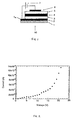
- the device 10 of Figure 1 includes a substrate 1 which generally has a substantially planar surface 1a and may be a glass plate, although other suitable materials can be used for this purpose.
- An electrically conductive layer 2 is deposited on the planar surface 1 a so as to form a relatively uniform electrical contact.
- Layers 3, 4 and 5 may be a single layer (for example, of the electroluminescent material of the present invention) comprising a mixture of conductive materials and luminescent dopant (such as a complex of the invention).
- a more efficient working device consists of a first organic layer 3 of a hole transporting material, the host emissive material 4 (such as the electroluminescent material of the invention), a second organic layer 5 of electron transporting material (which may comprise an organolanthanide of the invention also useful as a phosphor) and a second electrically conductive layer 6 to form a second electrical contact.
- substrate 1 is formed of glass and conductive layer 2 is formed of organic and inorganic conductors, such as conductive polyaniline (PANI) or indium-tin-oxide (ITO), which are substantially transparent to visible light so that the emitted light exits downwardly through substrate 1 as the device 10 is shown in the Figure.
- PANI conductive polyaniline
- ITO indium-tin-oxide
- Device 10 has a potential applied between layers 2 and 6 by means of a potential source 7.
- conductive layer 2 is a p-type contact and conductive layer 6 is an n-type contact.
- the negative terminal of potential source 7 is connected to conductive layer 6 and the positive terminal is connected to conductive layer 2.
- Electrons injected through the n-type contact are transported through organic layer 5 and into organometallic layer 4 (the emissive layer). Holes injected from the p-type contact are transported through the organic layer 3 and into the organometallic layer 4 where, upon an electron and hole recombination, a photon is emitted.
- An electroluminescent device was prepared using this complex as a phosphor.
- the device had a single layer structure consisting of a homogeneous mixture of the organometallic phosphor, an electron carrying material and a hole carrying material.
- This layer was deposited by spin-coating a stock solution of these materials onto an indium-tin oxide coated glass substrate in a dry nitrogen atmosphere.
- the stock solution was prepared in a dry nitrogen atmosphere using a mixture of the organometallic phosphor, polyvinylcarbazole (PVK) and 2-(4-biphenylyl)-5-(5-tertbutylbenzene)-1,3,4-oxadiazole (BBO).
- PVK polyvinylcarbazole
- BBO 2-(4-biphenylyl)-5-(5-tertbutylbenzene)-1,3,4-oxadiazole
- Tm(OTf) 3 (0.62 g, 1.0 mmol) and KBpz (0.67 g, 2.0 mmol) were dissolved in THF (50 mL) and the solution was stirred for 12 h at room temperature. A fine colourless precipitate developed within 1 h. After 12 h the THF was removed under vacuum and the product extracted from the resulting colourless solid with CH 2 Cl 2 (50 mL). Removal of the CH 2 Cl 2 in vacuo afforded the product as a colourless solid (0.72 g, 79 %).
- Tb(OTf) 3 (0.61g, 1.0 mmol) and KT Ind (0.81 g, 2.0 mmol) in THF (50 mL) was allowed to stir for 16 h, by which time a colourless precipitate had formed.
- the THF was removed under reduced pressure and the pale yellow residue was treated with CH 2 Cl 2 (50 mL) and the yellow supernatant filtered from the colourless precipitate. Removal of the CH 2 Cl 2 under reduced pressure gave the product as a pale yellow solid (0.71 g, 69 %).
- Tm(OTf) 3 (0.62 g, 1.0 mmol) and KT ind (0.81 g, 2.0 mmol) were dissolved in THF (50 mL) and the orange solution was stirred for 15 h at room temperature. The solvent was removed from the resulting cloudy solution and the yellow residue was washed with CH 2 Cl 2 (50 mL). The yellow filtrate was evaporated to dryness under reduced pressure, affording the product as a pale yellow solid (0.68 g, 65 %).
- Nd(OTf) 3 (1.18 g, 2.0 mmol) and KT ind (1.61 g, 4.0 mmol) were dissolved in THF (50 mL) and the lilac solution was stirred for 24 h at room temperature. The solvent was removed from the resulting cloudy solution and the lilac residue was washed with CH 2 Cl 2 (50 mL). The lilac filtrate was evaporated to dryness under reduced pressure, affording the product as a lilac solid (1.27 g, 62 %).
- Tb(OTf) 3 (1.21 g, 2.0 mmol) and KBpz 12 (2.23 g, 4.0 mmol) were suspended in THF (50 mL) and allowed to stir for 14 h. The initial colourless cloudy mixture cleared and became pale green during this time. The solvent was removed under reduced pressure and the colourless solid residue was extracted into CH 2 Cl 2 (50 mL). The filtrate was concentrated to dryness to give the product as a colourless solid (2.00 g, 74 %).
Landscapes
- Chemical & Material Sciences (AREA)
- Engineering & Computer Science (AREA)
- Materials Engineering (AREA)
- Inorganic Chemistry (AREA)
- Organic Chemistry (AREA)
- Physics & Mathematics (AREA)
- High Energy & Nuclear Physics (AREA)
Applications Claiming Priority (3)
| Application Number | Priority Date | Filing Date | Title |
|---|---|---|---|
| GBGB9711237.9A GB9711237D0 (en) | 1997-06-02 | 1997-06-02 | Organomettallic Complexes |
| GB9711237 | 1997-06-02 | ||
| PCT/GB1998/001587 WO1998055561A1 (en) | 1997-06-02 | 1998-06-01 | Organometallic complexes |
Publications (2)
| Publication Number | Publication Date |
|---|---|
| EP0988353A1 EP0988353A1 (en) | 2000-03-29 |
| EP0988353B1 true EP0988353B1 (en) | 2002-11-27 |
Family
ID=10813346
Family Applications (1)
| Application Number | Title | Priority Date | Filing Date |
|---|---|---|---|
| EP98924488A Expired - Lifetime EP0988353B1 (en) | 1997-06-02 | 1998-06-01 | Organometallic complexes |
Country Status (7)
| Country | Link |
|---|---|
| US (1) | US7601859B2 (enExample) |
| EP (1) | EP0988353B1 (enExample) |
| JP (1) | JP4083243B2 (enExample) |
| AU (1) | AU7668198A (enExample) |
| DE (1) | DE69809739D1 (enExample) |
| GB (1) | GB9711237D0 (enExample) |
| WO (1) | WO1998055561A1 (enExample) |
Families Citing this family (63)
| Publication number | Priority date | Publication date | Assignee | Title |
|---|---|---|---|---|
| GB9712483D0 (en) | 1997-06-17 | 1997-08-20 | Kathirgamanathan Poopathy | Fabrication of light emitting devices from chelates of transition metals, lanthanides and actinides |
| JP3907142B2 (ja) * | 1998-08-18 | 2007-04-18 | 富士フイルム株式会社 | 有機エレクトロルミネツセンス素子材料およびそれを使用した有機エレクトロルミネツセンス素子 |
| GB9820805D0 (en) | 1998-09-25 | 1998-11-18 | Isis Innovation | Divalent lanthanide metal complexes |
| GB9823761D0 (en) | 1998-11-02 | 1998-12-23 | South Bank Univ Entpr Ltd | Novel electroluminescent materials |
| GB9826407D0 (en) | 1998-12-02 | 1999-01-27 | South Bank Univ Entpr Ltd | Novel electroluminescent materials |
| GB9826405D0 (en) | 1998-12-02 | 1999-01-27 | South Bank Univ Entpr Ltd | Method for forming films or layers |
| GB9901971D0 (en) | 1999-02-01 | 1999-03-17 | South Bank Univ Entpr Ltd | Electroluminescent material |
| US6872471B2 (en) * | 2000-03-06 | 2005-03-29 | The Ohio State University Research Foundation | Infrared emitting electroluminescent and photoluminescent devices |
| EP2276084A1 (en) * | 2001-03-14 | 2011-01-19 | The Trustees of Princeton University | Materials and devices for blue phosphorescence based organic light emitting diodes |
| GB0109755D0 (en) | 2001-04-20 | 2001-06-13 | Elam T Ltd | Devices incorporating mixed metal organic complexes |
| TWI303533B (en) | 2001-06-15 | 2008-11-21 | Oled T Ltd | Electroluminescent devices |
| GB0116644D0 (en) | 2001-07-09 | 2001-08-29 | Elam T Ltd | Electroluminescent materials and devices |
| US7303824B2 (en) | 2001-08-04 | 2007-12-04 | Oled-T Limited | Electroluminescent device |
| US6699597B2 (en) | 2001-08-16 | 2004-03-02 | 3M Innovative Properties Company | Method and materials for patterning of an amorphous, non-polymeric, organic matrix with electrically active material disposed therein |
| GB0120828D0 (en) | 2001-08-28 | 2001-10-17 | Isis Innovation | Method of driving an electroluminescent device |
| US6603150B2 (en) | 2001-09-28 | 2003-08-05 | Eastman Kodak Company | Organic light-emitting diode having an interface layer between the hole-transporting layer and the light-emitting layer |
| US6610455B1 (en) | 2002-01-30 | 2003-08-26 | Eastman Kodak Company | Making electroluminscent display devices |
| US6872472B2 (en) | 2002-02-15 | 2005-03-29 | Eastman Kodak Company | Providing an organic electroluminescent device having stacked electroluminescent units |
| US7241512B2 (en) | 2002-04-19 | 2007-07-10 | 3M Innovative Properties Company | Electroluminescent materials and methods of manufacture and use |
| US7282275B2 (en) | 2002-04-19 | 2007-10-16 | 3M Innovative Properties Company | Materials for organic electronic devices |
| US20040004433A1 (en) | 2002-06-26 | 2004-01-08 | 3M Innovative Properties Company | Buffer layers for organic electroluminescent devices and methods of manufacture and use |
| US6939660B2 (en) | 2002-08-02 | 2005-09-06 | Eastman Kodak Company | Laser thermal transfer donor including a separate dopant layer |
| US6890627B2 (en) | 2002-08-02 | 2005-05-10 | Eastman Kodak Company | Laser thermal transfer from a donor element containing a hole-transporting layer |
| US6747618B2 (en) | 2002-08-20 | 2004-06-08 | Eastman Kodak Company | Color organic light emitting diode display with improved lifetime |
| US7811675B2 (en) * | 2002-11-06 | 2010-10-12 | The University Of Hong Kong | Electroluminescent metallo-supramolecules with terpyridine-based groups |
| US7230594B2 (en) | 2002-12-16 | 2007-06-12 | Eastman Kodak Company | Color OLED display with improved power efficiency |
| US6975067B2 (en) | 2002-12-19 | 2005-12-13 | 3M Innovative Properties Company | Organic electroluminescent device and encapsulation method |
| JP2006512755A (ja) | 2002-12-24 | 2006-04-13 | エラム−ティー リミテッド | エレクトロルミネッセンス物質および装置 |
| US7271406B2 (en) | 2003-04-15 | 2007-09-18 | 3M Innovative Properties Company | Electron transport agents for organic electronic devices |
| US7192657B2 (en) | 2003-04-15 | 2007-03-20 | 3M Innovative Properties Company | Ethynyl containing electron transport dyes and compositions |
| US7892382B2 (en) | 2003-11-18 | 2011-02-22 | Samsung Mobile Display Co., Ltd. | Electroluminescent devices and methods of making electroluminescent devices including a color conversion element |
| US7221332B2 (en) | 2003-12-19 | 2007-05-22 | Eastman Kodak Company | 3D stereo OLED display |
| GB0411572D0 (en) * | 2004-05-24 | 2004-06-23 | Cambridge Display Tech Ltd | Light-emitting device |
| US7316756B2 (en) | 2004-07-27 | 2008-01-08 | Eastman Kodak Company | Desiccant for top-emitting OLED |
| US9040170B2 (en) | 2004-09-20 | 2015-05-26 | Global Oled Technology Llc | Electroluminescent device with quinazoline complex emitter |
| US7501152B2 (en) | 2004-09-21 | 2009-03-10 | Eastman Kodak Company | Delivering particulate material to a vaporization zone |
| US7315042B2 (en) | 2004-11-18 | 2008-01-01 | 3M Innovative Properties Company | Semiconductors containing trans-1,2-bis(acenyl)ethylene compounds |
| US8569948B2 (en) | 2004-12-28 | 2013-10-29 | Samsung Display Co., Ltd. | Electroluminescent devices and methods of making electroluminescent devices including an optical spacer |
| US7645478B2 (en) | 2005-03-31 | 2010-01-12 | 3M Innovative Properties Company | Methods of making displays |
| US7615501B2 (en) | 2005-08-11 | 2009-11-10 | 3M Innovative Properties Company | Method for making a thin film layer |
| US9666826B2 (en) | 2005-11-30 | 2017-05-30 | Global Oled Technology Llc | Electroluminescent device including an anthracene derivative |
| JP5209504B2 (ja) | 2006-02-08 | 2013-06-12 | スリーエム イノベイティブ プロパティズ カンパニー | ガラス転移点を超える温度でのフィルム基材の製造のための方法 |
| WO2007130047A1 (en) | 2006-05-08 | 2007-11-15 | Eastman Kodak Company | Oled electron-injecting layer |
| US7667391B2 (en) | 2006-08-04 | 2010-02-23 | Eastman Kodak Company | Electrically excited organic light-emitting diodes with spatial and spectral coherence |
| DE102006048202A1 (de) * | 2006-10-11 | 2008-04-17 | Universität Regensburg | Lanthanoid-Emitter für OLED-Anwendungen |
| US7911133B2 (en) | 2007-05-10 | 2011-03-22 | Global Oled Technology Llc | Electroluminescent device having improved light output |
| US7812531B2 (en) | 2007-07-25 | 2010-10-12 | Global Oled Technology Llc | Preventing stress transfer in OLED display components |
| US8076009B2 (en) | 2007-10-26 | 2011-12-13 | Global Oled Technology, Llc. | OLED device with fluoranthene electron transport materials |
| US8016631B2 (en) | 2007-11-16 | 2011-09-13 | Global Oled Technology Llc | Desiccant sealing arrangement for OLED devices |
| US8900722B2 (en) | 2007-11-29 | 2014-12-02 | Global Oled Technology Llc | OLED device employing alkali metal cluster compounds |
| US8877350B2 (en) | 2007-12-11 | 2014-11-04 | Global Oled Technology Llc | White OLED with two blue light-emitting layers |
| US7947974B2 (en) | 2008-03-25 | 2011-05-24 | Global Oled Technology Llc | OLED device with hole-transport and electron-transport materials |
| US8283054B2 (en) | 2009-04-03 | 2012-10-09 | Global Oled Technology Llc | Tandem white OLED with efficient electron transfer |
| WO2011052532A1 (ja) * | 2009-10-28 | 2011-05-05 | 住友化学株式会社 | 多座配位子金属錯体 |
| EP2726490B1 (de) * | 2011-06-28 | 2015-04-29 | Merck Patent GmbH | Metallkomplexe |
| WO2013079676A1 (en) * | 2011-11-30 | 2013-06-06 | Novaled Ag | Organic electronic device |
| CN104641484B (zh) | 2012-09-21 | 2017-09-08 | 株式会社半导体能源研究所 | 发光元件、发光装置、电子设备及照明装置 |
| US10593886B2 (en) | 2013-08-25 | 2020-03-17 | Molecular Glasses, Inc. | OLED devices with improved lifetime using non-crystallizable molecular glass mixture hosts |
| US10626326B2 (en) * | 2014-11-06 | 2020-04-21 | Postech Academy-Industry Foundation | Method for manufacturing perovskite nanocrystal particle light emitting body where organic ligand is substituted, nanocrystal particle light emitting body manufactured thereby, and light emitting device using same |
| WO2016072807A1 (ko) | 2014-11-06 | 2016-05-12 | 포항공과대학교 산학협력단 | 유기 리간드가 치환된 페로브스카이트 나노결정입자 발광체 제조방법, 이에 의해 제조된 나노결정입자 발광체 및 이를 이용한 발광소자 |
| JP7082984B2 (ja) * | 2017-02-20 | 2022-06-09 | ノヴァレッド ゲーエムベーハー | 電子半導体デバイスおよびその電子半導体デバイスの製造方法および化合物 |
| CN114057779B (zh) * | 2020-07-29 | 2023-06-06 | 北京大学 | 混配型Ce(III)配合物及其作为电致发光材料的应用 |
| CN116082376A (zh) * | 2021-11-01 | 2023-05-09 | 北京大学 | d-f跃迁稀土配合物的非掺杂器件 |
Family Cites Families (5)
| Publication number | Priority date | Publication date | Assignee | Title |
|---|---|---|---|---|
| US5237069A (en) * | 1990-10-26 | 1993-08-17 | The Dow Chemical Company | Hydridotris(pyrazolyl)borate metal complexes and polymerization process |
| WO1993011433A1 (en) * | 1991-12-05 | 1993-06-10 | Wallac Oy | Luminescent lanthanide chelates |
| US5707745A (en) * | 1994-12-13 | 1998-01-13 | The Trustees Of Princeton University | Multicolor organic light emitting devices |
| US6358631B1 (en) * | 1994-12-13 | 2002-03-19 | The Trustees Of Princeton University | Mixed vapor deposited films for electroluminescent devices |
| US5627164A (en) * | 1995-06-13 | 1997-05-06 | Exxon Research And Engineering Company | Pyrazolyl borates complexes-(LAW294) |
-
1997
- 1997-06-02 GB GBGB9711237.9A patent/GB9711237D0/en active Pending
-
1998
- 1998-06-01 EP EP98924488A patent/EP0988353B1/en not_active Expired - Lifetime
- 1998-06-01 AU AU76681/98A patent/AU7668198A/en not_active Abandoned
- 1998-06-01 WO PCT/GB1998/001587 patent/WO1998055561A1/en not_active Ceased
- 1998-06-01 JP JP50183199A patent/JP4083243B2/ja not_active Expired - Lifetime
- 1998-06-01 DE DE69809739T patent/DE69809739D1/de not_active Expired - Lifetime
-
2004
- 2004-05-18 US US10/848,183 patent/US7601859B2/en not_active Expired - Fee Related
Also Published As
| Publication number | Publication date |
|---|---|
| DE69809739D1 (de) | 2003-01-09 |
| US7601859B2 (en) | 2009-10-13 |
| JP4083243B2 (ja) | 2008-04-30 |
| US20040215000A1 (en) | 2004-10-28 |
| AU7668198A (en) | 1998-12-21 |
| JP2002513440A (ja) | 2002-05-08 |
| GB9711237D0 (en) | 1997-07-23 |
| WO1998055561A1 (en) | 1998-12-10 |
| EP0988353A1 (en) | 2000-03-29 |
Similar Documents
| Publication | Publication Date | Title |
|---|---|---|
| EP0988353B1 (en) | Organometallic complexes | |
| EP1115808B1 (en) | Divalent lanthanide metal complexes | |
| EP2084171B1 (en) | Iridium complex compound, organic electroluminescent device obtained by using the same, and uses of the device | |
| US7361414B2 (en) | Light emitting device and display apparatus using same | |
| JP4310077B2 (ja) | 金属配位化合物及び有機発光素子 | |
| JP3445315B2 (ja) | アルミニウムキレート化合物及び内部接合型有機電界発光素子 | |
| JP5174310B2 (ja) | フッ素化フェニルピリジン、フェニルピリミジン及びフェニルキノリンを伴うエレクトロルミネセントイリジウム化合物及びかかる化合物で作られたデバイス | |
| KR20220044889A (ko) | 유기 전계발광 물질 및 디바이스 | |
| JPH11251628A (ja) | テルビウム錯体を有する有機発光ダイオード | |
| WO2009011447A2 (en) | Iridium complex compounds, organic electroluminescent devices and uses thereof | |
| EP4016659B1 (en) | Organic electroluminescent materials and devices | |
| EP4059915A2 (en) | Organic electroluminescent materials and devices | |
| US12342716B2 (en) | Tandem-carbene phosphors | |
| Balashova et al. | New luminescent 10-oxybenzoquinolate complexes of rare earth metals | |
| KR20220170375A (ko) | 유기 전계발광 물질 및 디바이스 | |
| KR20230091829A (ko) | 유기 전계발광 물질 및 디바이스 | |
| JP2000012222A (ja) | 発光素子 | |
| KR20240011589A (ko) | 유기 전계발광 물질 및 디바이스 | |
| EP4242285A1 (en) | Organic electroluminescent materials and devices | |
| EP4001287B1 (en) | Organic electroluminescent materials and devices | |
| US20250051381A1 (en) | Organic electroluminescent materials and devices | |
| US12331064B2 (en) | Tandem carbene phosphors | |
| US20250017031A1 (en) | Organic electroluminescent materials and devices | |
| KR20240029722A (ko) | 유기 전계발광 물질 및 디바이스 | |
| JP2024009786A (ja) | 有機エレクトロルミネセンス材料及びデバイス |
Legal Events
| Date | Code | Title | Description |
|---|---|---|---|
| PUAI | Public reference made under article 153(3) epc to a published international application that has entered the european phase |
Free format text: ORIGINAL CODE: 0009012 |
|
| 17P | Request for examination filed |
Effective date: 19991224 |
|
| AK | Designated contracting states |
Kind code of ref document: A1 Designated state(s): BE DE ES FR GB IT NL |
|
| GRAG | Despatch of communication of intention to grant |
Free format text: ORIGINAL CODE: EPIDOS AGRA |
|
| 17Q | First examination report despatched |
Effective date: 20020215 |
|
| GRAG | Despatch of communication of intention to grant |
Free format text: ORIGINAL CODE: EPIDOS AGRA |
|
| GRAH | Despatch of communication of intention to grant a patent |
Free format text: ORIGINAL CODE: EPIDOS IGRA |
|
| GRAH | Despatch of communication of intention to grant a patent |
Free format text: ORIGINAL CODE: EPIDOS IGRA |
|
| GRAA | (expected) grant |
Free format text: ORIGINAL CODE: 0009210 |
|
| AK | Designated contracting states |
Kind code of ref document: B1 Designated state(s): BE DE ES FR GB IT NL |
|
| PG25 | Lapsed in a contracting state [announced via postgrant information from national office to epo] |
Ref country code: NL Free format text: LAPSE BECAUSE OF FAILURE TO SUBMIT A TRANSLATION OF THE DESCRIPTION OR TO PAY THE FEE WITHIN THE PRESCRIBED TIME-LIMIT Effective date: 20021127 Ref country code: IT Free format text: LAPSE BECAUSE OF FAILURE TO SUBMIT A TRANSLATION OF THE DESCRIPTION OR TO PAY THE FEE WITHIN THE PRESCRIBED TIME-LIMIT;WARNING: LAPSES OF ITALIAN PATENTS WITH EFFECTIVE DATE BEFORE 2007 MAY HAVE OCCURRED AT ANY TIME BEFORE 2007. THE CORRECT EFFECTIVE DATE MAY BE DIFFERENT FROM THE ONE RECORDED. Effective date: 20021127 Ref country code: FR Free format text: LAPSE BECAUSE OF FAILURE TO SUBMIT A TRANSLATION OF THE DESCRIPTION OR TO PAY THE FEE WITHIN THE PRESCRIBED TIME-LIMIT Effective date: 20021127 Ref country code: BE Free format text: LAPSE BECAUSE OF FAILURE TO SUBMIT A TRANSLATION OF THE DESCRIPTION OR TO PAY THE FEE WITHIN THE PRESCRIBED TIME-LIMIT Effective date: 20021127 |
|
| REG | Reference to a national code |
Ref country code: GB Ref legal event code: FG4D |
|
| REF | Corresponds to: |
Ref document number: 69809739 Country of ref document: DE Date of ref document: 20030109 |
|
| PG25 | Lapsed in a contracting state [announced via postgrant information from national office to epo] |
Ref country code: DE Free format text: LAPSE BECAUSE OF FAILURE TO SUBMIT A TRANSLATION OF THE DESCRIPTION OR TO PAY THE FEE WITHIN THE PRESCRIBED TIME-LIMIT Effective date: 20030228 |
|
| NLV1 | Nl: lapsed or annulled due to failure to fulfill the requirements of art. 29p and 29m of the patents act | ||
| PG25 | Lapsed in a contracting state [announced via postgrant information from national office to epo] |
Ref country code: ES Free format text: LAPSE BECAUSE OF FAILURE TO SUBMIT A TRANSLATION OF THE DESCRIPTION OR TO PAY THE FEE WITHIN THE PRESCRIBED TIME-LIMIT Effective date: 20030529 |
|
| EN | Fr: translation not filed | ||
| PLBE | No opposition filed within time limit |
Free format text: ORIGINAL CODE: 0009261 |
|
| STAA | Information on the status of an ep patent application or granted ep patent |
Free format text: STATUS: NO OPPOSITION FILED WITHIN TIME LIMIT |
|
| 26N | No opposition filed |
Effective date: 20030828 |
|
| PGFP | Annual fee paid to national office [announced via postgrant information from national office to epo] |
Ref country code: GB Payment date: 20170526 Year of fee payment: 20 |
|
| REG | Reference to a national code |
Ref country code: GB Ref legal event code: PE20 Expiry date: 20180531 |
|
| PG25 | Lapsed in a contracting state [announced via postgrant information from national office to epo] |
Ref country code: GB Free format text: LAPSE BECAUSE OF EXPIRATION OF PROTECTION Effective date: 20180531 |