EP0978197B1 - Control of video level by region and content of information displayed - Google Patents
Control of video level by region and content of information displayed Download PDFInfo
- Publication number
- EP0978197B1 EP0978197B1 EP97954312A EP97954312A EP0978197B1 EP 0978197 B1 EP0978197 B1 EP 0978197B1 EP 97954312 A EP97954312 A EP 97954312A EP 97954312 A EP97954312 A EP 97954312A EP 0978197 B1 EP0978197 B1 EP 0978197B1
- Authority
- EP
- European Patent Office
- Prior art keywords
- region
- displayed
- display
- image
- level
- Prior art date
- Legal status (The legal status is an assumption and is not a legal conclusion. Google has not performed a legal analysis and makes no representation as to the accuracy of the status listed.)
- Expired - Lifetime
Links
Images


Classifications
-
- H—ELECTRICITY
- H04—ELECTRIC COMMUNICATION TECHNIQUE
- H04N—PICTORIAL COMMUNICATION, e.g. TELEVISION
- H04N21/00—Selective content distribution, e.g. interactive television or video on demand [VOD]
- H04N21/40—Client devices specifically adapted for the reception of or interaction with content, e.g. set-top-box [STB]; Operations thereof
- H04N21/43—Processing of content or additional data, e.g. demultiplexing additional data from a digital video stream; Elementary client operations, e.g. monitoring of home network or synchronising decoder's clock; Client middleware
- H04N21/431—Generation of visual interfaces for content selection or interaction; Content or additional data rendering
-
- H—ELECTRICITY
- H04—ELECTRIC COMMUNICATION TECHNIQUE
- H04N—PICTORIAL COMMUNICATION, e.g. TELEVISION
- H04N21/00—Selective content distribution, e.g. interactive television or video on demand [VOD]
- H04N21/40—Client devices specifically adapted for the reception of or interaction with content, e.g. set-top-box [STB]; Operations thereof
- H04N21/47—End-user applications
- H04N21/478—Supplemental services, e.g. displaying phone caller identification, shopping application
- H04N21/4782—Web browsing, e.g. WebTV
-
- H—ELECTRICITY
- H04—ELECTRIC COMMUNICATION TECHNIQUE
- H04N—PICTORIAL COMMUNICATION, e.g. TELEVISION
- H04N21/00—Selective content distribution, e.g. interactive television or video on demand [VOD]
- H04N21/40—Client devices specifically adapted for the reception of or interaction with content, e.g. set-top-box [STB]; Operations thereof
- H04N21/41—Structure of client; Structure of client peripherals
- H04N21/4104—Peripherals receiving signals from specially adapted client devices
- H04N21/4113—PC
-
- H—ELECTRICITY
- H04—ELECTRIC COMMUNICATION TECHNIQUE
- H04N—PICTORIAL COMMUNICATION, e.g. TELEVISION
- H04N21/00—Selective content distribution, e.g. interactive television or video on demand [VOD]
- H04N21/40—Client devices specifically adapted for the reception of or interaction with content, e.g. set-top-box [STB]; Operations thereof
- H04N21/45—Management operations performed by the client for facilitating the reception of or the interaction with the content or administrating data related to the end-user or to the client device itself, e.g. learning user preferences for recommending movies, resolving scheduling conflicts
- H04N21/462—Content or additional data management e.g. creating a master electronic programme guide from data received from the Internet and a Head-end or controlling the complexity of a video stream by scaling the resolution or bit-rate based on the client capabilities
- H04N21/4622—Retrieving content or additional data from different sources, e.g. from a broadcast channel and the Internet
-
- H—ELECTRICITY
- H04—ELECTRIC COMMUNICATION TECHNIQUE
- H04N—PICTORIAL COMMUNICATION, e.g. TELEVISION
- H04N5/00—Details of television systems
- H04N5/44—Receiver circuitry for the reception of television signals according to analogue transmission standards
- H04N5/445—Receiver circuitry for the reception of television signals according to analogue transmission standards for displaying additional information
- H04N5/45—Picture in picture, e.g. displaying simultaneously another television channel in a region of the screen
-
- H—ELECTRICITY
- H04—ELECTRIC COMMUNICATION TECHNIQUE
- H04N—PICTORIAL COMMUNICATION, e.g. TELEVISION
- H04N5/00—Details of television systems
- H04N5/44—Receiver circuitry for the reception of television signals according to analogue transmission standards
- H04N5/57—Control of contrast or brightness
-
- H—ELECTRICITY
- H04—ELECTRIC COMMUNICATION TECHNIQUE
- H04N—PICTORIAL COMMUNICATION, e.g. TELEVISION
- H04N5/00—Details of television systems
- H04N5/44—Receiver circuitry for the reception of television signals according to analogue transmission standards
- H04N5/46—Receiver circuitry for the reception of television signals according to analogue transmission standards for receiving on more than one standard at will
Definitions
- the present invention relates to the display of alphanumeric or graphic information by an image reproducing device such as a kinescope, and, in particular, to a system and method for controlling the video level of an image reproducing device depending on the region and the content of the information being displayed.
- EP-A-0 729 273 and EP-A-0 569 018 Picture in Picture (PIP) based television systems are disclosed, in which the brightness and/or contrast of a picture is adjusted based on the intensity distributions of the different pictures.
- the present inventor has recognized that a problem arises when a display must exhibit both types of material, each of which has its own requirements.
- This type of setup is found for example, in a device which combines the functions of a personal computer (PC) with a television.
- a personal computer can be outfitted with a television tuner card, so that a user may watch a television program in one window of provided by the computer's graphical operating system (e.g., Microsoft Windows 95®), while working on a spread sheet application displayed in another window.
- graphical operating system e.g., Microsoft Windows 95®
- Another example is a television receiver which is also being used as a PC monitor or has built-in PC capabilities for surfing the internet or performing other computing functions. Video drive level adjustments need to be made to optimize each of the material being displayed.
- a display must exhibit both types of material is, for example, when a television has an electronic program guide or some other text/graphical On Screen Display (OSD) information that needs to be conveyed to the users, along with real-world, television broadcast information.
- OSD On Screen Display
- a television may include internet access so that computer graphics and text can be downloaded from the internet for viewing on the television display.
- the computer graphics and text may be displayed, for example, in a subpicture of a television with a Picture-in-Picture (PIP) or Picture-out-of-Picture (POP) capability, while the main picture is showing the television broadcast channel.
- PIP Picture-in-Picture
- POP Picture-out-of-Picture
- the inventor has recognized that drive level adjustment between two or more types of material may be made manually, if only one is shown on the display at a time. This might be done with the monitor's contrast control, for example.
- monitor's contrast control for example.
- a video processing system and method for presenting an image having more than one region on a display.
- the system has a control processor which can determine, for each region, the type (e.g., graphics, text, computer programs, broadcast TV video, etc.) of the image material being displayed in the region.
- the system also has a video driver coupled to the display for providing image signals having contrast and brightness characteristics.
- the control processor generates a control signal for causing the video driver to adjust the contrast and brightness characteristics of the image signals according to the type of material being displayed in the region.
- Another aspect of the present invention provides for manual adjustment of the image characteristics for each of the regions independently, therefore, allowing a user to adjust the drive level for each region to suit his or her own taste.
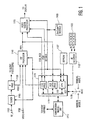
- FIG. 1 shows a television receiver receiving for processing both analog NTSC television signals and internet information .
- the system shown in FIG. 1 has a first input 1100 for receiving television signal RF_IN at RF frequencies and a second input 1102 for receiving baseband television signal VIDEO IN.
- Signal RF_IN may be supplied from a source such as an antenna or cable system while signal VIDEO IN may be supplied, for example, by a video cassette recorder (VCR) or a gaming device (both not shown in FIG. 1).
- VCR video cassette recorder
- IF processor 1130 operate in a conventional manner for tuning and demodulating a particular television signal that is included in signal RF_IN.
- IF processor 1130 produces baseband video signal VIDEO representing the video program portion of the tuned television signal.
- IF processor 1130 also produces a baseband audio signal that is coupled to an audio processing section (not shown in FIG. 1) for further audio processing.
- FIG. 1 shows input 1102 as a baseband signal
- the television receiver could include a second tuner and IF processor similar to units 1105 and 1130 for producing a second baseband video signal from either signal RF_IN or from a second RF signal source.
- the system shown in FIG. 1 also includes a main microprocessor ( ⁇ P) 1110 for controlling components of the television receiver such as tuner 1105, picture-in-picture processing unit 1140, video signal processor 1155, and StarSight® data processing module 1160.
- ⁇ P main microprocessor
- microprocessor represents various devices including, but not limited to, microprocessors, microcomputers, microcontrollers, control processors, and controllers.
- Microprocessor 1110 controls the system by sending and receiving both commands and data via serial data bus I 2 C BUS which utilizes the well-known I 2 C serial data bus protocol.
- CPU central processing unit
- CPU central processing unit
- EEPROM 1127 shown in FIG.
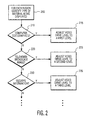
- EEPROM 1127 also includes software for implementing the operations shown in FIG. 2.
- Main microprocessor 1110 also controls the operation of a communications interface unit 1113 for providing the capability to download and upload information from the internet.
- Communication interface unit 1113 includes, for example, a modem for connecting to an internet service provider, e.g., via a telephone line or via a cable television line.
- the communication capability allows the system shown in Figure 1 to provide email capability and internet related features such as web browsing in addition to receiving television programming.
- CPU 1112 controls functions included within ⁇ P 1110 via bus 1119 within ⁇ P 1110.
- CPU 1112 controls auxiliary data processor 1115 and on-screen display (OSD) processor 1117.
- OSD on-screen display
- One function of the auxiliary data processor 1115 is to extract auxiliary data such as StarSight® data from video signal PIPV.
- StarSight® system is an Electronic Program Guide (EPG) provided by StacSight Telecast, Inc.
- EPG Electronic Program Guide
- An EPG is an interactive, on-screen equivalent to TV listings found in local newspapers or other print media.
- the information contained in an EPG includes programming characteristics such as channel number, program title, start time, end time, elapsed time, time remaining, rating (if available), topic, theme, and a brief description of the program's content.
- Aspects of the StarSight® system are described in US Pat. Nos. 5,353,121, 5,479,268, and 5,47,9,266 issued to Young et al. and assigned to StarSight Telecast, Inc.
- StarSight® data is typically received only on a particular television channel and the television receiver must tune that channel to extract StarSight® data.
- CPU 1112 initiates StarSight® data extractioorby tuning the particular channel only during a time period when the television receiver is usually not in use (e.g., 2:00 AM). At that time, CPU 1112 configures decoder 1115 such that auxiliary data is extracted from horizontal line intervals such as line 16 that are used for StarSight® data.
- CPU 1112 controls the transfer of extracted StarSight® data from decoder 1115 via I 2 C BUS to StarSight® module 1160.
- a processor internal to the module formats and stores the data in memory within the module.
- CPU 1112 transfers formatted StaiSight® EPG display data from StarSight® module 1160 via I 2 C BUS to OSD processor 1117.
- OSD processor 1117 operates in a conventional manner to produce R, G, and B video signals OSD_RGB that, when coupled to a display device, will produce a displayed image representing on-screen display information such as graphics and/or text comprising an EPG or graphics and/or text downloaded from internet as described below.
- OSD processor 1117 also produces control signal FSW which is intended to control a fast switch for inserting signals OSD_RGB into the system's video output signal at times when an on-screen display is to be displayed.
- CPU 1112 when a user enables an EPG, e.g., by activating a particular switch on remote control 1125, CPU 1112 enables processors 1115 and 1117 so that processor 1115 first requests and receives EPG data from StarSight® module 1160 via I 2 C BUS.
- Processor 1117 then produces signals OSD_RGB representing the closed caption data.
- Processor 1117 also produces signal FSW indicating when the EPG is to be displayed.
- the OSD processor 1117 is to generate computer text or graphics obtained from the internet, in cooperation with the communication interface unit 1113 and the Auxiliary Data Processor 1115.
- the communication interface unit 1113 demodulates the analog information into digital format and passes it to the Auxiliary Data Processor 1115 for further processing.
- the OSD processor then formats this digital information into RGB signals suitable for used by the Video Signal Processor 1155.
- the OSD produces control signal FSW which is intended to control a fast switch for inserting signals OSD_RGB into the system's video output signal at times When internet graphics and text is to be displayed.
- Video signal processor (VSP) 1155 performs conventional video signal processing functions, such as luma and chroma processing and contrast and brightness adjustment. Output image signals produced by VSP 1155 are suitable for coupling to a display device, e.g., a kinescope or LCD device (not shown in FIG. 1), for producing a displayed image.
- VSP 115 5 also includes a fast switch for coupling signals produced by OSD processor 1117 to the output video signal path at times when graphics and/or text is to be included in the displayed image. The fast switch is controlled by control signal FSW which is generated by OSD processor 1117 in main microprocessor 1110 at times when text and/or graphics are to be displayed.
- the input signal for VSP 1155 is signal PIPV that is output by picture-in-picture (PIP) processor 1140.
- PIP picture-in-picture
- PIP processor 1140 provides the described functionality in a conventional manner using features included in unit 1140 such as a video switch, analog-to-digital converter (ADC), RAM, and digital to analog converter (DAC).
- the subpicture 501 of the PIP image 500 of the television may be used to present text and/or graphics information from the internet, or text and/or graphics information from the EPG while the main picture 502 is showing a TV broadcast channel.
- This is accomplished by feeding the processed digital signals from the OSD processor 1117 directly to one of the inputs of the PIP processor.
- the video switch typically contained in the PIP processor 1140 receives all the signal inputs (e.g., VIDEO, VIDEO IN, and signal from OSD as shown in FIG. 1). Then the PIP processor under the control of the main microprocessor 1110, selects and switches the appropriate signals to be displayed during the appropriate main and subpicture scanning intervals. Conventional subsampling techniques are used to form the subpicture.
- the display data included in the EPG display is produced by OSD processor 1117 and included in the output signal by VSP 1155 in response to fast switch signal FSW.
- controller 1110 detects activation of the EPG display, e.g., when a user presses the appropriate key on remote control 1125, controller 1110 causes OSD processor 1117 to produce the EPG display using information such as program guide data from StarSight® module 1160.
- Controller 1110 causes VSP 1155 to combine the EPG display data from OSD processor 1117 and the video image signal in response to signal FSW to produce a display including EPG.
- the EPG can occupy all or only a portion of the display area.
- controller 1110 executes another control program stored in EEPROM 1127.
- the control program monitors the location of a position indicator, such as a cursor and/or highlighting, in the EPG display.
- a user controls the location of the position indicator using direction and selection keys of remote control 1125.
- the system could include a mouse device.
- Controller 1110 detects activation of a selection device, such as clicking a mouse button, and evaluates current cursor location information in conjunction with EPG data being displayed to determine the function desired, e.g., tuning a particular program. Controller 1110 subsequently activates the control action associated with the selected feature.
- suitable components for implementing the exemplary embodiment include an ST9296 microprocessor produced by SGS-Thomson Microelectronics for providing the features associated with ⁇ P 1110; an M65616 picture-in-picture processor produced by Mitsubishi for providing the described basic PIP functionality associated with PIP processor 1140; and an LA7612 video signal processor produced by Sanyo for providing the functions of VSP 1155.
- the main microprocessor 1110 under the supervision of the control programs contained within memory EEPROM 1127, will direct the video signal processor 1155 to provide the proper drive levels to the display, via the bus I 2 C BUS.
- the main microprocessor 1110 will first determine which region the rasters belong to.
- a region for example, may be a main or subpicture in the PIP mode.
- the main picture may be displaying the TV images and the subpicture of the PIP may be showing internet text and/or graphics or an EPG, or vise versa.
- the microprocessor 1110 will then determine whether the material being displayed is: 1) a computer text/graphics image such as information obtained from the internet, 2) a television broadcast image, or 3) an OSD information such as an EPG, as shown in steps 210, 220 and 230 of Fig. 2.
- the main microprocessor 1110 makes this determination by coordinating and monitoring the operations of the OSD processor 1117, CPU 1112, and the Auxiliary Data Processor 1115.
- the main microprocessor 1110 will then provide a control signal to the video signal processor so that the video signal processor 1155 can provide the desired video drive level to the display for the particular material being displayed during the associated scanning interval.
- Figure 1 includes a control switch 1118 coupled to microprocessor 1110.
- the control switch 1118 can be used to select the mode of operation for the television set. For example, when a user selects the "auto mode", the television operates automatically to adjust the image characteristics of the drive signals for each display region as described above. When the switch is in the "manual mode 1" position, the user may only adjust the image characteristic of the entire screen. When the switch is in "manual mode 2" position, the television may provide a prompt for the user to select the desired image characteristic for each region.
- This aspect of the invention will be further described in regard to a PC implementation shown in FIGS. 3 and 4.
- Fig. 3 shows another example of an electronic device implementing a video drive control system in accordance with the present invention.
- the example is a computer system having a television tuner card installed in one of its computer card slots.
- the computer system 10 is under the control of a CPU processor 110.
- the computer includes a display processor 130 for controlling a kine drive 135 of an associated display monitor 136.
- the display processor 130 under the control of the CPU processor 110 via a computer operating system to be discussed later, provides for each pixel a desired video drive level.
- the computer system 10 includes a television tuner card 100 for receiving television signals to be displayed. It is known, for example, to be able to concurrently display a television image in one of the windows under, for example, a windows based operating system, while performing other computing applications in other windows, as shown in Fig. 5B.
- An example of an expansion card having a TV tuner that can be used with an IBM-compatible PC is "All-In-Wonder"TM card made by ATI Technologies Inc., of Canada.
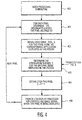
- FIG. 4 shows in a flowchart form a feature of the system shown in FIG. 3.
- the operating system of the PC has a video processing subroutine 400 to provide the proper display drive control for each pixel of the display according to the principles of the present invention.
- the operating system which contains the video processing subroutine 400, provides to the display processor 130 intensity information such as contrast and brightness characteristics about each pixel, as each pixel is being displayed on the display monitor 136 in the display scanning process.
- This intensity information typically corresponds to R, G, and B drive levels for each pixel on the display.
- the operating system knows the location and the boundary of the windows or regions since the operating system is responsible for coordinating the resources among the different applications being displayed. Therefore, as each pixel is being displayed in the CRT scanning process, the operating system first determines which region or application this pixel belongs to, as shown in Step 401.
- the operating system then obtains a normal drive level (X) for this pixel from the corresponding application program as shown in step 402.
- the drive levels (X) for a pixel in an application are normally represented internally as numbers, which can be represented as fractions of the maximum drive level. These might be thought of, for example as 0, 0.25, 0.50, 0.75, and 1.00, although many more levels are usually incorporated.
- these drive numbers received from the application being displayed in a window, would be multiplied by a second number Y as shown in step 403.
- the second number Y is an attenuation number associated with the window currently being scanned.
- the high-drive picture regions corresponding to real-world photographic style or television broadcast images might have an assigned attenuation number Y of 1.0 (no attenuation), but the computer-related text/graphics regions might have an assigned attenuation number Y of 0.25 (4 to 1 attenuation).
- Each pixel appearing in a window, which is of a certain type, is thereafter assigned an associated, final, attenuation level or a drive signal level Z.
- This level, Z is derived from, for example, the multiplication of the normal application video level X for each pixel in the region by the assigned attenuation number Y for that region or window, resulting in independent control of each region's video level appropriate for its type of material being presented, as shown in step 404.
- This number Z is then provided to the display processor 130 which will drive the kine drive 135 and the associated display 136 at the appropriate level for each pixel. This process is then repeated for each pixel of the displayed image until the system 10 is turned off.
- the system shown in FIG. 3 may provide a user interface feature to provide user adjustment of the final drive level for each window or application on the screen. This function is similar to that described above when switch 1118 of the television shown in FIG. 1 is in "manual mode 2" position.
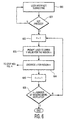
- steps 600 to 606, show in flow chart form, a user interface feature according to the present invention.
- the feature illustrated in FIG. 6 may be implemented as a subroutine of the operating system that is exercised by CPU 110 of the system shown in FIG. 3.
- the user can, for example enter a key on a keyboard (not shown) of the computer system 10 to invoke this feature, as shown in Step 600.
- the computer system 100 will prompt the user via the display screen 136 to enter a new, overriding attenuation number Y for each region shown on the screen, as shown in Step 603.
- the computer system overrides the old attenuation number Y previously derived by the CPU processor with this new number Y, thereby causing the final drive level Z for this particular window to be adjusted according to the user's taste.
- the user is able to manually adjust the drive level for each of the regions currently being displayed on the computer screen.
Landscapes
- Engineering & Computer Science (AREA)
- Multimedia (AREA)
- Signal Processing (AREA)
- Databases & Information Systems (AREA)
- Controls And Circuits For Display Device (AREA)
- User Interface Of Digital Computer (AREA)
Applications Claiming Priority (3)
| Application Number | Priority Date | Filing Date | Title |
|---|---|---|---|
| US4409797P | 1997-04-23 | 1997-04-23 | |
| US44097P | 1997-04-23 | ||
| PCT/US1997/024210 WO1998048571A1 (en) | 1997-04-23 | 1997-12-29 | Control of video level by region and content of information displayed |
Publications (2)
| Publication Number | Publication Date |
|---|---|
| EP0978197A1 EP0978197A1 (en) | 2000-02-09 |
| EP0978197B1 true EP0978197B1 (en) | 2004-10-06 |
Family
ID=21930518
Family Applications (1)
| Application Number | Title | Priority Date | Filing Date |
|---|---|---|---|
| EP97954312A Expired - Lifetime EP0978197B1 (en) | 1997-04-23 | 1997-12-29 | Control of video level by region and content of information displayed |
Country Status (7)
| Country | Link |
|---|---|
| EP (1) | EP0978197B1 (enExample) |
| JP (1) | JP4732553B2 (enExample) |
| KR (1) | KR100526740B1 (enExample) |
| CN (1) | CN1143528C (enExample) |
| AU (1) | AU5811998A (enExample) |
| DE (1) | DE69731120T2 (enExample) |
| WO (1) | WO1998048571A1 (enExample) |
Families Citing this family (47)
| Publication number | Priority date | Publication date | Assignee | Title |
|---|---|---|---|---|
| EP0965232B1 (en) * | 1997-12-31 | 2007-02-14 | Koninklijke Philips Electronics N.V. | Apparatus and method for dynamically controlling brightness of objects on a display monitor |
| JP3595745B2 (ja) | 1999-01-29 | 2004-12-02 | キヤノン株式会社 | 画像処理装置 |
| US6556253B1 (en) * | 1999-10-26 | 2003-04-29 | Thomson Licensing S.A. | Multi-window picture adjustment arrangement for a video display |
| KR100322755B1 (ko) * | 2000-02-14 | 2002-02-07 | 윤종용 | 가변형 오에스디 그래픽 데이터를 가진 영상장치 |
| KR100343385B1 (ko) * | 2000-04-24 | 2002-07-15 | 윤종용 | 온 스크린 디스플레이 커서 표시방법 및 오에스디 영상표시장치 |
| FI115186B (fi) * | 2000-12-18 | 2005-03-15 | Alma Media Oyj | Televisiolähetysjärjestelmä ja menetelmä televisiomainosten lähettämiseksi |
| US7191402B2 (en) * | 2001-05-10 | 2007-03-13 | Samsung Electronics Co., Ltd. | Method and apparatus for adjusting contrast and sharpness for regions in a display device |
| US20030007001A1 (en) * | 2001-06-07 | 2003-01-09 | Philips Electronics North America Corporation | Automatic setting of video and audio settings for media output devices |
| JP3658362B2 (ja) * | 2001-11-08 | 2005-06-08 | キヤノン株式会社 | 映像表示装置及びその制御方法 |
| DE10210485B4 (de) * | 2002-03-11 | 2006-01-12 | Loewe Opta Gmbh | Fernsehempfangsgerät mit Online-Modul |
| JP3783645B2 (ja) * | 2002-04-05 | 2006-06-07 | 株式会社日立製作所 | コントラスト調整方法、コントラスト調整回路及びそれを用いた映像表示装置 |
| US7646372B2 (en) | 2003-09-15 | 2010-01-12 | Sony Computer Entertainment Inc. | Methods and systems for enabling direction detection when interfacing with a computer program |
| US8797260B2 (en) | 2002-07-27 | 2014-08-05 | Sony Computer Entertainment Inc. | Inertially trackable hand-held controller |
| US7623115B2 (en) * | 2002-07-27 | 2009-11-24 | Sony Computer Entertainment Inc. | Method and apparatus for light input device |
| US9393487B2 (en) | 2002-07-27 | 2016-07-19 | Sony Interactive Entertainment Inc. | Method for mapping movements of a hand-held controller to game commands |
| US8019121B2 (en) | 2002-07-27 | 2011-09-13 | Sony Computer Entertainment Inc. | Method and system for processing intensity from input devices for interfacing with a computer program |
| US8570378B2 (en) | 2002-07-27 | 2013-10-29 | Sony Computer Entertainment Inc. | Method and apparatus for tracking three-dimensional movements of an object using a depth sensing camera |
| US8313380B2 (en) | 2002-07-27 | 2012-11-20 | Sony Computer Entertainment America Llc | Scheme for translating movements of a hand-held controller into inputs for a system |
| US7760248B2 (en) | 2002-07-27 | 2010-07-20 | Sony Computer Entertainment Inc. | Selective sound source listening in conjunction with computer interactive processing |
| US9474968B2 (en) | 2002-07-27 | 2016-10-25 | Sony Interactive Entertainment America Llc | Method and system for applying gearing effects to visual tracking |
| US9682319B2 (en) | 2002-07-31 | 2017-06-20 | Sony Interactive Entertainment Inc. | Combiner method for altering game gearing |
| US9177387B2 (en) | 2003-02-11 | 2015-11-03 | Sony Computer Entertainment Inc. | Method and apparatus for real time motion capture |
| US8072470B2 (en) | 2003-05-29 | 2011-12-06 | Sony Computer Entertainment Inc. | System and method for providing a real-time three-dimensional interactive environment |
| US10279254B2 (en) | 2005-10-26 | 2019-05-07 | Sony Interactive Entertainment Inc. | Controller having visually trackable object for interfacing with a gaming system |
| US9573056B2 (en) | 2005-10-26 | 2017-02-21 | Sony Interactive Entertainment Inc. | Expandable control device via hardware attachment |
| US20050063418A1 (en) * | 2003-09-23 | 2005-03-24 | Case Michael L. | Tuner module utilizing device-specific controller |
| JP4175234B2 (ja) | 2003-10-07 | 2008-11-05 | セイコーエプソン株式会社 | 表示制御装置、携帯型情報端末及び表示制御方法 |
| US7663689B2 (en) | 2004-01-16 | 2010-02-16 | Sony Computer Entertainment Inc. | Method and apparatus for optimizing capture device settings through depth information |
| US8547401B2 (en) | 2004-08-19 | 2013-10-01 | Sony Computer Entertainment Inc. | Portable augmented reality device and method |
| JP3863904B1 (ja) * | 2005-03-30 | 2006-12-27 | シャープ株式会社 | 液晶表示装置 |
| WO2006125251A1 (en) | 2005-05-23 | 2006-11-30 | Biosonic Australia Pty. Ltd. | Apparatus for atomisation and liquid filtration |
| US20070035469A1 (en) | 2005-08-05 | 2007-02-15 | Samsung Electronics Co., Ltd. | Apparatus for providing multiple screens and method of dynamically configuring multiple screens |
| EP1911271A4 (en) * | 2005-08-05 | 2009-09-16 | Samsung Electronics Co Ltd | DEVICE FOR PROVIDING MULTIPLE SCREENS AND METHOD FOR THE DYNAMIC ADJUSTMENT OF SEVERAL SCREENS |
| CA2615762A1 (en) * | 2005-08-05 | 2007-02-15 | Samsung Electronics Co., Ltd. | Apparatus for providing multiple screens and method of dynamically configuring multiple screens |
| JP3953506B2 (ja) * | 2005-10-18 | 2007-08-08 | シャープ株式会社 | 液晶表示装置 |
| USRE48417E1 (en) | 2006-09-28 | 2021-02-02 | Sony Interactive Entertainment Inc. | Object direction using video input combined with tilt angle information |
| JP5013832B2 (ja) * | 2006-12-05 | 2012-08-29 | キヤノン株式会社 | 映像制御装置及びその方法 |
| JP4686503B2 (ja) * | 2007-05-31 | 2011-05-25 | 株式会社日立製作所 | 画像表示装置 |
| KR101487434B1 (ko) | 2007-11-14 | 2015-01-29 | 삼성전자 주식회사 | 디스플레이장치 및 그 제어방법 |
| US8542907B2 (en) | 2007-12-17 | 2013-09-24 | Sony Computer Entertainment America Llc | Dynamic three-dimensional object mapping for user-defined control device |
| KR101335346B1 (ko) | 2008-02-27 | 2013-12-05 | 소니 컴퓨터 엔터테인먼트 유럽 리미티드 | 장면의 심도 데이터를 포착하고, 컴퓨터 액션을 적용하기 위한 방법들 |
| JP5039829B2 (ja) * | 2010-12-22 | 2012-10-03 | 株式会社日立製作所 | 画像表示装置 |
| CN108519809B (zh) * | 2011-11-28 | 2021-05-18 | 联想(北京)有限公司 | 显示方法和电子设备 |
| CN102592568B (zh) * | 2011-12-29 | 2014-11-26 | 中航(苏州)雷达与电子技术有限公司 | 触摸屏显示器多窗口对比度调节方法 |
| CN103414950B (zh) * | 2013-08-16 | 2016-09-14 | 天脉聚源(北京)传媒科技有限公司 | 一种界面展示方法、装置、机顶盒和服务器 |
| GB2527738B (en) * | 2014-05-12 | 2020-08-12 | Apical Ltd | Method and apparatus for controlling a display |
| WO2024135888A1 (ko) * | 2022-12-22 | 2024-06-27 | 엘지전자 주식회사 | 신호 처리 장치 및 이를 구비하는 영상표시장치 |
Family Cites Families (4)
| Publication number | Priority date | Publication date | Assignee | Title |
|---|---|---|---|---|
| US5204748A (en) * | 1991-12-11 | 1993-04-20 | Thomson Consumer Electronics, Inc. | Beam current limiting arrangement for a television system with picture-in-picture provisions |
| JPH05316446A (ja) * | 1992-05-08 | 1993-11-26 | Matsushita Electric Ind Co Ltd | 階調補正装置 |
| JPH07264503A (ja) * | 1994-03-23 | 1995-10-13 | Toshiba Corp | テレビジョン受像機 |
| CN1135140A (zh) * | 1995-02-27 | 1996-11-06 | 松下电器产业株式会社 | 用于多重图像显示的补偿电压发生装置及其视频显示装置 |
-
1997
- 1997-12-29 WO PCT/US1997/024210 patent/WO1998048571A1/en not_active Ceased
- 1997-12-29 DE DE69731120T patent/DE69731120T2/de not_active Expired - Lifetime
- 1997-12-29 AU AU58119/98A patent/AU5811998A/en not_active Abandoned
- 1997-12-29 JP JP54567798A patent/JP4732553B2/ja not_active Expired - Lifetime
- 1997-12-29 KR KR10-1999-7009525A patent/KR100526740B1/ko not_active Expired - Lifetime
- 1997-12-29 CN CNB971821313A patent/CN1143528C/zh not_active Expired - Lifetime
- 1997-12-29 EP EP97954312A patent/EP0978197B1/en not_active Expired - Lifetime
Also Published As
| Publication number | Publication date |
|---|---|
| KR100526740B1 (ko) | 2005-11-08 |
| WO1998048571A1 (en) | 1998-10-29 |
| EP0978197A1 (en) | 2000-02-09 |
| DE69731120T2 (de) | 2005-02-24 |
| KR20010006435A (ko) | 2001-01-26 |
| JP2001523409A (ja) | 2001-11-20 |
| AU5811998A (en) | 1998-11-13 |
| CN1143528C (zh) | 2004-03-24 |
| DE69731120D1 (de) | 2004-11-11 |
| JP4732553B2 (ja) | 2011-07-27 |
| CN1253693A (zh) | 2000-05-17 |
Similar Documents
| Publication | Publication Date | Title |
|---|---|---|
| US6809776B1 (en) | Control of video level by region and content of information displayed | |
| JP4732553B2 (ja) | 1つ以上の領域を有する画像を供給するビデオ処理システムおよび方法 | |
| US5528304A (en) | Picture-in-picture feedback for channel related features | |
| EP1586026B1 (en) | System and method for advertising a currently airing program through the use of an electronic program guide interface | |
| US7643095B2 (en) | Image display device, image display method, and television receiver | |
| JP4353440B2 (ja) | ビデオ信号処理装置および方法 | |
| EP1095510B1 (en) | Web browser system for displaying recently viewed television channels | |
| US7864249B2 (en) | Method and apparatus displaying double screen | |
| GB2326788A (en) | Displaying television programme progress time in a digital television receiver | |
| US20020007487A1 (en) | Image processing apparatus using operation menu | |
| US7009659B2 (en) | System and method for establishing TV settings | |
| WO2004006569A1 (en) | System and method for obscuring a portion of a displayed image | |
| WO1998043419A1 (en) | Picture in an electronic program guide for a video processing system | |
| AU720976B2 (en) | Television receiver | |
| EP1672924B1 (en) | Display Apparatus and Method | |
| JP2000105650A (ja) | 情報表示装置及び情報表示方法 | |
| KR100223781B1 (ko) | 인터넷 텔레비전의 인터넷화면 탐색제어방법 | |
| WO2002017623A1 (en) | An internet access device | |
| EP1933559A2 (en) | Display apparatus and control method thereof | |
| KR20080048126A (ko) | 영상표시기기의 텔레텍스트 제어 장치 및 방법 | |
| KR20060016876A (ko) | 디지털 방송 수신장치 및 프로그램 시청환경 설정방법 |
Legal Events
| Date | Code | Title | Description |
|---|---|---|---|
| PUAI | Public reference made under article 153(3) epc to a published international application that has entered the european phase |
Free format text: ORIGINAL CODE: 0009012 |
|
| 17P | Request for examination filed |
Effective date: 19991009 |
|
| AK | Designated contracting states |
Kind code of ref document: A1 Designated state(s): DE FR GB IT |
|
| 17Q | First examination report despatched |
Effective date: 20020911 |
|
| GRAP | Despatch of communication of intention to grant a patent |
Free format text: ORIGINAL CODE: EPIDOSNIGR1 |
|
| GRAS | Grant fee paid |
Free format text: ORIGINAL CODE: EPIDOSNIGR3 |
|
| GRAA | (expected) grant |
Free format text: ORIGINAL CODE: 0009210 |
|
| AK | Designated contracting states |
Kind code of ref document: B1 Designated state(s): DE FR GB IT |
|
| REG | Reference to a national code |
Ref country code: GB Ref legal event code: FG4D |
|
| REG | Reference to a national code |
Ref country code: GB Ref legal event code: 746 Effective date: 20041014 |
|
| REF | Corresponds to: |
Ref document number: 69731120 Country of ref document: DE Date of ref document: 20041111 Kind code of ref document: P |
|
| PLBE | No opposition filed within time limit |
Free format text: ORIGINAL CODE: 0009261 |
|
| STAA | Information on the status of an ep patent application or granted ep patent |
Free format text: STATUS: NO OPPOSITION FILED WITHIN TIME LIMIT |
|
| ET | Fr: translation filed | ||
| 26N | No opposition filed |
Effective date: 20050707 |
|
| REG | Reference to a national code |
Ref country code: FR Ref legal event code: PLFP Year of fee payment: 19 |
|
| REG | Reference to a national code |
Ref country code: FR Ref legal event code: PLFP Year of fee payment: 20 |
|
| PGFP | Annual fee paid to national office [announced via postgrant information from national office to epo] |
Ref country code: FR Payment date: 20161222 Year of fee payment: 20 Ref country code: IT Payment date: 20161221 Year of fee payment: 20 |
|
| PGFP | Annual fee paid to national office [announced via postgrant information from national office to epo] |
Ref country code: DE Payment date: 20161221 Year of fee payment: 20 |
|
| PGFP | Annual fee paid to national office [announced via postgrant information from national office to epo] |
Ref country code: GB Payment date: 20170130 Year of fee payment: 20 |
|
| REG | Reference to a national code |
Ref country code: DE Ref legal event code: R082 Ref document number: 69731120 Country of ref document: DE Representative=s name: HOFSTETTER, SCHURACK & PARTNER PATENT- UND REC, DE |
|
| REG | Reference to a national code |
Ref country code: DE Ref legal event code: R071 Ref document number: 69731120 Country of ref document: DE |
|
| REG | Reference to a national code |
Ref country code: GB Ref legal event code: PE20 Expiry date: 20171228 |
|
| PG25 | Lapsed in a contracting state [announced via postgrant information from national office to epo] |
Ref country code: GB Free format text: LAPSE BECAUSE OF EXPIRATION OF PROTECTION Effective date: 20171228 |