EP0964366B1 - Dreidimensionales Bildrekonstruktionsverfahren - Google Patents
Dreidimensionales Bildrekonstruktionsverfahren Download PDFInfo
- Publication number
- EP0964366B1 EP0964366B1 EP99304406A EP99304406A EP0964366B1 EP 0964366 B1 EP0964366 B1 EP 0964366B1 EP 99304406 A EP99304406 A EP 99304406A EP 99304406 A EP99304406 A EP 99304406A EP 0964366 B1 EP0964366 B1 EP 0964366B1
- Authority
- EP
- European Patent Office
- Prior art keywords
- voxels
- resolution
- image
- voxel
- volume
- Prior art date
- Legal status (The legal status is an assumption and is not a legal conclusion. Google has not performed a legal analysis and makes no representation as to the accuracy of the status listed.)
- Expired - Lifetime
Links
Images

Classifications
-
- G—PHYSICS
- G06—COMPUTING OR CALCULATING; COUNTING
- G06T—IMAGE DATA PROCESSING OR GENERATION, IN GENERAL
- G06T12/00—Tomographic reconstruction from projections
- G06T12/10—Image preprocessing, e.g. calibration, positioning of sources or scatter correction
-
- A—HUMAN NECESSITIES
- A61—MEDICAL OR VETERINARY SCIENCE; HYGIENE
- A61B—DIAGNOSIS; SURGERY; IDENTIFICATION
- A61B6/00—Apparatus or devices for radiation diagnosis; Apparatus or devices for radiation diagnosis combined with radiation therapy equipment
- A61B6/58—Testing, adjusting or calibrating thereof
- A61B6/582—Calibration
- A61B6/583—Calibration using calibration phantoms
-
- G—PHYSICS
- G06—COMPUTING OR CALCULATING; COUNTING
- G06T—IMAGE DATA PROCESSING OR GENERATION, IN GENERAL
- G06T12/00—Tomographic reconstruction from projections
- G06T12/20—Inverse problem, i.e. transformations from projection space into object space
-
- G—PHYSICS
- G06—COMPUTING OR CALCULATING; COUNTING
- G06T—IMAGE DATA PROCESSING OR GENERATION, IN GENERAL
- G06T2211/00—Image generation
- G06T2211/40—Computed tomography
- G06T2211/424—Iterative
Definitions
- the invention relates to the reconstruction of a three-dimensional image of an object from a set of projected two-dimensional images of said object obtained from different positions of an imaging apparatus around the object.
- the invention can nevertheless have applications in other fields, particularly in nondestructive industrial testing, in which tests of the same type as the medical tests are conducted.
- the projected two-dimensional images of the object are generally obtained by the rotation of an X-ray imaging apparatus that revolves around the object.
- a first type provides for a retroprojection and filtering calculation, or even a Fourrier transform reconstruction in several dimensions.
- a second type involves iterative reconstruction methods, also referred to as algebraic.
- algebraic The principle of such an algebraic algorithm is well known to one skilled in the art and has already been the subject of many publications.
- GORDON, BENDER and HERMAN entitled, "Algebraic Reconstruction Technique for Three-dimensional Electron Microscopy and X-ray Photography," THEO. BIOL Journal 29, pages 471 to 781 (1970), or the book by Anil K. JAIN entitled “Fundamentals of Digital Image Processing,” Prentice Hall Information and System Sciences Series, Thomas Kailath Series Edition, or French Patent Application No. 89 03606 or No. 89 16906.
- the algebraic image reconstruction algorithm is used to reconstruct the three-dimensional volume from these projected two-dimensional images.
- the basic principle of this algorithm is to initialize the voxels of the volume to a predetermined initial value, for example a null value, and to iterate the following operations a certain number of times: the projection of the voxels into the plane of each acquired image so as to obtain a virtual image, the determination of the difference between the projected volume (virtual image) and the corresponding acquired image, followed by the projection of this difference back into the volume.
- an estimated value representing the density of the contrast medium injected into the X-rayed vessels is obtained for each voxel, making it possible to display the three-dimensional cartography of these X-rayed vessels.
- the acquired images generally have a resolution equal to 512, i.e., they comprise 512 rows and 512 columns of pixels. If the image reconstruction algorithm were applied to the acquired images in their entirety, it would result in the processing of about 128 million voxels, which is too high a number and in any case would not be very useful, since the vascular structures that generally need to be displayed typically occupy about 2% of the virtual volume.
- Trousset Y. et al. Multisale Cone-Beam X-Ray Reconstruction
- XP9010110 acquired images, by calculating averages of four pixels, in order to arrive at a resolution value of 256, which results in a reduction of the virtual volume.
- Each of these remaining p voxels is then subdivided into eight, so that the projection of such a subdivided voxel corresponds to 1/2 a pixel of resolution 256, i.e., a pixel of resolution 512.
- the sub-sequent iterations of the algorithm in practice two iterations, are then performed on all of these subdivided voxels.
- the set of subdivided voxels amounts to about 32 million, which is still a very high number, and which translates into a non-negligible cost in terms of calculation time.
- An embodiment of the invention seeks to reduce the calculation time of the processor implementing the image reconstruction algorithm while not modifying the quality of the images obtained, i.e., by specifically not introducing artifacts into the images.
- An embodiment of the invention is a process for reconstructing a three-dimensional image of an object from a set of numbered projected two-dimensional images of the object obtained from various positions of an imaging apparatus around the object.
- This process comprises a calibration of the apparatus in which a virtual volume surrounding the object is generated and broken down into voxels, an acquisition of the set of numbered projected two-dimensional images, and a reconstruction of the three-dimensional image from the projected acquired two-dimensional images, and from an iterative algebraic image reconstruction algorithm.
- a first iteration of the algorithm is performed with a predetermined initial image resolution so as to obtain, at the end of this first iteration, first density values for the voxels of said volume.
- At least one part of the voxels of the virtual volume are subdivided into several sets, respectively corresponding to different image resolutions that are multiples or sub-multiples of the initial resolution.
- the algorithm is successively applied to each of the sets of voxels.
- an embodiment of the invention makes it possible to apply the iterative algebraic image reconstruction algorithm to a multi-resolution volume.
- voxels which a priori represent the objects of interest to be displayed are selected, and they are divided in order to increase the resolution.
- the other voxels, which are of less interest since they do not directly relate to the objects to be displayed, are either left as is, or regrouped at least once in order to reduce the value of the resolution, but they are still used for the image reconstitution calculations, making it possible to ultimately obtain images of very good quality with a reduced calculation time.
- a virtual image is determined for each projected acquired image by successively combining the elementary virtual images respectively obtained from the projections of the corresponding sets of voxels into the acquisition plane of the projected acquired image.
- the elementary virtual images are preferably generated in the increasing order of the resolution values, beginning with the elementary virtual image corresponding to the lowest resolution value (for example 64), and after an elementary virtual image is determined, a scaling is performed in order to obtain a so-called "enlarged" virtual image whose resolution corresponds to that of the next elementary virtual image to be determined, and said enlarged virtual image is combined with the next elementary virtual image.
- the lowest resolution value for example 64
- a first density threshold is generated as a function of a predetermined selection criterion.
- the voxels whose density is lower than the first threshold, and which do not meet the predetermined regrouping criterion form a third set of voxels corresponding to the initial resolution (256).
- a voxel meets the regrouping criterion if each of the coordinates of the center of the voxel is a multiple of 2 and if the density of each voxel adjacent to said voxel is lower than the first threshold.
- the part of the voxels of the virtual volume that is subdivided can be obtained by eliminating the voxels located in a layer of predetermined thickness of the surface of the volume. It has actually been observed that the image reconstruction algorithm tends to create high densities on the periphery of the volume, which do not in fact correspond to objects of interest to be displayed.
- each voxel whose density value is higher than or equal to a third predetermined threshold is preferably assigned a density value equal to the maximum density value obtained among the density values of said voxel and the adjacent voxels.
- an expansion of the high-density voxels is preferably performed, in order to further improve the quality of the display of the objects of interest.
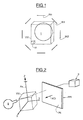
- each acquired image IAi is a subtracted image which is, for example, obtained by means of standard logarithmic subtraction technique from two X-rays taken at the same incidence, before and after the injection of a contrast medium into the vascular tree whose three-dimensional image is intended to be reconstructed.
- Each acquired image IAi is obtained from a two-dimensional radiation detector, for example of the luminance amplifier type used in radiology, disposed opposite the X-ray tube in a plane called the projection plane PPi.
- the various projection planes are obtained from the various angular positions of the detector rotating around the patient's head.
- the normal XOi to the projection plane PPi defines the optical axis of the acquired image IAi.
- the detector is connected to processing means 3 specifically comprising sampling means connected to a microprocessor incorporating in software form in its associated program memory the algebraic image reconstruction algorithm used in the invention and in general, all of the functional means that allow the imple-mentation of the process according to the invention.
- the geometric operation involved in the production of the acquired image is a conical projection of a scanned object, which occupies a three-dimensional space, into a two-dimensional space which is that of the projection plane corresponding to the detection plane.
- the geometric parameters that completely describe the various conical projections must be known. It is too imprecise, and often impossible, to access these parameters directly, i.e., for example by directly measuring the distance between the X-ray source and the detector in the acquisition system.
- a frequently used shape for a geometric calibration phantom is that of a cube in whose eight corners are disposed metal balls that are opaque to X-rays.
- Calibration being an operation that is known to one skilled in the art, it will not be described in further detail, in that several publications have already described the principle of a manual geometric calibration. The following articles in particular may be cited:
- the calibration of the imaging system makes it possible, in particular, to determine the estimated mean axis of rotation Ax of the imaging apparatus around the object as well as the position of the source 2 and the geometric characteristics of the optical axes of the various images acquired.
- the calibration also makes it possible to define a virtual volume VV (the intersection of the various projection cones) surround-ing the object 1 and broken down into elementary volume elements Vi or "voxels.”
- This volume VV, and therefore each voxel Vi is spatially located in a repository, hereinafter called the calibration repository, one of whose axes, in this case the Z axis, is the same as the estimated axis of rotation Ax.
- the calibration repository one of whose axes, in this case the Z axis, is the same as the estimated axis of rotation Ax.
- the projection planes PPi into which the acquired images IAi are projected are generally not parallel to the axis Z.
- the calibration also makes it possible to define for each acquired image IAi a projection matrix Pi that makes it possible to determine, for each voxel Vi, the coordinates of its projection (pixel) into the corresponding acquired image IAi.
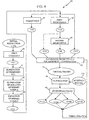
- the algebraic image reconstruction algorithm is applied directly to the acquired images IAi (obtained after the calibration 30 and the acquisition 31) in order to deliver the reconstructed three-dimensional image IF, typically with three iterations.
- the basic principle of the image reconstruction algorithm according to the invention consists of initializing the voxels of the volume to a predetermined initial value, for example the null value, and of subsequently performing a certain number of iterations, typically three.
- Each iteration comprises, for each acquired image, the projection of the voxels into the plane of each acquired image so as to obtain a virtual image, the determination of the difference between the projected volume (virtual image) and the corresponding acquired image, followed by the projection of this difference back into the volume.
- an estimated value representing the density of the contrast medium injected into the X-rayed vessels is obtained for each voxel, making it possible to display the three-dimensional cartography of these X-rayed vessels (the image IF).
- the base resolution of the acquired images is typically equal to 512 (512 x 512 pixels)
- this base resolution is reduced to an initial resolution of one-half that (256), which amounts to regrouping the voxels of the volume into groups of eight, and to performing on each acquired image a regrouping of pixels into groups of four.
- a first iteration (step 40) is then performed and first density values are obtained for each of the voxels of the volume VV1.
- an elimination of voxels from the periphery of the volume VV1 is performed (step 41).
- this amounts to "peeling" the volume i.e., removing a superficial layer from the surface of the volume having, for example, a "thickness" of three voxels.
- An elimination of the isolated bright voxels is then performed (step 42). In other words, all the voxels having a density value higher than a predetermined threshold, and whose adjacent voxels do not have density values higher than this threshold, are eliminated.
- step 43 an expansion of the bright voxels, i.e., an expansion of the voxels whose density value is higher than a predetermined threshold t3, is performed.
- each voxel whose density value is higher than the threshold t3 is assigned the maximum density obtained among the density value of said voxel and the density values of the voxels adjacent to this voxel.
- voxels of the volume VV2 whose density value is higher than a first predetermined threshold t 1 are selected. These voxels are then subdivided into 8 (step 44) so as to obtain subdivided voxels forming a first subset VV3 and corresponding to an image resolution of double the initial resolution, i.e., to the base resolution equal to 512.
- Those among the non-subdivided voxels of the volume VV2 that can be regrouped in accordance with a regrouping criterion are selected. This set of voxels, regrouped into groups of eight, will be used to form a second subset of voxels corresponding to a resolution of half the initial resolution, i.e., to a resolution of 128.
- the regrouping criterion is as follows:
- a voxel can be regrouped with the seven adjacent voxels if the coordinates of its center are each a multiple of two and if the value of the density of each of the seven adjacent voxels is also less than the threshold ti. If either of these two conditions is not met, then even if a voxel has a density lower than the threshold ti, it cannot be re-grouped and will therefore remain as is.
- a sub-set VV4 of regrouped voxels corresponding to a resolution of 128 is obtained, as well as a subset VV7 of non-regrouped voxels having a density lower than the first threshold ti and therefore corresponding to a resolution of 256.
- the same regrouping criterion is advantageously applied to the subset VV4, in order to perform a second regrouping of voxels that have already been regrouped so as to obtain subset VV6 of voxels derived from the subset VV4 and again regrouped Into groups of eight, and hence corresponding to a resolution of 64.
- a voxel of the subset VV4 could be regrouped with its seven adjacent voxels if the coordinates are multiples of two and if each of these seven adjacent voxels also has a density lower than the first threshold t 1 .
- the voxels of the subset VV4 that were not able to be regrouped a second time form the subset VV5, corresponding to the resolution 128.
- step 47 for each acquired image, a virtual image is generated which corresponding to the projection of the voxels into the acquisition plane of said acquired image.
- an elementary virtual image with a resolution of 64 is generated by projection.
- Each pixel is then divided in four in order to obtain four times as many pixels and to enlarge this elementary virtual image so as to bring it to a resolution of 128.
- the voxels of the volume VV5 (corresponding to the resolution 128) are projected into the same plane, in order to define the elementary virtual image having a resolution of 128, which is added pixel by pixel to the preceding enlarged virtual image, also having a resolution of 128.
- a composite image having a resolution of 128 is obtained, in which each pixel is again divided in four in order to obtain four times as many pixels, and in order to thereby obtain an enlarged virtual image having a resolution of 256.
- the voxels of the subset VV7 are projected so as to obtain the elementary virtual image having a resolution of 256, which is combined with the enlarged image having a resolution of 256 in order to obtain the intermediate virtual image having a resolution of 256.
- this intermediate image having a resolution of 256 is enlarged in a way similar to that just described, in order to obtain an enlarged image having a resolution of 512, which is added pixel by pixel to the projection of the voxels of the subset VV3, in order to ultimately obtain the virtual image IVi having a resolution of 512 and corres-ponding to the projection of the voxels of the volume VV2 in the plane of the acquired image IAi.
- the difference between the virtual image IVi and the acquired image IAi is calculated (step 48).
- step 49 a retroprojection of this difference (step 49) is performed in order to respectively correct the density values of the respective subsets VV3, VV5, VV6 and VV7.
- a third iteration is then performed and ultimately, a three-dimensional representation of the X-rayed object is obtained.
- the image reconstruction algorithm according to the invention therefore operates, in the second and third iterations, on approximately 7 million voxels, which are split into about 6 million voxels having a resolution of 512, 300,000 voxels having a resolution of 256, 82,000 voxels having a resolution of 128, and 100,000 voxels having a resolution of 64.
- the first detection threshold ti is predetermined so as to have a maximum number on the order of 6 million, for the voxels having a resolution of 512.
- voxels having a resolution of 512 correspond to the X-rayed blood vessels, while the other voxels correspond to the adjacent and more distant areas.
- the voxels having a resolution of 64 correspond, in the case of a brain X-ray, to the demi-hemisphere of the brain that is not involved in the injection of the contrast medium.
Landscapes
- Engineering & Computer Science (AREA)
- Health & Medical Sciences (AREA)
- Life Sciences & Earth Sciences (AREA)
- Physics & Mathematics (AREA)
- Medical Informatics (AREA)
- General Physics & Mathematics (AREA)
- Theoretical Computer Science (AREA)
- Radiology & Medical Imaging (AREA)
- Surgery (AREA)
- Nuclear Medicine, Radiotherapy & Molecular Imaging (AREA)
- Optics & Photonics (AREA)
- Pathology (AREA)
- Biophysics (AREA)
- Biomedical Technology (AREA)
- Heart & Thoracic Surgery (AREA)
- Molecular Biology (AREA)
- High Energy & Nuclear Physics (AREA)
- Animal Behavior & Ethology (AREA)
- General Health & Medical Sciences (AREA)
- Public Health (AREA)
- Veterinary Medicine (AREA)
- Apparatus For Radiation Diagnosis (AREA)
- Image Generation (AREA)
- Image Processing (AREA)
- Transforming Light Signals Into Electric Signals (AREA)
- Studio Devices (AREA)
- Image Analysis (AREA)
Claims (10)
- Verfahren zum Rekonstruieren eines dreidimensionalen Bildes von einem Objekt aus einem Satz numerierter projizierter zweidimensionaler Pixelbilder von dem Objekt, die aus verschiedenen Positionen von einem Bildgebungssystem um das Objekt herum erhalten werden, enthaltend die Schritte:Kalibrieren (30) des Bildgebungssystems,Generieren eines virtuellen Volumens, das das Objekt umgibt und in Voxel (vi) unterteilt ist,Gewinnen (31) des Satzes numerierter projizierter zweidimensionaler Pixelbilder undRekonstruieren (31) des dreidimensionalen Bildes aus den projizierten gewonnenen zweidimensionalen Pixelbildern und aus einem iterativen algebraischen dreidimensionalen Bildrekonstruktions-Algorithmus, dadurch gekennzeichnet, dasseine erste Iteration der algebraischen Bildrekonstruktion mit einer vorbestimmten Anfangs-Pixelauflösung ausgeführt wird, um, am Ende dieser ersten Iteration, erste Dichtewerte für Voxel des Volumens (VV1) zu erhalten, die bei einer Anfangs-Voxelauflösung erhalten werden, die einer Anfangs-Pixelauflösung entspricht,eine Multiauflösungs-Volumenunterteilung erhalten wird durch Unterteilen (44) wenigstens eines Teils (VV2) der Voxel des virtuellen Volumens (VV1) in mehrere bestimmte Sätze (VV3, VV5, VV7) von entsprechend unterschiedlichen Voxelauflösungen, die auf entsprechende Weise unterschiedlichen Pixelauflösungen entsprechen, die die Anfangs-Pixelauflösung und auch Vielfache und Untervielfache der Anfangsauflösungen enthalten, undwährend jeder nachfolgenden Iteration des Algorithmus die algebraische Bildrekonstruktion sukkzessive auf jeden dieser Sätze (VV3, VV5, VV7) der Voxel angewendet wird, so dass die iterative algebraische Bildrekonstruktion unter Verwendung der Multiauflösungs-Volumenunterteilung ausgeführt wird.
- Verfahren nach Anspruch 1, wobei während jeder nachfolgenden Iteration des Algorithmus ein virtuelles Bild (IVi) für jedes projizierte gewonnene Bild ermittelt wird, indem die elementaren virtuellen Bilder, die auf entsprechende Weise aus den Projektionen der entsprechenden Voxelsätze erhalten werden, in die Gewinnungsebene des projizierten gewonnenen Bildes aufeinanderfolgend verknüpft (47) werden.
- Verfahren nach Anspruch 2, wobei die elementaren virtuellen Bilder (IVi) in der ansteigenden Reihenfolge der Auflösungswerte generiert werden, wobei mit dem elementaren virtuellen Bild begonnen wird, das dem kleinsten Auflösungswert entspricht, und nachdem ein elementares virtuelles Bild ermittelt wird, eine Skalierung ausgeführt wird, um ein vergrössertes virtuelles Bild zu erhalten, dessen Auflösung derjenigen des nächsten elementaren virtuellen Bildes entspricht, das zu ermitteln ist, und das vergrösserte virtuelle Bild mit dem nächsten elementaren virtuellen Bild verknüpft wird.
- Verfahren nach einem der vorstehenden Ansprüche, wobei projizierte zweidimensionale Bilder, die eine vorbestimmte Basisauflösung (r=512) haben, gewonnen werden, eine Anfangsauflösung (r/2) gewählt wird, die gleich einem Untervielfachen der Basisauflösung ist, und aus den unterschiedlichen Bildauflösungen ausgewählt wird, die die Basisauflöung (r), die Anfangsauflösung (r/2) und wenigstens eine erste zusätzliche Auflösung (r/4=128) sind, die ein Untervielfaches der Anfangsauflösung (r/2=256) ist.
- Verfahren nach einem der vorstehenden Ansprüche, wobei ein erster Dichte-Schwellenwert (t1) als eine Funktion eines vorbestimmten Auswahlkriteriums generiert wird, wobei jedes Voxel, das eine Dichte hat, die höher oder gleich dem ersten Schwellenwert ist, in eine erste Anzahl unterteilter Voxel unterteilt wird, wobei die erste Anzahl auf der Basis der Beziehung zwischen der Basisauflösung und der Anfangsauflösung definiert wird, wobei alle unterteilten Voxel einen ersten Satz von Voxeln (VV3) bilden, die der Basisauflösung entsprechen, wenigstens einige der Voxel, deren Dichte kleiner als der erste Schwellenwert ist und die ein vorbestimmtes Umgruppierungskriterium erfüllen, umgruppiert werden, um so umgruppierte Voxel zu bilden, die zusammen einen zweiten Satz von Voxeln (VV5) bilden, die der ersten zusätzlichen Auflösung entsprechen, wobei die Anzahl umgruppierter Voxel in jeder Gruppe auf der Beziehung zwischen der Anfangsauflösung und der ersten zusätzlichen Auflösung basiert, und dass die Voxel, deren Dichte kleiner als der erste Schwellenwert ist und die das vorbestimmte Umgruppierungskriterium nicht erfüllen, einen dritten Satz von Voxeln (VV7) bilden, die der Anfangsauflösung entsprechen.
- Verfahren nach Anspruch 5, wobei ein Voxel das Umgruppierungskriterium erfüllt, wenn jede der Koordinaten von der Voxelmitte ein Vielfaches von 2 ist und wenn die Dichte von jedem voxel neben diesem Voxel kleiner als der erste Schwellenwert ist.
- Verfahren nach Anspruch 5 oder 6, wobei die umgruppierten Voxel, die das Umgruppierungskriterium erfüllen, umgruppiert werden (46), um einen vierten Satz von Voxeln (VV6) zu bilden, die einer zweiten zusätzlichen Auflösung entsprechen, die ein Untervielfaches der ersten zusätzlichen Auflösung ist.
- Verfahren nach einem der vorstehenden Ansprüche, wobei der Teil (VV2) der Voxel des virtuellen Volumens, der unterteilt wird (44), dadurch erhalten wird, dass die Voxel, die in einer Schicht vorbestimmter Dicke der Oberfläche des Volumens angeordnet sind, eliminiert werden (41).
- Verfahren nach einem der vorstehenden Ansprüche, wobei der Teil (VV2) der Voxel des virtuellen Volumens, der unterteilt wird, dadurch erhalten wird, dass die isolierten Voxel, deren Dichte grösser als ein zweiter vorbestimmter Schwellenwert ist, eliminiert werden (42).
- Verfahren nach einem der vorstehenden Ansprüche, wobei nach der ersten Iteration des Algorithmus jedem Voxel, dessen Dichtewert grösser als ein dritter vorbestimmter Schwellenwert (t3) ist, ein Dichtewert zugeordnet wird, der gleich dem maximalen Dichtewert ist, der unter den Dichtewerten des Voxels und den benachbarten Voxeln erhalten wird.
Applications Claiming Priority (2)
| Application Number | Priority Date | Filing Date | Title |
|---|---|---|---|
| FR9807371 | 1998-06-11 | ||
| FR9807371A FR2779853B1 (fr) | 1998-06-11 | 1998-06-11 | Procede de reconstruction d'une image tridimensionnelle d'un objet, en particulier une image tridimensionnelle angiographique |
Publications (2)
| Publication Number | Publication Date |
|---|---|
| EP0964366A1 EP0964366A1 (de) | 1999-12-15 |
| EP0964366B1 true EP0964366B1 (de) | 2004-10-20 |
Family
ID=9527277
Family Applications (1)
| Application Number | Title | Priority Date | Filing Date |
|---|---|---|---|
| EP99304406A Expired - Lifetime EP0964366B1 (de) | 1998-06-11 | 1999-06-07 | Dreidimensionales Bildrekonstruktionsverfahren |
Country Status (5)
| Country | Link |
|---|---|
| US (1) | US6510241B1 (de) |
| EP (1) | EP0964366B1 (de) |
| JP (1) | JP2000051204A (de) |
| DE (1) | DE69921234T2 (de) |
| FR (1) | FR2779853B1 (de) |
Cited By (6)
| Publication number | Priority date | Publication date | Assignee | Title |
|---|---|---|---|---|
| US8775510B2 (en) | 2007-08-27 | 2014-07-08 | Pme Ip Australia Pty Ltd | Fast file server methods and system |
| US8976190B1 (en) | 2013-03-15 | 2015-03-10 | Pme Ip Australia Pty Ltd | Method and system for rule based display of sets of images |
| US9019287B2 (en) | 2007-11-23 | 2015-04-28 | Pme Ip Australia Pty Ltd | Client-server visualization system with hybrid data processing |
| US9355616B2 (en) | 2007-11-23 | 2016-05-31 | PME IP Pty Ltd | Multi-user multi-GPU render server apparatus and methods |
| US9454813B2 (en) | 2007-11-23 | 2016-09-27 | PME IP Pty Ltd | Image segmentation assignment of a volume by comparing and correlating slice histograms with an anatomic atlas of average histograms |
| US9509802B1 (en) | 2013-03-15 | 2016-11-29 | PME IP Pty Ltd | Method and system FPOR transferring data to improve responsiveness when sending large data sets |
Families Citing this family (66)
| Publication number | Priority date | Publication date | Assignee | Title |
|---|---|---|---|---|
| US7212311B2 (en) * | 1999-12-28 | 2007-05-01 | Fujifilm Corporation | Image processing condition setting apparatus and image processing condition setting program storage medium |
| US8256430B2 (en) | 2001-06-15 | 2012-09-04 | Monteris Medical, Inc. | Hyperthermia treatment and probe therefor |
| FR2812741B1 (fr) | 2000-08-02 | 2003-01-17 | Ge Med Sys Global Tech Co Llc | Procede et dispositif de reconstruction d'une image tridimensionnelle dynamique d'un objet parcouru par un produit de contraste |
| FR2824164B1 (fr) | 2001-04-26 | 2003-08-15 | Ge Med Sys Global Tech Co Llc | Systeme d'imagerie medicale a affichage d'une representation tridimensionnelle |
| US7079996B2 (en) * | 2001-05-30 | 2006-07-18 | Ford Global Technologies, Llc | System and method for design of experiments using direct surface manipulation of a mesh model |
| US6930683B2 (en) * | 2002-04-19 | 2005-08-16 | Hewlett-Packard Development Company, L.P. | Three-dimensional reconstruction method utilizing reprojective optimization |
| US6862335B2 (en) * | 2003-06-27 | 2005-03-01 | General Electric Company | System and method for iterative reconstruction of cone beam tomographic images |
| US7424141B2 (en) * | 2003-08-29 | 2008-09-09 | Agilent Technologies, Inc. | System and method for performing auto-focused tomosynthesis |
| WO2005031635A1 (en) | 2003-09-25 | 2005-04-07 | Paieon, Inc. | System and method for three-dimensional reconstruction of a tubular organ |
| US7308297B2 (en) | 2003-11-05 | 2007-12-11 | Ge Medical Systems Global Technology Company, Llc | Cardiac imaging system and method for quantification of desynchrony of ventricles for biventricular pacing |
| US7693318B1 (en) | 2004-01-12 | 2010-04-06 | Pme Ip Australia Pty Ltd | Method and apparatus for reconstruction of 3D image volumes from projection images |
| US20050270298A1 (en) * | 2004-05-14 | 2005-12-08 | Mercury Computer Systems, Inc. | Daughter card approach to employing multiple graphics cards within a system |
| DE102004025685A1 (de) * | 2004-05-26 | 2005-12-22 | Siemens Ag | Verfahren zur Bilderzeugung mit einer bildgebenden Modalität |
| FR2878054A1 (fr) * | 2004-11-18 | 2006-05-19 | Norbert Beyrard France S A R L | Procede destine a reduire l'exposition a des radiations, des faisceaux a lumiere infrarouge, ultrasoniques ou des impulsions magnetiques dans des dispositifs d'imagerie medicale |
| WO2006003312A2 (fr) | 2004-06-16 | 2006-01-12 | Norbert Beyrard | Procede destine a reduire l'exposition a des radiations, des faisceaux a lumiere infrarouge, ultrasoniques ou des impulsions magnetiques dans des dispositifs d’imagerie medicale |
| US7734119B2 (en) * | 2004-09-21 | 2010-06-08 | General Electric Company | Method and system for progressive multi-resolution three-dimensional image reconstruction using region of interest information |
| US8189002B1 (en) | 2004-10-29 | 2012-05-29 | PME IP Australia Pty, Ltd. | Method and apparatus for visualizing three-dimensional and higher-dimensional image data sets |
| US7778392B1 (en) | 2004-11-02 | 2010-08-17 | Pme Ip Australia Pty Ltd | Method of reconstructing computed tomography (CT) volumes suitable for execution on commodity central processing units (CPUs) and graphics processors, and apparatus operating in accord with those methods (rotational X-ray on GPUs) |
| US7609884B1 (en) | 2004-12-23 | 2009-10-27 | Pme Ip Australia Pty Ltd | Mutual information based registration of 3D-image volumes on GPU using novel accelerated methods of histogram computation |
| US8774560B2 (en) * | 2005-01-11 | 2014-07-08 | University Of Central Florida Research Foundation, Inc. | System for manipulation, modification and editing of images via remote device |
| US20060184066A1 (en) * | 2005-02-15 | 2006-08-17 | Baylor College Of Medicine | Method for aiding stent-assisted coiling of intracranial aneurysms by virtual parent artery reconstruction |
| FI20055168A0 (fi) * | 2005-04-13 | 2005-04-13 | Gen Electric | Tomografiamenetelmä |
| US7623732B1 (en) | 2005-04-26 | 2009-11-24 | Mercury Computer Systems, Inc. | Method and apparatus for digital image filtering with discrete filter kernels using graphics hardware |
| US20080162090A1 (en) * | 2006-12-27 | 2008-07-03 | Ernest Clay Perry | System, methods, and computer readable media, for product design using t-spline deformation |
| US20080275677A1 (en) * | 2007-03-19 | 2008-11-06 | Optimal Solutions Software, Llc | System, methods, and computer readable media, for product design using coupled computer aided engineering models |
| US8019151B2 (en) * | 2007-06-11 | 2011-09-13 | Visualization Sciences Group, Inc. | Methods and apparatus for image compression and decompression using graphics processing unit (GPU) |
| JP2009045092A (ja) * | 2007-08-13 | 2009-03-05 | Canon Inc | Ct撮影装置及びその制御方法 |
| US10311541B2 (en) | 2007-11-23 | 2019-06-04 | PME IP Pty Ltd | Multi-user multi-GPU render server apparatus and methods |
| US9904969B1 (en) | 2007-11-23 | 2018-02-27 | PME IP Pty Ltd | Multi-user multi-GPU render server apparatus and methods |
| US10070903B2 (en) | 2008-01-09 | 2018-09-11 | Stryker European Holdings I, Llc | Stereotactic computer assisted surgery method and system |
| JP2011510757A (ja) * | 2008-01-30 | 2011-04-07 | ザ リージェンツ オブ ザ ユニヴァーシティー オブ カリフォルニア | 対象の周囲を動的な束縛として使用することによる、トモグラフィにおける放射線量低減および画質向上 |
| CN102123664B (zh) * | 2008-08-13 | 2014-05-07 | 皇家飞利浦电子股份有限公司 | 使用旋转中心寻找算法进行环形伪影校正的校准方法 |
| US8184887B2 (en) * | 2008-08-29 | 2012-05-22 | General Electric Company | System and method for image reconstruction |
| US8979871B2 (en) | 2009-08-13 | 2015-03-17 | Monteris Medical Corporation | Image-guided therapy of a tissue |
| KR20110026910A (ko) * | 2009-09-09 | 2011-03-16 | 현대중공업 주식회사 | 선박블록 운영관리장치 |
| US10588647B2 (en) | 2010-03-01 | 2020-03-17 | Stryker European Holdings I, Llc | Computer assisted surgery system |
| GB201008281D0 (en) | 2010-05-19 | 2010-06-30 | Nikonovas Arkadijus | Indirect analysis and manipulation of objects |
| WO2012003850A1 (en) * | 2010-07-09 | 2012-01-12 | Ge Sensing & Inspection Technologies Gmbh | Computed tomography method, computer program, computing device and computed tomography system |
| CA2804812C (en) | 2010-07-16 | 2015-02-17 | Stryker Trauma Gmbh | Surgical targeting system and method |
| WO2014048447A1 (en) * | 2012-09-27 | 2014-04-03 | Stryker Trauma Gmbh | Rotational position determination |
| US9039706B2 (en) | 2013-03-13 | 2015-05-26 | DePuy Synthes Products, Inc. | External bone fixation device |
| JP6382293B2 (ja) | 2013-03-13 | 2018-08-29 | デピュイ・シンセス・プロダクツ・インコーポレイテッド | 外部骨固定装置 |
| US8864763B2 (en) | 2013-03-13 | 2014-10-21 | DePuy Synthes Products, LLC | External bone fixation device |
| US10540803B2 (en) | 2013-03-15 | 2020-01-21 | PME IP Pty Ltd | Method and system for rule-based display of sets of images |
| US10070839B2 (en) | 2013-03-15 | 2018-09-11 | PME IP Pty Ltd | Apparatus and system for rule based visualization of digital breast tomosynthesis and other volumetric images |
| US11183292B2 (en) | 2013-03-15 | 2021-11-23 | PME IP Pty Ltd | Method and system for rule-based anonymized display and data export |
| US11244495B2 (en) | 2013-03-15 | 2022-02-08 | PME IP Pty Ltd | Method and system for rule based display of sets of images using image content derived parameters |
| US9492121B2 (en) | 2014-03-18 | 2016-11-15 | Monteris Medical Corporation | Image-guided therapy of a tissue |
| US9700342B2 (en) | 2014-03-18 | 2017-07-11 | Monteris Medical Corporation | Image-guided therapy of a tissue |
| US10675113B2 (en) | 2014-03-18 | 2020-06-09 | Monteris Medical Corporation | Automated therapy of a three-dimensional tissue region |
| US10327830B2 (en) | 2015-04-01 | 2019-06-25 | Monteris Medical Corporation | Cryotherapy, thermal therapy, temperature modulation therapy, and probe apparatus therefor |
| US11599672B2 (en) | 2015-07-31 | 2023-03-07 | PME IP Pty Ltd | Method and apparatus for anonymized display and data export |
| US9984478B2 (en) | 2015-07-28 | 2018-05-29 | PME IP Pty Ltd | Apparatus and method for visualizing digital breast tomosynthesis and other volumetric images |
| US10368822B2 (en) * | 2015-08-31 | 2019-08-06 | General Electric Company | Iterative X-ray imaging optimization method and system |
| US11127174B2 (en) | 2016-01-25 | 2021-09-21 | Adaptix Ltd. | Medical imaging system with a fixed array of x-ray detectors and a fixed array of x-ray emitters for producing a digital 3-dimensional image |
| US10835318B2 (en) | 2016-08-25 | 2020-11-17 | DePuy Synthes Products, Inc. | Orthopedic fixation control and manipulation |
| DE102016226336A1 (de) * | 2016-12-30 | 2018-07-05 | Siemens Healthcare Gmbh | Verfahren und Vorrichtung zur Erzeugung eines zweidimensionalen Projektionsbildes aus einem dreidimensionalen Bilddatensatz |
| US10909679B2 (en) | 2017-09-24 | 2021-02-02 | PME IP Pty Ltd | Method and system for rule based display of sets of images using image content derived parameters |
| FR3076203B1 (fr) | 2017-12-28 | 2019-12-20 | Thales | Procede et systeme pour calibrer un systeme d'imagerie a rayons x |
| JP7138858B2 (ja) * | 2018-07-04 | 2022-09-20 | 国立大学法人 東京大学 | フィルタ逆投影法によるct再構成処理方法 |
| US11439436B2 (en) | 2019-03-18 | 2022-09-13 | Synthes Gmbh | Orthopedic fixation strut swapping |
| US11304757B2 (en) | 2019-03-28 | 2022-04-19 | Synthes Gmbh | Orthopedic fixation control and visualization |
| US11334997B2 (en) | 2020-04-03 | 2022-05-17 | Synthes Gmbh | Hinge detection for orthopedic fixation |
| CN114979610B (zh) | 2021-02-26 | 2025-02-25 | 微软技术许可有限责任公司 | 用于3d场景重构的图像传输 |
| EP4120201B1 (de) * | 2021-07-16 | 2026-02-11 | Dassault Systèmes | Voxelisierung eines medizinischen 3d-strukturbild des menschlichen gehirns |
| CN117132663B (zh) * | 2023-08-03 | 2025-10-03 | 浙江大学 | 一种基于标定球旋转的束调整平差三维重建的标定方法 |
Family Cites Families (8)
| Publication number | Priority date | Publication date | Assignee | Title |
|---|---|---|---|---|
| FR2597227B1 (fr) * | 1986-04-14 | 1992-09-11 | Pixar | Procede pour produire un affichage bidimensionnel representant un ensemble de donnees tridimensionnelles |
| FR2644590B1 (fr) | 1989-03-20 | 1994-08-19 | General Electric Cgr Sa | Procede d'acquisition de donnees radiologiques et de reconstruction de structures correspondant a ce corps |
| FR2656129B1 (fr) | 1989-12-20 | 1992-03-13 | Gen Electric Cgr | Procede de reconstruction multi-echelle de l'image de la structure d'un corps. |
| FR2700909B1 (fr) | 1993-01-27 | 1995-03-17 | Gen Electric Cgr | Dispositif et procédé automatique de calibration géométrique d'un système d'imagerie par rayons X. |
| US5588033A (en) * | 1995-06-06 | 1996-12-24 | St. Jude Children's Research Hospital | Method and apparatus for three dimensional image reconstruction from multiple stereotactic or isocentric backprojections |
| US5841890A (en) * | 1996-05-06 | 1998-11-24 | Northrop Grumman Corporation | Multi-dimensional wavelet tomography |
| FR2752975B1 (fr) * | 1996-09-04 | 1998-12-04 | Ge Medical Syst Sa | Procede de reconstruction d'une image tridimensionnelle d'un objet, en particulier une image tridimentionnelle angiographique |
| US5963612A (en) * | 1997-12-31 | 1999-10-05 | Siemens Corporation Research, Inc. | Apparatus for C-arm calibration for 3D reconstruction in an imaging system utilizing planar transformation |
-
1998
- 1998-06-11 FR FR9807371A patent/FR2779853B1/fr not_active Expired - Fee Related
-
1999
- 1999-06-04 US US09/326,013 patent/US6510241B1/en not_active Expired - Lifetime
- 1999-06-07 DE DE69921234T patent/DE69921234T2/de not_active Expired - Fee Related
- 1999-06-07 EP EP99304406A patent/EP0964366B1/de not_active Expired - Lifetime
- 1999-06-11 JP JP11164958A patent/JP2000051204A/ja not_active Withdrawn
Non-Patent Citations (1)
| Title |
|---|
| Trousset Y. et al: SPIE, VOL. 1231, MEDICAL IMAGING IV: IMAGE FORMATION (1990), 'MULTISCALE CONE-BEAM X-RAY RECONSTRUCTION', pp. 229-238 * |
Cited By (10)
| Publication number | Priority date | Publication date | Assignee | Title |
|---|---|---|---|---|
| US8775510B2 (en) | 2007-08-27 | 2014-07-08 | Pme Ip Australia Pty Ltd | Fast file server methods and system |
| US9167027B2 (en) | 2007-08-27 | 2015-10-20 | PME IP Pty Ltd | Fast file server methods and systems |
| US9531789B2 (en) | 2007-08-27 | 2016-12-27 | PME IP Pty Ltd | Fast file server methods and systems |
| US9019287B2 (en) | 2007-11-23 | 2015-04-28 | Pme Ip Australia Pty Ltd | Client-server visualization system with hybrid data processing |
| US9355616B2 (en) | 2007-11-23 | 2016-05-31 | PME IP Pty Ltd | Multi-user multi-GPU render server apparatus and methods |
| US9454813B2 (en) | 2007-11-23 | 2016-09-27 | PME IP Pty Ltd | Image segmentation assignment of a volume by comparing and correlating slice histograms with an anatomic atlas of average histograms |
| US9595242B1 (en) | 2007-11-23 | 2017-03-14 | PME IP Pty Ltd | Client-server visualization system with hybrid data processing |
| US8976190B1 (en) | 2013-03-15 | 2015-03-10 | Pme Ip Australia Pty Ltd | Method and system for rule based display of sets of images |
| US9509802B1 (en) | 2013-03-15 | 2016-11-29 | PME IP Pty Ltd | Method and system FPOR transferring data to improve responsiveness when sending large data sets |
| US9524577B1 (en) | 2013-03-15 | 2016-12-20 | PME IP Pty Ltd | Method and system for rule based display of sets of images |
Also Published As
| Publication number | Publication date |
|---|---|
| US6510241B1 (en) | 2003-01-21 |
| FR2779853A1 (fr) | 1999-12-17 |
| JP2000051204A (ja) | 2000-02-22 |
| DE69921234T2 (de) | 2005-10-13 |
| EP0964366A1 (de) | 1999-12-15 |
| FR2779853B1 (fr) | 2000-08-11 |
| DE69921234D1 (de) | 2004-11-25 |
Similar Documents
| Publication | Publication Date | Title |
|---|---|---|
| EP0964366B1 (de) | Dreidimensionales Bildrekonstruktionsverfahren | |
| JP3761094B2 (ja) | 対象物の3次元画像を再構成する方法 | |
| US6404843B1 (en) | Method of reconstruction of a three-dimensional image of elements of sharp contrast | |
| US5241471A (en) | Method of multi-scale reconstruction of the image of the structure of a body at an increased speed | |
| US6549606B1 (en) | Method of reconstruction of a section of an element of interest | |
| US4989142A (en) | Three-dimensional images obtained from tomographic slices with gantry tilt | |
| JP2744490B2 (ja) | 物体内部構造表面の2次元像を表示する装置と方法 | |
| EP2126842B1 (de) | Bewegungsermittlung System zur Bestimmung der Bewegung eines sich periodisch bewegenden Objekts. | |
| JP5408641B2 (ja) | 局所化および高度に限定された画像再構成法 | |
| US7113631B2 (en) | Method and device for reconstruction of a dynamic three-dimensional image of an object covered by a contrast medium | |
| JP2001515378A (ja) | らせん走査ctスキャナにおけるオンライン画像再構成 | |
| EP0265334B1 (de) | Verfahren und System zur Konstruktion von dreidimensionalen Bildern | |
| CN1947154A (zh) | 使用截短的投影和在先采集的3d ct图像的锥形束ct设备 | |
| EP1352365A1 (de) | Verfahren zur abbildung des blutstroms in einem gefässbaum | |
| JPH0731739B2 (ja) | 2次元断層撮影スライスの中の面を抽出する方法と装置 | |
| JPH11326243A (ja) | Ctイメ―ジング装置を動作する方法及び走査及びデ―タ収集装置 | |
| US4953087A (en) | Three-dimensional images obtained from tomographic data having unequally spaced slices | |
| EP0928458B1 (de) | Eine computertomographische methode und ein computertomograph | |
| CN106981090B (zh) | 一种管内步进单向光束扫描断层图像的三维重建方法 | |
| US7215734B2 (en) | Method and system for three-dimensional reconstruction of images | |
| EP0318293B1 (de) | Vorrichtung und Verfahren zur tomographischen Datenverarbeitung | |
| CN1936958A (zh) | 用于从二维投影图像中重建三维图像体积的方法和装置 | |
| US6103350A (en) | Process for producing a restored sequence of images of a moving object from noisy measurements | |
| IL129201A (en) | 4d kappa 5 gaussian noise reduction | |
| US7702180B2 (en) | Imaging method and device for the computer-assisted evaluation of computer-tomographic measurements by means of direct iterative reconstruction |
Legal Events
| Date | Code | Title | Description |
|---|---|---|---|
| PUAI | Public reference made under article 153(3) epc to a published international application that has entered the european phase |
Free format text: ORIGINAL CODE: 0009012 |
|
| AK | Designated contracting states |
Kind code of ref document: A1 Designated state(s): DE NL |
|
| AX | Request for extension of the european patent |
Free format text: AL;LT;LV;MK;RO;SI |
|
| 17P | Request for examination filed |
Effective date: 20000615 |
|
| AKX | Designation fees paid |
Free format text: DE NL |
|
| 17Q | First examination report despatched |
Effective date: 20021002 |
|
| GRAP | Despatch of communication of intention to grant a patent |
Free format text: ORIGINAL CODE: EPIDOSNIGR1 |
|
| GRAS | Grant fee paid |
Free format text: ORIGINAL CODE: EPIDOSNIGR3 |
|
| GRAA | (expected) grant |
Free format text: ORIGINAL CODE: 0009210 |
|
| AK | Designated contracting states |
Kind code of ref document: B1 Designated state(s): DE NL |
|
| REF | Corresponds to: |
Ref document number: 69921234 Country of ref document: DE Date of ref document: 20041125 Kind code of ref document: P |
|
| PLBE | No opposition filed within time limit |
Free format text: ORIGINAL CODE: 0009261 |
|
| STAA | Information on the status of an ep patent application or granted ep patent |
Free format text: STATUS: NO OPPOSITION FILED WITHIN TIME LIMIT |
|
| 26N | No opposition filed |
Effective date: 20050721 |
|
| PGFP | Annual fee paid to national office [announced via postgrant information from national office to epo] |
Ref country code: NL Payment date: 20070624 Year of fee payment: 9 |
|
| PGFP | Annual fee paid to national office [announced via postgrant information from national office to epo] |
Ref country code: DE Payment date: 20070731 Year of fee payment: 9 |
|
| NLV4 | Nl: lapsed or anulled due to non-payment of the annual fee |
Effective date: 20090101 |
|
| PG25 | Lapsed in a contracting state [announced via postgrant information from national office to epo] |
Ref country code: DE Free format text: LAPSE BECAUSE OF NON-PAYMENT OF DUE FEES Effective date: 20090101 |
|
| PG25 | Lapsed in a contracting state [announced via postgrant information from national office to epo] |
Ref country code: NL Free format text: LAPSE BECAUSE OF NON-PAYMENT OF DUE FEES Effective date: 20090101 |