EP0959342A2 - Konzentrationsbestimmung - Google Patents
Konzentrationsbestimmung Download PDFInfo
- Publication number
- EP0959342A2 EP0959342A2 EP99850085A EP99850085A EP0959342A2 EP 0959342 A2 EP0959342 A2 EP 0959342A2 EP 99850085 A EP99850085 A EP 99850085A EP 99850085 A EP99850085 A EP 99850085A EP 0959342 A2 EP0959342 A2 EP 0959342A2
- Authority
- EP
- European Patent Office
- Prior art keywords
- mixture
- image
- component
- concentration
- tablet
- Prior art date
- Legal status (The legal status is an assumption and is not a legal conclusion. Google has not performed a legal analysis and makes no representation as to the accuracy of the status listed.)
- Withdrawn
Links
Images
Classifications
-
- B—PERFORMING OPERATIONS; TRANSPORTING
- B07—SEPARATING SOLIDS FROM SOLIDS; SORTING
- B07C—POSTAL SORTING; SORTING INDIVIDUAL ARTICLES, OR BULK MATERIAL FIT TO BE SORTED PIECE-MEAL, e.g. BY PICKING
- B07C5/00—Sorting according to a characteristic or feature of the articles or material being sorted, e.g. by control effected by devices which detect or measure such characteristic or feature; Sorting by manually actuated devices, e.g. switches
- B07C5/34—Sorting according to other particular properties
- B07C5/342—Sorting according to other particular properties according to optical properties, e.g. colour
- B07C5/3422—Sorting according to other particular properties according to optical properties, e.g. colour using video scanning devices, e.g. TV-cameras
-
- G—PHYSICS
- G01—MEASURING; TESTING
- G01N—INVESTIGATING OR ANALYSING MATERIALS BY DETERMINING THEIR CHEMICAL OR PHYSICAL PROPERTIES
- G01N21/00—Investigating or analysing materials by the use of optical means, i.e. using sub-millimetre waves, infrared, visible or ultraviolet light
- G01N21/17—Systems in which incident light is modified in accordance with the properties of the material investigated
- G01N21/25—Colour; Spectral properties, i.e. comparison of effect of material on the light at two or more different wavelengths or wavelength bands
- G01N21/31—Investigating relative effect of material at wavelengths characteristic of specific elements or molecules, e.g. atomic absorption spectrometry
- G01N21/35—Investigating relative effect of material at wavelengths characteristic of specific elements or molecules, e.g. atomic absorption spectrometry using infrared light
- G01N21/3577—Investigating relative effect of material at wavelengths characteristic of specific elements or molecules, e.g. atomic absorption spectrometry using infrared light for analysing liquids, e.g. polluted water
-
- G—PHYSICS
- G01—MEASURING; TESTING
- G01N—INVESTIGATING OR ANALYSING MATERIALS BY DETERMINING THEIR CHEMICAL OR PHYSICAL PROPERTIES
- G01N21/00—Investigating or analysing materials by the use of optical means, i.e. using sub-millimetre waves, infrared, visible or ultraviolet light
- G01N21/17—Systems in which incident light is modified in accordance with the properties of the material investigated
- G01N21/25—Colour; Spectral properties, i.e. comparison of effect of material on the light at two or more different wavelengths or wavelength bands
- G01N21/31—Investigating relative effect of material at wavelengths characteristic of specific elements or molecules, e.g. atomic absorption spectrometry
- G01N21/35—Investigating relative effect of material at wavelengths characteristic of specific elements or molecules, e.g. atomic absorption spectrometry using infrared light
- G01N21/359—Investigating relative effect of material at wavelengths characteristic of specific elements or molecules, e.g. atomic absorption spectrometry using infrared light using near infrared light
-
- G—PHYSICS
- G01—MEASURING; TESTING
- G01N—INVESTIGATING OR ANALYSING MATERIALS BY DETERMINING THEIR CHEMICAL OR PHYSICAL PROPERTIES
- G01N21/00—Investigating or analysing materials by the use of optical means, i.e. using sub-millimetre waves, infrared, visible or ultraviolet light
- G01N21/84—Systems specially adapted for particular applications
- G01N21/85—Investigating moving fluids or granular solids
-
- G—PHYSICS
- G01—MEASURING; TESTING
- G01N—INVESTIGATING OR ANALYSING MATERIALS BY DETERMINING THEIR CHEMICAL OR PHYSICAL PROPERTIES
- G01N21/00—Investigating or analysing materials by the use of optical means, i.e. using sub-millimetre waves, infrared, visible or ultraviolet light
- G01N21/17—Systems in which incident light is modified in accordance with the properties of the material investigated
- G01N21/25—Colour; Spectral properties, i.e. comparison of effect of material on the light at two or more different wavelengths or wavelength bands
- G01N21/31—Investigating relative effect of material at wavelengths characteristic of specific elements or molecules, e.g. atomic absorption spectrometry
- G01N21/35—Investigating relative effect of material at wavelengths characteristic of specific elements or molecules, e.g. atomic absorption spectrometry using infrared light
- G01N21/3563—Investigating relative effect of material at wavelengths characteristic of specific elements or molecules, e.g. atomic absorption spectrometry using infrared light for analysing solids; Preparation of samples therefor
Definitions
- the present invention relates to an apparatus for determining the concentration of a first component in a mixture of at least two components which have different absorption properties in the IR range.
- an active substance In the manufacture of pharmaceutical preparations, an active substance is in many cases mixed with an inactive substance to achieve a sufficient volume of the pharmaceutical preparation and to obtain suitable properties of the pharmaceutical preparation.
- the substances frequently have the form of powder consisting of a variety of particles. Moreover, it is normally large volumes of powder that are mixed to manufacture a large number of doses of the pharmaceutical preparation. It is then most important for the mixture to be homogeneous so that the concentration of the active substance is the same in all doses, for instance in all tablets, that are manufactured from the mixture.
- a further difficulty associated with the homogeneity arises in the manufacture of divisible tablets. Some tablets are formed with a notch indicating that these tablets may be divided to allow the user to take half a dose of the pharmaceutical preparation. For such tablets, the manufacturer must be able to guarantee that the concentration of the active substance is the desired one not only in the tablet in its entirety but also in each half of the tablet.
- the homogeneity in a powder mixture can be monitored by sampling the mixture at different points of time. If the concentration of the active substance is the desired in each sample, it is assumed that the mixture is homogeneous and that the concentration in all manufactured doses is correct. Correspondingly, when manufacturing tablets, random sampling of tablets from the manufacturing line is made and the concentration is determined. If the concentration is correct, it is assumed that all tablets have the correct concentration.
- the concentration of the active substance in powders and tablets is in many cases determined by a wet-chemical or dry-chemical method.
- a drawback of this method is that it is slow since it is necessary to generate an entire spectrum for each tablet. Further it is not possible to determine how the active substance is distributed in the tablet. Nor can the method be used to study particles of the size that exists in powders.
- An object of the present invention therefore is to provide an improved apparatus for determining the concentration of a first component in a mixture of at least two components.
- the invention concerns an apparatus of the type described by way of introduction and characterised by image recording means which are adapted to image the mixture by means of IR radiation to produce at least one image, on the basis of which it is possible to determine the concentration of said first component in the mixture.
- This apparatus thus is based on the idea that it is possible to use images and image analysis instead of spectrum and spectrum analysis to determine the concentration in a mixture. This is advantageous since it is a much quicker and much easier operation to record an image than to generate a spectrum which requires that the light be spectrally divided. This results, in turn, in the possibility of analysing all tablets in the manufacture, which yields a much greater safety than random sampling.
- An image further contains position information.
- the image of the mixture can thus supply information on how the components and, in particular, the active component are distributed in the mixture.
- the image recording means can be any means whatever that are sensitive to IR radiation and that render it possible to produce a two-dimensional "IR image". They may comprise, for instance, a line sensor which produces an image by scanning. They can record one or more images of the mixture, for instance, images that are based on IR radiation at different wavelengths.
- the image recording means can be adapted to carry out the imaging by means of IR radiation that is reflected from the mixture or transmitted through the mixture. Sometimes a combination of these alternatives can be advantageous.
- the advantage of using reflected radiation is that the position information will be improved so that it will be possible to determine, for instance, the distribution of the interesting component in a tablet or the like where the particles in the mixture are compressed into a unit.
- the drawback is that the reflected radiation supplies information merely on the particles to a certain level of penetration.
- IR radiation transmitted through a mixture supplies information on particles at all levels in the mixture.
- this IR radiation supplies poorer position information since the transmitted light is scattered by the particles on which it falls.
- the image recording means advantageously comprise a filter for selecting at least one wavelength at which the components have different absorption properties. The selection of a suitable wavelength/suitable wavelengths is made individually for each specific substance that is to be monitored. In this manner, a monochromatic image of the mixture is produced.
- the image recording means may comprise at least two filters for performing the imaging by means of IR radiation from two different wavelengths ranges to produce an image of the mixture in "IR colour” in a manner corresponding to that in which ordinary colour images with red, green and blue light are produced.
- the IR radiation is advantageously NIR radiation since biologically active substances included in, inter alia, pharmaceutical preparations in most cases have characteristic absorption properties in the NIR range.
- An electronic image is composed of a large number of pixels each having one or more intensity values.
- each pixel has at least one IR intensity value which yields a measure of the intensity of the IR radiation which has fallen on a corresponding point on a sensor in the image recording means. Knowing the absorption properties of the components contained in the imaged mixture in respect of the IR wavelengths involved, it is then possible to determine which pixels represent the different components and, thus, the concentration thereof.
- the apparatus therefore suitably comprises image processing means which are adapted to determine, with the aid of intensity values for pixels in the image of the mixture, the concentration of said first component in the mixture.
- the image processing means can advantageously consist of a suitably programmed computer. If the image of the mixtures is monochromatic, the computer can determine, for instance, the concentration of the interesting component by using threshold values for the intensity values. If the image is in "IR colour", the "IR colour” can instead be used for determining the concentration.
- the apparatus is advantageously also adapted to determine, on the basis of the image of the mixture, the distribution of the first component in the mixture. This can also be carried out by means of a suitably programmed computer.
- the apparatus can be used to determine the concentration of a component in a number of different mixtures.
- the mixture may consist of, for instance, a plurality of particles which are suspended in a liquid or gas.
- the mixture may also consist of a single particle containing different substances. It may also consist of droplets of a first component in an emulsion.
- the apparatus is used to determine the concentration of the first component in a mixture which is present in the form of an ointment on a carrier, such as an adhesive plaster. It is becoming more and more common to dose pharmaceutical preparations as an ointment on an adhesive plaster.
- a carrier such as an adhesive plaster.
- the invention makes it possible to easily determine both the concentration and the distribution of the active substance on each piece of adhesive plaster. This is advantageous since the later in the manufacturing process the quality control can be performed the greater reliability is achieved.
- the apparatus can be used to determine the concentration of the first component in the mixture when the mixture is in the form of separate particles, e.g. particles that exist freely from each other, such as in a powder.
- the particles can be analysed on a carrier in the form of an adhesive plaster, a piece of adhesive tape or something else to which the particles can adhere, or when they are spread on an arbitrary base.
- This embodiment can be of interest during manufacture before the mixture has been tabletted or to control a completed pharmaceutical preparation when being supplied to the patient by means of an adhesive plaster.
- the apparatus suitably comprises image processing means which are adapted to identify in said image pixels representing each of the particles and, on the basis of the intensity of the pixels, determine to which of the components each particle belongs.
- Each particle can be imaged by means of one or more pixels, and by determining whether the intensity values of these pixels correspond to the radiation that can be expected from the one component or the other, it is thus possible to determine whether the particle belongs to the one component or the other.
- the image processing means then counting, for instance, how many particles or pixels belong to the one component or the other, the concentration of the first component can be determined.
- the apparatus is used to determine the concentration of the first component in the mixture when the mixture is present in the form of a tablet.
- Tablet is here to be interpreted in a wide sense and comprises, for example, granules, pellets, capsules, sugar-coated pills and all other dosing forms in which a variety of particles are joined to a unit.
- the tablet can be analysed as it is or when packed in an IR-transparent container.
- the apparatus suitably comprises image processing means, which are adapted to identify in said picture pixels representing the tablet and, on the basis of the intensity of the pixels, determine the concentration of the first component in the tablet.
- image processing means which are adapted to identify in said picture pixels representing the tablet and, on the basis of the intensity of the pixels, determine the concentration of the first component in the tablet.
- the image processing means are adapted to determine whether the tablet has a desired composition, which may relate to the concentration of the first component as well as the distribution thereof.
- the apparatus then comprises a separating mechanism, which is adapted to discard, under the action of the image processing means, the tablet if it is not composed as desired. In this manner, a fully automated quality control is obtained, which ensures that only such tablets as satisfy the quality requirements are made to advance in the manufacture.
- the apparatus is advantageously adapted to determine a size parameter and/or a shape parameter for the mixture.
- the apparatus may comprise special software for this purpose.
- the size parameter can be, for instance, the size of a particle or a tablet, or the distribution of the mixture on a carrier.
- the shape parameter can be, for instance, the form of a tablet or a particle. With the aid of the size and shape parameters it is then possible to determine the volume and mass by correlation.
- the apparatus is particularly suited for concentration determination when the first component is a biologically active substance, preferably a pharmacologically active substance.
- a second aspect of the invention concerns an apparatus for determining the homogeneity, that is the distribution, of a first component in a mixture of at least two components, which have different absorption properties in the IR range, the image recording means being adapted to image the mixture by means of IR radiation to produce at least one image, on the basis of which it is possible to determine the homogeneity or distribution of said first component in the mixture.
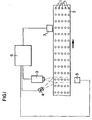
- Fig. 1 shows an apparatus for determining the concentration of a biologically active substance in pharmaceutical tablets containing a mixture of the active substance and an inactive substance.
- the tablets 1 are arranged in rows of five tablets on a travelling belt 2.
- the apparatus comprises an image recording means in the form of a NIR camera 3, a lighting fitting 4, a triggering unit 5, a computer 6 and a separating mechanism 7.
- the NIR camera 1 consists of a CCD camera which is provided with a NIR filter which lets through NIR radiation having a desired wavelength.
- the NIR camera takes an image of each row of tablets 1 passing through its lens coverage.
- the camera records the NIR radiation reflected from the tablets. If transmitted radiation is to be recorded, the camera must be placed in such manner that it can receive radiation that has passed through the tablets.
- the lighting fitting 4 is a broadband lamp having a strong emission in the NIR range.
- the triggering unit 5 is a sensor which detects when a new row of tablets passes in front of it and emits a signal to the NIR camera 3 through the computer 6 instructing the NIR camera to take an image.
- the separating mechanism 7 consists of a movable arm which, by applying subatmospheric pressure, lifts and discards tablets 1 which the computer 6 has assessed not to have the desired composition.
- the apparatus operates as follows.
- the tablets 1 on the belt 2 are illuminated with NIR radiation from the lighting fitting 4.
- the triggering unit 5 detects that a new row of tablets 1 is passing in the front of it, it triggers the camera 3 to take an image of the tablets in this row.
- the image is transferred to the computer 6, which identifies which pixels in the image correspond to the tablets. This can be carried out, for instance, with the aid of threshold values which separate the tablets from the background.
- the computer determines with the aid of the intensity values of the pixels which pixels in each tablet correspond to the biologically active substance and which correspond to the inactive substance. This is also carried out with the aid of threshold values. After that, the computer can determine both the concentration of the active substance in the tablet and the distribution thereof.
- the concentration and distribution for each of the tablets in the image are compared with predetermined quality requirements. If a tablet does not satisfy the quality requirements, the computer signals to the separating mechanism 7 that the defective tablet is to be discarded, which occurs when the tablet in question passes the separating mechanism.
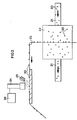
- Fig. 2 illustrates how an apparatus according to the invention can be composed if the concentration of a biologically active substance is to be determined in a mixture which is present in the form of a powder, from which random samples are to be taken.
- the powder which consists of a very large number of particles 20, is transported in a duct 21.
- the duct contains a cyclone chamber 22 in which the particles are made to eddy in air.
- a plastic adhesive tape 23 is passed, to which certain particles adhere.
- the plastic adhesive tape 23 is made to pass in front of a camera 24 while being illuminated with NIR light from a lamp 25.
- the camera takes images at such a frequency that each particle is to be seen in an image.
- the images are then processed in a computer 26, which is connected to the camera 24 and determines which particles belong to which component. By counting the number of particles of each component, the computer can determine whether the mixture has the desired concentration. In this embodiment, neither triggering means nor separating mechanism is required. The concentration is determined in reflected light, but can, of course, just as well be determined in transmitted light.
- the apparatus can be used, for instance, to control a tablet manufacturing process so that the tablets are made of the powder only when the powder has the correct composition.
Landscapes
- Physics & Mathematics (AREA)
- Spectroscopy & Molecular Physics (AREA)
- Health & Medical Sciences (AREA)
- Life Sciences & Earth Sciences (AREA)
- Chemical & Material Sciences (AREA)
- Analytical Chemistry (AREA)
- Biochemistry (AREA)
- General Health & Medical Sciences (AREA)
- General Physics & Mathematics (AREA)
- Immunology (AREA)
- Pathology (AREA)
- Engineering & Computer Science (AREA)
- Multimedia (AREA)
- Investigating Or Analysing Materials By Optical Means (AREA)
- Investigating Materials By The Use Of Optical Means Adapted For Particular Applications (AREA)
Applications Claiming Priority (2)
| Application Number | Priority Date | Filing Date | Title |
|---|---|---|---|
| SE9801776A SE512098C2 (sv) | 1998-05-19 | 1998-05-19 | Koncentrationsbestämning av en komponent i en blandning av minst två komponenter |
| SE9801776 | 1998-05-19 |
Publications (2)
| Publication Number | Publication Date |
|---|---|
| EP0959342A2 true EP0959342A2 (de) | 1999-11-24 |
| EP0959342A3 EP0959342A3 (de) | 2000-01-12 |
Family
ID=20411386
Family Applications (1)
| Application Number | Title | Priority Date | Filing Date |
|---|---|---|---|
| EP99850085A Withdrawn EP0959342A3 (de) | 1998-05-19 | 1999-05-18 | Konzentrationsbestimmung |
Country Status (4)
| Country | Link |
|---|---|
| US (1) | US6316772B1 (de) |
| EP (1) | EP0959342A3 (de) |
| JP (1) | JP4647046B2 (de) |
| SE (1) | SE512098C2 (de) |
Cited By (10)
| Publication number | Priority date | Publication date | Assignee | Title |
|---|---|---|---|---|
| WO2002065101A3 (en) * | 2001-02-12 | 2003-02-27 | Analytical Spectral Devices In | System and method for the collection of spectral image data |
| WO2003078983A1 (en) * | 2002-03-14 | 2003-09-25 | Astrazeneca Ab | Method of analysing a pharmaceutical sample |
| US6667802B2 (en) | 2001-02-12 | 2003-12-23 | Analytical Spectral Devices, Inc. | System and method for self-referencing calibration |
| US6765212B2 (en) | 2001-02-12 | 2004-07-20 | Analytical Spectral Devices, Inc. | System and method for combining reflectance data |
| US6894772B2 (en) | 2001-02-12 | 2005-05-17 | Analytical Spectral Devices | System and method for grouping reflectance data |
| EP1218705A4 (de) * | 1999-07-14 | 2009-07-29 | Malvern Instr Inc | Grossvolumige spektroskopische on-line-untersuchung von hergestellten pharmazeutischen dosiseinheiten |
| EP1812079A4 (de) * | 2004-10-15 | 2012-07-25 | Spectral Dimensions Inc | Beurteilung eines pharmazeutischen gemisches |
| EP2728341A4 (de) * | 2011-06-28 | 2015-04-22 | Otsuka Pharma Co Ltd | Arzneimittelprüfvorrichtung und arzneimittelprüfverfahren |
| GB2568313A (en) * | 2017-11-14 | 2019-05-15 | Lpw Technology Ltd | Method and apparatus for determining powder condition |
| GB2584820A (en) * | 2019-05-15 | 2020-12-23 | Lpw Technology Ltd | Method and apparatus for analysing metal powder |
Families Citing this family (24)
| Publication number | Priority date | Publication date | Assignee | Title |
|---|---|---|---|---|
| US7595878B2 (en) * | 2000-10-13 | 2009-09-29 | Chemimage Corporation | Spectroscopic methods for component particle analysis |
| US7288768B2 (en) * | 2002-07-18 | 2007-10-30 | Purdue Research Foundation | Method for measuring the amount of an organic substance in a food product with infrared electromagnetic radiation |
| US7538869B2 (en) * | 2004-06-30 | 2009-05-26 | Chemimage Corporation | Multipoint method for identifying hazardous agents |
| US20050097021A1 (en) * | 2003-11-03 | 2005-05-05 | Martin Behr | Object analysis apparatus |
| ATE366921T1 (de) * | 2004-05-27 | 2007-08-15 | Uhlmann Visiotec Gmbh | Tablettenpresse mit integrierter nir- messvorrichtung |
| WO2007098392A2 (en) * | 2006-02-21 | 2007-08-30 | Glaxo Group Limited | Method and system for chemical specific spectral analysis |
| GB2480170B (en) * | 2007-01-29 | 2012-02-08 | Teraview Ltd | A pharmaceutical analysis method and apparatus |
| US7680553B2 (en) * | 2007-03-08 | 2010-03-16 | Smp Logic Systems Llc | Methods of interfacing nanomaterials for the monitoring and execution of pharmaceutical manufacturing processes |
| IL185130A0 (en) | 2007-08-08 | 2008-01-06 | Semi Conductor Devices An Elbi | Thermal based system and method for detecting counterfeit drugs |
| JP2010536039A (ja) * | 2007-08-09 | 2010-11-25 | グラクソスミスクライン エルエルシー | 光干渉断層解析 |
| GB2456643B (en) * | 2008-01-24 | 2012-04-25 | Teraview Ltd | A terahertz investigative system and method |
| US8467066B2 (en) | 2008-09-29 | 2013-06-18 | Johanson Holdings Llc | Mixture segregation testing devices and methods |
| US8374801B2 (en) * | 2009-01-09 | 2013-02-12 | Chemimage Corporation | Automation of ingredient-specific particle sizing employing raman chemical imaging |
| EP2508882B1 (de) * | 2009-02-05 | 2016-09-21 | D.I.R. Technologies (Detection Ir) Ltd. | Verfahren und System zur Bestimmung der Qualität pharmazeutischer Produkte |
| JP2011191129A (ja) * | 2010-03-12 | 2011-09-29 | Hitachi Information & Control Solutions Ltd | 錠剤検査装置、錠剤包装装置、錠剤検査方法及び錠剤包装方法 |
| CN103542805A (zh) * | 2013-10-22 | 2014-01-29 | 中国科学院半导体研究所 | 基于高速图像传感器和并行处理的视觉检测系统 |
| US10145776B2 (en) | 2015-04-13 | 2018-12-04 | Massachusetts Institute Of Technology | Fluid analysis using digital imagery |
| JP2016215192A (ja) * | 2015-05-15 | 2016-12-22 | アイセル株式会社 | 流体の混合方法 |
| CN106770002A (zh) * | 2016-11-21 | 2017-05-31 | 无锡艾科瑞思产品设计与研究有限公司 | 一种近红外线家用食品检测装置 |
| CN108453058B (zh) * | 2018-01-24 | 2019-12-03 | 三峡大学 | 一种基于机器视觉的粽叶自动排列上料装置 |
| JP6568245B2 (ja) * | 2018-01-24 | 2019-08-28 | Ckd株式会社 | 検査装置、ptp包装機、及び、検査装置の較正方法 |
| RU2690539C1 (ru) * | 2018-07-02 | 2019-06-04 | Федеральное государственное бюджетное образовательное учреждение высшего образования "Ярославский государственный технический университет" ФГБОУВО "ЯГТУ" | Способ исследования качества смеси компонентов, различающихся по цвету |
| JP6786565B2 (ja) * | 2018-10-10 | 2020-11-18 | Ckd株式会社 | 検査装置、ptp包装機及びptpシートの製造方法 |
| JP7078520B2 (ja) * | 2018-11-15 | 2022-05-31 | アンリツ株式会社 | 物質特性検査装置 |
Family Cites Families (29)
| Publication number | Priority date | Publication date | Assignee | Title |
|---|---|---|---|---|
| JPS5896238A (ja) * | 1981-12-04 | 1983-06-08 | Isao Shimizu | 粒子群の平均粒径及び体積濃度測定方法 |
| JPS60207039A (ja) * | 1984-03-30 | 1985-10-18 | Hamamatsu Photonics Kk | 2種の液体混合気を観察する装置 |
| JPH0750031B2 (ja) * | 1988-03-24 | 1995-05-31 | 敬司 笹木 | 物質パターンの分離検出方法 |
| JPH03257351A (ja) * | 1990-03-07 | 1991-11-15 | Showa Denko Kk | 赤外線顕微鏡による測定方法 |
| JPH04270944A (ja) * | 1991-02-27 | 1992-09-28 | Fuji Xerox Co Ltd | 用紙の含水分布検出装置 |
| DE4111903A1 (de) * | 1991-04-12 | 1992-10-15 | Bayer Ag | Spektroskopiekorrelierte licht-rastermikroskopie |
| JPH04328449A (ja) * | 1991-04-26 | 1992-11-17 | Kao Corp | 水分測定方法および測定装置 |
| JPH06123700A (ja) * | 1992-06-03 | 1994-05-06 | Hamamatsu Photonics Kk | 赤外光吸収度の測定方法および装置 |
| JPH05332919A (ja) * | 1992-06-03 | 1993-12-17 | Hamamatsu Photonics Kk | 散乱物質内の吸収成分の存在位置測定方法および装置 |
| US5321265A (en) | 1992-07-15 | 1994-06-14 | Block Myron J | Non-invasive testing |
| US5351303A (en) | 1993-02-25 | 1994-09-27 | Willmore Michael R | Infra-red imaging and pattern recognition system |
| JPH06263244A (ja) * | 1993-03-09 | 1994-09-20 | Tohoku Ricoh Co Ltd | 物品の旋回搬送装置 |
| JP2664042B2 (ja) * | 1994-01-21 | 1997-10-15 | 科学技術庁航空宇宙技術研究所長 | 浮遊粒子群の濃度と粒度の空間分布の測定方法と装置 |
| JP3022145B2 (ja) * | 1994-04-08 | 2000-03-15 | 三洋電機株式会社 | 画像認識手段を具えた錠剤検査装置及び錠剤検査方法 |
| JPH0821805A (ja) * | 1994-07-08 | 1996-01-23 | Datsuku Eng Kk | 外観検査方法およびその装置 |
| JP3310782B2 (ja) * | 1994-07-14 | 2002-08-05 | 株式会社日立製作所 | 吸収物質濃度の空間分布画像化装置 |
| US5504332A (en) | 1994-08-26 | 1996-04-02 | Merck & Co., Inc. | Method and system for determining the homogeneity of tablets |
| US5603413A (en) * | 1994-09-01 | 1997-02-18 | Wellman, Inc. | Sortation method for transparent optically active articles |
| JP3524968B2 (ja) * | 1994-10-04 | 2004-05-10 | 株式会社エスアールエル | 生体結石中のシュウ酸カルシウム・一水化物とシュウ酸カルシウム・二水化物の赤外分光分析による定量 |
| US5900634A (en) * | 1994-11-14 | 1999-05-04 | Soloman; Sabrie | Real-time on-line analysis of organic and non-organic compounds for food, fertilizers, and pharmaceutical products |
| US5606413A (en) * | 1995-01-19 | 1997-02-25 | Northrop Grumman Corporation | Real time spectroscopic imaging system and method |
| DK171926B1 (da) * | 1995-02-10 | 1997-08-11 | Slagteriernes Forskningsinst | Apparat til undersøgelse af strømningsdygtigt materiale og indretning til fremføring af prøver |
| JPH08161823A (ja) * | 1995-05-26 | 1996-06-21 | Nagano Nippon Densan Kk | スピンドルモータ |
| US5760399A (en) * | 1995-10-02 | 1998-06-02 | Foss Nirsystems, Inc. | Measurement of transmission spectra of pharmaceutical tablets |
| US5646405A (en) * | 1995-11-29 | 1997-07-08 | Lawson-Hemphill, Inc. | Method of detecting contaminants in cotton fibers |
| SE513163C2 (sv) * | 1995-12-20 | 2000-07-17 | Astrazeneca Ab | Anordning och metod för spektrometri |
| US5781289A (en) * | 1996-11-05 | 1998-07-14 | Sabsabi; Mohamad | Method and apparatus for rapid in situ analysis of preselected components of homogeneous solid compositions, especially pharmaceutical compositions |
| US5745243A (en) * | 1996-11-15 | 1998-04-28 | Optical Solutions, Inc. | Photometer apparatus |
| JPH10232203A (ja) * | 1997-02-20 | 1998-09-02 | Kinousui Kenkyusho:Kk | 配管内微粒子の測定方法および測定装置 |
-
1998
- 1998-05-19 SE SE9801776A patent/SE512098C2/sv unknown
-
1999
- 1999-05-18 US US09/313,203 patent/US6316772B1/en not_active Expired - Lifetime
- 1999-05-18 EP EP99850085A patent/EP0959342A3/de not_active Withdrawn
- 1999-05-19 JP JP13894499A patent/JP4647046B2/ja not_active Expired - Fee Related
Cited By (16)
| Publication number | Priority date | Publication date | Assignee | Title |
|---|---|---|---|---|
| EP1218705A4 (de) * | 1999-07-14 | 2009-07-29 | Malvern Instr Inc | Grossvolumige spektroskopische on-line-untersuchung von hergestellten pharmazeutischen dosiseinheiten |
| US6853447B2 (en) | 2001-02-12 | 2005-02-08 | Analytical Spectral Devices, Inc. | System and method for the collection of spectral image data |
| US6667802B2 (en) | 2001-02-12 | 2003-12-23 | Analytical Spectral Devices, Inc. | System and method for self-referencing calibration |
| US6765212B2 (en) | 2001-02-12 | 2004-07-20 | Analytical Spectral Devices, Inc. | System and method for combining reflectance data |
| WO2002065101A3 (en) * | 2001-02-12 | 2003-02-27 | Analytical Spectral Devices In | System and method for the collection of spectral image data |
| US6894772B2 (en) | 2001-02-12 | 2005-05-17 | Analytical Spectral Devices | System and method for grouping reflectance data |
| WO2003078983A1 (en) * | 2002-03-14 | 2003-09-25 | Astrazeneca Ab | Method of analysing a pharmaceutical sample |
| US7276700B2 (en) | 2002-03-14 | 2007-10-02 | Astrazeneca Ab | Method of analysing a pharmaceutical sample |
| AU2003214401B2 (en) * | 2002-03-14 | 2008-08-21 | Astrazeneca Ab | Method of analysing a pharmaceutical sample |
| EP1812079A4 (de) * | 2004-10-15 | 2012-07-25 | Spectral Dimensions Inc | Beurteilung eines pharmazeutischen gemisches |
| EP2728341A4 (de) * | 2011-06-28 | 2015-04-22 | Otsuka Pharma Co Ltd | Arzneimittelprüfvorrichtung und arzneimittelprüfverfahren |
| GB2568313A (en) * | 2017-11-14 | 2019-05-15 | Lpw Technology Ltd | Method and apparatus for determining powder condition |
| GB2568313B (en) * | 2017-11-14 | 2023-03-08 | Lpw Technology Ltd | Method and apparatus for determining powder condition |
| US11969789B2 (en) | 2017-11-14 | 2024-04-30 | Lpw Technology Ltd. | Method and apparatus for determining metal powder condition |
| GB2584820A (en) * | 2019-05-15 | 2020-12-23 | Lpw Technology Ltd | Method and apparatus for analysing metal powder |
| GB2584820B (en) * | 2019-05-15 | 2024-01-24 | Lpw Technology Ltd | Method and apparatus for analysing metal powder |
Also Published As
| Publication number | Publication date |
|---|---|
| US6316772B1 (en) | 2001-11-13 |
| EP0959342A3 (de) | 2000-01-12 |
| JP4647046B2 (ja) | 2011-03-09 |
| SE9801776L (sv) | 1999-11-20 |
| SE512098C2 (sv) | 2000-01-24 |
| SE9801776D0 (sv) | 1998-05-19 |
| JPH11352067A (ja) | 1999-12-24 |
Similar Documents
| Publication | Publication Date | Title |
|---|---|---|
| US6316772B1 (en) | Determination of concentration | |
| US8842266B2 (en) | Pharmaceutical mixture evaluation | |
| US11391662B2 (en) | Raw material particle size distribution measuring apparatus, particle size distribution measuring method, and porosity measuring apparatus | |
| HU226972B1 (en) | Method for measuring degree and homogeneity of alumina calcination | |
| US10902575B2 (en) | Automated grains inspection | |
| JP2013238579A (ja) | 穀粒成分分析装置および穀粒成分分析方法 | |
| JP2000329683A (ja) | ベルトコンベアで搬送されるばら物の粒度検知方法 | |
| US6694048B2 (en) | Method for generating intra-particle morphological concentration/density maps and histograms of a chemically pure particulate substance | |
| AU770628B2 (en) | Apparatus and method for analysing | |
| JP2022178140A (ja) | 焼結原料の水分測定方法 | |
| KR20050002854A (ko) | 제약 샘플을 분석하는 방법 | |
| AU2002214504B2 (en) | A method and device for recording images of grains from cereals to detect cracking | |
| WO2008019112A2 (en) | Pharmaceutical mixture evaluation | |
| JP2005334642A (ja) | 錠剤機 | |
| JP3985946B2 (ja) | 異物検査装置 | |
| JP2004191074A (ja) | タブレットの密度推定方法及び検査装置 | |
| EP1616354A1 (de) | Erzeugung von partikelinternen kristallographischen parameterabbildungen und histogrammen einer chemisch reinen kristallinen teilchensubstanz | |
| JP2001050901A (ja) | 異物検査装置 | |
| JP2675239B2 (ja) | 粉粒体色調検査装置 | |
| JPH10332567A (ja) | 粒子の混合比測定方法及び装置 | |
| WO2024224175A1 (en) | Sorter devices, detections systems of sorter devices, and related methods | |
| JPH03257347A (ja) | 粒度分布測定装置 | |
| JP2000046741A (ja) | 粒状物の品質判定方法及びその装置 | |
| JP2001050815A (ja) | 測色システム、及び検査システム | |
| BR0004421B1 (pt) | Processo para identificação e qualificação de impurezas em material em pó |
Legal Events
| Date | Code | Title | Description |
|---|---|---|---|
| PUAI | Public reference made under article 153(3) epc to a published international application that has entered the european phase |
Free format text: ORIGINAL CODE: 0009012 |
|
| AK | Designated contracting states |
Kind code of ref document: A2 Designated state(s): AT BE CH DE DK ES FI FR GB GR IE IT LI NL PT SE |
|
| AX | Request for extension of the european patent |
Free format text: AL;LT;LV;MK;RO;SI |
|
| PUAL | Search report despatched |
Free format text: ORIGINAL CODE: 0009013 |
|
| AK | Designated contracting states |
Kind code of ref document: A3 Designated state(s): AT BE CH CY DE DK ES FI FR GB GR IE IT LI LU MC NL PT SE |
|
| AX | Request for extension of the european patent |
Free format text: AL;LT;LV;MK;RO;SI |
|
| 17P | Request for examination filed |
Effective date: 20000328 |
|
| RAP1 | Party data changed (applicant data changed or rights of an application transferred) |
Owner name: PHARMA VISION SYSTEMS AKTIEBOLAG |
|
| AKX | Designation fees paid |
Free format text: AT BE CH DE DK ES FI FR GB GR IE IT LI NL PT SE |
|
| AXX | Extension fees paid |
Free format text: LT PAYMENT 20000328;LV PAYMENT 20000328;SI PAYMENT 20000328 |
|
| RAP1 | Party data changed (applicant data changed or rights of an application transferred) |
Owner name: MALVERN INSTRUMENTS LIMITED |
|
| 17Q | First examination report despatched |
Effective date: 20080408 |
|
| STAA | Information on the status of an ep patent application or granted ep patent |
Free format text: STATUS: THE APPLICATION IS DEEMED TO BE WITHDRAWN |
|
| 18D | Application deemed to be withdrawn |
Effective date: 20150825 |