EP0950652B1 - Ungesättigte Ester mit cis-Struktur,Verfahren zu ihrer Herstellung, und diese enthaltende Riechstoffkompositionen - Google Patents
Ungesättigte Ester mit cis-Struktur,Verfahren zu ihrer Herstellung, und diese enthaltende Riechstoffkompositionen Download PDFInfo
- Publication number
- EP0950652B1 EP0950652B1 EP99106205A EP99106205A EP0950652B1 EP 0950652 B1 EP0950652 B1 EP 0950652B1 EP 99106205 A EP99106205 A EP 99106205A EP 99106205 A EP99106205 A EP 99106205A EP 0950652 B1 EP0950652 B1 EP 0950652B1
- Authority
- EP
- European Patent Office
- Prior art keywords
- cis
- formula
- configurational
- methyl
- represented
- Prior art date
- Legal status (The legal status is an assumption and is not a legal conclusion. Google has not performed a legal analysis and makes no representation as to the accuracy of the status listed.)
- Expired - Lifetime
Links
Classifications
-
- C—CHEMISTRY; METALLURGY
- C07—ORGANIC CHEMISTRY
- C07C—ACYCLIC OR CARBOCYCLIC COMPOUNDS
- C07C69/00—Esters of carboxylic acids; Esters of carbonic or haloformic acids
- C07C69/02—Esters of acyclic saturated monocarboxylic acids having the carboxyl group bound to an acyclic carbon atom or to hydrogen
- C07C69/12—Acetic acid esters
-
- C—CHEMISTRY; METALLURGY
- C11—ANIMAL OR VEGETABLE OILS, FATS, FATTY SUBSTANCES OR WAXES; FATTY ACIDS THEREFROM; DETERGENTS; CANDLES
- C11B—PRODUCING, e.g. BY PRESSING RAW MATERIALS OR BY EXTRACTION FROM WASTE MATERIALS, REFINING OR PRESERVING FATS, FATTY SUBSTANCES, e.g. LANOLIN, FATTY OILS OR WAXES; ESSENTIAL OILS; PERFUMES
- C11B9/00—Essential oils; Perfumes
- C11B9/0061—Essential oils; Perfumes compounds containing a six-membered aromatic ring not condensed with another ring
-
- C—CHEMISTRY; METALLURGY
- C07—ORGANIC CHEMISTRY
- C07C—ACYCLIC OR CARBOCYCLIC COMPOUNDS
- C07C29/00—Preparation of compounds having hydroxy or O-metal groups bound to a carbon atom not belonging to a six-membered aromatic ring
- C07C29/36—Preparation of compounds having hydroxy or O-metal groups bound to a carbon atom not belonging to a six-membered aromatic ring increasing the number of carbon atoms by reactions with formation of hydroxy groups, which may occur via intermediates being derivatives of hydroxy, e.g. O-metal
-
- C—CHEMISTRY; METALLURGY
- C07—ORGANIC CHEMISTRY
- C07C—ACYCLIC OR CARBOCYCLIC COMPOUNDS
- C07C33/00—Unsaturated compounds having hydroxy or O-metal groups bound to acyclic carbon atoms
- C07C33/28—Alcohols containing only six-membered aromatic rings as cyclic part with unsaturation outside the aromatic rings
- C07C33/30—Alcohols containing only six-membered aromatic rings as cyclic part with unsaturation outside the aromatic rings monocyclic
-
- C—CHEMISTRY; METALLURGY
- C07—ORGANIC CHEMISTRY
- C07C—ACYCLIC OR CARBOCYCLIC COMPOUNDS
- C07C69/00—Esters of carboxylic acids; Esters of carbonic or haloformic acids
- C07C69/007—Esters of unsaturated alcohols having the esterified hydroxy group bound to an acyclic carbon atom
-
- C—CHEMISTRY; METALLURGY
- C11—ANIMAL OR VEGETABLE OILS, FATS, FATTY SUBSTANCES OR WAXES; FATTY ACIDS THEREFROM; DETERGENTS; CANDLES
- C11B—PRODUCING, e.g. BY PRESSING RAW MATERIALS OR BY EXTRACTION FROM WASTE MATERIALS, REFINING OR PRESERVING FATS, FATTY SUBSTANCES, e.g. LANOLIN, FATTY OILS OR WAXES; ESSENTIAL OILS; PERFUMES
- C11B9/00—Essential oils; Perfumes
- C11B9/0007—Aliphatic compounds
- C11B9/0015—Aliphatic compounds containing oxygen as the only heteroatom
- C11B9/0019—Aliphatic compounds containing oxygen as the only heteroatom carbocylic acids; Salts or esters thereof
-
- C—CHEMISTRY; METALLURGY
- C07—ORGANIC CHEMISTRY
- C07B—GENERAL METHODS OF ORGANIC CHEMISTRY; APPARATUS THEREFOR
- C07B2200/00—Indexing scheme relating to specific properties of organic compounds
- C07B2200/09—Geometrical isomers
Definitions
- the present invention relates to a cis -configurational unsaturated ester having a unique odor.
- the present invention also relates to a fragrance composition containing this cis -configurational unsaturated ester.
- 3-hexenyl acetate having a Japanese radish-like odor
- 3-isopropyl-5-hepten-3-yl acetate having a floral note
- 4,8-dimethyl-7-nonen-4-yl acetate having a lemony note
- unsaturated esters used for perfumery were known as unsaturated esters used for perfumery.
- An object of the present invention is to provide a novel compound that satisfies the above need, a process for producing this compound, and a fragrance composition containing this compound.
- the present invention provides a cis -configurational unsaturated ester represented by the formula (1) (where R is a methyl group or a phenyl group, and n is 1 or 2) and also provides a fragrance composition containing the cis -configurational unsaturated ester in an effective amount.
- the present invention also provides a process for producing the cis -configurational unsaturated ester represented by the formula (1), comprising the steps of:
- the cis -configurational unsaturated alcohol represented by the formula (4) including the cis -configurational unsaturated alcohol represented by the formula (4a) can be obtained by a process comprising the step of:
- the above-mentioned cis -configurational unsaturated ester of the present invention has a unique odor and is a useful compound for perfumery.
- 3-methyl- cis -4-hexenyl acetate has a fruity note, such as the odor of pears or apples, with a green note.
- the fragrance composition of the present invention containing an effective amount of the cis -configurational unsaturated ester of the formula (1) can be used in various applications, for examples, perfumes; air fresheners; toiletries such as soap, lotions, cosmetic cream, pomade, hair tonics, shampoos and hair rinses; bath salts; cleansers and cleaners.
- the fragrance composition can also be used to give a fragrance to foods, fibers, sheets, cloth, paper, paint, ink, clay, woods, furniture, carpets, sanitary goods, erasers, man-made leather, plastics and the like.
- the effective amount of the cis -configurational unsaturated ester of the formula (1) in the fragrance composition of the present invention is usually 0.01% by weight or more, preferably 0.1 to 95% by weight, and more preferably 1 to 40% by weight, on the basis of the total weight of the fragrance composition.
- the fragrance composition of the present invention can also contain water; alcohols such as ethanol, 2-propanol, benzyl alcohol, phenethyl alcohol, 3-methyl-3-methoxybutanol, linalool, tetrahydrolinalool, citronellol, glycerol and 1,3-butanediol; ketones such as ⁇ -ionone and irone; aldehydes such as citral and citronellal; esters such as ethyl acetate, benzyl acetate and benzyl salicylate; hydrocarbons such as squalane; carboxylic acids such as stearic acid and oleic acid; sugars such as cyclodextrin; vaseline, microcrystalline wax and the like.
- alcohols such as ethanol, 2-propanol, benzyl alcohol, phenethyl alcohol, 3-methyl-3-methoxybutanol, linalool, tetrahydrolinalool,
- the fragrance composition of the present invention can also contain thickeners such as carboxymethyl cellulose, casein, sodium polyacrylate and polyvinyl alcohol; antiseptics; UV absorbents; antioxidants; surfactants; pigments; inorganic fillers such as silica, alumina and talc; and the like.
- thickeners such as carboxymethyl cellulose, casein, sodium polyacrylate and polyvinyl alcohol; antiseptics; UV absorbents; antioxidants; surfactants; pigments; inorganic fillers such as silica, alumina and talc; and the like.
- the fragrance composition of the present invention can be prepared by mixing the cis -configurational unsaturated ester represented by the formula (1) with other components by conventional methods.
- This process comprises the steps of allowing the cyclic vinyl ether of the formula (2a) to react with the Grignard reagent of the formula (3a) to give the unsaturated alcohol of the formula (4a), and then subjecting this unsaturated alcohol to acylation with acetic acid or a derivative thereof.
- the cyclic vinyl ether of the formula (2a) is the compound in which R 1 in the formula (2) is a methyl group
- the Grignard reagent of the formula (3a) is the compound in which R 2 in the formula (3) is a methyl group or a phenyl group
- the unsaturated alcohol of the formula (4a) is the compound in which R 1 in the formula (4) is a methyl group and R 2 is a methyl group or a phenyl group.
- a commercially available product may be used, or one prepared by the process disclosed in Japanese Patent Application Laid-Open No. 3-26177 may be used.
- the cyclic vinyl ether represented by the formula (2) or the formula (2a) is usually used in an amount of 0.8 to 5 mol, preferably 0.8 to 1 mol per one mole of the Grignard reagent represented by the formula (3) or the formula (3a).
- the Grignard reagent of the formula (3a) corresponds to a Grignard reagent of the formula (3).
- the Grignard reagent of the formula (3a) is the compound in which R 2 in the formula (3) is a methyl group or a phenyl group.
- the Grignard reagent represented by the formula (3) or the formula (3a) is commercially available as a solution of diethyl ether or tetrahydrofuran, or can be prepared by the reaction of metallic magnesium with a compound represented by the formula R 2 X or RX (where R 2 , R and X are defined as above) in diethyl ether or tetrahydrofuran according to the method described in the literature (eg, Shin Jikken Kagaku Koza, Vol. 12, Yuki Kinzoku Kagaku, p. 62).
- diethyl ether or tetrahydrofuran As much as possible prior to the reaction of the Grignard reagent represented by the formula (3) or the formula (3a) with the cyclic vinyl ether represented by the formula (2) or the formula (2a).
- the diethyl ether or tetrahydrofuran can be removed by known methods such as evaporation under reduced pressure or replacement with an appropriate solvent.
- nickel compound used in the present invention examples include nickel(II) chloride, nickel(II) bromide, nickel(II) acetate tetrahydrate, nickel(II) acetylacetonate dihydrate, dichlorobis(triphenylphosphine) nickel(II), bis(1,5-cyclooctadiene) nickel(0), tetrakis(triphenylphosphine) nickel(0).
- a nickel complex having a ligand such as triphenylphosphine is preferable.
- the nickel compound is used in an amount of usually 0.05 mol or less, preferably 0.00001 to 0.05 mol per one mole of the cyclic vinyl ether represented by the formula (2) or the formula (2a). From the point of higher. selectivity to the cis -configurational unsaturated alcohol represented by the formula (4) or the formula (4a), it is preferable to use the nickel compound in a smaller amount, with a range of 0.00001 to 0.02 mol, more preferably 0.0001 to 0.01 mol per one mole of the cyclic vinyl ether represented by the formula (2) or the formula (2a).
- triarylphosphine used in the present invention examples include triphenylphosphine, tris(p-tolyl)phosphine and tris(2,4-dimethylphenyl)phosphine. Of these, triphenylphosphine is preferred for industrial applications because of its low cost.
- the triarylphosphine is used in an amount of usually 0.1 to 3000 mol per one mole of nickel atoms of the above-mentioned nickel compound. From the point of reaction rate and higher selectivity to the cis -configurational unsaturated alcohol represented by the formula (4) or the formula (4a), it is preferable to use the triarylphosphine in a larger amount, with a range of 2 to 2000 mol per one mole of nickel atoms in the above-mentioned nickel compound.
- the triarylphosphine may be incorporated as a ligand into the nickel compound during the reaction, depending on the type of nickel compound. In this case, the amount of the triarylphosphine should be increased, according to the amount that will be incorporated as a ligand.
- the reaction of the Grignard reagent represented by the formula (3) or the formula (3a) with the cyclic vinyl ether represented by the formula (2) or the formula (2a) is usually carried out in the presence of a solvent which does not inhibit the reaction.
- a solvent which does not inhibit the reaction.
- the solvents include aromatic hydrocarbons such as benzene, toluene, xylene and mesitylene; and ethers with a low coordination property with respect to nickel, such as t-butyl methyl ether.
- the solvent can be used to the extent that does not suppress the reaction.
- the cyclic vinyl ether represented by the formula (2) or the formula (2a) can be used in an excessive amount in place of the above-mentioned solvent.
- the Grignard reaction in the present invention is usually carried out at a temperature of 30 to 100°C, preferably 50 to 90°C.
- the reaction time is usually 30 minutes to 10 hours.
- the cis -configurational unsaturated alcohol represented by the formula (4) or the formula (4a), the product is separated by a conventional method, examples of which include a method that comprises the steps of pouring the reaction mixture into an aqueous ammonium chloride, dilute hydrochloric acid or the like, obtaining an organic layer containing the product by the separation of the organic layer, or by the extraction with hydrocarbons such as n-hexane, benzene or toluene; ethers such as diethyl ether; esters such as ethyl acetate; halogenated hydrocarbons such as dichloromethane, and removing the organic solvent from the obtained organic layer.
- a conventional method examples of which include a method that comprises the steps of pouring the reaction mixture into an aqueous ammonium chloride, dilute hydrochloric acid or the like, obtaining an organic layer containing the product by the separation of the organic layer, or by the extraction with hydrocarbons such as n-hexane,
- the cis -configurational unsaturated alcohol represented by the formula (4) or the formula (4a) obtained in this manner can be further purified by a known method such as distillation or column chromatography as needed.
- the cis -configurational unsaturated alcohols represented by the formula (4) or the formula (4a) can be used for perfumery.
- the cis -configurational unsaturated alcohol represented by the formula (4a) can be converted into the cis -configurational unsaturated ester represented by the formula (1), which has a unique odor and is extremely useful for perfumery, by acylation with acetic acid or a derivative thereof such as acetic anhydride or acetyl chloride.
- acylation of the cis -configurational unsaturated alcohol represented by the formula (4a) with acetic acid or a derivative thereof can be carried out by a conventional esterification method disclosed in the literature (eg, Shin Jikken Kagaku Koza, Vol. 22, Yuki Gosei 4, p.
- examples of which include (1) a method in which the cis -configurational unsaturated alcohol represented by the formula (4a) is allowed to react with 0.9 to 2 mol of acetic anhydride per one mole of the unsaturated alcohol at 0 to 50°C and in the presence of a basic substance such as triethylamine, pyridine or sodium acetate, (2) a method in which the cis -configurational unsaturated alcohol represented by the formula (4a) is allowed to react with 0.9 to 1.5 mol of acetyl halide per one mole of the unsaturated alcohol at 0 to 50°C, in a solvent such as ether, and in the presence of a basic substance such as sodium hydroxide, pyridine or triethylamine, and (3) a method in which the cis -configurational unsaturated alcohol represented by the formula (4a) is allowed to react with 0.2 to 2 mol of acetic acid per one mole of the unsaturated alcohol in the presence of an acidic catalyst
- the cis -configurational unsaturated ester represented by the formula (1), the product can be separated by a conventional method, examples of which include i) a method that comprises the steps of pouring the reaction mixture into an aqueous ammonium chloride, dilute hydrochloric acid or the like, obtaining an organic layer containing the product by the extraction with hydrocarbons such as n-hexane, benzene, toluene; ethers such as diethyl ether; esters such as ethyl acetate; halogenated hydrocarbons such as dichloromethane, and removing the organic solvent from the obtained organic layer, or ii) a method in which the reaction mixture is separated by chromatography.
- the cis -configurational unsaturated ester represented by the formula (1) obtained in this manner can be further purified by a known method such as distillation or column chromatography as needed.
- reaction mixture was cooled to room temperature, and poured into 4 liters of a saturated aqueous ammonium chloride, followed by stirring. Then the mixture was allowed to stand and separate into an organic layer and an aqueous layer. The organic layer was collected, while the aqueous layer was twice extracted with 200 mL of toluene.
- a three-neck flask with a volume of 200 mL was charged with 30.0 g (0.263 mol) of the 3-methyl- cis -4-hexen-1-ol obtained in (a) above and 1.61 g (13.2 mmol) of 4-dimethylaminopyridine. Then 53.65 g (0.526 mol) of acetic anhydride was added dropwise to the obtained mixture at a rate such that the reaction temperature did not exceed 40°C. 30 mL of n-hexane and 50 mL of water were added to the reaction mixture, followed by stirring. The resulting mixture was allowed to stand and separate into an organic layer and an aqueous layer.
- reaction mixture was cooled to room temperature, and poured into 2 liters of a saturated aqueous ammonium chloride, followed by stirring. Then the mixture was allowed to stand and separate into an organic layer and an aqueous layer. The organic layer was collected, while the aqueous layer was twice extracted with 200 mL of toluene.
- a Grignard reaction was conducted by the same manner as in Example 1 (a), except that 140 mL of a solution of phenyl magnesium bromide in diethyl ether (concentration: 3.0 mol/liter, containing 0.42 mol of phenyl magnesium bromide) was used instead of the solution of methyl magnesium bromide in diethyl ether, that the amount of 4-methyl-3,4-dihydro-2H-pyran is changed to 39.43 g(0.402 mol) and that the reaction temperature was changed to 50°C.
- a Grignard reaction was conducted by the same manner as in Example 1 (a) except that 38.12 g (0.454 mol) of 3-methyl-2,3-dihydrofuran and 150 mL of a solution of phenyl magnesium bromide in diethyl ether (concentration: 3.0 mol/liter, containing 0.45 mol of phenyl magnesium bromide) were used instead of the 4-methyl-3,4-dihydro-2H-pyran and the solution of methyl magnesium bromide in diethyl ether, respectively, and that the reaction temperature was changed to 50°C.
- fragrance compositions 1 and 2 The components listed in Table 1 were mixed under stirring at room temperature to give fragrance compositions 1 and 2.
- Table 2 shows the cis -configurational unsaturated esters used in the fragrance compositions.
- Components of fragrance compositions Component Parts by weight cis -configurational unsaturated ester 10.0 geraniol 15.0 citronellol 30.0 tetrahydrogeraniol 0.5 nerol 10.0 linalool 2.0 phenylethylacohol 15.0 eugenol 1.5 citronellyl acetate 2.0 geranyl acetate 1.0 phenylethyl acetate 6.0 dimethyl benzyl acetate 1.0 ionone 2.0 ⁇ -methyl ionone 1.0 citral 0.5 decanal 0.3 undecylenaldehyde 0.2 oil of rose 2.0 Total 100.0 Fragrance Composition cis -Configurational unsaturated ester used 1 3-methyl- cis -4-hex
- a Grignard reaction was carried out by the same manner as in Example 1 (a), except that 37.5 g (0.446 mol) of 3,4-dihydro-2H-pyran was used instead of the 4-methyl-3,4-dihydro-2H-pyran, and that the reaction was conducted at 50°C for 2 hours.
- reaction mixture was cooled to room temperature, and poured into 2 liters of a saturated aqueous ammonium chloride, followed by stirring. Then the mixture was allowed to stand and separate into an organic layer and an aqueous layer. The organic layer was collected, while the aqueous layer was twice extracted with 200 mL of toluene.
- reaction mixture was cooled to room temperature, and poured into 120 mL of a saturated aqueous ammonium chloride, followed by stirring. Then the mixture was allowed to stand and separate into an organic layer and an aqueous layer. The organic layer was collected, while the aqueous layer was twice extracted with 20 mL of toluene.
- Comparative Example 1 (The case in which the amount of nickel compound is increased, corresponding to the conventional method)
- reaction mixture was cooled to room temperature, and poured into 120 mL of a saturated aqueous ammonium chloride, followed by stirring. Then the mixture was allowed to stand and separate into an organic layer and an aqueous layer. The organic layer was collected, while the aqueous layer was twice extracted with 20 mL of toluene.
Landscapes
- Chemical & Material Sciences (AREA)
- Organic Chemistry (AREA)
- Chemical Kinetics & Catalysis (AREA)
- Life Sciences & Earth Sciences (AREA)
- Engineering & Computer Science (AREA)
- Oil, Petroleum & Natural Gas (AREA)
- Wood Science & Technology (AREA)
- Organic Low-Molecular-Weight Compounds And Preparation Thereof (AREA)
- Fats And Perfumes (AREA)
Claims (4)
- Ungesättigter Ester in cis-Konfiguration, dargestellt durch die Formel (1)(worin R eine Methylgruppe oder eine Phenylgruppe bedeutet und n 1 oder 2 ist).

- Duftstoffzusammensetzung, die eine wirksame Menge eines ungesättigten Esters in cis-Konfiguration, dargestellt durch die Formel (1), enthält,(worin R eine Methylgruppe oder eine Phenylgruppe bedeutet und n 1 oder 2 ist).

- Verfahren zur Herstellung eines ungesättigten Esters in cis-Konfiguration, dargestellt durch die Formel (1)(worin R eine Methylgruppe oder eine Phenylgruppe bedeutet und n 1 oder 2 ist), umfassend die Schritte von:
 Umsetzen eines cyclischen Vinylethers der Formel (2a)(worin n wie vorstehend definiert ist)
mit einem Grignard-Reagenz der Formel (3a)
in Gegenwart eines Triarylphosphins und nicht mehr als 0,05 Mol einer Nickelverbindung pro 1 Mol der cyclischen Vinyletherverbindung, dargestellt durch die Formel (2a), zu einem ungesättigten Alkohol in cis-Konfiguration, dargestellt durch die Formel (4a)(worin n und R wie vorstehend definiert sind) und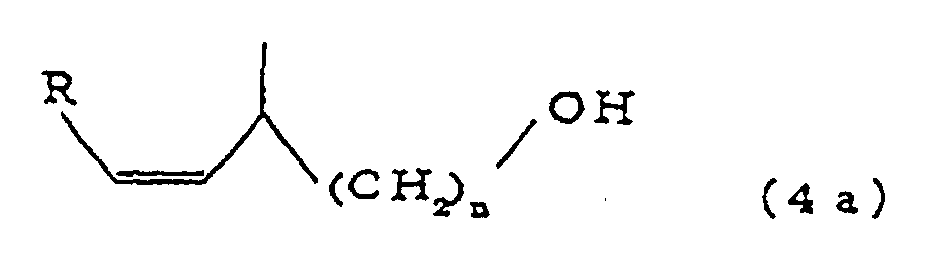 Unterwerfen dieses ungesättigten Alkohols in cis-Konfiguration einer Acylierung mit Essigsäure oder einem Derivat davon zu dem ungesättigten Ester in cis-Konfiguration, dargestellt durch die Formel (1).
 - 3-Methyl-5-phenyl-cis-4-penten-1-ol oder 2-Methyl-4-phenyl-cis-3-buten-1-ol.
Applications Claiming Priority (4)
| Application Number | Priority Date | Filing Date | Title |
|---|---|---|---|
| JP10117872A JPH11292810A (ja) | 1998-04-13 | 1998-04-13 | シス型不飽和アルコールの製造方法 |
| JP11787298 | 1998-04-13 | ||
| JP34567098 | 1998-12-04 | ||
| JP34567098 | 1998-12-04 |
Publications (2)
| Publication Number | Publication Date |
|---|---|
| EP0950652A1 EP0950652A1 (de) | 1999-10-20 |
| EP0950652B1 true EP0950652B1 (de) | 2002-07-03 |
Family
ID=26455913
Family Applications (1)
| Application Number | Title | Priority Date | Filing Date |
|---|---|---|---|
| EP99106205A Expired - Lifetime EP0950652B1 (de) | 1998-04-13 | 1999-04-12 | Ungesättigte Ester mit cis-Struktur,Verfahren zu ihrer Herstellung, und diese enthaltende Riechstoffkompositionen |
Country Status (6)
| Country | Link |
|---|---|
| US (1) | US6159928A (de) |
| EP (1) | EP0950652B1 (de) |
| KR (1) | KR19990083159A (de) |
| CN (1) | CN1135220C (de) |
| AT (1) | ATE220057T1 (de) |
| DE (1) | DE69901979T2 (de) |
Families Citing this family (12)
| Publication number | Priority date | Publication date | Assignee | Title |
|---|---|---|---|---|
| US20030078186A1 (en) * | 2001-10-18 | 2003-04-24 | Christopher W. Denver | Method and composition for the prevention of the auto-oxidation of flavors and fragrances |
| US8006336B1 (en) * | 2001-12-20 | 2011-08-30 | The Procter & Gamble Company | Fabric article treating method and apparatus |
| US20030147972A1 (en) * | 2002-02-05 | 2003-08-07 | Christopher W. Denver | Method and composition for diminishing loss of color in flavors and fragrances |
| US7217471B2 (en) * | 2002-05-17 | 2007-05-15 | 3M Innovative Properties Company | Membrane electrode assembly with compression control gasket |
| GB0303676D0 (en) * | 2003-02-18 | 2003-03-19 | Quest Int | Improvements in or relating to flavour compositions |
| JP4451390B2 (ja) * | 2003-06-26 | 2010-04-14 | 中国塗料株式会社 | 低臭気性溶剤型塗料組成物 |
| JP4896680B2 (ja) * | 2006-11-27 | 2012-03-14 | 高砂香料工業株式会社 | 香料組成物、該香料組成物を含む製品及び新規エステル化合物 |
| DE102011085509A1 (de) * | 2011-10-31 | 2013-05-02 | Beiersdorf Ag | Fixierung von Parfum auf nasser Haut |
| EP2841407A1 (de) * | 2012-04-24 | 2015-03-04 | Elevance Renewable Sciences, Inc. | Zusammensetzungen aus ungesättigten fettsäuren und alkohol aus einer erdölmetathese |
| EP3561029A1 (de) * | 2018-04-27 | 2019-10-30 | Basf Se | Ester und ether von 3-methyl-pentan-diol und ungesättigte derivate davon sowie deren verwendung als aromachemikalie |
| CN111362802B (zh) * | 2020-04-07 | 2022-07-05 | 东莞波顿香料有限公司 | 具有胡椒香气的化合物及其制备方法和香料添加剂 |
| CN111333509B (zh) * | 2020-04-14 | 2022-06-10 | 东莞波顿香料有限公司 | 苹果风味化合物及其制备方法和食品添加剂 |
Family Cites Families (3)
| Publication number | Priority date | Publication date | Assignee | Title |
|---|---|---|---|---|
| US4387047A (en) * | 1980-02-13 | 1983-06-07 | Firmenich Sa | Esters of 1,3-dimethyl-but-3-en-1-yl, their utilization as perfuming and flavoring ingredients and compositions containing same |
| DE69230779T2 (de) * | 1991-12-25 | 2000-09-21 | Sumitomo Chemical Co., Ltd. | Verfahren zur Herstellung eines Lactons oder eines Esters |
| JPH10502959A (ja) * | 1994-07-19 | 1998-03-17 | ザ、プロクター、エンド、ギャンブル、カンパニー | 洗濯用及び洗浄用の組成物に用いる為の香料 |
-
1999
- 1999-04-12 AT AT99106205T patent/ATE220057T1/de not_active IP Right Cessation
- 1999-04-12 EP EP99106205A patent/EP0950652B1/de not_active Expired - Lifetime
- 1999-04-12 DE DE69901979T patent/DE69901979T2/de not_active Expired - Fee Related
- 1999-04-12 US US09/289,395 patent/US6159928A/en not_active Expired - Fee Related
- 1999-04-13 KR KR1019990012970A patent/KR19990083159A/ko not_active Ceased
- 1999-04-13 CN CNB991062965A patent/CN1135220C/zh not_active Expired - Fee Related
Also Published As
| Publication number | Publication date |
|---|---|
| CN1233611A (zh) | 1999-11-03 |
| EP0950652A1 (de) | 1999-10-20 |
| KR19990083159A (ko) | 1999-11-25 |
| ATE220057T1 (de) | 2002-07-15 |
| DE69901979D1 (de) | 2002-08-08 |
| DE69901979T2 (de) | 2003-02-27 |
| US6159928A (en) | 2000-12-12 |
| CN1135220C (zh) | 2004-01-21 |
Similar Documents
| Publication | Publication Date | Title |
|---|---|---|
| EP0472966B1 (de) | Ester und ihre Anwendung in der Parfümerie | |
| JP4038282B2 (ja) | 付臭性組成物 | |
| US6159928A (en) | Cis-configurational unsaturated ester, process for producing the same, and fragrance composition containing the same | |
| US4521331A (en) | Method of imparting a pleasant odor | |
| JP6423972B2 (ja) | シクロヘキセノンの合成方法および香料製造におけるその使用 | |
| JP2010506861A (ja) | 匂い物質として有用な2,2,3−トリメチルシクロペンタ−3−エンカルバルデヒド誘導体 | |
| JP2001048854A (ja) | シクロペンチルアルキル−ニトリル | |
| KR20070006895A (ko) | 지환식 카복실산 옥시카본일메틸 에스터 및 이의취기제로서의 용도 | |
| JPS648040B2 (de) | ||
| JP2000226357A (ja) | シス型不飽和エステル、その製造方法及びそれを含有する香料組成物 | |
| JP4676880B2 (ja) | シクロオクト−(エン−)イル誘導体の香料としての使用 | |
| US5892104A (en) | Cycloheptenols and their derivatives, methods of making thereof, and utilization thereof as fragrances | |
| US6180814B1 (en) | Nitriles and aldehydes derived from 3-isopropenyl-1,2-dimethyl-1-cyclopentanol and their use in perfumery | |
| EP0882697B1 (de) | Riechstoffe mit holzartigen und fruchtartigen Geruchsnoten | |
| US4104202A (en) | Perfume compositions and process for preparing same | |
| US4287100A (en) | 1,2,3,6-Tetrahydrobenzyl alcohol esters and compositions containing the same | |
| EP2279235B1 (de) | Duftstoff | |
| JP2007507563A (ja) | 有機化合物 | |
| US4931428A (en) | 1-tert-butoxy-ω-alkenes and their use as scents | |
| MX2014012403A (es) | Compuestos organicos. | |
| HK1209075B (en) | Method for synthesising cyclohexenones and the use of same in the perfume industry | |
| JPH0692884A (ja) | ジエノ−ル及びそのエステル、並びにそれらの製造方法 | |
| JPH0465815B2 (de) |
Legal Events
| Date | Code | Title | Description |
|---|---|---|---|
| PUAI | Public reference made under article 153(3) epc to a published international application that has entered the european phase |
Free format text: ORIGINAL CODE: 0009012 |
|
| AK | Designated contracting states |
Kind code of ref document: A1 Designated state(s): AT BE CH CY DE DK ES FI FR GB GR IE IT LI LU MC NL PT SE |
|
| AX | Request for extension of the european patent |
Free format text: AL;LT;LV;MK;RO;SI |
|
| 17P | Request for examination filed |
Effective date: 19991202 |
|
| AKX | Designation fees paid |
Free format text: AT BE CH CY DE DK ES FI FR GB GR IE IT LI LU MC NL PT SE |
|
| 17Q | First examination report despatched |
Effective date: 20010208 |
|
| GRAG | Despatch of communication of intention to grant |
Free format text: ORIGINAL CODE: EPIDOS AGRA |
|
| GRAG | Despatch of communication of intention to grant |
Free format text: ORIGINAL CODE: EPIDOS AGRA |
|
| GRAG | Despatch of communication of intention to grant |
Free format text: ORIGINAL CODE: EPIDOS AGRA |
|
| GRAH | Despatch of communication of intention to grant a patent |
Free format text: ORIGINAL CODE: EPIDOS IGRA |
|
| GRAH | Despatch of communication of intention to grant a patent |
Free format text: ORIGINAL CODE: EPIDOS IGRA |
|
| GRAA | (expected) grant |
Free format text: ORIGINAL CODE: 0009210 |
|
| AK | Designated contracting states |
Kind code of ref document: B1 Designated state(s): AT BE CH CY DE DK ES FI FR GB GR IE IT LI LU MC NL PT SE |
|
| PG25 | Lapsed in a contracting state [announced via postgrant information from national office to epo] |
Ref country code: NL Free format text: LAPSE BECAUSE OF FAILURE TO SUBMIT A TRANSLATION OF THE DESCRIPTION OR TO PAY THE FEE WITHIN THE PRESCRIBED TIME-LIMIT Effective date: 20020703 Ref country code: IT Free format text: LAPSE BECAUSE OF FAILURE TO SUBMIT A TRANSLATION OF THE DESCRIPTION OR TO PAY THE FEE WITHIN THE PRESCRIBED TIME-LIMIT;WARNING: LAPSES OF ITALIAN PATENTS WITH EFFECTIVE DATE BEFORE 2007 MAY HAVE OCCURRED AT ANY TIME BEFORE 2007. THE CORRECT EFFECTIVE DATE MAY BE DIFFERENT FROM THE ONE RECORDED. Effective date: 20020703 Ref country code: GR Free format text: LAPSE BECAUSE OF FAILURE TO SUBMIT A TRANSLATION OF THE DESCRIPTION OR TO PAY THE FEE WITHIN THE PRESCRIBED TIME-LIMIT Effective date: 20020703 Ref country code: FI Free format text: LAPSE BECAUSE OF FAILURE TO SUBMIT A TRANSLATION OF THE DESCRIPTION OR TO PAY THE FEE WITHIN THE PRESCRIBED TIME-LIMIT Effective date: 20020703 Ref country code: BE Free format text: LAPSE BECAUSE OF FAILURE TO SUBMIT A TRANSLATION OF THE DESCRIPTION OR TO PAY THE FEE WITHIN THE PRESCRIBED TIME-LIMIT Effective date: 20020703 Ref country code: AT Free format text: LAPSE BECAUSE OF FAILURE TO SUBMIT A TRANSLATION OF THE DESCRIPTION OR TO PAY THE FEE WITHIN THE PRESCRIBED TIME-LIMIT Effective date: 20020703 |
|
| REF | Corresponds to: |
Ref document number: 220057 Country of ref document: AT Date of ref document: 20020715 Kind code of ref document: T |
|
| REG | Reference to a national code |
Ref country code: CH Ref legal event code: EP |
|
| REG | Reference to a national code |
Ref country code: IE Ref legal event code: FG4D |
|
| REF | Corresponds to: |
Ref document number: 69901979 Country of ref document: DE Date of ref document: 20020808 |
|
| PG25 | Lapsed in a contracting state [announced via postgrant information from national office to epo] |
Ref country code: SE Free format text: LAPSE BECAUSE OF FAILURE TO SUBMIT A TRANSLATION OF THE DESCRIPTION OR TO PAY THE FEE WITHIN THE PRESCRIBED TIME-LIMIT Effective date: 20021003 Ref country code: PT Free format text: LAPSE BECAUSE OF FAILURE TO SUBMIT A TRANSLATION OF THE DESCRIPTION OR TO PAY THE FEE WITHIN THE PRESCRIBED TIME-LIMIT Effective date: 20021003 Ref country code: DK Free format text: LAPSE BECAUSE OF FAILURE TO SUBMIT A TRANSLATION OF THE DESCRIPTION OR TO PAY THE FEE WITHIN THE PRESCRIBED TIME-LIMIT Effective date: 20021003 |
|
| REG | Reference to a national code |
Ref country code: CH Ref legal event code: NV Representative=s name: PATENTANWAELTE SCHAAD, BALASS, MENZL & PARTNER AG |
|
| NLV1 | Nl: lapsed or annulled due to failure to fulfill the requirements of art. 29p and 29m of the patents act | ||
| ET | Fr: translation filed | ||
| PG25 | Lapsed in a contracting state [announced via postgrant information from national office to epo] |
Ref country code: ES Free format text: LAPSE BECAUSE OF FAILURE TO SUBMIT A TRANSLATION OF THE DESCRIPTION OR TO PAY THE FEE WITHIN THE PRESCRIBED TIME-LIMIT Effective date: 20030130 |
|
| PG25 | Lapsed in a contracting state [announced via postgrant information from national office to epo] |
Ref country code: LU Free format text: LAPSE BECAUSE OF NON-PAYMENT OF DUE FEES Effective date: 20030412 Ref country code: CY Free format text: LAPSE BECAUSE OF FAILURE TO SUBMIT A TRANSLATION OF THE DESCRIPTION OR TO PAY THE FEE WITHIN THE PRESCRIBED TIME-LIMIT Effective date: 20030412 |
|
| PG25 | Lapsed in a contracting state [announced via postgrant information from national office to epo] |
Ref country code: IE Free format text: LAPSE BECAUSE OF NON-PAYMENT OF DUE FEES Effective date: 20030414 |
|
| PG25 | Lapsed in a contracting state [announced via postgrant information from national office to epo] |
Ref country code: MC Free format text: LAPSE BECAUSE OF NON-PAYMENT OF DUE FEES Effective date: 20030430 |
|
| PLBE | No opposition filed within time limit |
Free format text: ORIGINAL CODE: 0009261 |
|
| STAA | Information on the status of an ep patent application or granted ep patent |
Free format text: STATUS: NO OPPOSITION FILED WITHIN TIME LIMIT |
|
| 26N | No opposition filed |
Effective date: 20030404 |
|
| REG | Reference to a national code |
Ref country code: IE Ref legal event code: MM4A |
|
| PGFP | Annual fee paid to national office [announced via postgrant information from national office to epo] |
Ref country code: GB Payment date: 20050407 Year of fee payment: 7 |
|
| PGFP | Annual fee paid to national office [announced via postgrant information from national office to epo] |
Ref country code: FR Payment date: 20050419 Year of fee payment: 7 |
|
| PGFP | Annual fee paid to national office [announced via postgrant information from national office to epo] |
Ref country code: CH Payment date: 20050422 Year of fee payment: 7 |
|
| PGFP | Annual fee paid to national office [announced via postgrant information from national office to epo] |
Ref country code: DE Payment date: 20050427 Year of fee payment: 7 |
|
| PG25 | Lapsed in a contracting state [announced via postgrant information from national office to epo] |
Ref country code: GB Free format text: LAPSE BECAUSE OF NON-PAYMENT OF DUE FEES Effective date: 20060412 |
|
| PG25 | Lapsed in a contracting state [announced via postgrant information from national office to epo] |
Ref country code: LI Free format text: LAPSE BECAUSE OF NON-PAYMENT OF DUE FEES Effective date: 20060430 Ref country code: CH Free format text: LAPSE BECAUSE OF NON-PAYMENT OF DUE FEES Effective date: 20060430 |
|
| PG25 | Lapsed in a contracting state [announced via postgrant information from national office to epo] |
Ref country code: DE Free format text: LAPSE BECAUSE OF NON-PAYMENT OF DUE FEES Effective date: 20061101 |
|
| REG | Reference to a national code |
Ref country code: CH Ref legal event code: PL |
|
| GBPC | Gb: european patent ceased through non-payment of renewal fee |
Effective date: 20060412 |
|
| REG | Reference to a national code |
Ref country code: FR Ref legal event code: ST Effective date: 20061230 |
|
| PG25 | Lapsed in a contracting state [announced via postgrant information from national office to epo] |
Ref country code: FR Free format text: LAPSE BECAUSE OF NON-PAYMENT OF DUE FEES Effective date: 20060502 |