EP0950120B1 - Process for the treatment of grain oriented silicon steel - Google Patents
Process for the treatment of grain oriented silicon steel Download PDFInfo
- Publication number
- EP0950120B1 EP0950120B1 EP97940018A EP97940018A EP0950120B1 EP 0950120 B1 EP0950120 B1 EP 0950120B1 EP 97940018 A EP97940018 A EP 97940018A EP 97940018 A EP97940018 A EP 97940018A EP 0950120 B1 EP0950120 B1 EP 0950120B1
- Authority
- EP
- European Patent Office
- Prior art keywords
- comprised
- process according
- treatment
- nitriding
- strip
- Prior art date
- Legal status (The legal status is an assumption and is not a legal conclusion. Google has not performed a legal analysis and makes no representation as to the accuracy of the status listed.)
- Expired - Lifetime
Links
Images





Classifications
-
- C—CHEMISTRY; METALLURGY
- C21—METALLURGY OF IRON
- C21D—MODIFYING THE PHYSICAL STRUCTURE OF FERROUS METALS; GENERAL DEVICES FOR HEAT TREATMENT OF FERROUS OR NON-FERROUS METALS OR ALLOYS; MAKING METAL MALLEABLE, e.g. BY DECARBURISATION OR TEMPERING
- C21D8/00—Modifying the physical properties of ferrous metals or ferrous alloys by deformation combined with, or followed by, heat treatment
- C21D8/12—Modifying the physical properties of ferrous metals or ferrous alloys by deformation combined with, or followed by, heat treatment during manufacturing of articles with special electromagnetic properties
- C21D8/1244—Modifying the physical properties of ferrous metals or ferrous alloys by deformation combined with, or followed by, heat treatment during manufacturing of articles with special electromagnetic properties characterised by the heat treatment
- C21D8/1255—Modifying the physical properties of ferrous metals or ferrous alloys by deformation combined with, or followed by, heat treatment during manufacturing of articles with special electromagnetic properties characterised by the heat treatment with diffusion of elements, e.g. decarburising, nitriding
-
- C—CHEMISTRY; METALLURGY
- C21—METALLURGY OF IRON
- C21D—MODIFYING THE PHYSICAL STRUCTURE OF FERROUS METALS; GENERAL DEVICES FOR HEAT TREATMENT OF FERROUS OR NON-FERROUS METALS OR ALLOYS; MAKING METAL MALLEABLE, e.g. BY DECARBURISATION OR TEMPERING
- C21D1/00—General methods or devices for heat treatment, e.g. annealing, hardening, quenching or tempering
- C21D1/74—Methods of treatment in inert gas, controlled atmosphere, vacuum or pulverulent material
-
- C—CHEMISTRY; METALLURGY
- C21—METALLURGY OF IRON
- C21D—MODIFYING THE PHYSICAL STRUCTURE OF FERROUS METALS; GENERAL DEVICES FOR HEAT TREATMENT OF FERROUS OR NON-FERROUS METALS OR ALLOYS; MAKING METAL MALLEABLE, e.g. BY DECARBURISATION OR TEMPERING
- C21D6/00—Heat treatment of ferrous alloys
- C21D6/008—Heat treatment of ferrous alloys containing Si
-
- C—CHEMISTRY; METALLURGY
- C21—METALLURGY OF IRON
- C21D—MODIFYING THE PHYSICAL STRUCTURE OF FERROUS METALS; GENERAL DEVICES FOR HEAT TREATMENT OF FERROUS OR NON-FERROUS METALS OR ALLOYS; MAKING METAL MALLEABLE, e.g. BY DECARBURISATION OR TEMPERING
- C21D8/00—Modifying the physical properties of ferrous metals or ferrous alloys by deformation combined with, or followed by, heat treatment
- C21D8/12—Modifying the physical properties of ferrous metals or ferrous alloys by deformation combined with, or followed by, heat treatment during manufacturing of articles with special electromagnetic properties
- C21D8/1216—Modifying the physical properties of ferrous metals or ferrous alloys by deformation combined with, or followed by, heat treatment during manufacturing of articles with special electromagnetic properties characterised by the working steps
- C21D8/1222—Hot rolling
-
- C—CHEMISTRY; METALLURGY
- C21—METALLURGY OF IRON
- C21D—MODIFYING THE PHYSICAL STRUCTURE OF FERROUS METALS; GENERAL DEVICES FOR HEAT TREATMENT OF FERROUS OR NON-FERROUS METALS OR ALLOYS; MAKING METAL MALLEABLE, e.g. BY DECARBURISATION OR TEMPERING
- C21D8/00—Modifying the physical properties of ferrous metals or ferrous alloys by deformation combined with, or followed by, heat treatment
- C21D8/12—Modifying the physical properties of ferrous metals or ferrous alloys by deformation combined with, or followed by, heat treatment during manufacturing of articles with special electromagnetic properties
- C21D8/1216—Modifying the physical properties of ferrous metals or ferrous alloys by deformation combined with, or followed by, heat treatment during manufacturing of articles with special electromagnetic properties characterised by the working steps
- C21D8/1233—Cold rolling
-
- C—CHEMISTRY; METALLURGY
- C21—METALLURGY OF IRON
- C21D—MODIFYING THE PHYSICAL STRUCTURE OF FERROUS METALS; GENERAL DEVICES FOR HEAT TREATMENT OF FERROUS OR NON-FERROUS METALS OR ALLOYS; MAKING METAL MALLEABLE, e.g. BY DECARBURISATION OR TEMPERING
- C21D8/00—Modifying the physical properties of ferrous metals or ferrous alloys by deformation combined with, or followed by, heat treatment
- C21D8/12—Modifying the physical properties of ferrous metals or ferrous alloys by deformation combined with, or followed by, heat treatment during manufacturing of articles with special electromagnetic properties
- C21D8/1244—Modifying the physical properties of ferrous metals or ferrous alloys by deformation combined with, or followed by, heat treatment during manufacturing of articles with special electromagnetic properties characterised by the heat treatment
- C21D8/1272—Final recrystallisation annealing
-
- C—CHEMISTRY; METALLURGY
- C21—METALLURGY OF IRON
- C21D—MODIFYING THE PHYSICAL STRUCTURE OF FERROUS METALS; GENERAL DEVICES FOR HEAT TREATMENT OF FERROUS OR NON-FERROUS METALS OR ALLOYS; MAKING METAL MALLEABLE, e.g. BY DECARBURISATION OR TEMPERING
- C21D8/00—Modifying the physical properties of ferrous metals or ferrous alloys by deformation combined with, or followed by, heat treatment
- C21D8/12—Modifying the physical properties of ferrous metals or ferrous alloys by deformation combined with, or followed by, heat treatment during manufacturing of articles with special electromagnetic properties
- C21D8/1277—Modifying the physical properties of ferrous metals or ferrous alloys by deformation combined with, or followed by, heat treatment during manufacturing of articles with special electromagnetic properties involving a particular surface treatment
- C21D8/1283—Application of a separating or insulating coating
-
- C—CHEMISTRY; METALLURGY
- C22—METALLURGY; FERROUS OR NON-FERROUS ALLOYS; TREATMENT OF ALLOYS OR NON-FERROUS METALS
- C22C—ALLOYS
- C22C38/00—Ferrous alloys, e.g. steel alloys
- C22C38/02—Ferrous alloys, e.g. steel alloys containing silicon
-
- C—CHEMISTRY; METALLURGY
- C22—METALLURGY; FERROUS OR NON-FERROUS ALLOYS; TREATMENT OF ALLOYS OR NON-FERROUS METALS
- C22C—ALLOYS
- C22C38/00—Ferrous alloys, e.g. steel alloys
- C22C38/06—Ferrous alloys, e.g. steel alloys containing aluminium
-
- C—CHEMISTRY; METALLURGY
- C21—METALLURGY OF IRON
- C21D—MODIFYING THE PHYSICAL STRUCTURE OF FERROUS METALS; GENERAL DEVICES FOR HEAT TREATMENT OF FERROUS OR NON-FERROUS METALS OR ALLOYS; MAKING METAL MALLEABLE, e.g. BY DECARBURISATION OR TEMPERING
- C21D3/00—Diffusion processes for extraction of non-metals; Furnaces therefor
- C21D3/02—Extraction of non-metals
- C21D3/04—Decarburising
-
- C—CHEMISTRY; METALLURGY
- C21—METALLURGY OF IRON
- C21D—MODIFYING THE PHYSICAL STRUCTURE OF FERROUS METALS; GENERAL DEVICES FOR HEAT TREATMENT OF FERROUS OR NON-FERROUS METALS OR ALLOYS; MAKING METAL MALLEABLE, e.g. BY DECARBURISATION OR TEMPERING
- C21D8/00—Modifying the physical properties of ferrous metals or ferrous alloys by deformation combined with, or followed by, heat treatment
- C21D8/12—Modifying the physical properties of ferrous metals or ferrous alloys by deformation combined with, or followed by, heat treatment during manufacturing of articles with special electromagnetic properties
- C21D8/1205—Modifying the physical properties of ferrous metals or ferrous alloys by deformation combined with, or followed by, heat treatment during manufacturing of articles with special electromagnetic properties involving particular fabrication steps or treatments of ingots or slabs
Definitions
- the present invention relates to a process for the treatment of silicon steel; in particular it relates to a process for transforming a sheet of grain oriented silicon steel, wherein an initial controlled amount of precipitates (sulfides and aluminum as nitride) is produced in the hot-rolled strip in a fine and uniformly distributed form, suitable for the control of the grain size during decarburization annealing; the control of the subsequent secondary recrystallisation is obtained by adding to the initial precipitates further aluminum as nitride, directly obtained in a continuous high-temperature treatment.
- precipitates sulfides and aluminum as nitride
- Grain oriented silicon steel for electrical applications is generally classified into two categories, basically differing in the level of induction, measured under the influence of a magnetic field of 800 As/m, this parameter being indicated as 'B800'.
- Conventional grain oriented steels have B800 levels lower than 1890 mT; high-permeability grain oriented steels have B800 higher than 1900 mT. Further subdivisions have been made according to the so-called core losses, expressed in W/kg.
- the conventional grain oriented steel, introduced in the thirties and the super-oriented grain steel, industrially introduced in the second half of the sixties, are essentially used for the production of cores of electric transformers, the advantages of the super-oriented grain product being its higher permeability, allowing cores of lower dimensions, and its lesser losses, allowing energy saving.
- the permeability of electrical steel sheets is a function of the orientation of the cubic, body-centred iron crystals (grains); the best theoretical orientation is the one showing one corner of the cube parallel to the rolling direction.
- Certain suitably precipitated products called second phases, reduce the mobility of the grain boundary.
- Their use allows to obtain the selective growth of grains having the desired orientation; the higher the dissolution temperature in the steel of these precipitates, the higher the uniformity of orientation, the better the magnetic features of the end product.
- the inhibitor In the oriented grain, the inhibitor consists essentially of manganese sulfides and/or selenides, whereas in the super-oriented grain the inhibition is produced by a number of precipitates comprising said sulfides and aluminum as nitride, also in a mixture with other elements, from now on being referred to as aluminum nitride.
- the inhibitors are precipitated in a coarse form, unsuitable for the desired purposes; therefore they must be dissolved and reprecipitated in the correct form, and so maintained until the grain having the desired dimensions and orientation is obtained at the stage of final annealing, after the cold rolling to the desired thickness and the decarburization annealing, i.e. at the end of a complex and costly transformation process.
- Nitrogen released in this manner can now deeply penetrate the sheet and react with aluminum, reprecipitating in a fine and homogeneous form along the whole thickness of the strip in the form of mixed alluminum and silicon nitride; this process requires the permanence of the material at 700-800°C for at least four hours.
- the temperature of nitrogen introduction must be close to the decarburization temperature (about 850°C), and in any case not higher than 900°C, in order to avoid an uncontrolled grain growth, given the absence of suitable inhibitors.
- the optimal nitriding temperature appears to be 750°C, whereas 850°C represents the upper limit to avoid such uncontrolled growth.
- This process seems to comprise certain advantages, such as the relatively low heating temperature of the slab before the hot rolling step, or the relatively low decarburization and nitriding temperatures; another advantage lies in the fact that there is no increase in production costs in maintaining the strip in the box-annealing furnace at 700-800°C for at least four hours (with the purpose of obtaining the mixed aluminum and silicon nitrides necessary for a controlled grain growth), because the time required for heating the box annealing furnaces is approximately the same.
- the present invention aims at overcoming the disadvantages of the known production systems, by proposing a new process allowing the control within optimal limits of the size of the grain of primary crystallisation and, at the same time, allowing to perform a high-temperature nitriding reaction enabling the correction of the total useful inhibition content, up to the necessary values, directly during continuous annealing.
- the continuously cast slab is heated at a temperature sufficient to dissolve a limited but significant amount of second phases like sulfides and nitrides, which are thereafter reprecipitated in a way suitable to control the grain growth up to the decarburization annealing. included.
- second phases like sulfides and nitrides
- further aluminum-bonded nitrogen is precipitated, in order to adapt the total amount of second phases to the desired grain orientation during the secondary recrystallisation.
- the present invention relates to a process for the production of an electrical steel sheet, wherein a silicon steel is continuously cast, hot-rolled and cold-rolled, and wherein the obtained cold strip is annealed in continuous in order to perform primary recrystallisation, and optionally decarburization, and thereafter (still under continuous conditions) nitriding, coated with an annealing separator, and box-annealed in order to perform a final secondary crystallisation treatment, said process being characterised by the combination in cooperation relationship of the following steps:
- the present invention it is also possible to remarkably increase, during the next secondary recrystallisation treatment, the heating rate within the temperature range of 700 to 1200°C, thereby reducing the heating time from the conventional 25 hours or more, necessary according to the known processes, to less than four hours; interestingly, this is the same temperature range as critically required by the known processes in order to dissolve the silicon nitride formed on the surface, to diffuse the released nitrogen into the sheet, and to form a precipitate consisting of mixed alluminum nitrides, such process requiring, according to the known teachings, at least four hours at a temperature comprised between 700 and 800°C.
- alluminum should suitably be present in the range of 150 to 450 ppm.
- nitriding treatment after the primary recrystallisation it is not necessary to perform the nitriding treatment after the primary recrystallisation: it may also be performed during other steps of the transformation process of the laminate after the cold-rolling step.
- the present invention allows, independently from the desired end product, to operate under no tight temperature control, and yet to obtain, in primary recrystallisation, a grain with optimal dimensions for the final quality; it also allows to obtain the direct high-temperature precipitation of aluminum as nitride during the nitriding annealing step.
- composition elements necessary for the precipitation of sulfides, selenides,and nitrides such as S, Se, N, Mn, Cu, Cr, Ti, V, Nb, B, etc.
- elements which, when present in solid solution may affect the movement of the grain boundary during the thermic treatments, such as Sn, Sb, Bi, etc., together with (b) the employed type and modality of casting, the temperature of the cast bodies before the hot rolling step, the temperature of the hot rolling step itself, the thermic cycle of the hot-rolled strips possible hot annealing.
- the final strips must show a useful inhibition content within a well defined range: on the basis of extensive experimentation performed in laboratory as well as on industrial plants, the present inventors have defined this range as being comprised between 400 and 1300 cm-1 (as shown in Example 1 below).
- the control of precipitates is obtained by maintaining the slab temperature high enough to solubilize a significant amount of inhibitors, but at the same time low enough to prevent the formation of liquid slag, thereby avoiding the need for expensive special furnaces.
- the inhibitors once finely reprecipitated after the hot-rolling process, allow to avoid an extended control of the treatment temperatures; they also allow to increase the nitriding temperature up to the level necessary for the direct precipitation of aluminum as nitride, and to increase the rate of nitrogen penetration and diffusion into the sheet.
- the second phases present in the matrix work as nuclei for said precipitation induced by the nitrogen diffusion, also allowing to obtain a more uniform distribution of the absorbed nitrogen along the sheet thickness.
- Iz 1.91 Fv/r
- Iz is a value in cm-1 representing the inhibition level
- Fv is the volumetric fraction of the useful precipitates evaluated for chemical analysis
- r is the mean radius of the precipitate particles, evaluated by counting the precipitates at the microscope, on the basis of 300 particles per sample.
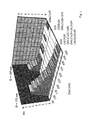
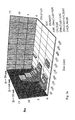
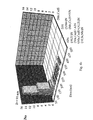
- a silicon steel (comprising Si 3.05% by weight, Al(s) 320 ppm, Mn 750 ppm, S 70 ppm, C 400 ppm, N 75 ppm, Cu 1000 ppm) was cast in a continuous thin casting machine (slab thickness 60 mm); the slabs were heated at 1230°C and hot-rolled; the hot-rolled strip was annealed at a maximum temperature of 1100°C, and cold-rolled to a thickness of 0.25 mm. The cold-rolled strip was decarburized at 850°C and then nitrided under different conditions of temperature and composition of nitriding atmosphere (NH 3 content).
- B800 B800 (mT) A B 650 22 120 0 0 18 1610 1520 750 44 130 10 0 21 1905 1580 850 92 180 60 10 20 1920 1930 950 75 230 100 30 24 1940 1920 1000 54 240 120 30 20 1925 1930 (intermediate nitriding power) Nitriding temp.
- B800 B800 (mT) A B 650 65 120 0 0 19 1870 1580 750 152 140 20 10 20 1910 1720 850 237 210 90 30 18 1905 1920 950 155 290 170 50 24 1920 1930 1000 119 300 180 55 28 1935 1930 (high nitriding power) Nitriding temp. °C N i AlN AlN n N c D B800 B800 (mT) A B 650 115 120 0 0 18 1880 1660 750 284 150 30 20 19 1870 1805 850 395 230 110 40 18 1890 1930 950 255 310 190 60 22 1920 1935 1000 195 310 190 70 25 1925 1930
- Steel slabs (comprising Si 3.2% by weight, C 320 ppm, Als 290 ppm, N 80 ppm, Mn 1300 ppm, S 80 ppm) were produced by continuous casting, and further heated up to 1300°C according to the present invention, hot- and cold-rolled to various thicknesses.
- the cold laminates were thereafter decarburized in continuous and nitrided according to the present invention at 970°C, by adjusting the nitriding power of the furnace atmosphere in order to let the steel absorb from 40 to 90 ppm of nitrogen.
- the strips were then box-annealed at 1200°C with a heating rate of 40°C/hour.
- a steel was produced (comprising Si 3.15% by weight, C 340 ppm, Als 270 ppm, N 80 ppm, Mn 1300 ppm, S 100 ppm, Cu 1000 ppm) and cold-transformed according to the present invention in a strip with thickness 0.29 mm. Process parameters were chosen in order to obtain an inhibition value (as defined in Example 1) comprised between 650 and 750 cm-1.
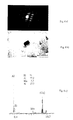
- This laminate was decarburized at 850 °C and nitrided, either at low temperature according to the conventional procedure (770°C during 30 s), or according to the present invention (1000°C during 30 s); in both cases a nitriding atmosphere was used consisting of nitrogen/hydrogen with addition of NH 3 .
- precipitates present in the decarburized strip contain sulfides, also mixed with nitrides and Al- and Si-based nitrides.
- the formation of aluminum nitride or mixed aluminum and/or silicon and/or manganese nitrides is obtained along the whole strip thickness; these products are formed as new precipitates or as a coating of already existing sulfide precipitates, whereas silicon nitride is almost absent.
- the amount of particles and the relative dimensional distribution are different.
- the introduced nitrogen mainly precipitates, far from the strip centre, in the form of silicon- and silicon-manganese nitrides; these compounds, well known as being fairly unstable from the thermic point of view, must nevertheless undergo a long treatment in the temperature range from 700 to 900°C in order to be dissolved and to release the nitrogen necessary for diffusion and reaction with aluminum.
Landscapes
- Chemical & Material Sciences (AREA)
- Engineering & Computer Science (AREA)
- Physics & Mathematics (AREA)
- Mechanical Engineering (AREA)
- Organic Chemistry (AREA)
- Metallurgy (AREA)
- Materials Engineering (AREA)
- Thermal Sciences (AREA)
- Crystallography & Structural Chemistry (AREA)
- Manufacturing & Machinery (AREA)
- Electromagnetism (AREA)
- Manufacturing Of Steel Electrode Plates (AREA)
- Solid-Phase Diffusion Into Metallic Material Surfaces (AREA)
- Crystals, And After-Treatments Of Crystals (AREA)
- Soft Magnetic Materials (AREA)
- Photovoltaic Devices (AREA)
Applications Claiming Priority (3)
| Application Number | Priority Date | Filing Date | Title |
|---|---|---|---|
| IT96RM000903A IT1290171B1 (it) | 1996-12-24 | 1996-12-24 | Procedimento per il trattamento di acciaio al silicio, a grano orientato. |
| ITRM960903 | 1996-12-24 | ||
| PCT/EP1997/004009 WO1998028453A1 (en) | 1996-12-24 | 1997-07-24 | Process for the treatment of grain oriented silicon steel |
Publications (2)
| Publication Number | Publication Date |
|---|---|
| EP0950120A1 EP0950120A1 (en) | 1999-10-20 |
| EP0950120B1 true EP0950120B1 (en) | 2001-11-28 |
Family
ID=11404619
Family Applications (1)
| Application Number | Title | Priority Date | Filing Date |
|---|---|---|---|
| EP97940018A Expired - Lifetime EP0950120B1 (en) | 1996-12-24 | 1997-07-24 | Process for the treatment of grain oriented silicon steel |
Country Status (16)
| Country | Link |
|---|---|
| US (1) | US6406557B1 (pl) |
| EP (1) | EP0950120B1 (pl) |
| JP (1) | JP2001506703A (pl) |
| KR (1) | KR100561140B1 (pl) |
| CN (1) | CN1073163C (pl) |
| AT (1) | ATE209700T1 (pl) |
| AU (1) | AU4202297A (pl) |
| BR (1) | BR9714234A (pl) |
| CZ (1) | CZ295507B6 (pl) |
| DE (1) | DE69708686T2 (pl) |
| ES (1) | ES2168668T3 (pl) |
| IT (1) | IT1290171B1 (pl) |
| PL (1) | PL182803B1 (pl) |
| RU (1) | RU2184787C2 (pl) |
| SK (1) | SK284523B6 (pl) |
| WO (1) | WO1998028453A1 (pl) |
Cited By (3)
| Publication number | Priority date | Publication date | Assignee | Title |
|---|---|---|---|---|
| DE10334493B4 (de) * | 2003-07-29 | 2006-01-05 | Klingelnberg Gmbh | Verfahren zum Fräsen von Spiralkegelrädern |
| DE102011107304A1 (de) | 2011-07-06 | 2013-01-10 | Thyssenkrupp Electrical Steel Gmbh | Verfahren zum Herstellen eines kornorientierten, für elektrotechnische Anwendungen bestimmten Elektrostahlflachprodukts |
| DE102014104106A1 (de) | 2014-03-25 | 2015-10-01 | Thyssenkrupp Electrical Steel Gmbh | Verfahren zur Herstellung von hochpermeablem kornorientiertem Elektroband |
Families Citing this family (12)
| Publication number | Priority date | Publication date | Assignee | Title |
|---|---|---|---|---|
| IT1290978B1 (it) | 1997-03-14 | 1998-12-14 | Acciai Speciali Terni Spa | Procedimento per il controllo dell'inibizione nella produzione di lamierino magnetico a grano orientato |
| KR19990088437A (ko) * | 1998-05-21 | 1999-12-27 | 에모또 간지 | 철손이매우낮은고자속밀도방향성전자강판및그제조방법 |
| JP4258349B2 (ja) * | 2002-10-29 | 2009-04-30 | Jfeスチール株式会社 | 方向性電磁鋼板の製造方法 |
| CN100513060C (zh) * | 2006-05-12 | 2009-07-15 | 武汉分享科工贸有限公司 | 无取向冷轧电工钢板制造方法 |
| CN101768697B (zh) | 2008-12-31 | 2012-09-19 | 宝山钢铁股份有限公司 | 用一次冷轧法生产取向硅钢的方法 |
| CN102789872B (zh) * | 2012-08-20 | 2015-07-15 | 烟台正海磁性材料股份有限公司 | 一种钕铁硼磁体及其制备方法 |
| RU2608258C1 (ru) * | 2012-12-28 | 2017-01-17 | ДжФЕ СТИЛ КОРПОРЕЙШН | Способ производства текстурированного листа из электротехнической стали |
| WO2016035345A1 (ja) * | 2014-09-04 | 2016-03-10 | Jfeスチール株式会社 | 方向性電磁鋼板の製造方法および窒化処理設備 |
| KR101998723B1 (ko) * | 2014-09-26 | 2019-07-10 | 제이에프이 스틸 가부시키가이샤 | 방향성 전자 강판, 방향성 전자 강판의 제조 방법 및 철심 |
| DE102015114358B4 (de) | 2015-08-28 | 2017-04-13 | Thyssenkrupp Electrical Steel Gmbh | Verfahren zum Herstellen eines kornorientierten Elektrobands und kornorientiertes Elektroband |
| CN110438439B (zh) * | 2019-08-30 | 2021-03-19 | 武汉钢铁有限公司 | 气氛区域可调式的渗氮装置及其连续气体渗氮工艺 |
| CN113174546B (zh) * | 2021-04-15 | 2022-06-14 | 鞍钢股份有限公司 | 一种解决取向硅钢热轧板晶粒粗大的方法 |
Family Cites Families (16)
| Publication number | Priority date | Publication date | Assignee | Title |
|---|---|---|---|---|
| US5472521A (en) * | 1933-10-19 | 1995-12-05 | Nippon Steel Corporation | Production method of grain oriented electrical steel sheet having excellent magnetic characteristics |
| SU1275053A1 (ru) * | 1985-03-20 | 1986-12-07 | Новолипецкий Ордена Ленина Металлургический Комбинат | Способ производства холоднокатаной анизотропной электротехнической стали |
| JPH0717961B2 (ja) * | 1988-04-25 | 1995-03-01 | 新日本製鐵株式会社 | 磁気特性、皮膜特性ともに優れた一方向性電磁鋼板の製造方法 |
| US5759293A (en) * | 1989-01-07 | 1998-06-02 | Nippon Steel Corporation | Decarburization-annealed steel strip as an intermediate material for grain-oriented electrical steel strip |
| JP2782086B2 (ja) * | 1989-05-29 | 1998-07-30 | 新日本製鐵株式会社 | 磁気特性、皮膜特性ともに優れた一方向性電磁鋼板の製造方法 |
| JPH0730397B2 (ja) * | 1990-04-13 | 1995-04-05 | 新日本製鐵株式会社 | 磁気特性の優れた一方向性電磁鋼板の製造方法 |
| JP2883226B2 (ja) * | 1991-06-27 | 1999-04-19 | 川崎製鉄株式会社 | 磁気特性の極めて優れた薄方向性けい素鋼板の製造方法 |
| JP2519615B2 (ja) * | 1991-09-26 | 1996-07-31 | 新日本製鐵株式会社 | 磁気特性の優れた方向性電磁鋼板の製造方法 |
| KR960010811B1 (ko) * | 1992-04-16 | 1996-08-09 | 신니뽄세이데스 가부시끼가이샤 | 자성이 우수한 입자배향 전기 강 시트의 제조방법 |
| US5507883A (en) * | 1992-06-26 | 1996-04-16 | Nippon Steel Corporation | Grain oriented electrical steel sheet having high magnetic flux density and ultra low iron loss and process for production the same |
| DE4311151C1 (de) * | 1993-04-05 | 1994-07-28 | Thyssen Stahl Ag | Verfahren zur Herstellung von kornorientierten Elektroblechen mit verbesserten Ummagnetisierungsverlusten |
| JP3240035B2 (ja) * | 1994-07-22 | 2001-12-17 | 川崎製鉄株式会社 | コイル全長にわたり磁気特性に優れた方向性けい素鋼板の製造方法 |
| JP3598590B2 (ja) * | 1994-12-05 | 2004-12-08 | Jfeスチール株式会社 | 磁束密度が高くかつ鉄損の低い一方向性電磁鋼板 |
| FR2731713B1 (fr) * | 1995-03-14 | 1997-04-11 | Ugine Sa | Procede de fabrication d'une tole d'acier electrique a grains orientes pour la realisation notamment de circuits magnetiques de transformateurs |
| US5643370A (en) * | 1995-05-16 | 1997-07-01 | Armco Inc. | Grain oriented electrical steel having high volume resistivity and method for producing same |
| US5885371A (en) * | 1996-10-11 | 1999-03-23 | Kawasaki Steel Corporation | Method of producing grain-oriented magnetic steel sheet |
-
1996
- 1996-12-24 IT IT96RM000903A patent/IT1290171B1/it active IP Right Grant
-
1997
- 1997-07-24 KR KR1019997005739A patent/KR100561140B1/ko not_active Expired - Lifetime
- 1997-07-24 ES ES97940018T patent/ES2168668T3/es not_active Expired - Lifetime
- 1997-07-24 RU RU99116259/02A patent/RU2184787C2/ru not_active IP Right Cessation
- 1997-07-24 DE DE69708686T patent/DE69708686T2/de not_active Expired - Lifetime
- 1997-07-24 AT AT97940018T patent/ATE209700T1/de active
- 1997-07-24 WO PCT/EP1997/004009 patent/WO1998028453A1/en not_active Ceased
- 1997-07-24 BR BR9714234-4A patent/BR9714234A/pt not_active IP Right Cessation
- 1997-07-24 US US09/331,273 patent/US6406557B1/en not_active Expired - Lifetime
- 1997-07-24 EP EP97940018A patent/EP0950120B1/en not_active Expired - Lifetime
- 1997-07-24 SK SK862-99A patent/SK284523B6/sk not_active IP Right Cessation
- 1997-07-24 CN CN97180953A patent/CN1073163C/zh not_active Expired - Fee Related
- 1997-07-24 PL PL97333916A patent/PL182803B1/pl unknown
- 1997-07-24 AU AU42022/97A patent/AU4202297A/en not_active Abandoned
- 1997-07-24 CZ CZ19992308A patent/CZ295507B6/cs not_active IP Right Cessation
- 1997-07-24 JP JP52827498A patent/JP2001506703A/ja active Pending
Cited By (5)
| Publication number | Priority date | Publication date | Assignee | Title |
|---|---|---|---|---|
| DE10334493B4 (de) * | 2003-07-29 | 2006-01-05 | Klingelnberg Gmbh | Verfahren zum Fräsen von Spiralkegelrädern |
| DE102011107304A1 (de) | 2011-07-06 | 2013-01-10 | Thyssenkrupp Electrical Steel Gmbh | Verfahren zum Herstellen eines kornorientierten, für elektrotechnische Anwendungen bestimmten Elektrostahlflachprodukts |
| WO2013004747A1 (de) | 2011-07-06 | 2013-01-10 | Thyssenkrupp Electrical Steel Gmbh | Verfahren zum herstellen eines kornorientierten, für elektrotechnische anwendungen bestimmten elektrostahlflachprodukts |
| DE102014104106A1 (de) | 2014-03-25 | 2015-10-01 | Thyssenkrupp Electrical Steel Gmbh | Verfahren zur Herstellung von hochpermeablem kornorientiertem Elektroband |
| EP2942417A1 (de) | 2014-03-25 | 2015-11-11 | Thyssenkrupp Electrical Steel Gmbh | Verfahren zur herstellung von hochpermeablem kornorientiertem elektroband |
Also Published As
| Publication number | Publication date |
|---|---|
| KR100561140B1 (ko) | 2006-03-15 |
| WO1998028453A1 (en) | 1998-07-02 |
| BR9714234A (pt) | 2000-04-18 |
| AU4202297A (en) | 1998-07-17 |
| CN1244220A (zh) | 2000-02-09 |
| RU2184787C2 (ru) | 2002-07-10 |
| PL333916A1 (en) | 2000-01-31 |
| CZ295507B6 (cs) | 2005-08-17 |
| ITRM960903A0 (it) | 1996-12-24 |
| SK86299A3 (en) | 2000-01-18 |
| DE69708686D1 (de) | 2002-01-10 |
| SK284523B6 (sk) | 2005-05-05 |
| US6406557B1 (en) | 2002-06-18 |
| DE69708686T2 (de) | 2004-03-04 |
| KR20000062310A (ko) | 2000-10-25 |
| IT1290171B1 (it) | 1998-10-19 |
| ITRM960903A1 (it) | 1998-06-24 |
| JP2001506703A (ja) | 2001-05-22 |
| CZ230899A3 (cs) | 2000-06-14 |
| ES2168668T3 (es) | 2002-06-16 |
| CN1073163C (zh) | 2001-10-17 |
| PL182803B1 (pl) | 2002-03-29 |
| ATE209700T1 (de) | 2001-12-15 |
| EP0950120A1 (en) | 1999-10-20 |
Similar Documents
| Publication | Publication Date | Title |
|---|---|---|
| EP0219611B1 (en) | Method for producing a grain-oriented electrical steel sheet | |
| EP0950119B1 (en) | Process for the production of oriented-grain electrical steel sheet with high magnetic characteristics | |
| EP0950120B1 (en) | Process for the treatment of grain oriented silicon steel | |
| EP0390140B1 (en) | Process for producing grain-oriented electrical steel sheet having excellent magnetic characteristic | |
| KR101149792B1 (ko) | 저철손 고자속밀도 방향성 전기강판 및 그 제조방법 | |
| KR950005793B1 (ko) | 자속밀도가 높은 일방향성 전기 강스트립의 제조방법 | |
| EP1162280A2 (en) | Method for producing a grain-oriented electrical steel sheet excellent in magnetic properties | |
| EP0966549B1 (en) | Process for the inhibition control in the production of grain-oriented electrical sheets | |
| EP1356127B9 (en) | Process for the production of grain oriented electrical steel strips | |
| US4938807A (en) | Process for production of grain oriented electrical steel sheet having high flux density | |
| JP2022514794A (ja) | 方向性電磁鋼板およびその製造方法 | |
| JP3736125B2 (ja) | 方向性電磁鋼板 | |
| EP1313886B1 (en) | Process for the control of inhibitors distribution in the production of grain oriented electrical steel strips | |
| EP0966548B1 (en) | Process for the inhibition control in the production of grain-oriented electrical sheets | |
| KR100430601B1 (ko) | 고자속 밀도 박판형 일방향성 전기 강판의 제조 방법 | |
| EP0823488A2 (en) | Method for producing grain-oriented silicon steel sheet | |
| KR101263795B1 (ko) | 저철손 고자속밀도 방향성 전기강판과 그 제조방법 및 여기에 사용되는 방향성 전기강판 슬라브 | |
| KR20060074648A (ko) | 자기특성이 우수한 방향성 전기강판 및 그 제조방법 | |
| KR100479995B1 (ko) | 자속밀도가 우수한 방향성 전기강판의 제조방법 | |
| KR100721819B1 (ko) | 철손이 낮고 자속밀도가 높은 방향성 전기강판 제조방법 | |
| JP2653948B2 (ja) | 熱鋼帯焼なましなしの標準結晶粒配向珪素鋼の製法 | |
| JPH01176033A (ja) | 磁気特性の優れた一方向性電磁綱板の製造方法 | |
| JPH11131141A (ja) | 一方向性けい素鋼板の製造方法 |
Legal Events
| Date | Code | Title | Description |
|---|---|---|---|
| PUAI | Public reference made under article 153(3) epc to a published international application that has entered the european phase |
Free format text: ORIGINAL CODE: 0009012 |
|
| 17P | Request for examination filed |
Effective date: 19990721 |
|
| AK | Designated contracting states |
Kind code of ref document: A1 Designated state(s): AT BE DE ES FR GB GR SE |
|
| GRAG | Despatch of communication of intention to grant |
Free format text: ORIGINAL CODE: EPIDOS AGRA |
|
| 17Q | First examination report despatched |
Effective date: 20010119 |
|
| GRAG | Despatch of communication of intention to grant |
Free format text: ORIGINAL CODE: EPIDOS AGRA |
|
| GRAH | Despatch of communication of intention to grant a patent |
Free format text: ORIGINAL CODE: EPIDOS IGRA |
|
| GRAH | Despatch of communication of intention to grant a patent |
Free format text: ORIGINAL CODE: EPIDOS IGRA |
|
| GRAA | (expected) grant |
Free format text: ORIGINAL CODE: 0009210 |
|
| AK | Designated contracting states |
Kind code of ref document: B1 Designated state(s): AT BE DE ES FR GB GR SE |
|
| REF | Corresponds to: |
Ref document number: 209700 Country of ref document: AT Date of ref document: 20011215 Kind code of ref document: T |
|
| REG | Reference to a national code |
Ref country code: GB Ref legal event code: IF02 |
|
| REF | Corresponds to: |
Ref document number: 69708686 Country of ref document: DE Date of ref document: 20020110 |
|
| ET | Fr: translation filed | ||
| REG | Reference to a national code |
Ref country code: ES Ref legal event code: FG2A Ref document number: 2168668 Country of ref document: ES Kind code of ref document: T3 |
|
| REG | Reference to a national code |
Ref country code: GR Ref legal event code: EP Ref document number: 20020400695 Country of ref document: GR |
|
| PLBE | No opposition filed within time limit |
Free format text: ORIGINAL CODE: 0009261 |
|
| STAA | Information on the status of an ep patent application or granted ep patent |
Free format text: STATUS: NO OPPOSITION FILED WITHIN TIME LIMIT |
|
| 26N | No opposition filed | ||
| PGFP | Annual fee paid to national office [announced via postgrant information from national office to epo] |
Ref country code: GR Payment date: 20050719 Year of fee payment: 9 |
|
| PG25 | Lapsed in a contracting state [announced via postgrant information from national office to epo] |
Ref country code: GR Free format text: LAPSE BECAUSE OF NON-PAYMENT OF DUE FEES Effective date: 20070202 |
|
| PGFP | Annual fee paid to national office [announced via postgrant information from national office to epo] |
Ref country code: SE Payment date: 20130619 Year of fee payment: 17 |
|
| PGFP | Annual fee paid to national office [announced via postgrant information from national office to epo] |
Ref country code: DE Payment date: 20140716 Year of fee payment: 18 |
|
| PGFP | Annual fee paid to national office [announced via postgrant information from national office to epo] |
Ref country code: FR Payment date: 20140723 Year of fee payment: 18 Ref country code: AT Payment date: 20140728 Year of fee payment: 18 Ref country code: ES Payment date: 20140730 Year of fee payment: 18 |
|
| PGFP | Annual fee paid to national office [announced via postgrant information from national office to epo] |
Ref country code: BE Payment date: 20140714 Year of fee payment: 18 |
|
| REG | Reference to a national code |
Ref country code: SE Ref legal event code: EUG |
|
| PG25 | Lapsed in a contracting state [announced via postgrant information from national office to epo] |
Ref country code: SE Free format text: LAPSE BECAUSE OF NON-PAYMENT OF DUE FEES Effective date: 20140725 |
|
| PGFP | Annual fee paid to national office [announced via postgrant information from national office to epo] |
Ref country code: GB Payment date: 20150722 Year of fee payment: 19 |
|
| REG | Reference to a national code |
Ref country code: DE Ref legal event code: R119 Ref document number: 69708686 Country of ref document: DE |
|
| REG | Reference to a national code |
Ref country code: AT Ref legal event code: MM01 Ref document number: 209700 Country of ref document: AT Kind code of ref document: T Effective date: 20150724 |
|
| PG25 | Lapsed in a contracting state [announced via postgrant information from national office to epo] |
Ref country code: DE Free format text: LAPSE BECAUSE OF FAILURE TO SUBMIT A TRANSLATION OF THE DESCRIPTION OR TO PAY THE FEE WITHIN THE PRESCRIBED TIME-LIMIT Effective date: 20160202 |
|
| REG | Reference to a national code |
Ref country code: FR Ref legal event code: ST Effective date: 20160331 |
|
| PG25 | Lapsed in a contracting state [announced via postgrant information from national office to epo] |
Ref country code: FR Free format text: LAPSE BECAUSE OF NON-PAYMENT OF DUE FEES Effective date: 20150731 Ref country code: AT Free format text: LAPSE BECAUSE OF NON-PAYMENT OF DUE FEES Effective date: 20150724 |
|
| REG | Reference to a national code |
Ref country code: ES Ref legal event code: FD2A Effective date: 20160826 |
|
| PG25 | Lapsed in a contracting state [announced via postgrant information from national office to epo] |
Ref country code: ES Free format text: LAPSE BECAUSE OF NON-PAYMENT OF DUE FEES Effective date: 20150725 |
|
| GBPC | Gb: european patent ceased through non-payment of renewal fee |
Effective date: 20160724 |
|
| PG25 | Lapsed in a contracting state [announced via postgrant information from national office to epo] |
Ref country code: GB Free format text: LAPSE BECAUSE OF NON-PAYMENT OF DUE FEES Effective date: 20160724 |
|
| PG25 | Lapsed in a contracting state [announced via postgrant information from national office to epo] |
Ref country code: BE Free format text: LAPSE BECAUSE OF NON-PAYMENT OF DUE FEES Effective date: 20150731 |