EP0945494B1 - Molded body of carbon black - Google Patents
Molded body of carbon black Download PDFInfo
- Publication number
- EP0945494B1 EP0945494B1 EP96931287A EP96931287A EP0945494B1 EP 0945494 B1 EP0945494 B1 EP 0945494B1 EP 96931287 A EP96931287 A EP 96931287A EP 96931287 A EP96931287 A EP 96931287A EP 0945494 B1 EP0945494 B1 EP 0945494B1
- Authority
- EP
- European Patent Office
- Prior art keywords
- carbon black
- molded product
- press molded
- press
- ink
- Prior art date
- Legal status (The legal status is an assumption and is not a legal conclusion. Google has not performed a legal analysis and makes no representation as to the accuracy of the status listed.)
- Expired - Lifetime
Links
Images
Classifications
-
- C—CHEMISTRY; METALLURGY
- C09—DYES; PAINTS; POLISHES; NATURAL RESINS; ADHESIVES; COMPOSITIONS NOT OTHERWISE PROVIDED FOR; APPLICATIONS OF MATERIALS NOT OTHERWISE PROVIDED FOR
- C09C—TREATMENT OF INORGANIC MATERIALS, OTHER THAN FIBROUS FILLERS, TO ENHANCE THEIR PIGMENTING OR FILLING PROPERTIES ; PREPARATION OF CARBON BLACK ; PREPARATION OF INORGANIC MATERIALS WHICH ARE NO SINGLE CHEMICAL COMPOUNDS AND WHICH ARE MAINLY USED AS PIGMENTS OR FILLERS
- C09C1/00—Treatment of specific inorganic materials other than fibrous fillers; Preparation of carbon black
- C09C1/44—Carbon
- C09C1/48—Carbon black
- C09C1/56—Treatment of carbon black ; Purification
- C09C1/60—Agglomerating, pelleting, or the like by dry methods
-
- C—CHEMISTRY; METALLURGY
- C08—ORGANIC MACROMOLECULAR COMPOUNDS; THEIR PREPARATION OR CHEMICAL WORKING-UP; COMPOSITIONS BASED THEREON
- C08K—Use of inorganic or non-macromolecular organic substances as compounding ingredients
- C08K3/00—Use of inorganic substances as compounding ingredients
- C08K3/02—Elements
- C08K3/04—Carbon
-
- C—CHEMISTRY; METALLURGY
- C09—DYES; PAINTS; POLISHES; NATURAL RESINS; ADHESIVES; COMPOSITIONS NOT OTHERWISE PROVIDED FOR; APPLICATIONS OF MATERIALS NOT OTHERWISE PROVIDED FOR
- C09D—COATING COMPOSITIONS, e.g. PAINTS, VARNISHES OR LACQUERS; FILLING PASTES; CHEMICAL PAINT OR INK REMOVERS; INKS; CORRECTING FLUIDS; WOODSTAINS; PASTES OR SOLIDS FOR COLOURING OR PRINTING; USE OF MATERIALS THEREFOR
- C09D11/00—Inks
- C09D11/02—Printing inks
- C09D11/03—Printing inks characterised by features other than the chemical nature of the binder
- C09D11/037—Printing inks characterised by features other than the chemical nature of the binder characterised by the pigment
-
- C—CHEMISTRY; METALLURGY
- C09—DYES; PAINTS; POLISHES; NATURAL RESINS; ADHESIVES; COMPOSITIONS NOT OTHERWISE PROVIDED FOR; APPLICATIONS OF MATERIALS NOT OTHERWISE PROVIDED FOR
- C09D—COATING COMPOSITIONS, e.g. PAINTS, VARNISHES OR LACQUERS; FILLING PASTES; CHEMICAL PAINT OR INK REMOVERS; INKS; CORRECTING FLUIDS; WOODSTAINS; PASTES OR SOLIDS FOR COLOURING OR PRINTING; USE OF MATERIALS THEREFOR
- C09D7/00—Features of coating compositions, not provided for in group C09D5/00; Processes for incorporating ingredients in coating compositions
- C09D7/40—Additives
- C09D7/60—Additives non-macromolecular
- C09D7/61—Additives non-macromolecular inorganic
-
- C—CHEMISTRY; METALLURGY
- C09—DYES; PAINTS; POLISHES; NATURAL RESINS; ADHESIVES; COMPOSITIONS NOT OTHERWISE PROVIDED FOR; APPLICATIONS OF MATERIALS NOT OTHERWISE PROVIDED FOR
- C09D—COATING COMPOSITIONS, e.g. PAINTS, VARNISHES OR LACQUERS; FILLING PASTES; CHEMICAL PAINT OR INK REMOVERS; INKS; CORRECTING FLUIDS; WOODSTAINS; PASTES OR SOLIDS FOR COLOURING OR PRINTING; USE OF MATERIALS THEREFOR
- C09D7/00—Features of coating compositions, not provided for in group C09D5/00; Processes for incorporating ingredients in coating compositions
- C09D7/40—Additives
- C09D7/66—Additives characterised by particle size
- C09D7/69—Particle size larger than 1000 nm
-
- C—CHEMISTRY; METALLURGY
- C01—INORGANIC CHEMISTRY
- C01P—INDEXING SCHEME RELATING TO STRUCTURAL AND PHYSICAL ASPECTS OF SOLID INORGANIC COMPOUNDS
- C01P2004/00—Particle morphology
- C01P2004/60—Particles characterised by their size
- C01P2004/61—Micrometer sized, i.e. from 1-100 micrometer
-
- C—CHEMISTRY; METALLURGY
- C01—INORGANIC CHEMISTRY
- C01P—INDEXING SCHEME RELATING TO STRUCTURAL AND PHYSICAL ASPECTS OF SOLID INORGANIC COMPOUNDS
- C01P2006/00—Physical properties of inorganic compounds
- C01P2006/10—Solid density
-
- C—CHEMISTRY; METALLURGY
- C01—INORGANIC CHEMISTRY
- C01P—INDEXING SCHEME RELATING TO STRUCTURAL AND PHYSICAL ASPECTS OF SOLID INORGANIC COMPOUNDS
- C01P2006/00—Physical properties of inorganic compounds
- C01P2006/19—Oil-absorption capacity, e.g. DBP values
Definitions
- the present invention relates to a molded product of carbon black.
- Furnace black carbon black produced by a furnace method
- lamp black and thermal black were present as carbon black.
- a furnace method developed by Phillips in 1942 i.e. a method wherein a feed oil is sprayed in a furnace heated to a temperature of at least 1300°C to obtain carbon black. This may be attributable to the excellent productivity such as the high yield and at the same time to the properties of furnace black, especially such that the one having a small particle size and small structure can be obtained, and it provides excellent performance to increase blackness of an ink or a coating material.
- furnace black tends to be difficult to be dispersed in a vehicle due to its small particle size and small structure and a less amount of material adsorbed on its surface.
- carbon black produced by a furnace method usually has an extremely low bulk density at a level of about 0.1 g/cc immediately after the production. Due to this low bulk density, the cost for packing bags, the cost for storage at a warehouse and the cost for transportation by trucks, freight cars or ships, are expensive, and dusting is substantial during distribution or use, whereby environmental pollution is problematic.
- the beads product has a bulk density of from 0.3 to 0.5 g/cc which is substantially higher than non-treated carbon black.
- it is not still adequate in preventing dusting at the time of weighing or in preventing powdering of the granulated product during transportation.
- the dispersibility will be poor in a vehicle such as a varnish or resin which is a material for an ink or a coating material. Therefore, the beads product may sometimes be not useful for this purpose.
- the beads products is granulated with carbon black particles having a long structure mutually entangled during the granulation process, whereby the dispersibility tends to be poor.
- the handling efficiency and the dispersibility in a vehicle, of carbon black, particularly furnace black which can be made to have a small particle size are in an antinomic relation to each other, and it has been believed difficult to satisfy the handling efficiency and the dispersibility simultaneously.
- Carbon Black Hand Book, third edition (p. 563), compiled by Carbon Black Association, discloses that "there will be a substantial need for developing a carbon black excellent in handling efficiency free from substantial pollution or a readily dispersible carbon black to further improve the quality and productivity of an ink; and the handling efficiency and the dispersibility of carbon black is in an antinomic relation, and an improvement beyond the fence of e.g. the surface chemistry or rheology, or the formulation, packaging or shipping form of carbon black, is required".
- Various proposals have been made heretofore, but no case has been reported wherein these two problems have been solved simultaneously.
- U.K. Patent 511,862 discloses an attempt to improve the handling efficiency by improving the bulk density by press deaerating lamp black or the like
- U.K. Patent 618,955 proposes an apparatus for the press deaeration of U.K. patent 551,862.
- German Patent 1302382 (filed in 1966) discloses that a molded product of lamp black having a density of from 0.160 to 0.480 g/cc was obtained by an apparatus to increase the density by a press.
- JP-A-3-259962 discloses an attempt to improve the handling efficiency by coating a casein/starch/polyvinyl alcohol aqueous solution and a styrene/butadiene latex or an acrylic latex on the surface of a block of carbon black by drying the block after suction filtration of an aqueous slurry of carbon black.
- this method it is necessary to prepare a slurry of carbon black which is superfine powder and to subject this slurry to filtration and drying, whereby substantial labor and costs will be required.
- the obtained block is considered to be poor in the dispersibility.
- JP-A-6-122111 discloses that a carbon black powder is charged into a closed mold and subjected to reduced pressure treatment, and then the pressure in the mold is returned to atmospheric pressure to obtain a molded product.
- the molding pressure exerted by reduced pressure is less than atmospheric pressure (about 1.03 kg/cm 2 ), whereby the bulk density can not be increased to such an extent to reduce the transportation cost or the storage cost in a warehouse.
- the molded product thereby obtained has substantial irregularities on its surface. This is considered to be attributable to the fact that carbon black as a bulky powder is compressed by the atmospheric pressure difference, whereby a part of the charged carbon black has scattered.
- EP-A-0 370 490 relates to compacted carbon black flake pellets having a bulk density of from 0.10 to 0.05 g/cm 3 and an initial dispersion of at most 5.0%.
- the problem underlying EP-A-0 370 490 is the provision of carbon black compacted flake pellets, the storage and transportation of which is facilitated, the scattering is prevented and the dispersibility to a vehicle is not impaired.
- the present inventors have conducted extensive studies to solve the above problems. As a result, it has been surprisingly found that the dispersibility and improvement of the bulk density can simultaneously be satisfied by controlling the molded density which is the density of a molded product obtained by press molding carbon black, the particle size and the DBP oil absorption within a specific relation.
- the present invention has been accomplished on the basis of this discovery. Further, it has surprisingly been found that this molded product improves blackness when used as a coating material, over the starting material carbon black powder (loose product).
- the present invention provides a press molded product as specified in claim 1.
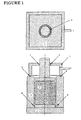
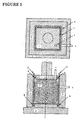
- reference numeral 1 indicates an upper punch, numeral 2 a lower punch, numeral 3 a die, and numeral 5 a reduced pressure chamber.
- the carbon black to be used in the present invention may, for example, be carbon black produced by a furnace method or acetylene black.
- furnace black produced by a furnace method since it provides a remarkable effect for maintaining the dispersibility. Further, it provides a substantial effect for improving blackness.
- the particle size of the carbon black is not particularly limited. However, when it is within a small particle range of from 1 to 60 nm, particularly from 1 to 50 nm, the effect for improving the handling efficiency and the dispersibility is high, and a high effect is obtained also for improvement of blackness.
- Carbon black having fine particle sizes within such a range has a strong tendency for agglomeration of particles and used to be difficult to disperse at the time of producing an ink, a coating material, a colored resin, a rubber or the like.
- An additional merit may be pointed out that the merit of the present invention is even larger with respect to such carbon black which is normally difficult to disperse.
- Such carbon black is molded by pressing.
- the mold to be used may be made of any material so long as it has a sufficient strength durable against the pressure applied during molding.
- a metallic mold a stainless steel mold made of e.g. SUS304 or SUS316 or a mold made of super steel such as tungsten carbide, may be used.
- a mold made of a fluorine resin such as polytetrafluoroethylene (PTFE), polychlorotrifluoroethylene (PCTPE) or polytetrafluoroethylene-hexafluoropropylene (FEP), a mold made of a plastic such as nylon, polyethylene, polycarbonate or a phenol resin, or a mold made of a composite material, for example, FRP such as CFRP or GFRP, may be used.
- a mold made of e.g. alumina, zirconia or mullite may be used.
- the size of the mold is at least 1 cm 3 , preferably at least 100 cm 3 . If it is less than 1 cm 3 , the transportation tends to be cumbersome. If necessary, a molded product of a large size may prepared, and it may be cut into a proper size for use or transportation.
- the pressing machine which can be used for pressing may be any press molding machine so long as press molding can be done, such as a hydraulic mechanical pressing machine, a hydraulic hand pressing machine, a mechanical pressing machine or an air cylinder type pressing machine.
- the shape of the mold is not particularly limited and depends upon the desired shape of the molded product, such as a columnar shape having a triangle or other polygonal cross-section, particularly a cubic or rectangular parallelpiped shape, which is advantageous from the viewpoint of handling.
- Carbon black is introduced into the above mold and molded by pressing.
- the density of the obtained molded product is adjusted within the following specific range.
- D is the arithmetic mean particle size (nm) of carbon black by an electron microscope
- L is the DBP oil absorption (ml/100 g).
- the DBP oil absorption is a value measured by a method in accordance with JIS K6221-1982.
- the particle size of carbon black is a value measured by the following method. Namely, carbon black is put in chloroform and dispersed by application of supersonic waves of 200 KHz for 20 minutes, and then the dispersed sample is fixed on a supporting film. The film is photographed by a transmission electron microscope, and a particle size is calculated by the diameter on the photograph and the magnification of the photograph. This operation is carried out over about 1500 times, and an arithmetic mean of such values is taken as the particle size.
- the molded product By controlling the density within the above range, the molded product will be excellent in the handling efficiency without impairing the basic properties of carbon black such as the dispersibility in a vehicle.
- the molded product of carbon black of the present invention preferably has a powdering ratio of at most 40%, more preferably at most 20%.
- the powering ratio can be obtained by a measuring method which will be described hereinafter in Examples.
- the ratio (hereinafter sometimes referred to as "the bulk density ratio”) of the bulk density of the molded product of carbon black to the bulk density of powdery carbon black as the starting material is preferably at least 2.5 times and at most 8 times, more preferably at least 3 times and at most 7 times. If this bulk density ratio is lower than 2.5, the compacting property of the molded product tends to be low. On the other hand, if the bulk density ratio exceeds 8, the dispersibility tends to be low. When the bulk density ratio is at least 2.5 and at most 8, the compacting property and the dispersibility will be simultaneously satisfied within preferred ranges.
- the pressure during press molding is preferably at least 0.196 mPa (2 kgf/cm 2 ) and at most 49 mPa (500 kgf/cm 2 ), more preferably at least 0.49 mPa (5 kgf/cm 2 ) and at most 39.2 mPa (400 kgf/cm 2 ). If the molding pressure is lower than 0.196 mPa (2 kgf/cm 2 ), the compacting property tends to be low, and the powdering ratio tends to increase.
- press molding is preferably conducted under a molding pressure of at least 0.196 mPa (2 kgf/cm 2 ) and at most 49 mPa (500 kgf/cm 2 ).
- press molding it is possible to employ a method wherein press molding is carried out after preliminarily degassing a gas among carbon black particles by means of a reduced pressure chamber.
- press molding is carried out after preliminarily degassing a gas among carbon black particles by means of a reduced pressure chamber.
- the following method may be employed, which will be described with reference to the apparatus shown in Figures 1 and 2.
- a carbon black powder as a starting material to be molded is filled into a mold having a slidable cylinder and a piston, as shown in Figures 1 and 2.
- the inside of a vacuum chamber set above the cylinder and the inside of the cylinder are substantially sealed from the exterior by a gasket material.
- a vacuum pump connected to the vacuum chamber is driven to lower the piston to press mold the carbon black in the cylinder while maintaining the vacuumed condition .
- the operation of the vacuum pump is stopped, and the pressure of the atmosphere in the chamber and the cylinder is returned to atmospheric pressure.
- the vacuum chamber and the piston are raised, and the molded product of carbon black is taken out.
- degassing of the gas among carbon black particles by the reduced pressure chamber and subsequent press molding of carbon black can be carried out.
- the reduced pressure is preferably from 1.33 Pa to 6.67 ⁇ 10 4 Pa (0.01 to 500 Torr). At a pressure of not higher than 6.67 ⁇ 10 4 Pa (500 Torr), degassing among particles is very easy. On the other hand, no additional effect can be obtained even if the pressure is reduced to a level of less than 1.33 Pa (0.01 Torr), and cumbersomeness increases to attain such a high vacuumed condition.
- the method for accomplishing the desired degree of reduced pressure is not particularly limited.
- an oil rotary type vacuum pump, an aspirator, a sliding type vacuum pump, a free piston type vacuum pump, a diaphragm type vacuum pump, a diffuser pump or a turbo vacuum pump may, for example, be mentioned.
- Control of the density of the press molded product of carbon black can be made by measuring the resistance.
- the density control can be made by measuring the resistance of the molded product during or after press molding.
- a two probe method, a four terminal method, a four probe method or a van der Pauw method is, for example, available.
- a four probe method is most suitable for the density measurement of the press molded product of carbon black of the present invention, since measurement can be carried out simply by pressing electrode probes to the sample.
- the resistance it is preferred to employ the volume resistance as an index of the specific resistance independent of the shape of the sample. The volume resistance can be obtained by arithmetic processing of the result measured by the four probe method.
- an operation of filling and pressing the starting material may be repeated a plurality of times, whereby it is possible to control the size of the press molding apparatus.
- This embodiment can be practiced by using, for example, a filter paper, a filter cloth or a fluorine resin as the porous body.
- a porous body may be bonded to a piston of the press molding apparatus.
- the pressure at the time of such releasing is preferably from 9.8 ⁇ 10 -4 mPa to 0.49 mPa (0.01 to 5 kgf/cm 2 ) and within a range not to exceed the pressure during the press molding, which is particularly effective for preventing breakage. Further, it is also effective to use a carbon black having its water content adjusted to a level of from 0.5 to 11 wt%, or a carbon black which is preliminarily granulated, for preventing breakage, depending upon the particular application.
- the shape of the molded product of carbon black is not particularly limited, but is preferably a columnar shape having a polygonal cross-section, more preferably cubic or rectangular parallelpiped.
- a truck or a freight car for transporting carbon black or a warehouse is usually rectangular parallelpiped. Accordingly, the molded product of the above-mentioned shape can be filled in such a space compactly, whereby the transportation cost or the cost for storage in a warehouse can effectively be reduced.
- the press molded product of carbon black as described in the foregoing has a high bulk density and is excellent in the compacting property, whereby it is possible to substantially reduce the storage and transportation costs which occupy a substantial proportion in the costs for the production and distribution of carbon black, by storing and transporting carbon black in the form of such a press molded product of carbon black, which is industrially extremely advantageous.
- the storage includes storing, accommodating or keeping in a open or closed space such as a warehouse or else temporarily or over a long period of time.
- the product is maintained in a prescribed space for a predetermined period of time until next transportation or use.
- it may be stored in a warehouse in a state piled on a pallet or put in various containers.
- the press molded product of carbon black of the present invention as described above, can be used as a pigment for an ink, a coating material or a resin composition, whereby a product excellent in blackness and gloss can be obtained.
- a conventional method may be employed for blending the molded product of carbon black in a varnish as a vehicle. Further, the dispersing step is not particularly limited, and a conventional method may be employed, except that the molded product of carbon black of the present invention is used.
- the varnish (vehicle) to be used is not particularly limited, so long as it is useful for an ink.
- a varnish to be used for printing a mixture of a rosin-modified phenol resin, an alkyd resin and drying oil, which is used for lithographic printing, may be mentioned.
- a varnish to be used for relief printing a mixture comprising a natural resin such as gilsonite or rosin, a synthetic resin such as a rosin-modified phenol resin, a maleic acid resin, a petroleum resin, an alkyd resin or ester gum, a vegetable oil such as linseed oil or tung oil, and a mineral oil such as an ink oil or a solvent oil, may be mentioned.
- a varnish to be used for a rotary press ink a mixture comprising a resin such as gilsonite, a rosin-modified phenol resin, a rosin ester resin, a maleic acid resin or an alkyd resin, a drying oil such as linseed oil or tung oil and a mineral oil such as ink oil, ink solvent, spindle oil or machine oil, may be mentioned.
- a varnish to be used for a gravure ink a mixture comprising a resin such as a rosin-modified resin, a maleic acid resin or gilsonite, and a solvent such as toluene, n-hexane or cyclohexane, may be mentioned.
- a varnish to be used for an aqueous gravure ink a mixture comprising a resin such as a polyvinyl alcohol or starch and various alcohols, may be mentioned.
- a varnish to be used for a flexo ink a mixture comprising a resin such as a rosin-modified maleic acid resin, a styrene acrylic acid resin, a styrene maleic acid resin, a styrene methacrylic resin, an acrylate acrylic acid resin or a methacrylate acrylic acid resin, and a solvent such as glycol, an alcohol, an ester or an aliphatic hydrocarbon, may be mentioned.
- a varnish to be used for a screen ink a mixture comprising a resin such as an acrylic resin, a vinyl chloride-vinyl acetate copolymer, a polyester resin, a cellulose resin, an epoxy resin, a melanine resin, various polyols, an alkyd resin or various acrylates, and a solvent such as various alcohols, various ethers, various ketones, various aromatic hydrocarbons, various aliphatic hydrocarbons or various halogen type solvents, may be mentioned.
- a resin such as an acrylic resin, a vinyl chloride-vinyl acetate copolymer, a polyester resin, a cellulose resin, an epoxy resin, a melanine resin, various polyols, an alkyd resin or various acrylates, and a solvent such as various alcohols, various ethers, various ketones, various aromatic hydrocarbons, various aliphatic hydrocarbons or various halogen type solvents.
- the ink for which the present invention may be used is not particularly limited, and may, for example, be a relief printing ink such as news ink, rotary press ink or half tone block ink, a lithographic printing ink such as offset ink, dry offset ink or colo type ink, an intaglio printing ink such as engraved intaglio ink, gravure ink, quick set ink, gloss ink, abrasion resistant ink, heat set ink, steam set ink, pressure set ink, plastisol ink, balanced ink, cold set ink or raset ink, or others such as a rubber plate ink, an aniline ink, a tin plate printing ink, an ink for plastic film, a silk screen ink or a water base ink.
- the press molded product of carbon black of the present invention can be used for the production of any one of these inks.
- a method for dispersing the press molded product of carbon black of the present invention in a vehicle is not particularly limited. It may be used in a size as taken out from the mold used for press molding. Otherwise, it may be crushed to a diameter of from 0.1 mm to 1 cm so that the size will be smaller than the inlet of a kneader, and then put into the kneader for dispersing. The effect for improving blackness can be obtained even when the crushed product is used.
- the crushing method is not particularly limited, but it is preferred to use a shearing type crusher such as a cutting mill, a rotary crusher or a shearing roll mill, whereby the density of the particles will not be increased during crushing.
- a shearing type crusher such as a cutting mill, a rotary crusher or a shearing roll mill, whereby the density of the particles will not be increased during crushing.
- the resin useful for this purpose is not particularly limited and may, for example, be a thermoplastic resin such as a low density polyethylene, a high density polyethylene, a polypropylene, a polystyrene, a vinyl chloride resin, a polyvinyl alcohol, a vinylidine chloride resin, a methacrylic resin, a polyamide, a polycarbonate, a polyacetal, a polyethylene terephthalate, a polybutylene terephthalate, a modified polyphenylene ether or nylon, or a thermosetting resin such as a phenol resin, a urea resin, a melamine resin, an unsaturated polyester resin or a urethane foam. Further, a mixture of these resins, or a resin having various additives incorporated thereto, may be used.
- a thermoplastic resin such as a low density polyethylene, a high density polyethylene, a polypropylene, a polystyrene, a vinyl chloride resin, a
- the press molded product of carbon black of the present invention is added and kneaded, as the case requires.
- a kneader for rubber the one commonly used as a kneader for rubber, such as a roll mixer of a batch system open type, a Banbury type mixer of a batch system closed type, a single screw kneading extruder or a twin screw kneading extruder of a continuous screw type, a single shaft kneader of a continuous rotor type, or a twin shaft kneader of a continuous rotor type, may be used.
- the varnish (vehicle) to be used for this purpose is not particularly limited so long as it is commonly used for a coating material.
- it may be drying oil, improved drying oil, a natural resin or bitumen for an oil base coating material.
- It may be shellac for an alcoholic coating material. It may be nitrocellulose, acetyl cellulose, an acrylic resin, a phenol formaldehyde resin or a resin modified phenol formaldehyde resin for a cellulose derivative coating material.
- It may be an oxidized oil-modified alkyd resin, a modified alkyd resin, a butyrated aminoalkyd resin, an aminoalkyd resin, polyvinyl acetate, polyvinyl chloride, chlorinated rubber, a styrene-butadiene resin, a thermosetting acrylic resin, an epoxy resin, an unsaturated polyester, a polyisocyanate resin, silicone and an alkyd resin, or butyl titanate for a synthetic resin coating material. It may be polyvinyl acetate, polystyrene-butadiene or a polyacrylic compound for a synthetic emulsion paint.
- It may be a phenol aldehyde polycondensate, an etherified melamine resin or an amine-neutralized alkyd resin for a water-base baking paint. It may be a protein ⁇ starch ⁇ arginate ⁇ polyvinyl alcohol or carboxymethyl cellulose for a water base coating material. Natural high grade phenol or a natural phenol aldehyde resin may be used for a Japanese lacquer.
- the coating material is also not particularly limited.
- it may, for example, be an oil paint, an oil enamel, a phenol resin or maleic acid resin coating material, an alkyd resin coating material, an aminoalkyd resin coating material, a urea resin coating material, an alcoholic coating material, a lacquer, a vinyl resin coating material, an acryl resin coating material, a polyester resin coating material, an epoxy resin coating material, a polyurethane resin coating material, a silicone resin coating material, a emulsion resin coating material or a watersoluble resin coating material.
- the press molded material of carbon black of the present invention may be blended with at least one of natural rubber and synthetic rubber to obtain a rubber composition.
- the press molded material is blended in an amount of from 30 to 150% by weight per 100 parts by weight of rubber, whereby it is possible to obtain a rubber composition having a small loss factor or heat build-up.
- the synthetic rubber may be styrene butadiene rubber (SBR), butadiene rubber (BR), isoprene rubber (IR), chloroprene rubber (CR), nitrilebutadiene rubber (NBR), isobutylene isoprene rubber (IIR), ethylene propylene rubber (EPM), silicone rubber, fluorine rubber, chlorosulfonated polyethylene (CSM), chlorinated polyethylene (CM), polysulfide rubber, urethane rubber (AU), acryl rubber (ACM), epichlorohydrin rubber (ECO), propylene oxide rubber (PO), an ethylenevinyl acetate copolymer (EVA), liquid rubber, polyalkylene sulfide, or nitroso rubber.
- SBR styrene butadiene rubber
- BR butadiene rubber
- IR isoprene rubber
- CR chloroprene rubber
- NBR nitrilebutadiene rubber
- IIR isobut
- Natural rubber or a mixture of such rubbers may also be used.
- the press molded product of carbon black of the present invention is added and kneaded to obtain a rubber composition.
- the kneader to be used here may be the one commonly used as a kneader for rubber, such as a roll mixer of a batch system open type, a Banbury mixer of a batch system closed type, a single screw kneading extruder or a twin screw kneading extruder of a continuous screw type, a single shaft kneader of a continuous rotor type or a twin shaft kneader of a continuous rotor type.
- Carbon black was press-molded using as the carbon black the one identified in Table 1, using as a pressing machine a 37 ton four columnar single acting hydraulic press (ram diameter: 152.4 mm) and using as a mold a SUS 304 mold (inner size: 70 mm ⁇ 70 mm, height: 40 mm, manufactured by Mitsubishi Kasei Engineering K.K.).
- a method for measuring an ink screen residue to test the dispersibility of carbon black for the preparation of an ink will be described.
- Into an about 1.8 l stainless steel container (diameter: 11 cm, height: 18.5 cm) 480 g of Reductus #220 (manufactured by Kyodo Sekiyu) and 120 g of a molded product of carbon black or a granulated product of carbon black, were added.
- a stirrer (four vanes, diameter of each vane: 4.5 cm) set in a TK AUTO HOMOMIXER SL10A (manufactured by Tokushu Rika Kogyo) was inserted at 2 cm above the bottom of the stainless steel container.
- the stirrer was operated at 5000 rpm and stirring was carried out for 1 hour.
- 50 g of the mixture was sampled and subjected to filtration with a stainless steel screen of 325 mesh (opening: 46 ⁇ m). After the filtration, about 200 cc of light oil was sprinkled on the screen for washing. This screen was dried for 1 hour in a dryer set at 150°C. Then, the screen was taken out from the dryer and cooled, and then the weight of the screen was measured. The weight of the initial screen preliminarily measured, was subtracted from the measured value to obtain the weight (A g) of the carbon black remaining on the screen, whereby the screen residue was calculated by the following formula.
- Screen residue (%) (A ⁇ 600/(50 ⁇ 120)) ⁇ 100
- the density of the molded product was calculated.
- the weight (g) of the molded product was measured by an electronic direct reading type even balance. From the weight and the volume of the molded product, the density (g/cm 3 ) of the molded product was calculated.
- the press molded product of carbon black was accurately weighed for 25 ⁇ 1 g (W) to an accuracy of 0.01 g, and put into a sieve having a diameter of 200 mm with an opening of 1 mm, as stipulated in JIS K-6221.
- a receptacle and a cover were attached to this sieve, and the sieve was shaked by a shaking machine as stipulated in JIS K-6221 for 20 seconds while applying shocks.
- Tables 2 to 7 show the results of measurements in Examples and Comparative Examples, the compacting property and the dispersibility judged from these results, and the overall evaluation obtained by judging the compacting property, the dispersibility, etc. from overall aspects.
- Example 6-7 shows a dispersibility which is about twice as compared with Comparative Example 6-8.
- the present invention it is possible to obtain carbon black excellent in both the compacting property (handling efficiency) and the dispersibility, which have been believed to be in an antinomic relation to each other.
- a grined gauge was used; for measuring the color difference, a method by a color difference measuring instrument and a method by visual observation were used; and for the gloss, visual observation was employed. Measurement by a grined gauge was carried out in the following manner. Namely, the grined gauge is the one having two grooves engraved on a steel plate so that the depth of the grooves varies from 0 to 25 ⁇ 10 -6 m.
- An ink is placed at the deepest portion and stretched towards a shallow portion by a scraper, whereupon the particle size is determined from the gradation at the position of striae formed at a portion shallower than the diameters of coarse particles ("Coloring Material Engineering Handbook", p. 1052-1053, published by Asakura Shoten).
- Measurement of a color difference by visual observation was carried out as follows. "Place a sample and a standard ink side by side on a prescribed paper and stretch them toward yourself with a knife having a broad front blade. With the knife slightly inclined toward yourself, pull it firmly toward yourself, and towards the end, gently pull the knife by inclining it at an angle of 30° to the paper, so as to form a portion where the ink film is thin and a portion where the ink film is thick so that the portion is free from an influence of the paper. At the thin portion, observe the bottom color i.e.
- non-dispersed block carbon black within a range of from 0 to 50 ⁇ m by a grined gauge (model: "R1110") manufactured by Kabushiki Kaisha Kamishima Seisakusho. If the size of non-dispersed block carbon black was larger than 10 ⁇ m, the carbon black was again passed through the roll mill. As a result, the maximum particle size was 37 ⁇ m as a result of the first measurement, 24 ⁇ m as a result of the second measurement and 9 ⁇ m as a result of the third measurement.
- the ink with which the result of measurement became less than 10 ⁇ m was aged at room temperature for 1 week. Using this aged ink, drawdown tests were carried out by printing and knife spreading. 0.6 cm 3 of the ink was sampled and 5 sheets of groundwood paper of A4 size were printed (printing area: 198 mm ⁇ 192 mm) by an offset printing machine manufactured by Toyo Seiki. The printed first and fifth sheets were subjected to color difference measurement by a SM color computer manufactured by Suga Shikenki K.K. to determine the L value, the a value and the b value. As a result, the L value of the first sheet was 25.9, and the L value of the fifth sheet was 37.8.
- this aged ink and the ink prepared by the following Comparative Example 1 were respectively sampled, whereupon knife spreading of the inks was carried out by means of an ointment knife.
- the gloss and blackness of the spread inks were visually evaluated.
- the gloss and blackness of the knife spread product of the ink prepared in Comparative Example 1 were taken as a reference of 10 points.
- both the gloss and blackness of the aged ink were 10, and there was no difference from the ink of Comparative Example 1.
- Example 7 The experiment was carried out in the same manner as in Example 7 except that the molding pressure of "CF9" was changed to 15.88 mPa (162 kgf/cm 2 ), whereby the density of the molded product thereby obtained was 0.788 g/cm 3 .
- the grined gauge test results were such that the result of the first measurement was 51 ⁇ m, the result of the second measurement was 35 ⁇ m, the result of the third measurement was 16 ⁇ m and the result of the fourth measurement was 7 ⁇ m.
- Example 7 The experiment was carried out in the same manner as in Example 7 except that carbon black "CF31" manufactured by Mitsubishi Chemical Corporation was used, and the molding pressure was changed to 1.82 mPa (18.6 kgf/cm 2 ), whereby the density of the molded product thereby obtained was 0.432 g/cm 3 .
- the grined gauge test results were such that the result of the first measurement was 9 ⁇ m, and the result of the second measurement was 7 ⁇ m.
- Example 7 The experiment was carried out in the same manner as in Example 7 except that the molding pressure of "CF31" was changed to 36.46 mPa (372 kgf/cm 2 ), whereby the density of the molded product obtained was 0.531 g/cm 3 .
- the grined gauge test results were such that the result of the first measurement was 13 ⁇ m, the result of the second measurement was 10 ⁇ m, and the result of the third measurement was 7 ⁇ m.
- Press molding was carried out in the same manner as in Example 7 except that carbon black "MA7” manufactured by Mitsubishi Chemical Corporation was used instead of carbon black “CF9” manufactured by Mitsubishi Chemical Corporation, and the density of the molded product was measured and found to be 0.518 g/cm 3 .
- Example 11 The experiment was carried out in the same manner as in Example 11 except that the molding pressure of "MA7" was changed to 14.6 mPa (149 kgf/cm 2 ), whereby the density of the molded product obtained was 0.748 g/cm 3 .
- the grined gauge test results were such that the result of the first measurement was 40 ⁇ m, and the result of the second measurement was 7 ⁇ m.
- Example 7 An ink was prepared and the experiment was carried out in the same manner as in Example 7 except that non-granulated product of carbon black "CF9" (bulk density: 0.250 g/cm 3 ) manufactured by Mitsubishi Chemical Corporation was used by itself without molding.
- non-granulated product of carbon black "CF9" bulk density: 0.250 g/cm 3
- the grined gauge test results were such that the result of the first measurement was 48 ⁇ m, the result of the second measurement was 37 ⁇ m, the result of the third measurement was 32 ⁇ m, the result of the fourth measurement was 30 ⁇ m, the result of the fifth measurement was 19 ⁇ m, and the result of the sixth measurement was 9 ⁇ m.
- Example 7 wherein the particle size became less than 10 ⁇ m in the third measurement, six times of kneading was required.
- the grined gauge test results were such that the result of the first measurement was 62 ⁇ m, the result of the second measurement was 46 ⁇ m, the result of the third measurement was 38 ⁇ m, the result of the fourth measurement 15 ⁇ m, and the result of the fifth measurement was 7 ⁇ m.
- Example 8 wherein the size became less than 10 ⁇ m in the fourth measurement, 5 times of kneading was required.
- Example 7 An ink was prepared and the experiment was carried out in the same manner as in Example 7 except that a non-granulated product of carbon black "CF31" (bulk density: 0.136 g/cm 3 ) manufactured by Mitsubishi Chemical Corporation was used by itself without molding.
- CF31 carbon black
- the grined gauge test results were such that the result of the first measurement was 25 ⁇ m, the result of the second measurement was 13 ⁇ m, and the result of the third measurement was 7 ⁇ m. As compared with Example 9 wherein the size became less than 10 ⁇ m in the first measurement, 3 times of kneading was required.
- the grined gauge test results were such that the result of the first measurement was 81 ⁇ m, the result of the second measurement was 11 ⁇ m, and the result of the third measurement was 7 ⁇ m.
- Example 10 As compared with Example 10 wherein the size became less than 10 ⁇ m in the second measurement, 3 times of kneading was required.
- Example 11 An ink was prepared and the experiment was carried out in the same manner as in Example 11 except that a non-granulated product of carbon black "MA7" (bulk density: 0.220 g/cm 3 ) manufactured by Mitsubishi Chemical Corporation was used by itself without molding.
- a non-granulated product of carbon black "MA7" bulk density: 0.220 g/cm 3
- the grined gauge test results were such that the result of the first measurement was 33 ⁇ m, the result of the second measurement was 25 ⁇ m, the result of the third measurement was 22 ⁇ m, the result of the fourth measurement was 16 ⁇ m, the result of the fifth measurement was 10 ⁇ m, and the result of the sixth measurement was 8 ⁇ m.
- Example 11 As compared with Example 11 wherein the size became less than 10 ⁇ m in the third measurement, 6 times of kneading was required.
- the grined gauge test results were such that the result of the first measurement was 100 ⁇ m, the result of the second measurement was 68 ⁇ m, the result of the third measurement was 18 ⁇ m, the result of the fourth measurement was 15 ⁇ m, the result of the fifth measurement was 10 ⁇ m, and the result of the sixth measurement was 7 ⁇ m.
- Example 12 As compared with Example 12 wherein the size became less than 10 ⁇ m in the second measurement, 6 times of kneading was required.
- This molded product of carbon black was crushed and classified by standard sieves of 100 mesh (150 ⁇ m), 60 mesh (250 ⁇ m), 30 mesh (500 ⁇ m), 16 mesh (1 mm) and 8.6 mesh (2 mm).
- the colored resin sample was formed into a sheet having a thickness of 0.3 mm, from which a specimen of 3 ⁇ 3 mm was cut out.
- a slide glass was placed on a hot plate set at 240°C.
- the specimen cut out in a size of 3 ⁇ 3 mm was placed on the slide glass and sandwiched by placing another slide glass thereon. A load was exerted for 10 minutes to stretch the specimen.
- Dispersion index total area of coarse particles/ inspected field area ⁇ 100000
- the dispersion index was 1336.
- a dispersion index was measured in the same manner as in Example 13 except that the particle size of carbon black was changed to a level of from 500 ⁇ m to 1 mm. As a result, the dispersion index was 1884.
- a dispersion index was measured in the same manner as in Example 13 except that the particle size of carbon black was changed to a level of from 250 ⁇ m to 500 ⁇ m. As a result, the dispersion index was 1113.
- a dispersion index was measured in the same manner as in Example 13 except that the particle size of carbon black was changed to a level of from 150 ⁇ m to 250 ⁇ m. As a result, the dispersion index was 1268.
- a dispersion index was measured in the same manner as in Example 17 except that the particle size of carbon black was changed to a level of from 500 ⁇ m to 1 mm. As a result, the dispersion index was 1520.
- a dispersion index was measured in the same manner as in Example 17 except that the particle size of carbon black was changed to a level of from 250 ⁇ m to 500 ⁇ m. As a result, the dispersion index was 1520.
- a dispersion index was measured in the same manner as in Example 17 except that the particle size of carbon black was changed to a level of from 150 ⁇ m to 250 ⁇ m. As a result, the dispersion index was 1478.
- Example 13 In the same manner as in Example 13, a molded product of carbon black was prepared, crushed and classified.
- the colored resin sample was formed into a sheet having a thickness of 0.3 mm, and a specimen of 3 ⁇ 3 mm was cut out.
- a slide glass was put on a hot plate set at 240°C. Then, the specimen cut out in a size of 3 ⁇ 3 mm was placed on the slide glass and sandwiched by placing another slide glass thereon. A load was exerted for 10 minutes to stretch the specimen.
- a dispersion index was measured in the same manner as in Example 21 except that the particle size of carbon black was changed to a level of from 500 ⁇ m to 1 mm. As a result, the dispersion index was 347.
- a dispersion index was measured in the same manner as in Example 21 except that the particle size of carbon black was changed to a level of from 250 ⁇ m to 500 ⁇ m. As a result, the dispersion index was 327.
- a dispersion index was measured in the same manner as in Example 13 except that the particle size of carbon black was changed to a level of from 150 ⁇ m to 25 ⁇ m. As a result, the dispersion index was 341.
- a dispersion index was measured in the same manner as in Example 25 except that the particle size of carbon black was changed to a level of from 500 ⁇ m to 1 mm. As a result, the dispersion index was 405.
- a dispersion index was measured in the same manner as in Example 25 except that the particle size of carbon black was changed to a level of from 250 ⁇ m to 500 ⁇ m. As a result, the dispersion index was 446.
- a dry system granulated product #45B manufactured by Mitsubishi Chemical Corporation was classified to have a size of from 1 to 2 mm. Using the particles, a dispersion index was measured in the same manner as in Example 13. As a result, the dispersion index was 1739.
- a dry system granulated product #45B manufactured by Mitsubishi Chemical Corporation was crushed and classified to have a size of from 500 ⁇ m to 1 mm. Using the particles, a dispersion index was measured in the same manner as in Example 14. As a result, the dispersion index was 1676.
- a dry system granulated product #45B manufactured by Mitsubishi Chemical Corporation was crushed and classified to have a size of from 250 ⁇ m to 500 ⁇ m. Using the particles, a dispersion index was measured in the same manner as in Example 15. As a result, the dispersion index was 1953.
- a dry system granulated product #45B manufactured by Mitsubishi Chemical Corporation was crushed and classified to have a size of from 150 ⁇ m to 250 ⁇ m. Using the particles, a dispersion index was measured in the same manner as in Example 16. As a result, the dispersion index was 2110.
- a dry system granulated product #45B manufactured by Mitsubishi Chemical Corporation was classified to have a size of from 1 mm to 2 mm. Using the particles, a dispersion index was measured in the same manner as in Example 17. As a result, the dispersion index was 553.
- a dry system granulated product #45B manufactured by Mitsubishi Chemical Corporation was crushed and classified to have a size of from 500 ⁇ m to 1 mm. Using the particles, a dispersion index was measured in the same manner as in Example 18. As a result, the dispersion index was 630.
- a dry system granulated product #45B manufactured by Mitsubishi Chemical Corporation was crushed and classified to have a size of from 250 ⁇ m to 500 ⁇ m. Using the particles, a dispersion index was measured in the same manner as in Example 19. As a result, the dispersion index was 646.
- a dry system granulated product #45B manufactured by Mitsubishi Chemical Corporation was crushed and classified to have a size of from 150 ⁇ m to 250 ⁇ m. Using the particles, a dispersion index was measured in the same manner as in Example 20. As a result, the dispersion index was 734.
- a wet system granulated product #45BW manufactured by Mitsubishi Chemical Corporation was classified to have a size of from 1 mm to 2 mm. Using the particles, a dispersion index was measured in the same manner as in Example 21. As a result, the dispersion index was 2141.
- a wet system granulated product #45BW manufactured by Mitsubishi Chemical Corporation was crushed and classified to have a size of from 500 ⁇ m to 1 mm. Using the particles, a dispersion index was measured in the same manner as in Example 22. As a result, the dispersion index was 2086.
- a wet system granulated product #45BW manufactured by Mitsubishi Chemical Corporation was crushed and classified to have a size of from 250 ⁇ m to 500 ⁇ m. Using the particles, a dispersion index was measured in the same manner as in Example 23. As a result, the dispersion index was 2168.
- a wet system granulated product #45BW manufactured by Mitsubishi Chemical Corporation was crushed and classified to have a size of from 150 ⁇ m to 250 ⁇ m. Using the particles, a dispersion index was measured in the same manner as in Example 22. As a result, the dispersion index was 2307.
- a wet system granulated product #45BW manufactured by Mitsubishi Chemical Corporation was classified to have a size of from 1 mm to 2 mm. Using the particles, a dispersion index was measured in the same manner as in Example 25. As a result, the dispersion index was 541.
- a wet system granulated product #45BW manufactured by Mitsubishi Chemical Corporation was crushed and classified to have a size of from 500 ⁇ m to 1 mm. Using the particles, a dispersion index was measured in the same manner as in Example 26. As a result, the dispersion index was 584.
- a wet system granulated product #45BW manufactured by Mitsubishi Chemical Corporation was crushed and classified to have a size of from 250 ⁇ m to 500 ⁇ m. Using the particles, a dispersion index was measured in the same manner as in Example 27. As a result, the dispersion index was 584.
- the grined gauge measurement is as follows. "The grined gauge is the one having two grooves engraved on a steel plate so that the depth varies from 0 to 25 ⁇ 10 -6 m, and an ink is placed at the deepest portion and stretched towards a shallow side by a scraper, whereupon the particle size is determined from the gradation at the position of striae formed at a portion shallower than the diameters of coarse particles.” (“Coloring Material Engineering Handbook", p. 1052-1053, published by Asakura shoten)
- a coating material prepared by an Example and a coating material prepared in an Comparative Example were placed side by side on a polyethylene terephthalate (PET) film and stretched towards this side by a bar coater to form coating films having a thickness corresponding to the setting of the bar coater.
- PET polyethylene terephthalate
- the PET film coated with these coating materials was subjected to baking for 20 minutes in an air circulating dryer set at 120°C.
- the blackness of the coating material of the Comparative Example was compared relative thereto and represented by a numerical value, so that a sample with a higher degree of blackness is given a larger numerical value.
- Gloss was measured by visual observation. A coating film prepared for measuring the above blackness was inclined at an angle of about 60°, and the degree of reflection of light was visually measured. Using the coating material prepared in the Comparative Example as a reference of 10 points, the gloss of the coating film of the Example was compared thereto and represented by a numerical value, so that a sample having higher gloss is given a larger numerical value.
- Tinting strength was determined as follows.
- a prepared black coating material and a white coating material were mixed and coated on a PET film, followed by baking to obtain a coating film, the L value of which was measured by a color difference meter, whereupon a coating material having a smaller L value was judged to have a higher tinting strength.
- This mayonnaise bottle was set on a single type paint shaker (RC-5000A) manufactured by Red Devil Co. and shaked for 15 minutes.
- This black varnish was cooled to room temperature, and then the size of non-dispersed block carbon black within a range of from 0 to 50 ⁇ m was measured by a grined gauge (model: R1110) manufactured by Kabushiki Kaisha Kamishima Seisakusho. The result of measurement by the grined gauge was 15 ⁇ m.
- Amylak 1026 Clear was put into this mayonnaise bottle, followed by mixing for 10 minutes by the paint shaker to obtain a black coating material.
- a part of the black coating material was sampled (about 1 cm 3 ), and the coating material of Example 1 and the coating material of Comparative Example 1 were put on a PET film (Trancee G, thickness: 180 ⁇ m) manufactured by Fuji Film Co., Ltd. with a distance of about 5 cm and stretched by a bar coater (No. 24) manufactured by Toyo Seiki K.K.
- This PET film was subjected to baking for 20 minutes in an air circulating dryer (Automatic Drying Oven SS-200N) manufactured by Ikeda Rika K.K. set at 120°C.
- the L value of the black coating film thus baked was measured by a color difference meter (Spectro Color Meter SE-2000) manufactured by Nippon Denshoku K.K. The L value was 4.78.
- the blackness of the coating material of Comparative Example 1 was visually evaluated. The blackness was 10+.
- a sample for evaluating tinting strength was prepared.
- 40 g of a white coating material (Amylak 1531 White) manufactured by Kansai Paint K.K. was put into a 140 cc mayonnaise bottle.
- 8 g of the black coating material prepared as described above was put thereinto, followed by mixing for 21 minutes (7 minutes ⁇ 3 times) by a paint shaker manufactured by Red Devil Co. to obtain a sample for evaluating tinting strength.
- a coating film was prepared on a PET film in the same manner as for the black coating material, and the L value was measured by a color difference meter manufactured by Nippon Denshoku K.K. The L value was 44.9.
- Example 28 The same operation as in Example 28 was carried out except that the shaking time by the paint shaker was changed to 30 minutes.
- the measured value by the grined gauge was 9 ⁇ m
- the L value of the black coating material was 4.68
- the blackness by visual observation was 10+
- the gloss by visual observation was 11+
- the L value of the sample for evaluating tinting strength was 41.7.
- Example 28 The same operation as in Example 28 was carried out except that the shaking time by the paint shaker was changed to 1 hour.
- the measured value by the grined gauge was 7.5 ⁇ m
- the L value of the black coating material was 4.48
- the blackness by visual observation was 11-
- the gloss by visual observation was 12+
- the L value of the sample for evaluating tinting strength was 39.5.
- Example 28 The same operation as in Example 28 was carried out except that the shaking time by the paint shaker was changed to 2 hours.
- the measured value by the grined gauge was 7.5 ⁇ m
- the L value of the black coating material was 4.23
- the blackness by visual observation was 10+
- the gloss by visual observation was 10+
- the L value of the sample for evaluating tinting strength was 39.6.
- Example 28 The same operation as in Example 28 was carried out except that the molding pressure was changed to 36.5 mPa (372 kgf/cm 2 ). As a result, the bulk density of the molded product was 0.842 g/cm 3 . Further, a coating material prepared by using this molded product of carbon black, was subjected to measurements, whereby the measured value of the grined gauge was 15 ⁇ m, the L value of the black coating material was 4.13, the blackness by visual observation was 11-, the gloss by visual observation was 15, and the L value of the sample for evaluating tinting strength was 39.7.
- Example 32 The same operation as in Example 32 was carried out except that the shaking time by the paint shaker was changed to 30 minutes.
- the measured value by the grined gauge was 7.5 ⁇ m
- the L value of the black coating material was 4.33
- the blackness by visual observation was 11
- the gloss by visual observation was 12
- the L value of the sample for evaluating tinting strength was 39.0.
- Example 32 The same operation as in Example 32 was carried out except that the shaking time by the paint shaker was changed to 1 hour.
- the measured value by the grined gauge was 7.5 ⁇ m
- the L value of the black coating material was 4.19
- the blackness by visual observation was 13
- the gloss by visual observation was 13
- the L value of the sample for evaluating tinting strength was 38.3.
- Example 32 The same operation as in Example 32 was carried out except that the shaking time by the paint shaker was changed to 2 hours.
- the measured value by the grined gauge was 8.0 ⁇ m
- the L value of the black coating material was 3.96
- the blackness by visual observation was 12
- the gloss by visual observation was 11,
- the L value of the sample for evaluating tinting strength was 38.3.
- Example 28 The same operation as in Example 28 was carried out except that instead of the molded product of carbon black used in Example 28, carbon black #2650 (bulk density: 0.077 g/cm 3 ) manufactured by Mitsubishi Chemical Corporation was used.
- the measured value by the grined gauge was 17 ⁇ m
- the L value of the black coating material was 4.83
- the L value of the sample for evaluating tinting strength was 45.8.
- the blackness and gloss by visual observation were used as standard references of 10 points.
- Example 29 The same operation as in Example 29 was carried out except that instead of the molded product of carbon black used in Example 29, carbon black #2650 (bulk density: 0.077 g/cm 3 ) manufactured by Mitsubishi Chemical Corporation was used.
- the measured value by the grined gauge was 10 ⁇ m
- the L value of the black coating material was 4.76
- the L value of the sample for evaluating tinting strength was 41.9.
- the blackness and gloss by visual observation were used as standard references of 10 points.
- Example 30 The same operation as in Example 30 was carried out except that instead of the molded product of carbon black used in Example 30, carbon black #2650 (bulk density: 0.077 g/cm 3 ) manufactured by Mitsubishi Chemical Corporation was used.
- the measured value by the grined gauge was 7.5 ⁇ m
- the L value of the black coating material was 4.50
- the L value of the sample for evaluating tinting strength was 39.7.
- the blackness and gloss by visual observation were used as standard references of 10 points.
- Example 31 The same operation as in Example 31 was carried out except that instead of the molded product of carbon black used in Example 31, carbon black #2650 (bulk density: 0.077 g/cm 3 ) manufactured by Mitsubishi Chemical Corporation was used.
- the measured value by the grined gauge was 8.0 ⁇ m
- the L value of the black coating material was 4.23
- the L value of the sample for evaluating tinting strength was 39.7.
- the blackness and gloss by visual observation were used as standard references of 10 points.
- Example 32 The same operation as in Example 32 was carried out except that instead of the molded product of carbon black used in Example 32, a dry system granulated product of carbon black #2650B (bulk density: 0.463 g/cm 3 ) manufactured by Mitsubishi Chemical Corporation was used.
- the measured value by the grined gauge was 19 ⁇ m
- the L value of the black coating material was 4.35
- the L value of the sample for evaluating tinting strength was 43.4.
- Example 33 The same operation as in Example 33 was carried out except that instead of the molded product of carbon black used in Example 33, a dry system granulated product of carbon black #2650B (bulk density: 0.463 g/cm 3 ) manufactured by Mitsubishi Chemical Corporation was used.
- the measured value by the grined gauge was 7.5 ⁇ m
- the L value of the black coating material was 4.46
- the L value of the sample for evaluating tinting strength was 40.4.
- the blackness and gloss by visual observation were used as standard references of 10 points.
- Example 34 The same operation as in Example 34 was carried out except that instead of the molded product of carbon black used in Example 34, a dry system granulated product of carbon black #2650B (bulk density: 0.463 g/cm 3 ) manufactured by Mitsubishi Chemical Corporation was used.
- the measured value by the grined gauge was 7.5 ⁇ m
- the L value of the black coating material was 4.29
- the L value of the sample for evaluating tinting strength was 38.6.
- the blackness and gloss by visual observation were used as standard references of 10 points.
- Example 35 The same operation as in Example 35 was carried out except that instead of the molded product of carbon black used in Example 35, a dry system granulated product of carbon black #2650B (bulk density: 0.463 g/cm 3 ) manufactured by Mitsubishi Chemical Corporation was used.
- the measured value by the grined gauge was 9.0 ⁇ m
- the L value of the black coating material was 4.01
- the L value of the sample for evaluating tinting strength was 38.6.
- the blackness and gloss by visual observation were used as standard references of 10 points.
- This molded product of carbon black was blended with other components in the proportions as identified in Table 13 by a Banbury mixer and an open roll mixer to obtain a rubber composition.
- a rubber composition was subjected to press vulcanization at 160°C to prepare a vulcanized rubber test specimen.
- Various test were carried out by the following testing methods, and the physical properties were measured.
- the loss factor (tan ⁇ ) was measured under the following conditions using "DVE Rheospectrer” manufactured by Kabushiki Kaisha Rheology. Static distortion: 10%, dynamic distortion (amplitude): 2%, frequency: 10 Hz, measuring temperature: 60°C
- the heat build-up was measured under the following conditions using Good Rich Flexometer manufactured by Kabushiki Kaisha Kamishima Seisakusho Test temperature: 35°C, load: 24 pounds, testing time: 25 minutes
- This dispersibility was measured in accordance with the method for measuring dispersibility of carbon black i.e. ASTM D2663-B Method (method for counting agglomerates). Namely, a vulcanized rubber was sliced into a thin film by a Sledge type microtome (manufactured by Leitz Co.). Then, the total area occupied by agglomerates of reinforcing particles (carbon black) of at least 5 ⁇ m in the blend, was measured by an optical microscope, and the percentage of reinforcing particles dispersed in a size of not larger than 5 ⁇ m was obtained from the total cross-sectional area (calculated value) of reinforcing particles added to the blend and taken as the dispersibility (D%).
- ASTM D2663-B Method method for counting agglomerates. Namely, a vulcanized rubber was sliced into a thin film by a Sledge type microtome (manufactured by Leitz Co.). Then, the total area occupied by a
- a molded product of carbon black was prepared in the same manner as in Example 36 except that the carbon black was changed to DIA-H (non-granulated product) (bulk density: 0.192 g/cm 3 ) manufactured by Mitsubishi Chemical Corporation.
- a molded product of carbon black was prepared in the same manner as in Example 36 except that the carbon black was changed to DIA-G (non-granulated product) (bulk density: 0.192 g/cm 3 ) manufactured by Mitsubishi Chemical Corporation.
- the loss factor at 60°C was 0.152
- the heat build-up was 35.0°C
- D% was 95.4%.
- the loss factor at 60°C was 0.123
- the heat build-up was 29.0°C
- D% was 97.3%.
- the loss factor at 60°C was 0.065
- the heat build-up was 19.0°C
- D% was 98.0%.
- the rubber produced by using the press molded product of carbon black of the present invention shows high dispersibility, a low loss factor and a low heat build-up.
- Carbon black used in Examples and Comparative Examples Product No. Particle size (nm) DBP oil absorption (ml/100 g) Bulk density (g/cm 3 ) Carbon blacks manufactured by Mitsubishi Chemical Corporation #45 24 53 0.270 #960 16 71 0.175 #990 16 113 0.081 #2300 15 65 0.170 MA8 24 58 0.217 MA100 22 100 0.180 Examples Brand name Form Molding pressure mPa (kgf/cm 2 ) Bulk density (g/cm 2 ) Number of times of roll milling required to bring the size to less than 10 ⁇ m (times)
- this press molded product of carbon black which is excellent in the compacting property and suitable for handling, without impairing the basic properties of carbon black. Further, this press molded product of carbon black can be made to have improved blackness as compared with the blackness prior to molding.
Landscapes
- Chemical & Material Sciences (AREA)
- Organic Chemistry (AREA)
- Engineering & Computer Science (AREA)
- Life Sciences & Earth Sciences (AREA)
- Materials Engineering (AREA)
- Wood Science & Technology (AREA)
- Inorganic Chemistry (AREA)
- Chemical Kinetics & Catalysis (AREA)
- Health & Medical Sciences (AREA)
- Medicinal Chemistry (AREA)
- Polymers & Plastics (AREA)
- General Chemical & Material Sciences (AREA)
- Nanotechnology (AREA)
- Pigments, Carbon Blacks, Or Wood Stains (AREA)
Applications Claiming Priority (24)
| Application Number | Priority Date | Filing Date | Title |
|---|---|---|---|
| JP24443095 | 1995-09-22 | ||
| JP24443095 | 1995-09-22 | ||
| JP7305641A JPH09143389A (ja) | 1995-11-24 | 1995-11-24 | カーボンブラック成型体及びその製造方法 |
| JP30564195 | 1995-11-24 | ||
| JP7330200A JPH09169928A (ja) | 1995-12-19 | 1995-12-19 | カーボンブラックの移送方法 |
| JP33020095 | 1995-12-19 | ||
| JP33181595 | 1995-12-20 | ||
| JP7331817A JPH09169509A (ja) | 1995-12-20 | 1995-12-20 | カーボンブラック成型体の製造方法 |
| JP33181995 | 1995-12-20 | ||
| JP7331819A JPH09169510A (ja) | 1995-12-20 | 1995-12-20 | カーボンブラック成型体の製造方法 |
| JP33181795 | 1995-12-20 | ||
| JP7331821A JPH09169511A (ja) | 1995-12-20 | 1995-12-20 | カーボンブラック成型体の製造方法及びカーボンブラック加圧成型装置 |
| JP7331816A JPH09169926A (ja) | 1995-12-20 | 1995-12-20 | カーボンブラックの貯蔵方法 |
| JP7331818A JPH09169929A (ja) | 1995-12-20 | 1995-12-20 | カーボンブラック成型体の製造方法 |
| JP33181695 | 1995-12-20 | ||
| JP7331815A JPH09170992A (ja) | 1995-12-20 | 1995-12-20 | カーボンブラック成型体の製造方法及びその密度管理方法 |
| JP33181895 | 1995-12-20 | ||
| JP33182095 | 1995-12-20 | ||
| JP7331820A JPH09169927A (ja) | 1995-12-20 | 1995-12-20 | カーボンブラック成型体の製造方法 |
| JP10136196 | 1996-04-23 | ||
| JP10136196 | 1996-04-23 | ||
| JP33182195 | 1996-04-23 | ||
| PCT/JP1996/002736 WO1997011128A1 (fr) | 1995-09-22 | 1996-09-24 | Corps en noir de carbone moule |
| CA002201233A CA2201233A1 (en) | 1995-09-22 | 1997-03-27 | Molded product of carbon black |
Publications (3)
| Publication Number | Publication Date |
|---|---|
| EP0945494A1 EP0945494A1 (en) | 1999-09-29 |
| EP0945494A4 EP0945494A4 (member.php) | 1999-09-29 |
| EP0945494B1 true EP0945494B1 (en) | 2004-05-12 |
Family
ID=27582872
Family Applications (1)
| Application Number | Title | Priority Date | Filing Date |
|---|---|---|---|
| EP96931287A Expired - Lifetime EP0945494B1 (en) | 1995-09-22 | 1996-09-24 | Molded body of carbon black |
Country Status (2)
| Country | Link |
|---|---|
| EP (1) | EP0945494B1 (member.php) |
| WO (1) | WO1997011128A1 (member.php) |
Families Citing this family (2)
| Publication number | Priority date | Publication date | Assignee | Title |
|---|---|---|---|---|
| DE10025872A1 (de) * | 2000-05-25 | 2001-12-06 | Wacker Chemie Gmbh | Verfahren zur Herstellung von feststoffhaltigen Kautschukmassen |
| CN105136538B (zh) * | 2015-08-19 | 2017-12-22 | 吉林省交通规划设计院 | 一种碎石封层试件制备装置及使用型模的试件制备方法 |
Family Cites Families (5)
| Publication number | Priority date | Publication date | Assignee | Title |
|---|---|---|---|---|
| JPS5114192A (ja) * | 1974-07-26 | 1976-02-04 | Denki Kagaku Kogyo Kk | Kaabonburatsukupuresuho |
| JPS532554A (en) * | 1976-06-29 | 1978-01-11 | Tokai Carbon Kk | New rubber compositions |
| JP2674602B2 (ja) * | 1988-11-25 | 1997-11-12 | 三菱化学株式会社 | 易分散性カーボンブラック |
| JPH03259962A (ja) * | 1990-03-12 | 1991-11-20 | Bridgestone Corp | ハンドリング性の改良されたカーボンブラックの製造方法 |
| JP3306921B2 (ja) * | 1992-09-29 | 2002-07-24 | 三菱化学株式会社 | カーボンブラック成形体及びその製造法 |
-
1996
- 1996-09-24 WO PCT/JP1996/002736 patent/WO1997011128A1/ja not_active Ceased
- 1996-09-24 EP EP96931287A patent/EP0945494B1/en not_active Expired - Lifetime
Also Published As
| Publication number | Publication date |
|---|---|
| EP0945494A1 (en) | 1999-09-29 |
| WO1997011128A1 (fr) | 1997-03-27 |
| EP0945494A4 (member.php) | 1999-09-29 |
Similar Documents
| Publication | Publication Date | Title |
|---|---|---|
| EP0839875B1 (en) | Carbon black aggregate | |
| DE69707462T2 (de) | Modifizierte kohlenstoffprodukte für tinten und beschichtungen | |
| EP0777014A2 (en) | Pigments for paper coating compositions | |
| CA1311091C (en) | Carbonate-containing mineral fillers, pigments and similar materials | |
| Bota et al. | Reduced water permeability of biodegradable PCL nanocomposite coated paperboard packaging | |
| EP0945494B1 (en) | Molded body of carbon black | |
| EP1692230B1 (en) | Rapid dispersing hydrous kaolins | |
| CA2201233A1 (en) | Molded product of carbon black | |
| CA2194557A1 (en) | Dispersible carbon black pellets | |
| Boluk et al. | Interfacial interactions and properties of filled polymers. II: Dispersion of filler particles | |
| DE69632485T2 (de) | Formkörper aus russ | |
| JP4407789B2 (ja) | 改質カーボンブラック粒子粉末及びその製造法、当該改質カーボンブラック粒子粉末を含有する塗料及び樹脂組成物 | |
| JPH107930A (ja) | インク用顔料及びこれを用いたインクの製造方法 | |
| KR100494215B1 (ko) | 카본블랙응집물 | |
| US4158690A (en) | Control of carbon black densification | |
| JPH10114869A (ja) | 塗料用顔料及びこれを用いた塗料の製造方法 | |
| US3963501A (en) | Process for preparing anti-mist compounds for printing inks and process for preparing printing inks containing same | |
| EP4339363A1 (en) | Talc particulates | |
| JP3862327B2 (ja) | カーボンブラック成型体 | |
| JPH10140038A (ja) | インク用顔料及びその製造方法並びにこれを用いたインクの製造方法 | |
| JPH10140051A (ja) | 塗料用顔料及びその製造方法並びにこれを用いた塗料の製造方法 | |
| Leyland et al. | Flexible ceramic and metal lithographic inks | |
| JP3804198B2 (ja) | 顔料包装体 | |
| Sward | Oil absorption of pigments | |
| JPH10130530A (ja) | カーボンブラック加圧成型体及びその製造方法 |
Legal Events
| Date | Code | Title | Description |
|---|---|---|---|
| PUAI | Public reference made under article 153(3) epc to a published international application that has entered the european phase |
Free format text: ORIGINAL CODE: 0009012 |
|
| 17P | Request for examination filed |
Effective date: 19980730 |
|
| A4 | Supplementary search report drawn up and despatched |
Effective date: 19990729 |
|
| AK | Designated contracting states |
Kind code of ref document: A4 Designated state(s): DE FR GB IT Kind code of ref document: A1 Designated state(s): DE FR GB IT |
|
| 17Q | First examination report despatched |
Effective date: 20001219 |
|
| GRAP | Despatch of communication of intention to grant a patent |
Free format text: ORIGINAL CODE: EPIDOSNIGR1 |
|
| GRAA | (expected) grant |
Free format text: ORIGINAL CODE: 0009210 |
|
| GRAS | Grant fee paid |
Free format text: ORIGINAL CODE: EPIDOSNIGR3 |
|
| AK | Designated contracting states |
Kind code of ref document: B1 Designated state(s): DE FR GB IT |
|
| REG | Reference to a national code |
Ref country code: GB Ref legal event code: FG4D |
|
| REF | Corresponds to: |
Ref document number: 69632485 Country of ref document: DE Date of ref document: 20040617 Kind code of ref document: P |
|
| RAP2 | Party data changed (patent owner data changed or rights of a patent transferred) |
Owner name: MITSUBISHI CHEMICAL CORPORATION |
|
| ET | Fr: translation filed | ||
| PLBE | No opposition filed within time limit |
Free format text: ORIGINAL CODE: 0009261 |
|
| STAA | Information on the status of an ep patent application or granted ep patent |
Free format text: STATUS: NO OPPOSITION FILED WITHIN TIME LIMIT |
|
| 26N | No opposition filed |
Effective date: 20050215 |
|
| PGFP | Annual fee paid to national office [announced via postgrant information from national office to epo] |
Ref country code: GB Payment date: 20090923 Year of fee payment: 14 |
|
| PGFP | Annual fee paid to national office [announced via postgrant information from national office to epo] |
Ref country code: DE Payment date: 20090917 Year of fee payment: 14 |
|
| PGFP | Annual fee paid to national office [announced via postgrant information from national office to epo] |
Ref country code: IT Payment date: 20090917 Year of fee payment: 14 Ref country code: FR Payment date: 20091012 Year of fee payment: 14 |
|
| GBPC | Gb: european patent ceased through non-payment of renewal fee |
Effective date: 20100924 |
|
| PG25 | Lapsed in a contracting state [announced via postgrant information from national office to epo] |
Ref country code: IT Free format text: LAPSE BECAUSE OF NON-PAYMENT OF DUE FEES Effective date: 20100924 |
|
| REG | Reference to a national code |
Ref country code: FR Ref legal event code: ST Effective date: 20110531 |
|
| REG | Reference to a national code |
Ref country code: DE Ref legal event code: R119 Ref document number: 69632485 Country of ref document: DE Effective date: 20110401 |
|
| PG25 | Lapsed in a contracting state [announced via postgrant information from national office to epo] |
Ref country code: DE Free format text: LAPSE BECAUSE OF NON-PAYMENT OF DUE FEES Effective date: 20110401 Ref country code: FR Free format text: LAPSE BECAUSE OF NON-PAYMENT OF DUE FEES Effective date: 20100930 |
|
| PG25 | Lapsed in a contracting state [announced via postgrant information from national office to epo] |
Ref country code: GB Free format text: LAPSE BECAUSE OF NON-PAYMENT OF DUE FEES Effective date: 20100924 |