EP0937716B1 - Verfahren zur Herstellung von Phenyldichloro-1,3,5-triazinverbindungen - Google Patents
Verfahren zur Herstellung von Phenyldichloro-1,3,5-triazinverbindungen Download PDFInfo
- Publication number
- EP0937716B1 EP0937716B1 EP99810118A EP99810118A EP0937716B1 EP 0937716 B1 EP0937716 B1 EP 0937716B1 EP 99810118 A EP99810118 A EP 99810118A EP 99810118 A EP99810118 A EP 99810118A EP 0937716 B1 EP0937716 B1 EP 0937716B1
- Authority
- EP
- European Patent Office
- Prior art keywords
- formula
- compound
- reaction step
- process according
- alkoxy
- Prior art date
- Legal status (The legal status is an assumption and is not a legal conclusion. Google has not performed a legal analysis and makes no representation as to the accuracy of the status listed.)
- Expired - Lifetime
Links
- 238000000034 method Methods 0.000 title claims description 13
- 238000002360 preparation method Methods 0.000 title claims description 7
- AMEVJOWOWQPPJQ-UHFFFAOYSA-N 2,4-dichloro-6-phenyl-1,3,5-triazine Chemical class ClC1=NC(Cl)=NC(C=2C=CC=CC=2)=N1 AMEVJOWOWQPPJQ-UHFFFAOYSA-N 0.000 title description 3
- 150000001875 compounds Chemical class 0.000 claims description 25
- 238000006243 chemical reaction Methods 0.000 claims description 20
- UFHFLCQGNIYNRP-UHFFFAOYSA-N Hydrogen Chemical compound [H][H] UFHFLCQGNIYNRP-UHFFFAOYSA-N 0.000 claims description 11
- OHJMTUPIZMNBFR-UHFFFAOYSA-N biuret Chemical compound NC(=O)NC(N)=O OHJMTUPIZMNBFR-UHFFFAOYSA-N 0.000 claims description 10
- 125000002887 hydroxy group Chemical group [H]O* 0.000 claims description 10
- 229910052739 hydrogen Inorganic materials 0.000 claims description 8
- 239000001257 hydrogen Substances 0.000 claims description 8
- -1 aldehyde compound Chemical class 0.000 claims description 7
- 125000000956 methoxy group Chemical group [H]C([H])([H])O* 0.000 claims description 4
- JZMJDSHXVKJFKW-UHFFFAOYSA-M methyl sulfate(1-) Chemical compound COS([O-])(=O)=O JZMJDSHXVKJFKW-UHFFFAOYSA-M 0.000 claims description 3
- 230000035484 reaction time Effects 0.000 claims description 2
- VEXZGXHMUGYJMC-UHFFFAOYSA-N Hydrochloric acid Chemical compound Cl VEXZGXHMUGYJMC-UHFFFAOYSA-N 0.000 description 13
- 239000000203 mixture Substances 0.000 description 11
- 239000006096 absorbing agent Substances 0.000 description 10
- 239000002537 cosmetic Substances 0.000 description 10
- LFQSCWFLJHTTHZ-UHFFFAOYSA-N Ethanol Chemical compound CCO LFQSCWFLJHTTHZ-UHFFFAOYSA-N 0.000 description 5
- 239000003921 oil Substances 0.000 description 5
- PEDCQBHIVMGVHV-UHFFFAOYSA-N Glycerine Chemical compound OCC(O)CO PEDCQBHIVMGVHV-UHFFFAOYSA-N 0.000 description 4
- KFZMGEQAYNKOFK-UHFFFAOYSA-N Isopropanol Chemical compound CC(C)O KFZMGEQAYNKOFK-UHFFFAOYSA-N 0.000 description 3
- OKKJLVBELUTLKV-UHFFFAOYSA-N Methanol Chemical compound OC OKKJLVBELUTLKV-UHFFFAOYSA-N 0.000 description 3
- DNIAPMSPPWPWGF-UHFFFAOYSA-N Propylene glycol Chemical compound CC(O)CO DNIAPMSPPWPWGF-UHFFFAOYSA-N 0.000 description 3
- 125000000217 alkyl group Chemical group 0.000 description 3
- HUMNYLRZRPPJDN-UHFFFAOYSA-N benzenecarboxaldehyde Natural products O=CC1=CC=CC=C1 HUMNYLRZRPPJDN-UHFFFAOYSA-N 0.000 description 3
- 235000014113 dietary fatty acids Nutrition 0.000 description 3
- 239000003995 emulsifying agent Substances 0.000 description 3
- 239000000194 fatty acid Substances 0.000 description 3
- 229930195729 fatty acid Natural products 0.000 description 3
- 238000009472 formulation Methods 0.000 description 3
- 238000000227 grinding Methods 0.000 description 3
- 238000004519 manufacturing process Methods 0.000 description 3
- FYSNRJHAOHDILO-UHFFFAOYSA-N thionyl chloride Substances ClS(Cl)=O FYSNRJHAOHDILO-UHFFFAOYSA-N 0.000 description 3
- POCYIUDPXPIYNW-UHFFFAOYSA-N 1-phenyl-2h-triazine Chemical compound N1N=CC=CN1C1=CC=CC=C1 POCYIUDPXPIYNW-UHFFFAOYSA-N 0.000 description 2
- SVTBMSDMJJWYQN-UHFFFAOYSA-N 2-methylpentane-2,4-diol Chemical compound CC(O)CC(C)(C)O SVTBMSDMJJWYQN-UHFFFAOYSA-N 0.000 description 2
- VYPSYNLAJGMNEJ-UHFFFAOYSA-N Silicium dioxide Chemical compound O=[Si]=O VYPSYNLAJGMNEJ-UHFFFAOYSA-N 0.000 description 2
- 229910010413 TiO 2 Inorganic materials 0.000 description 2
- VSCWAEJMTAWNJL-UHFFFAOYSA-K aluminium trichloride Chemical compound Cl[Al](Cl)Cl VSCWAEJMTAWNJL-UHFFFAOYSA-K 0.000 description 2
- 238000005660 chlorination reaction Methods 0.000 description 2
- 150000002148 esters Chemical class 0.000 description 2
- 150000004665 fatty acids Chemical class 0.000 description 2
- 150000002191 fatty alcohols Chemical class 0.000 description 2
- 235000011187 glycerol Nutrition 0.000 description 2
- 239000004611 light stabiliser Substances 0.000 description 2
- 239000007764 o/w emulsion Substances 0.000 description 2
- ZRSNZINYAWTAHE-UHFFFAOYSA-N p-methoxybenzaldehyde Chemical compound COC1=CC=C(C=O)C=C1 ZRSNZINYAWTAHE-UHFFFAOYSA-N 0.000 description 2
- QNGNSVIICDLXHT-UHFFFAOYSA-N para-ethylbenzaldehyde Natural products CCC1=CC=C(C=O)C=C1 QNGNSVIICDLXHT-UHFFFAOYSA-N 0.000 description 2
- 239000002245 particle Substances 0.000 description 2
- 229920005862 polyol Polymers 0.000 description 2
- 150000003077 polyols Chemical class 0.000 description 2
- 125000002924 primary amino group Chemical group [H]N([H])* 0.000 description 2
- GHMLBKRAJCXXBS-UHFFFAOYSA-N resorcinol Chemical compound OC1=CC=CC(O)=C1 GHMLBKRAJCXXBS-UHFFFAOYSA-N 0.000 description 2
- 229920002545 silicone oil Polymers 0.000 description 2
- 238000003756 stirring Methods 0.000 description 2
- 239000000126 substance Substances 0.000 description 2
- 239000007762 w/o emulsion Substances 0.000 description 2
- XLYOFNOQVPJJNP-UHFFFAOYSA-N water Substances O XLYOFNOQVPJJNP-UHFFFAOYSA-N 0.000 description 2
- 125000006527 (C1-C5) alkyl group Chemical group 0.000 description 1
- 125000004209 (C1-C8) alkyl group Chemical group 0.000 description 1
- DSSYKIVIOFKYAU-XCBNKYQSSA-N (R)-camphor Chemical class C1C[C@@]2(C)C(=O)C[C@@H]1C2(C)C DSSYKIVIOFKYAU-XCBNKYQSSA-N 0.000 description 1
- GGHBKCSNURXPNB-UHFFFAOYSA-N 2-n,4-n,6-n-triphenyl-1,3,5-triazine-2,4,6-triamine Chemical class N=1C(NC=2C=CC=CC=2)=NC(NC=2C=CC=CC=2)=NC=1NC1=CC=CC=C1 GGHBKCSNURXPNB-UHFFFAOYSA-N 0.000 description 1
- WMJBVALTYVXGHW-UHFFFAOYSA-N 3,3-diphenylprop-2-enoic acid Chemical class C=1C=CC=CC=1C(=CC(=O)O)C1=CC=CC=C1 WMJBVALTYVXGHW-UHFFFAOYSA-N 0.000 description 1
- ALYNCZNDIQEVRV-UHFFFAOYSA-N 4-aminobenzoic acid Chemical class NC1=CC=C(C(O)=O)C=C1 ALYNCZNDIQEVRV-UHFFFAOYSA-N 0.000 description 1
- ILOWQZGYHGDVAI-UHFFFAOYSA-N 4-hydroxy-5-phenyl-1H-triazin-6-one Chemical compound C1(=CC=CC=C1)C=1C(=NN=NC=1O)O ILOWQZGYHGDVAI-UHFFFAOYSA-N 0.000 description 1
- GJCOSYZMQJWQCA-UHFFFAOYSA-N 9H-xanthene Chemical compound C1=CC=C2CC3=CC=CC=C3OC2=C1 GJCOSYZMQJWQCA-UHFFFAOYSA-N 0.000 description 1
- 0 CC(C)(*)C=C(C(NC(N1)=O)NC1=O)C=CC Chemical compound CC(C)(*)C=C(C(NC(N1)=O)NC1=O)C=CC 0.000 description 1
- 239000004215 Carbon black (E152) Substances 0.000 description 1
- FBPFZTCFMRRESA-FSIIMWSLSA-N D-Glucitol Natural products OC[C@H](O)[C@H](O)[C@@H](O)[C@H](O)CO FBPFZTCFMRRESA-FSIIMWSLSA-N 0.000 description 1
- FBPFZTCFMRRESA-JGWLITMVSA-N D-glucitol Chemical compound OC[C@H](O)[C@@H](O)[C@H](O)[C@H](O)CO FBPFZTCFMRRESA-JGWLITMVSA-N 0.000 description 1
- 238000005863 Friedel-Crafts acylation reaction Methods 0.000 description 1
- 239000002841 Lewis acid Substances 0.000 description 1
- 241001465754 Metazoa Species 0.000 description 1
- 239000004909 Moisturizer Substances 0.000 description 1
- WHNWPMSKXPGLAX-UHFFFAOYSA-N N-Vinyl-2-pyrrolidone Chemical class C=CN1CCCC1=O WHNWPMSKXPGLAX-UHFFFAOYSA-N 0.000 description 1
- XUIMIQQOPSSXEZ-UHFFFAOYSA-N Silicon Chemical group [Si] XUIMIQQOPSSXEZ-UHFFFAOYSA-N 0.000 description 1
- 239000004904 UV filter Substances 0.000 description 1
- 239000000654 additive Substances 0.000 description 1
- 239000000443 aerosol Substances 0.000 description 1
- 150000001298 alcohols Chemical class 0.000 description 1
- 229910052783 alkali metal Inorganic materials 0.000 description 1
- 150000001340 alkali metals Chemical class 0.000 description 1
- 125000003342 alkenyl group Chemical group 0.000 description 1
- 230000029936 alkylation Effects 0.000 description 1
- 238000005804 alkylation reaction Methods 0.000 description 1
- RWZYAGGXGHYGMB-UHFFFAOYSA-N anthranilic acid Chemical class NC1=CC=CC=C1C(O)=O RWZYAGGXGHYGMB-UHFFFAOYSA-N 0.000 description 1
- 239000007900 aqueous suspension Substances 0.000 description 1
- 150000008366 benzophenones Chemical class 0.000 description 1
- 125000003354 benzotriazolyl group Chemical class N1N=NC2=C1C=CC=C2* 0.000 description 1
- 238000006480 benzoylation reaction Methods 0.000 description 1
- 239000004359 castor oil Substances 0.000 description 1
- 235000019438 castor oil Nutrition 0.000 description 1
- 239000003054 catalyst Substances 0.000 description 1
- 239000003795 chemical substances by application Substances 0.000 description 1
- 150000001851 cinnamic acid derivatives Chemical class 0.000 description 1
- 238000009833 condensation Methods 0.000 description 1
- 230000005494 condensation Effects 0.000 description 1
- 238000007796 conventional method Methods 0.000 description 1
- 229920001577 copolymer Polymers 0.000 description 1
- 150000001907 coumarones Chemical class 0.000 description 1
- 230000000254 damaging effect Effects 0.000 description 1
- NZZIMKJIVMHWJC-UHFFFAOYSA-N dibenzoylmethane Chemical class C=1C=CC=CC=1C(=O)CC(=O)C1=CC=CC=C1 NZZIMKJIVMHWJC-UHFFFAOYSA-N 0.000 description 1
- QGBSISYHAICWAH-UHFFFAOYSA-N dicyandiamide Chemical compound NC(N)=NC#N QGBSISYHAICWAH-UHFFFAOYSA-N 0.000 description 1
- GYZLOYUZLJXAJU-UHFFFAOYSA-N diglycidyl ether Chemical class C1OC1COCC1CO1 GYZLOYUZLJXAJU-UHFFFAOYSA-N 0.000 description 1
- 239000006185 dispersion Substances 0.000 description 1
- 239000000975 dye Substances 0.000 description 1
- 239000003974 emollient agent Substances 0.000 description 1
- 239000000839 emulsion Substances 0.000 description 1
- UVCJGUGAGLDPAA-UHFFFAOYSA-N ensulizole Chemical compound N1C2=CC(S(=O)(=O)O)=CC=C2N=C1C1=CC=CC=C1 UVCJGUGAGLDPAA-UHFFFAOYSA-N 0.000 description 1
- 229960000655 ensulizole Drugs 0.000 description 1
- 238000006266 etherification reaction Methods 0.000 description 1
- 239000012065 filter cake Substances 0.000 description 1
- 239000003205 fragrance Substances 0.000 description 1
- 125000005456 glyceride group Chemical group 0.000 description 1
- ZEMPKEQAKRGZGQ-XOQCFJPHSA-N glycerol triricinoleate Natural products CCCCCC[C@@H](O)CC=CCCCCCCCC(=O)OC[C@@H](COC(=O)CCCCCCCC=CC[C@@H](O)CCCCCC)OC(=O)CCCCCCCC=CC[C@H](O)CCCCCC ZEMPKEQAKRGZGQ-XOQCFJPHSA-N 0.000 description 1
- 230000009931 harmful effect Effects 0.000 description 1
- 229940051250 hexylene glycol Drugs 0.000 description 1
- 229930195733 hydrocarbon Natural products 0.000 description 1
- 150000002430 hydrocarbons Chemical class 0.000 description 1
- 150000002431 hydrogen Chemical class 0.000 description 1
- 239000005457 ice water Substances 0.000 description 1
- ZFSLODLOARCGLH-UHFFFAOYSA-N isocyanuric acid Chemical compound OC1=NC(O)=NC(O)=N1 ZFSLODLOARCGLH-UHFFFAOYSA-N 0.000 description 1
- 150000007517 lewis acids Chemical class 0.000 description 1
- 150000002632 lipids Chemical class 0.000 description 1
- 239000006210 lotion Substances 0.000 description 1
- 230000014759 maintenance of location Effects 0.000 description 1
- 238000002156 mixing Methods 0.000 description 1
- 230000001333 moisturizer Effects 0.000 description 1
- RCZSVBALDZUFRY-UHFFFAOYSA-N n-(carbamoylcarbamoyl)benzamide Chemical compound NC(=O)NC(=O)NC(=O)C1=CC=CC=C1 RCZSVBALDZUFRY-UHFFFAOYSA-N 0.000 description 1
- 239000011368 organic material Substances 0.000 description 1
- TWNQGVIAIRXVLR-UHFFFAOYSA-N oxo(oxoalumanyloxy)alumane Chemical compound O=[Al]O[Al]=O TWNQGVIAIRXVLR-UHFFFAOYSA-N 0.000 description 1
- 125000004115 pentoxy group Chemical group [*]OC([H])([H])C([H])([H])C([H])([H])C(C([H])([H])[H])([H])[H] 0.000 description 1
- 125000001997 phenyl group Chemical group [H]C1=C([H])C([H])=C(*)C([H])=C1[H] 0.000 description 1
- 150000003904 phospholipids Chemical class 0.000 description 1
- 229920000642 polymer Polymers 0.000 description 1
- 229920001296 polysiloxane Polymers 0.000 description 1
- 239000003755 preservative agent Substances 0.000 description 1
- 230000002335 preservative effect Effects 0.000 description 1
- 239000000047 product Substances 0.000 description 1
- 230000001681 protective effect Effects 0.000 description 1
- 230000005855 radiation Effects 0.000 description 1
- 238000007363 ring formation reaction Methods 0.000 description 1
- 229940058287 salicylic acid derivative anticestodals Drugs 0.000 description 1
- 150000003872 salicylic acid derivatives Chemical class 0.000 description 1
- 150000003839 salts Chemical class 0.000 description 1
- 239000000377 silicon dioxide Substances 0.000 description 1
- 235000012239 silicon dioxide Nutrition 0.000 description 1
- 239000000344 soap Substances 0.000 description 1
- 239000007787 solid Substances 0.000 description 1
- 239000002904 solvent Substances 0.000 description 1
- 239000000600 sorbitol Substances 0.000 description 1
- 239000003381 stabilizer Substances 0.000 description 1
- QAOWNCQODCNURD-UHFFFAOYSA-N sulfuric acid Substances OS(O)(=O)=O QAOWNCQODCNURD-UHFFFAOYSA-N 0.000 description 1
- 239000000725 suspension Substances 0.000 description 1
- 239000002562 thickening agent Substances 0.000 description 1
- 229920001285 xanthan gum Polymers 0.000 description 1
Classifications
-
- C—CHEMISTRY; METALLURGY
- C07—ORGANIC CHEMISTRY
- C07D—HETEROCYCLIC COMPOUNDS
- C07D251/00—Heterocyclic compounds containing 1,3,5-triazine rings
- C07D251/02—Heterocyclic compounds containing 1,3,5-triazine rings not condensed with other rings
- C07D251/12—Heterocyclic compounds containing 1,3,5-triazine rings not condensed with other rings having three double bonds between ring members or between ring members and non-ring members
- C07D251/14—Heterocyclic compounds containing 1,3,5-triazine rings not condensed with other rings having three double bonds between ring members or between ring members and non-ring members with hydrogen or carbon atoms directly attached to at least one ring carbon atom
- C07D251/16—Heterocyclic compounds containing 1,3,5-triazine rings not condensed with other rings having three double bonds between ring members or between ring members and non-ring members with hydrogen or carbon atoms directly attached to at least one ring carbon atom to only one ring carbon atom
- C07D251/20—Heterocyclic compounds containing 1,3,5-triazine rings not condensed with other rings having three double bonds between ring members or between ring members and non-ring members with hydrogen or carbon atoms directly attached to at least one ring carbon atom to only one ring carbon atom with no nitrogen atoms directly attached to a ring carbon atom
-
- A—HUMAN NECESSITIES
- A61—MEDICAL OR VETERINARY SCIENCE; HYGIENE
- A61K—PREPARATIONS FOR MEDICAL, DENTAL OR TOILETRY PURPOSES
- A61K8/00—Cosmetics or similar toiletry preparations
- A61K8/18—Cosmetics or similar toiletry preparations characterised by the composition
- A61K8/30—Cosmetics or similar toiletry preparations characterised by the composition containing organic compounds
- A61K8/49—Cosmetics or similar toiletry preparations characterised by the composition containing organic compounds containing heterocyclic compounds
- A61K8/494—Cosmetics or similar toiletry preparations characterised by the composition containing organic compounds containing heterocyclic compounds with more than one nitrogen as the only hetero atom
- A61K8/4966—Triazines or their condensed derivatives
-
- A—HUMAN NECESSITIES
- A61—MEDICAL OR VETERINARY SCIENCE; HYGIENE
- A61Q—SPECIFIC USE OF COSMETICS OR SIMILAR TOILETRY PREPARATIONS
- A61Q17/00—Barrier preparations; Preparations brought into direct contact with the skin for affording protection against external influences, e.g. sunlight, X-rays or other harmful rays, corrosive materials, bacteria or insect stings
- A61Q17/04—Topical preparations for affording protection against sunlight or other radiation; Topical sun tanning preparations
-
- C—CHEMISTRY; METALLURGY
- C07—ORGANIC CHEMISTRY
- C07D—HETEROCYCLIC COMPOUNDS
- C07D251/00—Heterocyclic compounds containing 1,3,5-triazine rings
- C07D251/02—Heterocyclic compounds containing 1,3,5-triazine rings not condensed with other rings
- C07D251/10—Heterocyclic compounds containing 1,3,5-triazine rings not condensed with other rings having two double bonds between ring members or between ring members and non-ring members
Definitions
- the present invention relates to a simple, three-stage process for the production of Phenyldichloro-1,3,5-triazine compounds, starting from biuret and a benzaldehyde compound.
- Phenyldichlorotrazines or their methoxy and hydroxy derivatives can be obtained, for example, by benzoylation of dicyandiamide, conversion of the benzoyldicyandiamide into benzoylbiuret, cyclization of this compound to phenyldihydroxytriazine and subsequent chlorination with PCl 4 according to the following scheme:
- This manufacturing process is e.g. known from US-A-2,691,020.
- No. 4,092,466 A describes the preparation of phenyldichloro-1,3,5-triazines by chlorination of the corresponding phenyldihydroxy-1,3,5-triazines Thionyl chloride.
- Phenyl-dihydrotriazine which is not substituted in the phenyl ring can be prepared by reacting biuret with benzaldehyde in concentrated sulfuric acid. This reaction is, for example, in Beilst. E III / IV 26, pp. 582-583. The analog preparation of the corresponding hydroxy- or alkoxy-substituted phenyl-dihydrotriazines is not possible with this process.
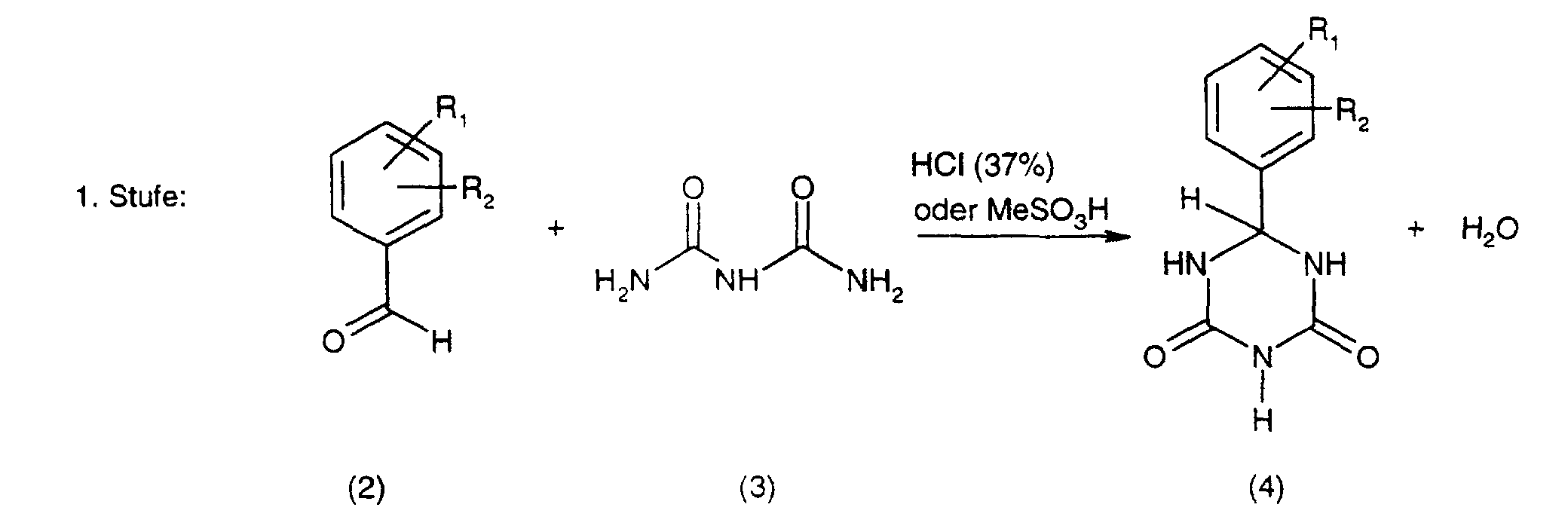
- the process according to the invention for producing an aryl-1,3-5-triazine compound of the formula (1) is characterized in that an aldehyde compound of the formula (2) is reacted with biuret, compound of the formula (3) in a hydrochloric acid medium or with methyl sulfate (1st reaction stage), then the compound of formula (4) obtained is oxidized to the compound of formula (5) or (6) (2nd reaction stage) and then chlorinated to the compound of formula (1) chlorinated (3rd reaction stage) according to the following scheme:
- R 1 and R 2 are independently hydrogen; Hydroxy or C 1 -C 5 alkoxy.
- C 1 -C 5 alkoxy are straight-chain or branched alkoxy radicals such as methoxy, ethoxy, propoxy, butoxy, or pentyloxy.
- the reaction time for the first reaction stage is generally 1 to 24, preferably 5 up to 12 hours.
- the reaction is carried out at temperatures of 0 to 60 ° C, and preferably at Room temperature.
- the first reaction stage is generally carried out by initially charging the hydrochloric acid or MeSO 3 H, stirring about 1 mol of biuret, and metering in 1 mol of the compound of the formula (2). Then about 0.2 mol of biuret and hydrochloric acid or MeSO 3 H are added and the reaction mass is stirred within 1 to 8 hours.
- Solvents and other additives are generally not for the first reaction stage required. If necessary, monohydric alcohols, e.g. Methanol, ethanol or i-propanol can be added. Also on the use of There is no need for catalysts.
- the compounds of the formula (1) prepared by the process according to the invention are used as UV absorbers or are starting products for the production of UV absorbers. produce.
- the two resorcing groups are introduced in a generally known manner by Friedel-Crafts acylation of resorcinol in the presence of a Lewis acid, in particular aluminum chloride.
- a Lewis acid in particular aluminum chloride.
- the etherification of the free, p-position hydroxyl groups takes place, depending on the meaning of the radicals R 3 and R 4 , by alkylation or acid-catalyzed addition of glycidyl ethers.
- the compounds of the formula (7) are particularly suitable as UV filters, ie for protecting ultraviolet-sensitive organic materials, in particular the skin and hair of humans and animals, from the harmful effects of UV radiation. These compounds are therefore suitable as light stabilizers in cosmetic, pharmaceutical and veterinary preparations. These compounds can be used both in solution and in the micronized state.
- these light stabilizers usually have a medium one Particle size in the range of 0.02 to 2, preferably 0.05 to 1.5, and very particularly from 0.1 to 1.0 ⁇ .
- the insoluble UV absorbers according to the invention can be replaced by conventional ones Methods, e.g. Grinding with e.g. a nozzle, ball, vibration or hammer mill on the desired particle size can be brought.
- the grinding is in the presence from 0.1 to 30, preferably 0.5 to 15 wt .-%, based on the UV absorber, one Grinding aid such as an alkylated vinylpyrrolidone polymer, a vinylpyrrolidone-vinyl acetate copolymer, an acylglutamate or in particular a phospholipid carried out.
- the cosmetic composition can also contain one or more further UV protective substances, such as, for example, an organic UV absorber from the class of the p-aminobenzoic acid derivatives, salicylic acid derivatives, benzophenone derivatives, dibenzoylmethane derivatives, diphenylacrylate derivatives, benzofuran derivatives, the polymeric UV absorbers , containing one or more organic silicon residues, cinnamic acid derivatives, camphor derivatives, trianilino-s-triazine derivatives, phenylbenzimidazole sulfonic acid and its salts, menthyl anthranilates, benzotriazole derivatives, and / or an inorganic micropigment selected from TiO 2 coated with aluminum oxide or silicon dioxide or TiO 2 ,
- an organic UV absorber from the class of the p-aminobenzoic acid derivatives, salicylic acid derivatives, benzophenone derivatives, dibenzoylmethane derivatives, diphenyl
- the cosmetic compositions contain 0.1 to 15, preferably 0.5 to 10% by weight, based on the total weight of the composition, a UV absorber or one Mixture of UV absorbers and a cosmetically compatible auxiliary.
- the cosmetic compositions can be prepared by physical mixing of the UV absorber (s) with the auxiliary by conventional methods, such as by simply stir the individual components together.
- the cosmetic compositions can be in the form of a water-in-oil or oil-in-water emulsion, as an oil-in-alcohol lotion, as a vesicular dispersion of an ionic or nonionic amphiphilic lipids, formulated as a gel, solid stick or as an aerosol formulation become.
- the cosmetically compatible auxiliary contains preferably 5 to 50% of an oil phase, 5 to 20% of an emulsifier and 30 to 90% Water.
- the oil phase can be any oil suitable for cosmetic formulations included, such as one or more hydrocarbon oils, a wax, a natural oil, a silicone oil, a fatty acid ester or a fatty alcohol.
- Preferred mono- or polyols are ethanol, isopropanol, propylene glycol, hexylene glycol, glycerin and sorbitol.
- any conventionally used emulsifier can be used for the cosmetic compositions be used, e.g. one or more ethoxylated esters of natural derivatives, such as. polyethoxylated esters of hydrogenated Castor oil; or a silicone oil emulsifier such as. silicone polyol; an optionally ethoxylated fatty acid soap; an ethoxylated Fatty alcohol; an optionally ethoxylated sorbitan ester; an ethoxylated fatty acid; or an ethoxylated glyceride.
- the cosmetic compositions can also contain other components such as e.g. emollients, Emulsion stabilizers, skin moisturizers, skin tanning accelerators, Thickeners such as Xanthan, moisture retention agents such as e.g. Glycerin, preservative, Contain fragrances and dyes.
- emollients e.g. emollients, Emulsion stabilizers, skin moisturizers, skin tanning accelerators, Thickeners such as Xanthan, moisture retention agents such as e.g. Glycerin, preservative, Contain fragrances and dyes.
- the cosmetic formulations are characterized by excellent protection of human Skin against the damaging effects of sunlight.
Landscapes
- Organic Chemistry (AREA)
- Chemical & Material Sciences (AREA)
- Health & Medical Sciences (AREA)
- Life Sciences & Earth Sciences (AREA)
- Veterinary Medicine (AREA)
- Public Health (AREA)
- General Health & Medical Sciences (AREA)
- Animal Behavior & Ethology (AREA)
- Dermatology (AREA)
- Birds (AREA)
- Epidemiology (AREA)
- Organic Low-Molecular-Weight Compounds And Preparation Thereof (AREA)
- Cosmetics (AREA)
- Pharmaceuticals Containing Other Organic And Inorganic Compounds (AREA)
Description


R1 und R2 unabhängig voneinander Wasserstoff; Hydroxy oder C1-C5-Alkoxy.
- R1
- C1-C5-Alkoxy; und
- R2
- Wasserstoff bedeuten, und ganz besonders Verbindungen der Formel (1), worin
- R1
- Methoxy bedeutet.

- R1 und R2
- unabhängig voneinander Wasserstoff; Hydroxy oder C1-C5-Alkoxy;
- R3 und R4
- unabhängig voneinander, C3-C18-Alkyl; C2-C18-Alkenyl; einen Rest der
Formel -CH2-CH(-OH)-CH2-O-T1 ;
einen Rest der Formel (7a)
- R5
- Hydroxy; nicht substituiertes oder durch ein oder mehrere OH-Gruppen substituiertes C1-C5-Alkoxy; Amino; Mono- oder Di-C1-C5-Alkylamino; M;

 worin R', R" und R"' unabhängig voneinander nicht substituiertes oder durch ein oder mehrere OH-Gruppen substituiertes C1-C14-Alkyl;
- R6
- Wasserstoff; M; C1-C5-Alkyl; oder einen Rest der Formel -(CH2)m
3 -O-T1 ; - T1
- Wasserstoff; oder C1-C8-Alkyl;
- M
- Alkalimetall; und
- m1, m2 und m3
- unabhängig voneinander 1 bis 4 bedeuten.


Ausbeute: 214 g der Verbindung der Formel (101)


Claims (6)
- Verfahren zur Herstellung einer Aryl-1,3-5-Triazinverbindung der Formel (1), dadurch gekennzeichnet, dass man eine Aldehydverbindung der Formel (2) mit Biuret, Verbindung der Formel (3), in salzsaurem Medium bzw. mit Methylsulfat umsetzt (1. Reaktionsstufe), anschliessend die erhaltene Verbindung der Formel (4) zur Verbindung der Formel (5) bzw. (6) oxidiert (2. Reaktionsstufe) und anschliessend zur Verbindung der Formel (1) chloriert (3. Reaktionsstufe) nach folgendem Schema:
 worin in dem obigen Schema
- R1 und R2
- unabhängig voneinander Wasserstoff; Hydroxy oder C1-C5-Alkoxy;
- Verfahren nach Anspruch 1, dadurch gekennzeichnet, dass die Reaktionszeit der ersten Stufe 1 bis 24 Stunden beträgt.
- Verfahren nach Anspruch 1 oder 2, dadurch gekennzeichnet, dass die erste Reaktionsstufe bei einer Temperatur von 0 bis 60°C durchgeführt wird.
- Verfahren nach einem der Ansprüche 1 bis 3, dadurch gekennzeichnet, dass die erste Reaktionsstufe bei Raumtemperatur durchgeführt wird.
- Verfahren nach einem der Ansprüche 1 bis 4, dadurch gekennzeichnet, dass
- R1
- C1-C5-Alkoxy; und
- R2
- Wasserstoff bedeuten.
- Verfahren nach Anspruch 5, dadurch gekennzeichnet, dass
- R1
- Methoxy bedeutet.
Applications Claiming Priority (2)
| Application Number | Priority Date | Filing Date | Title |
|---|---|---|---|
| CH40798 | 1998-02-20 | ||
| CH40798 | 1998-02-20 |
Publications (3)
| Publication Number | Publication Date |
|---|---|
| EP0937716A2 EP0937716A2 (de) | 1999-08-25 |
| EP0937716A3 EP0937716A3 (de) | 1999-11-24 |
| EP0937716B1 true EP0937716B1 (de) | 2003-04-09 |
Family
ID=4186344
Family Applications (1)
| Application Number | Title | Priority Date | Filing Date |
|---|---|---|---|
| EP99810118A Expired - Lifetime EP0937716B1 (de) | 1998-02-20 | 1999-02-11 | Verfahren zur Herstellung von Phenyldichloro-1,3,5-triazinverbindungen |
Country Status (5)
| Country | Link |
|---|---|
| US (1) | US6057444A (de) |
| EP (1) | EP0937716B1 (de) |
| CN (1) | CN1137106C (de) |
| DE (1) | DE59904904D1 (de) |
| ES (1) | ES2194432T3 (de) |
Families Citing this family (4)
| Publication number | Priority date | Publication date | Assignee | Title |
|---|---|---|---|---|
| DE69724992T2 (de) * | 1996-11-20 | 2004-07-22 | Ciba Speciality Chemicals Holding Inc. | Symmetrische triazin-derivate |
| KR101773621B1 (ko) | 2009-01-19 | 2017-08-31 | 바스프 에스이 | 유기 흑색 안료 및 이의 제조 방법 |
| CN116655549B (zh) * | 2023-05-26 | 2025-10-21 | 湖北尚赛光电材料有限公司 | 一种多取代1,3,5-三嗪类衍生物的制备方法 |
| CN120648017B (zh) * | 2025-06-19 | 2026-04-24 | 江苏厚邦实业有限公司 | 一种引流袋医用膜及其制备方法 |
Family Cites Families (6)
| Publication number | Priority date | Publication date | Assignee | Title |
|---|---|---|---|---|
| US2691019A (en) * | 1954-10-05 | O-hydroxyaryl dihalotkiazines | ||
| BE634399A (de) * | ||||
| US2691018A (en) * | 1951-07-10 | 1954-10-05 | American Cyanamid Co | Process of chlorinating hydroxy triazines with thionyl chloride |
| US2691020A (en) * | 1953-04-10 | 1954-10-05 | American Cyanamid Co | Triazine vat dyes |
| US3907721A (en) * | 1973-10-26 | 1975-09-23 | Dow Chemical Co | High resiliency, flexible polyurethane foams and crosslinkers for the preparation thereof |
| US4092466A (en) * | 1976-07-19 | 1978-05-30 | Nasa | Heat resistant polymers of oxidized styrylphosphine |
-
1999
- 1999-02-11 EP EP99810118A patent/EP0937716B1/de not_active Expired - Lifetime
- 1999-02-11 ES ES99810118T patent/ES2194432T3/es not_active Expired - Lifetime
- 1999-02-11 DE DE59904904T patent/DE59904904D1/de not_active Expired - Fee Related
- 1999-02-14 CN CNB991022114A patent/CN1137106C/zh not_active Expired - Fee Related
- 1999-02-17 US US09/251,809 patent/US6057444A/en not_active Expired - Lifetime
Also Published As
| Publication number | Publication date |
|---|---|
| DE59904904D1 (de) | 2003-05-15 |
| EP0937716A3 (de) | 1999-11-24 |
| US6057444A (en) | 2000-05-02 |
| ES2194432T3 (es) | 2003-11-16 |
| CN1137106C (zh) | 2004-02-04 |
| EP0937716A2 (de) | 1999-08-25 |
| CN1228426A (zh) | 1999-09-15 |
Similar Documents
| Publication | Publication Date | Title |
|---|---|---|
| EP0775698B1 (de) | Bis-Resorcinyl-Triazine als UV-Absorber | |
| EP0818450B1 (de) | Triazinderivate als UV-Filter in Sonnenschutzmitteln | |
| EP0878469B1 (de) | Resorcinyl-Triazine | |
| DE69215434T2 (de) | 1,3,5-Triazinderivate, ihre Herstellung und ihre Verwendung als Lichtschutzmittel | |
| DE69726529T2 (de) | Benzoxazolderivate und ihre Verwendung als UV-Filter | |
| EP0114607B1 (de) | Neue Dibenzoyl-methan-Derivate, Verfahren zu ihrer Herstellung und ihre Verwendung | |
| DE3781061T2 (de) | Sonnenschutzmittel, sonnenschutzpraeparate und verfahren zur verhuetung des sonnenbrandes. | |
| DE3321679C2 (de) | ||
| DE69514330T2 (de) | Sonnenschutzmittel | |
| JPS58157774A (ja) | s−トリアジン誘導体及びその光保護剤としての使用 | |
| DE19648010A1 (de) | Verwendung von substituierten Benzazolen als UV-Absorber, neue Benzazole und Verfahren zu ihrer Herstellung | |
| DE3781048T2 (de) | Chromophore, sonnenschutzpraeparate und verfahren zur verhuetung des sonnenbrandes. | |
| DE69724992T2 (de) | Symmetrische triazin-derivate | |
| DE69827393T2 (de) | Kosmetische verwendung von bis-resorcinol-triazinderivaten | |
| EP0949251B1 (de) | Diresorcinyltriazine als Lichtschutzmittel | |
| EP0780382A1 (de) | S-Triazinederivate als Lichtschutzmittel für Kosmetika | |
| DE4223890A1 (de) | Triazin-derivate | |
| EP0937716A2 (de) | Verfahren zur Herstellung von Phenyldichloro-1,3,5-triazinverbindungen | |
| DE2336219A1 (de) | Campherderivate | |
| DE69624474T2 (de) | Triazinderivate enthaltendes Sonnenschutzmittel | |
| EP0207287A2 (de) | Indolinderivate, Verfahren zu ihrer Herstellung und diese Indolinderivate enthaltende kosmetische Lichtschutzmittel | |
| EP0859759B1 (de) | Sulfonsäuren und ihre verwendung als uv-absorber | |
| DE19857252A1 (de) | Benzyliden-gamma-butyrolactone, Verfahren zu ihrer Herstellung und ihre Verwendung als UV-Absorber | |
| DE3028502A1 (de) | Verwendung von veraetherten 2-(4-hydroxybenzyliden)-(gamma)-butyrolactonen als lichtschutzmittel | |
| DE3843325C2 (de) | Ungesättigte 3-Benzyliden-Campher-derivate, Verfahren zu deren Herstellung, kosmetische Mittel die diese Verbindungen enthalten und Verfahren zum Schutz der Haut und zum Schutze eines kosmetischen Mittels |
Legal Events
| Date | Code | Title | Description |
|---|---|---|---|
| PUAI | Public reference made under article 153(3) epc to a published international application that has entered the european phase |
Free format text: ORIGINAL CODE: 0009012 |
|
| AK | Designated contracting states |
Kind code of ref document: A2 Designated state(s): BE CH DE ES FR GB IT LI NL |
|
| AX | Request for extension of the european patent |
Free format text: AL;LT;LV;MK;RO;SI |
|
| PUAL | Search report despatched |
Free format text: ORIGINAL CODE: 0009013 |
|
| RTI1 | Title (correction) |
Free format text: PROCESS FOR THE PREPARATION OF PHENYLDICHLORO-1,3,5-TRIAZINES |
|
| AK | Designated contracting states |
Kind code of ref document: A3 Designated state(s): AT BE CH CY DE DK ES FI FR GB GR IE IT LI LU MC NL PT SE |
|
| AX | Request for extension of the european patent |
Free format text: AL;LT;LV;MK;RO;SI |
|
| AKX | Designation fees paid | ||
| REG | Reference to a national code |
Ref country code: DE Ref legal event code: 8566 |
|
| RBV | Designated contracting states (corrected) |
Designated state(s): BE CH DE ES FR GB IT LI NL |
|
| 17P | Request for examination filed |
Effective date: 20000122 |
|
| 17Q | First examination report despatched |
Effective date: 20010726 |
|
| GRAG | Despatch of communication of intention to grant |
Free format text: ORIGINAL CODE: EPIDOS AGRA |
|
| GRAG | Despatch of communication of intention to grant |
Free format text: ORIGINAL CODE: EPIDOS AGRA |
|
| GRAH | Despatch of communication of intention to grant a patent |
Free format text: ORIGINAL CODE: EPIDOS IGRA |
|
| GRAH | Despatch of communication of intention to grant a patent |
Free format text: ORIGINAL CODE: EPIDOS IGRA |
|
| GRAA | (expected) grant |
Free format text: ORIGINAL CODE: 0009210 |
|
| AK | Designated contracting states |
Designated state(s): BE CH DE ES FR GB IT LI NL |
|
| REG | Reference to a national code |
Ref country code: GB Ref legal event code: FG4D Free format text: NOT ENGLISH |
|
| REG | Reference to a national code |
Ref country code: CH Ref legal event code: EP |
|
| GBT | Gb: translation of ep patent filed (gb section 77(6)(a)/1977) |
Effective date: 20030519 |
|
| REG | Reference to a national code |
Ref country code: ES Ref legal event code: FG2A Ref document number: 2194432 Country of ref document: ES Kind code of ref document: T3 |
|
| ET | Fr: translation filed | ||
| PGFP | Annual fee paid to national office [announced via postgrant information from national office to epo] |
Ref country code: FR Payment date: 20040120 Year of fee payment: 6 Ref country code: CH Payment date: 20040120 Year of fee payment: 6 |
|
| PGFP | Annual fee paid to national office [announced via postgrant information from national office to epo] |
Ref country code: NL Payment date: 20040126 Year of fee payment: 6 |
|
| PGFP | Annual fee paid to national office [announced via postgrant information from national office to epo] |
Ref country code: GB Payment date: 20040129 Year of fee payment: 6 |
|
| PGFP | Annual fee paid to national office [announced via postgrant information from national office to epo] |
Ref country code: DE Payment date: 20040130 Year of fee payment: 6 |
|
| PGFP | Annual fee paid to national office [announced via postgrant information from national office to epo] |
Ref country code: ES Payment date: 20040209 Year of fee payment: 6 |
|
| PLBE | No opposition filed within time limit |
Free format text: ORIGINAL CODE: 0009261 |
|
| STAA | Information on the status of an ep patent application or granted ep patent |
Free format text: STATUS: NO OPPOSITION FILED WITHIN TIME LIMIT |
|
| PGFP | Annual fee paid to national office [announced via postgrant information from national office to epo] |
Ref country code: BE Payment date: 20040311 Year of fee payment: 6 |
|
| 26N | No opposition filed |
Effective date: 20040112 |
|
| PG25 | Lapsed in a contracting state [announced via postgrant information from national office to epo] |
Ref country code: IT Free format text: LAPSE BECAUSE OF NON-PAYMENT OF DUE FEES;WARNING: LAPSES OF ITALIAN PATENTS WITH EFFECTIVE DATE BEFORE 2007 MAY HAVE OCCURRED AT ANY TIME BEFORE 2007. THE CORRECT EFFECTIVE DATE MAY BE DIFFERENT FROM THE ONE RECORDED. Effective date: 20050211 Ref country code: GB Free format text: LAPSE BECAUSE OF NON-PAYMENT OF DUE FEES Effective date: 20050211 |
|
| PG25 | Lapsed in a contracting state [announced via postgrant information from national office to epo] |
Ref country code: ES Free format text: LAPSE BECAUSE OF NON-PAYMENT OF DUE FEES Effective date: 20050212 |
|
| PG25 | Lapsed in a contracting state [announced via postgrant information from national office to epo] |
Ref country code: LI Free format text: LAPSE BECAUSE OF NON-PAYMENT OF DUE FEES Effective date: 20050228 Ref country code: CH Free format text: LAPSE BECAUSE OF NON-PAYMENT OF DUE FEES Effective date: 20050228 Ref country code: BE Free format text: LAPSE BECAUSE OF NON-PAYMENT OF DUE FEES Effective date: 20050228 |
|
| BERE | Be: lapsed |
Owner name: *CIBA SPECIALTY CHEMICALS HOLDING INC. Effective date: 20050228 |
|
| PG25 | Lapsed in a contracting state [announced via postgrant information from national office to epo] |
Ref country code: NL Free format text: LAPSE BECAUSE OF NON-PAYMENT OF DUE FEES Effective date: 20050901 Ref country code: DE Free format text: LAPSE BECAUSE OF NON-PAYMENT OF DUE FEES Effective date: 20050901 |
|
| GBPC | Gb: european patent ceased through non-payment of renewal fee |
Effective date: 20050211 |
|
| REG | Reference to a national code |
Ref country code: CH Ref legal event code: PL |
|
| PG25 | Lapsed in a contracting state [announced via postgrant information from national office to epo] |
Ref country code: FR Free format text: LAPSE BECAUSE OF NON-PAYMENT OF DUE FEES Effective date: 20051031 |
|
| NLV4 | Nl: lapsed or anulled due to non-payment of the annual fee |
Effective date: 20050901 |
|
| REG | Reference to a national code |
Ref country code: FR Ref legal event code: ST Effective date: 20051031 |
|
| REG | Reference to a national code |
Ref country code: ES Ref legal event code: FD2A Effective date: 20050212 |
|
| BERE | Be: lapsed |
Owner name: *CIBA SPECIALTY CHEMICALS HOLDING INC. Effective date: 20050228 |