EP0934520B1 - Ölqualitätssensor - Google Patents
Ölqualitätssensor Download PDFInfo
- Publication number
- EP0934520B1 EP0934520B1 EP97913159A EP97913159A EP0934520B1 EP 0934520 B1 EP0934520 B1 EP 0934520B1 EP 97913159 A EP97913159 A EP 97913159A EP 97913159 A EP97913159 A EP 97913159A EP 0934520 B1 EP0934520 B1 EP 0934520B1
- Authority
- EP
- European Patent Office
- Prior art keywords
- oil
- analyte
- layer
- sensor
- sensitive layer
- Prior art date
- Legal status (The legal status is an assumption and is not a legal conclusion. Google has not performed a legal analysis and makes no representation as to the accuracy of the status listed.)
- Expired - Lifetime
Links
- 239000003921 oil Substances 0.000 claims description 136
- 239000012491 analyte Substances 0.000 claims description 58
- 229920000642 polymer Polymers 0.000 claims description 31
- 239000010705 motor oil Substances 0.000 claims description 30
- 239000007788 liquid Substances 0.000 claims description 28
- 230000032683 aging Effects 0.000 claims description 20
- 230000008859 change Effects 0.000 claims description 17
- 239000000470 constituent Substances 0.000 claims description 15
- 239000010913 used oil Substances 0.000 claims description 13
- 239000004814 polyurethane Substances 0.000 claims description 10
- 229920002635 polyurethane Polymers 0.000 claims description 10
- 238000000034 method Methods 0.000 claims description 9
- 238000002485 combustion reaction Methods 0.000 claims description 8
- 239000000463 material Substances 0.000 claims description 8
- 238000001514 detection method Methods 0.000 claims description 7
- 238000010348 incorporation Methods 0.000 claims description 7
- 239000007791 liquid phase Substances 0.000 claims description 7
- 239000011159 matrix material Substances 0.000 claims description 7
- 238000009792 diffusion process Methods 0.000 claims description 3
- 230000010355 oscillation Effects 0.000 claims description 3
- 125000003277 amino group Chemical group 0.000 claims 1
- 239000010410 layer Substances 0.000 description 73
- 235000012239 silicon dioxide Nutrition 0.000 description 29
- 239000010453 quartz Substances 0.000 description 28
- VYPSYNLAJGMNEJ-UHFFFAOYSA-N silicon dioxide Inorganic materials O=[Si]=O VYPSYNLAJGMNEJ-UHFFFAOYSA-N 0.000 description 28
- 239000002699 waste material Substances 0.000 description 24
- IMNFDUFMRHMDMM-UHFFFAOYSA-N N-Heptane Chemical compound CCCCCCC IMNFDUFMRHMDMM-UHFFFAOYSA-N 0.000 description 18
- 239000000203 mixture Substances 0.000 description 18
- WYURNTSHIVDZCO-UHFFFAOYSA-N Tetrahydrofuran Chemical compound C1CCOC1 WYURNTSHIVDZCO-UHFFFAOYSA-N 0.000 description 16
- 230000000694 effects Effects 0.000 description 16
- 238000005259 measurement Methods 0.000 description 15
- 238000003380 quartz crystal microbalance Methods 0.000 description 13
- GSEJCLTVZPLZKY-UHFFFAOYSA-N Triethanolamine Chemical compound OCCN(CCO)CCO GSEJCLTVZPLZKY-UHFFFAOYSA-N 0.000 description 12
- IISBACLAFKSPIT-UHFFFAOYSA-N bisphenol A Chemical compound C=1C=C(O)C=CC=1C(C)(C)C1=CC=C(O)C=C1 IISBACLAFKSPIT-UHFFFAOYSA-N 0.000 description 12
- 238000002329 infrared spectrum Methods 0.000 description 11
- 239000000523 sample Substances 0.000 description 11
- 238000006116 polymerization reaction Methods 0.000 description 10
- QCDYQQDYXPDABM-UHFFFAOYSA-N phloroglucinol Chemical compound OC1=CC(O)=CC(O)=C1 QCDYQQDYXPDABM-UHFFFAOYSA-N 0.000 description 9
- 229960001553 phloroglucinol Drugs 0.000 description 9
- 239000000243 solution Substances 0.000 description 8
- 238000000576 coating method Methods 0.000 description 7
- 239000013078 crystal Substances 0.000 description 7
- 230000004044 response Effects 0.000 description 7
- 230000002378 acidificating effect Effects 0.000 description 6
- 239000011248 coating agent Substances 0.000 description 6
- 230000007423 decrease Effects 0.000 description 6
- 238000004049 embossing Methods 0.000 description 6
- 239000000047 product Substances 0.000 description 6
- JPYHHZQJCSQRJY-UHFFFAOYSA-N Phloroglucinol Natural products CCC=CCC=CCC=CCC=CCCCCC(=O)C1=C(O)C=C(O)C=C1O JPYHHZQJCSQRJY-UHFFFAOYSA-N 0.000 description 5
- 239000000654 additive Substances 0.000 description 5
- RRAMGCGOFNQTLD-UHFFFAOYSA-N hexamethylene diisocyanate Chemical compound O=C=NCCCCCCN=C=O RRAMGCGOFNQTLD-UHFFFAOYSA-N 0.000 description 5
- 230000003993 interaction Effects 0.000 description 5
- 239000012948 isocyanate Substances 0.000 description 5
- 150000002513 isocyanates Chemical class 0.000 description 5
- 238000004519 manufacturing process Methods 0.000 description 5
- 238000003860 storage Methods 0.000 description 5
- 239000000126 substance Substances 0.000 description 5
- 238000005033 Fourier transform infrared spectroscopy Methods 0.000 description 4
- 239000005057 Hexamethylene diisocyanate Substances 0.000 description 4
- 239000002253 acid Substances 0.000 description 4
- 238000010790 dilution Methods 0.000 description 4
- 239000012895 dilution Substances 0.000 description 4
- 125000000325 methylidene group Chemical group [H]C([H])=* 0.000 description 4
- 239000000178 monomer Substances 0.000 description 4
- UPMLOUAZCHDJJD-UHFFFAOYSA-N 4,4'-Diphenylmethane Diisocyanate Chemical compound C1=CC(N=C=O)=CC=C1CC1=CC=C(N=C=O)C=C1 UPMLOUAZCHDJJD-UHFFFAOYSA-N 0.000 description 3
- LFQSCWFLJHTTHZ-UHFFFAOYSA-N Ethanol Chemical compound CCO LFQSCWFLJHTTHZ-UHFFFAOYSA-N 0.000 description 3
- 238000004566 IR spectroscopy Methods 0.000 description 3
- 230000006978 adaptation Effects 0.000 description 3
- 230000001476 alcoholic effect Effects 0.000 description 3
- 238000004458 analytical method Methods 0.000 description 3
- 238000004132 cross linking Methods 0.000 description 3
- 230000002349 favourable effect Effects 0.000 description 3
- 239000000446 fuel Substances 0.000 description 3
- 239000007789 gas Substances 0.000 description 3
- 239000011521 glass Substances 0.000 description 3
- 125000002496 methyl group Chemical group [H]C([H])([H])* 0.000 description 3
- 239000011541 reaction mixture Substances 0.000 description 3
- 230000035945 sensitivity Effects 0.000 description 3
- 238000001228 spectrum Methods 0.000 description 3
- VZGDMQKNWNREIO-UHFFFAOYSA-N tetrachloromethane Chemical compound ClC(Cl)(Cl)Cl VZGDMQKNWNREIO-UHFFFAOYSA-N 0.000 description 3
- IJGRMHOSHXDMSA-UHFFFAOYSA-N Atomic nitrogen Chemical compound N#N IJGRMHOSHXDMSA-UHFFFAOYSA-N 0.000 description 2
- 239000004971 Cross linker Substances 0.000 description 2
- 239000004264 Petrolatum Substances 0.000 description 2
- 150000001298 alcohols Chemical class 0.000 description 2
- 125000001931 aliphatic group Chemical group 0.000 description 2
- 150000001412 amines Chemical class 0.000 description 2
- 238000013459 approach Methods 0.000 description 2
- 239000002199 base oil Substances 0.000 description 2
- 230000015572 biosynthetic process Effects 0.000 description 2
- 238000000354 decomposition reaction Methods 0.000 description 2
- 230000001419 dependent effect Effects 0.000 description 2
- 230000006866 deterioration Effects 0.000 description 2
- 125000005442 diisocyanate group Chemical group 0.000 description 2
- 239000001257 hydrogen Substances 0.000 description 2
- 229910052739 hydrogen Inorganic materials 0.000 description 2
- 238000011068 loading method Methods 0.000 description 2
- 238000005461 lubrication Methods 0.000 description 2
- 239000002480 mineral oil Substances 0.000 description 2
- 235000010446 mineral oil Nutrition 0.000 description 2
- 229940066842 petrolatum Drugs 0.000 description 2
- 235000019271 petrolatum Nutrition 0.000 description 2
- 230000002265 prevention Effects 0.000 description 2
- 230000008569 process Effects 0.000 description 2
- 239000010802 sludge Substances 0.000 description 2
- 238000003756 stirring Methods 0.000 description 2
- 239000002344 surface layer Substances 0.000 description 2
- YLQBMQCUIZJEEH-UHFFFAOYSA-N tetrahydrofuran Natural products C=1C=COC=1 YLQBMQCUIZJEEH-UHFFFAOYSA-N 0.000 description 2
- 239000004215 Carbon black (E152) Substances 0.000 description 1
- UFHFLCQGNIYNRP-UHFFFAOYSA-N Hydrogen Chemical compound [H][H] UFHFLCQGNIYNRP-UHFFFAOYSA-N 0.000 description 1
- 229930194542 Keto Natural products 0.000 description 1
- 238000001069 Raman spectroscopy Methods 0.000 description 1
- 238000010521 absorption reaction Methods 0.000 description 1
- 150000007513 acids Chemical class 0.000 description 1
- 230000000996 additive effect Effects 0.000 description 1
- 230000008901 benefit Effects 0.000 description 1
- HIFVAOIJYDXIJG-UHFFFAOYSA-N benzylbenzene;isocyanic acid Chemical compound N=C=O.N=C=O.C=1C=CC=CC=1CC1=CC=CC=C1 HIFVAOIJYDXIJG-UHFFFAOYSA-N 0.000 description 1
- 125000003178 carboxy group Chemical group [H]OC(*)=O 0.000 description 1
- 150000007942 carboxylates Chemical class 0.000 description 1
- 230000015556 catabolic process Effects 0.000 description 1
- 125000002091 cationic group Chemical group 0.000 description 1
- 238000012512 characterization method Methods 0.000 description 1
- 238000006243 chemical reaction Methods 0.000 description 1
- 239000003795 chemical substances by application Substances 0.000 description 1
- 239000007859 condensation product Substances 0.000 description 1
- 229920002770 condensed tannin Polymers 0.000 description 1
- 238000010276 construction Methods 0.000 description 1
- 238000001816 cooling Methods 0.000 description 1
- 238000012937 correction Methods 0.000 description 1
- 230000007797 corrosion Effects 0.000 description 1
- 238000005260 corrosion Methods 0.000 description 1
- 239000003431 cross linking reagent Substances 0.000 description 1
- 238000013016 damping Methods 0.000 description 1
- 239000007857 degradation product Substances 0.000 description 1
- 238000006731 degradation reaction Methods 0.000 description 1
- 238000013461 design Methods 0.000 description 1
- 238000011161 development Methods 0.000 description 1
- 230000018109 developmental process Effects 0.000 description 1
- 238000011156 evaluation Methods 0.000 description 1
- 238000011010 flushing procedure Methods 0.000 description 1
- 125000002485 formyl group Chemical class [H]C(*)=O 0.000 description 1
- 239000010711 gasoline engine oil Substances 0.000 description 1
- 229930195733 hydrocarbon Natural products 0.000 description 1
- 125000004435 hydrogen atom Chemical group [H]* 0.000 description 1
- 125000002887 hydroxy group Chemical group [H]O* 0.000 description 1
- 230000006872 improvement Effects 0.000 description 1
- 239000004615 ingredient Substances 0.000 description 1
- 229910052500 inorganic mineral Inorganic materials 0.000 description 1
- 125000000468 ketone group Chemical group 0.000 description 1
- 238000010030 laminating Methods 0.000 description 1
- 239000000314 lubricant Substances 0.000 description 1
- 238000012067 mathematical method Methods 0.000 description 1
- 238000013178 mathematical model Methods 0.000 description 1
- 230000005012 migration Effects 0.000 description 1
- 238000013508 migration Methods 0.000 description 1
- 239000011707 mineral Substances 0.000 description 1
- 238000002156 mixing Methods 0.000 description 1
- 229910052757 nitrogen Inorganic materials 0.000 description 1
- 150000007524 organic acids Chemical class 0.000 description 1
- 235000005985 organic acids Nutrition 0.000 description 1
- 230000003647 oxidation Effects 0.000 description 1
- 238000007254 oxidation reaction Methods 0.000 description 1
- 230000010363 phase shift Effects 0.000 description 1
- 239000002244 precipitate Substances 0.000 description 1
- 238000002360 preparation method Methods 0.000 description 1
- 230000002035 prolonged effect Effects 0.000 description 1
- 238000010926 purge Methods 0.000 description 1
- 230000009467 reduction Effects 0.000 description 1
- 230000000717 retained effect Effects 0.000 description 1
- 230000002441 reversible effect Effects 0.000 description 1
- 238000007789 sealing Methods 0.000 description 1
- 230000011664 signaling Effects 0.000 description 1
- 239000007787 solid Substances 0.000 description 1
- 239000002904 solvent Substances 0.000 description 1
- 238000001179 sorption measurement Methods 0.000 description 1
- 238000004528 spin coating Methods 0.000 description 1
- 239000000758 substrate Substances 0.000 description 1
- 150000003512 tertiary amines Chemical group 0.000 description 1
- 230000008646 thermal stress Effects 0.000 description 1
- 230000008719 thickening Effects 0.000 description 1
- 238000012546 transfer Methods 0.000 description 1
- 230000007704 transition Effects 0.000 description 1
Images


Classifications
-
- G—PHYSICS
- G01—MEASURING; TESTING
- G01N—INVESTIGATING OR ANALYSING MATERIALS BY DETERMINING THEIR CHEMICAL OR PHYSICAL PROPERTIES
- G01N33/00—Investigating or analysing materials by specific methods not covered by groups G01N1/00 - G01N31/00
- G01N33/26—Oils; Viscous liquids; Paints; Inks
- G01N33/28—Oils, i.e. hydrocarbon liquids
- G01N33/2888—Lubricating oil characteristics, e.g. deterioration
-
- G—PHYSICS
- G01—MEASURING; TESTING
- G01N—INVESTIGATING OR ANALYSING MATERIALS BY DETERMINING THEIR CHEMICAL OR PHYSICAL PROPERTIES
- G01N33/00—Investigating or analysing materials by specific methods not covered by groups G01N1/00 - G01N31/00
- G01N33/26—Oils; Viscous liquids; Paints; Inks
- G01N33/28—Oils, i.e. hydrocarbon liquids
-
- G—PHYSICS
- G01—MEASURING; TESTING
- G01N—INVESTIGATING OR ANALYSING MATERIALS BY DETERMINING THEIR CHEMICAL OR PHYSICAL PROPERTIES
- G01N11/00—Investigating flow properties of materials, e.g. viscosity, plasticity; Analysing materials by determining flow properties
- G01N11/10—Investigating flow properties of materials, e.g. viscosity, plasticity; Analysing materials by determining flow properties by moving a body within the material
- G01N11/16—Investigating flow properties of materials, e.g. viscosity, plasticity; Analysing materials by determining flow properties by moving a body within the material by measuring damping effect upon oscillatory body
-
- G—PHYSICS
- G01—MEASURING; TESTING
- G01N—INVESTIGATING OR ANALYSING MATERIALS BY DETERMINING THEIR CHEMICAL OR PHYSICAL PROPERTIES
- G01N29/00—Investigating or analysing materials by the use of ultrasonic, sonic or infrasonic waves; Visualisation of the interior of objects by transmitting ultrasonic or sonic waves through the object
- G01N29/02—Analysing fluids
- G01N29/036—Analysing fluids by measuring frequency or resonance of acoustic waves
-
- G—PHYSICS
- G01—MEASURING; TESTING
- G01N—INVESTIGATING OR ANALYSING MATERIALS BY DETERMINING THEIR CHEMICAL OR PHYSICAL PROPERTIES
- G01N2291/00—Indexing codes associated with group G01N29/00
- G01N2291/02—Indexing codes associated with the analysed material
- G01N2291/025—Change of phase or condition
- G01N2291/0258—Structural degradation, e.g. fatigue of composites, ageing of oils
-
- G—PHYSICS
- G01—MEASURING; TESTING
- G01N—INVESTIGATING OR ANALYSING MATERIALS BY DETERMINING THEIR CHEMICAL OR PHYSICAL PROPERTIES
- G01N2291/00—Indexing codes associated with group G01N29/00
- G01N2291/02—Indexing codes associated with the analysed material
- G01N2291/028—Material parameters
- G01N2291/02818—Density, viscosity
-
- G—PHYSICS
- G01—MEASURING; TESTING
- G01N—INVESTIGATING OR ANALYSING MATERIALS BY DETERMINING THEIR CHEMICAL OR PHYSICAL PROPERTIES
- G01N2291/00—Indexing codes associated with group G01N29/00
- G01N2291/04—Wave modes and trajectories
- G01N2291/042—Wave modes
- G01N2291/0427—Flexural waves, plate waves, e.g. Lamb waves, tuning fork, cantilever
Definitions
- the invention relates to an oil quality sensor according to the preamble of claim 12, a method for detecting an analyte and the use of a sensor.
- Engine oils have evolved over time into high-tech products that are prerequisite to enable high engine performance.
- "Engine oils” are a collective term for base oil components of mineral oil, hydrocrackants and synthetic components. Motor oils still contain additives that are added as a ready-mixed ("package"), and viscosity index improvers (VI).
- the engine oils serve as lubricants for the engines as well as cooling and sealing medium. Furthermore, they should clean and keep clean all engine parts.
- the VI improvers cause a more favorable viscosity-temperature behavior, as it have the pure base oils.
- the level of additives and VI improvers is usually between 5 and 25%, depending on the requirements placed on the oil.
- the oils age, whereby primarily the additive components and the VI improvers are degraded (consumed).
- a significant proportion of oil aging has unused, partially oxidized and polymerized fuel components.
- the aging of oil is influenced by temperature and reactive combustion products (radicals) and exceeding the Dispersibility of the oils for solids and aging products.
- An increased viscosity has z. B. during startup a prolonged transport of the oil to the lubrication points result, causing an increase in wear occurs.
- the consumption of the dispersing additives results in a deterioration in the ability of the oils to keep the engines clean, especially at critical lubrication points, such as in the area of the piston rings / grooves and fire bars, as well as a deterioration in the prevention of deposit formation on valves and in the valve train.
- the TAN or TBN (Total Basic Number) is of the basic principle for an on-board measurement is not suitable, since in this case the waste oil is titrated with KOH.
- More recent approaches such as those known from SAE 910497, SAE 962112, US Pat. No. 4,675,662, 4,792,791 and 5,200,027, show interesting solutions which operate, for example, with capacitance sensors, measurement of ion migration or potential difference, with solid-state electrochemical cells and with corrosion sensors. These approaches are partly inaccurate, too large and too heavy or require a sacrificial component, which is generally undesirable:
- mathematical models SAE 870403
- HC exhaust gas sensors DE 42 35 225
- level sensors are not very suitable because they fail, for example, in a strong dilution of the engine oil by fuels.
- US-A-5,151,110 describes a selective chemical sensor consisting of a piezoelectric component and a coating of this component.
- This coating has a porous structure that allows specific chemical molecules to adsorb from a liquid sample based on their size.
- the resulting weight change of the sensor causes a changed oscillation frequency, whereby an analyte can be determined.
- US-A-5,201,215 describes a quartz crystal microbalance (QMB) microchemical sensor that can be used to simultaneously measure changes in the weight and viscosity of a liquid. These measurements can also be performed independently.
- the piezoelectric component of the sensor is surrounded by a layer which may consist of a polymer. Specific analytes of a liquid sample bind to this layer, resulting in a weight change of the sensor.
- Object of the present invention is to provide a sensor that can make on-board measurements on an internal combustion engine, the sensor should largely reliable and trouble-free to determine the aging of an oil.
- the invention further relates to the use of a sensor having a sensitive layer for detecting an analyst in an oil and / or for detecting an oily analyte according to claim 1 and a method for detecting an analyte in a liquid phase by means of a sensor, wherein the aging of an oil is determined according to claim 15.
- the layer is a material firmly bonded to a substrate.
- the detection of the analyte according to the invention is generally not only qualitative, but in particular at least semi-quantitative. That is, with the determination of the analyte also an accurate or estimated concentration or quantity determination of the analyte takes place.
- the attainment of the determination threshold value may be used in conjunction with a mathematical method (eg timeout) for signaling (the oil change).
- the senor can be used in all liquids in which a material change of the composition takes place, ie in which at least one component increases or decreases.
- the sensor is used to characterize a complex liquid, ie in a liquid containing a plurality of unknown from the structure and quantity ago components, in particular, a repeatability of the exact composition of the liquid is usually not given, for. B. because the composition of the liquid is due to a (not manageable) variety of influences.
- the sensor is very particularly advantageously used in an oil-containing liquid, preferably in a liquid which contains at least 30% and in particular at least 50% of an oil. In addition to the oil, there may be various other components which may also be detected by the sensor.
- the senor is designed for one or more constituents of the oil which decrease in the course of use of the oil (or liquid); However, it is also an interpretation of the sensor possible to an increase of one or more components of the liquid. Such an increase is z. As in the increasing acidity with the aging of the oil, ie, it can also be found the increase of acidic compounds.
- the sensor is designed for one or more main components of the liquid, ie those components which make up the main weight fraction of the liquid, for example the oil composition.
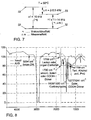
- the above-described acidic changes in the aging of a motor oil are detectable by IR spectroscopy.
- the used oil IR spectrum in FIG. 8 clearly shows absorption bands of the hydroxyl groups at 3,353 cm -1 , which originate from alcohols or organic acids compared with the new oil IR spectrum.
- a sensor which can repeatedly store and dispose of at least one constituent of the liquid, advantageously in accordance with the concentration of this constituent.
- the constituent is chosen so that it changes in the course of use of the liquid in terms of its affinity for the sensitive layer, this is usually achieved by a change in concentration of the substance in the liquid by the use thereof.
- the storage can also be referred to as volume effect, d. H.
- the incorporation of the analyte or at least up to a certain layer thickness is substantially proportional to the layer thickness.
- one (or more) analyte (one component) in an oil and / or one (or more) oily analyte is determined by the incorporation of the analyte (s) into the sensitive layer.
- an analyte and / or oil is particularly suitable engine oil, as used for example in internal combustion engines.
- the analyte is at least one component of a new engine oil, but it may also be a component of the used oil forming during use of the engine oil, in particular an oxidation product.
- the analyte here again preferably has an aliphatic radical, as is customarily present in mineral and / or synthetic motor oils.
- Such hydrocarbon radicals usually have a molecular weight between 300 and 3 000.
- the sensitive layer of the sensor is constructed of a polymer.
- Polyurethanes which are particularly suitable are polyurethanes and / or modified polyurethanes, for example those in which the OH component is at least partially replaced by an NH 2 component.
- basic components are incorporated into the polymer structure. This can be done for example by the use of basic monomers or prepolymers with basic radicals, wherein the basicity is advantageously retained in the polymer formation.
- Such a basic monomer For example, triethanolamine N (CN 2 CH 2 OH) 3 , which acts as a crosslinker and its tertiary amine group is maintained in the polymerization to polyurethane.
- the adaptation to waste oil, ie the polymerization takes place in the presence of waste oil, which can then be dissolved out of the finished polymer again.
- the nitrogen contained in the triethanolamine can then undergo polar interactions with the acidic components in the waste oil and thus extract these components from a mixture, even in the presence of certain amounts of unconsumed oil.
- the triethanolamine in the layers thus obtained generally offers polar interaction centers for analyte molecules with adapted properties.
- the adaptation to the analyte can be done according to an alternative by forming the layer together with the analyte, for example by mixing a motor oil with the laminating agent, in particular a monomer or prepolymer.
- the layer composition is chosen such that the analyte as well as the entire liquid is inert to the layer, i. H. neither degrades nor otherwise chemically altered.
- the senor is advantageously used together with a non-sensitive sensor (measuring element of the same construction as the sensor, but without the sensitive properties for a component of the liquid) which serves as a reference.
- a non-sensitive sensor measuring element of the same construction as the sensor, but without the sensitive properties for a component of the liquid
- This allows a simple and reliable measurement setup.
- sensors of different sensitivity together, in particular also in conjunction with a non-sensitive sensor.
- a sensor is designed to detect new oil, and the other sensor is designed to detect used oil.
- These sensors of different sensitivity can serve as reference for each other, so that viscosity changes can be averaged out.
- a third, non-sensitive sensor can be used with particular advantage, by which a change in viscosity is determined.
- the most diverse oil changes can be detected particularly reliable, so that the oil sensor for a variety of oils (or other liquids) can be used.
- the use of multiple (different) sensitive sensors can also be the failure of a sensor or a possible reduced sensitivity of a sensor, as may occur when using a variety of oils, are detected, creating a particularly high process reliability is given.
- the measurement itself is preferably carried out by putting the layer into vibration, a dielectric effect of the layer can be used for example as a measuring principle.
- the layer is advantageously applied to a vibrating crystal (quartz crystal), which is then excited to vibrate.
- a vibrating crystal quartz crystal
- the layer becomes heavier according to the loading amount, which changes the vibration behavior. This in turn can be deduced on the load.
- a temperature sensor is advantageously used, since the viscosity (especially in the case of engine oil) is highly temperature-dependent.
- the temperature-dependent viscosity behavior of the liquid phase can in this case be stored, for example, in a characteristic field, via which the temperature correction of the measured values then takes place.
- the measurement can also be carried out only at one or more specified temperatures.
- the sensor further includes an evaluation, via which the sensor is operated on the one hand and on the other hand, the sensor signal is converted to the desired information.
- the information may in particular be an indication of the maturity of the engine oil change.
- determining component of the liquid are adapted, ie store the analyte according to its concentration (at a high concentration) or outsource (at a low concentration of the analyte in the liquid).
- molecular imprinting The manufacture of such adapted surfaces is also known as "molecular imprinting" wherein such molecularly imprinted layers have been used substantially only in gases.
- Such molecularly imprinted layers can be produced industrially and inexpensively.
- the analyte to be detected is added to the reaction mixture.
- the analyte molecules leave their imprint in the matrix during polymerization or curing and can be evaporated or rinsed out of the (polymeric) network after completion of the reaction.
- an analyte which is inert with regard to the polymerization process and the finished polymer layer (or the reaction mixture must be selected accordingly) must be selected.
- the quality of the molecularly imprinted layers depends on many influences, in particular on the choice of the layer material (polymer), duration of polymerization, proportion of solvent in the production of the layer, temperature, amount of crosslinking agent etc.
- This embossing analogous to the key-lock principle, leads to analyte-specific interactions, corresponding to the concentration of the analyte.
- This embossing process can be carried out not only with a chemically pure analyte but also with an analyte mixture of complex composition.
- such a sensitive layer for example by polymerization of a polyurethane with a certain proportion of crosslinking molecules in the presence of z.
- fresh engine oil for example, for gasoline engines, based on mineral oil and / or synthetic
- cavities adapted to the constituents of the fresh engine oil remain in the polymeric matrix.
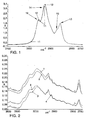
- infrared spectroscopy it can be shown that these cavities remarkably selectively reincorporate new oil.
- embossing with waste oil the selectivity being lower in the case of stamping with waste oil, ie small amounts of new oil are also stored, as a result of which the response (eg weight change, electronic signal) is lower.
- Each of the polyurethanes synthesized contains one of the isocyanates in the stoichiometric ratio and a mixture of the two alcoholic components.
- the proportion of phloroglucin in the alcoholic component determines the degree of crosslinking.
- a favorable degree of crosslinking for imprints (for the restitution of the analyte) is about 60% (depending on the polymer in general 20-85%).
- hexamethylene diisocyanate a mixture of 60% by weight phloroglucinol and 40 mol% bisphenol A is used for this purpose; for the isocyanate mixture, the proportion of phloroglucin in the alcohol mixture is 40 mol%, since here also the isocyanate acts as crosslinker due to its triisocyanate content.
- the individual components are dissolved together with the appropriate amount of new oil in THF.
- This mixture can be applied directly to glass slides or quartz plates for measurement by means of FT-IR or on quartz crystals.
- Used petrol was weighed into Eppendorf tubes (62.8 mg at 30% oil content in the layer, 48.9 mg for 25% and 36.7 mg for 20%) and dissolved in 0.5 ml THF.
- the alcoholic components were then first added to this solution by means of a Gilson pipette and the isocyanate was added just before application.
- the mixtures are composed as follows: Bisphenol A 148 ⁇ l solution trifunctional alcohol 100 ⁇ l solution isocyanate 231 ⁇ l solution
- the two trifunctional components phloroglucinol and triethanolamine were mixed in the required ratio (eg 10% TEA in the view ⁇ 10 ⁇ l TEA solution and 90 ⁇ l phloroglucinolysis).
- the platelets polymerized overnight are measured blank in an FT-IR apparatus (Perkin-Elmer FTIR 2000) against an empty quartz plate.
- FT-IR apparatus Perkin-Elmer FTIR 2000
- symmetric and antisymmetric methylene vibrations at 2 856 cm -1 and 2 921 cm -1 are used.
- the reaction mixture is applied to the quartz crystal.
- the so-called spin-coating method in which the sensor rotates during the polymerization at 200-400 rpm (depending on the viscosity of the layer material).
- the layer thickness is about 1.5 microns, which generates a frequency of about 75 kHz.
- the mass-sensitive measurement is performed with a network analyzer, whereby a high-frequency variable frequency is applied to the coated quartz component and so the Damping behavior of the component is determined. This happens in the resonance range of the thickness shear vibration of the quartz.
- the frequency of least attenuation is then read out by the computer and displayed as a function of time.
- T 50 ⁇ 0.1 ° C.
- the oil samples are mixed with the aid of a stirrer at approx. 700 rpm.
- the measuring oil is changed after the constancy of the sensor signal.
- the used oil is also pre-thermostated.
- the frequency of least attenuation (resonance frequency) then changes due to two opposing effects.
- the increase in viscosity in the case of viscous waste oil
- the viscosity effect is 16,000 Hz
- the frequency deviation varies between 11,000 and 15,000 Hz, depending on the polymer layer.
- the mass effect therefore amounts to 1,000 to 5,000 Hz, depending on the layer used.
- the intensities of the aliphatic peaks decrease on flushing out the imprint, so that a large part of the oil can be removed from the polymeric matrix.
- the intensities rise approximately to the initial value, so the new oil re-deposits itself in the polymer matrix (same spectra are obtained in a repeated storage and removal of the new oil).
- the spectra also show that waste oil (4) is not incorporated into the polymer backbone, the IR spectrum corresponds to that of n-heptane flushed sample.
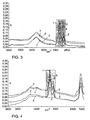
- FIG. 5 shows the temperature dependence of the resonance frequency of an uncoated QMB in waste oil 22 or in new oil 21.
- the frequency deviation 23 of the quartz immersed in the respective oil is 16 kHz during the transition from new oil to waste oil.
- Obtained crystals coated with polymers that can not incorporate oil non-imprinted polymers, non-imprint sample).
- a linear relationship between the logarithm of the frequency sweep and the reciprocal absolute temperature can be observed.
- Oscillating crystals with non-sensitive polymer layers result in parallel shifted straight lines whose slopes differ by a maximum of 10%. It follows that the measured frequency sweeps are pure viscosity effects and not mass effects.
- the frequency deviation which can be observed during the transfer of a quartz micro balance of Neuöl in waste oil loaded with an imprint sample prepared by molecular imprinting is initially lower by 2 to 3 kHz at a temperature of 50 ° C. as for a non-imprint quartz. Depending on the polymer layer, the frequency deviation may also be lower.
- FIG. 6 shows a frequency sweep 25 of 11 kHz for a quartz with a sensitive layer, i. h., This frequency deviation 25 is 5.0 kHz below that of an uncoated quartz (also a quartz with a non-imprint layer can be used here).
- the quartz not provided with a sensitive layer reacts almost exclusively on the different viscosity of Neuöl 31 and waste oil 32, regardless of their chemical compositions.
- the frequency response ⁇ f is 16 kHz.
- an amount of 11 to 14 kHz (depending on the sensitive layer) is obtained (see above), i. H. about 2 to 5 kHz less. This amount results from the mass effect, i. H. the difference in weight of the sensitive layer loaded with new oil 33 and the release of the new oil 33 from the sensitive layer when it is stored in waste oil 32.
- the change in viscosity from new oil to waste oil and the consumption of new oil can be determined.
- the latter is proportional to the Mass effect ⁇ m. Accordingly, with the sensor of the present invention, the aging of an engine oil can be continuously monitored by increasing the mass effect, and the change of the viscosity ranging from an increase to a decrease is taken into account by the reference.
- FIG. 9 shows the comparison between a quartz coating 42 embossed with waste oil and a quartz coating 41 embossed with new oil.
- the quartz 41 embossed on new oil shows a frequency shift of 16 kHz in new oil, which decreases to 13 kHz in waste oil.
- the quartz 42 which is characterized by waste oil, shows a 16 kHz frequency shift in fresh oil, which increases to 18 kHz in waste oil.
- the oil quality determination advantageously takes place by means of a quartz coated with a sensitive layer.
- the sensitive layer has an adapted to at least one oil component surface, which is predestined according to the concentration of the oil component for repeated storage and retrieval of the oil component. In the presence of the oil component, this is incorporated in the sensitive layer, whereby a mass effect, an effective increase in the component thickness or mass, the resonant frequency decreases. Due to aging of the oil, the ingredient that enters the sensitive Layer deposits, whereby the resonance frequency increases.
- a non-sensitive layer is used by which the viscosity effect of the oil on the vibration of the quartz is determined.
Landscapes
- Chemical & Material Sciences (AREA)
- Health & Medical Sciences (AREA)
- Life Sciences & Earth Sciences (AREA)
- Physics & Mathematics (AREA)
- Pathology (AREA)
- Biochemistry (AREA)
- General Health & Medical Sciences (AREA)
- General Physics & Mathematics (AREA)
- Immunology (AREA)
- Analytical Chemistry (AREA)
- Engineering & Computer Science (AREA)
- General Chemical & Material Sciences (AREA)
- Chemical Kinetics & Catalysis (AREA)
- Oil, Petroleum & Natural Gas (AREA)
- Food Science & Technology (AREA)
- Medicinal Chemistry (AREA)
- Acoustics & Sound (AREA)
- Investigating Or Analyzing Materials By The Use Of Electric Means (AREA)
- Lubrication Details And Ventilation Of Internal Combustion Engines (AREA)
- Investigating Or Analysing Materials By Optical Means (AREA)
- Investigating Or Analyzing Non-Biological Materials By The Use Of Chemical Means (AREA)
Applications Claiming Priority (5)
| Application Number | Priority Date | Filing Date | Title |
|---|---|---|---|
| DE1996144572 DE19644572B4 (de) | 1996-10-26 | 1996-10-26 | Ölqualitätssensor |
| DE19644572 | 1996-10-26 | ||
| DE19731621 | 1997-07-23 | ||
| DE19731621 | 1997-07-23 | ||
| PCT/EP1997/005748 WO1998019156A1 (de) | 1996-10-26 | 1997-10-17 | Ölqualitätssensor |
Publications (2)
| Publication Number | Publication Date |
|---|---|
| EP0934520A1 EP0934520A1 (de) | 1999-08-11 |
| EP0934520B1 true EP0934520B1 (de) | 2005-09-21 |
Family
ID=26030801
Family Applications (1)
| Application Number | Title | Priority Date | Filing Date |
|---|---|---|---|
| EP97913159A Expired - Lifetime EP0934520B1 (de) | 1996-10-26 | 1997-10-17 | Ölqualitätssensor |
Country Status (8)
| Country | Link |
|---|---|
| US (1) | US6223589B1 (enExample) |
| EP (1) | EP0934520B1 (enExample) |
| JP (1) | JP4071289B2 (enExample) |
| KR (1) | KR100651891B1 (enExample) |
| CN (1) | CN1165762C (enExample) |
| AU (1) | AU5050998A (enExample) |
| DE (1) | DE59712425D1 (enExample) |
| WO (1) | WO1998019156A1 (enExample) |
Families Citing this family (51)
| Publication number | Priority date | Publication date | Assignee | Title |
|---|---|---|---|---|
| US6494079B1 (en) * | 2001-03-07 | 2002-12-17 | Symyx Technologies, Inc. | Method and apparatus for characterizing materials by using a mechanical resonator |
| JP2002511948A (ja) * | 1997-11-07 | 2002-04-16 | フォルクスワーゲン・アクチェンゲゼルシャフト | エンジンオイル特性を監視,算出又はこれらの双方を行う方法と装置 |
| DE19901815A1 (de) * | 1999-01-19 | 2000-07-20 | Volkswagen Ag | Verfahren zur Bestimmung der Ölqualität sowie Ölqualitätssensor |
| DE19907743B4 (de) * | 1999-02-23 | 2012-01-05 | Volkswagen Ag | Ölqualitätssensor sowie Verfahren zu dessen Herstellung |
| US7302830B2 (en) | 2001-06-06 | 2007-12-04 | Symyx Technologies, Inc. | Flow detectors having mechanical oscillators, and use thereof in flow characterization systems |
| RU2204824C1 (ru) * | 2001-09-25 | 2003-05-20 | Ульяновский государственный технический университет | Датчик диэлькометрического анализатора качества моторного топлива |
| US6840093B2 (en) | 2002-04-05 | 2005-01-11 | Caterpillar Inc. | System and method for determining oil grade |
| US6675635B2 (en) | 2002-04-17 | 2004-01-13 | Caterpillar Inc | System and method for determining oil quality |
| US7043969B2 (en) * | 2002-10-18 | 2006-05-16 | Symyx Technologies, Inc. | Machine fluid sensor and method |
| US6873916B2 (en) * | 2002-10-18 | 2005-03-29 | Symyx Technologies, Inc. | Application specific integrated circuitry for controlling analysis of a fluid |
| AU2003282936A1 (en) * | 2002-10-18 | 2004-05-04 | Symyx Technologies, Inc. | Environmental control system fluid sensing system and method comprising a sesnsor with a mechanical resonator |
| US7244353B2 (en) * | 2002-11-15 | 2007-07-17 | Oil Purification Systems, Inc. | Method of and system for fluid purification |
| RU2244295C2 (ru) * | 2002-12-20 | 2005-01-10 | Ассоциация противодействия контрабандным и поддельным автомобильным расходным материалам (АПКПАРМ) | Устройство для определения характеристик автомобильных масел |
| US6725707B1 (en) | 2003-01-13 | 2004-04-27 | Delphi Technologies, Inc. | In-situ liquid viscosity measurement |
| GB0302519D0 (en) * | 2003-02-04 | 2003-03-05 | Trw Ltd | Improvements in fluid monitoring |
| US7721590B2 (en) | 2003-03-21 | 2010-05-25 | MEAS France | Resonator sensor assembly |
| US7210332B2 (en) * | 2003-03-21 | 2007-05-01 | Symyx Technologies, Inc. | Mechanical resonator |
| US7158897B2 (en) * | 2003-03-21 | 2007-01-02 | Symyx Technologies, Inc. | Integrated circuitry for controlling analysis of a fluid |
| WO2005050228A2 (en) * | 2003-11-14 | 2005-06-02 | Impact Technologies, Llc | Electrochemical impedance measurement system and method for use thereof |
| EP1711824A1 (en) * | 2004-02-03 | 2006-10-18 | SPHERE Medical Limited | Sensor |
| US7272525B2 (en) | 2004-04-21 | 2007-09-18 | Visyx Technologies, Inc. | Portable fluid sensing device and method |
| US7862875B2 (en) * | 2004-10-04 | 2011-01-04 | Trico Corporation | Flinger disc |
| US7541004B2 (en) * | 2004-11-12 | 2009-06-02 | Predict, Inc. | MEMS-based sensor for lubricant analysis |
| DE102005012453A1 (de) * | 2005-03-18 | 2006-09-21 | Robert Bosch Gmbh | Verfahren und Vorrichtung zur Viskositätsmessung von nicht-Newtonschen Flüssigkeiten, insbesondere Motorbetriebsstoffen |
| DE102005012454A1 (de) * | 2005-03-18 | 2006-09-21 | Robert Bosch Gmbh | Verfahren zur quantitiven Bestimmung eines Alterungseinflusses auf ein Motoröl |
| US7322243B2 (en) * | 2005-06-16 | 2008-01-29 | Honeywell International Inc. | Acoustic wave etch rate sensor system |
| US7634937B2 (en) * | 2005-07-01 | 2009-12-22 | Symyx Solutions, Inc. | Systems and methods for monitoring solids using mechanical resonator |
| US20080022757A1 (en) * | 2006-07-27 | 2008-01-31 | Honeywell International Inc. | Oxidation stability measurement for oil condition management |
| US8149004B2 (en) * | 2007-01-19 | 2012-04-03 | Honeywell International Inc. | Corrosion sensor for monitoring and controlling lubricant acidity |
| KR100811677B1 (ko) * | 2007-02-09 | 2008-03-11 | 대성전기공업 주식회사 | 다기능 감지장치 |
| US7677086B2 (en) * | 2007-03-12 | 2010-03-16 | Gm Global Technology Operations, Inc. | Engine oil viscosity diagnostic systems and methods |
| US20080289399A1 (en) * | 2007-05-11 | 2008-11-27 | Flowtonics, Llc | Fluid quality sensor |
| US8096164B2 (en) | 2008-01-17 | 2012-01-17 | Trico Corporation | Apparatus and methods for management of fluid condition |
| KR100928947B1 (ko) * | 2008-02-21 | 2009-11-30 | 한국과학기술연구원 | 통합형 인라인 오일 모니터링 장치 |
| US8220671B2 (en) | 2008-03-12 | 2012-07-17 | Trico Corporation | Lubricant dispenser with nozzle |
| USD687923S1 (en) | 2008-06-03 | 2013-08-13 | Trico Corporation | Lubricant dispensing nozzle |
| US8147684B2 (en) * | 2009-03-27 | 2012-04-03 | Trico Corporation | Apparatus and methods for lubricant filtration and drum pump filtration system |
| US8321158B2 (en) * | 2009-04-03 | 2012-11-27 | GM Global Technology Operations LLC | Method and system for monitoring freshness of fuel in vehicles |
| US8147683B2 (en) | 2010-01-22 | 2012-04-03 | Trico Corporation | Portable lubricant filtration system and method |
| CN101936936B (zh) * | 2010-07-30 | 2012-10-31 | 浙江大学 | 基于导电高分子复合物的溶剂水分检测元件及其制作方法 |
| CN104271017B (zh) * | 2012-03-21 | 2016-11-23 | 特斯托股份公司 | 油炸装置,便携式油炸用油测量仪,油炸装置机组和用于控制油炸装置的方法 |
| USD696956S1 (en) | 2012-04-25 | 2014-01-07 | Trico Corporation | Lubricant dispenser |
| USD687922S1 (en) | 2012-04-25 | 2013-08-13 | Trico Corporation | Lubricant dispenser |
| USD687921S1 (en) | 2012-04-25 | 2013-08-13 | Trico Corporation | Lubricant dispenser |
| GB201212542D0 (en) * | 2012-07-13 | 2012-08-29 | Universit De Mons | Method of monitoring quality and/or aging of oil |
| BR112015023375A2 (pt) * | 2013-03-15 | 2017-07-18 | Mastinc | sistema integrado; sistema de monitoramento de lubrificação dentro do motor; método de monitorar regularmente um fluido operacional de uma máquina; e unidade de comunicações |
| US20140266065A1 (en) * | 2013-03-15 | 2014-09-18 | Mastinc | Multi-modal fluid condition sensor platform and system thereof |
| EP3211417A1 (en) * | 2016-02-23 | 2017-08-30 | C.C. Jensen A/S | System and sensor unit for monitoring and evaluation of the condition of a liquid |
| CN112384797A (zh) * | 2018-07-06 | 2021-02-19 | Qorvo美国公司 | 动态范围增加的体声波谐振器 |
| AT521457B1 (de) | 2018-07-13 | 2020-07-15 | Ac2T Res Gmbh | Sensor zur Erfassung von Fluideigenschaften |
| CN112748039A (zh) * | 2020-12-24 | 2021-05-04 | 哈尔滨东安汽车发动机制造有限公司 | 一种缸内直喷发动机机油稀释比例的测试方法 |
Family Cites Families (11)
| Publication number | Priority date | Publication date | Assignee | Title |
|---|---|---|---|---|
| JPS59126931A (ja) * | 1983-01-12 | 1984-07-21 | Nippon Soken Inc | 流体の特性測定装置 |
| US4741200A (en) * | 1986-07-11 | 1988-05-03 | Ford Motor Company | Method and apparatus for measuring viscosity in a liquid utilizing a piezoelectric sensor |
| US5306644A (en) * | 1988-09-29 | 1994-04-26 | Hewlett-Packard Company | Mass sensor method for measuring analytes in a sample |
| US5151110A (en) * | 1990-09-11 | 1992-09-29 | University Of New Mexico | Molecular sieve sensors for selective detection at the nanogram level |
| US5201215A (en) * | 1991-10-17 | 1993-04-13 | The United States Of America As Represented By The United States Department Of Energy | Method for simultaneous measurement of mass loading and fluid property changes using a quartz crystal microbalance |
| US5341128A (en) * | 1992-04-10 | 1994-08-23 | Chomerics, Inc. | Sensor element for detection of hydrocarbons |
| FR2711797B1 (fr) * | 1993-10-29 | 1996-01-12 | Inst Francais Du Petrole | Dispositif de surveillance du vieillissement de fluides. |
| JPH07174685A (ja) * | 1993-12-20 | 1995-07-14 | Hitachi Ltd | 油劣化診断装置、及びこれを備えている油循環装置 |
| WO1996014573A1 (de) * | 1994-11-07 | 1996-05-17 | Hoechst Aktiengesellschaft | Polymer-sensor |
| US5656767A (en) * | 1996-03-08 | 1997-08-12 | Computational Systems, Inc. | Automatic determination of moisture content and lubricant type |
| US5852229A (en) * | 1996-05-29 | 1998-12-22 | Kimberly-Clark Worldwide, Inc. | Piezoelectric resonator chemical sensing device |
-
1997
- 1997-10-17 AU AU50509/98A patent/AU5050998A/en not_active Abandoned
- 1997-10-17 EP EP97913159A patent/EP0934520B1/de not_active Expired - Lifetime
- 1997-10-17 JP JP51999098A patent/JP4071289B2/ja not_active Expired - Fee Related
- 1997-10-17 WO PCT/EP1997/005748 patent/WO1998019156A1/de not_active Ceased
- 1997-10-17 CN CNB971809275A patent/CN1165762C/zh not_active Expired - Fee Related
- 1997-10-17 DE DE59712425T patent/DE59712425D1/de not_active Expired - Lifetime
- 1997-10-17 KR KR1019997003649A patent/KR100651891B1/ko not_active Expired - Fee Related
-
1999
- 1999-04-26 US US09/299,126 patent/US6223589B1/en not_active Expired - Fee Related
Also Published As
| Publication number | Publication date |
|---|---|
| US6223589B1 (en) | 2001-05-01 |
| CN1242077A (zh) | 2000-01-19 |
| WO1998019156A1 (de) | 1998-05-07 |
| EP0934520A1 (de) | 1999-08-11 |
| JP4071289B2 (ja) | 2008-04-02 |
| JP2001502806A (ja) | 2001-02-27 |
| KR100651891B1 (ko) | 2006-12-01 |
| DE59712425D1 (de) | 2006-02-02 |
| AU5050998A (en) | 1998-05-22 |
| KR20000052822A (ko) | 2000-08-25 |
| CN1165762C (zh) | 2004-09-08 |
Similar Documents
| Publication | Publication Date | Title |
|---|---|---|
| EP0934520A1 (de) | Ölqualitätssensor | |
| DE69432917T2 (de) | Sensorelemente und Verfahren zu ihrer Herstellung | |
| DE19612680C2 (de) | Kationselektiver Sensor | |
| DE69814035T2 (de) | Verfahren un vorrichtung zur charakterisierung von materialien mittels einem mechanischem resonator | |
| Mujahid et al. | Monitoring automotive oil degradation: analytical tools and onboard sensing technologies | |
| DE4437274A1 (de) | Analytselektiver Sensor | |
| Dickert et al. | Quality control of automotive engine oils with mass-sensitive chemical sensors–QCMs and molecularly imprinted polymers | |
| DE3406773A1 (de) | Vorrichtung und verfahren zur chemischen analyse | |
| DE19644572B4 (de) | Ölqualitätssensor | |
| EP0182795B1 (de) | Messfühler zur untersuchung von flüssigkeiten | |
| EP1151293B1 (de) | Verfahren zur bestimmung der ölqualität sowie ölqualitätssensor | |
| EP1157272B1 (de) | Ölqualitätssensor sowie verfahren zu dessen herstellung | |
| EP0901011B1 (de) | Oelalterungssensor | |
| Lieberzeit et al. | Nanostructured polymers for detecting chemical changes during engine oil degradation | |
| EP1393439B1 (de) | Messanordnung, beinhaltend ein PIEZOELEKTRISCHES RESONATORELEMENT DER KRISTALLOGRAPHISCHEN PUNKTGRUPPE 32 | |
| DE102006004449A1 (de) | Vorrichtung und Verfahren zur Detektion einer Substanz in einer Flüssigkeit | |
| EP0523437A1 (de) | Kapazitiv messendes chemisches Sensorsystem | |
| EP1864108A1 (de) | Verfahren und vorrichtung zur viskositätsmessung von nicht-newtonschen flüssigkeiten, insbesondere motorbetriebsstoffen | |
| DE29825207U1 (de) | Vorrichtung zur Charakterisierung von Materialien mittels eines mechanischen Resonators | |
| DE4306448C2 (de) | Vorrichtung zur Thermoanalyse in Lösungsmitteln | |
| DE19826617C1 (de) | Verfahren zur Herstellung von Immunosensoren | |
| DE19832598C2 (de) | Oberflächenmodifizierung von Mikrotiterplatten mit pH- und/oder redoxsensitiven und/oder molekular geprägten Polymeren sowie die Verwendung solcher modifizierter Mikrotiterplatten in Assays bzw. Test- und Screeningssystemen | |
| Lieberzeit et al. | Nanostructured functional polymers for engine oil quality sensors | |
| DE102009047905A1 (de) | Vorrichtung zum Detektieren mindestens einer Substanz eines Fluids, Verfahren zur Herstellung dieser Vorrichtung und Verfahren zum Detektieren mindestens einer Substanz eines weiteren Fluids | |
| Dickert et al. | Quality assessment with molecularly imprinted microsensors: degradation processes in automotive oils |
Legal Events
| Date | Code | Title | Description |
|---|---|---|---|
| PUAI | Public reference made under article 153(3) epc to a published international application that has entered the european phase |
Free format text: ORIGINAL CODE: 0009012 |
|
| 17P | Request for examination filed |
Effective date: 19990526 |
|
| AK | Designated contracting states |
Kind code of ref document: A1 Designated state(s): DE ES FR GB IT SE |
|
| RIN1 | Information on inventor provided before grant (corrected) |
Inventor name: MARQUARDT, KLAUS, DIETER Inventor name: VOIGT, GUENTER Inventor name: LIEBERZEIT, PETER Inventor name: FORTH, PETER Inventor name: DICKERT, FRANZ |
|
| 17Q | First examination report despatched |
Effective date: 20030922 |
|
| GRAP | Despatch of communication of intention to grant a patent |
Free format text: ORIGINAL CODE: EPIDOSNIGR1 |
|
| GRAS | Grant fee paid |
Free format text: ORIGINAL CODE: EPIDOSNIGR3 |
|
| GRAA | (expected) grant |
Free format text: ORIGINAL CODE: 0009210 |
|
| AK | Designated contracting states |
Kind code of ref document: B1 Designated state(s): DE ES FR GB IT SE |
|
| PG25 | Lapsed in a contracting state [announced via postgrant information from national office to epo] |
Ref country code: IT Free format text: LAPSE BECAUSE OF FAILURE TO SUBMIT A TRANSLATION OF THE DESCRIPTION OR TO PAY THE FEE WITHIN THE PRE;WARNING: LAPSES OF ITALIAN PATENTS WITH EFFECTIVE DATE BEFORE 2007 MAY HAVE OCCURRED AT ANY TIME BEFORE 2007. THE CORRECT EFFECTIVE DATE MAY BE DIFFERENT FROM THE ONE RECORDED.SCRIBED TIME-LIMIT Effective date: 20050921 |
|
| REG | Reference to a national code |
Ref country code: GB Ref legal event code: FG4D Free format text: NOT ENGLISH |
|
| REF | Corresponds to: |
Ref document number: 59712425 Country of ref document: DE Date of ref document: 20051027 Kind code of ref document: P |
|
| PG25 | Lapsed in a contracting state [announced via postgrant information from national office to epo] |
Ref country code: SE Free format text: LAPSE BECAUSE OF FAILURE TO SUBMIT A TRANSLATION OF THE DESCRIPTION OR TO PAY THE FEE WITHIN THE PRESCRIBED TIME-LIMIT Effective date: 20051221 |
|
| PG25 | Lapsed in a contracting state [announced via postgrant information from national office to epo] |
Ref country code: ES Free format text: LAPSE BECAUSE OF FAILURE TO SUBMIT A TRANSLATION OF THE DESCRIPTION OR TO PAY THE FEE WITHIN THE PRESCRIBED TIME-LIMIT Effective date: 20060101 |
|
| GBT | Gb: translation of ep patent filed (gb section 77(6)(a)/1977) |
Effective date: 20051221 |
|
| REF | Corresponds to: |
Ref document number: 59712425 Country of ref document: DE Date of ref document: 20060202 Kind code of ref document: P |
|
| PLBE | No opposition filed within time limit |
Free format text: ORIGINAL CODE: 0009261 |
|
| STAA | Information on the status of an ep patent application or granted ep patent |
Free format text: STATUS: NO OPPOSITION FILED WITHIN TIME LIMIT |
|
| 26N | No opposition filed |
Effective date: 20060622 |
|
| PG25 | Lapsed in a contracting state [announced via postgrant information from national office to epo] |
Ref country code: FR Free format text: LAPSE BECAUSE OF FAILURE TO SUBMIT A TRANSLATION OF THE DESCRIPTION OR TO PAY THE FEE WITHIN THE PRESCRIBED TIME-LIMIT Effective date: 20061020 |
|
| EN | Fr: translation not filed | ||
| PG25 | Lapsed in a contracting state [announced via postgrant information from national office to epo] |
Ref country code: FR Free format text: LAPSE BECAUSE OF FAILURE TO SUBMIT A TRANSLATION OF THE DESCRIPTION OR TO PAY THE FEE WITHIN THE PRESCRIBED TIME-LIMIT Effective date: 20051031 |
|
| PG25 | Lapsed in a contracting state [announced via postgrant information from national office to epo] |
Ref country code: FR Free format text: LAPSE BECAUSE OF FAILURE TO SUBMIT A TRANSLATION OF THE DESCRIPTION OR TO PAY THE FEE WITHIN THE PRESCRIBED TIME-LIMIT Effective date: 20050921 |
|
| PGFP | Annual fee paid to national office [announced via postgrant information from national office to epo] |
Ref country code: DE Payment date: 20091031 Year of fee payment: 13 |
|
| PGFP | Annual fee paid to national office [announced via postgrant information from national office to epo] |
Ref country code: GB Payment date: 20101029 Year of fee payment: 14 |
|
| REG | Reference to a national code |
Ref country code: DE Ref legal event code: R119 Ref document number: 59712425 Country of ref document: DE Effective date: 20110502 |
|
| GBPC | Gb: european patent ceased through non-payment of renewal fee |
Effective date: 20111017 |
|
| PG25 | Lapsed in a contracting state [announced via postgrant information from national office to epo] |
Ref country code: GB Free format text: LAPSE BECAUSE OF NON-PAYMENT OF DUE FEES Effective date: 20111017 |
|
| PG25 | Lapsed in a contracting state [announced via postgrant information from national office to epo] |
Ref country code: DE Free format text: LAPSE BECAUSE OF NON-PAYMENT OF DUE FEES Effective date: 20110502 |