EP0933348B1 - Verfahren zur Herstellung von Säuregruppen enthaltenden Bisxylenolen - Google Patents
Verfahren zur Herstellung von Säuregruppen enthaltenden Bisxylenolen Download PDFInfo
- Publication number
- EP0933348B1 EP0933348B1 EP99300224A EP99300224A EP0933348B1 EP 0933348 B1 EP0933348 B1 EP 0933348B1 EP 99300224 A EP99300224 A EP 99300224A EP 99300224 A EP99300224 A EP 99300224A EP 0933348 B1 EP0933348 B1 EP 0933348B1
- Authority
- EP
- European Patent Office
- Prior art keywords
- reaction
- ion exchange
- water
- exchange resin
- acid
- Prior art date
- Legal status (The legal status is an assumption and is not a legal conclusion. Google has not performed a legal analysis and makes no representation as to the accuracy of the status listed.)
- Expired - Lifetime
Links
- 238000000034 method Methods 0.000 title claims description 30
- 239000002253 acid Substances 0.000 title description 26
- 238000006243 chemical reaction Methods 0.000 claims description 62
- 239000003456 ion exchange resin Substances 0.000 claims description 38
- 229920003303 ion-exchange polymer Polymers 0.000 claims description 38
- JOOXCMJARBKPKM-UHFFFAOYSA-N 4-oxopentanoic acid Chemical compound CC(=O)CCC(O)=O JOOXCMJARBKPKM-UHFFFAOYSA-N 0.000 claims description 36
- XLYOFNOQVPJJNP-UHFFFAOYSA-N water Substances O XLYOFNOQVPJJNP-UHFFFAOYSA-N 0.000 claims description 36
- NXXYKOUNUYWIHA-UHFFFAOYSA-N 2,6-Dimethylphenol Chemical compound CC1=CC=CC(C)=C1O NXXYKOUNUYWIHA-UHFFFAOYSA-N 0.000 claims description 32
- NWUYHJFMYQTDRP-UHFFFAOYSA-N 1,2-bis(ethenyl)benzene;1-ethenyl-2-ethylbenzene;styrene Chemical compound C=CC1=CC=CC=C1.CCC1=CC=CC=C1C=C.C=CC1=CC=CC=C1C=C NWUYHJFMYQTDRP-UHFFFAOYSA-N 0.000 claims description 27
- 229930185605 Bisphenol Natural products 0.000 claims description 27
- -1 bisphenol compound Chemical class 0.000 claims description 22
- 239000000203 mixture Substances 0.000 claims description 21
- 229920000642 polymer Polymers 0.000 claims description 21
- 125000000217 alkyl group Chemical group 0.000 claims description 18
- ISWSIDIOOBJBQZ-UHFFFAOYSA-N Phenol Chemical compound OC1=CC=CC=C1 ISWSIDIOOBJBQZ-UHFFFAOYSA-N 0.000 claims description 16
- 239000003054 catalyst Substances 0.000 claims description 13
- 238000010438 heat treatment Methods 0.000 claims description 12
- 229940040102 levulinic acid Drugs 0.000 claims description 12
- 239000011541 reaction mixture Substances 0.000 claims description 12
- 238000005342 ion exchange Methods 0.000 claims description 10
- 229910052739 hydrogen Inorganic materials 0.000 claims description 9
- 239000001257 hydrogen Substances 0.000 claims description 9
- 125000004435 hydrogen atom Chemical group [H]* 0.000 claims description 9
- 239000000463 material Substances 0.000 claims description 9
- 125000001997 phenyl group Chemical group [H]C1=C([H])C([H])=C(*)C([H])=C1[H] 0.000 claims description 9
- 229920001577 copolymer Polymers 0.000 claims description 7
- MYRTYDVEIRVNKP-UHFFFAOYSA-N 1,2-Divinylbenzene Chemical compound C=CC1=CC=CC=C1C=C MYRTYDVEIRVNKP-UHFFFAOYSA-N 0.000 claims description 6
- PPBRXRYQALVLMV-UHFFFAOYSA-N Styrene Chemical compound C=CC1=CC=CC=C1 PPBRXRYQALVLMV-UHFFFAOYSA-N 0.000 claims description 6
- 125000004432 carbon atom Chemical group C* 0.000 claims description 6
- 150000001735 carboxylic acids Chemical class 0.000 claims description 5
- 238000004519 manufacturing process Methods 0.000 claims description 3
- 125000000542 sulfonic acid group Chemical group 0.000 claims description 3
- 239000004812 Fluorinated ethylene propylene Substances 0.000 claims description 2
- 239000004793 Polystyrene Substances 0.000 claims description 2
- NIXOWILDQLNWCW-UHFFFAOYSA-N acrylic acid group Chemical group C(C=C)(=O)O NIXOWILDQLNWCW-UHFFFAOYSA-N 0.000 claims description 2
- HQQADJVZYDDRJT-UHFFFAOYSA-N ethene;prop-1-ene Chemical group C=C.CC=C HQQADJVZYDDRJT-UHFFFAOYSA-N 0.000 claims description 2
- 229910052736 halogen Inorganic materials 0.000 claims description 2
- 150000002367 halogens Chemical group 0.000 claims description 2
- 239000011261 inert gas Substances 0.000 claims description 2
- 229920009441 perflouroethylene propylene Polymers 0.000 claims description 2
- 229920002223 polystyrene Polymers 0.000 claims description 2
- TXEYQDLBPFQVAA-UHFFFAOYSA-N tetrafluoromethane Chemical compound FC(F)(F)F TXEYQDLBPFQVAA-UHFFFAOYSA-N 0.000 claims description 2
- 229920005989 resin Polymers 0.000 description 29
- 239000011347 resin Substances 0.000 description 29
- 150000002989 phenols Chemical class 0.000 description 21
- 239000002904 solvent Substances 0.000 description 20
- 238000002360 preparation method Methods 0.000 description 18
- IISBACLAFKSPIT-UHFFFAOYSA-N bisphenol A Chemical class C=1C=C(O)C=CC=1C(C)(C)C1=CC=C(O)C=C1 IISBACLAFKSPIT-UHFFFAOYSA-N 0.000 description 15
- 238000006482 condensation reaction Methods 0.000 description 15
- 150000002576 ketones Chemical class 0.000 description 14
- 150000001299 aldehydes Chemical class 0.000 description 13
- WEVYAHXRMPXWCK-UHFFFAOYSA-N Acetonitrile Chemical compound CC#N WEVYAHXRMPXWCK-UHFFFAOYSA-N 0.000 description 12
- YMWUJEATGCHHMB-UHFFFAOYSA-N Dichloromethane Chemical compound ClCCl YMWUJEATGCHHMB-UHFFFAOYSA-N 0.000 description 12
- YXFVVABEGXRONW-UHFFFAOYSA-N Toluene Chemical compound CC1=CC=CC=C1 YXFVVABEGXRONW-UHFFFAOYSA-N 0.000 description 12
- OKKJLVBELUTLKV-UHFFFAOYSA-N Methanol Chemical compound OC OKKJLVBELUTLKV-UHFFFAOYSA-N 0.000 description 9
- 238000004128 high performance liquid chromatography Methods 0.000 description 8
- 239000012535 impurity Substances 0.000 description 8
- LSDPWZHWYPCBBB-UHFFFAOYSA-N Methanethiol Chemical compound SC LSDPWZHWYPCBBB-UHFFFAOYSA-N 0.000 description 7
- 239000011148 porous material Substances 0.000 description 7
- LYNSKJBSYULMQU-UHFFFAOYSA-N 2,2-bis(4-hydroxy-3,5-dimethylphenyl)pentanoic acid Chemical compound C=1C(C)=C(O)C(C)=CC=1C(C(O)=O)(CCC)C1=CC(C)=C(O)C(C)=C1 LYNSKJBSYULMQU-UHFFFAOYSA-N 0.000 description 6
- LFQSCWFLJHTTHZ-UHFFFAOYSA-N Ethanol Chemical compound CCO LFQSCWFLJHTTHZ-UHFFFAOYSA-N 0.000 description 6
- KFZMGEQAYNKOFK-UHFFFAOYSA-N Isopropanol Chemical compound CC(C)O KFZMGEQAYNKOFK-UHFFFAOYSA-N 0.000 description 6
- 229920001429 chelating resin Polymers 0.000 description 5
- 150000001875 compounds Chemical class 0.000 description 5
- 238000009833 condensation Methods 0.000 description 5
- 230000005494 condensation Effects 0.000 description 5
- 239000007858 starting material Substances 0.000 description 5
- 238000005406 washing Methods 0.000 description 5
- WSLDOOZREJYCGB-UHFFFAOYSA-N 1,2-Dichloroethane Chemical compound ClCCCl WSLDOOZREJYCGB-UHFFFAOYSA-N 0.000 description 4
- VPWNQTHUCYMVMZ-UHFFFAOYSA-N 4,4'-sulfonyldiphenol Chemical class C1=CC(O)=CC=C1S(=O)(=O)C1=CC=C(O)C=C1 VPWNQTHUCYMVMZ-UHFFFAOYSA-N 0.000 description 4
- VEXZGXHMUGYJMC-UHFFFAOYSA-N Hydrochloric acid Chemical compound Cl VEXZGXHMUGYJMC-UHFFFAOYSA-N 0.000 description 4
- 238000010533 azeotropic distillation Methods 0.000 description 4
- 238000006555 catalytic reaction Methods 0.000 description 4
- 229910052500 inorganic mineral Inorganic materials 0.000 description 4
- 125000002496 methyl group Chemical group [H]C([H])([H])* 0.000 description 4
- 239000011707 mineral Substances 0.000 description 4
- UHOVQNZJYSORNB-UHFFFAOYSA-N Benzene Chemical compound C1=CC=CC=C1 UHOVQNZJYSORNB-UHFFFAOYSA-N 0.000 description 3
- 150000007513 acids Chemical class 0.000 description 3
- 238000010923 batch production Methods 0.000 description 3
- 239000007795 chemical reaction product Substances 0.000 description 3
- 239000003426 co-catalyst Substances 0.000 description 3
- 238000010924 continuous production Methods 0.000 description 3
- 239000000178 monomer Substances 0.000 description 3
- 239000000047 product Substances 0.000 description 3
- QTBSBXVTEAMEQO-UHFFFAOYSA-N Acetic acid Chemical compound CC(O)=O QTBSBXVTEAMEQO-UHFFFAOYSA-N 0.000 description 2
- OKTJSMMVPCPJKN-UHFFFAOYSA-N Carbon Chemical compound [C] OKTJSMMVPCPJKN-UHFFFAOYSA-N 0.000 description 2
- RWSOTUBLDIXVET-UHFFFAOYSA-N Dihydrogen sulfide Chemical class S RWSOTUBLDIXVET-UHFFFAOYSA-N 0.000 description 2
- 238000007171 acid catalysis Methods 0.000 description 2
- 125000003118 aryl group Chemical group 0.000 description 2
- 239000011324 bead Substances 0.000 description 2
- 239000006227 byproduct Substances 0.000 description 2
- 239000003729 cation exchange resin Substances 0.000 description 2
- 239000003153 chemical reaction reagent Substances 0.000 description 2
- 230000000052 comparative effect Effects 0.000 description 2
- 238000004132 cross linking Methods 0.000 description 2
- 238000002425 crystallisation Methods 0.000 description 2
- 230000008025 crystallization Effects 0.000 description 2
- 239000008367 deionised water Substances 0.000 description 2
- 229910021641 deionized water Inorganic materials 0.000 description 2
- 238000004821 distillation Methods 0.000 description 2
- 238000001035 drying Methods 0.000 description 2
- 150000002148 esters Chemical class 0.000 description 2
- 239000012442 inert solvent Substances 0.000 description 2
- 150000004715 keto acids Chemical class 0.000 description 2
- 239000012633 leachable Substances 0.000 description 2
- 229920001467 poly(styrenesulfonates) Polymers 0.000 description 2
- 229920005668 polycarbonate resin Polymers 0.000 description 2
- 239000004431 polycarbonate resin Substances 0.000 description 2
- 239000000376 reactant Substances 0.000 description 2
- 238000001953 recrystallisation Methods 0.000 description 2
- 238000003786 synthesis reaction Methods 0.000 description 2
- IJGRMHOSHXDMSA-UHFFFAOYSA-N Atomic nitrogen Chemical compound N#N IJGRMHOSHXDMSA-UHFFFAOYSA-N 0.000 description 1
- LSNNMFCWUKXFEE-UHFFFAOYSA-M Bisulfite Chemical compound OS([O-])=O LSNNMFCWUKXFEE-UHFFFAOYSA-M 0.000 description 1
- VKOUCJUTMGHNOR-UHFFFAOYSA-N Diphenolic acid Chemical compound C=1C=C(O)C=CC=1C(CCC(O)=O)(C)C1=CC=C(O)C=C1 VKOUCJUTMGHNOR-UHFFFAOYSA-N 0.000 description 1
- 239000004593 Epoxy Substances 0.000 description 1
- CTQNGGLPUBDAKN-UHFFFAOYSA-N O-Xylene Chemical compound CC1=CC=CC=C1C CTQNGGLPUBDAKN-UHFFFAOYSA-N 0.000 description 1
- 235000014676 Phragmites communis Nutrition 0.000 description 1
- QAOWNCQODCNURD-UHFFFAOYSA-N Sulfuric acid Chemical compound OS(O)(=O)=O QAOWNCQODCNURD-UHFFFAOYSA-N 0.000 description 1
- 229920006362 Teflon® Polymers 0.000 description 1
- 229960000583 acetic acid Drugs 0.000 description 1
- 239000000654 additive Substances 0.000 description 1
- 238000013019 agitation Methods 0.000 description 1
- 150000003973 alkyl amines Chemical class 0.000 description 1
- 238000005576 amination reaction Methods 0.000 description 1
- 238000004458 analytical method Methods 0.000 description 1
- 150000008064 anhydrides Chemical class 0.000 description 1
- 239000003957 anion exchange resin Substances 0.000 description 1
- 239000012298 atmosphere Substances 0.000 description 1
- 230000015572 biosynthetic process Effects 0.000 description 1
- 238000009835 boiling Methods 0.000 description 1
- 125000003178 carboxy group Chemical group [H]OC(*)=O 0.000 description 1
- 239000003431 cross linking reagent Substances 0.000 description 1
- 230000001419 dependent effect Effects 0.000 description 1
- 229910001873 dinitrogen Inorganic materials 0.000 description 1
- 239000003792 electrolyte Substances 0.000 description 1
- 125000003700 epoxy group Chemical group 0.000 description 1
- 238000001704 evaporation Methods 0.000 description 1
- 230000008020 evaporation Effects 0.000 description 1
- 239000000706 filtrate Substances 0.000 description 1
- 238000001914 filtration Methods 0.000 description 1
- 238000007306 functionalization reaction Methods 0.000 description 1
- 239000007789 gas Substances 0.000 description 1
- 239000012362 glacial acetic acid Substances 0.000 description 1
- 230000036571 hydration Effects 0.000 description 1
- 238000006703 hydration reaction Methods 0.000 description 1
- 125000002887 hydroxy group Chemical group [H]O* 0.000 description 1
- 150000002500 ions Chemical class 0.000 description 1
- 238000002955 isolation Methods 0.000 description 1
- 125000000468 ketone group Chemical group 0.000 description 1
- 150000002596 lactones Chemical group 0.000 description 1
- 238000004811 liquid chromatography Methods 0.000 description 1
- 239000011159 matrix material Substances 0.000 description 1
- 125000005358 mercaptoalkyl group Chemical group 0.000 description 1
- 239000003607 modifier Substances 0.000 description 1
- 239000002808 molecular sieve Substances 0.000 description 1
- 229920000620 organic polymer Polymers 0.000 description 1
- 150000002905 orthoesters Chemical class 0.000 description 1
- 230000003647 oxidation Effects 0.000 description 1
- 238000007254 oxidation reaction Methods 0.000 description 1
- 239000002245 particle Substances 0.000 description 1
- NQPDZGIKBAWPEJ-UHFFFAOYSA-N pentanoic acid group Chemical group C(CCCC)(=O)O NQPDZGIKBAWPEJ-UHFFFAOYSA-N 0.000 description 1
- 239000004417 polycarbonate Substances 0.000 description 1
- 229920000515 polycarbonate Polymers 0.000 description 1
- 229920000647 polyepoxide Polymers 0.000 description 1
- 239000002952 polymeric resin Substances 0.000 description 1
- 230000000379 polymerizing effect Effects 0.000 description 1
- 229920001955 polyphenylene ether Polymers 0.000 description 1
- 239000002243 precursor Substances 0.000 description 1
- 238000000746 purification Methods 0.000 description 1
- 238000011084 recovery Methods 0.000 description 1
- 230000000717 retained effect Effects 0.000 description 1
- URGAHOPLAPQHLN-UHFFFAOYSA-N sodium aluminosilicate Chemical compound [Na+].[Al+3].[O-][Si]([O-])=O.[O-][Si]([O-])=O URGAHOPLAPQHLN-UHFFFAOYSA-N 0.000 description 1
- 229910000033 sodium borohydride Inorganic materials 0.000 description 1
- 239000012279 sodium borohydride Substances 0.000 description 1
- 239000012798 spherical particle Substances 0.000 description 1
- 238000010561 standard procedure Methods 0.000 description 1
- 239000000126 substance Substances 0.000 description 1
- 125000001424 substituent group Chemical group 0.000 description 1
- PXQLVRUNWNTZOS-UHFFFAOYSA-N sulfanyl Chemical class [SH] PXQLVRUNWNTZOS-UHFFFAOYSA-N 0.000 description 1
- 238000006277 sulfonation reaction Methods 0.000 description 1
- 239000001117 sulphuric acid Substances 0.000 description 1
- 235000011149 sulphuric acid Nutrition 0.000 description 1
- 230000008961 swelling Effects 0.000 description 1
- 229920003002 synthetic resin Polymers 0.000 description 1
- 150000003548 thiazolidines Chemical class 0.000 description 1
- 125000003396 thiol group Chemical group [H]S* 0.000 description 1
- JOXIMZWYDAKGHI-UHFFFAOYSA-N toluene-4-sulfonic acid Chemical compound CC1=CC=C(S(O)(=O)=O)C=C1 JOXIMZWYDAKGHI-UHFFFAOYSA-N 0.000 description 1
- 239000011800 void material Substances 0.000 description 1
- 239000008096 xylene Substances 0.000 description 1
Classifications
-
- C—CHEMISTRY; METALLURGY
- C07—ORGANIC CHEMISTRY
- C07C—ACYCLIC OR CARBOCYCLIC COMPOUNDS
- C07C51/00—Preparation of carboxylic acids or their salts, halides or anhydrides
- C07C51/347—Preparation of carboxylic acids or their salts, halides or anhydrides by reactions not involving formation of carboxyl groups
- C07C51/353—Preparation of carboxylic acids or their salts, halides or anhydrides by reactions not involving formation of carboxyl groups by isomerisation; by change of size of the carbon skeleton
-
- C—CHEMISTRY; METALLURGY
- C07—ORGANIC CHEMISTRY
- C07C—ACYCLIC OR CARBOCYCLIC COMPOUNDS
- C07C51/00—Preparation of carboxylic acids or their salts, halides or anhydrides
- C07C51/347—Preparation of carboxylic acids or their salts, halides or anhydrides by reactions not involving formation of carboxyl groups
- C07C51/367—Preparation of carboxylic acids or their salts, halides or anhydrides by reactions not involving formation of carboxyl groups by introduction of functional groups containing oxygen only in singly bound form
-
- Y—GENERAL TAGGING OF NEW TECHNOLOGICAL DEVELOPMENTS; GENERAL TAGGING OF CROSS-SECTIONAL TECHNOLOGIES SPANNING OVER SEVERAL SECTIONS OF THE IPC; TECHNICAL SUBJECTS COVERED BY FORMER USPC CROSS-REFERENCE ART COLLECTIONS [XRACs] AND DIGESTS
- Y02—TECHNOLOGIES OR APPLICATIONS FOR MITIGATION OR ADAPTATION AGAINST CLIMATE CHANGE
- Y02P—CLIMATE CHANGE MITIGATION TECHNOLOGIES IN THE PRODUCTION OR PROCESSING OF GOODS
- Y02P20/00—Technologies relating to chemical industry
- Y02P20/50—Improvements relating to the production of bulk chemicals
- Y02P20/582—Recycling of unreacted starting or intermediate materials
Definitions
- This invention relates to a process for making functionalized substituted bisphenol compounds using ion exchange resins. More particularly, this invention relates to the preparation of functionalized substituted bisphenol compounds from functionalized ketones or aldehydes with substituted phenols using macroreticular ion exchange resins. In an especially preferred embodiment, this invention relates to the synthesis of an acid functionalized bis-xylenol compound from levulinic acid and 2,6-dimethylphenol using a macroreticular ion exchange resin as catalyst.
- Japanese publication JP62070338 (Tabayashi, et al.) refers to the preparation of functionalized bisphenols from phenols and keto-carboxylic acids using add catalysis.
- JP61186346 (Itsuda, et al.) refers to the preparation of 4,4-bis(4-hydroxyphenyl)pentanoic acid from phenol and levulinic acid using mineral acid catalysis.
- bis-xylenol containing acid moieties can be produced, that is substantially free of impurities, from 2,6-dimethylphenol and 4-oxopentanoic acid.
- the functionalized ring substituted bisphenols described in the invention can be used as intermediate compounds or modifiers of various polymeric materials such as functionalization of polyphenylene ether by redistribution reaction, co-monomer for preparation of polycarbonate copolyrners, building block to epoxies, intermediate for preparation of FR additives and so forth.
- a method of making a functionalized substituted bisphenol compound of the formula: which comprises heating a mixture comprising a 2,6-dimethylphenol and levulinic acid in the presence of a macroreticular ion-exchange resin, optionally with removal of the water of reaction.
- a method for the preparation of bis-xylenols containing acid moieties compounds, and in particular bis-(3,5-dimethyl-4-hydroxy-phenyl)pentanoic acid comprises heating a mixture of, for example, 2,6-dimethylphenol and 4-ketopentanoic acid in the presence of effective amounts of a macroreticular ion exchange catalyst.
- each R 1 and R 2 is independently hydrogen, halogen, primary or secondary lower alkyl (i.e., alkyl containing up to 7 carbon atoms), phenyl, or alkyl substituted phenyl, could be utilized in the present invention to make various functionalized substituted-bisphenol compounds.
- each R 2 independently is hydrogen or primary alkyl.
- R 3 is a hydrogen or an alkyl group containing up to about six carbons and n is on average from one to about six.
- Various combinations are also possible for all the substituents.
- the resultant functionalized substituted bisphenol compounds would comprise Formula (IV): wherein each R 1 , R 2 , and R 3 are as previously defined.
- Especially preferred functionalized substituted bisphenol compounds are wherein each R 1 is a methyl group, each R 2 is a hydrogen, R 3 is a lower alkyl moiety of from 1 to about 6 carbons and n is on average from one to three.
- Especially preferred reaction materials are 2,6-dimethylphenol and levulinic acid for the preparation of the corresponding functionalized substituted bisphenol compound wherein each R 1 is a methyl group, each R 2 is a hydrogen, R 3 is a methyl group and n is on average about two.
- the product mixture of the above reaction generally contains functionalized substituted bisphenol compound, excess substituted phenol and the aldehyde and/or ketone starting materials and water (as a reaction by-product), in addition to any inert solvent or water that was added to the reaction mixture.
- the functionalized substituted bisphenol compound is often isolated via filtration and crystallization techniques known to one skilled in the art. Examples of isolation techniques which can be utilized can be found in U.S. Patent Nos. 4,400,555 (Mendiratta), 4,507,509 (Mendiratta), and 4,992,598 (Strutz et al).
- any macroreticular ion-exchange resin having appended sulfonic acid groups may be utilized according to the present invention.
- the term "macroreticular” as opposed to "microreticular” means porous adsorbance in which the pores are larger than atomic distances and are not part of the polymer structure per se. Rather, the pores are microscopic channels resulting from the squeezing out of an organic precipitant from a copolymer mass. As a consequence, the pore structure is not dependent upon environment and therefore is retained despite contact with various concentrations of electrolyte, solvent and exchangeable ions.
- the terms macroporous and macroreticular are synonymous, as are the terms microporous and microreticular.
- Microreticular resins are also called gelular resins.
- microreticular resins gel-type
- the pores are not really pores at all because they are extremely small, usually below 30A in diameter and will disappear from the polymer structure when the polymer is dry.
- the microreticular gel resin has a continuous polymer phase while the macroreticular resin is clearly shown to consist of conglomerates of granularly packed macrospheres with both a continuous polymer phase and a continuous void phase.
- the expression "porous” as used herein refers to channels or openings between conglomerates of minute spherical particles.
- Macroporous resins have been synthesized by the inclusion of various uncross-linked polymers in a monomer mixture. The included polymers are rendered soluble and leachable following sulfonation or amination. The leachable polymers are removed, leaving relatively large-sized pores throughout the cation exchange resin or the anion exchange resin.
- Other macroporous resins have been synthesized by polymerizing a resin in a solvent which dissolves monomer reagents but exerts essentially no solvent action on the copolymer produced.
- the polymer matrix of the resin itself may be formed of a variety of materials, such as polystyrene; copolymers of styrene and divinylbenzene; acrylic based polymers; phenolic polymers; and Teflon® type materials such as, for example, tetrafluorocarbon or fluorinated ethylene propylene polymers.
- Illustrative sulfonated polystyrene resins which can be utilized in the present invention are formed of copolymers of styrene and divinylbenzene, the latter compound generally being employed as a crosslinking agent at a level of about 1% to about 50% by weight, based on the total resin weight.
- the degree of crosslinking of the polymer enables higher throughput rates in a continuous reaction process by preventing deformation of the ion exchange resin.
- resin designers have adjusted hydration, swelling, and porosity of ion exchange resins through proper choice of polymers and copolymers and through control of the degree of cross-linking of polymer chains.
- resins having pores with dimensions significantly larger than the molecular distance between adjacent copolymer chains have been synthesized.
- Commercial microreticular ion exchange beads have surface areas less than 0.1 square meters/gram whereas, most macroreticular ion-exchange beads of the same particle size have surface areas in the 5-200 square meters/gram range.
- Specific examples of commerciallv available sulfonic acid containing macroreticular ion exchange resins include: resins sold under the tradenames AMBERLITE and AMBERLYST resins, available from Rohm and Haas; DOWEX resins, available from Dow Chemical Company; and LEWATIT BG, available from Bayer.
- the resins are generally purified prior to use by means of repeated washing with several volumes of deionized water prior to use.
- Ion exchange resins that have been treated with repeated washings with base followed with washing with acid as described in U.S. Patent No. 4,847,432 (Faler) are also useful.
- the ion exchange resins can be predried prior to use in the condensation reaction in a standard method such as heating in a dry air stream at elevated temperatures, typically from 90°C to 100°C.
- the ion exchange resin can also be used in the present invention wet, that is, without a drying step when the water washing step is utilized.
- the resin can be dehydrated by passing anhydrous solvent, such as anhydrous 2,6-dimethylphenol, phenol, or toluene, through a column containing the wet resin prior to the condensation reaction.
- a rate accelerator or co-catalyst may be used in some embodiments of the present invention in order to effectively accelerate the condensation reaction.
- a useful class of accelerators are mercaptans.
- the mercaptan can be an alkyl mercaptan and can have other non-alkyl moieties present such as, for example, carboxyl. Sometimes a mixture of mercaptans is used.
- the mercaptan can be present either as a free promoter in the reaction mixture or can be bound to a polymeric resin such as the ion exchange resin.
- An effective amount of free mercaptan present as a promoter is typically in the range of 1:20 to 1:1 mole ratio of mercaptan to ketone, although the exact amount utilized is not critical.
- the ion exchange resins can be partially modified by reacting the acid groups on the resin with mercapto alkyl amines, by partially esterifying the acid resins with a mercapto alcohol, or with an alkyl amine precursor such as thiazolidines. It is sometimes preferred to use a polymer bound mercaptan as a promoter to avoid having the promoter present in the final reaction mixture. Examples of the preparation of polymer bound mercaptan promoters can be found in U.S. Patent Nos. 4,294,995 (Faler et al), 4,396,728 (Faler) and 4,584,416 (Pressman et al).
- the unmodified ion exchange resins generally have an ion exchange capacity of at least 2.0 milliequivalents of H + , with exchange capacities in the range of from 3 milliequivalents of H + to 6 milliequivalents of H + ; per gram of dry resin. 5% to 35% or more, of the acid sites are modified by reacting the acid sites with a mercapto group, for the case when the mercaptan is bound.
- the present process for conducting the condensation reaction of a substituted phenol and ketone or aldehyde containing the acid functionality to form the functionalized substituted bisphenol compounds can be carried out in accordance with methods in the art for ion exchange catalyzed condensation reactions.
- the condensation reaction can be carried out either in a batch mode or in a continuous process.
- Mole ratios of substituted phenol to the aldehyde or ketone can range from 4:1 to 20:1 or an even greater amount of substituted phenol.
- Substantially anhydrous reaction conditions can be used whereby the water reaction by-product is maintained at less than 2% through the use of anhydrous feed stocks and anhydrous reaction conditions known in the art.
- Azeotropic removal of the water of reaction can be readily achieved through the use of a toluene azeotrope.
- Examples of reaction conditions can be found in U.S. Patent Nos. 4,375,567 (Faler), 4,391,997 (Mendiratta), and 4,590,303 (Mendiratta).
- reaction temperature is maintained between 50°C and 90°C.
- the reaction can be carried out at atmospheric, sub-atmospheric, or superatmospheric pressures.
- the reaction is maintained under an inert and preferably, anhydrous atmosphere in the reaction.
- a slightly elevated pressure is preferred to insure adequate flow of the materials through the reaction system.
- Removal of at least a portion, preferably a substantial portion, of the water of reaction is preferred to drive the condensation to near completion. This can be accomplished by several methods including sparging the reaction with an inert dry gas such as, for example, dry nitrogen gas, or azeotropic removal of the water with an inert solvent such as, for example, toluene, methylene chloride, 1,2-dichloroethane, or mixtures of solvents capable of forming azeotropes with water. Molecular sieves may also be used to remove the water of reaction.
- an inert dry gas such as, for example, dry nitrogen gas
- an inert solvent such as, for example, toluene, methylene chloride, 1,2-dichloroethane, or mixtures of solvents capable of forming azeotropes with water.
- Molecular sieves may also be used to remove the water of reaction.
- Organic sponges for water such as, for example, anhydrides and ortho esters typically are not preferred as they can also react with the desired phenolic products, the aldehyde, the ketone, and/or co-catalyst to result in a reduction in the yield obtained.
- Organic sponges that would be selective for water but not phenolic compounds, the aldehyde, the ketone, and/or the co-catalyst would, however, be useful for the present reaction.
- a sparge of dry inert gas through the reaction solution or ion exchange bed during the reaction is sufficient to remove the water.
- Various reactor designs are known in the art for both batch and continuous processes for sparging a reactor, collecting the wet effluent by evaporation and distillation followed by returning the dry solvent to the reaction. In a batch reaction mode, the distilled solvent can be recycled into the next batch or added back into the same reaction.
- Azeotropic removal of the water of reaction can be achieved in a likewise fashion to sparging the reaction mixture. It is preferable that the azeotropic solvent selected have an azeotropic boiling point lower than the substituted phenol utilized in the condensation reaction in order to prevent unintentional loss of the substituted phenol from the reaction mixture. Substituted phenol can, however, be utilized for the azeotropic removal of the water of the reaction with replacement of the substituted phenol in order to maintain the level of substituted phenol within the preferred range. It is also preferable that the azeotropic solvent not be reactive towards any of the chemical reagents or the desired product. Mixtures of solvents can also be utilized. Reactor designs are known in the art for both batch and continuous processes to recycle the azeotropic solvent either into the same reaction for continuous removal of water or into a subsequent condensation reaction.
- the removal of the water can be done continuously during the condensation reaction or can be done in steps at intervals during the reaction. It is also possible to utilize a single water removal step after the reaction has substantially progressed to further the reaction towards completion.
- substantially progressed is meant that the percentage conversion of the starting materials into the functionalized substituted bisphenol compounds is at least about 20 mole percent converted.
- a mixture of substituted phenol and ketone or aldehyde containing carboxylic acid moieties can be heated in the presence of the macroreticular cation-exchange resin prepared in accordance with the practice of the present invention.
- the ion-exchange resin can be employed at from 0.1% to 50% or more by weight, based on the weight of the total mixture in instances where a batch process is used.
- the ion-exchange resin can be used in a column which can be operated at a temperature of 50°C to 100°C.
- the mole ratio of reactants can vary widely, such as from 3 to 1 to 30 to 1 or more, moles of substituted phenol per mole of ketone/aldehyde. It is preferred, however, to use the reactants at a mole ratio of 5 to 1 to 20 to 1 moles of substituted phenol per mole of ketone/aldehyde.
- the impurities present in the reaction mixture are generally less than 30%, preferably less that 20% and most preferably less than 10%; wherein the % by area of the impurities was determined by liquid chromatography analysis.
- One method of recovering the functionalized substituted bisphenol compounds reaction product is by crystallizing the functionalized substituted bisphenol compound reaction product from the reactor effluent.
- Another procedure involves the partial distillation to remove the substituted phenol followed by recrystallization of the residual functionalized substituted bisphenol compound using methanol, methanol/water, ethanol, ethanol/water, 2-propanol, 2-propanol/water, phenol, phenol/methylene chloride, or phenol/1,2-dichloroethane as the solvent.
- a crystallization procedure for BPA recovery is also shown in U. S. Pat No.
- 4,375,567 (Faler), is also useful for recovering functionalized substituted bisphenol compound.
- the crude functionalized substituted bisphenol compound reaction product solution or the functionalized substituted bisphenol compound dissolved in a suitable solvent can be treated with activated carbon or a sodium borohydride solution as illustrated by U.S. Pat. No. 4,992,598 (Strutz, et al).
- the functionalized substituted bisphenol compound reaction mixture can be admixed with a non-solvent for the functionalized substituted bisphenol compound to cause the functionalized substituted bisphenol compound to precipitate from the reaction solution.
- a non-solvent for the functionalized substituted bisphenol compound it is preferred that the starting materials as well as the reaction impurities be soluble in the non-solvent for the functionalized substituted bisphenol compound. It is also preferred that the non-solvent and the starting materials be readily separable from each other such that the starting materials could be recycled into subsequent functionalized substituted bisphenol compound synthesis reactions.
- Non-limiting examples for the non-solvent include both halogenated and non-halogenated lower alkyl and aryl solvents.
- Preferred non-solvents include, for example, 1,2-dichloroethane, dichloromethane, toluene, and xylene.
- the lower alkyl halogenated solvents including 1,2-dichloroethane, dichloromethane.
- the ion exchange catalyst was prepared as follows:
- Macroreticular ion-exchange resin catalysis without water removal.
- Macroreticular ion-exchange resin catalysis with water removal.
Landscapes
- Chemical & Material Sciences (AREA)
- Organic Chemistry (AREA)
- Chemical Kinetics & Catalysis (AREA)
- Engineering & Computer Science (AREA)
- Oil, Petroleum & Natural Gas (AREA)
- Organic Low-Molecular-Weight Compounds And Preparation Thereof (AREA)
- Low-Molecular Organic Synthesis Reactions Using Catalysts (AREA)
Claims (10)
- Verfahren zum Herstellen einer substituierten Bisphenol-Verbindung mit funktionellen Gruppen und der Formel:umfassend das Erhitzen einer Mischung mit einer Phenol-Verbindung der Formel:
 und einem carbonsäurehaltigen Material der Formel:
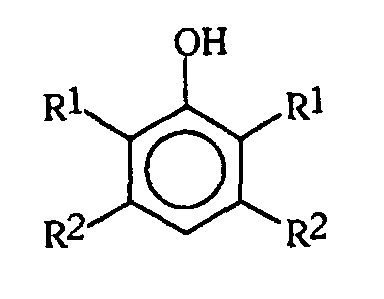 in Gegenwart eines makroretikulären Ionenaustauscherharzes als Katalysator, worin jedes R1 und R2 unabhängig Wasserstoff, Halogen, primäres oder sekundäres Alkyl mit bis zu 7 Kohlenstoffatomen, Phenyl oder alkyl-substituiertes Phenyl ist, R3 Wasserstoff, primäres oder sekundäres Alkyl mit bis zu 7 Kohlenstoffatomen, Phenyl oder alkyl-substituiertes Phenyl ist, und n von 1 bis 20 ist.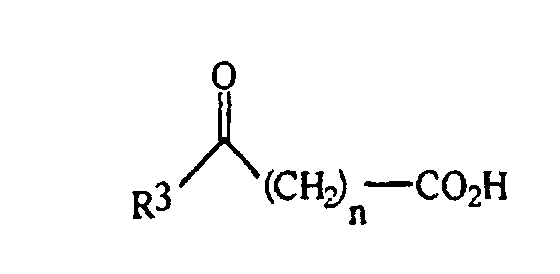
- Verfahren nach Anspruch 1, worin das makroretikuläre Ionenaustauscherharz hergestellt ist aus einem Polymer, ausgewählt aus der Gruppe bestehend aus Polystyrol, Copolymeren von Styrol und Divinylbenzol, Polymeren auf Acrylgrundlage, phenolischen Polymeren, Tetrafluorkohlenstoff- und fluorierten Ethylen-Propylen-Polymeren.
- Verfahren nach Anspruch 1, worin das Ionenaustauscherharz Sulfonsäure-Gruppen enthält.
- Verfahren nach Anspruch 1, worin das Reaktionswasser aus der Reaktionsmischung entfernt wird.
- Verfahren nach Anspruch 4, worin das Reaktionswasser mittels Durchspülen der Reaktion mit einem Inertgas oder mit einem Azeotrop oder sowohl durch Spülen als auch einem Azeotrop entfernt wird.
- Verfahren nach Anspruch 1, worin das Phenol 2,6-Dimethylphenol und das carbonsäurehaltige Material Lävulinsäure ist.
- Verfahren nach Anspruch 6, worin das Molverhältnis von 2,6-Dimethylphenol zu Lävulinsäure mindestens 2:1 beträgt.
- Verfahren nach Anspruch 1, bestehend im Wesentlichen aus dem Erhitzen einer Mischung mit dem Phenol und dem carbonsäurehaltigen Material in Gegenwart eines Ionenaustausch-Katalysators, gegebenenfalls unter Entfernung des Reaktionswassers.
- Verfahren nach Anspruch 8, worin das Ionenaustauscherharz Sulfonsäure-Gruppen enthält.
- Verfahren nach den Ansprüchen 1 bis 9, umfassend das Erhitzen einer Mischung mit einem 2,6-Dimethylphenol und Lävulinsäure in Gegenwart eines makroretikulären Ionenaustauscherharzes, gegebenenfalls unter Entfernung des Reaktionswassers.
Applications Claiming Priority (2)
| Application Number | Priority Date | Filing Date | Title |
|---|---|---|---|
| US09/016,365 US5969180A (en) | 1998-01-30 | 1998-01-30 | Method for making bis-xylenols containing acid moieties |
| US16365 | 1998-01-30 |
Publications (2)
| Publication Number | Publication Date |
|---|---|
| EP0933348A1 EP0933348A1 (de) | 1999-08-04 |
| EP0933348B1 true EP0933348B1 (de) | 2002-01-16 |
Family
ID=21776752
Family Applications (1)
| Application Number | Title | Priority Date | Filing Date |
|---|---|---|---|
| EP99300224A Expired - Lifetime EP0933348B1 (de) | 1998-01-30 | 1999-01-14 | Verfahren zur Herstellung von Säuregruppen enthaltenden Bisxylenolen |
Country Status (7)
| Country | Link |
|---|---|
| US (1) | US5969180A (de) |
| EP (1) | EP0933348B1 (de) |
| JP (1) | JPH11279109A (de) |
| CN (1) | CN1134399C (de) |
| DE (1) | DE69900653T2 (de) |
| ES (1) | ES2169588T3 (de) |
| SG (1) | SG71899A1 (de) |
Families Citing this family (7)
| Publication number | Priority date | Publication date | Assignee | Title |
|---|---|---|---|---|
| US6730816B2 (en) * | 2000-12-29 | 2004-05-04 | Rohm And Haas Company | High productivity bisphenol-A catalyst |
| US20040249229A1 (en) * | 2003-06-06 | 2004-12-09 | Gee Jeffery C. | Isomerization of olefins with carboxylic acid |
| EP1700824A1 (de) * | 2005-03-09 | 2006-09-13 | Degussa AG | Granulate basierend auf pyrogen hergestelles silicon dioxid, sowie Verfahren zu deren Herstellung und Verwendung dergleichen |
| CN102584569B (zh) * | 2011-12-15 | 2015-01-14 | 北京林业大学 | 一种在离子液体中制备双酚酸的方法 |
| JP6074902B2 (ja) * | 2012-03-28 | 2017-02-08 | 三菱化学株式会社 | 精製フェノール系化合物の製造方法 |
| CN106588643A (zh) * | 2016-10-21 | 2017-04-26 | 江苏大学 | 一种四溴双酚a衍生物tbbpa‑dbpe半抗原及其合成方法和用途 |
| CN106588631B (zh) * | 2016-10-21 | 2019-08-02 | 江苏大学 | 一种四溴双酚a衍生物tbbpa-dhee半抗原及其合成方法和用途 |
Family Cites Families (16)
| Publication number | Priority date | Publication date | Assignee | Title |
|---|---|---|---|---|
| US1193686A (en) * | 1916-08-08 | Botative vibbatoby testing-machine | ||
| CA698847A (en) * | 1964-12-01 | R. Bader Alfred | Ether derivatives of di(hydroxy-aromatic) alkylidene carboxylic acids | |
| US2933520A (en) * | 1953-08-27 | 1960-04-19 | Johnson & Son Inc S C | Addition products of phenols and keto acids and derivatives of the same |
| US3049568A (en) * | 1958-10-20 | 1962-08-14 | Union Carbide Corp | Preparation of bisphenols |
| US3153001A (en) * | 1958-10-20 | 1964-10-13 | Union Carbide Corp | Cationic exchanging polymeric resin |
| US3049569A (en) * | 1958-10-20 | 1962-08-14 | Union Carbide Corp | Production of 2, 2-bis(4-hydroxyphenyl) propane |
| US3248421A (en) * | 1962-05-21 | 1966-04-26 | Johnson & Son Inc S C | Method of preparing 4, 4-bis (4-hydroxyaryl) pentanoic acids |
| US3567686A (en) * | 1969-08-27 | 1971-03-02 | Gen Motors Corp | Polycarbonates |
| CA1005943A (en) * | 1971-01-26 | 1977-02-22 | David D. Taft | Compositions based on diphenolic-type acid capped materials and polyisocyanate and a process for curing same |
| DE2228448C2 (de) * | 1972-06-10 | 1984-05-24 | Hoechst Ag, 6230 Frankfurt | Hypolipidämisch wirksame Mittel |
| GB1446435A (en) * | 1972-11-02 | 1976-08-18 | Cooper Ltd Ethyl | Lubricant additives |
| US4375567A (en) * | 1981-08-21 | 1983-03-01 | General Electric Company | Method for making bisphenol |
| DE3329693A1 (de) * | 1983-08-17 | 1985-03-07 | Basf Farben + Fasern Ag, 2000 Hamburg | Verfahren zur herstellung von selbstvernetzenden kunstharzen und ihre verwendung |
| JPH0643366B2 (ja) * | 1985-02-13 | 1994-06-08 | 住友精化株式会社 | 4,4−ビス(4−ヒドロキシフエニル)ペンタン酸の製造法 |
| DE3928658A1 (de) * | 1989-08-30 | 1991-03-07 | Bayer Ag | Bisphenolderivate und deren polymerisate |
| JPH06270338A (ja) * | 1993-03-25 | 1994-09-27 | Dainippon Ink & Chem Inc | 積層体 |
-
1998
- 1998-01-30 US US09/016,365 patent/US5969180A/en not_active Expired - Lifetime
- 1998-12-30 CN CNB981259626A patent/CN1134399C/zh not_active Expired - Fee Related
-
1999
- 1999-01-14 EP EP99300224A patent/EP0933348B1/de not_active Expired - Lifetime
- 1999-01-14 DE DE69900653T patent/DE69900653T2/de not_active Expired - Fee Related
- 1999-01-14 ES ES99300224T patent/ES2169588T3/es not_active Expired - Lifetime
- 1999-01-16 SG SG1999000103A patent/SG71899A1/en unknown
- 1999-01-29 JP JP11020919A patent/JPH11279109A/ja active Pending
Also Published As
| Publication number | Publication date |
|---|---|
| EP0933348A1 (de) | 1999-08-04 |
| JPH11279109A (ja) | 1999-10-12 |
| DE69900653D1 (de) | 2002-02-21 |
| ES2169588T3 (es) | 2002-07-01 |
| SG71899A1 (en) | 2000-04-18 |
| CN1134399C (zh) | 2004-01-14 |
| DE69900653T2 (de) | 2002-09-12 |
| US5969180A (en) | 1999-10-19 |
| CN1227217A (zh) | 1999-09-01 |
Similar Documents
| Publication | Publication Date | Title |
|---|---|---|
| US5475154A (en) | Method for producing high-purity bisphenols | |
| US5302774A (en) | Process for the production of bisphenols | |
| US3049568A (en) | Preparation of bisphenols | |
| US7112702B2 (en) | Process for the synthesis of bisphenol | |
| US8263521B2 (en) | Process for producing bisphenol A | |
| JP3819050B2 (ja) | 酸性イオン交換触媒の活性を延長する方法 | |
| US5756781A (en) | Method for making tris(hydroxyphenyl) compounds using ion exchange | |
| JP2006509818A5 (de) | ||
| JPH11246458A (ja) | ビスフェノールの製造方法 | |
| US5969180A (en) | Method for making bis-xylenols containing acid moieties | |
| US3153001A (en) | Cationic exchanging polymeric resin | |
| CN101511478B (zh) | 强酸性阳离子交换树脂 | |
| JP5332846B2 (ja) | ビスフェノール化合物製造用強酸性イオン交換樹脂触媒及び、それを用いたビスフェノール化合物の製造方法 | |
| US20050119111A1 (en) | Catalytic reactions using thermally stable resins | |
| EP1381463B1 (de) | Verfahren zur herstellung eines starksauren kationenaustauscherharzes | |
| AU725397B2 (en) | Process for the manufacture of carboxylic acids | |
| EP0968166B1 (de) | Verfahren zur herstellung von carbonsäuren | |
| CN1134396C (zh) | 季化羧酸的制备方法 |
Legal Events
| Date | Code | Title | Description |
|---|---|---|---|
| PUAI | Public reference made under article 153(3) epc to a published international application that has entered the european phase |
Free format text: ORIGINAL CODE: 0009012 |
|
| AK | Designated contracting states |
Kind code of ref document: A1 Designated state(s): DE ES FR GB IT NL |
|
| AX | Request for extension of the european patent |
Free format text: AL;LT;LV;MK;RO;SI |
|
| 17P | Request for examination filed |
Effective date: 20000204 |
|
| AKX | Designation fees paid |
Free format text: DE ES FR GB IT NL |
|
| GRAG | Despatch of communication of intention to grant |
Free format text: ORIGINAL CODE: EPIDOS AGRA |
|
| GRAG | Despatch of communication of intention to grant |
Free format text: ORIGINAL CODE: EPIDOS AGRA |
|
| GRAH | Despatch of communication of intention to grant a patent |
Free format text: ORIGINAL CODE: EPIDOS IGRA |
|
| 17Q | First examination report despatched |
Effective date: 20010607 |
|
| GRAH | Despatch of communication of intention to grant a patent |
Free format text: ORIGINAL CODE: EPIDOS IGRA |
|
| GRAA | (expected) grant |
Free format text: ORIGINAL CODE: 0009210 |
|
| REG | Reference to a national code |
Ref country code: GB Ref legal event code: IF02 |
|
| AK | Designated contracting states |
Kind code of ref document: B1 Designated state(s): DE ES FR GB IT NL |
|
| REF | Corresponds to: |
Ref document number: 69900653 Country of ref document: DE Date of ref document: 20020221 |
|
| ET | Fr: translation filed | ||
| REG | Reference to a national code |
Ref country code: ES Ref legal event code: FG2A Ref document number: 2169588 Country of ref document: ES Kind code of ref document: T3 |
|
| PLBE | No opposition filed within time limit |
Free format text: ORIGINAL CODE: 0009261 |
|
| STAA | Information on the status of an ep patent application or granted ep patent |
Free format text: STATUS: NO OPPOSITION FILED WITHIN TIME LIMIT |
|
| PGFP | Annual fee paid to national office [announced via postgrant information from national office to epo] |
Ref country code: NL Payment date: 20021223 Year of fee payment: 5 |
|
| 26N | No opposition filed | ||
| PGFP | Annual fee paid to national office [announced via postgrant information from national office to epo] |
Ref country code: ES Payment date: 20030207 Year of fee payment: 5 |
|
| PG25 | Lapsed in a contracting state [announced via postgrant information from national office to epo] |
Ref country code: ES Free format text: LAPSE BECAUSE OF NON-PAYMENT OF DUE FEES Effective date: 20040115 |
|
| PG25 | Lapsed in a contracting state [announced via postgrant information from national office to epo] |
Ref country code: NL Free format text: LAPSE BECAUSE OF NON-PAYMENT OF DUE FEES Effective date: 20040801 |
|
| NLV4 | Nl: lapsed or anulled due to non-payment of the annual fee |
Effective date: 20040801 |
|
| REG | Reference to a national code |
Ref country code: ES Ref legal event code: FD2A Effective date: 20040115 |
|
| REG | Reference to a national code |
Ref country code: GB Ref legal event code: 732E |
|
| PGFP | Annual fee paid to national office [announced via postgrant information from national office to epo] |
Ref country code: IT Payment date: 20080128 Year of fee payment: 10 Ref country code: GB Payment date: 20080129 Year of fee payment: 10 |
|
| PGFP | Annual fee paid to national office [announced via postgrant information from national office to epo] |
Ref country code: FR Payment date: 20080117 Year of fee payment: 10 Ref country code: DE Payment date: 20080229 Year of fee payment: 10 |
|
| REG | Reference to a national code |
Ref country code: FR Ref legal event code: TP |
|
| GBPC | Gb: european patent ceased through non-payment of renewal fee |
Effective date: 20090114 |
|
| PG25 | Lapsed in a contracting state [announced via postgrant information from national office to epo] |
Ref country code: DE Free format text: LAPSE BECAUSE OF NON-PAYMENT OF DUE FEES Effective date: 20090801 |
|
| REG | Reference to a national code |
Ref country code: FR Ref legal event code: ST Effective date: 20091030 |
|
| PG25 | Lapsed in a contracting state [announced via postgrant information from national office to epo] |
Ref country code: GB Free format text: LAPSE BECAUSE OF NON-PAYMENT OF DUE FEES Effective date: 20090114 |
|
| PG25 | Lapsed in a contracting state [announced via postgrant information from national office to epo] |
Ref country code: FR Free format text: LAPSE BECAUSE OF NON-PAYMENT OF DUE FEES Effective date: 20090202 |
|
| PG25 | Lapsed in a contracting state [announced via postgrant information from national office to epo] |
Ref country code: IT Free format text: LAPSE BECAUSE OF NON-PAYMENT OF DUE FEES Effective date: 20090114 |