EP0929677B1 - Rekombinantes herstellungsverfahren für ein vollständiges malaria-antigen gp190/msp1 - Google Patents
Rekombinantes herstellungsverfahren für ein vollständiges malaria-antigen gp190/msp1 Download PDFInfo
- Publication number
- EP0929677B1 EP0929677B1 EP97911173A EP97911173A EP0929677B1 EP 0929677 B1 EP0929677 B1 EP 0929677B1 EP 97911173 A EP97911173 A EP 97911173A EP 97911173 A EP97911173 A EP 97911173A EP 0929677 B1 EP0929677 B1 EP 0929677B1
- Authority
- EP
- European Patent Office
- Prior art keywords
- protein
- sequence
- dna sequence
- expression
- msp1
- Prior art date
- Legal status (The legal status is an assumption and is not a legal conclusion. Google has not performed a legal analysis and makes no representation as to the accuracy of the status listed.)
- Expired - Lifetime
Links
- 201000004792 malaria Diseases 0.000 title claims description 27
- 108091007433 antigens Proteins 0.000 title description 9
- 239000000427 antigen Substances 0.000 title description 8
- 102000036639 antigens Human genes 0.000 title description 8
- 238000010188 recombinant method Methods 0.000 title description 3
- 108090000623 proteins and genes Proteins 0.000 claims abstract description 109
- 238000000034 method Methods 0.000 claims abstract description 27
- 210000004027 cell Anatomy 0.000 claims abstract description 25
- 108010052285 Membrane Proteins Proteins 0.000 claims abstract description 14
- 239000013598 vector Substances 0.000 claims abstract description 12
- 241000224016 Plasmodium Species 0.000 claims abstract description 5
- 102000018697 Membrane Proteins Human genes 0.000 claims abstract 3
- 102000004169 proteins and genes Human genes 0.000 claims description 66
- 235000018102 proteins Nutrition 0.000 claims description 64
- 108010057081 Merozoite Surface Protein 1 Proteins 0.000 claims description 57
- 102100039867 Outer mitochondrial transmembrane helix translocase Human genes 0.000 claims description 53
- 230000014509 gene expression Effects 0.000 claims description 45
- 108091028043 Nucleic acid sequence Proteins 0.000 claims description 43
- 241000223960 Plasmodium falciparum Species 0.000 claims description 37
- 241000223997 Toxoplasma gondii Species 0.000 claims description 29
- 238000004519 manufacturing process Methods 0.000 claims description 23
- 241000588724 Escherichia coli Species 0.000 claims description 20
- 238000003786 synthesis reaction Methods 0.000 claims description 18
- 229960005486 vaccine Drugs 0.000 claims description 18
- 125000003275 alpha amino acid group Chemical group 0.000 claims description 17
- 230000015572 biosynthetic process Effects 0.000 claims description 16
- 238000002649 immunization Methods 0.000 claims description 16
- 230000003053 immunization Effects 0.000 claims description 16
- 230000008569 process Effects 0.000 claims description 16
- 108010076504 Protein Sorting Signals Proteins 0.000 claims description 14
- 235000001014 amino acid Nutrition 0.000 claims description 13
- 150000001413 amino acids Chemical class 0.000 claims description 13
- 210000004978 chinese hamster ovary cell Anatomy 0.000 claims description 12
- 239000013604 expression vector Substances 0.000 claims description 12
- 108091008146 restriction endonucleases Proteins 0.000 claims description 7
- 108020004705 Codon Proteins 0.000 claims description 6
- 241000222722 Leishmania <genus> Species 0.000 claims description 6
- 150000007523 nucleic acids Chemical group 0.000 claims description 6
- 230000004927 fusion Effects 0.000 claims description 5
- 238000012545 processing Methods 0.000 claims description 5
- 238000003776 cleavage reaction Methods 0.000 claims description 4
- 238000010367 cloning Methods 0.000 claims description 4
- 235000014304 histidine Nutrition 0.000 claims description 4
- 108020004707 nucleic acids Proteins 0.000 claims description 4
- 102000039446 nucleic acids Human genes 0.000 claims description 4
- 230000007017 scission Effects 0.000 claims description 4
- 239000002773 nucleotide Substances 0.000 claims description 3
- 125000003729 nucleotide group Chemical group 0.000 claims description 3
- 241000701161 unidentified adenovirus Species 0.000 claims description 3
- 241000701447 unidentified baculovirus Species 0.000 claims description 3
- 240000004808 Saccharomyces cerevisiae Species 0.000 claims description 2
- 238000013461 design Methods 0.000 claims description 2
- 108010042407 Endonucleases Proteins 0.000 claims 1
- 102000004533 Endonucleases Human genes 0.000 claims 1
- 101710163270 Nuclease Proteins 0.000 claims 1
- 150000002411 histidines Chemical class 0.000 claims 1
- 210000003936 merozoite Anatomy 0.000 abstract description 9
- 238000002360 preparation method Methods 0.000 abstract description 9
- 230000003019 stabilising effect Effects 0.000 abstract 1
- 244000045947 parasite Species 0.000 description 28
- 239000000047 product Substances 0.000 description 18
- 241000282693 Cercopithecidae Species 0.000 description 14
- 239000012634 fragment Substances 0.000 description 13
- 102400000368 Surface protein Human genes 0.000 description 11
- 239000000463 material Substances 0.000 description 11
- 238000010166 immunofluorescence Methods 0.000 description 9
- 208000015181 infectious disease Diseases 0.000 description 9
- 108700028369 Alleles Proteins 0.000 description 7
- 241000282708 Aotus <primate> Species 0.000 description 7
- 108020004414 DNA Proteins 0.000 description 7
- 241001465754 Metazoa Species 0.000 description 6
- 108091034117 Oligonucleotide Proteins 0.000 description 6
- 208000030852 Parasitic disease Diseases 0.000 description 6
- 238000001042 affinity chromatography Methods 0.000 description 6
- 210000004899 c-terminal region Anatomy 0.000 description 6
- 230000036039 immunity Effects 0.000 description 6
- 238000000746 purification Methods 0.000 description 6
- 108091006106 transcriptional activators Proteins 0.000 description 6
- 108060001084 Luciferase Proteins 0.000 description 5
- 101150077426 MSP-1 gene Proteins 0.000 description 5
- 208000009182 Parasitemia Diseases 0.000 description 5
- JLCPHMBAVCMARE-UHFFFAOYSA-N [3-[[3-[[3-[[3-[[3-[[3-[[3-[[3-[[3-[[3-[[3-[[5-(2-amino-6-oxo-1H-purin-9-yl)-3-[[3-[[3-[[3-[[3-[[3-[[5-(2-amino-6-oxo-1H-purin-9-yl)-3-[[5-(2-amino-6-oxo-1H-purin-9-yl)-3-hydroxyoxolan-2-yl]methoxy-hydroxyphosphoryl]oxyoxolan-2-yl]methoxy-hydroxyphosphoryl]oxy-5-(5-methyl-2,4-dioxopyrimidin-1-yl)oxolan-2-yl]methoxy-hydroxyphosphoryl]oxy-5-(6-aminopurin-9-yl)oxolan-2-yl]methoxy-hydroxyphosphoryl]oxy-5-(6-aminopurin-9-yl)oxolan-2-yl]methoxy-hydroxyphosphoryl]oxy-5-(6-aminopurin-9-yl)oxolan-2-yl]methoxy-hydroxyphosphoryl]oxy-5-(6-aminopurin-9-yl)oxolan-2-yl]methoxy-hydroxyphosphoryl]oxyoxolan-2-yl]methoxy-hydroxyphosphoryl]oxy-5-(5-methyl-2,4-dioxopyrimidin-1-yl)oxolan-2-yl]methoxy-hydroxyphosphoryl]oxy-5-(4-amino-2-oxopyrimidin-1-yl)oxolan-2-yl]methoxy-hydroxyphosphoryl]oxy-5-(5-methyl-2,4-dioxopyrimidin-1-yl)oxolan-2-yl]methoxy-hydroxyphosphoryl]oxy-5-(5-methyl-2,4-dioxopyrimidin-1-yl)oxolan-2-yl]methoxy-hydroxyphosphoryl]oxy-5-(6-aminopurin-9-yl)oxolan-2-yl]methoxy-hydroxyphosphoryl]oxy-5-(6-aminopurin-9-yl)oxolan-2-yl]methoxy-hydroxyphosphoryl]oxy-5-(4-amino-2-oxopyrimidin-1-yl)oxolan-2-yl]methoxy-hydroxyphosphoryl]oxy-5-(4-amino-2-oxopyrimidin-1-yl)oxolan-2-yl]methoxy-hydroxyphosphoryl]oxy-5-(4-amino-2-oxopyrimidin-1-yl)oxolan-2-yl]methoxy-hydroxyphosphoryl]oxy-5-(6-aminopurin-9-yl)oxolan-2-yl]methoxy-hydroxyphosphoryl]oxy-5-(4-amino-2-oxopyrimidin-1-yl)oxolan-2-yl]methyl [5-(6-aminopurin-9-yl)-2-(hydroxymethyl)oxolan-3-yl] hydrogen phosphate Polymers Cc1cn(C2CC(OP(O)(=O)OCC3OC(CC3OP(O)(=O)OCC3OC(CC3O)n3cnc4c3nc(N)[nH]c4=O)n3cnc4c3nc(N)[nH]c4=O)C(COP(O)(=O)OC3CC(OC3COP(O)(=O)OC3CC(OC3COP(O)(=O)OC3CC(OC3COP(O)(=O)OC3CC(OC3COP(O)(=O)OC3CC(OC3COP(O)(=O)OC3CC(OC3COP(O)(=O)OC3CC(OC3COP(O)(=O)OC3CC(OC3COP(O)(=O)OC3CC(OC3COP(O)(=O)OC3CC(OC3COP(O)(=O)OC3CC(OC3COP(O)(=O)OC3CC(OC3COP(O)(=O)OC3CC(OC3COP(O)(=O)OC3CC(OC3COP(O)(=O)OC3CC(OC3COP(O)(=O)OC3CC(OC3COP(O)(=O)OC3CC(OC3CO)n3cnc4c(N)ncnc34)n3ccc(N)nc3=O)n3cnc4c(N)ncnc34)n3ccc(N)nc3=O)n3ccc(N)nc3=O)n3ccc(N)nc3=O)n3cnc4c(N)ncnc34)n3cnc4c(N)ncnc34)n3cc(C)c(=O)[nH]c3=O)n3cc(C)c(=O)[nH]c3=O)n3ccc(N)nc3=O)n3cc(C)c(=O)[nH]c3=O)n3cnc4c3nc(N)[nH]c4=O)n3cnc4c(N)ncnc34)n3cnc4c(N)ncnc34)n3cnc4c(N)ncnc34)n3cnc4c(N)ncnc34)O2)c(=O)[nH]c1=O JLCPHMBAVCMARE-UHFFFAOYSA-N 0.000 description 5
- 238000002955 isolation Methods 0.000 description 5
- BPHPUYQFMNQIOC-NXRLNHOXSA-N isopropyl beta-D-thiogalactopyranoside Chemical compound CC(C)S[C@@H]1O[C@H](CO)[C@H](O)[C@H](O)[C@H]1O BPHPUYQFMNQIOC-NXRLNHOXSA-N 0.000 description 5
- 239000012528 membrane Substances 0.000 description 5
- 239000002243 precursor Substances 0.000 description 5
- 238000013518 transcription Methods 0.000 description 5
- 230000035897 transcription Effects 0.000 description 5
- 238000002255 vaccination Methods 0.000 description 5
- 239000005089 Luciferase Substances 0.000 description 4
- 239000002671 adjuvant Substances 0.000 description 4
- 230000003321 amplification Effects 0.000 description 4
- 238000004458 analytical method Methods 0.000 description 4
- 230000002457 bidirectional effect Effects 0.000 description 4
- 239000000969 carrier Substances 0.000 description 4
- 238000012512 characterization method Methods 0.000 description 4
- 238000011161 development Methods 0.000 description 4
- 238000002474 experimental method Methods 0.000 description 4
- 230000006698 induction Effects 0.000 description 4
- 210000004962 mammalian cell Anatomy 0.000 description 4
- 238000003199 nucleic acid amplification method Methods 0.000 description 4
- 102000004196 processed proteins & peptides Human genes 0.000 description 4
- 108090000765 processed proteins & peptides Proteins 0.000 description 4
- 230000001681 protective effect Effects 0.000 description 4
- 108091026890 Coding region Proteins 0.000 description 3
- 102000053602 DNA Human genes 0.000 description 3
- 101900235899 Plasmodium falciparum Merozoite surface protein 1 Proteins 0.000 description 3
- 241000223810 Plasmodium vivax Species 0.000 description 3
- 241000288906 Primates Species 0.000 description 3
- 239000004098 Tetracycline Substances 0.000 description 3
- 238000004873 anchoring Methods 0.000 description 3
- 210000004369 blood Anatomy 0.000 description 3
- 239000008280 blood Substances 0.000 description 3
- 238000001962 electrophoresis Methods 0.000 description 3
- 239000000284 extract Substances 0.000 description 3
- 125000000487 histidyl group Chemical class [H]N([H])C(C(=O)O*)C([H])([H])C1=C([H])N([H])C([H])=N1 0.000 description 3
- 239000002054 inoculum Substances 0.000 description 3
- 244000052769 pathogen Species 0.000 description 3
- 239000013612 plasmid Substances 0.000 description 3
- 229920001184 polypeptide Polymers 0.000 description 3
- 230000009257 reactivity Effects 0.000 description 3
- 230000001105 regulatory effect Effects 0.000 description 3
- 229960002180 tetracycline Drugs 0.000 description 3
- 229930101283 tetracycline Natural products 0.000 description 3
- 235000019364 tetracycline Nutrition 0.000 description 3
- 150000003522 tetracyclines Chemical class 0.000 description 3
- 238000006257 total synthesis reaction Methods 0.000 description 3
- 238000001262 western blot Methods 0.000 description 3
- QKICWELGRMTQCR-UHFFFAOYSA-N 4-[(7-chloroquinolin-4-yl)azaniumyl]pentyl-diethylazanium;dihydrogen phosphate Chemical compound OP(O)(O)=O.OP(O)(O)=O.ClC1=CC=C2C(NC(C)CCCN(CC)CC)=CC=NC2=C1 QKICWELGRMTQCR-UHFFFAOYSA-N 0.000 description 2
- PNEYBMLMFCGWSK-UHFFFAOYSA-N Alumina Chemical compound [O-2].[O-2].[O-2].[Al+3].[Al+3] PNEYBMLMFCGWSK-UHFFFAOYSA-N 0.000 description 2
- 108091033380 Coding strand Proteins 0.000 description 2
- YQYJSBFKSSDGFO-UHFFFAOYSA-N Epihygromycin Natural products OC1C(O)C(C(=O)C)OC1OC(C(=C1)O)=CC=C1C=C(C)C(=O)NC1C(O)C(O)C2OCOC2C1O YQYJSBFKSSDGFO-UHFFFAOYSA-N 0.000 description 2
- 208000002476 Falciparum Malaria Diseases 0.000 description 2
- 241000282412 Homo Species 0.000 description 2
- PXHVJJICTQNCMI-UHFFFAOYSA-N Nickel Chemical compound [Ni] PXHVJJICTQNCMI-UHFFFAOYSA-N 0.000 description 2
- 229910019142 PO4 Inorganic materials 0.000 description 2
- 201000011336 Plasmodium falciparum malaria Diseases 0.000 description 2
- 102000007056 Recombinant Fusion Proteins Human genes 0.000 description 2
- 108010008281 Recombinant Fusion Proteins Proteins 0.000 description 2
- 241000283984 Rodentia Species 0.000 description 2
- 241000282695 Saimiri Species 0.000 description 2
- 241000607142 Salmonella Species 0.000 description 2
- 241000223996 Toxoplasma Species 0.000 description 2
- 102000004243 Tubulin Human genes 0.000 description 2
- 108090000704 Tubulin Proteins 0.000 description 2
- 238000013459 approach Methods 0.000 description 2
- 238000007846 asymmetric PCR Methods 0.000 description 2
- 230000033228 biological regulation Effects 0.000 description 2
- 238000004113 cell culture Methods 0.000 description 2
- 239000013522 chelant Substances 0.000 description 2
- 238000006243 chemical reaction Methods 0.000 description 2
- OPTASPLRGRRNAP-UHFFFAOYSA-N cytosine Chemical compound NC=1C=CNC(=O)N=1 OPTASPLRGRRNAP-UHFFFAOYSA-N 0.000 description 2
- 230000000694 effects Effects 0.000 description 2
- 239000012467 final product Substances 0.000 description 2
- UYTPUPDQBNUYGX-UHFFFAOYSA-N guanine Chemical compound O=C1NC(N)=NC2=C1N=CN2 UYTPUPDQBNUYGX-UHFFFAOYSA-N 0.000 description 2
- 230000028993 immune response Effects 0.000 description 2
- 239000000543 intermediate Substances 0.000 description 2
- 230000009545 invasion Effects 0.000 description 2
- 239000002502 liposome Substances 0.000 description 2
- 230000001717 pathogenic effect Effects 0.000 description 2
- 239000010452 phosphate Substances 0.000 description 2
- 229920002401 polyacrylamide Polymers 0.000 description 2
- 238000000926 separation method Methods 0.000 description 2
- 241000894007 species Species 0.000 description 2
- 208000037369 susceptibility to malaria Diseases 0.000 description 2
- RWQNBRDOKXIBIV-UHFFFAOYSA-N thymine Chemical compound CC1=CNC(=O)NC1=O RWQNBRDOKXIBIV-UHFFFAOYSA-N 0.000 description 2
- 238000012546 transfer Methods 0.000 description 2
- 230000007704 transition Effects 0.000 description 2
- 108091032973 (ribonucleotides)n+m Proteins 0.000 description 1
- 229930024421 Adenine Natural products 0.000 description 1
- GFFGJBXGBJISGV-UHFFFAOYSA-N Adenine Chemical compound NC1=NC=NC2=C1N=CN2 GFFGJBXGBJISGV-UHFFFAOYSA-N 0.000 description 1
- 241000256186 Anopheles <genus> Species 0.000 description 1
- 241001135752 Aotus griseimembra Species 0.000 description 1
- 241001502973 Aotus nancymaae Species 0.000 description 1
- 241000224482 Apicomplexa Species 0.000 description 1
- 101100174784 Bacillus subtilis (strain 168) ganR gene Proteins 0.000 description 1
- 241000894006 Bacteria Species 0.000 description 1
- 102100021935 C-C motif chemokine 26 Human genes 0.000 description 1
- 101100056797 Canis lupus familiaris SAG gene Proteins 0.000 description 1
- 208000035473 Communicable disease Diseases 0.000 description 1
- 101710088194 Dehydrogenase Proteins 0.000 description 1
- 108090000790 Enzymes Proteins 0.000 description 1
- 102000004190 Enzymes Human genes 0.000 description 1
- BCCRXDTUTZHDEU-VKHMYHEASA-N Gly-Ser Chemical compound NCC(=O)N[C@@H](CO)C(O)=O BCCRXDTUTZHDEU-VKHMYHEASA-N 0.000 description 1
- 102000003886 Glycoproteins Human genes 0.000 description 1
- 108090000288 Glycoproteins Proteins 0.000 description 1
- 101000897493 Homo sapiens C-C motif chemokine 26 Proteins 0.000 description 1
- 102000008070 Interferon-gamma Human genes 0.000 description 1
- 108010074328 Interferon-gamma Proteins 0.000 description 1
- 101710084021 Large envelope protein Proteins 0.000 description 1
- DSWOTZCVCBEPOU-IUCAKERBSA-N Met-Arg-Gly Chemical compound CSCC[C@H](N)C(=O)N[C@H](C(=O)NCC(O)=O)CCCNC(N)=N DSWOTZCVCBEPOU-IUCAKERBSA-N 0.000 description 1
- 241001529936 Murinae Species 0.000 description 1
- 125000001429 N-terminal alpha-amino-acid group Chemical group 0.000 description 1
- 238000012408 PCR amplification Methods 0.000 description 1
- 241000223821 Plasmodium malariae Species 0.000 description 1
- 241001505293 Plasmodium ovale Species 0.000 description 1
- 101100532512 Saccharomyces cerevisiae (strain ATCC 204508 / S288c) SAG1 gene Proteins 0.000 description 1
- 108020004682 Single-Stranded DNA Proteins 0.000 description 1
- 210000001744 T-lymphocyte Anatomy 0.000 description 1
- 101150114468 TUB1 gene Proteins 0.000 description 1
- 208000002903 Thalassemia Diseases 0.000 description 1
- 108091036066 Three prime untranslated region Proteins 0.000 description 1
- 241000700618 Vaccinia virus Species 0.000 description 1
- 206010046865 Vaccinia virus infection Diseases 0.000 description 1
- 239000002253 acid Substances 0.000 description 1
- 150000007513 acids Chemical class 0.000 description 1
- 229960000643 adenine Drugs 0.000 description 1
- 239000003463 adsorbent Substances 0.000 description 1
- 229940037003 alum Drugs 0.000 description 1
- 238000010171 animal model Methods 0.000 description 1
- 239000002246 antineoplastic agent Substances 0.000 description 1
- 108010069926 arginyl-glycyl-serine Proteins 0.000 description 1
- 230000001580 bacterial effect Effects 0.000 description 1
- 210000004900 c-terminal fragment Anatomy 0.000 description 1
- 230000004709 cell invasion Effects 0.000 description 1
- 230000001413 cellular effect Effects 0.000 description 1
- 239000007795 chemical reaction product Substances 0.000 description 1
- 229960005091 chloramphenicol Drugs 0.000 description 1
- WIIZWVCIJKGZOK-RKDXNWHRSA-N chloramphenicol Chemical compound ClC(Cl)C(=O)N[C@H](CO)[C@H](O)C1=CC=C([N+]([O-])=O)C=C1 WIIZWVCIJKGZOK-RKDXNWHRSA-N 0.000 description 1
- 230000002759 chromosomal effect Effects 0.000 description 1
- 238000004140 cleaning Methods 0.000 description 1
- 238000012761 co-transfection Methods 0.000 description 1
- 239000000287 crude extract Substances 0.000 description 1
- 229940104302 cytosine Drugs 0.000 description 1
- 229940127089 cytotoxic agent Drugs 0.000 description 1
- 230000007812 deficiency Effects 0.000 description 1
- 238000012217 deletion Methods 0.000 description 1
- 230000037430 deletion Effects 0.000 description 1
- 101150095218 der gene Proteins 0.000 description 1
- 201000010099 disease Diseases 0.000 description 1
- 231100000676 disease causative agent Toxicity 0.000 description 1
- 208000037265 diseases, disorders, signs and symptoms Diseases 0.000 description 1
- 238000009826 distribution Methods 0.000 description 1
- 229940079593 drug Drugs 0.000 description 1
- 239000003814 drug Substances 0.000 description 1
- 230000005684 electric field Effects 0.000 description 1
- 238000010828 elution Methods 0.000 description 1
- 108010030074 endodeoxyribonuclease MluI Proteins 0.000 description 1
- 238000005516 engineering process Methods 0.000 description 1
- 210000003743 erythrocyte Anatomy 0.000 description 1
- 229940044627 gamma-interferon Drugs 0.000 description 1
- 238000001502 gel electrophoresis Methods 0.000 description 1
- 238000001415 gene therapy Methods 0.000 description 1
- 230000002068 genetic effect Effects 0.000 description 1
- 230000013595 glycosylation Effects 0.000 description 1
- 238000006206 glycosylation reaction Methods 0.000 description 1
- 229930004094 glycosylphosphatidylinositol Natural products 0.000 description 1
- 244000144993 groups of animals Species 0.000 description 1
- 230000012010 growth Effects 0.000 description 1
- 244000000011 human parasite Species 0.000 description 1
- 230000028996 humoral immune response Effects 0.000 description 1
- 238000010185 immunofluorescence analysis Methods 0.000 description 1
- 238000000338 in vitro Methods 0.000 description 1
- 230000002401 inhibitory effect Effects 0.000 description 1
- 238000003780 insertion Methods 0.000 description 1
- 230000037431 insertion Effects 0.000 description 1
- 230000010354 integration Effects 0.000 description 1
- 230000003993 interaction Effects 0.000 description 1
- 238000002372 labelling Methods 0.000 description 1
- 101150043267 lacR gene Proteins 0.000 description 1
- 229940124735 malaria vaccine Drugs 0.000 description 1
- 239000003550 marker Substances 0.000 description 1
- 230000007246 mechanism Effects 0.000 description 1
- 230000001404 mediated effect Effects 0.000 description 1
- 230000004060 metabolic process Effects 0.000 description 1
- 239000002184 metal Substances 0.000 description 1
- 229910052751 metal Inorganic materials 0.000 description 1
- 238000013508 migration Methods 0.000 description 1
- 230000005012 migration Effects 0.000 description 1
- 239000000203 mixture Substances 0.000 description 1
- 210000004897 n-terminal region Anatomy 0.000 description 1
- 239000005445 natural material Substances 0.000 description 1
- 229910052759 nickel Inorganic materials 0.000 description 1
- 229940046166 oligodeoxynucleotide Drugs 0.000 description 1
- 230000036281 parasite infection Effects 0.000 description 1
- 229940118768 plasmodium malariae Drugs 0.000 description 1
- 238000002264 polyacrylamide gel electrophoresis Methods 0.000 description 1
- 230000001737 promoting effect Effects 0.000 description 1
- 230000000644 propagated effect Effects 0.000 description 1
- 238000011321 prophylaxis Methods 0.000 description 1
- 230000009145 protein modification Effects 0.000 description 1
- 230000006798 recombination Effects 0.000 description 1
- 238000005215 recombination Methods 0.000 description 1
- 229920002477 rna polymer Polymers 0.000 description 1
- 238000011808 rodent model Methods 0.000 description 1
- 238000012163 sequencing technique Methods 0.000 description 1
- 210000002966 serum Anatomy 0.000 description 1
- 238000010186 staining Methods 0.000 description 1
- 238000012360 testing method Methods 0.000 description 1
- 238000002560 therapeutic procedure Methods 0.000 description 1
- 229940113082 thymine Drugs 0.000 description 1
- 230000002103 transcriptional effect Effects 0.000 description 1
- 208000007089 vaccinia Diseases 0.000 description 1
- 239000003981 vehicle Substances 0.000 description 1
- 230000003612 virological effect Effects 0.000 description 1
Images








Classifications
-
- C—CHEMISTRY; METALLURGY
- C07—ORGANIC CHEMISTRY
- C07K—PEPTIDES
- C07K14/00—Peptides having more than 20 amino acids; Gastrins; Somatostatins; Melanotropins; Derivatives thereof
- C07K14/435—Peptides having more than 20 amino acids; Gastrins; Somatostatins; Melanotropins; Derivatives thereof from animals; from humans
- C07K14/44—Peptides having more than 20 amino acids; Gastrins; Somatostatins; Melanotropins; Derivatives thereof from animals; from humans from protozoa
- C07K14/445—Plasmodium
-
- A—HUMAN NECESSITIES
- A61—MEDICAL OR VETERINARY SCIENCE; HYGIENE
- A61P—SPECIFIC THERAPEUTIC ACTIVITY OF CHEMICAL COMPOUNDS OR MEDICINAL PREPARATIONS
- A61P33/00—Antiparasitic agents
- A61P33/02—Antiprotozoals, e.g. for leishmaniasis, trichomoniasis, toxoplasmosis
- A61P33/06—Antimalarials
-
- A—HUMAN NECESSITIES
- A61—MEDICAL OR VETERINARY SCIENCE; HYGIENE
- A61K—PREPARATIONS FOR MEDICAL, DENTAL OR TOILETRY PURPOSES
- A61K39/00—Medicinal preparations containing antigens or antibodies
- A61K2039/51—Medicinal preparations containing antigens or antibodies comprising whole cells, viruses or DNA/RNA
-
- A—HUMAN NECESSITIES
- A61—MEDICAL OR VETERINARY SCIENCE; HYGIENE
- A61K—PREPARATIONS FOR MEDICAL, DENTAL OR TOILETRY PURPOSES
- A61K39/00—Medicinal preparations containing antigens or antibodies
- A61K2039/51—Medicinal preparations containing antigens or antibodies comprising whole cells, viruses or DNA/RNA
- A61K2039/52—Bacterial cells; Fungal cells; Protozoal cells
- A61K2039/523—Bacterial cells; Fungal cells; Protozoal cells expressing foreign proteins
-
- A—HUMAN NECESSITIES
- A61—MEDICAL OR VETERINARY SCIENCE; HYGIENE
- A61K—PREPARATIONS FOR MEDICAL, DENTAL OR TOILETRY PURPOSES
- A61K39/00—Medicinal preparations containing antigens or antibodies
- A61K2039/51—Medicinal preparations containing antigens or antibodies comprising whole cells, viruses or DNA/RNA
- A61K2039/53—DNA (RNA) vaccination
-
- A—HUMAN NECESSITIES
- A61—MEDICAL OR VETERINARY SCIENCE; HYGIENE
- A61K—PREPARATIONS FOR MEDICAL, DENTAL OR TOILETRY PURPOSES
- A61K39/00—Medicinal preparations containing antigens or antibodies
-
- C—CHEMISTRY; METALLURGY
- C07—ORGANIC CHEMISTRY
- C07K—PEPTIDES
- C07K2319/00—Fusion polypeptide
-
- Y—GENERAL TAGGING OF NEW TECHNOLOGICAL DEVELOPMENTS; GENERAL TAGGING OF CROSS-SECTIONAL TECHNOLOGIES SPANNING OVER SEVERAL SECTIONS OF THE IPC; TECHNICAL SUBJECTS COVERED BY FORMER USPC CROSS-REFERENCE ART COLLECTIONS [XRACs] AND DIGESTS
- Y02—TECHNOLOGIES OR APPLICATIONS FOR MITIGATION OR ADAPTATION AGAINST CLIMATE CHANGE
- Y02A—TECHNOLOGIES FOR ADAPTATION TO CLIMATE CHANGE
- Y02A50/00—TECHNOLOGIES FOR ADAPTATION TO CLIMATE CHANGE in human health protection, e.g. against extreme weather
- Y02A50/30—Against vector-borne diseases, e.g. mosquito-borne, fly-borne, tick-borne or waterborne diseases whose impact is exacerbated by climate change
Definitions
- the invention relates to a recombinant production process for the complete Malaria antigen gp190 / MSP1 as well as single naturally occurring domains and Parts thereof by expression of a synthetic DNA sequences.
- the invention also relates to the DNA sequences produced by the method and the host organisms used for the expression of the DNA sequences. furthermore The invention relates to the use of the complete malaria antigen and parts same as a vaccine for the immunization against malaria.
- Malaria is one of the world's leading infectious diseases. According to the In 1990, WHO exposed malaria risk to 40% of the world's population in 99 countries. Its distribution is currently increasing again massively. This is mainly due to one attributed to intensive resistance formation of malaria parasites, thereby promoting is that the drugs used for therapy also recommended as prophylaxis and be taken. In addition to finding new, effective chemotherapeutic agents There are also hopes in the development of vaccines today set as people in malaria-epidemic regions of the world different species of immunity.
- the major problem with vaccine development is the identification of an antigen that can provide protective immunity because there is no readily available and well-defined animal model for the four human parasites.
- the malaria parasites belong to the group of plasmodia, whereby the infection with one of the four pathogens Plasmodium vivax, Plasmodium ovale, Plasmodium malariae or Plasmodium falciparum occurs through the bite of Anopheles mosquitoes. Of this pathogen Plasmodium falciparum is the most dangerous and the most widespread.
- the main surface protein of merozoites is a 190-220 kD glycoprotein. Late in the development of the parasite, this precursor is processed into smaller proteins, which, however, can be isolated as a single complex of merozoites. The complex is linked to the merozoite membrane by means of a glycosylphosphatidyl-inositol anchor. The sequences of the gp190 proteins of different P. falciparum strains fall into two groups, between which intragenic recombination is frequent.
- the protein consists of several highly conserved regions, one dimorphic region, each belonging to one of two alleles, and two relatively small oligomorphic blocks in the N-terminal region (Tanabe, K., Mackay, M., Goman, M. and Scaife JG (1987), Allelic dimorphism in a surface antigen gene of the malaria parasite Plasmodium falciparum, J. Mol. Biol. 195, 273-287; Miller, LH, Roberts, T., Shahabuddin, M. and McCutchan, TF ( 1993), Analysis of sequence diversity in the Plasmodium falciparum merozoite surface protein-1 (MSP-1), Mol. Biochem., Parasit., 59, 1-14).
- MSP-1 Plasmodium falciparum merozoite surface protein-1
- the gp190 / MSP1 was considered early as a potential candidate for a vaccine. So was active in the rodent model after immunization with the analog protein received against infection with rodent parasites. Passive protection was against reach this protein targeted antibodies (see also Holder, A. A. and Freeman, R.R. (1981), Immunization against blood-stage rodent malaria using purified parasite antigens, Nature 294, 361-364; Majahan, W.R., Daly, T.M., Weidanz, W. P. and Long, C.A. (1984), Passive immunization against murine malaria with IgG3 monoclonal antibody, J. Immunol. 132, 3131-3137). The data, this assumption are not statistically significant, however.
- Recombinant method of preparation means that a protein from a DNA sequence is expressed by a suitable host organism; being the DNA sequence resulting from a cloning and fusion of individual DNA sections.
- “Complete gp190 / MSP1 protein” here means the entire gp190 / MSP1 surface protein which can be isolated from the abovementioned plasmodia, in particular Plasmodium falciparum , which represents the main surface protein of the merozoites of the aforementioned pathogen and the proteins with analogous function from the other Plasmodium species, such as P. vivax . The term thus refers in each case to the main surface protein of the merozoites of the 4 og, harmful to humans malaria.
- “Complete gp190 / MSP1 gene” is the gene coding for this protein. “Complete” in this context means that the entire amino acid sequence of the native protein is present, or that the gene sequence encodes the entire amino acid sequence of the native protein.
- gp190 / MSP1 also included are mutated and / or truncated forms of gp190 / MSP1, provided they have the same immunization potential (vaccine protection) as the complete gp190 / MSP1.
- the term also includes variants of gp190 / MSP1 which are characterized in that they have protein sections of various Alleles contained in a protein molecule.
- FCB-1 is a strain of P. falciparum as described by Heidrich, H.-G., Miettinen-Baumann, A., Eckerskorn, C. and Lottspeich, F. (1989) The N-terminal amino acid sequences of the Plasmodium falciparum (FCB1) merozoite surface antigens of 42 and 36 kilodaltons, both derived from the 185-195-kilodalton precursor. Mol. Biochem. Parasitol. 34, 147-154.
- Ankersignal means here a protein structure for which a DNA sequence at the 3 'or 5'-end of the gene of the invention encoded.
- Ankersignale are structures that one Polypeptide anchoring to other structures, such. Allow membranes.
- Signal peptide here means a protein structure for which a DNA sequence at the N-terminal Encoded end of the gene of the invention.
- Signal peptides are structures, the polypeptide u.a. allow an introduction into membranes.
- AT content in the context of the present invention means the percentage Amount of adenine / thymine base pairs relative to guanine / cytosine base pairs.
- the protein in its entirety synthesize outside of the parasite.
- the protein so synthesized is like the Analysis with conformational epitope-recognizing monoclonal antibodies, at least over wide areas in naturally folded form produced.
- the Recombinant manufacturing processes could each have several milligrams of intact gp190 / MSP1 are obtained from the host organisms, a lot of that technical and cost reasons from parasites practically can not be won can.
- the now possible production of the protein in arbitrary quantities opens new ones Perspectives for its use as an experimental malaria vaccine. About that In addition, the way is clear for the development of live vaccines and for vaccines on a nucleic acid basis.
- the synthesis of the gene sequence coding for the protein gp190 / MSP1 is preferably based on the sequence of the P. falciparum FCB-1 strain.
- P. falciparum is the causative agent of malaria tropica and thus the most dangerous among malaria species.
- the underlying gene is a member of the "K1 allele", where K1 stands for a particular P. falciparum strain. Its coding sequence extends over 4917 base pairs and includes a signal sequence at the N-terminal end and an anchor sequence at the C-terminal end.
- the recombinant production process according to the invention is preferred characterized in that the AT content of the protein is based is lower than the wild type sequence of 74% in the primitive gene to preferably about 55% by, for example, obtaining the amino acid sequence of the FCB-1 protein has a DNA sequence identical to that in human Genome customary codon frequencies is produced. Other codon frequencies, which lower the AT content, are also conceivable.
- the gene underlying the protein produced by the recombinant production method codes for the full amino acid sequence including signal peptide and GPI anchor signal peptide, hereinafter referred to as gp190 S.
- the gene underlying the protein produced by the recombinant production method codes for the full amino acid sequence, with the exception of the GPI anchor signal. This embodiment is hereinafter referred to as gp190 S1 .
- the full amino acid sequence gene underlying the protein produced by the recombinant production process except for the GPI anchor signal and the signal peptide encodes.
- This embodiment is hereinafter referred to as gp190 S2 .
- this is encoded by the recombinant Production process generated protein underlying gene for full Amino acid sequence and a transmembrane anchor sequence.
- the recombinant production process comprises following steps.
- the designed sequence becomes, for example, 5 overlapping regions each domain of natural processing products of the gp190 / MSP1 protein from FCB-1 correspond to p83, p31, p36, p30 and p19.
- Deoxyoligonucleotides are synthesized, each containing at least the entire Cover the length of a region.
- the deoxyoligonucleotides are synthesized such that their Sequence alternating the "upper” (5 '-3') and the “lower” (3 '- 5') DNA strand equivalent.
- the length of these oligonucleotides is preferably 120 on average Nucleotides and they overlap the adjacent sequences by about 20 bases each.
- DNA sequences of about double Length as the respective starting product produced by asymmetric PCR in such a way that the excess DNA sequences which are adjacent, respectively represent the opposite strand. This leads to a second
- PCR amplification cycle to a second product, the length of four originally used oligonucleotides (minus the overlapping region).
- the conversion of these products into a predominantly single-stranded DNA existing preparation by asymmetric PCR with the terminal oligonucleotides allows the production of a 800 bp in a further amplification step long double-stranded DNA fragment in only 25 PCR cycles.
- the coding regions for p19, p30, p36 and p31 are directly synthesized and molecularly cloned in E. coli .
- Clones with error-free sequences were obtained either directly or by assembling error-free subsequences.
- the region encoding the p83 was obtained by fusion from two sequences comprising about 1200 bp.
- Expression vectors are preferably the plasmids pDS56, RBSII ("Hochuli, E., Bannwarth, W. Döbeli, H. Gentz, R., and Stüber, D. (1988) Genetic approach to facilitating purification of recombinant proteins with a novel metal chelate adsorbent. Biotech. 6, 1321-1325 "), pBi-5 (" Baron, U., Freund Kunststoff, S., Gossen, M. and Bujard, " H. (1995) Corregulation of two genes activities by tetracycline via a bidirectional promoter. Nucl. Acids Res. 23, 3605-3606 ”) and ppTMCS, but there are others as well Expression vectors conceivable.
- Preferred host organisms for the expression are E. coli , more preferably the strain DH5alphaZ1 (R. Rutz, Dissertation 1996, University of Heidelberg), HeLa cells, CHO cells, Toxoplasma gondii (Pfefferkorn, ER and Pfefferkorn, CC 1976, Toxoplasma gondii: Parasitol, 39 , 365-376) or Leishmania.
- Further host systems could be, for example, yeasts, baculoviruses or adenoviruses, the subject matter of the invention not being restricted to the said host systems.
- gp190 / MSP1 encodes the DNA sequence suitable for expression for the complete amino acid sequence with the exception of the armature signal and the signal peptide.
- This embodiment gp190 / MSP1 may be characterized by being at the N-terminus 1.1 additional amino acids, of which 6 histidines contains.
- the DNA sequence suitable for expression contains no detectable "splice-donor” and “splice-acceptor” signals, and it is preferable characterized in that it contains no larger GC-rich sequences, the could cause stable hairpin structures at the RNA level.
- recognition signals for restriction enzymes which sequences of six and more base pairs can be avoided.
- sequences for restriction endonucleases be present, which do not occur in the gene.
- host organisms are provided by the invention, the complete nucleic acid sequence of the gp190 / MSP-1 surface protein according to one of claims 17 - 25 included.
- Such host organisms are preferably E. coli, more preferably the strain DH5alphaZ1, HeLA cells, CHO cells, Toxoplasma gondii or Leishmania.
- the HeLa cells and CHO cells should preferably synthesize constitutively tTA.
- the present invention provides a possibility for a gp190 / MSP1 surface protein produced by the recombinant method of production or parts thereof for active immunization against malaria.
- the synthetic scheme presented here also allows the second allele of the gp190 / MSP1 gene. This takes into account the dimorphism of the protein carried.
- the main variability of the protein is based on the sequences of two relatively short blocks (blocks II and IV, ref. 1) that are oligomorphic.
- the present Sequence data make it possible that with 6-8 sequence combinations of these Blocks over 95% of all known gp190 / MSP1 sequences can be covered.
- the synthesis of these sequence variants can be easily based on the here realized strategies, so that variants in both the K1 and in the MAD20 allele can be incorporated.
- Vaccines from the resulting Sequence families may be able to compete with a broad spectrum of parasites Give protection to gp190 / MSP1 variants.
- Another way of vaccination is to use one according to the Recombinant production methods according to the invention produced gp190 / MSP1 protein for the production of monoclonal antibodies, which in turn become passive Immunization against malaria can be used.
- Gene for the gp190 / MSP-1 Surface protein provided according to the present invention, which characterized in that it has a lower AT content than that Wild type gene.
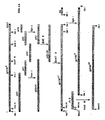
- the dark blocks represent regions that are highly conserved in all strains.
- the shaded blocks show the dimorphic regions which, in the case of the FCB-1 isolate, originate from the K1 allele.
- O1 and O2 show the oligomorphic regions.
- S denotes the signal peptide sequence comprising 19 amino acids, GA, the C-terminal region which contains the signal for GPI anchoring of the protein in the membrane.
- the arrows indicate the processing sites through which proteins p53, p31, p36, p30 and p19 are formed.
- the gp190 gene encodes a total of 1639 amino acids.
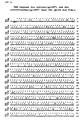
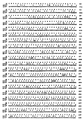
- Example 1 Total Synthesis of a DNA Sequence Coding the gp190 / MSP1 (see FIG. 3)
- the sequence was split into fragments, which are the main processing products corresponded to p83, p31, p36, p30 and p19.
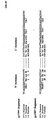
- In the transition regions were cleavage sites for restriction endonucleases (arrows in Fig. 3) so that the amino acid sequence was not changed. All the interfaces listed here come in the sequence only once before.
- the fragments were synthesized overlapping so that the interfaces at the respective ends made the linkage to the neighboring fragments possible by ligation. All individual fragments additionally contained at their 5 'end a BamHI site for insertion into expression vectors. Via MluI and ClaI the complete sequence could be cloned. The scheme shown here leads first to a sequence that can not form the GPI anchor, since C-terminal 18 amino acids are missing. The synthesis of the corresponding oligonucleotide, as well as a SphI on the interface extending "primer” leads to the PCR fragment to the GA, which could be used over SphI and ClaI, the resulting total sequence was S gp190.
- PCR primers were prepared, via which the fragment ⁇ S was synthesized. It allows the N-terminus to be altered via a BamHI and a HindIII site such that the protein started with amino acid # 20.
- the core sequence encoding the gp190 / MSP1 without signal sequence and without GPI anchor signal was designated gp 190 S2 . Deletion of the GPI anchor signal alone resulted in gp190 S1 .
- Oligodeoxynucleotides of about 120 nucleotides in length were synthesized alternately from the coding or non-coding strand such that they each overlapped about 20 bases with the adjacent fragment.
- the scheme exemplifies the synthesis of an approximately 800 bp fragment from oligonucleotides.
- 2 oligonucleotides were amplified "asymmetrically" in 4 reaction vessels.
- step III Asymmetric amplification of these DNA fragments (step III) resulted in single strand populations which, after unification and amplification (step IV), gave final product G of about 800 bp in length after 10 cycles.
- step IV This synthesis was feasible without isolation of the intermediates and without buffer or enzyme control, and was complete after 3 hours.
- the final product was electrophoresed, recut with the appropriate restriction endonucleases, and cloned into E. coli in the pBluescript (Stratagene) in which a polylinker was inserted with a Mlul and a ClaI site.
- the N-terminal sequence starting with the BamHI site, showed the transition at amino acid 20, which is believed to be present after cleavage of the Signal peptide defines the N-terminus.
- At the C-terminus was the encoded sequence at amino acid 1621 to end. The stop codons were followed by the clal interface.
- the gp190 S2 sequence was inserted via the BamHI and ClaI sites in pDS56RBSII.
- 6 histidines as well as some vector-derived amino acids were fused to the N-terminus; this results in the following N-terminal sequence of the reading frame; Met Arg Gly Ser (His) 6 Gly Ser.
- P N25lacO-1 transcription was under lacR / O / IPTG control.
- Example 3 Tetracycline-Controlled Expression of gp190 S1 in HeLa and CHO cells and isolation of the product (see also Fig. 51 or 6c)
- Example 4 Expression of gp190 S in Toxoplasma gondii and purification of the product (see also Fig. 6).
- Example 6 Expression of gp190 S in heterologous systems.
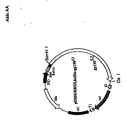
- the gp190 S2 was inserted into the expression vector, pDS56, RBSII, where it was under the control of the P N25lacO-1 promoter, which is regulatable via the lac operator / repressor / IPTG system ( Figure 4A).
- the transfer of the plasmid into repressor-producing E. coli cells, eg E. coli DH5 ⁇ Z1 allows expression of gp190 S2 under IPTG control.
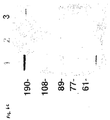
- the product was isolated from the crude extract by means of a nickel chelate column via the N-terminal (His) 6 sequence introduced by the vector. Subsequent affinity chromatography on an antibody column resulted in a high purity preparation. Since the monoclonal antibody used (mAk5.2) recognized a conformational epitope in the C-terminal region, this two-step purification sets up for full length intact protein, with correct folding at least at the C terminus ( Figure 48).
- the end product has, in contrast to the natural material, at the N-terminus 11 additional amino acids, of which 6 histidines. It contains no N-terminal signal and also no C-terminal anchor sequence.
- the P. falciparum -specific sequence begins with amino acid 20 and ends with amino acid 1621.
- a bidirectional promoter was activated by Tc-controlled transcriptional activator (tTA) and intitiated the transcription of both the gp190 S1 and the luciferase indicator gene. In the presence of Tc, the promoter is inactive.
- the transcriptional unit was synthesized in both HeLa and CHO cells, both constitutively tTA (HtTA-1 line (Gossen, M. and Bujard, H. (1992), Tight control of gene expression in mammalian cells by tetracycline-responsive promotors, Proc Natl Acad Sci USA 89, 5547-5551); CHO tTA line, unpublished).
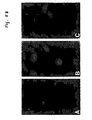
- the subclones HtTA93-9 and CH027-29 were used for cultures on a 10 liter scale. From cell extracts of these cultures intact gp190 S1 could be isolated by affinity chromatography (mAk5.2). The material is homogeneous, except for a single cellular component, which is not derived from gp190 S1 and accounts for approximately 25% of the preparation ( Figure 6C). It would have to be removed in a further cleaning step.
- Toxoplasma gondii belongs to P. falciparum to the apicomplexa and therefore probably has a protein modification system similar to the P. felciparum .
- T. gondii can be transfected with foreign DNA, which is efficiently integrated into the genome, in addition, T. gondii can be easily propagated in cell culture.
- gp190 S2 was expressed so that the protein is secreted and anchored on the surface of the parasite, as in P. falciparum , via a GPI motif in the membrane.
- the gp190 S2 (FIG. 3A) was inserted into the plasmid ppTMCS (D. Soldati, unpublished) (FIG. 6A) and thus placed under the control of the T. gondii tubulin promoter.
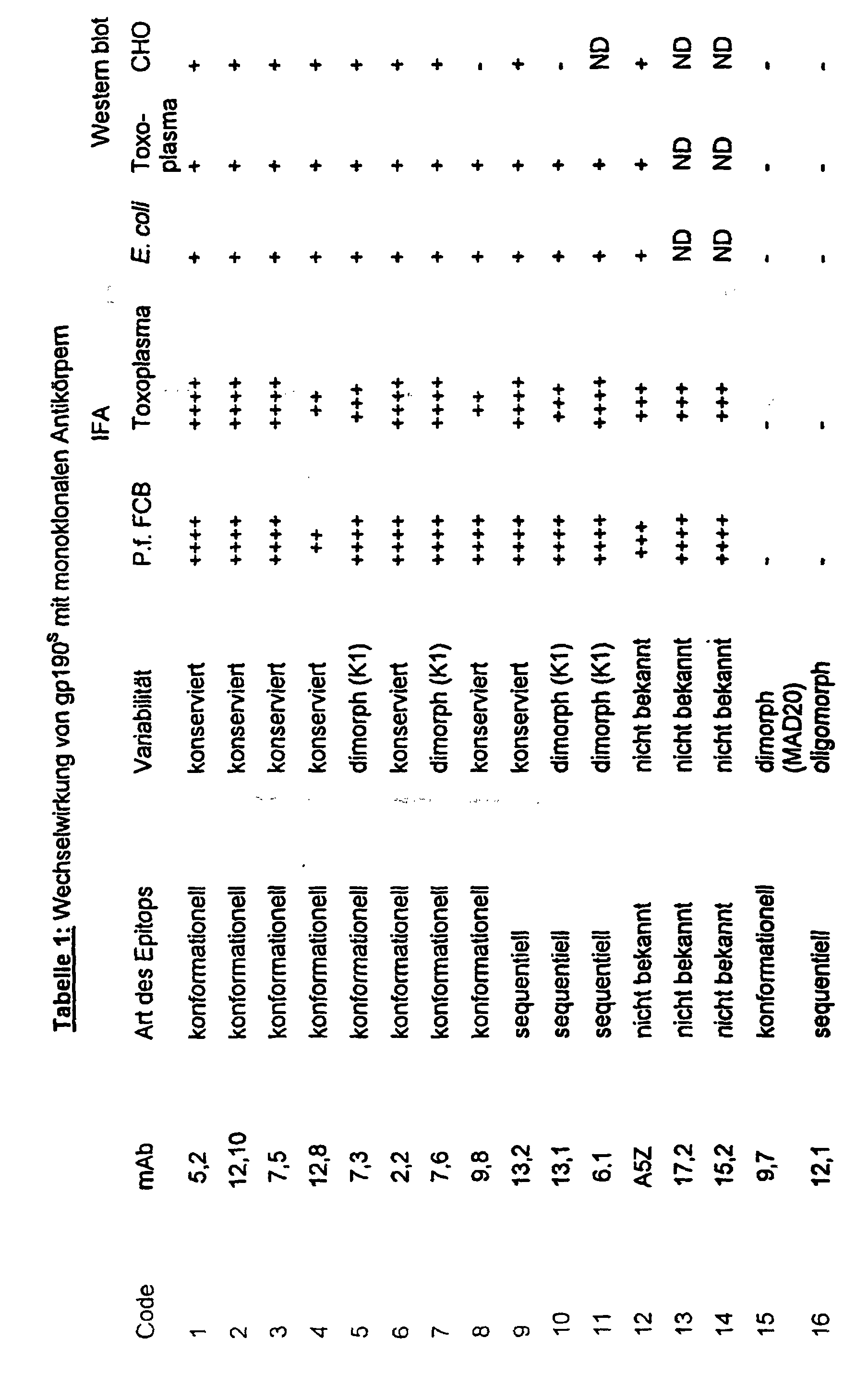
- Table 1 shows that the reactivity of the 16 antibodies is the same for both parasites. This is a strong indication that T. gondii produces mostly "native" gp190.
- the comparison of the reactivity of the antibodies with protein from E. coli , HeLa or CHO cells as well as T. gondii also shows that most of the antibodies react with the 4 preparations. In particular, this becomes E from. coli isolated protein from more antibodies recognized as the product of mammalian cells. This is probably a consequence of glycosylation in mammalian cells.
- FCB-1 P. falciparum
Landscapes
- Health & Medical Sciences (AREA)
- Chemical & Material Sciences (AREA)
- Organic Chemistry (AREA)
- Life Sciences & Earth Sciences (AREA)
- Tropical Medicine & Parasitology (AREA)
- General Health & Medical Sciences (AREA)
- Medicinal Chemistry (AREA)
- Proteomics, Peptides & Aminoacids (AREA)
- Biochemistry (AREA)
- Molecular Biology (AREA)
- Gastroenterology & Hepatology (AREA)
- Genetics & Genomics (AREA)
- Veterinary Medicine (AREA)
- Biophysics (AREA)
- Toxicology (AREA)
- Zoology (AREA)
- General Chemical & Material Sciences (AREA)
- Chemical Kinetics & Catalysis (AREA)
- Public Health (AREA)
- Animal Behavior & Ethology (AREA)
- Pharmacology & Pharmacy (AREA)
- Nuclear Medicine, Radiotherapy & Molecular Imaging (AREA)
- Peptides Or Proteins (AREA)
- Preparation Of Compounds By Using Micro-Organisms (AREA)
- Medicines Containing Antibodies Or Antigens For Use As Internal Diagnostic Agents (AREA)
- Micro-Organisms Or Cultivation Processes Thereof (AREA)
Description
- Verwendung von aus Parasiten isoliertem Material und
- Einsatz von in heterologen Expressionssystemen gewonnenem Material.
- Auf der Ebene von Proteinpräparaten, wobei jeweils Mischungen der zwei Familien (K1-Typ, MAD20-Typ mit verschiedenen Varianten der Blöcke II und IV) zur Anwendung kommen können. Verschiedene Träger bzw. Adjuvans-Materialien können zum Einsatz kommen: Aluminiumoxid, Liposomen, lscoms QSz1 etc.
- Auf der Ebene der Lebendimpfstoffe: (a) virale Träger, insbesondere Vakzinia und Adenoviren; (b) Parasiten als Träger, insbesonder avirulente Formen von Leishmania und Toxoplasma; (c) bakterielle Träger, z.B. Salmonella
- Auf der Ebene der Nukleinsäuren, wobei bspw. für die Gentherapie geeignete Vektoren als Vehikel zum Einbringen der Gene in den Wirt verwendet werden; weiterhin ist das Einbringen von Ribonukleinsäuren, welche das gewünschte Protein kodieren, denkbar.
- Es gehört zu den Expressionssystemen, mit denen höchste Ausbeuten in Säugerzellen erreicht werden.
- Nicht-sekretierte Fremdproteine in hoher Konzentration können mit dem Metabolismus der Zellen in negativer Weise interferieren. Die Synthese des gewünschten Produktes wird daher erst nach aufwachsen der Kultur initiiert.
Claims (39)
- Herstellungsverfahren für das vollständige gp190/MSP1-Protein von Plasmodium, insbesondere Plasmodium falciparum, dadurch gekennzeichnet, daß das vollständige Gen für gp190/MSP1 in einem geeigneten System, vorzugsweise einem Wirtsorganismus, exprimiert wird, und daß der AT-Gehalt der dem Protein zugrunde liegenden, exprimierten DNA-Sequenz gegenüber der natürlich vorkommenden Sequenz erniedrigt ist
- Rekombinantes Herstellungsverfahren gemäß Anspruch 1, dadurch gekennzeichnet, daß der Synthese der dem Protein zugrunde liegenden DNA-Sequenz die DNA-Sequenz des P. falciparum-Stammes FCB-1 zugrunde gelegt wird.
- Rekombinantes Herstellungsverfahren gemäß Anspruch 2, dadurch gekennzeichnet, daß der AT-Gehalt von 74% auf 55% erniedrigt ist.
- Rekombinantes Herstellungsverfahren gemäß einem oder mehreren der Ansprüche 1 bis 3, dadurch gekennzeichnet, daß das dem erzeugten Protein zugrunde liegende Gen für die volle Aminosäuresequenz einschließlich Signalpeptid und Ankersignal kodiert.
- Rekombinantes Herstellungsverfahren gemäß einem oder mehreren der Ansprüche 1 bis 3, dadurch gekennzeichnet, daß das dem erzeugten Protein zugrunde liegende Gen für die volle Aminosäuresequenz mit Ausnahme des Ankersignals kodiert.
- Rekombinantes Herstellungsverfahren gemäß einem oder mehreren der Ansprüche 1 bis 3, dadurch gekennzeichnet, daß das dem erzeugten Protein zugrunde liegende Gen für die volle Aminosäuresequenz mit Ausnahme des Ankersignals und des Signalpeptides kodiert.
- Rekombinantes Herstellungsverfahren gemäß einem oder mehreren der Ansprüche 1 bis 6, dadurch gekennzeichnet, daß es folgende Schritte umfaßt(a) Entwurf der zu synthetisierenden DNA-Sequenz aus P. falciparum FCB-1, wobei eine DNA-Sequenz mit den im menschlichen Genom üblichen Codon-Häufigkeiten unter Erhalt der Aminosäuresequenz des FCB-1 Proteins hergestellt werden sollte,(b) Einteilung der entworfenen Sequenz in überlappende Regionen, vorzugsweise in Regionen p83, p31, p36, p30 und p19,(c) Synthese von Desoxyoligonukleotiden, die jeweils mindestens die gesamte Länge einer Region abdecken,(d) Synthese der kodierenden Regionen für p19, p30, p36 und p31 durch PCR und Synthese der kodierenden Region für p83 durch Fusion aus zwei etwa 1200bp umfassenden Sequenzen,(e) einzelne Klonierung der kodierenden Sequenzen(f) Fusion des gesamten Gens und(g) Expression in einem geeigneten Expressionssystem.
- Rekombinantes Herstellungsverfahren nach Anspruch 7, dadurch gekennzeichnet, daß die in Schritt (c) synthetisierten Desoxyoligonukleotide durchschnittlich 120 Nukleotide lang sind und die benachbarten Sequenzen jeweils um ca 20 Basen überlappen.
- Rekombinantes Herstellungsverfahren nach einem oder mehreren der Ansprüche 1 bis 8, dadurch gekennzeichnet, daß als Expressionsvektor pDS56, RBSII verwendet wird.
- Rekombinantes Herstellungsverfahren nach einem oder mehreren der Ansprüche 1 bis 8, dadurch gekennzeichnet, daß als Expressionsvektor pBi-5 verwendet wird.
- Rekombinantes Herstellungsverfahren nach einem oder mehreren der Ansprüche 1 bis 8, dadurch gekennzeichnet, daß als Expressionsvektor ppTMCS vewendet wird.
- Rekombinantes Herstellungsverfahren nach einem oder mehreren der Ansprüche 1 bis 11, dadurch gekennzeichnet, daß die dem Protein zugrunde liegende DNA-Sequenz in E. coli exprimiert wird.
- Rekombinantes Herstellungsverfahren nach Anspruch 12, dadurch gekennzeichnet, daß der verwendete E. coli-Stamm der Repressor-produzierende Stamm E. coli DH5alphaZ1 ist.
- Rekombinantes Herstellungsverfahren nach einem oder mehreren der Ansprüche 1 bis 11, dadurch gekennzeichnet, daß die dem Protein zugrunde liegende DNA-Sequenz in HeLa-Zellen exprimiert wird.
- Rekombinantes Herstellungsverfahren nach einem oder mehreren der Ansprüche 1 bis 11, dadurch gekennzeichnet, daß die dem Protein zugrunde liegende DNA-Sequenz in CHO-Zellen exprimiert wird.
- Rekombinantes Herstellungsverfahren nach einem oder mehreren der Ansprüche 1 bis 11, dadurch gekennzeichnet, daß die dem Protein zugrunde liegende DNA-Sequenz in Toxoplasma gondii oder Leishmania exprimiert wird.
- Vollständige, zur Expression geeignete DNA-Sequenz des gp190/MSP1-Oberflächenproteins von Plasmodium, insbesondere P. falciparum, erhältlich durch das rekombinante Herstellungsverfahren gemäß einem oder mehreren der Ansprüche 1 bis 16.
- Zur Expression geeignete DNA-Sequenz gemäß Anspruch 17, dadurch gekennzeichnet, daß sie nicht für das Ankersignal kodiert.
- Zur Expression geeignete DNA-Sequenz gemäß Anspruch 18, dadurch gekennzeichnet, daß sie weder für das Ankersignal noch für das Signalpeptid kodiert.
- Zur Expression geeignete DNA-Sequenz gemäß Anspruch 19, dadurch gekennzeichnet, daß sie eine Sequenz für am N-Terminus vorliegende 11 zusätzliche Aminosäuren, davon 6 Histidine, umfaßt.
- Zur Expression geeignete DNA-Sequenz gemäß einem oder mehreren der Ansprüche 17 bis 20, dadurch gekennzeichnet, daß die Sequenz keine erkennbaren "splice donor"- und "splice acceptor"-Signale enthält.
- Zur Expression geeignete DNA-Sequenz gemäß einem oder mehreren der Ansprüche 17 bis 21, dadurch gekennzeichnet, daß die Sequenz keine größeren GC-reichen Sequenzen enthält.
- Zur Expression geeignete DNA-Sequenz gemäß einem oder mehreren der Ansprüche 17 bis 22, dadurch gekennzeichnet, daß die Sequenz keine Erkennungssignale für Restriktionsenzyme, weiche Sequenzen von sechs oder mehr Basenpaaren erkennen, enthält.
- Zur Expression geeignete DNA-Sequenz gemäß einem oder mehreren der Ansprüche 17 bis 23, dadurch gekennzeichnet, daß die Sequenz für Erkennungssignale bestimmter Restriktionsnukleasen in Regionen, die die nach der Prozessierung des Proteins entstehenden Domänen trennen, einmal vorkommende Schnittstellen für Restriktionsendonukleasen enthält.
- Zur Expression geeignete DNA-Sequenz gemäß einem oder mehreren der Ansprüche 17 bis 24, dadurch gekennzeichnet, daß die Sequenz an ihren beiden Enden Schnittstellen für Restriktonsendonukleasen aufweist, die in der übrigen Sequenz und in einem zu verwendenden Vektor nicht vorkommen.
- Wirtsorganismus, der die vollständige Nukleinsäuresequenz gemäß einem der Ansprüche 17 bis 25 für das gp190/MSP1-Oberflächenprotein enthält.
- Wirtsorganismus gemäß Anspruch 26, dadurch gekennzeichnet, daß der Wirtsorganismus E. coli ist.
- Wirtsorganismus gemäß Anspruch 27, dadurch gekennzeichnet, daß der E. coli-Stamm der Repressor-produzierende E. coli-Stamm DH5alphaZ1 ist.
- Wirtsorganismus gemäß Anspruch 26, dadurch gekennzeichnet, daß der Wirtsorganismus HeLa-Zellen sind.
- Wirtsorganismus gemäß Anspruch 26, dadurch gekennzeichnet, daß der Wirtsorganismus CHO-Zellen sind.
- Wirtsorganismus gemäß Anspruch 29 oder 30, dadurch gekennzeichnet, daß die Wirtszellen konstitutiv tTA synthetisieren.
- Wirtsorganismus gemäß Anspruch 26, dadurch gekennzeichnet, daß als Wirtsorganismus Toxoplasma gondli, Leishmania, Baculoviren, Adenoviren oder Hefen vorgesehen sind.
- Verwendung eines gemäß einem der Ansprüche 1 bis 16 hergestellten gp190/MSP1-Proteins zur aktiven Immunisierung gegen Malaria.
- Verwendung eines gemäß einem der Ansprüche 1 bis 16 hergestelten gp190/MSP1-Proteins zur Herstellung von monoklonalen, zur passiven Immunisierung geeigneten Antikörpern.
- Verwendung einer gemäß der Ansprüche 1 bis 16 hergestellten DNA-Sequenz zur Herstellung einer Vakzine auf Nukleinsäurebasis.
- Vektor enthaltend eine DNA-Sequenz nach einem der Ansprüche 17 bis 25.
- Wirtszelle enthaltend einen Vektor nach Anspruch 36.
- Impfstoff enthaltend eine DNA-Sequenz nach einem der Ansprüche 17-25 und/oder einen Wirt nach einem der Ansprüche 26-31 und/oder einen Vektor nach Anspruch 36.
- Impfstoff nach Anspruch 38, dadurch gekennzeichnet, daß er weitere Immunität hervorrufende Produkte aus Plasmodium, insbesondere P. falciparum, enthält
Priority Applications (1)
| Application Number | Priority Date | Filing Date | Title |
|---|---|---|---|
| EP05015686A EP1637602A1 (de) | 1996-10-02 | 1997-10-02 | Rekombinantes Herstellungsverfahren für ein vollständiges Malaria-Antigen gp190/MSP1 |
Applications Claiming Priority (3)
| Application Number | Priority Date | Filing Date | Title |
|---|---|---|---|
| DE19640817A DE19640817A1 (de) | 1996-10-02 | 1996-10-02 | Rekombinantes Herstellungsverfahren für ein vollständiges Malaria-Antigen gp190/MSP 1 |
| DE19640817 | 1996-10-02 | ||
| PCT/EP1997/005441 WO1998014583A2 (de) | 1996-10-02 | 1997-10-02 | Rekombinantes herstellungsverfahren für ein vollständiges malaria-antigen gp190/msp1 |
Related Child Applications (1)
| Application Number | Title | Priority Date | Filing Date |
|---|---|---|---|
| EP05015686A Division EP1637602A1 (de) | 1996-10-02 | 1997-10-02 | Rekombinantes Herstellungsverfahren für ein vollständiges Malaria-Antigen gp190/MSP1 |
Publications (2)
| Publication Number | Publication Date |
|---|---|
| EP0929677A2 EP0929677A2 (de) | 1999-07-21 |
| EP0929677B1 true EP0929677B1 (de) | 2005-07-20 |
Family
ID=7807776
Family Applications (2)
| Application Number | Title | Priority Date | Filing Date |
|---|---|---|---|
| EP05015686A Ceased EP1637602A1 (de) | 1996-10-02 | 1997-10-02 | Rekombinantes Herstellungsverfahren für ein vollständiges Malaria-Antigen gp190/MSP1 |
| EP97911173A Expired - Lifetime EP0929677B1 (de) | 1996-10-02 | 1997-10-02 | Rekombinantes herstellungsverfahren für ein vollständiges malaria-antigen gp190/msp1 |
Family Applications Before (1)
| Application Number | Title | Priority Date | Filing Date |
|---|---|---|---|
| EP05015686A Ceased EP1637602A1 (de) | 1996-10-02 | 1997-10-02 | Rekombinantes Herstellungsverfahren für ein vollständiges Malaria-Antigen gp190/MSP1 |
Country Status (11)
| Country | Link |
|---|---|
| US (2) | US6933130B1 (de) |
| EP (2) | EP1637602A1 (de) |
| JP (1) | JP2000516477A (de) |
| CN (1) | CN1148448C (de) |
| AT (1) | ATE299939T1 (de) |
| AU (1) | AU727864B2 (de) |
| DE (2) | DE19640817A1 (de) |
| DK (1) | DK0929677T3 (de) |
| ES (1) | ES2244993T3 (de) |
| ID (1) | ID22037A (de) |
| WO (1) | WO1998014583A2 (de) |
Families Citing this family (12)
| Publication number | Priority date | Publication date | Assignee | Title |
|---|---|---|---|---|
| JP2001520048A (ja) | 1997-10-20 | 2001-10-30 | ジェンザイム トランスジェニックス コーポレイション | 新規な改変されたMSP−1核酸配列並びに細胞システムにおいてmRNAレベル及び蛋白質発現を増大させる方法 |
| WO2001066776A2 (de) * | 2000-03-10 | 2001-09-13 | Institut für Molekulare Biotechnologie E.V. | Neuartige l-form-bakterienstämme, verfahren zu deren herstellung sowie deren verwendung zur herstellung von genprodukten |
| CN1176945C (zh) * | 2001-02-01 | 2004-11-24 | 中国人民解放军第二军医大学 | 疟原虫融合抗原及其制法和用途 |
| EP1490494A1 (de) * | 2002-04-01 | 2004-12-29 | Walter Reed Army Institute of Research | Verfahren zum entwerfen von synthetischen nukleinsäuremolekülen zur optimaler proteinen expression in einer wirtszelle |
| DE10249390A1 (de) * | 2002-10-23 | 2004-05-13 | Ruprecht-Karls-Universität Heidelberg | Rekombinante MVA-Stämme als potentielle Impfstoffe gegen P.falciparum-Malaria |
| EP1565749B9 (de) | 2002-11-22 | 2012-04-25 | Eisai R&D Management Co., Ltd. | Verfahren zum screenen von verbindungen, welche die gpi biosynthese von malariaparasiten hemmen |
| EP1649869A1 (de) * | 2004-10-21 | 2006-04-26 | Vakzine Projekt Management GmbH | Kombination von rekombinanten Mycobakterien und einem biologisch aktiven Agent als Vakzine |
| CA2652347A1 (en) * | 2006-05-15 | 2007-11-22 | Paratek Pharmaceuticals, Inc. | Methods of regulating expression of genes or of gene products using substituted tetracycline compounds |
| WO2008059314A1 (es) * | 2006-11-14 | 2008-05-22 | Centro Internacional De Vacunas | Vacuna contra la malaria, basada en la subunidad 200l de la proteína msp1 de plasmodium vivax |
| EP1944313A1 (de) * | 2007-01-15 | 2008-07-16 | Vakzine Projekt Management GmbH | Rekombinanter Malariaimpfstoff |
| EP2141177A1 (de) * | 2008-07-04 | 2010-01-06 | Bujard, Hermann | MSP-1-Proteinherstellung aus Plasmodium |
| BRPI0919245A2 (pt) * | 2008-09-24 | 2021-11-03 | Us Gov Sec Army | Vacina para malária |
Family Cites Families (9)
| Publication number | Priority date | Publication date | Assignee | Title |
|---|---|---|---|---|
| PH25993A (en) * | 1984-02-22 | 1992-01-13 | Wellcome Found | Cloning of DNA for protozoal antigens |
| US4978621A (en) * | 1985-09-03 | 1990-12-18 | Scripps Clinic And Research Foundation | Merozoite surface antigens |
| WO1988000595A1 (en) * | 1986-07-17 | 1988-01-28 | Saramane Pty. Ltd. | Merozoite surface antigen of plasmodium falciparum |
| US4897354A (en) * | 1986-07-28 | 1990-01-30 | University Of Hawaii | Monoclonal antibody-specific merozoite antigens |
| GB8810808D0 (en) * | 1988-05-06 | 1988-06-08 | Wellcome Found | Vectors |
| NZ230375A (en) * | 1988-09-09 | 1991-07-26 | Lubrizol Genetics Inc | Synthetic gene encoding b. thuringiensis insecticidal protein |
| EP1103616A3 (de) * | 1989-02-24 | 2001-06-27 | Monsanto Company | Synthetische Pflanzengene und Verfahren zu ihrer Herstellung |
| US5766597A (en) * | 1991-03-07 | 1998-06-16 | Virogenetics Corporation | Malaria recombinant poxviruses |
| CA2106464A1 (en) * | 1991-03-20 | 1992-09-21 | Enzo Paoletti | Malaria recombinant poxvirus vaccine |
-
1996
- 1996-10-02 DE DE19640817A patent/DE19640817A1/de not_active Ceased
-
1997
- 1997-10-02 CN CNB971994986A patent/CN1148448C/zh not_active Expired - Fee Related
- 1997-10-02 EP EP05015686A patent/EP1637602A1/de not_active Ceased
- 1997-10-02 EP EP97911173A patent/EP0929677B1/de not_active Expired - Lifetime
- 1997-10-02 AU AU48649/97A patent/AU727864B2/en not_active Expired
- 1997-10-02 US US09/269,874 patent/US6933130B1/en not_active Expired - Lifetime
- 1997-10-02 AT AT97911173T patent/ATE299939T1/de not_active IP Right Cessation
- 1997-10-02 DK DK97911173T patent/DK0929677T3/da active
- 1997-10-02 JP JP10516249A patent/JP2000516477A/ja active Pending
- 1997-10-02 WO PCT/EP1997/005441 patent/WO1998014583A2/de not_active Ceased
- 1997-10-02 ES ES97911173T patent/ES2244993T3/es not_active Expired - Lifetime
- 1997-10-02 DE DE59712370T patent/DE59712370D1/de not_active Expired - Lifetime
- 1997-10-02 ID IDW990194A patent/ID22037A/id unknown
-
2004
- 2004-09-29 US US10/954,924 patent/US20050095256A1/en not_active Abandoned
Also Published As
| Publication number | Publication date |
|---|---|
| DE19640817A1 (de) | 1998-05-14 |
| EP0929677A2 (de) | 1999-07-21 |
| DE59712370D1 (de) | 2005-08-25 |
| JP2000516477A (ja) | 2000-12-12 |
| ID22037A (id) | 1999-08-26 |
| ATE299939T1 (de) | 2005-08-15 |
| CN1148448C (zh) | 2004-05-05 |
| AU4864997A (en) | 1998-04-24 |
| WO1998014583A2 (de) | 1998-04-09 |
| AU727864B2 (en) | 2001-01-04 |
| ES2244993T3 (es) | 2005-12-16 |
| CN1236391A (zh) | 1999-11-24 |
| US20050095256A1 (en) | 2005-05-05 |
| EP1637602A1 (de) | 2006-03-22 |
| DK0929677T3 (da) | 2005-11-14 |
| US6933130B1 (en) | 2005-08-23 |
Similar Documents
| Publication | Publication Date | Title |
|---|---|---|
| DE3586853T2 (de) | Immunologisch aktive Peptide, geeignet zur Einführung von Immunisierung gegen Malaria und deren Kodierung von Genen. | |
| DE3854952T2 (de) | Mykobakterielle rekombinanten und peptide | |
| DE3486110T2 (de) | ||
| DE68921923T2 (de) | Rekombinante Coccidiosis-Vakzine. | |
| DE3650242T2 (de) | Mit dem plasmodium-vivax-circumsporozoit-protein übereinstimmendes immunogenes peptidantigen. | |
| DE69434413T2 (de) | Fusionsproteine zwischen antigene aminosäuresequenzen und beta - 2- mikroglobulin | |
| EP1637602A1 (de) | Rekombinantes Herstellungsverfahren für ein vollständiges Malaria-Antigen gp190/MSP1 | |
| WO1998014583A9 (de) | Rekombinantes herstellungsverfahren für ein vollständiges malaria-antigen gp190/msp1 | |
| DE68907254T2 (de) | Rekombinante und natürliche Eimeria tenella immunogens der Gruppe B, die für Coccidiosis-Impfstoffe verwendbar sind. | |
| DE69101646T2 (de) | Vakzine gegen Coccidiose. | |
| DE3687071T2 (de) | Malaria-impfstoff. | |
| DE3686178T2 (de) | Malaria-impfstoff. | |
| DE3875043T2 (de) | Immunogenes produkt, erhalten durch expression in einer rekombinanten hefe, und verfahren zu seiner reinigung. | |
| EP1615663B1 (de) | Mittel zur behandlung von infektionen mit leishmanien | |
| DE69837507T2 (de) | Humanes Hedgehog-Protein | |
| DE3587503T2 (de) | Antigene aus plasmodium-falciparum. | |
| EP0492500B1 (de) | Protektive Plasmodium falciparum Hybridproteine, die Teilsequenzen der Malaria-Antigene HRPII und SERP enthalten | |
| DE69229899T2 (de) | Schützendes malaria sporozoiten-oberflächenprotein immunogen und gen | |
| EP0283882B1 (de) | Klonierung von Malaria-spezifischen DNA-Sequenzen:Isolierung des Gens für das 140 kd Protein | |
| EP0315085B1 (de) | Rekombinantes histidinreiches Protein von Plasmodium falciparum, seine Herstellung und Verwendung | |
| EP0283829B1 (de) | Plasmodium falciparum Merozoitenantigen-Peptide | |
| EP0309746A1 (de) | Antimalaria-Vakzine | |
| DE69130675T2 (de) | Klonierung und expression eines rhoptry-assoziierten proteins aus p. falciparum | |
| EP0499834B1 (de) | Ein Plasmodium falciparum Blutstadien-Antigen, seine Herstellung und Verwendung | |
| DE69303840T2 (de) | Neue Polypeptide, deren kodierende DNS |
Legal Events
| Date | Code | Title | Description |
|---|---|---|---|
| PUAI | Public reference made under article 153(3) epc to a published international application that has entered the european phase |
Free format text: ORIGINAL CODE: 0009012 |
|
| 17P | Request for examination filed |
Effective date: 19990401 |
|
| AK | Designated contracting states |
Kind code of ref document: A2 Designated state(s): AT BE CH DE DK ES FI FR GB GR IE IT LI LU MC NL PT SE |
|
| 17Q | First examination report despatched |
Effective date: 20030522 |
|
| GRAP | Despatch of communication of intention to grant a patent |
Free format text: ORIGINAL CODE: EPIDOSNIGR1 |
|
| RAP1 | Party data changed (applicant data changed or rights of an application transferred) |
Owner name: BUJARD, HERMANN |
|
| GRAS | Grant fee paid |
Free format text: ORIGINAL CODE: EPIDOSNIGR3 |
|
| GRAA | (expected) grant |
Free format text: ORIGINAL CODE: 0009210 |
|
| RTI1 | Title (correction) |
Free format text: RECOMBINANT METHOD FOR PREPARING A COMPLETE MALARIA ANTIGEN GP190/MSP1 |
|
| AK | Designated contracting states |
Kind code of ref document: B1 Designated state(s): AT BE CH DE DK ES FI FR GB GR IE IT LI LU MC NL PT SE |
|
| REG | Reference to a national code |
Ref country code: GB Ref legal event code: FG4D Free format text: NOT ENGLISH |
|
| REG | Reference to a national code |
Ref country code: CH Ref legal event code: NV Representative=s name: ISLER & PEDRAZZINI AG Ref country code: CH Ref legal event code: EP |
|
| REG | Reference to a national code |
Ref country code: IE Ref legal event code: FG4D Free format text: LANGUAGE OF EP DOCUMENT: GERMAN |
|
| REF | Corresponds to: |
Ref document number: 59712370 Country of ref document: DE Date of ref document: 20050825 Kind code of ref document: P |
|
| GBT | Gb: translation of ep patent filed (gb section 77(6)(a)/1977) |
Effective date: 20050804 |
|
| PGFP | Annual fee paid to national office [announced via postgrant information from national office to epo] |
Ref country code: ES Payment date: 20051007 Year of fee payment: 9 |
|
| PGFP | Annual fee paid to national office [announced via postgrant information from national office to epo] |
Ref country code: IE Payment date: 20051019 Year of fee payment: 9 |
|
| PG25 | Lapsed in a contracting state [announced via postgrant information from national office to epo] |
Ref country code: GR Free format text: LAPSE BECAUSE OF FAILURE TO SUBMIT A TRANSLATION OF THE DESCRIPTION OR TO PAY THE FEE WITHIN THE PRESCRIBED TIME-LIMIT Effective date: 20051020 |
|
| PGFP | Annual fee paid to national office [announced via postgrant information from national office to epo] |
Ref country code: AT Payment date: 20051020 Year of fee payment: 9 |
|
| PGFP | Annual fee paid to national office [announced via postgrant information from national office to epo] |
Ref country code: FI Payment date: 20051021 Year of fee payment: 9 |
|
| PGFP | Annual fee paid to national office [announced via postgrant information from national office to epo] |
Ref country code: DK Payment date: 20051025 Year of fee payment: 9 |
|
| PG25 | Lapsed in a contracting state [announced via postgrant information from national office to epo] |
Ref country code: MC Free format text: LAPSE BECAUSE OF NON-PAYMENT OF DUE FEES Effective date: 20051031 Ref country code: LU Free format text: LAPSE BECAUSE OF NON-PAYMENT OF DUE FEES Effective date: 20051031 |
|
| REG | Reference to a national code |
Ref country code: SE Ref legal event code: TRGR |
|
| REG | Reference to a national code |
Ref country code: DK Ref legal event code: T3 |
|
| REG | Reference to a national code |
Ref country code: ES Ref legal event code: FG2A Ref document number: 2244993 Country of ref document: ES Kind code of ref document: T3 |
|
| PG25 | Lapsed in a contracting state [announced via postgrant information from national office to epo] |
Ref country code: PT Free format text: LAPSE BECAUSE OF FAILURE TO SUBMIT A TRANSLATION OF THE DESCRIPTION OR TO PAY THE FEE WITHIN THE PRESCRIBED TIME-LIMIT Effective date: 20051221 |
|
| ET | Fr: translation filed | ||
| PLBE | No opposition filed within time limit |
Free format text: ORIGINAL CODE: 0009261 |
|
| STAA | Information on the status of an ep patent application or granted ep patent |
Free format text: STATUS: NO OPPOSITION FILED WITHIN TIME LIMIT |
|
| 26N | No opposition filed |
Effective date: 20060421 |
|
| PG25 | Lapsed in a contracting state [announced via postgrant information from national office to epo] |
Ref country code: IE Free format text: LAPSE BECAUSE OF NON-PAYMENT OF DUE FEES Effective date: 20061002 Ref country code: FI Free format text: LAPSE BECAUSE OF NON-PAYMENT OF DUE FEES Effective date: 20061002 Ref country code: AT Free format text: LAPSE BECAUSE OF NON-PAYMENT OF DUE FEES Effective date: 20061002 |
|
| PG25 | Lapsed in a contracting state [announced via postgrant information from national office to epo] |
Ref country code: DK Free format text: LAPSE BECAUSE OF NON-PAYMENT OF DUE FEES Effective date: 20061031 |
|
| REG | Reference to a national code |
Ref country code: IE Ref legal event code: MM4A |
|
| REG | Reference to a national code |
Ref country code: CH Ref legal event code: PCAR Free format text: ISLER & PEDRAZZINI AG;POSTFACH 1772;8027 ZUERICH (CH) |
|
| REG | Reference to a national code |
Ref country code: ES Ref legal event code: FD2A Effective date: 20061003 |
|
| PG25 | Lapsed in a contracting state [announced via postgrant information from national office to epo] |
Ref country code: ES Free format text: LAPSE BECAUSE OF NON-PAYMENT OF DUE FEES Effective date: 20061003 |
|
| PGFP | Annual fee paid to national office [announced via postgrant information from national office to epo] |
Ref country code: NL Payment date: 20101028 Year of fee payment: 14 |
|
| PGFP | Annual fee paid to national office [announced via postgrant information from national office to epo] |
Ref country code: SE Payment date: 20101026 Year of fee payment: 14 Ref country code: IT Payment date: 20101028 Year of fee payment: 14 |
|
| REG | Reference to a national code |
Ref country code: NL Ref legal event code: V1 Effective date: 20120501 |
|
| REG | Reference to a national code |
Ref country code: SE Ref legal event code: EUG |
|
| PG25 | Lapsed in a contracting state [announced via postgrant information from national office to epo] |
Ref country code: NL Free format text: LAPSE BECAUSE OF NON-PAYMENT OF DUE FEES Effective date: 20120501 |
|
| PG25 | Lapsed in a contracting state [announced via postgrant information from national office to epo] |
Ref country code: IT Free format text: LAPSE BECAUSE OF NON-PAYMENT OF DUE FEES Effective date: 20111002 |
|
| PG25 | Lapsed in a contracting state [announced via postgrant information from national office to epo] |
Ref country code: SE Free format text: LAPSE BECAUSE OF NON-PAYMENT OF DUE FEES Effective date: 20111003 |
|
| PGFP | Annual fee paid to national office [announced via postgrant information from national office to epo] |
Ref country code: DE Payment date: 20141029 Year of fee payment: 18 Ref country code: CH Payment date: 20141014 Year of fee payment: 18 |
|
| PGFP | Annual fee paid to national office [announced via postgrant information from national office to epo] |
Ref country code: FR Payment date: 20140925 Year of fee payment: 18 |
|
| REG | Reference to a national code |
Ref country code: DE Ref legal event code: R119 Ref document number: 59712370 Country of ref document: DE |
|
| REG | Reference to a national code |
Ref country code: CH Ref legal event code: PL |
|
| REG | Reference to a national code |
Ref country code: GB Ref legal event code: 732E Free format text: REGISTERED BETWEEN 20160519 AND 20160525 |
|
| PG25 | Lapsed in a contracting state [announced via postgrant information from national office to epo] |
Ref country code: CH Free format text: LAPSE BECAUSE OF NON-PAYMENT OF DUE FEES Effective date: 20151031 Ref country code: DE Free format text: LAPSE BECAUSE OF NON-PAYMENT OF DUE FEES Effective date: 20160503 Ref country code: LI Free format text: LAPSE BECAUSE OF NON-PAYMENT OF DUE FEES Effective date: 20151031 |
|
| REG | Reference to a national code |
Ref country code: FR Ref legal event code: ST Effective date: 20160630 |
|
| PG25 | Lapsed in a contracting state [announced via postgrant information from national office to epo] |
Ref country code: FR Free format text: LAPSE BECAUSE OF NON-PAYMENT OF DUE FEES Effective date: 20151102 |
|
| PGFP | Annual fee paid to national office [announced via postgrant information from national office to epo] |
Ref country code: GB Payment date: 20161024 Year of fee payment: 20 |
|
| PGFP | Annual fee paid to national office [announced via postgrant information from national office to epo] |
Ref country code: BE Payment date: 20161020 Year of fee payment: 20 |
|
| REG | Reference to a national code |
Ref country code: GB Ref legal event code: PE20 Expiry date: 20171001 |
|
| PG25 | Lapsed in a contracting state [announced via postgrant information from national office to epo] |
Ref country code: GB Free format text: LAPSE BECAUSE OF EXPIRATION OF PROTECTION Effective date: 20171001 |
|
| REG | Reference to a national code |
Ref country code: BE Ref legal event code: PD Owner name: SUMAYA BIOTECH GMBH & CO. KG; DE Free format text: DETAILS ASSIGNMENT: CHANGE OF OWNER(S), AFFECTATION / CESSION; FORMER OWNER NAME: BUJARD, HERMANN Effective date: 20160523 Ref country code: BE Ref legal event code: MK Effective date: 20171002 |