Die vorliegende Erfindung betrifft einen Schmierstoff für die
mechanische Bearbeitung bzw. Verarbeitung von Werkstoffen mit
den Merkmalen des Oberbegriffs des Patentanspruchs 1 sowie
Additiv für einen derartigen Schmierstoff.
Schmierstoffe, denen ein Additiv zur physikalischen und/oder
mikrobiologischen Stabilisierung Zugesetzt werden, sind seit
langem bekannt. Hierbei dienen diese Additive dazu, dem flüssigen
oder viskosen Schmierstoff, bei dem es sich in der Regel
um öl- oder fetthaltige Systeme oder Emulsionen davon
handelt, gezielte Eigenschaften zu verleihen.
So wurden z.B. noch vor fünf bis zehn Jahren den sogenannten
biostabilen wassermischbaren Kühlschmierstoffe Additive auf
der Basis von Borsäure oder Diethanolamin zugesetzt, wobei
derartige Zusammensetzungen heute praktisch restlos vom Markt
verschwunden sind. Ebenso ist man bemüht, stickstoffhaltige,
schwefelhaltige oder phosphorhaltige Additive in Schmierstoffen
weitestgehend zu vermeiden, wobei dies bei den modernen
aminfreien Kühlschmierstoffen heute weitestgehend gelungen
ist.
Durch den Einsatz spezieller Additive, wie zum Beispiel 2-Phenoxyalkanole,
lassen sich bei Schmierstoffen bzw. Kühlschmierstoffen
gute tribologischen Eigenschaften, so insbesondere
gute Schmier-, Kühl- und Spülwirkungen, erreichen.
Eine über ein derartiges Additiv, insbesondere eine über ein
2-Phenoxyethanol, stabilisierte Zusammensetzung weist den
Vorteil auf, daß die diesbezügliche öl- oder fetthaltige Zusammensetzung
oder eine hieraus hergestellte Emulsion aufgrund
ihrer physikalischen Stabilisierung durch das Additiv
eine hohe Standzeit von mehr als zwei Jahren besitzt. Auch
kann hierbei in der Regel auf den Einsatz von zusätzlichen
Bakteriziden verzichtet werden, da 2-Phenoxyalkanole, insbesondere
2-Phenoxyethanol, bakteriostatische Eigenschaften besitzt
und somit die erforderliche mikrobiologische Stabilisierung
bewirkt oder zumindestens mit zur mikrobiologischen
Stabilisierung beiträgt.
Das zuvor beschriebene bekannte Additiv auf der Basis von 2-Phenoxyalkanolen,
insbesondere das 2-Phenoxyethanol, hat jedoch
den Nachteil, daß es unter bestimmten Bedingungen zu einem
unerwünschten Abbau zu Phenolen kommen kann, insbesondere
dann, wenn diese zuvor genannten Additive bzw. das zuvor genannte
Additiv in Schmierstoffen und insbesondere in Kühlschmierstoffen
verwendet werden bzw. wird. Ein derartiger unerwünschter
Abbau der Phenoxyalkanole und insbesondere des 2-Phenoxyethanols
ist immer dann zu befürchten, wenn die Konzentration
des Additivs auf der Basis von 2-Phenoxyalkanolen,
insbesondere von 2-Phenoxyethanol, in der Emulsion unterhalb
einer bestimmten Grenzkonzentration liegt, wenn außerdem eine
hohe mikrobielle Besiedelung der Emulsion vorliegt und wenn
zusätzlich noch sauerstoffarme, d.h. anaerobe, Bereiche in
der Emulsion vorhanden sind. Letzteres kann dann auftreten,
wenn die diesbezügliche wäßrige Emulsion der flüssigen oder
viskosen Zusammensetzung für längere Zeit nicht mit Luft vermischt
wurde, was beispielsweise bei wäßrigen Emulsionen eines
Schmierstoffes bzw. Kühlschmierstoffes der Fall sein
kann, wenn diese Emulsionen aufgrund von Betriebsunterbrechungen
über einen längeren Zeitraum nicht benutzt werden, so
daß dementsprechend kein Vermischen der Emulsionen mit Luft
stattfindet.
Darüber hinaus wurde bereits versucht, Schmierstoffe durch
Zusatz von 3-Phenyl-1-propanol zu stabilisieren, wobei jedoch
die US 5,614,538 zu dem Ergebnis kommt, daß ein derartiges
Additiv nur dann vertretbare antibakterielle Werte ergibt,
wenn gleichzeitig mit dem 3-Phenyl-1-propanol ein weiteres
Additiv auf der Basis von Pyrithion anwesend ist.
Der vorliegenden Erfindung liegt die Aufgabe zugrunde, einen
Schmierstoff und vorzugsweise einen Kühlschmierstoff zur Verfügung
zu stellen, der eine hohe physikalische und mikrobiologische
Stabilität besitzt und bei dem es selbst unter extremen
Bedingungen nicht zu einer Bildung von Phenolen kommt.
Diese Aufgabe wird erfindungsgemäß durch einen Schmierstoff
mit den kennzeichnenden Merkmalen des Patentanspruchs 1 gelöst.
Der erfindungsgemäße Schmierstoff umfaßt neben einer Basisverbindung
mindestens ein Additiv zur physikalischen und/oder
mikrobiologischen Stabilisierung der flüssigen oder viskosen
Zusammensetzung, wobei das Additiv ein aromatischer Alkohol
gemäß Formel I ist.
In dieser Formel I bedeuten m eine ganze Zahl zwischen 0 und
4 und R1 bis R5 Wasserstoff, eine lineare oder verzweigte C1-C4-Alkylgruppe,
wobei jedoch R1 bis R5 nicht gleichzeitig
Wasserstoff sind.
Der erfindungsgemäße Schmierstoff weist eine Reihe von Vorteilen
auf. So ist zunächst festzuhalten, daß der erfindungsgemäße
Schmierstoff selbst unter den zuvor angesprochenen extremen
Bedingungen, d.h. beim Auftreten von anaeroben Bereichen,
Nichteinhaltung von bestimmten Grenzkonzentrationen sowie
bei hoher Keimbesiedelung, kein Phenol ausbildet, was dadurch
erklärlich wird, daß bei dem in dem erfindungsgemäßen
Schmierstoff enthaltenen Additiv an der Phenylgruppe keine
Ethergruppe vorhanden ist. Auch konnte überraschend festgestellt
werden, daß in Schmierstoffen, insbesondere Kühlschmierstoffen
oder Konzentraten von Kühlschmierstoffen,
durch Verwendung des zuvor beschriebenen und in Formel I wiedergegebenen
Additivs die Konzentration dieses Additivs im
Vergleich zu einem herkömmlichen Additiv, insbesondere einem
solchen auf der Basis von Phenoxyethanol, deutlich gesenkt
werden konnte, da der erfindungsgemäße Schmierstoff sowohl
bezüglich der physikalischen als auch der mikrobiologischen
Stabilisierung bessere Eigenschaften besitzt als die
herkömmlichen Schmierstoffe. Diese verbesserten Eigenschaften
des erfindungsgemäßen Schmierstoffes führen dazu, daß der
Einsatz von Bakteriziden in entsprechenden flüssigen oder
viskosen Schmierstoff-Zusammensetzungen deutlich reduziert
werden kann, so daß derartige flüssige Schmierstoff-Zusammensetzungen,
insbesondere auch die zuvor genannten Kühlschmierstoffe
bzw Kühlschmierstoff-Konzentrate, größtenteils gänzlich
auf derartige Bakterizide verzichten. Ferner kann in
derartigen Zusammensetzungen sogar auf Fungizide verzichtet
werden, sofern das in der Formel I beschriebene Additiv in
der entsprechenden Zusammensetzung in der erforderlichen Konzentration
enthalten ist. Sollte man aus speziellen Gründen
nicht auf die Fungizide verzichten wollen, so ist zumindestens
durch Anwendung des in Formel I beschriebenen Additivs
die Konzentration dieser Fungizide in dem erfindungsgemäßen
Schmierstoff reduziert.
Bedingt dadurch, daß das in dem erfindungsgemäßen Schmierstoff
enthaltene Additiv gemäß Formel I als sehr sicher bezüglich
seiner toxikologischen Daten eingestuft wurde, sind
die hiermit formulierten erfindungsgemäßen Schmierstoff-Zusammensetzungen
unbedenklich anzuwenden. Auch ist das in dem
erfindungsgemäßen Schmierstoff enthaltene Additiv in entsprechender
Verdünnung sehr gut biologisch abbaubar und bereitet
in biologischen Kläranlagen keinerlei Probleme, zumal beim
biologischen Abbau in den entsprechenden Kläranlagen kein
Phenol ausgebildet wird. Ferner konnte festgestellt werden,
daß sich das Additiv gemäß Formel I problemlos in Schmierstoffe,
Kühlschmierstoffkonzentrate sowie Kühlschmierstoffe
einarbeiten läßt, wobei neben den bereits zuvor aufgeführten
Vorteilen in diesem Fall das Additiv die hiermit formulierten
erfindungsgemäßen Schmierstoffe nicht nur mikrobiologisch
sondern auch physikalisch stabilisiert. Dies wird darauf zurückgeführt,
daß der Zusatz des Additivs gemäß Formel I die
Löslichkeit von anderen Komponenten, die in Schmierstoffen,
Kühlschmierstoffen sowie in Kühlschmierstoffkonzentraten enthalten
sind, verbessert, so daß dementsprechend diese konkret
genannten Zusammensetzungen durch Anwesenheit eines derartigen
Additivs besonders gut physikalisch und mikrobiologisch
stabilisiert sind und hierdurch eine hohe Lagerbeständigkeit
aufweisen.
Unter Schmierstoffe im Rahmen der vorliegenden Anmeldung sind
mit Wasser mischbare oder nicht mischbare Schmierstoffe zu
verstehen, die ohne Verdünnung mit Wasser sofort angewendet
werden. Kühlschmierstoffkonzentrate können entweder direkt
oder nach Zusatz von Wasser verwendet werden, wobei letztere
dann als wassergemischte Kühlschmierstoffe zu bezeichnen
sind.
Wie bereits vorstehend ausgeführt ist, wird der erfindungsgemäße
Schmierstoff für die mechanische Bearbeitung bzw. Verarbeitung
von Werkstoffen verwendet, wobei der Begriff Werkstoff
insbesondere Werkstoffe aus Metall, Kunststoff, Glas
oder Keramik, abdeckt, während der Begriff Verarbeitung bzw.
Bearbeitung alle Arbeitsschritte umfaßt, die im Rahmen einer
spanenden oder spanlosen Bearbeitung, so zum Beispiel beim
Bohren, Schneiden, Schleifen, Fräsen, Stanzen, Drehen, Reiben,
Gewindeformen und -bohren, Räumen o. dgl., anfallen.
Hierbei bewirkt der erfindungsgemäße Schmierstoff, daß eine
Kühlung und/oder Schmierung herbeigeführt wird, so daß insbesondere
ein Verschleiß der Werkzeuge unterdrückt wird, daß
ein Korrosionsschutz von Werkzeug und/oder Werkstück zumindestens
temporär gegeben ist und daß Metallstaub und Späne abgeführt
werden.
Wird das Additiv gemäß Formel I zur Stabilisierung von entsprechenden
Schmierstoffemulsionen, bei denen es sich vorzugsweise
um Schmierstoffe, Kühlschmierstoffkonzentrate oder
Kühlschmierstoff handelt, eingesetzt, so konnte ferner überraschend
festgestellt werden, daß abhängig von den jeweiligen
Bestandteilen dieser zuvor konkret genannten Zusammensetzungen
sogar die in diesen Zusammensetzungen enthaltenen Emulgatoren
bezüglich ihrer Konzentration reduziert werden können,
ohne daß dabei das Problem auftrat, daß sich derartige, über
das Additiv gemäß Formel I stabilisierte Zusammensetzungen
entmischten. Selbst bei solchen Zusammensetzungen, die ohne
Anwesenheit dieses Additivs eine deutliche Entmischung zeigten,
konnte festgestellt werden, daß bereits durch Zusatz einer
entsprechend verringerten Menge des in dem erfindungsgemäßen
Schmierstoff enthaltenen Additivs wieder eine
dauerhafte Vermischung aller Bestandteile der Zusammensetzung
stattfand, wodurch die Wirksamkeit des Additivs gemäß Formel
I in bezug auf eine physikalische Stabilisierung des erfindungsgemäßen
Schmierstoffes besonders deutlich demonstriert
werden konnte.
Bedingt dadurch, daß das in dem erfindungsgemäßen Schmierstoff
enthaltene Additiv ein aromatischer Alkohol der zuvor
angegebenen Zusammensetzung ist, besteht zwischen diesem
Additiv und anderen Additiven, die alkoholische OH-Gruppen
enthalten, eine hohe Verträglichkeit. Dies wiederum führt
dazu, daß das in dem erfindungsgemäßen Schmierstoff enthaltene
Additiv gemäß Formel I mit anderen, alkoholische OH-Gruppen
aufweisenden Additiven synergistisch wirkt, so daß
bereits eine relativ geringe Konzentration des Additivs gemäß
Formel I sowie der zuvor genannten Additiven mit alkoholischen
OH-Gruppen eine ausgezeichnete Stabilisierung der flüssigen
oder viskosen Schmierstoffzusammensetzung, insbesondere
bei Kühlschmierstoffen oder Kühlschmierstoffkonzentraten,
herbeiführt.
Die zuvor konkret aufgeführten Vorteile treten immer dann
auf, wenn das Additiv gemäß Formel I mit anderen Additiven
auf der Basis von Alkylglykolen, insbesondere Ethylenglykol,
Propylenglykol, Butylenglykol, Pentylenglykol, Hexylenglykol,
Diethylenglykol und/oder Triethylenglykol, in entsprechenden
Schmierstoffen, Kühlschmierstoffkonzentraten und/oder Kühlschmierstoffen
verwendet wird, wobei das in dem erfindungsgemäßen
Schmierstoff enthaltene Additiv ebenso gut verträglich
mit solchen anderen Additiven ist, die auf Basis von Monoalkylethern,
so zum Beispiel Methyldiglykol, Ethyldiglykol,
Propyldiglykol, Butyldiglykol und/oder Derivaten bzw. Oligomeren
des Propylenglykols und/oder des Glycerins aufgebaut
sind.
Obwohl das in Formel I wiedergegebene und in dem erfindungsgemäßen
Schmierstoff enthaltene Additiv mit vielen anders
aufgebauten Additiven verträglich ist und hiermit teilweise
sogar eine synergistische Wirkung hervorruft, hat sich jedoch
überraschenderweise bei einer Vielzahl von anwendungsfallen
gezeigt, daß die alleinige Anwesenheit des Additivs gemäß
vorstehender Formel I dem hiermit versehenen Schmierstoff,
insbesondere den hiermit versetzten Kühlschmierstoff oder
Kühlschmierstoffkonzentrat, eine hervorragende physikalische
und mikrobiologische Stabilität verleiht, wie dies nachfolgend
noch bei den konkreten Ausführungsbeispielen belegt ist.
Von daher weist eine besonders geeignete Ausführungsform des
erfindungsgemäßen Schmierstoffes das Additiv gemäß Formel I
als einziges Additiv zur physikalischen und mikrobiologischen
Stabilisierung des Schmierstoffes auf.
Vorzugsweise besitzt das in dem erfindungsgemäßen Schmierstoff
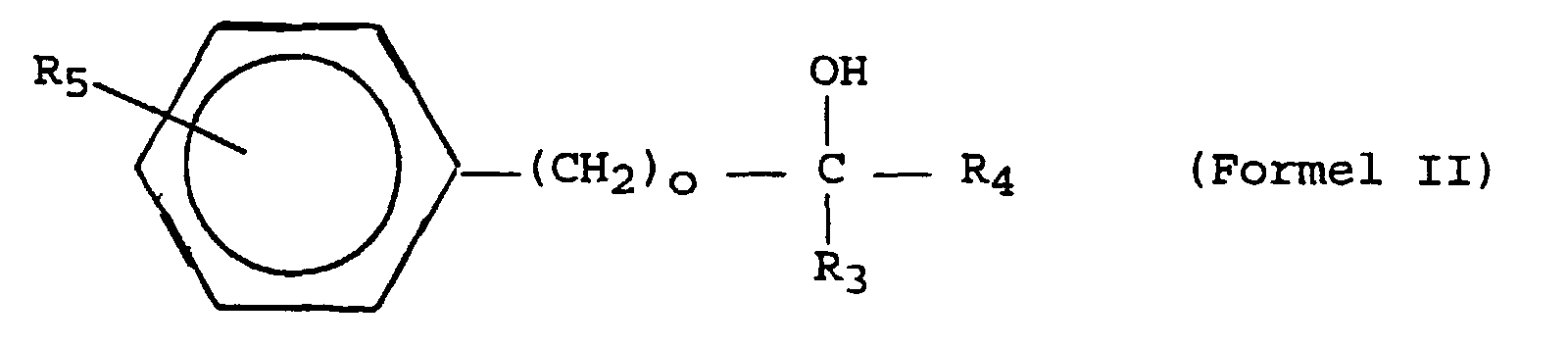
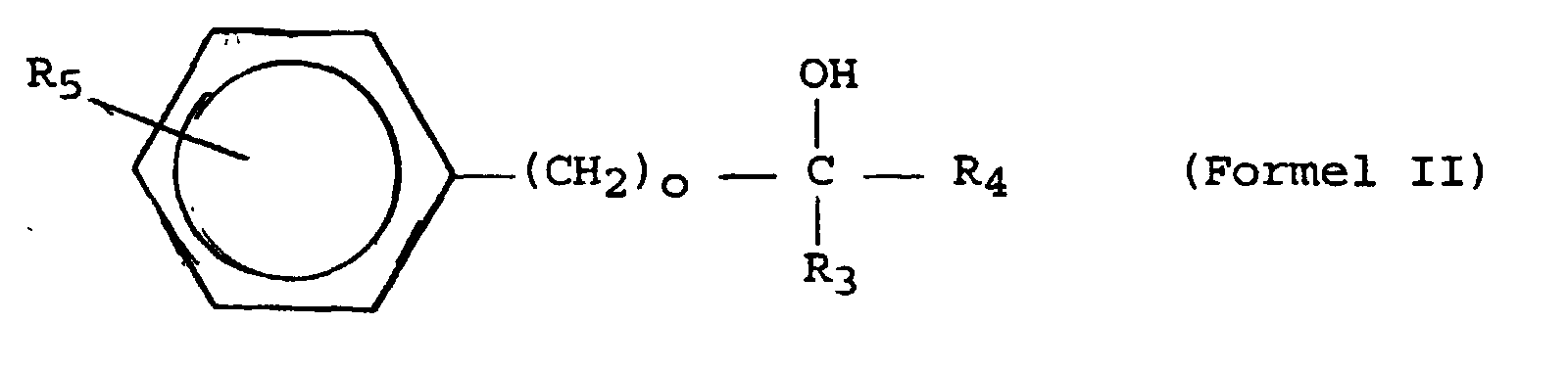
enthaltene Additiv eine Aufbau, wie dieser nachfolgend
durch die Formel II wiedergegeben ist.
In der Formel II bedeuten R3, R4, R5 ein Wasserstoff und/oder
eine lineare oder verzweigte C1-C4-Alkylgruppe, jedoch
gleichzeitig nicht alle Wasserstoff und o eine ganze Zahl
zwischen 0 und 4.
Insbesondere nimmt der Substituent R5, der insbesondere eine
lineare C1-C4-Alkylgruppe darstellt, in den Formeln I und II
eine ortho- oder para-Stellung ein.
Besonders geeignete Ausführungsformen des erfindungsgemäßen
Schmierstoffes weisen als Additiv die nachfolgend aufgelisteten
konkreten Verbindungen auf:
1-Phenyl-2-propanol, C1-C4-Alkyl-1-phenyl-2-propanol,
2-Phenyl-1-propanol, C1-C4-Alkyl-2-phenyl-1-propanol,
1-Phenyl-2-propanol, C1-C4-Alkyl-1-phenyl-2-propanol,
3-Phenyl-2-butanol, C1-C4-Alkyl-3-phenyl-2-butanol,
2-Phenyl-1-butanol, C1-C4-Alkyl-2-phenyl-1-butanol,
C1-C4-Alkyl-4-phenyl-1-butanol, 2-Phenyl-2-methyl-1-propanol,
C1-C4-Alkyl-2-phenyl-2-methyl-1-propanol, 1-Phenyl-2-methyl-1-propanol,
C1-C4-Alkyl-1-phenyl-2-methyl-1-propanol, C1-C4-Alkyl-5-phenyl-1-pentanol,
5-Phenyl-2-pentanol, C1-C4-Alkyl-5-phenyl-2-pentanol,
5-Phenyl-3-pentanol (=1-Phenyl-3-pentanol),
C1-C4-Alkyl-5-phenyl-3-pentanol, 1-Phenyl-2-pentanol,
C1-C4-Alkyl-1-phenyl-2-pentanol, 2-Phenyl-1-pentanol, C1-C4-Alkyl-2-phenyl-1-pentanol,
2-Phenyl-3-methyl-1-butanol,
C1-C4-Alkyl-2-phenyl-3-methyl-1-butanol, 1-Phenyl-3-methyl-1-butanol,
C1-C4-Alkyl-1-phenyl-3-methyl-1-butanol, 3-Phenyl-2-methyl-1-butanol,
C1-C4-Alkyl-3-phenyl-2-methyl-1-butanol,
2-Phenyl-2-methyl-1-butanol, C1-C4-Alkyl-2-phenyl-2-methyl-1-butanol,
1-Phenyl-2-methyl-1-butanol, C1-C4-Alkyl-1-phenyl-2-methyl-1-butanol,
3-Phenyl-3-methyl-2-butanol, C1-C4-Alkyl-3-phenyl-3-methyl-2-butanol,
2-Phenyl-3-methyl-2-butanol, C1-C4-Alkyl-2-phenyl-3-methyl-2-butanol,
1-Phenyl-3-methyl-2-butanol,
C1-C4-Alkyl-1-phenyl-3-methyl-2-butanol, 1-Phenyl-2-methyl-2-butanol,
C1-C4-Alkyl-1-phenyl-2-methyl-2-butanol,
3-Phenyl-2-methyl-2-butanol, C1-C4-Alkyl-3-phenyl-2-methyl-2-butanol,
4-Phenyl-2-methyl-2-butanol und/oder C1-C4-Alkyl-4-phenyl-2-methyl-2-butanol,
wobei die zuvor angesprochenen Alkylgruppen
vorzugsweise lineare Alkylgruppen sind und in
ortho- oder para-Stellung vorgesehen sind.
Besonders gute Eigenschaften in bezug auf eine physikalische
und mikrobiologische Stabilisierung der jeweiligen Ausführungsform
des erfindungsgemäßen Schmierstoffes, insbesondere
des Kühlschmierstoffkonzentrates oder des Kühlschmierstoffes,
besitzen solche Additive, die chemisch als ein C1-C4-Alkyl-2-phenyl-1-ethanol,
ein 1-Phenyl-1-ethanol, ein C1-C4-Alkyl-1-phenyl-1-ethanol,
ein 1-Phenyl-1-propanol, ein C1-C4-Alkyl-1-phenyl-1-propanol,
ein 2-Phenyl-2-propanol, ein C1-C4-Alkyl-2-phenyl-2-propanol,
ein C1-C4-Alkyl-3-phenyl-1-propanol, ein
1-Phenyl-1-butanol, ein C1-C4-Alkyl-1-phenyl-1-butanol, ein
4-Phenyl-2-butanol, ein C1-C4-Alkyl-4-phenyl-2-butanol, ein
2-Phenyl-2-butanol, ein C1-C4-Alkyl-2-phenyl-2-butanol, ein
5-Phenyl-3-pentanol, ein C1-C4-Alkyl-5-phenyl-3-pentanol, ein
1-Phenyl-1-pentanol, ein C1-C4-Alkyl-1-phenyl-1-pentanol
und/oder Derivate davon anzusprechen sind.
Bezüglich der Konzentration, in der das zuvor beschriebene
Additiv in der erfindungsgemäßen flüssigen oder viskosen
Schmierstoffzusammensetzung, insbesondere in dem Kühlschmierstoffkonzentrat
oder in dem Kühlschmierstoff, vorhanden ist,
ist festzuhalten, daß sich diese Konzentration nach der jeweiligen
flüssigen oder viskosen Zusammensetzung richtet.
Allgemein ist hierzu festzustellen, daß insbesondere bei relativ
instabilen Schmierstoffzusammensetzungen, die zudem
noch eine lange Lagerzeit besitzen sollen, höhere Konzentrationen
des Additivs gemäß Formel I oder der vorstehend konkret
genannten Art vorzusehen sind, während an sich stabile
Schmierstoffzusammensetzungen, die recht kurzfristig verbraucht
werden, relativ geringe Konzentrationen dieses Additivs
in der Regel aufweisen. Vorzugsweise variiert die Konzentration
des Additivs gemäß Formel I oder der vorstehend
konkret genannten Art in der flüssigen oder viskosen erfindungsgemäßen
Schmierstoffzusammensetzung zwischen 0,5 Gew.%
und 20 Gew.%, insbesondere zwischen 3 Gew.% und 18 Gew.%, jeweils
bezogen auf die anwendungsfertige Schmierstoffzusammensetzung.
Wie bereits mehrfach beschrieben ist, handelt es sich bei dem
erfindungsgemäßen Schmierstoff insbesondere um einen Kühlschmierstoff
oder um ein Kühlschmierstoffkonzentrat. Hierbei
ist unter dem Begriff Kühlschmierstoffkonzentrat ein solches
Produkt zu verstehen, das entweder selbst direkt angewandt
wird oder insbesondere durch Zusatz von Wasser in den entsprechenden
anwendungsfertigen Kühlschmierstoff überführt
wird, wobei ein derartiges wassermischbares Kühlschmierstoffkonzentrat
bzw. ein wassermischbarer Kühlschmierstoff neben
der mindestens einen Basisverbindung und den zuvor beschriebenen
Ausführungsformen des Additivs noch vorzugsweise mindestens
einen Emulgator enthält.
Abhängig von dem Anwendungsgebiet des erfindungsgemäßen
Schmierstoffes, insbesondere des Kühlschmierstoffkonzentrates
oder des bereits mit Wasser vermischten Kühlschmierstoffes,
variiert die chemische Zusammensetzung des hierin enthaltenen
Emulgators. Vorzugsweise wird ein nichtionischer und/oder
anionischer Emulgator dem erfindungsgemäßen Schmierstoff oder
dem erfindungsgemäßen Kühlschmierstoffkonzentrat zugesetzt,
wobei der entsprechende mit Wasser vermischte Kühlschmierstoff
dann einen derartigen anionischen und/oder nichtionischen
Emulgator aufweist.
Als nichtionische Emulgatoren, die in dem erfindungsgemäßen
Schmierstoff, dem erfindungsgemäßen Kühlschmierstoffkonzentrat
oder dem bereits mit Wasser vermischten Kühlschmierstoff
enthalten sind, sind alkoxylierte, insbesondere ethoxylierte
Fettalkohole, alkoxylierte, insbesondere ethoxylierte Fettsäuren
und/oder alkoxylierte, insbesondere ethoxylierte Alkyl-Arylverbindungen
und/oder alkoxylierte, insbesondere ethoxylierte,
Alkyl-/Arylphosphorsäurerester anzusehen.
Bevorzugte anionische Emulgatoren stellen solche Emulgatoren
dar, die auf der Basis einer Alkaliseife, einer Alkanolaminseife,
eines Petroleumsulfonat, eines sulfatierter Fettsäureester
und/oder einem Alkanolamin aufgebaut sind.
Konkrete, insbesondere in dem erfindungsgemäßen Schmierstoff,
Kühlschmierstoff oder Kühlschmierstoffkonzentrat vorhandene
Emulgatoren sind die C16-C18-Fettalkohole bzw. C16-C18-Fettsäuren,
die insbesondere mit 2 bis 10 Mol Ethylenoxid ethoxyliert
sind. Ebenso zeigen Rizinusölethoxylate, die mit 2 bis
10 Mol Ethylenoxid ethoxyliert sind, Alkylphenolethoxylate,
die mit 2 bis 10 Mol Ethylenoxid ethoxyliert sind, C18-C22-Kaliumcarboxylate,
Ammoniumcarboxylate mit Monoethanolamin,
Triethanolamin, Aminobutanol oder Monoisopropanolamin, Natriumalkylbenzolsulfate
mit einem Molekulargewicht zwischen 350
und 500, und Tallölfettsäuremonoethanolamid eine hohe Verträglichkeit
mit den zuvor beschriebenen Ausführungsformen
des erfindungsgemäßen Additivs, so daß diese konkreten Emulgatoren
besonders bevorzugt in dem erfindungsgemäßen Schmierstoff
vorhanden sind.
Bezüglich der Konzentration des Emulgators, der in dem erfindungsgemäßen
Schmiermittel vorhanden ist, ist festzuhalten,
daß diese Konzentration zwischen 0,5 Gew.% und 50 Gew.%, insbesondere
zwischen 3 Gew.% und 30 Gew.%, bezogen auf den anwendungsfertigen
Schmierstoff variiert.
Bei einer geeigneten Weiterbildung des erfindungsgemäßen
Schmierstoffs weist dieser desweiteren mindestens eine
Korrosionsschutzkomponente auf. Hierbei handelt es sich insbesondere
um Alkaliseife, Alkanolaminseife, Petroleumsulfonate,
Alkanolamide, alkoxylierter Alkyl-/Aryl-Phosphorsäureester,
organische Borverbindungen, Alkali- bzw. Ammoniumsalze
von Amidocarbonsäuren, Thiophosphorsäureester und
Salze, Alkylbernsteinsäurederivate und/oder Alkylimidazole.
Insbesondere dann, wenn der erfindungsgemäße Schmierstoff als
Korrosionsschutzkomponente ein Kaliumcarboxylat, vorzugsweise
von einer C7-C12- und/oder einer C18-C22-Carbonsäure, ein
Ammoniumcarboxylat, insbesondere der zuvor genannten Carbonsäuren,
ein Natriumalkylbenzolsulfonat, vorzugsweise mit einem
Molekulargewicht zwischen 350 und 500, ein
Tallölfettsäuremonoethanolamid, ein Ammoniumborat mit Monoethanolamin,
Triethanolamin, Aminobutanol und/oder
Monoisopropanolamin, eine Sulfonamidocarbonsäure, ein Dialkyldithiophosphat,
vorzugsweise ein C3-C8-Dialkyldithio-phosphat,
ein Bernsteinsäurederivat, heterocyclische Stickstoffverbindungen
mit Alkylresten und/oder Calcium-Sulfonate
aufweist, besitzt eine derartige Ausführungsform des erfindungsgemäßes
Schmierstoffes eine hohe Wirksamkeit in bezug
auf den bei der mechanischen Bearbeitung von metallischen
Werkstoffen erforderlichen Korrosionsschutz.
Vorzugsweise variiert die Konzentration der Korrosionsschutzkomponente
im anwendungsfertigen Schmierstoff zwischen 3
Gew.% und 50 Gew.%, vorzugsweise zwischen 5 Gew.% und 30
Gew.%.
Neben der Basisverbindung und den zuvor beschriebenen Additiven
gemäß der Formeln I und II bzw. den konkret zuvor aufgeführten
Additiven, den Emulgatoren sowie den Korrosionsschutzkomponenten
werden andere Ausführungsformen des
erfindungsgemäßen Schmierstoffes bevorzugt, bei denen der
erfindungsgemäße Schmierstoff weitere Zusätze in einer Konzentration
zwischen 0,2 Gew.% und 30 Gew.%, jeweils bezogen
auf die anwendungsfertige Schmierstofformulierung, enthält.
Bei diesen weiteren Zusätze handelt es sich insbesondere um
solche Zusätze, die den Schmierstoff bei einem hohen Anwendungsdruck
schützen und/oder einen Verschleiß der für die mechanische
Metallbearbeitung eingesetzten Werkzeuge verhindern.
Hier sind insbesondere als weitere Zusätze, die in
Fachkreisen auch als EP/AW-Additive benannt sind, Fettsäureester,
insbesondere native, synthetische und/oder geschwefelte
native bzw. synthetische Ester, geschwefelte Kohlenwasserstoffe,
geschwefelte Fettsäureester, Chlorparaffine,
Phosphor-Derivate, Schwefel-Phosphor-Derivate, Thiophosphorsäureester
und deren Salze, Polyalkylenglykol und/oder Fettamide
zu nennen.
Besonders gute Eigenschaften vermitteln solche EP/AW-Additive,
die auf der Basis von Rüböl, geblasenem Rüböl, geschwefeltem
Rüböl, Polymerestern vom Trimethylolpropan-Typ, geschwefelten
Kohlenwasserstoffen mit Schwefelbrücken mit 3 bis
5 Schwefelatomen, Dialkyldithiophosphaten, insbesondere C3-C8-Dialkyldithiophosphaten,
Oleylalkoholen und/oder Tallölfettsäuremonoethanolamid
aufgebaut sind.
Ferner können in dem erfindungsgemäßen Schmierstoff noch Fungizide,
Bakterizide, Entschäumer, Antioxidantien, Buntmetalldesaktivatoren,
Lösungsvermittler, Antinebelzusätze und/oder
Geruchsverbesserer enthalten sein, wobei jedoch insbesondere
bezüglich der Konzentration an Fungiziden und Bakteriziden
festzuhalten ist, daß diese Produkte teilweise oder vollständig
durch das eingangs beschriebene erfindungsgemäße Additiv
ersetzt werden können. Als konkrete Zusätze der vorstehend
genannten Art sind insbesondere Borsäure und ihre Salze,
Isothiazolinone, Natriumpyrion, Siloxanentschäumer, Ditert.Butyl-Hydroxytoluol,
Benzotriazol, Ethylhexandiol, Polypropylenglykole,
Polymethacrylate, Phosphonate und/oder übliche
Duftstoffe zu nennen.
Wie bereits eingangs ausgeführt ist, weist der erfindungsgemäße
Schmierstoff eine Basisverbindung auf, wobei diese Basisverbindung
unterschiedlich aufgebaut sein kann. Im einfachsten
Fall enthält der erfindungsgemäße Schmierstoff als
Basisverbindung Wasser sowie desweiteren das Additiv gemäß
der Formeln I und II oder der vorstehend konkret genannten
Art, wobei hierin noch ggf. mindestens eine Korrosionsschutzkomponente
enthalten sein kann.
So ist bei einer weiteren Gruppe der erfindungsgemäßen
Schmierstoffe in dem erfindungsgemäßen Schmierstoff als Basisverbindung
mindestens ein Mineralöl, mindestens ein
Fettsäureester, mindestens ein Glykol, mindestens ein Polyglykol
und/oder mindestens ein Fettalkohol enthalten, wobei
es sich dabei insbesondere um naphthenbasische Mineralöle,
paraffinbasische Mineralöle, aromatische Mineralöle, Weißöle,
Poly[α]olefine, geschwefelte Kohlenwasserstoffe, Chlorparaffine,
native Ester, vorzugsweise pflanzliche und/oder
tierische Triglyceride, synthetische Fettsäureester, insbesondere
Mono- und/oder Dicarbonsäureester, synthetische Polycarbonsäureester,
synthetische Polyester, synthetische Kornplexester
und/oder synthetische Triglyceride, vorzugsweise
mittelkettige Triglyceride, geschwefelte native und/oder synthetische
Ester enthalten. Hierzu zählen desweiteren Rüböl,
modifiziertes Rüböl, Rizinusöl, Rizinusölderivate, Trimethylolpropansäureester,
Ethylenglykole, Propylenglykole, Polyethylenglykol,
Aminethoxylate und/oder Polyaminethoxylate.
Bei den Polyethylenglykolen sind insbesondere Polyethylenglykol,
vorzugsweise mit einem Ethylenoxid/Propylenoxid-Verhältnis
von 1/0 und einem Molekulargewicht von 200 ± 20, Polyethylenglykol
600 mit einem Ethylenoxid/Propylenoxid-Verhältnis
von 1/0 und einem Molekulargewicht von 600 ± 60 sowie ein
Polyethylenglykol, das unter der Handelsbezeichnung B11/300
erhältlich ist und ein Ethylenoxid/Propylenoxid-Verhältnis
von 1/1 und ein Molekulargewicht von 300 ± 40 aufweist, zu
nennen.
Bevorzugte Fettalkohole stellen Cetylalkohol, Oleylalkohol
sowie Guebert-Alkohole (α'-verzweigte Alkohole) dar, wobei
insbesondere Oleylalkohol mit einer Jodzahl zwischen 90 und
95 als Basisverbindung dem erfindungsgemäßen Schmierstoff
hervorragende Eigenschaften verleiht.
Weist der erfindungsgemäße Schmierstoff als Basisverbindung
mindestens ein Mineralöl auf, so ist es besonders vorteilhaft,
wenn dieses Mineralöl eine Viskosität zwischen 2 und
1.500 mm2/s und eine Dichte zwischen 800 kg/m3 und 950 kg/m3
besitzt, wobei die Viskositätswerte bei 40 °C und die Dichtewerte
bei 15 °C bestimmt werden.
Bezüglich der Ausführungsformen des erfindungsgemäßes
Schmierstoffes, bei denen als Basisverbindung mindestens ein
Mineralöl vorhanden ist, empfiehlt es sich ferner, daß hierfür
ein Mineralöl ausgewählt wird, dessen Aromatengehalt
kleiner als 10 Gew.%, dessen Gehalt an polycyklischen Aromaten
kleiner als 3 Gew.% und dessen Konzentration an
Benz[a]pyren kleiner als 3 ppm ist.
Enthält hingegen der erfindungsgemäße Schmierstoff als Basisverbindung
mindestens einen der zuvor genannten nativen
und/oder synthetischen Fettsäureester, so variiert vorteilhafterweise
die Viskosität des Fettsäureesters zwischen 20
mm2/s und 100 mm2/s, während die Neutralisationszahl insbesondere
kleiner als 15 ist, wobei die Viskositätswerte bei 40
°C gemessen werden.
Solche Ausführungsformen des erfindungsgemäßen Schmierstoffes,
die als Basisverbindung mindestens ein Glykol und/oder
mindestens ein Polyglykol enthalten, weisen vorzugsweise solche
Produkte auf, bei denen das Molekulargewicht des Glykols
bzw. Polyglykols zwischen 60 und 30.000 variiert.
Für andere Ausführungsformen des erfindungsgemäßen Schmierstoffes,
bei denen im Schmierstoff als Basisverbindung mindestens
ein Fettalkohol enthalten ist, hat sich als besonders
vorteilhaft gezeigt, daß der diesbezügliche Fettalkohol eine
Jodzahl zwischen 40 und 130 aufweist.
Wie bereits vorstehend wiederholt ausgeführt ist, handelt es
sich bei dem erfindungsgemäßen Schmierstoff insbesondere um
einen solchen Schmierstoff, der ein mit Wasser vermischbarer
oder vermischter Kühlschmierstoff ist, wobei in einer besonders
vorteilhaften Ausführungsform dieser Variante des erfindungsgemäßen
Kühlschmierstoffes dann die zuvor aufgeführten
Basisverbindungen als Tröpfchen mit einer Größe kleiner als
100 nm, insbesondere mit einer Größe zwischen 90 nm und 35
nm, vorliegen. Ein derartiger, mit Wasser vermischbarer bzw.
vermischter Kühlschmierstoff kann auch als Mikroemulsion bezeichnet
werden.
Insbesondere ist festzuhalten, daß das Additiv gemäß der Formeln
I und II sowie der vorstehend genannten konkreten Art
vorzugsweise in aminfreien Schmierstoffen, aminfreien
Kühlschmierstoffkonzentraten und/oder aminfreien Kühlschmierstoffen
verwendet wird.
Die vorliegende Erfindung betrifft desweiteren ein Additiv
zur physikalischen und/oder mikrobiologischen Stabilisierung
eines Schmierstoffes, insbesondere eines Kühlschmierstoffkonzentrates
oder eines Kühlschmierstoffes, der vorstehend beschriebenen
Art. Hierbei weist das erfindungsgemäße Additiv,
das ein aromatischer Alkohol ist, eine Zusammensetzung auf,
wie diese vorstehend ausgiebig beschrieben und nachfolgend
durch die Formel I wiedergegeben ist.
In der Formel I bedeuten R1 bis R5 Wasserstoff, eine lineare
und/oder verzweigte C1-C4-Alkylgruppe und m eine ganze Zahl
zwischen 0 und 4, wobei jedoch R1 bis R5 nicht gleichzeitig
Wasserstoff ist.
Das erfindungsgemäße Additiv weist alle die Vorteile auf, wie
sie vorstehend im Zusammenhang mit dem erfindungsgemäßen
Schmierstoff beschrieben sind, so daß zur Vermeidung von Wiederholungen
auf die vorstehenden Ausführungen verwiesen wird,
die analog auch bei dem erfindungsgemäßen Additiv gelten.
Insbesondere ist hierzu nochmals kurz festzuhalten, daß das
erfindungsgemäße Additiv selbst dann keine Phenole ausbildet,
wenn innerhalb des Schmierstoffes bei einer hohen Keimbesiedelung
anaerobe Bedingungen vorherrschen und wenn die Konzentration
des zuvor beschriebenen und in den Formeln I und II
wiedergegebenen erfindungsgemäßen Additivs im Schmierstoff
einen vorgegebenen Grenzwert unterschreitet. Als weitere Vorteil
ist, wie bereits vorstehend bei den Vorteilen des erfindungsgemäßen
Schmierstoffes herausgestellt wurde, festzuhalten,
daß bei Anwesenheit des erfindungsgemäßen Additivs im
Schmierstoff auf einen Zusatz von Bakteriziden und/oder Fungiziden
weitestgehend verzichtet werden kann, daß der erfindungsgemäße
Schmierstoff zumindestens bezuglich des Additivs
sehr gut biologisch abbaubar ist, ohne daß beim biologischen
Abbau Phenole ausgebildet werden und daß sich in alle üblichen
Schmierstoffen das in den Formeln I und II wiedergegebene
erfindungsgemäße Additiv problemlos einarbeiten läßt,
ohne daß es dabei zu einer Entmischung kommt. Neben den bereits
zuvor bei dem erfindungsgemäßen Schmierstoff aufgeführten
Vorteilen ist als weiterer Vorteil festzuhalten, daß sich
der mit dem erfindungsgemäßen Additiv versetzte Schmierstoff
von solchen Schmierstoffen, in denen dieses erfindungsgemäße
Additiv nicht vorhanden ist, insbesondere auch dadurch unterscheidet,
daß der mit dem erfindungsgemäßen Additiv versetzte
Schmierstoff eine gleichmäßige und gleichbleibende Verteilung
von Tröpfchen der Basisverbindung aufweist, wodurch die überragende
Schmierwirkung des mit dem erfindungsgemäßen Additiv
versetzten Schmierstoffes im Vergleich zu herkömmlichen
Schmierstoffen bei der mechanischen Bearbeitung bzw. Verarbeitung
von Werkstoffen, insbesondere von Werkstoffen aus Metall,
Kunststoff, Glas oder Keramik, erklärlich wird. Dieser
Vorteil kommt auch insbesondere dann zum Ausdruck, wenn der
mit dem erfindungsgemäßen Additiv versetzte Schmierstoff ein
Kühlschmierstoff bzw. ein Kühlschmierstoffkonzentrat ist, wobei
ein derartiges Kühlschmierstoffkonzentrat dann vorzugsweise
unter Ausbildung des Kühlschmierstoffes mit Wasser vermischt
wird.
Vorzugsweise weist das erfindungsgemäße Additiv eine solchen
Aufbau auf, wie dieser durch die Strukturformel II wiedergegeben
ist.
In der Formel II bedeuten R3, R4, R5 ein Wasserstoff und/oder
eine lineare oder verzweigte C1-C4-Alkylgruppe, jedoch
gleichzeitig nicht alle Wasserstoff und
o eine ganze Zahl zwischen 0 und 4.
Insbesondere handelt es sich bei dem erfindungsgemäßen
Additiv um ein C1-C4-Alkyl-2-phenyl-1-ethanol, ein 1-Phenyl-1-ethanol,
ein C1-C4-Alkyl-1-phenyl-1-ethanol, ein 1-Phenyl-1-propanol,
ein C1-C4-Alkyl-1-phenyl-1-propanol, ein 2-Phenyl-2-propanol,
ein C1-C4-Alkyl-2-phenyl-2-propanol, ein C1-C4-Alkyl-3-phenyl-1-propanol,
ein 1-Phenyl-1-butanol, ein C1-C4-Alkyl-1-phenyl-1-butanol,
ein 4-Phenyl-2-butanol, ein C1-C4-Alkyl-4-phenyl-2-butanol,
ein 2-Phenyl-2-butanol, ein C1-C4-Alkyl-2-phenyl-2-butanol,
ein 5-Phenyl-3-pentanol, ein C1-C4-Alkyl-5-phenyl-3-pentanol,
ein 1-Phenyl-1-pentanol
und/oder ein C1-C4-Alkyl-1-phenyl-1-pentanol oder um eine Mischung
der zuvor genannten Verbindungen.
Zur Vermeidung von weiteren Wiederholungen wird auf die zuvor
wiedergegebenen Ausführungen zum erfindungsgemäßen Schmierstoff
verwiesen, die analog auch für das erfindungsgemäße
Additiv gelten.
Der erfindungsgemäße Schmierstoff bzw. das erfindungsgemäße
Additiv werden nachfolgend anhand von Ausführungsbeispielen
näher erläutert.
Ausführungsbeispiele 1 - 3
Es wurden drei Kühlschmierstoffzusammensetzungen nach den üblichen
Techniken erstellt, wobei die nachfolgend mit 1 bis 3
bezeichneten Kühlschmierstoffe folgende Zusammensetzung aufwiesen:
| | Ausführungsbeispiel |
| | 1 | 2 | 3 |
| Mineralöl | 51,4 | 51,4 | 48,9 |
| Fettsäureester | 10 | 10 | 10 |
| Fettalkoholethoxylate | 6,2 | 6,2 | 6,2 |
| Petroleumsulfonate | 6 | 6 | 6 |
| aliphatische Fettsäuren | 7,9 | 7,9 | 7,9 |
| KOH 45 | 5,2 | 5,2 | 5,2 |
| Sonstiges | 0,8 | 0,8 | 0,8 |
| Wasser | 10 | 7,5 | 7,5 |
| Additiv | 2,5 | 5 | 7,5 |
Sonstiges = Buntmetallinhibitor und Entschäumer
KOH 45 = 45 Gew.% Kaliumhydroxid (fest) in Wasser |
Hierbei enthielten die Kühlschmierstoffe 1 - 3 als Additiv
zur mikrobiologischen und physikalischen Stabilisierung 4-(Ethylphenyl)
-benzylalkohol in drei unterschiedlichen Konzentrationen,
die vorstehend in der Tabelle 1 angegeben sind.
Ausführungsbeispiele 4 - 6
Es wurden drei Kühlschmierstoffzusammensetzungen nach den üblichen
Techniken erstellt, wobei die nachfolgend mit 4 bis 6
bezeichneten Kühlschmierstoffe folgende Zusammensetzung aufwiesen:
| | Ausführungsbeispiel |
| | 4 | 5 | 6 |
| Mineralöl | 51,4 | 51,4 | 48,9 |
| Fettsäureester | 10 | 10 | 10 |
| Fettalkoholethoxylate | 6,2 | 6,2 | 6,2 |
| Petroleumsulfonate | 6 | 6 | 6 |
| aliphatische Fettsäuren | 7,9 | 7,9 | 7,9 |
| KOH 45 | 5,2 | 5,2 | 5,2 |
| Sonstiges | 0,8 | 0,8 | 0,8 |
| Wasser | 10 | 7,5 | 7,5 |
| Additiv | 2,5 | 5 | 7,5 |
Sonstiges = Buntmetallinhibitor und Entschäumer
KOH 45 = 45 Gew.% Kaliumhydroxid (fest) in Wasser |
Hierbei enthielten die Kühlschmierstoffe 4 bis 6 als Additiv
zur mikrobiologischen und physikalischen Stabilisierung 2-(o-Methylphenyl)-ethanol
in drei unterschiedlichen Konzentrationen,
die vorstehend in der Tabelle 2 angegeben sind.
Ausführungsbeispiele 7 - 9
Es wurden drei Kühlschmierstoffzusammensetzungen nach den üblichen
Techniken erstellt, wobei die nachfolgend mit 7 bis 9
bezeichneten Kühlschmierstoffe folgende Zusammensetzung aufwiesen:
| | Ausführungsbeispiel |
| | 7 | 8 | 9 |
| Mineralöl | 51,4 | 51,4 | 48,9 |
| Fettsäureester | 10 | 10 | 10 |
| Fettalkoholethoxylate | 6,2 | 6,2 | 6,2 |
| Petroleumsulfonate | 6 | 6 | 6 |
| aliphatische Fettsäuren | 7,9 | 7,9 | 7,9 |
| KOH 45 | 5,2 | 5,2 | 5,2 |
| Sonstiges | 0,8 | 0,8 | 0,8 |
| Wasser | 10 | 7,5 | 7,5 |
| Additiv | 2,5 | 5 | 7,5 |
Sonstiges = Buntmetallinhibitor und Entschäumer
KOH 45 = 45 Gew.% Kaliumhydroxid (fest) in Wasser |
Hierbei enthielten die Kühlschmierstoffe 7 bis 9 als Additiv
zur mikrobiologischen und physikalischen Stabilisierung 1-Phenyl-1-propanol
in drei unterschiedlichen Konzentrationen,
die vorstehend in der Tabelle 3 angegeben sind.
Ausführungsbeispiele 10 - 12
Es wurden drei Kühlschmierstoffzusammensetzungen nach den üblichen
Techniken erstellt, wobei die nachfolgend mit 10 bis
12 bezeichneten Kühlschmierstoffe folgende Zusammensetzung
aufwiesen:
| | Ausführungsbeispiel |
| | 10 | 11 | 12 |
| Mineralöl | 51,4 | 51,4 | 48,9 |
| Fettsäureester | 10 | 10 | 10 |
| Fettalkoholethoxylate | 6,2 | 6,2 | 6,2 |
| Petroleumsulfonate | 6 | 6 | 6 |
| aliphatische Fettsäuren | 7,9 | 7,9 | 7,9 |
| KOH 45 | 5,2 | 5,2 | 5,2 |
| Sonstiges | 0,8 | 0,8 | 0,8 |
| Wasser | 10 | 7,5 | 7,5 |
| Additiv | 2,5 | 5 | 7,5 |
Sonstiges = Buntmetallinhibitor und Entschäumer
KOH 45 = 45 Gew.% Kaliumhydroxid (fest) in Wasser |
Hierbei enthielten die Kühlschmierstoffe 10 bis 12 als Additiv
zur mikrobiologischen und physikalischen Stabilisierung
1-Phenyl-2-propanol in drei unterschiedlichen Konzentrationen,
die vorstehend in der Tabelle 4 angegeben sind.
Ausführungsbeispiele 13 - 15
Es wurden drei Kühlschmierstoffzusammensetzungen nach den üblichen
Techniken erstellt, wobei die nachfolgend mit 13 bis
15 bezeichneten Kühlschmierstoffe folgende Zusammensetzung
aufwiesen:
| | Ausführungsbeispiel |
| | 13 | 14 | 15 |
| Mineralöl | 51,4 | 51,4 | 48,9 |
| Fettsäureester | 10 | 10 | 10 |
| Fettalkoholethoxylate | 6,2 | 6,2 | 6,2 |
| Petroleumsulfonate | 6 | 6 | 6 |
| aliphatische Fettsäuren | 7,9 | 7,9 | 7,9 |
| KOH 45 | 5,2 | 5,2 | 5,2 |
| Sonstiges | 0,8 | 0,8 | 0,8 |
| Wasser | 10 | 7,5 | 7,5 |
| Additiv | 2,5 | 5 | 7,5 |
Sonstiges = Buntmetallinhibitor und Entschäumer
KOH 45 = 45 Gew.% Kaliumhydroxid (fest) in Wasser |
Hierbei enthielten die Kühlschmierstoffe 13 bis 15 als Additiv
zur mikrobiologischen und physikalischen Stabilisierung
2-Phenyl-2-propanol in drei unterschiedlichen Konzentrationen,
die vorstehend in der Tabelle 5 angegeben sind.
Ausführungsbeispiele 16 - 18
Es wurden drei Kühlschmierstoffzusammensetzungen nach den üblichen
Techniken erstellt, wobei die nachfolgend mit 16 bis
18 bezeichneten Kühlschmierstoffe folgende Zusammensetzung
aufwiesen:
| | Ausführungsbeispiel |
| | 16 | 17 | 18 |
| Mineralöl | 51,4 | 51,4 | 48,9 |
| Fettsäureester | 10 | 10 | 10 |
| Fettalkoholethoxylate | 6,2 | 6,2 | 6,2 |
| Petroleumsulfonate | 6 | 6 | 6 |
| aliphatische Fettsäuren | 7,9 | 7,9 | 7,9 |
| KOH 45 | 5,2 | 5,2 | 5,2 |
| Sonstiges | 0,8 | 0,8 | 0,8 |
| Wasser | 10 | 7,5 | 7,5 |
| Additiv | 2,5 | 5 | 7,5 |
Sonstiges = Buntmetallinhibitor und Entschäumer
KOH 45 = 45 Gew.% Kaliumhydroxid (fest) in Wasser |
Hierbei enthielten die Kühlschmierstoffe 16 bis 18 als Additiv
zur mikrobiologischen und physikalischen Stabilisierung
2-Phenyl-1-propanol in drei unterschiedlichen Konzentrationen,
die vorstehend in der Tabelle 6 angegeben sind.
Ausführungsbeispiele 19 - 21
Es wurden drei Kühlschmierstoffzusammensetzungen nach den üblichen
Techniken erstellt, wobei die nachfolgend mit 19 bis
21 bezeichneten Kühlschmierstoffe folgende Zusammensetzung
aufwiesen:
| | Ausführungsbeispiel |
| | 19 | 20 | 21 |
| Mineralöl | 51,4 | 51,4 | 48,9 |
| Fettsäureester | 10 | 10 | 10 |
| Fettalkoholethoxylate | 6,2 | 6,2 | 6,2 |
| Petroleumsulfonate | 6 | 6 | 6 |
| aliphatische Fettsäuren | 7,9 | 7,9 | 7,9 |
| KOH 45 | 5,2 | 5,2 | 5,2 |
| Sonstiges | 0,8 | 0,8 | 0,8 |
| Wasser | 10 | 7,5 | 7,5 |
| Additiv | 2,5 | 5 | 7,5 |
Sonstiges = Buntmetallinhibitor und Entschäumer
KOH 45 = 45 Gew.% Kaliumhydroxid (fest) in Wasser |
Hierbei enthielten die Kühlschmierstoffe 19 bis 21 als Additiv
zur mikrobiologischen und physikalischen Stabilisierung
2-Phenyl-2-butanol in drei unterschiedlichen Konzentrationen,
die vorstehend in der Tabelle 7 angegeben sind.
Ausführungsbeispiele 22 - 24
Es wurden drei Kühlschmierstoffzusammensetzungen nach den üblichen
Techniken erstellt, wobei die nachfolgend mit 22 bis
24 bezeichneten Kühlschmierstoffe folgende Zusammensetzung
aufwiesen:
| | Ausführungsbeispiel |
| | 22 | 23 | 24 |
| Mineralöl | 51,4 | 51,4 | 48,9 |
| Fettsäureester | 10 | 10 | 10 |
| Fettalkoholethoxylate | 6,2 | 6,2 | 6,2 |
| Petroleumsulfonate | 6 | 6 | 6 |
| aliphatische Fettsäuren | 7,9 | 7,9 | 7,9 |
| KOH 45 | 5,2 | 5,2 | 5,2 |
| Sonstiges | 0,8 | 0,8 | 0,8 |
| Wasser | 10 | 7,5 | 7,5 |
| Additiv | 2,5 | 5 | 7,5 |
Sonstiges = Buntmetallinhibitor und Entschäumer
KOH 45 = 45 Gew.% Kaliumhydroxid (fest) in Wasser |
Hierbei enthielten die Kühlschmierstoffe 22 bis 24 als Additiv
zur mikrobiologischen und physikalischen Stabilisierung
3-Phenyl-2-butanol in drei unterschiedlichen Konzentrationen,
die vorstehend in der Tabelle 8 angegeben sind.
Ausführungsbeispiele 25 - 33
Um einen Vergleich gegenüber den zuvor beschriebenen
Ausführungsbeispielen 1 - 24 zu haben, wurden neun Kühlschmierstoffe
25 - 33 hergestellt, wobei diese Kühlschmierstoffe
25 - 33 als Additiv unterschiedliche, nicht im Rahmen
der vorliegenden Anmeldung beanspruchte Additive bzw. kein
Additiv aufwiesen, wie diese in den nachfolgenden Tabellen 9
a bis 9 c wiedergegeben sind.
Die Zusammensetzung der Kühlschmierstoffe 25 - 33 ist in den
nachfolgenden Tabellen 9 a bis 9 c wiedergegeben.
| | Ausführungsbeispiel |
| | 25 | 26 | 27 |
| Mineralöl | 53,9 | 52 | 49 |
| Fettsäureester | 10 | 10 | 8 |
| Fettalkoholethoxylate | 6,2 | 6,2 | 6,2 |
| Petroleumsulfonate | 6 | 6 | 6 |
| aliphatische Fettsäuren | 7,9 | 7,9 | 7,9 |
| KOH 45 | 5,2 | 5,2 | 5,2 |
| Sonstiges | 0,8 | 0,8 | 0,8 |
| Wasser | 10 | 6,9 | 6,9 |
| Phenoxyethanol | 0 | 5 | 10 |
Sonstiges = Buntmetallinhibitor und Entschäumer
KOH 45 = 45 Gew.% Kaliumhydroxid (fest) in Wasser |
| | Ausführungsbeispiel |
| | 28 | 29 | 30 |
| Mineralöl | 52 | 49 | 52 |
| Fettsäureester | 10 | 8 | 10 |
| Fettalkoholethoxylate | 6,2 | 6,2 | 6,2 |
| Petroleumsulfonate | 6 | 6 | 6 |
| aliphatische Fettsäuren | 7,9 | 7,9 | 7,9 |
| KOH 45 | 5,2 | 5,2 | 5,2 |
| Sonstiges | 0,8 | 0,8 | 0,8 |
| Wasser | 6,9 | 6,9 | 6,9 |
| 3-Phenyl-1-propanol | 5 | 10 | 0 |
| 4-Phenyl-1-butanol | 0 | 0 | 5 |
Sonstiges = Buntmetallinhibitor und Entschäumer
KOH 45 = 45 Gew.% Kaliumhydroxid (fest) in Wasser |
| | Ausführungsbeispiel |
| | 31 | 32 | 33 |
| Mineralöl | 49 | 52 | 49 |
| Fettsäureester | 8 | 10 | 8 |
| Fettalkoholethoxylate | 6,2 | 6,2 | 6,2 |
| Petroleumsulfonate | 6 | 6 | 6 |
| aliphatische Fettsäuren | 7,9 | 7,9 | 7,9 |
| KOH 45 | 5,2 | 5,2 | 5,2 |
| Sonstiges | 0,8 | 0,8 | 0,8 |
| Wasser | 6,9 | 6,9 | 6,9 |
| 4-Phenyl-1-butanol | 10 | 0 | 0 |
| 2.2-Dimethyl-3-phenyl- |
| 1-propanol | 0 | 5 | 10 |
Sonstiges = Buntmetallinhibitor und Entschäumer
KOH 45 = 45 Gew.% Kaliumhydroxid (fest) in Wasser |
Zu den zuvor angesprochenen Kühlschmierstoffen 1 - 33 ist
festzuhalten, daß zur Herstellung dieser Kühlschmierstoffe
die selben Mineralöle, Fettsäureester, Fettalkoholethoxylate,
Petroleumsulfonate, aliphatische Fettsäuren, KOH 45, Entschäumer
und Buntermetallinhibitoren verwendet wurden, wobei
sich lediglich bei den Ausfünrungsbeispielen 1 - 24 die Konzentration
und der chemische Aufbau des jeweiligen Additivs,
bei dem es sich jedoch immer um einen Phenylalkohol der vorstehend
konkret genannten Art handelte, unterscheiden, während
in den Ausführungsbeispielen 25 - 33 dieses Additiv
durch das herkömmliche Additiv Phenoxyethanol, 2.2-Dimethyl-3-phenyl-1-propanol
sowie durch die linearen Alkohole 3-Phenyl-1-propanol
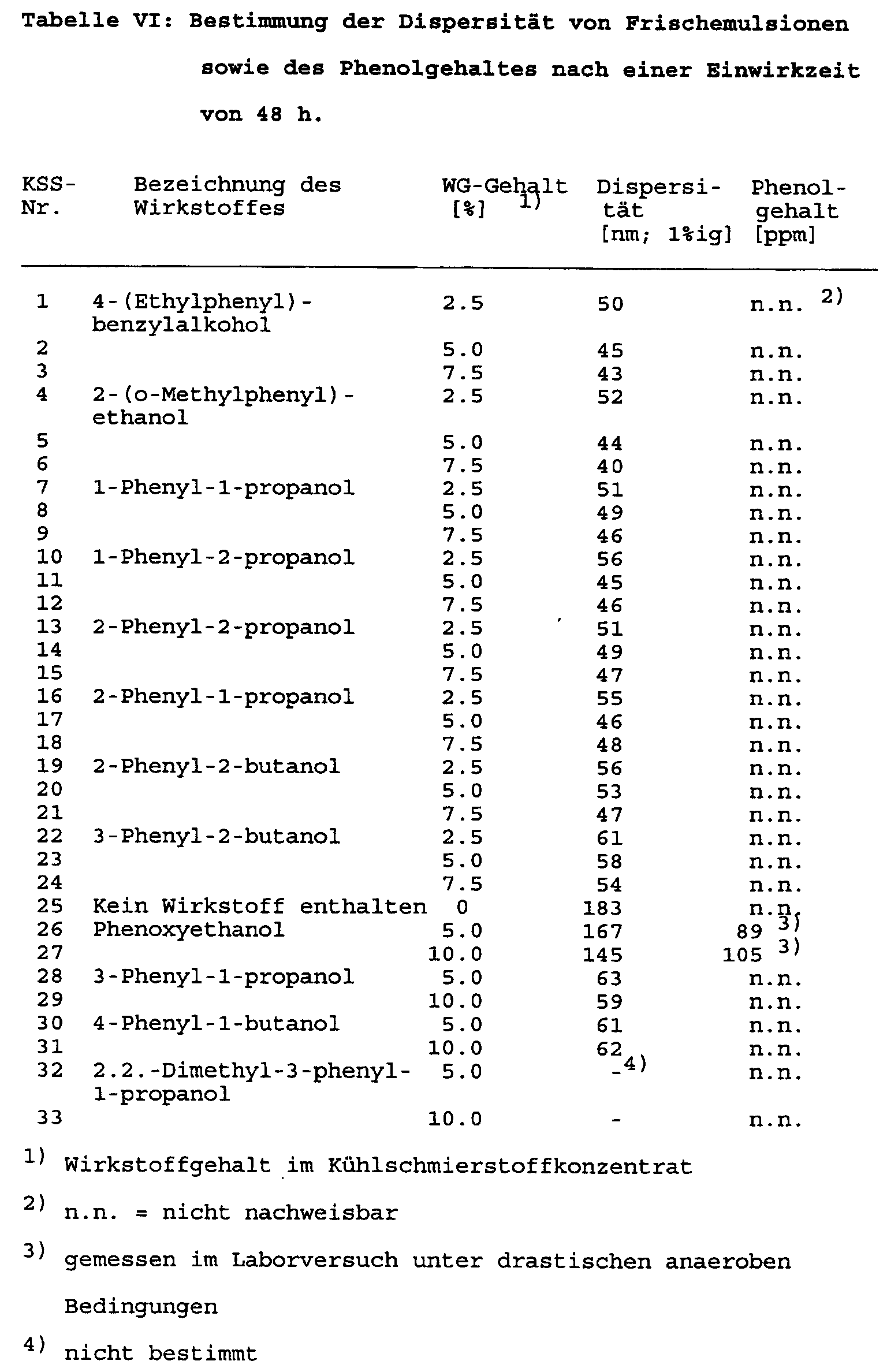
und 4-Phenyl-1-butanol ersetzt wurde bzw. kein
Additiv enthielt.
Zum Nachweis der Wirksamkeit des erfindungsgemäßen Additivs
wurden die zuvor beschriebenen Kühlschmierstoffe 1 - 33 jeweils
unmittelbar nach ihrer Herstellung als auch nach einer
Lagerzeit von sechs Monaten untersucht. Hierbei wurde im Rahmen
dieser Untersuchung die Dispersität einer 1 %-igen wäßrigen
Frischemulsion mit dem "Zeta-Master" (Fa. Malvern) bestimmt.
Desweiteren wurde der Phenolgehalt durch
Kapillarzonenelektrophorese gemessen. Der Nachweis der antimikrobiellen
Wirksamkeit verlief über die Abnahme des Gehaltes
an ATP (Adenosintriphosphat) sowie über die Bestimmung
der Pilze und Hefebesiedelung mittels Dip-slids der Firma
Easycult. Für das ATP-Monitoring wurde das Luminometer "HY-LITE"
(Fa. Merck) verwendet, gemessen nach Verdünnung der jeweils
zu untersuchenden Emulsion im Verhältnis 1:100 mit Wasser.
Für die Testreihe zur Überprüfung der antimikrobiellen Effektivität
wurden jeweils 95 ml einer 2 %igen, hochkontaminierten
Standardemulsion mit 5 g der betreffenden Kühlschmierstoffkonzentrate
1 - 33 versetzt, wobei die Standardemulsion
eine Gesamtkeimzahl von mindestens 107 kolonienbildenden Einheiten/ml
aufwies, bestimmt mittels der zuvor genannten Dipslides
bei 24 h Bebrütungsdauer und 30°C. Desweiteren
enthielt die Standardemulsion die Höchstmenge an mit diesen
Dip-slides nachweisbaren Pilzen und Hefen. Der ATP-Gehalt der
Standardemulsion entsprach 2.300.000 RLE (Relative Lichteinheiten).
Nach einer Verweilzeit von 48 h, 72 h und 96 h bei Raumtemperatur
erfolgten jeweils die weiteren ATP-Messungen sowie die
Ermittlung der Pilzbesiedelungen. Zu deren Nachweis wurden
die mit dem jeweiligen Kühlschmierstoff benetzten Dip-slides
während 120 Stunden bei einer Temperatur von 30 °C bebrütet.
Die Bestimmung des Hefenbefalls erfolgte nach 96 h Einwirkzeit
unter den gleichen Inkubationsbedingungen wie für Pilze
angegeben.
Der Phenolgehalt, in Frischemulsionen aufgrund der hohen
Reinheit des verwendeten Phenoxyethanols < 1 ppm, wurde nach
einer Einwirkzeit von 48 h erneut ermittelt.
Nach einer Lagerzeit von sechs Monaten bei Raumtemperatur
wurde ein Großteil der zuvor aufgeführten Kühlschmierstoffe 1
- 33 erneut untersucht.
Die Meßergebnisse sind in den folgenden Tabellen I bis VIII
wiedergegeben.
A. Ergebnisse unmittelbar nach der Herstellung
|
ATP-Messungen und Bestimmung des Pilzbefalls nach einer
Einwirkzeit von 96 h
|
| KSS-Nr. |
Bezeichnung des Wirkstoffes |
WG-Gehalt [%] |
ATP [RLE] x 1.000 |
Rest-ATP-Aktivität [%] |
Pilzbefall |
| 2 |
4-(Ethylphenyl)-benzylalkohol |
5.0 |
370 |
8.8 |
|
| 3 |
|
7.5 |
11.2 |
0.27 |
|
| 5 |
2-(o-Methylphenyl)-ethanol |
5.0 |
530 |
12.6 |
|
| 6 |
|
7.5 |
15.3 |
0.36 |
|
| 8 |
1-Phenyl-1-propanol |
5.0 |
2.300 |
54.8 |
|
| 9 |
|
7.5 |
1.2 |
0.31 |
|
| 11 |
1-Phenyl-2-propanol |
5.0 |
5.700 |
136 |
|
| 12 |
|
7.5 |
17.1 |
0.41 |
|
| 14 |
2-Phenyl-2-propanol |
5.0 |
410 |
9.8 |
|
| 15 |
|
7.5 |
9.1 |
0.22 |
|
| 17 |
2-Phenyl-1-propanol |
5.0 |
170 |
4.0 |
|
| 18 |
|
7.5 |
7.5 |
0.18 |
|
| 20 |
2-Phenyl-2-butanol |
5.0 |
830 |
20 |
|
| 21 |
|
7.5 |
12.4 |
0.30 |
|
| 23 |
3-Phenyl-2-butanol |
5.0 |
640 |
15 |
|
| 24 |
|
7.5 |
14.3 |
0.34 |
|
| 25 |
Kein Wirkstoff enthalten |
0 |
4.200 |
100 |
|
| 26 |
Phenoxyethanol |
5.0 |
5.300 |
126 |
|
| 27 |
|
10.0 |
3.800 |
90 |
|
| 28 |
3-Phenyl-1-propanol |
5.0 |
3.980 |
95 |
|
| 29 |
|
10.0 |
3.360 |
80 |
|
| 30 |
4-Phenyl-1-butanol |
5.0 |
4.500 |
107 |
|
| 31 |
|
10.0 |
3.100 |
74 |
+ |
| 32 |
2.2.-Dimethyl-3-phenyl-1-propanol |
15.0 |
4.820 |
115 |
|
| 33 |
|
10.0 |
840 |
20 |
|
|
Auswertung der Hefenbesiedelungen nach 96 h Einwirkzeit
|
| KSS-Nr. |
Bezeichnung des Wirkstoffes |
WG-Gehalt [%] |
Hefebefall [KBE/ml] |
| 3 |
4-(Ethylphenyl)-benzylalkohol |
7.5 |
o.B. |
| 6 |
2-(o-Methylphenyl)-ethanol |
7.5 |
o.B. |
| 9 |
1-Phenyl-1-propanol |
7.5 |
o.B. |
| 12 |
1-Phenyl-2-propanol |
7.5 |
o.B. |
| 15 |
2-Phenyl-2-propanol |
7.5 |
o.B. |
| 18 |
2-Phenyl-1-propanol |
7.5 |
o.B. |
| 21 |
2-Phenyl-2-butanol |
7.5 |
o.B |
| 24 |
3-Phenyl-2-butanol |
7.5 |
o.B. |
| 25 |
Kein Wirkstoff enthalten |
0 |
105 |
| 27 |
Phenoxyethanol |
10.0 |
o.B. |
| 29 |
3-Phenyl-1-propanol |
10.0 |
104 |
| 31 |
4-Phenyl-1-butanol |
10.0 |
104 |
| 33 |
2.2-Dimethyl-3-phenyl-1-propanol |
10.0 |
106 |
B. Ergebnisse nach 6-monatiger Lagerung bei Raumtemperatur
|
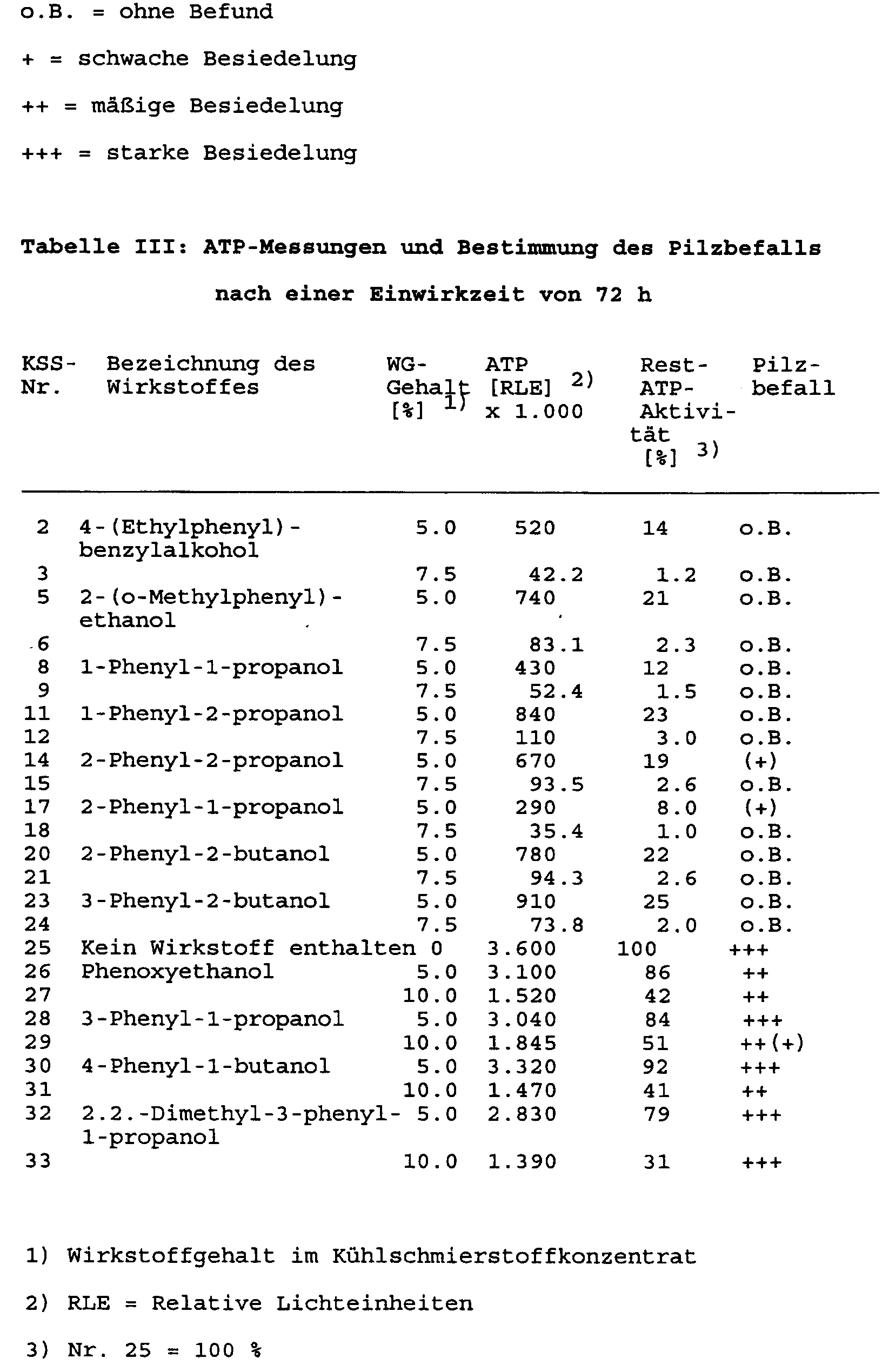
ATP-Messungen und Bestimmung des Pilzbefalls nach einer
Einwirkzeit von 72
|
| KSS-Nr. |
Bezeichnung des Wirkstoffes |
WG-Gehalt [%] |
ATP [RLE] x 1.000 |
Rest-ATP-Aktivität [%] |
Pilzbefall |
| 2 |
4-(Ethylphenyl)-benzylalkohol |
5.0 |
580 |
11 |
|
| 3 |
|
7.5 |
47.7 |
0.9 |
|
| 5 |
2-(o-Methylphenyl)-ethanol |
5.0 |
930 |
18 |
|
| 6 |
|
7.5 |
84.8 |
1.6 |
() |
| 8 |
1-Phenyl-1-propanol |
5.0 |
538 |
10 |
|
| 9 |
|
7.5 |
100.7 |
1.9 |
|
| 11 |
1-Phenyl-2-propanol |
5.0 |
1430 |
27 |
|
| 12 |
|
7.5 |
138 |
2.6 |
|
| 14 |
2-Phenyl-2-propanol |
5.0 |
901 |
17 |
() |
| 15 |
|
7.5 |
111 |
2.1 |
|
| 17 |
2-Phenyl-1-propanol |
5.0 |
265 |
5.0 |
|
| 18 |
|
7.5 |
31.8 |
0.6 |
|
| 20 |
2-Phenyl-2-butanol |
5.0 |
1000 |
19 |
|
| 21 |
|
7.5 |
87.5 |
1.7 |
|
| 23 |
3-Phenyl-2-butanol |
5.0 |
980 |
18 |
|
| 24 |
|
7.5 |
90.4 |
1.7 |
|
| 25 |
Kein Wirkstoff enthalten |
0 |
530 |
100 |
|
| 26 |
Phenoxyethanol |
5.0 |
4820 |
91 |
|
| 27 |
|
10.0 |
2800 |
53 |
+ (+) |
| 28 |
3-Phenyl-1-propanol |
5.0 |
4560 |
86 |
|
| 29 |
|
10.0 |
2490 |
47 |
|
| 30 |
4-Phenyl-1-butanol |
5.0 |
4700 |
89 |
|
| 31 |
|
10.0 |
1590 |
39 |
|
| 32 |
2.2.-Dimethyl-3-phenyl-5.0 1-propanol |
|
4000 |
75 |
|
| 33 |
|
10.0 |
1750 |
33 |
|
|
Auswertung der Hefenbesiedelungen nach 96 h Einwirkzeit
|
| KSS-Nr. |
Bezeichnung des Wirkstoffes |
WG-Gehalt [%] |
Hefebefal [KBE/ml] |
| 3 |
4-(Ethylphenyl)-benzylalkohol |
7.5 |
o.B. |
| 6 |
2-(o-Methylphenyl)-ethanol |
7.5 |
o.B. |
| 9 |
1-Phenyl-1-propanol |
7.5 |
o.B. |
| 12 |
1-Phenyl-2-propanol |
7.5 |
o.B. |
| 15 |
2-Phenyl-2-propanol |
7.5 |
o.B. |
| 18 |
2-Phenyl-1-propanol |
7.5 |
o.B. |
| 21 |
2-Phenyl-2-butanol |
7.5 |
o.B |
| 24 |
3-Phenyl-2-butanol |
7.5 |
o.B. |
| 25 |
Kein Wirkstoff enthalten |
0 |
10 6 |
| 27 |
Phenoxyethanol |
10.0 |
10 3 |
| 29 |
3-Phenyl-1-propanol |
10.0 |
10 4 |
| 31 |
4-Phenyl-1-butanol |
10.0 |
10 5 |
| 33 |
2.2-Dimethyl-3-phenyl-1-propanol |
10.0 |
10 6 |
Ausführungsbeispiele 34 - 37
Es wurden vier weitere Schmierstoffe 34 - 37 nach den üblichen
Techniken erstellt, wobei die Schmierstoffe 34 - 37 die
in Tabelle 10 wiedergegebenen Bestandteile aufwiesen:
| | Ausführungsbeispiel |
| | 34 | 35 | 36 | 37 |
| Mineralöl | 94,5 | 84,5 | 94,5 | 84,5 |
| Fettsäureester | 3,4 | 3,4 | 3,4 | 3,4 |
| Petroleumsulfonate | 0,7 | 0,7 | 0,7 | 0,7 |
| Sonstiges | 1,4 | 1,4 | 1,4 | 1,4 |
| Additiv | 0 | 10 | 0 | 10 |
| Sonstiges = Entschäumer, Buntmetallinhibitor, Antinebelzusatz
und Antioxidans |
Der Schmierstoff gemäß Ausführungsbeispiel 35 enthielt als
Additiv 1-Phenyl-1-propanol, während im Ausführungsbeispiel
37 als Additiv 1-Phenyl-2-propanol enthalten war.
Der jeweilige Schmierstoff wurde unmittelbar nach der Herstellung
visuell beurteilt. Hierbei ist festzustellen, daß
bei einer Schmierstofftemperatur von 50 °C die Schmierstoffe
34 und 36 eine Phasentrennung zeigten, wahrend die Schmierstoffe
35 und 37 eine homogene, klare Flüssigkeit ausbildeten.
Bei einer Schmierstofftemperatur von 20 °C waren die Schmierstoffe
34 und 36 trübe, wahrend die Schmierstoffe 35 und 37
klar (blank) blieben.
Bei einer Schmierstofftemperatur von 0 °C waren die Schmierstoffe
34 und 36 nach wie vor trübe, während die Schmierstoffe
35 und 37 klar blieben.
Ausführungsbeispiele 38 - 41
Es wurden vier Schmierstoffe 38 - 41 nach den üblichen Techniken
erstellt, wobei die Schmierstoffe 38 - 41 die in Tabelle
11 wiedergegebenen Bestandteile aufwiesen:
| | Ausführungsbeispiel |
| | 38 | 39 | 40 | 41 |
| Glykole/Polyglykole | 44,2 | 40,2 | 44,2 | 40,2 |
| aliphatische Fettsäuren | 14 | 14 | 14 | 14 |
| Borverbindungen | 8,5 | 8,5 | 8,5 | 8,5 |
| KOH 45 | 8 | 8 | 8 | 8 |
| Sonstiges | 9,7 | 9,7 | 9,7 | 9,7 |
| Wasser | 15,6 | 9,6 | 15,6 | 9,6 |
| Additiv | 0 | 10 | 0 | 10 |
Sonstiges = Entschäumer, Buntmetallinhibitor, Netzmittel und
Geruchsverbesserer
KOH 45 = 45 Gew.% Kaliumhydroxid (fest) in Wasser |
Der Schmierstoff gemäß Ausführungsbeispiel 39 enthielt als
Additiv 1-Phenyl-1-propanol, während im Ausführungsbeispiel
41 als Additiv 1-Phenyl-2-propanol enthalten war.
Der jeweilige Schmierstoff wurde unmittelbar nach der Herstellung
visuell beurteilt. Hierbei ist festzustellen, daß
bei einer Schmierstofftemperatur von 50 °C die Schmierstoffe
38 und 40 eine Phasentrennung Zeigten, während die Schmierstoffe
39 und 41 eine homogene klare Flüssigkeit ausbildeten.
Bei einer Schmierstofftemperatur von 20 °C waren die Schmierstoffe
38 und 40 trübe, während die Schmierstoffe 39 und 41
klar blieben.
Alle in den Tabellen 1 bis 11 wiedergegebenen Angaben zu den
Einzelbestandteile der Kühlschmierstoffe bzw. Schmierstoffe
stellen Gewichtsprozent dar.
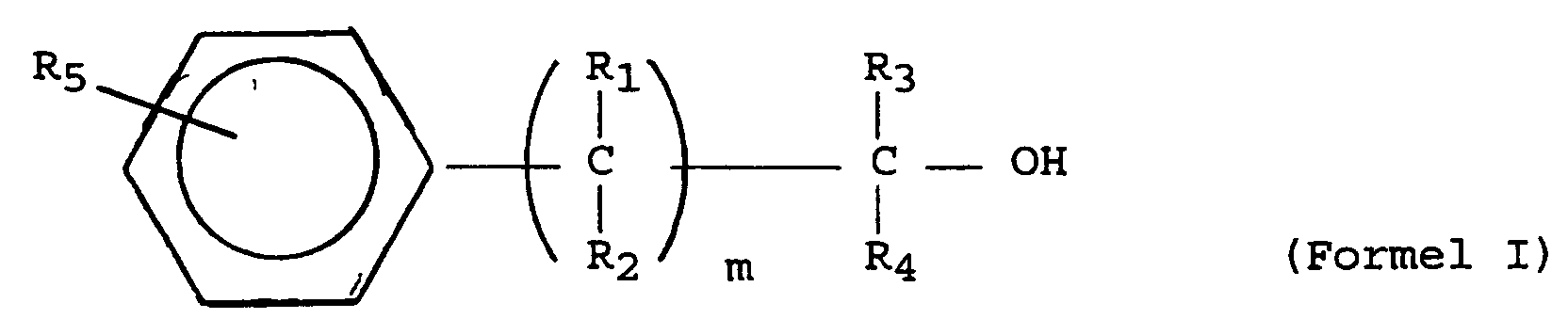





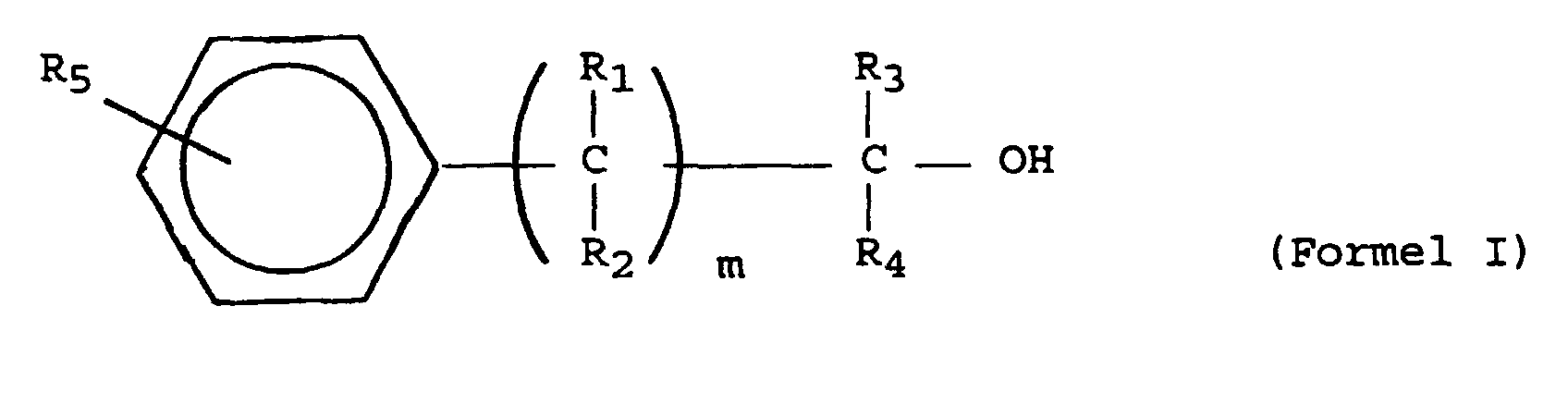 R1 bis R5 Wasserstoff, eine lineare und/oder verzweigte C1-C4-Alkylgruppe undm eine ganze Zahl zwischen 0 und 4 bedeuten, wobei jedoch R1 bis R5 nicht gleichzeitig Wasserstoff ist.
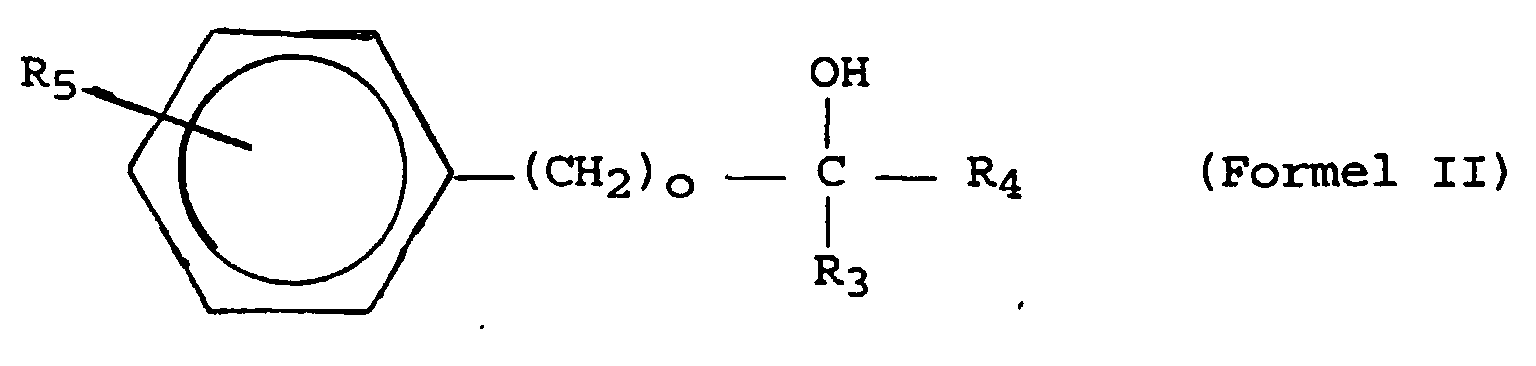 R3, R4, R5 ein Wasserstoff und/oder eine lineare oder verzweigte C1-C4-Alkylgruppe, jedoch gleichzeitig nicht alle Wasserstoff undo eine ganze Zahl zwischen 0 und 4 bedeuten.
 R1 bis R5 Wasserstoff, eine lineare und/oder verzweigte C1-C4-Alkylgruppe undm eine ganze Zahl zwischen 0 und 4 bedeuten, wobei jedoch R1 bis R5 nicht gleichzeitig Wasserstoff ist.
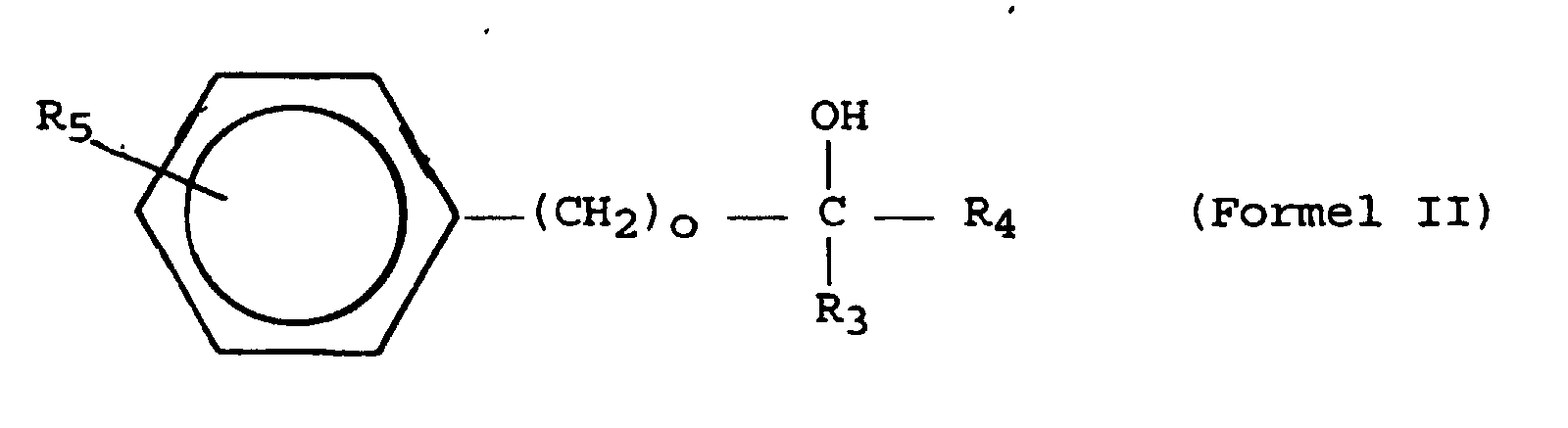 R3, R4, R5 ein Wasserstoff und/oder eine lineare oder verzweigte C1-C4-Alkylgruppe, jedoch gleichzeitig nicht alle Wasserstoff undo eine ganze Zahl zwischen 0 und 4 bedeuten.