EP0906378B2 - Reaktive schmelzklebstoff-zusammensetzung für isolierglas - Google Patents
Reaktive schmelzklebstoff-zusammensetzung für isolierglas Download PDFInfo
- Publication number
- EP0906378B2 EP0906378B2 EP97928165A EP97928165A EP0906378B2 EP 0906378 B2 EP0906378 B2 EP 0906378B2 EP 97928165 A EP97928165 A EP 97928165A EP 97928165 A EP97928165 A EP 97928165A EP 0906378 B2 EP0906378 B2 EP 0906378B2
- Authority
- EP
- European Patent Office
- Prior art keywords
- sheets
- sheet
- adhesive composition
- silane
- group
- Prior art date
- Legal status (The legal status is an assumption and is not a legal conclusion. Google has not performed a legal analysis and makes no representation as to the accuracy of the status listed.)
- Expired - Lifetime
Links
- 239000000203 mixture Substances 0.000 title claims abstract description 28
- 239000000853 adhesive Substances 0.000 title abstract description 18
- 230000001070 adhesive effect Effects 0.000 title abstract description 18
- 239000011230 binding agent Substances 0.000 claims abstract description 21
- 229920002367 Polyisobutene Polymers 0.000 claims abstract description 16
- 229920013639 polyalphaolefin Polymers 0.000 claims abstract description 15
- 238000000034 method Methods 0.000 claims abstract description 14
- 229920002857 polybutadiene Polymers 0.000 claims abstract description 11
- 229920005549 butyl rubber Polymers 0.000 claims abstract description 10
- 150000001993 dienes Chemical class 0.000 claims abstract description 8
- 229920001083 polybutene Polymers 0.000 claims abstract description 6
- 229920006132 styrene block copolymer Polymers 0.000 claims abstract description 5
- 239000011521 glass Substances 0.000 claims description 39
- XLYOFNOQVPJJNP-UHFFFAOYSA-N water Substances O XLYOFNOQVPJJNP-UHFFFAOYSA-N 0.000 claims description 16
- 239000004831 Hot glue Substances 0.000 claims description 12
- 239000011159 matrix material Substances 0.000 claims description 11
- 229920001577 copolymer Polymers 0.000 claims description 8
- 230000004888 barrier function Effects 0.000 claims description 7
- 229920001971 elastomer Polymers 0.000 claims description 7
- 230000002093 peripheral effect Effects 0.000 claims description 7
- 239000005060 rubber Substances 0.000 claims description 7
- 125000004432 carbon atom Chemical group C* 0.000 claims description 6
- 239000012080 ambient air Substances 0.000 claims description 4
- 238000010438 heat treatment Methods 0.000 claims description 4
- 239000000126 substance Substances 0.000 claims description 4
- 125000000217 alkyl group Chemical group 0.000 claims description 2
- 125000003710 aryl alkyl group Chemical group 0.000 claims description 2
- 125000003118 aryl group Chemical group 0.000 claims description 2
- 125000002887 hydroxy group Chemical group [H]O* 0.000 claims description 2
- 238000010521 absorption reaction Methods 0.000 claims 2
- 229920000642 polymer Polymers 0.000 abstract description 16
- 125000006850 spacer group Chemical group 0.000 abstract description 15
- 238000004519 manufacturing process Methods 0.000 abstract description 11
- 239000002131 composite material Substances 0.000 abstract description 10
- 239000000565 sealant Substances 0.000 abstract description 10
- 239000005062 Polybutadiene Substances 0.000 abstract description 6
- 239000000463 material Substances 0.000 abstract description 6
- 238000004064 recycling Methods 0.000 abstract description 3
- 239000004033 plastic Substances 0.000 abstract description 2
- 229920003023 plastic Polymers 0.000 abstract description 2
- 239000002184 metal Substances 0.000 abstract 1
- 239000010410 layer Substances 0.000 description 11
- 239000004014 plasticizer Substances 0.000 description 10
- 238000006243 chemical reaction Methods 0.000 description 6
- 238000004132 cross linking Methods 0.000 description 5
- 239000002274 desiccant Substances 0.000 description 5
- 239000007789 gas Substances 0.000 description 5
- RRHGJUQNOFWUDK-UHFFFAOYSA-N Isoprene Chemical compound CC(=C)C=C RRHGJUQNOFWUDK-UHFFFAOYSA-N 0.000 description 4
- BLRPTPMANUNPDV-UHFFFAOYSA-N Silane Chemical compound [SiH4] BLRPTPMANUNPDV-UHFFFAOYSA-N 0.000 description 4
- 239000000945 filler Substances 0.000 description 4
- 239000002808 molecular sieve Substances 0.000 description 4
- 230000035699 permeability Effects 0.000 description 4
- 238000007789 sealing Methods 0.000 description 4
- URGAHOPLAPQHLN-UHFFFAOYSA-N sodium aluminosilicate Chemical compound [Na+].[Al+3].[O-][Si]([O-])=O.[O-][Si]([O-])=O URGAHOPLAPQHLN-UHFFFAOYSA-N 0.000 description 4
- 244000043261 Hevea brasiliensis Species 0.000 description 3
- VQTUBCCKSQIDNK-UHFFFAOYSA-N Isobutene Chemical compound CC(C)=C VQTUBCCKSQIDNK-UHFFFAOYSA-N 0.000 description 3
- 239000003570 air Substances 0.000 description 3
- 125000003545 alkoxy group Chemical group 0.000 description 3
- 239000003054 catalyst Substances 0.000 description 3
- 150000001875 compounds Chemical class 0.000 description 3
- 238000009413 insulation Methods 0.000 description 3
- 238000002156 mixing Methods 0.000 description 3
- 229920003052 natural elastomer Polymers 0.000 description 3
- 229920001194 natural rubber Polymers 0.000 description 3
- 238000002360 preparation method Methods 0.000 description 3
- 229920001169 thermoplastic Polymers 0.000 description 3
- VXNZUUAINFGPBY-UHFFFAOYSA-N 1-Butene Chemical compound CCC=C VXNZUUAINFGPBY-UHFFFAOYSA-N 0.000 description 2
- KAKZBPTYRLMSJV-UHFFFAOYSA-N Butadiene Chemical compound C=CC=C KAKZBPTYRLMSJV-UHFFFAOYSA-N 0.000 description 2
- PPBRXRYQALVLMV-UHFFFAOYSA-N Styrene Chemical compound C=CC1=CC=CC=C1 PPBRXRYQALVLMV-UHFFFAOYSA-N 0.000 description 2
- 239000002318 adhesion promoter Substances 0.000 description 2
- 230000002411 adverse Effects 0.000 description 2
- 230000032683 aging Effects 0.000 description 2
- XAGFODPZIPBFFR-UHFFFAOYSA-N aluminium Chemical compound [Al] XAGFODPZIPBFFR-UHFFFAOYSA-N 0.000 description 2
- 229910052782 aluminium Inorganic materials 0.000 description 2
- 235000012211 aluminium silicate Nutrition 0.000 description 2
- 150000001412 amines Chemical class 0.000 description 2
- 238000010276 construction Methods 0.000 description 2
- 230000000694 effects Effects 0.000 description 2
- 125000001301 ethoxy group Chemical group [H]C([H])([H])C([H])([H])O* 0.000 description 2
- 125000000956 methoxy group Chemical group [H]C([H])([H])O* 0.000 description 2
- 150000001282 organosilanes Chemical class 0.000 description 2
- XNGIFLGASWRNHJ-UHFFFAOYSA-L phthalate(2-) Chemical compound [O-]C(=O)C1=CC=CC=C1C([O-])=O XNGIFLGASWRNHJ-UHFFFAOYSA-L 0.000 description 2
- 239000011814 protection agent Substances 0.000 description 2
- 150000004756 silanes Chemical class 0.000 description 2
- 230000035882 stress Effects 0.000 description 2
- -1 tackifiers Substances 0.000 description 2
- 229920006250 telechelic polymer Polymers 0.000 description 2
- 239000004416 thermosoftening plastic Substances 0.000 description 2
- 239000003039 volatile agent Substances 0.000 description 2
- 239000010457 zeolite Substances 0.000 description 2
- 239000004971 Cross linker Substances 0.000 description 1
- 229920002943 EPDM rubber Polymers 0.000 description 1
- 239000004593 Epoxy Substances 0.000 description 1
- VGGSQFUCUMXWEO-UHFFFAOYSA-N Ethene Chemical compound C=C VGGSQFUCUMXWEO-UHFFFAOYSA-N 0.000 description 1
- 239000005977 Ethylene Substances 0.000 description 1
- 229920000181 Ethylene propylene rubber Polymers 0.000 description 1
- UFHFLCQGNIYNRP-UHFFFAOYSA-N Hydrogen Chemical compound [H][H] UFHFLCQGNIYNRP-UHFFFAOYSA-N 0.000 description 1
- 229920002633 Kraton (polymer) Polymers 0.000 description 1
- LSDPWZHWYPCBBB-UHFFFAOYSA-N Methanethiol Chemical compound SC LSDPWZHWYPCBBB-UHFFFAOYSA-N 0.000 description 1
- 239000004825 One-part adhesive Substances 0.000 description 1
- 229910008051 Si-OH Inorganic materials 0.000 description 1
- 229910006358 Si—OH Inorganic materials 0.000 description 1
- 229910000831 Steel Inorganic materials 0.000 description 1
- ATJFFYVFTNAWJD-UHFFFAOYSA-N Tin Chemical compound [Sn] ATJFFYVFTNAWJD-UHFFFAOYSA-N 0.000 description 1
- 230000006750 UV protection Effects 0.000 description 1
- 229910021536 Zeolite Inorganic materials 0.000 description 1
- 125000003668 acetyloxy group Chemical group [H]C([H])([H])C(=O)O[*] 0.000 description 1
- 239000000654 additive Substances 0.000 description 1
- 239000012790 adhesive layer Substances 0.000 description 1
- 125000003368 amide group Chemical group 0.000 description 1
- 125000003277 amino group Chemical group 0.000 description 1
- 230000003712 anti-aging effect Effects 0.000 description 1
- 239000003963 antioxidant agent Substances 0.000 description 1
- 150000007860 aryl ester derivatives Chemical class 0.000 description 1
- 239000012965 benzophenone Substances 0.000 description 1
- 150000008366 benzophenones Chemical class 0.000 description 1
- 150000001565 benzotriazoles Chemical class 0.000 description 1
- 229920001400 block copolymer Polymers 0.000 description 1
- DQXBYHZEEUGOBF-UHFFFAOYSA-N but-3-enoic acid;ethene Chemical compound C=C.OC(=O)CC=C DQXBYHZEEUGOBF-UHFFFAOYSA-N 0.000 description 1
- 239000006229 carbon black Substances 0.000 description 1
- 235000019241 carbon black Nutrition 0.000 description 1
- 229910010293 ceramic material Inorganic materials 0.000 description 1
- 239000003795 chemical substances by application Substances 0.000 description 1
- 238000003776 cleavage reaction Methods 0.000 description 1
- 238000009833 condensation Methods 0.000 description 1
- 230000005494 condensation Effects 0.000 description 1
- 239000000470 constituent Substances 0.000 description 1
- 230000008602 contraction Effects 0.000 description 1
- 238000007796 conventional method Methods 0.000 description 1
- 238000001816 cooling Methods 0.000 description 1
- 239000003431 cross linking reagent Substances 0.000 description 1
- 239000013078 crystal Substances 0.000 description 1
- 230000001627 detrimental effect Effects 0.000 description 1
- 238000009792 diffusion process Methods 0.000 description 1
- HNPSIPDUKPIQMN-UHFFFAOYSA-N dioxosilane;oxo(oxoalumanyloxy)alumane Chemical compound O=[Si]=O.O=[Al]O[Al]=O HNPSIPDUKPIQMN-UHFFFAOYSA-N 0.000 description 1
- 238000005538 encapsulation Methods 0.000 description 1
- 239000005038 ethylene vinyl acetate Substances 0.000 description 1
- 239000011888 foil Substances 0.000 description 1
- 238000009472 formulation Methods 0.000 description 1
- 125000000524 functional group Chemical group 0.000 description 1
- 230000007062 hydrolysis Effects 0.000 description 1
- 238000006460 hydrolysis reaction Methods 0.000 description 1
- 230000003301 hydrolyzing effect Effects 0.000 description 1
- 239000011261 inert gas Substances 0.000 description 1
- 239000004615 ingredient Substances 0.000 description 1
- 238000001746 injection moulding Methods 0.000 description 1
- 239000004611 light stabiliser Substances 0.000 description 1
- 239000007788 liquid Substances 0.000 description 1
- 229920002521 macromolecule Polymers 0.000 description 1
- 239000012778 molding material Substances 0.000 description 1
- XNGIFLGASWRNHJ-UHFFFAOYSA-N o-dicarboxybenzene Natural products OC(=O)C1=CC=CC=C1C(O)=O XNGIFLGASWRNHJ-UHFFFAOYSA-N 0.000 description 1
- 150000002894 organic compounds Chemical class 0.000 description 1
- 150000003961 organosilicon compounds Chemical class 0.000 description 1
- 125000003544 oxime group Chemical group 0.000 description 1
- 150000002989 phenols Chemical class 0.000 description 1
- 229920001200 poly(ethylene-vinyl acetate) Polymers 0.000 description 1
- 229920001195 polyisoprene Polymers 0.000 description 1
- 229920000098 polyolefin Polymers 0.000 description 1
- 239000005077 polysulfide Substances 0.000 description 1
- 229920001021 polysulfide Polymers 0.000 description 1
- 150000008117 polysulfides Polymers 0.000 description 1
- 229920002635 polyurethane Polymers 0.000 description 1
- 239000004814 polyurethane Substances 0.000 description 1
- 239000000843 powder Substances 0.000 description 1
- QQONPFPTGQHPMA-UHFFFAOYSA-N propylene Natural products CC=C QQONPFPTGQHPMA-UHFFFAOYSA-N 0.000 description 1
- 125000004805 propylene group Chemical group [H]C([H])([H])C([H])([*:1])C([H])([H])[*:2] 0.000 description 1
- 150000003839 salts Chemical class 0.000 description 1
- 230000007017 scission Effects 0.000 description 1
- 229910000077 silane Inorganic materials 0.000 description 1
- 229920002379 silicone rubber Polymers 0.000 description 1
- 125000005373 siloxane group Chemical group [SiH2](O*)* 0.000 description 1
- 239000002904 solvent Substances 0.000 description 1
- 239000004071 soot Substances 0.000 description 1
- 238000001179 sorption measurement Methods 0.000 description 1
- 239000010959 steel Substances 0.000 description 1
- 238000012721 stereospecific polymerization Methods 0.000 description 1
- 238000003860 storage Methods 0.000 description 1
- 229920001897 terpolymer Polymers 0.000 description 1
- 229920001187 thermosetting polymer Polymers 0.000 description 1
- 150000003568 thioethers Chemical class 0.000 description 1
- 229920000428 triblock copolymer Polymers 0.000 description 1
Classifications
-
- C—CHEMISTRY; METALLURGY
- C09—DYES; PAINTS; POLISHES; NATURAL RESINS; ADHESIVES; COMPOSITIONS NOT OTHERWISE PROVIDED FOR; APPLICATIONS OF MATERIALS NOT OTHERWISE PROVIDED FOR
- C09J—ADHESIVES; NON-MECHANICAL ASPECTS OF ADHESIVE PROCESSES IN GENERAL; ADHESIVE PROCESSES NOT PROVIDED FOR ELSEWHERE; USE OF MATERIALS AS ADHESIVES
- C09J115/00—Adhesives based on rubber derivatives
-
- C—CHEMISTRY; METALLURGY
- C09—DYES; PAINTS; POLISHES; NATURAL RESINS; ADHESIVES; COMPOSITIONS NOT OTHERWISE PROVIDED FOR; APPLICATIONS OF MATERIALS NOT OTHERWISE PROVIDED FOR
- C09J—ADHESIVES; NON-MECHANICAL ASPECTS OF ADHESIVE PROCESSES IN GENERAL; ADHESIVE PROCESSES NOT PROVIDED FOR ELSEWHERE; USE OF MATERIALS AS ADHESIVES
- C09J119/00—Adhesives based on rubbers, not provided for in groups C09J107/00 - C09J117/00
- C09J119/006—Rubber characterised by functional groups, e.g. telechelic diene polymers
-
- C—CHEMISTRY; METALLURGY
- C09—DYES; PAINTS; POLISHES; NATURAL RESINS; ADHESIVES; COMPOSITIONS NOT OTHERWISE PROVIDED FOR; APPLICATIONS OF MATERIALS NOT OTHERWISE PROVIDED FOR
- C09J—ADHESIVES; NON-MECHANICAL ASPECTS OF ADHESIVE PROCESSES IN GENERAL; ADHESIVE PROCESSES NOT PROVIDED FOR ELSEWHERE; USE OF MATERIALS AS ADHESIVES
- C09J123/00—Adhesives based on homopolymers or copolymers of unsaturated aliphatic hydrocarbons having only one carbon-to-carbon double bond; Adhesives based on derivatives of such polymers
- C09J123/26—Adhesives based on homopolymers or copolymers of unsaturated aliphatic hydrocarbons having only one carbon-to-carbon double bond; Adhesives based on derivatives of such polymers modified by chemical after-treatment
-
- C—CHEMISTRY; METALLURGY
- C09—DYES; PAINTS; POLISHES; NATURAL RESINS; ADHESIVES; COMPOSITIONS NOT OTHERWISE PROVIDED FOR; APPLICATIONS OF MATERIALS NOT OTHERWISE PROVIDED FOR
- C09J—ADHESIVES; NON-MECHANICAL ASPECTS OF ADHESIVE PROCESSES IN GENERAL; ADHESIVE PROCESSES NOT PROVIDED FOR ELSEWHERE; USE OF MATERIALS AS ADHESIVES
- C09J143/00—Adhesives based on homopolymers or copolymers of compounds having one or more unsaturated aliphatic radicals, each having only one carbon-to-carbon double bond, and containing boron, silicon, phosphorus, selenium, tellurium, or a metal; Adhesives based on derivatives of such polymers
- C09J143/04—Homopolymers or copolymers of monomers containing silicon
-
- C—CHEMISTRY; METALLURGY
- C08—ORGANIC MACROMOLECULAR COMPOUNDS; THEIR PREPARATION OR CHEMICAL WORKING-UP; COMPOSITIONS BASED THEREON
- C08L—COMPOSITIONS OF MACROMOLECULAR COMPOUNDS
- C08L2666/00—Composition of polymers characterized by a further compound in the blend, being organic macromolecular compounds, natural resins, waxes or and bituminous materials, non-macromolecular organic substances, inorganic substances or characterized by their function in the composition
- C08L2666/02—Organic macromolecular compounds, natural resins, waxes or and bituminous materials
- C08L2666/04—Macromolecular compounds according to groups C08L7/00 - C08L49/00, or C08L55/00 - C08L57/00; Derivatives thereof
Definitions
- the invention relates to two-pane or multi-pane insulating glass and method for its production.
- Multi-pane insulating glass systems are known to consist of two or more glass panes arranged in parallel, which are connected in its edge region so that the space enclosed by the discs is sealed from the ambient air so that moisture can not penetrate into this space. Furthermore, the edge bond is designed so that it withstands all mechanical and chemical stresses resulting from changing climatic loads. In many cases, this gap is filled with dry gases, which cause an increase in thermal insulation or increase the sound insulation against air filling.
- the spacer In the commercially available insulating glass arrangements, rigid spacers provide the desired spacing between the glass panes.
- the spacer consists of an aluminum or sheet steel hollow profile. It is located near the edges of the glass sheets so that the spacer together with the edge portions of the glass sheet form an outwardly facing channel for receiving sealants and adhesives.
- the side of the spacer facing the interspace between the glass panes has small openings and the cavity of the spacer arm is used to receive a desiccant for adsorbing the moisture and possibly existing solvent residues in the air or gas space between the panes. This prevents moisture from condensing on the inside of the insulating glass panes at low ambient temperatures.
- a sealant with high water vapor barrier effect In high-quality insulating glass systems is located between the glass panes facing surfaces of the spacer and the glass surface, a sealant with high water vapor barrier effect.
- formulations based on polyisobutylene and / or butyl rubber are used for this purpose.
- the channel formed by the outwardly directed surface of the spacer and the edge regions of the glass panes is usually filled with a two-component adhesive / sealant, which achieves a sufficient strength combination of the insulating glass arrangement.
- this adhesive / sealant must have good adhesion to the discs and also be resilient enough to withstand the expansion or contraction movements of the glass panes with changing climatic conditions.
- system Biver consists for example of a thermoplastic inner strand whose polymer component is preferably composed of polyisobutylene or butyl rubber and which contains a molecular sieve for the adsorption of moisture.
- This strand is facing the space between the panes and is first extruded onto a pane, then the second pane is positioned above it and the two panes are then pressed together to the predetermined distance. Thereafter, the outer edge region is sealed by a generally two-component adhesive / sealant.
- the inner strand of the thermoplastic polymer takes over the function of the spacer as well as the desiccant carrier and also serves as the main water vapor barrier.
- the outer, usually two-component adhesive / sealant provides the mechanical strength of the insulating glass composite system.
- This system is described in numerous patents / applications, for example in US Pat DE-C-2555381 . DE-A-2555383 . DE-A-2555384 as well as the EP-A-176388 ,
- the DE-A-4407892 describes a method for producing insulating glass composite systems in which the two or more glass sheets arranged in parallel are kept at a distance and bordered at their peripheral edge with a molded-on distance frame. It is said that the material used for encapsulation should be a thermoset, thermoplastic or ceramic material. Information about the composition of the injection molding material are not to be found in this document, nor are statements made as to whether and how the gas or the air can be kept dry in the space between the glass sheets.
- the EP-A-517 067 describes a deformable belt-shaped extrudate for sealing and maintaining the distance between two insulating glass panes.
- this deformable strip consists of a flow-resistant polymer matrix, which contains in its center a wave-shaped sheet, whose planar expansion is perpendicular to the glass sheets and in intimate contact with the polymer matrix.
- This wavy planar structure has the function of the spacer and also serves as a water vapor barrier.
- the volume of the polymer matrix facing the space between the panes preferably contains a desiccant.
- a "semi-interpenetrating network" consisting of a butyl rubber and a slightly crosslinked polyisobutylene is proposed.
- the preformed deformable sealing strip by coextrusion generates the polymer matrices and the wavy planar structure.
- This preformed sealing tape is then placed on one of the discs, the second is positioned over it and the two discs are pressed together. Since no further curing process takes place after application, the edge region between the sealant strip and the glass pane tends to flow in a cold manner.
- the DE-A-3843400 describes an insulating glass pane, which consists of two individual glass panes, which are edge-connected by a plastic spacer.
- This spacer consists of two or more different layers, of which the inner layer defines the disc interior and is formed of a cured adhesive containing a moisture-absorbing substance and the outer layer is formed by a cured adhesive, which of the inner layer forming adhesive is different.
- the inner layer of the adhesive consists of polymers with a higher water vapor permeability, this layer may additionally contain a powdered desiccant, such as molecular sieve, while the outer adhesive layer should have a low specific water vapor permeability than the inner layer.
- the WO 95/13449 describes for this purpose prefabricated sealing profiles, which consists of a fully or partially crosslinked polyisobutylene copolymer as a polymer matrix and contains an aluminum foil as a water vapor diffusion barrier.
- a disadvantage of this system is that the spacer system is made up of several different layers, which is both expensive to manufacture and unfavorable for disposal and / or recycling.
- the EP-A-232873 describes sealants for the production of spacer-free Isolierglassysteme based on 20 to 80 wt.% Epoxidierem natural rubber, 5 to 30 wt.% Of at least one other epoxy compound and a Trialkoxysilyl phenomenon-bearing amine or mercaptan as a crosslinking agent and conventional additives such as adhesion promoters, tackifiers, plasticizers, fillers , Desiccants, aging and UV protection agents.
- insulating glass composite systems based on this have excellent aging resistance, their decisive disadvantage is that they can only be prepared as two-component systems, with the two reactive components only being able to be mixed immediately before application.
- multi-pane insulating glass composite systems can be produced in a particularly cost-effective manner, if hot melt adhesive compositions are used which contain a mixture of at least one reactive and at least one non-reactive binder, wherein at least one reactive binder of silane-functional polyisobutylene and / or silane-functional hydrogenated polybutadiene and / or silane-functional poly- ⁇ -olefin and the one or more non-reactive binder from the group of butyl rubbers, poly- ⁇ -olefins, polybutenes, rubbers based on styrene block copolymers, rubbers based on random diene homo- and / or copolymers are selected.
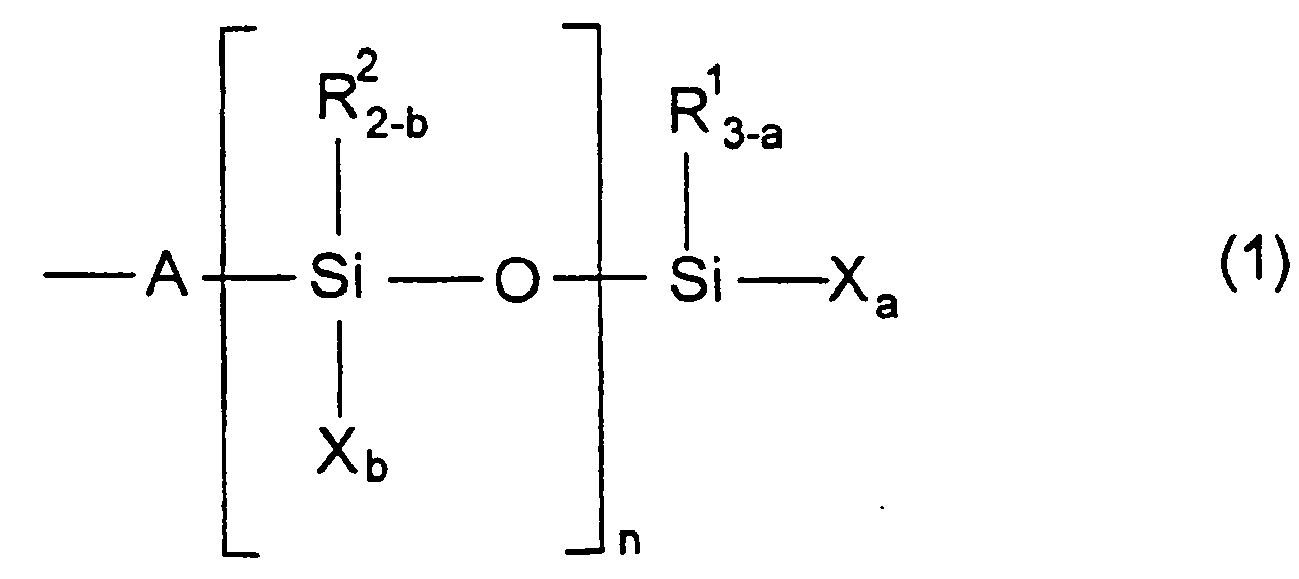
- the preferred silane-functional groups of the reactive binder (s) can be represented by the formula (1): it can -A- - (CH 2 ) m - (2) -S- (CH 2 ) m - (3) and R 1 and R 2 may be the same and different and be an alkyl group having 1 to 20 carbon atoms, an aryl group having 6 to 20 carbon atoms or an arylalkyl group having 7 to 20 carbon atoms, X may be a hydroxyl group or a hydrolyzable group, a is an integer between 0 and 3 and b is 0, 1 or 2, where the sum of a and b is greater than or equal to 1 and n is an integer between 0 and 18.
- m is an integer between 0 and 4 and R 3 is - (CH 2 ) m - or
- the reactive binder (s) contain at least one silane-functional group of the formula (1), preferably containing on average between 1 and 3 silane-functional groups per molecule.
- the silane-functional groups are either located at the ends of the macromolecule (telechelic polymers) or they are randomly distributed over the polymer chain.
- Suitable hydrolyzable groups X are all hydrolysable groups known per se; examples which may be mentioned here include alkoxy groups, acetoxy groups, amino groups, oxime groups, amide groups.
- alkoxy groups are used as hydrolyzable groups, most preferably the methoxy or the ethoxy group.
- silane-functional polyisobutylenes, silane-functional polybutadienes or silane-functional poly- ⁇ -olefins are prepared in a conventional manner, wherein in the first stage usually a telechelic polymer with olefinically unsaturated end groups is formed, which in a subsequent reaction with organosilicon compounds to silane-functional polyisobutylene, hydrogenated polybutadiene or poly- ⁇ -olefin is reacted.
- the various types of this preparation of silane-functional polyisobutylenes or polybutadienes are described, for example, in the following patent applications: EP-A-287 025 . EP-A-452 875 . EP-A-434840 , EP-A-252372 . EP-A-79456 . EP-A-537 660 ,
- silane-functional binder Another possibility for the preparation of the silane-functional binder is that the non-functional polyisobutylenes, hydrogenated polybutadienes or poly- ⁇ -olefins are reacted in a grafting reaction according to a conventional method with corresponding organofunctional silanes. Naturally, the silane groups are randomly distributed in the polymer chain.
- any kautsckuk shame polymer without functional groups can be used for the non-reactive binder, but since the overall composition should preferably be used for the production of spacer-free insulating glass edge bonds, also the non-reactive binder should be selected from those polymers which have a low gas permeability and in particular a ensure low water vapor permeability for the entire composite.
- the non-reactive binders can be selected from the group of poly- ⁇ -olefins, rubbers based on styrene block copolymers, rubbers based on random diene homo- and / or copolymers, and in particular polybutenes or butyl rubbers.
- ethylene-propylene elastomers e.g. Ethylene-propylene copolymers
- terpolymers of ethylene and propylene with a non-conjugated diene EPDM
- propene-butene copolymers and ethylene vinyl acetate are also suitable.
- the rubbers based on styrene block copolymers are the di- or triblock copolymers of styrene with a diene such as butadiene or isoprene, as described, for example, under the trade name Kraton of The company Shell are available. It is also possible to use the hydrogenated or partially hydrogenated block copolymers.
- random diene homo- and copolymers examples include polybutadiene, polyisoprene, their copolymers and Styrolbutadiencopolymere, Acrylnitrilbutadiencopolymere and the partially hydrogenated or fully hydrogenated diene polymers of the latter group.
- Natural rubber or in particular epoxidized natural rubber can likewise be used as non-reactive binder.
- the polybutenes and / or polyisobutene are most preferred.
- the polyolefins prepared by stereospecific polymerization of 1-butene or isobutene, and the butyl rubbers, i. Copolymers of isobutylene with isoprene are most preferred.
- suitable plasticizers are the per se known phthalate plasticizers based on phthalic acid alkyl or aryl esters, provided that their volatiles are so low that these plasticizers cause no fogging and the phthalate plasticizers are also compatible with the binder system, i. do not tend to exude.
- liquid polybutenes and polyisobutenes are particularly suitable as plasticizers.
- the hotmelt adhesive compositions used may further contain components known per se, in particular water-binding fillers, preferably the 3 A-type zeolites known as molecular sieves in powder form; furthermore, finely divided inert fillers, e.g. ground or precipitated chalks, kaolins, clays and carbon blacks are used.
- the chalks, kaolins or clays can be used both in their superficially hydrophobicized form or even without surface pretreatment.
- compositions contain organofunctional silanes as adhesion promoters and / or crosslinkers, these include, for example, 3-acryloxypropyltrialkoxysilane, 3-aminopropyltrialkoxysilane, vinyltrialkoxysilane, N-aminoethyl-3-aminopropyl-methyldialkoxysilane, phenylaminopropyltrialkoxysilane, aminoalkyltrialkoxydisilane or i-butylmethoxysilane , As the alkoxy group, the methoxy or ethoxy group are particularly preferred.
- Catalysts which can be used are all known compounds which can catalyze the hydrolytic cleavage of the hydrolyzable groups of the silane groups and the subsequent condensation of the Si-OH group to form siloxane groups (crosslinking reaction or adhesion-promoting function). Very particular preference is given here to the organic compounds of 2- and 4-valent tin.
- any anti-aging agents depends on the composition of the binder, it can here antioxidants of the type of hindered phenols, thioethers or high molecular weight mercapto compounds are used, UV protectants of the type of known benzotriazoles, benzophenones or the type of HALS (Hindered Amine Light Stabilizer). It may prove convenient to add known antiozonants, in exceptional cases, the addition of hydrolysis protection agents may be necessary.
- a particular advantage is that all previous steps for the production of a conventional marginal adhesive edge composite can be combined in one operation.
- Another advantage is that such a system, since it consists of only one material, after disassembly of the insulating glass unit at the end of the Life cycle can be fed to a recycling process, since it is not as in the prior art is a composite material of different composite polymer matrices.
- compositions used consist of (a) silane-functional polyisobutylene, silane-functional hydrogenated polybutadiene or silane-functional poly- ⁇ -olefin 20-70% by weight (b) butyl rubber 5-30% by weight (c) poly- ⁇ -olefin 5-30% by weight (d) Zeolite 3A molecular sieve 20-30% by weight (e) soot 5-30% by weight (f) catalyst 0.1-2% by weight (g) organosilane 0.1-2% by weight.
- compositions can be prepared by methods known per se by mixing the components to homogeneity under high shear and optionally under vacuum or inert gas. Possibly. must be heated or cooled during the mixing process. Since the hot melt adhesive compositions react with moisture to form crosslinking, the compositions must be protected from moisture by the user until they are finally applied to ensure adequate storage stability.
- component A consists of components (a) to (g) and component B consists of a water-containing paste, the water optionally being in the form of water-donating compounds in this paste, e.g. Crystal water-containing salts.
- the compositions are optionally injected with heating and profiling by means of an extruder-like applicator in the peripheral edge of the discs.
- the edge bond already acquires a first strength which is sufficient to immediately further process, transport or store the insulating glass units.
- Ultimate strength is achieved by the crosslinking process of the reactive binder reactive silane moieties in combination with the added organosilane by reaction with moisture from the disk space and / or ambient air.
- the hot melt adhesive is optionally applied with heating and profiling on the peripheral edge of a disc, the second or further disc is positioned over the first disc, that the discs are arranged congruently one above the other. Subsequently, the discs are pressed together so that the adhesive completely wets the peripheral edges of both or all discs and the predetermined disc spacing is achieved. Also in this embodiment, the initial strength of the edge bond is achieved by the cooling process, while the final strength is achieved by crosslinking with moisture.
- the mixing of the two components of the two-component hot melt adhesives takes place immediately before the application steps just described, the final strength of the edge bond is achieved faster in this embodiment than in the one-component version.
Landscapes
- Chemical & Material Sciences (AREA)
- Organic Chemistry (AREA)
- Chemical Kinetics & Catalysis (AREA)
- General Chemical & Material Sciences (AREA)
- Adhesives Or Adhesive Processes (AREA)
- Joining Of Glass To Other Materials (AREA)
- Sealing Material Composition (AREA)
- Inorganic Insulating Materials (AREA)
Description
- Die Erfindung betrifft Zwei- oder Mehrscheiben-Isolierglas sowie Verfahren zu dessen Herstellung.
- Isoliergläser haben sich im Bauwesen und zum großen Teil auch im Fahrzeugbau aufgrund ihrer Vorzüge weitgehend durchgesetzt. Besonders hervorzuheben sind die verbesserte Wärme- und Geräuschdämmung gegenüber Einfachverglasungen. Mehrscheiben-Isolierglassysteme bestehen bekanntermaßen aus zwei oder mehr parallel angeordneten Glasscheiben, die in ihrem Randbereich so verbunden sind, daß der durch die Scheiben eingeschlossene Zwischenraum so gegen die Umgebungsluft abgedichtet ist, daß keine Feuchtigkeit in diesen Zwischenraum eindringen kann. Weiterhin ist der Randverbund so ausgebildet, daß er allen durch wechselnde Klimabelastungen entstehenden mechanischen und chemischen Beanspruchungen standhält. In vielen Fällen ist dieser Zwischenraum auch mit trockenen Gasen gefüllt, die eine Erhöhung der Wärmedämmung bzw. Erhöhung der Schalldämmung gegenüber Luftfüllung bewirken.
- Bei den handelsüblichen Isolierglasanordnungen sorgen starre Abstandshalter fiir den gewünschten Abstand zwischen den Glasscheiben. In der häufigsten Ausführungsform besteht der Abstandshalter aus einem Aluminium- oder Stahlblechhohlprofil. Er ist in der Nähe der Ränder der Glasscheiben so angeordnet, daß der Abstandshalter zusammen mit den Randbereichen der Glasscheibe eine nach außen weisende Rinne zur Aufnahme von Dicht- und Klebstoffen bilden. Üblicherweise weist die dem Zwischenraum zwischen den Glasscheiben zugewandte Seite des Abstandshalters kleine Öffnungen auf und der Hohlraum des Abstandshaiters dient zur Aufnahme eines Trockenmittels zur Adsorption der Feuchtigkeit und eventuell vorhandenen Lösungsmittelresten in dem Luft- bzw. Gasraum zwischen den Scheiben. Dadurch wird verhindert, daß sich an der Innenseite der Isolierglasscheiben bei niedrigen Umgebungstemperaturen Feuchtigkeit kondensiert. Bei hochwertigen Isolierglassystemen befindet sich zwischen den den Glasscheiben zugewandten Flächen des Abstandshalters und der Glasoberfläche ein Dichtstoff mit hoher Wasserdampfsperrwirkung. Hierfür kommen in der Regel Formulierungen auf der Basis von Polyisobutylen und/oder Butylkautschuk zur Anwendung. Die durch die nach außen gerichtete Fläche des Abstandshalters und die Randbereiche der Glasscheiben gebildete Rinne wird in der Regel mit einem zweikomponentigen Kleb-/Dichtstoff ausgefüllt, der einen ausreichenden Festigkeitsverbund der Isolierglasanordnung erzielt. Dabei muß dieser Kleb-/Dichtstoff eine gute Haftung zu den Scheiben haben und außerdem elastisch genug sein, um die Expansions- bzw. Kontraktionsbewegungen der Glasscheiben bei wechselnden Klimaeinwirkungen standzuhalten.
- Die Herstellung derartiger hochwertiger Isolierglasanordnungen besteht daher naturgemäß aus einer Reihe von komplexen Arbeitsabläufen und ist trotz hohen Automatisierungsgrades bei großen Fertigungsstraßen sehr kostenintensiv. Es hat daher in der Vergangenheit nicht an Versuchen gefehlt, die komplexen Arbeitsabläufe zur Herstellung von Isoliergläsern zu vereinfachen, insbesondere ohne vorprofilierte Abstandshalter auszukommen.
- Das sogenannte "System Biver" besteht beispielsweise aus einem thermoplastischen inneren Strang, dessen Polymerbestandteil vorzugsweise aus Polyisobutylen bzw. Butylkautschuk aufgebaut ist und der ein Molekularsieb zur Adsorption von Feuchtigkeit enthält. Dieser Strang ist dem Scheibenzwischenraum zugewandt und wird dabei zunächst auf eine Scheibe extrudiert, anschließend wird die zweite Scheibe darüber positioniert und die beiden Scheiben werden anschließend miteinander auf den vorbestimmten Abstand verpreßt. Danach wird der äußere Randbereich durch einen in der Regel zweikomponentigen Kleb-/Dichtstoff versiegelt. Bei dieser Anordnung übernimmt der innere Strang des thermoplastischen Polymers die Funktion des Abstandshalters sowie des Trockenmittelträgers und dient außerdem als die Hauptwasserdampfsperre. Der äußere, in der Regel zweikomponentige Kleb-/Dichtstoff sorgt für die mechanische Festigkeit des Isolierglasverbundsystems. Dieses System ist in zahlreichen Patenten/Anmeldungen beschrieben, beispielsweise in der
DE-C-2555381 ,DE-A-2555383 ,DE-A-2555384 sowie derEP-A-176388 - Die
DE-A-4407892 beschreibt ein Verfahren zur Herstellung von Isolierglasverbundsystemen, bei dem die zwei oder mehr parallel angeordneten Glasscheiben auf Abstand gehalten werden und an ihrem Umfangsrand mit einem angespritzten sie auf Abstand haltenden Rahmen eingefaßt werden. Es wird gesagt, daß das Material, das zur Umspritzung verwendet wird, ein duroplastisches, thermoplastisches oder keramisches Material sein soll. Angaben über die Zusammensetzung des Spritzgußmaterials sind dieser Schrift nicht zu entnehmen, ebensowenig werden Angaben darüber gemacht, ob und wie das Gas bzw. die Luft in dem Zwischenraum zwischen den Glasscheiben trockengehalten werden kann. - Die
EP-A-517067 - Die
DE-A-3843400 beschreibt eine Isolierglasscheibe, welche aus zwei einzelnen Glasscheiben besteht, die durch einen plastischen Abstandshalter randverbunden sind. Dieser Abstandshalter besteht aus zwei oder mehreren unterschiedlichen Schichten, von denen die innere Schicht den Scheibeninnenraum begrenzt und aus einem ausgehärteten Kleber gebildet ist, welcher eine die Feuchtigkeit aufnehmende Substanz enthält und die äußere Schicht durch einen ausgehärteten Kleber gebildet wird, welcher von dem die innere Schicht bildenden Kleber verschieden ist. Dabei besteht die innere Schicht des Klebers aus Polymeren mit einer höheren Wasserdampfdurchlässigkeit, diese Schicht kann zusätzlich ein pulverförmiges Trockenmittel, beispielsweise Molekularsieb, enthalten, während die äußere Kleberschicht eine geringe spezifische Wasserdampfdurchlässigkeit haben soll als die innere Schicht. Für die innere Schicht werden Polyurethane oder Silikonkautschuke vorgeschlagen, für die äußere Schicht wird ein Kleber auf Polysulfidbasis vorgeschlagen. Gegenüber den vorgenannten Isolierglassystemen hat dieses System den Vorteil, daß beide Kleberschichten aus reaktiven Materialien bestehen, die nach Applikation vemetzen, so daß der mechanische Zusammenhalt der Scheiben auch bei Belastungen durch Witterungseinflüsse besser gewährleistet ist. Nachteilig bei diesem Verfahren ist, daß in zwei Arbeitsgängen zwei unterschiedliche Materialien aufgetragen werden müssen. - Die
WO 95/13449 - Die
EP-A-232873 - Es wurde jetzt gefunden, daß sich Mehrscheiben-Isolierglasverbundsysteme auf besonders kostengünstige Weise herstellen lassen, wenn Schmelzklebstoff-Zusammensetzungen verwendet werden, die eine Mischung aus mindestens einem reaktiven und mindestens einem nichtreaktiven Bindemittel enthalten, wobei mindestens ein reaktives Bindemittel aus silanfunktionellem Polyisobutylen und/oder silanfunktionellem hydriertem Polybutadien und/oder silanfunktionellem Poly-α-Olefin besteht und das oder die nichtreaktiven Bindemittel aus der Gruppe der Butylkautschuke, Poly-α-Olefine, Polybutene, Kautschuke auf Basis von Styrolblock-Copolymeren, Kautschuke auf Basis von statistischen Dien-Homo-und/oder Copolymeren ausgewählt werden.
- Die bevorzugten Silan-funktionellen Gruppen des oder der reaktiven Bindemittel lassen sich durch die Formel (1) darstellen:

-(CH2)m - (2)
-S-(CH2)m - (3)

-(CH2)m-
oder
- Das oder die reaktiven Bindemittel enthalten dabei mindestens eine silanfunktionelle Gruppe der Formel (1), vorzugsweise enthalten sie im statistischen Mittel zwischen 1 und 3 silanfunktionelle Gruppen pro Molekül. Dabei befinden sich die silanfunktionellen Gruppen entweder an den Enden des Makromoleküls (telechele Polymere) oder sie sind statistisch über die Polymerkette verteilt. Als hydrolysierbare Gruppen X können alle an sich bekannten hydrolysierbaren Gruppen zum Einsatz kommen, beispielhaft genannt seien hier Alkoxygruppen, Acetoxygruppen, Aminogruppen, Oximgruppen, Amidgruppen. Vorzugsweise werden Alkoxygruppen als hydrolysierbare Gruppen verwendet, ganz besonders bevorzugt sind die Methoxy- bzw. die Ethoxygruppe.
- Die silanfunktionellen Polyisobutylene, silanfunktionellen Polybutadiene bzw. silanfunktionellen Poly-α-Olefine werden dabei in an sich bekannter Weise hergestellt, wobei in der ersten Stufe üblicherweise ein telecheles Polymer mit olefinisch ungesättigten Endgruppen entsteht, das in einer Folgereaktion mit Organosiliciumverbindungen zu silanfunktionellem Polyisobutylen, hydriertem Polybutadien oder Poly-α-olefin umgesetzt wird. Die verschiedenen Arten dieser Herstellung von silanfunktionellen Polyisobutylenen bzw. Polybutadienen ist beispielsweise in den folgenden Patentanmeldungen beschrieben:
EP-A-287025 EP-A-452875 EP-A-434840 EP-A-252372 EP-A-79456 EP-A-537660 - Weitere Möglichkeiten der Herstellung von silanfunktionellen Polyisobutylenen bzw. hydrierten Polybutadienen werden in der
EP-A-312967 - Eine weitere Möglichkeit zur Herstellung der silanfunktionellen Bindemittel besteht darin, daß die nichtfunktionellen Polyisobutylene, hydrierten Polybutadiene oder Poly-α-Olefine in einer Pfropfreaktion nach an sich bekanntem Verfahren mit entsprechenden organofunktionellen Silanen umgesetzt werden. Hierbei sind naturgemäß die Silangruppen statistisch in der Polymerkette verteilt.
- Prinzipiell kann für das nichtreaktive Bindemittel jedes kautsckukartige Polymer ohne funktionelle Gruppen eingesetzt werden, da die Gesamtzusammensetzung jedoch vorzugsweise für die Herstellung von abstandshalterfreiem Isolierglas-Randverbunden eingesetzt werden soll, sollte auch das nichtreaktive Bindemittel aus solchen Polymeren ausgewählt werden, die eine geringe Gasdurchlässigkeit und insbesondere eine geringe Wasserdampfdurchlässigkeit für den Gesamtverbund gewährleisten. Die nichtreaktiven Bindemittel können ausgewählt werden aus der Gruppe der Poly-α-olefine, Kautschuke auf Basis von Styrol-Blockcopolymeren, Kautschuke auf Basis von statistischen Dien-Homo- und/oder Copolymeren sowie insbesondere Polybutene oder Butylkautschuke.
- Aus der Gruppe der Poly-α-Olefine seien beispielhaft die Ethylen-Propylenelastomeren genannt, wie z.B. Ethylenpropylen-Copolymere, sowie Terpolymere des Ethylens und Propylens mit einem nichtkonjugierten Dien (EPDM). Weiterhin eignen sich Propen-Buten-Copolymere sowie Ethylenvinylacetat.
- Bei den Kautschuken auf Basis von Styrol-Blockcopolymeren handelt es sich um die Di- bzw. Triblockcopolymeren aus Styrol mit einem Dien wie z.B. Butadien oder Isopren, wie sie z.B. unter dem Handelsnamen Kraton von der Fa. Shell erhältlich sind. Es können auch die hydrierten oder teilweise hydrierten Blockcopolymeren eingesetzt werden.
- Beispiele für die statistischen Dien-Homo- und Copolymeren sind Polybutadien, Polyisopren, deren Copolymere sowie Styrolbutadiencopolymere, Acrylnitrilbutadiencopolymere sowie die partiell hydrierten oder vollständig hydrierten Dienpolymeren der letztgenannten Gruppe.
- Naturkautschuk oder auch insbesondere epoxidierter Naturkautschuk können ebenfalls als nicht reaktives Bindemittel eingesetzt werden.
- Wegen ihrer bekanntermaßen besonders guten Wasserdampf- bzw. Gassperrwirkung sind die Polybutene und/oder Polyisobuten, die durch stereospezifische Polymerisation von 1-Buten oder Isobuten hergestellten Polyolefine sowie die Butylkautschuke, d.h. Copolymere von Isobutylen mit Isopren ganz besonders bevorzugt.
- Die verwendeten Schmelzklebstoff-Zusammensetzungen können auch Weichmacher enthalten, jedoch müssen die Weichmacher besonders sorgfältig nach folgenden Kriterien ausgewählt werden:
- extrem niedriger Anteil an flüchtigen Bestandteilen, damit ein sogenanntes "Fogging" über die Lebensdauer der Isolierglaseinheit vermieden wird. Beim Fogging treten bekanntermaßen geringe Mengen flüchtiger Bestandteile des Bindemittelsystems zunächst in den Scheibenzwischenraum und kondensieren an den kälteren Stellen der Scheibe.
- Die Wasserdampf- bzw. Gassperrwirkung der Polymermatrix darf durch den Weichmacher nicht in negativer Weise beeinflußt werden.
- Beispiele für geeignete Weichmacher sind die an sich bekannte Phthalatweichmacher auf der Basis von Phthalsäurealkyl-oder Arylestern, vorausgesetzt, daß ihre flüchtigen Bestandteile so niedrig sind, daß diese Weichmacher kein Fogging verursachen und die Phthalatweichmacher außerdem verträglich mit dem Bindemittelsystem sind, d.h. nicht zum Ausschwitzen neigen.
- Ganz besonders geeignet sind die flüssigen Polybutene und Polyisobutene als Weichmacher.
- Die verwendeten Schmelzklebstoff-Zusammensetzungen können weiterhin an sich bekannte Bestandteile enthalten, hierzu gehören insbesondere wasserbindende Füllstoffe, vorzugsweise die als Molekularsieb bekannten Zeolithe vom 3 A-Typ in Pulverform, weiterhin können feinteilige inerte Füllstoffe wie z.B. gemahlene oder gefällte Kreiden, Kaoline, Tone und Ruße eingesetzt werden. Die Kreiden, Kaoline oder Tone können dabei sowohl in ihrer oberflächlich hydrophobisierten Form oder auch ohne Oberflächenvorbehandlung eingesetzt werden.
- Weiterhin enthalten die Zusammensetzungen organofunktionelle Silane als Haftvermittler und/oder Vernetzer, hierzu gehören beispielsweise das 3-Glycidoxy-Propyltrialkoxysilan, 3-Acryloxypropyltrialkoxysilan, 3-Aminopropyltrialkoxysilan, Vinyltrialkoxysilan, N-Aminoethyl-3-Aminopropyl-Methyldialkoxysilan, Phenylaminopropyltrialkoxysilan, Aminoalkyltrialkoxydisilan oder i-Butylmethoxysilan. Als Alkoxygruppe sind dabei die Methoxy- bzw. Ethoxygruppe besonders bevorzugt.
- Als Katalysatoren können alle bekannten Verbindungen eingesetzt werden, die die hydrolytische Spaltung der hydrolysierbaren Gruppen der Silangruppierungen katalysieren können sowie die anschließende Kondensation der Si-OH-Gruppe zu Siloxangruppierungen (Vernetzungsreaktion bzw. Haftvermittlungsfunktion). Ganz besonders bevorzugt sind hier die organischen Verbindungen des 2- und 4-wertigen Zinns.
- Die Auswahl der evtl. verwendenden Alterungsschutzmittel richtet sich nach der Zusammensetzung der Bindemittel, es können hier Antioxidantien vom Typ der sterisch gehinderten Phenole, Thioether oder hochmolekularen Mercaptoverbindungen eingesetzt werden, UV-Schutzmittel vom Typ der bekannten Benzotriazole, Benzophenone oder vom Typ der HALS (Hindered Amine Light Stabilizer). Es kann sich als zweckmäßig erweisen, bekannte Ozonschutzmittel zuzusetzen, in Ausnahmefällen kann auch der Zusatz von Hydrolyseschutzmitteln notwendig werden.
- Die erfindungsgemäßen Zwei- oder Mehrscheibenisoliergläser zeichnen sich durch die folgenden Merkmale gegenüber den Stand der Technik aus:
- die Klebstoffmischung dient dabei sowohl als Abstandhalter als auch als Matrix fiir die feuchtigkeitsaufnehmende Substanz,
- sie bewirkt auch den elastischen Randverbund der Isolierglasscheiben,
- dabei wird nicht nur das für die Lebensdauer der Isolierglaseinheit schädliche Wasser durch das Molekularsieb in der Matrix gebunden, sondern auch mindestens teilweise durch eine chemische Reaktion bei der Härtung verbraucht.
- Besonderer Vorteil dabei ist, daß alle bisherigen Arbeitsschritte zur Herstellung eines konventionellen randhaftenden Randverbundes in einem Arbeitsgang vereinigt werden können. Ein weiterer Vorteil liegt darin, daß ein solches System, da es nur aus einem Material besteht, nach der Demontage der Isolierglaseinheit am Ende von dessen Lebenszyklus einem Recycling-Prozeß zugeführt werden kann, da es sich nicht wie beim Stand der Technik um ein Verbundmaterial aus verschieden zusammengesetzten Polymermatrices handelt.
- Vorzugsweise bestehen die verwendeten Zusammensetzungen aus
(a) silanfunktionellem Polyisobutylen, silanfunktionellem hydrierten Polybutadien oder silanfunktionellem Poly-α-Olefin 20-70 Gew.% (b) Butylkautschuk 5-30 Gew.% (c) Poly-α-Olefin 5-30 Gew.% (d) Molekularsieb vom Typ Zeolith 3A 20-30 Gew.% (e) Ruß 5-30 Gew.% (f) Katalysator 0,1-2 Gew.% (g) Organosilan 0,1-2 Gew.%. - Die Zusammensetzungen können dabei nach an sich bekannten Verfahren durch Mischen der Komponenten bis zur Homogenität unter hoher Scherung und ggf. unter Vakuum bzw. Schutzgas hergestellt werden. Ggf. muß während des Mischprozesses geheizt oder gekühlt werden. Da die Schmelzklebstoff-Zusammensetzungen mit Feuchtigkeit unter Vernetzung reagieren, müssen die Zusammensetzungen bis zu ihrer endgültigen Applikation beim Anwender vor Feuchtigkeit geschützt werden, um eine ausreichende Lagerstabilität zu gewährleisten.
- Bei der Verwendung als Einkomponenten-Klebstoff-Dichtstoff werden im Herstellungsprozeß alle o.g. Komponenten miteinander gemischt, bei der zweikomponentigen Ausführung werden der oder die Katalysatoren (f) getrennt in einer Paste aus dem nichtreaktiven Bindemittel (b) und/ oder (c) und anteiligem Füllstoff (e) sowie ggf. Weichmacher als Komponente B hergestellt. Die übrigen Bestandteile werden als Komponente A hergestellt und beide Komponenten unmittelbar vor der Applikation gemischt. In einer anderen Ausführungsform besteht die Komponente A aus den Bestandteilen (a) bis (g) und die Komponente B besteht aus einer wasserhaltigen Paste, wobei das Wasser ggf. in Form von wasserabgebenden Verbindungen in dieser Paste vorliegt, wie z.B. Kristallwasser-haltigen Salzen. Ein Vorteil dieser Vorgehensweise ist die Möglichkeit, die Zusammensetzungen so zu gestalten, daß eine besonders schnelle Vernetzungsreaktion eintritt, so daß ein so hergestellter Isolierglasverbund nach besonders kurzer Zeit starken mechanischen Belastungen ausgesetzt werden kann.
- Zur Herstellung der Isoliergläser werden die zu verbindenden Glasscheiben entweder in an sich bekannter Weise auf dem vorbestimmten Abstand gehalten und die Zusammensetungen werden ggf. unter Erwärmen und Profilieren mittels eines Extruderähnlichen Auftragsgerätes in den Umfangsrand der Scheiben gespritzt. Durch die Schmelzklebstoff-artige Konsistenz der Zusammensetzung erhält der Randverbund nach dem Abkühlen der Klebstoffzusammensetzung bereits eine erste Festigkeit, die ausreichend ist, um die Isolierglaseinheiten sofort weiter zu verarbeiten, zu transportieren oder zu lagern. Die Endfestigkeit wird durch den Vernetzungsprozeß der Silangruppierungen des reaktiven Bindemittels in Kombination mit den zugesetzten Organosilan durch Reaktion mit der Feuchtigkeit aus dem Scheibenzwischenraum und/oder der Umgebungsluft erzielt.
- In einer anderen Ausführungsform wird der Schmelzklebstoff ggf. unter Erwärmen und Profilieren auf den Umfangsrand der einen Scheibe aufgetragen, die zweite oder weitere Scheibe wird so über der ersten Scheibe positioniert, daß die Scheiben deckungsgleich übereinander angeordnet sind. Anschließend werden die Scheiben so miteinander verpreßt, daß der Klebstoff die Umfangsränder beider oder aller Scheiben vollständig benetzt und der vorbestimmte Scheibenabstand erreicht wird. Auch bei dieser Ausführungsform wird die Anfangsfestigkeit des Randverbundes durch den Abkühlprozeß erzielt, während die Endfestigkeit durch Vernetzung mit Feuchtigkeit erzielt wird.
- Wie bereits oben ausgeführt, erfolgt das Mischen der beiden Komponenten der zweikomponentigen Schmelzklebstoffe unmittelbar vor den eben beschriebenen Applikationsschritten, die Endfestigkeit des Randverbundes wird in dieser Ausführungsform schneller erreicht als bei der einkomponentigen Version.
Claims (4)
- Zwei- oder Mehrscheibenisolierglas, dadurch gekennzeichnet, daß eine Schmelzklebstoff-Zusammensetzung, enthaltend eine Mischung aus mindestens einem reaktiven Bindemittel, ausgewählt aus silanfunktionellen Polyisobutylenen und/oder silanfunktionellen hydrierten Polybutadienen und/oder silanfunktionellen Poly-α-Olefinen, und mindestens einem nichtreaktiven Bindemittel, ausgewählt aus der Gruppe der Butylkautschuke, Poly-α-olefine, Polybutene, Kautschuke auf Basis von Styrol-Blockcopolymeren, Kautschuke auf Basis von statistischen Dien-Homo- und/oder- Copolymeren, gleichzeitig als- Abstandshalter zwischen den Scheiben- Matrix für die Feuchtigkeit aufnehmenden Substanzen- Wasserdampfsperre- elastischer Randverbund
für das Isolierglas dient. - Zwei- oder Mehrscheibenisolierglas nach Anspruch 1, dadurch gekennzeichnet, daß die silanfunktionellen Gruppen des/der reaktiven Bindemittels durch die Formel (1)
-(CH2)m- (2),
-S-(CH2)m- (3)
oder
a 0, 1, 2 oder 3 und b 0,1 oder 2 ist, wobei die Summe von a und b größer/gleich 1 ist und n eine ganze Zahl zwischen 0 und 18 ist,
m eine ganze Zahl zwischen 0 und 4 ist und
R3
-(CH2)m-
oder
- Verfahren zur Herstellung von Isoliergläsern nach Anspruch 1 oder 2, gekennzeichnet durch die folgenden Verfahrenssschritte:(a) die zu verbindenden Glasscheiben werden auf dem vorbestimmten Abstand gehalten(b) eine Schmelzklebstoff-Zusammensetzung, wie definiert in Anspruch 1 oder 2, wird ggf. unter Wärme und Profilierung zwischen den Umfangsrand der Scheiben gespritzt, und(c) die Schmelzklebstoff-Zusammensetzung härtet unter Aufnahme von Feuchtigkeit aus dem Scheibenzwischenraum und/oder der Umgebungsluft zu einem elastischen Randverbund.
- Verfahren zur Herstellung von Isoliergläsern nach Anspruch 1 oder 2, gekennzeichnet durch die folgenden Verfahrensschritte:(a) die Schmelzklebstoff-Zusammensetzung, wie definiert in Anspruch 1 oder 2, wird auf den Umfangsrand einer Scheibe, ggf. unter Erwärmen und Profilierung aufgetragen,(b) die zweite oder weitere Scheibe wird so über der ersten Scheibe positioniert, daß die Scheiben deckungsgleich übereinander angeordnet sind,(c) die Scheiben werden so miteinander verpreßt, daß die Schmelzklebstoff-Zusammensetzung die Umfangsränder beider oder aller Scheiben vollständig benetzt und der vorbestimmte Scheibenabstand erreicht wird,(d) die Schmelzklebstoff-Zusammensetzung härtet unter Aufnahme von Feuchtigkeit aus dem Scheibenzwischenraum und/oder der Umgebungsluft zu einem elastischen Randverbund.
Applications Claiming Priority (3)
| Application Number | Priority Date | Filing Date | Title |
|---|---|---|---|
| DE19624236 | 1996-06-18 | ||
| DE19624236A DE19624236A1 (de) | 1996-06-18 | 1996-06-18 | Reaktive Schmelzklebstoff-Zusammensetzung für Isolierglas |
| PCT/EP1997/002995 WO1997048778A1 (de) | 1996-06-18 | 1997-06-09 | Reaktive schmelzklebstoff-zusammensetzung für isolierglas |
Publications (3)
| Publication Number | Publication Date |
|---|---|
| EP0906378A1 EP0906378A1 (de) | 1999-04-07 |
| EP0906378B1 EP0906378B1 (de) | 2002-10-23 |
| EP0906378B2 true EP0906378B2 (de) | 2008-03-12 |
Family
ID=7797239
Family Applications (1)
| Application Number | Title | Priority Date | Filing Date |
|---|---|---|---|
| EP97928165A Expired - Lifetime EP0906378B2 (de) | 1996-06-18 | 1997-06-09 | Reaktive schmelzklebstoff-zusammensetzung für isolierglas |
Country Status (8)
| Country | Link |
|---|---|
| EP (1) | EP0906378B2 (de) |
| JP (1) | JP2000512333A (de) |
| AT (1) | ATE226618T1 (de) |
| CA (1) | CA2258585A1 (de) |
| DE (2) | DE19624236A1 (de) |
| NO (1) | NO985925D0 (de) |
| PL (1) | PL330317A1 (de) |
| WO (1) | WO1997048778A1 (de) |
Families Citing this family (29)
| Publication number | Priority date | Publication date | Assignee | Title |
|---|---|---|---|---|
| EP0827994B1 (de) * | 1996-09-04 | 2002-12-18 | Degussa AG | Verwendung von silangepfropften amorphen Poly-alpha-Olefinen als feuchtigkeitsvernetzender Klebrohstoff oder Klebstoff |
| DE19821355B4 (de) * | 1998-05-13 | 2005-02-24 | Chemetall Gmbh | Verwendung einer Dichtungsmasse zur Herstellung von Mehrscheibenisolierglas |
| US6121354A (en) * | 1998-11-19 | 2000-09-19 | Bostik, Inc. | High performance single-component sealant |
| DE10080292D2 (de) * | 1999-02-11 | 2002-01-31 | Jowat Lobers U Frank Gmbh & Co | Mehrkomponenten Beschichtungs- und Klebstoffmaterial |
| EP1195405A4 (de) * | 1999-06-04 | 2009-07-08 | Kaneka Corp | Härtbare zusammensetzung und verfahren zu deren verwendung |
| DE19937562A1 (de) * | 1999-08-09 | 2001-02-15 | Basf Ag | Elastische Dichtungsmaterialien auf der Basis von Blockcopolymeren aus Isobuten und vinylaromatischen Monomeren |
| DE10015290A1 (de) * | 2000-03-28 | 2001-10-11 | Henkel Teroson Gmbh | Reaktives Schmelzstoff-Granulat für Isoliergals |
| DE10163844C1 (de) * | 2001-12-22 | 2003-10-09 | Henkel Teroson Gmbh | Verfahren zum Zusammenbauen von Isolierglasscheiben mit innenliegendem Sprossenrahmen und polymerem Abstandshalter |
| US8080308B2 (en) * | 2003-03-11 | 2011-12-20 | H.B. Fuller Company | One-part moisture curable hot melt silane functional poly-alpha-olefin sealant composition |
| EP1601529B1 (de) | 2003-03-11 | 2012-02-29 | H.B. Fuller Company | Niedrigtemperaturpressverfahren zur herstellung von isolierglasanordnungen |
| US6803412B2 (en) | 2003-03-13 | 2004-10-12 | H.B. Fuller Licensing & Financing Inc. | Moisture curable hot melt sealants for glass constructions |
| EP1462500A1 (de) * | 2003-03-28 | 2004-09-29 | Le Joint Francais | Einkomponentige, chemisch aushärtbare, warm angebrachte Dichtmasse für langlebige Isolierglasscheiben |
| US7270859B2 (en) | 2003-05-28 | 2007-09-18 | H.B. Fuller Licensing & Financing Inc. | Insulating glass assembly including a polymeric spacing structure |
| JP2005281404A (ja) * | 2004-03-29 | 2005-10-13 | Aica Kogyo Co Ltd | 湿気硬化型樹脂組成物とその硬化促進方法 |
| JP5143835B2 (ja) | 2006-07-03 | 2013-02-13 | ダウ・コーニング・コーポレイション | 化学的硬化性一体型ウォームエッジスペーサー及びシール |
| US8063140B2 (en) * | 2007-06-13 | 2011-11-22 | Momentive Performance Materials Inc. | Moisture-curable, graft-modified resin composition, process for its manufacture and process for bonding substrates employing the resin composition |
| DE102007045104A1 (de) | 2007-09-20 | 2009-04-02 | Kömmerling Chemische Fabrik GmbH | Dichtungsmasse zur Herstellung von Zwei- oder Mehrscheiben-Isolierglas oder Solarmodulen |
| US9115272B2 (en) | 2007-09-20 | 2015-08-25 | Adco Products Llc | Edge sealants having balanced properties |
| JP5129556B2 (ja) | 2007-12-14 | 2013-01-30 | サンスター技研株式会社 | 接着剤組成物 |
| DE102008041278A1 (de) | 2008-08-15 | 2010-02-18 | Evonik Degussa Gmbh | Verwendung von Polyolefinen als Haftvermittler für die Herstellung flächiger Laminate |
| JP5375357B2 (ja) * | 2009-06-18 | 2013-12-25 | 横浜ゴム株式会社 | 反応性ホットメルト接着剤組成物 |
| JP2013509694A (ja) * | 2009-10-14 | 2013-03-14 | アドコ・プロダクツ・インコーポレーテッド | 反応性又は不飽和ポリオレフィンを含有するエッジシーラント組成物 |
| KR101780631B1 (ko) * | 2009-10-14 | 2017-09-21 | 에이디씨오 프로덕츠 엘엘씨 | 밸런스드 특성을 갖는 모서리 실란트 |
| CN102695769A (zh) * | 2009-10-14 | 2012-09-26 | 阿德科产品公司 | 炭黑在太阳能模块应用中用于氧化和热稳定性的用途 |
| DE102009044892A1 (de) | 2009-12-14 | 2011-06-16 | Kömmerling Chemische Fabrik GmbH | Fenster oder Tür |
| US9573347B2 (en) | 2009-12-15 | 2017-02-21 | Teknor Apex Company | Thermoplastic elastomer with desirable grip especially during wet conditions |
| EP2844714B1 (de) * | 2012-05-03 | 2021-06-23 | Henkel AG & Co. KGaA | Zwei-komponenten schmelzklebstoff |
| JP2014212313A (ja) * | 2013-04-05 | 2014-11-13 | 日東電工株式会社 | 太陽電池パネル端部シール用組成物、太陽電池パネル端部シール用シートおよび太陽電池パネル |
| WO2016051714A1 (ja) | 2014-09-30 | 2016-04-07 | パナソニックIpマネジメント株式会社 | ガラスパネルユニット及びその検査方法 |
Citations (7)
| Publication number | Priority date | Publication date | Assignee | Title |
|---|---|---|---|---|
| US4144196A (en) † | 1975-08-11 | 1979-03-13 | Schoofs Richard J | Adsorbent for use in double glazed windows |
| US4198254A (en) † | 1976-11-26 | 1980-04-15 | Bfg Glassgroup | Vitreous sheets with synthetic polymer spacer and process for making the same |
| US4808664A (en) † | 1987-12-11 | 1989-02-28 | Dow Corning Corporation | Moisture curable polyisobutylenes |
| WO1991006580A1 (en) † | 1989-11-01 | 1991-05-16 | Swift Adhesives Limited | Crosslinkable polymers |
| JPH05179217A (ja) † | 1992-01-07 | 1993-07-20 | Sumitomo Electric Ind Ltd | 接着剤組成物 |
| WO1995013449A1 (en) † | 1993-11-12 | 1995-05-18 | Konrad Kaeding | Sealant strip |
| DE4407892A1 (de) † | 1994-03-10 | 1995-09-14 | Mecalit Gmbh | Glas-Verbundscheibe und Verfahren zu ihrer Herstellung |
Family Cites Families (6)
| Publication number | Priority date | Publication date | Assignee | Title |
|---|---|---|---|---|
| FR2294313A1 (fr) * | 1974-12-11 | 1976-07-09 | Saint Gobain | Vitrage multiple isolant a intercalaire de grande epaisseur et procede pour la mise en place de cet intercalaire |
| GB2088387A (en) * | 1980-11-25 | 1982-06-09 | Exxon Research Engineering Co | Adhesive sealants for double glazing |
| CA1274647A (en) * | 1986-06-25 | 1990-09-25 | Takahisa Iwahara | Curable isobutylene polymer |
| CA1312409C (en) * | 1987-10-16 | 1993-01-05 | Masayoshi Imanaka | Sealant for double-layered glass |
| GB8811615D0 (en) * | 1988-05-17 | 1988-06-22 | Swift Adhesives Ltd | Adhesive compositions |
| JPH07278522A (ja) * | 1994-04-08 | 1995-10-24 | Nippon Unicar Co Ltd | ペレット等が粘着固化しないホットメルト接着性組成物 |
-
1996
- 1996-06-18 DE DE19624236A patent/DE19624236A1/de not_active Ceased
-
1997
- 1997-06-09 CA CA002258585A patent/CA2258585A1/en not_active Abandoned
- 1997-06-09 WO PCT/EP1997/002995 patent/WO1997048778A1/de not_active Ceased
- 1997-06-09 DE DE59708569T patent/DE59708569D1/de not_active Expired - Lifetime
- 1997-06-09 JP JP10502197A patent/JP2000512333A/ja not_active Withdrawn
- 1997-06-09 AT AT97928165T patent/ATE226618T1/de not_active IP Right Cessation
- 1997-06-09 PL PL97330317A patent/PL330317A1/xx unknown
- 1997-06-09 EP EP97928165A patent/EP0906378B2/de not_active Expired - Lifetime
-
1998
- 1998-12-17 NO NO985925A patent/NO985925D0/no not_active Application Discontinuation
Patent Citations (7)
| Publication number | Priority date | Publication date | Assignee | Title |
|---|---|---|---|---|
| US4144196A (en) † | 1975-08-11 | 1979-03-13 | Schoofs Richard J | Adsorbent for use in double glazed windows |
| US4198254A (en) † | 1976-11-26 | 1980-04-15 | Bfg Glassgroup | Vitreous sheets with synthetic polymer spacer and process for making the same |
| US4808664A (en) † | 1987-12-11 | 1989-02-28 | Dow Corning Corporation | Moisture curable polyisobutylenes |
| WO1991006580A1 (en) † | 1989-11-01 | 1991-05-16 | Swift Adhesives Limited | Crosslinkable polymers |
| JPH05179217A (ja) † | 1992-01-07 | 1993-07-20 | Sumitomo Electric Ind Ltd | 接着剤組成物 |
| WO1995013449A1 (en) † | 1993-11-12 | 1995-05-18 | Konrad Kaeding | Sealant strip |
| DE4407892A1 (de) † | 1994-03-10 | 1995-09-14 | Mecalit Gmbh | Glas-Verbundscheibe und Verfahren zu ihrer Herstellung |
Also Published As
| Publication number | Publication date |
|---|---|
| EP0906378B1 (de) | 2002-10-23 |
| ATE226618T1 (de) | 2002-11-15 |
| EP0906378A1 (de) | 1999-04-07 |
| JP2000512333A (ja) | 2000-09-19 |
| DE59708569D1 (de) | 2002-11-28 |
| PL330317A1 (en) | 1999-05-10 |
| WO1997048778A1 (de) | 1997-12-24 |
| NO985925L (no) | 1998-12-17 |
| CA2258585A1 (en) | 1997-12-24 |
| NO985925D0 (no) | 1998-12-17 |
| DE19624236A1 (de) | 1998-01-08 |
Similar Documents
| Publication | Publication Date | Title |
|---|---|---|
| EP0906378B1 (de) | Reaktive schmelzklebstoff-zusammensetzung für isolierglas | |
| EP1268703B2 (de) | Reaktives schmelzklebstoff-granulat für isolierglas | |
| DE60031866T2 (de) | Isolierscheibeneinheit mit strukturellem, primärem dichtungssystem | |
| DE2752542C2 (de) | ||
| EP2190919B1 (de) | Randverbund zur herstellung von zwei- oder mehrscheiben-isolierglas oder solarmodulen | |
| US4169822A (en) | Hot melt sealants | |
| DE2112157A1 (de) | Befestigungsstreifen,insbesondere zur Befestigung von Windschutzscheiben | |
| US3852149A (en) | Insulating glass window assemblies | |
| US3932341A (en) | Hot melt sealants, adhesives and the like | |
| US5509984A (en) | Method of applying pumpable disiccated mastic for an insulating glass unit | |
| DE19644855A1 (de) | Schwefelfreie expandierende, heißhärtende Kautschuk-Formteile | |
| DE3313585A1 (de) | Klebstoffmasse | |
| US20040059069A1 (en) | Reactive hotmelt adhesive composition for insulating glass | |
| DE69707250T2 (de) | Pumpbarer, feuchtigkeitsentziehender kitt | |
| DE2913782A1 (de) | Dichtungsmassen | |
| WO1996036660A1 (de) | Heisshärtende geschäumte kautschukmassen mit hoher strukturfestigkeit | |
| DE2127173A1 (de) | Mehrscheibeneinheit sowie Dichtungs material zur Herstellung derselben | |
| EP3308984B1 (de) | Fahrzeugluftreifen und verwendung eines polybutens mit einem geringen chlorgehalt | |
| DE2913818A1 (de) | Verfahren zur herstellung von mehrscheibeneinheiten | |
| EP0232873B1 (de) | Dicht- und Klebstoff | |
| US4092290A (en) | In situ curable sealant and methods for making and using same | |
| DE10055151A1 (de) | Butyldichtungsmasse, enthaltend eine bei Temperaturen oberhalb 150 DEG C aufschäumende Komponente, und Verwendung dieser Butyldichtungsmasse | |
| DE19821355B4 (de) | Verwendung einer Dichtungsmasse zur Herstellung von Mehrscheibenisolierglas | |
| EP3576929B1 (de) | Selbsttätig abdichtendes reifendichtmittel und fahrzeugluftreifen enthaltend das reifendichtmittel | |
| DD298894A5 (de) | Anordnung und verfahren zur montage von fensterscheiben |
Legal Events
| Date | Code | Title | Description |
|---|---|---|---|
| PUAI | Public reference made under article 153(3) epc to a published international application that has entered the european phase |
Free format text: ORIGINAL CODE: 0009012 |
|
| 17P | Request for examination filed |
Effective date: 19981209 |
|
| AK | Designated contracting states |
Kind code of ref document: A1 Designated state(s): AT BE CH DE DK ES FI FR GB IE IT LI NL PT SE |
|
| 17Q | First examination report despatched |
Effective date: 20010202 |
|
| GRAG | Despatch of communication of intention to grant |
Free format text: ORIGINAL CODE: EPIDOS AGRA |
|
| GRAG | Despatch of communication of intention to grant |
Free format text: ORIGINAL CODE: EPIDOS AGRA |
|
| GRAH | Despatch of communication of intention to grant a patent |
Free format text: ORIGINAL CODE: EPIDOS IGRA |
|
| GRAH | Despatch of communication of intention to grant a patent |
Free format text: ORIGINAL CODE: EPIDOS IGRA |
|
| GRAA | (expected) grant |
Free format text: ORIGINAL CODE: 0009210 |
|
| AK | Designated contracting states |
Kind code of ref document: B1 Designated state(s): AT BE CH DE DK ES FI FR GB IE IT LI NL PT SE |
|
| PG25 | Lapsed in a contracting state [announced via postgrant information from national office to epo] |
Ref country code: NL Free format text: LAPSE BECAUSE OF FAILURE TO SUBMIT A TRANSLATION OF THE DESCRIPTION OR TO PAY THE FEE WITHIN THE PRESCRIBED TIME-LIMIT Effective date: 20021023 Ref country code: FI Free format text: LAPSE BECAUSE OF FAILURE TO SUBMIT A TRANSLATION OF THE DESCRIPTION OR TO PAY THE FEE WITHIN THE PRESCRIBED TIME-LIMIT Effective date: 20021023 |
|
| REF | Corresponds to: |
Ref document number: 226618 Country of ref document: AT Date of ref document: 20021115 Kind code of ref document: T |
|
| REG | Reference to a national code |
Ref country code: GB Ref legal event code: FG4D Free format text: NOT ENGLISH |
|
| REG | Reference to a national code |
Ref country code: CH Ref legal event code: EP |
|
| REG | Reference to a national code |
Ref country code: IE Ref legal event code: FG4D Free format text: GERMAN |
|
| REF | Corresponds to: |
Ref document number: 59708569 Country of ref document: DE Date of ref document: 20021128 |
|
| PG25 | Lapsed in a contracting state [announced via postgrant information from national office to epo] |
Ref country code: SE Free format text: LAPSE BECAUSE OF FAILURE TO SUBMIT A TRANSLATION OF THE DESCRIPTION OR TO PAY THE FEE WITHIN THE PRESCRIBED TIME-LIMIT Effective date: 20030123 Ref country code: PT Free format text: LAPSE BECAUSE OF FAILURE TO SUBMIT A TRANSLATION OF THE DESCRIPTION OR TO PAY THE FEE WITHIN THE PRESCRIBED TIME-LIMIT Effective date: 20030123 Ref country code: DK Free format text: LAPSE BECAUSE OF FAILURE TO SUBMIT A TRANSLATION OF THE DESCRIPTION OR TO PAY THE FEE WITHIN THE PRESCRIBED TIME-LIMIT Effective date: 20030123 |
|
| GBT | Gb: translation of ep patent filed (gb section 77(6)(a)/1977) |
Effective date: 20030221 |
|
| NLV1 | Nl: lapsed or annulled due to failure to fulfill the requirements of art. 29p and 29m of the patents act | ||
| PG25 | Lapsed in a contracting state [announced via postgrant information from national office to epo] |
Ref country code: ES Free format text: LAPSE BECAUSE OF FAILURE TO SUBMIT A TRANSLATION OF THE DESCRIPTION OR TO PAY THE FEE WITHIN THE PRESCRIBED TIME-LIMIT Effective date: 20030429 |
|
| ET | Fr: translation filed | ||
| PG25 | Lapsed in a contracting state [announced via postgrant information from national office to epo] |
Ref country code: AT Free format text: LAPSE BECAUSE OF NON-PAYMENT OF DUE FEES Effective date: 20030609 |
|
| PG25 | Lapsed in a contracting state [announced via postgrant information from national office to epo] |
Ref country code: LI Free format text: LAPSE BECAUSE OF NON-PAYMENT OF DUE FEES Effective date: 20030630 Ref country code: CH Free format text: LAPSE BECAUSE OF NON-PAYMENT OF DUE FEES Effective date: 20030630 Ref country code: BE Free format text: LAPSE BECAUSE OF NON-PAYMENT OF DUE FEES Effective date: 20030630 |
|
| PLBI | Opposition filed |
Free format text: ORIGINAL CODE: 0009260 |
|
| PLBQ | Unpublished change to opponent data |
Free format text: ORIGINAL CODE: EPIDOS OPPO |
|
| PLAX | Notice of opposition and request to file observation + time limit sent |
Free format text: ORIGINAL CODE: EPIDOSNOBS2 |
|
| 26 | Opposition filed |
Opponent name: BASF AKTIENGESELLSCHAFT, LUDWIGSHAFEN Effective date: 20030722 Opponent name: DEGUSSA AGINTELLECTUAL PROPERTY MANAGEMENT Effective date: 20030721 |
|
| BERE | Be: lapsed |
Owner name: *HENKEL TEROSON G.M.B.H. Effective date: 20030630 |
|
| PLAX | Notice of opposition and request to file observation + time limit sent |
Free format text: ORIGINAL CODE: EPIDOSNOBS2 |
|
| REG | Reference to a national code |
Ref country code: CH Ref legal event code: PL |
|
| PLBB | Reply of patent proprietor to notice(s) of opposition received |
Free format text: ORIGINAL CODE: EPIDOSNOBS3 |
|
| TPAC | Observations filed by third parties |
Free format text: ORIGINAL CODE: EPIDOSNTIPA |
|
| RAP2 | Party data changed (patent owner data changed or rights of a patent transferred) |
Owner name: HENKEL KGAA |
|
| RAP2 | Party data changed (patent owner data changed or rights of a patent transferred) |
Owner name: H.B. FULLER LICENSING & FINANCING, INC. |
|
| PLAB | Opposition data, opponent's data or that of the opponent's representative modified |
Free format text: ORIGINAL CODE: 0009299OPPO |
|
| R26 | Opposition filed (corrected) |
Opponent name: BASF AKTIENGESELLSCHAFT, LUDWIGSHAFEN Effective date: 20030722 Opponent name: DEGUSSA GMBH Effective date: 20030721 |
|
| REG | Reference to a national code |
Ref country code: FR Ref legal event code: TP |
|
| PUAH | Patent maintained in amended form |
Free format text: ORIGINAL CODE: 0009272 |
|
| STAA | Information on the status of an ep patent application or granted ep patent |
Free format text: STATUS: PATENT MAINTAINED AS AMENDED |
|
| 27A | Patent maintained in amended form |
Effective date: 20080312 |
|
| AK | Designated contracting states |
Kind code of ref document: B2 Designated state(s): AT BE CH DE DK ES FI FR GB IE IT LI NL PT SE |
|
| REG | Reference to a national code |
Ref country code: ES Ref legal event code: FD2A Effective date: 20030610 |
|
| REG | Reference to a national code |
Ref country code: GB Ref legal event code: 732E |
|
| ET3 | Fr: translation filed ** decision concerning opposition | ||
| REG | Reference to a national code |
Ref country code: GB Ref legal event code: 732E Free format text: REGISTERED BETWEEN 20100121 AND 20100127 |
|
| REG | Reference to a national code |
Ref country code: FR Ref legal event code: TP |
|
| PGFP | Annual fee paid to national office [announced via postgrant information from national office to epo] |
Ref country code: IE Payment date: 20100625 Year of fee payment: 14 |
|
| REG | Reference to a national code |
Ref country code: IE Ref legal event code: MM4A |
|
| PG25 | Lapsed in a contracting state [announced via postgrant information from national office to epo] |
Ref country code: IE Free format text: LAPSE BECAUSE OF NON-PAYMENT OF DUE FEES Effective date: 20110609 |
|
| PGFP | Annual fee paid to national office [announced via postgrant information from national office to epo] |
Ref country code: DE Payment date: 20130627 Year of fee payment: 17 Ref country code: GB Payment date: 20130627 Year of fee payment: 17 |
|
| PGFP | Annual fee paid to national office [announced via postgrant information from national office to epo] |
Ref country code: IT Payment date: 20130625 Year of fee payment: 17 Ref country code: FR Payment date: 20130702 Year of fee payment: 17 |
|
| REG | Reference to a national code |
Ref country code: DE Ref legal event code: R119 Ref document number: 59708569 Country of ref document: DE |
|
| GBPC | Gb: european patent ceased through non-payment of renewal fee |
Effective date: 20140609 |
|
| REG | Reference to a national code |
Ref country code: DE Ref legal event code: R119 Ref document number: 59708569 Country of ref document: DE Effective date: 20150101 |
|
| REG | Reference to a national code |
Ref country code: FR Ref legal event code: ST Effective date: 20150227 |
|
| PG25 | Lapsed in a contracting state [announced via postgrant information from national office to epo] |
Ref country code: DE Free format text: LAPSE BECAUSE OF NON-PAYMENT OF DUE FEES Effective date: 20150101 Ref country code: IT Free format text: LAPSE BECAUSE OF NON-PAYMENT OF DUE FEES Effective date: 20140609 |
|
| PG25 | Lapsed in a contracting state [announced via postgrant information from national office to epo] |
Ref country code: GB Free format text: LAPSE BECAUSE OF NON-PAYMENT OF DUE FEES Effective date: 20140609 Ref country code: FR Free format text: LAPSE BECAUSE OF NON-PAYMENT OF DUE FEES Effective date: 20140630 |