EP0906302B1 - Enantiomerentrennung von chromansäureestern - Google Patents
Enantiomerentrennung von chromansäureestern Download PDFInfo
- Publication number
- EP0906302B1 EP0906302B1 EP97922985A EP97922985A EP0906302B1 EP 0906302 B1 EP0906302 B1 EP 0906302B1 EP 97922985 A EP97922985 A EP 97922985A EP 97922985 A EP97922985 A EP 97922985A EP 0906302 B1 EP0906302 B1 EP 0906302B1
- Authority
- EP
- European Patent Office
- Prior art keywords
- atoms
- substituted
- process according
- separation
- eluent
- Prior art date
- Legal status (The legal status is an assumption and is not a legal conclusion. Google has not performed a legal analysis and makes no representation as to the accuracy of the status listed.)
- Expired - Lifetime
Links
Images

Classifications
-
- C—CHEMISTRY; METALLURGY
- C07—ORGANIC CHEMISTRY
- C07D—HETEROCYCLIC COMPOUNDS
- C07D311/00—Heterocyclic compounds containing six-membered rings having one oxygen atom as the only hetero atom, condensed with other rings
- C07D311/02—Heterocyclic compounds containing six-membered rings having one oxygen atom as the only hetero atom, condensed with other rings ortho- or peri-condensed with carbocyclic rings or ring systems
- C07D311/04—Benzo[b]pyrans, not hydrogenated in the carbocyclic ring
- C07D311/58—Benzo[b]pyrans, not hydrogenated in the carbocyclic ring other than with oxygen or sulphur atoms in position 2 or 4
- C07D311/66—Benzo[b]pyrans, not hydrogenated in the carbocyclic ring other than with oxygen or sulphur atoms in position 2 or 4 with carbon atoms having three bonds to hetero atoms with at the most one bond to halogen, e.g. ester or nitrile radicals, directly attached in position 2
-
- C—CHEMISTRY; METALLURGY
- C07—ORGANIC CHEMISTRY
- C07B—GENERAL METHODS OF ORGANIC CHEMISTRY; APPARATUS THEREFOR
- C07B2200/00—Indexing scheme relating to specific properties of organic compounds
- C07B2200/07—Optical isomers
Definitions
- the invention relates to the chromatographic separation of enantiomers of esters of 2-alkanoyl-chroman derivatives of the formula I, in particular by means of continuous processes.
- Esters of the 2-alkanoyl-chroman derivatives according to formula I are important intermediates, in particular in the preparation of pharmaceutically active amino (thio) ether derivatives, as disclosed, for example, in EP-A-0 707 007. If these chroman derivatives are optically active, the separation of the enantiomers is necessary or desirable.
- enantiomers can be separated on chiral sorbents.
- a large number of chiral sorbents for example those based on cellulose derivatives, cyclodextrins or poly (meth) acrylamide derivatives with an optically active side chain, are known to the person skilled in the art.
- Such chiral sorbents and their use are described, for example, in EP-A-0 147 804, EP-A-0 155 637, DE 36 19 303, DE 40 05 868 or DE 40 06 923.
- C 1 to C 5 alcohols in particular methanol and ethanol, or mixtures thereof, and mixtures of C 1 to C 5 alcohols and C 5 to C 10 hydrocarbons, in particular mixtures of hexane or heptane with 2, have proven to be particularly suitable eluents -Propanol.
- Figure 1 is the method of countercurrent chromatography, which is the basis of "simulated moving bed” chromatography (SMB chromatography) is shown schematically.
- SMB chromatography Simulated stream of sorbent that is physically difficult to achieve by cyclic switching of multi-way valves, which connect several columns connected in a cycle.
- the invention relates to processes for the enantiomer separation of derivatized chromium esters of the formula I, in particular of chroman-2-carboxylic acid esters, in particular in turn of ethyl chroman-2-carboxylic acid, by means of chromatography on sorbents, the polysaccharides substituted by aromatic carbamates, for example cellulose, in particular cellulose-tris - (3,5-Dimethylphenylcarbamat), contain, using eluents containing C 1 to C 5 alcohols. Suitable eluents are C 1 to C 5 alcohols, in particular methanol and ethanol, or mixtures thereof. Preferred eluents are mixtures of C 1 to C 5 alcohols and C 5 to C 10 hydrocarbons, in particular mixtures of hexane or heptane with 2-propanol.
- Derivatized chromium esters of the formula I and the preferred meanings of the radicals mentioned in formula I are disclosed in EP-A-0 707 007.
- Preferred compounds of the formula I are the chroman-2-carboxylic acid esters, in particular the chroman-2-carboxylic acid ethyl ester.
- the radicals from formula I have the following meanings: R 6 , R 7 , R 8 and R 9 denote H; in Z, n1, n2 and n3 are 0; particularly preferred is the ethyl ester (A is ethyl).
- the C 1 to C 5 alcohols mentioned as eluents mean methanol, ethanol, n-propanol, i-propanol, n-butanol, i-butanol; methanol or ethanol are preferred. Mixtures of these alcohols can also be used according to the invention. Mixtures of the C 1 to C 5 alcohols already mentioned and linear, branched or cyclic C 5 to C 10 hydrocarbons are particularly preferred as eluents according to the invention, where the mixtures can consist of more than one of the alcohols mentioned and more than one of these hydrocarbons .
- linear, branched or cyclic C 5 -C 10 -hydrocarbons may be mentioned: n-pentane, isopentane, n-hexane, isohexane, cyclohexane, n-heptane, isoheptane, n-octane, isooctane.
- the proportion of hydrocarbon in the mixtures of alcohol and hydrocarbon is preferably between 70 and 99% by volume, particularly preferably between 85 and 95% by volume.
- the separation according to the invention can be carried out in a conventional batch process be carried out. Separation by means of is preferred of the continuously working SMB process, as follows is explained in more detail with reference to Figure 1.
- the SMB is for the separation of Two-substance mixtures (e.g. the two enantiomers of a racemate) ideally suited.
- the continuous mode of operation of the SMB process allows the setting of a temporally steady state in which the continuous eluent (3) and a solution of the two-substance mixture to be separated (Feed; (4)) are fed to the system and the two separate components (raffinate (6) and extract (5)) can also be continuously removed from the system.
- the feed and discharge of the mentioned material flows takes place with the help of 4 pumps (not shown).
- the main stream of the eluent (2) is circulated with another pump (recycling pump; not shown).
- Example 1 Enantiomer separation of chroman-2-carboxylic acid ethyl ester on CHIRALCEL® OD (methanol as eluent)
- Example 2 Enantiomer separation of chroman-2-carboxylic acid ethyl ester on CHIRALCEL® OD (hexane / 2-propanol (90:10; v: v) as eluent)
- Example 3 Enantiomer separation of chroman-2-carboxylic acid ethyl ester on CHIRALCEL® OD (further eluents)
- Example 6 Enantiomer separation of chroman-2-carboxylic acid ethyl ester on porous cellulose tribenzoate
- Example 7 Enantiomer separation of chroman-2-carboxylic acid ethyl ester on CHIRALCEL® OD (preparative column separation in a batch process)
- Example 8 Enantiomer separation of chroman-2-carboxylic acid ethyl ester on CHIRALCEL® OD (preparative separation in a continuous SMB process)
Landscapes
- Chemical & Material Sciences (AREA)
- Organic Chemistry (AREA)
- Organic Low-Molecular-Weight Compounds And Preparation Thereof (AREA)
- Treatment Of Liquids With Adsorbents In General (AREA)
- Pyrane Compounds (AREA)
- Solid-Sorbent Or Filter-Aiding Compositions (AREA)
Description

- Z
- -(CH2)n1-(CHA)n2-(CH2)n3, wobei
n1 = 0, 1, 2 oder 3;
n2= 0 oder 1;
n3 = 0, 1, 2 oder 3 mit der Maßgabe, daß
n1 + n2+ n3 < 4, - R6, R7, R8 und R9
- unabhängig voneinander H, A, OA, Phenoxy, OH, F, Cl, Br, I, CN, CF3, NO2, NH2, NHA, NA2, Ac, Ph, Cycloalkyl mit 3-7 C-Atomen, -CH2NH2, -CH2NHA, -CH2NA2, -CH2NHAc oder -CH2NHSO2CH3, wobei auch zwei benachbarte Reste eine Alkylenkette mit 3 oder 4 C-Atomen bedeuten können,
- A
- Alkyl mit 1-6 C-Atomen,
- Ac
- Alkanoyl mit 1-10 C-Atomen or Aroyl mit 7-11 C-Atomen,
- Ph
- unsubstituiertes oder mit R5, 2-, 3- oder 4-Pyridyl oder Phenoxy substituiertes Phenyl,
- R5
- unsubstituiertes oder mit 1-5 F, oder mit CF3, oder mit ganz oder teilweise fluorsubstituiertem A, A, und/oder OA substituiertes Phenyl.
EP-A-0 155 637, DE 36 19 303, DE 40 05 868 oder DE 40 06 923 offenbart.
| Zone I | - zwischen Eluent- und Extrakt-Leitung |
| Zone II | - zwischen Extrakt- und Feed-Leitung |
| Zone III | - zwischen Feed- und Raffinat-Leitung |
| Zone IV | - zwischen Raffinat und Eluent-Leitung |
| Säule | CHIRALCEL® OD (Daicel; Säulendimensionen: 250*4 mm) |
| Elutionsmittel | Methanol |
| Flußrate | 0,8 ml/min |
| Detektion | UV bei 220 nm |
| Fließmittel: | Retentionszeit (1. Enantiomer) | Retentionszeit (2. Enantiomer) | α |
| (a)Ethanol | 5,17 min | 7,27 min | 2,65 |
| (b)Heptan/2-Propanol (90:10) | 9,27 min | 44,32 min | 7,53 |
| Säule | CHIRALPAK® AD (Daicel; Säulendimensionen: 250*4 mm) |
| Elutionsmittel | Ethanol |
| Flußrate | 0,8 ml/min |
| Detektion | UV bei 220 nm |
| Säule | Poröses beadförmiges Cellulosetribenzoat (Säulendimensionen: 3 Säulen je 125*4 mm) |
| Elutionsmittel | Methanol |
| Flußrate | 0,5 ml/min |
| Detektion | UV bei 220 nm |
| Stationäre Phase | Chiralcel® OD (Korngröße: 20 µm) |
| Säulendimensionen | 250*50 mm |
| Flußrate | 45 ml/min |
| Fließmittel | Heptan/2-Propanol (90:10; v:v) |
| SMB-System | LICOSEP® 12-26 (Separex), bestückt mit 8 Superformance® Säulen (Merck; 26 mm Innendurchmesser) |
| Stationäre Phase | CHIRALCEL® OD (Korngröße: 20 µm; Länge des Säulenbettes: 100 mm) |
| Fließmittel | Heptan/2-Propanol (90:10) |
| Temperatur | 25 °C |
| Feed-Konzentration | 10 g/l |
| Feed Flußrate | 5 ml/min |
| Recycling Flußrate | 50 ml/min |
| Säule | Cellulosetriacetat (Merck; Säulendimensionen: 250*10 mm) |
| Elutionsmittel | Methanol |
| Flußrate | 1,8 ml/min |
| Detektion | UV bei 220 nm |
| Säule | Cellulose-tris-(3,5-dimethylbenzoat), adsorbiert an Kieselgel (CHIRALCEL® OJ: Daicel; Säulen-dimension: 250*4 mm) |
| Elutionsmittel | Methanol |
| Flußrate | 0,8 ml/min |
| Detektion | UV bei 220 nm |
Claims (9)
- Verfahren zur chromatographischen Trennung von enantiomeren Estern von 2-Alkanoyl-chromanderivaten der Formel I,worin
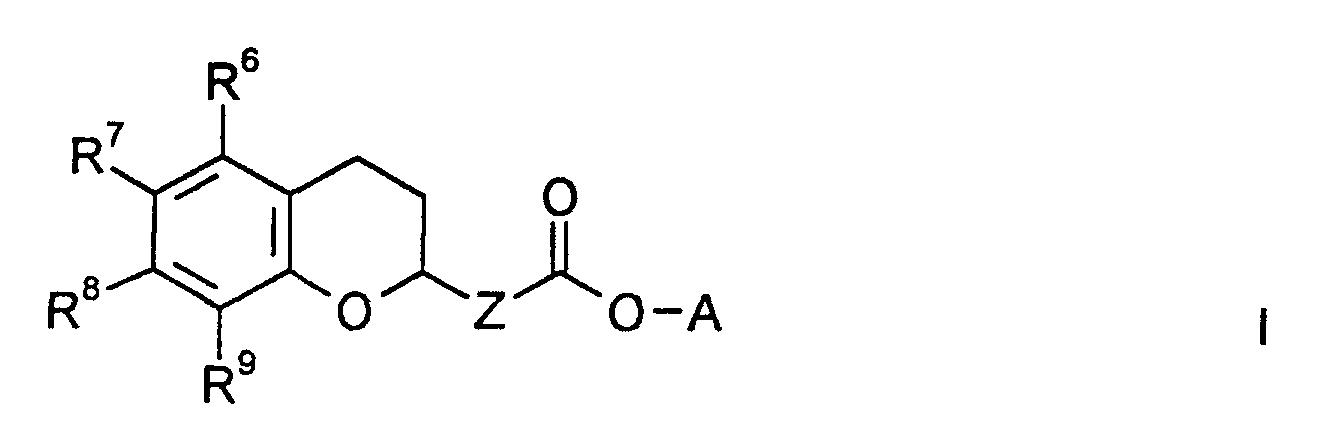
- Z
- -(CH2)n1-(CHA)n2-(CH2)n3 wobei
n1 = 0, 1, 2 oder 3;
n2= 0 oder 1;
n3 = 0, 1, 2 oder 3 mit der Maßgabe, daß
n1 + n2+ n3 < 4, - R6, R7, R8 und R9
- unabhängig voneinander H, A, OA, Phenoxy, OH, F, Cl, Br, I, CN, CF3, NO2, NH2, NHA, NA2, Ac, Ph, Cycloalkyl mit 3-7 C-Atomen, -CH2NH2, -CH2NHA, -CH2NA2,-CH2NHAc oder -CH2NHSO2CH3, wobei auch zwei benachbarte Reste eine Alkylenkette mit 3 oder 4 C-Atomen bedeuten können,
- A
- Alkyl mit 1-6 C-Atomen,
- Ac
- Alkanoyl mit 1-10 C-Atomen oder Aroyl mit 7-11 C-Atomen,
- Ph
- unsubstituiertes oder mit R5, 2-, 3- or 4-Pyridyl oder Phenoxy substituiertes Phenyl
- R5
- unsubstituiertes oder mit 1-5 F, oder mit CF3, oder mit ganz oder teilweise fluorsubstituiertem A, A, und/oder OA substituiertes Phenyl.
dadurch gekennzeichnet, daß die Trennung an einem Sorbens erfolgt, das mit aromatischen Carbamaten substituierte Polysaccharide enthält, und daß ein Elutionsmittel mit einem Gehalt an C1- bis C5-Alkoholen verwendet wird. - Verfahren nach Anspruch 1, dadurch gekennzeichnet, daß als substituiertes Polysaccharid ein Cellulosederivat im Sorbens enthalten ist.
- Verfahren nach Anspruch 1 oder 2, dadurch gekennzeichnet, daß Enantiomere getrennt werden, wobei die in Formel I genannten Reste die folgende Bedeutung besitzen: R6, R7, R8 und R9 bedeuten H; in Z sind n1, n2 und n3 gleich 0.
- Verfahren nach Anspruch 3, dadurch gekennzeichnet, daß Enantiomere getrennt werden, wobei der Rest A in Formel I Ethyl bedeutet.
- Verfahren nach einem der Ansprüche 1-4, dadurch gekennzeichnet, daß das Sorbens Cellulose-tris-(3,5-dimethylphenylcarbamat) enthält.
- Verfahren nach einem der Ansprüche 1-5, dadurch gekennzeichnet, daß als Elutionsmittel ein C1 bis C5-Alkohol verwendet wird.
- Verfahren nach einem der Ansprüche 1-5, dadurch gekennzeichnet, daß als Elutionsmittel eine Mischung enthaltend einen C1 bis C5-Alkohol und einen C5 bis C10-Kohlenwasserstoff verwendet wird.
- Verfahren nach einem der Ansprüche 1-7, dadurch gekennzeichnet, daß das Verfahren im batch-Verfahren ausgeführt wird.
- Verfahren nach einem der Ansprüche 1-7, dadurch gekennzeichnet, daß das Verfahren kontinuierlich nach dem SMB-Verfahren ausgeführt wird.
Priority Applications (1)
| Application Number | Priority Date | Filing Date | Title |
|---|---|---|---|
| SI9730218T SI0906302T1 (en) | 1996-06-14 | 1997-05-07 | Enantiomer separation from chromane acid esters |
Applications Claiming Priority (3)
| Application Number | Priority Date | Filing Date | Title |
|---|---|---|---|
| DE19623755 | 1996-06-14 | ||
| DE19623755 | 1996-06-14 | ||
| PCT/EP1997/002314 WO1997047617A1 (de) | 1996-06-14 | 1997-05-07 | Enantiomerentrennung von chromansäureestern |
Publications (2)
| Publication Number | Publication Date |
|---|---|
| EP0906302A1 EP0906302A1 (de) | 1999-04-07 |
| EP0906302B1 true EP0906302B1 (de) | 2001-08-08 |
Family
ID=7796950
Family Applications (1)
| Application Number | Title | Priority Date | Filing Date |
|---|---|---|---|
| EP97922985A Expired - Lifetime EP0906302B1 (de) | 1996-06-14 | 1997-05-07 | Enantiomerentrennung von chromansäureestern |
Country Status (17)
| Country | Link |
|---|---|
| EP (1) | EP0906302B1 (de) |
| JP (1) | JP2000512283A (de) |
| KR (1) | KR20000016726A (de) |
| CN (1) | CN1221413A (de) |
| AT (1) | ATE203988T1 (de) |
| AU (1) | AU2892497A (de) |
| BR (1) | BR9709716A (de) |
| CA (1) | CA2258032A1 (de) |
| DE (1) | DE59704253D1 (de) |
| DK (1) | DK0906302T3 (de) |
| ES (1) | ES2162290T3 (de) |
| GR (1) | GR3037032T3 (de) |
| NO (1) | NO985810D0 (de) |
| PL (1) | PL330422A1 (de) |
| PT (1) | PT906302E (de) |
| SK (1) | SK168298A3 (de) |
| WO (1) | WO1997047617A1 (de) |
Families Citing this family (2)
| Publication number | Priority date | Publication date | Assignee | Title |
|---|---|---|---|---|
| CN101328161B (zh) * | 2007-06-20 | 2011-09-14 | 北京德众万全药物技术开发有限公司 | 一种用液相色谱法分离测定奈必洛尔中间体的方法 |
| CN105218502B (zh) * | 2015-10-26 | 2017-12-15 | 浙江工业大学 | 一种手性苯并二氢吡喃类化合物的不对称合成方法 |
-
1997
- 1997-05-07 PT PT97922985T patent/PT906302E/pt unknown
- 1997-05-07 AT AT97922985T patent/ATE203988T1/de not_active IP Right Cessation
- 1997-05-07 BR BR9709716A patent/BR9709716A/pt not_active Application Discontinuation
- 1997-05-07 DK DK97922985T patent/DK0906302T3/da active
- 1997-05-07 JP JP10501100A patent/JP2000512283A/ja not_active Ceased
- 1997-05-07 CA CA002258032A patent/CA2258032A1/en not_active Abandoned
- 1997-05-07 PL PL97330422A patent/PL330422A1/xx unknown
- 1997-05-07 ES ES97922985T patent/ES2162290T3/es not_active Expired - Lifetime
- 1997-05-07 AU AU28924/97A patent/AU2892497A/en not_active Abandoned
- 1997-05-07 CN CN97195453A patent/CN1221413A/zh active Pending
- 1997-05-07 DE DE59704253T patent/DE59704253D1/de not_active Expired - Lifetime
- 1997-05-07 SK SK1682-98A patent/SK168298A3/sk unknown
- 1997-05-07 KR KR1019980710333A patent/KR20000016726A/ko not_active Withdrawn
- 1997-05-07 WO PCT/EP1997/002314 patent/WO1997047617A1/de not_active Ceased
- 1997-05-07 EP EP97922985A patent/EP0906302B1/de not_active Expired - Lifetime
-
1998
- 1998-12-11 NO NO985810A patent/NO985810D0/no unknown
-
2001
- 2001-10-30 GR GR20010401902T patent/GR3037032T3/el not_active IP Right Cessation
Also Published As
| Publication number | Publication date |
|---|---|
| NO985810L (no) | 1998-12-11 |
| GR3037032T3 (en) | 2002-01-31 |
| WO1997047617A1 (de) | 1997-12-18 |
| JP2000512283A (ja) | 2000-09-19 |
| CN1221413A (zh) | 1999-06-30 |
| BR9709716A (pt) | 1999-08-10 |
| DE59704253D1 (de) | 2001-09-13 |
| ATE203988T1 (de) | 2001-08-15 |
| EP0906302A1 (de) | 1999-04-07 |
| ES2162290T3 (es) | 2001-12-16 |
| PL330422A1 (en) | 1999-05-10 |
| SK168298A3 (en) | 1999-05-07 |
| KR20000016726A (ko) | 2000-03-25 |
| DK0906302T3 (da) | 2001-11-05 |
| AU2892497A (en) | 1998-01-07 |
| NO985810D0 (no) | 1998-12-11 |
| PT906302E (pt) | 2002-01-30 |
| CA2258032A1 (en) | 1997-12-18 |
Similar Documents
| Publication | Publication Date | Title |
|---|---|---|
| DE69913332T2 (de) | Verfahren zur herstellung von enantiomeren reinem oder optisch angereicherter sertraline-tetralon durch kontinuierliche chromatographie | |
| DE69130277T2 (de) | Verfahren zur trennung optischer isomere | |
| EP2225192B1 (de) | Verfahren zur herstellung von optisch aktivem und racemischem menthol | |
| DE60103431T2 (de) | Ein Verfahren zur chromatographischen Isolierung von Isomeren des Vitamins E | |
| DE60022280T2 (de) | Verfahren zu Herstellung von gereinigte Tocotrienolen und Tocopherolen mit Hilfe von Flüssigechromatographie | |
| CA1204721A (en) | Process for separating fatty acids | |
| DE69117181T2 (de) | Gestützte chirale flüssigkeitsmembran zur trennung von enantiomeren | |
| LU88570A1 (de) | Verfahren zur Herstellung eines optisch reinen Enantiomeren von Formoterol | |
| US5518625A (en) | Chiral separations by simulated moving bed chromatography operating at low k' values | |
| DE69922519T2 (de) | Verfahren zur bereitstellung von hochreinen hmg-coa reductase hemmer | |
| DE69526784T2 (de) | Verfahren zur herstellung von optisch aktiven mevalonolactonen | |
| DE60127713T2 (de) | Insulinreinigung unter verwendung der simulierten wanderbett-technologie | |
| DE69535355T2 (de) | Verfahren zur trennung von optischen isomeren | |
| Lämmerhofer et al. | HPLC enantiomer separation of a chiral 1, 4-dihydropyridine monocarboxylic acid | |
| DE19507294B4 (de) | Verfahren zur Herstellung und Reinigung iodierter Kontrastmittel | |
| EP0906302A1 (de) | Enantiomerentrennung von chromansäureestern | |
| DE19707641C1 (de) | Enantiomerentrennung von 5-Hetaryl-1,3,4-thiadiazinonen | |
| EP0921847B1 (de) | Verwendung nicht-partikulärer sorbentien für "simulated moving bed" trennverfahren | |
| DE19958498A1 (de) | Enantiomerentrennung on 2-(1-Alkyl-1-arylalkyl)cycloalkonolen | |
| EP1572620B1 (de) | Verfahren zur herstellung optisch aktiver dihydropyrone | |
| DE10014961A1 (de) | Enantiomerentrennung von 3,5-disubstituierten 2-Oxazolidinonen | |
| DE19958497A1 (de) | Enantiomerentrennung von 2,6-Disubstituierten 2-Azabicyclo[3.1.0]hex-3-enen | |
| EP1375501B1 (de) | Verfahren zur Enantiomerenanreicherung von cis-8-Benzyl-7,9-dioxo-2,8-diazabicyclo(4.3.0)nonan unter Verwendung von Gegenstromchromatographie | |
| DE69835421T2 (de) | Verfahren zur trennung optischer isomere | |
| DE60001821T2 (de) | Verfahren zu trennung von ftc isomere und deren derivate |
Legal Events
| Date | Code | Title | Description |
|---|---|---|---|
| PUAI | Public reference made under article 153(3) epc to a published international application that has entered the european phase |
Free format text: ORIGINAL CODE: 0009012 |
|
| 17P | Request for examination filed |
Effective date: 19981113 |
|
| AK | Designated contracting states |
Kind code of ref document: A1 Designated state(s): AT BE CH DE DK ES FI FR GB GR IE IT LI LU NL PT SE |
|
| AX | Request for extension of the european patent |
Free format text: LT PAYMENT 981113;LV PAYMENT 981113;SI PAYMENT 981113 |
|
| GRAG | Despatch of communication of intention to grant |
Free format text: ORIGINAL CODE: EPIDOS AGRA |
|
| 17Q | First examination report despatched |
Effective date: 20000629 |
|
| GRAG | Despatch of communication of intention to grant |
Free format text: ORIGINAL CODE: EPIDOS AGRA |
|
| GRAH | Despatch of communication of intention to grant a patent |
Free format text: ORIGINAL CODE: EPIDOS IGRA |
|
| GRAH | Despatch of communication of intention to grant a patent |
Free format text: ORIGINAL CODE: EPIDOS IGRA |
|
| GRAA | (expected) grant |
Free format text: ORIGINAL CODE: 0009210 |
|
| AK | Designated contracting states |
Kind code of ref document: B1 Designated state(s): AT BE CH DE DK ES FI FR GB GR IE IT LI LU NL PT SE |
|
| AX | Request for extension of the european patent |
Free format text: LT PAYMENT 19981113;LV PAYMENT 19981113;SI PAYMENT 19981113 |
|
| REF | Corresponds to: |
Ref document number: 203988 Country of ref document: AT Date of ref document: 20010815 Kind code of ref document: T |
|
| REG | Reference to a national code |
Ref country code: CH Ref legal event code: EP |
|
| REG | Reference to a national code |
Ref country code: IE Ref legal event code: FG4D Free format text: GERMAN |
|
| REF | Corresponds to: |
Ref document number: 59704253 Country of ref document: DE Date of ref document: 20010913 |
|
| GBT | Gb: translation of ep patent filed (gb section 77(6)(a)/1977) |
Effective date: 20011001 |
|
| REG | Reference to a national code |
Ref country code: DK Ref legal event code: T3 |
|
| REG | Reference to a national code |
Ref country code: ES Ref legal event code: FG2A Ref document number: 2162290 Country of ref document: ES Kind code of ref document: T3 |
|
| ET | Fr: translation filed | ||
| REG | Reference to a national code |
Ref country code: GB Ref legal event code: IF02 |
|
| REG | Reference to a national code |
Ref country code: PT Ref legal event code: SC4A Free format text: AVAILABILITY OF NATIONAL TRANSLATION Effective date: 20011018 |
|
| REG | Reference to a national code |
Ref country code: GR Ref legal event code: EP Ref document number: 20010401902 Country of ref document: GR |
|
| PLBE | No opposition filed within time limit |
Free format text: ORIGINAL CODE: 0009261 |
|
| STAA | Information on the status of an ep patent application or granted ep patent |
Free format text: STATUS: NO OPPOSITION FILED WITHIN TIME LIMIT |
|
| 26N | No opposition filed | ||
| REG | Reference to a national code |
Ref country code: SI Ref legal event code: IF |
|
| PGFP | Annual fee paid to national office [announced via postgrant information from national office to epo] |
Ref country code: GR Payment date: 20060413 Year of fee payment: 10 |
|
| PGFP | Annual fee paid to national office [announced via postgrant information from national office to epo] |
Ref country code: NL Payment date: 20060503 Year of fee payment: 10 |
|
| PGFP | Annual fee paid to national office [announced via postgrant information from national office to epo] |
Ref country code: SE Payment date: 20060505 Year of fee payment: 10 |
|
| PGFP | Annual fee paid to national office [announced via postgrant information from national office to epo] |
Ref country code: PT Payment date: 20060508 Year of fee payment: 10 |
|
| PGFP | Annual fee paid to national office [announced via postgrant information from national office to epo] |
Ref country code: AT Payment date: 20060511 Year of fee payment: 10 |
|
| PGFP | Annual fee paid to national office [announced via postgrant information from national office to epo] |
Ref country code: FI Payment date: 20060512 Year of fee payment: 10 |
|
| PGFP | Annual fee paid to national office [announced via postgrant information from national office to epo] |
Ref country code: CH Payment date: 20060515 Year of fee payment: 10 Ref country code: IE Payment date: 20060515 Year of fee payment: 10 |
|
| PGFP | Annual fee paid to national office [announced via postgrant information from national office to epo] |
Ref country code: DK Payment date: 20060516 Year of fee payment: 10 |
|
| PGFP | Annual fee paid to national office [announced via postgrant information from national office to epo] |
Ref country code: LU Payment date: 20060607 Year of fee payment: 10 |
|
| PGFP | Annual fee paid to national office [announced via postgrant information from national office to epo] |
Ref country code: BE Payment date: 20060711 Year of fee payment: 10 |
|
| REG | Reference to a national code |
Ref country code: PT Ref legal event code: MM4A Free format text: LAPSE DUE TO NON-PAYMENT OF FEES Effective date: 20071107 |
|
| LTLA | Lt: lapse of european patent or patent extension |
Effective date: 20070507 |
|
| BERE | Be: lapsed |
Owner name: *MERCK PATENT G.M.B.H. Effective date: 20070531 |
|
| EUG | Se: european patent has lapsed | ||
| REG | Reference to a national code |
Ref country code: CH Ref legal event code: PL |
|
| REG | Reference to a national code |
Ref country code: DK Ref legal event code: EBP |
|
| PG25 | Lapsed in a contracting state [announced via postgrant information from national office to epo] |
Ref country code: PT Free format text: LAPSE BECAUSE OF NON-PAYMENT OF DUE FEES Effective date: 20071107 Ref country code: NL Free format text: LAPSE BECAUSE OF NON-PAYMENT OF DUE FEES Effective date: 20071201 Ref country code: FI Free format text: LAPSE BECAUSE OF NON-PAYMENT OF DUE FEES Effective date: 20070507 |
|
| NLV4 | Nl: lapsed or anulled due to non-payment of the annual fee |
Effective date: 20071201 |
|
| REG | Reference to a national code |
Ref country code: IE Ref legal event code: MM4A |
|
| PG25 | Lapsed in a contracting state [announced via postgrant information from national office to epo] |
Ref country code: AT Free format text: LAPSE BECAUSE OF NON-PAYMENT OF DUE FEES Effective date: 20070507 Ref country code: CH Free format text: LAPSE BECAUSE OF NON-PAYMENT OF DUE FEES Effective date: 20070531 Ref country code: LI Free format text: LAPSE BECAUSE OF NON-PAYMENT OF DUE FEES Effective date: 20070531 |
|
| REG | Reference to a national code |
Ref country code: SI Ref legal event code: KO00 Effective date: 20080103 |
|
| PG25 | Lapsed in a contracting state [announced via postgrant information from national office to epo] |
Ref country code: BE Free format text: LAPSE BECAUSE OF NON-PAYMENT OF DUE FEES Effective date: 20070531 |
|
| PG25 | Lapsed in a contracting state [announced via postgrant information from national office to epo] |
Ref country code: DK Free format text: LAPSE BECAUSE OF NON-PAYMENT OF DUE FEES Effective date: 20070531 |
|
| PG25 | Lapsed in a contracting state [announced via postgrant information from national office to epo] |
Ref country code: IE Free format text: LAPSE BECAUSE OF NON-PAYMENT OF DUE FEES Effective date: 20070507 |
|
| PG25 | Lapsed in a contracting state [announced via postgrant information from national office to epo] |
Ref country code: SE Free format text: LAPSE BECAUSE OF NON-PAYMENT OF DUE FEES Effective date: 20070508 |
|
| PG25 | Lapsed in a contracting state [announced via postgrant information from national office to epo] |
Ref country code: GR Free format text: LAPSE BECAUSE OF NON-PAYMENT OF DUE FEES Effective date: 20071204 |
|
| PG25 | Lapsed in a contracting state [announced via postgrant information from national office to epo] |
Ref country code: LU Free format text: LAPSE BECAUSE OF NON-PAYMENT OF DUE FEES Effective date: 20070507 |
|
| REG | Reference to a national code |
Ref country code: FR Ref legal event code: PLFP Year of fee payment: 20 |
|
| PGFP | Annual fee paid to national office [announced via postgrant information from national office to epo] |
Ref country code: DE Payment date: 20160504 Year of fee payment: 20 Ref country code: ES Payment date: 20160412 Year of fee payment: 20 Ref country code: GB Payment date: 20160504 Year of fee payment: 20 |
|
| PGFP | Annual fee paid to national office [announced via postgrant information from national office to epo] |
Ref country code: IT Payment date: 20160523 Year of fee payment: 20 Ref country code: FR Payment date: 20160412 Year of fee payment: 20 |
|
| REG | Reference to a national code |
Ref country code: DE Ref legal event code: R071 Ref document number: 59704253 Country of ref document: DE |
|
| REG | Reference to a national code |
Ref country code: GB Ref legal event code: PE20 Expiry date: 20170506 |
|
| PG25 | Lapsed in a contracting state [announced via postgrant information from national office to epo] |
Ref country code: GB Free format text: LAPSE BECAUSE OF EXPIRATION OF PROTECTION Effective date: 20170506 |
|
| REG | Reference to a national code |
Ref country code: ES Ref legal event code: FD2A Effective date: 20180508 |
|
| PG25 | Lapsed in a contracting state [announced via postgrant information from national office to epo] |
Ref country code: ES Free format text: LAPSE BECAUSE OF EXPIRATION OF PROTECTION Effective date: 20170508 |