EP0905172A1 - Polysilane ind positive ladungslöchertransportmaterialien - Google Patents
Polysilane ind positive ladungslöchertransportmaterialien Download PDFInfo
- Publication number
- EP0905172A1 EP0905172A1 EP97925289A EP97925289A EP0905172A1 EP 0905172 A1 EP0905172 A1 EP 0905172A1 EP 97925289 A EP97925289 A EP 97925289A EP 97925289 A EP97925289 A EP 97925289A EP 0905172 A1 EP0905172 A1 EP 0905172A1
- Authority
- EP
- European Patent Office
- Prior art keywords
- polysilane
- alkyl group
- group
- same
- hole transporting
- Prior art date
- Legal status (The legal status is an assumption and is not a legal conclusion. Google has not performed a legal analysis and makes no representation as to the accuracy of the status listed.)
- Withdrawn
Links
- 229920000548 poly(silane) polymer Polymers 0.000 title claims abstract description 73
- 239000000463 material Substances 0.000 title claims description 16
- 125000004432 carbon atom Chemical group C* 0.000 claims description 31
- 125000000217 alkyl group Chemical group 0.000 claims description 23
- 125000004435 hydrogen atom Chemical group [H]* 0.000 claims description 15
- 125000003118 aryl group Chemical group 0.000 claims description 9
- 125000003545 alkoxy group Chemical group 0.000 claims description 8
- 125000003808 silyl group Chemical group [H][Si]([H])([H])[*] 0.000 claims description 6
- 125000003277 amino group Chemical group 0.000 claims description 5
- 108091008695 photoreceptors Proteins 0.000 abstract description 6
- 238000000034 method Methods 0.000 description 37
- MROCJMGDEKINLD-UHFFFAOYSA-N dichlorosilane Chemical compound Cl[SiH2]Cl MROCJMGDEKINLD-UHFFFAOYSA-N 0.000 description 23
- WYURNTSHIVDZCO-UHFFFAOYSA-N Tetrahydrofuran Chemical compound C1CCOC1 WYURNTSHIVDZCO-UHFFFAOYSA-N 0.000 description 22
- YXFVVABEGXRONW-UHFFFAOYSA-N Toluene Chemical compound CC1=CC=CC=C1 YXFVVABEGXRONW-UHFFFAOYSA-N 0.000 description 18
- 239000011777 magnesium Substances 0.000 description 16
- 239000000203 mixture Substances 0.000 description 16
- 239000002904 solvent Substances 0.000 description 16
- 238000006243 chemical reaction Methods 0.000 description 15
- 230000015572 biosynthetic process Effects 0.000 description 14
- 238000003786 synthesis reaction Methods 0.000 description 14
- UNXNWOPQBHNAEM-UHFFFAOYSA-N C(CC)C1=CC=C(C=C1)C[SiH](Cl)Cl Chemical compound C(CC)C1=CC=C(C=C1)C[SiH](Cl)Cl UNXNWOPQBHNAEM-UHFFFAOYSA-N 0.000 description 13
- 238000005160 1H NMR spectroscopy Methods 0.000 description 12
- RTZKZFJDLAIYFH-UHFFFAOYSA-N Diethyl ether Chemical compound CCOCC RTZKZFJDLAIYFH-UHFFFAOYSA-N 0.000 description 10
- 239000010408 film Substances 0.000 description 10
- 229910000861 Mg alloy Inorganic materials 0.000 description 9
- KWGKDLIKAYFUFQ-UHFFFAOYSA-M lithium chloride Chemical compound [Li+].[Cl-] KWGKDLIKAYFUFQ-UHFFFAOYSA-M 0.000 description 9
- 229910052749 magnesium Inorganic materials 0.000 description 9
- NUPWGLKBGVNSJX-UHFFFAOYSA-N 1-bromo-4-propylbenzene Chemical compound CCCC1=CC=C(Br)C=C1 NUPWGLKBGVNSJX-UHFFFAOYSA-N 0.000 description 8
- VLKZOEOYAKHREP-UHFFFAOYSA-N n-Hexane Chemical compound CCCCCC VLKZOEOYAKHREP-UHFFFAOYSA-N 0.000 description 8
- -1 p-n-propylphenyl Chemical group 0.000 description 8
- 150000003839 salts Chemical class 0.000 description 8
- 229910001507 metal halide Inorganic materials 0.000 description 7
- 150000005309 metal halides Chemical class 0.000 description 7
- 125000001997 phenyl group Chemical group [H]C1=C([H])C([H])=C(*)C([H])=C1[H] 0.000 description 7
- 230000002829 reductive effect Effects 0.000 description 7
- 239000000758 substrate Substances 0.000 description 7
- YLQBMQCUIZJEEH-UHFFFAOYSA-N tetrahydrofuran Natural products C=1C=COC=1 YLQBMQCUIZJEEH-UHFFFAOYSA-N 0.000 description 7
- XKRFYHLGVUSROY-UHFFFAOYSA-N Argon Chemical compound [Ar] XKRFYHLGVUSROY-UHFFFAOYSA-N 0.000 description 6
- LFQSCWFLJHTTHZ-UHFFFAOYSA-N Ethanol Chemical compound CCO LFQSCWFLJHTTHZ-UHFFFAOYSA-N 0.000 description 6
- VEXZGXHMUGYJMC-UHFFFAOYSA-N Hydrochloric acid Chemical compound Cl VEXZGXHMUGYJMC-UHFFFAOYSA-N 0.000 description 6
- 230000000052 comparative effect Effects 0.000 description 6
- 239000002798 polar solvent Substances 0.000 description 6
- 238000006116 polymerization reaction Methods 0.000 description 6
- 238000002360 preparation method Methods 0.000 description 6
- 239000000243 solution Substances 0.000 description 6
- CDEPDCYUKSQDJZ-UHFFFAOYSA-N (4-butylphenyl)methyl-dichlorosilane Chemical compound CCCCc1ccc(C[SiH](Cl)Cl)cc1 CDEPDCYUKSQDJZ-UHFFFAOYSA-N 0.000 description 5
- XUIMIQQOPSSXEZ-UHFFFAOYSA-N Silicon Chemical compound [Si] XUIMIQQOPSSXEZ-UHFFFAOYSA-N 0.000 description 5
- 238000011156 evaluation Methods 0.000 description 5
- IJGRMHOSHXDMSA-UHFFFAOYSA-N Atomic nitrogen Chemical compound N#N IJGRMHOSHXDMSA-UHFFFAOYSA-N 0.000 description 4
- XTHFKEDIFFGKHM-UHFFFAOYSA-N Dimethoxyethane Chemical compound COCCOC XTHFKEDIFFGKHM-UHFFFAOYSA-N 0.000 description 4
- BLRPTPMANUNPDV-UHFFFAOYSA-N Silane Chemical compound [SiH4] BLRPTPMANUNPDV-UHFFFAOYSA-N 0.000 description 4
- BMHCUNHQVCXTPZ-UHFFFAOYSA-N dichloro-[(4-ethylphenyl)methyl]silane Chemical compound CCC1=CC=C(C[SiH](Cl)Cl)C=C1 BMHCUNHQVCXTPZ-UHFFFAOYSA-N 0.000 description 4
- GNEPOXWQWFSSOU-UHFFFAOYSA-N dichloro-methyl-phenylsilane Chemical compound C[Si](Cl)(Cl)C1=CC=CC=C1 GNEPOXWQWFSSOU-UHFFFAOYSA-N 0.000 description 4
- 239000000049 pigment Substances 0.000 description 4
- 239000011541 reaction mixture Substances 0.000 description 4
- 229910000077 silane Inorganic materials 0.000 description 4
- 238000003756 stirring Methods 0.000 description 4
- 239000000126 substance Substances 0.000 description 4
- XLYOFNOQVPJJNP-UHFFFAOYSA-N water Substances O XLYOFNOQVPJJNP-UHFFFAOYSA-N 0.000 description 4
- WEVYAHXRMPXWCK-UHFFFAOYSA-N Acetonitrile Chemical compound CC#N WEVYAHXRMPXWCK-UHFFFAOYSA-N 0.000 description 3
- UHOVQNZJYSORNB-UHFFFAOYSA-N Benzene Chemical compound C1=CC=CC=C1 UHOVQNZJYSORNB-UHFFFAOYSA-N 0.000 description 3
- YMWUJEATGCHHMB-UHFFFAOYSA-N Dichloromethane Chemical compound ClCCl YMWUJEATGCHHMB-UHFFFAOYSA-N 0.000 description 3
- 238000003747 Grignard reaction Methods 0.000 description 3
- KFZMGEQAYNKOFK-UHFFFAOYSA-N Isopropanol Chemical compound CC(C)O KFZMGEQAYNKOFK-UHFFFAOYSA-N 0.000 description 3
- ZMXDDKWLCZADIW-UHFFFAOYSA-N N,N-Dimethylformamide Chemical compound CN(C)C=O ZMXDDKWLCZADIW-UHFFFAOYSA-N 0.000 description 3
- 229910052782 aluminium Inorganic materials 0.000 description 3
- XAGFODPZIPBFFR-UHFFFAOYSA-N aluminium Chemical compound [Al] XAGFODPZIPBFFR-UHFFFAOYSA-N 0.000 description 3
- 229910052786 argon Inorganic materials 0.000 description 3
- 238000005452 bending Methods 0.000 description 3
- 229910052799 carbon Inorganic materials 0.000 description 3
- 230000015556 catabolic process Effects 0.000 description 3
- 150000001875 compounds Chemical class 0.000 description 3
- 238000006731 degradation reaction Methods 0.000 description 3
- PELXUZMGKWSPKR-UHFFFAOYSA-N dichloro-[(4-hexylphenyl)methyl]silane Chemical compound C(CCCCC)C1=CC=C(C=C1)C[SiH](Cl)Cl PELXUZMGKWSPKR-UHFFFAOYSA-N 0.000 description 3
- ZUOUZKKEUPVFJK-UHFFFAOYSA-N diphenyl Chemical group C1=CC=CC=C1C1=CC=CC=C1 ZUOUZKKEUPVFJK-UHFFFAOYSA-N 0.000 description 3
- 238000004821 distillation Methods 0.000 description 3
- 229960002089 ferrous chloride Drugs 0.000 description 3
- 239000007789 gas Substances 0.000 description 3
- 238000002347 injection Methods 0.000 description 3
- 239000007924 injection Substances 0.000 description 3
- NMCUIPGRVMDVDB-UHFFFAOYSA-L iron dichloride Chemical compound Cl[Fe]Cl NMCUIPGRVMDVDB-UHFFFAOYSA-L 0.000 description 3
- ZUVVLBGWTRIOFH-UHFFFAOYSA-N methyl 4-methyl-2-[(4-methylphenyl)sulfonylamino]pentanoate Chemical compound COC(=O)C(CC(C)C)NS(=O)(=O)C1=CC=C(C)C=C1 ZUVVLBGWTRIOFH-UHFFFAOYSA-N 0.000 description 3
- 125000002496 methyl group Chemical group [H]C([H])([H])* 0.000 description 3
- 239000000178 monomer Substances 0.000 description 3
- 239000012454 non-polar solvent Substances 0.000 description 3
- 238000012643 polycondensation polymerization Methods 0.000 description 3
- 230000035484 reaction time Effects 0.000 description 3
- 239000010409 thin film Substances 0.000 description 3
- 238000001771 vacuum deposition Methods 0.000 description 3
- SRJIJYCUUQDQEL-UHFFFAOYSA-N (4-tert-butylphenyl)methyl-dichlorosilane Chemical compound C(C)(C)(C)C1=CC=C(C=C1)C[SiH](Cl)Cl SRJIJYCUUQDQEL-UHFFFAOYSA-N 0.000 description 2
- 238000005133 29Si NMR spectroscopy Methods 0.000 description 2
- IAZDPXIOMUYVGZ-UHFFFAOYSA-N Dimethylsulphoxide Chemical compound CS(C)=O IAZDPXIOMUYVGZ-UHFFFAOYSA-N 0.000 description 2
- 239000007818 Grignard reagent Substances 0.000 description 2
- OFBQJSOFQDEBGM-UHFFFAOYSA-N Pentane Chemical compound CCCCC OFBQJSOFQDEBGM-UHFFFAOYSA-N 0.000 description 2
- VSCWAEJMTAWNJL-UHFFFAOYSA-K aluminium trichloride Chemical compound Cl[Al](Cl)Cl VSCWAEJMTAWNJL-UHFFFAOYSA-K 0.000 description 2
- 239000000010 aprotic solvent Substances 0.000 description 2
- 239000011230 binding agent Substances 0.000 description 2
- 238000009835 boiling Methods 0.000 description 2
- 150000001721 carbon Chemical group 0.000 description 2
- 238000002425 crystallisation Methods 0.000 description 2
- 230000008025 crystallization Effects 0.000 description 2
- DIOQZVSQGTUSAI-UHFFFAOYSA-N decane Chemical compound CCCCCCCCCC DIOQZVSQGTUSAI-UHFFFAOYSA-N 0.000 description 2
- 238000006298 dechlorination reaction Methods 0.000 description 2
- 230000007423 decrease Effects 0.000 description 2
- KTQYJQFGNYHXMB-UHFFFAOYSA-N dichloro(methyl)silicon Chemical compound C[Si](Cl)Cl KTQYJQFGNYHXMB-UHFFFAOYSA-N 0.000 description 2
- SBZXBUIDTXKZTM-UHFFFAOYSA-N diglyme Chemical compound COCCOCCOC SBZXBUIDTXKZTM-UHFFFAOYSA-N 0.000 description 2
- 239000012153 distilled water Substances 0.000 description 2
- 230000000694 effects Effects 0.000 description 2
- 239000011521 glass Substances 0.000 description 2
- 239000008187 granular material Substances 0.000 description 2
- 150000004795 grignard reagents Chemical class 0.000 description 2
- IIPYXGDZVMZOAP-UHFFFAOYSA-N lithium nitrate Chemical compound [Li+].[O-][N+]([O-])=O IIPYXGDZVMZOAP-UHFFFAOYSA-N 0.000 description 2
- 238000005259 measurement Methods 0.000 description 2
- 229910052751 metal Inorganic materials 0.000 description 2
- 239000002184 metal Substances 0.000 description 2
- 239000005048 methyldichlorosilane Substances 0.000 description 2
- 229910052757 nitrogen Inorganic materials 0.000 description 2
- TVMXDCGIABBOFY-UHFFFAOYSA-N octane Chemical compound CCCCCCCC TVMXDCGIABBOFY-UHFFFAOYSA-N 0.000 description 2
- 230000005693 optoelectronics Effects 0.000 description 2
- 239000000843 powder Substances 0.000 description 2
- 239000002244 precipitate Substances 0.000 description 2
- 238000010992 reflux Methods 0.000 description 2
- 238000011160 research Methods 0.000 description 2
- 229920005989 resin Polymers 0.000 description 2
- 239000011347 resin Substances 0.000 description 2
- 238000005185 salting out Methods 0.000 description 2
- 229910052710 silicon Inorganic materials 0.000 description 2
- TVIVIEFSHFOWTE-UHFFFAOYSA-K tri(quinolin-8-yloxy)alumane Chemical compound [Al+3].C1=CN=C2C([O-])=CC=CC2=C1.C1=CN=C2C([O-])=CC=CC2=C1.C1=CN=C2C([O-])=CC=CC2=C1 TVIVIEFSHFOWTE-UHFFFAOYSA-K 0.000 description 2
- RYHBNJHYFVUHQT-UHFFFAOYSA-N 1,4-Dioxane Chemical compound C1COCCO1 RYHBNJHYFVUHQT-UHFFFAOYSA-N 0.000 description 1
- WLVSTXWBNDJBBG-UHFFFAOYSA-N 1-bromo-3-butylbenzene Chemical compound CCCCC1=CC=CC(Br)=C1 WLVSTXWBNDJBBG-UHFFFAOYSA-N 0.000 description 1
- HZUVRCRPECDFAT-UHFFFAOYSA-N 1-bromo-3-hexylbenzene Chemical compound CCCCCCC1=CC=CC(Br)=C1 HZUVRCRPECDFAT-UHFFFAOYSA-N 0.000 description 1
- XHCAGOVGSDHHNP-UHFFFAOYSA-N 1-bromo-4-tert-butylbenzene Chemical compound CC(C)(C)C1=CC=C(Br)C=C1 XHCAGOVGSDHHNP-UHFFFAOYSA-N 0.000 description 1
- SVONRAPFKPVNKG-UHFFFAOYSA-N 2-ethoxyethyl acetate Chemical compound CCOCCOC(C)=O SVONRAPFKPVNKG-UHFFFAOYSA-N 0.000 description 1
- 125000000590 4-methylphenyl group Chemical group [H]C1=C([H])C(=C([H])C([H])=C1*)C([H])([H])[H] 0.000 description 1
- OKTJSMMVPCPJKN-UHFFFAOYSA-N Carbon Chemical compound [C] OKTJSMMVPCPJKN-UHFFFAOYSA-N 0.000 description 1
- 229910021580 Cobalt(II) chloride Inorganic materials 0.000 description 1
- XDTMQSROBMDMFD-UHFFFAOYSA-N Cyclohexane Chemical compound C1CCCCC1 XDTMQSROBMDMFD-UHFFFAOYSA-N 0.000 description 1
- DGAQECJNVWCQMB-PUAWFVPOSA-M Ilexoside XXIX Chemical compound C[C@@H]1CC[C@@]2(CC[C@@]3(C(=CC[C@H]4[C@]3(CC[C@@H]5[C@@]4(CC[C@@H](C5(C)C)OS(=O)(=O)[O-])C)C)[C@@H]2[C@]1(C)O)C)C(=O)O[C@H]6[C@@H]([C@H]([C@@H]([C@H](O6)CO)O)O)O.[Na+] DGAQECJNVWCQMB-PUAWFVPOSA-M 0.000 description 1
- 229910021575 Iron(II) bromide Inorganic materials 0.000 description 1
- 229910021576 Iron(III) bromide Inorganic materials 0.000 description 1
- 229910021578 Iron(III) chloride Inorganic materials 0.000 description 1
- FYYHWMGAXLPEAU-UHFFFAOYSA-N Magnesium Chemical compound [Mg] FYYHWMGAXLPEAU-UHFFFAOYSA-N 0.000 description 1
- CSNNHWWHGAXBCP-UHFFFAOYSA-L Magnesium sulfate Chemical compound [Mg+2].[O-][S+2]([O-])([O-])[O-] CSNNHWWHGAXBCP-UHFFFAOYSA-L 0.000 description 1
- CTQNGGLPUBDAKN-UHFFFAOYSA-N O-Xylene Chemical compound CC1=CC=CC=C1C CTQNGGLPUBDAKN-UHFFFAOYSA-N 0.000 description 1
- 229910002666 PdCl2 Inorganic materials 0.000 description 1
- 206010034972 Photosensitivity reaction Diseases 0.000 description 1
- 235000002597 Solanum melongena Nutrition 0.000 description 1
- 244000061458 Solanum melongena Species 0.000 description 1
- 229910003074 TiCl4 Inorganic materials 0.000 description 1
- 229910021626 Tin(II) chloride Inorganic materials 0.000 description 1
- 229910021551 Vanadium(III) chloride Inorganic materials 0.000 description 1
- 229910052783 alkali metal Inorganic materials 0.000 description 1
- 150000001340 alkali metals Chemical class 0.000 description 1
- 229910045601 alloy Inorganic materials 0.000 description 1
- 239000000956 alloy Substances 0.000 description 1
- PQLAYKMGZDUDLQ-UHFFFAOYSA-K aluminium bromide Chemical compound Br[Al](Br)Br PQLAYKMGZDUDLQ-UHFFFAOYSA-K 0.000 description 1
- 239000003054 catalyst Substances 0.000 description 1
- 239000007795 chemical reaction product Substances 0.000 description 1
- 238000007796 conventional method Methods 0.000 description 1
- 229920001577 copolymer Polymers 0.000 description 1
- 238000006356 dehydrogenation reaction Methods 0.000 description 1
- XNAFLNBULDHNJS-UHFFFAOYSA-N dichloro(phenyl)silicon Chemical compound Cl[Si](Cl)C1=CC=CC=C1 XNAFLNBULDHNJS-UHFFFAOYSA-N 0.000 description 1
- LXZULBFQYOJBBN-UHFFFAOYSA-N dichloro-[(4-methylphenyl)methyl]silane Chemical compound CC1=CC=C(C[SiH](Cl)Cl)C=C1 LXZULBFQYOJBBN-UHFFFAOYSA-N 0.000 description 1
- SNAYOMFRDAVUCN-UHFFFAOYSA-N dichloro-methyl-(4-propylphenyl)silane Chemical compound CCCC1=CC=C([Si](C)(Cl)Cl)C=C1 SNAYOMFRDAVUCN-UHFFFAOYSA-N 0.000 description 1
- 239000006185 dispersion Substances 0.000 description 1
- 230000005611 electricity Effects 0.000 description 1
- 230000005284 excitation Effects 0.000 description 1
- 125000000524 functional group Chemical group 0.000 description 1
- PCHJSUWPFVWCPO-UHFFFAOYSA-N gold Chemical compound [Au] PCHJSUWPFVWCPO-UHFFFAOYSA-N 0.000 description 1
- 239000010931 gold Substances 0.000 description 1
- 229910052737 gold Inorganic materials 0.000 description 1
- 238000010438 heat treatment Methods 0.000 description 1
- RBTARNINKXHZNM-UHFFFAOYSA-K iron trichloride Chemical compound Cl[Fe](Cl)Cl RBTARNINKXHZNM-UHFFFAOYSA-K 0.000 description 1
- GYCHYNMREWYSKH-UHFFFAOYSA-L iron(ii) bromide Chemical compound [Fe+2].[Br-].[Br-] GYCHYNMREWYSKH-UHFFFAOYSA-L 0.000 description 1
- XGZVUEUWXADBQD-UHFFFAOYSA-L lithium carbonate Chemical compound [Li+].[Li+].[O-]C([O-])=O XGZVUEUWXADBQD-UHFFFAOYSA-L 0.000 description 1
- 229910052808 lithium carbonate Inorganic materials 0.000 description 1
- MHCFAGZWMAWTNR-UHFFFAOYSA-M lithium perchlorate Chemical compound [Li+].[O-]Cl(=O)(=O)=O MHCFAGZWMAWTNR-UHFFFAOYSA-M 0.000 description 1
- 229910001486 lithium perchlorate Inorganic materials 0.000 description 1
- 238000004519 manufacturing process Methods 0.000 description 1
- 239000005055 methyl trichlorosilane Substances 0.000 description 1
- JLUFWMXJHAVVNN-UHFFFAOYSA-N methyltrichlorosilane Chemical compound C[Si](Cl)(Cl)Cl JLUFWMXJHAVVNN-UHFFFAOYSA-N 0.000 description 1
- 230000000116 mitigating effect Effects 0.000 description 1
- 125000001624 naphthyl group Chemical group 0.000 description 1
- 239000003921 oil Substances 0.000 description 1
- SJHHDDDGXWOYOE-UHFFFAOYSA-N oxytitamium phthalocyanine Chemical compound [Ti+2]=O.C12=CC=CC=C2C(N=C2[N-]C(C3=CC=CC=C32)=N2)=NC1=NC([C]1C=CC=CC1=1)=NC=1N=C1[C]3C=CC=CC3=C2[N-]1 SJHHDDDGXWOYOE-UHFFFAOYSA-N 0.000 description 1
- PIBWKRNGBLPSSY-UHFFFAOYSA-L palladium(II) chloride Chemical compound Cl[Pd]Cl PIBWKRNGBLPSSY-UHFFFAOYSA-L 0.000 description 1
- 229920002120 photoresistant polymer Polymers 0.000 description 1
- 230000036211 photosensitivity Effects 0.000 description 1
- 229920002037 poly(vinyl butyral) polymer Polymers 0.000 description 1
- 239000002861 polymer material Substances 0.000 description 1
- 238000001556 precipitation Methods 0.000 description 1
- 125000002924 primary amino group Chemical group [H]N([H])* 0.000 description 1
- RUOJZAUFBMNUDX-UHFFFAOYSA-N propylene carbonate Chemical compound CC1COC(=O)O1 RUOJZAUFBMNUDX-UHFFFAOYSA-N 0.000 description 1
- 239000002994 raw material Substances 0.000 description 1
- VPRJMFJPKMESHB-UHFFFAOYSA-L samarium(ii) chloride Chemical compound Cl[Sm]Cl VPRJMFJPKMESHB-UHFFFAOYSA-L 0.000 description 1
- UAWABSHMGXMCRK-UHFFFAOYSA-L samarium(ii) iodide Chemical compound I[Sm]I UAWABSHMGXMCRK-UHFFFAOYSA-L 0.000 description 1
- 238000007789 sealing Methods 0.000 description 1
- 239000010703 silicon Substances 0.000 description 1
- 229910052709 silver Inorganic materials 0.000 description 1
- 229910052708 sodium Inorganic materials 0.000 description 1
- 239000011734 sodium Substances 0.000 description 1
- 238000004544 sputter deposition Methods 0.000 description 1
- 239000010935 stainless steel Substances 0.000 description 1
- 229910001220 stainless steel Inorganic materials 0.000 description 1
- 239000007858 starting material Substances 0.000 description 1
- AXZWODMDQAVCJE-UHFFFAOYSA-L tin(II) chloride (anhydrous) Chemical compound [Cl-].[Cl-].[Sn+2] AXZWODMDQAVCJE-UHFFFAOYSA-L 0.000 description 1
- XJDNKRIXUMDJCW-UHFFFAOYSA-J titanium tetrachloride Chemical compound Cl[Ti](Cl)(Cl)Cl XJDNKRIXUMDJCW-UHFFFAOYSA-J 0.000 description 1
- FEONEKOZSGPOFN-UHFFFAOYSA-K tribromoiron Chemical compound Br[Fe](Br)Br FEONEKOZSGPOFN-UHFFFAOYSA-K 0.000 description 1
- HQYCOEXWFMFWLR-UHFFFAOYSA-K vanadium(iii) chloride Chemical compound [Cl-].[Cl-].[Cl-].[V+3] HQYCOEXWFMFWLR-UHFFFAOYSA-K 0.000 description 1
- 239000008096 xylene Substances 0.000 description 1
- 239000011592 zinc chloride Substances 0.000 description 1
- JIAARYAFYJHUJI-UHFFFAOYSA-L zinc dichloride Chemical compound [Cl-].[Cl-].[Zn+2] JIAARYAFYJHUJI-UHFFFAOYSA-L 0.000 description 1
Images



Classifications
-
- C—CHEMISTRY; METALLURGY
- C08—ORGANIC MACROMOLECULAR COMPOUNDS; THEIR PREPARATION OR CHEMICAL WORKING-UP; COMPOSITIONS BASED THEREON
- C08G—MACROMOLECULAR COMPOUNDS OBTAINED OTHERWISE THAN BY REACTIONS ONLY INVOLVING UNSATURATED CARBON-TO-CARBON BONDS
- C08G77/00—Macromolecular compounds obtained by reactions forming a linkage containing silicon with or without sulfur, nitrogen, oxygen or carbon in the main chain of the macromolecule
- C08G77/60—Macromolecular compounds obtained by reactions forming a linkage containing silicon with or without sulfur, nitrogen, oxygen or carbon in the main chain of the macromolecule in which all the silicon atoms are connected by linkages other than oxygen atoms
Definitions
- the present invention relates to novel polysilane compounds.
- the polysilane compounds of this invention are excellent in film-forming property, flexibility, optoelectronic function and the like, and are useful as an organic hole transporting material, a photoresist material and so on which are used for electrophotographic photoreceptors, organic electroluminescent devices, thin film transistors, rectifying devices, etc.
- a material with a hole drift mobility such as a low molecular pigment has been dispersed in a binder resin to produce a hole transporting material useful for an electrophotographic photoreceptor or the like.
- this procedure poses problems such as degradation of properties arising due to precipitation and/or crystallization of a pigment.
- the polysilanes which have a high hole drift mobility at room temperature have been limited to those with aryl group such as phenyl group at the side chain.
- the polysilanes having phenyl group or the like entail problems of showing a poor film-forming property due to their rigidity in forming a thin film and creating cracks for their low flexibility, failing to show a satisfactory hole drift mobility.
- a primary object of the present invention is to provide polysilanes which show a good hole transporting characteristic when used for electrophotographic photoreceptors, organic electroluminescent devices or the like.
- n-alkyl group is introduced into the p-position of phenyl group in a polysilane having phenyl group at the side chain
- the main chain of silicon is given a controlled skeleton structure due to the cohesion of side chains between each other, whereby a low ionization potential is involved, resulting in enhanced optoelectronic function such as proper injection of holes from a charge generation layer or an electrode.
- the flexibility of n-alkyl group serves to improve the film-forming property, flexibility and other properties of the polysilane. Based on these findings, the inventors succeeded in substantially resolving or markedly alleviating the problems of conventional hole transporting materials.
- the polysilane of the first invention is represented by the formula (1).
- R is n-alkyl group having 3 to 20 carbon atoms
- R 1 is hydrogen atom and alkyl group having 1 to 10 carbon atoms
- the carbon atom adjacent to a silicon atom is the primary or secondary carbon atom.
- R is more preferably alkyl group having 3 to 8 carbon atoms, and most preferably alkyl group having 3 to 5 carbon atoms.
- R 1 is alkyl group, alkyl group having 1 to 6 carbon atoms is more preferred, and methyl group is the most preferred.
- the symbol n is in the range of 10 to 20000.
- the polysilane of the formula (1) can be prepared from the corresponding silane monomer as the raw material by conventional methods.
- the methods include (a) a method wherein a dichlorosilane is subjected to dechlorination condensation polymerization in the presence of an alkali metal ("Kipping Method", J. Am. Chem. Soc., 103 (1981) 7352), (b) a method wherein a dichlorosilane is subjected to dechlorination condensation polymerization due to electrochemical reduction (J. Chem. Soc., Chem.
- Mg or Mg alloy is acted on at least one of dihalosilanes in an aprotic solvent in the presence of a specific Li salt and a metal halide, giving a polysilane.
- the dihalosilane is reduced by Mg or Mg alloy and polymerized into a polysilane.
- the Mg or Mg alloy is consumed into halogenated Mg.
- aprotic solvent examples include polar solvents such as tetrahydrofuran, 1,2-dimethoxyethane, propylene carbonate, acetonitrile, dimethylformamide, dimethylsulfoxide, bis(2-methoxyethyl)ether, 1,4-dioxane and methylene chloride; and non-polar solvents such as toluene, xylene, benzene, n-pentane, n-hexane, n-octane, n-decane and cyclohexane. These solvents can be used either alone or in combination.
- polar solvents such as tetrahydrofuran, 1,2-dimethoxyethane, propylene carbonate, acetonitrile, dimethylformamide, dimethylsulfoxide, bis(2-methoxyethyl)ether, 1,4-dioxane and methylene chloride
- non-polar solvents such as tolu
- Preferred solvents are a polar solvent used singly, a mixture of at least two different polar solvents and a mixture of polar and non-polar solvents.
- the mixture of polar and non-polar solvents is used preferably at a former : latter ratio of approximately 1 : 0.01-20.
- Tetrahydrofuran and 1,2-dimethoxyethane are more preferred as a polar solvent usable either alone or in mixture with other solvents.
- the concentration of the dihalosilane in the solvent is usually about 0.05 to about 20 mol/l, preferably about 0.2 to about 15 mol/l, more preferably about 0.3 to about 13 mol/l.
- Li salt examples include LiCl, LiNO 3 , Li 2 CO 3 , LiClO 4 , etc. These Li salts can be used either alone or in combination. Of these Li salts, LiCl is the most preferred.
- the concentration of the Li salt in the solvent is usually about 0.05 to about 5 mol/l, preferably about 0.1 to about 3 mol/l, more preferably about 0.15 to about 2 mol/l.
- Preferred examples of the metal halide are FeCl 2 , FeCl 3 , FeBr 2 , FeBr 3 , AlCl 3 , AlBr 3 , ZnCl 2 , SnCl 2 , CoCl 2 , VCl 3 , TiCl 4 , PdCl 2 , SmCl 2 , SmI 2 , etc.
- FeCl 2 is more preferred.
- the concentration of the metal halide in the solvent is usually about 0.01 to about 6 mol/l, preferably about 0.03 to about 4 mol/l, more preferably about 0.05 to about 3 mol/l.
- Mg or Mg alloy is not limited insofar as the reaction is feasible. Examples include powders, granules, ribbons, cut pieces, agglomerates, rods, flat plates and the like. Of these shapes, preferred are those which are large in specific surface area such as powders, granules, ribbons, cut pieces, etc.
- the amount of Mg or Mg alloy to be used the amount of Mg is 2 mols or more per mol of the dihalosilane used, and the amount of Mg alloy is such that the amount of Mg component is 2 mols or more per mol of the dihalosilane used.
- the reaction time is shortened.
- the use of at least 3 mols is more preferred and the use of at least 5 mols is the most preferred.
- the chemical polymerization method is conducted as follows. For example, a dihalosilane, a Li salt, a metal halide and Mg or Mg alloy are placed, along with a solvent, into a hermetically closable reactor wherein preferably the mixture is mechanically or magnetically stirred to carry out the reaction.
- the shape of the reactor is not limited insofar as it has a structure which assures sealing.
- the reaction time is variable depending on the amount of Mg or Mg alloy, Li salt and metal halide to be used and is usually about at least 30 minutes.
- the molecular weight of the reaction product can be controlled by adjustment of the reaction time.
- the degree of polymerization to be attained in the chemical polymerization method is preferably about 5 to about 1000.
- the reaction temperature ranges from -20°C to the boiling point of the solvent used, preferably about -10 to about 50°C, more preferably about -5 to about 30°C.
- a dichlorosilane is used as the silane monomer in the preparation of the polysilane of the formula (1)
- an alkyltrichlorosilane and p-(n-propyl)bromobenzene are subjected to the Grignard reaction, whereby alkyl-p-(n-propyl)phenyldichlorosilane can be easily prepared.
- the hole transporting material of the second invention comprises the polysilane (1) of the first invention.
- the n-alkyl group of R having a small number of carbon atoms has a low cohesion, and lessens the decline of ionization potential.
- the n-alkyl group having a large number of carbon atoms softens the film and the film may become useless although depending on the purpose of use. Consequently, the n-alkyl group of 3 to 20 carbon atoms is proper in the polysilane (1), while the n-alkyl group of 3 to 8 carbon atoms is more preferred and the n-alkyl group of 3 to 5 carbon atoms is the most preferred in the hole transporting material.
- the group R predominantly present have preferably 3 to 8 carbon atoms, more preferably 3 to 5 carbon atoms.
- R 1 in the polysilane (1) is more preferably alkyl group having 1 to 6 carbon atoms, and most preferably methyl group.
- n in the polysilane (1) is in the range of 10 to 20000, more preferably 15 to 5000, most preferably 20 to 1000.
- the polysilane of the third invention is represented by the formula (2).
- the polysilane of the third invention is substantially the same as the polysilane of the first invention except that the former polysilane is a copolymer formed from a silicon unit having p-(n-alkyl)phenyl group and R 1 at the side chain and other silicon unit.
- R 2 and R 3 in the polysilane (2) are hydrogen atom, alkyl group, aryl group, alkoxy group, amino group and silyl group.
- R 1 , R 2 and R 3 in the polysilane (2) may be different from each other or at least two of them may be the same.
- Examples of the alkyl group include those having about 1 to about 10 carbon atoms among which those having 1 to 6 carbon atoms are more preferred.
- Examples of the aryl group are phenyl, naphthyl and p-alkoxyphenyl.
- Examples of the alkoxy group are those having about 1 to about 10 carbon atoms.
- R 1 , R 2 and R 3 are alkyl, aryl, alkoxy, amino and silyl
- the hydrogen atom thereof may be substituted with other functional group such as alkyl, aryl or alkoxy (having the same number of carbon atoms as above).
- l is a positive number
- m is zero or a positive number
- l+m is in the range of 10 to 20000.
- the hole transporting material of the fourth invention comprises the polysilane (2) of the third invention.
- the n-alkyl group of R with a small number of carbon atoms has a low cohesion, and lessesns the decline of ionization potential. But the n-alkyl group with a large number of carbon atoms softens a film and the film may become useless although depending on the purpose of use.
- a suitable carbon number of n-alkyl group is variable with the ratio (l/l+m) of silicon unit having p-(n-alkyl)phenyl group. For example, if the ratio is 50%, the number of carbon atoms is more preferably 3 to 10, most preferably 4 to 6.
- R 1 in the polysilane (2) is more preferably alkyl group having 1 to 6 carbon atoms and methyl group is the most preferred.
- l+m in the polysilane (2) is in the range of about 10 to about 20000, more preferably 15 to 5000, most preferably 20 to 1000.
- a preferred range of l/m varies with the number of carbon atoms in the R group. For example, when the number of carbon atoms is 4, l/m is preferably 0.3 to 3.0, more preferably 0.5 to 2.0.
- Anhydrous lithium chloride (0.4 g ) and 0.24 g of anhydrous ferrous chloride were placed into a 30 ml 3-necked flask (hereinafter referred to as "reactor") provided with a three way stop-cock, an anode of Mg (1 cm (diameter) X 5 cm) and a cathode of stainless steel (SUS 304) (1 cm X 1 mm X 5 cm).
- the mixture was heated to 50°C and the pressure was reduced to 1 mmHg to dry the lithium chloride and ferrous chloride. Thereafter deoxidized dry nitrogen was introduced into the reactor, followed by addition of 15 ml of tetrahydrofuran dried over sodium-benzophenoneketyl.
- reaction mixture 20 ml of 1N hydrochloric acid was added to the reaction mixture, followed by addition of 80 ml of distilled water. The mixture was extracted with 100 ml of ether and reprecipitated by addition of 80 ml of poor solvent ethanol and 4 ml of good solvent tetrahydrofuran.
- the obtained polysilane was evaluated as a hole transporting material in the following manner. The results are shown below in Table 1 together with the results of evaluation made in subsequent Examples and Comparative Examples. In Table 1, the polysilanes obtained in Examples 1-7 are indicated as Samples 1-7, respectively and the polysilanes obtained in Comparative Examples 1-4 are indicated as Samples 8-11, respectively.
- a 10 wt% (wt% will be hereinafter referred to simply as "%") toluene solution of polysilane was cast on a 100 ⁇ m-thick aluminum substrate.
- the coated substrate was dried at 55°C for 2 hours under pressure being reduced by a rotary pump.
- the thickness of the polysilane film was about 25 ⁇ m.
- the polysilane-coated aluminum substrate was bent and visually inspected for the occurrence or non-occurrence of cracks to evaluate the film-forming property and the flexibility.
- a 25% toluene solution of polysilane was spin-coated on an aluminum-deposited glass substrate.
- the coated substrate was dried at 55°C for 2 hours under pressure being reduced by a rotary pump, whereby a thin film of polysilane having a thickness of about 5.0 ⁇ m was formed.
- a semitransparent gold film was formed as a top electrode by DC sputtering.
- the time of flight of the obtained sample was measured by direct excitation of nitrogen pulse laser (wavelength 337 nm) to determine from the transit pulse shape whether transport was dispersive or non-dispersive.
- the hole drift mobility was also evaluated from the measurement.
- a solution was prepared by dispersing a mixture of titanyl phthalocyanine, polyvinyl butyral and cellosolve acetate at a weight ratio of 1 : 1 : 18 by a ball mill.
- the solution was bar-coated on a 100 ⁇ m-thick aluminum substrate and dried to form a charge generation layer having a thickness of about 0.5 ⁇ m.
- a 30% toluene solution of polysilane was bar-coated on the charge generation layer.
- the film was dried in an air-circulation oven at 100°C for about 1 hour.
- the half-decay exposure of the obtained sample was measured by a static-mode electrophotographic measurement using "EPA-8200" manufactured by Kawaguchi Denki Co., Ltd..
- a 1500 ⁇ -thick hole injection layer was spin-coated from a 5% toluene solution of polysilane on an ITO deposited glass substrate.
- Alq3 ⁇ tris(8-quinolinolato)aluminum (III) ⁇ light emitting layer (500 ⁇ ) was formed by vacuum deposition.
- a cathode (1500 ⁇ ) was formed by vacuum deposition using an alloy of Mg and Ag at a weight ratio of 10 : 1, whereby an electroluminescent device was produced.
- Example 2 The same procedure as in Example 1 was repeated to produce (p-n-propylphenyl)methyldichlorosilane. Then, a polysilane was prepared from the obtained compound as the starting material by the Kipping method.
- a mechanical stirrer and a reflux condenser were fitted to a three-necked flask. Then the air inside the reactor was replaced with argon gas.
- Into the reactor were placed 9.3 g of 40% sodium dispersion (manufactured by Aldrich Chemical Co., Ltd.), 83 ml of dry toluene and 24 ml of diglyme. The mixture was heated in an oil bath (bath temperature 130°C), followed by adding 18.6 g (80 mmols) of (p-n-propylphenyl)methyldichlorosilane. Thereafter the mixture was continuously heated at 110°C for 5 hours. After stopping heating, stirring was continued overnight.
- a reaction for synthesis of polysilane was carried out in the same manner as in Example 1 with the exception of using a mixture of 1.55 g (6.7 mmols) of (p-n-propylphenyl)methyldichlorosilane and 0.54 g (3.3 mmols) of methylphenyldichlorosilane in place of 2.33 g of (p-n-propylphenyl)methyldichlorosilane.
- This procedure gave (p-n-propylphenyl)methyl-co-methylphenylpolysilane with a weight average molecular weight of 17700 in a yield of 56%.
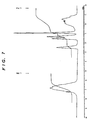
- a reaction for synthesis of polysilane was carried out in the same manner as in Example 1 with the exception of using a mixture of 1.24 g (5 mmols) of (p-n-butylphenyl)methyldichlorosilane and 0.96 g (5 mmols) of methylphenyldichlorosilane in place of 2.33 g of (p-n-propylphenyl)methyldichlorosilane. This procedure gave (p-n-butylphenyl)methyl-co-methylphenylpolysilane with a weight average molecular weight of 20900 in a yield of 43%.
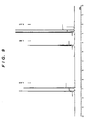
- a 1 H-NMR chart of the obtained polysilane is shown in FIG. 7.
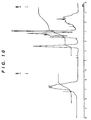
- a 1 H-NMR chart of the obtained polysilane is shown in FIG. 10.
- a reaction for synthesis of polysilane was carried out in the same manner as in Example 1 with the exception of using 1.91 g (10 mmols) of methylphenyldichlorosilane in place of 2.33 g of (p-n-propylphenyl)methyldichlorosilane. This procedure gave methylphenylpolysilane with a weight average molecular weight of 17800 in a yield of 51%.
- Example 2 The same procedure as in Example 1 was repeated with the exception of using p-bromo-t-butylbenzene in place of p-bromo-n-propylbenzene in the preparation of dichlorosilane, giving (p-t-butylphenyl)methyldichlorosilane.
- a reaction for synthesis of polysilane was carried out in the same manner as in Example 1 with the exception of using 2.47 g (10 mmols) of (p-t-butylphenyl)methyldichlorosilane in place of 2.33 g of (p-n-propylphenyl)methyldichlorosilane. This procedure gave (p-t-butylphenyl)methylpolysilane with a weight average molecular weight of 13700 in a yield of 18%.
- a reaction for synthesis of polysilane was carried out in the same manner as in Example 1 with the exception of using 2.05 g (10 mmols) of commercially available (p-methylphenyl)methyldichlorosilane in place of 2.33 g of (p-n-propylphenyl)methyldichlorosilane. This procedure gave (p-methylphenyl)methylpolysilane with a weight average molecular weight of 19900 in a yield of 40%.
- Example 2 The same procedure as in Example 1 was conducted with the exception of using p-bromo-biphenylbenzene in place of p-bromo-n-propylbenzene in the preparation of dichlorosilane. This procedure gave (p-biphenyl)methyldichlorosilane.
- a reaction for synthesis of polysilane was carried out in the same manner as in Example 1 with the exception of using 2.70 g (10 mmols) of (p-biphenyl)methyldichlorosilane in place of 2.33 g of (p-n-propylphenyl) methyldichlorosilane.
Landscapes
- Chemical & Material Sciences (AREA)
- Health & Medical Sciences (AREA)
- Chemical Kinetics & Catalysis (AREA)
- Medicinal Chemistry (AREA)
- Polymers & Plastics (AREA)
- Organic Chemistry (AREA)
- Silicon Polymers (AREA)
Applications Claiming Priority (3)
| Application Number | Priority Date | Filing Date | Title |
|---|---|---|---|
| JP14606296 | 1996-06-07 | ||
| JP146062/96 | 1996-06-07 | ||
| PCT/JP1997/001928 WO1997046605A1 (fr) | 1996-06-07 | 1997-06-06 | Polysilanes et materiaux de transport des trous positifs |
Publications (2)
| Publication Number | Publication Date |
|---|---|
| EP0905172A1 true EP0905172A1 (de) | 1999-03-31 |
| EP0905172A4 EP0905172A4 (de) | 1999-10-20 |
Family
ID=15399226
Family Applications (1)
| Application Number | Title | Priority Date | Filing Date |
|---|---|---|---|
| EP97925289A Withdrawn EP0905172A4 (de) | 1996-06-07 | 1997-06-06 | Polysilane ind positive ladungslöchertransportmaterialien |
Country Status (5)
| Country | Link |
|---|---|
| EP (1) | EP0905172A4 (de) |
| JP (1) | JP3843458B2 (de) |
| KR (1) | KR20000034782A (de) |
| CN (1) | CN1221434A (de) |
| WO (1) | WO1997046605A1 (de) |
Cited By (1)
| Publication number | Priority date | Publication date | Assignee | Title |
|---|---|---|---|---|
| EP0905567A4 (de) * | 1996-06-07 | 1999-09-01 | Osaka Gas Co Ltd | Ladungslöchertransportmaterial |
Family Cites Families (7)
| Publication number | Priority date | Publication date | Assignee | Title |
|---|---|---|---|---|
| JPS62269964A (ja) * | 1986-05-19 | 1987-11-24 | Mitsui Toatsu Chem Inc | 電子写真感光体 |
| US4772525A (en) * | 1987-05-01 | 1988-09-20 | Xerox Corporation | Photoresponsive imaging members with high molecular weight polysilylene hole transporting compositions |
| JPH0196222A (ja) * | 1987-10-08 | 1989-04-14 | Uki Gosei Kogyo Co Ltd | 1,2,2−トリメチル−1−(置換フェニル)ポリジシランおよびその製造法 |
| JPH04264132A (ja) * | 1991-02-19 | 1992-09-18 | Nippon Telegr & Teleph Corp <Ntt> | ヒドロフェニルポリシラン及びその製造方法 |
| US5278014A (en) * | 1991-06-21 | 1994-01-11 | Konica Corporation | Electrophotographic photoreceptor |
| FR2712893B1 (fr) * | 1993-11-24 | 1997-10-10 | France Telecom | Film photoconducteur formé d'un polymère de silane greffé, procédé de préparation, procédé de formation d'une image électrostatique mettant en Óoeuvre un tel film et valve optique comportant un tel film. |
| JP3116759B2 (ja) * | 1994-03-11 | 2000-12-11 | 信越化学工業株式会社 | ポリシラン及びその製造方法 |
-
1997
- 1997-06-06 KR KR1019980710138A patent/KR20000034782A/ko not_active Abandoned
- 1997-06-06 CN CN97195243A patent/CN1221434A/zh active Pending
- 1997-06-06 EP EP97925289A patent/EP0905172A4/de not_active Withdrawn
- 1997-06-06 WO PCT/JP1997/001928 patent/WO1997046605A1/ja not_active Ceased
- 1997-06-06 JP JP50042998A patent/JP3843458B2/ja not_active Expired - Lifetime
Cited By (1)
| Publication number | Priority date | Publication date | Assignee | Title |
|---|---|---|---|---|
| EP0905567A4 (de) * | 1996-06-07 | 1999-09-01 | Osaka Gas Co Ltd | Ladungslöchertransportmaterial |
Also Published As
| Publication number | Publication date |
|---|---|
| CN1221434A (zh) | 1999-06-30 |
| WO1997046605A1 (fr) | 1997-12-11 |
| KR20000034782A (ko) | 2000-06-26 |
| JP3843458B2 (ja) | 2006-11-08 |
| EP0905172A4 (de) | 1999-10-20 |
Similar Documents
| Publication | Publication Date | Title |
|---|---|---|
| US5830972A (en) | Polysilane, its production process and starting materials therefor | |
| EP0893485B1 (de) | Ladungslöchertransportpolymer und organische elektrolumineszente Vorrichtung | |
| US6369258B1 (en) | Silicon-containing compound and organic electroluminescence device using the same | |
| CN1203609A (zh) | 聚(9,9'-螺双芴),其制备和其应用 | |
| US7705174B2 (en) | Condensed polycyclic π-conjugated organic material, intermediate product therefor, and method of manufacturing condensed polycyclic π-conjugated organic material | |
| JP3873424B2 (ja) | 含ケイ素化合物およびそれを用いた有機エレクトロルミネッセンス素子 | |
| EP0905567A1 (de) | Ladungslöchertransportmaterial | |
| JP4158204B2 (ja) | ポリシラン化合物、その製造方法およびその原料 | |
| JP3843458B2 (ja) | ポリシランおよび正孔輸送材料 | |
| KR20070026599A (ko) | 선형 폴리실록산, 실리콘 조성물 및 유기 발광 다이오드 | |
| JPWO1997046605A1 (ja) | ポリシランおよび正孔輸送材料 | |
| JPWO1997046916A1 (ja) | 正孔輸送材料 | |
| JP2853546B2 (ja) | フタロシアニン環含有化合物の製造方法 | |
| US6255430B1 (en) | Polysilanes and process for preparation of same | |
| JP3951479B2 (ja) | 光伝導性ケイ素系高分子およびその製造方法 | |
| JPH04359989A (ja) | 有機エレクトロルミネッセンス素子 | |
| JPH036232A (ja) | 新規な重合体およびその用途 | |
| JPH0827275A (ja) | N−カルバゾリルポリシランおよびオルガノ−n−カルバゾリルジハロゲノシラン化合物 | |
| JPH09110993A (ja) | シアノフェニルポリシランおよびその製造方法 | |
| JP3646432B2 (ja) | 可視応答性ケイ素系高分子およびその製造方法 | |
| JP3665885B2 (ja) | ポリシランの製造方法 | |
| KR100530205B1 (ko) | 규소-함유 화합물 및 이를 이용한 유기전기발광장치 | |
| Perry | Synthesis and properties of polysilane-poly (ferrocenylsilane) random copolymers and oxidized poly (ferrocenylsilane) s | |
| JPH0790086A (ja) | 含フッ素ポリシランおよびその製造方法 | |
| JPH0539358A (ja) | ポリシラン |
Legal Events
| Date | Code | Title | Description |
|---|---|---|---|
| PUAI | Public reference made under article 153(3) epc to a published international application that has entered the european phase |
Free format text: ORIGINAL CODE: 0009012 |
|
| 17P | Request for examination filed |
Effective date: 19981130 |
|
| AK | Designated contracting states |
Kind code of ref document: A1 Designated state(s): DE FR GB |
|
| RIC1 | Information provided on ipc code assigned before grant |
Free format text: 6C 08G 77/60 A, 6G 03G 5/07 B, 6C 08L 83/16 B |
|
| A4 | Supplementary search report drawn up and despatched |
Effective date: 19990907 |
|
| AK | Designated contracting states |
Kind code of ref document: A4 Designated state(s): DE FR GB |
|
| 17Q | First examination report despatched |
Effective date: 20000914 |
|
| STAA | Information on the status of an ep patent application or granted ep patent |
Free format text: STATUS: THE APPLICATION IS DEEMED TO BE WITHDRAWN |
|
| 18D | Application deemed to be withdrawn |
Effective date: 20010130 |