EP0904887A1 - Mit Gold beschichtetes Weichlötmaterial und Verfahren zum flussmittelfreien Weichlöten mit diesem Material - Google Patents
Mit Gold beschichtetes Weichlötmaterial und Verfahren zum flussmittelfreien Weichlöten mit diesem Material Download PDFInfo
- Publication number
- EP0904887A1 EP0904887A1 EP98117357A EP98117357A EP0904887A1 EP 0904887 A1 EP0904887 A1 EP 0904887A1 EP 98117357 A EP98117357 A EP 98117357A EP 98117357 A EP98117357 A EP 98117357A EP 0904887 A1 EP0904887 A1 EP 0904887A1
- Authority
- EP
- European Patent Office
- Prior art keywords
- core
- gold
- solder material
- component
- solder
- Prior art date
- Legal status (The legal status is an assumption and is not a legal conclusion. Google has not performed a legal analysis and makes no representation as to the accuracy of the status listed.)
- Withdrawn
Links
Images


Classifications
-
- B—PERFORMING OPERATIONS; TRANSPORTING
- B23—MACHINE TOOLS; METAL-WORKING NOT OTHERWISE PROVIDED FOR
- B23K—SOLDERING OR UNSOLDERING; WELDING; CLADDING OR PLATING BY SOLDERING OR WELDING; CUTTING BY APPLYING HEAT LOCALLY, e.g. FLAME CUTTING; WORKING BY LASER BEAM
- B23K35/00—Rods, electrodes, materials, or media, for use in soldering, welding, or cutting
- B23K35/02—Rods, electrodes, materials, or media, for use in soldering, welding, or cutting characterised by mechanical features, e.g. shape
- B23K35/0222—Rods, electrodes, materials, or media, for use in soldering, welding, or cutting characterised by mechanical features, e.g. shape for use in soldering or brazing
- B23K35/0233—Sheets or foils
- B23K35/0238—Sheets or foils layered
-
- H—ELECTRICITY
- H05—ELECTRIC TECHNIQUES NOT OTHERWISE PROVIDED FOR
- H05K—PRINTED CIRCUITS; CASINGS OR CONSTRUCTIONAL DETAILS OF ELECTRIC APPARATUS; MANUFACTURE OF ASSEMBLAGES OF ELECTRICAL COMPONENTS
- H05K3/00—Apparatus or processes for manufacturing printed circuits
- H05K3/30—Assembling printed circuits with electric components, e.g. with resistors
- H05K3/32—Assembling printed circuits with electric components, e.g. with resistors electrically connecting electric components or wires to printed circuits
- H05K3/34—Assembling printed circuits with electric components, e.g. with resistors electrically connecting electric components or wires to printed circuits by soldering
- H05K3/3494—Heating processes for reflow soldering
-
- B—PERFORMING OPERATIONS; TRANSPORTING
- B23—MACHINE TOOLS; METAL-WORKING NOT OTHERWISE PROVIDED FOR
- B23K—SOLDERING OR UNSOLDERING; WELDING; CLADDING OR PLATING BY SOLDERING OR WELDING; CUTTING BY APPLYING HEAT LOCALLY, e.g. FLAME CUTTING; WORKING BY LASER BEAM
- B23K35/00—Rods, electrodes, materials, or media, for use in soldering, welding, or cutting
- B23K35/22—Rods, electrodes, materials, or media, for use in soldering, welding, or cutting characterised by the composition or nature of the material
- B23K35/24—Selection of soldering or welding materials proper
- B23K35/26—Selection of soldering or welding materials proper with the principal constituent melting at less than 400°C
-
- B—PERFORMING OPERATIONS; TRANSPORTING
- B23—MACHINE TOOLS; METAL-WORKING NOT OTHERWISE PROVIDED FOR
- B23K—SOLDERING OR UNSOLDERING; WELDING; CLADDING OR PLATING BY SOLDERING OR WELDING; CUTTING BY APPLYING HEAT LOCALLY, e.g. FLAME CUTTING; WORKING BY LASER BEAM
- B23K35/00—Rods, electrodes, materials, or media, for use in soldering, welding, or cutting
- B23K35/22—Rods, electrodes, materials, or media, for use in soldering, welding, or cutting characterised by the composition or nature of the material
- B23K35/24—Selection of soldering or welding materials proper
- B23K35/26—Selection of soldering or welding materials proper with the principal constituent melting at less than 400°C
- B23K35/262—Sn as the principal constituent
-
- H—ELECTRICITY
- H05—ELECTRIC TECHNIQUES NOT OTHERWISE PROVIDED FOR
- H05K—PRINTED CIRCUITS; CASINGS OR CONSTRUCTIONAL DETAILS OF ELECTRIC APPARATUS; MANUFACTURE OF ASSEMBLAGES OF ELECTRICAL COMPONENTS
- H05K3/00—Apparatus or processes for manufacturing printed circuits
- H05K3/10—Apparatus or processes for manufacturing printed circuits in which conductive material is applied to the insulating support in such a manner as to form the desired conductive pattern
- H05K3/18—Apparatus or processes for manufacturing printed circuits in which conductive material is applied to the insulating support in such a manner as to form the desired conductive pattern using precipitation techniques to apply the conductive material
- H05K3/181—Apparatus or processes for manufacturing printed circuits in which conductive material is applied to the insulating support in such a manner as to form the desired conductive pattern using precipitation techniques to apply the conductive material by electroless plating
-
- H—ELECTRICITY
- H05—ELECTRIC TECHNIQUES NOT OTHERWISE PROVIDED FOR
- H05K—PRINTED CIRCUITS; CASINGS OR CONSTRUCTIONAL DETAILS OF ELECTRIC APPARATUS; MANUFACTURE OF ASSEMBLAGES OF ELECTRICAL COMPONENTS
- H05K3/00—Apparatus or processes for manufacturing printed circuits
- H05K3/30—Assembling printed circuits with electric components, e.g. with resistors
- H05K3/32—Assembling printed circuits with electric components, e.g. with resistors electrically connecting electric components or wires to printed circuits
- H05K3/34—Assembling printed circuits with electric components, e.g. with resistors electrically connecting electric components or wires to printed circuits by soldering
- H05K3/346—Solder materials or compositions specially adapted therefor
-
- B—PERFORMING OPERATIONS; TRANSPORTING
- B23—MACHINE TOOLS; METAL-WORKING NOT OTHERWISE PROVIDED FOR
- B23K—SOLDERING OR UNSOLDERING; WELDING; CLADDING OR PLATING BY SOLDERING OR WELDING; CUTTING BY APPLYING HEAT LOCALLY, e.g. FLAME CUTTING; WORKING BY LASER BEAM
- B23K35/00—Rods, electrodes, materials, or media, for use in soldering, welding, or cutting
- B23K35/22—Rods, electrodes, materials, or media, for use in soldering, welding, or cutting characterised by the composition or nature of the material
- B23K35/24—Selection of soldering or welding materials proper
- B23K35/26—Selection of soldering or welding materials proper with the principal constituent melting at less than 400°C
- B23K35/268—Pb as the principal constituent
-
- B—PERFORMING OPERATIONS; TRANSPORTING
- B23—MACHINE TOOLS; METAL-WORKING NOT OTHERWISE PROVIDED FOR
- B23K—SOLDERING OR UNSOLDERING; WELDING; CLADDING OR PLATING BY SOLDERING OR WELDING; CUTTING BY APPLYING HEAT LOCALLY, e.g. FLAME CUTTING; WORKING BY LASER BEAM
- B23K35/00—Rods, electrodes, materials, or media, for use in soldering, welding, or cutting
- B23K35/22—Rods, electrodes, materials, or media, for use in soldering, welding, or cutting characterised by the composition or nature of the material
- B23K35/24—Selection of soldering or welding materials proper
- B23K35/30—Selection of soldering or welding materials proper with the principal constituent melting at less than 1550°C
- B23K35/3013—Au as the principal constituent
-
- H—ELECTRICITY
- H10—SEMICONDUCTOR DEVICES; ELECTRIC SOLID-STATE DEVICES NOT OTHERWISE PROVIDED FOR
- H10W—GENERIC PACKAGES, INTERCONNECTIONS, CONNECTORS OR OTHER CONSTRUCTIONAL DETAILS OF DEVICES COVERED BY CLASS H10
- H10W72/00—Interconnections or connectors in packages
- H10W72/071—Connecting or disconnecting
- H10W72/073—Connecting or disconnecting of die-attach connectors
- H10W72/07351—Connecting or disconnecting of die-attach connectors characterised by changes in properties of the die-attach connectors during connecting
- H10W72/07355—Connecting or disconnecting of die-attach connectors characterised by changes in properties of the die-attach connectors during connecting changes in materials
-
- H—ELECTRICITY
- H10—SEMICONDUCTOR DEVICES; ELECTRIC SOLID-STATE DEVICES NOT OTHERWISE PROVIDED FOR
- H10W—GENERIC PACKAGES, INTERCONNECTIONS, CONNECTORS OR OTHER CONSTRUCTIONAL DETAILS OF DEVICES COVERED BY CLASS H10
- H10W72/00—Interconnections or connectors in packages
- H10W72/30—Die-attach connectors
- H10W72/351—Materials of die-attach connectors
-
- Y—GENERAL TAGGING OF NEW TECHNOLOGICAL DEVELOPMENTS; GENERAL TAGGING OF CROSS-SECTIONAL TECHNOLOGIES SPANNING OVER SEVERAL SECTIONS OF THE IPC; TECHNICAL SUBJECTS COVERED BY FORMER USPC CROSS-REFERENCE ART COLLECTIONS [XRACs] AND DIGESTS
- Y10—TECHNICAL SUBJECTS COVERED BY FORMER USPC
- Y10T—TECHNICAL SUBJECTS COVERED BY FORMER US CLASSIFICATION
- Y10T428/00—Stock material or miscellaneous articles
- Y10T428/12—All metal or with adjacent metals
- Y10T428/12493—Composite; i.e., plural, adjacent, spatially distinct metal components [e.g., layers, joint, etc.]
- Y10T428/12687—Pb- and Sn-base components: alternative to or next to each other
-
- Y—GENERAL TAGGING OF NEW TECHNOLOGICAL DEVELOPMENTS; GENERAL TAGGING OF CROSS-SECTIONAL TECHNOLOGIES SPANNING OVER SEVERAL SECTIONS OF THE IPC; TECHNICAL SUBJECTS COVERED BY FORMER USPC CROSS-REFERENCE ART COLLECTIONS [XRACs] AND DIGESTS
- Y10—TECHNICAL SUBJECTS COVERED BY FORMER USPC
- Y10T—TECHNICAL SUBJECTS COVERED BY FORMER US CLASSIFICATION
- Y10T428/00—Stock material or miscellaneous articles
- Y10T428/12—All metal or with adjacent metals
- Y10T428/12493—Composite; i.e., plural, adjacent, spatially distinct metal components [e.g., layers, joint, etc.]
- Y10T428/12708—Sn-base component
- Y10T428/12715—Next to Group IB metal-base component
-
- Y—GENERAL TAGGING OF NEW TECHNOLOGICAL DEVELOPMENTS; GENERAL TAGGING OF CROSS-SECTIONAL TECHNOLOGIES SPANNING OVER SEVERAL SECTIONS OF THE IPC; TECHNICAL SUBJECTS COVERED BY FORMER USPC CROSS-REFERENCE ART COLLECTIONS [XRACs] AND DIGESTS
- Y10—TECHNICAL SUBJECTS COVERED BY FORMER USPC
- Y10T—TECHNICAL SUBJECTS COVERED BY FORMER US CLASSIFICATION
- Y10T428/00—Stock material or miscellaneous articles
- Y10T428/12—All metal or with adjacent metals
- Y10T428/12493—Composite; i.e., plural, adjacent, spatially distinct metal components [e.g., layers, joint, etc.]
- Y10T428/12771—Transition metal-base component
- Y10T428/12861—Group VIII or IB metal-base component
- Y10T428/12889—Au-base component
Definitions
- the present invention is directed to the field of microelectronic packaging and, more particularly, to a gold plated solder material and a method of fluxless soldering attachment using the solder material.
- Different types of components are commonly attached to substrates in microelectronic assemblies such as hybrid packages using eutectic attachment techniques.
- different types of components are commonly attached to a substrate using different solder compositions.
- Typical metal alloy solder compositions that are used include gold-based alloys such as Au-Si, Au-Ge and Au-Sn.
- gold-based alloys do not oxidize in air and, consequently, do not require the use of fluxes to dissolve oxides and enable wetting of the joined surfaces. Fluxes are undesirable in soldering hybrid packages, however, due to the detrimental effects fluxes can have on certain components such as micro-optoelectronic devices.
- soldering hierarchy approach in which the components are soldered in the order of descending temperature resistance using different solder compositions in the order of descending processing temperature.
- 96.4% Au-3.6% Si has a eutectic temperature of about 370°C and is typically heated to a processing temperature of about 390-420°C to form a eutectic bond between the component and the substrate.
- Components having an upper temperature limit above this processing temperature are attached first to the substrate using Au-Si solder.
- Au-Ge solder has a eutectic temperature below that of Au-Si solder and above that of Au-Sn solder. Accordingly, components having a temperature upper limit below the Au-Si solder process temperature range and above the Au-Sn process temperature are next attached to the substrate using the Au-Ge solder. This process is repeated until the soldering hierarchy is completed.
- the present gold-based solders are less than completely satisfactory because they cannot be used in microelectronic assemblies such as hybrid packages to attach components having an upper temperature limit below the process temperature of Au-Sn solders.
- 80% Au-20% Sn solder has a eutectic temperature of about 280°C and typically is heated to about 310-330°C during soldering to ensure complete melting occurs. This processing temperature range can degrade some components.
- solder compositions such as Sn-Pb solders have a sufficiently low process temperature for attaching such components, but these solders require fluxes to form a satisfactory joint. Accordingly, these solders are not suitable for use in hybrid packages that include micro-optoelectronic devices which can be degraded by fluxes.
- solder composition and a method of using the solder composition to attach a component to a substrate in a microelectronic assembly such as a hybrid package that (i) does not require a flux; and (ii) melts at a relatively low temperature, making it suitable for attaching components at lower process temperatures than can be used for known gold-based solders.
- the present invention provides a solder material and a method of fluxless soldering attachment of a component to a substrate in a microelectronic assembly such as a hybrid package using the solder material that satisfies the above-described needs.
- the solder material comprises a core and a layer of gold covering at least a portion of the core.
- the core can comprise tin, lead and small amounts of other elements such as silver.
- the alloy preferably consists essentially of at least about 30 wt.% tin and the balance lead. This composition melts at temperatures of less than about 250°C.
- the solder material comprising this core composition can be heated to a temperature of less than about 280°C to melt the core alloy and form a solder joint.
- the alloy preferably consists essentially of a eutectic composition of about 63 wt.% tin and about 37 wt.% lead that melts at the eutectic temperature of about 183°C.
- the solder material comprising this core composition can be heated to a low process temperature of less than about 230°C to join the component and the substrate. Heating of the solder material is preferably conducted in an inert gas atmosphere.
- the gold layer is preferably applied on the core using an electroless plating process. Electroless plating provides a gold layer having excellent coverage and thickness uniformity.
- the component and the substrate typically each also have a gold layer to prevent surface oxidation.
- the solder material has an effective thickness to provide a joint between the component and the substrate comprising less than about 3 wt.% gold. Higher percentages of gold can degrade the mechanical properties of the joint.
- the method of attaching the component to the substrate in the microelectronic assembly comprises placing the solder material between the component and the substrate and heating the solder material to an effective temperature to melt the solder material and form a solder joint.
- the effective temperature depends on the composition of the core.
- the joint preferably comprises less than about 3 wt.% of gold.
- the present solder material and method of attaching a component to a substrate in a microelectronic assembly (i) enables fluxless soldering; (ii) has a relatively low process temperature, making it suitable for attaching components in hybrid packages at lower temperatures than can be used for known gold-based solders; and (iii) forms a joint having a controlled gold content.
- Fig. 1 illustrates a solder material 10 in accordance with the present invention disposed between a component 12 and a substrate 14 supporting the component 12 in a microelectronic assembly 16 such as a hybrid package 16 .
- the solder material 10 is shown prior to the formation of a solder joint between the component 12 and the substrate 14 .
- the component 12 can be, for example, a V-groove, modulator, waveguide, standard electronic component, microwave component, lens, fiber holder, transmitter, receiver, feedthrough or the like.
- the substrate 14 can be, for example, a metallized ceramic, a metallized package or the like.
- the solder material 10 comprises a core 18 and a layer 20 on the core 18 .
- the core 18 can comprise tin (Sn) and lead (Pb).
- the layer 20 on the core 18 consists essentially of gold.
- the solder material 10 preferably has a melting temperature of less than about 250°C and, accordingly, a process temperature of less than about 280°C.
- the solder material 10 is heated to a temperature that is from about 30°C to about 50°C above its melting temperature to ensure that complete melting occurs and a good solder joint is formed.
- An inert gas atmosphere is preferably used.
- the core 18 can consist essentially of at least about 30 wt.% tin and the balance lead.
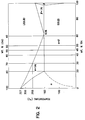
- the liquids temperature of an alloy consisting essentially of 30 wt.% tin and 70 wt.% lead is about 255°C.
- This composition melts over a temperature range of from about 183°C (eutectic temperature) to about 255°C.
- Alloys between about 30 wt.% tin and the eutectic composition have a decreasing liquidus temperature.
- Alloys containing more than about 63 wt.% tin have an increasing liquidus temperature up to the melting temperature of tin, 232°C.
- the core 18 preferably has the eutectic composition of about 63 wt.% tin and about 37 wt.% lead, so that the melting temperature of the core 18 is only about 183°C.
- the process temperature of this composition is less than about 230°C. This low orocess temperature enables the solder material 10 to be used to attach components that can be degraded during soldering with known gold-based solders. Accordingly, the solder material 10 can provide an additional low temperature step in the soldering hierarchy in the assembly 16 .
- Small amounts of less than about 1-5 wt.% of other elements such as silver can be added to tin-lead alloys comprising at least about 30 wt.% tin and lead to form the core 18 .
- an alloy consisting essentially of about 62.5 wt.% tin, 36.1 wt.% lead and 1.4 wt.% silver has a suitable low melting temperature of about 179°C. It is contemplated that small amounts of other elements that do not degrade the microstructure and mechanical properties of the solder joint can alternately be added to tin-lead alloys to form the core 18 .
- the amount of gold in the solder joint is preferably maintained at less than about 3 wt.% to avoid problems associated with higher percentages.
- Gold levels below about 3 wt. % do not have a significant effect on the melting temperature of tin-lead alloys over the preferred composition range of the core 18 . Accordingly, the process temperature of the solder material 10 can be approximated based on the melting temperature of the core 18 .
- the core 18 typically has a sheet configuration.
- the solder material 10 has an effective thickness so that it contains a sufficient amount of tin relative to the amount of gold in the solder joint to give the joint good mechanical properties.
- the layer 20 of gold is preferably applied on the core 18 using an electroless plating process.
- An electroless plating process was performed to produce a gold plating layer on a core consisting essentially of about 63 wt.% tin and about 37 wt.% lead.
- the resulting gold layer had a highly uniform thickness of about 0.1 ⁇ m on substantially the entire outer surface of the core.
- the plating solution used to plate the core was OROMERSE MN available from Technic, Inc. Of Anaheim, California. The plating solution was mechanically agitated. The temperature of the solution was about 85°C, and the plating time was about two minutes.
- the gold layer 20 on the core 18 enables the solder material 10 to be used without a flux.
- the electroless plating process removes substantially all oxide from the outer surface of the core 18 during plating.
- the combination of the low melting temperature and fluxless soldering capabilities of the solder material 10 provide important advantages as compared to known gold-based solders.
- the solder material 10 can be used to attach components in microelectronic assemblies that can be degraded by the process temperatures of known gold-based solders.
- the solder material 10 adds a step in the soldering hierarchy at process temperatures significantly below the lowest process temperatures that can be used with known gold-based solders (i.e., about 310°C-330°C as used for Au-Sn solders).
- the solder material 10 is particularly advantageous for use in hybrid packages which are hermetically sealed to prevent contamination. Fluxes can have detrimental effects on components in hybrid packages. Furthermore, the solder material 10 can be used in hybrid packages that include micro-optoelectronic devices without degrading the performance of such devices. The solder material 10 can be used to attach optoelectronic devices, and to attach other types of components in hybrid packages that include optoelectronic devices.
- the component 12 typically has a diffusion barrier layer 22 on its lower surface 24 and a gold layer 26 on the barrier layer 22 .
- the barrier layer 22 can be a nickel layer applied by an electroless plating process.
- the substrate 14 typically has a gold layer 28 on its upper surface 30 .
- the gold layers 26 , 28 are applied to prevent oxidation.
- the thickness of the layers 26 , 28 is typically about 0.1 ⁇ m. It is known that the weight percentage of gold in tin-containing alloys has significant effects on the microstructure and mechanical properties of the alloys. Particularly, increasing the gold content coarsens tin-lead microstructures and reduces yield strength. Gold can form brittle AuSn 4 or Au(Sn,Pb) 4 intermetallic structures which align along shear directions under vibration shear conditions.
- gold promotes the formation of voids in gold-containing solder joints. Accordingly, the amount of gold in the solder material 10 is limited to reduce defects, to achieve a satisfactory low cycle fatigue life, and to reduce brittle fracture behavior in the solder joint. A gold level of less than about 3 wt.% in the solder joint formed using the solder material 10 is preferred to overcome these problems.
- the solder material 10 preferably has a thickness of at least about 50 ⁇ m. This thickness of the solder material 10 provides a sufficient amount of tin and lead in the resulting joint between the component 12 and the substrate 14 such that the joint comprises less than about 3 wt.% gold. A greater thickness of the solder material 10 can be used to further reduce the weight percentage of gold in the solder joint.
- Fig. 3 illustrates the microstructure of a typical solder joint formed by a fluxless soldering method using the solder material 10 according to the present invention.
- the gold layer 20 on the core 18 and the gold layer 26 on the component 12 , the gold layer 20 , and the gold layer 28 on the substrate 14 are dissolved in the molten solder.
- the core 18 comprises a lead-rich phase 36 and a tin-rich phase 38 .
- the gold layers 20 , 26 , and 28 prevent oxidation of all metal surfaces involved and enable the soldering process to be performed without a flux. Accordingly, the solder material 10 can be used to attach components such as micro-optoelectronic devices that can be degraded by fluxes. The solder material 10 also enables the attachment of components in assemblies on which micro-optoelectronic components are already present. The solder material 10 adds a lower temperature step in the soldering hierarchy than can be achieved with known gold-based solder materials.
Landscapes
- Engineering & Computer Science (AREA)
- Mechanical Engineering (AREA)
- Manufacturing & Machinery (AREA)
- Microelectronics & Electronic Packaging (AREA)
- Electric Connection Of Electric Components To Printed Circuits (AREA)
- Chemically Coating (AREA)
Applications Claiming Priority (2)
| Application Number | Priority Date | Filing Date | Title |
|---|---|---|---|
| US937690 | 1978-08-28 | ||
| US93769097A | 1997-09-29 | 1997-09-29 |
Publications (1)
| Publication Number | Publication Date |
|---|---|
| EP0904887A1 true EP0904887A1 (de) | 1999-03-31 |
Family
ID=25470273
Family Applications (1)
| Application Number | Title | Priority Date | Filing Date |
|---|---|---|---|
| EP98117357A Withdrawn EP0904887A1 (de) | 1997-09-29 | 1998-09-14 | Mit Gold beschichtetes Weichlötmaterial und Verfahren zum flussmittelfreien Weichlöten mit diesem Material |
Country Status (4)
| Country | Link |
|---|---|
| US (1) | US6203929B1 (de) |
| EP (1) | EP0904887A1 (de) |
| JP (1) | JPH11170083A (de) |
| KR (1) | KR19990029741A (de) |
Families Citing this family (6)
| Publication number | Priority date | Publication date | Assignee | Title |
|---|---|---|---|---|
| JP2001176999A (ja) * | 2000-11-27 | 2001-06-29 | Tanaka Kikinzoku Kogyo Kk | 電子部品の気密封止方法 |
| US7168608B2 (en) * | 2002-12-24 | 2007-01-30 | Avago Technologies General Ip (Singapore) Pte. Ltd. | System and method for hermetic seal formation |
| US8348139B2 (en) * | 2010-03-09 | 2013-01-08 | Indium Corporation | Composite solder alloy preform |
| JP5601275B2 (ja) * | 2010-08-31 | 2014-10-08 | 日立金属株式会社 | 接合材料、その製造方法、および接合構造の製造方法 |
| KR101626511B1 (ko) | 2015-12-01 | 2016-06-01 | 동의대학교 산학협력단 | 유니버설 조인트의 윤활유 공급장치 |
| CN108346952B (zh) * | 2018-01-25 | 2020-11-24 | 番禺得意精密电子工业有限公司 | 电连接器固持装置 |
Citations (5)
| Publication number | Priority date | Publication date | Assignee | Title |
|---|---|---|---|---|
| US2503564A (en) * | 1944-09-02 | 1950-04-11 | Bell Telephone Labor Inc | Soldering composition |
| GB2036794A (en) * | 1978-11-28 | 1980-07-02 | Semi Alloys Inc | Solder Preform |
| JPS61137697A (ja) * | 1984-12-07 | 1986-06-25 | Hitachi Ltd | 成形半田およびその製造方法 |
| GB2221570A (en) * | 1988-08-04 | 1990-02-07 | Stc Plc | Bonding a semiconductor to a heat sink |
| US5384204A (en) * | 1990-07-27 | 1995-01-24 | Shinko Electric Industries Co. Ltd. | Tape automated bonding in semiconductor technique |
Family Cites Families (9)
| Publication number | Priority date | Publication date | Assignee | Title |
|---|---|---|---|---|
| FR1483574A (de) * | 1965-06-24 | 1967-09-06 | ||
| US4645116A (en) * | 1982-10-08 | 1987-02-24 | At&T Bell Laboratories | Fluxless bonding of microelectronic chips |
| JPH0746747B2 (ja) * | 1986-09-09 | 1995-05-17 | 松下電器産業株式会社 | 半導体レーザのボンディング方法 |
| US5878943A (en) * | 1990-02-19 | 1999-03-09 | Hitachi, Ltd. | Method of fabricating an electronic circuit device and apparatus for performing the method |
| US5341980A (en) * | 1990-02-19 | 1994-08-30 | Hitachi, Ltd. | Method of fabricating electronic circuit device and apparatus for performing the same method |
| US5086966A (en) * | 1990-11-05 | 1992-02-11 | Motorola Inc. | Palladium-coated solder ball |
| US5622305A (en) * | 1995-05-10 | 1997-04-22 | Lucent Technologies Inc. | Bonding scheme using group VB metallic layer |
| US6037065A (en) * | 1995-12-19 | 2000-03-14 | The Westaim Corporation | Spheres useful in a detachable connective medium for ball grid array assemblies |
| US6119920A (en) * | 1996-12-20 | 2000-09-19 | Rf Monolithics, Inc. | Method of forming an electronic package with a solder seal |
-
1998
- 1998-09-11 KR KR1019980037607A patent/KR19990029741A/ko not_active Withdrawn
- 1998-09-14 EP EP98117357A patent/EP0904887A1/de not_active Withdrawn
- 1998-09-29 JP JP10275099A patent/JPH11170083A/ja active Pending
-
1999
- 1999-04-19 US US09/294,264 patent/US6203929B1/en not_active Expired - Fee Related
Patent Citations (5)
| Publication number | Priority date | Publication date | Assignee | Title |
|---|---|---|---|---|
| US2503564A (en) * | 1944-09-02 | 1950-04-11 | Bell Telephone Labor Inc | Soldering composition |
| GB2036794A (en) * | 1978-11-28 | 1980-07-02 | Semi Alloys Inc | Solder Preform |
| JPS61137697A (ja) * | 1984-12-07 | 1986-06-25 | Hitachi Ltd | 成形半田およびその製造方法 |
| GB2221570A (en) * | 1988-08-04 | 1990-02-07 | Stc Plc | Bonding a semiconductor to a heat sink |
| US5384204A (en) * | 1990-07-27 | 1995-01-24 | Shinko Electric Industries Co. Ltd. | Tape automated bonding in semiconductor technique |
Non-Patent Citations (1)
| Title |
|---|
| PATENT ABSTRACTS OF JAPAN vol. 010, no. 333 (M - 534) 12 November 1986 (1986-11-12) * |
Also Published As
| Publication number | Publication date |
|---|---|
| KR19990029741A (ko) | 1999-04-26 |
| US6203929B1 (en) | 2001-03-20 |
| JPH11170083A (ja) | 1999-06-29 |
Similar Documents
| Publication | Publication Date | Title |
|---|---|---|
| KR100213695B1 (ko) | 주석-비스무트 솔더 페이스트 및 고온 특성이 개량된 접속을 형성하는데 페이스트를 사용하는방법 | |
| US5411703A (en) | Lead-free, tin, antimony, bismtuh, copper solder alloy | |
| KR101004589B1 (ko) | 기능 부품용 리드와 그 제조 방법 | |
| US5328660A (en) | Lead-free, high temperature, tin based multi-component solder | |
| KR970010891B1 (ko) | 고온의 무연 주석 기재 납땜 조성물 | |
| US5414303A (en) | Lead-free, high tin, ternary solder alloy of tin, bismuth, and indium | |
| CN104704620B (zh) | 用于流控自组装的双焊料层、电组件衬底以及采用该流控自组装的方法 | |
| US20050139644A1 (en) | Electronic devices and methods of forming electronic devices | |
| US4634638A (en) | High melting point copper-gold-tin brazing alloy for chip carriers | |
| JP3475147B2 (ja) | はんだ接続部 | |
| US6203929B1 (en) | Gold plated solder material and method of fluxless soldering using solder | |
| JP4369643B2 (ja) | はんだ接合層 | |
| JP2002185130A (ja) | 電子回路装置及び電子部品 | |
| JP2000015479A (ja) | はんだ合金及び電子部品の実装方法 | |
| JPH0146228B2 (de) | ||
| JP4071049B2 (ja) | 鉛フリー半田ペースト | |
| JPH0985484A (ja) | 鉛フリーはんだとそれを用いた実装方法及び実装品 | |
| JP2007194630A (ja) | はんだ接合層 | |
| JP2004095907A (ja) | ハンダ接合構造およびハンダペースト | |
| KR100883863B1 (ko) | 기계적 특성이 개선된 전자부품, 전자부품간 접합구조체 및이의 접합방법 | |
| JP3725789B2 (ja) | 管球の口金とリード線との接合方法 | |
| JP2002066783A (ja) | 鉛フリー半田ペーストおよび半田接合方法ならびに実装構造 | |
| JP2003094194A (ja) | はんだ材及び電子部品における部材の固定方法 | |
| JP2000135557A (ja) | 鉛フリ−耐熱性はんだ及びはんだ付け方法 | |
| JP2002185131A (ja) | はんだ付け方法およびはんだ接合部 |
Legal Events
| Date | Code | Title | Description |
|---|---|---|---|
| PUAI | Public reference made under article 153(3) epc to a published international application that has entered the european phase |
Free format text: ORIGINAL CODE: 0009012 |
|
| AK | Designated contracting states |
Kind code of ref document: A1 Designated state(s): DE FR GB IT |
|
| AX | Request for extension of the european patent |
Free format text: AL;LT;LV;MK;RO;SI |
|
| 17P | Request for examination filed |
Effective date: 19990421 |
|
| AKX | Designation fees paid |
Free format text: DE FR GB IT |
|
| 17Q | First examination report despatched |
Effective date: 20030220 |
|
| STAA | Information on the status of an ep patent application or granted ep patent |
Free format text: STATUS: THE APPLICATION IS DEEMED TO BE WITHDRAWN |
|
| 18D | Application deemed to be withdrawn |
Effective date: 20030703 |