EP0904534B1 - Festelektrolyt-gassensor - Google Patents
Festelektrolyt-gassensor Download PDFInfo
- Publication number
- EP0904534B1 EP0904534B1 EP97928193A EP97928193A EP0904534B1 EP 0904534 B1 EP0904534 B1 EP 0904534B1 EP 97928193 A EP97928193 A EP 97928193A EP 97928193 A EP97928193 A EP 97928193A EP 0904534 B1 EP0904534 B1 EP 0904534B1
- Authority
- EP
- European Patent Office
- Prior art keywords
- galvanic cell
- ion
- gas
- conducting
- cation
- Prior art date
- Legal status (The legal status is an assumption and is not a legal conclusion. Google has not performed a legal analysis and makes no representation as to the accuracy of the status listed.)
- Expired - Lifetime
Links
Images

Classifications
-
- G—PHYSICS
- G01—MEASURING; TESTING
- G01N—INVESTIGATING OR ANALYSING MATERIALS BY DETERMINING THEIR CHEMICAL OR PHYSICAL PROPERTIES
- G01N27/00—Investigating or analysing materials by the use of electric, electrochemical, or magnetic means
- G01N27/26—Investigating or analysing materials by the use of electric, electrochemical, or magnetic means by investigating electrochemical variables; by using electrolysis or electrophoresis
- G01N27/403—Cells and electrode assemblies
- G01N27/406—Cells and probes with solid electrolytes
- G01N27/407—Cells and probes with solid electrolytes for investigating or analysing gases
- G01N27/4073—Composition or fabrication of the solid electrolyte
- G01N27/4074—Composition or fabrication of the solid electrolyte for detection of gases other than oxygen
Definitions
- the invention relates to a galvanic cell, which is preferably designed as a potentiometric sensor for determining gases such as CO 2 , SO x and NO x .
- the galvanic cell according to the invention can be operated at elevated temperatures and is particularly suitable for those application conditions in which the partial pressure of the oxygen in the measuring medium changes with the content of the gases to be detected.
- the function of the measuring electrode is based on the presence of a so-called ionic bridge.
- This ionic bridge which is an electrochemical compound between the metal salt and the O-FE by training a solid phase that both me and Should contain oxygen ions.
- a disadvantage of the sensors proposed by the Yamazoe group is that the reproducible production of workable sensors, i.e. sensors that respond to the concentration of the gas to be detected, is not always successful (cf. Yan et al., J.Electrochem. Soc. 143 (1996), 609 ). Obviously, the successful operation of such a sensor is an exception due to random constellations. Our own studies have shown that the formation of the phase that is supposed to function as an ionic bridge is rather unlikely for kinetic reasons and that the electrodes used in the Yamazoe sensors do not open at all Address CO 2 partial pressure changes.
- the salt itself serves as Me-FE, but an independent material that is a comparatively better ion conductor and in equilibrium with the salt Me m (XO n ) p forms the measuring electrode.
- a generic sulfur dioxide sensor on a pipe Made of stabilized zirconia between those on the surface platinum electrode located a thin layer Lithium sulfate / magnesium oxide as a gas sensitive material and on a platinum reference electrode is arranged on the inside of the tube has, with a mixed oxide layer between the two half cells lithium oxide, zirconium oxide and magnesium oxide.
- the object underlying the invention is thus reproducible production of a galvanic cell, especially a potentiometric sensor for the detection of Gases based exclusively on an oxygen concentration chain using an O-FE, which ensures is that the measuring properties of the sensor are not affected by Electron conduction in the electrolyte are impaired.
- At least one intermediate layer of a material is introduced between the oxygen ion-conducting solid electrolyte and the metal salt Me m (XO n ) p which acts as a gas-sensitive layer and which seals the potential-determining region of the solid electrolyte surface in a gas-tight manner with respect to the environment and a high conductivity for metal ions Me as well as for electrons, ie the electron line should preferably be of the order of magnitude of the ion line or larger under the conditions of use.
- the material of the intermediate layer should preferably be inert under the operating conditions of the sensor, realize a finite solubility for the metal oxide Me y O and have a negligible mobility for oxygen or the oxide Me y O.
- the oxygen-ion-conducting solid electrolyte can be, for example, a material based on ZrO 2 , ThO 2 , CeO 2 , HfO 2 or Bi 2 O 3 .
- a material based on cubic, tetragonal or partially stabilized ZrO 2 for example a YO 1.5 stabilized ZrO 2, is particularly preferred as the oxygen ion-conducting solid electrolyte.
- the salt of the structural formula Me m (XO n ) p is preferably an alkali metal or an alkaline earth metal salt, for example a Li, Na, K, Rb, Cs, Ca, Sr or Ba salt.
- the metal salt is preferably a carbonate, sulfate or nitrate.
- the cation-conducting material can be an alkali metal or Be alkaline earth metal ion conductor, its electronic Conductivity preferred over the usual conditions was deliberately increased.
- This increase in electronic Conductivity can be achieved, for example, by using a Composite material can be achieved, which is a mixture of a electronically conductive phase such as Pt and one contains cation-conducting phase. You can also Materials are used that are both sufficiently high have cationic and electronic conductivity.
- the galvanic cell according to the invention is preferably used as a gas sensor, in particular for the detection of CO 2 , NO x or SO x both in the trace region and for larger concentrations.
- the temperature range in which the sensor according to the invention can be used is usually 450 ° C to 750 ° C.
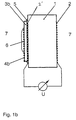
- FIGS. 1a and 1b The basic structure of a cell according to the invention is shown as an example in FIGS. 1a and 1b.
- solid electrolyte (1) which can be, for example, a pellet made of YO 1.5 stabilized ZrO 2 .
- an electronically conductive potential tap (2,2 ') is attached to each of the two plane-parallel surfaces. This can be done, for example, by burning in a commercially available platinum paste.
- a thin layer of a Li 2 O-containing glass for example a Li silicate glass
- a noble metal network for example a gold network (4a) is electronically short-circuited to the potential tap (2 ').
- a thin layer of a densely sintered material (3b), which is known as a cation conductor, for example as a Li, Na or K ion conductor, can be used instead of the glass (3a).
- a densely sintered material (3b) which is known as a cation conductor, for example as a Li, Na or K ion conductor
- Suitable materials for this purpose are, for example, Nasicon, Na- or K-beta-Al 2 O 3 , Lisicon or a high-melting Li glass.
- the body can also be both cationic and electronic conductive composite body (not shown) used become.
- Sintered body (3b) is subsequently placed on one with the Potential tap (2 ') provided platinized surfaces of the solid ion (1) conducting oxygen ions. This can be done, for example, using a drop of a Na or K water glass solution (5).
- cation and electron conductor (3a, 3b) is the surface provided with the potential tap (2 ') of the oxygen ion-conducting solid electrolyte or potential-tuning area of which gastight against the Environment sealed.
- a thin layer of a gas-sensitive salt Me m (XO n ) p (6) is subsequently applied to the conductor (3a, 3b), which has a conductivity for ions of the metal Me and for electrons. This can be done, for example, by drying a drop of a saturated aqueous salt solution.
- the oxygen-ion-conducting solid electrolyte is exposed on both electrode sides to the measuring gas atmosphere (7), which contains the gas to be determined XO x and O 2 .
- the signal is tapped from the platinum-coated surfaces of the oxygen-ion-conducting solid electrolyte.
- the material combination Cs 2 CO 3 / Cs ion conductor and Rb 2 CO 3 / Rb ion conductor can also be used to measure CO 2 .
- the combination CsNO 3 / Cs ion conductor is suitable for measuring NO x .
- the sensor according to the invention can also be used in planar technology produce.
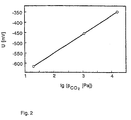
- FIG. 2 illustrates, on the basis of the CO 2 partial pressure dependence of the cell voltage measured at 680 ° C., the sensitivity of a CO 2 sensor produced according to FIG. 1 to the change in the CO 2 content in the measuring gas.
Landscapes
- Chemical & Material Sciences (AREA)
- Life Sciences & Earth Sciences (AREA)
- Health & Medical Sciences (AREA)
- Physics & Mathematics (AREA)
- Chemical Kinetics & Catalysis (AREA)
- Electrochemistry (AREA)
- Molecular Biology (AREA)
- Analytical Chemistry (AREA)
- Biochemistry (AREA)
- General Health & Medical Sciences (AREA)
- General Physics & Mathematics (AREA)
- Immunology (AREA)
- Pathology (AREA)
- Measuring Oxygen Concentration In Cells (AREA)
- Hybrid Cells (AREA)
Description
- Fig. 1a
- eine erste Ausführungsform der erfindungsgemäßen galvanischen Zelle,
- Fig. 1b
- eine zweite Ausführungsform der erfindungsgemäßen galvanischen Zelle und
- Fig. 2
- die Empfindlichkeit der galvanischen Zelle gemäß Fig. 1 auf eine Änderung im Partialdruck des Meßgases.
Claims (11)
- Galvanische Zelle, umfassend(a) einen sauerstoffionenleitenden Festelektrolyten (1),(b) ein gassensitives Material (6), das mindestens ein Salz der Strukturformel Mem(XOn)p enthält, worin Me ein Metall darstellt, X C, S oder N bedeutet und die Symbole m, n und p die jeweiligen Stöchiometrieverhältnisse charakterisieren, und(c) zwei elektronisch leitende Potentialabgriffe (2, 2') an Oberflächenbereichen des sauerstoffionen-leitenden Festelektrolyten (1),(d) gekennzeichnet durch ein zwischen dem sauerstoffionenleitenden Festelektrolyten (1) und dem gassensitiven Material (6) angeordnetes Material (3a, b), welches für Kationen des Metalls Me und für Elektronen leitfähig ist und die mit dem einen Potentialabgriff (2') versehene Oberfläche des Festelektrolyten (1) gasdicht versiegelt.
- Galvanische Zelle nach Anspruch 1,
dadurch gekennzeichnet, daß sich das kationenleitende Material (3a, b) unter den Betriebsbedingungen der Zelle chemisch inert gegenüber dem gassensitiven Material (6) und dem Festelektrolyten (1) verhält. - Galvanische Zelle nach Anspruch 1 oder 2,
dadurch gekennzeichnet, daß das kationenleitende Material (3a, b) eine Löslichkeit für das dem Kation Me entsprechende Oxid MeyO aufweist. - Galvanische Zelle nach einem der Ansprüche 1 - 3,
dadurch gekennzeichnet, daß das kationenleitende Material (3a, b) eine vernachlässigbar geringe Beweglichkeit für Sauerstoff oder/und das Oxid MeyO aufweist. - Galvanische Zelle nach einem der Ansprüche 1 - 4,
dadurch gekennzeichnet, daß das für Metallionen und Elektronen leitfähige Material (3a, b) ein Kompositmaterial umfaßt, das ein Gemisch aus einer elektronisch leitenden Phase und einer kationenleitenden Phase enthält. - Galvanische Zelle nach einem der vorgehenden Ansprüche,
dadurch gekennzeichnet, daß das für Metallionen und Elektronen leitfähige Material (3a, b) einen elektronisch kurzgeschlossenen Kationenleiter umfaßt. - Galvanische Zelle nach einem der vorhergehenden Ansprüche,
dadurch gekennzeichnet, daß das kationenleitende Material (3a, b) ein Alkalimetalloder Erdalkalimetallionenleiter ist. - Galvanische Zelle nach einem der vorhergehenden Ansprüche,
dadurch gekennzeichnet, daß der sauerstoffionenleitende Festelektrolyt (1) ein Material auf der Basis von ZrO2, ThO2, CeO2, HfO2 oder Bi2O3 ist. - Galvanische Zelle nach einem der vorhergehenden Ansprüche,
dadurch gekennzeichnet, daß das gassensitive Material (6) ein Alkalimetall- oder Erdalkalimetallsalz enthält. - Galvanische Zelle nach einem der vorhergehenden Ansprüche,
dadurch gekennzeichnet, daß das Salz ein Carbonat, Nitrat oder Sulfat ist. - Verwendung einer galvanischen Zelle nach einem der Ansprüche 1 - 10 als Gassensor zur Messung von Kohlendioxid, Schwefeloxiden und Stickoxiden.
Applications Claiming Priority (3)
| Application Number | Priority Date | Filing Date | Title |
|---|---|---|---|
| DE19623487 | 1996-06-12 | ||
| DE19623487A DE19623487C2 (de) | 1996-06-12 | 1996-06-12 | Gavanische Zelle und deren Verwendung als Gassensor |
| PCT/EP1997/003081 WO1997047964A1 (de) | 1996-06-12 | 1997-06-12 | Gassensor |
Publications (2)
| Publication Number | Publication Date |
|---|---|
| EP0904534A1 EP0904534A1 (de) | 1999-03-31 |
| EP0904534B1 true EP0904534B1 (de) | 2003-11-26 |
Family
ID=7796773
Family Applications (1)
| Application Number | Title | Priority Date | Filing Date |
|---|---|---|---|
| EP97928193A Expired - Lifetime EP0904534B1 (de) | 1996-06-12 | 1997-06-12 | Festelektrolyt-gassensor |
Country Status (6)
| Country | Link |
|---|---|
| US (1) | US6179992B1 (de) |
| EP (1) | EP0904534B1 (de) |
| JP (1) | JP2000512384A (de) |
| DE (2) | DE19623487C2 (de) |
| DK (1) | DK0904534T3 (de) |
| WO (1) | WO1997047964A1 (de) |
Families Citing this family (11)
| Publication number | Priority date | Publication date | Assignee | Title |
|---|---|---|---|---|
| DE19841707A1 (de) | 1998-09-11 | 2000-03-16 | Max Planck Gesellschaft | Verfahren zur Herstellung einer Referenzelektrode für eine galvanische Zelle mit kationenleitenden Festelektrolyten |
| US7677082B2 (en) * | 2003-05-20 | 2010-03-16 | The University Of Akron | Solid state gas sensors based on tunnel junction geometry |
| US20080017510A1 (en) * | 2004-05-26 | 2008-01-24 | Nair Balakrishnan G | NOx Gas Sensor Method and Device |
| US8057652B2 (en) * | 2005-03-28 | 2011-11-15 | Uchicago Argonne, Llc | High-temperature potentiometric oxygen sensor with internal reference |
| US7611612B2 (en) * | 2005-07-14 | 2009-11-03 | Ceramatec, Inc. | Multilayer ceramic NOx gas sensor device |
| EP2115402A2 (de) * | 2007-02-16 | 2009-11-11 | Ceramatec, Inc. | Nox-sensor mit variabler selektivität und empfindlichkeit |
| DE102009031773B4 (de) * | 2009-06-26 | 2019-08-29 | Fraunhofer-Gesellschaft zur Förderung der angewandten Forschung e.V. | Potentiometrischer Sensor zur kombinierten Bestimmung der Konzentration eines ersten und eines zweiten Gasbestandteils einer Gasprobe, insbesondere zur kombinierten Bestimmung von CO2 und O2, entsprechendes Bestimmungsverfahren und Verwendung derselben |
| DE102012110481A1 (de) | 2011-12-29 | 2013-07-04 | Technische Universität Dresden | Stickoxidsensor auf Festkörperbasis |
| US9164080B2 (en) | 2012-06-11 | 2015-10-20 | Ohio State Innovation Foundation | System and method for sensing NO |
| GB2517902A (en) * | 2013-07-26 | 2015-03-11 | Cambridge Entpr Ltd | Method and apparatus for sensing molecular gases |
| DE102014215545B3 (de) * | 2014-08-06 | 2015-12-24 | Fraunhofer-Gesellschaft zur Förderung der angewandten Forschung e.V. | Sensor zur Bestimmung des Anteils eines oxidischen Gases in einem Messgas |
Family Cites Families (8)
| Publication number | Priority date | Publication date | Assignee | Title |
|---|---|---|---|---|
| US4622105A (en) * | 1981-09-17 | 1986-11-11 | University Patents, Inc. | Method for measuring gaseous sulfur dioxide |
| JPS60256043A (ja) * | 1984-06-01 | 1985-12-17 | Advance Res & Dev Co Ltd | ガスセンサ |
| DE4022136A1 (de) * | 1990-07-11 | 1992-01-23 | Battelle Institut E V | Co(pfeil abwaerts)2(pfeil abwaerts)-sensor |
| CA2048812C (en) * | 1990-08-09 | 1995-07-04 | Hozumi Futata | Gaseous carbon dioxide detection sensor |
| DE4112301A1 (de) * | 1991-04-15 | 1992-10-22 | Max Planck Gesellschaft | Referenzelektrode, ihre verwendung in gassensoren mit festelektrolyten und gassensoren, die solche elektroden enthalten |
| US5413691A (en) * | 1992-12-25 | 1995-05-09 | Tokyuama Corporation | Solid electrolyte gas-sensing device |
| CA2141561A1 (en) * | 1993-06-02 | 1994-12-08 | John F. Currie | Thin film gas sensor and method of fabrication thereof |
| CA2169350A1 (en) * | 1994-06-13 | 1995-12-21 | Mitsui Chemicals, Incorporated | Lithium ionic conducting glass thin film and carbon dioxide sensor comprising the glass thin film |
-
1996
- 1996-06-12 DE DE19623487A patent/DE19623487C2/de not_active Expired - Fee Related
-
1997
- 1997-06-12 JP JP10501216A patent/JP2000512384A/ja active Pending
- 1997-06-12 WO PCT/EP1997/003081 patent/WO1997047964A1/de not_active Ceased
- 1997-06-12 DE DE59711056T patent/DE59711056D1/de not_active Expired - Lifetime
- 1997-06-12 EP EP97928193A patent/EP0904534B1/de not_active Expired - Lifetime
- 1997-06-12 US US09/202,407 patent/US6179992B1/en not_active Expired - Lifetime
- 1997-06-12 DK DK97928193T patent/DK0904534T3/da active
Also Published As
| Publication number | Publication date |
|---|---|
| JP2000512384A (ja) | 2000-09-19 |
| EP0904534A1 (de) | 1999-03-31 |
| US6179992B1 (en) | 2001-01-30 |
| WO1997047964A1 (de) | 1997-12-18 |
| DE19623487A1 (de) | 1997-12-18 |
| DE19623487C2 (de) | 1999-01-07 |
| DK0904534T3 (da) | 2004-04-05 |
| DE59711056D1 (de) | 2004-01-08 |
Similar Documents
| Publication | Publication Date | Title |
|---|---|---|
| DE69735302T2 (de) | Gas sensor | |
| EP0241751B1 (de) | Verfahren zum kontinuierlichen Überwachen von gasförmigen Bestandteilen in Gasgemischen, ausgenommen O2 | |
| DE4333232B4 (de) | Meßfühler zur Bestimmung des Sauerstoffgehaltes von Gasgemischen | |
| DE2914947C2 (de) | Einrichtung zur Gasanalyse mit galvanischen Festelektrolytzellen | |
| DE3038104A1 (de) | Wasserstoffion-sensor | |
| DE4445033A1 (de) | Verfahren zur Messung der Konzentration eines Gases in einem Gasgemisch sowie elektrochemischer Sensor zur Bestimmung der Gaskonzentration | |
| DE2556483C3 (de) | Vorrichtung zum Nachweis gasförmiger Anhydride in einem sauerstoffhaltigen Gas nach dem Prinzip der Potentialdifferenzmessung | |
| DE19623487C2 (de) | Gavanische Zelle und deren Verwendung als Gassensor | |
| EP0938668A1 (de) | Gassensor | |
| DE19734861C2 (de) | Sensorelement zur Bestimmung der Konzentration oxidierbarer Bestandteile in einem Gasgemisch | |
| EP0019731A1 (de) | Polarographischer Messfühler für die Bestimmung des Sauerstoffgehaltes in Gasen, insbesondere in Abgasen von Verbrennungsmotoren | |
| DE4226540A1 (de) | Polarographischer Sensor | |
| DE4442272A1 (de) | Vorrichtung und Verfahren zur Bestimmung von gasförmigen Bestandteilen in Gasgemischen | |
| DE3490037T1 (de) | Elektrode für einen Festelektrolyt-Sauerstoff(meß)fühl r, Verfahren zu seiner Herstellung und mindestens eine derartige Elektrode enthaltender Sauerstoff(meß)fühler | |
| DE4109516A1 (de) | Vorrichtung zum kontinuierlichen ueberwachen der konzentrationen von gasfoermigen bestandteilen in gasgemischen | |
| DE102009031773B4 (de) | Potentiometrischer Sensor zur kombinierten Bestimmung der Konzentration eines ersten und eines zweiten Gasbestandteils einer Gasprobe, insbesondere zur kombinierten Bestimmung von CO2 und O2, entsprechendes Bestimmungsverfahren und Verwendung derselben | |
| EP0526479B1 (de) | Verfahren zur bestimmung von gaskonzentrationen und gassensor mit festem elektrolyten | |
| DE3543818C2 (de) | ||
| DE4112302A1 (de) | Amperometrischer gassensor zur selektiven bestimmung von partialdrucken eines gases | |
| DE19503783C2 (de) | CO¶2¶ - Sensor | |
| DE2454339A1 (de) | Vorrichtung zur relativen messung der konzentration einer probe in einem fluid | |
| DE3108305C2 (de) | ||
| DE19714364C2 (de) | Verfahren zum NO-Nachweis in fluiden Medien | |
| EP0867714B1 (de) | Elektrodenmaterial | |
| DE2735789C3 (de) | Vorrichtung zum Messen der Sauerstoffkonzentration in Abgasen und Verfahren zum Herstellen der Vorrichtung |
Legal Events
| Date | Code | Title | Description |
|---|---|---|---|
| PUAI | Public reference made under article 153(3) epc to a published international application that has entered the european phase |
Free format text: ORIGINAL CODE: 0009012 |
|
| 17P | Request for examination filed |
Effective date: 19981203 |
|
| AK | Designated contracting states |
Kind code of ref document: A1 Designated state(s): CH DE DK FR GB IT LI NL SE |
|
| 17Q | First examination report despatched |
Effective date: 20020723 |
|
| GRAH | Despatch of communication of intention to grant a patent |
Free format text: ORIGINAL CODE: EPIDOS IGRA |
|
| RTI1 | Title (correction) |
Free format text: SOLID ELECTROLYTE GAS SENSOR |
|
| GRAS | Grant fee paid |
Free format text: ORIGINAL CODE: EPIDOSNIGR3 |
|
| GRAA | (expected) grant |
Free format text: ORIGINAL CODE: 0009210 |
|
| AK | Designated contracting states |
Kind code of ref document: B1 Designated state(s): CH DE DK FR GB IT LI NL SE |
|
| PG25 | Lapsed in a contracting state [announced via postgrant information from national office to epo] |
Ref country code: NL Free format text: LAPSE BECAUSE OF FAILURE TO SUBMIT A TRANSLATION OF THE DESCRIPTION OR TO PAY THE FEE WITHIN THE PRESCRIBED TIME-LIMIT Effective date: 20031126 Ref country code: IT Free format text: LAPSE BECAUSE OF FAILURE TO SUBMIT A TRANSLATION OF THE DESCRIPTION OR TO PAY THE FEE WITHIN THE PRESCRIBED TIME-LIMIT;WARNING: LAPSES OF ITALIAN PATENTS WITH EFFECTIVE DATE BEFORE 2007 MAY HAVE OCCURRED AT ANY TIME BEFORE 2007. THE CORRECT EFFECTIVE DATE MAY BE DIFFERENT FROM THE ONE RECORDED. Effective date: 20031126 |
|
| REG | Reference to a national code |
Ref country code: GB Ref legal event code: FG4D Free format text: NOT ENGLISH |
|
| REG | Reference to a national code |
Ref country code: CH Ref legal event code: EP |
|
| REG | Reference to a national code |
Ref country code: CH Ref legal event code: NV |
|
| REF | Corresponds to: |
Ref document number: 59711056 Country of ref document: DE Date of ref document: 20040108 Kind code of ref document: P |
|
| GBT | Gb: translation of ep patent filed (gb section 77(6)(a)/1977) |
Effective date: 20040128 |
|
| PG25 | Lapsed in a contracting state [announced via postgrant information from national office to epo] |
Ref country code: SE Free format text: LAPSE BECAUSE OF FAILURE TO SUBMIT A TRANSLATION OF THE DESCRIPTION OR TO PAY THE FEE WITHIN THE PRESCRIBED TIME-LIMIT Effective date: 20040226 |
|
| REG | Reference to a national code |
Ref country code: DK Ref legal event code: T3 |
|
| NLV1 | Nl: lapsed or annulled due to failure to fulfill the requirements of art. 29p and 29m of the patents act | ||
| PG25 | Lapsed in a contracting state [announced via postgrant information from national office to epo] |
Ref country code: GB Free format text: LAPSE BECAUSE OF NON-PAYMENT OF DUE FEES Effective date: 20040612 |
|
| PG25 | Lapsed in a contracting state [announced via postgrant information from national office to epo] |
Ref country code: LI Free format text: LAPSE BECAUSE OF NON-PAYMENT OF DUE FEES Effective date: 20040630 Ref country code: DK Free format text: LAPSE BECAUSE OF NON-PAYMENT OF DUE FEES Effective date: 20040630 Ref country code: CH Free format text: LAPSE BECAUSE OF NON-PAYMENT OF DUE FEES Effective date: 20040630 |
|
| ET | Fr: translation filed | ||
| PLBE | No opposition filed within time limit |
Free format text: ORIGINAL CODE: 0009261 |
|
| STAA | Information on the status of an ep patent application or granted ep patent |
Free format text: STATUS: NO OPPOSITION FILED WITHIN TIME LIMIT |
|
| 26N | No opposition filed |
Effective date: 20040827 |
|
| REG | Reference to a national code |
Ref country code: DK Ref legal event code: EBP |
|
| GBPC | Gb: european patent ceased through non-payment of renewal fee |
Effective date: 20040612 |
|
| REG | Reference to a national code |
Ref country code: CH Ref legal event code: PL |
|
| PG25 | Lapsed in a contracting state [announced via postgrant information from national office to epo] |
Ref country code: FR Free format text: LAPSE BECAUSE OF NON-PAYMENT OF DUE FEES Effective date: 20050228 |
|
| REG | Reference to a national code |
Ref country code: FR Ref legal event code: ST |
|
| PGFP | Annual fee paid to national office [announced via postgrant information from national office to epo] |
Ref country code: DE Payment date: 20120531 Year of fee payment: 16 |
|
| REG | Reference to a national code |
Ref country code: DE Ref legal event code: R119 Ref document number: 59711056 Country of ref document: DE Effective date: 20140101 |
|
| PG25 | Lapsed in a contracting state [announced via postgrant information from national office to epo] |
Ref country code: DE Free format text: LAPSE BECAUSE OF NON-PAYMENT OF DUE FEES Effective date: 20140101 |