EP0904534B1 - Solid electrolyte gas sensor - Google Patents
Solid electrolyte gas sensor Download PDFInfo
- Publication number
- EP0904534B1 EP0904534B1 EP97928193A EP97928193A EP0904534B1 EP 0904534 B1 EP0904534 B1 EP 0904534B1 EP 97928193 A EP97928193 A EP 97928193A EP 97928193 A EP97928193 A EP 97928193A EP 0904534 B1 EP0904534 B1 EP 0904534B1
- Authority
- EP
- European Patent Office
- Prior art keywords
- galvanic cell
- ion
- gas
- conducting
- cation
- Prior art date
- Legal status (The legal status is an assumption and is not a legal conclusion. Google has not performed a legal analysis and makes no representation as to the accuracy of the status listed.)
- Expired - Lifetime
Links
Images

Classifications
-
- G—PHYSICS
- G01—MEASURING; TESTING
- G01N—INVESTIGATING OR ANALYSING MATERIALS BY DETERMINING THEIR CHEMICAL OR PHYSICAL PROPERTIES
- G01N27/00—Investigating or analysing materials by the use of electric, electrochemical, or magnetic means
- G01N27/26—Investigating or analysing materials by the use of electric, electrochemical, or magnetic means by investigating electrochemical variables; by using electrolysis or electrophoresis
- G01N27/403—Cells and electrode assemblies
- G01N27/406—Cells and probes with solid electrolytes
- G01N27/407—Cells and probes with solid electrolytes for investigating or analysing gases
- G01N27/4073—Composition or fabrication of the solid electrolyte
- G01N27/4074—Composition or fabrication of the solid electrolyte for detection of gases other than oxygen
Definitions
- the invention relates to a galvanic cell, which is preferably designed as a potentiometric sensor for determining gases such as CO 2 , SO x and NO x .
- the galvanic cell according to the invention can be operated at elevated temperatures and is particularly suitable for those application conditions in which the partial pressure of the oxygen in the measuring medium changes with the content of the gases to be detected.
- the function of the measuring electrode is based on the presence of a so-called ionic bridge.
- This ionic bridge which is an electrochemical compound between the metal salt and the O-FE by training a solid phase that both me and Should contain oxygen ions.
- a disadvantage of the sensors proposed by the Yamazoe group is that the reproducible production of workable sensors, i.e. sensors that respond to the concentration of the gas to be detected, is not always successful (cf. Yan et al., J.Electrochem. Soc. 143 (1996), 609 ). Obviously, the successful operation of such a sensor is an exception due to random constellations. Our own studies have shown that the formation of the phase that is supposed to function as an ionic bridge is rather unlikely for kinetic reasons and that the electrodes used in the Yamazoe sensors do not open at all Address CO 2 partial pressure changes.
- the salt itself serves as Me-FE, but an independent material that is a comparatively better ion conductor and in equilibrium with the salt Me m (XO n ) p forms the measuring electrode.
- a generic sulfur dioxide sensor on a pipe Made of stabilized zirconia between those on the surface platinum electrode located a thin layer Lithium sulfate / magnesium oxide as a gas sensitive material and on a platinum reference electrode is arranged on the inside of the tube has, with a mixed oxide layer between the two half cells lithium oxide, zirconium oxide and magnesium oxide.
- the object underlying the invention is thus reproducible production of a galvanic cell, especially a potentiometric sensor for the detection of Gases based exclusively on an oxygen concentration chain using an O-FE, which ensures is that the measuring properties of the sensor are not affected by Electron conduction in the electrolyte are impaired.
- At least one intermediate layer of a material is introduced between the oxygen ion-conducting solid electrolyte and the metal salt Me m (XO n ) p which acts as a gas-sensitive layer and which seals the potential-determining region of the solid electrolyte surface in a gas-tight manner with respect to the environment and a high conductivity for metal ions Me as well as for electrons, ie the electron line should preferably be of the order of magnitude of the ion line or larger under the conditions of use.
- the material of the intermediate layer should preferably be inert under the operating conditions of the sensor, realize a finite solubility for the metal oxide Me y O and have a negligible mobility for oxygen or the oxide Me y O.
- the oxygen-ion-conducting solid electrolyte can be, for example, a material based on ZrO 2 , ThO 2 , CeO 2 , HfO 2 or Bi 2 O 3 .
- a material based on cubic, tetragonal or partially stabilized ZrO 2 for example a YO 1.5 stabilized ZrO 2, is particularly preferred as the oxygen ion-conducting solid electrolyte.
- the salt of the structural formula Me m (XO n ) p is preferably an alkali metal or an alkaline earth metal salt, for example a Li, Na, K, Rb, Cs, Ca, Sr or Ba salt.
- the metal salt is preferably a carbonate, sulfate or nitrate.
- the cation-conducting material can be an alkali metal or Be alkaline earth metal ion conductor, its electronic Conductivity preferred over the usual conditions was deliberately increased.
- This increase in electronic Conductivity can be achieved, for example, by using a Composite material can be achieved, which is a mixture of a electronically conductive phase such as Pt and one contains cation-conducting phase. You can also Materials are used that are both sufficiently high have cationic and electronic conductivity.
- the galvanic cell according to the invention is preferably used as a gas sensor, in particular for the detection of CO 2 , NO x or SO x both in the trace region and for larger concentrations.
- the temperature range in which the sensor according to the invention can be used is usually 450 ° C to 750 ° C.
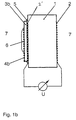
- FIGS. 1a and 1b The basic structure of a cell according to the invention is shown as an example in FIGS. 1a and 1b.
- solid electrolyte (1) which can be, for example, a pellet made of YO 1.5 stabilized ZrO 2 .
- an electronically conductive potential tap (2,2 ') is attached to each of the two plane-parallel surfaces. This can be done, for example, by burning in a commercially available platinum paste.
- a thin layer of a Li 2 O-containing glass for example a Li silicate glass
- a noble metal network for example a gold network (4a) is electronically short-circuited to the potential tap (2 ').
- a thin layer of a densely sintered material (3b), which is known as a cation conductor, for example as a Li, Na or K ion conductor, can be used instead of the glass (3a).
- a densely sintered material (3b) which is known as a cation conductor, for example as a Li, Na or K ion conductor
- Suitable materials for this purpose are, for example, Nasicon, Na- or K-beta-Al 2 O 3 , Lisicon or a high-melting Li glass.
- the body can also be both cationic and electronic conductive composite body (not shown) used become.
- Sintered body (3b) is subsequently placed on one with the Potential tap (2 ') provided platinized surfaces of the solid ion (1) conducting oxygen ions. This can be done, for example, using a drop of a Na or K water glass solution (5).
- cation and electron conductor (3a, 3b) is the surface provided with the potential tap (2 ') of the oxygen ion-conducting solid electrolyte or potential-tuning area of which gastight against the Environment sealed.
- a thin layer of a gas-sensitive salt Me m (XO n ) p (6) is subsequently applied to the conductor (3a, 3b), which has a conductivity for ions of the metal Me and for electrons. This can be done, for example, by drying a drop of a saturated aqueous salt solution.
- the oxygen-ion-conducting solid electrolyte is exposed on both electrode sides to the measuring gas atmosphere (7), which contains the gas to be determined XO x and O 2 .
- the signal is tapped from the platinum-coated surfaces of the oxygen-ion-conducting solid electrolyte.
- the material combination Cs 2 CO 3 / Cs ion conductor and Rb 2 CO 3 / Rb ion conductor can also be used to measure CO 2 .
- the combination CsNO 3 / Cs ion conductor is suitable for measuring NO x .
- the sensor according to the invention can also be used in planar technology produce.
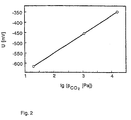
- FIG. 2 illustrates, on the basis of the CO 2 partial pressure dependence of the cell voltage measured at 680 ° C., the sensitivity of a CO 2 sensor produced according to FIG. 1 to the change in the CO 2 content in the measuring gas.
Landscapes
- Chemical & Material Sciences (AREA)
- Life Sciences & Earth Sciences (AREA)
- Health & Medical Sciences (AREA)
- Physics & Mathematics (AREA)
- Chemical Kinetics & Catalysis (AREA)
- Electrochemistry (AREA)
- Molecular Biology (AREA)
- Analytical Chemistry (AREA)
- Biochemistry (AREA)
- General Health & Medical Sciences (AREA)
- General Physics & Mathematics (AREA)
- Immunology (AREA)
- Pathology (AREA)
- Measuring Oxygen Concentration In Cells (AREA)
- Hybrid Cells (AREA)
Description
Die Erfindung betrifft eine galvanische Zelle, die vorzugsweise als potentiometrischer Sensor zur Bestimmung von Gasen wie etwa CO2, SOx und NOx ausgestaltet ist. Die erfindungsgemäße galvanische Zelle kann bei erhöhten Temperaturen betrieben werden und ist insbesondere für solche Anwendungsbedingungen geeignet, bei denen sich mit dem Gehalt der nachzuweisenden Gase zugleich der Partialdruck des Sauerstoffs im Meßmedium ändert.The invention relates to a galvanic cell, which is preferably designed as a potentiometric sensor for determining gases such as CO 2 , SO x and NO x . The galvanic cell according to the invention can be operated at elevated temperatures and is particularly suitable for those application conditions in which the partial pressure of the oxygen in the measuring medium changes with the content of the gases to be detected.
Die Verwendung von sauerstoffionenleitenden Festelektrolyten zum potentiometrischen Nachweis von gasförmigen Anhydriden der Formel XOx (X = C, S, N) geht auf Veröffentlichungen von Yamazoe und Mitarbeitern zurück, die das Meßprinzip zunächst zur Bestimmung von SOx (Yan et al., Chem.Lett. (1992), 635; Yan et al., Sensors and Actuators B. 12 (1993), 77; Yan et al., Sensors and Actuators B. 20 (1994), 81), später auch zum Nachweis von NOx (Kurosawa et al., Solid State Ionics 79 (1995), 338; Miura et al., J.Electrochem.Soc. 143 (1996), L33) und CO2 (Miura et al., Sensors and Actuators B., 24-25 (1995), 260) nutzten.The use of oxygen ion-conducting solid electrolytes for the potentiometric detection of gaseous anhydrides of the formula XO x (X = C, S, N) is based on publications by Yamazoe and co-workers, who initially used the measuring principle to determine SO x (Yan et al., Chem. Lett. (1992), 635; Yan et al., Sensors and Actuators B. 12 (1993), 77; Yan et al., Sensors and Actuators B. 20 (1994), 81), later also for the detection of NO x (Kurosawa et al., Solid State Ionics 79 (1995), 338; Miura et al., J. Electrochem. Soc. 143 (1996), L33) and CO 2 (Miura et al., Sensors and Actuators B., 24 -25 (1995), 260).
Grundlage des Meßprinzips bei diesen galvanischen Zellen ist
die Anordnung:
Gemäß Miura et al., Supra, basiert die Funktion der Meßelektrode auf dem Vorhandensein einer sogenannten ionischen Brükke. Diese ionische Brücke, die eine elektrochemische Verbindung zwischen dem Metallsalz und dem O-FE bewirkt, entsteht durch Ausbildung einer Festphase, die sowohl Me- als auch Sauerstoffionen enthalten soll.According to Miura et al., Supra, the function of the measuring electrode is based on the presence of a so-called ionic bridge. This ionic bridge, which is an electrochemical compound between the metal salt and the O-FE by training a solid phase that both me and Should contain oxygen ions.
Ein Nachteil der von der Arbeitsgruppe Yamazoe vorgeschlagenen Sensoren besteht darin, daß die reproduzierbare Herstellung arbeitsfähiger, d.h. auf die Konzentration des nachzuweisenden Gases ansprechender Sensoren nicht immer gelingt (vgl. Yan et al., J.Electrochem.Soc. 143 (1996), 609). Offensichtlich stellt der erfolgreiche Betrieb eines solchen Sensors eine auf zufällige Konstellationen zurückzuführende Ausnahme dar. Eigene Untersuchungen haben gezeigt, daß die Bildung der als ionische Brücke vermeintlicherweise fungierenden Phase aus kinetischen Gründen eher unwahrscheinlich ist und daß die in den Yamazoe-Sensoren verwendeten Elektroden überhaupt nicht auf CO2-Partialdruckänderungen ansprechen.A disadvantage of the sensors proposed by the Yamazoe group is that the reproducible production of workable sensors, i.e. sensors that respond to the concentration of the gas to be detected, is not always successful (cf. Yan et al., J.Electrochem. Soc. 143 (1996), 609 ). Obviously, the successful operation of such a sensor is an exception due to random constellations. Our own studies have shown that the formation of the phase that is supposed to function as an ionic bridge is rather unlikely for kinetic reasons and that the electrodes used in the Yamazoe sensors do not open at all Address CO 2 partial pressure changes.
Bereits vor den Veröffentlichungen von Yamazoe und Mitarbeitern war die Verwendung eines O-FE im Zusammenhang mit dem potentiometrischen Nachweis von Gasen bekannt. So haben Kleitz et al., New Types of Solid-Electrolyte Gas Sensors, in: P. Vashishta, J.N. Mundy, G.K. Shenoy (Hrsg.), Fast Ion Transport in Solids, Elsevier North Holland Inc., New York 1979, 69) sowie Belanger et al. (J.Electrochem.Soc. 131 (1984), 579) erstmals darauf hingewiesen, welchen Vorteil der direkte Kontakt zwischen einem O-FE und einem dem nachzuweisenden gasförmigen Anhydrid entsprechenden Salz, im konkreten Fall einem Sulfat bzw. einem Carbonat für die Bestimmung von SOx bzw. CO2 in Hinsicht auf die Eliminierung des Sauerstoffpartialdrucks mit sich bringt. In diesen Sensorvarianten erfüllte der O-FE jedoch nur die Funktion eines Hilfsmittels. Das auf den Gehalt des zu bestimmenden Gases im Meßmedium ansprechende Signal des Sensors fällt ausschließlich an dem als Metallionenleiter (Me-FE) wirkenden Salz ab. Der O-FE mißt lediglich die Differenz im Sauerstoffpotential zwischen dem Meß- und einem Referenzgas. Durch direkten Kontakt zwischen O-FE und Me-Fe addiert sich die Zellspannung beider Meßzellen und das Bruttosignal wird vom Sauerstoffdruck unabhängig.The use of an O-FE in connection with the potentiometric detection of gases was already known before the publications by Yamazoe and co-workers. Thus Kleitz et al., New Types of Solid-Electrolyte Gas Sensors, in: P. Vashishta, JN Mundy, GK Shenoy (ed.), Fast Ion Transport in Solids, Elsevier North Holland Inc., New York 1979, 69) and Belanger et al. (J.Electrochem.Soc. 131 (1984), 579) for the first time pointed out the advantage of direct contact between an O-FE and a salt corresponding to the gaseous anhydride to be detected, in the specific case a sulfate or a carbonate for the determination of SO x or CO 2 with regard to the elimination of the oxygen partial pressure. In these sensor variants, however, the O-FE only fulfilled the function of an aid. The sensor signal, which responds to the content of the gas to be determined in the measuring medium, drops exclusively from the salt acting as a metal ion conductor (Me-FE). The O-FE only measures the difference in oxygen potential between the sample and a reference gas. Through direct contact between O-FE and Me-Fe, the cell voltage of both measuring cells is added and the gross signal is independent of the oxygen pressure.
Den mit der Bereitstellung eines Referenzgases verbundenen Nachteil umgeht eine später vorgeschlagene Sensorvariante (Maruyama et al., Solid State Ionics 23 (1987), 107 und Saito et al., Solid States Ionics 28-30 (1988), 1644 und DE-OS 41 12 301). Hier braucht der O-FE ausschließlich nur noch von dem Meßgas umströmt zu werden. Dennoch bleibt der Sensor eine Kombination zwischen einer Sauerstoff- und einer Metallionenkonzentrationskette, nur daß beide Elektrolyte in diesem Sensor aufeinandergesintert sind und damit einen sogenannten Zweischichtelektrolyten bilden. Gemäß diesem Meßprinzip muß die elektronische Leitfähigkeit des Metallionenleiters gegenüber der Ionenleitfähigkeit vernachlässigbar klein sein. Hinzu kommt, daß bei diesen Sensortypen, nicht wie bei den Sensoren von Kleitz et al., Supra sowie Belanger et al., Supra, das Salz selbst als Me-FE dient, sondern ein davon unabhängiges Material, das ein vergleichsweise besserer Ionenleiter ist und im Gleichgewicht mit dem Salz Mem(XOn)p die Meßelektrode bildet.The disadvantage associated with the provision of a reference gas is avoided by a sensor variant proposed later (Maruyama et al., Solid State Ionics 23 (1987), 107 and Saito et al., Solid States Ionics 28-30 (1988), 1644 and DE-OS 41 12 301). The O-FE only needs to be flowed around by the sample gas. Nevertheless, the sensor remains a combination between an oxygen and a metal ion concentration chain, only that both electrolytes are sintered together in this sensor and thus form a so-called two-layer electrolyte. According to this measuring principle, the electronic conductivity of the metal ion conductor must be negligibly small compared to the ion conductivity. In addition, in these sensor types, not like the sensors from Kleitz et al., Supra and Belanger et al., Supra, the salt itself serves as Me-FE, but an independent material that is a comparatively better ion conductor and in equilibrium with the salt Me m (XO n ) p forms the measuring electrode.
Ein Nachteil der von Maruyama et al., Supra, und Saito et al., Supra, beschriebenen Sensorvarianten besteht darin, daß sie stets eine Kombination zwischen einer Metallionen- und einer Sauerstoffkonzentrationskette darstellen. Dies ist insbesondere bedeutungsvoll unter dem Aspekt einer nicht zu vernachlässigenden Elektronenleitung im Me-FE (Näfe, Sensors and Actuators B. 21 (1994), 79 und Näfe., Solid State Ionics 68 (1994), 249), die üblicherweise mit einer Beeinträchtigung der Sensormeßeigenschaften einhergeht. A disadvantage of that of Maruyama et al., Supra, and Saito et al., Supra, described sensor variants is that they are always a combination between a metal ion and a Represent oxygen concentration chain. This is particularly so meaningful under the aspect of a not negligible Electron conduction in the Me-FE (Näfe, Sensors and Actuators B. 21 (1994), 79 and Näfe., Solid State Ionics 68 (1994), 249), the usually with an impairment of Sensor measurement properties goes hand in hand.
Yan et al., J. Elektrochem. Soc. 143 (1996), 609-613 offenbart einen gattungsbildenden Schwefeldioxid-Sensor, der auf einem Rohr aus stabilisiertem Zirkondioxid zwischen der an der Oberfläche befindlichen Platinelektrode eine dünne Schicht Lithiumsulfat/Magnesiumoxid als gassensitives Material und auf der Rohrinnenseite eine Referenzelektrode aus Platin angeordnet hat, wobei zwischen sich beiden Halbzellen eine Mischoxidschicht aus Lithiumoxid, Zirkoniumoxid und Magnesiumoxid befinden kann. Yan et al., J. Elektrochem. Soc. 143: 609-613 (1996) a generic sulfur dioxide sensor on a pipe Made of stabilized zirconia between those on the surface platinum electrode located a thin layer Lithium sulfate / magnesium oxide as a gas sensitive material and on a platinum reference electrode is arranged on the inside of the tube has, with a mixed oxide layer between the two half cells lithium oxide, zirconium oxide and magnesium oxide.
Die der Erfindung zugrunde liegende Aufgabe ist somit die reproduzierbare Herstellung einer galvanischen Zelle, insbesondere eines potentiometrischen Sensors zum Nachweis von Gasen, auf der Basis ausschließlich einer Sauerstoffkonzentrationskette unter Verwendung eines O-FE, wodurch gewährleistet ist, daß die Meßeigenschaften des Sensors nicht durch Elektronenleitung im Elektrolyten beeinträchtigt sind.The object underlying the invention is thus reproducible production of a galvanic cell, especially a potentiometric sensor for the detection of Gases based exclusively on an oxygen concentration chain using an O-FE, which ensures is that the measuring properties of the sensor are not affected by Electron conduction in the electrolyte are impaired.
Diese Aufgabe kann dadurch gelöst werden, daß zwischen dem sauerstoffionenleitenden Festelektrolyten und dem als gassensitive Schicht wirkenden Metallsalz Mem(XOn)p mindestens eine Zwischenschicht eines Materials eingebracht wird, das den potentialbestimmenden Bereich der Festelektrolytenoberfläche gasdicht gegenüber der Umgebung versiegelt und eine hohe Leitfähigkeit sowohl für Metallionen Me als auch für Elektronen aufweist, d.h. die Elektronenleitung soll vorzugsweise unter den Anwendungsbedingungen von der Größenordnung der Ionenleitung oder größer sein. Weiterhin soll sich das Material der Zwischenschicht vorzugsweise unter den Betriebsbedingungen des Sensors inert verhalten, eine endliche Löslichkeit für das Metalloxid MeyO realisieren und eine vernachlässigbar kleine Beweglichkeit für Sauerstoff bzw. das Oxid MeyO aufweisen.This object can be achieved in that at least one intermediate layer of a material is introduced between the oxygen ion-conducting solid electrolyte and the metal salt Me m (XO n ) p which acts as a gas-sensitive layer and which seals the potential-determining region of the solid electrolyte surface in a gas-tight manner with respect to the environment and a high conductivity for metal ions Me as well as for electrons, ie the electron line should preferably be of the order of magnitude of the ion line or larger under the conditions of use. Furthermore, the material of the intermediate layer should preferably be inert under the operating conditions of the sensor, realize a finite solubility for the metal oxide Me y O and have a negligible mobility for oxygen or the oxide Me y O.
Ein Gegenstand der vorliegenden Erfindung ist somit eine
galvanische Zelle umfassend:
Der sauerstoffionenleitende Festelektrolyt kann beispielsweise ein Material auf der Basis von ZrO2, ThO2, CeO2, HfO2 oder Bi2O3 sein. Besonders bevorzugt als sauerstoffionenleitender Festelektrolyt ist ein Material auf der Basis von kubischem, tetragonalem oder partiell stabilisiertem ZrO2, z.B. ein YO1,5stabilisiertes ZrO2.The oxygen-ion-conducting solid electrolyte can be, for example, a material based on ZrO 2 , ThO 2 , CeO 2 , HfO 2 or Bi 2 O 3 . A material based on cubic, tetragonal or partially stabilized ZrO 2 , for example a YO 1.5 stabilized ZrO 2, is particularly preferred as the oxygen ion-conducting solid electrolyte.
Das Salz der Strukturformel Mem(XOn)p ist vorzugsweise ein Alkalimetall- oder ein Erdalkalimetallsalz, z.B. ein Li-, Na-, K-, Rb-, Cs-, Ca-, Sr- oder Ba-Salz. Das Metallsalz ist nach Maßgabe des zu detektierenden Gases vorzugsweise ein Carbonat, Sulfat oder Nitrat.The salt of the structural formula Me m (XO n ) p is preferably an alkali metal or an alkaline earth metal salt, for example a Li, Na, K, Rb, Cs, Ca, Sr or Ba salt. Depending on the gas to be detected, the metal salt is preferably a carbonate, sulfate or nitrate.
Das kationenleitende Material kann ein Alkalimetall- oder Erdalkalimetallionenleiter sein, dessen elektronische Leitfähigkeit gegenüber den üblichen Verhältnissen vorzugsweise gezielt erhöht wurde. Diese Erhöhung der elektronischen Leitfähigkeit kann beispielsweise durch Verwendung eines Kompositmaterials erreicht werden, das ein Gemisch aus einer elektronisch leitenden Phase wie etwa Pt und einer kationenleitenden Phase enthält. Darüberhinaus können auch Materialien verwendet werden, die sowohl ausreichend hohe kationische und elektronische Leitfähigkeit aufweisen.The cation-conducting material can be an alkali metal or Be alkaline earth metal ion conductor, its electronic Conductivity preferred over the usual conditions was deliberately increased. This increase in electronic Conductivity can be achieved, for example, by using a Composite material can be achieved, which is a mixture of a electronically conductive phase such as Pt and one contains cation-conducting phase. You can also Materials are used that are both sufficiently high have cationic and electronic conductivity.
Beispiele für geeignete Ionenleiter sind die als Na- oder Li-Ionenleiter bekannten Materialien Nasicon und Lisicon, alle Metalloxid-dotierten Beta-Aluminate sowie Gläser wie beispielsweise ein Lithiumsilikatglas (Li2O:SiO2=1:2-4). Diese Materialien werden zur Erhöhung der elektronischen Leitfähigkeit vorzugsweise als Kompositmaterial mit einer elektronisch leitenden Phase eingesetzt.Examples of suitable ion conductors are the materials known as Na or Li ion conductors Nasicon and Lisicon, all metal oxide-doped beta aluminates and glasses such as, for example, a lithium silicate glass (Li 2 O: SiO 2 = 1: 2-4). To increase the electronic conductivity, these materials are preferably used as a composite material with an electronically conductive phase.
Die erfindungsgemäße galvanische Zelle wird vorzugsweise als Gassensor insbesondere zum Nachweis von CO2, NOx oder SOx sowohl im Spurenbereich als auch für größere Konzentrationen eingesetzt. Der Temperaturbereich, in dem der erfindungsgemäße Sensor eingesetzt werden kann, ist üblicherweise 450°C bis 750°C.The galvanic cell according to the invention is preferably used as a gas sensor, in particular for the detection of CO 2 , NO x or SO x both in the trace region and for larger concentrations. The temperature range in which the sensor according to the invention can be used is usually 450 ° C to 750 ° C.
Die Erfindung soll weiterhin im Zusammenhang mit den Figuren 1a, 1b und 2 erläutert werden. Es zeigen:
- Fig. 1a
- eine erste Ausführungsform der erfindungsgemäßen galvanischen Zelle,
- Fig. 1b
- eine zweite Ausführungsform der erfindungsgemäßen galvanischen Zelle und
- Fig. 2
- die Empfindlichkeit der galvanischen Zelle gemäß Fig. 1 auf eine Änderung im Partialdruck des Meßgases.
- Fig. 1a
- a first embodiment of the galvanic cell according to the invention,
- Fig. 1b
- a second embodiment of the galvanic cell according to the invention and
- Fig. 2
- 1 to a change in the partial pressure of the measuring gas.
Der prinzipell e Aufbau einer erfindungsgemäßen Zelle ist in Fig. 1a und Fig. 1b exemplarisch dargestellt. Auf den Festelektrolyten (1), bei dem es sich z.B. um ein Pellet aus YO1,5stabilisiertem ZrO2 handeln kann, wird auf beiden planparallelen Oberflächen jeweils ein elektronisch leitender Potentialabgriff (2,2') angebracht. Dies kann beispielsweise durch Einbrennen einer handelsüblichen Platinpaste erfolgen.The basic structure of a cell according to the invention is shown as an example in FIGS. 1a and 1b. On the solid electrolyte (1), which can be, for example, a pellet made of YO 1.5 stabilized ZrO 2 , an electronically conductive potential tap (2,2 ') is attached to each of the two plane-parallel surfaces. This can be done, for example, by burning in a commercially available platinum paste.
Bei der in Fig. 1a gezeigten Ausführungsform der erfindungsgemäßen galvanischen Zelle wird auf eine dieser Oberflächen eine dünne Schicht eines Li2O-haltigen Glases, beispielsweise eines Li-Silikat-Glases so aufgeschmolzen, daß die Glasschicht (3a) unter Verwendung eines Edelmetallnetzes, z.B. eines Goldnetzes (4a) elektronisch mit dem Potentialabgriff (2') kurzgeschlossen ist.In the embodiment of the galvanic cell according to the invention shown in Fig. 1a, a thin layer of a Li 2 O-containing glass, for example a Li silicate glass, is melted onto one of these surfaces in such a way that the glass layer (3a) using a noble metal network, for example a gold network (4a) is electronically short-circuited to the potential tap (2 ').
Alternativ dazu kann bei der in Fig. 1b gezeigten Ausführungsform der erfindungsgemäßen Zelle anstelle des Glases (3a) eine dünne Schicht eines dichtgesinterten Materials (3b) verwendet werden, das als Kationenleiter, z.B. als Li-, Na- oder K-Ionenleiter bekannt ist. Geeignete Materialien für diesen Zweck sind beispielsweise Nasicon, Na- oder K-beta-Al2O3, Lisicon oder ein hochschmelzendes Li-Glas.Alternatively, in the embodiment of the cell according to the invention shown in FIG. 1b, a thin layer of a densely sintered material (3b), which is known as a cation conductor, for example as a Li, Na or K ion conductor, can be used instead of the glass (3a). Suitable materials for this purpose are, for example, Nasicon, Na- or K-beta-Al 2 O 3 , Lisicon or a high-melting Li glass.
Auf beiden Seiten des Kationenleiters wird ein elektronisch leitender Potentialabgriff (4b) angebracht. Dies kann beispielsweise durch Bedampfen der beiden planparallelen Oberflächen mit einer Goldschicht erfolgen. Beide Schichten werden vorzugsweise über den Rand des Sinterkörpers miteinander verbunden, also kurzgeschlossen. Anstelle dieses kurzgeschlossenen Körpers kann auch ein sowohl kationisch als auch elektronisch leitfähiger Kompositkörper (nicht gezeigt) eingesetzt werden.One becomes electronic on both sides of the cation leader conductive potential tap (4b) attached. For example by steaming the two plane-parallel surfaces done with a gold layer. Both layers will preferably connected to one another via the edge of the sintered body, so short-circuited. Instead of this short-circuited The body can also be both cationic and electronic conductive composite body (not shown) used become.
Der auf diese Weise präparierte Kationen und Elektronen leitende Sinterkörper (3b) wird nachfolgend auf eine mit dem Potentialabgriff (2') versehene platinierte Oberflächen des sauerstoffionenleitenden Festelektrolyten (1) aufgedrückt. Dies kann beispielsweise unter Verwendung eines Tropfens einer Na- bzw. K-Wasserglaslösung (5) erfolgen.The cations and electrons conductive prepared in this way Sintered body (3b) is subsequently placed on one with the Potential tap (2 ') provided platinized surfaces of the solid ion (1) conducting oxygen ions. This can be done, for example, using a drop of a Na or K water glass solution (5).
Durch das Aufbringen des Kationen- und Elektronenleiters (3a, 3b) wird die mit dem Potentialabgriff (2') versehene Oberfläche des sauerstoffionenleitenden Festelektrolyten bzw. ein potentialabstimmender Bereich davon gasdicht gegenüber der Umgebung versiegelt.By applying the cation and electron conductor (3a, 3b) is the surface provided with the potential tap (2 ') of the oxygen ion-conducting solid electrolyte or potential-tuning area of which gastight against the Environment sealed.
Auf den Leiter (3a, 3b), der eine Leitfähigkeit für Ionen des Metalls Me und für Elektronen aufweist, wird nachfolgend eine dünne Schicht eines gassensitiven Salzes Mem(XOn)p (6) aufgebracht. Dies kann beispielsweise durch Eintrocknen eines Tropfens einer gesättigten wässrigen Salzlösung erfolgen.A thin layer of a gas-sensitive salt Me m (XO n ) p (6) is subsequently applied to the conductor (3a, 3b), which has a conductivity for ions of the metal Me and for electrons. This can be done, for example, by drying a drop of a saturated aqueous salt solution.
Der sauerstoffionenleitende Festelektrolyt wird auf beiden Elektrodenseiten der Meßgasatmosphäre (7), die das zu bestimmende Gas XOx und O2 enthält, ausgesetzt. Das Signal wird von den platinierten Oberflächen des sauerstoffionenleitenden Festelektrolyten abgegriffen.The oxygen-ion-conducting solid electrolyte is exposed on both electrode sides to the measuring gas atmosphere (7), which contains the gas to be determined XO x and O 2 . The signal is tapped from the platinum-coated surfaces of the oxygen-ion-conducting solid electrolyte.
Neben dem vorstehend beschriebenen Ausführungsbeispiel lassen sich natürlich noch andere Sensorvarianten realisieren. So kann beispielsweise zur Messung von CO2 auch die Verwendung der Materialkombination Cs2CO3/Cs-Ionenleiter und Rb2CO3/Rb-Ionenleiter verwendet werden. Zur Messung von SOx kann beispielsweise die Kombination von Me2SO4/Me-Ionenleiter (Me=Rb, Cs) und MeSO4/Me-Ionenleiter (Me=Ca, Sr, Ba) verwendet werden. Zur Messung von NOx ist beispielsweise die Kombination CsNO3/Cs-Ionenleiter geeignet.In addition to the exemplary embodiment described above, other sensor variants can of course also be implemented. For example, the material combination Cs 2 CO 3 / Cs ion conductor and Rb 2 CO 3 / Rb ion conductor can also be used to measure CO 2 . For example, the combination of Me 2 SO 4 / Me ion conductor (Me = Rb, Cs) and MeSO 4 / Me ion conductor (Me = Ca, Sr, Ba) can be used to measure SO x . For example, the combination CsNO 3 / Cs ion conductor is suitable for measuring NO x .
Anstelle der im Ausführungsbeispiel beschriebenen Kompaktbauweise läßt sich der erfindungsgemäße Sensor auch in der Planartechnik herstellen.Instead of the compact design described in the exemplary embodiment The sensor according to the invention can also be used in planar technology produce.
Fig. 2 illustriert anhand der CO2-Partialdruckabhängigkeit der bei 680 °C gemessenen Zellspannung die Empfindlichkeit eines gemäß Fig. 1 hergestellten CO2-Sensors auf die Änderung des CO2-Gehalts im Meßgas.FIG. 2 illustrates, on the basis of the CO 2 partial pressure dependence of the cell voltage measured at 680 ° C., the sensitivity of a CO 2 sensor produced according to FIG. 1 to the change in the CO 2 content in the measuring gas.
Claims (11)
- Galvanic cell comprising(a) an oxygen-ion-conducting solid electrolyte (1),(b) a gas-sensitive material (6) which contains at least one salt of the structural formula Mem(XOn)p in which Me represents a metal, X denotes C, S or N and the symbols m, n and p characterize the respective stoichiometric ratios and(c) two electronically-conductive potential taps (2, 2') on surface areas of the oxygen-ion-conducting solid electrolye (1),(d) characterized by a material (3a, b) arranged between the oxygen-ion-conducting solid electrolyte (1) and the gas-sensitive material (6) which can conduct cations of the metal Me and electrons, and which seals the surface of the solid electrolyte (1) that is provided with the one potential tap (2') in a gas-tight manner.
- Galvanic cell as claimed in claim 1,
characterized in that
the cation-conducting material (3a, b) is chemically inert towards the gas-sensitive material (6) and the solid electrolyte (1) under the operating conditions of the cell. - Galvanic cell as claimed in claim 1 or 2,
characterized in that
the cation-conducting material (3a, b) is soluble for the oxide MeyO of the cation Me. - Galvanic cell as claimed in one of the claims 1 - 3,
characterized in that
the mobility of oxygen or/and the oxide MeyO is negligible in the cation-conducting material (3a, b). - Galvanic cell as claimed in one of the claims 1 - 4,
characterized in that
the material (3a, b) which can conduct metal ions and electrons comprises a composite material which contains a mixture of an electronically conductive phase and a cation-conducting phase. - Galvanic cell as claimed in one of the previous claims,
characterized in that
the material (3a, b) that can conduct metal ions and electrons comprises an electronically short-circuited cation conductor. - Galvanic cell as claimed in one of the previous claims,
characterized in that
the cation-conducting material (3a, b) is an alkali metal ion or alkaline earth metal ion conductor. - Galvanic cell as claimed in one of the previous claims,
characterized in that
the oxygen-ion-conducting solid electrolyte (1) is a material based on ZrO2, ThO2, CeO2, HfO2 or Bi2O3. - Galvanic cell as claimed in one of the previous claims,
characterized in that
the gas-sensitive material (6) contains a salt of an alkali metal or alkaline earth metal. - Galvanic cell as claimed in one of the previous claims,
characterized in that
the salt is a carbonate, nitrate or sulphate. - Use of a galvanic cell as claimed in one of the claims 1 - 10 as a gas sensor for measuring carbon dioxide, sulphur oxides and nitrogen oxides.
Applications Claiming Priority (3)
| Application Number | Priority Date | Filing Date | Title |
|---|---|---|---|
| DE19623487 | 1996-06-12 | ||
| DE19623487A DE19623487C2 (en) | 1996-06-12 | 1996-06-12 | Javanese cell and its use as a gas sensor |
| PCT/EP1997/003081 WO1997047964A1 (en) | 1996-06-12 | 1997-06-12 | Gas sensor |
Publications (2)
| Publication Number | Publication Date |
|---|---|
| EP0904534A1 EP0904534A1 (en) | 1999-03-31 |
| EP0904534B1 true EP0904534B1 (en) | 2003-11-26 |
Family
ID=7796773
Family Applications (1)
| Application Number | Title | Priority Date | Filing Date |
|---|---|---|---|
| EP97928193A Expired - Lifetime EP0904534B1 (en) | 1996-06-12 | 1997-06-12 | Solid electrolyte gas sensor |
Country Status (6)
| Country | Link |
|---|---|
| US (1) | US6179992B1 (en) |
| EP (1) | EP0904534B1 (en) |
| JP (1) | JP2000512384A (en) |
| DE (2) | DE19623487C2 (en) |
| DK (1) | DK0904534T3 (en) |
| WO (1) | WO1997047964A1 (en) |
Families Citing this family (11)
| Publication number | Priority date | Publication date | Assignee | Title |
|---|---|---|---|---|
| DE19841707A1 (en) | 1998-09-11 | 2000-03-16 | Max Planck Gesellschaft | Reference electrode for galvanic cells with solid electrolytes made by applying a metal oxide and/or double oxide in liquid hydrosol or organosol form to the electrolyte to form a solid film |
| US7677082B2 (en) * | 2003-05-20 | 2010-03-16 | The University Of Akron | Solid state gas sensors based on tunnel junction geometry |
| US20080017510A1 (en) * | 2004-05-26 | 2008-01-24 | Nair Balakrishnan G | NOx Gas Sensor Method and Device |
| US8057652B2 (en) * | 2005-03-28 | 2011-11-15 | Uchicago Argonne, Llc | High-temperature potentiometric oxygen sensor with internal reference |
| US7611612B2 (en) * | 2005-07-14 | 2009-11-03 | Ceramatec, Inc. | Multilayer ceramic NOx gas sensor device |
| EP2115402A2 (en) * | 2007-02-16 | 2009-11-11 | Ceramatec, Inc. | Nox sensor with improved selectivity and sensitivity |
| DE102009031773B4 (en) * | 2009-06-26 | 2019-08-29 | Fraunhofer-Gesellschaft zur Förderung der angewandten Forschung e.V. | Potentiometric sensor for the combined determination of the concentration of a first and a second gas component of a gas sample, in particular for the combined determination of CO2 and O2, corresponding determination method and use thereof |
| DE102012110481A1 (en) | 2011-12-29 | 2013-07-04 | Technische Universität Dresden | Nitrogen oxide sensor used in automobile industry for sensing nitrogen oxide in exhaust gas of diesel engine vehicle, has heater which is connected with the substrate carrier |
| US9164080B2 (en) | 2012-06-11 | 2015-10-20 | Ohio State Innovation Foundation | System and method for sensing NO |
| GB2517902A (en) * | 2013-07-26 | 2015-03-11 | Cambridge Entpr Ltd | Method and apparatus for sensing molecular gases |
| DE102014215545B3 (en) * | 2014-08-06 | 2015-12-24 | Fraunhofer-Gesellschaft zur Förderung der angewandten Forschung e.V. | Sensor for determining the proportion of an oxidic gas in a sample gas |
Family Cites Families (8)
| Publication number | Priority date | Publication date | Assignee | Title |
|---|---|---|---|---|
| US4622105A (en) * | 1981-09-17 | 1986-11-11 | University Patents, Inc. | Method for measuring gaseous sulfur dioxide |
| JPS60256043A (en) * | 1984-06-01 | 1985-12-17 | Advance Res & Dev Co Ltd | Gas sensor |
| DE4022136A1 (en) * | 1990-07-11 | 1992-01-23 | Battelle Institut E V | Carbon di:oxide sensor prodn. - by printing operating electrode with gold and/or platinum before coating with alkali metal bi:carbonate suspension and firing |
| CA2048812C (en) * | 1990-08-09 | 1995-07-04 | Hozumi Futata | Gaseous carbon dioxide detection sensor |
| DE4112301A1 (en) * | 1991-04-15 | 1992-10-22 | Max Planck Gesellschaft | Gas sensor reference electrode contg. alkali cpd. - for partial pressure determn. of e.g. nitrogen oxide(s), used in multiphase equilibrium avoiding escape of e.g. liq. sodium at high operating temp. |
| US5413691A (en) * | 1992-12-25 | 1995-05-09 | Tokyuama Corporation | Solid electrolyte gas-sensing device |
| CA2141561A1 (en) * | 1993-06-02 | 1994-12-08 | John F. Currie | Thin film gas sensor and method of fabrication thereof |
| CA2169350A1 (en) * | 1994-06-13 | 1995-12-21 | Mitsui Chemicals, Incorporated | Lithium ionic conducting glass thin film and carbon dioxide sensor comprising the glass thin film |
-
1996
- 1996-06-12 DE DE19623487A patent/DE19623487C2/en not_active Expired - Fee Related
-
1997
- 1997-06-12 JP JP10501216A patent/JP2000512384A/en active Pending
- 1997-06-12 WO PCT/EP1997/003081 patent/WO1997047964A1/en not_active Ceased
- 1997-06-12 DE DE59711056T patent/DE59711056D1/en not_active Expired - Lifetime
- 1997-06-12 EP EP97928193A patent/EP0904534B1/en not_active Expired - Lifetime
- 1997-06-12 US US09/202,407 patent/US6179992B1/en not_active Expired - Lifetime
- 1997-06-12 DK DK97928193T patent/DK0904534T3/en active
Also Published As
| Publication number | Publication date |
|---|---|
| JP2000512384A (en) | 2000-09-19 |
| EP0904534A1 (en) | 1999-03-31 |
| US6179992B1 (en) | 2001-01-30 |
| WO1997047964A1 (en) | 1997-12-18 |
| DE19623487A1 (en) | 1997-12-18 |
| DE19623487C2 (en) | 1999-01-07 |
| DK0904534T3 (en) | 2004-04-05 |
| DE59711056D1 (en) | 2004-01-08 |
Similar Documents
| Publication | Publication Date | Title |
|---|---|---|
| DE69735302T2 (en) | GAS SENSOR | |
| EP0241751B1 (en) | Method of continuously monitoring the gaseous constituents of a gas mixture, besides oxygen | |
| DE4333232B4 (en) | Sensor for determining the oxygen content of gas mixtures | |
| DE2914947C2 (en) | Device for gas analysis with galvanic solid electrolyte cells | |
| DE3038104A1 (en) | HYDROGEN SENSOR | |
| DE4445033A1 (en) | Method for measuring the concentration of a gas in a gas mixture and electrochemical sensor for determining the gas concentration | |
| DE2556483C3 (en) | Device for the detection of gaseous anhydrides in an oxygen-containing gas according to the principle of potential difference measurement | |
| DE19623487C2 (en) | Javanese cell and its use as a gas sensor | |
| EP0938668A1 (en) | Gas sensor | |
| DE19734861C2 (en) | Sensor element for determining the concentration of oxidizable components in a gas mixture | |
| EP0019731A1 (en) | Polarographic sensor for the determination of the oxygen content in gases, especially in exhaust gases of internal-combustion engines | |
| DE4226540A1 (en) | Polarographic sensor | |
| DE4442272A1 (en) | Device and method for determining gaseous components in gas mixtures | |
| DE3490037T1 (en) | Electrode for a solid electrolyte oxygen (measuring) sensor, process for its production and at least one such electrode containing oxygen (measuring) sensor | |
| DE4109516A1 (en) | DEVICE FOR CONTINUOUSLY MONITORING THE CONCENTRATIONS OF GASEOUS INGREDIENTS IN GAS MIXTURES | |
| DE102009031773B4 (en) | Potentiometric sensor for the combined determination of the concentration of a first and a second gas component of a gas sample, in particular for the combined determination of CO2 and O2, corresponding determination method and use thereof | |
| EP0526479B1 (en) | Process for determining gas concentrations and gas sensor with solid electrolyte | |
| DE3543818C2 (en) | ||
| DE4112302A1 (en) | AMPEROMETRIC GAS SENSOR FOR SELECTIVE DETERMINATION OF PARTIAL PRESSURES OF A GAS | |
| DE19503783C2 (en) | CO¶2¶ sensor | |
| DE2454339A1 (en) | DEVICE FOR THE RELATIVE MEASUREMENT OF THE CONCENTRATION OF A SAMPLE IN A FLUID | |
| DE3108305C2 (en) | ||
| DE19714364C2 (en) | NO detection method in fluid media | |
| EP0867714B1 (en) | Electrode material | |
| DE2735789C3 (en) | Device for measuring the oxygen concentration in exhaust gases and method of manufacturing the device |
Legal Events
| Date | Code | Title | Description |
|---|---|---|---|
| PUAI | Public reference made under article 153(3) epc to a published international application that has entered the european phase |
Free format text: ORIGINAL CODE: 0009012 |
|
| 17P | Request for examination filed |
Effective date: 19981203 |
|
| AK | Designated contracting states |
Kind code of ref document: A1 Designated state(s): CH DE DK FR GB IT LI NL SE |
|
| 17Q | First examination report despatched |
Effective date: 20020723 |
|
| GRAH | Despatch of communication of intention to grant a patent |
Free format text: ORIGINAL CODE: EPIDOS IGRA |
|
| RTI1 | Title (correction) |
Free format text: SOLID ELECTROLYTE GAS SENSOR |
|
| GRAS | Grant fee paid |
Free format text: ORIGINAL CODE: EPIDOSNIGR3 |
|
| GRAA | (expected) grant |
Free format text: ORIGINAL CODE: 0009210 |
|
| AK | Designated contracting states |
Kind code of ref document: B1 Designated state(s): CH DE DK FR GB IT LI NL SE |
|
| PG25 | Lapsed in a contracting state [announced via postgrant information from national office to epo] |
Ref country code: NL Free format text: LAPSE BECAUSE OF FAILURE TO SUBMIT A TRANSLATION OF THE DESCRIPTION OR TO PAY THE FEE WITHIN THE PRESCRIBED TIME-LIMIT Effective date: 20031126 Ref country code: IT Free format text: LAPSE BECAUSE OF FAILURE TO SUBMIT A TRANSLATION OF THE DESCRIPTION OR TO PAY THE FEE WITHIN THE PRESCRIBED TIME-LIMIT;WARNING: LAPSES OF ITALIAN PATENTS WITH EFFECTIVE DATE BEFORE 2007 MAY HAVE OCCURRED AT ANY TIME BEFORE 2007. THE CORRECT EFFECTIVE DATE MAY BE DIFFERENT FROM THE ONE RECORDED. Effective date: 20031126 |
|
| REG | Reference to a national code |
Ref country code: GB Ref legal event code: FG4D Free format text: NOT ENGLISH |
|
| REG | Reference to a national code |
Ref country code: CH Ref legal event code: EP |
|
| REG | Reference to a national code |
Ref country code: CH Ref legal event code: NV |
|
| REF | Corresponds to: |
Ref document number: 59711056 Country of ref document: DE Date of ref document: 20040108 Kind code of ref document: P |
|
| GBT | Gb: translation of ep patent filed (gb section 77(6)(a)/1977) |
Effective date: 20040128 |
|
| PG25 | Lapsed in a contracting state [announced via postgrant information from national office to epo] |
Ref country code: SE Free format text: LAPSE BECAUSE OF FAILURE TO SUBMIT A TRANSLATION OF THE DESCRIPTION OR TO PAY THE FEE WITHIN THE PRESCRIBED TIME-LIMIT Effective date: 20040226 |
|
| REG | Reference to a national code |
Ref country code: DK Ref legal event code: T3 |
|
| NLV1 | Nl: lapsed or annulled due to failure to fulfill the requirements of art. 29p and 29m of the patents act | ||
| PG25 | Lapsed in a contracting state [announced via postgrant information from national office to epo] |
Ref country code: GB Free format text: LAPSE BECAUSE OF NON-PAYMENT OF DUE FEES Effective date: 20040612 |
|
| PG25 | Lapsed in a contracting state [announced via postgrant information from national office to epo] |
Ref country code: LI Free format text: LAPSE BECAUSE OF NON-PAYMENT OF DUE FEES Effective date: 20040630 Ref country code: DK Free format text: LAPSE BECAUSE OF NON-PAYMENT OF DUE FEES Effective date: 20040630 Ref country code: CH Free format text: LAPSE BECAUSE OF NON-PAYMENT OF DUE FEES Effective date: 20040630 |
|
| ET | Fr: translation filed | ||
| PLBE | No opposition filed within time limit |
Free format text: ORIGINAL CODE: 0009261 |
|
| STAA | Information on the status of an ep patent application or granted ep patent |
Free format text: STATUS: NO OPPOSITION FILED WITHIN TIME LIMIT |
|
| 26N | No opposition filed |
Effective date: 20040827 |
|
| REG | Reference to a national code |
Ref country code: DK Ref legal event code: EBP |
|
| GBPC | Gb: european patent ceased through non-payment of renewal fee |
Effective date: 20040612 |
|
| REG | Reference to a national code |
Ref country code: CH Ref legal event code: PL |
|
| PG25 | Lapsed in a contracting state [announced via postgrant information from national office to epo] |
Ref country code: FR Free format text: LAPSE BECAUSE OF NON-PAYMENT OF DUE FEES Effective date: 20050228 |
|
| REG | Reference to a national code |
Ref country code: FR Ref legal event code: ST |
|
| PGFP | Annual fee paid to national office [announced via postgrant information from national office to epo] |
Ref country code: DE Payment date: 20120531 Year of fee payment: 16 |
|
| REG | Reference to a national code |
Ref country code: DE Ref legal event code: R119 Ref document number: 59711056 Country of ref document: DE Effective date: 20140101 |
|
| PG25 | Lapsed in a contracting state [announced via postgrant information from national office to epo] |
Ref country code: DE Free format text: LAPSE BECAUSE OF NON-PAYMENT OF DUE FEES Effective date: 20140101 |