EP0885273B1 - Verfahren zur selektiven hydrierung von dienen in reformatströmen - Google Patents
Verfahren zur selektiven hydrierung von dienen in reformatströmen Download PDFInfo
- Publication number
- EP0885273B1 EP0885273B1 EP97905112A EP97905112A EP0885273B1 EP 0885273 B1 EP0885273 B1 EP 0885273B1 EP 97905112 A EP97905112 A EP 97905112A EP 97905112 A EP97905112 A EP 97905112A EP 0885273 B1 EP0885273 B1 EP 0885273B1
- Authority
- EP
- European Patent Office
- Prior art keywords
- dienes
- nickel
- catalyst
- feed stream
- selective hydrogenation
- Prior art date
- Legal status (The legal status is an assumption and is not a legal conclusion. Google has not performed a legal analysis and makes no representation as to the accuracy of the status listed.)
- Expired - Lifetime
Links
Classifications
-
- C—CHEMISTRY; METALLURGY
- C10—PETROLEUM, GAS OR COKE INDUSTRIES; TECHNICAL GASES CONTAINING CARBON MONOXIDE; FUELS; LUBRICANTS; PEAT
- C10G—CRACKING HYDROCARBON OILS; PRODUCTION OF LIQUID HYDROCARBON MIXTURES, e.g. BY DESTRUCTIVE HYDROGENATION, OLIGOMERISATION, POLYMERISATION; RECOVERY OF HYDROCARBON OILS FROM OIL-SHALE, OIL-SAND, OR GASES; REFINING MIXTURES MAINLY CONSISTING OF HYDROCARBONS; REFORMING OF NAPHTHA; MINERAL WAXES
- C10G45/00—Refining of hydrocarbon oils using hydrogen or hydrogen-generating compounds
- C10G45/32—Selective hydrogenation of the diolefin or acetylene compounds
- C10G45/34—Selective hydrogenation of the diolefin or acetylene compounds characterised by the catalyst used
- C10G45/36—Selective hydrogenation of the diolefin or acetylene compounds characterised by the catalyst used containing nickel or cobalt metal, or compounds thereof
Definitions
- the invention relates to a process for the selective hydrogenation of dienes, especially of serving in reformate streams (feed streams) on one nickel-containing precipitation catalyst.
- the invention further relates to a method for the production of high-purity aromatics or aromatic mixtures.
- the reformate produced by catalytic reforming of naphtha represents a very important source of aromatics for the production of pure aromatics.
- Essential components of the reformate are aromatic compounds such as benzene, toluene, xylene and ethylbenzene.
- the boiling range of the hydrocarbon mixture lies between 60 and 180 ° C. Except for the saturated ones
- the untreated contain hydrocarbons and aromatic compounds Reformate streams components such as olefins and diolefins.
- FR-A 2 720 754 discloses that in pyrolysis gasoline Serve selectively on a palladium impregnation catalyst at approx. 150 ° C and can be hydrogenated about 15 bar.
- This task is accomplished by a process for the selective hydrogenation of Serve resolved in the feed streams containing diene, which is characterized by is that such a diene containing feed current on a nickel-containing Precipitation catalyst at a temperature between 40 and 100 ° C, one Pressure between 3 and 20 bar and a WHSV between 1 and 10 kg / (lxh) is hydrogenated in the presence of free hydrogen.
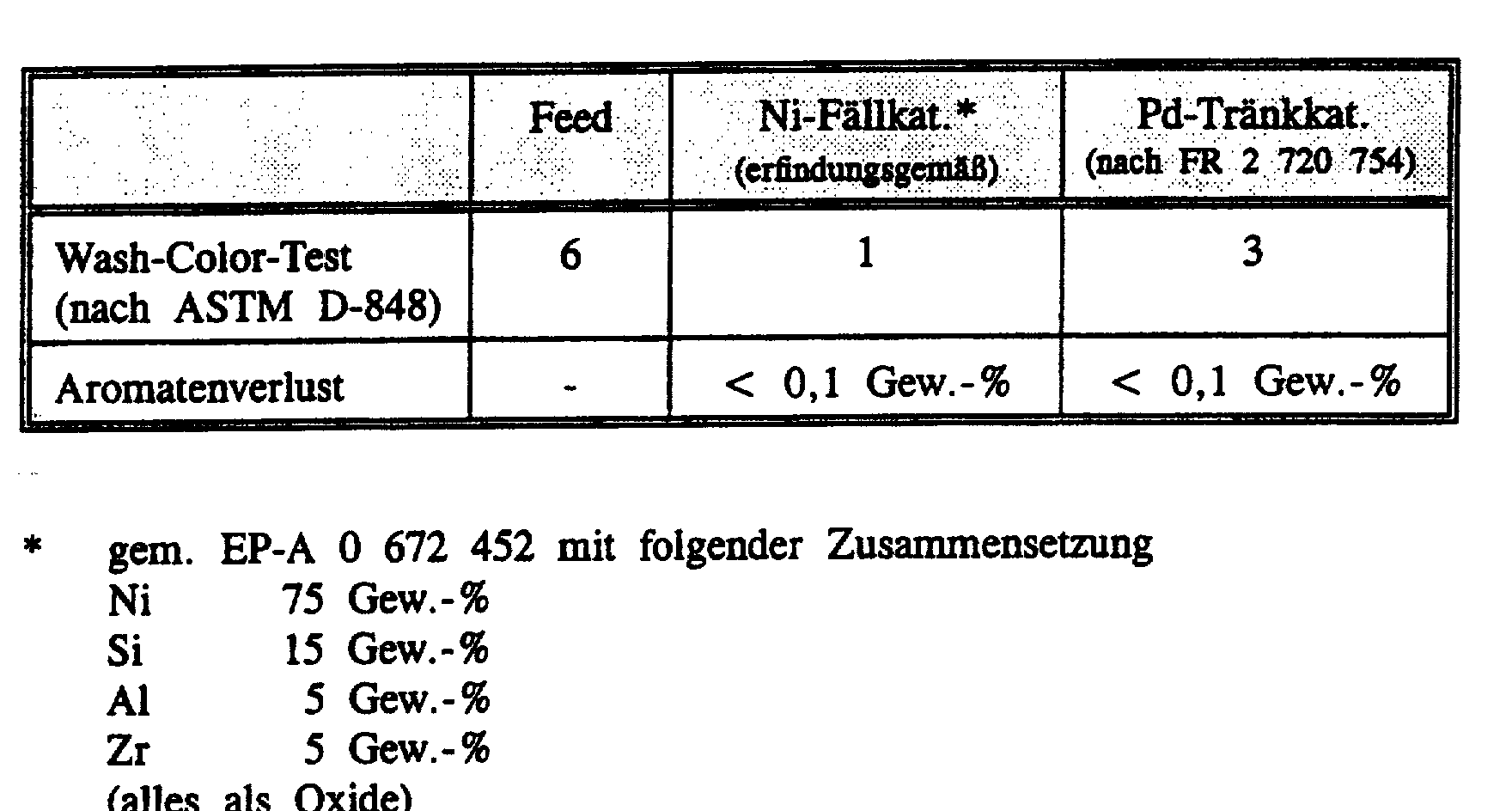
- nickel-containing precipitation catalysts such as are known per se from EP-A 0 672 452
- a very effective selective Allow hydrogenation of dienes, being hydrogenated with this catalyst under high reformate load and low pressure and low temperature conditions is carried out. It is with the method according to the invention possible that when operating under low pressure and temperature conditions and high reformate throughput of hydrogen compared to hydrogenated dienes is fed into the hydrogenation reactor in a quantity-controlled manner.
- the nickel precipitation catalysts used according to the invention are in EP-A 0 672 452. These are catalysts that are in the essentially 65 to 80% nickel, calculated as nickel oxide, 10 to 25% Silicon, calculated as silicon dioxide, 2 to 10% zirconium, calculated as Zirconium oxide and 0 to 10% aluminum, calculated as aluminum oxide, included with the proviso that the sum of the silicon dioxide content and aluminum oxide is at least 15% (percentages in% by weight, based on the total mass of the catalyst).
- the catalysts used according to the invention preferably contain 70 to 78% nickel, 10 to 20% silicon, 3 to 7% zirconium and 2 to 10% Aluminum.
- Catalysts are preferably used which only have nickel as catalytic contain active metal. In particular those catalysts that are free of Palladium can be used.
- the catalysts can contain promoters in amounts of up to 10%. These are compounds such as CuO, TiO 2 , MgO, CaO, ZnO and B 2 O 3 . However, catalysts which do not contain any promoters are preferred.
- the preparation of the catalysts used according to the invention is carried out of aqueous acidic solutions of nickel, zirconium and optionally Aluminum salts.
- Organic and inorganic salts come as salts such as acetates, sulfates, carbonates, but preferably nitrates of the above Metals into consideration.
- the total content of metal salts is generally 30 to 40% by weight. Because the later precipitation of the metals from the solution done practically quantitatively, the concentration of the individual components depends in the solution only on the content of the catalyst to be produced Component.
- the aqueous solution is obtained by adding a mineral acid, preferably nitric acid adjusted to a pH below 2.
- This solution is, advantageously with stirring, in an aqueous basic Solution, the silicon compounds and, if desired, aluminum compounds contains, registered.
- This solution contains, for example, alkali metal hydroxide or preferably soda, usually in amounts of 15 to 40 wt .-%, based on the solution.
- the pH is generally over 10.
- SiO 2 can also be used as the silicon compound.
- the silicon content of the solution is expediently 0.5 to 4% by weight.
- the solution may contain aluminum compounds in the form of oxidic solids, although it is preferred to add aluminum salts only to the acidic solution.
- the acidic addition to the basic solution is generally carried out at 30 to 100 ° C., preferably at 60 to 80 ° C. It is usually carried out over a period of 0.5 to 4 hours.
- catalysts which contain promoters are desired, it is expedient to one of the solutions described soluble metal salts as precursors for add the promoters, co-precipitate these metals and with the so obtained To further process the precipitate.
- the promoters can also be added as solids in the precipitation solution.
- the precipitated product is isolated, for example by filtration. In the This is usually followed by a washing step, in particular where appropriate Alkali metal ions and nitrate ions entrained during the precipitation be washed out.
- the solid thus obtained is then dried, for which depending on the amount of dry goods, for example, a drying cabinet or a spray dryer can be used. Generally is the drying temperature 100 to 200 ° C. Before the next step if desired, the solid can use the above promoters be added.
- the dried product is then preferably calcined, which is usually at temperatures of 300 to 700 ° C, preferably 320 to 450 ° C, over a period of 0.5 to 8 hours.
- the calcined solid is added to the intended use Shaped bodies, for example by extrusion into strands or by Tableting.
- the calcined solid is known per se Peptizing agents such as nitric acid or formic acid in amounts of in generally 0.1 to 10% by weight, based on the solid to be molded, added.
- Graphite e.g. Graphite can be used.
- the so Moldings obtained are usually at temperatures from 300 to 700 ° C, preferably 350 to 500 ° C, over a period of 1 to 8 Hours calcined.
- the feed streams preferably used in the process according to the invention contain about 15 to about 90% by weight aromatics and up to about 5000 wppm dienes.
- the most preferred feed streams are reformate streams.
- the hydrogen in the hydrogenation stage is regulated in this way fed in that about as much hydrogen is supplied as for the hydrogenation the servant is required.
- the control is preferably carried out in such a way that per mole of diene structure in the feed stream 1 to 1.3, preferably 1 to 1.2, especially about 1.2 moles of hydrogen is fed.
- a catalyst which is 65 to 80 % By weight nickel, 10 to 25% by weight silicon, 2 to 10% by weight zirconium, Contains 0 to 10% by weight aluminum - all components calculated as oxides and percentages in% by weight, based on the total mass of the Catalyst - with the proviso that the sum of the content of silicon dioxide and alumina is at least 15%.
- the aromatic content of the mixture to be hydrogenated before the selective hydrogenation by one or more upstream distillation, extraction and / or Extractive distillation levels is increased.
- the described nickel-containing precipitation catalysts show also a high selectivity in the hydrogenation of dienes in aromatics rich hydrocarbon mixtures if the process is designed that the catalyst with a low pressure and temperature levels high feed current, especially reformate throughput is loaded, and the amount of hydrogen is regulated in relation to the dienes to be hydrogenated the reactor is fed.
- the use of the hydrogenation stage according to the invention is particularly suitable in Combination with a downstream extractive distillation of the hydrogenated Product for processing and obtaining the valuable aromatics.
- the organic used Solvent consists of a high-boiling polar liquid (Ullmann's Encyclopedia of Industrial Chemistry, 5th ed., Vol. A3, page 490, publisher Chemistry).
- DE-A 20 40 025 discloses that N-substituted morpholines are known as such a selective solvent are particularly suitable.
- the preferred The solvent for the extractive distillation stage is NFM (N-formylmorpholine).
Landscapes
- Chemical & Material Sciences (AREA)
- Oil, Petroleum & Natural Gas (AREA)
- Engineering & Computer Science (AREA)
- Chemical Kinetics & Catalysis (AREA)
- General Chemical & Material Sciences (AREA)
- Organic Chemistry (AREA)
- Organic Low-Molecular-Weight Compounds And Preparation Thereof (AREA)
- Catalysts (AREA)
- Production Of Liquid Hydrocarbon Mixture For Refining Petroleum (AREA)
- Low-Molecular Organic Synthesis Reactions Using Catalysts (AREA)
- Medicines Containing Material From Animals Or Micro-Organisms (AREA)
- Solid-Sorbent Or Filter-Aiding Compositions (AREA)
- Studio Devices (AREA)
- Image Processing (AREA)
Description
- eine hocheffektive Hydrierung der Diene erfolgt
- Aromaten im wesentlichen nicht hydriert werden
- ein stabiler, preiswerter Katalysator eingesetzt wird
- eine einfache und effektive automatische Steuerung des Verfahrens erfolgen kann, und
- das Verfahren in einfacher Weise in vorhandenen Anlagen und Raffinerien ausgeführt werden kann.

- Temperatur: T = 60°C
- Druck: PH
2 = 10 bar - Durchsatz: WHSV = 6 kg/(lKat x h)
- Abgas: 1,7 Nl/kg
Claims (7)
- Verfahren zur selektiven Hydrierung von Dienen in Diene enthaltenden Speiseströmen, dadurch gekennzeichnet, daß ein solche Diene enthaltender Speisestrom an einem nickelhaltigen Fällkatalysator bei einer Temperatur zwischen 40 und 100°C, einem Druck zwischen 3 und 20 bar und einer WHSV zwischen 1 und 10 kg/(lxh) in Gegenwart von freiem Wasserstoff hydriert wird.
- Verfahren nach Anspruch 1, dadurch gekennzeichnet, daß es bei einer Temperatur zwischen 50 und 80°C, einem Druck zwischen 5 und 12 bar und einer WHSV zwischen 3 und 7 kg/(lxh) durchgeführt wird.
- Verfahren nach Anspruch 1 oder 2, dadurch gekennzeichnet, daß der Speisestrom 15 bis 90 Gew.-% Aromaten und bis zu 5000 Gew.-ppm Diene enthält.
- Verfahren nach einem der Ansprüche 1 bis 3, dadurch gekennzeichnet, daß der Wasserstoff gegenüber den zu hydrierenden Dienen mengengeregelt in die Hydrierstufe vorzugsweise pro Mol Dien-Struktur im Speisestrom 1 bis 1,3, insbesondere 1 bis 1,2, besonders etwa 1,2 Mol Wasserstoff, eingespeist wird.
- Verfahren nach einem der Ansprüche 1 bis 4, dadurch gekennzeichnet, daß der Katalysator 65 bis 80 % Nickel, 10 bis 25 % Silicium, 2 bis 10 % Zirkonium, 0 bis 10 % Aluminium enthält - alle Komponenten als Oxide berechnet und Prozentangaben in Gew.-%, bezogen auf die Gesamtmasse des Katalysators- mit der Maßgabe, daß die Summe aus dem Gehalt an Siliciumdioxid und Aluminiumoxid mindestens 15 % beträgt.
- Verfahren nach Anspruch 1 oder 2, dadurch gekennzeichnet, daß man hydriertes Produkt in einer Extraktivdestillationsstufe zu einem aromatischen Kohlenwasserstoff-Gemisch und einem nicht-aromatischen Kohlenwasserstoff-Gemisch auftrennt.
- Verfahren nach Anspruch 1 oder 2, dadurch gekennzeichnet, daß der Aromaten-Gehalt des Speisestroms vor der selektiven Hydrierung durch eine oder mehrere vorgeschaltete Destillations-, Extraktions- und/oder Extraktivdestillationsstufen erhöht wird.
Applications Claiming Priority (3)
| Application Number | Priority Date | Filing Date | Title |
|---|---|---|---|
| DE19608241A DE19608241A1 (de) | 1996-03-04 | 1996-03-04 | Verfahren zur selektiven Hydrierung von Dienen |
| DE19608241 | 1996-03-04 | ||
| PCT/EP1997/000960 WO1997032944A1 (de) | 1996-03-04 | 1997-02-27 | Verfahren zur selektiven hydrierung von dienen in reformatströmen |
Publications (2)
| Publication Number | Publication Date |
|---|---|
| EP0885273A1 EP0885273A1 (de) | 1998-12-23 |
| EP0885273B1 true EP0885273B1 (de) | 1999-11-24 |
Family
ID=7787133
Family Applications (1)
| Application Number | Title | Priority Date | Filing Date |
|---|---|---|---|
| EP97905112A Expired - Lifetime EP0885273B1 (de) | 1996-03-04 | 1997-02-27 | Verfahren zur selektiven hydrierung von dienen in reformatströmen |
Country Status (15)
| Country | Link |
|---|---|
| US (1) | US6118034A (de) |
| EP (1) | EP0885273B1 (de) |
| JP (1) | JP3852952B2 (de) |
| KR (1) | KR100437978B1 (de) |
| CN (1) | CN1083878C (de) |
| AT (1) | ATE186942T1 (de) |
| BR (1) | BR9707831A (de) |
| CA (1) | CA2248020C (de) |
| DE (2) | DE19608241A1 (de) |
| ES (1) | ES2140963T3 (de) |
| GR (1) | GR3032014T3 (de) |
| PT (1) | PT885273E (de) |
| RU (1) | RU2180678C2 (de) |
| TW (1) | TW432042B (de) |
| WO (1) | WO1997032944A1 (de) |
Families Citing this family (14)
| Publication number | Priority date | Publication date | Assignee | Title |
|---|---|---|---|---|
| KR100419858B1 (ko) * | 2001-01-17 | 2004-02-25 | 한국화학연구원 | 디올레핀류 화합물의 선택적 수소화 반응을 위한 수식된니켈-알루미나계 촉매와 그 제조방법 |
| US6632414B2 (en) | 2001-03-30 | 2003-10-14 | Corning Incorporated | Mini-structured catalyst beds for three-phase chemical processing |
| US6716339B2 (en) | 2001-03-30 | 2004-04-06 | Corning Incorporated | Hydrotreating process with monolithic catalyst |
| DE10150556A1 (de) * | 2001-10-15 | 2003-04-17 | Basf Ag | Verfahren zur katalytischen Hydrierung |
| AR044779A1 (es) * | 2003-06-16 | 2005-10-05 | Shell Int Research | Un proceso y un catalizador para la hidrogenacion selectiva de las diolefinas de una corriente de olefinas y para la remocion de arsenico de la misma y un metodo de elaboracion de dicho catalizador |
| JP4835595B2 (ja) * | 2005-11-04 | 2011-12-14 | トヨタ自動車株式会社 | 触媒担体粒子、排ガス浄化触媒、及びそれらの製造方法 |
| JP4829308B2 (ja) * | 2005-11-10 | 2011-12-07 | ユーオーピー エルエルシー | オレフィン類の選択的水素化方法 |
| EP2277980B1 (de) * | 2009-07-21 | 2018-08-08 | IFP Energies nouvelles | Verfahren zur selektiven reduzierung des benzolgehalts und des gehalts an leichten ungesättigten verbindungen von verschiedenen kohlenwasserstoffverschnitten |
| EP2670502B1 (de) | 2011-02-02 | 2020-11-18 | Basf Se | Verfahren zur abtrennung von wasser aus pyrolysebenzin |
| ES2981207T3 (es) | 2017-10-25 | 2024-10-07 | Basf Se | Proceso de eliminación de dienos de un flujo de material que contiene hidrocarburos C3 a C5 mediante hidrogenación selectiva |
| WO2022084433A1 (en) | 2020-10-23 | 2022-04-28 | Exxonmobil Chemical Patents Inc. | Hydrocarbon fluids |
| EP4232426A1 (de) | 2020-10-23 | 2023-08-30 | ExxonMobil Chemical Patents Inc. | Verfahren zur herstellung höherer alkohole aus kunststoff-pyrolyseölabfällen und daraus erhaltene höhere alkohole |
| CN116408090B (zh) * | 2021-12-31 | 2024-10-15 | 中国石油天然气股份有限公司 | 加氢催化剂及其制备方法、重整抽余油生产溶剂油的方法及系统 |
| EP4549617A1 (de) | 2023-10-31 | 2025-05-07 | Basf Se | Herstellung von gesättigten oder ethylenisch ungesättigten (cyclo)aliphatischen verbindungen durch hydrierung ethylenisch oder acetylenisch ungesättigter (cyclo)aliphatischer verbindungen unter verwendung von wasserstoff mit niedrigem deuteriumgehalt |
Family Cites Families (7)
| Publication number | Priority date | Publication date | Assignee | Title |
|---|---|---|---|---|
| GB213043A (en) * | 1923-01-20 | 1924-03-27 | Arthur G Enock & Company Ltd | Improvements in apparatus for sterilising or pasteurizing milk and for like operations |
| US2906790A (en) * | 1957-09-12 | 1959-09-29 | Gulf Research Development Co | Purification process |
| GB2131043B (en) * | 1982-11-26 | 1986-09-10 | Shell Int Research | Selective hydrogenation of dienes in pyrolysis gasoline |
| US4659687A (en) * | 1984-12-17 | 1987-04-21 | Phillips Petroleum Company | Hydrogenation catalysts and process of making said catalyst |
| FR2664610A1 (fr) * | 1990-07-13 | 1992-01-17 | Inst Francais Du Petrole | Hydrogenation selective des essences de vapocraquage sur des catalyseurs a base d'un metal supporte dans lesquels un compose organique a ete incorpore avant chargement dans le reacteur. |
| DE59402754D1 (de) * | 1994-03-15 | 1997-06-19 | Basf Ag | Nickelhaltige Hydrierkatalysatoren |
| FR2720754B1 (fr) * | 1994-06-01 | 1996-07-26 | Inst Francais Du Petrole | Procédé et installation pour le traitement par hydrogénation sélective d'une essence de craquage catalytique. |
-
1996
- 1996-03-04 DE DE19608241A patent/DE19608241A1/de not_active Withdrawn
-
1997
- 1997-02-27 US US09/142,217 patent/US6118034A/en not_active Expired - Lifetime
- 1997-02-27 AT AT97905112T patent/ATE186942T1/de active
- 1997-02-27 ES ES97905112T patent/ES2140963T3/es not_active Expired - Lifetime
- 1997-02-27 JP JP53141997A patent/JP3852952B2/ja not_active Expired - Fee Related
- 1997-02-27 WO PCT/EP1997/000960 patent/WO1997032944A1/de not_active Ceased
- 1997-02-27 BR BR9707831A patent/BR9707831A/pt not_active IP Right Cessation
- 1997-02-27 RU RU98118235/04A patent/RU2180678C2/ru not_active IP Right Cessation
- 1997-02-27 CN CN97194233A patent/CN1083878C/zh not_active Expired - Fee Related
- 1997-02-27 DE DE59700760T patent/DE59700760D1/de not_active Expired - Lifetime
- 1997-02-27 PT PT97905112T patent/PT885273E/pt unknown
- 1997-02-27 CA CA002248020A patent/CA2248020C/en not_active Expired - Fee Related
- 1997-02-27 KR KR10-1998-0706916A patent/KR100437978B1/ko not_active Expired - Fee Related
- 1997-02-27 EP EP97905112A patent/EP0885273B1/de not_active Expired - Lifetime
- 1997-03-04 TW TW086102534A patent/TW432042B/zh not_active IP Right Cessation
-
1999
- 1999-11-30 GR GR990403108T patent/GR3032014T3/el unknown
Also Published As
| Publication number | Publication date |
|---|---|
| PT885273E (pt) | 2000-04-28 |
| ES2140963T3 (es) | 2000-03-01 |
| RU2180678C2 (ru) | 2002-03-20 |
| TW432042B (en) | 2001-05-01 |
| DE59700760D1 (de) | 1999-12-30 |
| EP0885273A1 (de) | 1998-12-23 |
| WO1997032944A1 (de) | 1997-09-12 |
| KR19990087488A (ko) | 1999-12-27 |
| KR100437978B1 (ko) | 2004-07-16 |
| JP2000506202A (ja) | 2000-05-23 |
| BR9707831A (pt) | 1999-07-27 |
| DE19608241A1 (de) | 1997-09-18 |
| JP3852952B2 (ja) | 2006-12-06 |
| CA2248020A1 (en) | 1997-09-12 |
| US6118034A (en) | 2000-09-12 |
| CA2248020C (en) | 2005-09-27 |
| CN1217015A (zh) | 1999-05-19 |
| GR3032014T3 (en) | 2000-03-31 |
| ATE186942T1 (de) | 1999-12-15 |
| CN1083878C (zh) | 2002-05-01 |
Similar Documents
| Publication | Publication Date | Title |
|---|---|---|
| DE60119206T2 (de) | Benzin Entschwefelungsverfahren mit Entschwefelung von Schwer- und Mittelfraktionen von einen Fraktionierung in mindestens drei Schnitten | |
| DE60207738T2 (de) | Hochaktiver isomerisationskatalysator und verfahren für seine herstellung und seine anwendung | |
| DE2851145C2 (de) | ||
| DE19608241A1 (de) | Verfahren zur selektiven Hydrierung von Dienen | |
| EP1242181A1 (de) | Trägerkatalysator zur selektivhydrierung von alkinen und dienen | |
| DE69201976T2 (de) | Katalysator zur Herstellung von aromatischen Kohlenwasserstoffen und Verfahren zur Herstellung aromatischer Kohlenwasserstoffe unter Verwendung dieses Katalysators. | |
| DE2340337A1 (de) | Verfahren zur hydrierung von aromatischen verbindungen, die schwefelhaltige verunreinigungen enthalten | |
| EP1915207B1 (de) | Mehrschichtkatalysator auf niobbasis zur katalytischen umsetzung von kohlenwasserstoffen | |
| DE69604407T2 (de) | Hydrierung von thiofenische schwefel enthaltenden kohlenwasserstoffeinsätzen | |
| DE69513346T2 (de) | Verfahren zur Hydrierung von Benzen in Kohlenwasserstoffölen | |
| EP0856572A1 (de) | Verfahren zur hydrierenden Entaromatisierung | |
| DE3010094A1 (de) | Katalysator zur kohlenwasserstoffumwandlung | |
| EP0078951B1 (de) | Verfahren zur Herstellung von technischen Weissölen durch Hydrierung | |
| DE2161565A1 (de) | Neuer Katalysator zur Hydrierung von Kohlenwasserstoffen, dessen Herstellung und Verwendung | |
| DE1443496A1 (de) | Katalysatorgemisch und seine Verwendung in hydrokatalytischen Verfahren | |
| MXPA98007197A (en) | Selective hydrogenation of diens in currents reform | |
| DE1645824C (de) | Verfahren zum Reformieren einer Kohlenwasserstoffbeschickung | |
| AT233706B (de) | Verfahren zur katalytischen Hydrocrackung von Stickstoffverbindungen enthaltenden Kohlenwasserstoffölen | |
| DE1470631B (de) | Verfahren zur selektiven Hydrierung eines leichten, Diene enthaltenden Kohlenwasserstofföles | |
| DE2038443A1 (de) | Verfahren zur Herstellung von Duesentreibstoff sowie gegebenenfalls Motortreibstoff | |
| DE2459174A1 (de) | Verfahren zur selektiven hydrierung von olefinen in olefine und aromatische verbindungen enthaltenden kohlenwasserstoffen | |
| DE2003929A1 (de) | Verfahren zur Wasserstoffbehandlung von leichten Kreislaufoelen | |
| DD266924A3 (de) | Verfahren zur herstellung strukturselektiver hydrospaltkatalysatoren fuer hoehersiedende destillate | |
| DEST006928MA (de) | ||
| DE1203898B (de) | Verfahren zur Umwandlung eines stickstoffhaltigen Kohlenwasserstoffoeles |
Legal Events
| Date | Code | Title | Description |
|---|---|---|---|
| PUAI | Public reference made under article 153(3) epc to a published international application that has entered the european phase |
Free format text: ORIGINAL CODE: 0009012 |
|
| 17P | Request for examination filed |
Effective date: 19980929 |
|
| AK | Designated contracting states |
Kind code of ref document: A1 Designated state(s): AT BE DE ES FI FR GB GR IT NL PT SE |
|
| GRAG | Despatch of communication of intention to grant |
Free format text: ORIGINAL CODE: EPIDOS AGRA |
|
| 17Q | First examination report despatched |
Effective date: 19990121 |
|
| GRAG | Despatch of communication of intention to grant |
Free format text: ORIGINAL CODE: EPIDOS AGRA |
|
| GRAH | Despatch of communication of intention to grant a patent |
Free format text: ORIGINAL CODE: EPIDOS IGRA |
|
| GRAH | Despatch of communication of intention to grant a patent |
Free format text: ORIGINAL CODE: EPIDOS IGRA |
|
| GRAA | (expected) grant |
Free format text: ORIGINAL CODE: 0009210 |
|
| AK | Designated contracting states |
Kind code of ref document: B1 Designated state(s): AT BE DE ES FI FR GB GR IT NL PT SE |
|
| REF | Corresponds to: |
Ref document number: 186942 Country of ref document: AT Date of ref document: 19991215 Kind code of ref document: T |
|
| REF | Corresponds to: |
Ref document number: 59700760 Country of ref document: DE Date of ref document: 19991230 |
|
| GBT | Gb: translation of ep patent filed (gb section 77(6)(a)/1977) |
Effective date: 19991214 |
|
| ITF | It: translation for a ep patent filed | ||
| REG | Reference to a national code |
Ref country code: ES Ref legal event code: FG2A Ref document number: 2140963 Country of ref document: ES Kind code of ref document: T3 |
|
| ET | Fr: translation filed | ||
| REG | Reference to a national code |
Ref country code: PT Ref legal event code: SC4A Free format text: AVAILABILITY OF NATIONAL TRANSLATION Effective date: 20000118 |
|
| PLBE | No opposition filed within time limit |
Free format text: ORIGINAL CODE: 0009261 |
|
| STAA | Information on the status of an ep patent application or granted ep patent |
Free format text: STATUS: NO OPPOSITION FILED WITHIN TIME LIMIT |
|
| 26N | No opposition filed | ||
| REG | Reference to a national code |
Ref country code: GB Ref legal event code: IF02 |
|
| PGFP | Annual fee paid to national office [announced via postgrant information from national office to epo] |
Ref country code: AT Payment date: 20110223 Year of fee payment: 15 Ref country code: SE Payment date: 20110223 Year of fee payment: 15 Ref country code: PT Payment date: 20110207 Year of fee payment: 15 |
|
| PGFP | Annual fee paid to national office [announced via postgrant information from national office to epo] |
Ref country code: GR Payment date: 20110224 Year of fee payment: 15 |
|
| REG | Reference to a national code |
Ref country code: PT Ref legal event code: MM4A Free format text: LAPSE DUE TO NON-PAYMENT OF FEES Effective date: 20120827 |
|
| REG | Reference to a national code |
Ref country code: GR Ref legal event code: ML Ref document number: 990403108 Country of ref document: GR Effective date: 20120905 |
|
| PG25 | Lapsed in a contracting state [announced via postgrant information from national office to epo] |
Ref country code: SE Free format text: LAPSE BECAUSE OF NON-PAYMENT OF DUE FEES Effective date: 20120228 |
|
| PG25 | Lapsed in a contracting state [announced via postgrant information from national office to epo] |
Ref country code: GR Free format text: LAPSE BECAUSE OF NON-PAYMENT OF DUE FEES Effective date: 20120905 Ref country code: PT Free format text: LAPSE BECAUSE OF NON-PAYMENT OF DUE FEES Effective date: 20120827 |
|
| REG | Reference to a national code |
Ref country code: AT Ref legal event code: MM01 Ref document number: 186942 Country of ref document: AT Kind code of ref document: T Effective date: 20120227 |
|
| PG25 | Lapsed in a contracting state [announced via postgrant information from national office to epo] |
Ref country code: AT Free format text: LAPSE BECAUSE OF NON-PAYMENT OF DUE FEES Effective date: 20120227 |
|
| REG | Reference to a national code |
Ref country code: FR Ref legal event code: PLFP Year of fee payment: 19 |
|
| PGFP | Annual fee paid to national office [announced via postgrant information from national office to epo] |
Ref country code: IT Payment date: 20150220 Year of fee payment: 19 Ref country code: NL Payment date: 20150223 Year of fee payment: 19 Ref country code: FI Payment date: 20150223 Year of fee payment: 19 Ref country code: ES Payment date: 20150326 Year of fee payment: 19 |
|
| PGFP | Annual fee paid to national office [announced via postgrant information from national office to epo] |
Ref country code: GB Payment date: 20150227 Year of fee payment: 19 Ref country code: FR Payment date: 20150227 Year of fee payment: 19 |
|
| PGFP | Annual fee paid to national office [announced via postgrant information from national office to epo] |
Ref country code: BE Payment date: 20150218 Year of fee payment: 19 |
|
| PGFP | Annual fee paid to national office [announced via postgrant information from national office to epo] |
Ref country code: DE Payment date: 20150429 Year of fee payment: 19 |
|
| PG25 | Lapsed in a contracting state [announced via postgrant information from national office to epo] |
Ref country code: BE Free format text: LAPSE BECAUSE OF NON-PAYMENT OF DUE FEES Effective date: 20160229 |
|
| REG | Reference to a national code |
Ref country code: DE Ref legal event code: R119 Ref document number: 59700760 Country of ref document: DE |
|
| GBPC | Gb: european patent ceased through non-payment of renewal fee |
Effective date: 20160227 |
|
| PG25 | Lapsed in a contracting state [announced via postgrant information from national office to epo] |
Ref country code: FI Free format text: LAPSE BECAUSE OF NON-PAYMENT OF DUE FEES Effective date: 20160227 |
|
| REG | Reference to a national code |
Ref country code: NL Ref legal event code: MM Effective date: 20160301 |
|
| REG | Reference to a national code |
Ref country code: FR Ref legal event code: ST Effective date: 20161028 |
|
| PG25 | Lapsed in a contracting state [announced via postgrant information from national office to epo] |
Ref country code: IT Free format text: LAPSE BECAUSE OF NON-PAYMENT OF DUE FEES Effective date: 20160227 |
|
| PG25 | Lapsed in a contracting state [announced via postgrant information from national office to epo] |
Ref country code: GB Free format text: LAPSE BECAUSE OF NON-PAYMENT OF DUE FEES Effective date: 20160227 Ref country code: DE Free format text: LAPSE BECAUSE OF NON-PAYMENT OF DUE FEES Effective date: 20160901 Ref country code: FR Free format text: LAPSE BECAUSE OF NON-PAYMENT OF DUE FEES Effective date: 20160229 Ref country code: NL Free format text: LAPSE BECAUSE OF NON-PAYMENT OF DUE FEES Effective date: 20160301 |
|
| REG | Reference to a national code |
Ref country code: ES Ref legal event code: FD2A Effective date: 20180507 |
|
| PG25 | Lapsed in a contracting state [announced via postgrant information from national office to epo] |
Ref country code: ES Free format text: LAPSE BECAUSE OF NON-PAYMENT OF DUE FEES Effective date: 20160228 |