EP0860359B1 - Verfahren und Vorrichtung zum Herstellen von Paketen von losen Gegenständen unter Anwendung von siegelbarer Folie - Google Patents
Verfahren und Vorrichtung zum Herstellen von Paketen von losen Gegenständen unter Anwendung von siegelbarer Folie Download PDFInfo
- Publication number
- EP0860359B1 EP0860359B1 EP98830075A EP98830075A EP0860359B1 EP 0860359 B1 EP0860359 B1 EP 0860359B1 EP 98830075 A EP98830075 A EP 98830075A EP 98830075 A EP98830075 A EP 98830075A EP 0860359 B1 EP0860359 B1 EP 0860359B1
- Authority
- EP
- European Patent Office
- Prior art keywords
- packs
- advance
- film
- pack
- sealing
- Prior art date
- Legal status (The legal status is an assumption and is not a legal conclusion. Google has not performed a legal analysis and makes no representation as to the accuracy of the status listed.)
- Expired - Lifetime
Links
Images

Classifications
-
- B—PERFORMING OPERATIONS; TRANSPORTING
- B65—CONVEYING; PACKING; STORING; HANDLING THIN OR FILAMENTARY MATERIAL
- B65B—MACHINES, APPARATUS OR DEVICES FOR, OR METHODS OF, PACKAGING ARTICLES OR MATERIALS; UNPACKING
- B65B55/00—Preserving, protecting or purifying packages or package contents in association with packaging
- B65B55/24—Cleaning of, or removing dust from, containers, wrappers, or packaging ; Preventing of fouling
-
- B—PERFORMING OPERATIONS; TRANSPORTING
- B65—CONVEYING; PACKING; STORING; HANDLING THIN OR FILAMENTARY MATERIAL
- B65B—MACHINES, APPARATUS OR DEVICES FOR, OR METHODS OF, PACKAGING ARTICLES OR MATERIALS; UNPACKING
- B65B19/00—Packaging rod-shaped or tubular articles susceptible to damage by abrasion or pressure, e.g. cigarettes, cigars, macaroni, spaghetti, drinking straws or welding electrodes
- B65B19/34—Packaging other rod-shaped articles, e.g. sausages, macaroni, spaghetti, drinking straws, welding electrodes
Definitions
- the present invention relates to a machine for packaging a loose product, for example a foodstuff, and in particular (but not exclusively) an elongated product such as, for example, long pasta, in a pack formed by sealing and cutting a continuous film.
- a loose product for example a foodstuff
- an elongated product such as, for example, long pasta
- the machines used to package long pasta have a tube or channel into which predetermined amounts of product are unloaded and are then pushed into a tubular film which is formed around the product advancing channel using sheet film.
- Located at the exit to the channel are a first and a second means for advancing the packs being formed, with a sealing and cutting jaw positioned between the said means and forming transverse sealing and cutting lines in the film in order to form the packs of product one after the other.
- the feeding, weighing and loading operations involved can cause the product to break, forming small pieces or residues. These are often left behind in the area where the sealing and cutting jaws operate, with the result that the front and rear sealing lines of each pack may include foodstuff residues. This not only constitutes a disadvantage from a technical viewpoint, it also ruins the look of the product and may put the consumer off choosing it.
- the object of the present invention is to provide a packaging machine and method that do away with the disadvantages described above.
- the present invention basically provides a machine for packaging loose products of the type referred to above - comprising first and second means for advancing the packs being formed along an approximately horizontal path, and in which a cutting and sealing member is located between the first and the second advance means - in which the second advance means can be inclined downwards relative to the path of advance of the packs being formed, its motion being synchronized with the motion of the cutting and sealing member in such a way that the pack is temporarity inclined downwards before the cutting and sealing member starts acting. It is thus possible to incline the pack being formed once the loose product has been inserted therein and before the rear end of the pack is sealed and cut. In this way, any product residues found in the area where the sealing and cutting are to take place, slide down to the bottom of the pack under the effect of gravity and do not obstruct the area in which the sealing and cutting members operate.
- a film support element is provided underneath the path of advance of the packs, between the first advance means and the cutting and sealing member.
- This support element can be raisable so as to be moved from a retracted position, beneath the path of advance, into a position that approximately corresponds to the path of advance of the packs being formed.
- the support element can consist of a first portion of a clamp having two elements, one placed above and the other below the path of advance of the packs.
- the clamp is closed at the same time as the pack being formed is inclined downwards, thereby clamping the tubular film in an intermediate position between the sealing and cutting member and the area for loading the loose product.
- the invention also relates to a method for packaging a loose product in packs formed by sealing and cutting a continuous film, comprising the following stages:
- the method is characterized in that the pack being formed is temporarily inclined downwards before the second sealing line is formed and cut, so that any product residues in the sealing area slide away under the effect of gravity.
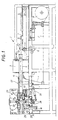
- the machine-denoted overall by the reference 1 - has a loading area 3 into which weighed batches of product to be packaged are unloaded one after the other, collecting in a subjacent horizontal tube or channel 5.
- a piston 7 which has a reciprocating motion as shown by the arrow f7 and is controlled by means of, for example, a pusher element 9 attached to a belt 11 that runs around two pulleys 13, 15, one of which is driven by a brushless motor 17 which imparts a reciprocating motion to the belt 11.
- the dashed lines show the position 7X in which the piston 7 is fully retracted and in which it is located when the loose product is unloaded into the channel 5.
- a shaping collar 19 Positioned around the channel 5 is a shaping collar 19, of a type known per se and not described in detail, around which is shaped a sealable plastic film F which is unwound from a reel B located in the bottom of the machine (on the right-hand side in the figure).
- a longitudinal sealing unit 23 Located downstream of the shaping collar 19, which folds the flat film so as to join its longitudinal edges, is a longitudinal sealing unit 23 which seals the longitudinal edges of the film F in order to form a tubular film which is then sealed and cut along transverse lines to form the product packs once the product to be packaged has been inserted.
- the reference 25 generically denotes the station in which the film is sealed and cut transversely to form the individual packs.
- a first means for advancing the packs being formed consisting of a pair of flexible conveyors or belts 27 which have the dual function of advancing the packs being formed and of entraining the film F so as to unwind it from the reel B and pull it through the shaping collar 19 and through the longitudinal sealing unit 23.
- a second feed means consisting of a lower conveyor 29 and an upper belt 31. Both these elements also have the function of advancing the packs being formed and entraining the film.
- a pair of sealing and cutting jaws 33 and 35 which are opened and closed by a cylinder and piston actuator 37 via lever mechanisms denoted overall by the reference 39 and of a type known per se.
- the advance means 29, which consists of a flexible conveyor or equivalent device, is mounted so that it can pivot downwards and assume the inclined position 29X indicated by dashed lines in Fig. 1.
- This movement is controlled by a cylinder and piston actuator 41.
- Fig. 4 shows the moving element 43 on which are mounted the rollers 45, 47 around which the conveyor 29 travels.
- the moving element 43 is hinged about an axis A-A located between the sealing and cutting jaws 33, 35 and the advance means 27, for reasons which will be explained below.
- Jaws 33, 35, each of which has a pair of sealing bars 33A, 33B and 35A, 35B are shown in greater detail in Fig. 4 and in the remaining Figs 3 and 5, a cutting blade 34 being positioned between the sealing bars 33A, 33B and engaging in a channel 36 formed between the sealing bars 35A, 35B.
- a clamp 51 Positioned between the advance means 27 and the sealing and cutting jaws 33 and 35 is a clamp 51 formed by two portions 51A, 51B, the first placed above and the other below the path of advance of the packs in the machine.
- the clamp 51 is opened and closed by a cylinder and piston actuator 53, diagrammatically indicated in Fig. 1, via a suitable lever mechanism which is not shown.
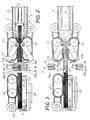
- Fig. 2 shows the position of the machine when a pack C 0 of product P has been formed and is located between the belt 31 and the conveyor 29.
- the sealing and cutting jaws 33, 35 are in the closed position and have just formed a rear transverse sealing line in the pack C 0 and a front transverse sealing and cutting line in the next pack being formed, denoted C 1 .
- the latter is located between the belts 27.
- the product P1 which is to be packaged in the pack C 1 has been inserted by the piston 7 so that it takes up all the available space between the piston 7 and the front sealing line formed by the sealing bars 33B, 35B of the jaws 33, 35.
- Fig. 3 shows the next stage, in which the sealing and cutting jaws 33, 35 have been opened and, by activating the conveyor 29 and the belts 27, 31, the film has been made to advance by a distance equivalent to the length of a pack.
- the pack being formed, denoted C 1 is now between the conveyor 29 and the belt 31, in a position ready to be transversely sealed at the rear and cut to separate the pack C 1 from the next pack.
- the piston 7 has been retracted so as to allow a new batch of product to be loaded into the tube or channel 5.
- pieces or residues of product indicated diagrammatically by the letter R, may be found in the area in which the jaws 33, 35 operate.
- the conveyor 29 In order to remove the pieces and residues from the sealing and cutting area, the conveyor 29 is made to pivot downwards so as to assume the inclined position indicated in Fig. 4. Since the pivoting axis A-A of the conveyor 29 is located upstream of the sealing and cutting jaws 33, 35, inclining the pack downwards allows all the residues found in the sealing and cutting area to slide away.
- the clamp 51 In order to keep the film F in the correct position in the area upstream of the position of the sealing jaws, the clamp 51 has been closed, causing the portions 51A, 51B to meet approximately on the path of advance of the packs being formed.
- the lower portion 51B therefore forms a support for the film F, preventing it from being pulled downwards in the area in which the belts 27 operate.
- the film is also held in place by the upper portion 51A of the clamp, even though, in theory, the lower support formed by the portion 51B should be sufficient.
- the machine then returns from the position shown in Fig. 4 to that shown in Fig. 5 (corresponding to that of Fig. 2) by closing the closing and cutting jaws 33, 35 and raising the conveyor 29, at which point the piston 7 can advance and push a new batch of product P2 towards the closed jaws 33, 35, the clamp 51 having been opened in the meantime.
- the pack C 1 has been completed, the rear sealing line having been formed by the sealing bars 33A, 35A and cut by the blade 34, and formation of the next pack C 2 containing the product P2 is started between the belts 27.
Landscapes
- Engineering & Computer Science (AREA)
- Mechanical Engineering (AREA)
- Containers And Plastic Fillers For Packaging (AREA)
- Auxiliary Devices For And Details Of Packaging Control (AREA)
Claims (9)
- Vorrichtung zum Verpacken eines losen Produkts in einer Packung, die durch das Siegeln und Schneiden einer durchgehenden Folie (F) gebildet wird, umfassend:dadurch gekennzeichnet, dass das zweite Mittel (29) zum Vorwärtsbewegen, bezogen auf den Vorwärtsweg der gebildeten Packungen nach unten geneigt werden kann, wobei dessen Bewegung nach unten mit der Bewegung des Schneid- und Siegelgliedes derart abgeglichen wird, dass die Packung zeitweilig nach unten geneigt wird, bevor das Schneid- und Siegelglied beginnt, tätig zu werden.Mittel (5, 7) zum zuführen des losen Materials (P);Zuführmittel (27) und Formgebungsmittel (19) zum Zuführen der durchgehenden Folie (F), aus der die Packungen (C0, C1, C2) gebildet werden;ein erstes (27) und ein zweites Mittel (29) zur Vorwärtsbewegung der entlang eines annähernd horizontalen Weges gebildeten Packungen; undein Schneid- und Siegelglied (33, 35), das zwischen dem ersten (27) und dem zweiten Mittel (29) zum Vorwärtsbewegen liegt;
- Vorrichtung gemäß Anspruch 1, dadurch gekennzeichnet, dass ein Element (51B) zum Halten der Folie (P) unterhalb des Vorwärtsweges der gebildeten Packungen positioniert ist, zwischen dem ersten Mittel (27) zum Vorwärtsbewegen und dem Schneid- und Siegelglied (33, 35).
- Vorrichtung gemäß Anspruch 2, dadurch gekennzeichnet, dass das Element (51B) zum Halten nach oben in Richtung des Vorwärtsweges der gebildeten Packungen bewegt werden kann.
- Vorrichtung gemäß Anspruch 2, dadurch gekennzeichnet, dass das Element (51B) zum Halten aus einer Klemme (51) besteht, die zwei Elemente (51A, 51B) aufweist, wovon das erste oberhalb und das andere unterhalb des Vorwärtsweges der gebildeten Packungen angeordnet ist.
- Vorrichtung gemäß Anspruch 4, dadurch gekennzeichnet, dass wenn die Klemme (51) in der geschlossenen Position ist, die beiden Elemente, aus denen sie sich zusammensetzt, die Folie ungefähr auf dem Vorwärtsweg der gebildeten Packungen festklemmt.
- Vorrichtung gemäß einem oder mehreren der vorangehenden Ansprüche, dadurch gekennzeichnet, dass das zweite Mittel (29) zum Vorwärtsbewegen aus einem ununterbrochenen flexiblen Förderband besteht, das sich um zwei Walzen (45, 47) herum bewegt, die durch ein bewegliches Element (43) getragen werden, das um eine ungefähr horizontale Achse (A-A) schwenkt, die bezogen auf die Vorwärtsrichtung der gebildeten Packungen, vor dem Förderband (29) angeordnet ist.
- Verfahren zum Verpacken eines losen Produkts in Packungen, die durch das Siegeln und Schneiden einer durchgehenden Polie (F) gebildet werden, das die folgenden Stufen umfasst:Herstellen einer röhrenförmigen Folie aus einer flachen Folie durch das Verbinden und Zusammensiegeln ihrer längsverlaufenden Kanten;Erzeugen einer ersten querlaufenden Siegellinie in der röhrenförmigen Folie (F), um das Vorderende einer ersten Packung (C1) zu schließen;Einfügen einer vorgegebenen Menge des Produkts (P1) in die erste Packung;Vorwärtsbewegen der ersten Packung (C1) entlang eines ungefähr horizontalen Weges; undErzeugen einer zweiten querlaufenden Siegellinie in der Folie, um das hintere Ende der Packung (C1) zu schließen und quer Schneiden der Folie, um die erste Packung (C1) von der Folie (F) abzutrennen, dadurch gekennzeichnet, dass die gebildete Packung zeitweilig nach unten geneigt wird, bevor die zweite Siegellinie gebildet wird, so dass jegliche Produktreste unter der Wirkung der Schwerkraft von dem Siegel- und Schneidbereich wegrutschen.
- Verfahren nach Anspruch 7, dadurch gekennzeichnet, dass eine Stelle (51B) zum Halten der röhrenförmigen Folie gebildet wird, die vor dem Bereich angeordnet ist, in dem die zweite Siegellinie gebildet werden soll, wobei die Stelle (51B) zum Halten ungefähr auf dem Vorwärtsweg der gebildeten Packungen liegt, und wobei die Haltestelle aus dem Weg zurückgezogen wird, um es den gebildeten Packungen zu erlauben, sich vorwärts zu bewegen.
- Verfahren nach Anspruch 8, dadurch gekennzeichnet, dass die röhrenförmige Folie, welche die Packungen bildet, an der Haltestelle festgeklemmt wird.
Applications Claiming Priority (2)
| Application Number | Priority Date | Filing Date | Title |
|---|---|---|---|
| ITFI970029 | 1997-02-21 | ||
| IT97FI000029A IT1291785B1 (it) | 1997-02-21 | 1997-02-21 | Metodo e macchina per la formazione di confezioni di prodotto sfuso con film saldabile |
Publications (2)
| Publication Number | Publication Date |
|---|---|
| EP0860359A1 EP0860359A1 (de) | 1998-08-26 |
| EP0860359B1 true EP0860359B1 (de) | 2002-10-09 |
Family
ID=11351949
Family Applications (1)
| Application Number | Title | Priority Date | Filing Date |
|---|---|---|---|
| EP98830075A Expired - Lifetime EP0860359B1 (de) | 1997-02-21 | 1998-02-19 | Verfahren und Vorrichtung zum Herstellen von Paketen von losen Gegenständen unter Anwendung von siegelbarer Folie |
Country Status (5)
| Country | Link |
|---|---|
| EP (1) | EP0860359B1 (de) |
| BR (1) | BR9800644A (de) |
| DE (1) | DE69808530T2 (de) |
| ES (1) | ES2182257T3 (de) |
| IT (1) | IT1291785B1 (de) |
Families Citing this family (3)
| Publication number | Priority date | Publication date | Assignee | Title |
|---|---|---|---|---|
| IT1314830B1 (it) | 2000-05-17 | 2003-01-16 | Sasib Packaging Italia Srl | Macchina confezionatrice per prodotti sfusi di forma allungata, comepasta alimentare lunga o simili |
| ES2647631T3 (es) * | 2014-10-24 | 2017-12-22 | Altopack S.P.A. | Máquina de envasado para pasta larga o productos similares |
| CN105539934B (zh) * | 2016-01-18 | 2017-08-04 | 广东标华科技有限公司 | 一种套膜包装机的拉套膜装置 |
Family Cites Families (2)
| Publication number | Priority date | Publication date | Assignee | Title |
|---|---|---|---|---|
| FR1498142A (fr) * | 1966-11-03 | 1967-10-13 | Parisienne Des Usines Holweg S | Machine pour l'emballage automatique de produits |
| DE2734526A1 (de) * | 1977-07-30 | 1979-02-08 | Bosch Gmbh Robert | Kontinuierlich arbeitende einwickelmaschine |
-
1997
- 1997-02-21 IT IT97FI000029A patent/IT1291785B1/it active IP Right Grant
-
1998
- 1998-02-18 BR BR9800644-4A patent/BR9800644A/pt not_active IP Right Cessation
- 1998-02-19 DE DE69808530T patent/DE69808530T2/de not_active Expired - Fee Related
- 1998-02-19 ES ES98830075T patent/ES2182257T3/es not_active Expired - Lifetime
- 1998-02-19 EP EP98830075A patent/EP0860359B1/de not_active Expired - Lifetime
Also Published As
| Publication number | Publication date |
|---|---|
| ITFI970029A1 (it) | 1998-08-21 |
| ITFI970029A0 (it) | 1997-02-21 |
| DE69808530T2 (de) | 2003-06-18 |
| ES2182257T3 (es) | 2003-03-01 |
| BR9800644A (pt) | 1999-09-14 |
| IT1291785B1 (it) | 1999-01-21 |
| DE69808530D1 (de) | 2002-11-14 |
| EP0860359A1 (de) | 1998-08-26 |
Similar Documents
| Publication | Publication Date | Title |
|---|---|---|
| AU712087B2 (en) | Method and apparatus for automatically packaging a food or non food product | |
| US4583348A (en) | Extended film draw for film wrapping machine | |
| EP0453522B1 (de) | Maschine zum herstellen, füllen, verschliessen und getrennten verpacken wiederverschliessbarer behälter | |
| EP1006051B1 (de) | Verfahren und Vorrichtung, um Gruppen von zylindrischen Gegenständen zu verpacken | |
| CA1199615A (en) | Blank belt | |
| US5327704A (en) | Method and apparatus for packaging bread loafs into bags | |
| GB2139175A (en) | A machine for packing continuously moving articles with a strip of heat-shrinkable material | |
| US4183193A (en) | System for packaging a succession of objects in a foil | |
| JP3045278B2 (ja) | 包装装置 | |
| NZ196887A (en) | Bag loading and vacuum packaging device: bag held open while article pushed into it | |
| US3731452A (en) | Process and apparatus for continuous packaging of products and objects | |
| EP0860359A1 (de) | Verfahren und Vorrichtung zum Herstellen von Paketen von losen Gegenständen unter Anwendung von siegelbarer Folie | |
| US6119441A (en) | Automatic bagging machine | |
| JPS6322325A (ja) | 真空圧で製品を包装するための方法および装置 | |
| EP1281617B1 (de) | Verfahren und Vorrichtung zum Verpacken eines Produktes, wie eine oder mehrere Scheiben eines Käse- oder Fleischproduktes, in Folienmaterial | |
| WO1998054055A1 (en) | Film tuck-in device of packaging apparatus | |
| US3507094A (en) | Apparatus for packing or wrapping articles | |
| EP0965521A1 (de) | Vorrichtung zum Verpacken von Schüttgütern oder Gruppen von Gegenständen in einem Schlauchbeutel | |
| EP0532785A1 (de) | Einwickel- und Einschachtelmaschine, vorzugsweise für Garnspulen oder dergleichen | |
| JPH0457710A (ja) | 多列自動包装装置 | |
| EP1125842B1 (de) | Vorrichtung und Verfahren zum Verpacken eines Produktes in Folienmaterial | |
| JPH11193126A (ja) | スティック状シール袋の自動整列装置 | |
| JP3147066B2 (ja) | ストレッチ包装機 | |
| JPH0212806B2 (de) | ||
| JPS60217911A (ja) | 包装機 |
Legal Events
| Date | Code | Title | Description |
|---|---|---|---|
| PUAI | Public reference made under article 153(3) epc to a published international application that has entered the european phase |
Free format text: ORIGINAL CODE: 0009012 |
|
| AK | Designated contracting states |
Kind code of ref document: A1 Designated state(s): DE ES IT |
|
| AX | Request for extension of the european patent |
Free format text: AL;LT;LV;MK;RO;SI |
|
| 17P | Request for examination filed |
Effective date: 19990118 |
|
| AKX | Designation fees paid |
Free format text: DE ES IT |
|
| RBV | Designated contracting states (corrected) |
Designated state(s): DE ES IT |
|
| GRAG | Despatch of communication of intention to grant |
Free format text: ORIGINAL CODE: EPIDOS AGRA |
|
| 17Q | First examination report despatched |
Effective date: 20011210 |
|
| GRAG | Despatch of communication of intention to grant |
Free format text: ORIGINAL CODE: EPIDOS AGRA |
|
| GRAH | Despatch of communication of intention to grant a patent |
Free format text: ORIGINAL CODE: EPIDOS IGRA |
|
| GRAH | Despatch of communication of intention to grant a patent |
Free format text: ORIGINAL CODE: EPIDOS IGRA |
|
| GRAA | (expected) grant |
Free format text: ORIGINAL CODE: 0009210 |
|
| AK | Designated contracting states |
Kind code of ref document: B1 Designated state(s): DE ES IT |
|
| REF | Corresponds to: |
Ref document number: 69808530 Country of ref document: DE Date of ref document: 20021114 |
|
| PG25 | Lapsed in a contracting state [announced via postgrant information from national office to epo] |
Ref country code: ES Free format text: LAPSE BECAUSE OF NON-PAYMENT OF DUE FEES Effective date: 20030220 |
|
| REG | Reference to a national code |
Ref country code: ES Ref legal event code: FG2A Ref document number: 2182257 Country of ref document: ES Kind code of ref document: T3 |
|
| PLBE | No opposition filed within time limit |
Free format text: ORIGINAL CODE: 0009261 |
|
| STAA | Information on the status of an ep patent application or granted ep patent |
Free format text: STATUS: NO OPPOSITION FILED WITHIN TIME LIMIT |
|
| PG25 | Lapsed in a contracting state [announced via postgrant information from national office to epo] |
Ref country code: DE Free format text: LAPSE BECAUSE OF NON-PAYMENT OF DUE FEES Effective date: 20030902 |
|
| 26N | No opposition filed |
Effective date: 20030710 |
|
| REG | Reference to a national code |
Ref country code: ES Ref legal event code: FD2A Effective date: 20030220 |
|
| PG25 | Lapsed in a contracting state [announced via postgrant information from national office to epo] |
Ref country code: IT Free format text: LAPSE BECAUSE OF NON-PAYMENT OF DUE FEES;WARNING: LAPSES OF ITALIAN PATENTS WITH EFFECTIVE DATE BEFORE 2007 MAY HAVE OCCURRED AT ANY TIME BEFORE 2007. THE CORRECT EFFECTIVE DATE MAY BE DIFFERENT FROM THE ONE RECORDED. Effective date: 20050219 |