EP0858796A2 - Mittel zum oxidativen Färben von Haaren - Google Patents
Mittel zum oxidativen Färben von Haaren Download PDFInfo
- Publication number
- EP0858796A2 EP0858796A2 EP97118996A EP97118996A EP0858796A2 EP 0858796 A2 EP0858796 A2 EP 0858796A2 EP 97118996 A EP97118996 A EP 97118996A EP 97118996 A EP97118996 A EP 97118996A EP 0858796 A2 EP0858796 A2 EP 0858796A2
- Authority
- EP
- European Patent Office
- Prior art keywords
- acids
- agent according
- acid
- peroxide
- alkaline earth
- Prior art date
- Legal status (The legal status is an assumption and is not a legal conclusion. Google has not performed a legal analysis and makes no representation as to the accuracy of the status listed.)
- Granted
Links
Classifications
-
- A—HUMAN NECESSITIES
- A61—MEDICAL OR VETERINARY SCIENCE; HYGIENE
- A61K—PREPARATIONS FOR MEDICAL, DENTAL OR TOILETRY PURPOSES
- A61K8/00—Cosmetics or similar toiletry preparations
- A61K8/18—Cosmetics or similar toiletry preparations characterised by the composition
- A61K8/19—Cosmetics or similar toiletry preparations characterised by the composition containing inorganic ingredients
- A61K8/22—Peroxides; Oxygen; Ozone
-
- A—HUMAN NECESSITIES
- A61—MEDICAL OR VETERINARY SCIENCE; HYGIENE
- A61Q—SPECIFIC USE OF COSMETICS OR SIMILAR TOILETRY PREPARATIONS
- A61Q5/00—Preparations for care of the hair
- A61Q5/10—Preparations for permanently dyeing the hair
Definitions
- the present invention relates to an agent for oxidative dyeing of keratin fibers, especially human hair, which as Oxidizing agent at least one alkaline earth peroxide or a combination from at least one alkaline earth peroxide and at least one inorganic or contains organic acids or their salts, and the use of alkaline earth peroxides as an oxidizing agent in Agents for the oxidative dyeing of keratin fibers
- direct dyes are relatively gentle Applied conditions, but have direct dyes only insufficient authenticity properties.
- Leave with oxidation dyes usually intensive dyeings with good fastness properties achieve, but the development of the color happens under the Influence of strong oxidizing agents, such as hydrogen peroxide, which often results in damage to the fiber.
- DE-OS 44 45 282 From the DE-OS 44 45 282 is the use of easily soluble alkali peroxides and alkali peroxides Known as an oxidizing agent, but arise from them violent reaction of these peroxides with water the strongly basic and easily soluble alkali hydroxides, which are also harmful to the keratin fiber Act.
- DE-OS 26 28 398 describes a process for coloring Hair described in which by pretreating the fibers with a highly diluted transition metal salt solution or entry of small amounts of a transition metal salt in the colorant Coupling reaction is activated so that even under weakly alkaline Conditions runs sufficiently fast. However, enrich the heavy metal ions in the keratin fiber, so that with repeated treatment damage to the hair can occur.
- the disadvantage of all The aforementioned oxidizing agent is also in that it is at the beginning the application is present in high concentration and this concentration only decreases in the course of the hair treatment.
- the object of the present invention is to provide an oxidative coloring of To enable keratin fibers, in which the aforementioned disadvantages do not occur.
- the subject of the present application is therefore an agent for oxidative Dyeing keratin fibers, especially human hair, which is characterized in that it contains at least one alkaline earth peroxide, preferably magnesium peroxide, calcium peroxide, barium peroxide and / or strontium peroxide, especially calcium peroxide and / or barium peroxide.
- alkaline earth peroxide preferably magnesium peroxide, calcium peroxide, barium peroxide and / or strontium peroxide, especially calcium peroxide and / or barium peroxide.
- Another object of the present application is therefore an agent for the oxidative dyeing of keratin fibers, especially human Hair, which in addition to the alkaline earth peroxide at least one contains inorganic or organic acid.
- the following acids can be mentioned as inorganic acids: Hydrochloric acid, sulfuric acid and phosphoric acid or their alkali salts and ammonium salts, preferably buffering salts such as sodium hydrogen sulfate, Potassium hydrogen sulfate or ammonium hydrogen sulfate, Diammonium sulfate, sodium dihydrogen phosphate, potassium dihydrogen phosphate or ammonium dihydrogen phosphate, disodium hydrogen phosphate, Dipotassium hydrogen phosphate or diammonium hydrogen phosphate and ammonium chloride.
- buffering salts such as sodium hydrogen sulfate, Potassium hydrogen sulfate or ammonium hydrogen sulfate, Diammonium sulfate, sodium dihydrogen phosphate, potassium dihydrogen phosphate or ammonium dihydrogen phosphate, disodium hydrogen phosphate, Dipotassium hydrogen phosphate or diammonium hydrogen phosphate and ammonium chloride.
- organic acids monocarboxylic acids such as Acetic acid, propionic acid or palmitic acid; Polycarboxylic acids and dicarboxylic acids such as oxalic acid, malonic acid or phthalic acid; amino acids such as glycine, alanine, leucine or amino acids with other functional Groups such as serine, cysteine, lysine, arginine, ornithine, citrulline or carnitine; Aminopolycarboxylic acids such as nitrilotriacetic acid, methylglycinediacetic acid, Ethylglycinediacetic acid, ⁇ -alaninediacetic acid, serinediacetic acid, Isoserine diacetic acid, aspartic diacetic acid, polyaspartic acid, imidodisuccinate, Iminodiacetic acid, methyliminodiacetic acid, hydroxyethylethylenediamine triacetic acid, Ethy
- the aforementioned inorganic and organic acids can both can be used alone or in combination.
- the pH value of the ready-to-use dye preparation is approximately one Range from 4 to 11, preferably 7 to 10, particularly preferably 7.7 to 9.3.
- the Alkaline earth peroxides in a total amount of 0.01 to 25 percent by weight, preferably in a total amount of 0.1 to 10 percent by weight, in particular in a total amount of 0.5 to 5 percent by weight, used.
- inorganic or organic acids respectively their salts or combinations thereof are based on the ready-to-use Oxidation colorant 0.01 to 25 percent by weight, preferably 0.1 to 15 percent by weight, with a total of 0.2 to 7.5 percent by weight is particularly preferred.
- oxidizing agent in particular when using a combination of magnesium peroxide, calcium peroxide, Barium peroxide and / or strontium peroxide with an organic and / or inorganic acid
- oxidizing agent can be conventional oxidation dye precursors even without adding the otherwise required hydrogen peroxide solutions or hydrogen peroxide addition compounds couple together to form dyes.
- Developer substances are usually used as oxidation dye precursors and coupler substances used.
- Substituted m-diaminobenzenes, m-aminophenols, Resorcinol derivatives, indole derivatives, naphthols or substituted Heterocycles in particular from the class of pyrimidines and pyridines, such as N, N-dimethyl-3-ureido-aniline, 2,6-diaminopyridine, 2-amino-4 - [(2-hydroxyethyl) amino] anisole, 2,4-diamino-1-fluoro-5-methyl-benzene, 2,4-diamino-1-methoxy-5-methyl-benzene, 2,4-diamino-1-ethoxy-5-methyl-benzene, 2,4-diamino-1- (2-hydroxy-ethoxy) -5-methyl-benzene, 2,4-di [(2-hydroxyethyl) -amino] -1,5-dimethoxy-benzene, 2,3-diamino
- the agent according to the invention contains one or more of the aforementioned direct dyes and / or developer substances and Coupler substances, the dyes, if they are bases, also in Form of the physiologically acceptable acid addition salts, for example as hydrochloride or sulfate, or - if they are aromatic
- the dyes if they are bases, also in Form of the physiologically acceptable acid addition salts, for example as hydrochloride or sulfate, or - if they are aromatic
- Have OH groups - in the form of the salts with bases, for example as alkali phenolate, can be used.
- the oxidation dye precursors are based on the ready-to-use Oxidation dye, in the dye according to the invention in one Total amount from 0.02 to 20 percent by weight, preferably in one Total amount from 0.5 to 5 percent by weight included.
- the developer substances and coupler substances are preferably in equimolar Amounts used. However, it is not a disadvantage if either of these Substance classes in a certain excess or deficit is included. For example, the developer and the coupler in a ratio of 1: 0.5 to 1: 2 can be used.
- customary direct shades can also be used Dyes, for example triphenylmethane dyes such as basic Violet 14 (C.I. 42 510) and Basic Violet 2 (C.I. 42 520), aromatic nitro dyes such as 2-amino-4,6-dinitrophenol, 2-nitro-4- (2'-hydroxyethylamino) aniline and 2-amino-4-nitrophenol, azo dyes such as Acid Brown 4 (C.I. 14 805) and Acid Blue 135 (C.I. 13 385), anthraquinone dyes such as disperses Violet 4 (C.I. 61 105), Disperse Blue (C.I. 64 500), Disperse Red 15 (C.I.
- triphenylmethane dyes such as basic Violet 14 (C.I. 42 510) and Basic Violet 2 (C.I. 42 520)
- aromatic nitro dyes such as 2-amino-4,6-dinitrophenol, 2-nitro-4- (2'-hydroxyethylamino) aniline and 2-a
- Disperse Violet 1 (C.I. 61 100)
- 1,4,5,8, -Tetraaminoanthraquinone and 1,4-diaminoanthraquinone in the colorant of the present invention be included.
- Formulations which contain the oxidation system according to the invention are therefore anhydrous, the term Anhydrous "is to be understood to mean that the total amount of the water of crystallization contained in the raw materials used or the traces of moisture contained in the raw materials used in the colorant according to the invention (based on the ready-to-use colorant) is not greater than 10 percent by weight, preferably less than 4 percent by weight, in particular less than 1 percent by weight.
- the oxidizing agent according to the invention (consisting of at least one Alkaline earth peroxide or from a combination of at least one Alkaline earth peroxide and at least one organic and / or inorganic Acid) is mixed with the dye precursors in an anhydrous Medium, preferably in the form of a dust-free powder, formulated, this mixture immediately before application to Start the dyeing reaction with water, preferably in a weight ratio from 1: 0.5 to 1:20.
- Oxidation hair dye according to the invention in the form of a 2-component preparation pack, the alkaline earth peroxides as anhydrous formulation in powder form, or microencapsulated, or as Suspension in an anhydrous medium separated from the rest Components of the oxidation hair dye are packaged while the remaining components of the oxidation hair dye in the form of a preparation containing water.
- the oxidizer is in this Case immediately before use with the water-based preparation mixed, the water-based preparation also in the form of a concentrate that may be present with water before use is diluted.
- the oxidation system according to the invention and the dye precursors are individually or as a mixture in cosmetic preparations, which as Serve carrier mass, incorporated, the alkaline earth peroxides in in an anhydrous environment (as defined above).
- Suitable cosmetic preparations are, for example, creams, emulsions, gels, surfactant-containing solutions such as shampoos, foam aerosols or other formulations which are suitable for hair cosmetic purposes.
- Common components of such preparations are described in the relevant specialist literature, for example K. Schrader, Fundamentals and formulations of cosmetics, 2nd edition ", Wegig Verlag, Heidelberg, 1989.
- surfactants and emulsifiers such as anionic, nonionic or ampholytic surface active compounds, for example Fatty alcohol sulfates, alkane sulfonates, olefin sulfonates, fatty alcohol polyglycol ether sulfates, Alkyl polyglycosides and ethoxylated fatty alcohols, fatty acids, Alkylphenols, sorbitan fatty acid esters and fatty acid alkanolamides, Thickeners and gelling agents such as fatty alcohols, fatty acids, Paraffin oils, fatty acid esters, methyl celluloses or hydroxyethyl celluloses, Starch, synthetic polymers such as polyvinylpyrrolidone (PVP) or polyacrylates, Biopolymers such as alginic acid ⁇ antioxidants for stabilization dyes such as ascorbic acid, thioglycolic acid or sodium sulfite, as well as complexing agents
- the components of the cosmetic preparations are used in the manufacture of the hair dye according to the invention in the usual for this purpose Quantities used; for example, the emulsifiers in concentrations from 0.2 to 30 percent by weight and the thickeners in concentrations from 0.1 to 25 percent by weight, based in each case on the ready-to-use Oxidation hair dye.
- the hair dye according to the invention is applied by the individual components together before use mixed, mixed with water if necessary and then one for the hair coloring is sufficient, preferably 30 to 150 grams, of the hair dye obtained on the hair.
- the application temperature is in a range from 10 to 50 ° C., preferably 20 to 40 ° C, the dyeing process by the action of Heat can be accelerated during treatment.
- the oxidation hair dye according to the invention enables an extreme mild and gentle coloring of the hair, even without the addition of Hydrogen peroxide leads to excellent coloring results.
- component A 50 g of component A are mixed with 5.0 g immediately before use added to component B and mixed intimately with 50 ml of water. That so Ready-to-use hair dye obtained is applied to the hair and after an exposure time of 30 minutes at 40 ° C with water rinsed thoroughly. The hair is then dried. The hair has an intense dark purple color.
- component A 50 g of component A are mixed with 5.0 g of component B immediately before use and mixed intimately with 50 ml of water.
- the dyestuff thus obtained is allowed to act on natural blond hair at 40 ° C. for 30 minutes.
- the hair is then rinsed thoroughly with water and dried.
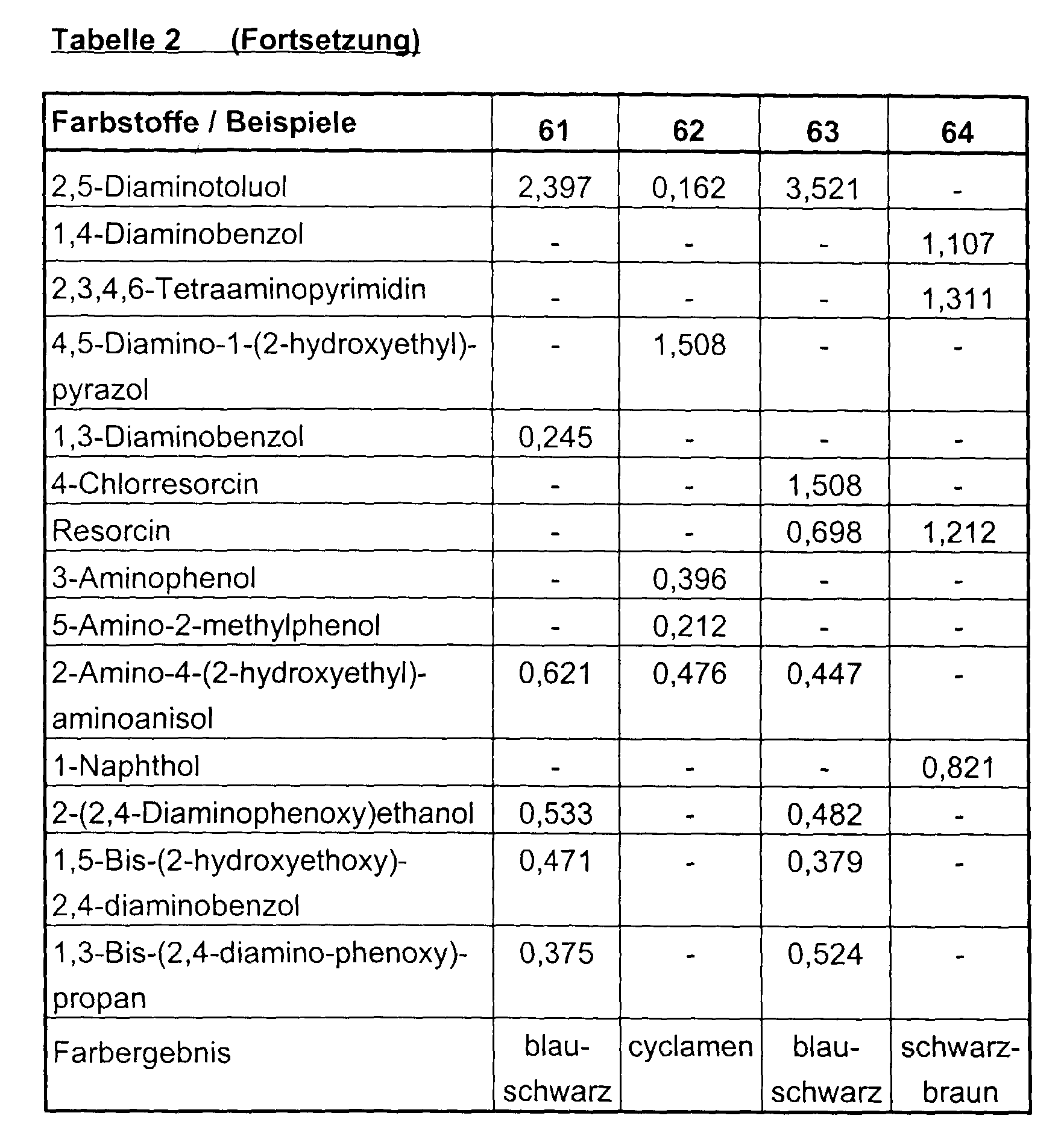
- the selection and amount X (in grams) of dye precursors and the resulting hair color are given in Table 2.
- Example 65 Colorant in powder form
Landscapes
- Health & Medical Sciences (AREA)
- Life Sciences & Earth Sciences (AREA)
- Animal Behavior & Ethology (AREA)
- General Health & Medical Sciences (AREA)
- Public Health (AREA)
- Veterinary Medicine (AREA)
- Emergency Medicine (AREA)
- Chemical & Material Sciences (AREA)
- Inorganic Chemistry (AREA)
- Birds (AREA)
- Epidemiology (AREA)
- Cosmetics (AREA)
Abstract
Description

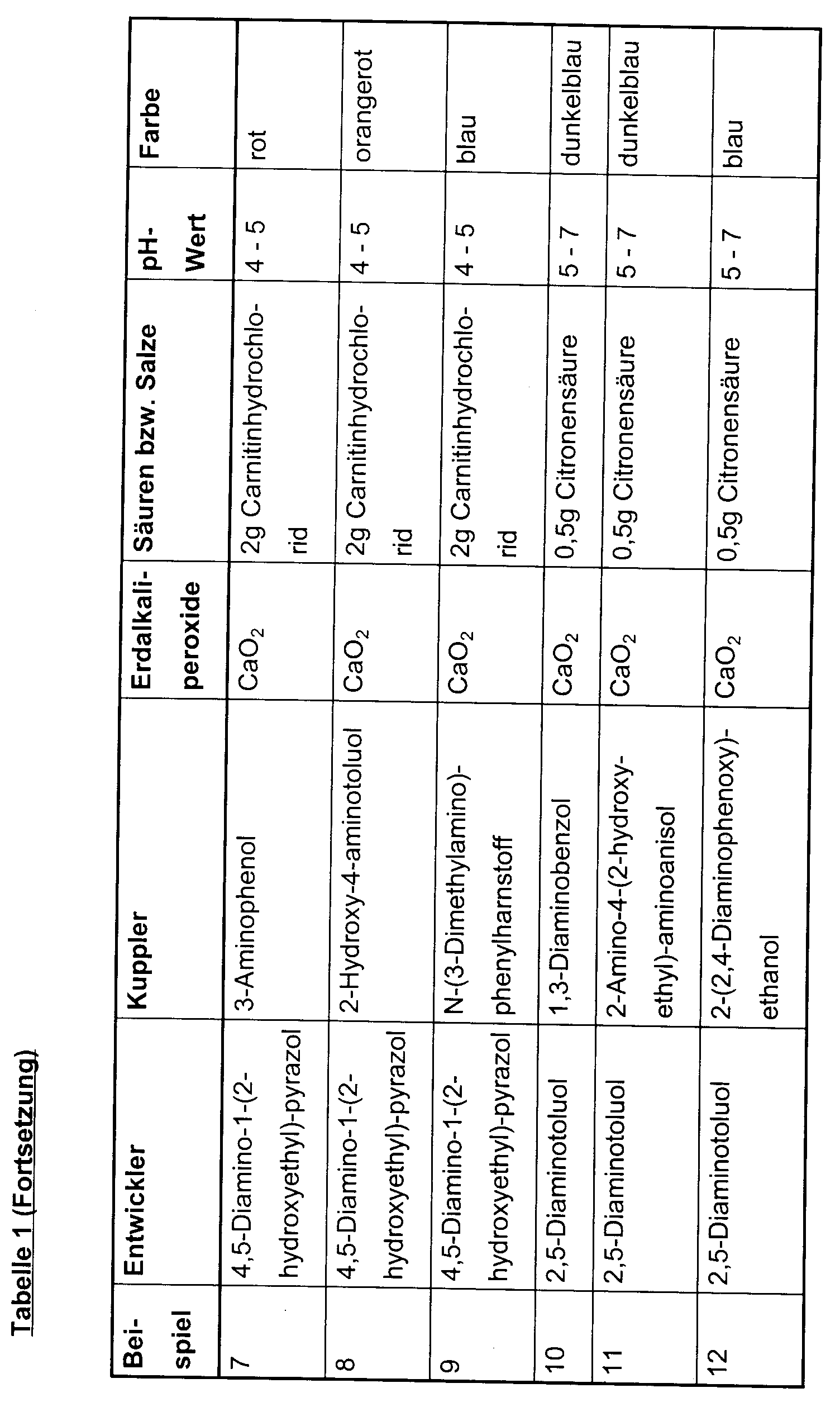
- 0,0025 mol
- Entwickler gemäß Tabelle 1
- 0,0025 mol
- Kuppler gemäß Tabelle 1
- 0,3 g
- Dinatriumethylendiaminotetraessigsäure
- 0,3 g
- Ascorbinsäure
- 10,0 g
- Ethanol
- 10,0 g
- Laurylalkohol-diglykolethersulfat-Natriumsalz (28%ige wässrige Lösung)
- ad 100,0 g
- Wasser



- 1,1 g
- 2,5-Diaminotoluol
- 1,2 g
- 4-Amino-3-methylphenol
- 1,2 g
- 5-Amino-2-methylphenol
- 1,4 g
- 2-Amino-4-(2-hydroxyethyl)-aminoanisol
- 0,3 g
- Ascorbinsäure
- 7,0 g
- Propanol-2
- 15,0 g
- Ölsäure
- 10,0 g
- Ammoniak (25%ige wässrige Lösung)
- 62,8 g
- Wasser
-
100,0 g
- 32,0 g
- Calciumperoxid
- 12,0 g
- Calciumhydroxid
- 6,0 g
- Calciumcarbonat
- 50,0 g
- Diammoniumhydrogencarbonat
-
100,0 g
- X g
- Farbstoffvorstufen und direktziehende Farbstoffe (gemäß Tabelle 2)
- 0,3 g
- Natriumsulfit
- 0,1 g
- Ascorbinsäure
- 3,5 g
- Laurylalkoholdiglykolethersulfat-Natriumsalz (28%ige wässrige Lösung)
- 15,0 g
- Cetylalkohol
- 3,0 g
- Ammoniak (25%ige wässrige Lösung)
- ad 100,0 g
- Wasser
- 32,0 g
- Calciumperoxid
- 12,0 g
- Calciumhydroxid
- 6,0 g
- Calciumcarbonat
- 50,0 g
- Diammoniumhydrogencarbonat
-
100,0 g


- 17,0 g
- Hydroxypropylcellulose
- 12,8 g
- Calciumperoxid
- 10,3 g
- Natriumsulfat
- 10,0 g
- Ammoniumchlorid
- 10,0 g
- Magnesiumcarbonat
- 10,0 g
- Citronensäure
- 5,0 g
- Natriumsulfit
- 5,0 g
- Siliciumdioxid
- 4,8 g
- Calciumhydroxid
- 3,3 g
- 1,4-Diaminobenzol
- 2,0 g
- Natriumlaurylsulfat
- 2,0 g
- Dinatrium-EDTA
- 2,8 g
- 2-Amino-(2-hydroxyethyl)-aminoanisol
- 2,4 g
- Calciumcarbonat
- 1,5 g
- 4-Aminophenolhydrochlorid
- 1,1 g
- Resorcin
-
100,0 g
Claims (21)
- Mittel zum oxidativen Färben von Keratinfasern, insbesondere menschlichen Haaren, dadurch gekennzeichnet, daß es mindestens ein Erdalkaliperoxid enthält.
- Mittel nach Anspruch 1, dadurch gekennzeichnet, daß das Erdalkaliperoxid ausgewählt ist aus Magnesiumperoxid, Calciumperoxid, Bariumperoxid und/oder Strontiumperoxid.
- Mittel nach Anspruch 1 oder 2, dadurch gekennzeichnet, daß es (bezogen auf das gebrauchsfertige Färbemittel) das Erdalkaliperoxid in einer Gesamtmenge von 0,01 bis 25 Gewichtsprozent enthält.
- Mittel nach einem der Ansprüche 1 bis 3, dadurch gekennzeichnet, daß es mindestens eine anorganische oder organische Säure enthält.
- Mittel nach Anspruch 4, dadurch gekennzeichnet, daß die anorganische Säure ausgewählt ist aus Salzsäure, Schwefelsäure und Phosphorsäure beziehungsweise deren Salzen sowie Kombinationen dieser Säuren.
- Mittel nach Anspruch 4, dadurch gekennzeichnet, daß die organische Säure ausgewählt ist aus Monocarbonsäuren, Dicarbonsäuren, Polycarbonsäuren, Sulfonsäuren, Aminosäuren, Aminopolycarbonsäuren, Aminosulfonsäuren, Phosphonsäuren, Hydroxyphosphonsäuren, Aminophosphonsäuren, Monohydroxycarbonsäuren und Polyhydroxycarbonsäuren beziehungsweise deren Salzen sowie Kombinationen dieser Säuren.
- Mittel nach Anspruch 6, dadurch gekennzeichnet, daß die organische Säure ausgewählt ist aus Äpfelsäure, Citronensäure und Weinsäure beziehungsweise deren Salzen sowie Kombinationen dieser Säuren.
- Mittel nach einem der Ansprüche 1 bis 7, dadurch gekennzeichnet, daß es (bezogen auf das gebrauchsfertige Färbemittel) die organische oder anorganische Säure in einer Gesamtmenge von 0,01 bis 25 Gewichtsprozent enthält.
- Mittel nach einem der Ansprüche 1 bis 8, dadurch gekennzeichnet, daß die gebrauchsfertige Zubereitung einen pH-Wert von 4 bis 11 aufweist.
- Mittel nach einem der Ansprüche 1 bis 9, dadurch gekennzeichnet, daß es (bezogen auf das gebrauchsfertige Färbemittel) 0,02 bis 20 Gewichtsprozent Oxidationsfarbstoffvorstufen enthält.
- Mittel nach Anspruch 10, dadurch gekennzeichnet, daß die Oxidationsfarbstoffvorstufen ausgewählt sind aus primären aromatischen Aminen mit einer weiteren in ortho- oder para-Position befindlichen freien oder substituierten Hydroxy- oder Aminofunktion, Indolderivaten, substituierten Heterozyklen aus der Klasse der Pyridine, Pyrimidine oder Pyrazole, substituierten m-Diaminobenzolen, m-Aminophenolen, Resorcinderivaten und Naphtholen.
- Mittel nach Anspruch 10 oder 11, dadurch gekennzeichnet, daß es direktziehende Farbstoffe enthält.
- Mittel nach einem der Ansprüche 1 bis 12, dadurch gekennzeichnet, daß es in Form einer wasserfreien kosmetischen Zubereitung vorliegt.
- Mittel nach einem der Ansprüche 1 bis 13, dadurch gekennzeichnet, daß es in Form eines Pulvers vorliegt.
- Mittel nach Anspruch 13 oder 14, dadurch gekennzeichnet, daß es vor Gebrauch mit Wasser in einem Gewichtsverhältnis von 1:0,5 bis 1:20 vermischt wird.
- Mittel nach einem der Ansprüche 1 bis 12, dadurch gekennzeichnet, daß es in Form einer 2-Komponenten-Zubereitung vorliegt.
- Mittel nach Anspruch 16, dadurch gekennzeichnet, daß es aus einer pulverförmigen, das Erdalkaliperoxid enthaltenden wasserfreien Zubereitung und einer wäßrigen kosmetischen Zubereitung besteht.
- Mittel nach Anspruch 16, dadurch gekennzeichnet, daß es aus einer das Erdalkaliperoxid enthaltenden wasserfreien Suspension und einer wäßrigen kosmetischen Zubereitung besteht.
- Mittel nach einem der Ansprüche 1 bis 18, dadurch gekennzeichnet, daß es ohne Zusatz von Wasserstoffperoxid hergestellt wird.
- Verwendung von Erdalkaliperoxiden als Oxidationsmittel in Mitteln zur oxidativen Färbung von Haaren.
- Verwendung einer Kombination aus Erdalkaliperoxiden und organischen oder anorganischen Säuren als Oxidationsmittel in Mitteln zur oxidativen Färbung von Haaren.
Applications Claiming Priority (2)
| Application Number | Priority Date | Filing Date | Title |
|---|---|---|---|
| DE19705875 | 1997-02-15 | ||
| DE19705875A DE19705875C1 (de) | 1997-02-15 | 1997-02-15 | Mittel zum oxidativen Färben von Haaren |
Publications (4)
| Publication Number | Publication Date |
|---|---|
| EP0858796A2 true EP0858796A2 (de) | 1998-08-19 |
| EP0858796A3 EP0858796A3 (de) | 1999-11-10 |
| EP0858796B1 EP0858796B1 (de) | 2003-02-26 |
| EP0858796B2 EP0858796B2 (de) | 2007-04-11 |
Family
ID=7820381
Family Applications (1)
| Application Number | Title | Priority Date | Filing Date |
|---|---|---|---|
| EP97118996A Expired - Lifetime EP0858796B2 (de) | 1997-02-15 | 1997-10-31 | Mittel zum oxidativen Färben von Haaren |
Country Status (6)
| Country | Link |
|---|---|
| US (1) | US5961667A (de) |
| EP (1) | EP0858796B2 (de) |
| JP (1) | JPH10226630A (de) |
| BR (1) | BR9800623A (de) |
| DE (2) | DE19705875C1 (de) |
| ES (1) | ES2192642T5 (de) |
Cited By (6)
| Publication number | Priority date | Publication date | Assignee | Title |
|---|---|---|---|---|
| WO2002002062A1 (de) * | 2000-07-05 | 2002-01-10 | Wella Aktiengesellschaft | Verwendung von salzen zur verbesserung des aufziehverhaltens von anionischen direktziehenden farbstoffen |
| WO2013144244A2 (en) | 2012-03-30 | 2013-10-03 | L'oreal | Dye composition using (2,5-diaminophenyl)ethanol and an aliphatic fatty alcohol in a medium rich in fatty substances, dyeing process and device |
| WO2013144260A2 (en) | 2012-03-30 | 2013-10-03 | L'oreal | Composition comprising (2,5-diaminophenyl)ethanol, an alkylpolyglucoside nonionic surfactant, an oxyethylenated sorbitan ester or a polyalkoxylated or polyglycerolated fatty alcohol in a medium rich in fatty substances, dyeing process and device therefore |
| WO2013144243A2 (en) | 2012-03-30 | 2013-10-03 | L'oreal | Composition comprising (2,5-diaminophenyl)ethanol and a cellulose polymer or carboxylic anionic polymer in a medium rich in fatty substances, dyeing process and device |
| WO2013152956A1 (en) | 2012-03-30 | 2013-10-17 | L'oreal | Hair dyeing composition using (2,5- diaminophenyl) ethanol, a betaine amphoteric surfactant or a tertiary fatty amine in a medium rich in fatty substances |
| FR3118707A1 (fr) * | 2021-01-08 | 2022-07-15 | L'oreal | Composition solide pour la teinture et/ou l’éclaircissement des fibres kératineuses |
Families Citing this family (45)
| Publication number | Priority date | Publication date | Assignee | Title |
|---|---|---|---|---|
| ATE258421T1 (de) * | 1998-06-23 | 2004-02-15 | Henkel Kgaa | Färbemittel zum färben von keratinfasern |
| JP2000226319A (ja) * | 1999-02-04 | 2000-08-15 | Pola Chem Ind Inc | 染毛料 |
| JP2004500361A (ja) * | 1999-12-20 | 2004-01-08 | ヘンケル・コマンディットゲゼルシャフト・アウフ・アクチエン | 固形のケラチン繊維用染料 |
| US6562327B1 (en) | 2000-03-01 | 2003-05-13 | L'oreal S.A. | Hair relaxer compositions utilizing complexing agent activators |
| DE10014149B4 (de) | 2000-03-22 | 2004-05-13 | Wella Ag | Mittel und Verfahren zur Färbung von Haaren |
| DE10016497A1 (de) * | 2000-04-01 | 2001-10-18 | Goldwell Gmbh | Verfahren und Zusammensetzung zum oxidativen Färben von menschlichen Haaren |
| AU2001291054B2 (en) * | 2000-09-21 | 2004-11-25 | P&G-Clairol, Inc. | Yellow hair color dyeing composition having improved wear properties |
| DE20016994U1 (de) * | 2000-09-29 | 2000-12-14 | Henkel KGaA, 40589 Düsseldorf | Oxidationsfärbemittel mit 2-Amino-5-methylphenol |
| DE10048751A1 (de) * | 2000-09-29 | 2002-04-18 | Henkel Kgaa | Oxidationsfärbemittel mit 2-Amino-5-methylphenol |
| US7118736B2 (en) * | 2001-02-22 | 2006-10-10 | L'oreal | Hair relaxer compositions comprising at least one hydroxide compound and at least one activating agent, and methods of using the same |
| US20020189027A1 (en) * | 2001-04-20 | 2002-12-19 | Cannell David W. | Composition and methods for lanthionizing keratin fibers using at least one organic nucleophile and at least one hydroxide ion generator |
| US7195755B2 (en) * | 2001-08-20 | 2007-03-27 | L'oreal S.A. | Compositions comprising at least one hydroxide compound and at least one reducing agent, and methods for relaxing hair |
| US7468180B2 (en) * | 2001-08-20 | 2008-12-23 | L'oreal, S.A. | Compositions comprising at least one hydroxide compound and at least one oxidizing agent, and methods to straighten curly hair |
| JP2003095896A (ja) * | 2001-09-25 | 2003-04-03 | Hoyu Co Ltd | 酸化染毛剤組成物 |
| AU2003211241A1 (en) * | 2002-02-21 | 2003-09-09 | Yugen Kaisha Okada Giken | Treating agent for protecting animal fiber |
| US20040016062A1 (en) * | 2002-03-01 | 2004-01-29 | L'oreal | Nondyeing composition containing a precursor and an oxidation reaction catalyst |
| FR2836632B1 (fr) * | 2002-03-01 | 2006-11-03 | Oreal | Composition non colorante contenant un precurseur et un catalyseur de reaction d'oxydation |
| US7261744B2 (en) | 2002-12-24 | 2007-08-28 | L'oreal S.A. | Method for dyeing or coloring human keratin materials with lightening effect using a composition comprising at least one fluorescent compound and at least one optical brightener |
| US7186278B2 (en) * | 2003-04-01 | 2007-03-06 | L'oreal S.A. | Composition for dyeing human keratin materials, comprising at least one fluorescent dye and at least one compound comprising an acid functional group and processes therefor |
| US7192454B2 (en) * | 2003-04-01 | 2007-03-20 | L'oreal S.A. | Composition for dyeing human keratin materials, comprising a fluorescent dye and a particular sequestering agent, process therefor and use thereof |
| US7204860B2 (en) | 2003-04-01 | 2007-04-17 | L'oreal | Composition for dyeing human keratin materials, comprising at least one fluorescent dye and at least one polyol, process therefor and use thereof |
| US7208018B2 (en) | 2003-04-01 | 2007-04-24 | L'oreal | Composition for dyeing human keratin materials, comprising at least one fluorescent dye and at least one associative polymer, process therefor and use thereof |
| US7736631B2 (en) * | 2003-04-01 | 2010-06-15 | L'oreal S.A. | Cosmetic dye composition with a lightening effect for human keratin materials, comprising at least one fluorescent dye and at least one aminosilicone, and process of dyeing |
| US7250064B2 (en) | 2003-04-01 | 2007-07-31 | L'oreal S.A. | Dye composition comprising at least one fluorescent dye and a non-associative thickening polymer for human keratin materials, process therefor, and method thereof |
| US7226487B2 (en) * | 2003-07-07 | 2007-06-05 | The Procter & Gamble Company | 2-(amino or substituted amino)-5-(substituted oxymethyl)-phenol compounds, dyeing compositions containing them, and use thereof |
| JP4083702B2 (ja) * | 2004-04-09 | 2008-04-30 | ホーユー株式会社 | 酸化染毛剤組成物 |
| CA2588373A1 (en) | 2004-12-02 | 2006-06-08 | The Procter & Gamble Company | Polymer thickened hair colouring and bleaching compositions |
| JP2008521925A (ja) * | 2004-12-02 | 2008-06-26 | ザ プロクター アンド ギャンブル カンパニー | 毛髪染色組成物 |
| WO2006060568A1 (en) | 2004-12-02 | 2006-06-08 | The Procter & Gamble Company | Thickened hair colourant and bleaching compositions |
| WO2006060567A2 (en) * | 2004-12-02 | 2006-06-08 | The Procter & Gamble Company | Hair colouring compositions |
| ATE456965T1 (de) * | 2005-08-12 | 2010-02-15 | Procter & Gamble | Haarfärbemittel enthaltent m-aminophenolderivate |
| EP1878469B1 (de) * | 2006-07-12 | 2010-09-01 | The Procter & Gamble Company | Auf Gelnetzwerk-Emulgatoren basierende Verdickersysteme für Haarfärbe und Haaraufhellungszusammensetzungen |
| BRPI0820061B1 (pt) * | 2007-11-05 | 2016-06-07 | Procter & Gamble | composições oxidantes de coloração de cabelos |
| EP2471502A1 (de) | 2010-12-28 | 2012-07-04 | KPSS-Kao Professional Salon Services GmbH | Bleichzusammensetzung enthaltend eine Polyhydroxycarbonsäure |
| EP2471503A1 (de) * | 2010-12-28 | 2012-07-04 | KPSS-Kao Professional Salon Services GmbH | Haarfärbezusammensetzungen enthaltend eine Polyhydroxycarbonsäure |
| US8518125B2 (en) * | 2011-06-24 | 2013-08-27 | L'oreal | Emulsion dyeing composition containing at least one phospholipid, at least one nonionic surfactant and at least one carboxylic acid, and method of using same |
| US8523955B2 (en) * | 2011-06-24 | 2013-09-03 | L'oreal | Emulsion dyeing composition containing at least one fatty quaternary amine, at least one nonionic surfactant and at least one silicone, and method of using same |
| US8512419B2 (en) * | 2011-06-24 | 2013-08-20 | L'oreal | Emulsion dyeing composition containing at least one phospholipid, at least one nonionic surfactant and at least one phosphate ester, and method of using same |
| US8529636B2 (en) * | 2011-06-24 | 2013-09-10 | L'oreal | Emulsion dyeing composition containing at least one phospholipid, at least one nonionic surfactant and at least one silicone, and method of using same |
| US8523954B2 (en) * | 2011-06-24 | 2013-09-03 | L'oreal | Emulsion dyeing composition containing at least one polyamine, at least one nonionic surfactant and at least one silicone, and method of using same |
| JP5800868B2 (ja) * | 2013-07-23 | 2015-10-28 | 株式会社マンダム | 毛髪脱色剤 |
| US10426716B2 (en) * | 2017-08-30 | 2019-10-01 | L'oreal | Compositions and methods for improving color deposit and durability of color in artificially colored hair |
| US10398635B1 (en) * | 2018-03-29 | 2019-09-03 | L'oreal | Compositions and methods for improving color deposit and durability of color in artificially colored hair |
| US10869816B2 (en) * | 2019-04-29 | 2020-12-22 | Henkel IP & Holding GmbH | Powder additive to reduce the damage of bleaching and colouring agents |
| CN112391660A (zh) * | 2019-08-19 | 2021-02-23 | 刘岳峰 | 一种单锡盐环保着色剂及其制备方法 |
Citations (3)
| Publication number | Priority date | Publication date | Assignee | Title |
|---|---|---|---|---|
| DE2628398A1 (de) | 1976-06-24 | 1977-12-29 | Buehrer Rudolf Dipl Ing | Baukonstruktion mit zwei grossflaechigen gegeneinander verschiebbaren bauteilen |
| GB1596956A (en) | 1977-05-10 | 1981-09-03 | Oreal | Liquid indole dyestuff compositions for use in the dyeing of hair |
| DE4445282A1 (de) | 1994-12-19 | 1996-06-27 | Henkel Kgaa | Oxidationshaarfärbemittel mit Alkalimetallhyperoxid |
Family Cites Families (11)
| Publication number | Priority date | Publication date | Assignee | Title |
|---|---|---|---|---|
| US3861868A (en) * | 1971-03-30 | 1975-01-21 | Procter & Gamble | Dyeing human hair with oxidation dyes and arginine or a protamine protein |
| DE3628398C2 (de) * | 1986-08-21 | 1994-04-21 | Goldwell Ag | Mittel zum oxidativen Färben von Haaren, Verfahren zu seiner Herstellung und Verwendung des Mittels |
| US4925655A (en) * | 1988-03-04 | 1990-05-15 | Robell Research | Powder composition for forming a mouthwash |
| US5100436A (en) * | 1991-03-07 | 1992-03-31 | Clairol Incorporated | Oxidative hair dyeing process with catalytic pretreatment |
| DE4207475A1 (de) * | 1992-03-10 | 1993-09-16 | Goldwell Ag | Mittel zum blondieren von menschlichen haaren und verfahren zu dessen herstellung |
| DE4217920C2 (de) * | 1992-05-30 | 1996-05-09 | Goldwell Gmbh | Verfahren zur Herstellung von pulverförmigen Mitteln zum Blondieren von menschlichen Haaren |
| ES2078129T3 (es) * | 1993-06-25 | 1995-12-01 | Goldwell Gmbh | Agente para teñir y enrubiar cabellos humanos y procedimiento para su preparacion. |
| DE19600704A1 (de) * | 1996-01-11 | 1997-07-17 | Henkel Kgaa | Blondiermittel |
| AU2510197A (en) * | 1996-04-19 | 1997-11-12 | Henkel Kommanditgesellschaft Auf Aktien | Solid agent for the treatment of keratinous fibres |
| ATE198036T1 (de) * | 1996-06-27 | 2000-12-15 | Goldwell Gmbh | Mittel zum blondieren von menschlichen haaren |
| DE19703802C2 (de) * | 1997-02-01 | 2001-06-13 | Wella Ag | Mittel zum Bleichen von Haaren |
-
1997
- 1997-02-15 DE DE19705875A patent/DE19705875C1/de not_active Expired - Lifetime
- 1997-10-31 ES ES97118996T patent/ES2192642T5/es not_active Expired - Lifetime
- 1997-10-31 DE DE59709396T patent/DE59709396D1/de not_active Expired - Lifetime
- 1997-10-31 EP EP97118996A patent/EP0858796B2/de not_active Expired - Lifetime
-
1998
- 1998-01-16 JP JP10020272A patent/JPH10226630A/ja active Pending
- 1998-01-30 US US09/015,997 patent/US5961667A/en not_active Expired - Lifetime
- 1998-02-16 BR BR9800623-1A patent/BR9800623A/pt not_active Application Discontinuation
Patent Citations (3)
| Publication number | Priority date | Publication date | Assignee | Title |
|---|---|---|---|---|
| DE2628398A1 (de) | 1976-06-24 | 1977-12-29 | Buehrer Rudolf Dipl Ing | Baukonstruktion mit zwei grossflaechigen gegeneinander verschiebbaren bauteilen |
| GB1596956A (en) | 1977-05-10 | 1981-09-03 | Oreal | Liquid indole dyestuff compositions for use in the dyeing of hair |
| DE4445282A1 (de) | 1994-12-19 | 1996-06-27 | Henkel Kgaa | Oxidationshaarfärbemittel mit Alkalimetallhyperoxid |
Non-Patent Citations (1)
| Title |
|---|
| K. SCHRADER: "GRUNDLAGEN UND REZEPTUREN DER KOSMETIKA", 1989, HÜTHIG VERLAG |
Cited By (9)
| Publication number | Priority date | Publication date | Assignee | Title |
|---|---|---|---|---|
| WO2002002062A1 (de) * | 2000-07-05 | 2002-01-10 | Wella Aktiengesellschaft | Verwendung von salzen zur verbesserung des aufziehverhaltens von anionischen direktziehenden farbstoffen |
| WO2013144244A2 (en) | 2012-03-30 | 2013-10-03 | L'oreal | Dye composition using (2,5-diaminophenyl)ethanol and an aliphatic fatty alcohol in a medium rich in fatty substances, dyeing process and device |
| WO2013144260A2 (en) | 2012-03-30 | 2013-10-03 | L'oreal | Composition comprising (2,5-diaminophenyl)ethanol, an alkylpolyglucoside nonionic surfactant, an oxyethylenated sorbitan ester or a polyalkoxylated or polyglycerolated fatty alcohol in a medium rich in fatty substances, dyeing process and device therefore |
| WO2013144243A2 (en) | 2012-03-30 | 2013-10-03 | L'oreal | Composition comprising (2,5-diaminophenyl)ethanol and a cellulose polymer or carboxylic anionic polymer in a medium rich in fatty substances, dyeing process and device |
| WO2013152956A1 (en) | 2012-03-30 | 2013-10-17 | L'oreal | Hair dyeing composition using (2,5- diaminophenyl) ethanol, a betaine amphoteric surfactant or a tertiary fatty amine in a medium rich in fatty substances |
| US9808409B2 (en) | 2012-03-30 | 2017-11-07 | L'oreal | Composition comprising (2,5-diaminophenyl)ethanol and a cellulose polymer or carboxylic anionic polymer in a medium rich in fatty substances, dyeing process and device |
| US9907743B2 (en) | 2012-03-30 | 2018-03-06 | L'oreal | Composition comprising (2,5-diaminophenyl)ethanol, an alkylpolyglucoside nonionic surfactant, an oxyethylenated sorbitan ester or a polyalkoxylated or polyglycerolated fatty alcohol in a medium rich in fatty substances, dyeing process and device therefor |
| EP3769817A1 (de) | 2012-03-30 | 2021-01-27 | L'oreal Sa | Zusammensetzung mit (2,5-diaminophenyl) ethanol und einem anionischem carboxylpolymer in einem medium reich an fettstoffen, färbeverfahren und -vorrichtung |
| FR3118707A1 (fr) * | 2021-01-08 | 2022-07-15 | L'oreal | Composition solide pour la teinture et/ou l’éclaircissement des fibres kératineuses |
Also Published As
| Publication number | Publication date |
|---|---|
| DE59709396D1 (de) | 2003-04-03 |
| ES2192642T3 (es) | 2003-10-16 |
| BR9800623A (pt) | 1999-12-07 |
| EP0858796B2 (de) | 2007-04-11 |
| JPH10226630A (ja) | 1998-08-25 |
| EP0858796B1 (de) | 2003-02-26 |
| DE19705875C1 (de) | 1998-04-02 |
| EP0858796A3 (de) | 1999-11-10 |
| US5961667A (en) | 1999-10-05 |
| ES2192642T5 (es) | 2007-11-16 |
Similar Documents
| Publication | Publication Date | Title |
|---|---|---|
| EP0858796B1 (de) | Mittel zum oxidativen Färben von Haaren | |
| EP1555986B1 (de) | Verwendung von nativem zein zur verbesserung des haarzustandes und mittel | |
| DE19810688B4 (de) | Mittel und Verfahren zur Entfärbung von Haaren sowie Mehrkomponenten-Kit zur Färbung und Entfärbung von Haaren | |
| EP3166690B1 (de) | Verbesserte entfärbung von gefärbten keratinischen fasern | |
| EP1287812B1 (de) | Verfahren zum gleichzeitigen Färben und dauerhaften Verformen von Haaren | |
| DE19637966C1 (de) | Mittel zum Färben von Haaren | |
| EP0739622B1 (de) | Haarfärbemittel | |
| DE102005013488A1 (de) | Mittel zum gleichzeitigen Färben und Aufhellen von keratinhaltigen Fasern | |
| WO1986002829A1 (fr) | Teinture pour cheveux, du type a oxydation, basee sur l'emploi de 4-amino-2-hydroxyalkylphenols | |
| EP1207844B1 (de) | Haarfärbeverfahren | |
| EP1727513A1 (de) | Haarfärbemittel mit indigoiden küpenfarbstoffen | |
| DE10100928A1 (de) | Kuppler/Entwickler- und Kuppler/Kuppler-Hybridfarbstoffe und -hybridfarbstoffvorprodukte | |
| DE4122748A1 (de) | Mittel zur oxidativen faerbung von haaren | |
| EP1778363B1 (de) | Stabile gel-formulierungen mit erhöhtem elektrolytgehalt | |
| EP1131043B1 (de) | Entstaubung pulverförmiger mittel | |
| DE3743769A1 (de) | Mittel zur oxidativen faerbung von haaren | |
| DE10132915A1 (de) | Oxidationshaarfärbemittel | |
| DE19961229C1 (de) | Verfahren zur Herstellung von 2-Aminomethyl-1,4-diamino-benzol und dessen Salzen sowie die Verwendung dieser Verbindungen in Färbemitteln für Keratinfasern | |
| EP1715837A1 (de) | Kationische cremegrundlage | |
| DE10251830A1 (de) | 2-Amino-5-ethylphenol enthaltendes Mittel zum Färben von Keratinfasern | |
| DE19647494C1 (de) | Mittel und Verfahren zur Entfärbung von Fasern, sowie Mehrkomponenten-Kit zur Färbung und Entfärbung von Fasern | |
| EP1037593A1 (de) | Mittel und verfahren zur färbung von fasern | |
| DE19647493C1 (de) | Mittel und Verfahren zur Entfärbung von Fasern, sowie Mehrkomponenten-Kit zur Färbung und Entfärbung von Fasern | |
| DE10120915A1 (de) | Verfahren zur oxidativen Färbung keratinischer Fasern | |
| WO2016139123A1 (de) | Färbemittel für keratinische fasern enthaltend ein dipeptid und einen direktziehenden farbstoff |
Legal Events
| Date | Code | Title | Description |
|---|---|---|---|
| PUAI | Public reference made under article 153(3) epc to a published international application that has entered the european phase |
Free format text: ORIGINAL CODE: 0009012 |
|
| AK | Designated contracting states |
Kind code of ref document: A2 Designated state(s): DE ES FR GB IT |
|
| AX | Request for extension of the european patent |
Free format text: AL;LT;LV;RO;SI |
|
| 17P | Request for examination filed |
Effective date: 19990423 |
|
| PUAL | Search report despatched |
Free format text: ORIGINAL CODE: 0009013 |
|
| AK | Designated contracting states |
Kind code of ref document: A3 Designated state(s): AT BE CH DE DK ES FI FR GB GR IE IT LI LU MC NL PT SE |
|
| AX | Request for extension of the european patent |
Free format text: AL;LT;LV;RO;SI |
|
| AKX | Designation fees paid |
Free format text: DE ES FR GB IT |
|
| 17Q | First examination report despatched |
Effective date: 20011210 |
|
| GRAH | Despatch of communication of intention to grant a patent |
Free format text: ORIGINAL CODE: EPIDOS IGRA |
|
| GRAH | Despatch of communication of intention to grant a patent |
Free format text: ORIGINAL CODE: EPIDOS IGRA |
|
| GRAA | (expected) grant |
Free format text: ORIGINAL CODE: 0009210 |
|
| AK | Designated contracting states |
Designated state(s): DE ES FR GB IT |
|
| REG | Reference to a national code |
Ref country code: GB Ref legal event code: FG4D Free format text: NOT ENGLISH |
|
| REF | Corresponds to: |
Ref document number: 59709396 Country of ref document: DE Date of ref document: 20030403 Kind code of ref document: P |
|
| GBT | Gb: translation of ep patent filed (gb section 77(6)(a)/1977) | ||
| ET | Fr: translation filed | ||
| REG | Reference to a national code |
Ref country code: ES Ref legal event code: FG2A Ref document number: 2192642 Country of ref document: ES Kind code of ref document: T3 |
|
| PLBI | Opposition filed |
Free format text: ORIGINAL CODE: 0009260 |
|
| 26 | Opposition filed |
Opponent name: KPSS-KAO PROFESSIONAL SALON SERVICES GMBH Effective date: 20031125 Opponent name: HENKEL KOMMANDITGESELLSCHAFT AUF AKTIEN Effective date: 20031121 |
|
| PLAX | Notice of opposition and request to file observation + time limit sent |
Free format text: ORIGINAL CODE: EPIDOSNOBS2 |
|
| PLAX | Notice of opposition and request to file observation + time limit sent |
Free format text: ORIGINAL CODE: EPIDOSNOBS2 |
|
| PLBB | Reply of patent proprietor to notice(s) of opposition received |
Free format text: ORIGINAL CODE: EPIDOSNOBS3 |
|
| PUAH | Patent maintained in amended form |
Free format text: ORIGINAL CODE: 0009272 |
|
| STAA | Information on the status of an ep patent application or granted ep patent |
Free format text: STATUS: PATENT MAINTAINED AS AMENDED |
|
| 27A | Patent maintained in amended form |
Effective date: 20070411 |
|
| AK | Designated contracting states |
Kind code of ref document: B2 Designated state(s): DE ES FR GB IT |
|
| RIC2 | Information provided on ipc code assigned after grant |
Ipc: A61Q 5/10 20060101ALI20070306BHEP Ipc: A61K 8/41 20060101ALI20070306BHEP Ipc: A61K 8/22 20060101AFI20070306BHEP |
|
| GBTA | Gb: translation of amended ep patent filed (gb section 77(6)(b)/1977) | ||
| ET3 | Fr: translation filed ** decision concerning opposition | ||
| REG | Reference to a national code |
Ref country code: ES Ref legal event code: DC2A Date of ref document: 20070711 Kind code of ref document: T5 |
|
| PGFP | Annual fee paid to national office [announced via postgrant information from national office to epo] |
Ref country code: ES Payment date: 20081013 Year of fee payment: 12 |
|
| PGFP | Annual fee paid to national office [announced via postgrant information from national office to epo] |
Ref country code: IT Payment date: 20081018 Year of fee payment: 12 |
|
| REG | Reference to a national code |
Ref country code: ES Ref legal event code: FD2A Effective date: 20110307 |
|
| PG25 | Lapsed in a contracting state [announced via postgrant information from national office to epo] |
Ref country code: IT Free format text: LAPSE BECAUSE OF NON-PAYMENT OF DUE FEES Effective date: 20091031 |
|
| PG25 | Lapsed in a contracting state [announced via postgrant information from national office to epo] |
Ref country code: ES Free format text: LAPSE BECAUSE OF NON-PAYMENT OF DUE FEES Effective date: 20110304 |
|
| REG | Reference to a national code |
Ref country code: DE Ref legal event code: R081 Ref document number: 59709396 Country of ref document: DE Owner name: WELLA GMBH, DE Free format text: FORMER OWNER: WELLA AG, 64295 DARMSTADT, DE Effective date: 20110629 |
|
| PG25 | Lapsed in a contracting state [announced via postgrant information from national office to epo] |
Ref country code: ES Free format text: LAPSE BECAUSE OF NON-PAYMENT OF DUE FEES Effective date: 20091101 |
|
| REG | Reference to a national code |
Ref country code: FR Ref legal event code: CD Owner name: WELLA GMBH, DE Effective date: 20120906 Ref country code: FR Ref legal event code: CA Effective date: 20120906 |
|
| REG | Reference to a national code |
Ref country code: FR Ref legal event code: PLFP Year of fee payment: 19 |
|
| REG | Reference to a national code |
Ref country code: FR Ref legal event code: PLFP Year of fee payment: 20 |
|
| PGFP | Annual fee paid to national office [announced via postgrant information from national office to epo] |
Ref country code: GB Payment date: 20160926 Year of fee payment: 20 |
|
| PGFP | Annual fee paid to national office [announced via postgrant information from national office to epo] |
Ref country code: FR Payment date: 20160926 Year of fee payment: 20 |
|
| PGFP | Annual fee paid to national office [announced via postgrant information from national office to epo] |
Ref country code: DE Payment date: 20161031 Year of fee payment: 20 |
|
| REG | Reference to a national code |
Ref country code: DE Ref legal event code: R071 Ref document number: 59709396 Country of ref document: DE |
|
| REG | Reference to a national code |
Ref country code: GB Ref legal event code: PE20 Expiry date: 20171030 |
|
| PG25 | Lapsed in a contracting state [announced via postgrant information from national office to epo] |
Ref country code: GB Free format text: LAPSE BECAUSE OF EXPIRATION OF PROTECTION Effective date: 20171030 |