EP0842304B1 - Procede de traitement de dechets contenant un ou des alliages hydrurables en vue de leur recyclage - Google Patents
Procede de traitement de dechets contenant un ou des alliages hydrurables en vue de leur recyclage Download PDFInfo
- Publication number
- EP0842304B1 EP0842304B1 EP19960926454 EP96926454A EP0842304B1 EP 0842304 B1 EP0842304 B1 EP 0842304B1 EP 19960926454 EP19960926454 EP 19960926454 EP 96926454 A EP96926454 A EP 96926454A EP 0842304 B1 EP0842304 B1 EP 0842304B1
- Authority
- EP
- European Patent Office
- Prior art keywords
- suspension
- water
- alloys
- processing method
- surfactant
- Prior art date
- Legal status (The legal status is an assumption and is not a legal conclusion. Google has not performed a legal analysis and makes no representation as to the accuracy of the status listed.)
- Expired - Lifetime
Links
- 229910045601 alloy Inorganic materials 0.000 title claims abstract description 84
- 239000000956 alloy Substances 0.000 title claims abstract description 84
- 238000000034 method Methods 0.000 title claims abstract description 26
- 150000004678 hydrides Chemical class 0.000 title claims abstract description 8
- 238000004064 recycling Methods 0.000 title claims abstract description 6
- XLYOFNOQVPJJNP-UHFFFAOYSA-N water Substances O XLYOFNOQVPJJNP-UHFFFAOYSA-N 0.000 claims abstract description 46
- 239000000725 suspension Substances 0.000 claims abstract description 42
- PXHVJJICTQNCMI-UHFFFAOYSA-N nickel Substances [Ni] PXHVJJICTQNCMI-UHFFFAOYSA-N 0.000 claims abstract description 29
- 239000004094 surface-active agent Substances 0.000 claims abstract description 27
- 238000004062 sedimentation Methods 0.000 claims abstract description 26
- 239000007790 solid phase Substances 0.000 claims abstract description 14
- 238000001035 drying Methods 0.000 claims abstract description 9
- 238000004519 manufacturing process Methods 0.000 claims abstract description 9
- 229910052987 metal hydride Inorganic materials 0.000 claims abstract description 7
- 150000004681 metal hydrides Chemical class 0.000 claims abstract description 7
- 229910000652 nickel hydride Inorganic materials 0.000 claims abstract description 7
- 238000003756 stirring Methods 0.000 claims abstract description 7
- 238000005406 washing Methods 0.000 claims abstract description 7
- 239000002245 particle Substances 0.000 claims description 19
- 238000013019 agitation Methods 0.000 claims description 18
- 230000008569 process Effects 0.000 claims description 14
- 239000007787 solid Substances 0.000 claims description 12
- 239000007788 liquid Substances 0.000 claims description 11
- 230000009471 action Effects 0.000 claims description 7
- 239000012071 phase Substances 0.000 claims description 5
- 239000007791 liquid phase Substances 0.000 claims description 4
- 238000002156 mixing Methods 0.000 claims description 4
- 238000000265 homogenisation Methods 0.000 claims description 3
- 239000011146 organic particle Substances 0.000 claims description 3
- 239000002904 solvent Substances 0.000 claims description 3
- 238000010306 acid treatment Methods 0.000 claims description 2
- 238000001704 evaporation Methods 0.000 claims description 2
- 230000002093 peripheral effect Effects 0.000 claims description 2
- 238000007873 sieving Methods 0.000 claims description 2
- 238000003672 processing method Methods 0.000 claims 9
- 235000021110 pickles Nutrition 0.000 claims 1
- 238000010298 pulverizing process Methods 0.000 claims 1
- 239000006185 dispersion Substances 0.000 abstract description 8
- 238000005507 spraying Methods 0.000 abstract description 6
- 239000012736 aqueous medium Substances 0.000 abstract 1
- 239000002699 waste material Substances 0.000 description 48
- 238000011282 treatment Methods 0.000 description 21
- 239000000203 mixture Substances 0.000 description 13
- OKTJSMMVPCPJKN-UHFFFAOYSA-N Carbon Chemical compound [C] OKTJSMMVPCPJKN-UHFFFAOYSA-N 0.000 description 11
- 239000000843 powder Substances 0.000 description 10
- 230000015556 catabolic process Effects 0.000 description 9
- 150000001875 compounds Chemical class 0.000 description 9
- 238000006731 degradation reaction Methods 0.000 description 9
- 238000009826 distribution Methods 0.000 description 8
- 239000010439 graphite Substances 0.000 description 8
- 229910002804 graphite Inorganic materials 0.000 description 8
- LFQSCWFLJHTTHZ-UHFFFAOYSA-N Ethanol Chemical compound CCO LFQSCWFLJHTTHZ-UHFFFAOYSA-N 0.000 description 7
- 229910052751 metal Inorganic materials 0.000 description 7
- 239000000047 product Substances 0.000 description 7
- 238000011084 recovery Methods 0.000 description 7
- 238000010586 diagram Methods 0.000 description 6
- 229910052500 inorganic mineral Inorganic materials 0.000 description 6
- 239000011707 mineral Substances 0.000 description 6
- 229910052759 nickel Inorganic materials 0.000 description 6
- 238000000926 separation method Methods 0.000 description 6
- 238000006243 chemical reaction Methods 0.000 description 5
- 239000006260 foam Substances 0.000 description 5
- 230000008929 regeneration Effects 0.000 description 5
- 238000011069 regeneration method Methods 0.000 description 5
- 238000012512 characterization method Methods 0.000 description 4
- 239000002184 metal Substances 0.000 description 4
- 238000009210 therapy by ultrasound Methods 0.000 description 4
- 239000002253 acid Substances 0.000 description 3
- QVGXLLKOCUKJST-UHFFFAOYSA-N atomic oxygen Chemical compound [O] QVGXLLKOCUKJST-UHFFFAOYSA-N 0.000 description 3
- 230000008901 benefit Effects 0.000 description 3
- 230000015572 biosynthetic process Effects 0.000 description 3
- 239000003795 chemical substances by application Substances 0.000 description 3
- 238000001033 granulometry Methods 0.000 description 3
- 239000001301 oxygen Substances 0.000 description 3
- 229910052760 oxygen Inorganic materials 0.000 description 3
- 229920001343 polytetrafluoroethylene Polymers 0.000 description 3
- 239000004810 polytetrafluoroethylene Substances 0.000 description 3
- 239000007921 spray Substances 0.000 description 3
- 230000007704 transition Effects 0.000 description 3
- 239000000470 constituent Substances 0.000 description 2
- 238000004090 dissolution Methods 0.000 description 2
- 238000000605 extraction Methods 0.000 description 2
- 238000004845 hydriding Methods 0.000 description 2
- 239000011572 manganese Chemical group 0.000 description 2
- 238000005086 pumping Methods 0.000 description 2
- 239000013049 sediment Substances 0.000 description 2
- 238000003860 storage Methods 0.000 description 2
- 241000195940 Bryophyta Species 0.000 description 1
- 208000031968 Cadaver Diseases 0.000 description 1
- PWHULOQIROXLJO-UHFFFAOYSA-N Manganese Chemical group [Mn] PWHULOQIROXLJO-UHFFFAOYSA-N 0.000 description 1
- 229910001122 Mischmetal Inorganic materials 0.000 description 1
- GRYLNZFGIOXLOG-UHFFFAOYSA-N Nitric acid Chemical compound O[N+]([O-])=O GRYLNZFGIOXLOG-UHFFFAOYSA-N 0.000 description 1
- 241000287107 Passer Species 0.000 description 1
- 239000004809 Teflon Substances 0.000 description 1
- 229920006362 Teflon® Polymers 0.000 description 1
- 229910010380 TiNi Inorganic materials 0.000 description 1
- 229910052782 aluminium Inorganic materials 0.000 description 1
- XAGFODPZIPBFFR-UHFFFAOYSA-N aluminium Chemical group [Al] XAGFODPZIPBFFR-UHFFFAOYSA-N 0.000 description 1
- 125000000129 anionic group Chemical group 0.000 description 1
- 239000011230 binding agent Substances 0.000 description 1
- 229910052793 cadmium Inorganic materials 0.000 description 1
- BDOSMKKIYDKNTQ-UHFFFAOYSA-N cadmium atom Chemical compound [Cd] BDOSMKKIYDKNTQ-UHFFFAOYSA-N 0.000 description 1
- 229910052799 carbon Inorganic materials 0.000 description 1
- 239000003093 cationic surfactant Substances 0.000 description 1
- 230000008859 change Effects 0.000 description 1
- 229910017052 cobalt Inorganic materials 0.000 description 1
- 239000010941 cobalt Substances 0.000 description 1
- GUTLYIVDDKVIGB-UHFFFAOYSA-N cobalt atom Chemical group [Co] GUTLYIVDDKVIGB-UHFFFAOYSA-N 0.000 description 1
- 230000000052 comparative effect Effects 0.000 description 1
- 230000008094 contradictory effect Effects 0.000 description 1
- 230000000593 degrading effect Effects 0.000 description 1
- 238000007599 discharging Methods 0.000 description 1
- 230000000694 effects Effects 0.000 description 1
- 239000003792 electrolyte Substances 0.000 description 1
- 230000008030 elimination Effects 0.000 description 1
- 238000003379 elimination reaction Methods 0.000 description 1
- 230000008020 evaporation Effects 0.000 description 1
- 238000002474 experimental method Methods 0.000 description 1
- 238000005188 flotation Methods 0.000 description 1
- 229920002313 fluoropolymer Polymers 0.000 description 1
- 239000004811 fluoropolymer Substances 0.000 description 1
- 239000011521 glass Substances 0.000 description 1
- 238000000892 gravimetry Methods 0.000 description 1
- 238000010438 heat treatment Methods 0.000 description 1
- 230000002209 hydrophobic effect Effects 0.000 description 1
- 230000010354 integration Effects 0.000 description 1
- 229910052748 manganese Chemical group 0.000 description 1
- 239000000463 material Substances 0.000 description 1
- 229910017604 nitric acid Inorganic materials 0.000 description 1
- 244000045947 parasite Species 0.000 description 1
- 230000002572 peristaltic effect Effects 0.000 description 1
- 238000005554 pickling Methods 0.000 description 1
- -1 polytetrafluoroethylene Polymers 0.000 description 1
- 230000000750 progressive effect Effects 0.000 description 1
- 229910052761 rare earth metal Inorganic materials 0.000 description 1
- 150000002910 rare earth metals Chemical group 0.000 description 1
- 230000000717 retained effect Effects 0.000 description 1
- 238000012216 screening Methods 0.000 description 1
- 239000000126 substance Substances 0.000 description 1
- 239000006228 supernatant Substances 0.000 description 1
- 238000007738 vacuum evaporation Methods 0.000 description 1
- 239000010926 waste battery Substances 0.000 description 1
- 238000005303 weighing Methods 0.000 description 1
- 238000009736 wetting Methods 0.000 description 1
Images

Classifications
-
- H—ELECTRICITY
- H01—ELECTRIC ELEMENTS
- H01M—PROCESSES OR MEANS, e.g. BATTERIES, FOR THE DIRECT CONVERSION OF CHEMICAL ENERGY INTO ELECTRICAL ENERGY
- H01M6/00—Primary cells; Manufacture thereof
- H01M6/52—Reclaiming serviceable parts of waste cells or batteries, e.g. recycling
-
- H—ELECTRICITY
- H01—ELECTRIC ELEMENTS
- H01M—PROCESSES OR MEANS, e.g. BATTERIES, FOR THE DIRECT CONVERSION OF CHEMICAL ENERGY INTO ELECTRICAL ENERGY
- H01M10/00—Secondary cells; Manufacture thereof
- H01M10/54—Reclaiming serviceable parts of waste accumulators
-
- Y—GENERAL TAGGING OF NEW TECHNOLOGICAL DEVELOPMENTS; GENERAL TAGGING OF CROSS-SECTIONAL TECHNOLOGIES SPANNING OVER SEVERAL SECTIONS OF THE IPC; TECHNICAL SUBJECTS COVERED BY FORMER USPC CROSS-REFERENCE ART COLLECTIONS [XRACs] AND DIGESTS
- Y02—TECHNOLOGIES OR APPLICATIONS FOR MITIGATION OR ADAPTATION AGAINST CLIMATE CHANGE
- Y02W—CLIMATE CHANGE MITIGATION TECHNOLOGIES RELATED TO WASTEWATER TREATMENT OR WASTE MANAGEMENT
- Y02W30/00—Technologies for solid waste management
- Y02W30/50—Reuse, recycling or recovery technologies
- Y02W30/84—Recycling of batteries or fuel cells
Definitions
- the invention relates to a method of treatment of waste containing one or more alloys hydrurable for recycling. It applies all particularly to the treatment of waste batteries from nickel / metal hydrides type.
- nickel / metal hydride batteries have significant advantages over lead acid batteries or nickel / cadmium batteries: compactness, longer life, higher energy density.
- the charge and discharge reactions of these nickel / hydride batteries are linked to a solid state transition of a compound of the LaNi 5 , TiNi 2 type ... (certain elements which can be substituted, for example rare earth substituted by mischmetal, nickel partially substituted by cobalt, aluminum or manganese ...); this type of compound, capable of leading to a hydriding reaction in the solid state is generally designated by the expression "hydrurable alloy".
- the present invention proposes to provide a satisfactory solution to this problem. Its objective is to provide a process for treating waste containing hydrurable alloys, in particular waste from the manufacture of nickel / hydride batteries metallic or from used batteries of the same type, said process for recovering these alloys hydrurable in a directly recyclable form.
- waste containing alloys hydrurable means waste presenting itself under form of agglomerates previously separated from the support metallic and containing compounds capable of leading to a hydriding reaction in the solid state.
- nickel / metal hydride battery means any electrical storage element in which charge and discharge reactions are linked to a transition to the solid state of a hydrurable alloy or of a metallic hydride.
- the detexturing and dispersing action is carried out by causing the suspension to pass, during a duration between 1 minute and 10 minutes, between two parts in relative rotation with respect to each other such that the relative linear velocity of one with respect to the other is between 5 m / s and 15 m / s.
- the suspension can in particular be drawn into a rotor turning and discharging in the centrifugal direction through the slots of a peripheral stator.
- the report by weight solid matter / liquid phase is advantageously adjusted to a value between 0.1 and 1.
- this beach seems to correspond to a good detexturing / degradation compromise: detexturing is almost complete and allows to separate the compounds organic (in particular the filaments in polytetrafluoroethylene: PTFE) in which are nested hydrurable alloys, while limiting the degradation of these alloys to low values (degradation less than a few percent).
- PTFE polytetrafluoroethylene
- the surfactant / waste weight ratio is advantageously adjusted to a value between 10 -4 and 5.10 -3 .
- This range of values makes it possible to eliminate the hydrophobicity problems which the nature of the compounds present causes, while avoiding the formation of foam capable of making the implementation of the process impractical.
- the agitation of the medium in particular mechanical agitation, can be combined with an ultrasonic vibration transmitted to the suspension, especially when the treated waste contain a significant percentage of finely graphite divided which has a very strong adhesion with particles of hydrurable alloy.
- a vibration ultrasonic suspension promotes detachment of mineral compounds (notably graphite) which are then separated during sedimentation.
- the suspension is subjected, for a duration substantially between 1 minute and 10 minutes, to an ultrasonic vibration such that the average energy density at the heart of the suspension is substantially between 10 and 20 Wl -1 .
- This mode of implementation appears to constitute a good compromise for eliminating the mineral compounds (in particular graphite) which pollute the particles of hydridable alloys without leading to a significant degradation of these alloys.
- the frequency of the ultrasonic vibration at which is subject the suspension to each cycle is preferably between 30 and 60 kilohertz.
- This vibration is combined with an agitation of the medium which can be a mechanical agitation carried out by any known means suitable for generating a mixture of homogenization of the medium.
- the number of successive agitation cycles (possibly combined with ultrasonic vibration) and sedimentation to which the suspension is subjected is preferably substantially between 10 and 30.
- the treatment thus has a very progressive character guaranteeing a low overall degradation of the alloys (less than 5%), while performing a separation increase in mineral pollution (final purity of alloys obtained greater than 99.6% by weight).
- the solid phase obtained is washed with water and dried.
- Several washes with water are preferably made to remove all foreign particles that would have been separated by the treatments and not yet eliminated during the various sediments.
- the product obtained is preferably dried in rinsing it with a volatile solvent miscible with water and ensuring vacuum evaporation of the liquid. This minimizes the reactions during drying. parasites of the hydrurable alloys, which would be likely to cause some degradation of these compounds.
- the product obtained after drying can, the if necessary, be sieved to extract large organic particles (gangues of size greater than or equal to 150 ⁇ m).
- the process is completed by inserting between water washes an acid treatment step suitable for pickling alloy particles on the surface.
- This treatment achieves a surface depassivation of the hydrurable alloys, which improves their characteristics electrochemical.
- the temperature of the medium during treatment does not seem critical (at least in the low temperature range), and the method of the invention can be implemented at room temperature or at a close temperature (for example between 5 ° C and 50 ° C).
- the composition of this mixture of rare earths varies from one alloy to another, as do the parameters x, y and z.
- the alloy regeneration process hydrurable is applied here to a production waste from "Saft” factories (registered trademark); this waste has suffered storage less than three months after recovery from the battery manufacturing line. It consists, on the one hand, 97.5% by weight of alloy, on the other hand, organic binders (mainly PTF) and pollution mineral (mainly graphite).
- the amount of waste treated is 300 g. This material is placed in a 2 liter beaker at which is then added 900 ml of demineralized water. The solid / liquid weight ratio is thus 1/3. The garbage is very hydrophobic and the two constituents present remain quite distinct. We then use agents surfactants.
- the last two agents are in solid form.
- the three agents are dissolved in demineralized water in the proportions indicated below. A given quantity of this solution will be withdrawn and added to the waste each time the water used for suspending the waste is renewed.
- the following masses are introduced into a 500 ml volumetric flask: Zonyl Improver Cataflot 11.25 g 5.625 g 5.625 g
- the volume withdrawn to stabilize the suspension of the 300 g of waste is 20 ml.
- the surfactant / waste weight ratio is then 3.10 -3 .
- the dispersion head is immersed in the water + waste + surfactants mixture so that the head / bottom distance of the beaker is approximately 1.5 cm.
- the rotational speed of the head is 5000 tr.min -1, which corresponds to a relative linear velocity of the rotor relative to the stator 10.5 ms -1.
- the duration of the detexturation is fixed at 7 min. During this stage, the mixture quickly becomes black.
- the homogenizer is stopped and the head removed and carefully rinsed with demineralized water.
- mosses form from time to time time during the dispersion without this phenomenon take on an embarrassing magnitude. They are washed by spraying demineralized water on the surface of the suspension.
- the densities of the different constituents of the suspension are very different (hydrurable alloy: d> 8; mineral and organic pollution: d ⁇ 2.2).
- the sedimentation which occurs as soon as the spraying leads to the formation of a detextured deposit very enriched in hydrurable alloy.
- the duration of the sedimentation of the deposit is 12 min. This interval of time corresponds to a maximum alloy recovery.
- the supernatant liquid has retained its black color linked to the presence in suspension pollution (especially graphite).
- This liquid is evacuated by means of a peristaltic pump.
- the deposit remaining at the bottom of the beaker is homogeneous and completely disaggregated. Much of the TFP has been eliminated, but the dark color of the deposit shows that it still contains a significant amount of pollution (graphite).
- a goal of the next step is the elimination of this residual pollution.
- Ultrasonic treatment of the mixture hydrurable alloy + surfactants + water is repeated for 10 consecutive cycles according to the same protocol. AT each cycle, the rejected water loses its color to become almost colorless at the last wash.
- the collected powder is then washed at demineralized water to remove surfactants. Three successive washings are carried out by adding 900 ml of water and stirring manually for 1 min. Setting suspension of hydrurable alloy particles in water pure leads to the flotation of some of them. We forces their sedimentation by spraying water demineralized on the surface of the suspension. After one 12 min sedimentation, water is pumped out.
- the regenerated alloy is recovered on a paper filter previously positioned on a buchner.
- the drying is then carried out in a vacuum enclosure primary.
- the filter + metal powder assembly is weighed and, knowing the mass of the filter, we deduce that of the powder.
- the alloy is deposited on a previously weighed paper filter and placed on a buchner.
- the acid solution is regularly poured in small quantities onto the powder.
- the metallic component is dissolved and carried through the filter, leaving the carbon elements (graphite and teflon) on the latter.
- the electrochemical capacity of a hydrurable alloy characterizes its ability to store electrical energy: it is therefore a fundamental parameter. Its determination implies that accumulators are made from the alloys to be tested.
- the hydrurable alloy powder is mixed with Ni powder and pelletized to form the negative electrode.
- the positive electrode is made from Ni ⁇ Ni (OH) 2 ⁇ hydroxide. The two electrodes are then assembled and immersed in an electrolyte of KOH, 8 M.
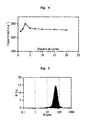
- Particle size distribution curves regenerated and virgin alloys are given respectively in Figures 2 and 3. It can be seen that the waste treatment process changed the grain size of the alloy. The decrease in the proportion of particles diameter less than 10 ⁇ m in the regenerated powder is obvious. This change is a positive point since small particles ( ⁇ ⁇ 10 ⁇ m) age more quickly than others during the life of the accumulator.
- the product treated in this example contains approximately 90% by mass of hydrurable alloy.
- the procedure followed to treat 300 g of waste in 900 ml of water is identical to that of the previous example with the only difference that the solution of surfactants contains only "Zonyl" at the same concentration (11.25 g in 500 ml of solution).
- the solid / liquid weight ratio is always 1/3 while the surfactant / waste weight ratio is no more than 1.5.10 -3 (addition of 20 ml of sol. Of "Zonyl" to the mixture 300 g waste + 900 ml of water).
- the détexturation and dispersion are obtained using the same device as above after treatment of 7 min at 5000 tr.min -1.
- the suspension thus obtained is black in color and a foam is formed on its surface consisting of a high proportion of PTFE.
- the alloy collected is washed with water (three times) then with ethanol (twice) before being recovered on a paper filter. Drying is carried out under vacuum primary.
- the waste is of the same type as that targeted in Example 2 and the quantities of waste treated, of water and surfactants are also identical.
- the détexturation is always obtained by means of the spray device "Ultra Turrax T50" after treatment for 7 min at 5000 tr.min -1. After sedimentation, the water is removed.
- the treatment continues in this example with mechanical agitation / sedimentation cycles.
- This mechanical agitation is effected by a rod equipped with blades and rotated by an electric motor at a speed of 400 tr.min -1. This is followed by stirring for 5 min of the waste + water + surfactants mixture, followed by 12 min sedimentation and pumping of the liquid. Eleven cycles are performed.
- a screening device of the type "RETSCH KS 1000" prints a circular translatory movement at a speed of 200 tr.min -1 to a screen assembly which in .mu.m mesh sizes are: 280, 200, 160, 100 , 80 and 71.
- the alloy particles are collected on the last three sieves and at the bottom of the sieving assembly.
- the electrochemical capacity and the particle size of the regenerated alloy are substantially identical to those obtained in example 2 (cf. fig. 4 and 5).
Landscapes
- Engineering & Computer Science (AREA)
- Manufacturing & Machinery (AREA)
- Chemical & Material Sciences (AREA)
- Chemical Kinetics & Catalysis (AREA)
- Electrochemistry (AREA)
- General Chemical & Material Sciences (AREA)
- Life Sciences & Earth Sciences (AREA)
- Sustainable Development (AREA)
- Processing Of Solid Wastes (AREA)
- Manufacture And Refinement Of Metals (AREA)
- Battery Electrode And Active Subsutance (AREA)
- Secondary Cells (AREA)
Description
- en premier- lieu, dans ces déchets, les alliages hydrurables sont fortement liés et imbriqués à d'autres éléments (organiques et minéraux) de sorte que leur extraction est difficile et paraít relever de techniques de traitement puissantes,
- de plus, les alliages hydrurables sont des produits très réactifs, ayant une grande affinité avec beaucoup de corps (oxygène, eau...) et ne peuvent être soumis à des traitements sévères sous peine de dégradation.
- à mélanger les déchets avec de l'eau en présence d'au moins un tensioactif,
- à soumettre la suspension obtenue à une action de détexturation et dispersion, en l'amenant à passer entre deux pièces contiguës en mouvement relatif de rotation l'une par rapport à l'autre, lesdites pièces étant pourvues de fentes de passage de la suspension,
- à mélanger la phase solide particulaire issue de l'étape de sédimentation (b) ou de l'étape de sédimentation du cycle précédent, avec de l'eau en présence d'au moins un tensioactif,
- à soumettre la suspension obtenue à une agitation du milieu,
- à laisser sédimenter la suspension obtenue et à en séparer la phase solide particulaire,
- la figure 1 est un diagramme donnant la capacité électrochimique en fonction du nombre de cycle charge/décharge, d'une part, des alliages hydrurables régénérés à l'exemple 1 (courbe A), d'autre part, d'alliages hydrurables vierges (courbe B),
- les figures 2 et 3 sont des diagrammes de répartition granulométrique des alliages hydrurables régénérés à l'exemple 1 (figure 2) et d'alliages hydrurables vierges (figure 3),
- la figure 4 est un diagramme donnant la capacité électrochimique des alliages hydrurables régénérés à l'exemple 2 en fonction du nombre de cycles charge/décharge (diagramme similaire obtenu à l'exemple 3),
- la figure 5 est un diagramme de répartition granulométrique des alliages hydrurables récupérés à l'exemple 2 (diagramme similaire obtenu à l'exemple 3).
- "Zonyl" (marque déposée par DU PONT DE NEMOURS) : polymère fluoré non ionique,
- "Mélioran P312" (marque déposée par ATOCHEM) : tension-actif anionique,
- "Cataflot NS100" (marque déposée par ATOCHEM) : tensio-actif cationique.
| Zonyl | Mélioran | Cataflot |
| 11,25 g | 5,625 g | 5,625 g |
- pas de particules de < 10 µm,
- une distribution très resserrée autour d'une valeur moyenne de 45 µm.
Claims (13)
- Procédé de traitement de déchets contenant un ou des alliages hydrurables en vue de leur recyclage, lesdits déchets provenant en particulier de la fabrication de batteries de type nickel/hydrures métalliques ou de batteries usagées du même type, ledit procédé de traitement étant caractérisé en ce qu'il combine :(a) une étape de pulvérisation des déchets dans un milieu aqueux tensioactif, consistant :à mélanger les déchets avec de l'eau en présence d'au moins un tensioactif,à soumettre la suspension obtenue à une action de détexturation et dispersion, en l'amenant à passer entre deux pièces contiguës en mouvement relatif de rotation l'une par rapport à l'autre, lesdites pièces étant pourvues de fentes de passage de la suspension,(b) une étape de sédimentation de la suspension issue de l'étape (a) pour en séparer la phase solide,(c) des cycles successifs d'agitation et de sédimentation, chaque cycle consistant :à mélanger la phase solide particulaire issue de l'étape de sédimentation (b) ou de l'étape de sédimentation du cycle précédent, avec de l'eau en présence d'au moins un tensioactif,à soumettre la suspension obtenue à une agitation du milieu,à laisser sédimenter la suspension obtenue et à en séparer la phase solide particulaire,(d) une étape finale de lavage à l'eau et de séchage de la phase solide particulaire issue des cycles (c).
- Procédé de traitement selon la revendication 1, caractérisé en ce que l'action de détexturation et dispersion est réalisée en amenant la suspension à passer, pendant une durée comprise entre 1 minute et 10 minutes, entre deux pièces en rotation relative l'une par rapport à l'autre telle que la vitesse linéaire relative de l'une par rapport à l'autre soit comprise entre 5 m/s et 15 m/s.
- Procédé de traitement selon l'une des revendications 1 ou 2, dans lequel l'action de détexturation et dispersion est réalisée en aspirant la suspension dans un rotor tournant et en la refoulant dans le sens centrifuge à travers les fentes d'un stator périphérique.
- Procédé de traitement selon la revendication 3, caractérisé en ce que, lors de l'étape de pulvérisation (a), on mélange les déchets avec de l'eau et un tensioactif de façon que le rapport pondéral matière solide/phase liquide soit compris entre 0,1 et 1, et que le rapport pondéral tensioactif/déchets soit compris entre 10-4 et 5.10-3.
- Procédé de traitement selon l'une des revendications 1 à 4, caractérisé en ce que, à chaque cycle (c), on mélange la phase solide avec de l'eau et un tensioactif de façon que le rapport pondéral matière solide/phase liquide soit sensiblement compris entre 0,1 et 1, et que le rapport pondéral tensioactif/phase solide soit compris entre 10-4 et 5.10-3.
- Procédé de traitement selon l'une des revendications 1 à 5, caractérisé en ce que à chaque cycle (c), la suspension est soumise à une vibration ultrasonore, combinée à l'agitation du milieu.
- Procédé de traitement selon la revendication 6, caractérisé en ce que, à chaque cycle (c), on soumet, pendant une durée sensiblement comprise entre 1 minute et 10 minutes, la suspension à une vibration ultrasonore telle que la densité énergétique moyenne au coeur de la suspension soit sensiblement comprise entre 10 et 20 W.l-1.
- Procédé de traitement selon l'une des revendications 6 ou 7, dans lequel à chaque cycle (c) on soumet la suspension à une vibration ultrasonore de fréquence sensiblement comprise entre 30 et 60 kilohertz.
- Procédé de traitement selon l'une des revendications 6, 7 ou 8, dans lequel à chaque cycle (c), on soumet la suspension à une vibration ultrasonore combinée à une agitation mécanique adaptée pour engendrer un brassage d'homogénéisation du milieu.
- Procédé de traitement selon l'une des revendications 1 à 9, caractérisé en ce que l'on soumet la suspension à un nombre de cycles successifs d'agitation et de sédimentation sensiblement compris entre 10 et 30.
- Procédé de traitement selon l'une des revendications 1 à 10, caractérisé en ce que (d) après plusieurs lavages à l'eau, on sèche le produit en réalisant un rinçage au moyen d'un solvant volatile miscible avec l'eau et en assurant une évaporation sous vide du liquide.
- Procédé de traitement selon l'une des revendications 1 à 11, caractérisé en ce que (e) on intercale entre les lavages à l'eau une étape de traitement acide adaptée pour décaper les particules en surface.
- Procédé de traitement selon l'une des revendications précédentes, dans lequel on soumet le produit obtenu après séchage à un tamisage adapté pour en extraire les particules organiques de taille supérieure ou égale à 150 µm.
Applications Claiming Priority (3)
| Application Number | Priority Date | Filing Date | Title |
|---|---|---|---|
| FR9509196 | 1995-07-26 | ||
| FR9509196A FR2737344B1 (fr) | 1995-07-26 | 1995-07-26 | Procede de traitement de dechets contenant un ou des alliages hydrurables en vue de leur recyclage |
| PCT/FR1996/001164 WO1997005293A1 (fr) | 1995-07-26 | 1996-07-24 | Procede de traitement de dechets contenant un ou des alliages hydrurables en vue de leur recyclage |
Publications (2)
| Publication Number | Publication Date |
|---|---|
| EP0842304A1 EP0842304A1 (fr) | 1998-05-20 |
| EP0842304B1 true EP0842304B1 (fr) | 1999-04-21 |
Family
ID=9481485
Family Applications (1)
| Application Number | Title | Priority Date | Filing Date |
|---|---|---|---|
| EP19960926454 Expired - Lifetime EP0842304B1 (fr) | 1995-07-26 | 1996-07-24 | Procede de traitement de dechets contenant un ou des alliages hydrurables en vue de leur recyclage |
Country Status (5)
| Country | Link |
|---|---|
| EP (1) | EP0842304B1 (fr) |
| AT (1) | ATE179216T1 (fr) |
| DE (1) | DE69602198D1 (fr) |
| FR (1) | FR2737344B1 (fr) |
| WO (1) | WO1997005293A1 (fr) |
Cited By (2)
| Publication number | Priority date | Publication date | Assignee | Title |
|---|---|---|---|---|
| DE19941231A1 (de) * | 1999-08-30 | 2001-03-01 | Howaldtswerke Deutsche Werft | Verfahren und Anordnung zur Behandlung von Metallhydrid |
| CN102412430A (zh) * | 2011-11-14 | 2012-04-11 | 佛山市邦普循环科技有限公司 | 一种废旧锂离子电池正极片中铝箔的化学分离方法 |
Families Citing this family (3)
| Publication number | Priority date | Publication date | Assignee | Title |
|---|---|---|---|---|
| EP1049190A4 (fr) * | 1998-10-27 | 2005-05-25 | Mitsui Mining & Smelting Co | Procede et systeme de recuperation de metal precieux a partir de batteries mises au rebut |
| GB202001183D0 (en) * | 2020-01-28 | 2020-03-11 | Univ Birmingham | Electrode separation |
| FR3114521B1 (fr) * | 2020-09-29 | 2023-04-21 | Air Liquide | Procédé et dispositif pour la purification de poudres |
Family Cites Families (5)
| Publication number | Priority date | Publication date | Assignee | Title |
|---|---|---|---|---|
| JPH04331000A (ja) * | 1991-05-01 | 1992-11-18 | Kubota Corp | 汚泥脱水方法 |
| CH684225A5 (de) * | 1992-09-02 | 1994-07-29 | Inter Recycling Ag | Verfahren zum Entsorgen von Nickel-Cadmium- oder Nickel-Hydrid-Zellen. |
| KR970007520B1 (ko) * | 1993-04-05 | 1997-05-09 | 산도쿠긴조쿠 고교 가부시키가이샤 | 니켈수소 2차 전지로부터의 유효금속회수법 |
| US5429887A (en) * | 1994-05-16 | 1995-07-04 | The United States Of America As Represented By The Secretary Of The Interior | Process for treating AB5 nickel-metal hydride battery scrap |
| JP2735146B2 (ja) * | 1994-06-06 | 1998-04-02 | 工業技術院長 | アルカリ蓄電池の回収法 |
-
1995
- 1995-07-26 FR FR9509196A patent/FR2737344B1/fr not_active Expired - Fee Related
-
1996
- 1996-07-24 EP EP19960926454 patent/EP0842304B1/fr not_active Expired - Lifetime
- 1996-07-24 WO PCT/FR1996/001164 patent/WO1997005293A1/fr not_active Ceased
- 1996-07-24 DE DE69602198T patent/DE69602198D1/de not_active Expired - Lifetime
- 1996-07-24 AT AT96926454T patent/ATE179216T1/de not_active IP Right Cessation
Cited By (4)
| Publication number | Priority date | Publication date | Assignee | Title |
|---|---|---|---|---|
| DE19941231A1 (de) * | 1999-08-30 | 2001-03-01 | Howaldtswerke Deutsche Werft | Verfahren und Anordnung zur Behandlung von Metallhydrid |
| DE19941231C2 (de) * | 1999-08-30 | 2003-09-25 | Howaldtswerke Deutsche Werft | Verfahren und Anordnung zur Behandlung von Wasserstoffspeichern |
| CN102412430A (zh) * | 2011-11-14 | 2012-04-11 | 佛山市邦普循环科技有限公司 | 一种废旧锂离子电池正极片中铝箔的化学分离方法 |
| CN102412430B (zh) * | 2011-11-14 | 2014-02-26 | 佛山市邦普循环科技有限公司 | 一种废旧锂离子电池正极片中铝箔的化学分离方法 |
Also Published As
| Publication number | Publication date |
|---|---|
| ATE179216T1 (de) | 1999-05-15 |
| FR2737344A1 (fr) | 1997-01-31 |
| EP0842304A1 (fr) | 1998-05-20 |
| DE69602198D1 (de) | 1999-05-27 |
| WO1997005293A1 (fr) | 1997-02-13 |
| FR2737344B1 (fr) | 1997-09-12 |
Similar Documents
| Publication | Publication Date | Title |
|---|---|---|
| JP5575097B2 (ja) | シリコン又はシリコン系材料を含む構造化された粒子の製造方法 | |
| EP0159266B1 (fr) | Procédé pour préparer des électrodes négatives alliées et dispositifs utilisant ces électrodes | |
| FR2786927A1 (fr) | Procede de traitement d'un accumulateur au lithium en vue du recyclage de ses materiaux constitutifs | |
| CN101154757B (zh) | 一种电池负极碳材料的回收方法 | |
| WO2021240113A1 (fr) | Procede de separation selective d'un materiau carbone d'un melange d'electrodes positives et d'electrodes negatives | |
| FR2748857A1 (fr) | Solution d'electrolyte et accumulateurs au plomb utilisant cette solution | |
| EP0842304B1 (fr) | Procede de traitement de dechets contenant un ou des alliages hydrurables en vue de leur recyclage | |
| FR3141811A1 (fr) | Procédé de réparation et de régénération de matériau de cathode de batterie à ions de métal alcalin, matériau de cathode et son utilisation | |
| WO1991020101A1 (fr) | Procede de preparation d'une poudre d'hydroxydes metalliques et poudre obtenue par ce procede | |
| CA2374132A1 (fr) | Procede de purification en surface d'un graphite contenant des impuretes a l'aide d'une solution aqueuse diluee de nh4f et de h2so4 | |
| FR3138812A1 (fr) | Carbonate de cobalt dopé au manganèse et procédé de préparation et utilisation correspondants | |
| CH693053A5 (fr) | Matériau graphitique pour une électrode négative d'un élément d'accumulateur à ions lithium et procédé pour le fabriquer. | |
| JP4892236B2 (ja) | 蓄電池用極板の活物質分離方法 | |
| FR2906084A1 (fr) | Composition pour electrode negative d'accumulateur a electrolyte alcalin. | |
| CA3157867A1 (fr) | Procedes pour l'alcalination ou la realcalination d'un materiau actif d'electrode | |
| FR2918214A1 (fr) | Dispersion de materiaux composites, notamment pour des piles a combustible | |
| FR2751791A1 (fr) | Electrode de type non fritte pour accumulateur a electrolyte alcalin | |
| FR3157407A1 (fr) | Procédé de recyclage des résidus d’encre catalytique dans une installation de production et/ou dépôt d’encre catalytique destinée aux piles à combustible | |
| JP5029858B2 (ja) | アルカリ二次電池正極材の分離回収方法、アルカリ二次電池正極材の特性分析方法 | |
| EP0497675B1 (fr) | Procédé d'obtention d'une poudre fine de cadmium dendritique et poudre obtenue par le procédé | |
| WO2025125752A1 (fr) | Procedes de purification et de regeneration de materiaux actifs d'electrodes de batterie | |
| Gleiß et al. | Electrodes and Recovery of Active Material | |
| FR2643061A1 (fr) | Procede de preparation de l'hydroxyde de cadmium, accumulateur secondaire alcalin et procede pour charger ce dernier | |
| JPH0883614A (ja) | 水素吸蔵合金電極用スラリーの製造方法 | |
| FR3141564A1 (fr) | Matériau d’électrode de blanc de prusse et son procédé de préparation |
Legal Events
| Date | Code | Title | Description |
|---|---|---|---|
| PUAI | Public reference made under article 153(3) epc to a published international application that has entered the european phase |
Free format text: ORIGINAL CODE: 0009012 |
|
| 17P | Request for examination filed |
Effective date: 19980115 |
|
| AK | Designated contracting states |
Kind code of ref document: A1 Designated state(s): AT BE CH DE DK FI FR GB IT LI NL SE |
|
| GRAG | Despatch of communication of intention to grant |
Free format text: ORIGINAL CODE: EPIDOS AGRA |
|
| GRAG | Despatch of communication of intention to grant |
Free format text: ORIGINAL CODE: EPIDOS AGRA |
|
| GRAH | Despatch of communication of intention to grant a patent |
Free format text: ORIGINAL CODE: EPIDOS IGRA |
|
| 17Q | First examination report despatched |
Effective date: 19980903 |
|
| GRAH | Despatch of communication of intention to grant a patent |
Free format text: ORIGINAL CODE: EPIDOS IGRA |
|
| GRAA | (expected) grant |
Free format text: ORIGINAL CODE: 0009210 |
|
| AK | Designated contracting states |
Kind code of ref document: B1 Designated state(s): AT BE CH DE DK FI FR GB IT LI NL SE |
|
| PG25 | Lapsed in a contracting state [announced via postgrant information from national office to epo] |
Ref country code: SE Free format text: THE PATENT HAS BEEN ANNULLED BY A DECISION OF A NATIONAL AUTHORITY Effective date: 19990421 Ref country code: NL Free format text: LAPSE BECAUSE OF FAILURE TO SUBMIT A TRANSLATION OF THE DESCRIPTION OR TO PAY THE FEE WITHIN THE PRESCRIBED TIME-LIMIT Effective date: 19990421 Ref country code: IT Free format text: LAPSE BECAUSE OF FAILURE TO SUBMIT A TRANSLATION OF THE DESCRIPTION OR TO PAY THE FEE WITHIN THE PRE;WARNING: LAPSES OF ITALIAN PATENTS WITH EFFECTIVE DATE BEFORE 2007 MAY HAVE OCCURRED AT ANY TIME BEFORE 2007. THE CORRECT EFFECTIVE DATE MAY BE DIFFERENT FROM THE ONE RECORDED.SCRIBED TIME-LIMIT Effective date: 19990421 Ref country code: GB Free format text: LAPSE BECAUSE OF FAILURE TO SUBMIT A TRANSLATION OF THE DESCRIPTION OR TO PAY THE FEE WITHIN THE PRESCRIBED TIME-LIMIT Effective date: 19990421 Ref country code: FI Free format text: LAPSE BECAUSE OF NON-PAYMENT OF DUE FEES Effective date: 19990421 Ref country code: AT Free format text: LAPSE BECAUSE OF FAILURE TO SUBMIT A TRANSLATION OF THE DESCRIPTION OR TO PAY THE FEE WITHIN THE PRESCRIBED TIME-LIMIT Effective date: 19990421 |
|
| REF | Corresponds to: |
Ref document number: 179216 Country of ref document: AT Date of ref document: 19990515 Kind code of ref document: T |
|
| REG | Reference to a national code |
Ref country code: CH Ref legal event code: EP |
|
| REF | Corresponds to: |
Ref document number: 69602198 Country of ref document: DE Date of ref document: 19990527 |
|
| PG25 | Lapsed in a contracting state [announced via postgrant information from national office to epo] |
Ref country code: DK Free format text: LAPSE BECAUSE OF FAILURE TO SUBMIT A TRANSLATION OF THE DESCRIPTION OR TO PAY THE FEE WITHIN THE PRESCRIBED TIME-LIMIT Effective date: 19990721 |
|
| PG25 | Lapsed in a contracting state [announced via postgrant information from national office to epo] |
Ref country code: DE Free format text: LAPSE BECAUSE OF FAILURE TO SUBMIT A TRANSLATION OF THE DESCRIPTION OR TO PAY THE FEE WITHIN THE PRESCRIBED TIME-LIMIT Effective date: 19990722 |
|
| PG25 | Lapsed in a contracting state [announced via postgrant information from national office to epo] |
Ref country code: BE Free format text: LAPSE BECAUSE OF NON-PAYMENT OF DUE FEES Effective date: 19990731 |
|
| GBV | Gb: ep patent (uk) treated as always having been void in accordance with gb section 77(7)/1977 [no translation filed] |
Effective date: 19990421 |
|
| BERE | Be: lapsed |
Owner name: SOC. NOUVELLE D'AFFINAGE DES METAUX SNAM Effective date: 19990731 |
|
| PLBE | No opposition filed within time limit |
Free format text: ORIGINAL CODE: 0009261 |
|
| STAA | Information on the status of an ep patent application or granted ep patent |
Free format text: STATUS: NO OPPOSITION FILED WITHIN TIME LIMIT |
|
| 26N | No opposition filed | ||
| PG25 | Lapsed in a contracting state [announced via postgrant information from national office to epo] |
Ref country code: LI Free format text: LAPSE BECAUSE OF NON-PAYMENT OF DUE FEES Effective date: 20000731 Ref country code: CH Free format text: LAPSE BECAUSE OF NON-PAYMENT OF DUE FEES Effective date: 20000731 |
|
| REG | Reference to a national code |
Ref country code: CH Ref legal event code: PL |
|
| PGFP | Annual fee paid to national office [announced via postgrant information from national office to epo] |
Ref country code: FR Payment date: 20120725 Year of fee payment: 17 |
|
| REG | Reference to a national code |
Ref country code: FR Ref legal event code: ST Effective date: 20140331 |
|
| PG25 | Lapsed in a contracting state [announced via postgrant information from national office to epo] |
Ref country code: FR Free format text: LAPSE BECAUSE OF NON-PAYMENT OF DUE FEES Effective date: 20130731 |