EP0839832B1 - Verwendung eines hydrophilen Polyurethans in wässrigen Systemen - Google Patents
Verwendung eines hydrophilen Polyurethans in wässrigen Systemen Download PDFInfo
- Publication number
- EP0839832B1 EP0839832B1 EP98100770A EP98100770A EP0839832B1 EP 0839832 B1 EP0839832 B1 EP 0839832B1 EP 98100770 A EP98100770 A EP 98100770A EP 98100770 A EP98100770 A EP 98100770A EP 0839832 B1 EP0839832 B1 EP 0839832B1
- Authority
- EP
- European Patent Office
- Prior art keywords
- polyurethane
- viscosity
- aqueous solution
- water
- weight
- Prior art date
- Legal status (The legal status is an assumption and is not a legal conclusion. Google has not performed a legal analysis and makes no representation as to the accuracy of the status listed.)
- Expired - Lifetime
Links
- 239000004814 polyurethane Substances 0.000 title claims abstract description 60
- 229920002635 polyurethane Polymers 0.000 title claims abstract description 51
- 150000002009 diols Chemical class 0.000 claims abstract description 24
- 125000005442 diisocyanate group Chemical group 0.000 claims abstract description 17
- 230000002209 hydrophobic effect Effects 0.000 claims abstract description 11
- 125000001931 aliphatic group Chemical group 0.000 claims abstract description 7
- 238000002425 crystallisation Methods 0.000 claims abstract description 5
- 239000000155 melt Substances 0.000 claims abstract description 3
- 229940093429 polyethylene glycol 6000 Drugs 0.000 claims abstract 2
- 239000000243 solution Substances 0.000 claims description 47
- 239000007864 aqueous solution Substances 0.000 claims description 36
- LYCAIKOWRPUZTN-UHFFFAOYSA-N Ethylene glycol Chemical compound OCCO LYCAIKOWRPUZTN-UHFFFAOYSA-N 0.000 claims description 22
- -1 polybutylene Polymers 0.000 claims description 21
- 229920001223 polyethylene glycol Polymers 0.000 claims description 21
- 239000002202 Polyethylene glycol Substances 0.000 claims description 16
- 229920001451 polypropylene glycol Polymers 0.000 claims description 14
- 239000002562 thickening agent Substances 0.000 claims description 12
- GHLKSLMMWAKNBM-UHFFFAOYSA-N dodecane-1,12-diol Chemical compound OCCCCCCCCCCCCO GHLKSLMMWAKNBM-UHFFFAOYSA-N 0.000 claims description 8
- 239000002736 nonionic surfactant Substances 0.000 claims description 8
- XTXRWKRVRITETP-UHFFFAOYSA-N Vinyl acetate Chemical compound CC(=O)OC=C XTXRWKRVRITETP-UHFFFAOYSA-N 0.000 claims description 6
- 238000007720 emulsion polymerization reaction Methods 0.000 claims description 5
- WGCNASOHLSPBMP-UHFFFAOYSA-N hydroxyacetaldehyde Natural products OCC=O WGCNASOHLSPBMP-UHFFFAOYSA-N 0.000 claims description 5
- 230000008025 crystallization Effects 0.000 claims description 4
- 239000003381 stabilizer Substances 0.000 claims description 4
- ORTVZLZNOYNASJ-UPHRSURJSA-N (z)-but-2-ene-1,4-diol Chemical compound OC\C=C/CO ORTVZLZNOYNASJ-UPHRSURJSA-N 0.000 claims description 3
- 125000002723 alicyclic group Chemical group 0.000 claims description 3
- 239000005977 Ethylene Substances 0.000 claims description 2
- BZHJMEDXRYGGRV-UHFFFAOYSA-N Vinyl chloride Chemical compound ClC=C BZHJMEDXRYGGRV-UHFFFAOYSA-N 0.000 claims description 2
- DLDJFQGPPSQZKI-UHFFFAOYSA-N but-2-yne-1,4-diol Chemical compound OCC#CCO DLDJFQGPPSQZKI-UHFFFAOYSA-N 0.000 claims description 2
- 229910052799 carbon Inorganic materials 0.000 claims description 2
- FOTKYAAJKYLFFN-UHFFFAOYSA-N decane-1,10-diol Chemical compound OCCCCCCCCCCO FOTKYAAJKYLFFN-UHFFFAOYSA-N 0.000 claims description 2
- 125000001033 ether group Chemical group 0.000 claims description 2
- 229920001748 polybutylene Polymers 0.000 claims description 2
- VGGSQFUCUMXWEO-UHFFFAOYSA-N Ethene Chemical compound C=C VGGSQFUCUMXWEO-UHFFFAOYSA-N 0.000 claims 1
- 238000007334 copolymerization reaction Methods 0.000 claims 1
- XLYOFNOQVPJJNP-UHFFFAOYSA-N water Substances O XLYOFNOQVPJJNP-UHFFFAOYSA-N 0.000 abstract description 33
- AZYRZNIYJDKRHO-UHFFFAOYSA-N 1,3-bis(2-isocyanatopropan-2-yl)benzene Chemical compound O=C=NC(C)(C)C1=CC=CC(C(C)(C)N=C=O)=C1 AZYRZNIYJDKRHO-UHFFFAOYSA-N 0.000 abstract description 17
- 125000004432 carbon atom Chemical group C* 0.000 abstract description 4
- 239000003054 catalyst Substances 0.000 abstract description 4
- 125000002947 alkylene group Chemical group 0.000 abstract description 3
- FAPWRFPIFSIZLT-UHFFFAOYSA-M Sodium chloride Chemical compound [Na+].[Cl-] FAPWRFPIFSIZLT-UHFFFAOYSA-M 0.000 description 20
- 235000014113 dietary fatty acids Nutrition 0.000 description 12
- 239000006185 dispersion Substances 0.000 description 12
- 229930195729 fatty acid Natural products 0.000 description 12
- 239000000194 fatty acid Substances 0.000 description 12
- 229920000909 polytetrahydrofuran Polymers 0.000 description 10
- 239000011780 sodium chloride Substances 0.000 description 10
- IAYPIBMASNFSPL-UHFFFAOYSA-N Ethylene oxide Chemical compound C1CO1 IAYPIBMASNFSPL-UHFFFAOYSA-N 0.000 description 8
- 238000007792 addition Methods 0.000 description 8
- 239000007795 chemical reaction product Substances 0.000 description 8
- 150000004665 fatty acids Chemical class 0.000 description 8
- NNOZGCICXAYKLW-UHFFFAOYSA-N 1,2-bis(2-isocyanatopropan-2-yl)benzene Chemical compound O=C=NC(C)(C)C1=CC=CC=C1C(C)(C)N=C=O NNOZGCICXAYKLW-UHFFFAOYSA-N 0.000 description 7
- 230000001070 adhesive effect Effects 0.000 description 7
- 239000003995 emulsifying agent Substances 0.000 description 7
- 239000000203 mixture Substances 0.000 description 7
- 239000000047 product Substances 0.000 description 7
- PEDCQBHIVMGVHV-UHFFFAOYSA-N Glycerine Chemical compound OCC(O)CO PEDCQBHIVMGVHV-UHFFFAOYSA-N 0.000 description 6
- 238000006243 chemical reaction Methods 0.000 description 6
- 239000012948 isocyanate Substances 0.000 description 6
- 229920000642 polymer Polymers 0.000 description 6
- 239000008367 deionised water Substances 0.000 description 5
- 229910021641 deionized water Inorganic materials 0.000 description 5
- 150000002191 fatty alcohols Chemical class 0.000 description 5
- 150000002513 isocyanates Chemical class 0.000 description 5
- 238000000034 method Methods 0.000 description 5
- 229920000151 polyglycol Polymers 0.000 description 5
- 239000010695 polyglycol Substances 0.000 description 5
- DHMQDGOQFOQNFH-UHFFFAOYSA-N Glycine Chemical compound NCC(O)=O DHMQDGOQFOQNFH-UHFFFAOYSA-N 0.000 description 4
- 239000008118 PEG 6000 Substances 0.000 description 4
- 229920002584 Polyethylene Glycol 6000 Polymers 0.000 description 4
- GOOHAUXETOMSMM-UHFFFAOYSA-N Propylene oxide Chemical compound CC1CO1 GOOHAUXETOMSMM-UHFFFAOYSA-N 0.000 description 4
- 229920013701 VORANOL™ Polymers 0.000 description 4
- 239000000853 adhesive Substances 0.000 description 4
- 150000001412 amines Chemical class 0.000 description 4
- HVYWMOMLDIMFJA-DPAQBDIFSA-N cholesterol Chemical compound C1C=C2C[C@@H](O)CC[C@]2(C)[C@@H]2[C@@H]1[C@@H]1CC[C@H]([C@H](C)CCCC(C)C)[C@@]1(C)CC2 HVYWMOMLDIMFJA-DPAQBDIFSA-N 0.000 description 4
- 229920001577 copolymer Polymers 0.000 description 4
- 150000002148 esters Chemical class 0.000 description 4
- 150000002170 ethers Chemical class 0.000 description 4
- RRAMGCGOFNQTLD-UHFFFAOYSA-N hexamethylene diisocyanate Chemical compound O=C=NCCCCCCN=C=O RRAMGCGOFNQTLD-UHFFFAOYSA-N 0.000 description 4
- 238000006116 polymerization reaction Methods 0.000 description 4
- 229920005862 polyol Polymers 0.000 description 4
- 238000002360 preparation method Methods 0.000 description 4
- DVKJHBMWWAPEIU-UHFFFAOYSA-N toluene 2,4-diisocyanate Chemical compound CC1=CC=C(N=C=O)C=C1N=C=O DVKJHBMWWAPEIU-UHFFFAOYSA-N 0.000 description 4
- FKTHNVSLHLHISI-UHFFFAOYSA-N 1,2-bis(isocyanatomethyl)benzene Chemical compound O=C=NCC1=CC=CC=C1CN=C=O FKTHNVSLHLHISI-UHFFFAOYSA-N 0.000 description 3
- HZAXFHJVJLSVMW-UHFFFAOYSA-N 2-Aminoethan-1-ol Chemical compound NCCO HZAXFHJVJLSVMW-UHFFFAOYSA-N 0.000 description 3
- UPMLOUAZCHDJJD-UHFFFAOYSA-N 4,4'-Diphenylmethane Diisocyanate Chemical compound C1=CC(N=C=O)=CC=C1CC1=CC=C(N=C=O)C=C1 UPMLOUAZCHDJJD-UHFFFAOYSA-N 0.000 description 3
- GLUUGHFHXGJENI-UHFFFAOYSA-N Piperazine Chemical compound C1CNCCN1 GLUUGHFHXGJENI-UHFFFAOYSA-N 0.000 description 3
- YXFVVABEGXRONW-UHFFFAOYSA-N Toluene Chemical compound CC1=CC=CC=C1 YXFVVABEGXRONW-UHFFFAOYSA-N 0.000 description 3
- ZMANZCXQSJIPKH-UHFFFAOYSA-N Triethylamine Chemical compound CCN(CC)CC ZMANZCXQSJIPKH-UHFFFAOYSA-N 0.000 description 3
- IISBACLAFKSPIT-UHFFFAOYSA-N bisphenol A Chemical compound C=1C=C(O)C=CC=1C(C)(C)C1=CC=C(O)C=C1 IISBACLAFKSPIT-UHFFFAOYSA-N 0.000 description 3
- 239000000539 dimer Substances 0.000 description 3
- ZZTCPWRAHWXWCH-UHFFFAOYSA-N diphenylmethanediamine Chemical compound C=1C=CC=CC=1C(N)(N)C1=CC=CC=C1 ZZTCPWRAHWXWCH-UHFFFAOYSA-N 0.000 description 3
- BTCSSZJGUNDROE-UHFFFAOYSA-N gamma-aminobutyric acid Chemical compound NCCCC(O)=O BTCSSZJGUNDROE-UHFFFAOYSA-N 0.000 description 3
- ACCCMOQWYVYDOT-UHFFFAOYSA-N hexane-1,1-diol Chemical compound CCCCCC(O)O ACCCMOQWYVYDOT-UHFFFAOYSA-N 0.000 description 3
- NAQMVNRVTILPCV-UHFFFAOYSA-N hexane-1,6-diamine Chemical compound NCCCCCCN NAQMVNRVTILPCV-UHFFFAOYSA-N 0.000 description 3
- 125000001165 hydrophobic group Chemical group 0.000 description 3
- 125000002887 hydroxy group Chemical group [H]O* 0.000 description 3
- NIMLQBUJDJZYEJ-UHFFFAOYSA-N isophorone diisocyanate Chemical compound CC1(C)CC(N=C=O)CC(C)(CN=C=O)C1 NIMLQBUJDJZYEJ-UHFFFAOYSA-N 0.000 description 3
- 150000003077 polyols Chemical class 0.000 description 3
- 150000003254 radicals Chemical class 0.000 description 3
- 230000035484 reaction time Effects 0.000 description 3
- 239000007787 solid Substances 0.000 description 3
- 239000002904 solvent Substances 0.000 description 3
- 230000008719 thickening Effects 0.000 description 3
- 239000002023 wood Substances 0.000 description 3
- PUPZLCDOIYMWBV-UHFFFAOYSA-N (+/-)-1,3-Butanediol Chemical compound CC(O)CCO PUPZLCDOIYMWBV-UHFFFAOYSA-N 0.000 description 2
- QYIXCDOBOSTCEI-QCYZZNICSA-N (5alpha)-cholestan-3beta-ol Chemical compound C([C@@H]1CC2)[C@@H](O)CC[C@]1(C)[C@@H]1[C@@H]2[C@@H]2CC[C@H]([C@H](C)CCCC(C)C)[C@@]2(C)CC1 QYIXCDOBOSTCEI-QCYZZNICSA-N 0.000 description 2
- WJVAPEMLIPHCJB-UHFFFAOYSA-N 1-n-methylpropane-1,2-diamine Chemical compound CNCC(C)N WJVAPEMLIPHCJB-UHFFFAOYSA-N 0.000 description 2
- NKNIZOPLGAJLRV-UHFFFAOYSA-N 2,2-diphenylpropane-1,1-diamine Chemical compound C=1C=CC=CC=1C(C(N)N)(C)C1=CC=CC=C1 NKNIZOPLGAJLRV-UHFFFAOYSA-N 0.000 description 2
- HLBLWEWZXPIGSM-UHFFFAOYSA-N 4-Aminophenyl ether Chemical compound C1=CC(N)=CC=C1OC1=CC=C(N)C=C1 HLBLWEWZXPIGSM-UHFFFAOYSA-N 0.000 description 2
- VHYFNPMBLIVWCW-UHFFFAOYSA-N 4-Dimethylaminopyridine Chemical compound CN(C)C1=CC=NC=C1 VHYFNPMBLIVWCW-UHFFFAOYSA-N 0.000 description 2
- FKNQCJSGGFJEIZ-UHFFFAOYSA-N 4-methylpyridine Chemical compound CC1=CC=NC=C1 FKNQCJSGGFJEIZ-UHFFFAOYSA-N 0.000 description 2
- SLXKOJJOQWFEFD-UHFFFAOYSA-N 6-aminohexanoic acid Chemical compound NCCCCCC(O)=O SLXKOJJOQWFEFD-UHFFFAOYSA-N 0.000 description 2
- OPGTXRAKKZSBOS-UHFFFAOYSA-N 6-phenyl-1h-triazine-2,4-diamine Chemical compound NC1=NN(N)NC(C=2C=CC=CC=2)=C1 OPGTXRAKKZSBOS-UHFFFAOYSA-N 0.000 description 2
- 239000004970 Chain extender Substances 0.000 description 2
- FBPFZTCFMRRESA-FSIIMWSLSA-N D-Glucitol Natural products OC[C@H](O)[C@H](O)[C@@H](O)[C@H](O)CO FBPFZTCFMRRESA-FSIIMWSLSA-N 0.000 description 2
- FBPFZTCFMRRESA-JGWLITMVSA-N D-glucitol Chemical compound OC[C@H](O)[C@@H](O)[C@H](O)[C@H](O)CO FBPFZTCFMRRESA-JGWLITMVSA-N 0.000 description 2
- RTZKZFJDLAIYFH-UHFFFAOYSA-N Diethyl ether Chemical compound CCOCC RTZKZFJDLAIYFH-UHFFFAOYSA-N 0.000 description 2
- PIICEJLVQHRZGT-UHFFFAOYSA-N Ethylenediamine Chemical compound NCCN PIICEJLVQHRZGT-UHFFFAOYSA-N 0.000 description 2
- 239000005058 Isophorone diisocyanate Substances 0.000 description 2
- KFZMGEQAYNKOFK-UHFFFAOYSA-N Isopropanol Chemical compound CC(C)O KFZMGEQAYNKOFK-UHFFFAOYSA-N 0.000 description 2
- OPKOKAMJFNKNAS-UHFFFAOYSA-N N-methylethanolamine Chemical compound CNCCO OPKOKAMJFNKNAS-UHFFFAOYSA-N 0.000 description 2
- IGFHQQFPSIBGKE-UHFFFAOYSA-N Nonylphenol Natural products CCCCCCCCCC1=CC=C(O)C=C1 IGFHQQFPSIBGKE-UHFFFAOYSA-N 0.000 description 2
- 239000004721 Polyphenylene oxide Substances 0.000 description 2
- UIIMBOGNXHQVGW-UHFFFAOYSA-M Sodium bicarbonate Chemical compound [Na+].OC([O-])=O UIIMBOGNXHQVGW-UHFFFAOYSA-M 0.000 description 2
- KKEYFWRCBNTPAC-UHFFFAOYSA-N Terephthalic acid Chemical compound OC(=O)C1=CC=C(C(O)=O)C=C1 KKEYFWRCBNTPAC-UHFFFAOYSA-N 0.000 description 2
- GSEJCLTVZPLZKY-UHFFFAOYSA-N Triethanolamine Chemical compound OCCN(CCO)CCO GSEJCLTVZPLZKY-UHFFFAOYSA-N 0.000 description 2
- XSQUKJJJFZCRTK-UHFFFAOYSA-N Urea Chemical compound NC(N)=O XSQUKJJJFZCRTK-UHFFFAOYSA-N 0.000 description 2
- UJELMAYUQSGICC-UHFFFAOYSA-N Zymosterol Natural products CC12CCC(O)CC1CCC1=C2CCC2(C)C(C(C)C=CCC(C)C)CCC21 UJELMAYUQSGICC-UHFFFAOYSA-N 0.000 description 2
- ORLQHILJRHBSAY-UHFFFAOYSA-N [1-(hydroxymethyl)cyclohexyl]methanol Chemical compound OCC1(CO)CCCCC1 ORLQHILJRHBSAY-UHFFFAOYSA-N 0.000 description 2
- 239000000654 additive Substances 0.000 description 2
- 230000000996 additive effect Effects 0.000 description 2
- 150000001298 alcohols Chemical class 0.000 description 2
- 150000001340 alkali metals Chemical class 0.000 description 2
- 150000001408 amides Chemical class 0.000 description 2
- 125000003118 aryl group Chemical group 0.000 description 2
- WERYXYBDKMZEQL-UHFFFAOYSA-N butane-1,4-diol Chemical compound OCCCCO WERYXYBDKMZEQL-UHFFFAOYSA-N 0.000 description 2
- 150000001875 compounds Chemical class 0.000 description 2
- 150000004985 diamines Chemical class 0.000 description 2
- 238000009826 distribution Methods 0.000 description 2
- 238000007046 ethoxylation reaction Methods 0.000 description 2
- 229920001519 homopolymer Polymers 0.000 description 2
- 238000010348 incorporation Methods 0.000 description 2
- 230000003993 interaction Effects 0.000 description 2
- 125000003010 ionic group Chemical group 0.000 description 2
- HJOVHMDZYOCNQW-UHFFFAOYSA-N isophorone Chemical compound CC1=CC(=O)CC(C)(C)C1 HJOVHMDZYOCNQW-UHFFFAOYSA-N 0.000 description 2
- 238000004519 manufacturing process Methods 0.000 description 2
- 239000000178 monomer Substances 0.000 description 2
- SNQQPOLDUKLAAF-UHFFFAOYSA-N nonylphenol Chemical compound CCCCCCCCCC1=CC=CC=C1O SNQQPOLDUKLAAF-UHFFFAOYSA-N 0.000 description 2
- 229940049964 oleate Drugs 0.000 description 2
- 239000003960 organic solvent Substances 0.000 description 2
- 210000002741 palatine tonsil Anatomy 0.000 description 2
- 239000002245 particle Substances 0.000 description 2
- 229920000570 polyether Polymers 0.000 description 2
- 239000005056 polyisocyanate Substances 0.000 description 2
- 229920001228 polyisocyanate Polymers 0.000 description 2
- 229920003009 polyurethane dispersion Polymers 0.000 description 2
- XWGJFPHUCFXLBL-UHFFFAOYSA-M rongalite Chemical compound [Na+].OCS([O-])=O XWGJFPHUCFXLBL-UHFFFAOYSA-M 0.000 description 2
- 150000003839 salts Chemical class 0.000 description 2
- 229920006395 saturated elastomer Polymers 0.000 description 2
- 239000000600 sorbitol Substances 0.000 description 2
- 239000007858 starting material Substances 0.000 description 2
- 239000000126 substance Substances 0.000 description 2
- 239000000758 substrate Substances 0.000 description 2
- 150000005846 sugar alcohols Polymers 0.000 description 2
- CIHOLLKRGTVIJN-UHFFFAOYSA-N tert‐butyl hydroperoxide Chemical compound CC(C)(C)OO CIHOLLKRGTVIJN-UHFFFAOYSA-N 0.000 description 2
- 238000012360 testing method Methods 0.000 description 2
- DNIAPMSPPWPWGF-VKHMYHEASA-N (+)-propylene glycol Chemical compound C[C@H](O)CO DNIAPMSPPWPWGF-VKHMYHEASA-N 0.000 description 1
- JNYAEWCLZODPBN-JGWLITMVSA-N (2r,3r,4s)-2-[(1r)-1,2-dihydroxyethyl]oxolane-3,4-diol Chemical class OC[C@@H](O)[C@H]1OC[C@H](O)[C@H]1O JNYAEWCLZODPBN-JGWLITMVSA-N 0.000 description 1
- IXRAQYMAEVFORF-UTLNTRLCSA-N (3S,8S,9S,10R,13S,14S,17R)-10,13-dimethyl-17-[(2R)-6-methylheptan-2-yl]-2,3,4,7,8,9,11,12,14,15,16,17-dodecahydro-1H-cyclopenta[a]phenanthrene-3,16-diol Chemical compound C1C=C2C[C@@H](O)CC[C@]2(C)[C@@H]2[C@@H]1[C@@H]1CC(O)[C@H]([C@H](C)CCCC(C)C)[C@@]1(C)CC2 IXRAQYMAEVFORF-UTLNTRLCSA-N 0.000 description 1
- DNIAPMSPPWPWGF-GSVOUGTGSA-N (R)-(-)-Propylene glycol Chemical compound C[C@@H](O)CO DNIAPMSPPWPWGF-GSVOUGTGSA-N 0.000 description 1
- GFNDFCFPJQPVQL-UHFFFAOYSA-N 1,12-diisocyanatododecane Chemical compound O=C=NCCCCCCCCCCCCN=C=O GFNDFCFPJQPVQL-UHFFFAOYSA-N 0.000 description 1
- WLUJHMKCLOIRSK-UHFFFAOYSA-N 1,2,4,5-tetramethylimidazole Chemical compound CC=1N=C(C)N(C)C=1C WLUJHMKCLOIRSK-UHFFFAOYSA-N 0.000 description 1
- ZTNJGMFHJYGMDR-UHFFFAOYSA-N 1,2-diisocyanatoethane Chemical compound O=C=NCCN=C=O ZTNJGMFHJYGMDR-UHFFFAOYSA-N 0.000 description 1
- GEYOCULIXLDCMW-UHFFFAOYSA-N 1,2-phenylenediamine Chemical class NC1=CC=CC=C1N GEYOCULIXLDCMW-UHFFFAOYSA-N 0.000 description 1
- VGHSXKTVMPXHNG-UHFFFAOYSA-N 1,3-diisocyanatobenzene Chemical compound O=C=NC1=CC=CC(N=C=O)=C1 VGHSXKTVMPXHNG-UHFFFAOYSA-N 0.000 description 1
- YPFDHNVEDLHUCE-UHFFFAOYSA-N 1,3-propanediol Substances OCCCO YPFDHNVEDLHUCE-UHFFFAOYSA-N 0.000 description 1
- ALQLPWJFHRMHIU-UHFFFAOYSA-N 1,4-diisocyanatobenzene Chemical compound O=C=NC1=CC=C(N=C=O)C=C1 ALQLPWJFHRMHIU-UHFFFAOYSA-N 0.000 description 1
- OVBFMUAFNIIQAL-UHFFFAOYSA-N 1,4-diisocyanatobutane Chemical compound O=C=NCCCCN=C=O OVBFMUAFNIIQAL-UHFFFAOYSA-N 0.000 description 1
- CDMDQYCEEKCBGR-UHFFFAOYSA-N 1,4-diisocyanatocyclohexane Chemical compound O=C=NC1CCC(N=C=O)CC1 CDMDQYCEEKCBGR-UHFFFAOYSA-N 0.000 description 1
- ATOUXIOKEJWULN-UHFFFAOYSA-N 1,6-diisocyanato-2,2,4-trimethylhexane Chemical class O=C=NCCC(C)CC(C)(C)CN=C=O ATOUXIOKEJWULN-UHFFFAOYSA-N 0.000 description 1
- QGLRLXLDMZCFBP-UHFFFAOYSA-N 1,6-diisocyanato-2,4,4-trimethylhexane Chemical class O=C=NCC(C)CC(C)(C)CCN=C=O QGLRLXLDMZCFBP-UHFFFAOYSA-N 0.000 description 1
- VZXPHDGHQXLXJC-UHFFFAOYSA-N 1,6-diisocyanato-5,6-dimethylheptane Chemical compound O=C=NC(C)(C)C(C)CCCCN=C=O VZXPHDGHQXLXJC-UHFFFAOYSA-N 0.000 description 1
- AZUYLZMQTIKGSC-UHFFFAOYSA-N 1-[6-[4-(5-chloro-6-methyl-1H-indazol-4-yl)-5-methyl-3-(1-methylindazol-5-yl)pyrazol-1-yl]-2-azaspiro[3.3]heptan-2-yl]prop-2-en-1-one Chemical compound ClC=1C(=C2C=NNC2=CC=1C)C=1C(=NN(C=1C)C1CC2(CN(C2)C(C=C)=O)C1)C=1C=C2C=NN(C2=CC=1)C AZUYLZMQTIKGSC-UHFFFAOYSA-N 0.000 description 1
- BDHGFCVQWMDIQX-UHFFFAOYSA-N 1-ethenyl-2-methylimidazole Chemical compound CC1=NC=CN1C=C BDHGFCVQWMDIQX-UHFFFAOYSA-N 0.000 description 1
- YIDSTEJLDQMWBR-UHFFFAOYSA-N 1-isocyanatododecane Chemical compound CCCCCCCCCCCCN=C=O YIDSTEJLDQMWBR-UHFFFAOYSA-N 0.000 description 1
- MCTWTZJPVLRJOU-UHFFFAOYSA-N 1-methyl-1H-imidazole Chemical compound CN1C=CN=C1 MCTWTZJPVLRJOU-UHFFFAOYSA-N 0.000 description 1
- SEULWJSKCVACTH-UHFFFAOYSA-N 1-phenylimidazole Chemical compound C1=NC=CN1C1=CC=CC=C1 SEULWJSKCVACTH-UHFFFAOYSA-N 0.000 description 1
- XLXCHZCQTCBUOX-UHFFFAOYSA-N 1-prop-2-enylimidazole Chemical compound C=CCN1C=CN=C1 XLXCHZCQTCBUOX-UHFFFAOYSA-N 0.000 description 1
- AFTPEBDOGXRMNQ-UHFFFAOYSA-N 2,2,4-Trimethylhexane Chemical compound CCC(C)CC(C)(C)C AFTPEBDOGXRMNQ-UHFFFAOYSA-N 0.000 description 1
- KKTUQAYCCLMNOA-UHFFFAOYSA-N 2,3-diaminobenzoic acid Chemical class NC1=CC=CC(C(O)=O)=C1N KKTUQAYCCLMNOA-UHFFFAOYSA-N 0.000 description 1
- FRSFUBGQKHJCKM-UHFFFAOYSA-N 2,3-diaminonaphthalene-1-carboxylic acid Chemical class C1=CC=C2C(C(O)=O)=C(N)C(N)=CC2=C1 FRSFUBGQKHJCKM-UHFFFAOYSA-N 0.000 description 1
- VZDIRINETBAVAV-UHFFFAOYSA-N 2,4-diisocyanato-1-methylcyclohexane Chemical class CC1CCC(N=C=O)CC1N=C=O VZDIRINETBAVAV-UHFFFAOYSA-N 0.000 description 1
- BSDKUWYSCTWBTP-UHFFFAOYSA-N 2,5-diisocyanato-5,6-dimethylcyclohexa-1,3-diene Chemical group CC1C=C(N=C=O)C=CC1(C)N=C=O BSDKUWYSCTWBTP-UHFFFAOYSA-N 0.000 description 1
- AQZABFSNDJQNDC-UHFFFAOYSA-N 2-[2,2-bis(dimethylamino)ethoxy]-1-n,1-n,1-n',1-n'-tetramethylethane-1,1-diamine Chemical compound CN(C)C(N(C)C)COCC(N(C)C)N(C)C AQZABFSNDJQNDC-UHFFFAOYSA-N 0.000 description 1
- IZCUYLAVNUVITQ-UHFFFAOYSA-N 2-[bis(methylamino)methyl]phenol Chemical compound CNC(NC)C1=CC=CC=C1O IZCUYLAVNUVITQ-UHFFFAOYSA-N 0.000 description 1
- QOFLTGDAZLWRMJ-UHFFFAOYSA-N 2-methylpropane-1,1-diol Chemical compound CC(C)C(O)O QOFLTGDAZLWRMJ-UHFFFAOYSA-N 0.000 description 1
- RNLHGQLZWXBQNY-UHFFFAOYSA-N 3-(aminomethyl)-3,5,5-trimethylcyclohexan-1-amine Chemical compound CC1(C)CC(N)CC(C)(CN)C1 RNLHGQLZWXBQNY-UHFFFAOYSA-N 0.000 description 1
- HVYWMOMLDIMFJA-UHFFFAOYSA-N 3-cholesterol Natural products C1C=C2CC(O)CCC2(C)C2C1C1CCC(C(C)CCCC(C)C)C1(C)CC2 HVYWMOMLDIMFJA-UHFFFAOYSA-N 0.000 description 1
- KDHWOCLBMVSZPG-UHFFFAOYSA-N 3-imidazol-1-ylpropan-1-amine Chemical compound NCCCN1C=CN=C1 KDHWOCLBMVSZPG-UHFFFAOYSA-N 0.000 description 1
- BLFRQYKZFKYQLO-UHFFFAOYSA-N 4-aminobutan-1-ol Chemical compound NCCCCO BLFRQYKZFKYQLO-UHFFFAOYSA-N 0.000 description 1
- QJWQYVJVCXMTJP-UHFFFAOYSA-N 4-pyridin-4-ylmorpholine Chemical compound C1COCCN1C1=CC=NC=C1 QJWQYVJVCXMTJP-UHFFFAOYSA-N 0.000 description 1
- RGUKYNXWOWSRET-UHFFFAOYSA-N 4-pyrrolidin-1-ylpyridine Chemical compound C1CCCN1C1=CC=NC=C1 RGUKYNXWOWSRET-UHFFFAOYSA-N 0.000 description 1
- MGYGFNQQGAQEON-UHFFFAOYSA-N 4-tolyl isocyanate Chemical compound CC1=CC=C(N=C=O)C=C1 MGYGFNQQGAQEON-UHFFFAOYSA-N 0.000 description 1
- XZMCDFZZKTWFGF-UHFFFAOYSA-N Cyanamide Chemical compound NC#N XZMCDFZZKTWFGF-UHFFFAOYSA-N 0.000 description 1
- MQJKPEGWNLWLTK-UHFFFAOYSA-N Dapsone Chemical compound C1=CC(N)=CC=C1S(=O)(=O)C1=CC=C(N)C=C1 MQJKPEGWNLWLTK-UHFFFAOYSA-N 0.000 description 1
- LFQSCWFLJHTTHZ-UHFFFAOYSA-N Ethanol Chemical compound CCO LFQSCWFLJHTTHZ-UHFFFAOYSA-N 0.000 description 1
- JOYRKODLDBILNP-UHFFFAOYSA-N Ethyl urethane Chemical compound CCOC(N)=O JOYRKODLDBILNP-UHFFFAOYSA-N 0.000 description 1
- 239000004471 Glycine Substances 0.000 description 1
- 239000005057 Hexamethylene diisocyanate Substances 0.000 description 1
- 239000004831 Hot glue Substances 0.000 description 1
- 239000004472 Lysine Substances 0.000 description 1
- KDXKERNSBIXSRK-UHFFFAOYSA-N Lysine Natural products NCCCCC(N)C(O)=O KDXKERNSBIXSRK-UHFFFAOYSA-N 0.000 description 1
- OTGQIQQTPXJQRG-UHFFFAOYSA-N N-(octadecanoyl)ethanolamine Chemical compound CCCCCCCCCCCCCCCCCC(=O)NCCO OTGQIQQTPXJQRG-UHFFFAOYSA-N 0.000 description 1
- IIGAAOXXRKTFAM-UHFFFAOYSA-N N=C=O.N=C=O.CC1=C(C)C(C)=C(C)C(C)=C1C Chemical compound N=C=O.N=C=O.CC1=C(C)C(C)=C(C)C(C)=C1C IIGAAOXXRKTFAM-UHFFFAOYSA-N 0.000 description 1
- OAICVXFJPJFONN-UHFFFAOYSA-N Phosphorus Chemical compound [P] OAICVXFJPJFONN-UHFFFAOYSA-N 0.000 description 1
- 229920003171 Poly (ethylene oxide) Polymers 0.000 description 1
- 239000005062 Polybutadiene Substances 0.000 description 1
- 239000004698 Polyethylene Substances 0.000 description 1
- 239000004793 Polystyrene Substances 0.000 description 1
- WUGQZFFCHPXWKQ-UHFFFAOYSA-N Propanolamine Chemical compound NCCCO WUGQZFFCHPXWKQ-UHFFFAOYSA-N 0.000 description 1
- NINIDFKCEFEMDL-UHFFFAOYSA-N Sulfur Chemical compound [S] NINIDFKCEFEMDL-UHFFFAOYSA-N 0.000 description 1
- KXBFLNPZHXDQLV-UHFFFAOYSA-N [cyclohexyl(diisocyanato)methyl]cyclohexane Chemical compound C1CCCCC1C(N=C=O)(N=C=O)C1CCCCC1 KXBFLNPZHXDQLV-UHFFFAOYSA-N 0.000 description 1
- UKLDJPRMSDWDSL-UHFFFAOYSA-L [dibutyl(dodecanoyloxy)stannyl] dodecanoate Chemical compound CCCCCCCCCCCC(=O)O[Sn](CCCC)(CCCC)OC(=O)CCCCCCCCCCC UKLDJPRMSDWDSL-UHFFFAOYSA-L 0.000 description 1
- 229960003767 alanine Drugs 0.000 description 1
- 229910052783 alkali metal Chemical class 0.000 description 1
- 229910001413 alkali metal ion Inorganic materials 0.000 description 1
- 229910001420 alkaline earth metal ion Inorganic materials 0.000 description 1
- 125000003342 alkenyl group Chemical group 0.000 description 1
- 125000000217 alkyl group Chemical group 0.000 description 1
- QYIXCDOBOSTCEI-UHFFFAOYSA-N alpha-cholestanol Natural products C1CC2CC(O)CCC2(C)C2C1C1CCC(C(C)CCCC(C)C)C1(C)CC2 QYIXCDOBOSTCEI-UHFFFAOYSA-N 0.000 description 1
- 150000001414 amino alcohols Chemical class 0.000 description 1
- IVHKZGYFKJRXBD-UHFFFAOYSA-N amino carbamate Chemical class NOC(N)=O IVHKZGYFKJRXBD-UHFFFAOYSA-N 0.000 description 1
- 229960002684 aminocaproic acid Drugs 0.000 description 1
- QGZKDVFQNNGYKY-UHFFFAOYSA-O ammonium group Chemical group [NH4+] QGZKDVFQNNGYKY-UHFFFAOYSA-O 0.000 description 1
- 150000008064 anhydrides Chemical class 0.000 description 1
- 239000012736 aqueous medium Substances 0.000 description 1
- 150000004984 aromatic diamines Chemical class 0.000 description 1
- 125000003710 aryl alkyl group Chemical group 0.000 description 1
- 125000004429 atom Chemical group 0.000 description 1
- 239000004305 biphenyl Substances 0.000 description 1
- 238000009835 boiling Methods 0.000 description 1
- CDQSJQSWAWPGKG-UHFFFAOYSA-N butane-1,1-diol Chemical compound CCCC(O)O CDQSJQSWAWPGKG-UHFFFAOYSA-N 0.000 description 1
- XEVRDFDBXJMZFG-UHFFFAOYSA-N carbonyl dihydrazine Chemical compound NNC(=O)NN XEVRDFDBXJMZFG-UHFFFAOYSA-N 0.000 description 1
- 150000007942 carboxylates Chemical class 0.000 description 1
- 150000001735 carboxylic acids Chemical class 0.000 description 1
- 230000015556 catabolic process Effects 0.000 description 1
- 125000002091 cationic group Chemical group 0.000 description 1
- 239000003795 chemical substances by application Substances 0.000 description 1
- 235000012000 cholesterol Nutrition 0.000 description 1
- 238000000576 coating method Methods 0.000 description 1
- 239000000084 colloidal system Substances 0.000 description 1
- 239000002537 cosmetic Substances 0.000 description 1
- VKIRRGRTJUUZHS-UHFFFAOYSA-N cyclohexane-1,4-diamine Chemical compound NC1CCC(N)CC1 VKIRRGRTJUUZHS-UHFFFAOYSA-N 0.000 description 1
- 238000006731 degradation reaction Methods 0.000 description 1
- 239000003599 detergent Substances 0.000 description 1
- JBSLOWBPDRZSMB-FPLPWBNLSA-N dibutyl (z)-but-2-enedioate Chemical compound CCCCOC(=O)\C=C/C(=O)OCCCC JBSLOWBPDRZSMB-FPLPWBNLSA-N 0.000 description 1
- 150000001991 dicarboxylic acids Chemical class 0.000 description 1
- KORSJDCBLAPZEQ-UHFFFAOYSA-N dicyclohexylmethane-4,4'-diisocyanate Chemical compound C1CC(N=C=O)CCC1CC1CCC(N=C=O)CC1 KORSJDCBLAPZEQ-UHFFFAOYSA-N 0.000 description 1
- GYZLOYUZLJXAJU-UHFFFAOYSA-N diglycidyl ether Chemical compound C1OC1COCC1CO1 GYZLOYUZLJXAJU-UHFFFAOYSA-N 0.000 description 1
- XXBDWLFCJWSEKW-UHFFFAOYSA-N dimethylbenzylamine Chemical compound CN(C)CC1=CC=CC=C1 XXBDWLFCJWSEKW-UHFFFAOYSA-N 0.000 description 1
- 238000004851 dishwashing Methods 0.000 description 1
- 125000003438 dodecyl group Chemical group [H]C([H])([H])C([H])([H])C([H])([H])C([H])([H])C([H])([H])C([H])([H])C([H])([H])C([H])([H])C([H])([H])C([H])([H])C([H])([H])C([H])([H])* 0.000 description 1
- 238000001035 drying Methods 0.000 description 1
- 230000000694 effects Effects 0.000 description 1
- 239000003792 electrolyte Substances 0.000 description 1
- 230000001804 emulsifying effect Effects 0.000 description 1
- 239000000839 emulsion Substances 0.000 description 1
- 238000002474 experimental method Methods 0.000 description 1
- 229960003692 gamma aminobutyric acid Drugs 0.000 description 1
- 150000002334 glycols Chemical class 0.000 description 1
- 239000011507 gypsum plaster Substances 0.000 description 1
- 125000005843 halogen group Chemical group 0.000 description 1
- 125000000623 heterocyclic group Chemical group 0.000 description 1
- 239000008240 homogeneous mixture Substances 0.000 description 1
- 229940042795 hydrazides for tuberculosis treatment Drugs 0.000 description 1
- 230000007062 hydrolysis Effects 0.000 description 1
- 238000006460 hydrolysis reaction Methods 0.000 description 1
- 230000003301 hydrolyzing effect Effects 0.000 description 1
- 150000008040 ionic compounds Chemical class 0.000 description 1
- 150000002500 ions Chemical class 0.000 description 1
- 239000004816 latex Substances 0.000 description 1
- 229920000126 latex Polymers 0.000 description 1
- 239000000787 lecithin Substances 0.000 description 1
- 235000010445 lecithin Nutrition 0.000 description 1
- 239000007788 liquid Substances 0.000 description 1
- 238000002844 melting Methods 0.000 description 1
- 230000008018 melting Effects 0.000 description 1
- 238000005065 mining Methods 0.000 description 1
- 238000012986 modification Methods 0.000 description 1
- 230000004048 modification Effects 0.000 description 1
- DNIAPMSPPWPWGF-UHFFFAOYSA-N monopropylene glycol Natural products CC(O)CO DNIAPMSPPWPWGF-UHFFFAOYSA-N 0.000 description 1
- SLCVBVWXLSEKPL-UHFFFAOYSA-N neopentyl glycol Chemical compound OCC(C)(C)CO SLCVBVWXLSEKPL-UHFFFAOYSA-N 0.000 description 1
- 239000012299 nitrogen atmosphere Substances 0.000 description 1
- KHLCTMQBMINUNT-UHFFFAOYSA-N octadecane-1,12-diol Chemical compound CCCCCCC(O)CCCCCCCCCCCO KHLCTMQBMINUNT-UHFFFAOYSA-N 0.000 description 1
- ZQPPMHVWECSIRJ-KTKRTIGZSA-N oleic acid Chemical compound CCCCCCCC\C=C/CCCCCCCC(O)=O ZQPPMHVWECSIRJ-KTKRTIGZSA-N 0.000 description 1
- 125000004430 oxygen atom Chemical group O* 0.000 description 1
- 239000003973 paint Substances 0.000 description 1
- UEZVMMHDMIWARA-UHFFFAOYSA-M phosphonate Chemical compound [O-]P(=O)=O UEZVMMHDMIWARA-UHFFFAOYSA-M 0.000 description 1
- 229910052698 phosphorus Inorganic materials 0.000 description 1
- 239000011574 phosphorus Substances 0.000 description 1
- 229940068065 phytosterols Drugs 0.000 description 1
- 229920001200 poly(ethylene-vinyl acetate) Polymers 0.000 description 1
- 229920001515 polyalkylene glycol Polymers 0.000 description 1
- 229920002857 polybutadiene Polymers 0.000 description 1
- 229920000573 polyethylene Polymers 0.000 description 1
- 229920001522 polyglycol ester Polymers 0.000 description 1
- 229920000136 polysorbate Polymers 0.000 description 1
- 229940068965 polysorbates Drugs 0.000 description 1
- 229920002223 polystyrene Polymers 0.000 description 1
- 229920000166 polytrimethylene carbonate Polymers 0.000 description 1
- 235000013772 propylene glycol Nutrition 0.000 description 1
- 230000001681 protective effect Effects 0.000 description 1
- 239000000376 reactant Substances 0.000 description 1
- 238000010992 reflux Methods 0.000 description 1
- 235000017557 sodium bicarbonate Nutrition 0.000 description 1
- 229910000030 sodium bicarbonate Inorganic materials 0.000 description 1
- 230000000087 stabilizing effect Effects 0.000 description 1
- 150000003431 steroids Chemical class 0.000 description 1
- BDHFUVZGWQCTTF-UHFFFAOYSA-M sulfonate Chemical compound [O-]S(=O)=O BDHFUVZGWQCTTF-UHFFFAOYSA-M 0.000 description 1
- 229910052717 sulfur Inorganic materials 0.000 description 1
- 239000011593 sulfur Substances 0.000 description 1
- 239000004094 surface-active agent Substances 0.000 description 1
- 239000000725 suspension Substances 0.000 description 1
- 238000010557 suspension polymerization reaction Methods 0.000 description 1
- 230000008961 swelling Effects 0.000 description 1
- 150000003512 tertiary amines Chemical class 0.000 description 1
- YODZTKMDCQEPHD-UHFFFAOYSA-N thiodiglycol Chemical compound OCCSCCO YODZTKMDCQEPHD-UHFFFAOYSA-N 0.000 description 1
- 229950006389 thiodiglycol Drugs 0.000 description 1
- KSBAEPSJVUENNK-UHFFFAOYSA-L tin(ii) 2-ethylhexanoate Chemical compound [Sn+2].CCCCC(CC)C([O-])=O.CCCCC(CC)C([O-])=O KSBAEPSJVUENNK-UHFFFAOYSA-L 0.000 description 1
- 239000005028 tinplate Substances 0.000 description 1
- RUELTTOHQODFPA-UHFFFAOYSA-N toluene 2,6-diisocyanate Chemical compound CC1=C(N=C=O)C=CC=C1N=C=O RUELTTOHQODFPA-UHFFFAOYSA-N 0.000 description 1
- 150000003626 triacylglycerols Chemical class 0.000 description 1
- SRPWOOOHEPICQU-UHFFFAOYSA-N trimellitic anhydride Chemical compound OC(=O)C1=CC=C2C(=O)OC(=O)C2=C1 SRPWOOOHEPICQU-UHFFFAOYSA-N 0.000 description 1
- JSPLKZUTYZBBKA-UHFFFAOYSA-N trioxidane Chemical compound OOO JSPLKZUTYZBBKA-UHFFFAOYSA-N 0.000 description 1
- 235000020681 well water Nutrition 0.000 description 1
- 239000002349 well water Substances 0.000 description 1
- CGSJXLIKVBJVRY-XTGBIJOFSA-N zymosterol Chemical compound C([C@@]12C)C[C@H](O)C[C@@H]1CCC1=C2CC[C@]2(C)[C@@H]([C@@H](CCC=C(C)C)C)CC[C@H]21 CGSJXLIKVBJVRY-XTGBIJOFSA-N 0.000 description 1
Classifications
-
- C—CHEMISTRY; METALLURGY
- C08—ORGANIC MACROMOLECULAR COMPOUNDS; THEIR PREPARATION OR CHEMICAL WORKING-UP; COMPOSITIONS BASED THEREON
- C08G—MACROMOLECULAR COMPOUNDS OBTAINED OTHERWISE THAN BY REACTIONS ONLY INVOLVING UNSATURATED CARBON-TO-CARBON BONDS
- C08G18/00—Polymeric products of isocyanates or isothiocyanates
- C08G18/06—Polymeric products of isocyanates or isothiocyanates with compounds having active hydrogen
- C08G18/28—Polymeric products of isocyanates or isothiocyanates with compounds having active hydrogen characterised by the compounds used containing active hydrogen
- C08G18/40—High-molecular-weight compounds
- C08G18/48—Polyethers
-
- C—CHEMISTRY; METALLURGY
- C08—ORGANIC MACROMOLECULAR COMPOUNDS; THEIR PREPARATION OR CHEMICAL WORKING-UP; COMPOSITIONS BASED THEREON
- C08G—MACROMOLECULAR COMPOUNDS OBTAINED OTHERWISE THAN BY REACTIONS ONLY INVOLVING UNSATURATED CARBON-TO-CARBON BONDS
- C08G18/00—Polymeric products of isocyanates or isothiocyanates
- C08G18/06—Polymeric products of isocyanates or isothiocyanates with compounds having active hydrogen
- C08G18/28—Polymeric products of isocyanates or isothiocyanates with compounds having active hydrogen characterised by the compounds used containing active hydrogen
- C08G18/40—High-molecular-weight compounds
- C08G18/48—Polyethers
- C08G18/4833—Polyethers containing oxyethylene units
-
- C—CHEMISTRY; METALLURGY
- C08—ORGANIC MACROMOLECULAR COMPOUNDS; THEIR PREPARATION OR CHEMICAL WORKING-UP; COMPOSITIONS BASED THEREON
- C08F—MACROMOLECULAR COMPOUNDS OBTAINED BY REACTIONS ONLY INVOLVING CARBON-TO-CARBON UNSATURATED BONDS
- C08F2/00—Processes of polymerisation
- C08F2/12—Polymerisation in non-solvents
- C08F2/16—Aqueous medium
- C08F2/22—Emulsion polymerisation
- C08F2/24—Emulsion polymerisation with the aid of emulsifying agents
-
- C—CHEMISTRY; METALLURGY
- C08—ORGANIC MACROMOLECULAR COMPOUNDS; THEIR PREPARATION OR CHEMICAL WORKING-UP; COMPOSITIONS BASED THEREON
- C08G—MACROMOLECULAR COMPOUNDS OBTAINED OTHERWISE THAN BY REACTIONS ONLY INVOLVING UNSATURATED CARBON-TO-CARBON BONDS
- C08G18/00—Polymeric products of isocyanates or isothiocyanates
- C08G18/06—Polymeric products of isocyanates or isothiocyanates with compounds having active hydrogen
- C08G18/28—Polymeric products of isocyanates or isothiocyanates with compounds having active hydrogen characterised by the compounds used containing active hydrogen
- C08G18/40—High-molecular-weight compounds
- C08G18/48—Polyethers
- C08G18/4804—Two or more polyethers of different physical or chemical nature
- C08G18/4808—Mixtures of two or more polyetherdiols
-
- C—CHEMISTRY; METALLURGY
- C08—ORGANIC MACROMOLECULAR COMPOUNDS; THEIR PREPARATION OR CHEMICAL WORKING-UP; COMPOSITIONS BASED THEREON
- C08G—MACROMOLECULAR COMPOUNDS OBTAINED OTHERWISE THAN BY REACTIONS ONLY INVOLVING UNSATURATED CARBON-TO-CARBON BONDS
- C08G18/00—Polymeric products of isocyanates or isothiocyanates
- C08G18/06—Polymeric products of isocyanates or isothiocyanates with compounds having active hydrogen
- C08G18/28—Polymeric products of isocyanates or isothiocyanates with compounds having active hydrogen characterised by the compounds used containing active hydrogen
- C08G18/65—Low-molecular-weight compounds having active hydrogen with high-molecular-weight compounds having active hydrogen
- C08G18/66—Compounds of groups C08G18/42, C08G18/48, or C08G18/52
-
- C—CHEMISTRY; METALLURGY
- C08—ORGANIC MACROMOLECULAR COMPOUNDS; THEIR PREPARATION OR CHEMICAL WORKING-UP; COMPOSITIONS BASED THEREON
- C08G—MACROMOLECULAR COMPOUNDS OBTAINED OTHERWISE THAN BY REACTIONS ONLY INVOLVING UNSATURATED CARBON-TO-CARBON BONDS
- C08G18/00—Polymeric products of isocyanates or isothiocyanates
- C08G18/06—Polymeric products of isocyanates or isothiocyanates with compounds having active hydrogen
- C08G18/28—Polymeric products of isocyanates or isothiocyanates with compounds having active hydrogen characterised by the compounds used containing active hydrogen
- C08G18/65—Low-molecular-weight compounds having active hydrogen with high-molecular-weight compounds having active hydrogen
- C08G18/66—Compounds of groups C08G18/42, C08G18/48, or C08G18/52
- C08G18/6666—Compounds of group C08G18/48 or C08G18/52
- C08G18/667—Compounds of group C08G18/48 or C08G18/52 with compounds of group C08G18/32 or polyamines of C08G18/38
- C08G18/6674—Compounds of group C08G18/48 or C08G18/52 with compounds of group C08G18/32 or polyamines of C08G18/38 with compounds of group C08G18/3203
-
- C—CHEMISTRY; METALLURGY
- C08—ORGANIC MACROMOLECULAR COMPOUNDS; THEIR PREPARATION OR CHEMICAL WORKING-UP; COMPOSITIONS BASED THEREON
- C08G—MACROMOLECULAR COMPOUNDS OBTAINED OTHERWISE THAN BY REACTIONS ONLY INVOLVING UNSATURATED CARBON-TO-CARBON BONDS
- C08G18/00—Polymeric products of isocyanates or isothiocyanates
- C08G18/06—Polymeric products of isocyanates or isothiocyanates with compounds having active hydrogen
- C08G18/28—Polymeric products of isocyanates or isothiocyanates with compounds having active hydrogen characterised by the compounds used containing active hydrogen
- C08G18/65—Low-molecular-weight compounds having active hydrogen with high-molecular-weight compounds having active hydrogen
- C08G18/66—Compounds of groups C08G18/42, C08G18/48, or C08G18/52
- C08G18/6666—Compounds of group C08G18/48 or C08G18/52
- C08G18/667—Compounds of group C08G18/48 or C08G18/52 with compounds of group C08G18/32 or polyamines of C08G18/38
- C08G18/6674—Compounds of group C08G18/48 or C08G18/52 with compounds of group C08G18/32 or polyamines of C08G18/38 with compounds of group C08G18/3203
- C08G18/6677—Compounds of group C08G18/48 or C08G18/52 with compounds of group C08G18/32 or polyamines of C08G18/38 with compounds of group C08G18/3203 having at least three hydroxy groups
-
- C—CHEMISTRY; METALLURGY
- C08—ORGANIC MACROMOLECULAR COMPOUNDS; THEIR PREPARATION OR CHEMICAL WORKING-UP; COMPOSITIONS BASED THEREON
- C08G—MACROMOLECULAR COMPOUNDS OBTAINED OTHERWISE THAN BY REACTIONS ONLY INVOLVING UNSATURATED CARBON-TO-CARBON BONDS
- C08G18/00—Polymeric products of isocyanates or isothiocyanates
- C08G18/06—Polymeric products of isocyanates or isothiocyanates with compounds having active hydrogen
- C08G18/70—Polymeric products of isocyanates or isothiocyanates with compounds having active hydrogen characterised by the isocyanates or isothiocyanates used
- C08G18/72—Polyisocyanates or polyisothiocyanates
- C08G18/73—Polyisocyanates or polyisothiocyanates acyclic
-
- C—CHEMISTRY; METALLURGY
- C08—ORGANIC MACROMOLECULAR COMPOUNDS; THEIR PREPARATION OR CHEMICAL WORKING-UP; COMPOSITIONS BASED THEREON
- C08G—MACROMOLECULAR COMPOUNDS OBTAINED OTHERWISE THAN BY REACTIONS ONLY INVOLVING UNSATURATED CARBON-TO-CARBON BONDS
- C08G18/00—Polymeric products of isocyanates or isothiocyanates
- C08G18/06—Polymeric products of isocyanates or isothiocyanates with compounds having active hydrogen
- C08G18/70—Polymeric products of isocyanates or isothiocyanates with compounds having active hydrogen characterised by the isocyanates or isothiocyanates used
- C08G18/72—Polyisocyanates or polyisothiocyanates
- C08G18/74—Polyisocyanates or polyisothiocyanates cyclic
- C08G18/76—Polyisocyanates or polyisothiocyanates cyclic aromatic
- C08G18/7614—Polyisocyanates or polyisothiocyanates cyclic aromatic containing only one aromatic ring
- C08G18/7628—Polyisocyanates or polyisothiocyanates cyclic aromatic containing only one aromatic ring containing at least one isocyanate or isothiocyanate group linked to the aromatic ring by means of an aliphatic group
-
- C—CHEMISTRY; METALLURGY
- C08—ORGANIC MACROMOLECULAR COMPOUNDS; THEIR PREPARATION OR CHEMICAL WORKING-UP; COMPOSITIONS BASED THEREON
- C08G—MACROMOLECULAR COMPOUNDS OBTAINED OTHERWISE THAN BY REACTIONS ONLY INVOLVING UNSATURATED CARBON-TO-CARBON BONDS
- C08G18/00—Polymeric products of isocyanates or isothiocyanates
- C08G18/06—Polymeric products of isocyanates or isothiocyanates with compounds having active hydrogen
- C08G18/70—Polymeric products of isocyanates or isothiocyanates with compounds having active hydrogen characterised by the isocyanates or isothiocyanates used
- C08G18/72—Polyisocyanates or polyisothiocyanates
- C08G18/74—Polyisocyanates or polyisothiocyanates cyclic
- C08G18/76—Polyisocyanates or polyisothiocyanates cyclic aromatic
- C08G18/7614—Polyisocyanates or polyisothiocyanates cyclic aromatic containing only one aromatic ring
- C08G18/7628—Polyisocyanates or polyisothiocyanates cyclic aromatic containing only one aromatic ring containing at least one isocyanate or isothiocyanate group linked to the aromatic ring by means of an aliphatic group
- C08G18/765—Polyisocyanates or polyisothiocyanates cyclic aromatic containing only one aromatic ring containing at least one isocyanate or isothiocyanate group linked to the aromatic ring by means of an aliphatic group alpha, alpha, alpha', alpha', -tetraalkylxylylene diisocyanate or homologues substituted on the aromatic ring
-
- C—CHEMISTRY; METALLURGY
- C09—DYES; PAINTS; POLISHES; NATURAL RESINS; ADHESIVES; COMPOSITIONS NOT OTHERWISE PROVIDED FOR; APPLICATIONS OF MATERIALS NOT OTHERWISE PROVIDED FOR
- C09D—COATING COMPOSITIONS, e.g. PAINTS, VARNISHES OR LACQUERS; FILLING PASTES; CHEMICAL PAINT OR INK REMOVERS; INKS; CORRECTING FLUIDS; WOODSTAINS; PASTES OR SOLIDS FOR COLOURING OR PRINTING; USE OF MATERIALS THEREFOR
- C09D7/00—Features of coating compositions, not provided for in group C09D5/00; Processes for incorporating ingredients in coating compositions
-
- C—CHEMISTRY; METALLURGY
- C09—DYES; PAINTS; POLISHES; NATURAL RESINS; ADHESIVES; COMPOSITIONS NOT OTHERWISE PROVIDED FOR; APPLICATIONS OF MATERIALS NOT OTHERWISE PROVIDED FOR
- C09J—ADHESIVES; NON-MECHANICAL ASPECTS OF ADHESIVE PROCESSES IN GENERAL; ADHESIVE PROCESSES NOT PROVIDED FOR ELSEWHERE; USE OF MATERIALS AS ADHESIVES
- C09J175/00—Adhesives based on polyureas or polyurethanes; Adhesives based on derivatives of such polymers
- C09J175/04—Polyurethanes
- C09J175/08—Polyurethanes from polyethers
-
- C—CHEMISTRY; METALLURGY
- C09—DYES; PAINTS; POLISHES; NATURAL RESINS; ADHESIVES; COMPOSITIONS NOT OTHERWISE PROVIDED FOR; APPLICATIONS OF MATERIALS NOT OTHERWISE PROVIDED FOR
- C09J—ADHESIVES; NON-MECHANICAL ASPECTS OF ADHESIVE PROCESSES IN GENERAL; ADHESIVE PROCESSES NOT PROVIDED FOR ELSEWHERE; USE OF MATERIALS AS ADHESIVES
- C09J7/00—Adhesives in the form of films or foils
- C09J7/20—Adhesives in the form of films or foils characterised by their carriers
- C09J7/21—Paper; Textile fabrics
-
- C—CHEMISTRY; METALLURGY
- C09—DYES; PAINTS; POLISHES; NATURAL RESINS; ADHESIVES; COMPOSITIONS NOT OTHERWISE PROVIDED FOR; APPLICATIONS OF MATERIALS NOT OTHERWISE PROVIDED FOR
- C09J—ADHESIVES; NON-MECHANICAL ASPECTS OF ADHESIVE PROCESSES IN GENERAL; ADHESIVE PROCESSES NOT PROVIDED FOR ELSEWHERE; USE OF MATERIALS AS ADHESIVES
- C09J7/00—Adhesives in the form of films or foils
- C09J7/30—Adhesives in the form of films or foils characterised by the adhesive composition
- C09J7/32—Water-activated adhesive, e.g. for gummed paper
-
- C—CHEMISTRY; METALLURGY
- C09—DYES; PAINTS; POLISHES; NATURAL RESINS; ADHESIVES; COMPOSITIONS NOT OTHERWISE PROVIDED FOR; APPLICATIONS OF MATERIALS NOT OTHERWISE PROVIDED FOR
- C09J—ADHESIVES; NON-MECHANICAL ASPECTS OF ADHESIVE PROCESSES IN GENERAL; ADHESIVE PROCESSES NOT PROVIDED FOR ELSEWHERE; USE OF MATERIALS AS ADHESIVES
- C09J7/00—Adhesives in the form of films or foils
- C09J7/30—Adhesives in the form of films or foils characterised by the adhesive composition
- C09J7/38—Pressure-sensitive adhesives [PSA]
-
- C—CHEMISTRY; METALLURGY
- C08—ORGANIC MACROMOLECULAR COMPOUNDS; THEIR PREPARATION OR CHEMICAL WORKING-UP; COMPOSITIONS BASED THEREON
- C08G—MACROMOLECULAR COMPOUNDS OBTAINED OTHERWISE THAN BY REACTIONS ONLY INVOLVING UNSATURATED CARBON-TO-CARBON BONDS
- C08G2170/00—Compositions for adhesives
- C08G2170/20—Compositions for hot melt adhesives
-
- C—CHEMISTRY; METALLURGY
- C08—ORGANIC MACROMOLECULAR COMPOUNDS; THEIR PREPARATION OR CHEMICAL WORKING-UP; COMPOSITIONS BASED THEREON
- C08G—MACROMOLECULAR COMPOUNDS OBTAINED OTHERWISE THAN BY REACTIONS ONLY INVOLVING UNSATURATED CARBON-TO-CARBON BONDS
- C08G2170/00—Compositions for adhesives
- C08G2170/80—Compositions for aqueous adhesives
-
- C—CHEMISTRY; METALLURGY
- C09—DYES; PAINTS; POLISHES; NATURAL RESINS; ADHESIVES; COMPOSITIONS NOT OTHERWISE PROVIDED FOR; APPLICATIONS OF MATERIALS NOT OTHERWISE PROVIDED FOR
- C09J—ADHESIVES; NON-MECHANICAL ASPECTS OF ADHESIVE PROCESSES IN GENERAL; ADHESIVE PROCESSES NOT PROVIDED FOR ELSEWHERE; USE OF MATERIALS AS ADHESIVES
- C09J2475/00—Presence of polyurethane
-
- Y—GENERAL TAGGING OF NEW TECHNOLOGICAL DEVELOPMENTS; GENERAL TAGGING OF CROSS-SECTIONAL TECHNOLOGIES SPANNING OVER SEVERAL SECTIONS OF THE IPC; TECHNICAL SUBJECTS COVERED BY FORMER USPC CROSS-REFERENCE ART COLLECTIONS [XRACs] AND DIGESTS
- Y10—TECHNICAL SUBJECTS COVERED BY FORMER USPC
- Y10S—TECHNICAL SUBJECTS COVERED BY FORMER USPC CROSS-REFERENCE ART COLLECTIONS [XRACs] AND DIGESTS
- Y10S528/00—Synthetic resins or natural rubbers -- part of the class 520 series
- Y10S528/904—Isocyanate polymer having stated hydrophilic or hydrophobic property
-
- Y—GENERAL TAGGING OF NEW TECHNOLOGICAL DEVELOPMENTS; GENERAL TAGGING OF CROSS-SECTIONAL TECHNOLOGIES SPANNING OVER SEVERAL SECTIONS OF THE IPC; TECHNICAL SUBJECTS COVERED BY FORMER USPC CROSS-REFERENCE ART COLLECTIONS [XRACs] AND DIGESTS
- Y10—TECHNICAL SUBJECTS COVERED BY FORMER USPC
- Y10S—TECHNICAL SUBJECTS COVERED BY FORMER USPC CROSS-REFERENCE ART COLLECTIONS [XRACs] AND DIGESTS
- Y10S528/00—Synthetic resins or natural rubbers -- part of the class 520 series
- Y10S528/905—Polymer prepared from isocyanate reactant has adhesive property
Definitions
- the invention relates to hydrophilic high molecular weight nonionic polyurethanes, their preparation and their use as thickeners and as stabilizers in emulsion polymerization.
- Hydrophilic polyurethanes are gaining increasing importance in the form of an aqueous dispersion.
- the dispersions may be stabilized by the addition of emulsifiers or by the incorporation of hydrophilic groups.
- the hydrophilic group used is ionic groups, in particular salts of carboxylic acids and alkali metals or amines. But there are also known aqueous dispersions of polyurethanes with a nonionic internal emulsifier.
- the polyurethane contains as internal emulsifier a reaction product of alkoxypolyethylene glycol with an anhydride, which is then further reacted with an alkylene oxide, an epoxy alcohol or a diglycidyl ether.
- Example 4 a) 133 parts by weight of a reaction product of methoxypolyethylene glycol and trimellitic anhydride, which was finally reacted with propylene oxide, b) 79 parts by weight of polypropylene glycol, c) 40 parts by weight of the Ethylenglykoldiethers of bisphenol A and d) 146 parts by weight of isophorone diisocyanate and kept at 90 ° C for 3 hours. Then carried out at 45 to 90 ° C, a chain extension with water. A dispersion with particles of 50 nm and with good water resistance was obtained. The dispersion can be used for the production of adhesives and paints.
- KC Frisch investigated the thermal and hydrolytic degradation of linear polyurethanes (Journal of Polymer Science, Vol. 11 (1973) pp. 637-648 and pp. 1683-1690 ).
- the polyurethanes were prepared from the diisocyanates 2,4- and 2,6-diisocyanato-toluene (TDI), m- and p-diisocyanato-xylene (XDI) and 4,4-diisocyanato-dicyclohexylmethane (HMDI) and from polyoxyethylene glycol having the equivalent weight 190, 1 485 and 2 955. In some cases, ethylene glycol was used as a chain extender.
- TDI 2,4- and 2,6-diisocyanato-toluene
- XDI m- and p-diisocyanato-xylene
- HMDI 4,4-diisocyanato-dicyclohexylmethan
- polyurethanes were prepared in the presence of tin octoate as a catalyst at about 70 ° C in solvents.
- the hydrolysis was assayed from a solution of 0.75 g in 25 ml of solvent with 10% by volume of isopropanol. None was said about the further use of the produced polyurethanes.
- a low molecular weight polyurethane as a thickener for a latex and other aqueous systems.
- the polyurethane contains at least 3 hydrophobic groups with hydrophilic polyoxyalkylene groups in between.
- a polyurethane having an average molecular weight (Mw) of 71,000 and having dodecyl end groups can be prepared, for example from 200 g of polyethylene glycol, 1.7 g of dodecyl isocyanate and 1.4 g of TDI in toluene at 75 ° C in the presence of dibutyltin laurate.
- the molecular weight is in the range of 10,000 to 200,000.
- the degree of polymerization is usually 1 to 4, at most 18.
- Table 19 contains as a clear distinction from the known linear thickeners of the two Components diol and monoisocyanate on the one hand and monoalcohol and diisocyanate on the other hand, the reaction products of the three components diol, diisocyanate and a monofunctional compound such as monoisocyanate or monohydric alcohols or amines. Polyethylene glycol, diisocyanates and optionally other polyols are not mentioned.
- the known linear polyurethanes are used as thickeners, for example also of adhesive dispersions. Not mentioned is the use as an adhesive.
- a thickener of a linear polyurethane is described. It is also made from a difunctional isocyanate, a polyether diol and a monofunctional alcohol.
- US 4,496,708 describes water-soluble polyurethanes having a hydrophilic polyether backbone and pendant monovalent hydrophobic groups of sufficient size and number to provide a proper balance of hydrophilic / lipophilic.
- the backbone is composed of residues of organic polyisocyanates, residues of a polyethylene glycol homopolymer or copolymer with up to 50 mol% of C 3 to C 5 polyoxyalkylene, or the monomer reactant having a monovalent hydrophobic group having a molar volume contribution of at least about 130 cm 3 / mole delivers.
- These polymers have a comb-like structure.
- EP 334 032 A1 describes a process for the preparation of aqueous dispersions of polymers by polymerization of olefinically unsaturated monomers in an aqueous medium using urethane-containing emulsifiers of less than 30,000 molecular weight, which have a content of chemically incorporated hydrophilic centers which ensure the solubility or dispersibility in water exclusively or predominantly terminally arranged, these emulsifiers having a branched molecular structure, the dispersions obtainable by this process and their use for the production of coatings on any substrates.
- the solution according to the invention can be found in the patent claims.
- the invention is based essentially on the provision of a hydrophilic high molecular weight nonionic polyurethane which is soluble in water and whose viscosity in water is additionally increased by hydrophobic interactions.
- water-soluble and “high molecular weight” is meant the property of the polyurethane to give a homogeneous mixture with water at 20 ° C, which has a considerably higher viscosity than pure water.
- the specific viscosity of a 1% solution is at least 0.4, in particular at least 0.5, preferably at least 0.7, measured at 20 ° C with an Ostwald viscometer.
- the concentration dependence of the specific viscosity is largely linear in the usual measure.
- the average molecular weight Mn is at least 10,000, preferably 20,000 to 200,000 and more preferably 40,000 to 180,000 determined by GPC with polystyrene as a calibration standard.
- the high molecular weight results from the high viscosity: the specific viscosity can be up to 6.0, but at least up to 4 (1% solution at 20 ° C with an Ostwald viscometer).
- melt viscosity according to Epprecht is greater than 3, preferably greater than 5 and especially greater than 10 Pas at 175 ° C. It can also occur products that are already practically solid at 175 ° C.
- the polyurethane is miscible in any ratio with water at 20 ° C. So there is no miscibility gap.
- At least an aqueous solution with a polymer content up to 70 wt .-% can be produced, based on the solution.
- the aqueous solution is surprisingly stable. This does not only apply to time, but also to the addition of ionic compounds or the addition of organic solvents. So it is possible to add up to 5% sodium chloride.
- the aqueous solution is also stable when changing the pH. Thus, it is possible to vary the pH in the range of 2 to 12.
- nonionic is meant that the polyurethane has no ionic groups as emulsifying groups, that is, no carboxylate, sulfonate, phosphonate or ammonium groups.
- the water solubility results rather from the hydrophilic nonionic groups of the polyethylene ether - [CH 2 -CH 2 -O-] n -.
- N is a number from 8 to 500, in particular from 20 to 300 and especially from 50 to 200. These structural units are derived in particular from the polyethylene glycols used as diols.
- Polyethylene glycol does not only mean polyaddition products of ethylene oxide with water or ethylene glycol as the starting molecule, but also polyaddition with other dihydric alcohols, for example butanediol, hexanediol, 4,4'-dihydroxydiphenylpropane. It is also possible to use several polyethylene glycols which differ in average molecular weight. It is also possible to use copolymers of ethylene oxide, for example with propylene oxide, provided they are sufficiently soluble in water, ie more than 10 g remain dissolved in 100 g of water at 20 ° C. for 6 months.
- the polyethylene glycol mass to 2 to 40, in particular up to 30 wt .-% are replaced by other diols containing a hydrophobic radical having a water solubility of at most 2 9/100 g of water.
- the hydrophobic radical Y is aliphatic or alicyclic structures.
- the radicals may also contain aromatic structures.
- the position of the two OH groups may be of some importance, e.g. for the thickening properties. Preference is given to using diols having at least one primary OH group, in particular 1,2- or alpha, omega-diols.
- polyethylene glycol may be replaced by other ethereal hydrophobic diols having molecular weights of from 250 to 6,000, preferably from 650 to 4,000, more preferably from 1,000 to 2,000.
- PPG polypropylene glycol
- Preferred hydrophobic diols are polypropylene glycol, polytetrahydrofuran having a molecular weight of 400 to 000, in particular 1,000 to 2,000 and 1,10-decanediol, 1,12-dodecanediol, or 2-butene-1,4-diol, 2-butyne-1, 4-diol.
- the hydrophobic diols are used alone or mixed in an amount of 2 to 30, in particular from 5 to 25 wt .-%, based on the total diols used.
- the content of alkali metal and alkaline earth metal ions should be below 500 ppm, in particular below 150 ppm and preferably below 10 ppm.
- the water content should be below 0.5, in particular below 0.1, preferably below 0.05 wt .-% according to K. Fischer.
- isocyanates 1,5-naphthylene diisocyanate, 4,4'-diphenylmethane diisocyanate (MDI), hydrogenated MDI (H 12 MDI), xylylene diisocyanate (XDI), tetramethylxylylene diisocyanate (TMXDI), 4,4'-diphenyldimethylmethane diisocyanate, di- and Tetraalkyldiphenylmethane diisocyanate, 4,4'-dibenzyl diisocyanate, 1,3-phenylene diisocyanate, 1,4-phenylene diisocyanate, the isomers of tolylene diisocyanate (TDI), 1-methyl-2,4-diisocyanato-cyclohexane, 1,6-diisocyanato-2,2,4-trimethylhexane, 1,6-diisocyanato-2,4,4- trimethylhexane, 1-isomers of tolylene
- Sulfur-containing polyisocyanates are obtained, for example, by reacting 2 moles of hexamethylene diisocyanate with 1 mole of thiodiglycol or Dihydroxydihexylsulfid.
- Other important diisocyanates are trimethylhexemethylene diisocyanate, 1,4-diisocyanatobutane, 1,12-diisocyanatododecane and dimer fatty acid diisocyanate.
- Particularly suitable are: tetramethylene, hexamethylene, undecane, dodecamethylene, 2,2,4-trimethylhexane, 1,3-cyclohexane, 1,4-cyclohexane, 1,3-resp.
- 1,4-tetramethylxylene, isophorone, 4,4-dicyclohexylmethane and lysine ester diisocyanate isophorone, 4,4-dicyclohexylmethane and lysine ester diisocyanate.
- Very particular preference is given to tetramethylxy-1-diisocyanate, especially m-TMXDI from Cyanamid.
- the molar ratio of diol to diisocyanate should be as close as possible to 1: 1 in order to achieve a high molecular weight.
- the molar ratio is generally from 1: 0.95 to 1: 1.25, preferably from 1: 0.95 to 1: 1.12, and more preferably from 1: 0.98 to 1: 1.1.
- the polyurethanes according to the invention can be prepared both in a one-stage and in a two-stage process.
- a prepolymer is first prepared by dissolving a portion of the polyols, e.g. the hydrophilic, with the diisocyanate vorreagieren. Then the next polyol is added.
- the polyurethane according to the invention is produced in a one-step process. Initially, all starting materials are mixed in the presence of an organic solvent at a water content of less than 0.5 wt .-%. The mixture is heated to 80 to 200 ° C, in particular to 100 to 180 ° C and preferably to 130 to 170 ° C for about 1 to 30 hours. The reaction time can be shortened by the presence of catalysts.
- tertiary amines are useful, e.g. Triethylamine, dimethylbenzylamine, bis-dimethylaminoethyl ether and bis-methylaminomethylphenol.
- the solvent is also expediently omitted. These are understood to mean inert organic liquids having a boiling point below 200 ° C. under atmospheric pressure.
- the resulting polyurethanes according to the invention are solid at room temperature and crystalline.
- the degree of crystallization varies widely depending on the starting materials and crystallization conditions. It is generally from 20 to 80%, in particular from 30 to 65%, based on the degree of crystallinity, of commercial long-chain polyethylene glycol, especially polyethylene glycol 6,000 (measured by DSC).
- the melting point is about 60 to 80 ° C.
- the polyurethanes of the invention are miscible with water in any ratio.
- the polyurethanes according to the invention are suitable for stabilizing two-phase systems with water as the continuous phase in the suspension and emulsion polymerization. They are particularly suitable as a stabilizer in the emulsion polymerization of vinyl acetate and vinyl chloride, be it for the preparation of homopolymers or copolymers such as ethylene-vinyl acetate copolymers. Conveniently, their concentration is 2.5 to 10 g / 100 g emulsion, in particular 3 to 7 g / 100 g.
- the polyurethanes according to the invention are also suitable as thickeners or swelling agents for aqueous systems, since they greatly increase the viscosity even at low concentrations. It is noteworthy that the Verdikker Ober is hardly affected by electrolytes and can be significantly increased by additions of nonionic surfactants. Polyurethanes in which Y is derived from polypropylene glycol, polytetrahydrofuran, 1,12-dodecanediol are particularly suitable for this purpose.
- the component c) should be present in an amount of 5 to 25 wt .-%, based on the sum of the components a) + c) in polymers.
- the preferred uses as thickeners are: adhesive dispersions, cosmetics, hand dishwashing detergents and systems in the field of mining oilfield.
- the nonionic surfactants suitable for thickening may be added in amounts of 1 to 99, in particular 10 to 80 and preferably 30 to 70 wt .-%, based on the mixture of polyurethane and nonionic surfactant.
- nonionic surfactants are fatty alcohol polyglycol ethers, alkylphenol polyglycol ethers, fatty acid polyglycol esters, fatty acid amide polyglycol ethers, fatty amine polyglycol ethers, alkoxylated triglycerides, alk (en) yloligoglycosides, fatty acid glucamides, polyol fatty acid esters. Sugar esters, sorbitan esters and polysorbates. If the nonionic surfactants contain polyglycol ether chains, they may have a conventional, but preferably a narrow homolog distribution.
- R represents a linear or branched alkyl radical which may be saturated or unsaturated.
- R can be composed of 1 to 43, preferably of 6 to 23, in particular 8 to 23, particularly preferably 12 to 23 carbon atoms.
- the ethoxylation products can also consist of mixtures of fatty acids or fatty alcohols of different alkyl radicals.
- a in the above-mentioned formulas means a chain of from 1 to 200, preferably from 3 to 50, especially from 4 to 30, ethylene ozide units.
- up to 80 equivalents, preferably up to 50 equivalents of ethylene oxide units can be replaced by propylene oxide units.
- the end group of the alkylene oxide units may consist of a hydroxyl function. Alternatively, however, their O atom may also be etherified with alkyl, alkenyl or aralkyl groups.
- Viscosity (4% aqueous solution): 5,200 mP • s (Brookfield, division 7).
- Examples 12 and 13 are PEG / PPG examples to demonstrate the solubility limit of PPG (Example 12 still soluble, Example 13 insoluble in water). Solubility limit ⁇ 60% PEG, 40% PPG.
- Example 2 Analogously to Example 1, 150 g Polywachs 6000 (0.05 equivalent) and 130 g Voranol P 2000 (0.13 equivalent) were dehydrated in a 500 ml flask. Add 22.85 g of m-TMXDI (0.187 equivalent). After 8 hours, the NCO content was 0.2%.
- a 5% solution (Example 7, Viscosity: 25,000 mPa ⁇ s, Sp.7, Brookfield) was applied to paper and glued to plasterboard or gypsum plaster. After drying, there was such a firm bond between paper and substrate that paper breakage occurred in peel tests.
Landscapes
- Chemical & Material Sciences (AREA)
- Organic Chemistry (AREA)
- Health & Medical Sciences (AREA)
- Chemical Kinetics & Catalysis (AREA)
- Medicinal Chemistry (AREA)
- Polymers & Plastics (AREA)
- Materials Engineering (AREA)
- Engineering & Computer Science (AREA)
- Life Sciences & Earth Sciences (AREA)
- Wood Science & Technology (AREA)
- Polyurethanes Or Polyureas (AREA)
- Adhesives Or Adhesive Processes (AREA)
- Addition Polymer Or Copolymer, Post-Treatments, Or Chemical Modifications (AREA)
- Organic Low-Molecular-Weight Compounds And Preparation Thereof (AREA)
- Materials For Medical Uses (AREA)
- Adhesive Tapes (AREA)
- Polymerisation Methods In General (AREA)
Description
- Die Erfindung betrifft hydrophile hochmolekulare nichtionische Polyurethane, ihre Herstellung und ihre Verwendung als Verdickungsmittel und als Stabilisator bei der Emulsionspolymerisation.
- Hydrophile Polyurethane gewinnen in Form einer wäßrigen Dispersion zunenmend an Bedeutung. Die Dispersionen können durch Zusatz von Emulgatoren oder durch den Einbau von hydrophilen Gruppen stabilisiert sein. Als hydrophile Gruppe sind ionische Gruppen, insbesondere Salze von Carbonsäuren und Alkalimetallen bzw. Aminen üblich. Es sind aber auch wäßrige Dispersionen von Polyurethanen mit einem nichtionischen inneren Emulgator bekannt.
- So wird in der
EP 0 497 404 A eine wäßrige Polyurethan-Dispersion auf der Basis von Tetramethylxylol-Diisocyanat beschrieben. Das Polyurethan enthält als inneren Emulgator ein Reaktionsprodukt von Alkoxypolyethylenglykol mit einem Anhydrid, welches dann noch weiter umgesetzt wird mit einem Alkylenoxid, einem Epoxyalkohol oder einem Diglycidylether. Im Beispiel 4 werden a) 133 Gew.-Teile eines Reaktionsproduktes von Methoxypolyethylenglykol und Trimellithsäureanhydrid, das schließlich noch mit Propylenoxid umgesetzt wurde, b) 79 Gew.-Teile Polypropylenglykol, c) 40 Gew.-Teile des Ethylenglykoldiethers von Bisphenol A und d) 146 Gew.-Teile an Isophorondiisocyanat gemischt und 3 Stunden bei 90°C gehalten. Dann erfolgt bei 45 bis 90°C eine Kettenverlängerung mit Wasser. Es wurde eine Dispersion mit Partikeln von 50 nm und mit einer guten Wasserbeständigkeit erhalten. Die Dispersion kann zur Herstellung von Klebstoffen und von Farben verwendet werden.
Nachteilig bei derartigen wäßrigen Polyurethan-Dispersionen ist, daß ihre Viskosität auch bei hohen Feststoffkonzentrationen für viele Einsatzgebiete zu niedrig ist, z.B. zum Verkleben von Tapeten. Außerdem ist die Klebkraft und der Tack der entsprechend stark verdünnten Produkte viel zu gering bzw. nicht vorhanden. - K.C. Frisch untersuchte den thermischen und hydrolytischen Abbau von linearen Polyurethanen (Journal of Polymer Science, Vol. 11 (1973) S. 637-648 und S. 1683-1690). Die Polyurethane wurden aus den Diisocyanaten 2,4- und 2,6-Diisocyanato-toluol (TDI), m- und p-Diisocyanato-xylol (XDI) und 4,4-Diisocyanato-dicyclohexylmethan (HMDI) sowie aus Polyoxyethylenglykol mit dem Äquivalentgewicht 190, 1 485 und 2 955 hergestellt. Teilweise wurde auch noch Ethylenglykol als Kettenverlängerer eingesetzt. Aus diesen Bausteinen wurden Polyurethane in Gegenwart von Zinn-octoat als Katalysator bei etwa 70°C in Lösungsmitteln hergestellt. Die Hydrolyse wurde anhand einer Lösung von 0,75 g in 25 ml Lösungsmittel mit 10 Vol-% an Isopropanol untersucht. Zur weiteren Verwendung der hergestellten Polyurethane wurde nichts gesagt.
- In der
US 4 079 028 wird ein niedermolekulares Polyurethan als Verdicker für einen Latex und andere wäßrige Systeme beschrieben. Das Polyurethan enthält mindestens 3 hydrophobe Gruppen mit hydrophilen Polyoxyalkylengruppen dazwischen. So kann ein Polyurethan mit einem durchschnittlichen Molekulargewicht (Mw) von 71 000 und mit Dodecyl-Endgruppen hergestellt werden, z.B. aus 200 g Polyethylenglykol, 1,7 g Dodecylisocyanat und 1,4 g TDI in Toluol bei 75°C in Gegenwart von Dibutylzinnlaurat. Das Molekulargewicht liegt im Bereich von 10 000 bis 200 000. Bei den linearen Polyurethanen (s. Beispiele 1 bis 102) beträgt der Polymerisationsgrad meistens 1 bis 4, maximal 18. Die Tabelle 19 enthält als klare Abgrenzung gegenüber den bekannten linearen Verdickern aus den beiden Komponenten Diol und Monoisocyanat einerseits und Monoalkohol und Diisocyanat andererseits die Reaktionsprodukte aus den drei Komponenten Diol, Diisocyanat und einer monofunktionellen Verbindung wie Monoisocyanat oder einwertige Alkohole oder Amine. Polyethylenglykol, Diisocyanate und gegebenenfalls weitere Polyole werden nicht erwähnt. Die bekannten linearen Polyurethane werden als Verdicker eingesetzt, z.B. auch von Klebstoff-Dispersionen. Nicht erwähnt wird die Verwendung als Klebstoff. - Ähnliches gilt für die
US 4,155,892 . - In der
EP 0 537 900 werden derartige Polyurethane als Verdicker für nichtwäßrige Systeme beschrieben. - Auch in der
DE 41 37 247 wird ein Verdicker aus einem linearen Polyurethan beschrieben. Es wird ebenfalls aus einem difunktionellen Isocyanat, einem Polyetherdiol und einem monofunktionellen Alkohol hergestellt. -
US 4 496 708 beschreibt wasserlösliche Polyurethane mit einem hydrophilen Polyether-Rückgrad und hieran hängenden einwertigen hydrophoben Gruppen ausreichender Größe und Anzahl, um eine passende Balance hydrophil/lipophil zu ergeben. Dabei ist das Rückgrad aufgebaut aus Resten organischer Polyisocyanate, Resten eines Polyethylenglykolhomopolymer oder Copolymer mit bis zu 50 Mol-% C3 bis C5 Polyoxyalkylen, oder das Monomere Reaktanden, der eine monovalente hydrophobe Gruppe aufweist, die einen molaren Volumenbeitrag von mindestens etwas 130 cm3/Mol liefert. Diese Polymere haben eine kammförmige Struktur. -
EP 334 032 A1 - Daraus ergibt sich als erfindungsgemäße Aufgabe, ein wäßriges System von Polyurethanen bereitzustellen, das bereits bei niedriger Konzentration eine hohe Viskosität hat, das mit Kleistern auch preislich konkurrieren kann und das in jedem Verhältnis mit Wasser mischbar ist.
- Die erfindungsgemäße Lösung ist den Patentansprüchen zu entnehmen. Die Erfindung beruht im wesentlichen auf der Bereitstellung eines hydrophilen hochmolekularen nichtionischen Polyurethans, das in Wasser löslich ist und dessen Viskosität in Wasser durch hydrophobe Wechselwirkungen zusätzlich erhöht wird.
- Unter "wasserlöslich" und "hochmolekular" wird die Eigenschaft des Polyurethans verstanden, mit Wasser bei 20 °C eine homogene Mischung zu ergeben, die eine beträchtlich höhere Viskosität als das reine Wasser hat. So beträgt die spezifische Viskosität einer 1 %igen Lösung mindestens 0,4, insbesondere mindestens 0,5, vorzugsweise mindestens 0,7, gemessen bei 20°C mit einem Ostwald-Viskosimeter. Die Konzentrationsabhängigkeit der spezifischen Viskosität ist im üblichen Maß weitgehend linear. Das durchschnittliche Molekulargewicht Mn beträgt mindestens 10000, Vorzugsweise 20000 bis 200000 und besonders bevorzugt 40000 bis 180000 bestimmt nach GPC mit Polystyrol als Eichstandard.
- Das hohe Molekulargewicht ergibt sich aus der hohen Viskosität: Die spezifische Viskosität kann bis zu 6,0 betragen, zumindest aber bis zu 4 (1 %ige Lösung bei 20°C mit einem Ostwald-Viskosimeter).
- Für Polyurethane mit zusätzlichen hydrophoben Diolen ist die Schmelzviskosität nach Epprecht größer als 3, vorzugsweise größer als 5 und besonders größer als 10 Pas bei 175°C. Es können auch Produkte vorkommen, die bei 175°C schon praktisch fest sind.
- 3 bis 20 %ige Lösungen haben bei 22°C eine Viskosität von 20 mPa•s bis standfest (Brookfield, Spindel 7). Eine 2 %ige Lösung hat eine Viskosität von 20 bis 24 000 mPa•s (Brookfield, Spindel 7). Eine 40 %ige Lösung hat eine Viskosität von 700 mPa•s bis standfest, insbesondere von 4 000 bis standfest (Brookfield, Spindel 7).
- Aus dem Viskositätsverhalten wird geschlossen, daß es sich um eine weitgehend echte Lösung mit molekularer Verteilung des PUs in dem Wasser handelt. Insbesondere ist das Polyurethan in jedem Verhältnis mit Wasser bei 20 °C mischbar. Es gibt also keine Mischungslücke. Zumindest ist eine wäßrige Lösung mit einem Polymergehalt bis zu 70 Gew.-% herstellbar, bezogen auf die Lösung. Die wäßrige Lösung ist überraschend stabil. Das gilt nicht nur in Abhängigkeit von der Zeit, sondern auch bei Zusatz von ionischen Verbindungen oder bei Zusatz von organischen Lösungsmitteln. So ist es möglich, bis zu 5 % Kochsalz zuzusetzen. Die wäßrige Lösung ist auch stabil bei Änderung des pH-Wertes. So ist es möglich, den pH-wert im Bereich von 2 bis 12 zu variieren.
- Mit "nichtionisch" ist gemeint, daß das Polyurethan keine ionischen Gruppen als emulgierende Gruppen aufweist, also keine Carboxylat-, Sulfonat-, Phosphonat- oder Ammonium-Gruppen. Die Wasserlöslichkeit ergibt sich vielmehr aus den hydrophilen nichtionischen Gruppen des Polyethylenethers - [CH2-CH2-O-]n -. Dabei ist n eine Zahl von 8 bis 500, insbesondere von 20 bis 300 und vor allem von 50 bis 200. Diese Struktureinheiten leiten sich insbesondere von den als Diolen eingesetzten Polyethylenglykolen ab. Unter Polyethylenglykol sind aber nicht nur Polyadditionsprodukte von Ethylenoxid an Wasser oder Ethylenglykol als Startmolekül zu verstehen, sondern auch Polyadditionen an andere zweiwertige Alkohole, z.B. Butandiol, Hexandiol, 4,4'-Dihydroxy-diphenylpropan. Es können auch mehrere Polyethylenglykole eingesetzt werden, die sich im durchschnittlichen Molekulargewicht unterscheiden. Es können auch Copolymere von Ethylenoxid z.B. mit Propylenoxid verwendet werden, sofern sie genügend wasserlöslich sind, d.h. mehr als 10 g in 100 g Wasser bei 20°C über 6 Monate gelöst bleiben.
- Das Polyethylenglykol mass zu 2 bis 40, insbesondere bis zu 30 Gew.-% durch andere Diole ersetzt werden, die einen hydrophoben Rest mit einer Wasserlöslichkeit von höchstens 2 9/100 g Wasser enthalten. Bei dem hydrophoben Rest Y handelt es sich um aliphatische oder alicyclische Strukturen. Die Reste können auch aromatische Strukturen enthalten. Die Stellung der beiden OH-Gruppen kann eine gewisse Bedeutung haben, z.B. für die verdickenden Eigenschaften. Bevorzugt werden Diole mit mindestens einer primären OH-Gruppe, insbesondere 1,2- oder alpha, omega-Diole eingesetzt.
- Ferner können 2 bis 40 % des Polyethylenglykols durch andere Ethergruppenhaltige hydrophobe Diole ersetzt werden mit Molgewichten von 250 bis 6 000, bevorzugt 650 bis 4 000, insbesondere von 1 000 bis 2 000. ausgewählt aus Polypropylenglykol (PPG), Polybutylenglykol, Polytetrahydrofuran, Polybutadiendiol Bevorzugte hydrophobe Diole sind Polypropylenglykol, Polytetrahydrofuran mit einem Molekulargewicht von 400 bis 000, insbesondere 1 000 bis 2 000 sowie 1,10-Decandiol, 1,12-Dodecandiol, oder 2-Buten-1,4-diol, 2-Butin-1,4-diol.
- Vorzugsweise werden die hydrophoben Diole allein oder gemischt in einer Menge von 2 bis 30, insbesondere von 5 bis 25 Gew.-%, bezogen auf die insgesamt eingesetzten Diole verwendet.
- Um ein hochmolekulares Polyurethan zu erhalten, ist selbstverständlich auf die Reinheit der Diole zu achten. So sollte der Gehalt an Alkali- und Erdalkalimetallionen unter 500 ppm, insbesondere unter 150 ppm und vorzugsweise unter 10 ppm liegen. Außerdem sollte der Wassergehalt unter 0,5, insbesondere unter 0,1, bevorzugt unter 0,05 Gew.-% nach K. Fischer liegen.
- Die genannten Diole sind alle bekannt und zum größten Teil auch käuflich im normalen Chemikalienhandel zu erwerben.
- Neben den Diolen sind die Diisocyanate wesentliche Bausteine des erfindungsgemäßen Polyurethans. Dabei handelt es sich um Verbindungen der allgemeinen Struktur O=C=N-X-N=C=O, wobei X ein aliphatischer, alicyclischer oder aromatischer Rest ist, vorzugsweise ein aliphatischer oder alicyclischer Rest mit 4 bis 18 C-Atomen.
- Beispielsweise seien als geeignete Isocyanate genannt 1,5-Naphthylendiisocyanat, 4,4'-Diphenylmethandiisocyanat (MDI), hydriertes MDI (H12MDI), Xylylendiisocyanat (XDI), Tetramethylxylylendiisocyanat (TMXDI), 4,4'-Diphenyldimethylmethandiisocyanat, Di- und Tetraalkyldiphenylmethandiisocyanat, 4,4'-Dibenzyldiisocyanat, 1,3-Phenylendiisocyanat, 1,4-Phenylendiisocyanat, die Isomeren des Toluylendiisocyanats (TDI), 1-Methyl-2,4diisocyanato-cyclohaxan, 1,6-Diisocyanato-2,2,4-trimethylhexan, 1,6-Diisocyanato-2,4,4-trimethylhexan, 1-Isocyanatomethyl-3-isocyanato-1,5,5-trimethylcyclohexan (IPDI), chlorierte und bromierte Diisocyanate, phosphorhaltige Diisocyanate, 4,4'-Diisocyanatophenylperfluorethan, Tetramethoxybutan-1,4-diisocyanat, Butan-1,4-diisocyanat, Hexan-1,6-diisocyanat (HDI), Dicyclohexylmethandiisocyanat, Cyclohexan-1,4-diisocyanat, Ethylen-diisocyanat, Phthalsäure-bis-isocyanatoethylester, ferner Diisocyanate mit reaktionsfähigen Halogenatomen, wie 1-Chlormethylphenyl-2,4-diisocyanat, 1-Brommethylphenyl-2,6-diisocyanat, 3,3-Bis-chlormethylether-4,4'-diphenyldiisocyanat. Schwefelhaltige Polyisocyanate erhält man beispielsweise durch Umsetzung von 2 mol Hexamethylen-diisocyanat mit 1 mol Thiodiglykol oder Dihydroxydihexylsulfid. Weitere wichtige Diisocyanate sind Trimethylhexemethylendiisocyanat, 1,4-Diisocyanatobutan, 1,12-Diisocyanatododecan und Dimerfettsäure-diisocyanat. Besonders geeignet sind: Tetramethylen-, Hexamethylen-, Undecan-, Dodecamethylen-, 2,2,4-Trimethylhexan-, 1,3-Cyclohexan-, 1,4-Cyclohexan-, 1,3-bzw. 1,4-Tetramethylxylol, Isophoron-, 4,4-Dicyclohexylmethan- und Lysinester-Diisocyanat. Ganz besonders bevorzugt ist das Tetramethylxy-loldiisocyanat, insbesondere das m-TMXDI von der Fa. Cyanamid.
- Das Molverhältnis von Diol zu Diisocyanat sollte möglichst in der Nähe von 1 : 1 liegen, um ein hohes Molekulargewicht zu erzielen. Das Molverhältnis beträgt im allgemeinen 1 : 0,95 bis 1 : 1,25, vorzugsweise 1 : 0,95 bis 1 : 1,12 und ganz bevorzugt 1 : 0,98 bis 1 : 1,1.
- Wenn auf ein besonders hohes Molekulargewicht Wert gelegt wird, sollte auf bekannte Weise eine Kettenverlängerung vorgenommen werden, indem zunächst Prepolymere mit überschüssigem Diisocyanat hergestellt werden, die dann anschließend mit kurzkettigen Diolen oder Diaminen oder mit Wasser verlängert werden. Als Kettenverlängerer seien konkret genannt:
- die üblichen gesättigten und ungesättigten Glykole, wie Ethylenglykol oder Kondensate des Ethylenglykols, Butandiol-1,3, Butandiol-1,4, Butendiol, Propandiol-1,2, Propandiol-1,3, Neopentylglykol, Hexandiol, Bis-hydroxymethylcyclohexan, Dioxyethoxyhydrochinon, Terephthalsäure-bis-glykolester, Bernsteinsäure-di-2-hydroxyethylamid, Bernsteinsäure-di-N-methyl-(2-hydroxy-ethyl)amid, 1,4-Di(2-hydroxy-methyl-mercapto)-2,3,5,6-tetrachlorbenzol, 2-Methylenpropandiol-(1,3), 2-Methylpropandiol-(1,3);
- aliphatische, cycloaliphatische und aromatische Diamine wie Ethylendiamin, Hexamethylendiamin, 1,4-Cydohexylendiamin, Piperazin, N-Methyl-propylendiamin, Diaminodiphenylsulfon, Diaminodiphenylether, Diaminodiphenyldimethylmethan, 2,4-Diamino-6-phenyltriazin, Isophorondiamin, Dimerfettsäurediamin, Diaminodiphenylmethan oder die Isomeren des Phenylendiamins. Weiterhin auch Carbohydrazide oder Hydrazide von Dicarbonsäuren.
- Aminoalkohole wie Ethanolamin, Propanolamin, Butanolamin, N-Methyl-ethanolamin, N-Methyl-isopropanolamin; Diethonolamin, Triethanolamin sowie Di- oder Tri(Alkanolamine).
- aliphatische, cycloaliphatische, aromatische und heterocyclische Mono- und Diaminocarbonsäuren wie Glycin, 1-und 2-Alanin, 6-Aminocapronsäure, 4-Aminobuttersäure, die isomeren Mono- und Diaminobenzoesäuren, die isomeren Mono- und Diaminonaphthoesäuren,
- Die erfindungsgemäßen Polyurethane können sowohl in einem einstufigen als auch in einem zweistufigen Verfahren hergestellt werden. In dem zweistufigen Verfahren wird zunächst ein Prepolymeres hergestellt, indem ein Teil der Polyole, z.B. die hydrophilen, mit dem Diisocyanat vorreagieren. Dann wird das nächste Polyol zugesetzt.
- Vorzugsweise wird das erfindungsgemäße Polyurethan jedoch in einem einstufigen Verfahren hergestellt. Dabei werden zunächst alle Ausgangsstoffe in Gegenwart eines organischen Lösungsmittels bei einem Wassergehalt von weniger als 0,5 Gew.-% gemischt. Die Mischung wird auf 80 bis 200°C, insbesondere auf 100 bis 180 °C und vorzugsweise auf 130 bis 170°C ca. 1 bis 30 Stunden erhitzt. Die Reaktionszeit kann durch Anwesenheit von Katalysatoren verkürzt werden. Insbesondere sind tertiäre Amine brauchbar, z.B. Triethylamin, Dimethylbenzylamin, Bis-Dimethylaminoethylether und Bis-Methylaminomethylphenol. Besonders geeignet sind 1-Methylimidazol, 2-Methyl-1-vinylimidazol, 1-Allylimidazol, 1-Phenylimidazol, 1,2,4,5-Tetramethylimidazol, 1(3-Aminopropyl)imidazol, Pyrimidazol, 4-Dimethylamino-pyridin, 4-Pyrrolidinopyridin, 4-Morpholinopyridin, 4-Methylpyridin. Vorzugsweise wird jedoch ohne Katalysator gearbeitet. Auch das Lösungsmittel wird zweckmäßigerweise weggelassen. Darunter werden inerte organische flüssige Stoffe mit einem Siedepunkt unter 200°C bei Normaldruck verstanden.
- Die erhaltenen erfindungsgemäßen Polyurethane sind bei Raumtemperatur fest und kristallin. Der Kristallisationsgrad schwankt in weiten Bereichen je nach den Ausgangsstoffen und den Kristallisationsbedingungen. Er liegt im allgemeinen bei 20 bis 80 %, insbesondere bei 30 bis 65 %, bezogen auf den Kristallisationsgrad, von käuflichem längerkettigem Polyethylenglykol speziell Polyethylenglykol 6 000 (gemessen mit DSC). Der Schmelzpunkt liegt bei ca. 60 bis 80°C.
Die erfindungsgemäßen Polyurethane sind in jedem Verhältnis mit Wasser mischbar. - Die erfindungsgemäßen Polyurethane eignen sich zur Stabilisierung zweiphasiger Systeme mit Wasser als kontinuierlicher Phase, bei der Suspensions- und Emulsions-Polymerisation. Sie eignen sich insbesondere als Stabilisator bei der Emulsions-Polymerisation von Vinylacetat und Vinylchlorid, sei es zur Herstellung von Homopolymerisaten oder von Copolymerisaten wie Ethylen-Vinylacetat-Copolymeren. Zweckmäßigerweise beträgt ihre Konzentration 2,5 bis 10 g/100 g Emulsion, insbesondere 3 bis 7 g/100 g.
- Die erfindungsgemäßen Polyurethane eignen sich auch als Verdickungsmittel bzw. Quellmittel für wäßrige Systeme, da sie bereits in geringen Konzentrationen die Viskosität stark erhöhen. Bemerkenswert ist, daß die Verdikkerwirkung durch Elektrolyte kaum beeinflußt wird und durch Zusätze an nichtionischen Tensiden noch erheblich gesteigert werden kann. Für diesen Zweck eignen sich insbesondere Polyurethane, bei denen sich Y von Polypropylenglykol, Polytetrahydrofuran, 1,12-Dodecandiol, ableitet. Die Komponente c) sollte in einer Menge von 5 bis 25 Gew.-%, bezogen auf die Summe der Komponenten a) + c) in Polymeren vorliegen. Die bevorzugten Einsatzbereiche als Verdickungsmittel sind: Klebstoffdispersionen, Kosmetika, Handgeschirrspülmittel und Systeme im Bereich von Mining Oilfield.
- Die für die Verdickung geeigneten nichtionischen Tenside können zugesetzt werden in Mengen von 1 bis 99, insbesondere 10 bis 80 und vorzugsweise 30 bis 70 Gew.-%, bezogen auf die Mischung aus Polyurethan und nichtionischem Tensid.
- Unter nichtionischen Tensiden sind zu verstehen:
- 1. Partielle Ester von Polyalkoholen: z.B. Glyzerinmono- bzw. - distearate und -oleate, Sorbitmonostearat und - oleat.
- 2. Ethylenoxid- bzw. Propylenoxid-Addukte: z.B. mit Fettsäuren, Fettalkoholen, Fettaminen (diese Produkte können auch kationaktivische Eigenschaften haben), partiellen Fettsäureestern mehrwertiger Alkohole, meist des Glyzerins und des Sorbits, Alkylphenolen, Wasser (Polyalkylenglykols).
- 3. Amide höherer Fettsäuren: z.B. Stearinsäureethanolamid, allgemeine Fettsäureamide.
- 4. Lecithine.
- 5. Steroide: z.B. Cholesterin, Dihydrocholesterin, Hydroxycholesterin, Phytosterine, Zymosterin (Protegin, Eucerin, Amphocerin, Dehymuls u.a.).
- Typische Beispiele für nichtionische Tenside sind Fettalkoholpolyglykolether, Alkylphenolpolyglykolether, Fettsäurepolyglykolester, Fettsäureamidpolyglykolether, Fettaminpolyglykolether, alkoxylierte Triglyceride, Alk(en)yloligoglykoside, Fettsäureglucamide, Polyolfettsäureester. Zuckerester, Sorbitanester und Polysorbate. Sofern die nichtionischen Tenside Polyglykoletherketten enthalten, können sie eine konventionelle, vorzugsweise jedoch eine eingeengte Homologenverteilung aufweisen. Besonders geeignet sind Ethoxylierungsprodukte von Fettsäuren oder Fettalkoholen der allgemeinen Formel
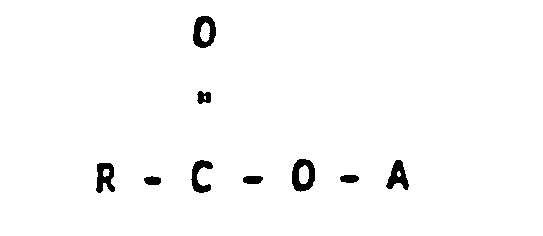
R bedeutet einen linearen oder verzweigten Alkylrest, der gesättigt oder ungesättigt sein kann.
R kann aus 1 bis 43, vorzugsweise aus 6 bis 23, insbesondere 8 bis 23 besonders bevorzugt 12 bis 23 C-Atomen aufgebaut sein. Die Ethoxylierungsprodukte können auch aus Gemischen von Fettsäuren oder Fettalkoholen unterschiedlicher Alkylreste bestehen.
A in den oben erwähnten Formeln bedeutet eine Kette von 1 bis 200, vorzugsweise 3 bis 50, insbesondere 4 bis 30, Ethylenozideinheiten. Weiterhin können bis zu 80 Äquivalente, vorzugsweise bis zu 50 Äquivalente an Ethylenoxideinheiten durch Propylenoxideinheiten ersetzt sein. Die Endgruppe der Alkylenoxideinheiten kann aus einer Hydroxylfunktion bestehen. Wahlweise kann deren O-Atom jedoch auch mit Alkyl-, Alkenyl- oder Aralkylgruppen verethert sein. - Die Erfindung wird anhand folgender Beispiele im einzelnen erläutert:
- Beispiel 1+1a nicht erfindungsgemäß Beispiel 1
- In einem 2l Dreihalskolben mit Rührer und N2-Zuleitung wurden 1 500 g Polywachs 6000 (Polyethylenglykol Lipoxol - Fa. Hüls; 0,5 Äquivalent) 1 h bei 80°C und 1 mbar Unterdruck entwässert. Danach wurde mit N2 belüftet, 67,2 g m-TMXDI (Fa. Cyanamid; 0,55 Äquivalent) zugegeben und bei 170°C in N-Atmosphäre N2 gerührt. Nach 5 h betrug der NCO-Gehalt 0,06 %. Es wurde heiß abgefüllt.
- Schmelzviskosität: 61 Pa•s (175°C, Epprecht)
- Viskosität (40 %ige wäßrige Lösung): 17 000 mPa•s (Sp. 7, Brookfield),
- spez. Viskosität (1%)ige wäßrige Lösung): 0,9 (Ostwald)
- In einem 1 l Dreihalskolben mit Rührer und N2-Zuleitung wurden 620 g Polywachs 6000 (Polyethylenglykol Lipoxol - Fa. Hüls; 1 Äquivalent) 1 h bei 80°C und 1 mbar Unterdruck entwässert. Danach wurde mit N2 belüftet, 26,4 g m-TMXDI (Fa. Cyanamid; 1,08 Äquivalente) zugegeben und homogenisiert. Die Substanz wurde dann in eine Weißblechdose umgefüllt und bei 145°C getempert. Nach 2 h betrug der NCO-Gehalt 0,1 %. Es wurde heiß abgefüllt.
- Schmelzviskosität: 105 Pas (175°C, Epprecht),
- Viskosität (40 % wäßrige Lösung): 33 000 mPas,
- spez. Viskosität (1 % wäßrige Lösung): 1,1 (Ostwald).
- Analog zu Beispiel 1 wurden in einem 500 ml Kolben 240 g Polywachs 6000 (0,08 Äquivalent) und 20 g Voranol P 2000 (Polypropylenglykol der Fa. Dow; 0,02 Äquivalent) entwässert. Zugabe von 12,46 g m-TMXDI (0,102 Äquivalent). Nach 5 h betrug der NCO-Gehalt 0,08 %.
- Schmelzviskosität: 25 Pa•s (175 °C, Epprecht)
- Viskosität (40 %ige wäßrige Lösung): 300 000 mPa•s (Sp. 7, Brookfield), spez. Viskosität (1 %ige wäßrige
- Lösung): 0,8 (Ostwald).
- Analog zu Beispiel 1 wurden in einem 1 l Kolben
450 g Polywachs 6000 (0,15 Äquivalent) und 150 g Voranol P 2000 (0,15 Äquivalent) entwässert.
Nch 5 h betrug der NCO-Gehalt 0,12 %. - Schmelzviskosität: 6 bis 8 Pa•s (175 °C, Epprecht)
- Viskosität (20 %ige wäßrige Lösung): 600 mPa•s (Sp. 7, Brookfield)
- spez. Viskosität (1 %ige wäßrige Lösung): 0,6 (Ostwald).
- Analog zu Beispiel 1 wurden in einem 500 ml Kolben
240 g Polywachs 6000 (0,08 Äquivalent) u. 20 g PTHF 2000 (Polytetrahydrofuran der Fa. BASF; 0,02 Äquivalent) entwässert.
Nach 5 h betrug der NCO-Gehalt 0,06 %. - Schmelzviskosität: 21 Pa•s (175 °C, Epprecht)
- Viskosität (20 %ige wäßrige Lösung): 8 000 mPa•s (Sp. 7, Brookfield), spez. Viskosität (1 %ige wäßrige Lösung): 0,85 (Ostwald).
- Beispiele 5+6 nicht erfindungsgemäß
- Analog zu Beispiel 1 wurden in einem 500 ml Kolben 300,4 g Polydiol 600 (Polyethylenglykol - Fa. Hüls; 0,88 Äquivalente entwässert. Zugabe von 108,9 g m-TMXDI (1,01 Äquivalent).
Nach 5 Stunden betrug der NCO-Gehalt o,14 %. - Schmelzviskosität: 0,4 Pa•s (175°C, Epprecht).
- Viskosität (100 %ig): 600 000 mPa•s (Sp. 7, Brookfield), spez. Viskosität (1 %ige wäßrige Lösung, Ostwald): 0,2.
- Analog zu Beispiel 1 wurden in einem 500 ml Kolben 233,80 g Polywachs 12 000 (0,04 Äquivalent) entwässert. Zugabe von 5,1 g m-TMXDI (0,042 Äquivalent).
Nach 5 h betrug der NCO-Gehalt 0 %. - Schmelzviskosität: 20 Pa•s (175°C; Epprecht).
- Viskosität (40 %ige wäßrige Lösung): 4 600 mPa•s (Sp.7, Brookfield), spez. Viskosität (1 %ige wäßrige Lösung Ostwald): 1,7.
- Analog zu Beispiel 1 wurden in einem 500 ml Kolben 300 g Polywachs 6 000 (0,1 Äquivalent) und 20,2 g 1,12-Dodecandiol (Fa. Fluka; 0,2 Äquivalent) entwässert. Zugabe von 37,9 g m-TMXDI (0,31 Äquivalent). Nach 5 Stunden betrug der NCO-Gehalt 0,12 %.
- Schmelzviskosität: 40 Pa•s (175°C, Epprecht).
- Viskosität (4 %ige wäßrige Lösung): 20 000 mPa•s (Brookfield, Sp. 7), spez. Viskosität (1 %ige wäßrige Lösung, Ostwald): 0,5.
- Der Versuch wurde analog zu Beispiel 7 durchgeführt, wobei die Reaktionstemperatur bei 150°C lag.
- Viskosität (4 %ige wäßrige Lösung): 5 200 mP•s (Brookfield, Sp. 7).
- Beispiele 8 bis 11 nicht erfindungsgemäß
- Analog zu Beispiel 1 wurden in einem 500 ml Kolben 216 g PW 6000 (vorbehandelt mit Jonenaustauscher Lewatit SP 112 - Fa. Bayer; 0,073 Äquivalent) entwässert.
Zugabe von 9,8 m-TMXDI (0,08 Äquivalent).
Nach 24 Stunden betrug der NCO-Gehalt 0,1 %. - Schmelzviskosität: 2,4 Pa•s (175 °C, Epprecht).
- Viskosität (40 %ige wäßrige Lösung): 800 mPa•s (Sp. 7; Brookfield), spez. Viskosität (1 %ige wäßrige Lösung; Ostwald): 0,5.
- Analog zu Beispiel 1 wurden in einem 500 ml Kolben 190,8 g PW 6000 (vorbehandelt mit Tonsil standard; 0,071 Äqu) entwässert.
Zugabe von 7,7 g Trimethylhexamethylendiisocyanat (Fa. Hüls; 0,074 Äquivalente).
Nach 4 Stunden betrug der NCO-Gehalt 0 %. - Schmelzviskosität: > 64 Pa•s (175°C, Epprecht).
- Viskosität (20 %ige wäßrige Lösung): 3 000 mPa•s (Sp. 7, Brookfield), spez. Viskosität (1 %ige wäßrige Lösung; Ostwald): 2,2.
- Analog zu Beispiel 1 wurden in einem 500 ml Kolben 300 g PW 6000 (0,1 Aquivalent) und 18,35 g Hexadecandiol-1,2 (0,14 Äquivalent) entwässert.
Zugabe von 30,55 g m-TMXDI (0,25 Äquivalent).
Nach 4 Stunden betrug der NCO-Gehalt 0 %. - Schmelzviskosität: 1 Pa•s (175°C; Epprecht).
- Viskosität (20 %ige wäßrige Lösung): 65 000 mPa•s (Sp. 7, Brookfield), spez. Viskosität (1 %ige wäßrige Lösung, Ostwald): 0,6.
- Analog zu Beispiel 1 wurden in einem 500 ml Kolben 133,55 g PW 6000 (vorbehandelt mit Tonsil standard; 0,05 Äquivalent) entwässert. Zugabe von 6,7 g m-TMXDI (0,055 Äquivalent).
Nach 6 Stunden betrug der NCO-Gehalt 0,2 %.
Zugabe von 0,7 g Diphenylmethandiamin (0,007 Äquivalent).
Nach 1 Stunde betrug der NCO-Gehalt 0 %. - Schmelzviskosität: 56 Pa•s (175°C; Epprecht).
- Viskosität (20 %ige wäßrige Lösung): 400 mPa•s (Sp. 7, Brookfield), spez. Viskosität (1 %ige wäßrige Lösung, Ostwald): 1,1.
- Bei den Beispielen 12 und 13 handelt es sich um PEG/PPG-Beispiele zum Beweis der Löslichkeitsgrenze von PPG (Beispiel 12 noch löslich, Beispiel 13 unlöslich in Wasser). Löslichkeitsgrenze ~ 60 % PEG, 40 % PPG.
- Analog zu Beispiel 1 wurden in einem 1 l Kolben 390 g Polywachs 6000 (0,13 Äquivalent) und 220 g Voranol P 2000 (0,22 Äquivalent) entwässert. Zugabe von 44,6 g m-TMXDI (0,365 Äquivalent).
Nach 5 Stunden betrug der NCO-Gehalt 0,2 %. - Schmelzviskosität < 1 Pa•s (175°C; Epprecht).
- Viskosität (30 %ige wäßrige Lösung): 5 000 mPa•s (Sp. 7, Brookfield), spez. Viskosität (1 %ige wäßrige Lösung; Ostwald): 0,4.
- Analog zu Beispiel 1 wurden in einem 500 ml Kolben 150 g Polywachs 6000 (0,05 Äquivalent) und 130 g Voranol P 2000 (0,13 Äquivalent) entwässert. Zugabe von 22,85 g m-TMXDI (0,187 Äquivalent).
Nach 8 Stunden betrug der NCO-Gehalt 0,2 %. - Schmelzviskosität < 1 Pa•s (175 °C; Epprecht).
- Beispiele 14 + 15 nicht erfindungsgemäß.
- Analog zu Beispiel 1 wurden in eins 500 ml Kolben 300 g Polywachs 6000 (0,1 Äquivalent) und 18,9 g Dimerdiol (0,07 Äquivalent) entwässert. Zugabe von 22,0 g m-TMXDI (0,18 Äquivalent).
Nach 5 Stunden betrug der NCO-Gehalt 0,094 %. - Schmelzviskosität: 32 Pa•s (175 °C; Epprecht).
- Viskosität (5 %ige wäßrige Lösung): 40 000 mPa•s (Sp. 7, Brookfield), spez. Viskosität (1 %ige wäßrige Lösung, Ostwald): 2,3.
- Analog zu Beispiel 1 wurden in einem 5 l Kolben 1772 g Polywachs 6000 (0,6 Äquiv.), 137 g 1,12-Octadecandiol (0,84 Äquiv.) entwässert.
Zugabe von 183 g m-TMXDI (1,5 Äquiv.).
In Abwandlung zu Beispiel 1 wurde die Reaktion bei einer Temperatur von 150 °C durchgeführt, Versuchsdauer 4,5 Std., - Schmelzviskosität 27,5 Pas (175°C, Epprecht),
- spez. Viskosität: 1,1,
- Viskosität (3 %ige wäßrige Lösung): 16000 mPas. Beispiele B I. bis III. nicht erfindungsgemäß.
- Geprüft wurde die Zugscherfestigkeit von Holz-Holz-Verklebungen nach DIN 53283:
Beispiel 1 6,8 N/mm2 Beispiel 2 4,6 N/mm2 Beispiel 3 2,8 N/mm2 Beispiel 4 6,6 N/mm2 - Geprüft wurde die Zugscherfestigkeit von Holz/Holz-Verklebungen nach DIN 53283:
Beispiel 1 8,3 N/mm2 2 5,3 N/mm2 3 5,0 N/mm2 4 7,8 N/mm2 6 5,8 N/mm2 7 7,5 N/mm2 11b 8,9 N/mm2 - Eine 5 %ige Lösung (Beispiel 7; Viskosität: 25 000 mPa•s, Sp.7, Brookfield) wurde auf Papier aufgetragen und mit Gipskarton bzw. Gipsputz verklebt. Nach dem Trocknen war eine so feste Verbindung zwischen Papier und Untergrund gegeben, daß bei Schälversuchen Papierausriß auftrat.
-
- a) Homopolymerisation von Vinylacetat unter Verwendung des Polyurethans nach Beispiel 1 und des Emulgators Nonylphenol x 10 EO.
In einem Reaktionsgefäß, das mit Rührer, Thermometer, zwei Zutropfgefäßen sowie einem Rückflußkühler versehen ist, wurden in 850 g entsalztem Wasser 10 g eines Umsetzungsproduktes von p-Alkylphenol (mit 6 bis 15 C-Atomen im Alkylrest) und 6,5 bis 30 Mol Ethylenoxid, 2 g Natriumhydrogencarbonat und 100 g eines Umsetzungsproduktes aus Polyethylenglykol und Isocyanat bei Temperaturen > 80 °C gelöst. Zu dieser Lösung wird bei 80°C eine Lösung aus 0,5 g Natriumformaldehydsulfoxylat in 50 g entsalztem Wasser gegeben. Im Zutropfgefäß A werden 887 g Vinylacetat Monomer bereitgestellt. Im Zutropfgefäß B werden eine Mischung aus 0,5 g t-Butylhydroperoxid und 100 g entsalzenem Wasser bereitgestellt.
Bei Temperaturen zwischen 75 und 80°C wird mit der kontinuierlichen Dosierung aus den Zutropfgefäßen A und B begonnen. Nach Einsetzen der Polymerisation wird die kontinuierliche Dosierung aus A und B so gesteuert, daß sich eine Reaktionstemperatur von 80 bis 85°C einstellt. Die Reaktionsdauer beträgt ca. 3,5 bis 4 Stunden. - b) Copolymerdispersion unter Verwendung des Polyurethans nach Beispiel 1 und des Emulgators Nonylphenol x 10 EO.
In einem Reaktionsgefäß (wie unter a beschrieben) werden in 849 g entsalztem Wasser 40 g eines Umsetzungsproduktes von p-Alkylphenol (mit 6 bis 15C-Atomen im Alkylrest) und 6,5 bis 30 Mol Ethylenoxid und 150 g eines Umetzungsproduktes aus Polyethylenglykol und Isocyanat bei Temperaturen > 80°C gelöst. Zu dieser Lösung wird bei 80°C eine Lösung aus 1,5 g Natriumformaldehydsulfoxylat in 50 g entsalztem Wasser gegeben. Im Zutropfgefäß A werden 539 g Vinylacetat Monomer und 270 g Maleinsäuredibutylester gemischt und bereitgestellt. Im Zutropfgefäß B werden eine Mischung aus 0,5 g t-Butylhydroperoxid und 100 g entsalztem Wassr bereitgestellt. Bei einer Temperatur zwischen 75 und 80°C wird mit den kontinuierlichen Dosierungen aus den Zutropfgefäßen A und B begonnen. Nach Einsetzen der Polymerisation wird die kontinuierliche Dosierung so gesteuert, daß sich eine Reaktionstemperatur von 80 bis 85°C einstellt. Die Reaktionsdauer beträgt ca. 3,5 bis 4 Stunden. - In beiden Fällen resultierten stabile koagulatfreie Dispersionen mit einer Teilchengröße von 660 nm. Die Dispersionen ergeben relativ weiche gut wasserfeste Filme.
- Die verdickende Wirkung der erfindungsgemäßen Polyurethane sowie das Zusammenwirken mit Salzen und mit nichtionischen Tensiden wird durch folgende Beispiele veranschaulicht.
Tabelle 1: Verwendung der erfindungsgemäßen Polyurethane als Verdickungsmittel: Viskosität (Brookfield, 22 °C) in Pas als Funktion der Polymerkonzentration Lfd. Nr. Ausgangsprodukte für das PU Konzentration des PU In Wasser Polyethylenglykol hydrophobes Diol Isocyanat Äquivalentsverhältnis in Gew.-% 5 4 3 2 1 1 . PEG 6000 1,12-C12-Diol TMXDI 1 : 2 : 3,1 a) ohne NaCL-Zusatz standfest 24000 5000 200 100 b) mit 1 Gew.-% an NaCl standfest 17000 200 c) mit 5 Gew.-% an NaCl standfest 13000 200 d) mit 20 Gew.-% an NaCl standfest 100 e) ohne NaCl-Zusatz standfest 52000 11000 300 200 2. PEG 6000 PPG 2000 TMXDI 0,5 : 0,5 : 1,02 a) mit 5 Gew.-% an NaCl 40000 (auch nach 2 Wochen) b) mit 25 Gew.-% an NaCl 2000 Fortsetzung Tabelle 1 siehe nächste Seite Fortsetzung Tabelle 1 Lfd. Nr. Ausgangsprodukte für das PU Konzentration des PU in Wasser Polyethylenglykol hydrophobes Diol Isocyanat Äquivalentsverhältnis in Gew.-% 5 4 3 2 1 3. PEG 6000 PTHF 2000 TMXDI 0,7 0,3 : 1,02 a) mit 5 Gew.-% an NaCl 43000 (35000 nach 2 Wochen) b) mit 20 Gew.-% an NaCl 26000 4. PEG 6000 1,12-C12-Diol TMXDI 1 : 2,5 : 2,6 a) ohne Tensid-Zusatz als 3%ige Lösung 800 b) mit Dehydol LT7 in Gewichtsverhältnis 7 : 3 (PU : Dehydol) 11000 als 3 %ige Lösung mit 2,1 Gew.-% an PU c) mit Dehydol LT7 in Gewichtsverhältnis 6 : 4 (PU : Dehydol) als 4 %ige Lösung mit 2,4 Gew.-% an PU 52000 - PPG: Polypropylenglykol,
- PTHF: Polytetrahydrofuran.
- Dehydol LT 7: Umsetzungsprodukt von 1 Mol C12-18-Fettalkohol mit 7 Molen Ethylenoxid,
- Das Beispiel 1e) wurde im Unterschied zu den Beispielen 1a) bis 1d) bei 145 in 4 Stunden hergestellt.
Claims (10)
- Verwendung eines hydrophilen hochmolekularen nichtionischen wasserlöslichen Polyurethans mit einer spezifischen Viskosität von mindestens 0,4 (1 %ige wässrige Lösung bei 20 °C) in einem wässrigen System als Stabilisator bei der Emulsionspolymerisation oder als Verdickungsmittel, wobei das Polyurethan die folgenden Struktureinheiten aufweist:a) -O(-CH2-CH2-O)n-,
wobei n = 8 bis 500 ist und wobei sich die Einheit -O(-CH2-CH2-O)n- von als Diole eingesetzten Polyethyleglykolen ableitet,b) -CO-NH-X-NH-CO-,
wobei sich die Gruppe -CO-NH-X-NH-CO- von einem Diisocyanat ableitet und X ein aliphatischer, alicyclischer oder aromatischer Rest ist, undc) -O-Y-O-,
wobei sich die Gruppe -O-Y-O- von einem Diol ableitet, das ausgewählt ist aus:c1) ethergruppenhaltigen hydrophoben Diolen mit Molgewichten von 250 bis 6000, ausgewählt aus: Polypropylenglykol, Polybutylenglykol, Polytetrahydrofuran, Polybutadiendiol,c2) 1,10-Decandiol, 1,12-Dodecandiol, 2-Buten-1,4-diol, 2-Butin-1,4-diol, wobei c) von 2 bis 40 Gew.-%, bezogen auf a) + c) im Polyurethan ausmacht. - Verwendung nach Anspruch 1, gekennzeichnet durch eine Wasserlöslichkeit des Polyurethans in jedem Mischungsverhältnis bei 20 °C, insbesondere durch eine Wasserlöslichkeit von mindestens 70 Gew.-%, bezogen auf die Lösung.
- Verwendung nach Anspruch 1 oder 2, gekennzeichnet durch ein Polyurethan mit einem Molekulargewicht, das durch eine spezifische Viskosität von 0,5 bis 6,0, insbesondere 0,7 bis 4,0, gekennzeichnet ist (1 %ige wässrige Lösung bei 20 °C).
- Verwendung nach mindestens einem der Ansprüche 1, 2 oder 3, gekennzeichnet durch ein Polyurethan mit einer Schmelzviskosität von mehr als 3, vorzugsweise mehr als 5 und insbesondere mehr als 10 Pas bei 175 °C nach Epprecht.
- Verwendung nach mindestens einem der Ansprüche 1 bis 4, gekennzeichnet durch ein Polyurethan mit einem Kristallisationsgrad von 20 bis 80, insbesondere von 30 bis 65 %, bezogen auf den Kristallisationsgrad von Polyethylenglykol, speziell käufliches Polyethylenglykol 6 000.
- Verwendung nach mindestens einem der Ansprüche 1 bis 5 in Form einer wässrigen Lösung von 1 bis 40, insbesondere von 2 bis 30 Gew. -% des Polyurethans.
- Verwendung des Polyurethans nach mindestens einem der Ansprüche 1 bis 6 als Stabilisator bei der Emulsionspolymerisation von Vinylacetat und Vinylchlorid sowie bei der Copolymerisation von Ethylen und Vinylacetat.
- Verwendung des Polyurethans nach mindestens einem der Ansprüche 1 bis 6 als Verdickungsmittel für wässrige Systeme zusammen mit nichtionischen Tensiden.
- Verwendung nach mindestens einem der Ansprüche 1 bis 8, dadurch gekennzeichnet, dass in des Struktureinheit a) n = 20 bis 300 ist.
- Verwendung nach mindestens einem der Ansprüche 1 bis 9, dadurch gekennzeichnet, dass c) 5 bis 25 Gew.-%, bezogen auf a) +c) im Polyurethan ausmacht.
Applications Claiming Priority (3)
| Application Number | Priority Date | Filing Date | Title |
|---|---|---|---|
| DE4242687 | 1992-12-17 | ||
| DE4242687A DE4242687B8 (de) | 1992-12-17 | 1992-12-17 | Hydrophile Polyurethane |
| EP94903768A EP0674675B1 (de) | 1992-12-17 | 1993-12-14 | Hydrophile polyurethane |
Related Parent Applications (2)
| Application Number | Title | Priority Date | Filing Date |
|---|---|---|---|
| EP94903768A Division EP0674675B1 (de) | 1992-12-17 | 1993-12-14 | Hydrophile polyurethane |
| EP94903768.3 Division | 1994-06-23 |
Publications (2)
| Publication Number | Publication Date |
|---|---|
| EP0839832A1 EP0839832A1 (de) | 1998-05-06 |
| EP0839832B1 true EP0839832B1 (de) | 2009-06-17 |
Family
ID=6475588
Family Applications (3)
| Application Number | Title | Priority Date | Filing Date |
|---|---|---|---|
| EP94903768A Expired - Lifetime EP0674675B1 (de) | 1992-12-17 | 1993-12-14 | Hydrophile polyurethane |
| EP98100770A Expired - Lifetime EP0839832B1 (de) | 1992-12-17 | 1993-12-14 | Verwendung eines hydrophilen Polyurethans in wässrigen Systemen |
| EP98100769A Expired - Lifetime EP0838511B1 (de) | 1992-12-17 | 1993-12-14 | Verwendung eines hydrophilen Polyurethans |
Family Applications Before (1)
| Application Number | Title | Priority Date | Filing Date |
|---|---|---|---|
| EP94903768A Expired - Lifetime EP0674675B1 (de) | 1992-12-17 | 1993-12-14 | Hydrophile polyurethane |
Family Applications After (1)
| Application Number | Title | Priority Date | Filing Date |
|---|---|---|---|
| EP98100769A Expired - Lifetime EP0838511B1 (de) | 1992-12-17 | 1993-12-14 | Verwendung eines hydrophilen Polyurethans |
Country Status (10)
| Country | Link |
|---|---|
| US (3) | US6399735B1 (de) |
| EP (3) | EP0674675B1 (de) |
| JP (1) | JPH08504459A (de) |
| KR (1) | KR100296784B1 (de) |
| AT (3) | ATE434002T1 (de) |
| CA (1) | CA2152164C (de) |
| DE (4) | DE4242687B8 (de) |
| DK (1) | DK0674675T3 (de) |
| ES (3) | ES2119158T3 (de) |
| WO (1) | WO1994013726A1 (de) |
Families Citing this family (47)
| Publication number | Priority date | Publication date | Assignee | Title |
|---|---|---|---|---|
| DE4242687B8 (de) * | 1992-12-17 | 2006-01-12 | Henkel Kgaa | Hydrophile Polyurethane |
| DE19508856A1 (de) | 1995-03-11 | 1996-09-12 | Henkel Kgaa | Schutzkolloide |
| DE19519391A1 (de) * | 1995-05-26 | 1996-11-28 | Henkel Kgaa | Klebeverfahren |
| EP0828801B1 (de) * | 1995-05-26 | 2004-10-27 | Henkel Kommanditgesellschaft auf Aktien | Klebeverfahren |
| DE19524250C2 (de) * | 1995-07-04 | 1997-12-18 | Beiersdorf Ag | Verwendung von blockierungsmittelfreien Isocyanaten zur chemisch/thermischen Vernetzung von Acrylat-Schmelzhaftklebern sowie entsprechende Acrylatschmelzhaftkleber |
| DE19607036A1 (de) * | 1996-02-24 | 1997-08-28 | Henkel Kgaa | Feste, haftende und geschmeidig abreibende Masse |
| WO1997031046A1 (de) * | 1996-02-24 | 1997-08-28 | Henkel Kommanditgesellschaft Auf Aktien | Feste, haftende und geschmeidig abreibende masse |
| US5977236A (en) * | 1997-04-18 | 1999-11-02 | Air Products And Chemicals, Inc. | Polymers prepared in the presence of colloidal polyurethane dispersions |
| DE59807989D1 (de) * | 1997-09-24 | 2003-05-22 | Henkel Kgaa | Polyurethan-klebstoff |
| US20020132129A1 (en) * | 1998-01-30 | 2002-09-19 | Rajeev Farwaha | Water-resistant adhesive based on a vinyl acetate emulsion polymer containing a nonionic polymurethane |
| US6218455B1 (en) | 1999-05-19 | 2001-04-17 | Air Products Polymers, L.P. | Vinyl acetate/ethylene paint latices stabilized with urethane linked poly(ethylene glycols) and polyoxyethylene-polyoxyalkylene glycols |
| US6642304B1 (en) * | 2000-02-25 | 2003-11-04 | 3M Innovative Properties Company | Polyurethane-based adhesives, systems for such adhesives, articles therefrom, and methods of making |
| US6518359B1 (en) | 2000-02-25 | 2003-02-11 | 3M Innovative Properties Co. | Polyurethane-based pressure-sensitive adhesives, systems for such adhesives, articles therefrom, and methods of making |
| US20040013810A1 (en) * | 2000-10-07 | 2004-01-22 | Rainer Hoefer | Coating compositions |
| DE10049654A1 (de) * | 2000-10-07 | 2002-04-11 | Cognis Deutschland Gmbh | Beschichtungszusammensetzungen |
| DE10119141A1 (de) | 2001-04-19 | 2002-10-24 | Cognis Deutschland Gmbh | Wäßrige Beschichtungszusammensetzungen auf Basis selbst-dispergierender Epoxidharze |
| DE10119127A1 (de) | 2001-04-19 | 2002-10-24 | Cognis Deutschland Gmbh | Wäßrige Beschichtungszusammensetzungen auf Basis von Epoxidharzen |
| JP4567334B2 (ja) * | 2001-10-22 | 2010-10-20 | ヘンケル・アクチェンゲゼルシャフト・ウント・コムパニー・コマンディットゲゼルシャフト・アウフ・アクチェン | 綿活性汚れ除去性ウレタン系ポリマー |
| US20030118658A1 (en) * | 2001-12-21 | 2003-06-26 | Trogolo Jeffrey A. | High aspect ratio encapsulated inorganic antimicrobial additive for controlled release |
| US7357949B2 (en) * | 2001-12-21 | 2008-04-15 | Agion Technologies Inc. | Encapsulated inorganic antimicrobial additive for controlled release |
| GB0222522D0 (en) | 2002-09-27 | 2002-11-06 | Controlled Therapeutics Sct | Water-swellable polymers |
| US20040072953A1 (en) * | 2002-10-15 | 2004-04-15 | Ju-Ming Hung | Reactive hot melt adhesive with non-polymeric aliphatic difunctionals |
| WO2004083274A1 (en) * | 2003-03-13 | 2004-09-30 | Stepan Company | Polyester polyols for polyurethane adhesives |
| US8664330B2 (en) * | 2003-04-04 | 2014-03-04 | Henkel US IP LLC | Reactive hot melt adhesive with improved hydrolysis resistance |
| JP4524564B2 (ja) * | 2004-01-07 | 2010-08-18 | 信越化学工業株式会社 | 壁紙用糊剤 |
| GB0417401D0 (en) | 2004-08-05 | 2004-09-08 | Controlled Therapeutics Sct | Stabilised prostaglandin composition |
| CA2589849A1 (en) * | 2004-12-10 | 2006-06-15 | Mitsui Chemicals Polyurethanes, Inc. | Aqueous polyurethane resin, method for producing aqueous polyurethane resin and film |
| US7566744B2 (en) * | 2004-12-20 | 2009-07-28 | Nalco Company | Environmentally friendly demulsifiers for crude oil emulsions |
| DE102005003122A1 (de) * | 2005-01-21 | 2006-07-27 | Henkel Kgaa | Antiadhäsive Polymere zur Verhinderung der Adhäsion von Mikroorganismen an Textilien und zur Verhinderung von Wäschegeruch |
| DE102005023050A1 (de) * | 2005-05-13 | 2006-11-16 | Henkel Kgaa | Wässrige, lagerstabile Emulsion α-silyl terminierter Polymere, deren Herstellung und Verwendung |
| CN101258204A (zh) * | 2005-09-07 | 2008-09-03 | 伊莱门蒂斯专业有限公司 | 含有用以减少由着色剂添加而引起粘性损失的添加剂的改进涂料组合物 |
| TWI310049B (en) * | 2005-09-27 | 2009-05-21 | Taiwan Textile Res Inst | A weather-resistive resin coating material and its manufacturing method |
| GB0613333D0 (en) | 2006-07-05 | 2006-08-16 | Controlled Therapeutics Sct | Hydrophilic polyurethane compositions |
| GB0613638D0 (en) | 2006-07-08 | 2006-08-16 | Controlled Therapeutics Sct | Polyurethane elastomers |
| GB0620685D0 (en) * | 2006-10-18 | 2006-11-29 | Controlled Therapeutics Sct | Bioresorbable polymers |
| US20090088516A1 (en) * | 2007-10-01 | 2009-04-02 | Chunzhao Li | Method to improve the color acceptance of viscosity stabilized latex paints |
| WO2009079578A1 (en) * | 2007-12-17 | 2009-06-25 | Elements Specialties, Inc. | Low voc waterbased coatings with efflorescence resistance |
| PL2238211T3 (pl) * | 2008-01-28 | 2011-12-30 | Upm Raflatac Oy | Etykieta i sposób mocowania etykiety do elementu |
| JP5634012B2 (ja) * | 2008-02-27 | 2014-12-03 | 株式会社Adeka | 水系ポリウレタン樹脂組成物及びそれを塗布してなる被塗物 |
| DE102008001808A1 (de) | 2008-05-15 | 2009-11-19 | Evonik Degussa Gmbh | Beschichtungszusammensetzung |
| US9340458B2 (en) | 2013-05-30 | 2016-05-17 | Laticrete International, Inc. | Premixed hybrid grout |
| US10072217B2 (en) | 2015-03-04 | 2018-09-11 | Ecolab Usa Inc. | Reverse emulsion breaker polymers |
| US9914882B2 (en) | 2015-03-06 | 2018-03-13 | Ecolab Usa Inc. | Reverse emulsion breaker polymers |
| KR101905957B1 (ko) * | 2016-06-21 | 2018-10-08 | 박희대 | 점착 기능을 가지는 폴리우레탄 핫멜트 필름의 제조방법 |
| WO2018009370A1 (en) * | 2016-07-05 | 2018-01-11 | Rohm And Haas Company | Compositions comprising polyether-urethane-urea additives for block resistance and open time |
| KR102781797B1 (ko) * | 2019-08-08 | 2025-03-18 | 비와이케이-케미 게엠베하 | 온도 적응성 레올로지 프로파일을 위한 첨가제 |
| CN111303378A (zh) * | 2020-03-06 | 2020-06-19 | 长春工业大学 | 一种基于tmxdi的聚氨酯类抗流挂树脂及其制备方法 |
Family Cites Families (16)
| Publication number | Priority date | Publication date | Assignee | Title |
|---|---|---|---|---|
| US2948691A (en) * | 1951-05-10 | 1960-08-09 | Mobay Chemical Corp | High molecular weight polyether urethane polymers |
| DE1127082B (de) | 1959-02-26 | 1962-04-05 | Hoechst Ag | Verfahren zur Herstellung von hochmolekularen wasserloeslichen oder wasserquellbaren Polyaetherurethanen |
| FR1279244A (fr) | 1959-04-23 | 1961-12-22 | Deering Milliken Res Corp | Nouveaux polymères de polyoxyalkylène glycols et de diisocyanates et emploi de ces produits en particulier dans l'encollage des fils textiles |
| GB1156784A (en) | 1965-08-24 | 1969-07-02 | Ici Ltd | Treatment of Shaped Articles |
| US3539482A (en) * | 1967-09-20 | 1970-11-10 | Goodrich Co B F | Soluble poly(etherurethane)s |
| US3660010A (en) * | 1969-12-17 | 1972-05-02 | Nat Starch Chem Corp | Treating textiles with soil release agents |
| US3970395A (en) * | 1975-07-02 | 1976-07-20 | Flint Theodore R | Hot-melt adhesive with self-melting capability |
| US4155892A (en) | 1975-10-03 | 1979-05-22 | Rohm And Haas Company | Polyurethane thickeners for aqueous compositions |
| JPS6047316B2 (ja) | 1977-06-06 | 1985-10-21 | 大日本インキ化学工業株式会社 | ホツトメルト接着布 |
| US4442259A (en) * | 1982-04-26 | 1984-04-10 | W. R. Grace & Co. | Aqueous-based polyurethane compositions and method of preparation |
| US4496708A (en) * | 1983-12-14 | 1985-01-29 | Union Carbide Corporation | Water-soluble polyurethane comb polymer production |
| DE3806066A1 (de) * | 1988-02-26 | 1989-09-07 | Bayer Ag | Verfahren zur herstellung von waessrigen polymerisatdispersionen, die so erhaeltlichen dispersionen und ihre verwendung zur herstellung von beschichtungen |
| EP0497404A1 (de) | 1991-01-25 | 1992-08-05 | Dsm N.V. | Auf Alkylenoxid-Einheiten basierendes internes Emulgiermittel-System |
| US5319055A (en) | 1991-10-18 | 1994-06-07 | Rohm And Haas Company | Non-aqueous thickening agents |
| DE4137247A1 (de) | 1991-11-13 | 1993-05-19 | Henkel Kgaa | Verdickungsmittel auf polyurethanbasis |
| DE4242687B8 (de) * | 1992-12-17 | 2006-01-12 | Henkel Kgaa | Hydrophile Polyurethane |
-
1992
- 1992-12-17 DE DE4242687A patent/DE4242687B8/de not_active Expired - Fee Related
-
1993
- 1993-12-14 CA CA002152164A patent/CA2152164C/en not_active Expired - Fee Related
- 1993-12-14 DE DE59310395T patent/DE59310395D1/de not_active Expired - Lifetime
- 1993-12-14 EP EP94903768A patent/EP0674675B1/de not_active Expired - Lifetime
- 1993-12-14 DE DE59308830T patent/DE59308830D1/de not_active Expired - Lifetime
- 1993-12-14 AT AT98100770T patent/ATE434002T1/de not_active IP Right Cessation
- 1993-12-14 ES ES94903768T patent/ES2119158T3/es not_active Expired - Lifetime
- 1993-12-14 AT AT98100769T patent/ATE385250T1/de active
- 1993-12-14 JP JP6513794A patent/JPH08504459A/ja active Pending
- 1993-12-14 EP EP98100770A patent/EP0839832B1/de not_active Expired - Lifetime
- 1993-12-14 DE DE59814366T patent/DE59814366D1/de not_active Expired - Lifetime
- 1993-12-14 EP EP98100769A patent/EP0838511B1/de not_active Expired - Lifetime
- 1993-12-14 ES ES98100770T patent/ES2326195T3/es not_active Expired - Lifetime
- 1993-12-14 US US08/448,543 patent/US6399735B1/en not_active Expired - Lifetime
- 1993-12-14 KR KR1019950702503A patent/KR100296784B1/ko not_active Expired - Fee Related
- 1993-12-14 DK DK94903768T patent/DK0674675T3/da active
- 1993-12-14 AT AT94903768T patent/ATE169040T1/de not_active IP Right Cessation
- 1993-12-14 ES ES98100769T patent/ES2301184T3/es not_active Expired - Lifetime
- 1993-12-14 WO PCT/EP1993/003526 patent/WO1994013726A1/de not_active Ceased
-
2002
- 2002-05-24 US US10/155,510 patent/US6943230B2/en not_active Expired - Fee Related
- 2002-05-24 US US10/154,547 patent/US6806341B2/en not_active Expired - Lifetime
Also Published As
| Publication number | Publication date |
|---|---|
| DE4242687B4 (de) | 2005-09-22 |
| ATE434002T1 (de) | 2009-07-15 |
| EP0838511A1 (de) | 1998-04-29 |
| DE59308830D1 (de) | 1998-09-03 |
| US20030032759A1 (en) | 2003-02-13 |
| US6943230B2 (en) | 2005-09-13 |
| US6399735B1 (en) | 2002-06-04 |
| EP0839832A1 (de) | 1998-05-06 |
| EP0674675B1 (de) | 1998-07-29 |
| DE4242687A1 (de) | 1994-06-23 |
| ES2301184T3 (es) | 2008-06-16 |
| JPH08504459A (ja) | 1996-05-14 |
| DK0674675T3 (da) | 1999-05-03 |
| DE4242687B8 (de) | 2006-01-12 |
| ATE169040T1 (de) | 1998-08-15 |
| CA2152164A1 (en) | 1994-06-23 |
| ES2119158T3 (es) | 1998-10-01 |
| CA2152164C (en) | 2005-10-11 |
| US20030045668A1 (en) | 2003-03-06 |
| ES2326195T3 (es) | 2009-10-02 |
| KR100296784B1 (ko) | 2001-10-24 |
| WO1994013726A1 (de) | 1994-06-23 |
| DE59310395D1 (de) | 2008-03-20 |
| KR950704390A (ko) | 1995-11-20 |
| ATE385250T1 (de) | 2008-02-15 |
| EP0838511B1 (de) | 2008-01-30 |
| US6806341B2 (en) | 2004-10-19 |
| EP0674675A1 (de) | 1995-10-04 |
| DE59814366D1 (de) | 2009-07-30 |
Similar Documents
| Publication | Publication Date | Title |
|---|---|---|
| EP0838511B1 (de) | Verwendung eines hydrophilen Polyurethans | |
| EP0526472B1 (de) | Haushaltsalleskleber auf polyurethanbasis | |
| DE69319731T3 (de) | Wässrige polyurethan-dispersionen | |
| DE69809078T2 (de) | Wässrige polymerdispersionen | |
| EP0061628B1 (de) | Verwendung von in Wasser dispergierbaren Polyisocyanat-Zubereitungen als Zusatzmittel für wässrige Klebstoffe | |
| EP1879936B1 (de) | Wässrige, lagerstabile emulsion alpha-silyl terminierter polymere, deren herstellung und verwendung | |
| DE60115478T2 (de) | Bei niedriger Temperatur wärmeaktivierte Klebstoffe mit hoher Wärmebeständigkeit | |
| DE2141807A1 (de) | Beständiger Polymerisatlatex und Verfahren zur Herstellung desselben | |
| EP3497164A1 (de) | Blockierte polyurethan-schlagzähigkeitsmodifikatoren zur verbesserung der schlagzähigkeit einkomponentiger tieftemperaturhärtender epoxidklebstoffe | |
| EP0354471A1 (de) | Verwendung von wässrigen Polyurethan-Dispersionen als Haushaltsalleskleber sowie deren Herstellung | |
| DE3877109T2 (de) | Waessrige polymerzusammensetzungen. | |
| WO1997019122A1 (de) | Einkomponenten-polyurethan-reaktionsklebstoff | |
| EP0506697B1 (de) | Haushaltsalleskleber auf polyurethanbasis | |
| EP3303438B1 (de) | Vinyl-terminierte prepolymere mit niedriger viskosität und guter wasserlöslichkeit | |
| EP0815152B1 (de) | Schutzkolloide | |
| JP4698049B2 (ja) | 水性接着剤 | |
| DE19745800A1 (de) | Hydrophile Polyurethan-Klebstoffe | |
| JPS6112956B2 (de) | ||
| WO2018029313A1 (de) | Verfahren zur herstellung blockierter polyurethan-schlagzähigkeitsmodifikatoren zur verbesserung der schlagzähigkeit einkomponentiger epoxidklebstoffe |
Legal Events
| Date | Code | Title | Description |
|---|---|---|---|
| PUAI | Public reference made under article 153(3) epc to a published international application that has entered the european phase |
Free format text: ORIGINAL CODE: 0009012 |
|
| 17P | Request for examination filed |
Effective date: 19980117 |
|
| AC | Divisional application: reference to earlier application |
Ref document number: 674675 Country of ref document: EP |
|
| AK | Designated contracting states |
Kind code of ref document: A1 Designated state(s): AT BE CH DE DK ES FR GB GR IT LI NL PT SE |
|
| RIN1 | Information on inventor provided before grant (corrected) |
Inventor name: FEUSTEL, DIETER, DR. DIPL.-CHEM. Inventor name: HELFTERKAMP, BERNHARD, DIPL.-CHEM.-ING. Inventor name: SCHOETTMER, BERNHARD, DR. DIPL.-CHEM. Inventor name: HALLER, WERNER, DR. DIPL.-CHEM. Inventor name: ONUSSEIT, HERMANN, DR. DIPL.-ING. Inventor name: MOELLER, THOMAS, DR. DIPL.-CHEM. Inventor name: EMMERLING, WINFRIED, DR. DIPL.-CHEM. Inventor name: FISCHER, HERBERT, DR. DIPL.-CHEM. |
|
| 17Q | First examination report despatched |
Effective date: 20031128 |
|
| APBN | Date of receipt of notice of appeal recorded |
Free format text: ORIGINAL CODE: EPIDOSNNOA2E |
|
| APBR | Date of receipt of statement of grounds of appeal recorded |
Free format text: ORIGINAL CODE: EPIDOSNNOA3E |
|
| APAF | Appeal reference modified |
Free format text: ORIGINAL CODE: EPIDOSCREFNE |
|
| APBT | Appeal procedure closed |
Free format text: ORIGINAL CODE: EPIDOSNNOA9E |
|
| 17Q | First examination report despatched |
Effective date: 20031128 |
|
| GRAP | Despatch of communication of intention to grant a patent |
Free format text: ORIGINAL CODE: EPIDOSNIGR1 |
|
| RIN1 | Information on inventor provided before grant (corrected) |
Inventor name: HUEBNER, NORBERT, DR. DIPL.-CHEM. Inventor name: BUESCHING, HARTMUT Inventor name: FRIEDRICH, KLAUS, DR. DIPL.-CHEM. Inventor name: FEUSTEL, DIETER, DR. DIPL.-CHEM. Inventor name: HELFTERKAMP, BERNHARD, DIPL.-CHEM.-ING. Inventor name: SCHOETTMER, BERNHARD, DR. DIPL.-CHEM. Inventor name: HALLER, WERNER, DR. DIPL.-CHEM. Inventor name: ONUSSEIT, HERMANN, DR. DIPL.-ING. Inventor name: MOELLER, THOMAS, DR. DIPL.-CHEM. Inventor name: EMMERLING, WINFRIED, DR. DIPL.-CHEM. Inventor name: FISCHER, HERBERT, DR. DIPL.-CHEM. |
|
| RAP1 | Party data changed (applicant data changed or rights of an application transferred) |
Owner name: HENKEL AG & CO. KGAA |
|
| GRAS | Grant fee paid |
Free format text: ORIGINAL CODE: EPIDOSNIGR3 |
|
| GRAA | (expected) grant |
Free format text: ORIGINAL CODE: 0009210 |
|
| AC | Divisional application: reference to earlier application |
Ref document number: 0674675 Country of ref document: EP Kind code of ref document: P |
|
| AK | Designated contracting states |
Kind code of ref document: B1 Designated state(s): AT BE CH DE DK ES FR GB GR IT LI NL PT SE |
|
| REG | Reference to a national code |
Ref country code: GB Ref legal event code: FG4D Free format text: NOT ENGLISH |
|
| REG | Reference to a national code |
Ref country code: CH Ref legal event code: EP |
|
| REF | Corresponds to: |
Ref document number: 59814366 Country of ref document: DE Date of ref document: 20090730 Kind code of ref document: P |
|
| REG | Reference to a national code |
Ref country code: ES Ref legal event code: FG2A Ref document number: 2326195 Country of ref document: ES Kind code of ref document: T3 |
|
| PG25 | Lapsed in a contracting state [announced via postgrant information from national office to epo] |
Ref country code: SE Free format text: LAPSE BECAUSE OF FAILURE TO SUBMIT A TRANSLATION OF THE DESCRIPTION OR TO PAY THE FEE WITHIN THE PRESCRIBED TIME-LIMIT Effective date: 20090917 |
|
| NLV1 | Nl: lapsed or annulled due to failure to fulfill the requirements of art. 29p and 29m of the patents act | ||
| PG25 | Lapsed in a contracting state [announced via postgrant information from national office to epo] |
Ref country code: NL Free format text: LAPSE BECAUSE OF FAILURE TO SUBMIT A TRANSLATION OF THE DESCRIPTION OR TO PAY THE FEE WITHIN THE PRESCRIBED TIME-LIMIT Effective date: 20090617 |
|
| PG25 | Lapsed in a contracting state [announced via postgrant information from national office to epo] |
Ref country code: PT Free format text: LAPSE BECAUSE OF FAILURE TO SUBMIT A TRANSLATION OF THE DESCRIPTION OR TO PAY THE FEE WITHIN THE PRESCRIBED TIME-LIMIT Effective date: 20091017 |
|
| PLBE | No opposition filed within time limit |
Free format text: ORIGINAL CODE: 0009261 |
|
| STAA | Information on the status of an ep patent application or granted ep patent |
Free format text: STATUS: NO OPPOSITION FILED WITHIN TIME LIMIT |
|
| PG25 | Lapsed in a contracting state [announced via postgrant information from national office to epo] |
Ref country code: DK Free format text: LAPSE BECAUSE OF FAILURE TO SUBMIT A TRANSLATION OF THE DESCRIPTION OR TO PAY THE FEE WITHIN THE PRESCRIBED TIME-LIMIT Effective date: 20090617 |
|
| 26N | No opposition filed |
Effective date: 20100318 |
|
| BERE | Be: lapsed |
Owner name: HENKEL A.G. & CO. KGAA Effective date: 20091231 |
|
| PG25 | Lapsed in a contracting state [announced via postgrant information from national office to epo] |
Ref country code: GR Free format text: LAPSE BECAUSE OF FAILURE TO SUBMIT A TRANSLATION OF THE DESCRIPTION OR TO PAY THE FEE WITHIN THE PRESCRIBED TIME-LIMIT Effective date: 20090918 Ref country code: BE Free format text: LAPSE BECAUSE OF NON-PAYMENT OF DUE FEES Effective date: 20091231 |
|
| PG25 | Lapsed in a contracting state [announced via postgrant information from national office to epo] |
Ref country code: AT Free format text: LAPSE BECAUSE OF NON-PAYMENT OF DUE FEES Effective date: 20091214 |
|
| PGFP | Annual fee paid to national office [announced via postgrant information from national office to epo] |
Ref country code: DE Payment date: 20121213 Year of fee payment: 20 Ref country code: CH Payment date: 20121213 Year of fee payment: 20 |
|
| PGFP | Annual fee paid to national office [announced via postgrant information from national office to epo] |
Ref country code: GB Payment date: 20121212 Year of fee payment: 20 Ref country code: ES Payment date: 20121227 Year of fee payment: 20 Ref country code: IT Payment date: 20121215 Year of fee payment: 20 |
|
| PGFP | Annual fee paid to national office [announced via postgrant information from national office to epo] |
Ref country code: FR Payment date: 20130107 Year of fee payment: 20 |
|
| REG | Reference to a national code |
Ref country code: DE Ref legal event code: R071 Ref document number: 59814366 Country of ref document: DE |
|
| REG | Reference to a national code |
Ref country code: CH Ref legal event code: PL |
|
| REG | Reference to a national code |
Ref country code: GB Ref legal event code: PE20 Expiry date: 20131213 |
|
| PG25 | Lapsed in a contracting state [announced via postgrant information from national office to epo] |
Ref country code: DE Free format text: LAPSE BECAUSE OF EXPIRATION OF PROTECTION Effective date: 20131217 Ref country code: GB Free format text: LAPSE BECAUSE OF EXPIRATION OF PROTECTION Effective date: 20131213 |
|
| REG | Reference to a national code |
Ref country code: ES Ref legal event code: FD2A Effective date: 20140925 |
|
| PG25 | Lapsed in a contracting state [announced via postgrant information from national office to epo] |
Ref country code: ES Free format text: LAPSE BECAUSE OF EXPIRATION OF PROTECTION Effective date: 20131215 |