EP0839211B1 - Verfahren zur herstellung von riboflavin mittels mikroorganismen mit veränderter isocitratlyase-aktivität - Google Patents
Verfahren zur herstellung von riboflavin mittels mikroorganismen mit veränderter isocitratlyase-aktivität Download PDFInfo
- Publication number
- EP0839211B1 EP0839211B1 EP96926334A EP96926334A EP0839211B1 EP 0839211 B1 EP0839211 B1 EP 0839211B1 EP 96926334 A EP96926334 A EP 96926334A EP 96926334 A EP96926334 A EP 96926334A EP 0839211 B1 EP0839211 B1 EP 0839211B1
- Authority
- EP
- European Patent Office
- Prior art keywords
- icl
- gene
- riboflavin
- microorganisms
- activity
- Prior art date
- Legal status (The legal status is an assumption and is not a legal conclusion. Google has not performed a legal analysis and makes no representation as to the accuracy of the status listed.)
- Expired - Lifetime
Links
Images


Classifications
-
- C—CHEMISTRY; METALLURGY
- C07—ORGANIC CHEMISTRY
- C07D—HETEROCYCLIC COMPOUNDS
- C07D475/00—Heterocyclic compounds containing pteridine ring systems
- C07D475/12—Heterocyclic compounds containing pteridine ring systems containing pteridine ring systems condensed with carbocyclic rings or ring systems
- C07D475/14—Benz [g] pteridines, e.g. riboflavin
-
- A—HUMAN NECESSITIES
- A23—FOODS OR FOODSTUFFS; TREATMENT THEREOF, NOT COVERED BY OTHER CLASSES
- A23K—FODDER
- A23K20/00—Accessory food factors for animal feeding-stuffs
- A23K20/10—Organic substances
- A23K20/174—Vitamins
-
- C—CHEMISTRY; METALLURGY
- C12—BIOCHEMISTRY; BEER; SPIRITS; WINE; VINEGAR; MICROBIOLOGY; ENZYMOLOGY; MUTATION OR GENETIC ENGINEERING
- C12P—FERMENTATION OR ENZYME-USING PROCESSES TO SYNTHESISE A DESIRED CHEMICAL COMPOUND OR COMPOSITION OR TO SEPARATE OPTICAL ISOMERS FROM A RACEMIC MIXTURE
- C12P25/00—Preparation of compounds containing alloxazine or isoalloxazine nucleus, e.g. riboflavin
Definitions
- the present invention relates to a method for manufacturing of riboflavin using microorganisms with altered isocitrate lyase activity.
- Vitamin B 2 also called riboflavin, is essential for humans and animals. With vitamin B 2 deficiency, inflammation of the mouth and throat mucous membranes, cracks in the corners of the mouth, itching and inflammation in the skin folds and the like occur. Skin damage, conjunctivitis, decreased visual acuity and clouding of the cornea. In babies and children growth stagnation and weight loss can occur. Vitamin B 2 is therefore of economic importance, particularly as a vitamin preparation for vitamin deficiency and as a feed additive. In addition, it is also used as a food coloring, for example in mayonnaise, ice cream, pudding, etc.
- Riboflavin is produced either chemically or microbial. In the chemical manufacturing process, this is Riboflavin usually in a multi-stage process as a pure end product won, with relatively expensive raw materials - such as D-Ribose - must be used.
- riboflavin by fermentation of fungi such as Ashbya gossypii or Eremothecium ashbyii is known (The Merck Index, Windholz et al., Eds. Merck & Co., page 1183, 1983); but also yeasts, such as Candida or Saccharomyces, and bacteria, such as Clostridium, are suitable for riboflavin production.
- Riboflavin overproducing bacterial strains are described, for example, in EP 405370 , the strains being obtained from Bacillus subtilis by transforming the riboflavin biosynthesis genes.
- these prokaryotic genes are unsuitable for a recombinant riboflavin production process using eukaryotes such as Saccharomyces cerevisiae or Ashbya gossypii.
- WO 93/03183 the cloning is for riboflavin biosynthesis specific genes from the eukaryotic organism Saccharomyces cerevisiae. Using these genes recombinant eukaryotic microorganisms are constructed, which allow efficient riboflavin production.
- the starting products and substrates of the riboflavin biosynthesis enzymes are often located limited in the microorganism Amount before, so that despite increasing the riboflavin biosynthesis - Activity achieved no increase in riboflavin production becomes.
- the object is achieved in that the used Microorganisms change their endogenous isocitrate lyase activity The change is compared to the unchanged Determine parent strain. There are a variety of Possibilities of such microorganisms with changed ICL activity to obtain.
- One way is to change the endogenous ICL gene so that it is for an enzyme with compared to the parent enzyme encoded increased ICL activity.
- An increase in enzyme activity can be achieved, for example, by changing the catalytic center an increased substrate turnover takes place or by canceling the action of enzyme inhibitors. Can too an increased enzyme activity by increasing the enzyme synthesis, for example by gene amplification or by switching off Factors that repress enzyme synthesis become.
- the endogenous ICL activity is preferably by mutation of the endogenous ICL gene increased. Such mutations can either generated undirected using classic methods, such as by UV radiation or mutation-inducing Chemicals or specifically using genetic engineering methods such as Deletions, insertions or substitutions.
- ICL gene expression is achieved by increasing the ICL gene copy number and / or by strengthening regulatory factors that affect the Affect ICL gene expression positively, increased. So can a reinforcement regulatory elements preferably at the transcriptional level done by strong transcription signals such as Promoters and enhancers are used. But there is also an increase in the translation possible, for example by the stability of the m-RNA is improved.
- the ICL gene is converted into a gene construct or into a vector built-in, which is preferably assigned to the ICL gene contains regulatory gene sequences, especially those that Enhance gene expression. It then produces a riboflavin Microorganism with the gene construct containing the ICL gene transformed.
- the ICL gene is preferably made up of microorganisms, in particular from the mushroom Ashbya gossypii, isolated. For the isolation of the Gens also come from all other organisms, the cells of which anaplerotic sequence of the glyoxylate cycle and thus the isocitrate lyase included, including plants.
- the insulation can be complemented by homologous or heterologous a mutant defective in the ICL gene or also due to heterologous Probing or PCR with heterologous primers. For subcloning can then insert the complementing plasmid by suitable cuts with restriction enzymes in the size can be minimized. After sequencing and identification The putative gene is precisely subcloned by fusion PCR. Plasmids, which are the fragments thus obtained as Insert are inserted into the ICL gene-defective mutant, that is tested for functionality of the ICL gene. Functional Constructs eventually transform a riboflavin producer used.
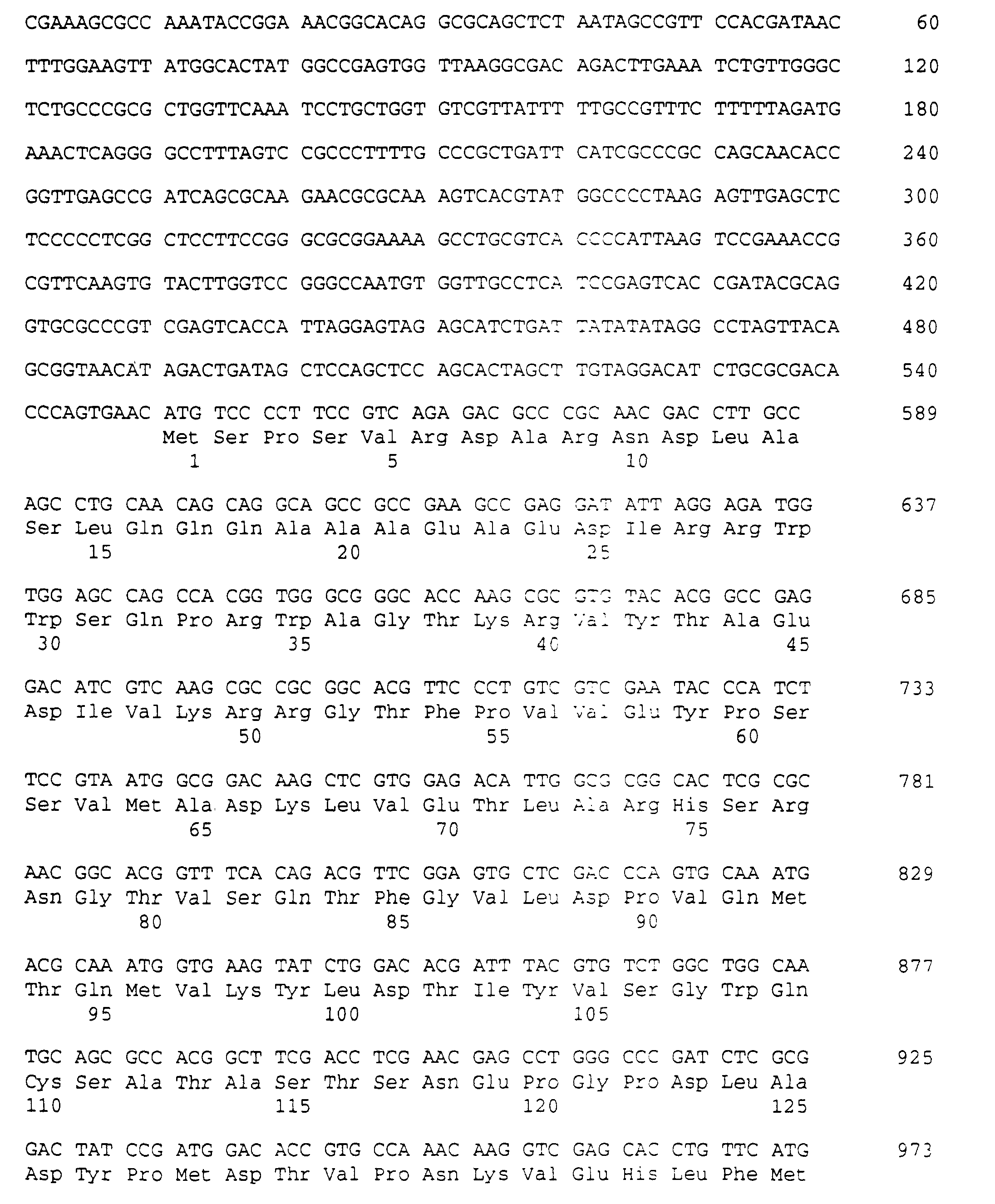
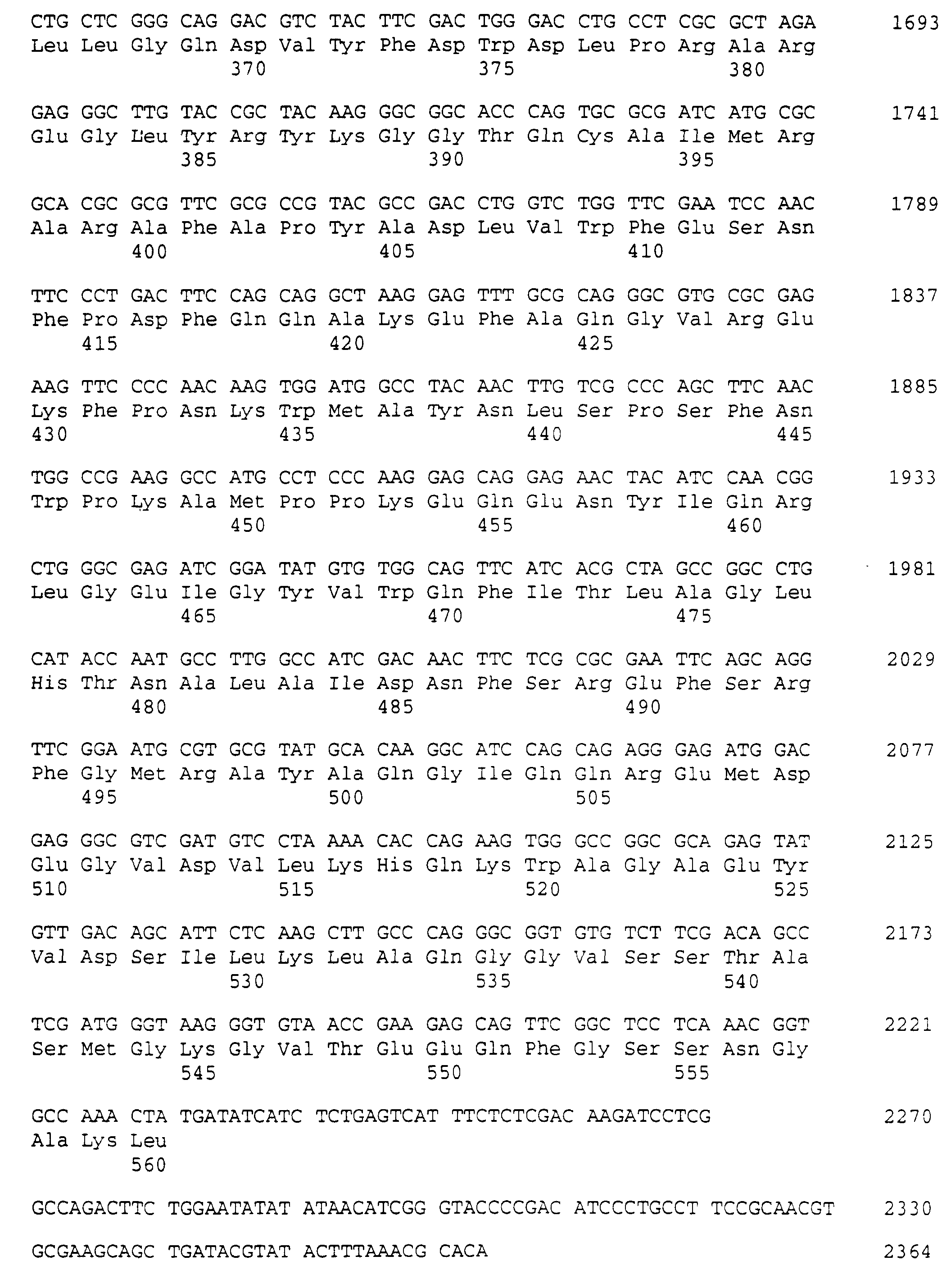
- isocitrate lyase genes with nucleotide sequences available for the specified in SEQ ID NO: 2 Encode amino acid sequence or its allelic variations. Allele variations include, in particular, functional derivatives that by deleting, inserting or substituting nucleotides of the sequence shown in SEQ ID NO: 1, wherein the ICL activity is retained.
- the isocitrate lyase genes is a promoter in particular Nucleotide sequence of nucleotide 176 to 550 according to SEQ ID NO: 1 or preceded by an essentially equivalent DNA sequence. So for example, the gene can be preceded by a promoter which differs from the promoter with the specified nucleotide sequence one or more nucleotide exchanges, by insertion (s) and / or deletion (s), but without the functionality or effectiveness of the promoter is impaired. Furthermore the promoter can also be changed by changing its sequence Effectiveness increased or completely replaced by more effective promoters become.
- regulatory gene sequences or Regulatory genes can be assigned, in particular the ICL gene activity increase.
- the ICL gene can "enhancers" can be associated with an improved interaction an increased ICL gene expression between RNA polymerase and DNA cause.
- the isocitrate lyase gene with or without an upstream promoter or with or without regulator gene one or more DNA sequences be upstream and / or downstream, so that the gene in a gene structure is included.
- plasmids or vectors which contain the ICL gene and - as mentioned above - are suitable for transforming a riboflavin producer.
- the cells obtainable by transformation which are: preferably transformed cells from Ashbya gossypii, contain the gene in replicable form, i.e. in additional Copies on the chromosome, the gene copies by homologous Recombination can be integrated anywhere in the genome, and / or on a plasmid or vector.
- ICL isocitrate lyase
- Riboflavin producing microorganism strains are now in Cultivated in the presence of such inhibitors surprisingly shows that riboflavin formation is inhibited. This manifests itself on culture plates in the formation of colonies that are not yellow become, but remain white. With this system there are therefore tribes easily recognizable, resistant to isocitrate lyase inhibition are such strains even in the presence of inhibitor riboflavin form and therefore form yellow colored colonies.
- Such Strains can arise either by spontaneous mutation or by corresponding mutations through common methods, such as can be induced chemically or by UV radiation. It microorganism strains can thus be obtained, the one excrete increased proportion of riboflavin in the culture medium. As a resistant strain with increased riboflavin formation, in particular Ashbya deposited with the DSM under number 10067 Obtained gossypii strain.
- Suitable mushrooms are, for example those listed in Indian Chem Engr. Section B. Vol 37, No 1.2 (1995) on page 15, table 6.
- microorganisms other than fungi can also be used, for example Bacteria, especially those found in Indian Chem Engr. Section B. Vol 37, No 1,2 (1995) on page 16, Table 6 are used.
- chromosomal DNA was isolated using the method of Wright and Philippsen (1991, Gene 109: 99-105). The DNA was partially digested with Sau 3A and fractionated with a sucrose density gradient. The largest fragments ( Figure 4) were ligated with Bam HI cut E.coli, S.cerevisiae shuttle vector YEp 352 (JE Hill et al., 1993, Yeast 2: 163-167). E.coli DH5 a was transformed with this ligation approach. 3600 colonies were isolated from plates with ampicillin and X-Gal, which were recognizable by their white color as clones with an insert-carrying plasmid.
- the yeast Saccharomyces cerevisiae ICL1d ura3 (fs) (E. Fernández et al., 1992, Eur. J. Biochem. 204: 983-990).
- This mutant is in ICL1 gene disrupted and has a mutation in the ura3 gene Reading frame.
- This genotype causes the strain not to appear Ethanol can grow as a carbon source and uracil auxotrophy shows.
- the plasmid was isolated again from one of the two clones Es contained an insert of about 8 kb. Another transformation of the Saccharomyces. Mutant led to the complementation of all found Clones. The 8 kb fragment could be reduced to 2.9 kb by Sph I, that were fully functional shorten.
- PCR with primers derived from tryptic peptides of the ICL resulted strong signals of the expected size.
- a protein was isolated using electrophoresis gel, using trypsin broken down into peptides and sequenced by Edmann degradation. The comparison the peptide sequences with databases gave an identity of over 70% with the isocitrate lyase from Saccharomyces cerevisiae. Primers derived from this were used for PCR. From the approximately 8 kb large complementary gene bank 3.3 kb sequenced (Sanger et al. Proc. Natl. Acad. Sci. USA 74 (1977) 5463-5467). On the determined sequence we were able to Database comparison two coding areas can be found.
- On Reading frame of 1680 bases shows a 65% identity to the ICL1 gene from Saccharomyces cerevisiae.
- the ICL gene is 375 bases upstream from a sequence that has 84% identity shows a Ser tRNA from Saccharomyces cerevisiae (SEQ ID NO: 1).
- the A. gossypii pAG 100.8 strain produced in a medium that was supplemented by 3 g / l glycine, 65 ⁇ 5.6 mg / l riboflavin within three days.
- the control strain A.gossypii pAG 100 made a direct comparison only 29.9 ⁇ 1.8 mg / l riboflavin ( Figure 8). Neither in the specific Activity of isocitrate lyase still in mycelial dry weight significant differences were measurable.
- ICL Isocitrate Lyase
- the purified enzyme can be used in a colorimetric Test (Dixon, H. and Kornberg, H.L. (1959), Biochem. J. 72, 3: Assay methods for key enzymes of the glyoxylate cycle) influences of substances to measure activity.
- Table 2 and Figure 1 are the effects of the substances tested on the enzyme summarized or represented.
- substances were examined, which as metabolites in the fungal cell inhibit Ef might have on the enzyme. Among them showed 6-P gluconate and phosphoenolpyruvate the clearest inhibitory effects with over 50% at a concentration of 10 mM. Looked a lot better however itaconate and oxalate, which are believed not to be metabolic of the mushroom. Already a concentration of 1 mmol resulted in 78% and 95% inhibition, respectively.
Landscapes
- Chemical & Material Sciences (AREA)
- Organic Chemistry (AREA)
- Life Sciences & Earth Sciences (AREA)
- Zoology (AREA)
- Engineering & Computer Science (AREA)
- Wood Science & Technology (AREA)
- Polymers & Plastics (AREA)
- Microbiology (AREA)
- General Health & Medical Sciences (AREA)
- General Chemical & Material Sciences (AREA)
- Biotechnology (AREA)
- Genetics & Genomics (AREA)
- Chemical Kinetics & Catalysis (AREA)
- Health & Medical Sciences (AREA)
- Biochemistry (AREA)
- Bioinformatics & Cheminformatics (AREA)
- General Engineering & Computer Science (AREA)
- Animal Husbandry (AREA)
- Food Science & Technology (AREA)
- Preparation Of Compounds By Using Micro-Organisms (AREA)
- Micro-Organisms Or Cultivation Processes Thereof (AREA)
- Enzymes And Modification Thereof (AREA)
Description
- (A) NAME: Forschungszentrum Juelich GmbH
- (B) STRASSE: Leo-Brandt-Strasse
- (C) ORT: Juelich
- (E) LAND: Germany
- (F) POSTLEITZAHL: D-52425
- (G) TELEPHON: 02461-61 3004



Claims (11)
- Verfahren zur mikrobiellen Herstellung von Riboflavin durch Kultivierung von Riboflavin produzierenden Mikroorganismen in einem Nährmedium und anschließender Isolierung des hergestellten Riboflavins, dadurch gekennzeichnet, daß Mikroorganismen verwendet werden, bei denen die endogene Isocitratlyase (ICL) Aktivität verändert wurde.
- Verfahren nach Anspruch 1, dadurch gekennzeichnet, daß die Mikroorganismen durch Mutation des endogenen ICL-Gens ein Enzym mit höherer ICL-Aktivität aufweisen.
- Verfahren nach Anspruch 1, dadurch gekennzeichnet, daß die Mikroorganismen durch eine Erhöhung der ICL-Genkopienzahl eine höhere ICL-Genexpression besitzen.
- Verfahren nach Anspruch 1, dadurch gekennzeichnet, daß das ICL-Gen mit regulatorischen DNA-Sequenzen funktionell verknüpft wurde, die eine verstärkte Genexpression des ICL-Gens erlauben.
- Verfahren nach Anspruch 1, dadurch gekennzeichnet, daß Mikroorganismen mit Resistenz gegenüber auf ICL hemmend wirkenden Substanzen verwendet werden.
- Verfahren nach Anspruch 5, dadurch gekennzeichnet, daß die Mikroorganismen resistent gegenüber den Stoffen Itakonat oder Oxalat sind.
- Verfahren nach einem der Ansprüche 1 bis 6, dadurch gekennzeichnet, daß als Mikroorganismus ein Pilz verwendet wird.
- Verfahren nach Anspruch 7, dadurch gekennzeichnet, daß der Pilz aus der Gattung Ashbya verwendet wird.
- ICL-Gen codierend für die in SEQ ID NO: 2 dargestellte Aminosäureseauenz.
- Genkonstrukt enthaltend ein ICL-Gen gemäß Anspruch 9.
- Genkonstrukt nach Anspruch 10, dadurch gekennzeichnet, daß das ICL-Gen funktionell mit einem oder mehreren Regulationssignalen zur Erhöhung der Genexpression funktionell verknüpft wurde.
Applications Claiming Priority (5)
| Application Number | Priority Date | Filing Date | Title |
|---|---|---|---|
| DE19525281A DE19525281C1 (de) | 1995-07-13 | 1995-07-13 | Verfahren zur Herstellung von Riboflavin mittels resistenter Mikroorganismen |
| DE19525281 | 1995-07-13 | ||
| DE19545468 | 1995-12-06 | ||
| DE1995145468 DE19545468A1 (de) | 1995-12-06 | 1995-12-06 | Verfahren zur Herstellung von Riboflavin mittels Mikroorganismen mit erhöhter Isocitratlyase-Aktivität |
| PCT/EP1996/003009 WO1997003208A1 (de) | 1995-07-13 | 1996-07-10 | Verfahren zur herstellung von riboflavin mittels mikroorganismen mit veränderter isocitratlyase-aktivität |
Publications (2)
| Publication Number | Publication Date |
|---|---|
| EP0839211A1 EP0839211A1 (de) | 1998-05-06 |
| EP0839211B1 true EP0839211B1 (de) | 2001-06-06 |
Family
ID=26016719
Family Applications (1)
| Application Number | Title | Priority Date | Filing Date |
|---|---|---|---|
| EP96926334A Expired - Lifetime EP0839211B1 (de) | 1995-07-13 | 1996-07-10 | Verfahren zur herstellung von riboflavin mittels mikroorganismen mit veränderter isocitratlyase-aktivität |
Country Status (12)
| Country | Link |
|---|---|
| US (1) | US5976844A (de) |
| EP (1) | EP0839211B1 (de) |
| JP (1) | JPH11509409A (de) |
| KR (1) | KR100414490B1 (de) |
| CN (1) | CN1110569C (de) |
| AT (1) | ATE201908T1 (de) |
| CA (1) | CA2223877A1 (de) |
| DE (1) | DE59607050D1 (de) |
| DK (1) | DK0839211T3 (de) |
| ES (1) | ES2160829T3 (de) |
| PT (1) | PT839211E (de) |
| WO (1) | WO1997003208A1 (de) |
Families Citing this family (10)
| Publication number | Priority date | Publication date | Assignee | Title |
|---|---|---|---|---|
| DE19840709A1 (de) * | 1997-12-22 | 1999-06-24 | Forschungszentrum Juelich Gmbh | Ein- oder mehrzellige Organismen zur Herstellung von Riboflavin |
| DE19801120A1 (de) | 1998-01-15 | 1999-07-22 | Basf Ag | Orotidin-5'-Phosphatdecarboxylase-Gen, Genkonstrukt enthaltend dieses Gen und seine Verwendung |
| US6387694B1 (en) * | 1998-04-03 | 2002-05-14 | Albert Einstein College Of Medicine Of Yeshiva University | Mycobacterial isocitrate lyase gene and uses thereof |
| DE19823834A1 (de) * | 1998-05-28 | 1999-12-02 | Basf Ag | Genetisches Verfahren zur Herstellung von Riboflavin |
| DE19839567A1 (de) * | 1998-08-31 | 2000-03-09 | Basf Ag | Organismen zur extrazellulären Herstellung von Riboflavin |
| IT1306141B1 (it) * | 1999-05-17 | 2001-05-30 | Giampiero Valletta | Composizione per il trattamento del prurito uremico e di forme diprurito non riconducibili a lesioni organiche. |
| DE19937548A1 (de) * | 1999-08-09 | 2001-03-29 | Forschungszentrum Juelich Gmbh | Ein- oder mehrzellige Organismen zur Herstellung von Riboflavin |
| KR100422307B1 (ko) * | 2002-12-05 | 2004-03-10 | 씨제이 주식회사 | 리보플라빈을 생산하는 미생물 및 이를 이용한리보플라빈의 생산방법 |
| DE102010014680A1 (de) | 2009-11-18 | 2011-08-18 | Evonik Degussa GmbH, 45128 | Zellen, Nukleinsäuren, Enzyme und deren Verwendung sowie Verfahren zur Herstellung von Sophorolipiden |
| DE102010015807A1 (de) | 2010-04-20 | 2011-10-20 | Evonik Degussa Gmbh | Biokatalytisches Oxidationsverfahren mit alkL-Genprodukt |
Family Cites Families (3)
| Publication number | Priority date | Publication date | Assignee | Title |
|---|---|---|---|---|
| CN1066486C (zh) * | 1989-06-22 | 2001-05-30 | 霍夫曼-拉罗奇有限公司 | 高产核黄素的细菌菌株 |
| AU1278192A (en) * | 1991-08-02 | 1993-03-02 | Transkaryotic Therapies, Inc. | Library screening method |
| EP0751995B1 (de) * | 1994-03-25 | 2004-02-18 | Basf Aktiengesellschaft | Riboflavin-biosynthesis in fungi |
-
1996
- 1996-07-10 DK DK96926334T patent/DK0839211T3/da active
- 1996-07-10 AT AT96926334T patent/ATE201908T1/de not_active IP Right Cessation
- 1996-07-10 DE DE59607050T patent/DE59607050D1/de not_active Expired - Fee Related
- 1996-07-10 CN CN96195479A patent/CN1110569C/zh not_active Expired - Fee Related
- 1996-07-10 CA CA002223877A patent/CA2223877A1/en not_active Abandoned
- 1996-07-10 WO PCT/EP1996/003009 patent/WO1997003208A1/de not_active Ceased
- 1996-07-10 JP JP9505501A patent/JPH11509409A/ja not_active Ceased
- 1996-07-10 EP EP96926334A patent/EP0839211B1/de not_active Expired - Lifetime
- 1996-07-10 PT PT96926334T patent/PT839211E/pt unknown
- 1996-07-10 KR KR10-1998-0700242A patent/KR100414490B1/ko not_active Expired - Fee Related
- 1996-07-10 ES ES96926334T patent/ES2160829T3/es not_active Expired - Lifetime
- 1996-07-10 US US08/981,690 patent/US5976844A/en not_active Expired - Fee Related
Also Published As
| Publication number | Publication date |
|---|---|
| PT839211E (pt) | 2001-10-30 |
| CA2223877A1 (en) | 1997-01-30 |
| CN1110569C (zh) | 2003-06-04 |
| KR100414490B1 (ko) | 2004-04-30 |
| WO1997003208A1 (de) | 1997-01-30 |
| ES2160829T3 (es) | 2001-11-16 |
| US5976844A (en) | 1999-11-02 |
| JPH11509409A (ja) | 1999-08-24 |
| EP0839211A1 (de) | 1998-05-06 |
| ATE201908T1 (de) | 2001-06-15 |
| DE59607050D1 (de) | 2001-07-12 |
| CN1193356A (zh) | 1998-09-16 |
| KR19990028940A (ko) | 1999-04-15 |
| DK0839211T3 (da) | 2001-09-03 |
Similar Documents
| Publication | Publication Date | Title |
|---|---|---|
| EP0751995B1 (de) | Riboflavin-biosynthesis in fungi | |
| DE69532603T2 (de) | Hefestämme und modifizierte albumine | |
| DE112014000710B4 (de) | Bakterienstamm mit hoher Ausbeute an 5-Aminolävulinsäure, Herstellungsverfahren und Verwendungen dafür | |
| DE69033616T3 (de) | Riboflavin überproduzierende Bakterienstämme | |
| DE69133066T2 (de) | Verfahren zur Expression heterologischer Gene in der Hefe Pichia Pastoris, Expressionsverfahren und transformierte Mikroorganismen | |
| EP0069697A2 (de) | Herstellung und Anwendung von Plasmiden mit Genen für die Biosynthese von L-Prolin | |
| DD212982A5 (de) | Verfahren zur herstellung von rinder-wachstumshormon-aehnlichen polypeptiden | |
| EP0839211A1 (de) | Verfahren zur herstellung von riboflavin mittels mikroorganismen mit veränderter isocitratlyase-aktivität | |
| EP0668917B1 (de) | Riboflavin-synthese in hefen | |
| DE68913846T3 (de) | Expressionssystem. | |
| EP0722500B1 (de) | Gene für den butyrobetain/crotonobetain-l-carnitin-stoffwechsel und ihre verwendung zur mikrobiologischen herstellung von l-carnitin | |
| WO1998029538A2 (de) | Gen für adenylatzyklase und seine verwendung | |
| CH640268A5 (en) | Process for the preparation of filamentous hybrid phages, novel hybrid phages and their use | |
| DE69011183T2 (de) | Hefestämme für die Herstellung von heterologen reifen Proteinen, besonders von Hirudin. | |
| DE69033770T2 (de) | Dna-zusammensetzung und modifizierte hefe | |
| EP0536192B1 (de) | Neue promotorregion | |
| DE3878410T2 (de) | Verfahren zur erhoehung von gen-expression. | |
| EP0930367B1 (de) | Pilz der Gattung Ashbya zur Herstellung von Riboflavin | |
| EP0187138B1 (de) | Mikroorganismus und Plasmid für konstitutive Creatinamidino-hydrolase-Bildung sowie Verfahren zur Herstellung derselben | |
| DE69917294T2 (de) | Verfahren zur herstellung von heterologen polypeptiden in transformierten hefezellen | |
| DE69025081T2 (de) | DNS für Expression und Sekretion | |
| DE69231145T2 (de) | Für eine Esterase kodierendes Gen und dieses Gen enthaltender Mikroorganismus | |
| DE19545468A1 (de) | Verfahren zur Herstellung von Riboflavin mittels Mikroorganismen mit erhöhter Isocitratlyase-Aktivität | |
| DD226012A1 (de) | Verfahren zur herstellung von bacillus-beta-1,3-1,4-glucanase | |
| DE3851535T2 (de) | Mutanter Stamm von einem methylotrophen Organismus und Verfahren zur Herstellung eines Proteins in methylotrophen Organismus. |
Legal Events
| Date | Code | Title | Description |
|---|---|---|---|
| PUAI | Public reference made under article 153(3) epc to a published international application that has entered the european phase |
Free format text: ORIGINAL CODE: 0009012 |
|
| 17P | Request for examination filed |
Effective date: 19971204 |
|
| AK | Designated contracting states |
Kind code of ref document: A1 Designated state(s): AT BE CH DE DK ES FR GB IE IT LI NL PT SE |
|
| 17Q | First examination report despatched |
Effective date: 19991108 |
|
| GRAG | Despatch of communication of intention to grant |
Free format text: ORIGINAL CODE: EPIDOS AGRA |
|
| GRAG | Despatch of communication of intention to grant |
Free format text: ORIGINAL CODE: EPIDOS AGRA |
|
| GRAH | Despatch of communication of intention to grant a patent |
Free format text: ORIGINAL CODE: EPIDOS IGRA |
|
| GRAH | Despatch of communication of intention to grant a patent |
Free format text: ORIGINAL CODE: EPIDOS IGRA |
|
| GRAA | (expected) grant |
Free format text: ORIGINAL CODE: 0009210 |
|
| AK | Designated contracting states |
Kind code of ref document: B1 Designated state(s): AT BE CH DE DK ES FR GB IE IT LI NL PT SE |
|
| REF | Corresponds to: |
Ref document number: 201908 Country of ref document: AT Date of ref document: 20010615 Kind code of ref document: T |
|
| PGFP | Annual fee paid to national office [announced via postgrant information from national office to epo] |
Ref country code: SE Payment date: 20010628 Year of fee payment: 6 |
|
| PGFP | Annual fee paid to national office [announced via postgrant information from national office to epo] |
Ref country code: AT Payment date: 20010704 Year of fee payment: 6 |
|
| REF | Corresponds to: |
Ref document number: 59607050 Country of ref document: DE Date of ref document: 20010712 |
|
| PGFP | Annual fee paid to national office [announced via postgrant information from national office to epo] |
Ref country code: IE Payment date: 20010725 Year of fee payment: 6 |
|
| REG | Reference to a national code |
Ref country code: IE Ref legal event code: FG4D Free format text: GERMAN |
|
| PGFP | Annual fee paid to national office [announced via postgrant information from national office to epo] |
Ref country code: PT Payment date: 20010727 Year of fee payment: 6 |
|
| ITF | It: translation for a ep patent filed | ||
| PGFP | Annual fee paid to national office [announced via postgrant information from national office to epo] |
Ref country code: BE Payment date: 20010816 Year of fee payment: 6 |
|
| REG | Reference to a national code |
Ref country code: DK Ref legal event code: T3 |
|
| GBT | Gb: translation of ep patent filed (gb section 77(6)(a)/1977) |
Effective date: 20010820 |
|
| ET | Fr: translation filed | ||
| REG | Reference to a national code |
Ref country code: ES Ref legal event code: FG2A Ref document number: 2160829 Country of ref document: ES Kind code of ref document: T3 |
|
| REG | Reference to a national code |
Ref country code: GB Ref legal event code: IF02 |
|
| PLBE | No opposition filed within time limit |
Free format text: ORIGINAL CODE: 0009261 |
|
| STAA | Information on the status of an ep patent application or granted ep patent |
Free format text: STATUS: NO OPPOSITION FILED WITHIN TIME LIMIT |
|
| 26N | No opposition filed | ||
| PG25 | Lapsed in a contracting state [announced via postgrant information from national office to epo] |
Ref country code: IE Free format text: LAPSE BECAUSE OF NON-PAYMENT OF DUE FEES Effective date: 20020710 Ref country code: AT Free format text: LAPSE BECAUSE OF NON-PAYMENT OF DUE FEES Effective date: 20020710 |
|
| PG25 | Lapsed in a contracting state [announced via postgrant information from national office to epo] |
Ref country code: SE Free format text: LAPSE BECAUSE OF NON-PAYMENT OF DUE FEES Effective date: 20020711 |
|
| PG25 | Lapsed in a contracting state [announced via postgrant information from national office to epo] |
Ref country code: BE Free format text: LAPSE BECAUSE OF NON-PAYMENT OF DUE FEES Effective date: 20020731 |
|
| BERE | Be: lapsed |
Owner name: FORSCHUNGSZENTRUM *JULICH G.M.B.H. Effective date: 20020731 Owner name: *BASF A.G. Effective date: 20020731 |
|
| PG25 | Lapsed in a contracting state [announced via postgrant information from national office to epo] |
Ref country code: PT Free format text: LAPSE BECAUSE OF NON-PAYMENT OF DUE FEES Effective date: 20030131 |
|
| EUG | Se: european patent has lapsed | ||
| REG | Reference to a national code |
Ref country code: PT Ref legal event code: MM4A Free format text: LAPSE DUE TO NON-PAYMENT OF FEES Effective date: 20030131 |
|
| REG | Reference to a national code |
Ref country code: IE Ref legal event code: MM4A |
|
| PGFP | Annual fee paid to national office [announced via postgrant information from national office to epo] |
Ref country code: NL Payment date: 20040704 Year of fee payment: 9 |
|
| PGFP | Annual fee paid to national office [announced via postgrant information from national office to epo] |
Ref country code: GB Payment date: 20040707 Year of fee payment: 9 |
|
| PGFP | Annual fee paid to national office [announced via postgrant information from national office to epo] |
Ref country code: FR Payment date: 20040708 Year of fee payment: 9 |
|
| PGFP | Annual fee paid to national office [announced via postgrant information from national office to epo] |
Ref country code: DK Payment date: 20040715 Year of fee payment: 9 Ref country code: CH Payment date: 20040715 Year of fee payment: 9 |
|
| PGFP | Annual fee paid to national office [announced via postgrant information from national office to epo] |
Ref country code: ES Payment date: 20040719 Year of fee payment: 9 |
|
| PGFP | Annual fee paid to national office [announced via postgrant information from national office to epo] |
Ref country code: DE Payment date: 20040722 Year of fee payment: 9 |
|
| PG25 | Lapsed in a contracting state [announced via postgrant information from national office to epo] |
Ref country code: IT Free format text: LAPSE BECAUSE OF NON-PAYMENT OF DUE FEES;WARNING: LAPSES OF ITALIAN PATENTS WITH EFFECTIVE DATE BEFORE 2007 MAY HAVE OCCURRED AT ANY TIME BEFORE 2007. THE CORRECT EFFECTIVE DATE MAY BE DIFFERENT FROM THE ONE RECORDED. Effective date: 20050710 Ref country code: GB Free format text: LAPSE BECAUSE OF NON-PAYMENT OF DUE FEES Effective date: 20050710 |
|
| PG25 | Lapsed in a contracting state [announced via postgrant information from national office to epo] |
Ref country code: ES Free format text: LAPSE BECAUSE OF NON-PAYMENT OF DUE FEES Effective date: 20050711 |
|
| PG25 | Lapsed in a contracting state [announced via postgrant information from national office to epo] |
Ref country code: LI Free format text: LAPSE BECAUSE OF NON-PAYMENT OF DUE FEES Effective date: 20050731 Ref country code: CH Free format text: LAPSE BECAUSE OF NON-PAYMENT OF DUE FEES Effective date: 20050731 |
|
| PG25 | Lapsed in a contracting state [announced via postgrant information from national office to epo] |
Ref country code: DK Free format text: LAPSE BECAUSE OF NON-PAYMENT OF DUE FEES Effective date: 20050801 |
|
| PG25 | Lapsed in a contracting state [announced via postgrant information from national office to epo] |
Ref country code: NL Free format text: LAPSE BECAUSE OF NON-PAYMENT OF DUE FEES Effective date: 20060201 Ref country code: DE Free format text: LAPSE BECAUSE OF NON-PAYMENT OF DUE FEES Effective date: 20060201 |
|
| REG | Reference to a national code |
Ref country code: CH Ref legal event code: PL |
|
| GBPC | Gb: european patent ceased through non-payment of renewal fee |
Effective date: 20050710 |
|
| PG25 | Lapsed in a contracting state [announced via postgrant information from national office to epo] |
Ref country code: FR Free format text: LAPSE BECAUSE OF NON-PAYMENT OF DUE FEES Effective date: 20060331 |
|
| NLV4 | Nl: lapsed or anulled due to non-payment of the annual fee |
Effective date: 20060201 |
|
| REG | Reference to a national code |
Ref country code: DK Ref legal event code: EBP |
|
| REG | Reference to a national code |
Ref country code: FR Ref legal event code: ST Effective date: 20060331 |
|
| REG | Reference to a national code |
Ref country code: ES Ref legal event code: FD2A Effective date: 20050711 |