EP0823923B1 - Verfahren zur herstellung von polymeren mit wiederkehrenden succinyleinheiten - Google Patents
Verfahren zur herstellung von polymeren mit wiederkehrenden succinyleinheiten Download PDFInfo
- Publication number
- EP0823923B1 EP0823923B1 EP96913521A EP96913521A EP0823923B1 EP 0823923 B1 EP0823923 B1 EP 0823923B1 EP 96913521 A EP96913521 A EP 96913521A EP 96913521 A EP96913521 A EP 96913521A EP 0823923 B1 EP0823923 B1 EP 0823923B1
- Authority
- EP
- European Patent Office
- Prior art keywords
- acid
- process according
- triammonium
- salt
- polymerization
- Prior art date
- Legal status (The legal status is an assumption and is not a legal conclusion. Google has not performed a legal analysis and makes no representation as to the accuracy of the status listed.)
- Expired - Lifetime
Links
- 125000002730 succinyl group Chemical group C(CCC(=O)*)(=O)* 0.000 title claims abstract description 15
- 229920000642 polymer Polymers 0.000 title claims description 30
- 238000004519 manufacturing process Methods 0.000 title description 16
- 150000003839 salts Chemical class 0.000 claims abstract description 28
- ZRIUUUJAJJNDSS-UHFFFAOYSA-N ammonium phosphates Chemical class [NH4+].[NH4+].[NH4+].[O-]P([O-])([O-])=O ZRIUUUJAJJNDSS-UHFFFAOYSA-N 0.000 claims abstract description 9
- XLYOFNOQVPJJNP-UHFFFAOYSA-N water Substances O XLYOFNOQVPJJNP-UHFFFAOYSA-N 0.000 claims description 38
- 238000000034 method Methods 0.000 claims description 33
- 238000006243 chemical reaction Methods 0.000 claims description 30
- FPYJFEHAWHCUMM-UHFFFAOYSA-N maleic anhydride Chemical compound O=C1OC(=O)C=C1 FPYJFEHAWHCUMM-UHFFFAOYSA-N 0.000 claims description 27
- 238000006116 polymerization reaction Methods 0.000 claims description 22
- VZCYOOQTPOCHFL-UHFFFAOYSA-N trans-butenedioic acid Natural products OC(=O)C=CC(O)=O VZCYOOQTPOCHFL-UHFFFAOYSA-N 0.000 claims description 21
- OFOBLEOULBTSOW-UHFFFAOYSA-N Propanedioic acid Natural products OC(=O)CC(O)=O OFOBLEOULBTSOW-UHFFFAOYSA-N 0.000 claims description 20
- 239000011976 maleic acid Substances 0.000 claims description 16
- 239000000047 product Substances 0.000 claims description 16
- VZCYOOQTPOCHFL-UPHRSURJSA-N maleic acid Chemical compound OC(=O)\C=C/C(O)=O VZCYOOQTPOCHFL-UPHRSURJSA-N 0.000 claims description 15
- VZCYOOQTPOCHFL-OWOJBTEDSA-N Fumaric acid Chemical compound OC(=O)\C=C\C(O)=O VZCYOOQTPOCHFL-OWOJBTEDSA-N 0.000 claims description 11
- 239000002253 acid Substances 0.000 claims description 11
- 229910000148 ammonium phosphate Inorganic materials 0.000 claims description 11
- 238000010438 heat treatment Methods 0.000 claims description 9
- -1 alkali metal salt Chemical class 0.000 claims description 8
- 235000003704 aspartic acid Nutrition 0.000 claims description 8
- 239000002585 base Substances 0.000 claims description 8
- CKLJMWTZIZZHCS-REOHCLBHSA-N L-aspartic acid Chemical compound OC(=O)[C@@H](N)CC(O)=O CKLJMWTZIZZHCS-REOHCLBHSA-N 0.000 claims description 7
- NBIIXXVUZAFLBC-UHFFFAOYSA-N Phosphoric acid Chemical compound OP(O)(O)=O NBIIXXVUZAFLBC-UHFFFAOYSA-N 0.000 claims description 7
- 150000003863 ammonium salts Chemical class 0.000 claims description 7
- OQFSQFPPLPISGP-UHFFFAOYSA-N beta-carboxyaspartic acid Natural products OC(=O)C(N)C(C(O)=O)C(O)=O OQFSQFPPLPISGP-UHFFFAOYSA-N 0.000 claims description 7
- MNNHAPBLZZVQHP-UHFFFAOYSA-N diammonium hydrogen phosphate Chemical group [NH4+].[NH4+].OP([O-])([O-])=O MNNHAPBLZZVQHP-UHFFFAOYSA-N 0.000 claims description 7
- 238000002360 preparation method Methods 0.000 claims description 7
- KRKNYBCHXYNGOX-UHFFFAOYSA-N citric acid Chemical compound OC(=O)CC(O)(C(O)=O)CC(O)=O KRKNYBCHXYNGOX-UHFFFAOYSA-N 0.000 claims description 6
- 239000000155 melt Substances 0.000 claims description 6
- WNLRTRBMVRJNCN-UHFFFAOYSA-N adipic acid Chemical class OC(=O)CCCCC(O)=O WNLRTRBMVRJNCN-UHFFFAOYSA-N 0.000 claims description 5
- 235000011037 adipic acid Nutrition 0.000 claims description 5
- 229960000250 adipic acid Drugs 0.000 claims description 5
- 239000001530 fumaric acid Substances 0.000 claims description 5
- 229910000147 aluminium phosphate Inorganic materials 0.000 claims description 4
- 230000003197 catalytic effect Effects 0.000 claims description 4
- 239000004254 Ammonium phosphate Substances 0.000 claims description 3
- 235000019289 ammonium phosphates Nutrition 0.000 claims description 3
- 150000008064 anhydrides Chemical class 0.000 claims description 3
- 150000001991 dicarboxylic acids Chemical class 0.000 claims description 3
- QJGQUHMNIGDVPM-UHFFFAOYSA-N nitrogen group Chemical group [N] QJGQUHMNIGDVPM-UHFFFAOYSA-N 0.000 claims description 3
- 229910019142 PO4 Inorganic materials 0.000 claims description 2
- 239000012736 aqueous medium Substances 0.000 claims description 2
- 239000012528 membrane Substances 0.000 claims description 2
- 239000010452 phosphate Substances 0.000 claims description 2
- ISIJQEHRDSCQIU-UHFFFAOYSA-N tert-butyl 2,7-diazaspiro[4.5]decane-7-carboxylate Chemical compound C1N(C(=O)OC(C)(C)C)CCCC11CNCC1 ISIJQEHRDSCQIU-UHFFFAOYSA-N 0.000 claims description 2
- 229910052783 alkali metal Inorganic materials 0.000 claims 1
- 239000000470 constituent Substances 0.000 claims 1
- 238000009792 diffusion process Methods 0.000 claims 1
- 239000000413 hydrolysate Substances 0.000 claims 1
- NBIIXXVUZAFLBC-UHFFFAOYSA-K phosphate Chemical compound [O-]P([O-])([O-])=O NBIIXXVUZAFLBC-UHFFFAOYSA-K 0.000 claims 1
- 150000007519 polyprotic acids Polymers 0.000 claims 1
- 229920000805 Polyaspartic acid Polymers 0.000 abstract description 18
- 108010064470 polyaspartate Proteins 0.000 abstract description 15
- QGZKDVFQNNGYKY-UHFFFAOYSA-N Ammonia Chemical compound N QGZKDVFQNNGYKY-UHFFFAOYSA-N 0.000 description 20
- IJGRMHOSHXDMSA-UHFFFAOYSA-N Atomic nitrogen Chemical compound N#N IJGRMHOSHXDMSA-UHFFFAOYSA-N 0.000 description 16
- 239000007858 starting material Substances 0.000 description 16
- 238000002156 mixing Methods 0.000 description 11
- 239000002904 solvent Substances 0.000 description 11
- 229910021529 ammonia Inorganic materials 0.000 description 10
- 230000007062 hydrolysis Effects 0.000 description 9
- 238000006460 hydrolysis reaction Methods 0.000 description 9
- 229910052757 nitrogen Inorganic materials 0.000 description 8
- 239000011541 reaction mixture Substances 0.000 description 8
- 239000000243 solution Substances 0.000 description 8
- ZMANZCXQSJIPKH-UHFFFAOYSA-N Triethylamine Chemical compound CCN(CC)CC ZMANZCXQSJIPKH-UHFFFAOYSA-N 0.000 description 7
- 239000000203 mixture Substances 0.000 description 7
- ZHNUHDYFZUAESO-UHFFFAOYSA-N Formamide Chemical compound NC=O ZHNUHDYFZUAESO-UHFFFAOYSA-N 0.000 description 6
- HEMHJVSKTPXQMS-UHFFFAOYSA-M Sodium hydroxide Chemical compound [OH-].[Na+] HEMHJVSKTPXQMS-UHFFFAOYSA-M 0.000 description 6
- 235000011007 phosphoric acid Nutrition 0.000 description 6
- DDXPLCBTGWFAIG-UHFFFAOYSA-N triazanium;phosphate;trihydrate Chemical compound [NH4+].[NH4+].[NH4+].O.O.O.[O-]P([O-])([O-])=O DDXPLCBTGWFAIG-UHFFFAOYSA-N 0.000 description 6
- PQHYOGIRXOKOEJ-UHFFFAOYSA-N 2-(1,2-dicarboxyethylamino)butanedioic acid Chemical group OC(=O)CC(C(O)=O)NC(C(O)=O)CC(O)=O PQHYOGIRXOKOEJ-UHFFFAOYSA-N 0.000 description 5
- 230000015572 biosynthetic process Effects 0.000 description 5
- 239000000543 intermediate Substances 0.000 description 5
- 239000012071 phase Substances 0.000 description 5
- BWHMMNNQKKPAPP-UHFFFAOYSA-L potassium carbonate Chemical compound [K+].[K+].[O-]C([O-])=O BWHMMNNQKKPAPP-UHFFFAOYSA-L 0.000 description 5
- DHMQDGOQFOQNFH-UHFFFAOYSA-N Glycine Chemical compound NCC(O)=O DHMQDGOQFOQNFH-UHFFFAOYSA-N 0.000 description 4
- CDBYLPFSWZWCQE-UHFFFAOYSA-L Sodium Carbonate Chemical compound [Na+].[Na+].[O-]C([O-])=O CDBYLPFSWZWCQE-UHFFFAOYSA-L 0.000 description 4
- 150000001412 amines Chemical class 0.000 description 4
- 150000001875 compounds Chemical class 0.000 description 4
- 238000001816 cooling Methods 0.000 description 4
- 229910000388 diammonium phosphate Inorganic materials 0.000 description 4
- 235000019838 diammonium phosphate Nutrition 0.000 description 4
- CKKXWJDFFQPBQL-UAIGNFCESA-N diazanium;(z)-but-2-enedioate Chemical compound [NH4+].[NH4+].[O-]C(=O)\C=C/C([O-])=O CKKXWJDFFQPBQL-UAIGNFCESA-N 0.000 description 4
- 238000001704 evaporation Methods 0.000 description 4
- 230000008020 evaporation Effects 0.000 description 4
- 238000012719 thermal polymerization Methods 0.000 description 4
- NLXLAEXVIDQMFP-UHFFFAOYSA-N Ammonium chloride Substances [NH4+].[Cl-] NLXLAEXVIDQMFP-UHFFFAOYSA-N 0.000 description 3
- VHUUQVKOLVNVRT-UHFFFAOYSA-N Ammonium hydroxide Chemical compound [NH4+].[OH-] VHUUQVKOLVNVRT-UHFFFAOYSA-N 0.000 description 3
- ZMXDDKWLCZADIW-UHFFFAOYSA-N N,N-Dimethylformamide Chemical compound CN(C)C=O ZMXDDKWLCZADIW-UHFFFAOYSA-N 0.000 description 3
- KWYUFKZDYYNOTN-UHFFFAOYSA-M Potassium hydroxide Chemical compound [OH-].[K+] KWYUFKZDYYNOTN-UHFFFAOYSA-M 0.000 description 3
- GSEJCLTVZPLZKY-UHFFFAOYSA-N Triethanolamine Chemical compound OCCN(CCO)CCO GSEJCLTVZPLZKY-UHFFFAOYSA-N 0.000 description 3
- 150000003973 alkyl amines Chemical class 0.000 description 3
- LFVGISIMTYGQHF-UHFFFAOYSA-N ammonium dihydrogen phosphate Chemical compound [NH4+].OP(O)([O-])=O LFVGISIMTYGQHF-UHFFFAOYSA-N 0.000 description 3
- 235000011114 ammonium hydroxide Nutrition 0.000 description 3
- 239000003054 catalyst Substances 0.000 description 3
- 239000003795 chemical substances by application Substances 0.000 description 3
- ZBCBWPMODOFKDW-UHFFFAOYSA-N diethanolamine Chemical compound OCCNCCO ZBCBWPMODOFKDW-UHFFFAOYSA-N 0.000 description 3
- HPNMFZURTQLUMO-UHFFFAOYSA-N diethylamine Chemical compound CCNCC HPNMFZURTQLUMO-UHFFFAOYSA-N 0.000 description 3
- 238000009826 distribution Methods 0.000 description 3
- 150000002688 maleic acid derivatives Chemical class 0.000 description 3
- 239000000178 monomer Substances 0.000 description 3
- 239000003960 organic solvent Substances 0.000 description 3
- 150000003016 phosphoric acids Chemical class 0.000 description 3
- 229920001515 polyalkylene glycol Polymers 0.000 description 3
- 238000006068 polycondensation reaction Methods 0.000 description 3
- 239000000126 substance Substances 0.000 description 3
- 238000001644 13C nuclear magnetic resonance spectroscopy Methods 0.000 description 2
- 238000005160 1H NMR spectroscopy Methods 0.000 description 2
- VQDJODAWOFNASI-UHFFFAOYSA-N 2-propylpropanedioic acid Chemical class CCCC(C(O)=O)C(O)=O VQDJODAWOFNASI-UHFFFAOYSA-N 0.000 description 2
- CSCPPACGZOOCGX-UHFFFAOYSA-N Acetone Chemical compound CC(C)=O CSCPPACGZOOCGX-UHFFFAOYSA-N 0.000 description 2
- CKLJMWTZIZZHCS-UHFFFAOYSA-N Aspartic acid Chemical compound OC(=O)C(N)CC(O)=O CKLJMWTZIZZHCS-UHFFFAOYSA-N 0.000 description 2
- VTYYLEPIZMXCLO-UHFFFAOYSA-L Calcium carbonate Chemical compound [Ca+2].[O-]C([O-])=O VTYYLEPIZMXCLO-UHFFFAOYSA-L 0.000 description 2
- CURLTUGMZLYLDI-UHFFFAOYSA-N Carbon dioxide Chemical compound O=C=O CURLTUGMZLYLDI-UHFFFAOYSA-N 0.000 description 2
- IAZDPXIOMUYVGZ-UHFFFAOYSA-N Dimethylsulphoxide Chemical compound CS(C)=O IAZDPXIOMUYVGZ-UHFFFAOYSA-N 0.000 description 2
- 239000004471 Glycine Substances 0.000 description 2
- MHAJPDPJQMAIIY-UHFFFAOYSA-N Hydrogen peroxide Chemical compound OO MHAJPDPJQMAIIY-UHFFFAOYSA-N 0.000 description 2
- XEEYBQQBJWHFJM-UHFFFAOYSA-N Iron Chemical compound [Fe] XEEYBQQBJWHFJM-UHFFFAOYSA-N 0.000 description 2
- 238000005481 NMR spectroscopy Methods 0.000 description 2
- JDRJCBXXDRYVJC-UHFFFAOYSA-N OP(O)O.N.N.N Chemical compound OP(O)O.N.N.N JDRJCBXXDRYVJC-UHFFFAOYSA-N 0.000 description 2
- 239000003513 alkali Substances 0.000 description 2
- 229910001854 alkali hydroxide Inorganic materials 0.000 description 2
- 229910001860 alkaline earth metal hydroxide Inorganic materials 0.000 description 2
- 229910000387 ammonium dihydrogen phosphate Inorganic materials 0.000 description 2
- 239000007864 aqueous solution Substances 0.000 description 2
- NLVWBYNKMPGKRG-ODZAUARKSA-N azane;(z)-but-2-enedioic acid Chemical compound N.OC(=O)\C=C/C(O)=O NLVWBYNKMPGKRG-ODZAUARKSA-N 0.000 description 2
- OSGAYBCDTDRGGQ-UHFFFAOYSA-L calcium sulfate Chemical compound [Ca+2].[O-]S([O-])(=O)=O OSGAYBCDTDRGGQ-UHFFFAOYSA-L 0.000 description 2
- 235000013877 carbamide Nutrition 0.000 description 2
- 150000004649 carbonic acid derivatives Chemical class 0.000 description 2
- 150000001732 carboxylic acid derivatives Chemical class 0.000 description 2
- 229920001577 copolymer Polymers 0.000 description 2
- 238000010612 desalination reaction Methods 0.000 description 2
- 239000003599 detergent Substances 0.000 description 2
- 150000002237 fumaric acid derivatives Chemical class 0.000 description 2
- 230000017525 heat dissipation Effects 0.000 description 2
- 229910001385 heavy metal Inorganic materials 0.000 description 2
- 238000011065 in-situ storage Methods 0.000 description 2
- 239000007788 liquid Substances 0.000 description 2
- 235000019837 monoammonium phosphate Nutrition 0.000 description 2
- 229910000027 potassium carbonate Inorganic materials 0.000 description 2
- 239000001124 (E)-prop-1-ene-1,2,3-tricarboxylic acid Substances 0.000 description 1
- BJEPYKJPYRNKOW-REOHCLBHSA-N (S)-malic acid Chemical group OC(=O)[C@@H](O)CC(O)=O BJEPYKJPYRNKOW-REOHCLBHSA-N 0.000 description 1
- SMZOUWXMTYCWNB-UHFFFAOYSA-N 2-(2-methoxy-5-methylphenyl)ethanamine Chemical compound COC1=CC=C(C)C=C1CCN SMZOUWXMTYCWNB-UHFFFAOYSA-N 0.000 description 1
- JAHNSTQSQJOJLO-UHFFFAOYSA-N 2-(3-fluorophenyl)-1h-imidazole Chemical compound FC1=CC=CC(C=2NC=CN=2)=C1 JAHNSTQSQJOJLO-UHFFFAOYSA-N 0.000 description 1
- NIXOWILDQLNWCW-UHFFFAOYSA-N 2-Propenoic acid Natural products OC(=O)C=C NIXOWILDQLNWCW-UHFFFAOYSA-N 0.000 description 1
- USFZMSVCRYTOJT-UHFFFAOYSA-N Ammonium acetate Chemical compound N.CC(O)=O USFZMSVCRYTOJT-UHFFFAOYSA-N 0.000 description 1
- 239000005695 Ammonium acetate Substances 0.000 description 1
- 102000005701 Calcium-Binding Proteins Human genes 0.000 description 1
- 108010045403 Calcium-Binding Proteins Proteins 0.000 description 1
- KXDHJXZQYSOELW-UHFFFAOYSA-N Carbamic acid Chemical class NC(O)=O KXDHJXZQYSOELW-UHFFFAOYSA-N 0.000 description 1
- OKTJSMMVPCPJKN-UHFFFAOYSA-N Carbon Chemical compound [C] OKTJSMMVPCPJKN-UHFFFAOYSA-N 0.000 description 1
- BVKZGUZCCUSVTD-UHFFFAOYSA-L Carbonate Chemical compound [O-]C([O-])=O BVKZGUZCCUSVTD-UHFFFAOYSA-L 0.000 description 1
- 241000393427 Cepaea hortensis Species 0.000 description 1
- RYGMFSIKBFXOCR-UHFFFAOYSA-N Copper Chemical compound [Cu] RYGMFSIKBFXOCR-UHFFFAOYSA-N 0.000 description 1
- 239000005696 Diammonium phosphate Substances 0.000 description 1
- WHUUTDBJXJRKMK-UHFFFAOYSA-N Glutamic acid Natural products OC(=O)C(N)CCC(O)=O WHUUTDBJXJRKMK-UHFFFAOYSA-N 0.000 description 1
- 108091060210 Heavy strand Proteins 0.000 description 1
- DGAQECJNVWCQMB-PUAWFVPOSA-M Ilexoside XXIX Chemical compound C[C@@H]1CC[C@@]2(CC[C@@]3(C(=CC[C@H]4[C@]3(CC[C@@H]5[C@@]4(CC[C@@H](C5(C)C)OS(=O)(=O)[O-])C)C)[C@@H]2[C@]1(C)O)C)C(=O)O[C@H]6[C@@H]([C@H]([C@@H]([C@H](O6)CO)O)O)O.[Na+] DGAQECJNVWCQMB-PUAWFVPOSA-M 0.000 description 1
- WHUUTDBJXJRKMK-VKHMYHEASA-N L-glutamic acid Chemical compound OC(=O)[C@@H](N)CCC(O)=O WHUUTDBJXJRKMK-VKHMYHEASA-N 0.000 description 1
- KDXKERNSBIXSRK-YFKPBYRVSA-N L-lysine Chemical compound NCCCC[C@H](N)C(O)=O KDXKERNSBIXSRK-YFKPBYRVSA-N 0.000 description 1
- 239000004472 Lysine Substances 0.000 description 1
- KDXKERNSBIXSRK-UHFFFAOYSA-N Lysine Natural products NCCCCC(N)C(O)=O KDXKERNSBIXSRK-UHFFFAOYSA-N 0.000 description 1
- XSQUKJJJFZCRTK-UHFFFAOYSA-N Urea Chemical compound NC(N)=O XSQUKJJJFZCRTK-UHFFFAOYSA-N 0.000 description 1
- FZNCGRZWXLXZSZ-CIQUZCHMSA-N Voglibose Chemical compound OCC(CO)N[C@H]1C[C@](O)(CO)[C@@H](O)[C@H](O)[C@H]1O FZNCGRZWXLXZSZ-CIQUZCHMSA-N 0.000 description 1
- 150000007513 acids Chemical class 0.000 description 1
- 229940091181 aconitic acid Drugs 0.000 description 1
- 150000001298 alcohols Chemical class 0.000 description 1
- 150000001346 alkyl aryl ethers Chemical class 0.000 description 1
- 150000001408 amides Chemical class 0.000 description 1
- 235000001014 amino acid Nutrition 0.000 description 1
- 150000001413 amino acids Chemical class 0.000 description 1
- 125000003277 amino group Chemical group 0.000 description 1
- 229940043376 ammonium acetate Drugs 0.000 description 1
- 235000019257 ammonium acetate Nutrition 0.000 description 1
- PRKQVKDSMLBJBJ-UHFFFAOYSA-N ammonium carbonate Chemical compound N.N.OC(O)=O PRKQVKDSMLBJBJ-UHFFFAOYSA-N 0.000 description 1
- 235000012501 ammonium carbonate Nutrition 0.000 description 1
- BFNBIHQBYMNNAN-UHFFFAOYSA-N ammonium sulfate Chemical compound N.N.OS(O)(=O)=O BFNBIHQBYMNNAN-UHFFFAOYSA-N 0.000 description 1
- 229910052921 ammonium sulfate Inorganic materials 0.000 description 1
- 235000011130 ammonium sulphate Nutrition 0.000 description 1
- 238000004458 analytical method Methods 0.000 description 1
- 150000001510 aspartic acids Chemical class 0.000 description 1
- 238000004061 bleaching Methods 0.000 description 1
- 238000009835 boiling Methods 0.000 description 1
- 229910000019 calcium carbonate Inorganic materials 0.000 description 1
- 239000001506 calcium phosphate Substances 0.000 description 1
- 229910000389 calcium phosphate Inorganic materials 0.000 description 1
- 235000011010 calcium phosphates Nutrition 0.000 description 1
- 239000004202 carbamide Substances 0.000 description 1
- 229910052799 carbon Inorganic materials 0.000 description 1
- 239000001569 carbon dioxide Substances 0.000 description 1
- 229910002092 carbon dioxide Inorganic materials 0.000 description 1
- 239000007795 chemical reaction product Substances 0.000 description 1
- GTZCVFVGUGFEME-IWQZZHSRSA-N cis-aconitic acid Chemical compound OC(=O)C\C(C(O)=O)=C\C(O)=O GTZCVFVGUGFEME-IWQZZHSRSA-N 0.000 description 1
- HNEGQIOMVPPMNR-IHWYPQMZSA-N citraconic acid Chemical compound OC(=O)C(/C)=C\C(O)=O HNEGQIOMVPPMNR-IHWYPQMZSA-N 0.000 description 1
- 229940018557 citraconic acid Drugs 0.000 description 1
- 239000012459 cleaning agent Substances 0.000 description 1
- 230000009918 complex formation Effects 0.000 description 1
- 238000009833 condensation Methods 0.000 description 1
- 230000005494 condensation Effects 0.000 description 1
- 229910052802 copper Inorganic materials 0.000 description 1
- 239000010949 copper Substances 0.000 description 1
- 239000013078 crystal Substances 0.000 description 1
- 238000002425 crystallisation Methods 0.000 description 1
- 230000008025 crystallization Effects 0.000 description 1
- 230000003247 decreasing effect Effects 0.000 description 1
- 230000006735 deficit Effects 0.000 description 1
- 238000013461 design Methods 0.000 description 1
- 150000001983 dialkylethers Chemical class 0.000 description 1
- 150000001990 dicarboxylic acid derivatives Chemical class 0.000 description 1
- 238000004821 distillation Methods 0.000 description 1
- 238000000921 elemental analysis Methods 0.000 description 1
- 229940082150 encore Drugs 0.000 description 1
- 238000005516 engineering process Methods 0.000 description 1
- 150000002148 esters Chemical class 0.000 description 1
- 238000002474 experimental method Methods 0.000 description 1
- 238000001125 extrusion Methods 0.000 description 1
- 238000011049 filling Methods 0.000 description 1
- 235000011389 fruit/vegetable juice Nutrition 0.000 description 1
- 239000007789 gas Substances 0.000 description 1
- 238000007429 general method Methods 0.000 description 1
- 239000004220 glutamic acid Substances 0.000 description 1
- 235000013922 glutamic acid Nutrition 0.000 description 1
- 238000004128 high performance liquid chromatography Methods 0.000 description 1
- 239000001257 hydrogen Substances 0.000 description 1
- 229910052739 hydrogen Inorganic materials 0.000 description 1
- 125000004435 hydrogen atom Chemical class [H]* 0.000 description 1
- 125000002887 hydroxy group Chemical group [H]O* 0.000 description 1
- 150000003949 imides Chemical class 0.000 description 1
- 239000013067 intermediate product Substances 0.000 description 1
- 238000005342 ion exchange Methods 0.000 description 1
- 229910052742 iron Inorganic materials 0.000 description 1
- 239000007791 liquid phase Substances 0.000 description 1
- 235000018977 lysine Nutrition 0.000 description 1
- 238000010327 methods by industry Methods 0.000 description 1
- LVHBHZANLOWSRM-UHFFFAOYSA-N methylenebutanedioic acid Natural products OC(=O)CC(=C)C(O)=O LVHBHZANLOWSRM-UHFFFAOYSA-N 0.000 description 1
- 150000007522 mineralic acids Chemical class 0.000 description 1
- 150000007524 organic acids Chemical class 0.000 description 1
- 235000020030 perry Nutrition 0.000 description 1
- 239000003880 polar aprotic solvent Substances 0.000 description 1
- 229920000058 polyacrylate Polymers 0.000 description 1
- 239000002685 polymerization catalyst Substances 0.000 description 1
- 238000001556 precipitation Methods 0.000 description 1
- 239000000376 reactant Substances 0.000 description 1
- 230000035484 reaction time Effects 0.000 description 1
- 238000004064 recycling Methods 0.000 description 1
- 238000007086 side reaction Methods 0.000 description 1
- 229910052708 sodium Inorganic materials 0.000 description 1
- 239000011734 sodium Substances 0.000 description 1
- 229910000029 sodium carbonate Inorganic materials 0.000 description 1
- 235000017550 sodium carbonate Nutrition 0.000 description 1
- 239000007787 solid Substances 0.000 description 1
- 239000007921 spray Substances 0.000 description 1
- 239000003381 stabilizer Substances 0.000 description 1
- 230000003068 static effect Effects 0.000 description 1
- 238000003756 stirring Methods 0.000 description 1
- 238000006467 substitution reaction Methods 0.000 description 1
- HXJUTPCZVOIRIF-UHFFFAOYSA-N sulfolane Chemical compound O=S1(=O)CCCC1 HXJUTPCZVOIRIF-UHFFFAOYSA-N 0.000 description 1
- 239000000725 suspension Substances 0.000 description 1
- 238000003786 synthesis reaction Methods 0.000 description 1
- 239000004753 textile Substances 0.000 description 1
- 239000010409 thin film Substances 0.000 description 1
- GTZCVFVGUGFEME-UHFFFAOYSA-N trans-aconitic acid Natural products OC(=O)CC(C(O)=O)=CC(O)=O GTZCVFVGUGFEME-UHFFFAOYSA-N 0.000 description 1
- QORWJWZARLRLPR-UHFFFAOYSA-H tricalcium bis(phosphate) Chemical compound [Ca+2].[Ca+2].[Ca+2].[O-]P([O-])([O-])=O.[O-]P([O-])([O-])=O QORWJWZARLRLPR-UHFFFAOYSA-H 0.000 description 1
- 150000003672 ureas Chemical class 0.000 description 1
- 238000005406 washing Methods 0.000 description 1
Classifications
-
- C—CHEMISTRY; METALLURGY
- C08—ORGANIC MACROMOLECULAR COMPOUNDS; THEIR PREPARATION OR CHEMICAL WORKING-UP; COMPOSITIONS BASED THEREON
- C08G—MACROMOLECULAR COMPOUNDS OBTAINED OTHERWISE THAN BY REACTIONS ONLY INVOLVING UNSATURATED CARBON-TO-CARBON BONDS
- C08G73/00—Macromolecular compounds obtained by reactions forming a linkage containing nitrogen with or without oxygen or carbon in the main chain of the macromolecule, not provided for in groups C08G12/00 - C08G71/00
- C08G73/06—Polycondensates having nitrogen-containing heterocyclic rings in the main chain of the macromolecule
- C08G73/10—Polyimides; Polyester-imides; Polyamide-imides; Polyamide acids or similar polyimide precursors
- C08G73/1092—Polysuccinimides
-
- C—CHEMISTRY; METALLURGY
- C08—ORGANIC MACROMOLECULAR COMPOUNDS; THEIR PREPARATION OR CHEMICAL WORKING-UP; COMPOSITIONS BASED THEREON
- C08G—MACROMOLECULAR COMPOUNDS OBTAINED OTHERWISE THAN BY REACTIONS ONLY INVOLVING UNSATURATED CARBON-TO-CARBON BONDS
- C08G69/00—Macromolecular compounds obtained by reactions forming a carboxylic amide link in the main chain of the macromolecule
- C08G69/02—Polyamides derived from amino-carboxylic acids or from polyamines and polycarboxylic acids
- C08G69/08—Polyamides derived from amino-carboxylic acids or from polyamines and polycarboxylic acids derived from amino-carboxylic acids
- C08G69/10—Alpha-amino-carboxylic acids
-
- C—CHEMISTRY; METALLURGY
- C02—TREATMENT OF WATER, WASTE WATER, SEWAGE, OR SLUDGE
- C02F—TREATMENT OF WATER, WASTE WATER, SEWAGE, OR SLUDGE
- C02F5/00—Softening water; Preventing scale; Adding scale preventatives or scale removers to water, e.g. adding sequestering agents
- C02F5/08—Treatment of water with complexing chemicals or other solubilising agents for softening, scale prevention or scale removal, e.g. adding sequestering agents
- C02F5/10—Treatment of water with complexing chemicals or other solubilising agents for softening, scale prevention or scale removal, e.g. adding sequestering agents using organic substances
- C02F5/12—Treatment of water with complexing chemicals or other solubilising agents for softening, scale prevention or scale removal, e.g. adding sequestering agents using organic substances containing nitrogen
-
- C—CHEMISTRY; METALLURGY
- C08—ORGANIC MACROMOLECULAR COMPOUNDS; THEIR PREPARATION OR CHEMICAL WORKING-UP; COMPOSITIONS BASED THEREON
- C08F—MACROMOLECULAR COMPOUNDS OBTAINED BY REACTIONS ONLY INVOLVING CARBON-TO-CARBON UNSATURATED BONDS
- C08F283/00—Macromolecular compounds obtained by polymerising monomers on to polymers provided for in subclass C08G
- C08F283/04—Macromolecular compounds obtained by polymerising monomers on to polymers provided for in subclass C08G on to polycarbonamides, polyesteramides or polyimides
-
- C—CHEMISTRY; METALLURGY
- C08—ORGANIC MACROMOLECULAR COMPOUNDS; THEIR PREPARATION OR CHEMICAL WORKING-UP; COMPOSITIONS BASED THEREON
- C08G—MACROMOLECULAR COMPOUNDS OBTAINED OTHERWISE THAN BY REACTIONS ONLY INVOLVING UNSATURATED CARBON-TO-CARBON BONDS
- C08G69/00—Macromolecular compounds obtained by reactions forming a carboxylic amide link in the main chain of the macromolecule
-
- C—CHEMISTRY; METALLURGY
- C08—ORGANIC MACROMOLECULAR COMPOUNDS; THEIR PREPARATION OR CHEMICAL WORKING-UP; COMPOSITIONS BASED THEREON
- C08G—MACROMOLECULAR COMPOUNDS OBTAINED OTHERWISE THAN BY REACTIONS ONLY INVOLVING UNSATURATED CARBON-TO-CARBON BONDS
- C08G69/00—Macromolecular compounds obtained by reactions forming a carboxylic amide link in the main chain of the macromolecule
- C08G69/02—Polyamides derived from amino-carboxylic acids or from polyamines and polycarboxylic acids
-
- C—CHEMISTRY; METALLURGY
- C08—ORGANIC MACROMOLECULAR COMPOUNDS; THEIR PREPARATION OR CHEMICAL WORKING-UP; COMPOSITIONS BASED THEREON
- C08G—MACROMOLECULAR COMPOUNDS OBTAINED OTHERWISE THAN BY REACTIONS ONLY INVOLVING UNSATURATED CARBON-TO-CARBON BONDS
- C08G73/00—Macromolecular compounds obtained by reactions forming a linkage containing nitrogen with or without oxygen or carbon in the main chain of the macromolecule, not provided for in groups C08G12/00 - C08G71/00
- C08G73/06—Polycondensates having nitrogen-containing heterocyclic rings in the main chain of the macromolecule
-
- C—CHEMISTRY; METALLURGY
- C11—ANIMAL OR VEGETABLE OILS, FATS, FATTY SUBSTANCES OR WAXES; FATTY ACIDS THEREFROM; DETERGENTS; CANDLES
- C11D—DETERGENT COMPOSITIONS; USE OF SINGLE SUBSTANCES AS DETERGENTS; SOAP OR SOAP-MAKING; RESIN SOAPS; RECOVERY OF GLYCEROL
- C11D3/00—Other compounding ingredients of detergent compositions covered in group C11D1/00
- C11D3/16—Organic compounds
- C11D3/37—Polymers
-
- C—CHEMISTRY; METALLURGY
- C11—ANIMAL OR VEGETABLE OILS, FATS, FATTY SUBSTANCES OR WAXES; FATTY ACIDS THEREFROM; DETERGENTS; CANDLES
- C11D—DETERGENT COMPOSITIONS; USE OF SINGLE SUBSTANCES AS DETERGENTS; SOAP OR SOAP-MAKING; RESIN SOAPS; RECOVERY OF GLYCEROL
- C11D3/00—Other compounding ingredients of detergent compositions covered in group C11D1/00
- C11D3/16—Organic compounds
- C11D3/37—Polymers
- C11D3/3703—Macromolecular compounds obtained otherwise than by reactions only involving carbon-to-carbon unsaturated bonds
- C11D3/3719—Polyamides or polyimides
Definitions
- the invention relates to a process for the preparation of polymers with recurring Succinyl units, especially of polyaspartic acid and polysuccinimide.
- PAA polysuccinimide and polyaspartic acid
- Maleic anhydride is in an aqueous medium with the addition of concentrated ammonia solution implemented and then polymerized. During this polymerization the Mass initially highly viscous and then solid-porous, which is a process engineering complex handling required.
- US Pat. No. 5,296,578 describes the production of PSI from maleic anhydride, Water and ammonia.
- Maleic anhydride becomes maleic acid in water hydrolyzed and then with concentrated ammonia solution in the Transferred ammonium salt.
- the water is released from the solution in a stirred reactor evaporated and then the monoammonium salt in bulk at temperatures Polymerized to PSI above 170 ° C.
- the mass is divided into several Hours over highly viscous phase states converted to the fixed PSI and then hydrolyzed to PAA.
- US-A 5 288 783 describes the production of PAA from maleic acid or Fumaric acid, water and ammonia.
- Maleic anhydride is mixed with water in the Mixing kettle mixed and converted to maleic acid with cooling.
- concentrated ammonia solution becomes the maleic acid monoammonium salt manufactured.
- the contained water is evaporated and the dry Monoammonium salt polymerized at temperatures of 190 to 350 ° C.
- the monoammonium salt be present in aqueous solution at temperatures of 160 to 200 ° C by extrusion to PSI to process.
- the PSI produced by one of the two process routes will then hydrolysed alkaline to PAA.
- EP-A 593 187 describes the production of PSI by thermal polymerization of maleic acid at temperatures of 160 to 330 ° C with a reaction time from 2 minutes to 6 hours. It is also based on polycondensation in the solvent using condensation aids.
- DE-A 4 023 463 (US-A 5 142 062) describes a process for the production of Polysuccinimide in the presence of phosphoric acids.
- WO 95/02007 discloses polymers of aspartic acid by heating of maleic anhydride and acid derivatives of ammonia.
- the acid Specified phosphoric acid. From the corresponding salts but only diammonium hydrogen phosphate and monoammonium dihydrogen phosphate mentioned.
- EP-A 604 813 (DE-A 4 244 031) for the production of polysuccinimide and polyaspartic acid from maleic acid known in which one maleic anhydride and ammonia to maleic acid converts and subjects the maleic acid to a polymerization, which in Presence of phosphoric acids and polyphosphorus salts are carried out can.
- a disadvantage of the known manufacturing processes is that they are very complex and to a large extent on products with unsatisfactory biological Degradability.
- the invention has for its object an improved method for Production of polymers with recurring succinyl units, in particular of polysuccinimide and polyaspartic acid.
- the invention relates to a process for the preparation of polymers with recurring Succinyl units, characterized in that at least one optionally substituted 1,4-butanedicarboxylic acid, butenedicarboxylic acid or Derivative thereof combines with a triammonium salt of a polyhydric acid and polymerized under heating.
- the invention further relates to a method for producing polymers with recurring succinyl units, characterized in that the anhydride an optionally substituted 1,4-butanedicarboxylic acid or butenedicarboxylic acid, especially maleic anhydride with a triammonium salt of an organic or inorganic acid together and polymerized under heating.
- derivatives of the optionally substituted 1,4-butanedicarboxylic acid / butenedicarboxylic acid are used for the purposes of the present invention, for example Salts and substitution products such as e.g. hydroxy and amino substituted dicarboxylic acids Understood.
- polymerization means for the purposes of present invention is not restricted to a specific method for Manufacture of higher molecular weight substances, including polymerizations in the narrow range Senses as well as especially polycondensation.
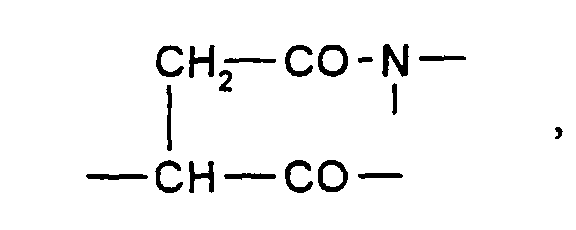
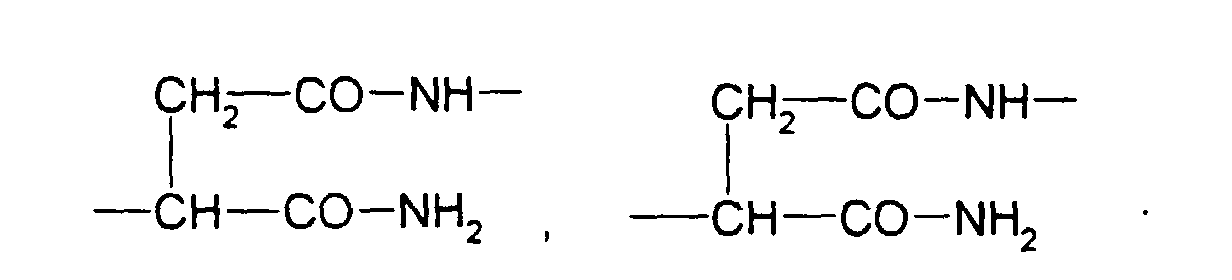
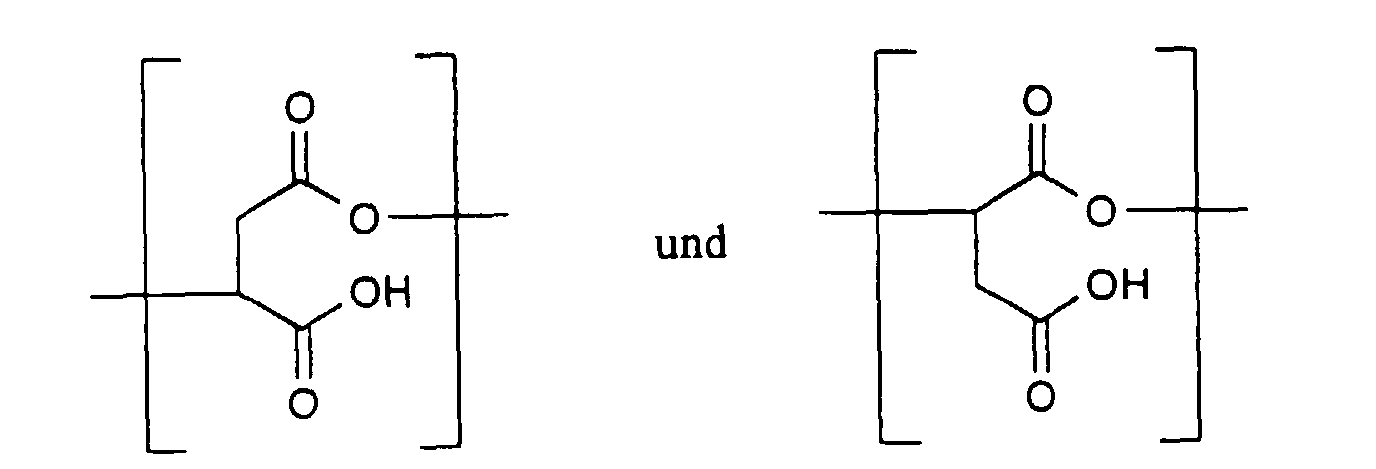
- the polymers produced according to the invention preferably have recurring succinyl units with at least one of the following structures prefers
- the iminodisuccinate units can be randomly distributed or preferred in the polymer available as end group. Based on the sum of all recurring units the iminodisuccinate unit is optionally present at least 0.1 mol%.
- the molar ratio of the iminodisuccinate units incorporated in the polymer to The sum of all monomer units incorporated in the polymer is preferably 0.1 mol% to 99 mol%, preferably 1 mol% to 50 mol%, particularly preferred 2 mol% to 25 mol%.
- maleic anhydride maleic acid
- Maleic acid derivatives e.g. Maleic acid ester and maleic acid half ester
- fumaric acid or fumaric acid derivatives used.
- Maleic acid and is particularly preferred Maleic anhydride.
- the corresponding compounds are particularly preferred triammonium salts citric acid and especially phosphoric acid and phosphorous Acid.
- citric acid and especially phosphoric acid and phosphorous Acid are particularly preferred.
- maleic anhydride and triammonium phosphate reacted with each other.
- the triammonium salt is used as the reactant the optionally substituted dicarboxylic acid used. Especially it is preferred here if, for example, 1 mol or optionally substituted MSA Dicarboxylic acid or mixtures thereof 1/3 to 1.0 mol of triammonium salt, in particular 0.4 to 0.6 and especially 0.5 to 0.6 mol is used.
- the polymerization product obtained which contains polysuccinimide units, can be hydrolyzed in the usual way to polyaspartic acid and its salts become.
- the invention further relates to a method for producing polymers with recurring succinyl units, characterized in that a nitrogen-containing Dicarboxylic acid, especially aspartic acid, in the presence of catalytic Amounts of an ammonium salt polymerized.
- a nitrogen-containing Dicarboxylic acid especially aspartic acid
- an ammonium salt polymerized in a preferred embodiment becomes an ammonium phosphate or ammonium phosphite as a catalyst for the polymerization, that is to say for the production of succinyl units Polymers used.
- At the aspartic acid can be L-, D- and DL-aspartic acid act.
- N-substituted is substituted per mole Butanedicarboxylic acid 0.01 to 0.2 mol triammonium salt, in particular 0.0.3 to 0.15 mol of triammonium salt, in particular triammonium phosphate and Triammonium phosphite used.
- Catalytic amounts are also suitable Diammonium hydrogen phosphate and ammonium dihydrogen phosphate as a polymerization catalyst.
- the components are preferably at room temperature mixed, melted at 80 to 100 ° C and then at a higher temperature, in particular 140 to 250 ° C, polymerized.
- dicarboxylic acids to be used according to the invention together with ammonia or other ammonia-providing compounds as a triammonium salt together with the e.g. to be used Use triammonium salt.
- starting materials Maleic anhydride, maleic acid, maleic acid derivatives, fumaric acid and fumaric acid derivatives or mixtures used.
- nitrogenous components can ammonia in liquid form, gaseous or dissolved in suitable solvents and ammonia-providing compounds such as Mono or Diammonium carbonate, ammonium phosphate (e.g. diammonium phosphate), ammonium sulfate, Ammonium acetate or formamide or urea or even mixtures various N-containing components can be used.
- the starting materials can be used individually or in mixtures, in bulk or in solution, be used.
- Maleic anhydride is used in a preferred embodiment used as a melt.
- Suitable solvents are water, lower Alcohols, polar aprotic solvents such as dimethylformamide, formamide and Ureas, N-alkylpyrrolidone, sulfolane, acetone, dimethyl sulfoxide, polyalkylene glycols, Polyalkylene glycol monoalkyl ether and polyalkylene glycol dialkyl ether.
- supercritical gases such as e.g. Carbon dioxide and Ammonia. Water or / and formamide is particularly suitable.
- the starting materials are molten maleic anhydride (Educt A) and triammonium phosphate (educt B).
- Maleic anhydride is used as educt A preferably in such amounts that the molar ratio of nitrogen in educt B relative to maleic anhydride in Educt A between 0.9 and 5.0, preferably between 1.0 and 4.0 and entirely is particularly preferably between 1.5 and 3.0 to 1.
- the polymers according to the invention can be obtained by various process routes.
- intermediates such as maleic acid diammonium salt, Maleic acid monoammonium salt or maleic acid ammonium salt the starting materials mentioned above are produced in a separate process step and then discontinuously in bulk or in suitable solvents or are continuously thermally polymerized.
- the thermal polymerization is generally at temperatures between 100 ° C and 350 ° C, preferably between 120 ° C and 260 ° C, particularly preferred between 140 ° C and 240 ° C.
- the residence time is preferably between 1 second and 600 minutes, preferably 5 seconds to 180 minutes, particularly preferably 10 seconds to 150 minutes.
- a preferred embodiment of the general method described above is characterized in that the reaction of the starting materials (A, B) in the first Reaction step is largely adiabatic and the heat of reaction released is used to bring the reaction mixture to polymerization temperature to bring and in the second reaction step the N-containing low molecular weight Derivative to obtain a polymer with recurring succinyl units at least partially polymerize.
- Preferred devices for rapid mixing of the educt streams are all Types of jet mixers, static mixers and dynamic mixers.
- Particularly preferred devices for the rapid mixing of the educts and to start the exothermic reaction are jet mixers, the others Advantages with hermetic tightness, the variably adjustable mixing energy and the global plug-flow characteristics.
- the starting materials are carried out the 1st reaction step to reduce unwanted side reactions in a rapidly mixing apparatus of the above Mixed design, if necessary with heating, and in parallel or afterwards the exothermic formation of the intermediates carried out.
- the heat released is in the educt-intermediate mixture essentially saved. This will make the reaction mixture brought to polymerization temperature and optionally the organic Solvent or the water and water formed during the reaction evaporated completely or at least partially.
- the mixing takes place in ⁇ 2 s and the exothermic formation of the intermediates in less than 60 s.
- the one emerging from the first reaction stage The reaction mixture is then in a suitable apparatus for polymerization brought.
- all apparatuses suitable for thermal polymerization are suitable for a narrow residence time distribution of the viscous-liquid phase is necessary Minimum residence time for the polymerization and at the same time an at least partial one Evaporation of the solvent, especially the water, as well as the Enable reaction formed water.
- a rapid and strong rise in temperature of the reaction mixture an educt component due to the very exothermic rapid formation of intermediate products at several points in a suitable manner along the tubular or multi-phase spiral tube reactor be metered in so that an optimal temperature profile can be achieved. This will prevent it from occurring high temperatures, which can lead to product damage.
- the Number of additional (without dosing in the mixing nozzle on the pipe or Multiphase spiral tube reactor inlet) dosing points is preferably in the range of up to 10.
- the type of feed is chosen so that good mixing with the reaction solution.
- the dosing points also serve to add those that may need to be added Feed comonomers (C). Under C e.g. Amino acids such as glycine etc. Understood.
- C Feed comonomers
- the last metering point which is just before the reactor outlet, to be used, one of the bases mentioned above and optionally further Add educt A to graft the polymer e.g. with iminodisuccinate units to reach.
- the mixing of the starting materials can, depending on the starting materials used Temperatures between 0 ° C and 200 ° C take place.
- the exothermic adiabatic Reaction of the first reaction step then provides enough heat so that the second reaction step depending on the type and concentration of the used Educts at 100 to 350 ° C, preferably at 120 to 260 ° C and particularly preferred can take place at 140 to 240 ° C.
- the temperature is advantageous over the Pressure in the reactor and the mass flows of the starting materials (A, B), if appropriate by the content of organic solvent and / or water set.
- To support temperature control during the reaction cooling and heating media can also be used.
- product educt areas with different temperatures in the reaction system Heat exchange can be brought into direct or indirect contact.
- the residence times of the above-mentioned starting materials in the reactor system that can be used are up to 600 minutes. Residence times of up to 180 are preferred Minutes. Decreasing with increasing temperature are particularly preferred Dwell times.
- the residence time in the reactor system is preferably chosen so that a practically complete implementation of the starting material used in the deficit A, preferably MSA, is guaranteed. For practically complete polymerization it may be necessary to do this shortly after mixing in the first Reaction path, e.g. in a tubular reactor, monomers and Oligomer mixture in a further device proposed above, preferred to implement a high-viscosity reactor. However, one can be particularly preferred High viscosity reactor can be used in which both steps to complete Polymer formation can be carried out.
- the reaction products obtained are each according to water or solvent content due to the released enthalpy of reaction hot solutions or solvent-containing or water-containing melts.
- the enthalpy of reaction can largely be used in the reactor. This will optimal heat management with low investment and operating costs procedural plant achieved, which leads to a high level of efficiency.
- reaction rate in a preferred reaction procedure for also possible direct synthesis from the intermediates maleic acid diammonium salt or maleic acid ammonium salt in such a device due to the already preheated and due to the released heat of reaction viscous mass partially depleted by evaporation of solvent be significantly increased.
- the residence time is determined by this procedure significantly reduced compared to the prior art.
- reactors are high viscosity reactors, e.g. Snail, List and Buss reactor.
- the primary polymer products can first be pulverized, then with water be washed out, leaving the polysuccinimide, which in the usual Way to polyaspartic acid or salts e.g. Sodium polyaspartic acid for example, can be hydrolyzed.
- the primary polymerization products can also be reacted with a base, optionally in the presence of water, into a PAA-containing one Copolymer salt are transferred.
- This conversion from PSI-containing to PAA-containing Copolymers are done in a suitable device by hydrolysis.
- a pH between 5 and 14 is preferably suitable.
- Particularly preferred A pH of 7 to 12 is chosen, especially by the Add a base.
- Suitable bases are alkali and alkaline earth metal hydroxides or Carbonates such as sodium hydroxide solution, potassium hydroxide solution, soda or potassium carbonate, Ammonia and amines such as triethylamine, triethanolamine, diethylamine, diethanolamine, Alkylamines etc.
- the hydrolysis of PSI can also partially done completely.
- Low molecular weight fractions (especially phosphoric acid salts) can be obtained from this Solution using conventional membrane technology in the manner of desalination be separated. However, they can also remain in the product.
- the temperature in the hydrolysis is suitably in a range including up to the boiling point of the suspension containing succinyl groups or Solution preferably at 20 to 150 ° C.
- the hydrolysis is optionally under Printing done.
- the hydrolysis is optionally carried out with the addition of a further monoethylenically unsaturated carboxylic acid derivative. Suitable Examples include maleic anhydride, maleic acid, citraconic acid, itaconic acid, Aconitic acid, acrylic acid and fumaric acid.
- the primary polymerization products also ethylenically unsaturated end groups have. Therefore, it may be useful to the reaction mixture during the basic hydrolysis, optionally also aminocarboxylic acids, e.g. Glycine, Add aspartic acid, lysine, glutamic acid etc. By this measure grafting of the polymer end groups is achieved.
- aminocarboxylic acids e.g. Glycine, Add aspartic acid, lysine, glutamic acid etc.
- the polymeric free acids can also be obtained from the salts Release continuous or discontinuous ion exchange treatment.
- the polymers produced according to the invention are characterized by an improved Calcium binding ability. Furthermore, they show complex formation properties against heavy metals such as Copper, iron etc. You can add in low-phosphate and phosphate-free detergents and cleaning agents are used become.
- the polymers are builders for detergents and act during the Washing process a reduction in incrustation and graying on the washed textile.
- polyaspartic acids produced according to the invention inhibit and delay the precipitation of calcium carbonate, calcium sulfate and Calcium phosphate, from aqueous solutions and are therefore used as water treatment agents suitable.
- the polymers Due to their complex-forming properties towards heavy metals the polymers also act as stabilizers for bleaches such as hydrogen peroxide serve in bleaching processes.
- the primary polymerization products were characterized by elemental analysis. In addition to carbon and hydrogen, there were three different ones Determined nitrogen types. The analysis differentiated between ionic bound nitrogen (ammonium ions), hydrolytically sensitive nitrogen (e.g. amide or imide nitrogen) and "non-hydrolyzable” nitrogen (amine nitrogen). In this way, the necessary for improved effectiveness optimal hydrolysis can be followed.
- ionic bound nitrogen ammonium ions
- hydrolytically sensitive nitrogen e.g. amide or imide nitrogen
- amine nitrogen non-hydrolyzable nitrogen
- the polymers according to the invention obtained after the hydrolysis were analyzed with the aid of 1 H-NMR and 13 C-NMR both in the salt form and after conversion into the free acid.
- the residual monomer content was determined by HPLC and the polymer distribution GPC against polyacrylates or polyaspartic acids from Sigma determined as the standard.
- Example 5 was carried out analogously to example 4. However, as a catalyst 10 g of diammonium hydrogen phosphate are used. The molecular weight obtained was Mw 4566.
- Example 6 was carried out analogously to Example 4, but without a catalyst. Man received Mw 2880 as molecular weight.
- Example 7 was carried out analogously to example 4. 10 g Triammonium phosphate trihydrate used The molecular weight Mw 4800 was obtained.
- This experiment can also be carried out continuously with simultaneous addition of Maleic anhydride and triammonium phosphate trihydrate are carried out.
Landscapes
- Chemical & Material Sciences (AREA)
- Chemical Kinetics & Catalysis (AREA)
- Organic Chemistry (AREA)
- Health & Medical Sciences (AREA)
- Medicinal Chemistry (AREA)
- Polymers & Plastics (AREA)
- Life Sciences & Earth Sciences (AREA)
- Engineering & Computer Science (AREA)
- Oil, Petroleum & Natural Gas (AREA)
- Wood Science & Technology (AREA)
- General Chemical & Material Sciences (AREA)
- Hydrology & Water Resources (AREA)
- Environmental & Geological Engineering (AREA)
- Water Supply & Treatment (AREA)
- Macromolecular Compounds Obtained By Forming Nitrogen-Containing Linkages In General (AREA)
- Polyamides (AREA)
- Addition Polymer Or Copolymer, Post-Treatments, Or Chemical Modifications (AREA)
- Biological Depolymerization Polymers (AREA)
- Detergent Compositions (AREA)
- Emulsifying, Dispersing, Foam-Producing Or Wetting Agents (AREA)
Description



- R
- OH, O-NH4 + oder NH2 bedeutet.

Claims (17)
- Verfahren zur Herstellung von Polymeren mit wiederkehrenden Succinyl-einheiten, dadurch gekennzeichnet, daß man wenigstens eine gegebenenfalls substituierte 1,4-Butandicarbonsäure, Butendicarbonsäure oder ein Derivat davon mit einem Triammoniumsalz einer mehrwertigen Säure zusammengibt und unter Erwärmung polymerisiert.
- Verfahren zur Herstellung von Polymeren mit wiederkehrenden Succinyl-einheiten gemäß Anspruch 1, dadurch gekennzeichnet, daß man das Anhydrid einer gegebenenfalls substituierten 1,4-Butandicarbonsäure oder Butendicarbonsäure mit einem Triammoniumsalz einer Säure zusammengibt und unter Erwärmung polymerisiert.
- Verfahren nach wenigstens einem der vorhergehenden Ansprüche, dadurch gekennzeichnet, daß man als Ammoniumsalz das Triammoniumsalz der Zitronensäure, Phosphorsäure oder phosphorigen Säure verwendet.
- Verfahren nach wenigstens einem der vorhergehenden Ansprüche, dadurch gekennzeichnet, daß man Maleinsäure, Maleinsäureanhydrid oder Fumarsäure verwendet.
- Verfahren nach wenigstens einem der vorhergehenden Ansprüche, dadurch gekennzeichnet, daß das Triammoniumsalz Triammoniumphosphat ist.
- Verfahren nach wenigstens einem der vorhergehenden Ansprüche, dadurch gekennzeichnet, daß Maleinsäureanhydrid und Triammoniumphosphat miteinander umgesetzt werden.
- Verfahren nach wenigstens einem der vorhergehenden Ansprüche, dadurch gekennzeichnet, daß pro Mol Dicarbonsäure bzw. Anhydrid 0,3 bis 1 mol Triammoniumsalz verwendet werden.
- Verfahren nach wenigstens einem der vorhergehenden Ansprüche, dadurch gekennzeichnet, daß Maleinsäureanhydrid mit Triammoniumphosphat in der Schmelze bei 60 bis 100°C einwirken und die Temperatur zur Polymerisation auf wenigstens 140°C bis 250°C gesteigert wird und anschließend oder gleichzeitig Reaktionswasser entfernt wird.
- Verfahren zur Herstellung von Polymeren mit wiederkehrenden Succinyl-einheiten nach einem der vorhergehenden Ansprüche, dadurch gekennzeichnet, daß man eine stickstoffhaltige Dicarbonsäure in Gegenwart katalytischer Mengen eines Ammoniumsalzes polymerisiert.
- Verfahren zur Herstellung von Polymeren mit wiederkehrenden Succinyl-einheiten gemäß Anspruch 9, dadurch gekennzeichnet, daß man Asparaginsäure in Gegenwart katalytischer Mengen eines Ammoniumsalzes polymerisiert.
- Verfahren nach Anspruch 9, dadurch gekennzeichnet, daß das Ammoniumsalz in einer Menge von 0,01 bis 0,2 Mol pro substituierte Dicarbonsäure verwendet wird.
- Verfahren nach Anspruch 9, dadurch gekennzeichnet, daß das Ammoniumsalz ein Ammoniumphosphat ist.
- Verfahren nach Anspruch 9, dadurch gekennzeichnet, daß die substituierte Dicarbonsäure und Triammoniumphosphat zusammen erhitzt und bei 80 bis 100°C verschmolzen werden und bei wenigstens 140 bis 250°C eine Polymerisation des erhaltenen Produktes durchgeführt wird.
- Verfahren nach wenigstens einem der vorhergehenden Ansprüche, dadurch gekennzeichnet, daß das erhaltene Polymerisationsprodukt in wäßrigem Milieu mit einer Base hydrolysiert wird.
- Verfahren nach Anspruch 14, dadurch gekennzeichnet, daß das rohe Polymerprodukt pulverisiert, mit Wasser niedermolekulare Anteile ausgewaschen werden und anschließend hydrolysiert wird zu Alkali- oder Aminsalzen oder zur freien Säure.
- Verfahren nach Anspruch 15, dadurch gekennzeichnet, daß die niedermolekularen Bestandteile Phosphat sein können.
- Verfahren nach Anspruch 14, dadurch gekennzeichnet, daß das rohe Hydrolysat mittels Diffusion durch Membranen von niedermolekularen Anteilen befreit wird.
Applications Claiming Priority (3)
| Application Number | Priority Date | Filing Date | Title |
|---|---|---|---|
| DE19516399A DE19516399A1 (de) | 1995-05-04 | 1995-05-04 | Verfahren zur Herstellung von Polymeren mit wiederkehrenden Succinyleinheiten |
| DE19516399 | 1995-05-04 | ||
| PCT/EP1996/001671 WO1996034908A1 (de) | 1995-05-04 | 1996-04-22 | Verfahren zur herstellung von polymeren mit wiederkehrenden succinyleinheiten |
Publications (2)
| Publication Number | Publication Date |
|---|---|
| EP0823923A1 EP0823923A1 (de) | 1998-02-18 |
| EP0823923B1 true EP0823923B1 (de) | 1999-01-27 |
Family
ID=7761092
Family Applications (1)
| Application Number | Title | Priority Date | Filing Date |
|---|---|---|---|
| EP96913521A Expired - Lifetime EP0823923B1 (de) | 1995-05-04 | 1996-04-22 | Verfahren zur herstellung von polymeren mit wiederkehrenden succinyleinheiten |
Country Status (11)
| Country | Link |
|---|---|
| US (1) | US5919894A (de) |
| EP (1) | EP0823923B1 (de) |
| JP (1) | JPH11505276A (de) |
| KR (1) | KR19990008269A (de) |
| AT (1) | ATE176258T1 (de) |
| CZ (1) | CZ349597A3 (de) |
| DE (2) | DE19516399A1 (de) |
| ES (1) | ES2127636T3 (de) |
| PL (1) | PL323182A1 (de) |
| TW (1) | TW322498B (de) |
| WO (1) | WO1996034908A1 (de) |
Families Citing this family (11)
| Publication number | Priority date | Publication date | Assignee | Title |
|---|---|---|---|---|
| DE19540086A1 (de) * | 1995-10-27 | 1997-04-30 | Henkel Kgaa | Verwendung von polymeren Aminodicarbonsäuren in Waschmitteln |
| DE19815025A1 (de) * | 1998-04-03 | 1999-10-07 | Bayer Ag | Verfahren zur Herstellung von Polymeren mit wiederkehrenden Succinyleinheiten unter Verwendung von Katalysatoren |
| DE19845639A1 (de) * | 1998-10-05 | 2000-04-06 | Bayer Ag | Verfahren zur Herstellung von biologisch abbaubaren Polymeren mit wiederkehrenden Succinyleinheiten |
| US6365706B1 (en) | 2000-06-21 | 2002-04-02 | Mississippi Chemical Corporation | Process for production of polyasparagine and the high nitrogen content polymer formed thereby |
| BR0113660A (pt) * | 2000-09-01 | 2003-06-03 | Reckitt Benckiser Uk Ltd | Processo de limpeza |
| WO2002018533A1 (en) * | 2000-09-01 | 2002-03-07 | Reckitt Benckiser (Uk) Limited | Cleaning method |
| EP2636757B1 (de) | 2008-05-27 | 2016-11-23 | Dako Denmark A/S | Zusammensetzungen und Verfahren zum Nachweis von chromosomalen Abweichungen mit neuen Hybridisierungspuffern |
| US9303287B2 (en) | 2009-02-26 | 2016-04-05 | Dako Denmark A/S | Compositions and methods for RNA hybridization applications |
| ES2601237T3 (es) * | 2009-12-02 | 2017-02-14 | Dako Denmark A/S | Composiciones y métodos para realizar hibridaciones sin desnaturalización |
| WO2013046033A1 (en) * | 2011-09-30 | 2013-04-04 | Dako Denmark A/S | Hybridization compositions and methods using formamide |
| US11118226B2 (en) | 2011-10-21 | 2021-09-14 | Agilent Technologies, Inc. | Hybridization compositions and methods |
Family Cites Families (8)
| Publication number | Priority date | Publication date | Assignee | Title |
|---|---|---|---|---|
| DE3626672A1 (de) * | 1986-08-07 | 1988-02-11 | Bayer Ag | Polyasparaginamidsaeure |
| DE4023463C2 (de) * | 1990-07-24 | 1999-05-27 | Roehm Gmbh | Verfahren zur Molekulargewichtserhöhung bei der Herstellung von Polysuccinimid |
| US5288783A (en) * | 1992-05-14 | 1994-02-22 | Srchem Incorporated | Preparation of salt of polyaspartic acid by high temperature reaction |
| DE4221875A1 (de) * | 1992-07-03 | 1994-01-05 | Basf Ag | Modifizierte Polyasparaginsäuren, Verfahren zu ihrer Herstellung und ihre Verwendung |
| US5296578A (en) * | 1992-09-18 | 1994-03-22 | Donlar Corporation | Production of polysuccinimide and polyaspartic acid from maleic anhydride and ammonia |
| US5393868A (en) * | 1992-10-13 | 1995-02-28 | Rohm And Haas Company | Production of polysuccinimide by thermal polymerization of maleamic acid |
| DE4244031A1 (de) * | 1992-12-24 | 1994-06-30 | Bayer Ag | Verfahren zur Herstellung und Verwendung von Polyasparaginsäure und ihrer Salze |
| DE4323191A1 (de) * | 1993-07-10 | 1995-01-12 | Basf Ag | Verfahren zur Herstellung von Polyasparaginsäure |
-
1995
- 1995-05-04 DE DE19516399A patent/DE19516399A1/de not_active Withdrawn
-
1996
- 1996-04-22 ES ES96913521T patent/ES2127636T3/es not_active Expired - Lifetime
- 1996-04-22 DE DE59601231T patent/DE59601231D1/de not_active Expired - Fee Related
- 1996-04-22 US US08/945,735 patent/US5919894A/en not_active Expired - Fee Related
- 1996-04-22 JP JP8532971A patent/JPH11505276A/ja active Pending
- 1996-04-22 CZ CZ973495A patent/CZ349597A3/cs unknown
- 1996-04-22 PL PL96323182A patent/PL323182A1/xx unknown
- 1996-04-22 WO PCT/EP1996/001671 patent/WO1996034908A1/de not_active Ceased
- 1996-04-22 EP EP96913521A patent/EP0823923B1/de not_active Expired - Lifetime
- 1996-04-22 KR KR1019970707795A patent/KR19990008269A/ko not_active Withdrawn
- 1996-04-22 AT AT96913521T patent/ATE176258T1/de not_active IP Right Cessation
- 1996-05-04 TW TW085105397A patent/TW322498B/zh active
Also Published As
| Publication number | Publication date |
|---|---|
| ATE176258T1 (de) | 1999-02-15 |
| JPH11505276A (ja) | 1999-05-18 |
| KR19990008269A (ko) | 1999-01-25 |
| US5919894A (en) | 1999-07-06 |
| DE59601231D1 (de) | 1999-03-11 |
| DE19516399A1 (de) | 1996-11-07 |
| PL323182A1 (en) | 1998-03-16 |
| WO1996034908A1 (de) | 1996-11-07 |
| CZ349597A3 (cs) | 1998-02-18 |
| EP0823923A1 (de) | 1998-02-18 |
| ES2127636T3 (es) | 1999-04-16 |
| TW322498B (de) | 1997-12-11 |
Similar Documents
| Publication | Publication Date | Title |
|---|---|---|
| EP0650995B1 (de) | Verfahren zur Herstellung von Asparaginsäure-haltigen Polymeren | |
| US6054553A (en) | Process for the preparation of polymers having recurring agents | |
| EP0633281B1 (de) | Verfahren zur Herstellung von Polysuccinimid und Polyasparaginsäure | |
| DE69333816T2 (de) | Polyasparaginsäuresalze erhalten durch Hochtemperaturreaktion | |
| DE4221875A1 (de) | Modifizierte Polyasparaginsäuren, Verfahren zu ihrer Herstellung und ihre Verwendung | |
| EP0612784B1 (de) | Verfahren zur Herstellung von Polysuccinimid und Polyasparaginsäure | |
| DE19516399A1 (de) | Verfahren zur Herstellung von Polymeren mit wiederkehrenden Succinyleinheiten | |
| EP0775167B1 (de) | Verfahren zur herstellung von polyasparaginsäure | |
| EP0992525B1 (de) | Verfahren zur Herstellung von biologisch abbaubaren Polymeren mit wiederkehrenden Succinyleinheiten | |
| EP0786487B1 (de) | Verfahren zur Herstellung von Polymeren mit wiederkehrenden Succinyl-Einheiten | |
| EP0947535A2 (de) | Verfahren zur Herstellung von Polymeren mit wiederkehrenden Succinyleinheiten unter Verwendung von Katalysatoren | |
| EP0819145B1 (de) | Iminodisuccinat-enthaltende polymere | |
| DE19512898A1 (de) | Iminodisuccinat-enthaltende Polymere | |
| DE19603052A1 (de) | Verfahren zur Herstellung von Polymeren mit wiederkehrenden Succinyl-Einheiten | |
| DE19636190A1 (de) | Verfahren zur Herstellung von Polymeren mit wiederkehrenden Succinyleinheiten | |
| DE19527572A1 (de) | Iminodisuccinat-enthaltende Polymere | |
| DE4425951A1 (de) | Verfahren zur Herstellung von Asparaginsäure-haltigen Polymeren | |
| WO1996000743A1 (de) | Verfahren zur herstellung von polyasparaginsäure und/oder polyasparaginsäureimiden | |
| DE69813545T2 (de) | Verfahren zur herstellung von melamin |
Legal Events
| Date | Code | Title | Description |
|---|---|---|---|
| PUAI | Public reference made under article 153(3) epc to a published international application that has entered the european phase |
Free format text: ORIGINAL CODE: 0009012 |
|
| 17P | Request for examination filed |
Effective date: 19971204 |
|
| AK | Designated contracting states |
Kind code of ref document: A1 Designated state(s): AT BE CH DE ES FR GB IE IT LI NL |
|
| GRAG | Despatch of communication of intention to grant |
Free format text: ORIGINAL CODE: EPIDOS AGRA |
|
| 17Q | First examination report despatched |
Effective date: 19980210 |
|
| GRAG | Despatch of communication of intention to grant |
Free format text: ORIGINAL CODE: EPIDOS AGRA |
|
| GRAH | Despatch of communication of intention to grant a patent |
Free format text: ORIGINAL CODE: EPIDOS IGRA |
|
| GRAH | Despatch of communication of intention to grant a patent |
Free format text: ORIGINAL CODE: EPIDOS IGRA |
|
| GRAA | (expected) grant |
Free format text: ORIGINAL CODE: 0009210 |
|
| AK | Designated contracting states |
Kind code of ref document: B1 Designated state(s): AT BE CH DE ES FR GB IE IT LI NL |
|
| REF | Corresponds to: |
Ref document number: 176258 Country of ref document: AT Date of ref document: 19990215 Kind code of ref document: T |
|
| REG | Reference to a national code |
Ref country code: CH Ref legal event code: EP |
|
| REG | Reference to a national code |
Ref country code: CH Ref legal event code: NV Representative=s name: E. BLUM & CO. PATENTANWAELTE |
|
| GBT | Gb: translation of ep patent filed (gb section 77(6)(a)/1977) |
Effective date: 19990209 |
|
| REG | Reference to a national code |
Ref country code: IE Ref legal event code: FG4D Free format text: GERMAN |
|
| REF | Corresponds to: |
Ref document number: 59601231 Country of ref document: DE Date of ref document: 19990311 |
|
| ITF | It: translation for a ep patent filed | ||
| REG | Reference to a national code |
Ref country code: ES Ref legal event code: FG2A Ref document number: 2127636 Country of ref document: ES Kind code of ref document: T3 |
|
| ET | Fr: translation filed | ||
| PLBE | No opposition filed within time limit |
Free format text: ORIGINAL CODE: 0009261 |
|
| STAA | Information on the status of an ep patent application or granted ep patent |
Free format text: STATUS: NO OPPOSITION FILED WITHIN TIME LIMIT |
|
| 26N | No opposition filed | ||
| PGFP | Annual fee paid to national office [announced via postgrant information from national office to epo] |
Ref country code: DE Payment date: 20000317 Year of fee payment: 5 |
|
| PGFP | Annual fee paid to national office [announced via postgrant information from national office to epo] |
Ref country code: CH Payment date: 20000324 Year of fee payment: 5 |
|
| PGFP | Annual fee paid to national office [announced via postgrant information from national office to epo] |
Ref country code: AT Payment date: 20000327 Year of fee payment: 5 |
|
| PGFP | Annual fee paid to national office [announced via postgrant information from national office to epo] |
Ref country code: ES Payment date: 20000404 Year of fee payment: 5 |
|
| PGFP | Annual fee paid to national office [announced via postgrant information from national office to epo] |
Ref country code: GB Payment date: 20000419 Year of fee payment: 5 Ref country code: FR Payment date: 20000419 Year of fee payment: 5 |
|
| PGFP | Annual fee paid to national office [announced via postgrant information from national office to epo] |
Ref country code: BE Payment date: 20000426 Year of fee payment: 5 |
|
| PGFP | Annual fee paid to national office [announced via postgrant information from national office to epo] |
Ref country code: NL Payment date: 20000428 Year of fee payment: 5 |
|
| PGFP | Annual fee paid to national office [announced via postgrant information from national office to epo] |
Ref country code: IE Payment date: 20000430 Year of fee payment: 5 |
|
| PG25 | Lapsed in a contracting state [announced via postgrant information from national office to epo] |
Ref country code: GB Free format text: LAPSE BECAUSE OF NON-PAYMENT OF DUE FEES Effective date: 20010422 Ref country code: AT Free format text: LAPSE BECAUSE OF NON-PAYMENT OF DUE FEES Effective date: 20010422 |
|
| PG25 | Lapsed in a contracting state [announced via postgrant information from national office to epo] |
Ref country code: IE Free format text: LAPSE BECAUSE OF NON-PAYMENT OF DUE FEES Effective date: 20010423 Ref country code: ES Free format text: LAPSE BECAUSE OF NON-PAYMENT OF DUE FEES Effective date: 20010423 |
|
| PG25 | Lapsed in a contracting state [announced via postgrant information from national office to epo] |
Ref country code: FR Free format text: THE PATENT HAS BEEN ANNULLED BY A DECISION OF A NATIONAL AUTHORITY Effective date: 20010430 Ref country code: BE Free format text: LAPSE BECAUSE OF NON-PAYMENT OF DUE FEES Effective date: 20010430 |
|
| PG25 | Lapsed in a contracting state [announced via postgrant information from national office to epo] |
Ref country code: LI Free format text: LAPSE BECAUSE OF NON-PAYMENT OF DUE FEES Effective date: 20010521 Ref country code: CH Free format text: LAPSE BECAUSE OF NON-PAYMENT OF DUE FEES Effective date: 20010521 |
|
| BERE | Be: lapsed |
Owner name: BAYER A.G. Effective date: 20010430 |
|
| PG25 | Lapsed in a contracting state [announced via postgrant information from national office to epo] |
Ref country code: NL Free format text: LAPSE BECAUSE OF NON-PAYMENT OF DUE FEES Effective date: 20011101 |
|
| GBPC | Gb: european patent ceased through non-payment of renewal fee |
Effective date: 20010422 |
|
| REG | Reference to a national code |
Ref country code: CH Ref legal event code: PL |
|
| NLV4 | Nl: lapsed or anulled due to non-payment of the annual fee |
Effective date: 20011101 |
|
| PG25 | Lapsed in a contracting state [announced via postgrant information from national office to epo] |
Ref country code: DE Free format text: LAPSE BECAUSE OF NON-PAYMENT OF DUE FEES Effective date: 20020201 |
|
| REG | Reference to a national code |
Ref country code: FR Ref legal event code: ST |
|
| REG | Reference to a national code |
Ref country code: IE Ref legal event code: MM4A |
|
| REG | Reference to a national code |
Ref country code: ES Ref legal event code: FD2A Effective date: 20030303 |
|
| PG25 | Lapsed in a contracting state [announced via postgrant information from national office to epo] |
Ref country code: IT Free format text: LAPSE BECAUSE OF NON-PAYMENT OF DUE FEES;WARNING: LAPSES OF ITALIAN PATENTS WITH EFFECTIVE DATE BEFORE 2007 MAY HAVE OCCURRED AT ANY TIME BEFORE 2007. THE CORRECT EFFECTIVE DATE MAY BE DIFFERENT FROM THE ONE RECORDED. Effective date: 20050422 |