EP0823116B1 - Schaltungen, systeme und verfahren zur speicherdatenänderung unter verwendung logischer funktionen - Google Patents
Schaltungen, systeme und verfahren zur speicherdatenänderung unter verwendung logischer funktionen Download PDFInfo
- Publication number
- EP0823116B1 EP0823116B1 EP96912973A EP96912973A EP0823116B1 EP 0823116 B1 EP0823116 B1 EP 0823116B1 EP 96912973 A EP96912973 A EP 96912973A EP 96912973 A EP96912973 A EP 96912973A EP 0823116 B1 EP0823116 B1 EP 0823116B1
- Authority
- EP
- European Patent Office
- Prior art keywords
- bit
- data
- logic
- modifying
- modifying data
- Prior art date
- Legal status (The legal status is an assumption and is not a legal conclusion. Google has not performed a legal analysis and makes no representation as to the accuracy of the status listed.)
- Expired - Lifetime
Links
- 238000000034 method Methods 0.000 title description 8
- 239000000872 buffer Substances 0.000 claims description 36
- 230000006870 function Effects 0.000 claims description 10
- 230000004044 response Effects 0.000 claims description 6
- 210000004027 cell Anatomy 0.000 description 31
- 238000010586 diagram Methods 0.000 description 9
- 230000004048 modification Effects 0.000 description 9
- 238000012986 modification Methods 0.000 description 9
- 240000007320 Pinus strobus Species 0.000 description 8
- 230000008901 benefit Effects 0.000 description 7
- 230000000295 complement effect Effects 0.000 description 6
- 238000006243 chemical reaction Methods 0.000 description 2
- 210000004457 myocytus nodalis Anatomy 0.000 description 2
- 230000004075 alteration Effects 0.000 description 1
- 230000008859 change Effects 0.000 description 1
- 230000000694 effects Effects 0.000 description 1
- 238000001914 filtration Methods 0.000 description 1
- 230000007274 generation of a signal involved in cell-cell signaling Effects 0.000 description 1
- 239000004973 liquid crystal related substance Substances 0.000 description 1
- 230000002093 peripheral effect Effects 0.000 description 1
- 230000008569 process Effects 0.000 description 1
- HBMJWWWQQXIZIP-UHFFFAOYSA-N silicon carbide Chemical compound [Si+]#[C-] HBMJWWWQQXIZIP-UHFFFAOYSA-N 0.000 description 1
- 229910010271 silicon carbide Inorganic materials 0.000 description 1
- 238000006467 substitution reaction Methods 0.000 description 1
Images


Classifications
-
- G—PHYSICS
- G11—INFORMATION STORAGE
- G11C—STATIC STORES
- G11C7/00—Arrangements for writing information into, or reading information out from, a digital store
-
- G—PHYSICS
- G11—INFORMATION STORAGE
- G11C—STATIC STORES
- G11C7/00—Arrangements for writing information into, or reading information out from, a digital store
- G11C7/10—Input/output [I/O] data interface arrangements, e.g. I/O data control circuits, I/O data buffers
- G11C7/1006—Data managing, e.g. manipulating data before writing or reading out, data bus switches or control circuits therefor
Definitions
- the present invention relates in general to electronic circuits and in particular to circuits, systems and methods for modifying data stored in a memory using logic operations.
- a typical processing system with video/graphics display capability includes a central processing unit (CPU), a display controller coupled with the CPU by a system bus, a system memory also coupled to the system bus, a frame buffer coupled to the display controller by a local bus, peripheral circuitry (e.g., clock drivers and signal converters), display driver circuitry, and a display unit.
- the CPU generally provides overall system control and, in response to user commands and program instructions retrieved from the system memory, controls the contents of graphics images to be displayed on the display unit.
- the display controller which may for example be a video graphics architecture (VGA) controller, generally interfaces the CPU and the display driver circuitry, exchanges graphics and/or video data with the frame buffer during data processing and display refresh operations, controls frame buffer memory operations, and performs additional processing on the subject graphics or video data, such as color expansion.
- the display driver circuitry converts digital data received from the display controller into the analog levels required by the display unit to generate graphics/video display images.
- the display unit may be any type of device which presents images to the user conveying the information represented by the graphics/video data being processed.
- the frame buffer which is typically constructed from dynamic random access memory devices (DRAMs) stores words of graphics or video data defining the color/gray-shade of each pixel of an entire display frame during processing operations such as filtering or drawing images. During display refresh, this "pixel data" is retrieved out of the frame buffer by the display controller pixel by pixel as the corresponding pixels on the display screen are refreshed.
- the size of the frame buffer directly corresponds to the number of pixels in each display frame and the number of bits (Bytes) in each word used to define each pixel.
- the size and performance of frame buffer is dictated by a number of factors such as, the number of monitor pixels, the monitor DOT clock rate, display refresh, data read/write frequency, and memory bandwidth, to name only a few.
- the system disclosed in the '743 patent allows data in a predetermined memory cell to be selectively subjected to a given logic operation.
- a level circuit is used to determine the logic level of modifying data being written to memory in response to a logic operation enable signal.
- the modifying data in the given cell is either inverted or remains the same.
- the '743 system has several substantial disadvantages. First, two separate inputs are required to input the modifying data and the logical operation enable signal. This is in addition to US-A-5 432 743 and JP-A-06 076 565 inputs for the normal memory control signals such as the row and column address strobes and the write enable signal. Second, a number of additional internal signals must be generated to insure proper operation timing in this system. Finally, while the '743 system can support either logical OR or logical AND operations, it cannot support both in a single set of control circuitry.
- circuits are constructed such that" a given logic operation is realized; the problem of a single circuit able to, in response to a control signal or the like, capable of performing one of a plurality of possible logic operations remains unsolved.
- the '657 system also is subject to a number of disadvantages. Admittedly, a series of "rapid operations" are required for a given logic operation. This forces the input of a number of control signals through a corresponding number of pins. As is well known, extra pins increase device costs and package size. Most importantly, the looping back of data requires additional circuitry for performing the loop-back itself and requires that the sense amplifier be active and latching valid data.
- the need has arisen for apparatus, systems and methods for performing logic operations on data stored in a memory.
- the need has arisen for apparatus, systems and methods which minimize the performance penalties paid by the presently available systems, especially those systems which require both the performance of multiple read and write cycles, during the process of performing a logic operation on selected bytes of data.
- apparatus, systems and methods should be particularly applicable to the performance of logic operations on pixel data being stored in a frame buffer.
- selected logic operations can be performed on data stored within selected locations in a memory without multiple or extended RAS/CAS cycles.
- the principles of the present invention generally take advantage of the fact that during AND and OR operations a bit of data being operated on either remains the same or is replaced with a corresponding bit of modifying data, depending on the state of that bit of modifying data.
- a memory system including an array of memory cells arranged in rows and columns and circuitry for selectively performing logic operations on a bit of data stored in a selected one of the cells using a bit of received modifying data and a mode data bit.
- the circuitry for performing logic operations performs an AND logic operation as a purely function of a logic state of the modifying bit and writes the bit of modifying data into the selected cell when the bit of modifying data is logic zero and maintains an existing bit stored in the cell when the bit of modifying data is a logic one.
- circuitry for receiving and latching the bit of modifying data and the mode data bit in serial though a single data port, wherein the mode data bit is latched-in on a falling edge of a row address strobe and the bit of modifying data is latched-in on falling edges of both a column address strobe and a write enable signal.
- a memory system including an array of memory cells arranged in rows and columns and circuitry for selectively performing logic operations on a bit of data stored in a selected one of the cells using a bit of received modifying data and a mode data bit.
- the circuitry for performing logic operations performs an OR logic operation as a purely function of a logic state of the modifying bit and writes the bit of modifying data into the selected cell when the bit of modifying data is logic one and maintains an existing bit stored in the cell when the bit of modifying data is a logic zero.
- circuitry for receiving and latching the bit of modifying data and the mode data bit in serial though a single data port, wherein the mode data bit is latched-in on a falling edge of a row address strobe and the bit of modifying data is latched-in on falling edges of both a column address strobe and a write enable signal.
- Apparatus, systems and methods embodying the principles of the present invention have substantial advantages over the prior art. Specifically, the principles of the present invention allow for the minimization of the performance penalties paid by presently available systems, circuits and methods for modifying bits of data within a memory device, especially those systems which require the performance of multiple read and write cycles. Further, the principles of the present invention are particularly useful for the performance of logic operations on pixel data being stored in a frame buffer.
- FIGURE 1 is a high level functional block diagram of the portion of a processing system 100 controlling the display of graphics and/or video data.
- System 100 includes a central processing unit 101, a system bus 102, a display controller 103, a frame buffer 104, a digital to analog converter (DAC) 105 and a display device 106.
- display controller 103 and frame buffer 104 and DAC 105 are fabricated together on a single integrated circuit chip 107.
- CPU 101 controls the overall operation of system 100, determines the content of graphics data to be displayed on display unit 106 under user commands, and performs various data processing functions.
- CPU 101 may be for example a general purpose microprocessor used in commercial personal computers.
- CPU 101 communicates with the remainder of system 100 via system bus 102, which may be for example a local bus, an ISA bus or a PCI bus.
- DAC 105 receives digital data from controller 103 and outputs in response the analog data required to drive display 106.
- DAC 105 may also include a color palette, YUV to RGB format conversion circuitry, and/or x- and y-zooming circuitry, to name a few options.
- controller 103 is a display controller, such as a VGA controller, which among other things, controls the exchange of graphics and/or video data with frame buffer 103, controls memory refresh, and performs data processing functions such as color expansion.
- a display controller is the "master" for the specific application of display and thus frees up CPU 101 to perform computational tasks.
- the architecture of a display controller optimizes it to perform graphics and video functions in a manner for superior to that of a general purpose microprocessor.
- Controller 103 may also include a color palette, cursor generation hardware, and/or video to graphics conversion circuitry, to name a few options.
- Frame buffer 104 is preferably a dynamic random access memory (DRAM) which includes an array of rows and columns of DRAM cells and associated address and control circuitry such as row and column decoders, read and write buffers, and sense amplifiers. Frame buffer 104 will be discussed in further detail below.
- DRAM dynamic random access memory
- Display 106 may be for example a CRT unit or liquid crystal display, electroluminescent display (ELD), plasma display (PLD), or other type of display device displays images on a display screen as a plurality of pixels. Further, display 106 may be a state-of-the-art device such as a digital micromirror device or a silicon carbide like device which directly accepts digital data. It should also be noted that in alternate embodiments, "display" 106 may be another type of output device such as a laser printer or similar document view/print appliances.
- ELD electroluminescent display
- PLD plasma display
- selected logic operations can be performed on words of data within selected locations within frame buffer 104.
- these principles take advantage of the fact that during AND and OR operations a bit of data in memory being operated on either remains the same or is replaced with the corresponding bit of the modifying data provided by controller 103, depending on the state of the bit of modifying data.
- This feature is illustrated in Table 1: OPERANDS RESULTS CELL DATA MODIFYING DATA AND OR 0 0 0 0 0 0 1 0 1 1 1 0 0 1 1 1 1 1 1 1 1
- the resulting data remains the same as that already stored in the selected memory cell for the input conditions set forth in the second and forth rows (i.e the modifying data equals a logic 1).
- a read (refresh) of the data within the given cell operation is all that is required to perform the "modification". This can be accomplished with a single RAS/CAS cycle with the write enable signal inactive.
- the resulting data is the same as the modifying data. In this case, all that is required to modify the data in the memory cell is to directly write the modifying data into the memory cell.
- the resulting data remains the same as that already stored in the selected memory cell for the input conditions set forth in the first and third rows (i.e. the modifying data equals a logic 0). Again, all that is required to "modify" the data in the cell is to perform a single RAS/CAS cycle read operation.
- the resulting data is the same as the modifying data and therefore all that is required is for the modifying data to be written directly to the selected memory cell using a conventional single RAS/CAS write cycle.
- the performance of an actual OR operation is not required; data is either refreshed by a read operation or the modifying data is written directly in as a function of the modifying data.
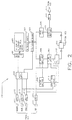
- FIGURE 2 is a more detailed functional block diagram of frame buffer 104 according to a preferred embodiment of the present invention.
- Frame buffer 103 includes an array 200 of conventional dynamic random access memory (DRAM) cells arranged in M number of rows and N number of columns. Coupled to array 200 are row decoder circuitry 201, sense amplifiers 202 and column decoder circuitry 203. In the preferred embodiment, N number of sense amplifiers 202, one per each column in array 200, are provided.
- Row decoder circuitry 201 and column decoder circuitry 203 control the access to P-cell storage locations from a selected row of array 200 in a conventional manner in response to row and column addresses latched into address latches 204 by RAS and CAS.
- Frame buffer 104 also includes readAwrite control circuitry embodying the principles of the present invention.
- Data reads from addressed locations in array 200 are accomplished through read amplifiers 205 and output buffer 206 when the output enable signal is active.
- the write/modify circuitry includes a first data latch 207 which during a conventional write latches data to be written into array 200 and during a modify latches the modifying data. Writes and modifications are performed through write buffer 208 which includes P number of conventional write buffers for writing into each accessed P-cell location.
- mode decoder 209 decodes the mode control data latched into a second data latch 210 to determine if an AND or OR operation (and consequently a NOR or NAND operation if complementary modification data is used) is to take place.
- latch 210 receives and holds at least two bits of data which, along with the conventional (external) write enable signal WE, determine if a conventional write or an AND or OR operation has been requested by controller 103.
- frame buffer 104 also includes data pads 211 and associated TTL drivers 212 for receiving data (DQ), addresses, RAS, CAS, WE and OE signals from the controller chip.
- DQ data
- addresses addresses
- RAS address
- CAS address
- WE OE signals
- write buffer 208 writes the modifying data latched into data latch 207 into the addressed memory cell when the modifying data is a logic 0.
- the modifying data is a logic 1
- no write is performed and instead a read takes place (as is known in the art a read operation refreshes the existing data stored in a given accessed memory cell, whatever the state).
- write buffer 208 writes the modifying data latched to data latch 207 into the addressed memory cell when the modifying data is a logic 1; a read occurs when the modifying data is a logic zero.
- the modifying of data is controlled by enabling or disabling write buffer 209.
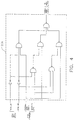
- FIGURE 4 is a logic diagram of preferred circuitry 400 for enabling or disabling write buffer 209 in order to perform the cell data modifications described above.
- this circuitry is located within write buffer 209 along with the write buffers themselves, although in altemate embodiments circuitry 400 may be disposed elsewhere within the chip.
- Circuitry 400 generates an "internal write enable" signal which enables/disables write buffer 208 during data modification operations.
- the internal write enable signal is derived from the conventional write enable signal generated by controller 103 for a conventional write, control signals MODE_AND and MODE_OR, and the modifying data.
- circuitry 400 is replicated P number of times such that each of P number of bits accessed in array 200 during a single address cycle can be independently modified. To independently modify P number of bits simultaneously, controller 103 correspondingly generates P number of bits of modifying data which are latched into latch 207.
- Control signals MODE_AND and MODE_OR are generated by decoder circuitry 209 from a control word (opcode) latched into data latch 210. Assuming a modification is requested by controller 103, the external write enable signal is active (i.e. high). When MODE_AND is high and MODE_OR is low, an AND operation is selected and the internal write enable signal is active (high) when the modifying data is a logic 0. When bit MODE_AND is low and bit MODE_OR is high, an OR operation is selected and the internal write enable signal is active (high) when the modifying data is a logic 1. For a conventional write. MODE_AND and MODE_OR are inactive (low) such that the internal write enable signal simply tracks the external write enable signal.
- controller 103 In the case of a NAND operation, the complement of the modifying data is taken and the OR mode is selected. In the case of a NOR operation. the complement of the modifying data is taken and the AND mode is applied. It should be noted that most controllers, such as controller 103, advantageously simultaneously generate complementary data for use in other operations.
- the timing diagram of FIGURE 3 illustrates the timing of a given modifying operation.
- the mode select data is latched into data latch 201.
- the falling edge of RAS also latches the row address for the selected location in array 200 into address latch 204.
- the column portion of the address is latched into address latch 204 on the falling edge of the column address strobe (CAS).
- CAS column address strobe
- the external enable signal both go low, the modifying data is latched into data latch 207.
- the data within data latch 210 is decoded by mode decoder 209 and presented as MODE_AND and MODE_OR to the circuitry shown in FIGURE 4, as is the modifying data within data latch 207 and the external write enable signal.
- the modification of the addressed cell or cells proceeds as above.
Landscapes
- Dram (AREA)
- Memory System (AREA)
- Controls And Circuits For Display Device (AREA)
Claims (5)
- Speichersystem (104) mit einem Feld (200) von Speicherzellen, die in Zeilen und Spalten angeordnet sind, und einem Schaltkreis (208) zum selektiven Durchführen von logischen Operationen an einem Datenbit, das in einer gewählten Zelle gespeichert ist, unter Verwendung eines Bits empfangener modifizierender Daten und eines Modusdatenbits zum Wählen einer logischen Operation zum Durchführen des Schaltkreises (208) zum Durchführen von logischen Operationen, der eine logische UND-Operation rein als Funktion eines logischen Zustandes des modifizierenden Bits durchführt und das Bit der modifizierenden Daten in die Zelle einschreibt, wenn das Bit modifizierender Daten logisch 0 ist, und ein bestehendes Bit, das in dieser Zelle gespeichert ist, aufrechterhält, wenn das Bit der modifzierenden Daten logisch 1 ist,
gekennzeichnet durch:einen Schaltkreis (207, 210) zum Empfangen und Speichern des Bits modifizierender Daten und des Modusdatenbits in Reihe durch einen einzelnen Datenport (211), wobei das Modusdatenbit bei einer fallenden Kante eines Zeilenadresstaktsignals gesperrt wird und das Bit der modifizierenden Daten halten wird, wenn ein Spaltenadresstaktsignal und ein Einschreib-Freigabesignal beide niedrig werden. - Speichersystem nach Anspruch 1,
wobei der Schaltkreis zum Durchführen der logischen Operationen (208) ferner betreibbar ist zum Durchführen einer ODER-Operation als Funktion des modifizierenden Bits durch Einschreiben des Bits der modifizierenden Daten in die Zelle, wenn das Bit der modifizierenden Daten logisch 1 ist und Halten des Bits, das in der Zelle gespeichert ist, wenn das Bit der modifizierenden Daten logisch 0 ist. - Speichersystem nach Anspruch 2,
wobei der Schaltkreis (208) zum selektiven Durchführen logischer Operationen ferner aufweist:einen Zeilen- und Spaltendekoderschaltkreis (202, 203) für das Zugreifen auf die gewählte Zelle;einen Schreibpuffer (208) zum selektiven Einschreiben des Bits der modifizierenden Daten in die gewählte Zelle in Antwort auf ein Einschreibfreigabesignal; undeinen Schaltkreis (208) zum Erzeugen des Einschreibfreigabesignals, wenn das Bit der modifizierenden Daten während einer ODER-Operation logisch 1 ist, und wenn das Bit der modifizierenden Daten während einer UND-Operation logisch 0 ist. - Speichersystem (104) mit einem Feld (200) Speicherzellen, die in Zeilen und Spalten angeordnet sind, und einem Schaltkreis (208) zum selektiven Durchführen logischer Operationen an einem Bit von Daten, das in einer gewählten Zelle gespeichert ist, unter Verwendung eines Bits von empfangenen modifizierenden Daten und einem Modusdatenbit, zum Wählen einer logischen Operation zur Durchführung, wobei der Schaltkreis (208) zur Durchführung logischer Operationen eine logische ODER-Operation rein als eine Funktion eines logischen Zustandes des modifizierenden Bits durchführt und dieses Bit der modifizierenden Daten in die Zelle einschreibt, wenn das Bit der modifizierenden Daten logisch 1 ist und ein bestehendes Bit, das in dieser Zelle gespeichert ist, hält, wenn das Bit der modifizierenden Daten logisch 0 ist;
gekennzeichnet durch:einen Schaltkreis (207, 210) zum Empfangen und Sperren des Bits der modifizierenden Daten und des Modusdatenbits in Reihe durch einen einzelnen Datenport (211), wobei das Modusdatenbit bei einer fallenden Kante der Zeilenadressmeßmarke gehalten wird, und das Bit der modifizierenden Daten gesperrt wird, wenn ein Spaltenadresstaktsignal und ein Einschreibfreigabesignal beide niedrig werden. - Speicher nach Anspruch 4,
wobei der Schaltkreis (208) zum Durchführen von logischen Operationen ferner betreibbar ist, um eine UND-Operation durchzuführen, indem das Bit der modifizierenden Daten in die Zelle eingeschrieben wird, wenn das Bit der modifizierenden Daten logisch 0 ist, und indem das Bit, das in der Zelle gespeichert ist, gehalten wird, wenn das Bit der modifizierenden Daten logisch 1 ist.
Applications Claiming Priority (3)
| Application Number | Priority Date | Filing Date | Title |
|---|---|---|---|
| US08/424,653 US5732024A (en) | 1995-04-19 | 1995-04-19 | Circuits, systems and methods for modifying data stored in a memory using logic operations |
| US424653 | 1995-04-19 | ||
| PCT/US1996/005523 WO1996033498A1 (en) | 1995-04-19 | 1996-04-19 | Circuits, systems and methods for modifying data stored in a memory using logic operations |
Publications (2)
| Publication Number | Publication Date |
|---|---|
| EP0823116A1 EP0823116A1 (de) | 1998-02-11 |
| EP0823116B1 true EP0823116B1 (de) | 1999-06-02 |
Family
ID=23683379
Family Applications (1)
| Application Number | Title | Priority Date | Filing Date |
|---|---|---|---|
| EP96912973A Expired - Lifetime EP0823116B1 (de) | 1995-04-19 | 1996-04-19 | Schaltungen, systeme und verfahren zur speicherdatenänderung unter verwendung logischer funktionen |
Country Status (6)
| Country | Link |
|---|---|
| US (4) | US5732024A (de) |
| EP (1) | EP0823116B1 (de) |
| JP (1) | JPH11504148A (de) |
| KR (1) | KR19990007860A (de) |
| DE (1) | DE69602742T2 (de) |
| WO (1) | WO1996033498A1 (de) |
Families Citing this family (5)
| Publication number | Priority date | Publication date | Assignee | Title |
|---|---|---|---|---|
| JP2000285671A (ja) | 1999-03-30 | 2000-10-13 | Nec Corp | 半導体メモリ |
| KR100296920B1 (ko) | 1999-06-28 | 2001-07-12 | 박종섭 | 반도체메모리장치의 데이터 기록 동작 제어 장치 |
| FR2812963B1 (fr) * | 2000-08-11 | 2003-07-25 | St Microelectronics Sa | Procede et circuit de commande de cellules d'un ecran a plasma |
| US6549470B2 (en) * | 2000-08-31 | 2003-04-15 | United Memories, Inc. | Small signal, low power read data bus driver for integrated circuit devices incorporating memory arrays |
| US20040268207A1 (en) * | 2003-05-21 | 2004-12-30 | Engim, Inc. | Systems and methods for implementing a rate converting, low-latency, low-power block interleaver |
Family Cites Families (11)
| Publication number | Priority date | Publication date | Assignee | Title |
|---|---|---|---|---|
| GB222567A (en) * | 1923-07-03 | 1924-10-03 | Maria Scholz | Process for dyeing textile fabric, paper and like materials |
| JPS5682928A (en) * | 1979-12-07 | 1981-07-07 | Nec Corp | Data processor |
| JPH0787032B2 (ja) * | 1985-07-08 | 1995-09-20 | 日本電気アイシ−マイコンシステム株式会社 | 半導体記憶装置 |
| US5195056A (en) * | 1987-05-21 | 1993-03-16 | Texas Instruments, Incorporated | Read/write memory having an on-chip input data register, having pointer circuits between a serial data register and input/output buffer circuits |
| ES2022698B3 (es) * | 1988-02-26 | 1991-12-01 | Ibm | Amplificador de sentido de doble fase para memorias de acceso aleatorias. |
| US5023838A (en) * | 1988-12-02 | 1991-06-11 | Ncr Corporation | Random access memory device with integral logic capability |
| JP2865469B2 (ja) * | 1992-01-24 | 1999-03-08 | 三菱電機株式会社 | 半導体メモリ装置 |
| JPH05298178A (ja) * | 1992-04-13 | 1993-11-12 | Nec Corp | 半導体集積回路 |
| JPH0636555A (ja) * | 1992-05-20 | 1994-02-10 | Nec Corp | ダイナミック型半導体記憶装置および画像データ生成装置 |
| JPH0676565A (ja) * | 1992-06-30 | 1994-03-18 | Nec Corp | 半導体記憶装置 |
| US5432743A (en) * | 1992-06-30 | 1995-07-11 | Nec Corporation | Semiconductor dynamic RAM for image processing |
-
1995
- 1995-04-19 US US08/424,653 patent/US5732024A/en not_active Expired - Lifetime
-
1996
- 1996-04-19 JP JP8531977A patent/JPH11504148A/ja active Pending
- 1996-04-19 DE DE69602742T patent/DE69602742T2/de not_active Expired - Fee Related
- 1996-04-19 EP EP96912973A patent/EP0823116B1/de not_active Expired - Lifetime
- 1996-04-19 WO PCT/US1996/005523 patent/WO1996033498A1/en not_active Ceased
- 1996-04-19 KR KR1019970707383A patent/KR19990007860A/ko not_active Withdrawn
-
1997
- 1997-07-30 US US08/903,390 patent/US5910919A/en not_active Expired - Lifetime
- 1997-07-30 US US08/902,674 patent/US5914900A/en not_active Expired - Lifetime
- 1997-07-30 US US08/903,317 patent/US5909401A/en not_active Expired - Lifetime
Also Published As
| Publication number | Publication date |
|---|---|
| DE69602742D1 (de) | 1999-07-08 |
| HK1007912A1 (en) | 1999-04-30 |
| DE69602742T2 (de) | 2000-01-13 |
| WO1996033498A1 (en) | 1996-10-24 |
| KR19990007860A (ko) | 1999-01-25 |
| US5910919A (en) | 1999-06-08 |
| EP0823116A1 (de) | 1998-02-11 |
| US5732024A (en) | 1998-03-24 |
| JPH11504148A (ja) | 1999-04-06 |
| US5914900A (en) | 1999-06-22 |
| US5909401A (en) | 1999-06-01 |
Similar Documents
| Publication | Publication Date | Title |
|---|---|---|
| JP4128234B2 (ja) | メモリ素子、処理システム、メモリ素子を制御する方法およびダイナミックランダムアクセスメモリを操作する方法 | |
| US5506810A (en) | Dual bank memory and systems using the same | |
| US5920885A (en) | Dynamic random access memory with a normal precharge mode and a priority precharge mode | |
| US5473566A (en) | Memory architecture and devices, systems and methods utilizing the same | |
| KR940000598B1 (ko) | 듀얼 포트 메모리를 사용한 플랫 패널 디스플레이 표시 제어장치 | |
| US5945974A (en) | Display controller with integrated half frame buffer and systems and methods using the same | |
| JP2554785B2 (ja) | 表示駆動制御用集積回路及び表示システム | |
| US5654932A (en) | Memory devices with selectable access type and methods using the same | |
| JP3105884B2 (ja) | メモリ性表示装置用表示コントローラ | |
| US5732024A (en) | Circuits, systems and methods for modifying data stored in a memory using logic operations | |
| EP0487819B1 (de) | Video-RAM mit schnellen Rücksetzung und Kopiermöglichkeit | |
| US5519667A (en) | Random access memory with apparatus for reducing power consumption | |
| EP0801375A2 (de) | Speicher mit optimiertem Speicherraum und breitem Dateneingang/-ausgang, Systeme und Verfahren zur Verwendung desselben | |
| HK1007912B (en) | Circuits, systems and methods for modifying data stored in a memory using logic operations | |
| KR100472478B1 (ko) | 메모리 억세스 제어방법 및 장치 | |
| HK1002883A (en) | A memory with optimized memory space and wide data input/output and systems and methods using the same | |
| JPH0430119B2 (de) | ||
| JPH04274082A (ja) | 半導体記憶装置 | |
| HK1004836A (en) | Display controller with internal half frame buffer and systems and methods using the same | |
| HK1010013A (en) | Memory devices with selectable access type and systems and methods using the same | |
| JPH05258557A (ja) | 半導体記憶装置 | |
| HK1004169B (en) | A dual bank memory and systems using the same |
Legal Events
| Date | Code | Title | Description |
|---|---|---|---|
| PUAI | Public reference made under article 153(3) epc to a published international application that has entered the european phase |
Free format text: ORIGINAL CODE: 0009012 |
|
| 17P | Request for examination filed |
Effective date: 19971118 |
|
| AK | Designated contracting states |
Kind code of ref document: A1 Designated state(s): DE FR GB IE IT NL |
|
| GRAG | Despatch of communication of intention to grant |
Free format text: ORIGINAL CODE: EPIDOS AGRA |
|
| 17Q | First examination report despatched |
Effective date: 19980722 |
|
| GRAG | Despatch of communication of intention to grant |
Free format text: ORIGINAL CODE: EPIDOS AGRA |
|
| GRAH | Despatch of communication of intention to grant a patent |
Free format text: ORIGINAL CODE: EPIDOS IGRA |
|
| GRAH | Despatch of communication of intention to grant a patent |
Free format text: ORIGINAL CODE: EPIDOS IGRA |
|
| GRAA | (expected) grant |
Free format text: ORIGINAL CODE: 0009210 |
|
| AK | Designated contracting states |
Kind code of ref document: B1 Designated state(s): DE FR GB IE IT NL |
|
| PG25 | Lapsed in a contracting state [announced via postgrant information from national office to epo] |
Ref country code: IT Free format text: LAPSE BECAUSE OF FAILURE TO SUBMIT A TRANSLATION OF THE DESCRIPTION OR TO PAY THE FEE WITHIN THE PRESCRIBED TIME-LIMIT;WARNING: LAPSES OF ITALIAN PATENTS WITH EFFECTIVE DATE BEFORE 2007 MAY HAVE OCCURRED AT ANY TIME BEFORE 2007. THE CORRECT EFFECTIVE DATE MAY BE DIFFERENT FROM THE ONE RECORDED. Effective date: 19990602 |
|
| REF | Corresponds to: |
Ref document number: 69602742 Country of ref document: DE Date of ref document: 19990708 |
|
| ET | Fr: translation filed | ||
| REG | Reference to a national code |
Ref country code: IE Ref legal event code: FG4D |
|
| PLBE | No opposition filed within time limit |
Free format text: ORIGINAL CODE: 0009261 |
|
| STAA | Information on the status of an ep patent application or granted ep patent |
Free format text: STATUS: NO OPPOSITION FILED WITHIN TIME LIMIT |
|
| 26N | No opposition filed | ||
| REG | Reference to a national code |
Ref country code: GB Ref legal event code: IF02 |
|
| PGFP | Annual fee paid to national office [announced via postgrant information from national office to epo] |
Ref country code: GB Payment date: 20020412 Year of fee payment: 7 |
|
| PGFP | Annual fee paid to national office [announced via postgrant information from national office to epo] |
Ref country code: IE Payment date: 20020416 Year of fee payment: 7 |
|
| PGFP | Annual fee paid to national office [announced via postgrant information from national office to epo] |
Ref country code: FR Payment date: 20020429 Year of fee payment: 7 |
|
| PGFP | Annual fee paid to national office [announced via postgrant information from national office to epo] |
Ref country code: NL Payment date: 20020430 Year of fee payment: 7 |
|
| PGFP | Annual fee paid to national office [announced via postgrant information from national office to epo] |
Ref country code: DE Payment date: 20020624 Year of fee payment: 7 |
|
| PG25 | Lapsed in a contracting state [announced via postgrant information from national office to epo] |
Ref country code: GB Free format text: LAPSE BECAUSE OF NON-PAYMENT OF DUE FEES Effective date: 20030419 |
|
| PG25 | Lapsed in a contracting state [announced via postgrant information from national office to epo] |
Ref country code: IE Free format text: LAPSE BECAUSE OF NON-PAYMENT OF DUE FEES Effective date: 20030421 |
|
| PG25 | Lapsed in a contracting state [announced via postgrant information from national office to epo] |
Ref country code: NL Free format text: LAPSE BECAUSE OF NON-PAYMENT OF DUE FEES Effective date: 20031101 Ref country code: DE Free format text: LAPSE BECAUSE OF NON-PAYMENT OF DUE FEES Effective date: 20031101 |
|
| NLV4 | Nl: lapsed or anulled due to non-payment of the annual fee |
Effective date: 20031101 |
|
| GBPC | Gb: european patent ceased through non-payment of renewal fee |
Effective date: 20030419 |
|
| PG25 | Lapsed in a contracting state [announced via postgrant information from national office to epo] |
Ref country code: FR Free format text: LAPSE BECAUSE OF NON-PAYMENT OF DUE FEES Effective date: 20031231 |
|
| REG | Reference to a national code |
Ref country code: FR Ref legal event code: ST |
|
| REG | Reference to a national code |
Ref country code: IE Ref legal event code: MM4A |