EP0801375A2 - Speicher mit optimiertem Speicherraum und breitem Dateneingang/-ausgang, Systeme und Verfahren zur Verwendung desselben - Google Patents
Speicher mit optimiertem Speicherraum und breitem Dateneingang/-ausgang, Systeme und Verfahren zur Verwendung desselben Download PDFInfo
- Publication number
- EP0801375A2 EP0801375A2 EP97301403A EP97301403A EP0801375A2 EP 0801375 A2 EP0801375 A2 EP 0801375A2 EP 97301403 A EP97301403 A EP 97301403A EP 97301403 A EP97301403 A EP 97301403A EP 0801375 A2 EP0801375 A2 EP 0801375A2
- Authority
- EP
- European Patent Office
- Prior art keywords
- frame buffer
- data
- display
- array
- memory
- Prior art date
- Legal status (The legal status is an assumption and is not a legal conclusion. Google has not performed a legal analysis and makes no representation as to the accuracy of the status listed.)
- Withdrawn
Links
Images



Classifications
-
- G—PHYSICS
- G09—EDUCATION; CRYPTOGRAPHY; DISPLAY; ADVERTISING; SEALS
- G09G—ARRANGEMENTS OR CIRCUITS FOR CONTROL OF INDICATING DEVICES USING STATIC MEANS TO PRESENT VARIABLE INFORMATION
- G09G5/00—Control arrangements or circuits for visual indicators common to cathode-ray tube indicators and other visual indicators
- G09G5/001—Arbitration of resources in a display system, e.g. control of access to frame buffer by video controller and/or main processor
-
- G—PHYSICS
- G11—INFORMATION STORAGE
- G11C—STATIC STORES
- G11C5/00—Details of stores covered by group G11C11/00
- G11C5/06—Arrangements for interconnecting storage elements electrically, e.g. by wiring
- G11C5/066—Means for reducing external access-lines for a semiconductor memory clip, e.g. by multiplexing at least address and data signals
-
- G—PHYSICS
- G06—COMPUTING OR CALCULATING; COUNTING
- G06F—ELECTRIC DIGITAL DATA PROCESSING
- G06F3/00—Input arrangements for transferring data to be processed into a form capable of being handled by the computer; Output arrangements for transferring data from processing unit to output unit, e.g. interface arrangements
- G06F3/14—Digital output to display device ; Cooperation and interconnection of the display device with other functional units
-
- G—PHYSICS
- G09—EDUCATION; CRYPTOGRAPHY; DISPLAY; ADVERTISING; SEALS
- G09G—ARRANGEMENTS OR CIRCUITS FOR CONTROL OF INDICATING DEVICES USING STATIC MEANS TO PRESENT VARIABLE INFORMATION
- G09G5/00—Control arrangements or circuits for visual indicators common to cathode-ray tube indicators and other visual indicators
- G09G5/36—Control arrangements or circuits for visual indicators common to cathode-ray tube indicators and other visual indicators characterised by the display of a graphic pattern, e.g. using an all-points-addressable [APA] memory
- G09G5/39—Control of the bit-mapped memory
Definitions
- the present invention relates in general to electronic memories and in particular to a memory with optimized memory space and systems and methods using the same.
- SRAMs static random access memory devices
- DRAMs dynamic random access memory devices
- SRAMs static random access memory devices
- DRAMs dynamic random access memory devices
- SRAMs are faster and are typically used in those applications where fast access times and high bandwidth are critical, such as in cache memories.
- SRAMs however consume more power, are more expensive to fabricate, and provide fewer cells (bits) per given chip space.
- DRAMs are typically less expensive, consume substantially less power, and provide more bits in the same chip space (i.e. have a higher cell density).
- DRAMs are typically used to construct those memory subsystems, such as system memories and display frame buffers, where power conservation and cell density are more critical than speed. In most computing systems, it is these subsystems which dominate the system architecture, and hence, DRAMs remain the prevalent type of memory device on the market.
- each memory bank will require four devices with a minimum capacity of 2 MBytes to support a 64-bit wide data bus.
- additional 2 MByte banks must be added, even if intermediate capacities, such as 1.3 or 1.7 MBytes are only required.
- timing and control becomes more complex during frame buffer design as a result of the fact that the data ports of currently available DRAMs are limited to 16 pins.
- typical display systems sometimes operate on display data with an 8 bits per pixel resolution (due to VGA legacy).
- the dispiay controller must be able to write to memory in 8-bit words.
- the controller must be able to enable 8 pins from the 16-pin data port from a given one of the four chips during a write operation.
- 8-bit write capability is achieved through the use of multiple row address strobes and/or column address strobes.
- circuits and methods useful for the efficient design and construction of memory subsystems should be applicable to the design and construction of DRAM frame buffer memories, although not necessarily limited thereto.
- excess memory space should be substantially reduced and the address timing substantially simplified.
- a single chip frame buffer for use in a display subsystem operable to display images as frames of a preselected number of pixels, each pixel defined by a preselected number of bits of pixel data.
- the single chip frame buffer includes an array of memory cells, a number of memory cells in the array preselected to store pixel data defining a display frame and to minimize excess cells.
- a data port is provided as part of the single chip frame buffer which has a predetermined number of terminals, the predetermined number of terminals being substantially equal to a number of lines of a selected data bus.
- a frame buffer is provided fabricated on a single chip which includes a memory array having a capacity preselected to contain a frame of display data and an amount of additional information with minimal unused memory space, and a data port for supporting an entire associated data bus.
- the principles of the present invention are also embodied in a display system comprising a display device and a single chip frame buffer.
- the display device is operable to display images as frames of a predetermined number of pixels, each pixel defined by a word of pixel data.
- the single chip frame buffer has a storage capacity optimized to store words of pixel data defining one of the frames with a minimum number of excess cells.
- the principles of the present invention are also embodied in methods for constructing a frame buffer.
- an array of memory cells is provided, the size of which is selected as required to store a frame of pixel data defining an image to be displayed on a selected display device with minimal excess cells.
- a selected number of terminals are provided for accessing the array, the number of terminals selected as required for the frame buffer to independently support a associated data bus.
- Memories embodying the principles of the present invention have substantial advantages over the prior art. Among other things, by tailoring the amount of memory storage capacity to meet the requirements for a given application, excess capacity is significantly reduced or even eliminated. Further, by providing a single chip device with a wide data port, for instance a 64-bit wide data port, the number of chips required to service a corresponding data bus is reduced from several chips to one. By reducing the number of chips required for the frame buffer, board space is saved, power consumption reduced and the access timing, especially for pixel by pixel modifications, simplified.
- FIGURES 1-5 of the drawings in which like numbers designate like parts. While memory devices embodying the principles of the present invention are useful in a wide number of applications, for purposes of illustration, such memory devices will be described in conjunction with a basic processing system architecture typically employed in personal computers.
- FIGURE 1 is a high level functional block diagram of portion of a processing system 100.
- System 100 includes a central processing unit 101, a CPU local bus 102, core logic 103, a display controller 104, a system memory 105, a digital to analog converter (DAC) 106, frame buffer 108, a display device 107.
- DAC digital to analog converter
- CPU 101 is the "master" which controls the overall operation of system 100. Among other things, CPU 101 performs various data processing functions and determines the content of the graphics data to be displayed on display unit 107 in response to user commands and/or the execution of application software.
- CPU 101 may be for example a general purpose microprocessor, such as an Intel PentiumTM, PentiumProTM class microprocessor or the like, used in commercial personal computers.
- CPU 101 communicates with the remainder of system 100 via CPU local bus 102, which may be for example a special bus, or a general bus. As discussed further below, bus 102 may be used to implement the novel memory interface of the present invention.
- Core logic 103 under the direction of CPU 101, controls the exchange of data, addresses, control signals and instructions between CPU 101, display controller 104, and system memory 105.
- Core logic 103 may be any one of a number cf commercially available core logic chip sets designed for compatibility with the remainder of the system, and in particular with CPU 101.
- One or more core logic chips such as chip 112 in the illustrated system, are typically “address and system controller intensive” while one or more core logic chips, such as chip 114 in FIGURE 1, are “data intensive.”
- Address intensive core logic chip 112 generally: interfaces CPU 101 with the address path of CPU bus 102; maintains cache memory, including the cache tags, set associative cache tags and other data necessary to insure cache coherency; performs cache "bus snooping"; generates the control signals required for DRAMs in the system memory or cache; and controls general management transactions.
- Data intensive chip 114 generally: interfaces CPU 101 with the data path of CPU bus 102; issues cycle completion responses to address chip 112 or CPU 101; may abort operations if their cycles are incomplete; and arbitrates for the data path of bus 102.
- CPU 101 can directly communicate with core logic 103 or through an external (L2) cache 115.
- L2 cache 115 may be for example a 256K Byte fast SRAM device(s). It should be noted that CPU 101 can also include on-board (L1) cache, typically up to 16 kilobytes.
- Display controller 104 may be any one of a number of commercially available VGA display controllers modified as required to interface with memory 200, when the principles of the present invention are applied to the display controller/frame buffer interface.
- display controller 104 may be based on one of the Cirrus Logic CL-GD754x series of display controllers. The structure and operation of such controllers is described in CL-GD754x Application Book, Rev 1.0, November 22, 1994, and CL-GD7542 LCD VGA Controller Preliminary Data Book, Rev. 1.0.2, June 1994, both available from Cirrus Logic, Inc., Fremont, California, and incorporated herein by reference.
- Display controller 104 may receive data, instructions and/or addresses from CPU 101 either through core logic 103 or directly from CPU 101 through CPU local bus 102.
- display controller 104 controls screen refresh, executes a limited number of graphics functions such as line draws, polygon fills, color space conversion, display data interpolation and zooming, and video streaming, and handles other ministerial chores such as power management. Most importantly, display controller 104 controls the raster of pixel data from frame buffer 108 to display unit 107 during screen refresh and interfaces CPU 101 and frame buffer 108 during display data update. Video data may be directly input into display controller 104.
- Digital to analog converter 106 receives digital data from controller 104 and outputs the analog data to drive displays 107a and 107b (when used)in response.
- DAC 106 is integrated with display controller 104 onto a single chip.
- DAC 106 may also include a color palette, YUV to RGB format conversion circuitry, and/or X- and Y- zooming circuitry, to name a few options.
- Displays 107 may be for example a CRT unit, a liquid crystal display, electroluminescent display, plasma display, or other type of display device which displays images on a screen as a plurality of pixels. It should also be noted that in alternate embodiments, "display" 107 may be another type of output device such as a laser printer or similar document view/print appliance.
- system 100 may be a "64-bit"or "72-bit" system. Assume for discussion purposes that a 64-bit system is chosen. Then, each of the data connections, including the data paths of CPU bus 102 and PCI bus 116, the data paths through core logic 103 to system memory 109 and display controller 104, and the data interconnection between display controller 104 and frame buffer 108, are all 64 bits wide. It should be noted that the address interconnections will vary depending on the size of the memory and such factors as the need to support data byte select, error detection and correction, and virtual memory operations.
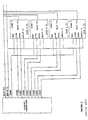
- FIGURE 2 generally depicts a typical conventional frame buffer organization and its interface with an associated display controller.
- the depicted subsystem includes a 64-bit data bus supported by four 256K by 16 dynamic random access memory devices (DRAMs).
- DRAMs dynamic random access memory devices
- each of the DRAMs is contained in a package which includes a 16-pin wide data port (DQ), an 8-pin address port, a /RAS input pin, and upper-byte and lower-byte /CAS input pins (UCAS and LCAS, respectively).
- DQ 16-pin wide data port
- 8-pin address port 8-pin address port
- UCAS and LCAS upper-byte and lower-byte /CAS input pins
- Each DRAM also will normally include output enable (/OE) and write (/WE) input pins which receive read/write control signals from the controller.
- /OE output enable
- /WE write
- the controller in the subsystem of FIGURE 2 In addition to generating addresses for reading and writing data to locations within the frame buffer, the controller in the subsystem of FIGURE 2 generates a row address strobe, /RAS0, and eight (8) column address strobes /CAS0 - /CAS 7.
- the row address strobe controls the row address latching into the four DRAMs and generally times the precharge and active cycles of the DRAMs.
- Two of the eight column address strobes are presented to each DRAM for column address latching, one to the LCAS pin for independently accessing the lower byte and the other to the UCAS pin for independently accessing the upper byte of each 16-bit location.
- FIGURE 3 is a functional block diagram depicting a memory subsystem 300 embodying the principles of the present invention.
- Subsystem 300 includes a display controller 301 and a frame buffer 302.
- display controller 301 and frame buffer 302 may be employed as display controller 104 and frame buffer 108 in system 100.
- frame buffer 302 has a storage capacity (i.e DRAM cell array size) optimized to meet the display data storage requirements of display controller 301 and the associated display device with minimal excess capacity.
- frame buffer 302 is a 1.5 MByte device in a single package which can provide for the approximately 1.3 MBytes of on-screen memory required for a 1024 x 1280 x 8 bit/pixel display and 200 KBytes of memory for such uses as icon storage and/or off-screen memory.
- the data port (DQ) of single-chip frame buffer 302 and the frame buffer - display controller data path 303 are 64 bits wide according to the principles of the present invention.
- the address path (bus) 304 is 9 bits wide.
- Frame buffer 302 includes a single /RAS and a single /CAS input.
- a write enable input /WE is provided for read/write control. Timing of the access and control cycles of frame buffer 302 is controlled by the system master CLK and a clock enable signals CKE.
- a DSF input allows for the input of a special function enable signal for performing, among other things, write per bit operations.
- Single-chip frame buffers such as frame buffer 302, embodying the principles of the present invention have a number of substantial advantages over the prior art. Among other things, since only a single package is required to service a 64-bit bus, less board space is consumed, the board level interconnect is simpler and presents less loading, and the display subsystem cost is reduced. Further, since the storage capacity is tailored to meet the requirements of the display subsystem, wasted memory space is substantially reduced or eliminated. In the 1.5 MByte memory of the illustrated embodiment, a full 1/2 MByte of memory, which is wasted in the prior art systems such as that shown in FIGURE 2, is eliminated. Finally the single chip frame buffer with a 64-bit data pinout substantially simplifies the address timing requirements and reduces the processing overhead of the associated display controller.
- the present system requires only one /RAS signal and one /CAS signal.
- a single /RAS signal and a single /CAS signal in conjunction with the DSF bit and a mask received at the input port, is sufficient to provide for pixel by pixel data modification.
- FIGURE 4 is a high level functional block diagram of a preferred architecture for implementing frame buffer 302.
- Frame buffer 302 includes and array of DRAM cells 401, which in the illustrated embodiment has a capacity of 1.5 MBytes.
- Array 401 is associated with a row decoder 402, column decoder 403 and sense amplifiers 404, each of which is constructed from dynamic circuitry known in the art.
- Address bits received from address bus 304 are input into a row address buffer 405 and a column address buffer 407.
- the row address and column address bits are received word-serial from a multiplexed address bus 304 and latched-in with /RAS and /CAS respectively.
- Address counters 406 and 408 are provided to internally increment from the received row and column addresses for implementing refresh and page mode access.
- Timing generators 409 receive the incoming clocks and control bits and generate and distribute the requisite clock and control signals.
- Write-per-bit circuitry 410 and a special mode register allow for selected masking of bits being written to array 401 through input/output buffers 412.
- I/O buffers 412 allow for the input and output of 64-bit words according to the preferred embodiment of the present invention.
- the write-per-bit function allows for pixel by pixel modification of display data.
- Write-per-bit is implemented using a 64-bit mask register within I/O buffers 412. The mask is loaded during a given active cycle by setting the DSF pin high, presenting a corresponding opcode at the address pins, and presenting a 64-bit mask at the data pins DQ0 - DQ63. During a subsequent selected active cycle(s) the DSF pin is set high to activate the mask to perform a masked write.
- Single-chip frame buffers according to the present invention can be packaged using any one of a number of packaging options.
- a 100-pin QFP package is used with the pin assignments substantially as shown in FIGURE 5.
Landscapes
- Engineering & Computer Science (AREA)
- Theoretical Computer Science (AREA)
- Physics & Mathematics (AREA)
- General Physics & Mathematics (AREA)
- Computer Hardware Design (AREA)
- Human Computer Interaction (AREA)
- Multimedia (AREA)
- General Engineering & Computer Science (AREA)
- Controls And Circuits For Display Device (AREA)
- Dram (AREA)
- Image Input (AREA)
- Memory System (AREA)
- Digital Computer Display Output (AREA)
- Control Of Indicators Other Than Cathode Ray Tubes (AREA)
Applications Claiming Priority (2)
| Application Number | Priority Date | Filing Date | Title |
|---|---|---|---|
| US61106196A | 1996-03-05 | 1996-03-05 | |
| US611061 | 1996-03-05 |
Publications (2)
| Publication Number | Publication Date |
|---|---|
| EP0801375A2 true EP0801375A2 (de) | 1997-10-15 |
| EP0801375A3 EP0801375A3 (de) | 1999-04-28 |
Family
ID=24447470
Family Applications (1)
| Application Number | Title | Priority Date | Filing Date |
|---|---|---|---|
| EP97301403A Withdrawn EP0801375A3 (de) | 1996-03-05 | 1997-03-04 | Speicher mit optimiertem Speicherraum und breitem Dateneingang/-ausgang, Systeme und Verfahren zur Verwendung desselben |
Country Status (4)
| Country | Link |
|---|---|
| EP (1) | EP0801375A3 (de) |
| JP (1) | JPH1040679A (de) |
| KR (1) | KR100490703B1 (de) |
| TW (1) | TW397960B (de) |
Cited By (1)
| Publication number | Priority date | Publication date | Assignee | Title |
|---|---|---|---|---|
| US8063910B2 (en) | 2008-07-08 | 2011-11-22 | Seiko Epson Corporation | Double-buffering of video data |
Families Citing this family (5)
| Publication number | Priority date | Publication date | Assignee | Title |
|---|---|---|---|---|
| US6650325B1 (en) | 1999-12-06 | 2003-11-18 | Nvidia Corporation | Method, apparatus and article of manufacture for boustrophedonic rasterization |
| US6573900B1 (en) | 1999-12-06 | 2003-06-03 | Nvidia Corporation | Method, apparatus and article of manufacture for a sequencer in a transform/lighting module capable of processing multiple independent execution threads |
| US6417851B1 (en) | 1999-12-06 | 2002-07-09 | Nvidia Corporation | Method and apparatus for lighting module in a graphics processor |
| US6515671B1 (en) | 1999-12-06 | 2003-02-04 | Nvidia Corporation | Method, apparatus and article of manufacture for a vertex attribute buffer in a graphics processor |
| US6504542B1 (en) | 1999-12-06 | 2003-01-07 | Nvidia Corporation | Method, apparatus and article of manufacture for area rasterization using sense points |
Family Cites Families (7)
| Publication number | Priority date | Publication date | Assignee | Title |
|---|---|---|---|---|
| US4562435A (en) * | 1982-09-29 | 1985-12-31 | Texas Instruments Incorporated | Video display system using serial/parallel access memories |
| US5163024A (en) * | 1983-12-30 | 1992-11-10 | Texas Instruments Incorporated | Video display system using memory with parallel and serial access employing serial shift registers selected by column address |
| JP3321651B2 (ja) * | 1991-07-26 | 2002-09-03 | サン・マイクロシステムズ・インコーポレーテッド | コンピュータの出力表示のためのフレームバッファメモリを提供する装置および方法 |
| US5243447A (en) * | 1992-06-19 | 1993-09-07 | Intel Corporation | Enhanced single frame buffer display system |
| WO1994018661A1 (en) * | 1993-02-05 | 1994-08-18 | Apple Computer, Inc. | Method and apparatus for computer video display memory |
| US5694143A (en) * | 1994-06-02 | 1997-12-02 | Accelerix Limited | Single chip frame buffer and graphics accelerator |
| WO1995035572A1 (en) * | 1994-06-20 | 1995-12-28 | Neomagic Corporation | Graphics controller integrated circuit without memory interface |
-
1997
- 1997-02-20 JP JP9036524A patent/JPH1040679A/ja active Pending
- 1997-02-27 TW TW086102376A patent/TW397960B/zh not_active IP Right Cessation
- 1997-03-04 EP EP97301403A patent/EP0801375A3/de not_active Withdrawn
- 1997-03-05 KR KR1019970007931A patent/KR100490703B1/ko not_active Expired - Lifetime
Cited By (1)
| Publication number | Priority date | Publication date | Assignee | Title |
|---|---|---|---|---|
| US8063910B2 (en) | 2008-07-08 | 2011-11-22 | Seiko Epson Corporation | Double-buffering of video data |
Also Published As
| Publication number | Publication date |
|---|---|
| JPH1040679A (ja) | 1998-02-13 |
| KR100490703B1 (ko) | 2005-08-11 |
| TW397960B (en) | 2000-07-11 |
| EP0801375A3 (de) | 1999-04-28 |
| KR970066883A (ko) | 1997-10-13 |
Similar Documents
| Publication | Publication Date | Title |
|---|---|---|
| JP4128234B2 (ja) | メモリ素子、処理システム、メモリ素子を制御する方法およびダイナミックランダムアクセスメモリを操作する方法 | |
| JP2968486B2 (ja) | メモリ、メモリサブシステム、メモリ装置およびメモリシステムアドレス方法 | |
| KR100245535B1 (ko) | 이중 뱅크 메모리와 이를 사용하는 시스템 | |
| US5781200A (en) | Tile memory mapping for increased throughput in a dual bank access DRAM | |
| US5815456A (en) | Multibank -- multiport memories and systems and methods using the same | |
| US5761694A (en) | Multi-bank memory system and method having addresses switched between the row and column decoders in different banks | |
| US5945974A (en) | Display controller with integrated half frame buffer and systems and methods using the same | |
| US5654932A (en) | Memory devices with selectable access type and methods using the same | |
| US5829016A (en) | Memory system with multiplexed input-output port and systems and methods using the same | |
| KR100490703B1 (ko) | 단일-칩프레임버퍼,프레임버퍼,디스플레이서브시스템및프레임버퍼구성방법 | |
| EP0487819B1 (de) | Video-RAM mit schnellen Rücksetzung und Kopiermöglichkeit | |
| EP0823116B1 (de) | Schaltungen, systeme und verfahren zur speicherdatenänderung unter verwendung logischer funktionen | |
| US5906003A (en) | Memory device with an externally selectable-width I/O port and systems and methods using the same | |
| US6425020B1 (en) | Systems and methods for passively transferring data across a selected single bus line independent of a control circuitry | |
| HK1002883A (en) | A memory with optimized memory space and wide data input/output and systems and methods using the same | |
| HK1007912B (en) | Circuits, systems and methods for modifying data stored in a memory using logic operations | |
| HK1010014A (en) | A memory architecture using conserved adressing and systems and methods using the same | |
| HK1010012B (en) | Low pin count-wide memory devices and systems and methods using the same | |
| HK1005277A (en) | Multibank-multiport memories and systems and methods using the same | |
| HK1010013A (en) | Memory devices with selectable access type and systems and methods using the same | |
| HK1004836A (en) | Display controller with internal half frame buffer and systems and methods using the same |
Legal Events
| Date | Code | Title | Description |
|---|---|---|---|
| PUAI | Public reference made under article 153(3) epc to a published international application that has entered the european phase |
Free format text: ORIGINAL CODE: 0009012 |
|
| AK | Designated contracting states |
Kind code of ref document: A2 Designated state(s): BE DE ES FR GB IE IT NL |
|
| PUAL | Search report despatched |
Free format text: ORIGINAL CODE: 0009013 |
|
| AK | Designated contracting states |
Kind code of ref document: A3 Designated state(s): BE DE ES FR GB IE IT NL |
|
| 17P | Request for examination filed |
Effective date: 19990618 |
|
| STAA | Information on the status of an ep patent application or granted ep patent |
Free format text: STATUS: THE APPLICATION HAS BEEN WITHDRAWN |
|
| 18W | Application withdrawn |
Withdrawal date: 20010125 |
|
| REG | Reference to a national code |
Ref country code: HK Ref legal event code: WD Ref document number: 1002883 Country of ref document: HK |