EP0816914B1 - Diazonium salt for thermosensitive recording medium - Google Patents
Diazonium salt for thermosensitive recording medium Download PDFInfo
- Publication number
- EP0816914B1 EP0816914B1 EP97304475A EP97304475A EP0816914B1 EP 0816914 B1 EP0816914 B1 EP 0816914B1 EP 97304475 A EP97304475 A EP 97304475A EP 97304475 A EP97304475 A EP 97304475A EP 0816914 B1 EP0816914 B1 EP 0816914B1
- Authority
- EP
- European Patent Office
- Prior art keywords
- diazonium salt
- thermosensitive recording
- naphthol
- recording medium
- coupler
- Prior art date
- Legal status (The legal status is an assumption and is not a legal conclusion. Google has not performed a legal analysis and makes no representation as to the accuracy of the status listed.)
- Expired - Lifetime
Links
- 150000001989 diazonium salts Chemical class 0.000 title claims description 243
- 239000012954 diazonium Substances 0.000 title claims description 242
- 239000002775 capsule Substances 0.000 claims description 44
- 150000007514 bases Chemical class 0.000 claims description 41
- 239000000203 mixture Substances 0.000 claims description 31
- 239000003094 microcapsule Substances 0.000 claims description 24
- 238000005979 thermal decomposition reaction Methods 0.000 claims description 19
- 230000001678 irradiating effect Effects 0.000 claims description 16
- 125000000217 alkyl group Chemical group 0.000 claims description 14
- 125000004432 carbon atom Chemical group C* 0.000 claims description 11
- 125000004108 n-butyl group Chemical group [H]C([H])([H])C([H])([H])C([H])([H])C([H])([H])* 0.000 claims description 8
- 125000002914 sec-butyl group Chemical group [H]C([H])([H])C([H])([H])C([H])(*)C([H])([H])[H] 0.000 claims description 8
- 125000000999 tert-butyl group Chemical group [H]C([H])([H])C(*)(C([H])([H])[H])C([H])([H])[H] 0.000 claims description 8
- 125000000753 cycloalkyl group Chemical group 0.000 claims description 5
- 125000002521 alkyl halide group Chemical group 0.000 claims description 4
- 238000005192 partition Methods 0.000 claims 2
- XEKOWRVHYACXOJ-UHFFFAOYSA-N Ethyl acetate Chemical compound CCOC(C)=O XEKOWRVHYACXOJ-UHFFFAOYSA-N 0.000 description 159
- IAZDPXIOMUYVGZ-UHFFFAOYSA-N Dimethylsulphoxide Chemical compound CS(C)=O IAZDPXIOMUYVGZ-UHFFFAOYSA-N 0.000 description 108
- 239000000243 solution Substances 0.000 description 94
- 239000000126 substance Substances 0.000 description 68
- DOIRQSBPFJWKBE-UHFFFAOYSA-N dibutyl phthalate Chemical compound CCCCOC(=O)C1=CC=CC=C1C(=O)OCCCC DOIRQSBPFJWKBE-UHFFFAOYSA-N 0.000 description 52
- 238000006243 chemical reaction Methods 0.000 description 48
- -1 hexafluorophosphate salt Chemical class 0.000 description 41
- JFGQHAHJWJBOPD-UHFFFAOYSA-N 3-hydroxy-n-phenylnaphthalene-2-carboxamide Chemical compound OC1=CC2=CC=CC=C2C=C1C(=O)NC1=CC=CC=C1 JFGQHAHJWJBOPD-UHFFFAOYSA-N 0.000 description 40
- 239000003921 oil Substances 0.000 description 40
- ZMXDDKWLCZADIW-UHFFFAOYSA-N N,N-Dimethylformamide Chemical compound CN(C)C=O ZMXDDKWLCZADIW-UHFFFAOYSA-N 0.000 description 39
- CRRLDLPBQWRVGN-UHFFFAOYSA-N n-[2-methyl-4-[3-methyl-4-(3-oxobutanoylamino)phenyl]phenyl]-3-oxobutanamide Chemical compound C1=C(C)C(NC(=O)CC(=O)C)=CC=C1C1=CC=C(NC(=O)CC(C)=O)C(C)=C1 CRRLDLPBQWRVGN-UHFFFAOYSA-N 0.000 description 38
- XLYOFNOQVPJJNP-UHFFFAOYSA-N water Substances O XLYOFNOQVPJJNP-UHFFFAOYSA-N 0.000 description 38
- 238000000605 extraction Methods 0.000 description 32
- YXFVVABEGXRONW-UHFFFAOYSA-N Toluene Chemical compound CC1=CC=CC=C1 YXFVVABEGXRONW-UHFFFAOYSA-N 0.000 description 30
- 238000001704 evaporation Methods 0.000 description 27
- YSMRWXYRXBRSND-UHFFFAOYSA-N TOTP Chemical compound CC1=CC=CC=C1OP(=O)(OC=1C(=CC=CC=1)C)OC1=CC=CC=C1C YSMRWXYRXBRSND-UHFFFAOYSA-N 0.000 description 25
- 238000000862 absorption spectrum Methods 0.000 description 24
- 239000010410 layer Substances 0.000 description 18
- 230000015572 biosynthetic process Effects 0.000 description 17
- 238000005259 measurement Methods 0.000 description 17
- 238000003756 stirring Methods 0.000 description 17
- 238000003786 synthesis reaction Methods 0.000 description 17
- VEXZGXHMUGYJMC-UHFFFAOYSA-N Hydrochloric acid Chemical compound Cl VEXZGXHMUGYJMC-UHFFFAOYSA-N 0.000 description 16
- 238000001816 cooling Methods 0.000 description 15
- 239000006185 dispersion Substances 0.000 description 15
- 239000002904 solvent Substances 0.000 description 15
- VLKZOEOYAKHREP-UHFFFAOYSA-N n-Hexane Chemical compound CCCCCC VLKZOEOYAKHREP-UHFFFAOYSA-N 0.000 description 14
- 238000005160 1H NMR spectroscopy Methods 0.000 description 13
- 238000010521 absorption reaction Methods 0.000 description 13
- 230000008020 evaporation Effects 0.000 description 13
- 239000000706 filtrate Substances 0.000 description 13
- YMWUJEATGCHHMB-UHFFFAOYSA-N Dichloromethane Chemical compound ClCCl YMWUJEATGCHHMB-UHFFFAOYSA-N 0.000 description 12
- 239000007864 aqueous solution Substances 0.000 description 12
- FUPAJKKAHDLPAZ-UHFFFAOYSA-N 1,2,3-triphenylguanidine Chemical class C=1C=CC=CC=1NC(=NC=1C=CC=CC=1)NC1=CC=CC=C1 FUPAJKKAHDLPAZ-UHFFFAOYSA-N 0.000 description 11
- BWHMMNNQKKPAPP-UHFFFAOYSA-L potassium carbonate Chemical compound [K+].[K+].[O-]C([O-])=O BWHMMNNQKKPAPP-UHFFFAOYSA-L 0.000 description 10
- 239000013078 crystal Substances 0.000 description 9
- 230000009257 reactivity Effects 0.000 description 9
- 238000000034 method Methods 0.000 description 8
- GEHJYWRUCIMESM-UHFFFAOYSA-L sodium sulfite Chemical compound [Na+].[Na+].[O-]S([O-])=O GEHJYWRUCIMESM-UHFFFAOYSA-L 0.000 description 8
- 239000003086 colorant Substances 0.000 description 7
- 230000003287 optical effect Effects 0.000 description 7
- HZNVUJQVZSTENZ-UHFFFAOYSA-N 2,3-dichloro-5,6-dicyano-1,4-benzoquinone Chemical compound ClC1=C(Cl)C(=O)C(C#N)=C(C#N)C1=O HZNVUJQVZSTENZ-UHFFFAOYSA-N 0.000 description 6
- HEDRZPFGACZZDS-UHFFFAOYSA-N Chloroform Chemical compound ClC(Cl)Cl HEDRZPFGACZZDS-UHFFFAOYSA-N 0.000 description 6
- OKKJLVBELUTLKV-UHFFFAOYSA-N Methanol Chemical compound OC OKKJLVBELUTLKV-UHFFFAOYSA-N 0.000 description 6
- HEMHJVSKTPXQMS-UHFFFAOYSA-M Sodium hydroxide Chemical compound [OH-].[Na+] HEMHJVSKTPXQMS-UHFFFAOYSA-M 0.000 description 6
- 239000000839 emulsion Substances 0.000 description 6
- 238000002360 preparation method Methods 0.000 description 6
- 239000004372 Polyvinyl alcohol Substances 0.000 description 5
- VYPSYNLAJGMNEJ-UHFFFAOYSA-N Silicium dioxide Chemical compound O=[Si]=O VYPSYNLAJGMNEJ-UHFFFAOYSA-N 0.000 description 5
- 238000004587 chromatography analysis Methods 0.000 description 5
- 238000006193 diazotization reaction Methods 0.000 description 5
- 239000003480 eluent Substances 0.000 description 5
- 229920002451 polyvinyl alcohol Polymers 0.000 description 5
- 235000019422 polyvinyl alcohol Nutrition 0.000 description 5
- 229910000027 potassium carbonate Inorganic materials 0.000 description 5
- 239000000741 silica gel Substances 0.000 description 5
- 229910002027 silica gel Inorganic materials 0.000 description 5
- ZROGCHDPRZRKTI-UHFFFAOYSA-N 1,4-dibutoxybenzene Chemical compound CCCCOC1=CC=C(OCCCC)C=C1 ZROGCHDPRZRKTI-UHFFFAOYSA-N 0.000 description 4
- FJKROLUGYXJWQN-UHFFFAOYSA-N 4-hydroxybenzoic acid Chemical compound OC(=O)C1=CC=C(O)C=C1 FJKROLUGYXJWQN-UHFFFAOYSA-N 0.000 description 4
- 0 CC(C)(*)c(cc1)ccc1O Chemical compound CC(C)(*)c(cc1)ccc1O 0.000 description 4
- XEEYBQQBJWHFJM-UHFFFAOYSA-N Iron Chemical compound [Fe] XEEYBQQBJWHFJM-UHFFFAOYSA-N 0.000 description 4
- CDBYLPFSWZWCQE-UHFFFAOYSA-L Sodium Carbonate Chemical compound [Na+].[Na+].[O-]C([O-])=O CDBYLPFSWZWCQE-UHFFFAOYSA-L 0.000 description 4
- 230000006866 deterioration Effects 0.000 description 4
- 238000002474 experimental method Methods 0.000 description 4
- 239000000463 material Substances 0.000 description 4
- 238000000655 nuclear magnetic resonance spectrum Methods 0.000 description 4
- 150000007530 organic bases Chemical class 0.000 description 4
- 239000002245 particle Substances 0.000 description 4
- 235000010265 sodium sulphite Nutrition 0.000 description 4
- 230000002194 synthesizing effect Effects 0.000 description 4
- ZWOYWHYRFBLDEV-UHFFFAOYSA-N 1-tert-butyl-4-(4-nitrophenoxy)benzene Chemical compound C1=CC(C(C)(C)C)=CC=C1OC1=CC=C([N+]([O-])=O)C=C1 ZWOYWHYRFBLDEV-UHFFFAOYSA-N 0.000 description 3
- NGAKTGQNKCJRRF-UHFFFAOYSA-N 2,5-dibutoxyphenol Chemical compound CCCCOC1=CC=C(OCCCC)C(O)=C1 NGAKTGQNKCJRRF-UHFFFAOYSA-N 0.000 description 3
- 238000005481 NMR spectroscopy Methods 0.000 description 3
- KWYUFKZDYYNOTN-UHFFFAOYSA-M Potassium hydroxide Chemical compound [OH-].[K+] KWYUFKZDYYNOTN-UHFFFAOYSA-M 0.000 description 3
- 150000001450 anions Chemical class 0.000 description 3
- 230000000295 complement effect Effects 0.000 description 3
- 150000001875 compounds Chemical class 0.000 description 3
- 150000008049 diazo compounds Chemical class 0.000 description 3
- 239000012948 isocyanate Substances 0.000 description 3
- 238000002844 melting Methods 0.000 description 3
- 230000008018 melting Effects 0.000 description 3
- 239000002798 polar solvent Substances 0.000 description 3
- YXPVJLPCUHRKKM-UHFFFAOYSA-N (2,5-dibutoxyphenyl) acetate Chemical compound CCCCOC1=CC=C(OCCCC)C(OC(C)=O)=C1 YXPVJLPCUHRKKM-UHFFFAOYSA-N 0.000 description 2
- KMOLKMSGDUDNDI-UHFFFAOYSA-N 1-(2,5-dibutoxyphenyl)ethanone Chemical compound CCCCOC1=CC=C(OCCCC)C(C(C)=O)=C1 KMOLKMSGDUDNDI-UHFFFAOYSA-N 0.000 description 2
- WBUKCUUFNOKAKE-UHFFFAOYSA-N 1-(4-diazocyclohexa-1,5-dien-1-yl)oxy-4-(2,4,4-trimethylpentan-2-yl)benzene Chemical compound C1=CC(C(C)(C)CC(C)(C)C)=CC=C1OC1=CCC(=[N+]=[N-])C=C1 WBUKCUUFNOKAKE-UHFFFAOYSA-N 0.000 description 2
- ZDFBKZUDCQQKAC-UHFFFAOYSA-N 1-bromo-4-nitrobenzene Chemical compound [O-][N+](=O)C1=CC=C(Br)C=C1 ZDFBKZUDCQQKAC-UHFFFAOYSA-N 0.000 description 2
- KJCVRFUGPWSIIH-UHFFFAOYSA-N 1-naphthol Chemical compound C1=CC=C2C(O)=CC=CC2=C1 KJCVRFUGPWSIIH-UHFFFAOYSA-N 0.000 description 2
- CZGCEKJOLUNIFY-UHFFFAOYSA-N 4-Chloronitrobenzene Chemical compound [O-][N+](=O)C1=CC=C(Cl)C=C1 CZGCEKJOLUNIFY-UHFFFAOYSA-N 0.000 description 2
- 229940090248 4-hydroxybenzoic acid Drugs 0.000 description 2
- CYYZDBDROVLTJU-UHFFFAOYSA-N 4-n-Butylphenol Chemical compound CCCCC1=CC=C(O)C=C1 CYYZDBDROVLTJU-UHFFFAOYSA-N 0.000 description 2
- CSCPPACGZOOCGX-UHFFFAOYSA-N Acetone Chemical compound CC(C)=O CSCPPACGZOOCGX-UHFFFAOYSA-N 0.000 description 2
- LFQSCWFLJHTTHZ-UHFFFAOYSA-N Ethanol Chemical compound CCO LFQSCWFLJHTTHZ-UHFFFAOYSA-N 0.000 description 2
- QIGBRXMKCJKVMJ-UHFFFAOYSA-N Hydroquinone Chemical compound OC1=CC=C(O)C=C1 QIGBRXMKCJKVMJ-UHFFFAOYSA-N 0.000 description 2
- KFSLWBXXFJQRDL-UHFFFAOYSA-N Peracetic acid Chemical compound CC(=O)OO KFSLWBXXFJQRDL-UHFFFAOYSA-N 0.000 description 2
- VSCWAEJMTAWNJL-UHFFFAOYSA-K aluminium trichloride Chemical compound Cl[Al](Cl)Cl VSCWAEJMTAWNJL-UHFFFAOYSA-K 0.000 description 2
- 239000012267 brine Substances 0.000 description 2
- 125000000484 butyl group Chemical group [H]C([*])([H])C([H])([H])C([H])([H])C([H])([H])[H] 0.000 description 2
- 238000004040 coloring Methods 0.000 description 2
- 238000000354 decomposition reaction Methods 0.000 description 2
- 230000003247 decreasing effect Effects 0.000 description 2
- 230000000694 effects Effects 0.000 description 2
- 238000010438 heat treatment Methods 0.000 description 2
- 239000012456 homogeneous solution Substances 0.000 description 2
- 238000004519 manufacturing process Methods 0.000 description 2
- 239000000155 melt Substances 0.000 description 2
- UZKWTJUDCOPSNM-UHFFFAOYSA-N methoxybenzene Substances CCCCOC=C UZKWTJUDCOPSNM-UHFFFAOYSA-N 0.000 description 2
- 238000002156 mixing Methods 0.000 description 2
- 239000012044 organic layer Substances 0.000 description 2
- GJYCVCVHRSWLNY-UHFFFAOYSA-N ortho-butylphenol Natural products CCCCC1=CC=CC=C1O GJYCVCVHRSWLNY-UHFFFAOYSA-N 0.000 description 2
- 238000006116 polymerization reaction Methods 0.000 description 2
- 229910000029 sodium carbonate Inorganic materials 0.000 description 2
- HPALAKNZSZLMCH-UHFFFAOYSA-M sodium;chloride;hydrate Chemical compound O.[Na+].[Cl-] HPALAKNZSZLMCH-UHFFFAOYSA-M 0.000 description 2
- UMGDCJDMYOKAJW-UHFFFAOYSA-N thiourea Chemical compound NC(N)=S UMGDCJDMYOKAJW-UHFFFAOYSA-N 0.000 description 2
- NAWXUBYGYWOOIX-SFHVURJKSA-N (2s)-2-[[4-[2-(2,4-diaminoquinazolin-6-yl)ethyl]benzoyl]amino]-4-methylidenepentanedioic acid Chemical compound C1=CC2=NC(N)=NC(N)=C2C=C1CCC1=CC=C(C(=O)N[C@@H](CC(=C)C(O)=O)C(O)=O)C=C1 NAWXUBYGYWOOIX-SFHVURJKSA-N 0.000 description 1
- FTWMCSGJSZWKCR-UHFFFAOYSA-N 1,2,3-tricyclohexylguanidine Chemical compound C1CCCCC1NC(NC1CCCCC1)=NC1CCCCC1 FTWMCSGJSZWKCR-UHFFFAOYSA-N 0.000 description 1
- FKTHNVSLHLHISI-UHFFFAOYSA-N 1,2-bis(isocyanatomethyl)benzene Chemical compound O=C=NCC1=CC=CC=C1CN=C=O FKTHNVSLHLHISI-UHFFFAOYSA-N 0.000 description 1
- MPUAUPQFSLHOHQ-UHFFFAOYSA-N 1,2-dicyclohexylguanidine Chemical class C1CCCCC1NC(=N)NC1CCCCC1 MPUAUPQFSLHOHQ-UHFFFAOYSA-N 0.000 description 1
- VGZQXMKOOXTPND-UHFFFAOYSA-N 1-[[naphthalen-1-yl(phenyl)methoxy]-phenylmethyl]naphthalene Chemical compound C=1C=CC=CC=1C(C=1C2=CC=CC=C2C=CC=1)OC(C=1C2=CC=CC=C2C=CC=1)C1=CC=CC=C1 VGZQXMKOOXTPND-UHFFFAOYSA-N 0.000 description 1
- MPPPKRYCTPRNTB-UHFFFAOYSA-N 1-bromobutane Chemical compound CCCCBr MPPPKRYCTPRNTB-UHFFFAOYSA-N 0.000 description 1
- VWGVUCWHPBULRD-UHFFFAOYSA-N 2,4,5-tris(furan-2-yl)-4,5-dihydro-1h-imidazole Chemical compound N1C(C=2OC=CC=2)C(C=2OC=CC=2)N=C1C1=CC=CO1 VWGVUCWHPBULRD-UHFFFAOYSA-N 0.000 description 1
- DYWBYCYREANRBJ-UHFFFAOYSA-N 2-[(4-chlorophenyl)methoxy]naphthalene Chemical compound C1=CC(Cl)=CC=C1COC1=CC=C(C=CC=C2)C2=C1 DYWBYCYREANRBJ-UHFFFAOYSA-N 0.000 description 1
- UHGULLIUJBCTEF-UHFFFAOYSA-N 2-aminobenzothiazole Chemical compound C1=CC=C2SC(N)=NC2=C1 UHGULLIUJBCTEF-UHFFFAOYSA-N 0.000 description 1
- 150000004964 2-benzylimidazoles Chemical class 0.000 description 1
- UPHOPMSGKZNELG-UHFFFAOYSA-N 2-hydroxynaphthalene-1-carboxylic acid Chemical class C1=CC=C2C(C(=O)O)=C(O)C=CC2=C1 UPHOPMSGKZNELG-UHFFFAOYSA-N 0.000 description 1
- WLTCCDHHWYAMCG-UHFFFAOYSA-N 2-phenylmethoxynaphthalene Chemical compound C=1C=C2C=CC=CC2=CC=1OCC1=CC=CC=C1 WLTCCDHHWYAMCG-UHFFFAOYSA-N 0.000 description 1
- FQHUDZKKDCTQET-UHFFFAOYSA-N 2-undecyl-4,5-dihydro-1h-imidazole Chemical class CCCCCCCCCCCC1=NCCN1 FQHUDZKKDCTQET-UHFFFAOYSA-N 0.000 description 1
- AQYMRQUYPFCXDM-UHFFFAOYSA-N 3-hydroxy-n-(2-methoxyphenyl)naphthalene-2-carboxamide Chemical compound COC1=CC=CC=C1NC(=O)C1=CC2=CC=CC=C2C=C1O AQYMRQUYPFCXDM-UHFFFAOYSA-N 0.000 description 1
- FBLAHUMENIHUGG-UHFFFAOYSA-N 3-hydroxy-n-(2-methylphenyl)naphthalene-2-carboxamide Chemical compound CC1=CC=CC=C1NC(=O)C1=CC2=CC=CC=C2C=C1O FBLAHUMENIHUGG-UHFFFAOYSA-N 0.000 description 1
- YZJSKRBKHCLMQC-UHFFFAOYSA-N 3-hydroxy-n-(3-nitrophenyl)naphthalene-2-carboxamide Chemical compound OC1=CC2=CC=CC=C2C=C1C(=O)NC1=CC=CC([N+]([O-])=O)=C1 YZJSKRBKHCLMQC-UHFFFAOYSA-N 0.000 description 1
- QGZGJNPVHADCFM-UHFFFAOYSA-N 3-hydroxy-n-naphthalen-1-ylnaphthalene-2-carboxamide Chemical compound C1=CC=C2C(NC(=O)C3=CC4=CC=CC=C4C=C3O)=CC=CC2=C1 QGZGJNPVHADCFM-UHFFFAOYSA-N 0.000 description 1
- PMYDPQQPEAYXKD-UHFFFAOYSA-N 3-hydroxy-n-naphthalen-2-ylnaphthalene-2-carboxamide Chemical compound C1=CC=CC2=CC(NC(=O)C3=CC4=CC=CC=C4C=C3O)=CC=C21 PMYDPQQPEAYXKD-UHFFFAOYSA-N 0.000 description 1
- ZUTYZAFDFLLILI-UHFFFAOYSA-N 4-sec-Butylphenol Chemical compound CCC(C)C1=CC=C(O)C=C1 ZUTYZAFDFLLILI-UHFFFAOYSA-N 0.000 description 1
- QHPQWRBYOIRBIT-UHFFFAOYSA-N 4-tert-butylphenol Chemical compound CC(C)(C)C1=CC=C(O)C=C1 QHPQWRBYOIRBIT-UHFFFAOYSA-N 0.000 description 1
- TYOXIFXYEIILLY-UHFFFAOYSA-N 5-methyl-2-phenyl-1h-imidazole Chemical class N1C(C)=CN=C1C1=CC=CC=C1 TYOXIFXYEIILLY-UHFFFAOYSA-N 0.000 description 1
- XHLKOHSAWQPOFO-UHFFFAOYSA-N 5-phenyl-1h-imidazole Chemical class N1C=NC=C1C1=CC=CC=C1 XHLKOHSAWQPOFO-UHFFFAOYSA-N 0.000 description 1
- ZPTVNYMJQHSSEA-UHFFFAOYSA-N Cc(cc1)ccc1[N+]([O-])=O Chemical compound Cc(cc1)ccc1[N+]([O-])=O ZPTVNYMJQHSSEA-UHFFFAOYSA-N 0.000 description 1
- VEXZGXHMUGYJMC-UHFFFAOYSA-M Chloride anion Chemical compound [Cl-] VEXZGXHMUGYJMC-UHFFFAOYSA-M 0.000 description 1
- MQIUGAXCHLFZKX-UHFFFAOYSA-N Di-n-octyl phthalate Natural products CCCCCCCCOC(=O)C1=CC=CC=C1C(=O)OCCCCCCCC MQIUGAXCHLFZKX-UHFFFAOYSA-N 0.000 description 1
- OTMSDBZUPAUEDD-UHFFFAOYSA-N Ethane Chemical compound CC OTMSDBZUPAUEDD-UHFFFAOYSA-N 0.000 description 1
- PDQAZBWRQCGBEV-UHFFFAOYSA-N Ethylenethiourea Chemical compound S=C1NCCN1 PDQAZBWRQCGBEV-UHFFFAOYSA-N 0.000 description 1
- KQJQICVXLJTWQD-UHFFFAOYSA-N N-Methylthiourea Chemical compound CNC(N)=S KQJQICVXLJTWQD-UHFFFAOYSA-N 0.000 description 1
- REYJJPSVUYRZGE-UHFFFAOYSA-N Octadecylamine Chemical compound CCCCCCCCCCCCCCCCCCN REYJJPSVUYRZGE-UHFFFAOYSA-N 0.000 description 1
- ZJCCRDAZUWHFQH-UHFFFAOYSA-N Trimethylolpropane Chemical compound CCC(CO)(CO)CO ZJCCRDAZUWHFQH-UHFFFAOYSA-N 0.000 description 1
- XSQUKJJJFZCRTK-UHFFFAOYSA-N Urea Natural products NC(N)=O XSQUKJJJFZCRTK-UHFFFAOYSA-N 0.000 description 1
- 150000004729 acetoacetic acid derivatives Chemical class 0.000 description 1
- WETWJCDKMRHUPV-UHFFFAOYSA-N acetyl chloride Chemical compound CC(Cl)=O WETWJCDKMRHUPV-UHFFFAOYSA-N 0.000 description 1
- 239000012346 acetyl chloride Substances 0.000 description 1
- 230000009471 action Effects 0.000 description 1
- 150000001350 alkyl halides Chemical class 0.000 description 1
- HTKFORQRBXIQHD-UHFFFAOYSA-N allylthiourea Chemical compound NC(=S)NCC=C HTKFORQRBXIQHD-UHFFFAOYSA-N 0.000 description 1
- 229960001748 allylthiourea Drugs 0.000 description 1
- 150000001409 amidines Chemical class 0.000 description 1
- 239000008346 aqueous phase Substances 0.000 description 1
- 239000000981 basic dye Substances 0.000 description 1
- BJQHLKABXJIVAM-UHFFFAOYSA-N bis(2-ethylhexyl) phthalate Chemical compound CCCCC(CC)COC(=O)C1=CC=CC=C1C(=O)OCC(CC)CCCC BJQHLKABXJIVAM-UHFFFAOYSA-N 0.000 description 1
- 238000009835 boiling Methods 0.000 description 1
- 235000019642 color hue Nutrition 0.000 description 1
- 239000007822 coupling agent Substances 0.000 description 1
- 238000005202 decontamination Methods 0.000 description 1
- 230000003588 decontaminative effect Effects 0.000 description 1
- 230000007423 decrease Effects 0.000 description 1
- 125000000664 diazo group Chemical group [N-]=[N+]=[*] 0.000 description 1
- IJGRMHOSHXDMSA-UHFFFAOYSA-O diazynium Chemical compound [NH+]#N IJGRMHOSHXDMSA-UHFFFAOYSA-O 0.000 description 1
- YPUGLZQRXQQCSX-UHFFFAOYSA-N dibenzylpiperazine Chemical compound C=1C=CC=CC=1CN(CC1)CCN1CC1=CC=CC=C1 YPUGLZQRXQQCSX-UHFFFAOYSA-N 0.000 description 1
- 235000014113 dietary fatty acids Nutrition 0.000 description 1
- 238000004945 emulsification Methods 0.000 description 1
- 239000000194 fatty acid Substances 0.000 description 1
- 229930195729 fatty acid Natural products 0.000 description 1
- 150000004665 fatty acids Chemical class 0.000 description 1
- 125000000524 functional group Chemical group 0.000 description 1
- CZLCEPVHPYKDPJ-UHFFFAOYSA-N guanidine;2,2,2-trichloroacetic acid Chemical compound NC(N)=N.OC(=O)C(Cl)(Cl)Cl CZLCEPVHPYKDPJ-UHFFFAOYSA-N 0.000 description 1
- 150000002357 guanidines Chemical class 0.000 description 1
- 125000003187 heptyl group Chemical group [H]C([*])([H])C([H])([H])C([H])([H])C([H])([H])C([H])([H])C([H])([H])C([H])([H])[H] 0.000 description 1
- 125000004051 hexyl group Chemical group [H]C([H])([H])C([H])([H])C([H])([H])C([H])([H])C([H])([H])C([H])([H])* 0.000 description 1
- 150000005419 hydroxybenzoic acid derivatives Chemical class 0.000 description 1
- 150000002460 imidazoles Chemical class 0.000 description 1
- 150000002462 imidazolines Chemical class 0.000 description 1
- 150000002475 indoles Chemical class 0.000 description 1
- 150000002513 isocyanates Chemical class 0.000 description 1
- 239000011259 mixed solution Substances 0.000 description 1
- CLWJIABBMNILFU-UHFFFAOYSA-N morpholine;2,2,2-trichloroacetic acid Chemical compound C1COCC[NH2+]1.[O-]C(=O)C(Cl)(Cl)Cl CLWJIABBMNILFU-UHFFFAOYSA-N 0.000 description 1
- 150000002780 morpholines Chemical class 0.000 description 1
- QTSGTSAWTPAMRU-UHFFFAOYSA-N n'-(1,3-benzothiazol-2-yl)benzohydrazide Chemical compound N=1C2=CC=CC=C2SC=1NNC(=O)C1=CC=CC=C1 QTSGTSAWTPAMRU-UHFFFAOYSA-N 0.000 description 1
- MXHTZQSKTCCMFG-UHFFFAOYSA-N n,n-dibenzyl-1-phenylmethanamine Chemical compound C=1C=CC=CC=1CN(CC=1C=CC=CC=1)CC1=CC=CC=C1 MXHTZQSKTCCMFG-UHFFFAOYSA-N 0.000 description 1
- FRQONEWDWWHIPM-UHFFFAOYSA-N n,n-dicyclohexylcyclohexanamine Chemical compound C1CCCCC1N(C1CCCCC1)C1CCCCC1 FRQONEWDWWHIPM-UHFFFAOYSA-N 0.000 description 1
- VTPSNRIENVXKCI-UHFFFAOYSA-N n-(2,4-dimethylphenyl)-3-hydroxynaphthalene-2-carboxamide Chemical compound CC1=CC(C)=CC=C1NC(=O)C1=CC2=CC=CC=C2C=C1O VTPSNRIENVXKCI-UHFFFAOYSA-N 0.000 description 1
- NXIGDUAONGBUKR-UHFFFAOYSA-N n-(2-ethoxyphenyl)-3-hydroxynaphthalene-2-carboxamide Chemical compound CCOC1=CC=CC=C1NC(=O)C1=CC2=CC=CC=C2C=C1O NXIGDUAONGBUKR-UHFFFAOYSA-N 0.000 description 1
- GXFGVXXEQKKDGE-UHFFFAOYSA-N n-(6-ethoxy-1,3-benzothiazol-2-yl)-3-oxobutanamide Chemical compound CCOC1=CC=C2N=C(NC(=O)CC(C)=O)SC2=C1 GXFGVXXEQKKDGE-UHFFFAOYSA-N 0.000 description 1
- OALZJIBCZVVPBY-UHFFFAOYSA-N n-benzyloctadecan-1-amine Chemical compound CCCCCCCCCCCCCCCCCCNCC1=CC=CC=C1 OALZJIBCZVVPBY-UHFFFAOYSA-N 0.000 description 1
- 125000000740 n-pentyl group Chemical group [H]C([H])([H])C([H])([H])C([H])([H])C([H])([H])C([H])([H])* 0.000 description 1
- 125000002347 octyl group Chemical group [H]C([*])([H])C([H])([H])C([H])([H])C([H])([H])C([H])([H])C([H])([H])C([H])([H])C([H])([H])[H] 0.000 description 1
- 125000001147 pentyl group Chemical group C(CCCC)* 0.000 description 1
- QHDYIMWKSCJTIM-UHFFFAOYSA-N phenyl 1-hydroxynaphthalene-2-carboxylate Chemical compound C1=CC2=CC=CC=C2C(O)=C1C(=O)OC1=CC=CC=C1 QHDYIMWKSCJTIM-UHFFFAOYSA-N 0.000 description 1
- XBDNVPPAQQNVBW-UHFFFAOYSA-N phenyl naphthalene-2-carboxylate Chemical compound C=1C=C2C=CC=CC2=CC=1C(=O)OC1=CC=CC=C1 XBDNVPPAQQNVBW-UHFFFAOYSA-N 0.000 description 1
- 150000003014 phosphoric acid esters Chemical class 0.000 description 1
- 238000006303 photolysis reaction Methods 0.000 description 1
- 150000003021 phthalic acid derivatives Chemical class 0.000 description 1
- 150000004885 piperazines Chemical class 0.000 description 1
- 229920003023 plastic Polymers 0.000 description 1
- 239000004033 plastic Substances 0.000 description 1
- 239000002243 precursor Substances 0.000 description 1
- 230000008569 process Effects 0.000 description 1
- 239000000047 product Substances 0.000 description 1
- VPJDULFXCAQHRC-UHFFFAOYSA-N prop-2-enylurea Chemical compound NC(=O)NCC=C VPJDULFXCAQHRC-UHFFFAOYSA-N 0.000 description 1
- 125000001436 propyl group Chemical group [H]C([*])([H])C([H])([H])C([H])([H])[H] 0.000 description 1
- 150000003222 pyridines Chemical class 0.000 description 1
- 150000003230 pyrimidines Chemical class 0.000 description 1
- 150000003233 pyrroles Chemical class 0.000 description 1
- 150000003839 salts Chemical class 0.000 description 1
- 230000001235 sensitizing effect Effects 0.000 description 1
- 229910001495 sodium tetrafluoroborate Inorganic materials 0.000 description 1
- 239000007858 starting material Substances 0.000 description 1
- 239000000758 substrate Substances 0.000 description 1
- 150000003557 thiazoles Chemical class 0.000 description 1
- 150000003585 thioureas Chemical class 0.000 description 1
- 150000003852 triazoles Chemical class 0.000 description 1
- STCOOQWBFONSKY-UHFFFAOYSA-N tributyl phosphate Chemical compound CCCCOP(=O)(OCCCC)OCCCC STCOOQWBFONSKY-UHFFFAOYSA-N 0.000 description 1
- XZZNDPSIHUTMOC-UHFFFAOYSA-N triphenyl phosphate Chemical compound C=1C=CC=CC=1OP(OC=1C=CC=CC=1)(=O)OC1=CC=CC=C1 XZZNDPSIHUTMOC-UHFFFAOYSA-N 0.000 description 1
- 150000003672 ureas Chemical class 0.000 description 1
- XOOUIPVCVHRTMJ-UHFFFAOYSA-L zinc stearate Chemical class [Zn+2].CCCCCCCCCCCCCCCCCC([O-])=O.CCCCCCCCCCCCCCCCCC([O-])=O XOOUIPVCVHRTMJ-UHFFFAOYSA-L 0.000 description 1
Images

Classifications
-
- C—CHEMISTRY; METALLURGY
- C07—ORGANIC CHEMISTRY
- C07C—ACYCLIC OR CARBOCYCLIC COMPOUNDS
- C07C245/00—Compounds containing chains of at least two nitrogen atoms with at least one nitrogen-to-nitrogen multiple bond
- C07C245/20—Diazonium compounds
-
- G—PHYSICS
- G03—PHOTOGRAPHY; CINEMATOGRAPHY; ANALOGOUS TECHNIQUES USING WAVES OTHER THAN OPTICAL WAVES; ELECTROGRAPHY; HOLOGRAPHY
- G03C—PHOTOSENSITIVE MATERIALS FOR PHOTOGRAPHIC PURPOSES; PHOTOGRAPHIC PROCESSES, e.g. CINE, X-RAY, COLOUR, STEREO-PHOTOGRAPHIC PROCESSES; AUXILIARY PROCESSES IN PHOTOGRAPHY
- G03C1/00—Photosensitive materials
- G03C1/52—Compositions containing diazo compounds as photosensitive substances
- G03C1/54—Diazonium salts or diazo anhydrides
Definitions
- the present invention relates to a diazonium salt used for a color-forming layer of a thermosensitive recording medium. More particularly, it relates to a diazonium salt which develops a red or yellow color when it reacts with a coupler, dissolves to a high concentration in capsule oil when sealed together with capsule oil in a microcapsule, and provides a thermosensitive recording medium that forms a high density, high contrast thermosensitive image and can prevent forgeries.
- thermosensitive recording medium using a diazonium salt which undergoes photodecomposition is replacing conventional thermosensitive recording media using color-forming leucodyes.
- the thermosensitive recording medium has a color-forming layer including a diazonium salt, coupler and basic compound on a support. It is known that, to improve the keeping properties of the thermosensitive recording medium, the diazonium salt is sealed together with capsule oil in a microcapsule by interface polymerization and is separated by the microcapsule wall from the coupler and basic compound so that it does not develop a color before exposing to heat.
- the thermosensitive recording medium using a diazonium salt is disclosed, for example, "Microcapsules" by Tamotsu Kondo, pp. 65 - 75, ed. Japan Standards Association (1991).
- thermosensitive recording media using diazonium salts which develop a blue color
- hardly any are known which develop a red or yellow color.
- diazonium salts which develop a blue color when they react with a coupler, and very few which develop a red or yellow color.
- the diazonium salt When the diazonium salt is sealed in the microcapsule, the diazonium salt must be dissolved in an oil (referred to hereafter as capsule oil) which forms the core of the capsule in order to form a stable emulsion which has a uniform particle diameter.
- capsule oil an oil which forms the core of the capsule in order to form a stable emulsion which has a uniform particle diameter.
- conventional diazonium salts have a low solubility in capsule oils such as dibutyl phthalate or tricresyl phosphate.
- capsule oils such as dibutyl phthalate or tricresyl phosphate.
- 4-diazodiphenyletherhexafluorophosphate which is generally used for developing a red color, has a solubility of 0.5 [g] or less in 100 [g] of dibutyl phthalate or 100 [g] of tricresyl phosphate.
- 4-diazo-4'-methyldiphenyletherhexafluorophosphate which is generally said to have a high solubility in capsule oil, has a solubility of 1.0 [g] or less in 100 [g] of dibutyl phthalate or 100 [g] of tricresyl phosphate.
- a method was therefore proposed for adding a polar solvent such as acetone to raise the solubility of a diazonium salt such as 4-diazodiphenyletherhexafluorophosphate or 4-diazo-4'-methyldiphenyletherhexafluorophosphate in capsule oil in JP-A-9 226 253 (Japanese Patent Application No. 36215/1996).
- a polar solvent such as acetone
- the polar solvent is also highly soluble in water
- the capsule oil, in which the diazonium salt is dissolved is dispersed in water giving an aqueous emulsion
- the diazonium salt tended to move into the aqueous phase and precipitated so that a concentration of the diazonium salt in the microcapsule fell. It is therefore necessary to dissolve a high concentration of the diazonium salt in the capsule oil alone without adding a polar solvent.
- thermosensitive recording media a diazonium salt, which is sealed together with capsule oil in a microcapsule and used for a color-forming layer of the thermosensitive recording media, was desired having the following properties:
- EP-A-0269440 discloses a multicolour heat-sensitive recording medium consisting of a plastics film coated with two or more layers (C, M and Y) producing different colour hues, each layer comprising a combination of (a) a precursor of a basic dye; (b) an electron accepting colour developer; (c) a diazo compound; and (d) a coupler.
- a number of diazo groups are disclosed, including 1-diazo-4-(4-tert-octyl-phenoxy)benzene, and the hexafluorophosphate salt thereof.
- GB-A-2164166 also relates to a heat-sensitive recording material comprising a support having several heat-colouring elements colouring in two or more different hues, each element comprising a diazo compound and a coupling agent.
- the diazonium salts disclosed include 1-diazo-4-(4-tert-octyl-phenoxy)benzene, hexafluorophosphate salt.
- JP-A-61197278 discloses a thermal recording material with a heat-sensitive recording layer containing an emulsified diazo compound. Diazonium salts having 2 or 18 carbon atoms are disclosed.
- thermosensitive recording medium which has a color-forming layer including a diazonium salt, can form a high density, high contrast thermosensitive image and can prevent forgeries.
- a diazonium salt for a color-forming layer of a thermosensitive recording medium having the formula (1) : wherein R is an alkyl group having four carbon atoms which is selected from the group consisting of n-butyl, t-butyl and sec-butyl, and X - is selected from the group consisting of hexafluorophosphate ion PF 6 - , tetrafluoroborate ion BF 4 - and tetraphenylborate ion (C 6 H 5 ) 4 B - .
- a diazonium salt for a color-forming layer of a thermosensitive recording medium having the formula (2): where R 1 and R 2 are alkyl, cycloalkyl or alkyl halide groups each having one or more carbon atoms, and X - is selected from the group consisting of hexafluorophosphate ion PF 6 - , tetrafluoroborate ion BF 4 - and tetraphenylborate ion (C 6 H 5 ) 4 B - .
- thermosensitive recording medium comprising a color-forming layer which includes a diazonium salt, a basic compound and a coupler: the diazonium salt having the formula (1) : wherein R is an alkyl group having four carbon atoms which is selected from the group consisting of n-butyl, t-butyl and sec-butyl, and X - is selected from the group consisting of hexafluorophosphate ion PF 6 - , tetrafluoroborate ion BF 4 - and tetraphenylborate ion (C 6 H 5 ) 4 B - .
- R is an alkyl group having four carbon atoms which is selected from the group consisting of n-butyl, t-butyl and sec-butyl
- X - is selected from the group consisting of hexafluorophosphate ion PF 6 - , tetrafluoroborate ion BF 4 -
- thermosensitive recording medium comprising a color-forming layer which includes a diazonium salt, a basic compound and a coupler: the diazonium salt having the formula (2) : where R 1 and R 2 are alkyl, cycloalkyl or alkyl halide groups each having one or more carbon atoms, and X - is selected from the group consisting of hexafluorophosphate ion PF 6 - , tetrafluoroborate ion BF 4 - and tetraphenylborate ion (C 6 H 5 ) 4 B - .
- thermosensitive recording medium there is provided the use of a diazonium salt having the formula (1) or (2) for a color-forming layer of a thermosensitive recording medium.
- a color-forming layer of a thermosensitive recording medium includes a diazonium salt, a basic compound and a coupler.
- the diazonium salt (referred to hereinafter as a first diazonium salt) for a color-forming layer of a thermosensitive recording medium according to the present invention is represented by the following formula (1): wherein R is an alkyl group which is selected from the group consisting of n-butyl, t-butyl and sec-butyl, and X - is selected from the group consisting of hexafluorophosphate ion PF 6 - , tetrafluoroborate ion BF 4 - and tetraphenylborate ion (C 6 H 5 ) 4 B - .
- the diazonium salt (referred to hereafter as a second diazonium salt) for a thermosensitive recording medium according to the present invention is represented by the following formula (2): wherein R 1 and R 2 are alkyl, cycloalkyl or alkyl halide groups each having one or more carbon atoms, R 1 and R 2 may be the same or different, and X - is selected from the group consisting of hexafluorophosphate ion PF 6 - , tetrafluoroborate ion BF 4 - and tetraphenylborate (C 6 H 5 ) 4 B - ion.
- R in the first diazonium salt represented by the above formula (1) is selected from the group consisting of n-butyl, t-butyl and sec-butyl, and R 1 and R 2 in the second diazonium salt represented by the above formula (2), may preferably be alkyl groups with 3 - 8 carbon atoms. This is because when there are 3 or more carbon atoms, the diazonium salt can be dissolved to a high concentration in capsule oil.
- the diazonium chloride formed in a diazotization step when the diazonium salt is synthesized which is described in detail with regard to a later process, is soluble in water so that a hexafluorophosphate salt, tetrafluoroborate salt or tetraphenylborate salt is easily prepared.
- the alkyl group R in the first diazonium salt represented by the above formula (1) is selected from the group consisting of n-butyl, t-butyl and sec-butyl and the alkyl groups R 1 and R 2 in the second diazonium salt represented by the above formula (2) may, for example, be propyl, butyl, pentyl (i.e., amyl), hexyl, heptyl or octyl, in addition to which cycloalkyl, alkyl halide or the like are also suitable.
- Butyl is particularly suitable as the alkyl group R of the first diazonium salt represented by the above formula (1) as it confers high solubility in capsule oil. Further, t-butyl and sec-butyl are especially suitable for the purpose of the present invention as these functional groups can be easily introduced using low-cost starting materials and the thermal stability of the resulting compounds is 115 °C or higher (i.e., thermal decontamination temperature is 115 °C or higher).
- the first or second diazonium salt of the present invention reacts with a coupler which is a hydroxynaphthoic acid derivative such as naphthol AS, naphthol AS-D, naphthol AS-OL, naphthol AS-PH, naphthol AS-MX, naphthol AS-BO, naphthol AS-BS or naphthol AS-SW, so as to develop a red color or a magenta color.
- a coupler which is a hydroxynaphthoic acid derivative such as naphthol AS, naphthol AS-D, naphthol AS-OL, naphthol AS-PH, naphthol AS-MX, naphthol AS-BO, naphthol AS-BS or naphthol AS-SW, so as to develop a red color or a magenta color.
- the first or second diazonium salt of the present invention reacts with a coupler which is an acetoacetic acid derivative such as naphthol AS-G, naphthol AS-LG, naphthol AS-L3G or naphthol AS-L4G so as to develop a yellow color.
- a coupler which is an acetoacetic acid derivative such as naphthol AS-G, naphthol AS-LG, naphthol AS-L3G or naphthol AS-L4G so as to develop a yellow color.
- naphthol AS and naphthol AS-G in a suitable proportion to use naphthol AS and naphthol AS-G as the coupler, and reacting the mixture with the first or second diazonium salt according to the present invention, an orange color, red color, pink color or the like may also be developed.
- This capsule oil dissolves a predetermined amount of diazonium salt, and forms a homogenous, stable emulsion in water. Ultimately, it has the important role of forming capsules of uniform particle diameter at the emulsion interface by interface polymerization.
- capsule oil examples include phthalic acid esters such as dibutyl phthalate and dioctyl phthalate, or phosphoric acid esters such as tricresyl phosphate, tributyl phosphate and triphenyl phosphate. These oils are most suitable as they have predetermined polar groups, form a homogenous, stable emulsion, and have a boiling point of 250 °C or higher, consequently they exhibit stability to the heat of a thermal head when used on thermosensitive paper.
- phthalic acid esters such as dibutyl phthalate and dioctyl phthalate
- phosphoric acid esters such as tricresyl phosphate, tributyl phosphate and triphenyl phosphate.
- the first and second diazonium salts of the present invention are, for example, characterized in that they have a high solubility in capsule oils such as dibutyl phthalate and tricresyl phosphate. Specifically, the diazonium salts of the present invention exhibit a solubility of 1 [g] or higher in 100 [g] of these capsule oils. Hence, when the diazonium salts of the present invention having this solubility range are used in thermosensitive recording media, it is possible to give a high density, high contrast print.
- the diazonium salt of the present invention has a solubility in the range 1 - 50 [g], and still more preferably 3 - 30 [g], with respect to 100 [g] of capsule oil. This is due to the fact that within these solubility limits, a print of still higher density and contrast can be obtained.
- 4-diazo-4'-n-butyldiphenyletherhexafluorophosphate the first diazonium salt
- 4-diazo-4'-t-butyldiphenyletherhexafluorophosphate has a solubility of 8 [g] in 100 [g] of dibutyl phthalate, and 8 [g] in 100 [g] of tricresyl phosphate.
- 4-diazo-4'-sec-butyldiphenyletherhexafluorophosphate has a solubility of 8 [g] in 100 [g] of dibutyl phthalate, 8 [g] in 100 [g] of tricresyl phosphate, and 10 [g] or more in 100 [g] of tricresyl phosphate. These compounds are therefore suitable as the diazonium salts of the present invention.
- 4-diazo-2',5'-di-n-butoxydiphenyletherhexafluorophosphate has a solubility of 20 [g] or more in either 100 [g] of dibutyl phthalate or 100 [g] of tricresyl phosphate, and is therefore suitable for the purpose of the present invention.
- thermosensitive recording medium in which the diazonium salt of the present invention is used, a predetermined amount of the basic compound is added to establish basic conditions so that the diazonium salt and coupler react together, thereby developing a color.
- organoammonium salts organoamines, amide compounds, urea derivatives, thiourea derivatives, thiazoles, pyrroles, pyrimidines, piperazines, guanidines, indoles, imidazoles, imidazolines, triazoles, morpholines, piperizines, amidines, pyridines or the like.
- tricyclohexylamine, tribenzylamine, octadecylbenzylamine, stearylamine, allyl urea, thiourea, methylthiourea, allyl thiourea, ethylene thiourea, 2-benzylimidazoles, 4-phenylimidazoles, 2-phenyl-4-methylimidazoles, 2-undecylimidazolines, 2,4,5-trifuryl-2-imidazoline, 1,2,3-triphenylguanidines, 1,2-dicyclohexylguanidines, 1,2,3-tricyclohexylguanidine, guanidine trichloroacetate, N,N'-dibenzylpiperazine, 4-4'-dithiomorpholine, morpholinium trichloroacetate, 2-aminobenzothiazole, and 2-benzoylhydrazinobenzothiazole are suitable as the basic compound of the
- addition amount of this basic compound there is no particular limitation on the addition amount of this basic compound, however an addition in the range 1 - 5000 weight parts per 100 weight parts of diazonium salt is suitable. This is because when the addition of basic compound is within this range, a predetermined addition effect is obtained, and a high density, high contrast image can be formed without decreasing the relative amounts of diazonium salts and coupler.
- a more suitable addition amount of basic compound is 10 - 1000 weight parts per 100 weight parts of diazonium salt, the optimum addition amount being in the range 100 - 400 weight parts.
- thermosensitive recording medium in which the diazonium salt of the present invention is used, the sensitizer melts on exposure to heat, the viscosity of the color-forming layer as a whole decreases, and the reaction between the diazonium salt and coupler proceeds more efficiently.
- This sensitizer may be insoluble in water, and when it has a comparatively low molecular weight (average molecular weight less than 10000, or preferably 1000), it is easily melted by the action of heat and has good compatibility with the diazonium salt and coupler.
- the sensitizer are hydroxybenzoic acid derivatives, fatty acid amides, zinc stearates, ⁇ -naphthylbenzylether, ⁇ -naphthylbenzylether, ⁇ -naphthoic acid phenyl ester, ⁇ -hydroxy- ⁇ -naphthoic acid phenyl ester, ⁇ -naphthol-(p-chlorobenzyl)ether, 1,4-butadiol-p-methylphenylether, 1,4-butadiol-p-ethylphenylether, 1,4-butadiol-m-methylphenylether, 1,4-phenoxy-2-(p-chlorophenoxy)ethane and p-benzylphenyl. These compounds have a high sensitizing action together with a high heat resistance, and are therefore suitable for the purpose of the present invention.
- this sensitizer there is no particular limitation on the addition amount of this sensitizer, however an addition in the range 1 - 1000 weight parts per 100 weight parts of diazonium salt is suitable. This is because when the addition of basic compound is within this range, a predetermined addition effect is obtained, and a high density, high contrast image can be formed without decreasing the relative amounts of diazonium salts and coupler.
- a more suitable addition amount of sensitizer is 10 - 1000 weight parts per 100 weight parts of diazonium salt, the optimum addition amount being in the range 400 - 800 weight parts.
- the heat resistance of the diazonium salt of the present invention will be described.
- the diazonium salt of the present invention has a predetermined heat resistance. It is therefore desirable that the diazonium salt has a predetermined thermal decomposition temperature, measured as a melting peak temperature by a DTA (differential thermal analyzer).
- the thermal decomposition temperature as an exothermic peak temperature due to thermal decomposition, this temperature is 70 °C or higher when, for example, a 10 [mg] sample of the diazonium salt is heated in air at a rate of 10 °C/min using the DTA to increase the temperature .
- the diazonium salt of the present invention has a thermal decomposition temperature within this range, the thermosensitive recording medium can be kept over comparatively long periods before exposure to heat.
- a more suitable thermal decomposition temperature of the diazonium salt is within the range 90 - 180 °C, and preferably 115 - 160 °C. This is because, if the diazonium salt of the present invention has a thermal decomposition temperature within this range, the thermosensitive recording medium can be kept over still longer periods before exposure to heat, and when it is exposed to heat, a high density, high contrast image can be formed at comparatively low temperature.
- thermosensitive recording medium Next, the method of using the diazonium salt of the present invention in a thermosensitive recording medium will be described. A method of manufacturing a thermosensitive recording medium using this diazonium salt will also be described, but it should be understood that a use of the diazonium salt according to the present invention is not limited to this manufacturing method.
- a numeral 101 is the paper, 102 is a color-forming layer, 103 is the microcapsule, 104 is the diazonium salt, 105 is the coupler, 106 is the basic compound, and 107 is the sensitizer.
- thermosensitive recording medium When this thermosensitive recording medium is heated to form a predetermined image using a thermal head, the sensitizer 107 first melts, thereby lowering the viscosity of the whole medium so that the coupler 105, basic compound 106 and the diazonium salt 104 of the present invention mix easily together. The mixed coupler 105 and diazonium salt 104 then react in the basic environment, and a red or yellow color is developed.
- the diazonium salt which is not colored without heating by exposing it to ultraviolet light of wavelength 250 - 380 [nm] using an ultraviolet light irradiating device.
- the diazonium salt can no longer react with the coupler to develop a color even if it is heated again.
- the diazonium salt of the first embodiment is 4-diazo-4'-n-butyldiphenyletherhexafluorophosphate in which R is the n-butyl group, (CH 3 (CH 2 ) 3 - ).
- peaks are caused by protons included in 4-diazo-4'-n-butyldiphenyletherhexafluorophosphate shown in the above formula (7).
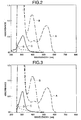
- Fig. 2 is an absorption spectrum wherein the vertical axis shows optical absorption (arbitrary units) and the horizontal axis shows wavelength [nm].
- Curve A is the absorption spectrum of the dimethylsulfoxide solution after reaction of the diazonium salt I with naphthol AS. Considering the visible wavelength region from 380 [nm] upwards, curve A shows an absorption of approximately 0.35 at wavelengths 380 [nm] and 450 [nm], and approximately 0 at a wavelength of 600 [nm].
- Curve B in Fig. 2 is the absorption spectrum of the dimethylsulfoxide solution after reaction of the diazonium salt I with naphthol AS-G. Curve B shows an absorption of approximately 0.60 at a wavelength of 350 [nm], and an absorption of approximately 0 at a wavelength of 490 [nm]. There was an absorption peak of approximately 1.2 in the wavelength region 350 - 490 [nm].
- the dimethylsulfoxide solution was irradiated with ultraviolet light of wavelength approximately 350 [nm].
- Naphthol AS and a basic compound were added to the dimethylsulfoxide solution, but no coloration was produced.
- naphthol AS-G and a basic compound were added to the dimethylsulfoxide solution, but no coloration was produced. This is due to the fact that the diazonium salt I was decomposed by irradiating with ultraviolet light, and lost its reactivity with naphthol AS or naphthol AS-G.
- the diazonium salt I turns a magenta color when it reacts with naphthol AS, and turns a yellow color when it reacts with naphthol AS-G.
- the diazonium salt I can be made to develop a red color, a orange color, a pink color or the like (hereafter, red colors is the general term for a red color, a orange color, a pink color or the like).
- the 4-diazo-4'-n-butyldiphenyletherhexafluorophosphate (diazonium salt I) is therefore suitable as a diazonium salt for a thermosensitive recording medium which develops red colors.
- the diazonium salt I is decomposed by irradiating with ultraviolet light so that it loses its reactivity with naphthol AS or naphthol AS-G, an image on a thermosensitive recording medium wherein 4-diazo-4'-n-butyldiphenyletherhexafluorophosphate (diazonium salt I) is used as the diazonium salt can be fixed in this way.
- the solubility of diazonium salt I was 8 [g] per 100 [g] of dibutyl phthalate, and 12 [g] per 100 [g] of tricresyl phosphate.
- the solubility of 4-diazodiphenyletherhexafluorophosphate or 4-diazo-4'-methyldiphenyletherhexafluorophosphate which are conventional diazonium salts for developing red colors in 100 [g] of dibutyl phthalate or 100 [g] of tricresyl phosphate is no higher than 1.0 [g]
- the diazonium salt I has a high solubility in dibutyl phthalate and tricresyl phosphate.
- diazonium salt I of the present invention has a high solubility in dibutyl phthalate and tricresyl phosphate as capsule oils
- 4-diazo-4'-n-butyldiphenyletherhexafluorophosphate (diazonium salt I) is suitable for use as a diazonium salt in a thermosensitive recording medium where the diazonium salt is sealed in microcapsules.
- the thermal decomposition temperature of the diazonium salt of the first embodiment was measured. Using a DTA, THERMAL ANALYZER DT-30 of Shimadzu Seisakusho, 10 [mg] of the diazonium salt of the first embodiment was heated so that the temperature rise was 10 °C/min, and the exothermic peak was measured as thermal decomposition temperature. A high value of 106 °C was obtained as a result.
- the diazonium salt of the second embodiment represented by the following general formula (8), is 4-diazo-2',5'-di-n-butoxydiphenyletherhexafluorophosphate in which R 1 and R 2 are n-butyl groups, (CH 3 (CH 2 ) 3 - ).
- 2,5-di-n-butoxyphenol was synthesized according to a reaction represented by the following formula (10).
- the concentrated filtrate was poured into 200 [ml] of water, and the mixture extracted with 200 [ml] of ethyl acetate.
- the extraction solution i.e. ethyl acetate solution
- peaks are caused by protons included in 4-diazo-2',5'-di-n-butoxydiphenyletherhexafluorophosphate shown in the above formula (14).
- Curve A in Fig. 3 is the absorption spectrum of the dimethylsulfoxide solution after reaction of the diazonium salt I with naphthol AS. Curve A in Fig. 3 shows the same variation as that of curve A in Fig. 2 described in the case of the first embodiment. From this variation, it may be understood why the dimethylsulfoxide solution after reaction exhibits a magenta coloration.
- Curve B in Fig. 3 is the absorption spectrum of the dimethylsulfoxide solution after reaction of the diazonium salt II with naphthol AS-G. From this variation, it may be understood why the dimethylsulfoxide solution after reaction exhibits a yellow coloration.
- the dimethylsulfoxide solution was irradiated with ultraviolet light of wavelength approximately 350 [nm].
- Naphthol AS and a basic compound were added to the dimethylsulfoxide solution, but no coloration was produced.
- naphthol AS-G and a basic compound were added to the dimethylsulfoxide solution, but no coloration was produced. This is due to the fact that the diazonium salt II was decomposed by irradiating with ultraviolet light, and lost its reactivity with naphthol AS or naphthol AS-G.
- the diazonium salt II develops a magenta color when it reacts with naphthol AS, and develops a yellow color when it reacts with naphthol AS-G.
- the diazonium salt II can be made to form red colors such as orange, red or pink.
- the 4-diazo-2',5'-di-n-butoxydiphenyletherhexafluorophosphate (diazonium salt II) is therefore suitable as a diazonium salt for a thermosensitive recording medium which develops a red color.
- thermosensitive recording medium in which 4-diazo-2',5'-di-n-butoxydiphenyletherhexafluorophosphate (diazonium salt II) is used as the diazonium salt, can be fixed.
- the solubility of diazonium salt II was at least 20 [g] per 100 [g] of dibutyl phthalate or per 100 [g] of tricresyl phosphate. Considering that the solubility of 4-diazodiphenyletherhexafluorophosphate in 100 [g] of dibutyl phthalate or 100 [g] of tricresyl phosphate is no higher than 0.5 [g], and the solubility of 4-diazo-4'-methyldiphenyletherhexafluorophosphate in 100 [g] of dibutyl phthalate or 100 [g] of tricresyl phosphate is no higher than 1.0 [g], it is clear that the diazonium salt II has a high solubility in dibutyl phthalate and tricresyl phosphate.
- diazonium salt II of the present invention has a high solubility in dibutyl phthalate and tricresyl phosphate as capsule oils
- 4-diazo-2',5'-di-n-butoxydiphenyletherhexafluorophosphate (diazonium salt II) is suitable for use as a diazonium salt in a thermosensitive recording medium where the diazonium salt is sealed in microcapsules.
- the present invention is in no way limited to the above embodiments.
- the diazonium salt is a hexafluorophosphate (i.e. for a diazonium salt in which the complementary anion is hexafluorophosphate)
- the diazonium salt may be a tetrafluoroborate (i.e. a diazonium salt in which the complementary anion is tetrafluoroborate), or a tetraphenylborate (i.e. a diazonium salt in which the complementary anion is tetraphenylborate).
- potassium tetrafluoroborate or sodium tetrafluoroborate may be used instead of potassium hexafluorophosphate in the final step of the synthesis
- sodium tetraphenylborate may be used instead of potassium hexafluorophosphate in the final step of the synthesis.
- the coupler is not limited to naphthol AS to produce a magenta coloration, and is not limited to naphthol AS-G to produce a yellow coloration.
- the diazonium salt of the third embodiment is 4-diazo-4'-t-butyldiphenyletherhexafluorophosphate in which R is a t-butyl group.
- peaks are caused by protons included in 4-diazo-4'-t-butyldiphenyletherhexafluorophosphate shown in the above formula (19).
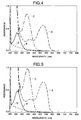
- Curve B in Fig. 4 is the absorption spectrum of the dimethylsulfoxide solution after reaction of the diazonium salt Ib with naphthol AS.
- curve B shows a small absorption peak of less than 0.3 centered on the wavelengths 410 - 420 [nm], and in the wavelength region 450 - 600 [nm], curve B shows an absorption peak of approximately 0.6 centered on the wavelengths 520 - 530 [nm]. From the fact that the dimethylsulfoxide solution of the diazonium salt Ib of the present invention has peaks in the wavelength region 450 - 600 [nm], it may be understood why it exhibits a magenta coloration.
- Curve C in Fig. 4 is the absorption spectrum of the dimethylsulfoxide solution after reaction of the diazonium salt Ib with naphthol AS-G. In the wavelength region 350 - 490 [nm], curve C shows an absorption peak of approximately 0.8 centered on a wavelength of 400 [nm]. From the fact that a peak is produced in the wavelength region 350 - 490 [nm] , it may be understood why the dimethylsulfoxide solution after reaction exhibits a yellow coloration.
- the diazonium salt Ib turns a magenta color when it reacts with naphthol AS, and turns a yellow color when it reacts with naphthol AS-G.
- the diazonium salt Ib can be made to form red colors such as orange, red or pink.
- the 4-diazo-4'-t-butyldiphenyletherhexafluorophosphate (diazonium salt Ib) is therefore suitable as a diazonium salt for a thermosensitive recording medium which forms a red color.
- diazonium salt Ib is decomposed by irradiating with ultraviolet light so that it loses its reactivity with naphthol AS or naphthol AS-G
- an image on a thermosensitive recording medium wherein 4-diazo-4'-t-butyldiphenyletherhexafluorophosphate (diazonium salt Ib) is used as the diazonium salt can be fixed in this way, and forgeries can be prevented.
- the solubility of diazonium salt Ib was at least 8 [g] per 100 [g] of dibutyl phthalate and at least 8 [g] per 100 [g] of tricresyl phosphate.
- the solubility of 4-diazodiphenyletherhexafluorophosphate in 100 [g] of dibutyl phthalate or 100 [g] of tricresyl phosphate is.no higher than 0.5 [g]
- the solubility of 4-diazo-4'-methyldiphenyletherhexafluorophosphate in 100 [g] of dibutyl phthalate or 100 [g] of tricresyl phosphate is no higher than 1.0 [g]
- the diazonium salt Ib has a high solubility in dibutyl phthalate and tricresyl phosphate.
- thermo decomposition temperature of 4-diazo-4'-t-butyldiphenyletherhexafluorophosphate (diazonium salt Ib) was measured using the DTA under the same conditions as those of the first embodiment.
- the thermal decomposition temperature of the diazonium salt Ib was found from the exothermic peak due to decomposition. As a result, only an exothermic peak due to thermal decomposition was observed without any endothermic peak due to melting, and it was situated at a high temperature of 164 °C.
- microcapsules were prepared using the 4-diazo-4'-t-butyldiphenyletherhexafluorophosphate of the present invention (diazonium salt Ib), a thermosensitive recording medium (thermosensitive recording paper) was prepared from them, and its print properties and keeping properties were evaluated.
- diazonium salt Ib 4 [g] of diazonium salt Ib, 48 [g] of dibutyl phthalate and 48 [g] of a trimethylolpropane addition product of xylylene diisocyanate (Takenate-D110N: brand name of Takeda Yakuhin Kogyo K.K.) were blended together. 126 [g] of an 8.2 [%] aqueous solution of polyvinylalcohol was added, and the mixture was emulsified by irradiating with ultrasonic waves.
- the diazonium salt Ib of the present invention exhibited good solubility in the capsule oil dibutyl phthalate, and it dissolved to give a homogeneous solution in a very short time.
- microcapsules having an average particle diameter of 1 - 2 microns including walls formed from polyvinyl alcohol and isocyanate were obtained.
- thermosensitive recording paper When printing was performed by a thermal printer using this thermosensitive recording paper, a magenta coloration was observed. The optical density was measured by a Macbeth densitometer using a magenta filter, and the OD was found to be a high value of 1.0 or more.
- thermosensitive recording paper when this thermosensitive recording paper was kept at room temperature under a relative humidity of 50 [%], there was no appreciable deterioration of print quality even after one year or more had elapsed.
- thermosensitive recording paper using a diazonium salt of the present invention was prepared and tested in the same way as in Preparation No. 1 described above, excepting that both naphthol AS and naphthol AS-G were used instead of naphthol AS alone.
- thermosensitive recording paper When printing was performed by a thermal printer using this thermosensitive recording paper, a red coloration was observed.
- the optical density was measured by a Macbeth densitometer using a magenta filter, and the OD was found to be a high value of 1.0 or more.
- thermosensitive recording paper when this thermosensitive recording paper was kept at room temperature under a relative humidity of 50 [%], there was no appreciable deterioration of print quality even after one year or more had elapsed.
- the diazonium salt of the fourth embodiment is 4-diazo-4'-sec-butyldiphenyletherhexafluorophosphate in which R is a sec-butyl group.
- the ethyl acetate solution was washed three times with 100 [ml] of a 5 [%] aqueous solution of sodium hydroxide, washed once with 10 [%] brine, and concentrated by evaporating off the ethyl acetate solvent under reduced pressure. Concentration of the extraction solution was continued until there is almost no further evaporation of ethyl acetate (i.e., almost no further ethyl acetate remained in the extraction solution) , giving a 17.6 [g] yield of 4-nitro-4'-sec-butyldiphenylether.
- peaks are caused by protons included in 4-diazo-4'-sec-butyldiphenyletherhexafluorophosphate shown in the above formula (24).
- diazonium salt Ic 4-diazo-4'-sec-butyldiphenyletherhexafluorophosphate (in some cases referred to hereafter as diazonium salt Ic).
- Fig. 5 is an absorption spectrum wherein the vertical axis shows optical absorption (arbitrary units) and the horizontal axis shows wavelength [nm].
- Curve B in Fig. 5 is the absorption spectrum of the dimethylsulfoxide solution after reaction of the diazonium salt Ic with naphthol AS. This curve B shows the same variation as that of curve B in Fig. 4 described in the case of the third embodiment. From the fact that the dimethylsulfoxide solution of the diazonium salt Ic of the present invention has peaks in the wavelength region 450 - 600 [nm], it may be understood why it exhibits a magenta coloration.
- Curve C in Fig. 5 is the absorption spectrum of the dimethylsulfoxide solution after reaction of the diazonium salt Ib with naphthol AS-G. This curve C shows the same variation as that of curve C in Fig. 4 described in the case of the third embodiment. From the fact that the dimethylsulfoxide solution of the diazonium salt Ic of the present invention has peaks in the wavelength region 450 - 600 [nm], it may be understood why it exhibits a yellow coloration.
- the diazonium salt Ic turns a magenta color when it reacts with naphthol AS, and turns a yellow color when it reacts with naphthol AS-G.
- the diazonium salt Ic can be made to form red colors such as orange, red or pink.
- the 4-diazo-4'-sec-butyldiphenyletherhexafluorophosphate (diazonium salt Ic) is therefore suitable as a diazonium salt for a thermosensitive recording medium which forms a red color.
- thermosensitive recording medium using the diazonium salt Ic can be fixed in this way, and forgeries can be prevented.
- diazonium salt Ic The solubility of diazonium salt Ic was at least 10 [g] per 100 [g] of dibutyl phthalate and at least 10 [g] per 100 [g] of tricresyl phosphate. Hence, the diazonium salt Ic dissolves easily in capsule oil within a short time to give a homogeneous solution, thus confirming the suitability of the diazonium salt of the present invention for a thermosensitive recording medium using microcapsules.
- the thermal decomposition temperature of 4-diazo-4'-sec-butyldiphenyletherhexafluorophosphate (diazonium salt Ic) was measured under the same conditions as those of the first embodiment.
- an endothermic peak due to melting and an exothermic peak due to thermal decomposition were observed, the exothermic peak being situated at a high decomposition temperature of 117 °C.
- thermosensitive recording medium thermosensitive recording paper
- thermosensitive recording paper When printing was performed by a thermal printer using this thermosensitive recording paper, a magenta coloration was observed. The optical density was measured by a Macbeth densitometer using a magenta filter, and the OD was found to be a high value of 1.0 or more.
- thermosensitive recording paper when this thermosensitive recording paper was kept at room temperature under a relative humidity of 50 [%], there was no appreciable deterioration of print quality even after one year or more had elapsed.
- thermosensitive recording paper using a diazonium salt of the present invention was prepared and tested in the same way as in Preparation No. 1 described above, excepting that naphthol AS-G was used as coupler instead of naphthol AS.
- thermosensitive recording paper When printing was performed by a thermal printer using this thermosensitive recording paper, a red coloration was observed.
- the optical density was measured by a Macbeth densitometer using a magenta filter, and the OD was found to be a high value of 1.0 or more.
- thermosensitive recording paper when this thermosensitive recording paper was kept at room temperature under a relative humidity of 50-[%], there was no appreciable deterioration of print quality even after one year or more had elapsed.
- the first and second diazonium salts according to the present invention therefore have the following advantages.
Landscapes
- Chemical & Material Sciences (AREA)
- Organic Chemistry (AREA)
- Engineering & Computer Science (AREA)
- Materials Engineering (AREA)
- Physics & Mathematics (AREA)
- General Physics & Mathematics (AREA)
- Heat Sensitive Colour Forming Recording (AREA)
- Non-Silver Salt Photosensitive Materials And Non-Silver Salt Photography (AREA)
Applications Claiming Priority (6)
| Application Number | Priority Date | Filing Date | Title |
|---|---|---|---|
| JP17503896 | 1996-07-04 | ||
| JP17503896 | 1996-07-04 | ||
| JP175038/96 | 1996-07-04 | ||
| JP3083997 | 1997-02-14 | ||
| JP30839/97 | 1997-02-14 | ||
| JP09030839A JP3108376B2 (ja) | 1996-07-04 | 1997-02-14 | 感熱記録媒体用のジアゾニウム塩 |
Publications (3)
| Publication Number | Publication Date |
|---|---|
| EP0816914A2 EP0816914A2 (en) | 1998-01-07 |
| EP0816914A3 EP0816914A3 (en) | 1998-01-21 |
| EP0816914B1 true EP0816914B1 (en) | 2004-03-17 |
Family
ID=26369255
Family Applications (1)
| Application Number | Title | Priority Date | Filing Date |
|---|---|---|---|
| EP97304475A Expired - Lifetime EP0816914B1 (en) | 1996-07-04 | 1997-06-25 | Diazonium salt for thermosensitive recording medium |
Country Status (4)
| Country | Link |
|---|---|
| US (1) | US5935756A (enExample) |
| EP (1) | EP0816914B1 (enExample) |
| JP (1) | JP3108376B2 (enExample) |
| DE (1) | DE69728085T2 (enExample) |
Families Citing this family (4)
| Publication number | Priority date | Publication date | Assignee | Title |
|---|---|---|---|---|
| JP3683685B2 (ja) * | 1997-09-02 | 2005-08-17 | 富士写真フイルム株式会社 | 感熱記録材料 |
| US6303259B1 (en) * | 1998-11-26 | 2001-10-16 | Mitsubishi Denki Kabushiki Kaisha | Heat and light-sensitive recording material and recording method with the same |
| JP4149109B2 (ja) | 2000-01-28 | 2008-09-10 | 株式会社ルネサステクノロジ | 半導体集積回路装置およびその製造方法 |
| ATE482083T1 (de) * | 2006-07-25 | 2010-10-15 | Fujifilm Corp | Lithographiedruckplattenvorläufer und verfahren zur herstellung einer lithographiedruckplatte |
Citations (1)
| Publication number | Priority date | Publication date | Assignee | Title |
|---|---|---|---|---|
| JPS61197278A (ja) * | 1985-02-28 | 1986-09-01 | Fuji Photo Film Co Ltd | 記録材料 |
Family Cites Families (9)
| Publication number | Priority date | Publication date | Assignee | Title |
|---|---|---|---|---|
| DE2057473C2 (de) * | 1970-11-23 | 1982-04-08 | Hoechst Ag, 6000 Frankfurt | Lichtempfindliches Gemisch |
| US4590263A (en) * | 1982-09-30 | 1986-05-20 | James River Graphics, Inc. | High speed diazonium salts useful in diazo type photoreproduction |
| GB2164166B (en) * | 1984-07-31 | 1988-06-15 | Fuji Photo Film Co Ltd | Heat-sensitive recording material and recording method therefor |
| US4760048A (en) * | 1985-03-01 | 1988-07-26 | Fuji Photo Film Co., Ltd. | Multicolor heat-sensitive recording material |
| JPH0745260B2 (ja) * | 1986-11-26 | 1995-05-17 | 富士写真フイルム株式会社 | 多色感熱記録材料 |
| JPS63265242A (ja) * | 1987-04-23 | 1988-11-01 | Fuji Photo Film Co Ltd | 多色画像形成方法 |
| US4965166A (en) * | 1988-03-02 | 1990-10-23 | Fuji Photo Film Co., Ltd. | Multicolor recording material |
| DE4414897A1 (de) * | 1994-04-28 | 1995-11-02 | Hoechst Ag | Aromatische Diazoniumsalze und deren Verwendung in strahlungsempfindlichen Gemischen |
| JP3352883B2 (ja) * | 1995-07-19 | 2002-12-03 | 沖電気工業株式会社 | 光定着型感熱記録媒体 |
-
1997
- 1997-02-14 JP JP09030839A patent/JP3108376B2/ja not_active Expired - Fee Related
- 1997-06-16 US US08/876,512 patent/US5935756A/en not_active Expired - Fee Related
- 1997-06-25 DE DE69728085T patent/DE69728085T2/de not_active Expired - Lifetime
- 1997-06-25 EP EP97304475A patent/EP0816914B1/en not_active Expired - Lifetime
Patent Citations (1)
| Publication number | Priority date | Publication date | Assignee | Title |
|---|---|---|---|---|
| JPS61197278A (ja) * | 1985-02-28 | 1986-09-01 | Fuji Photo Film Co Ltd | 記録材料 |
Also Published As
| Publication number | Publication date |
|---|---|
| JP3108376B2 (ja) | 2000-11-13 |
| EP0816914A3 (en) | 1998-01-21 |
| DE69728085T2 (de) | 2005-01-20 |
| JPH1071771A (ja) | 1998-03-17 |
| DE69728085D1 (de) | 2004-04-22 |
| EP0816914A2 (en) | 1998-01-07 |
| US5935756A (en) | 1999-08-10 |
Similar Documents
| Publication | Publication Date | Title |
|---|---|---|
| US5935756A (en) | Diazonium salt for thermosensitive recording medium | |
| US4665411A (en) | Heat-sensitive recording material | |
| JPH09290146A (ja) | マイクロカプセル、その製造方法及びそれを用いた感熱記録材料及び多色感熱記録材料 | |
| DE69811625T2 (de) | Wärmeempfindliches Aufzeichnungsmaterial | |
| JPS62146678A (ja) | 感熱記録材料 | |
| DE69708795T2 (de) | Thermisches Aufzeichnungsmaterial | |
| DE69719112T2 (de) | Wärmeempfindliches Aufzeichnungsmaterial | |
| JP3597252B2 (ja) | ジアゾニウム塩化合物含有マイクロカプセル及びそれを用いた光定着型感熱記録材料 | |
| JPH05317694A (ja) | マイクロカプセル及びそれを用いた感熱記録材料 | |
| US5492789A (en) | Process for producing microcapsules containing a diazonium salt compound and a photofixation thermal recording material employing the same | |
| JPH0533676B2 (enExample) | ||
| JP3352883B2 (ja) | 光定着型感熱記録媒体 | |
| JPH05142693A (ja) | ジアゾ型記録材料 | |
| JPH0698834B2 (ja) | 感熱記録材料 | |
| JP2678849B2 (ja) | マイクロカプセル及びそれを用いた感熱記録材料 | |
| JPH1158981A (ja) | 光定着型感熱記録媒体 | |
| JPH09281641A (ja) | 熱現像型複写材料 | |
| JPH10226169A (ja) | 光定着型感熱記録媒体およびその製造方法 | |
| JPH10226176A (ja) | 光定着型感熱記録媒体 | |
| JP2002212256A (ja) | 多官能イソシアネート化合物、マイクロカプセル及び感熱記録材料 | |
| JPH05305767A (ja) | ジアゾ型記録材料 | |
| EP0812698A1 (en) | Thermographic material and recording method | |
| JPH05318929A (ja) | ジアゾ型記録材料 | |
| JPH01279239A (ja) | 熱現像型複写材料 | |
| DE3639382A1 (de) | Waermeempfindliches aufzeichnungsmaterial |
Legal Events
| Date | Code | Title | Description |
|---|---|---|---|
| PUAI | Public reference made under article 153(3) epc to a published international application that has entered the european phase |
Free format text: ORIGINAL CODE: 0009012 |
|
| PUAL | Search report despatched |
Free format text: ORIGINAL CODE: 0009013 |
|
| AK | Designated contracting states |
Kind code of ref document: A2 Designated state(s): DE FR GB |
|
| AK | Designated contracting states |
Kind code of ref document: A3 Designated state(s): AT BE CH DE DK ES FI FR GB GR IE IT LI LU MC NL PT SE |
|
| 17P | Request for examination filed |
Effective date: 19980306 |
|
| AKX | Designation fees paid |
Free format text: DE FR GB |
|
| RBV | Designated contracting states (corrected) |
Designated state(s): DE FR GB |
|
| 17Q | First examination report despatched |
Effective date: 19990106 |
|
| GRAP | Despatch of communication of intention to grant a patent |
Free format text: ORIGINAL CODE: EPIDOSNIGR1 |
|
| GRAS | Grant fee paid |
Free format text: ORIGINAL CODE: EPIDOSNIGR3 |
|
| GRAA | (expected) grant |
Free format text: ORIGINAL CODE: 0009210 |
|
| AK | Designated contracting states |
Kind code of ref document: B1 Designated state(s): DE FR GB |
|
| REG | Reference to a national code |
Ref country code: GB Ref legal event code: FG4D |
|
| REF | Corresponds to: |
Ref document number: 69728085 Country of ref document: DE Date of ref document: 20040422 Kind code of ref document: P |
|
| ET | Fr: translation filed | ||
| PLBE | No opposition filed within time limit |
Free format text: ORIGINAL CODE: 0009261 |
|
| STAA | Information on the status of an ep patent application or granted ep patent |
Free format text: STATUS: NO OPPOSITION FILED WITHIN TIME LIMIT |
|
| 26N | No opposition filed |
Effective date: 20041220 |
|
| PGFP | Annual fee paid to national office [announced via postgrant information from national office to epo] |
Ref country code: FR Payment date: 20110621 Year of fee payment: 15 |
|
| PGFP | Annual fee paid to national office [announced via postgrant information from national office to epo] |
Ref country code: GB Payment date: 20110622 Year of fee payment: 15 |
|
| PGFP | Annual fee paid to national office [announced via postgrant information from national office to epo] |
Ref country code: DE Payment date: 20110622 Year of fee payment: 15 |
|
| GBPC | Gb: european patent ceased through non-payment of renewal fee |
Effective date: 20120625 |
|
| REG | Reference to a national code |
Ref country code: FR Ref legal event code: ST Effective date: 20130228 |
|
| REG | Reference to a national code |
Ref country code: DE Ref legal event code: R119 Ref document number: 69728085 Country of ref document: DE Effective date: 20130101 |
|
| PG25 | Lapsed in a contracting state [announced via postgrant information from national office to epo] |
Ref country code: DE Free format text: LAPSE BECAUSE OF NON-PAYMENT OF DUE FEES Effective date: 20130101 Ref country code: GB Free format text: LAPSE BECAUSE OF NON-PAYMENT OF DUE FEES Effective date: 20120625 Ref country code: FR Free format text: LAPSE BECAUSE OF NON-PAYMENT OF DUE FEES Effective date: 20120702 |