EP0809111B1 - Bestimmungsverfahren mit oligomerisierten Rezeptoren - Google Patents
Bestimmungsverfahren mit oligomerisierten Rezeptoren Download PDFInfo
- Publication number
- EP0809111B1 EP0809111B1 EP97108401A EP97108401A EP0809111B1 EP 0809111 B1 EP0809111 B1 EP 0809111B1 EP 97108401 A EP97108401 A EP 97108401A EP 97108401 A EP97108401 A EP 97108401A EP 0809111 B1 EP0809111 B1 EP 0809111B1
- Authority
- EP
- European Patent Office
- Prior art keywords
- antibody
- receptor
- solid phase
- oligomeric
- analyte
- Prior art date
- Legal status (The legal status is an assumption and is not a legal conclusion. Google has not performed a legal analysis and makes no representation as to the accuracy of the status listed.)
- Expired - Lifetime
Links
Classifications
-
- C—CHEMISTRY; METALLURGY
- C07—ORGANIC CHEMISTRY
- C07K—PEPTIDES
- C07K16/00—Immunoglobulins [IG], e.g. monoclonal or polyclonal antibodies
-
- C—CHEMISTRY; METALLURGY
- C07—ORGANIC CHEMISTRY
- C07K—PEPTIDES
- C07K16/00—Immunoglobulins [IG], e.g. monoclonal or polyclonal antibodies
- C07K16/18—Immunoglobulins [IG], e.g. monoclonal or polyclonal antibodies against material from animals or humans
- C07K16/26—Immunoglobulins [IG], e.g. monoclonal or polyclonal antibodies against material from animals or humans against hormones ; against hormone releasing or inhibiting factors
-
- G—PHYSICS
- G01—MEASURING; TESTING
- G01N—INVESTIGATING OR ANALYSING MATERIALS BY DETERMINING THEIR CHEMICAL OR PHYSICAL PROPERTIES
- G01N33/00—Investigating or analysing materials by specific methods not covered by groups G01N1/00 - G01N31/00
- G01N33/48—Biological material, e.g. blood, urine; Haemocytometers
- G01N33/50—Chemical analysis of biological material, e.g. blood, urine; Testing involving biospecific ligand binding methods; Immunological testing
-
- G—PHYSICS
- G01—MEASURING; TESTING
- G01N—INVESTIGATING OR ANALYSING MATERIALS BY DETERMINING THEIR CHEMICAL OR PHYSICAL PROPERTIES
- G01N33/00—Investigating or analysing materials by specific methods not covered by groups G01N1/00 - G01N31/00
- G01N33/48—Biological material, e.g. blood, urine; Haemocytometers
- G01N33/50—Chemical analysis of biological material, e.g. blood, urine; Testing involving biospecific ligand binding methods; Immunological testing
- G01N33/68—Chemical analysis of biological material, e.g. blood, urine; Testing involving biospecific ligand binding methods; Immunological testing involving proteins, peptides or amino acids
- G01N33/6854—Immunoglobulins
- G01N33/6857—Antibody fragments
-
- G—PHYSICS
- G01—MEASURING; TESTING
- G01N—INVESTIGATING OR ANALYSING MATERIALS BY DETERMINING THEIR CHEMICAL OR PHYSICAL PROPERTIES
- G01N33/00—Investigating or analysing materials by specific methods not covered by groups G01N1/00 - G01N31/00
- G01N33/48—Biological material, e.g. blood, urine; Haemocytometers
- G01N33/50—Chemical analysis of biological material, e.g. blood, urine; Testing involving biospecific ligand binding methods; Immunological testing
- G01N33/74—Chemical analysis of biological material, e.g. blood, urine; Testing involving biospecific ligand binding methods; Immunological testing involving hormones or other non-cytokine intercellular protein regulatory factors such as growth factors, including receptors to hormones and growth factors
- G01N33/76—Human chorionic gonadotropin including luteinising hormone, follicle stimulating hormone, thyroid stimulating hormone or their receptors
-
- Y—GENERAL TAGGING OF NEW TECHNOLOGICAL DEVELOPMENTS; GENERAL TAGGING OF CROSS-SECTIONAL TECHNOLOGIES SPANNING OVER SEVERAL SECTIONS OF THE IPC; TECHNICAL SUBJECTS COVERED BY FORMER USPC CROSS-REFERENCE ART COLLECTIONS [XRACs] AND DIGESTS
- Y10—TECHNICAL SUBJECTS COVERED BY FORMER USPC
- Y10S—TECHNICAL SUBJECTS COVERED BY FORMER USPC CROSS-REFERENCE ART COLLECTIONS [XRACs] AND DIGESTS
- Y10S435/00—Chemistry: molecular biology and microbiology
- Y10S435/962—Prevention or removal of interfering materials or reactants or other treatment to enhance results, e.g. determining or preventing nonspecific binding
Definitions
- the present invention relates to a method for immunological Determination of an analyte according to the sandwich assay principle and suitable binding substances.
- the invention relates to an improvement of such sandwich processes, to expand the measuring range and the hook effect to reduce.
- Sandwich assay used, two against the same or different Epitope of the analyte-directed antibody with a incubated the sample to be determined analyte become.
- a first soluble antibody is direct or indirectly with a signal generating system, i.e. a marker coupled, while a second antibody (in heterogeneous Assay) coupled to a solid phase or with is provided with a binding component, e.g. Biotin used for Binding capable with an appropriately coated solid phase is.
- the Concentration can vary within a wide range means that a wide measuring range is desirable for analysis or is even required.
- Proteins are e.g. Cancer parameters, such as ⁇ -fetoprotein (AFP) and Carzinogen-Embryonic Antigen (CEA) as well as that Pregnancy Protein Human Chorionic Gonadotropin (HCG).
- AFP ⁇ -fetoprotein
- CEA Carzinogen-Embryonic Antigen
- HCG Pregnancy Protein Human Chorionic Gonadotropin
- EP 0 289 003 discloses a method for quantitative determination a polyvalent antigen with three different receptors, wherein R1 and R3 are dissolved in the liquid phase and with the Antigen are bindable, R2 is in the solid phase and with R1 is bindable, and R3 bears a label and with R1 and R2 not cross-reacted. Accordingly, the receptor binds to the invention R1 with the solid phase R2 and labeling of the antigen is done via the receptor R3 dissolved in the liquid phase.
- the disclosed approaches do not contain any information to expand the measuring range in immunological detection methods.
- a disadvantage of the method according to US Patent No. 4,743,542 is however, the reduction in sensitivity in the lower measuring range. Such a reduction is particularly critical if an accurate test result in the lower measuring range is essential is, for example, in the HCG test to determine whether a Pregnancy or not.
- the object underlying the invention was therefore to a method for the immunological determination of an analyte provide the disadvantages of the prior art Technology are at least partially eliminated and in particular a quantitatively exact determination over a broad range Measuring range is possible and at the same time in the lower concentration range good results are obtained.
- this object is achieved by a method for the immunological determination of an analyte in a sample liquid according to the principle of the sandwich assay, whereby one the sample liquid in the presence of a solid phase with at least two receptors capable of binding to the analyte to be determined incubated, the first receptor being soluble and in marked form is present and the second receptor (a) to a Solid phase is bound or (b) bindable with a solid phase and the analyte by determining the label in the Solid phase or / and in the liquid phase, which is characterized by that the first receptor selected an oligomer of a binding molecule from antibodies, antibody fragments and mixtures of it is.
- the first receptor used according to the invention is an oligomer of a binding molecule selected from antibodies or / and antibody fragments and is referred to below for the sake of simplicity as “oligomeric antibody”.
- first or second antibody only has a differentiating function in this description and does not characterize an order of addition etc.
- antibody is understood to mean both an antibody with a singular specificity and a monoclonal antibody , as well as a mixture of antibodies directed against different epitopes of the same antigen, such as a polyclonal antiserum.
- Antibody fragment means any molecule which is derived from a complete antibody while retaining at least one paratope and which can be obtained, for example, by enzymatic or chemical treatment of an antibody or by genetic engineering.
- an antibody fragment is understood to mean an F (ab ') 2 fragment.
- the degree of oligomerization is at least two, ie the minimum paratope number of an oligomeric antibody according to the invention is four.
- the minimum degree of oligomerization is preferably two to three.
- the maximum degree of oligomerization is up to 15, preferably up to 10 and more preferably up to 8. Most preferably the degree of oligomerization is 2 to 8, particularly preferably 4 to 6.
- the oligomeric first receptor is used in the method according to the invention preferably used in marked form. That means, that he directly or indirectly to a marker group is coupled.
- a direct coupling a understood covalent incorporation of a detectable substance or of a molecule that when reacted with a suitable substrate produces a detectable substance.
- An example of the latter would be e.g. an enzyme that is covalent, optionally via a Spacer, is bound to the receptor.
- An indirect coupling denotes a configuration, the first receptor according to of the present invention and a detectable substance or a molecule producing such a substance via a specific one Binding pair, such as biotin / avidin, with each other are bindable.
- the marking group in the method according to the invention can be from Markings known in the prior art can be selected.
- Examples are radio labels as well as enzyme labels or Luminescent labels.
- Preferred examples of enzyme labels are e.g. alkaline phosphatase, peroxidase and galactosidase.
- Ca-activatable Ca luminescent labels are preferred Photoproteins such as aequorin and electrochemiluminescent labels. Markings for which the determination of a luminescence reaction is particularly preferred and most preferred is a luminescent labeling group Metal chelate marker group.
- the luminescent metal chelates are metal chelates that generate a detectable luminescence reaction.
- the proof this luminescence reaction can, for example, by fluorescence or by electrochemiluminescence measurement.
- the Metal of these metal chelates is, for example, a transition metal or a rare earth metal.
- the metal is Ruthenium, osmium, rhenium, iridium, rhodium, platinum, indium, Palladium, molybdenum, technetium, copper, chromium or tungsten. Ruthenium, rhenium, iridium and osmium are particularly preferred and most preferred is ruthenium.
- the ligands that together with the metal are the metal chelate are usually polydentate ligands, i.e. ligands with several coordination points. Include polydentate ligands for example aromatic and aliphatic ligands. Suitable aromatic polydentate ligands include aromatic heterocyclic ligands.
- Preferred heterocyclic Ligands are N-containing polyheterocycles such as e.g. bipyridyl, Bipyrazyl, terpyridyl and phenanthrolyl.
- ligands can, for example, substituted substituents such as alkyl Alkyl, aryl, substituted aryl, aralkyl, carboxylate, Carboxyaldehyde, carboxamide, cyano, amino, hydroxy, imino, Hydroxycarbonyl, aminocarbonyl, amidine, guanidinium, ureide, sulfur-containing groups, phosphorus-containing groups and the carboxylate esters of N-hydroxysuccinimide.
- the chelation can also contain one or more monodentate ligands. Examples of monodentate ligands include carbon monoxide, cyanides, Isocyanides, halides and aliphatic, aromatic and heterocyclic phosphines, amines, stilbenes and arsines.
- the luminescent metal chelate is particularly preferably selected from metal chelates with bipyridyl or phenanthrolyl ligands.
- suitable metal chelates and their preparation are described in EP-A-0 178 450, EP-A-0 255 534, EP-A 0 580 979 and WO 90/05301. Reference is hereby made to this disclosure.
- Most preferred metal chelates are ruthenium (bipyridyl) 3 chelates. These chelates are commercially available in the form of active ester derivatives, for example from Igen Inc. (Rockville, MD, USA).
- the labeled receptor used in the method according to the invention contains one or more marker groups. If more Marker groups per molecule of the first oligomer Receptor are used, it is preferred that the number of labeling groups 2 to 20, more preferably 2 to 10 is.
- the second receptor used in the method according to the invention is bound to the solid phase or bindable with it.
- bound to the solid phase is used in this description immobilization prior to the assay understood by attachment to a macromolecular support, such as by adsorption, covalent bonding or using a specific binding pair.
- immobilization becomes "bindable” during of the assay by means of the specific interaction of a suitable one understood specific binding pair such as biotin / avidin.
- the second receptor is preferably coupled to the solid phase via a specific binding pair.
- Especially the second receptor is preferably biotinylated and the solid phase coated with avidin and / or streptavidin.
- the type of second receptor is in the process of the present one Invention is not particularly critical and accordingly second receptor selected from a number of molecules be provided that he has a specific bond with the analytes to be determined.
- substances which can be used as a second receptor are, for example, oligomeric antibodies in the sense of this invention, Antibodies, antibody fragments, cell receptors, enzymes, Nucleic acids and other substances due to a special Spatial structure or chemical affinity to be determined Able to bind analytes.
- the solid phase in the process according to the invention is dependent on on the exact design of the test procedure conventional solid phases are used. These include e.g. finely divided Materials such as polystyrene beads or particulate magnetic material as well as surfaces in general of reaction vessels, such as the wall of a cuvette or a microtiter plate, and chips for special applications, Sensors or membranes.
- finely divided Materials such as polystyrene beads or particulate magnetic material as well as surfaces in general of reaction vessels, such as the wall of a cuvette or a microtiter plate, and chips for special applications, Sensors or membranes.
- the solid phase particulate magnetic material one with the second Contains receptor-binding coating.
- the exact implementation of the method according to the invention corresponds known protocols of sandwich assays and is the Expert familiar. Generally one is the one to be determined Sample containing analytes under suitable conditions and for a sufficient period of time with the first receptor, the second Incubated receptor and solid phase in any order, the formation of an immobilized sandwich complex to ensure. Then the one containing the analyte formed sandwich complex of free labeled antibody separated and, if necessary after adding a suitable Detection substrate, determined qualitatively or quantitatively.
- the sample to be examined is first processed using a Ruthenium chelate-labeled oligomeric antibody and one mixed and incubated biotinylated antibody.
- a magnet Beads i.e. complex formed from the rest of the sample or separated from unbound labeled antibody and the separated complex with a solution containing a reducing agent such as tripropylamine (TPA) and optionally a surface active Contains agent, washed again.
- TPA tripropylamine
- a surface active Contains agent washed again.
- an unlabeled analyte-specific Receptor e.g. an unlabeled monomeric antibody or / and oligomeric antibodies.
- the method relates to the use of an oligomeric antibody comprising a conjugate of at least two antibodies, antibody fragments and mixtures thereof, the binding molecules being covalently bonded directly to one another and which is characterized in that the degree of oligomerization Is 2 to 15.
- a direct connection of the binding molecules means that the antibodies or antibody fragments either a simple chemical bond or a suitable one bifunctional linker / spacer molecule linked together are. Ways to do this and suitable ones Large numbers of spacer molecules are known to the person skilled in the art.
- chemical linkers come, for example, bis (maleinimido) methyl ester, Dimethylsuberimidate, disuccinimidylsuberat, glutardialdehyde, N-succinimidyl-3- (2-pyridyldithio) propionate, N-5-azido-2-nitrobenzoylsuccinimide, N-succinimidyl (4-iodoacetyl) aminobenzoate, a combination of maleimidohexanoyl succinimidate and S-acetyl-mercaptosuccinic anhydride, or analog connections into consideration.
- the use of the oligomeric antibody according to the invention in accordance with the first aspect of the invention is provided with at least one and optionally a plurality of labeling groups.
- a luminescent metal chelate label is preferred as the label and the oligomeric antibody is particularly preferably ruthenylated, ie the metal chelate is a ruthenium chelate.
- the ligands which together with the metal form the metal chelate are usually polydentate ligands, ie ligands with several coordination sites. Such ligands and metal chelates are described, for example, in DE-A-44 30 998.8, the disclosure of which is hereby incorporated by reference.
- the most preferred metal chelates are ruthenium (bipyridyl) 3 chelates.
- Yet another aspect of the present invention relates the use of an oligomeric antibody comprising a Conjugate from at least two antibodies, antibody fragments or / and mixtures thereof, the degree of oligomerization being 2-15 is, and at least one labeling group as a detection reagent in a sandwich assay.
- the oligomeric antibody with a degree of oligomerization of 2-15 for reduction or / and avoiding the hook effect in an immunological Determination methods are used.
- kits for immunological determination of an analyte which is necessary for the implementation of the invention Process are suitable.
- a kit includes in particular a labeled oligomeric antibody as above defined, the labeling groups preferably luminescent Are metal chelate marker groups and the number is 2-20, and the second used in the method according to the invention Receptor, ie a solid phase bound or preferably with a solid phase receptor capable of binding, e.g. an antibody or / and an antibody fragment or / and mixtures thereof.
- the oligomeric antibodies and the second receptor can be used in the invention Reagent kit available separately or together in contained in a single reagent. If applicable, the Kit also other reagents, such as a suitable solid phase, a substrate solution etc., which is then generally spatial available separately.
- Monoclonal anti-HCG-M-1F7.9 IgG (Boehringer Mannheim GmbH) is dissolved in 0.1 M potassium phosphate buffer, pH 8.4, to a concentration of 10 mg / ml.
- the 6-fold molar amount of biotin DDS * (dissolved in dimethyl sulfoxide; 16.3 mg / ml).
- the batch is stopped by adding 10 ⁇ l of 1 M lysine.
- the mixture is dialyzed against 25 mM potassium phosphate / 50 mM NaCl, pH 7.0 and the product is lyophilized.
- AK-BPRU Monoclonal, Ru (bpy) 3- labeled anti-HCG-F (ab ') 2 antibody fragments, which are obtainable according to Example 1 (hereinafter referred to as AK-BPRU), are used as the oligomeric receptor.
- AK-BPRU comes with a degree of oligomerization of 5-7 and one Degree of ruthenylation of 3.3 used.
- IgG bovine immunoglobulin
- RSA Bovine serum albumin
- the result is a measuring range up to 12,000 mIU / ml HCG, taking a sample with 500,000 mIU / ml HCG as above that Measuring range lying down is recognized (hook effect).
- the lower one Detection limit is ⁇ 1.0 mIU / ml HCG.
- measuring range is in This application designates the area in which the used Human sera can be correctly determined undiluted.
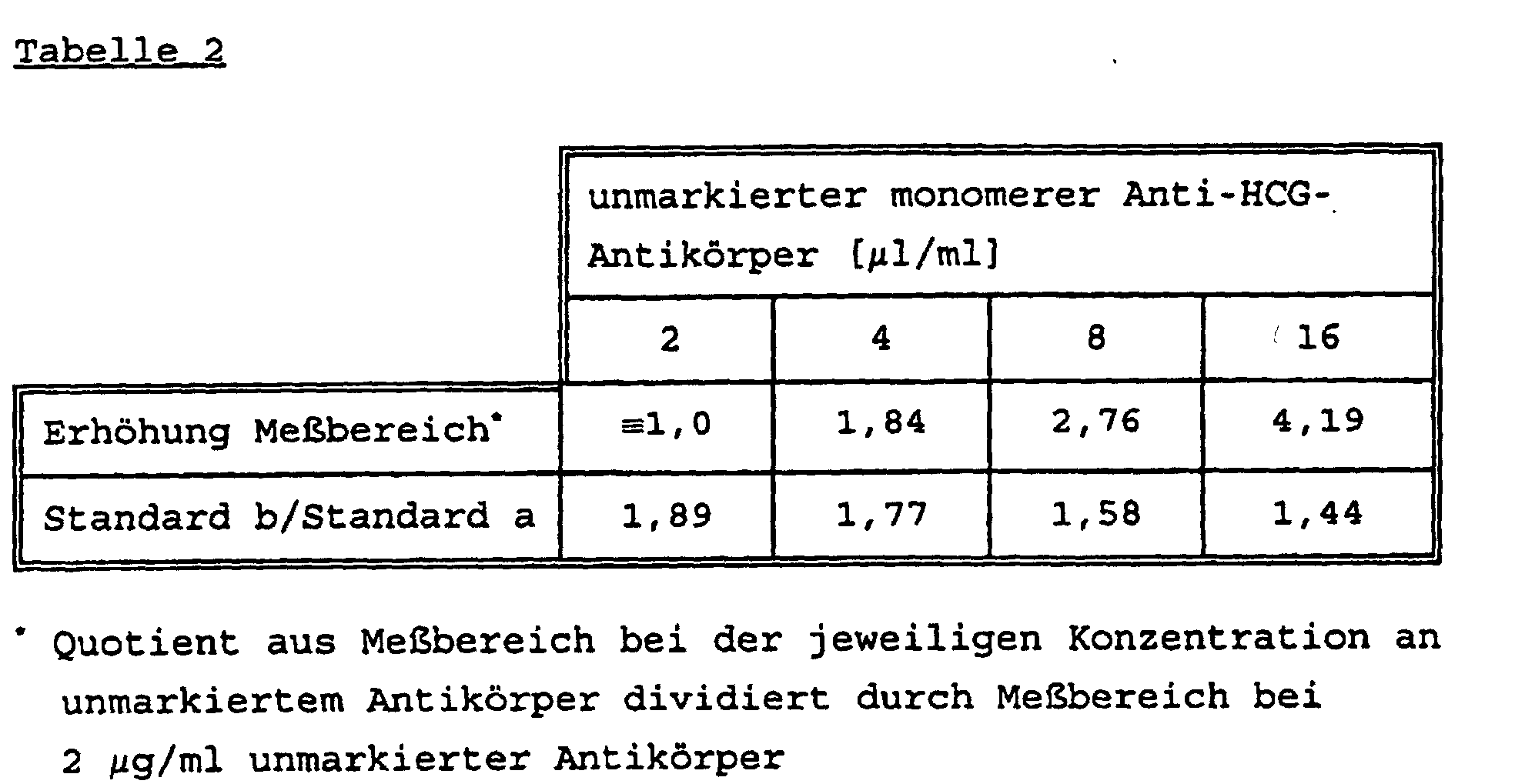
- a monomeric monoclonal antibody MAK ⁇ HCG> -BPRU with a degree of ruthenylation of 1: 8 is used in solution 1 in a concentration of 2 ⁇ g / ml and the biotinylated monoclonal antibody in solution 2 is used in solution 1 a concentration of 2 ⁇ g / ml was used.
- Example 4 The procedure is as in Example 4, except that as unlabeled antibody the polyclonal antibody PAK ⁇ -HCG> S- (PA) -IgG (DE) was used. The results match essentially that of Example 4, but the measuring range is only increased by a factor of 1.35. A reliable distinction is not possible in the lower signal range.
- the reaction is carried out by pipetting together 70 ⁇ l sample, 80 ⁇ l R1 and 80 ⁇ l R2, careful mixing and 10 min. Incubation. Then 50 ul beads are added and another 10 min. incubated.
- reaction mixture is as described for the HCG brought the electrode, the microparticles are using held and washed by a magnet.
- the electrochemical follows Response, the light signal being measured quantitatively becomes.
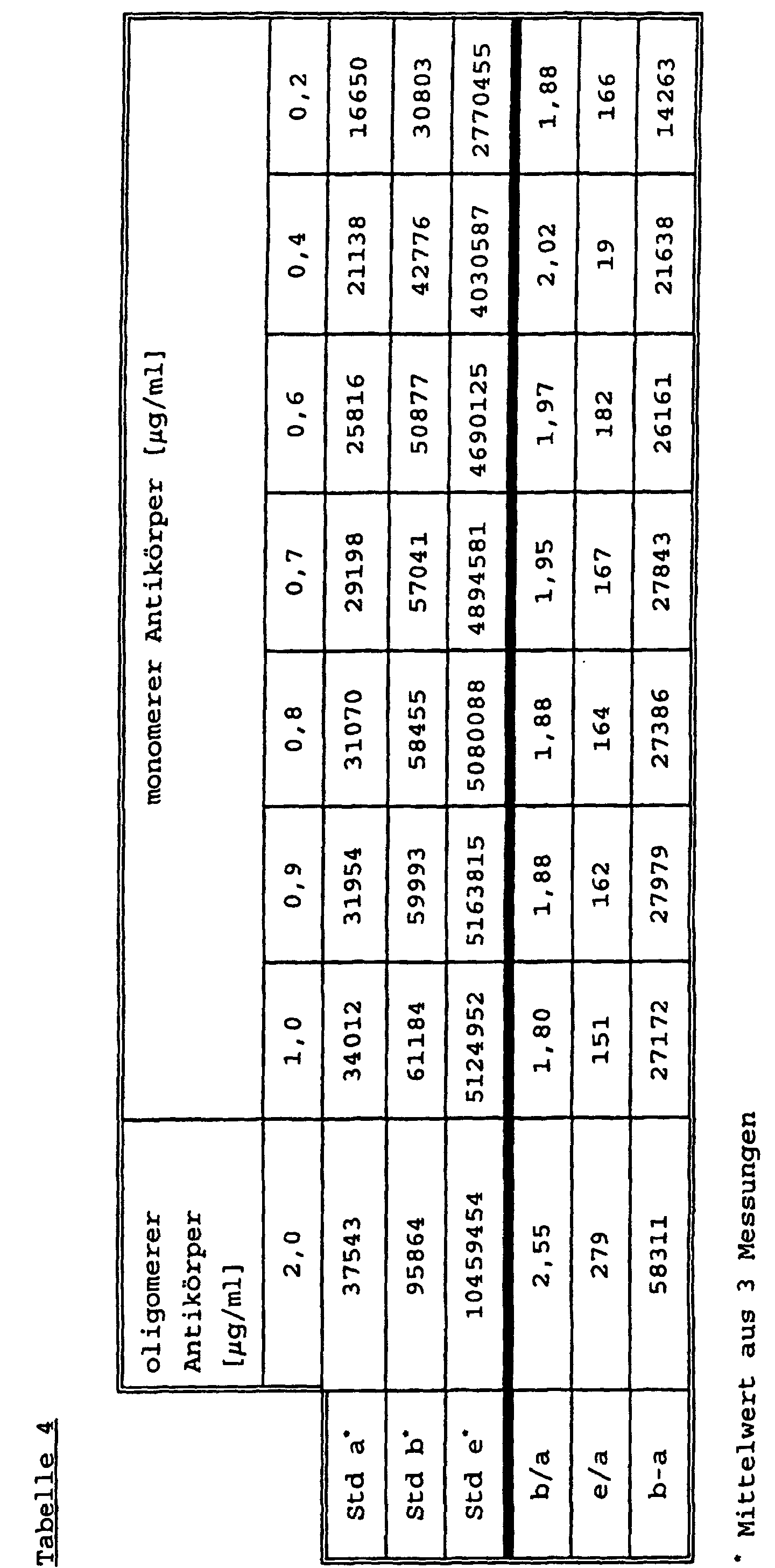
- a range of HCG standards with concentrations from 0 to 20,000 mIU / ml are, as described in Example 7, in the test system without (R1, R2, Beads) or with addition (R2, R3, Beads) of unlabelled monoclonal antibody.
Landscapes
- Health & Medical Sciences (AREA)
- Life Sciences & Earth Sciences (AREA)
- Chemical & Material Sciences (AREA)
- Immunology (AREA)
- Molecular Biology (AREA)
- Engineering & Computer Science (AREA)
- Biomedical Technology (AREA)
- Hematology (AREA)
- Urology & Nephrology (AREA)
- General Health & Medical Sciences (AREA)
- Biochemistry (AREA)
- Medicinal Chemistry (AREA)
- Organic Chemistry (AREA)
- Endocrinology (AREA)
- Food Science & Technology (AREA)
- Pathology (AREA)
- Physics & Mathematics (AREA)
- Analytical Chemistry (AREA)
- Cell Biology (AREA)
- Biotechnology (AREA)
- General Physics & Mathematics (AREA)
- Microbiology (AREA)
- Proteomics, Peptides & Aminoacids (AREA)
- Genetics & Genomics (AREA)
- Biophysics (AREA)
- Reproductive Health (AREA)
- Peptides Or Proteins (AREA)
- Investigating Or Analysing Biological Materials (AREA)
- Investigating Or Analysing Materials By The Use Of Chemical Reactions (AREA)
- Investigating Or Analyzing Non-Biological Materials By The Use Of Chemical Means (AREA)
Description
| P1 | MW> | 800.000 |
| P2 | 500.000 - 800.000 | |
| P3 | 400.000 | |
| P4 | 200.000 | |
| P5 | 100.000 (= F(ab')2 |


- R1:
- Phosphatpuffer, 50 mmol, pH=7,4; jeweils 0,1% MIT und Oxyperoin (zur Konservierung), 2% Rinderserumalbumin, 1% Rinder IgG und ruthenylierter monoklonaler Antikörper MAK <TSH>-m-Fab-BP-Ru in der Konzentration 2,0 µg/ml für das Oligomer und 0,2-1,0 µg/ml für das Monomer.
- R2:
- Reagenz wie R1, aber anstelle von MAK-BPRU wird biotinylierter monomerer Antikörper MAK<TSH>F(ab')b-Bi(DDS) in der Konzentration von 1,7 µg/ml eingesetzt.
- Beads:
- Es werden Micropartikel mit Eisenkern mit einer Biotinbindekapazität von 700 µg/ml verwendet.
- R1:
- In einem 40 mmol/l Phosphatpuffer, pH=7,5, der außerdem noch 0,1% Rinder IgG und 3% Rinderserumalbumin (RSA) enthält, werden 3,0 µg/ml MAK<HCG>-Ruthenium(II)tris(bipyridyl)-NHS-oligo, als F(ab')2, Polymerisierungsgrad 5-7, Ruthenylierungsgrad 3,3 gelöst und gemischt.
- R2:
- In ein Reagenz wie o.a. wird statt dem MAK-PBRU 5,0 g/ml MAK<HCG>-IgG-biotinyliert, Biotinylierungsgrad 1:10 gegeben.
- R3:
- Zu einem Reagenz R1 werden zusätzlich noch 4 µg/ml unmarkierter polyklonaler PAK<HCG>-IgG gegeben und gemischt.
Claims (12)
- Verfahren zur immunologischen Bestimmung eines Analyten in einer Probeflüssigkeit nach dem Prinzip des Sandwich-Assays, wobei man die Probeflüssigkeit in Gegenwart einer Festphase mit mindestens zwei mit dem zu bestimmenden Analyten bindefähigen Rezeptoren inkubiert, wobei der erste Rezeptor löslich ist und in markierter Form vorliegt und der zweite Rezeptorund den Analyten durch Bestimmung der Markierung in der Festphase oder/und in der flüssigen Phase nachweist,(a) an eine Festphase gebunden ist oder(b) mit einer Festphase bindefähig ist,
dadurch gekennzeichnet, daß der erste Rezeptor ein Oligomer eines Bindemoleküls ausgewählt aus Antikörpern, Antikörperfragmenten und Gemischen davon ist. - Verfahren nach Anspruch 1,
dadurch gekennzeichnet, daß der Oligomerisierungsgrad des ersten Rezeptors 2 bis 15 beträgt. - Verfahren nach Anspruch 1 oder 2,
dadurch gekennzeichnet, daß der erste Rezeptor 1 bis 2 Markierungsgruppen trägt. - Verfahren nach Anspruch 3,
dadurch gekennzeichnet, daß die Markierungsgruppe eine lumineszierende Metallchelat-Markierungsgruppe ist. - Verfahren nach einem der vorhergehenden Ansprüche,
dadurch gekennzeichnet, daß die Festphase aus teilchenförmigem, magnetischem Material besteht und mit dem zweiten Rezeptor oder einem Material, das mit dem zweiten Rezeptor bindefähig ist, beschichtet ist. - Verfahren nach einem der vorhergehenden Ansprüchen,
dadurch gekennzeichnet, daß man die Bestimmung in Gegenwart eines markierten ersten Rezeptors und zusätzlich eines unmarkierten Analyt-spezifischen Rezeptors durchführt. - Verwendung eines oligomeren Antikörpers umfassend ein Konjugat aus mindestens zwei Antikörpern, Antikörperfragmenten oder/und Gemischen davon, wobei der Oligomerisierungsgrad 2-15 beträgt, und mindestens einer Markierungsgruppe als Nachweisreagenz in einem Sandwich-Assay.
- Verwendung eines oligomeren Antikörpers umfassend ein Konjugat aus mindestens zwei Antikörpern, Antikörperfragmenten oder/und Gemischen davon, wobei der Oligomerisierungsgrad 2-15 beträgt, zur Verringerung oder/und Vermeidung des Hook-Effekts in einem immunologischen Verfahren.
- Verwendung nach Anspruch 8,
dadurch gekennzeichnet, daß der oligomere Antikörper mindestens eine Markierungsgruppe trägt. - Reagenzienkit zur immunologischen Bestimmung eines Antigens,
dadurch gekennzeichnet, daß er einen oligomeren Antikörper umfassend ein Konjugat aus mindestens zwei Antikörpern, Antikörperfragmenten oder/und Gemischen davon, wobei der Oligomerisierungsgrad 2-15 beträgt, und mindestens eine Markierungsgruppe, und einen an eine Festphase gebundenen oder mit einer Festphase bindefähigen Antikörper umfaßt. - Verwendung nach einem der Ansprüche 7 oder 9, bzw. Reagenzienkit nach Anspruch 10,
dadurch gekennzeichnet, daß die Markierungsgruppen des oligomeren Antikörpers lumineszierende Metallchelat-Markierungsgruppen sind. - Verwendung nach einem der Ansprüche 7 oder 9, bzw. Reagenzienkit nach Anspruch 10,
dadurch gekennzeichnet, daß die Anzahl der Markierungsgruppen des oligomeren Antikörpers 2 bis 20 beträgt.
Applications Claiming Priority (2)
| Application Number | Priority Date | Filing Date | Title |
|---|---|---|---|
| DE19621133 | 1996-05-24 | ||
| DE19621133A DE19621133A1 (de) | 1996-05-24 | 1996-05-24 | Bestimmungsverfahren mit oligomerisierten Rezeptoren |
Publications (3)
| Publication Number | Publication Date |
|---|---|
| EP0809111A2 EP0809111A2 (de) | 1997-11-26 |
| EP0809111A3 EP0809111A3 (de) | 1999-01-07 |
| EP0809111B1 true EP0809111B1 (de) | 2002-07-24 |
Family
ID=7795330
Family Applications (1)
| Application Number | Title | Priority Date | Filing Date |
|---|---|---|---|
| EP97108401A Expired - Lifetime EP0809111B1 (de) | 1996-05-24 | 1997-05-23 | Bestimmungsverfahren mit oligomerisierten Rezeptoren |
Country Status (8)
| Country | Link |
|---|---|
| US (1) | US6184042B1 (de) |
| EP (1) | EP0809111B1 (de) |
| JP (1) | JP2848457B2 (de) |
| KR (1) | KR100225682B1 (de) |
| AT (1) | ATE221202T1 (de) |
| DE (2) | DE19621133A1 (de) |
| ES (1) | ES2180852T3 (de) |
| TW (1) | TW370614B (de) |
Families Citing this family (48)
| Publication number | Priority date | Publication date | Assignee | Title |
|---|---|---|---|---|
| US20060057573A1 (en) * | 2002-02-15 | 2006-03-16 | Somalogic, Inc | Methods and reagents for detecting target binding by nucleic acid ligands |
| ATE221657T1 (de) * | 1998-05-06 | 2002-08-15 | Roche Diagnostics Gmbh | Entstörung durch rheumafaktoren |
| US6777198B2 (en) * | 2000-10-11 | 2004-08-17 | Pharmacia Diagnostics Ab | Assay method and kit therefor |
| EP1389209B1 (de) * | 2001-04-24 | 2009-04-08 | Purdue Research Foundation | Folat-mimetika und deren folatrezeptorbindende konjugate |
| KR100550707B1 (ko) * | 2001-08-09 | 2006-02-08 | 마츠시타 덴끼 산교 가부시키가이샤 | 바이오센서 및 측정방법 |
| US20030109067A1 (en) | 2001-12-06 | 2003-06-12 | Immunetech, Inc. | Homogeneous immunoassays for multiple allergens |
| US20030119203A1 (en) * | 2001-12-24 | 2003-06-26 | Kimberly-Clark Worldwide, Inc. | Lateral flow assay devices and methods for conducting assays |
| US6837171B1 (en) | 2002-04-29 | 2005-01-04 | Palmer/Snyder Furniture Company | Lightweight table with unitized table top |
| US8367013B2 (en) * | 2001-12-24 | 2013-02-05 | Kimberly-Clark Worldwide, Inc. | Reading device, method, and system for conducting lateral flow assays |
| KR20040106547A (ko) * | 2002-05-15 | 2004-12-17 | 엔도사이트, 인코포레이티드 | 비타민-마이토마이신 공액체 |
| US7432105B2 (en) * | 2002-08-27 | 2008-10-07 | Kimberly-Clark Worldwide, Inc. | Self-calibration system for a magnetic binding assay |
| US7285424B2 (en) * | 2002-08-27 | 2007-10-23 | Kimberly-Clark Worldwide, Inc. | Membrane-based assay devices |
| US7314763B2 (en) * | 2002-08-27 | 2008-01-01 | Kimberly-Clark Worldwide, Inc. | Fluidics-based assay devices |
| US7781172B2 (en) * | 2003-11-21 | 2010-08-24 | Kimberly-Clark Worldwide, Inc. | Method for extending the dynamic detection range of assay devices |
| US20040106190A1 (en) * | 2002-12-03 | 2004-06-03 | Kimberly-Clark Worldwide, Inc. | Flow-through assay devices |
| US7247500B2 (en) * | 2002-12-19 | 2007-07-24 | Kimberly-Clark Worldwide, Inc. | Reduction of the hook effect in membrane-based assay devices |
| US7601332B2 (en) | 2003-01-27 | 2009-10-13 | Endocyte, Inc. | Vitamin receptor binding drug delivery conjugates |
| US7851209B2 (en) * | 2003-04-03 | 2010-12-14 | Kimberly-Clark Worldwide, Inc. | Reduction of the hook effect in assay devices |
| US20040197819A1 (en) * | 2003-04-03 | 2004-10-07 | Kimberly-Clark Worldwide, Inc. | Assay devices that utilize hollow particles |
| US20050112703A1 (en) | 2003-11-21 | 2005-05-26 | Kimberly-Clark Worldwide, Inc. | Membrane-based lateral flow assay devices that utilize phosphorescent detection |
| US7943395B2 (en) * | 2003-11-21 | 2011-05-17 | Kimberly-Clark Worldwide, Inc. | Extension of the dynamic detection range of assay devices |
| US20050112585A1 (en) * | 2003-11-21 | 2005-05-26 | Dominic Zichi | Method for adjusting the quantification range of individual analytes in a multiplexed assay |
| US7713748B2 (en) * | 2003-11-21 | 2010-05-11 | Kimberly-Clark Worldwide, Inc. | Method of reducing the sensitivity of assay devices |
| US7943089B2 (en) * | 2003-12-19 | 2011-05-17 | Kimberly-Clark Worldwide, Inc. | Laminated assay devices |
| US20050136550A1 (en) * | 2003-12-19 | 2005-06-23 | Kimberly-Clark Worldwide, Inc. | Flow control of electrochemical-based assay devices |
| US7521226B2 (en) * | 2004-06-30 | 2009-04-21 | Kimberly-Clark Worldwide, Inc. | One-step enzymatic and amine detection technique |
| US20140031249A1 (en) * | 2004-07-20 | 2014-01-30 | Sqi Diagnostics Systems Inc. | Multiplex measure of isotype antigen response |
| CN101098854B (zh) | 2004-07-23 | 2012-12-05 | 恩多塞特公司 | 二价连接体及其轭合物 |
| US7396689B2 (en) * | 2005-02-04 | 2008-07-08 | Decision Biomarkers Incorporated | Method of adjusting the working range of a multi-analyte assay |
| CN101175757B (zh) * | 2005-03-16 | 2012-11-14 | 恩多塞特公司 | 蝶酸及其缀合物的合成和纯化 |
| RU2470668C2 (ru) * | 2005-08-19 | 2012-12-27 | Эндосайт, Инк. | Конъюгаты лиганда с несколькими лекарственными средствами |
| JP2009504783A (ja) * | 2005-08-19 | 2009-02-05 | エンドサイト,インコーポレイテッド | ビンカアルカロイド、類似体および誘導体のリガンド結合体 |
| JP4780405B2 (ja) * | 2006-08-29 | 2011-09-28 | アイシン精機株式会社 | 結合親和性を利用する被検物質の測定方法、及び被検物質の測定のための結合親和性解析の制御方法 |
| US20100104626A1 (en) | 2007-02-16 | 2010-04-29 | Endocyte, Inc. | Methods and compositions for treating and diagnosing kidney disease |
| CN104127878A (zh) * | 2007-03-14 | 2014-11-05 | 恩多塞特公司 | 结合配体连接的微管溶素递药缀合物 |
| US9877965B2 (en) | 2007-06-25 | 2018-01-30 | Endocyte, Inc. | Vitamin receptor drug delivery conjugates for treating inflammation |
| BRPI0812970A2 (pt) * | 2007-06-25 | 2019-09-24 | Endocyte Inc | conjugados contendo espaçadores hidrofílicos |
| EP2209374B1 (de) | 2007-10-25 | 2014-12-03 | Endocyte, Inc. | Tubulysine und verfahren zu ihrer herstellung |
| JP2010053118A (ja) * | 2008-07-28 | 2010-03-11 | Fujifilm Corp | ビオチン化チロキシン |
| CA2772020A1 (en) * | 2009-08-31 | 2011-03-03 | Mbio Diagnostics, Inc. | Integrated sample preparation and analyte detection |
| WO2011125877A1 (ja) * | 2010-03-31 | 2011-10-13 | 積水メディカル株式会社 | イムノクロマトグラフィーを利用した測定方法、イムノクロマトグラフィー用テストストリップ及びイムノクロマトグラフィー用測定試薬キット |
| WO2013126797A1 (en) | 2012-02-24 | 2013-08-29 | Purdue Research Foundation | Cholecystokinin b receptor targeting for imaging and therapy |
| US20140080175A1 (en) | 2012-03-29 | 2014-03-20 | Endocyte, Inc. | Processes for preparing tubulysin derivatives and conjugates thereof |
| RU2519023C2 (ru) * | 2012-06-14 | 2014-06-10 | Закрытое акционерное общество "ИММУНОСКРИН" (ЗАО "ИММУНОСКРИН") | Способ детектирования концентрации аналита с широким динамическим диапазоном |
| EA201590622A1 (ru) | 2012-10-16 | 2015-10-30 | Эндосайт, Инк. | Конъюгаты для доставки лекарственного средства, содержащие не встречающиеся в природе аминокислоты, и способы применения |
| US9005901B2 (en) | 2013-03-15 | 2015-04-14 | Abbott Laboratories | Assay with internal calibration |
| US9157910B2 (en) | 2013-03-15 | 2015-10-13 | Abbott Laboratories | Assay with increased dynamic range |
| CN104198721B (zh) * | 2014-07-28 | 2016-10-05 | 北京润诺思医疗科技有限公司 | 一种高尔基体蛋白73(gp73)抗原硅基磁珠结合物的制备及应用 |
Family Cites Families (7)
| Publication number | Priority date | Publication date | Assignee | Title |
|---|---|---|---|---|
| GB8601646D0 (en) * | 1986-01-23 | 1986-02-26 | Davidson R S | Binding assay & reagent |
| DE3714147A1 (de) * | 1987-04-28 | 1988-11-17 | Boehringer Mannheim Gmbh | Immunchemisches verfahren und reagenz zur bestimmung eines polyvalenten antigens in einer fluessigen probe |
| US4914040A (en) * | 1988-03-03 | 1990-04-03 | Boehringer Mannheim Gmbh | Reagent and method for determination of a polyvalent substance using an immunoaggregate |
| DE3922960A1 (de) * | 1989-07-12 | 1991-01-17 | Boehringer Mannheim Gmbh | Verfahren zur bestimmung eines analyten |
| JP2672151B2 (ja) * | 1989-07-14 | 1997-11-05 | 三井東圧化学株式会社 | 磁性体を利用した酵素免疫測定法 |
| AU6710790A (en) * | 1989-10-24 | 1991-05-31 | E.I. Du Pont De Nemours And Company | Use of polymerized immunoglobulin to reduce the incidence of false-positive responses in immunoassays |
| US5273743A (en) * | 1990-03-09 | 1993-12-28 | Hybritech Incorporated | Trifunctional antibody-like compounds as a combined diagnostic and therapeutic agent |
-
1996
- 1996-05-24 DE DE19621133A patent/DE19621133A1/de not_active Ceased
-
1997
- 1997-04-30 TW TW086105749A patent/TW370614B/zh active
- 1997-05-22 US US08/862,062 patent/US6184042B1/en not_active Expired - Lifetime
- 1997-05-23 DE DE59707770T patent/DE59707770D1/de not_active Expired - Fee Related
- 1997-05-23 ES ES97108401T patent/ES2180852T3/es not_active Expired - Lifetime
- 1997-05-23 KR KR1019970021431A patent/KR100225682B1/ko not_active Expired - Fee Related
- 1997-05-23 AT AT97108401T patent/ATE221202T1/de not_active IP Right Cessation
- 1997-05-23 EP EP97108401A patent/EP0809111B1/de not_active Expired - Lifetime
- 1997-05-26 JP JP9134676A patent/JP2848457B2/ja not_active Expired - Fee Related
Also Published As
| Publication number | Publication date |
|---|---|
| EP0809111A3 (de) | 1999-01-07 |
| KR970074793A (ko) | 1997-12-10 |
| US6184042B1 (en) | 2001-02-06 |
| JP2848457B2 (ja) | 1999-01-20 |
| EP0809111A2 (de) | 1997-11-26 |
| DE19621133A1 (de) | 1997-11-27 |
| KR100225682B1 (ko) | 1999-10-15 |
| TW370614B (en) | 1999-09-21 |
| ES2180852T3 (es) | 2003-02-16 |
| JPH1048211A (ja) | 1998-02-20 |
| ATE221202T1 (de) | 2002-08-15 |
| MX9703738A (es) | 1998-06-30 |
| DE59707770D1 (de) | 2002-08-29 |
Similar Documents
| Publication | Publication Date | Title |
|---|---|---|
| EP0809111A2 (de) | Bestimmungsverfahren mit oligomerisierten Rezeptoren | |
| DE69214942T2 (de) | Verfahren für spezifische bindungsassays unter verwendung eines freisetzbaren liganden | |
| DE69022254T2 (de) | Liganden-Rezeptor-Assays unter Verwendung eines Schwellenwertes. | |
| DE69231382T2 (de) | Neue konjugate und testverfahren für die gleichzeitige bestimmung von multiplen liganden | |
| DE68924345T2 (de) | Reagenzien zum Ionenfangen und Verfahren zur Verrichtung von Bindungsmessungen. | |
| DE69506387T2 (de) | Bindungstest unter verwendung von agenzien mit schwanzgruppen | |
| EP0998675B1 (de) | Verwendung von kontrollflächen zur detektion von störproben in einem nachweisverfahren | |
| DE69116236T2 (de) | Bestimmung von Analyten, die Bindungsstellen für mindestens zwei Bindungsgruppen haben | |
| DE69825465T2 (de) | Versuchsanordnung mit erweiterter bandbreite | |
| DE69125992T2 (de) | Verfahren und Kit für Immunoassay | |
| DE68911633T2 (de) | Verfahren zur Bestimmung von Peroxidase-Aktivität unter Verwendung von Chemilumineszenz. | |
| DE69024955T2 (de) | Ermittlung und quantifizierung mehrerer analyten unter verwendung von markierungstechniken | |
| DE3834766A1 (de) | Verfahren zur bestimmung einer spezifisch bindefaehigen substanz | |
| EP0356964B1 (de) | Verfahren zur Bestimmung einer spezifisch bindefähigen Substanz | |
| EP0349988B1 (de) | Verfahren zur Bestimmung einer spezifisch bindefähigen Substanz | |
| DE69310537T2 (de) | Zweiseiten-immunoassay für einen antikörper mit chemilumineszierendem marker und biotin-gebundenem liganden | |
| DE69418501T2 (de) | Immunologische Bestimmung eines Antigens oder eines Haptens | |
| DE69808895T2 (de) | Leistungssteigerung von bindungsassays mit verwendung mehr als einer markierungsmittel | |
| DE69328727T2 (de) | Immunologisches nachweisverfahren unter verwendung von zwei bestimmbaren markern | |
| DE69007473T2 (de) | Katalysierte ablagerung von markierungsmittel. | |
| DE19519973A1 (de) | Entstörungsreagenz für die Bestimmung eines Analyten mit einem lumineszenzfähigen Metallkomplex | |
| DE69718624T2 (de) | Nicht-kompetitiver immunoassay mit blockierung von freien bindungsstellen auf der festen phase | |
| DE19828378A1 (de) | Farbe entwickelndes Verfahren, Enzym-Immunoassay, der das Farbe entwickelnde Verfahren anwendet und Immunochromatographie, die den Enzym-Immunoassay einarbeitet | |
| DE69211371T2 (de) | Bestimmung von Analyten mit hohem Molekulargewicht | |
| EP0303284B2 (de) | Immunologisches Bestimmungsverfahren zur Bestimmung von Hapteneigenschaften aufweisenden freien Substanzen |
Legal Events
| Date | Code | Title | Description |
|---|---|---|---|
| PUAI | Public reference made under article 153(3) epc to a published international application that has entered the european phase |
Free format text: ORIGINAL CODE: 0009012 |
|
| 17P | Request for examination filed |
Effective date: 19970523 |
|
| AK | Designated contracting states |
Kind code of ref document: A2 Designated state(s): AT BE CH DE ES FR GB IT LI NL SE |
|
| PUAL | Search report despatched |
Free format text: ORIGINAL CODE: 0009013 |
|
| AK | Designated contracting states |
Kind code of ref document: A3 Designated state(s): AT BE CH DE ES FR GB IT LI NL SE |
|
| RAP3 | Party data changed (applicant data changed or rights of an application transferred) |
Owner name: ROCHE DIAGNOSTICS GMBH |
|
| 17Q | First examination report despatched |
Effective date: 20010117 |
|
| GRAG | Despatch of communication of intention to grant |
Free format text: ORIGINAL CODE: EPIDOS AGRA |
|
| GRAG | Despatch of communication of intention to grant |
Free format text: ORIGINAL CODE: EPIDOS AGRA |
|
| GRAH | Despatch of communication of intention to grant a patent |
Free format text: ORIGINAL CODE: EPIDOS IGRA |
|
| GRAH | Despatch of communication of intention to grant a patent |
Free format text: ORIGINAL CODE: EPIDOS IGRA |
|
| GRAA | (expected) grant |
Free format text: ORIGINAL CODE: 0009210 |
|
| AK | Designated contracting states |
Kind code of ref document: B1 Designated state(s): AT BE CH DE ES FR GB IT LI NL SE |
|
| REF | Corresponds to: |
Ref document number: 221202 Country of ref document: AT Date of ref document: 20020815 Kind code of ref document: T |
|
| REG | Reference to a national code |
Ref country code: GB Ref legal event code: FG4D Free format text: NOT ENGLISH |
|
| REG | Reference to a national code |
Ref country code: CH Ref legal event code: EP |
|
| GBT | Gb: translation of ep patent filed (gb section 77(6)(a)/1977) |
Effective date: 20020724 |
|
| REG | Reference to a national code |
Ref country code: CH Ref legal event code: NV Representative=s name: A. BRAUN, BRAUN, HERITIER, ESCHMANN AG PATENTANWAE |
|
| REF | Corresponds to: |
Ref document number: 59707770 Country of ref document: DE Date of ref document: 20020829 |
|
| ET | Fr: translation filed | ||
| REG | Reference to a national code |
Ref country code: ES Ref legal event code: FG2A Ref document number: 2180852 Country of ref document: ES Kind code of ref document: T3 |
|
| PLBE | No opposition filed within time limit |
Free format text: ORIGINAL CODE: 0009261 |
|
| STAA | Information on the status of an ep patent application or granted ep patent |
Free format text: STATUS: NO OPPOSITION FILED WITHIN TIME LIMIT |
|
| 26N | No opposition filed |
Effective date: 20030425 |
|
| PGFP | Annual fee paid to national office [announced via postgrant information from national office to epo] |
Ref country code: NL Payment date: 20040505 Year of fee payment: 8 |
|
| PGFP | Annual fee paid to national office [announced via postgrant information from national office to epo] |
Ref country code: SE Payment date: 20040506 Year of fee payment: 8 |
|
| PGFP | Annual fee paid to national office [announced via postgrant information from national office to epo] |
Ref country code: BE Payment date: 20040716 Year of fee payment: 8 |
|
| PG25 | Lapsed in a contracting state [announced via postgrant information from national office to epo] |
Ref country code: SE Free format text: LAPSE BECAUSE OF NON-PAYMENT OF DUE FEES Effective date: 20050524 |
|
| PG25 | Lapsed in a contracting state [announced via postgrant information from national office to epo] |
Ref country code: BE Free format text: LAPSE BECAUSE OF NON-PAYMENT OF DUE FEES Effective date: 20050531 |
|
| BERE | Be: lapsed |
Owner name: *ROCHE DIAGNOSTICS G.M.B.H. Effective date: 20050531 |
|
| PG25 | Lapsed in a contracting state [announced via postgrant information from national office to epo] |
Ref country code: NL Free format text: LAPSE BECAUSE OF NON-PAYMENT OF DUE FEES Effective date: 20051201 |
|
| EUG | Se: european patent has lapsed | ||
| NLV4 | Nl: lapsed or anulled due to non-payment of the annual fee |
Effective date: 20051201 |
|
| BERE | Be: lapsed |
Owner name: *ROCHE DIAGNOSTICS G.M.B.H. Effective date: 20050531 |
|
| REG | Reference to a national code |
Ref country code: CH Ref legal event code: PFA Owner name: ROCHE DIAGNOSTICS GMBH Free format text: ROCHE DIAGNOSTICS GMBH#SANDHOFER STRASSE 112-132#68305 MANNHEIM (DE) -TRANSFER TO- ROCHE DIAGNOSTICS GMBH#SANDHOFER STRASSE 112-132#68305 MANNHEIM (DE) |
|
| PGFP | Annual fee paid to national office [announced via postgrant information from national office to epo] |
Ref country code: ES Payment date: 20090518 Year of fee payment: 13 |
|
| PGFP | Annual fee paid to national office [announced via postgrant information from national office to epo] |
Ref country code: IT Payment date: 20090516 Year of fee payment: 13 Ref country code: FR Payment date: 20090507 Year of fee payment: 13 Ref country code: DE Payment date: 20090529 Year of fee payment: 13 Ref country code: AT Payment date: 20090407 Year of fee payment: 13 |
|
| PGFP | Annual fee paid to national office [announced via postgrant information from national office to epo] |
Ref country code: CH Payment date: 20090430 Year of fee payment: 13 |
|
| PGFP | Annual fee paid to national office [announced via postgrant information from national office to epo] |
Ref country code: GB Payment date: 20090407 Year of fee payment: 13 |
|
| REG | Reference to a national code |
Ref country code: CH Ref legal event code: PL |
|
| GBPC | Gb: european patent ceased through non-payment of renewal fee |
Effective date: 20100523 |
|
| PG25 | Lapsed in a contracting state [announced via postgrant information from national office to epo] |
Ref country code: AT Free format text: LAPSE BECAUSE OF NON-PAYMENT OF DUE FEES Effective date: 20100523 |
|
| REG | Reference to a national code |
Ref country code: FR Ref legal event code: ST Effective date: 20110131 |
|
| PG25 | Lapsed in a contracting state [announced via postgrant information from national office to epo] |
Ref country code: LI Free format text: LAPSE BECAUSE OF NON-PAYMENT OF DUE FEES Effective date: 20100531 Ref country code: CH Free format text: LAPSE BECAUSE OF NON-PAYMENT OF DUE FEES Effective date: 20100531 |
|
| PG25 | Lapsed in a contracting state [announced via postgrant information from national office to epo] |
Ref country code: IT Free format text: LAPSE BECAUSE OF NON-PAYMENT OF DUE FEES Effective date: 20100523 |
|
| PG25 | Lapsed in a contracting state [announced via postgrant information from national office to epo] |
Ref country code: DE Free format text: LAPSE BECAUSE OF NON-PAYMENT OF DUE FEES Effective date: 20101201 |
|
| PG25 | Lapsed in a contracting state [announced via postgrant information from national office to epo] |
Ref country code: FR Free format text: LAPSE BECAUSE OF NON-PAYMENT OF DUE FEES Effective date: 20100531 |
|
| REG | Reference to a national code |
Ref country code: ES Ref legal event code: FD2A Effective date: 20110715 |
|
| PG25 | Lapsed in a contracting state [announced via postgrant information from national office to epo] |
Ref country code: ES Free format text: LAPSE BECAUSE OF NON-PAYMENT OF DUE FEES Effective date: 20110705 Ref country code: GB Free format text: LAPSE BECAUSE OF NON-PAYMENT OF DUE FEES Effective date: 20100523 |
|
| PG25 | Lapsed in a contracting state [announced via postgrant information from national office to epo] |
Ref country code: ES Free format text: LAPSE BECAUSE OF NON-PAYMENT OF DUE FEES Effective date: 20100524 |