EP0809007A2 - Steuervorrichtung für Brennkraftmaschine - Google Patents
Steuervorrichtung für Brennkraftmaschine Download PDFInfo
- Publication number
- EP0809007A2 EP0809007A2 EP97113898A EP97113898A EP0809007A2 EP 0809007 A2 EP0809007 A2 EP 0809007A2 EP 97113898 A EP97113898 A EP 97113898A EP 97113898 A EP97113898 A EP 97113898A EP 0809007 A2 EP0809007 A2 EP 0809007A2
- Authority
- EP
- European Patent Office
- Prior art keywords
- fuel
- cylinder
- engine
- amount
- ignition
- Prior art date
- Legal status (The legal status is an assumption and is not a legal conclusion. Google has not performed a legal analysis and makes no representation as to the accuracy of the status listed.)
- Withdrawn
Links
Images






Classifications
-
- F—MECHANICAL ENGINEERING; LIGHTING; HEATING; WEAPONS; BLASTING
- F02—COMBUSTION ENGINES; HOT-GAS OR COMBUSTION-PRODUCT ENGINE PLANTS
- F02D—CONTROLLING COMBUSTION ENGINES
- F02D41/00—Electrical control of supply of combustible mixture or its constituents
- F02D41/02—Circuit arrangements for generating control signals
- F02D41/04—Introducing corrections for particular operating conditions
- F02D41/042—Introducing corrections for particular operating conditions for stopping the engine
-
- F—MECHANICAL ENGINEERING; LIGHTING; HEATING; WEAPONS; BLASTING
- F02—COMBUSTION ENGINES; HOT-GAS OR COMBUSTION-PRODUCT ENGINE PLANTS
- F02D—CONTROLLING COMBUSTION ENGINES
- F02D41/00—Electrical control of supply of combustible mixture or its constituents
- F02D41/02—Circuit arrangements for generating control signals
- F02D41/04—Introducing corrections for particular operating conditions
- F02D41/06—Introducing corrections for particular operating conditions for engine starting or warming up
- F02D41/062—Introducing corrections for particular operating conditions for engine starting or warming up for starting
-
- F—MECHANICAL ENGINEERING; LIGHTING; HEATING; WEAPONS; BLASTING
- F02—COMBUSTION ENGINES; HOT-GAS OR COMBUSTION-PRODUCT ENGINE PLANTS
- F02D—CONTROLLING COMBUSTION ENGINES
- F02D41/00—Electrical control of supply of combustible mixture or its constituents
- F02D41/22—Safety or indicating devices for abnormal conditions
- F02D41/221—Safety or indicating devices for abnormal conditions relating to the failure of actuators or electrically driven elements
Definitions
- the present invention relates to a control device for an internal combustion engine.
- Japanese Unexamined Utility Model Publication No. 3-119551 discloses a control device for a fuel injection system with an injector for injecting fuel directly into the cylinder of an internal combustion engine.
- This disclosure explains that the fuel injector easily leaks fuel into a cylinder when fuel is not to be injected, i.e., when fuel cut is carried out, because the pressure of fuel in a pressure chamber of the fuel injection system is kept high.
- the control device lowers the fuel pressure in the pressure chamber during a fuel cut.
- the control device then corrects a fuel injection period directly after the fuel injection is restarted because a fuel pump in the fuel injection system can not quickly increase the lowered fuel pressure to a required level.
- a fuel leak from a fuel injector is caused due to the inaccurate processing of the seat part of the fuel injector, the wear thereof for a long time of use, or the inclusion of a foreign object therein.
- the fuel injector must be replaced.
- the above-mentioned control device tends to prevent a fuel leak during a fuel cut by lowering the pressure of fuel in the pressure chamber.
- the fuel injector is designed to improve the sealing of the fuel injection hole by the use of the high fuel pressure in the pressure chamber, the leak will be worsened due to a decrease in the fuel pressure.
- document GB-A-2 273 573 discloses a method for recognizing injection valve leakage, wherein cylinders are monitored into which there is no injection of fuel. These cylinders are subject to ignition during a starting operation after an adequate time of having been turned off is recognized and after synchronization of the engine has taken place. During this starting operation, it is detected whether one or more inflammations take place in these cylinders which are not fed with fuel but which are merely subject to ignition. Normally, the inflammations taken place in the cylinders lead to an increased rotational speed of the engine which is detected by corresponding sensor arrangements so that the evaluation of the detection of the increased rotational speed allows the recognition of inflammations, whereby the rotational speed course is evaluated before and after the first ignitions.
- an object of the present invention is to provide a control device for an internal combustion engine capable of detecting a fuel leak in a fuel injector during a stoppage of the engine and identify the leaking fuel injector.
- Figure 1 is a sectional view showing a manifold-injection-type internal combustion engine having a control device according to the present invention.
- the engine has a piston 1, a combustion chamber 2, and an ignition plug 3 facing the combustion chamber 2.
- An intake passage 5 is connected to the combustion chamber 2 via an intake valve 4.
- An exhaust passage 7 is connected to the combustion chamber 2 via an exhaust valve 6.
- a fuel injector 8 is arranged in the intake passage 5 for each cylinder. As is well known, the fuel injector 8 is connected to a pressure chamber of a fuel injection system.
- Reference numeral 20 is an electronic control unit which carries out a fuel injection control via the fuel injector 8, and an ignition time control via the ignition plug 3.
- the ECU 20 is constructed as a digital computer and includes a ROM (read only memory) 22, a RAM (random access memory) 23, a CPU (microprocessor, etc.) 24, an input port 25, and an output port 26.
- the ROM 22, the RAM 23, the CPU 24, the input port 25, and the output port 26 are interconnected by a bidirectional bus 21.
- An engine speed sensor 31 for detecting the engine speed is connected to the input port 25.
- An airflow meter 32 for detecting the amount of intake air is connected to the input port 25, via an AD converter 27a.
- a temperature sensor 33 for detecting the temperature of. the cooling water is connected to the input port 25, via an AD converter 27b.
- An ignition switch 34 which makes the engine start or stop is connected to the input port 25, via an AD converter 27c.
- the fuel injector 8 is connected to the output port 26, via a drive circuit 28a.
- the ignition plug 3 is connected to the output port, via a drive circuit 28b.
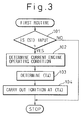
- the ECU 20 controls the ignition time, according to a first routine shown in figure 3.
- the first routine is carried out every predetermined period, and is explained as follows.
- step 101 it is determined whether or not a signal (S1) for starting the engine cranking is input from the ignition switch 34. When the determination is negative, the routine is stopped. On the other hand, when the determination is affirmative, the routine goes to step 102 and a current engine operating condition is determined on the basis of a current engine speed (N), a current amount of intake air (Q), and a temperature (THW) of the cooling water provided by the sensors 31, 32, 33.
- N current engine speed
- Q current amount of intake air
- TW temperature
- step 104 ignition is carried out at the optimum ignition time (Ti). Thus, ignition is started from a cylinder that carries out an initial compression stroke during the engine cranking.
- the ECU 20 controls the fuel injection according to a second routine shown in figure 4.
- the second routine is carried out every predetermined period, and is explained as follows.
- step 201 it is determined whether or not a signal (S1) for starting the engine cranking is input from the ignition switch 34. When the determination is negative, the routine is stopped.
- step 202 it is determined whether or not the preparation for injecting fuel from the fuel injector 8 is finished.
- the preparation include, for example, determining that pressure in the pressure chamber of the fuel injection system has reached a predetermined value which makes the fuel injection possible. When the determination is negative, the routine is stopped.
- a current engine operating condition is determined on the basis of a current engine speed (N), a current amount of intake air (Q), and a temperature (THW) of cooling water provided by the sensors 31, 32, 33.
- N current engine speed
- Q current amount of intake air
- TW temperature
- an optimum fuel injection start time (Ts) during an intake stroke and an optimum amount of fuel injected (THU) for the current engine operating condition are determined from maps (not shown), respectively.
- step 206 fuel injection is carried out on the basis of the optimum fuel injection start time (Ts) and the optimum amount of fuel (THU) or the corrected amount thereof (TAU-TAUK).
- Ts optimum fuel injection start time
- TAU-TAUK corrected amount thereof
- Figure 5 is a third routine for detecting a fuel leak of a fuel injector and identifying the leaking fuel injector through the above-mentioned ignition time control and fuel injection control.
- the routine is carried out at every explosion stroke of each cylinder.
- step 301 it is determined whether or not time (t) which elapses after a signal (S1) for starting the engine cranking is input from the ignition switch 34 is shorter than or equal to a predetermined time (t1).
- t1 time which elapses after a signal (S1) for starting the engine cranking is input from the ignition switch 34 is shorter than or equal to a predetermined time (t1).
- a cylinder in which an initial fuel injection is carried out has not yet completed an explosion stroke after the initial fuel injection was finished, and the routine goes to step 302.
- step 302 it is determined whether or not a difference between a current engine speed (N) and the cranking engine speed (N1) is above a predetermined value (A).
- a flap (F) is reset (0).
- the routine is stopped.
- the determination at step 302 is affirmative, the routine goes to step 304 and thus the flag (F) is set (1).
- step 305 it is determined whether or not a fuel injection was already carried out in a cylinder that is presently in an explosion stroke. When the determination is affirmative, the routine is stopped.
- Each of the count values (C1), (C2), (C3), and (C4) of the respective cylinders is set to (0) when the engine is started for the first time. These count values are not reset even if the engine is stopped.
- step 307 it is determined whether or not the flag (F) is (0).
- the routine is stopped.
- step 308 it is determined that the fuel injector of the cylinder that the first fuel injection is carried out has a fuel leak so that the fuel leak count value (Cn) of this cylinder is increased by one.
- Figure 6 is a time chart from showing the ignition time, fuel injection time, and engine speed, in a start of a manifold-injection-type four-cylinder internal combustion engine. This engine injects fuel during an intake stroke.
- the first to fourth cylinders are ignited in order of #1, #3, #4, and #2.
- the figure shows that the engine is stopped with the first cylinder #1 being in an explosion stroke, the third cylinder #3 in a compression stroke, the fourth cylinder #4 in an intake stroke, and the second cylinder #2 in an exhaust stroke.
- a continuous line in the time chart represents changes in the engine speed in the case that every fuel, injector has no fuel leak.
- the engine is cranked with the cylinders being in the stopped strokes, and in the first cylinder that reaches an intake stroke after the preparedness for fuel injection (after about one turn of the engine cranking) is finished, an initial fuel injection is carried out. Accordingly, an initial explosion occurs in the initial explosion stroke of the first cylinder, and at the same time, the engine speed exceeds the cranking speed. Thereafter, the third, fourth, and second cylinders successively cause an explosion, to gradually increase the engine speed.
- a dot-and-dash line of the time chart represents changes in the engine speed when the second cylinder has a fuel leak.
- no fuel injection is carried out.
- fuel leaked into the intake passage of the second cylinder is drawn into the cylinder with intake air.
- the second cylinder causes an explosion when it is ignited in a compression stroke.
- the engine speed exceeds the cranking speed before the explosion stroke of the first cylinder that the first fuel injection is carried out.
- the determination at step 305 of the third routine is negative, and at step 306, the fuel leak count value (C2) of the second cylinder is increased by one. Namely, it, is determined that the fuel injector of the second cylinder has a fuel leak.
- a two-dot chain line of the time chart represents changes in the engine speed when the first cylinder has a fuel leak.
- fuel leaked into the intake passage as well as injected fuel are drawn into the first cylinder with intake air in an intake stroke just after the start of cranking. Due to this excessive fuel, no explosion occurs even if the cylinder is ignited in the following compression stroke. Accordingly, the flag (F) is remains at (0) without passing the step 304, and therefore, the determination at step 307 is affirmative, and at step 308 the fuel leak count value (C1) of the first cylinder is increased by one. Namely, it is determined that the fuel injector of the first cylinder has a fuel leak.
- a cylinder having a leaking fuel injector in the manifold-injection-type internal combustion engine is stopped in an intake stroke, only a part of the leaked fuel is supplied into the cylinder during the latter half of the intake stroke as soon as the engine is cranked and the amount of fuel supplied is not enough to burn in the cylinder. Accordingly, the unburned fuel can be discharged in an exhaust stroke, to deteriorate the quality of emission.
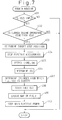
- a fourth routine of figure 7 can control a fuel cut time when the engine is stopped so that the cylinder in question is not stopped in an intake stroke.
- the fourth routine of Fig. 7 is carried out at intervals of predetermined crank angles.
- step 401 it is determined whether or not a signal (S2) for stopping the engine is input from the ignition switch 34. When the determination is negative, the routine is stopped. On the other hand, when the determination is affirmative, the routine goes to step 402, it is determined whether or not an accelerator pedal is released and a current engine operation is an idle condition. Usually, when a current engine operation is an idle condition, the signal (S2) is input, so that the determination at step 402 is usually affirmative. However, if the determination at step 402 is negative, the routine is repeated until the determination is affirmative. Thereafter, the routine goes to step 403.
- a target stop position of each cylinder is determined, according to the injector which has a fuel leak and any injector which is not yet tested for a fuel leak.
- electric accessories such as an air conditioner, that put load on the engine are stopped.
- a cooling water temperature (THW) is detected, as a value representing an engine friction based on the viscosity of a lubricant, and an engine speed (N) is detected, as a value representing kinetic energy.
- TSW cooling water temperature
- N engine speed
- K an engine revolution angle by the engine stopping after fuel cut is carried out from a given cylinder in the idle engine speed
- step 407 according to the engine revolution angle (K), a cylinder from which the fuel cut is started to realize the target stop position of each cylinder is determined.
- step 408 fuel cut is started from the determined cylinder.
- step 409 the actual engine revolution angle by the engine stopping after fuel cut is carried out from the determined cylinder is detected, and thus according to the actual angle, the map of Fig. 8 is updated.
- step 410 a main electric power is stopped, and the routine is stopped.
- the fuel cut time is delayed after the signal (S2) for stopping the engine is input from the ignition switch, such that the fuel cut is started from the fourth cylinder as shown in a time chart of figure 9.
- the engine revolution angle (K) is about 720 degrees at the maximum.
- a required time to realize the revolution angle (K) is about 0.2 seconds under a usual idling operation, and therefore, the driver will never sense the delay in the engine stop timing.
- the present invention has been explained with reference to the manifold-injection-type internal combustion engine in which a fuel injection is carried out during an intake stroke, the present invention is also applicable to manifold-injection-type internal combustion engines in which a fuel injection is carried out before an intake stroke. Moreover, the present invention is also applicable to a cylinder-injection-type internal combustion engines as shown in figure 10.
- the engine has a fuel injector 8' which is arranged in the cylinder head and injects fuel directly into the combustion chamber 2. Fuel injection of the engine is carried out during an intake stroke or during a compression stroke.
- Figure 11 shows a target stop position of each cylinder to surely burn leaked fuel when any one of fuel injectors leaks fuel in the manifold-injection-type and cylinder-injection-type internal combustion engines.
- the target stop position of one of the first, third, and fourth cylinders will be in an intake stroke. If the fuel injector of the second cylinder of the cylinder-injection-type engine has a fuel leak, the target stop position of the second or first cylinder will be in an intake stroke.
- the target stop position of the second cylinder is set to an intake stroke, to extend a period between the engine cranking start and an ignition time of the second cylinder. If a plurality of the fuel injectors have fuel leaks, the target stop positions of the cylinders are determined to minimize the number of cylinders that discharge unburned leaked fuel.
- the fuel injector of a given cylinder has a fuel leak in the manifold-injection-type internal combustion engine in which a fuel injection is carried out during an intake stroke, if a period between the stoppage and restart of the engine is short, the leak will be small so that the leaked fuel will not burn.
- the stop position of the cylinder in question is set to an explosion or compression stroke, so that fuel injection is carried out as soon as the leaked fuel is supplied into the cylinder in the first intake stroke during the engine cranking.
- the optimum amount of fuel injected (TAU) is corrected at step 205 of the second routine for controlling fuel injection.
- a map of figure 12 is used to estimate an amount of fuel leaked (TAUK) during the engine stoppage and the amount of fuel leaked (TAUK) is subtracted from the optimum amount of fuel injected (TAU) in an initial fuel injection of the fuel injector which has a fuel leak.
- the 12 is set such that the higher the temperature of cooling water (THW) at the start of the engine and the larger the fuel leak count value (Cn) is, the larger the amount of fuel leaked (TAUK) become. Because, the higher the temperature (THW) is, the shorter the time during the engine stoppage is. In connection with the fuel leak count value (Cn), the larger the fuel leak count value (Cn) is, the larger a degree of fuel leak in the fuel injector is. Because, when the fuel leak count value (Cn) is large, a fuel leak of the fuel injector is detected even if the engine stopped period is short.
- the map of Fig. 13 shows a coefficient (a) for correcting the amount of fuel reduced (TAUK) with respect to the number of cycles, i.e., the number of fuel injection operations carried out in a given one of the cylinders. According to this correction, an amount of fuel injected is made (TAU-TAUK*a) in the fuel injector which has a fuel leak.
- TAU-TAUK*a an amount of fuel injected is made (TAU-TAUK*a) in the fuel injector which has a fuel leak.
- step 302 of the third routine it is determined whether or not a given cylinder has caused combustion according to an increase in an engine speed.
- This does not limit the present invention. For example, the amount of intake air suddenly increases when the combustion causes an increase in the engine speed. Accordingly, determining whether or not a cylinder has caused combustion may be made by monitoring the amount of intake air with use of the airflow meter 32 disposed in the intake passage.
- Each cylinder may be provided with a temperature sensor 35 or a vibration sensor 36, as shown in Fig. 2, to directly detect heat or vibration caused by combustion.
- electrodes facing each other and spaced from each other may be arranged in each cylinder, to form one of circuits shown in figures 14 and 15.
- an ion current flows through the circuit.
- Monitoring the ion current by an ammeter 38 may detect the combustion.
- the voltage of the ion current changes in response to an air-fuel ratio as shown in figure 16.
- the voltage of the ion current is detected by a voltmeter 37 and it is possible, therefore, to estimate the amount of leaked fuel according to the air-fuel ratio, to thereby accurately correct a reduction in the amount of injected fuel at the start of the engine.
- the electrodes disposed in each cylinder may be the ignition plug 3.
- a fuel leak in a cylinder is detected by determining whether or not the cylinder has caused combustion without fuel injection, or whether or not the cylinder has caused no combustion even after fuel has been injected.
- ignition must be started from a cylinder that first reaches a compression stroke. To make the latter determination, it is not necessary to start ignition so early.
- a control device for an internal combustion engine comprises a fuel injector provided for each cylinder, an ignition plug starting ignition in each cylinder simultaneously with a start of the engine cranking, and a detection unit for detecting combustion in each cylinder when the engine is started which determines that the fuel injector of a cylinder in which ignition is carried out before fuel injection has a fuel leak when combustion is detected in the cylinder.
Landscapes
- Engineering & Computer Science (AREA)
- Chemical & Material Sciences (AREA)
- Combustion & Propulsion (AREA)
- Mechanical Engineering (AREA)
- General Engineering & Computer Science (AREA)
- Electrical Control Of Air Or Fuel Supplied To Internal-Combustion Engine (AREA)
- Combined Controls Of Internal Combustion Engines (AREA)
Applications Claiming Priority (5)
| Application Number | Priority Date | Filing Date | Title |
|---|---|---|---|
| JP262854/94 | 1994-10-26 | ||
| JP26285494 | 1994-10-26 | ||
| JP7241702A JPH08177586A (ja) | 1994-10-26 | 1995-09-20 | 内燃機関の制御装置 |
| JP241702/95 | 1995-09-20 | ||
| EP95116813A EP0709563B1 (de) | 1994-10-26 | 1995-10-25 | Steuerungsvorrichtung für Brennkraftmaschine |
Related Parent Applications (2)
| Application Number | Title | Priority Date | Filing Date |
|---|---|---|---|
| EP95116813.7 Division | 1995-10-25 | ||
| EP95116813A Division EP0709563B1 (de) | 1994-10-26 | 1995-10-25 | Steuerungsvorrichtung für Brennkraftmaschine |
Publications (2)
| Publication Number | Publication Date |
|---|---|
| EP0809007A2 true EP0809007A2 (de) | 1997-11-26 |
| EP0809007A3 EP0809007A3 (de) | 1999-02-03 |
Family
ID=26535402
Family Applications (2)
| Application Number | Title | Priority Date | Filing Date |
|---|---|---|---|
| EP97113898A Withdrawn EP0809007A3 (de) | 1994-10-26 | 1995-10-25 | Steuervorrichtung für Brennkraftmaschine |
| EP95116813A Expired - Lifetime EP0709563B1 (de) | 1994-10-26 | 1995-10-25 | Steuerungsvorrichtung für Brennkraftmaschine |
Family Applications After (1)
| Application Number | Title | Priority Date | Filing Date |
|---|---|---|---|
| EP95116813A Expired - Lifetime EP0709563B1 (de) | 1994-10-26 | 1995-10-25 | Steuerungsvorrichtung für Brennkraftmaschine |
Country Status (4)
| Country | Link |
|---|---|
| US (1) | US5611314A (de) |
| EP (2) | EP0809007A3 (de) |
| JP (1) | JPH08177586A (de) |
| DE (1) | DE69504937T2 (de) |
Families Citing this family (22)
| Publication number | Priority date | Publication date | Assignee | Title |
|---|---|---|---|---|
| US6360161B1 (en) * | 2000-05-04 | 2002-03-19 | Bombardier Motor Corporation Of America | Method and system for fuel injector coefficient installation |
| US6701897B2 (en) * | 2001-02-16 | 2004-03-09 | Optimum Power Technology | Engine fuel delivery management system |
| EP1477654B1 (de) * | 2003-05-16 | 2006-01-04 | Ford Global Technologies, LLC, A subsidary of Ford Motor Company | Verfahren zum Anhalten einer Brennkraftmaschine in einer gewuenschten Ruheposition |
| KR100588496B1 (ko) * | 2003-06-09 | 2006-06-13 | 현대자동차주식회사 | 차량의 초기 시동 제어장치 및 방법 |
| DE102007021594B4 (de) * | 2007-05-08 | 2016-06-02 | Continental Automotive Gmbh | Verfahren zur Diagnose der Undichtigkeit eines Injektors sowie zugehöriges Steuergerät |
| JP4835520B2 (ja) * | 2007-06-15 | 2011-12-14 | トヨタ自動車株式会社 | 内燃機関の制御装置 |
| DE102009045306A1 (de) * | 2009-10-02 | 2011-04-07 | Robert Bosch Gmbh | Verfahren und Vorrichtung zum Betreiben eines Verbrennungsmotors |
| DE102010062226B4 (de) | 2010-11-30 | 2018-10-25 | Continental Automotive Gmbh | Schätzen einer Leckage-Kraftstoffmenge eines Einspritzventils während einer Abstellzeit eines Kraftfahrzeugs |
| US8267067B2 (en) | 2011-03-08 | 2012-09-18 | Ford Global Technologies, Llc | Method for starting an engine automatically |
| JP5838712B2 (ja) * | 2011-10-14 | 2016-01-06 | いすゞ自動車株式会社 | ジメチルエーテル燃料使用エンジンの始動方法、及び、ジメチルエーテル燃料使用エンジン |
| JP5821749B2 (ja) * | 2012-03-30 | 2015-11-24 | トヨタ自動車株式会社 | 内燃機関の始動制御装置 |
| JP5821748B2 (ja) * | 2012-03-30 | 2015-11-24 | トヨタ自動車株式会社 | 内燃機関の始動制御装置 |
| JP6191552B2 (ja) * | 2014-06-19 | 2017-09-06 | トヨタ自動車株式会社 | 内燃機関の自動停止制御装置 |
| US9663096B2 (en) | 2015-02-20 | 2017-05-30 | Ford Global Technologies, Llc | Methods and systems for mitigating fuel injector leak |
| FR3047275B1 (fr) * | 2016-01-29 | 2020-08-14 | Continental Automotive France | Gestion des gouttes residuelles sur les injecteurs |
| GB2550599B (en) * | 2016-05-24 | 2020-05-27 | Delphi Tech Ip Ltd | Method of controlling fuel injection test equipment |
| DE102017206416B3 (de) * | 2017-04-13 | 2018-08-02 | Mtu Friedrichshafen Gmbh | Verfahren zum Ermitteln eines dauereinspritzenden Brennraums, Einspritzsystem und Brennkraftmaschine mit einem solchen Einspritzsystem |
| CN108318252B (zh) * | 2018-01-22 | 2020-06-16 | 哈尔滨工程大学 | 一种用于压气机进口加湿试验的模块式喷水装置 |
| DE102019212214B3 (de) * | 2019-08-14 | 2020-10-15 | Mtu Friedrichshafen Gmbh | Verfahren zur Diagnose einer Injektorleckage bei einer Brennkraftmaschine, Brennkraftmaschine sowie Computerprogrammprodukt |
| CN114856879B (zh) * | 2022-04-11 | 2023-04-07 | 哈尔滨工程大学 | 一种可用于燃烧状态在线监测的柴油机喷嘴装置及检测方法 |
| GB2634328A (en) * | 2023-10-06 | 2025-04-09 | Phinia Delphi Luxembourg Sarl | Leakage detection in gas-fuelled power plants |
| GB2636161A (en) * | 2023-12-01 | 2025-06-11 | Phinia Delphi Luxembourg Sarl | Fault detection in gas-fuelled engine systems |
Family Cites Families (13)
| Publication number | Priority date | Publication date | Assignee | Title |
|---|---|---|---|---|
| US4469070A (en) * | 1980-03-12 | 1984-09-04 | Rassey Louis J | Fuel control valve |
| JPS611841A (ja) * | 1984-06-12 | 1986-01-07 | Nippon Denso Co Ltd | 内燃エンジンの燃料噴射装置 |
| JPS6319536A (ja) * | 1986-07-14 | 1988-01-27 | Hitachi Ltd | 溶液中微粒子検出装置 |
| JPS63195356A (ja) * | 1987-02-06 | 1988-08-12 | Mazda Motor Corp | エンジンの燃料供給装置 |
| JPH0319445A (ja) * | 1989-06-16 | 1991-01-28 | Fujitsu Ltd | セル同期制御方式 |
| JPH03119551A (ja) * | 1989-10-02 | 1991-05-21 | Canon Inc | テープガイド装置 |
| JPH03271538A (ja) * | 1990-03-22 | 1991-12-03 | Fuji Heavy Ind Ltd | 燃料噴射制御装置 |
| JPH03119551U (de) | 1990-03-22 | 1991-12-10 | ||
| US5020362A (en) * | 1990-06-15 | 1991-06-04 | Hickok Electrical Instrument Company | Fuel injection system tester |
| JPH06137197A (ja) * | 1992-09-09 | 1994-05-17 | Nippondenso Co Ltd | 内燃機関の制御装置 |
| DE4243178B4 (de) * | 1992-12-19 | 2005-07-14 | Robert Bosch Gmbh | Verfahren zur Erkennung undichter Einspritzventile bei einer Brennkraftmaschine |
| JP2767352B2 (ja) * | 1993-02-02 | 1998-06-18 | 株式会社ユニシアジェックス | 内燃機関の始動時空燃比制御装置 |
| JP3064748B2 (ja) * | 1993-07-14 | 2000-07-12 | 日産自動車株式会社 | エンジンの燃料制御装置 |
-
1995
- 1995-09-20 JP JP7241702A patent/JPH08177586A/ja active Pending
- 1995-10-25 EP EP97113898A patent/EP0809007A3/de not_active Withdrawn
- 1995-10-25 US US08/548,116 patent/US5611314A/en not_active Expired - Fee Related
- 1995-10-25 EP EP95116813A patent/EP0709563B1/de not_active Expired - Lifetime
- 1995-10-25 DE DE69504937T patent/DE69504937T2/de not_active Expired - Fee Related
Also Published As
| Publication number | Publication date |
|---|---|
| US5611314A (en) | 1997-03-18 |
| DE69504937T2 (de) | 1999-04-29 |
| DE69504937D1 (de) | 1998-10-29 |
| EP0709563B1 (de) | 1998-09-23 |
| EP0709563A1 (de) | 1996-05-01 |
| JPH08177586A (ja) | 1996-07-09 |
| EP0809007A3 (de) | 1999-02-03 |
Similar Documents
| Publication | Publication Date | Title |
|---|---|---|
| EP0709563B1 (de) | Steuerungsvorrichtung für Brennkraftmaschine | |
| US9068548B2 (en) | Spark plug degradation detection | |
| US5808189A (en) | Failure diagnosis controller of pressure sensor | |
| US6732707B2 (en) | Control system and method for internal combustion engine | |
| US7603994B2 (en) | Abnormality diagnosis device and control system for internal combustion engine | |
| US4492203A (en) | Fuel supply control method for an internal combustion engine equipped with a supercharger, having a fail-safe function for abnormality in intake passage pressure sensor means | |
| US5881552A (en) | Control system for internal combustion engines and control system for vehicles | |
| US5690075A (en) | Method of and apparatus for controlling fuel injection in internal combustion engine | |
| US5927248A (en) | Method of monitoring an overheating protective arrangement during full-load operation of an internal combustion engine | |
| US7167794B2 (en) | Control apparatus for an internal combustion engine | |
| US7128053B2 (en) | Control apparatus for internal combustion engine | |
| US5546905A (en) | Control apparatus for controlling the ignition timing of an internal combustion engine | |
| US7085671B2 (en) | Abnormality detection apparatus of engine temperature adjusting thermostat | |
| CN101680376A (zh) | 内燃机的起动装置 | |
| JP2000230453A (ja) | 温度センサの故障診断装置 | |
| EP1783362A1 (de) | Verfahren zur ermittlung einer kohlenstoffverschmutzung eines verbrennungsmotors | |
| EP0176359B1 (de) | Kraftstoffversorgungsmethode für eine mehrzylindrige interne Brennkraftmaschine im Falle des Auftretens einer Abnormalität im Drehwinkelsensor | |
| US6684153B2 (en) | Fuel nature judging device for internal combustion engine | |
| US4502448A (en) | Method for controlling control systems for internal combustion engines immediately after termination of fuel cut | |
| JP3972604B2 (ja) | 筒内直噴式内燃機関の燃料系診断装置 | |
| JPH0263097B2 (de) | ||
| EP1321668A1 (de) | Vorrichtung zur Fehlererkennung von Glühkerzen | |
| JP2008280865A (ja) | 内燃機関の始動制御装置 | |
| EP1416146B1 (de) | Ausgangssteuerungsapparat für eine Brennkraftmaschine | |
| US7104046B2 (en) | Controller for an internal combustion engine |
Legal Events
| Date | Code | Title | Description |
|---|---|---|---|
| PUAI | Public reference made under article 153(3) epc to a published international application that has entered the european phase |
Free format text: ORIGINAL CODE: 0009012 |
|
| AC | Divisional application: reference to earlier application |
Ref document number: 709563 Country of ref document: EP |
|
| AK | Designated contracting states |
Kind code of ref document: A2 Designated state(s): DE FR GB |
|
| PUAL | Search report despatched |
Free format text: ORIGINAL CODE: 0009013 |
|
| AK | Designated contracting states |
Kind code of ref document: A3 Designated state(s): DE FR GB |
|
| STAA | Information on the status of an ep patent application or granted ep patent |
Free format text: STATUS: THE APPLICATION IS DEEMED TO BE WITHDRAWN |
|
| 18D | Application deemed to be withdrawn |
Effective date: 19990804 |