EP0808842A2 - Alkyl-2-acetamido-2-desoxy-gluco-pyranosid-uronsäuren und -Derivate, ihre Herstellung sowie ihre Verwendung als Tenside in kosmetischen und pharmazeutischen Zubereitungen - Google Patents
Alkyl-2-acetamido-2-desoxy-gluco-pyranosid-uronsäuren und -Derivate, ihre Herstellung sowie ihre Verwendung als Tenside in kosmetischen und pharmazeutischen Zubereitungen Download PDFInfo
- Publication number
- EP0808842A2 EP0808842A2 EP97105575A EP97105575A EP0808842A2 EP 0808842 A2 EP0808842 A2 EP 0808842A2 EP 97105575 A EP97105575 A EP 97105575A EP 97105575 A EP97105575 A EP 97105575A EP 0808842 A2 EP0808842 A2 EP 0808842A2
- Authority
- EP
- European Patent Office
- Prior art keywords
- alkyl
- acetamido
- acid
- deoxy
- cosmetic
- Prior art date
- Legal status (The legal status is an assumption and is not a legal conclusion. Google has not performed a legal analysis and makes no representation as to the accuracy of the status listed.)
- Withdrawn
Links
- 0 *C(C=C(CO*CC(C(C1N*C=*)=O)=C(*)C=C1O)C1N*C#*)=C(COC=C(C(C2=O)N*C=*)C=C(CO)C2=O)C1=O Chemical compound *C(C=C(CO*CC(C(C1N*C=*)=O)=C(*)C=C1O)C1N*C#*)=C(COC=C(C(C2=O)N*C=*)C=C(CO)C2=O)C1=O 0.000 description 1
Classifications
-
- A—HUMAN NECESSITIES
- A61—MEDICAL OR VETERINARY SCIENCE; HYGIENE
- A61Q—SPECIFIC USE OF COSMETICS OR SIMILAR TOILETRY PREPARATIONS
- A61Q19/00—Preparations for care of the skin
- A61Q19/10—Washing or bathing preparations
-
- A—HUMAN NECESSITIES
- A61—MEDICAL OR VETERINARY SCIENCE; HYGIENE
- A61K—PREPARATIONS FOR MEDICAL, DENTAL OR TOILETRY PURPOSES
- A61K8/00—Cosmetics or similar toiletry preparations
- A61K8/18—Cosmetics or similar toiletry preparations characterised by the composition
- A61K8/30—Cosmetics or similar toiletry preparations characterised by the composition containing organic compounds
- A61K8/60—Sugars; Derivatives thereof
- A61K8/602—Glycosides, e.g. rutin
-
- A—HUMAN NECESSITIES
- A61—MEDICAL OR VETERINARY SCIENCE; HYGIENE
- A61Q—SPECIFIC USE OF COSMETICS OR SIMILAR TOILETRY PREPARATIONS
- A61Q19/00—Preparations for care of the skin
- A61Q19/005—Preparations for sensitive skin
-
- A—HUMAN NECESSITIES
- A61—MEDICAL OR VETERINARY SCIENCE; HYGIENE
- A61Q—SPECIFIC USE OF COSMETICS OR SIMILAR TOILETRY PREPARATIONS
- A61Q5/00—Preparations for care of the hair
- A61Q5/02—Preparations for cleaning the hair
-
- C—CHEMISTRY; METALLURGY
- C07—ORGANIC CHEMISTRY
- C07H—SUGARS; DERIVATIVES THEREOF; NUCLEOSIDES; NUCLEOTIDES; NUCLEIC ACIDS
- C07H15/00—Compounds containing hydrocarbon or substituted hydrocarbon radicals directly attached to hetero atoms of saccharide radicals
- C07H15/02—Acyclic radicals, not substituted by cyclic structures
- C07H15/12—Acyclic radicals, not substituted by cyclic structures attached to a nitrogen atom of the saccharide radical
-
- C—CHEMISTRY; METALLURGY
- C07—ORGANIC CHEMISTRY
- C07H—SUGARS; DERIVATIVES THEREOF; NUCLEOSIDES; NUCLEOTIDES; NUCLEIC ACIDS
- C07H15/00—Compounds containing hydrocarbon or substituted hydrocarbon radicals directly attached to hetero atoms of saccharide radicals
- C07H15/02—Acyclic radicals, not substituted by cyclic structures
- C07H15/14—Acyclic radicals, not substituted by cyclic structures attached to a sulfur, selenium or tellurium atom of a saccharide radical
-
- Y—GENERAL TAGGING OF NEW TECHNOLOGICAL DEVELOPMENTS; GENERAL TAGGING OF CROSS-SECTIONAL TECHNOLOGIES SPANNING OVER SEVERAL SECTIONS OF THE IPC; TECHNICAL SUBJECTS COVERED BY FORMER USPC CROSS-REFERENCE ART COLLECTIONS [XRACs] AND DIGESTS
- Y10—TECHNICAL SUBJECTS COVERED BY FORMER USPC
- Y10S—TECHNICAL SUBJECTS COVERED BY FORMER USPC CROSS-REFERENCE ART COLLECTIONS [XRACs] AND DIGESTS
- Y10S516/00—Colloid systems and wetting agents; subcombinations thereof; processes of
- Y10S516/905—Agent composition per se for colloid system making or stabilizing, e.g. foaming, emulsifying, dispersing, or gelling
- Y10S516/914—The agent contains organic compound containing nitrogen, except if present solely as NH4+
- Y10S516/915—The compound contains -C[=O]NHH where substitution may be made for the hydrogen
Definitions
- the present invention relates to new active ingredients, their preparation and their use in the field of cosmetic and pharmaceutical dermatology.
- the present invention relates to active substances and cosmetic or dermatological preparations containing such active substance combinations.
- the present invention relates to active ingredients which have surfactant properties.
- the invention further relates to cosmetic and dermatological preparations containing such substances.
- the present invention relates to cosmetic cleaning agents.
- Such means are known per se. These are essentially surface-active substances or mixtures of substances that are offered to the consumer in various preparations.
- Preparations of this type are, for example, foam and shower baths, solid and liquid soaps or so-called “syndets” (synthetic detergents), shampoos, hand-washing pastes, intimate detergents, special cleaning agents for small children and the like.
- synthetic detergents synthetic detergents
- shampoos hand-washing pastes
- intimate detergents special cleaning agents for small children and the like.
- Cosmetic emulsions also contain surface-active substances, so-called emulsifiers. These lower the interfaces between the phases and form interface films at the oil / water interface. This counteracts the irreversible confluence of the dispersed phase.
- Powerful emulsifiers are therefore characterized by very good emulsification, solubilization and dispersibility. It is highly desirable that such substances not cause skin irritation. The selection of such substances known in the prior art is limited. It was therefore an object of the present invention to enrich the prior art in this regard.
- Advantageous cleaning formulations are shower preparations.
- Such preparations are known per se. These are essentially surface-active substances or mixtures of substances that are offered to the consumer in various preparations. Preparations of this type are generally distinguished by a more or less high water content, but can also be present, for example, as a concentrate.
- preparations which are intended for the shower bath do not differ, or hardly differ, from bath bath preparations, apart from the fact that products of higher viscosity which are not preferred after removal are preferred for shower preparations run out of the container from the hand. This is of less practical importance for bath bath preparations.
- preparations can be formulated which result in either spreading oil films, oil-in-water systems or total solubilisates on the bathing water surface. Foaming, but also low-foaming or non-foaming formulations are possible. In general, the functionality of such preparations in oil bath or oil cream bath preparations is limited to regreasing or over-greasing the uppermost skin layers.
- the present invention relates to cosmetic and dermatological preparations for the prophylaxis and treatment of cosmetic or dermatological cell changes, in particular skin changes such as e.g. skin aging, in particular cell aging caused by oxidative processes, in particular skin aging.
- alkyl-2-acetamido-2-deoxy-D-glucopyranoside uronic acids of the general formula is also according to the invention where R represents the group consisting of branched and unbranched alkyl of 1 to 48 carbon atoms, in particular 14 to 22, preferably 16 to 18 carbon atoms, as surface-active and / or surface-active agents, in particular as detergent surfactants or emulsifiers, and wherein the uronic acids can preferably be present in the form of their salts, in particular as alkali salts, of which preferably the sodium salt, as ammonium, alkylammonium, dialkylammonium, trialkylammonium or tetraalkylammonium salts.
- the substances obtained according to the invention are distinguished by excellent skin friendliness, very good surface and surface-active activity and processability in cosmetic and dermatological preparations.
- Mixtures of ⁇ - and ⁇ -glycosides can also be advantageous according to the invention.
- the person skilled in the art is familiar with an abundance of processes which are able to separate the anomers, for example chromatographic processes.
- alkyl-2-acetamido-2-deoxy-D-glucopyranoside uronic acids according to the invention and their advantageous salts are derived formally and practically from chitin, which has the structural formula is marked.
- chitin derivatives namely chitosan, a hydrolysis product of chitin
- chitin for example, is better than the chitin on which it is based, as a thickener or stabilizer and improves the adhesion and water resistance of polymeric films.
- HPFiedler Encyclopedia of auxiliaries for pharmacy, cosmetics and related areas , fourth edition 1989, Editio Cantor, Aulendorf, p. 349, keyword Chitosan .
- an anomer mixture is obtainable which can be separated into the anomers by the methods familiar to the person skilled in the art.
- the ⁇ -anomer is predominantly obtained, usually in a nine-fold excess over the ⁇ -anomer.
- alkyl-2-acetamido-2-deoxy-glucopyranosides known per se are also outstandingly suitable as surface-active or surface-active substances.
- the use of alkyl-2-acetamido-2-deoxy-glucopyranosides of the general structural formula is therefore also according to the invention where R represents the group consisting of branched and unbranched alkyl of 1 to 48 carbon atoms, in particular 14 to 22, preferably 16 to 18 carbon atoms, as surface-active and / or surface-active agents, in particular as detergent surfactants or emulsifiers.
- the cosmetic or dermatological formulations according to the invention can be composed as usual and can be used for the treatment, care and cleaning of the skin and / or hair and as a make-up product in decorative cosmetics. They preferably contain 0.001% by weight to 10% by weight, but in particular 0.01% by weight to 6% by weight, based on the total weight of the composition, of the alkyl 2-acetamido-2-deoxy according to the invention -D-glucopyranoside uronic acids.
- the cosmetic and dermatological preparations according to the invention are applied to the skin and / or the hair in a sufficient amount in the manner customary for cosmetics.
- Cosmetic and dermatological preparations according to the invention can be in various forms. So you can e.g. a solution, an anhydrous preparation, an emulsion or microemulsion of the water-in-oil (W / O) or oil-in-water (O / W) type, a multiple emulsions, for example of the water-in-oil type in water (W / O / W), a gel, a solid stick, an ointment or an aerosol.
- a solution an anhydrous preparation, an emulsion or microemulsion of the water-in-oil (W / O) or oil-in-water (O / W) type, a multiple emulsions, for example of the water-in-oil type in water (W / O / W), a gel, a solid stick, an ointment or an aerosol.
- alkyl 2-acetamido-2-deoxy-D-glucopyranoside uronic acids according to the invention into aqueous systems or surfactant preparations for cleaning the skin and hair.
- the cosmetic and dermatological preparations according to the invention can contain cosmetic auxiliaries as are usually used in such preparations, e.g. Preservatives, bactericides, perfumes, anti-foaming substances, dyes, pigments that have a coloring effect, thickeners, surface-active substances, emulsifiers, softening, moisturizing and / or moisturizing substances, fats, oils, waxes or other usual components of a cosmetic or dermatological formulation such as alcohols, polyols, polymers, foam stabilizers, electrolytes, organic solvents or silicone derivatives.
- cosmetic auxiliaries e.g. Preservatives, bactericides, perfumes, anti-foaming substances, dyes, pigments that have a coloring effect, thickeners, surface-active substances, emulsifiers, softening, moisturizing and / or moisturizing substances, fats, oils, waxes or other usual components of a cosmetic or dermatological formulation such as alcohols, polyols, polymers
- alkyl 2-acetamido-2-deoxy-D-glucopyranoside uronic acids according to the invention can also be combined with antioxidants.
- antioxidants suitable or customary for cosmetic and / or dermatological applications can be used as favorable antioxidants.
- the antioxidants are advantageously selected from the group consisting of amino acids (eg glycine, histidine, tyrosine, tryptophan) and their derivatives, imidazoles (eg urocanic acid) and their derivatives, peptides such as D, L-carnosine, D-carnosine, L-carnosine and their derivatives (e.g. anserine), carotenoids, carotenes (e.g. ⁇ -carotene, ⁇ -carotene, lycopene) and their derivatives, chlorogenic acid and their derivatives, lipoic acid and their derivatives (e.g.
- amino acids eg glycine, histidine, tyrosine, tryptophan
- imidazoles eg urocanic acid
- peptides such as D, L-carnosine, D-carnosine, L-carnosine and their derivatives (e.g. anserine)
- carotenoids e.g
- thiols e.g. thioredoxin, Glutathione, cysteine, cystine, cystamine and their glycosyl, N-acetyl, methyl, ethyl, propyl, amyl, butyl and lauryl, palmitoyl, oleyl, ⁇ -linoleyl, cholesteryl and glyceryl esters
- salts dilauryl thiodipropionate, distearyl thiodipropionate, thiodipropionic acid and their derivatives (esters, ethers, peptides, lipids, nucleotides, nucleosides and salts) as well as sulfoximine compounds (e.g.
- buthioninsulfoximines homocysteine sulfoximine, buthioninsulfones, penta-, hexa-, H eptathionine sulfoximine
- very low tolerable doses e.g. pmol to ⁇ mol / kg
- further (metal) chelators e.g. ⁇ -hydroxy fatty acids, palmitic acid, phytic acid, lactoferrin
- ⁇ -hydroxy acids e.g.
- citric acid citric acid, lactic acid, malic acid
- humic acid bile acid
- Biliary extracts bilirubin, biliverdin, EDTA, EGTA and their derivatives
- unsaturated fatty acids and their derivatives eg ⁇ -linolenic acid, linoleic acid, oleic acid
- folic acid and its derivatives unsaturated fatty acids and their derivatives
- ubiquinone and ubiquinol and their derivatives e.g. ascorbyl palmitate, Mg ascorbyl phosphate, ascorbyl acetate
- tocopherols and derivatives e.g.
- vitamin E acetate
- vitamin A and derivatives vitamin A palmitate
- coniferyl benzoate of the benzoin resin rutinic acid and derivatives thereof, ⁇ -glycosyl rutin, ferulic acid, Furfurylidenglucitol, carnosine, butylhydroxytoluene, butylhydroxyanisole, Nordihydroguajakharzklare, nordihydroguaiaretic acid, trihydroxybutyrophenone, uric acid and derivatives thereof, mannose and derivatives thereof, zinc and derivatives thereof (for example ZnO, ZnSO 4) selenium and derivatives thereof (eg selenium methionine), stilbenes and their derivatives (eg stilbene oxide, trans-stilbene oxide) and the derivatives suitable according to the invention (salts, esters, ethers, sugars, nucleotides, nucleosides, peptides and lipids) of these active substances.
- rutinic acid and derivatives thereof ⁇
- the amount of the aforementioned antioxidants (one or more compounds) in the preparations is preferably 0.001 to 30% by weight, particularly preferably 0.05-20% by weight, in particular 1-10% by weight, based on the total weight of the Preparation.
- vitamin E and / or its derivatives represent the antioxidant (s)
- vitamin A or vitamin A derivatives or carotenes or their derivatives represent the antioxidant or antioxidants, it is advantageous to have their respective concentrations in the range from 0.001-10% by weight, based on the total weight of the formulation, to choose.
- Emulsions according to the invention are advantageous and contain e.g. the fats, oils, waxes and other fat bodies mentioned, as well as water and an emulsifier, as is usually used for such a type of formulation.
- the aqueous phase of the preparations according to the invention advantageously advantageously contains alcohols, diols or polyols having a low C number, and also their ethers, preferably ethanol, isopropanol, propylene glycol, glycerol, ethylene glycol, ethylene glycol monoethyl or monobutyl ether, propylene glycol monomethyl, monoethyl or monobutyl ether, diethylene glycol monomethyl - or -monoethyl ether and analog products and in particular one or more thickeners, which or which can advantageously be selected from the group silicon dioxide, aluminum silicates, polysaccharides or their derivatives, for example Hyaluronic acid, xanthan gum, hydroxypropylmethyl cellulose, particularly advantageously from the group of polyacrylates, preferably a polyacrylate from the group of so-called carbopols, for example carbopoles of types 980, 981, 1382, 2984, 5984, each individually or in
- Water can also be a component of alcoholic solvents.
- Emulsions according to the invention are advantageous and contain e.g. the fats, oils, waxes and other fat bodies mentioned, as well as water and an emulsifier, as is usually used for such a type of formulation.
- Gels according to the invention usually contain alcohols of low C number, for example ethanol, isopropanol, 1,2-propanediol, glycerol and water or an oil mentioned above in the presence of a thickener which, in the case of oily alcoholic gels, preferably silicon dioxide or an aluminum silicate aqueous-alcoholic or alcoholic gels is preferably a polyacrylate.
- alcohols of low C number for example ethanol, isopropanol, 1,2-propanediol, glycerol and water or an oil mentioned above in the presence of a thickener which, in the case of oily alcoholic gels, preferably silicon dioxide or an aluminum silicate aqueous-alcoholic or alcoholic gels is preferably a polyacrylate.
- Suitable propellants for preparations according to the invention which can be sprayed from aerosol containers are the customary, known volatile, liquefied propellants, for example hydrocarbons (propane, butane, isobutane), which can be used alone or in a mixture with one another. Compressed air can also be used advantageously.
- hydrocarbons propane, butane, isobutane
- Preparations according to the invention can also advantageously contain substances which absorb UV radiation in the UVB range, the total amount of filter substances e.g. 0.1% by weight to 30% by weight, preferably 0.5 to 10% by weight, in particular 1.0 to 6.0% by weight, based on the total weight of the preparations, in order to produce cosmetic preparations To provide that protect the hair or skin from the entire range of ultraviolet radiation. They can also serve as a sunscreen for the hair or skin.
- UVB filters which can be used in combination with the alkyl 2-acetamido-2-deoxy-D-glucopyranoside uronic acids according to the invention, is of course not intended to be limiting.
- the invention also relates to the use of a combination of the alkyl 2-acetamide-2-deoxy-D-glucopyranoside uronic acids according to the invention with at least one UVB filter as an antioxidant or the use of a combination of the tocopheryglycosides according to the invention with at least one UVB filter as Antioxidant in a cosmetic or dermatological preparation.
- alkyl 2-acetamido-2-deoxy-D-glucopyranoside uronic acids may also be advantageous to combine alkyl 2-acetamido-2-deoxy-D-glucopyranoside uronic acids according to the invention with UVA filters which have hitherto usually been found in cosmetic preparations.
- These substances are preferably derivatives of dibenzoylmethane, in particular 1- (4'-tert-butylphenyl) -3- (4'-methoxyphenyl) propane-1,3-dione and 1-phenyl-3- (4 '-isopropylphenyl) propane-1,3-dione.
- These combinations or preparations containing these combinations are also the subject of the invention.
- the quantities used for the UVB combination can be used.
- the invention also relates to the use of a combination of the alkyl-2-acetamido-2-deoxy-D-glucopyranoside uronic acids according to the invention with at least one UVA filter as an antioxidant or the use of a combination of the tocopheryglycosides according to the invention with at least one UVA filter as Antioxidant in a cosmetic or dermatological preparation.
- the invention also relates to the use of a combination of the alkyl-2-acetamido-2-deoxy-D-glucopyranoside uronic acids according to the invention with at least one UVA filter and at least one UVB filter as an antioxidant or the use of a combination of the tocopheryglycosides according to the invention at least one UVA filter and at least one UVB filter as an antioxidant in a cosmetic or dermatological preparation.
- Cosmetic and dermatological preparations with an effective content of alkyl-2-acetamido-2-deoxy-D-glucopyranoside-uronic acids according to the invention can also contain inorganic pigments which are usually used in cosmetics to protect the skin from UV rays. These are oxides of titanium, zinc, iron, zirconium, silicon, manganese, aluminum, cerium and mixtures thereof, as well as modifications in which the oxides are the active agents. It is particularly preferred to use pigments based on titanium dioxide.
- UVA filter and pigment or preparations containing this combination are also the subject of the invention.
- the amounts given for the above combinations can be used.
- Cosmetic and dermatological preparations for protecting the hair from UV rays according to the invention are, for example, shampooing agents, preparations which are used when rinsing the hair before or after the shampooing, before or after the permanent wave treatment, before or after the coloring or discoloration of the Hair is applied to preparations for blow-drying or pickling hair, preparations for coloring or decolouring, to a styling and treatment lotion, a hair lacquer or to permanent waving agents.
- the cosmetic and dermatological agents contain active ingredients and auxiliaries, as are customary for this type of preparations for hair care and hair treatment be used.
- auxiliaries include preservatives, surface-active substances, substances to prevent foaming, thickeners, emulsifiers, fats, oils, waxes, organic solvents, bactericides, perfumes, dyes or pigments, the task of which is to add hair or the cosmetic or dermatological preparation itself coloring, electroyte, substances against greasing the hair.
- Electrolytes for the purposes of the present invention are water-soluble alkali metal, ammonium, alkaline earth metal (including magnesium) and zinc salts of inorganic anions and any mixtures of such salts, it being necessary to ensure that these salts are pharmaceutically or cosmetically harmless award.
- the anions according to the invention are preferably granted from the group of chlorides, sulfates and hydrogen sulfates, phosphates, hydrogen phosphates and linear and cyclic oligophosphates as well as carbonates and hydrogen carbonates.
- Cosmetic preparations which are a skin cleansing agent or shampooing agent preferably contain at least one further anionic, non-ionic or amphoteric and betaines surface-active substance or surface-active betaines, or also mixtures of such substances, furthermore alkyl-2-acetamido-2-deoxy- D-glucopyranoside uronic acids in an aqueous medium and auxiliary agents, as are usually used for this.
- the surface-active substance or the mixtures of these substances can be present in the shampoo in a concentration between 1% by weight and 50% by weight.
- a lotion that is rinsed out and e.g. before or after decolorization, before or after shampooing, between two shampooing steps, before or after permanent waving, these are e.g. around aqueous or aqueous-alcoholic solutions, which may contain surface-active substances, the concentration of which may be between 0.1 and 10% by weight, preferably between 0.2 and 5% by weight.
- These cosmetic or dermatological preparations can also be aerosols with the auxiliaries usually used for them.
- a cosmetic preparation in the form of a lotion that is not rinsed out, in particular a lotion for inlaying the hair, a lotion used for blow-drying the hair, a styling and treatment lotion generally provides an aqueous, alcoholic or aqueous-alcoholic solution represents and contains at least one cationic, anionic, non-ionic or amphoteric polymer or mixtures thereof, as well as active ingredient combinations according to the invention in effective concentration.
- the amount of the polymers used is e.g. between 0.1 and 10% by weight, preferably between 0.1 and 3% by weight.
- Cosmetic preparations for the treatment and care of the skin and hair which contain alkyl-2-acetamido-2-deoxy-D-glucopyranoside uronic acids according to the invention can be present as emulsions which are of the non-ionic or cationic type.
- non-ionic emulsions contain oils or fatty alcohols, which can also be polyethoxylated or polypropoxylated, for example, or also mixtures of the two organic components.
- These emulsions may contain cationic surface-active substances.
- cosmetic preparations for the treatment and care of the hair can be in the form of gels which, in addition to an effective content of alkyl-2-acetamido-2-deoxy-D-glucopyranoside uronic acids according to the invention, preferably water, and also organic thickeners, e.g. Gum arabic, xanthan gum, sodium alginate, cellulose derivatives, preferably methyl cellulose, hydroxymethyl cellulose, hydroxyethyl cellulose, hydroxypropyl cellulose, hydroxypropyl methyl cellulose or inorganic thickeners, e.g. Aluminum silicates such as bentonites, or a mixture of polyethylene glycol and polyethylene glycol stearate or distearate, contain.
- the thickener is in the gel e.g. in an amount between 0.1 and 30% by weight, preferably between 0.5 and 15% by weight.
- the amount of the alkyl-2-acetamido-2-deoxy-D-glucopyranoside uronic acids according to the invention in an agent intended for the hair is preferably from 0.05% to 10% by weight, in particular 0.5% by weight up to 5 wt .-%, based on the total weight of the agent.
- Aqueous cosmetic detergents according to the invention or water-free or anhydrous detergent concentrates intended for aqueous cleaning can contain anionic, nonionic and / or amphoteric surfactants, for example conventional soaps, e.g. Fatty acid salts of sodium, alkyl sulfates, alkyl ether sulfates, alkane and alkylbenzenesulfonates, sulfoacetates, sulfobetaines, sarcosinates, amidosulfobetaines, sulfosuccinates, sulfosuccinic acid esters, alkyl ether carboxylates, protein fatty acid condensates, alkyl betaines and amide alkanolamines, fatty acid or amide alkanols.
- anionic, nonionic and / or amphoteric surfactants for example conventional soaps, e.g. Fatty acid salts of sodium, alkyl sulfates
- Cosmetic preparations which are cosmetic cleaning preparations for the skin, can be in liquid or solid form.
- the alkyl-2-acetamido-2-deoxy-D-glucopyranoside uronic acids or their salts used according to the invention can preferably contain at least one anionic, non-ionic or amphoteric surface-active substance or mixtures thereof, if desired one or more electrolytes and auxiliaries, as they are usually used for this.
- the surface-active substance can be present in the cleaning preparations in a concentration of between 1 and 94% by weight, based on the total weight of the preparations.
- cosmetic preparations which are a shampooing agent preferably contain at least one anionic, nonionic or amphoteric surface-active substance or mixtures thereof , optionally an electrolyte and auxiliary according to the invention, as are usually used therefor.
- the surface-active substance can be present in the shampoo in a concentration between 1% by weight and 94% by weight.
- compositions according to the invention contain water and, if appropriate, the additives customary in cosmetics, for example perfume, thickeners, dyes, antimicrobial substances, refatting agents, complexing and sequestering agents, pearlescent agents, plant extracts, vitamins, active ingredients and the like.
- the additives customary in cosmetics for example perfume, thickeners, dyes, antimicrobial substances, refatting agents, complexing and sequestering agents, pearlescent agents, plant extracts, vitamins, active ingredients and the like.
- the amount of alkyl-2-acetamido-2-deoxy-D-glucopyranoside-uronic acids used in these preparations is preferably 0.001% by weight to 10% by weight, in particular 0.1% by weight to 3% by weight. %, based on the total weight of the preparations.
- the invention also relates to the process for the preparation of the cosmetic compositions according to the invention, which is characterized in that alkyl-2-acetamido-2-deoxy-D-glucopyranoside uronic acids according to the invention are incorporated into cosmetic and dermatological formulations in a manner known per se.
- Ground chitin is mixed with hydrochloric acid and butyl alcohol at 55 ° C. and the reaction product thus obtained is purified by electrodialysis.
- the reaction product is reacted with stearyl alcohol under acid catalysis with camphorsulfonic acid at 90 ° C. and the butyl alcohol is removed at 90 ° C. under a water jet vacuum.
- the product is neutralized with NaOH and the product is oxidized to the end product at 60 ° C. using an Adam's catalyst.
- Ground chitin is mixed with hydrochloric acid and butyl alcohol at 55 ° C. and the reaction product thus obtained is purified by electrodialysis.
- the reaction product is reacted with cetyl alcohol under acid catalysis with camphorsulfonic acid at 90 ° C. and the butyl alcohol is removed at 90 ° C. under a water jet vacuum.
- the product is neutralized with NaOH and the product is oxidized to the end product at 60 ° C. using an Adam's catalyst.
- Ground chitin is mixed with hydrochloric acid and butyl alcohol at 55 ° C. and the reaction product thus obtained is purified by electrodialysis.
- the reaction product is reacted with decyl alcohol under acid catalysis with camphorsulfonic acid at 90 ° C. and the butyl alcohol is removed at 90 ° C. under a water jet vacuum.
- the product is neutralized with NaOH and the product is oxidized to the end product at 60 ° C. using an Adam's catalyst.
- Ground chitin is mixed with hydrochloric acid and butyl alcohol at 55 ° C. and the reaction product thus obtained is purified by electrodialysis.
- the reaction product is reacted with dodecyl alcohol under acid catalysis with camphorsulfonic acid at 90 ° C. and the butyl alcohol is removed at 90 ° C. under a water jet vacuum.
- the product is neutralized with NaOH and the product is oxidized to the end product at 60 ° C. using an Adam's catalyst.
- Ground chitin is mixed with hydrochloric acid and butyl alcohol at 55 ° C. and the reaction product thus obtained is purified by electrodialysis.
- the reaction product is reacted with tetradecyl alcohol under acid catalysis with camphorsulfonic acid at 90 ° C and the butyl alcohol is removed at 90 ° C under a water jet vacuum.
- the product is neutralized with NaOH and the product is oxidized to the end product at 60 ° C. using an Adam's catalyst.
- Ground chitin is mixed with hydrochloric acid and butyl alcohol at 55 ° C. and the reaction product thus obtained is purified by electrodialysis.
- the reaction product is reacted with palmityl alcohol under acid catalysis with camphorsulfonic acid at 90 ° C. and the butyl alcohol is removed at 90 ° C. under a water jet vacuum.
- the product is neutralized with NaOH and the product is oxidized to the end product at 60 ° C. using an Adam's catalyst.
- Ground chitin is mixed with hydrochloric acid and butyl alcohol at 55 ° C. and the reaction product thus obtained is purified by electrodialysis.
- the reaction product is reacted with eicosyl alcohol under acid catalysis with camphorsulfonic acid at 90 ° C and the butyl alcohol is removed at 90 ° C under a water jet vacuum.
- the product is neutralized with NaOH and the product is oxidized to the end product at 60 ° C. using an Adam's catalyst.
- Hydrodispersion gel % By weight Cetyl-2-acetamide-2-deoxy-D-glucopyranoside uronic acid sodium salt 0.25 PEG-8 (polyethylene glycol 400) 5.00 Ethanol 2.00 Carbomer 2984 0.70 Triglyceride, liquid 1.50 Glycerin 4.00 Sorbitol 1.00 Panthenol 0.50 Tocopherol acetate 0.50 Perfume, preservatives, dyes, antioxidants q.s water ad 100.00
- Hydrodispersion gel % By weight Cetyl-2-acetamido-2-deoxy-D-glucopyranoside 0.15 PEG-8 (polyethylene glycol 400) 5.00 Ethanol 2.00 Carbomer 2984 0.70 Triglyceride, liquid 1.50 Glycerin 4.00 Sorbitol 1.00 Panthenol 0.50 Tocopherol acetate 0.50 Perfume, preservatives, dyes, antioxidants q.s water ad 100.00
- Facial cleansing wash lotion % By weight Stearyl-2-acetamido-2-deoxy-D-glucopyranoside-uronic acid Na salt 5.00 Sodium cocoamphoacetate (30%) 10.00 Perfume, preservatives, thickeners, dyes, antioxidants q.s water ad 100.00
Landscapes
- Health & Medical Sciences (AREA)
- Chemical & Material Sciences (AREA)
- Life Sciences & Earth Sciences (AREA)
- General Health & Medical Sciences (AREA)
- Organic Chemistry (AREA)
- Animal Behavior & Ethology (AREA)
- Public Health (AREA)
- Veterinary Medicine (AREA)
- Crystallography & Structural Chemistry (AREA)
- Engineering & Computer Science (AREA)
- Biochemistry (AREA)
- Biotechnology (AREA)
- Genetics & Genomics (AREA)
- Molecular Biology (AREA)
- Dermatology (AREA)
- Birds (AREA)
- Epidemiology (AREA)
- Cosmetics (AREA)
- Saccharide Compounds (AREA)
Abstract
Description
- Die vorliegende Erfindung betrifft neue Wirkstoffe, deren Herstellung sowie deren Verwendung auf dem Gebiete der kosmetischen sowie der pharmazeutischen Dermatologie. Insbesondere betrifft die vorliegende Erfindung Wirkstoffe und kosmetische oder dermatologische Zubereitungen, solche Wirkstoffkombinationen enthaltend. Insbesondere betrifft die vorliegende Erfindung Wirkstoffe, welche Tensideigenschaften besitzen. Ferner betrifft die Erfindung kosmetische und dermatologische Zubereitungen mit einem Gehalt an solchen Substanzen. In einer bevorzugten Ausführungsform betrifft die vorliegende Erfindung kosmetische Reinigungsmittel.
- Derartige Mittel sind an sich bekannt. Es handelt sich dabei im wesentlichen um oberflächenaktive Substanzen oder Stoffgemische, die dem Verbraucher in verschiedenen Zubereitungen angeboten werden.
- Zubereitungen dieser Art sind beispielsweise Schaum- und Duschbäder, feste und flüssige Seifen oder sogenannte "Syndets" (synthetische Detergentien), Shampoos, Handwaschpasten, Intimwaschmittel, spezielle Reinigungsmittel für Kleinkinder und dergleichen.
- Oberflächenaktive Stoffe - am bekanntesten die Alkalisalze der höheren Fettsäuren, also die klassischen "Seifen" - sind amphiphile Stoffe, die organische unpolare Substanzen in Wasser emulgieren können.
- Diese Stoffe schwemmen nicht nur Schmutz von Haut und Haaren, sie reizen, je nach Wahl des Tensids oder des Tensidgemisches, Haut und Schleimhäute mehr oder minder stark. Das gebräuchlichste Tensid für kosmetische Reinigungsmittel ist das Natriumlaurylethersulfat. Obwohl es gute Waschkraft besitzt und - je nach Dosierung - recht gut haut- und schleimhautverträglich ist, sollten empfindliche Personen den häufigen Kontakt damit meiden.
- Es ist zwar eine große Zahl recht milder Tenside erhältlich, jedoch sind die Tenside des Standes der Technik entweder mild, reinigen aber schlecht, oder aber sie reinigen gut, reizen jedoch Haut oder Schleimhäute.
- Auch kosmetische Emulsionen enthalten grenzflächenaktive Stoffe, sogenannte Emulgatoren. Diese setzen die Grenzflächen zwischen den Phasen herab und bilden an der Phasengrenze Öl/Wasser Grenzflächenfilme aus. Dadurch wird dem irreversiblen Zusammenfließen der dispergierten Phase entgegengewirkt.
- Leistungsfähige Emulgatoren zeichnen sich daher durch eine sehr gute Emulgier-, Solubilisierungs- sowie Dispergierungsfähigkelt aus. Es ist in hohem Maße wünschenswert, daß solche Substanzen keine Hautreizung auslösen. Die Auswahl solcher dem Stande der Technik bekannten Substanzen ist begrenzt. Es war daher eine Aufgabe der vorliegenden Erfindung, den Stand der Technik in dieser Hinsicht zu bereichern.
- Vorteilhafte Reinigungsformulierungen, auch im Sinne der vorliegenden Erfindung, sind Duschpräparate.
- Derartige Zubereitungen sind an sich bekannt. Es handelt sich dabei im wesentlichen um oberflächenaktive Substanzen oder Stoffgemische, die dem Verbraucher in verschiedenen Zubereitungen angeboten werden. Zubereitungen solcher Art zeichnen sich im allgemeinen durch einen mehr oder weniger hohen Wassergehalt aus, können aber auch beispielsweise als Konzentrat vorliegen.
- Im allgemeinen unterscheiden sich Präparate, welche für das Duschbad vorgesehen sind, nicht oder kaum von Wannenbadzubereitungen, abgesehen davon, daß bei Duschzubereitungen Produkte höherer Viskosität bevorzugt werden, die nicht nach Entnahme aus dem Behälter aus der Hand rinnen. Dies ist bei Wannenbadzubereitungen weniger von praktischer Bedeutung.
- Schon bei einem einfachen Wasserbade ohne Zusatz von Tensiden kommt es zunächst zu einer Quellung der Homschicht der Haut, wobei der Grad dieser Quellung beispielsweise von der Dauer des Bades und dessen Temperatur abhängt. Zugleich werden wasserlösliche Stoffe, z.B. wasserlösliche Schmutzbestandteile, aber auch hauteigene Stoffe, die für das Wasserbindungsvermögen der Hornschicht verantwortlich sind, ab- bzw. ausgewaschen. Durch hauteigene oberflächenaktive Stoffe werden zudem auch Hautfette in gewissem Ausmaße gelöst und ausgewaschen. Dies bedingt nach anfänglicher Quellung eine nachfolgende deutliche Austrocknung der Haut, die durch waschaktive Zusätze nach verstärkt werden kann.
- Bei gesunder Haut sind diese Vorgänge im allgemeinen belanglos, da die Schutzmechanismen der Haut solche leichten Störungen der oberen Hautschichten ohne weiteres kompensieren können. Aber bereits im Falle nichtpathologischer Abweichungen vom Normalstatus, z.B. durch umweltbedingte Abnutzungsschäden bzw. Irritationen, Lichtschäden, Altershaut usw., ist der Schutzmechanismus der Hautoberfläche gestört. Unter Umständen ist er dann aus eigener Kraft nicht mehr imstande, seine Aufgabe zu erfüllen und muß durch externe Maßnahmen regeneriert werden.
- Der Stand der Technik kennt Ölbadzubereitungen verschiedener Art, wobei die Eigenschaften der Fett- oder Ölphase durch Zugabe von oberflächenaktiven Substanzen variiert werden kann. Dabei können je nach Art und Menge der gewählten Bestandteile Zubereitungen formuliert werden, die auf der Badewasseroberfläche entweder spreitende Ölfilme, Öl-in-Wasser-Systeme oder auch Totalsolubilisate ergeben. Schäumende, aber auch wenig schäumende oder nicht schäumende Formulierungen sind möglich. Im allgemeinen beschränkt sich die Funktionalität derartiger Zubereitungen bei Ölbad- oder Ölcrèmebadzubereitungen auf die Rückfettung oder Überfettung der obersten Hautschichten.
- Dennoch können pflegende Öle im Einzelfalle die schädigende Wirkung eines wenig hautfreundlichen Tensides bestenfalls überdecken, weswegen ein Ölbad oder ein Ölcrèmebad nicht besser sein kann als das oder die darin eingesetzten Tenside.
- Es war somit die Aufgabe der vorliegenden Erfindung, den Mißständen des Standes der Technik in dieser Hinsicht abzuhelfen.
- In einer weiteren bevorzugten Ausführungsform betrifft die vorliegende Erfindung kosmetische und dermatologische Zubereitungen zur Prophylaxe und Behandlung kosmetischer oder dermatologischer Zellveränderungen, insbesondere Hautveränderungen wie z.B. der Hautalterung, insbesondere der durch oxidative Prozesse hervorgerufenen Zellalterung, insbesondere der Hautalterung.
- Schließlich war es Aufgabe der vorliegenden Erfindung, Herstellungsverfahren für solche Wirkstoffe zu konzipieren.
- Es war überraschend und für den Fachmann nicht vorauszusehen, daß Alkyl-2-acetamido-2-desoxy-D-glucopyranosid-uronsäuren der allgemeinen Formel
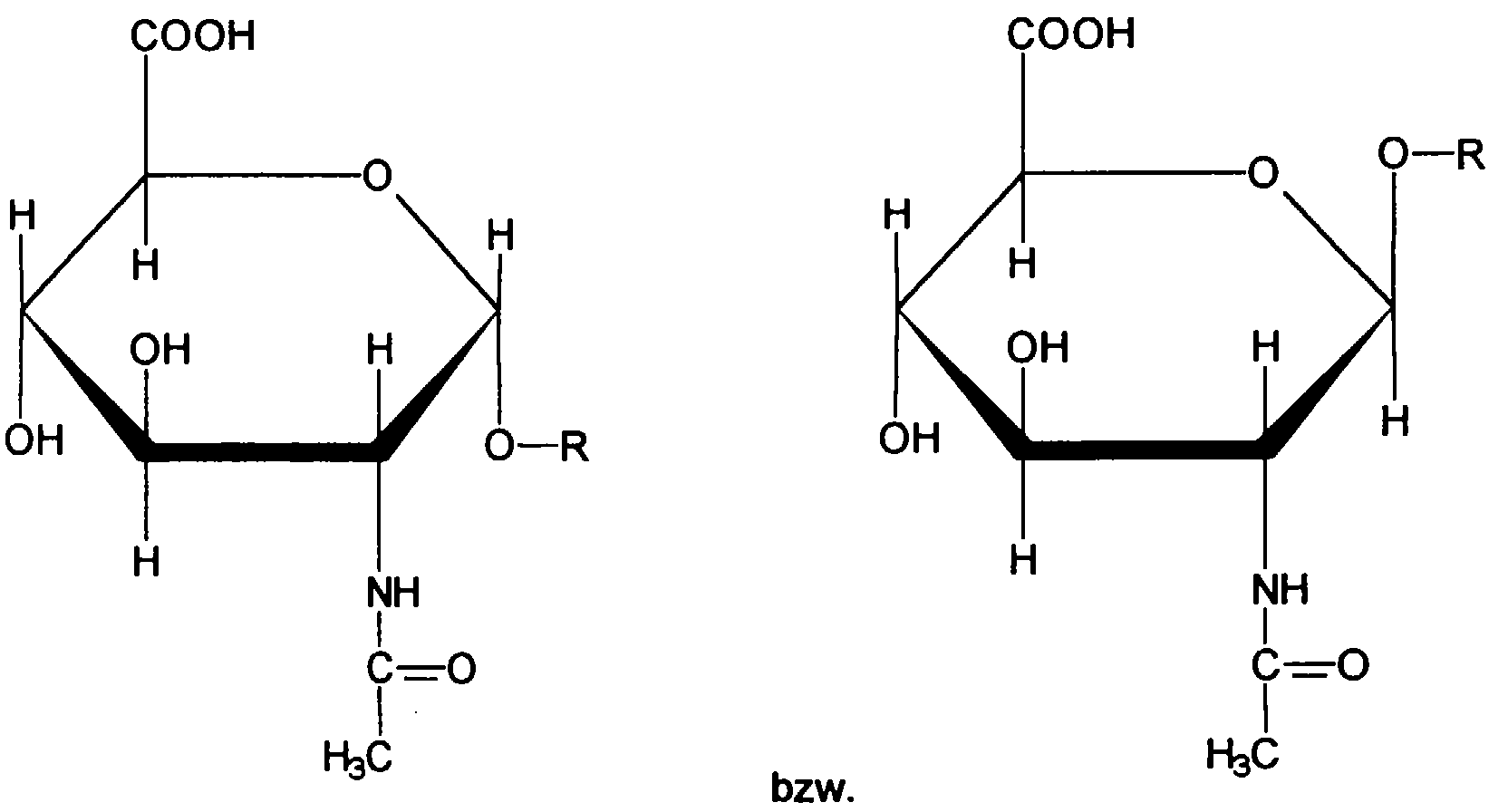
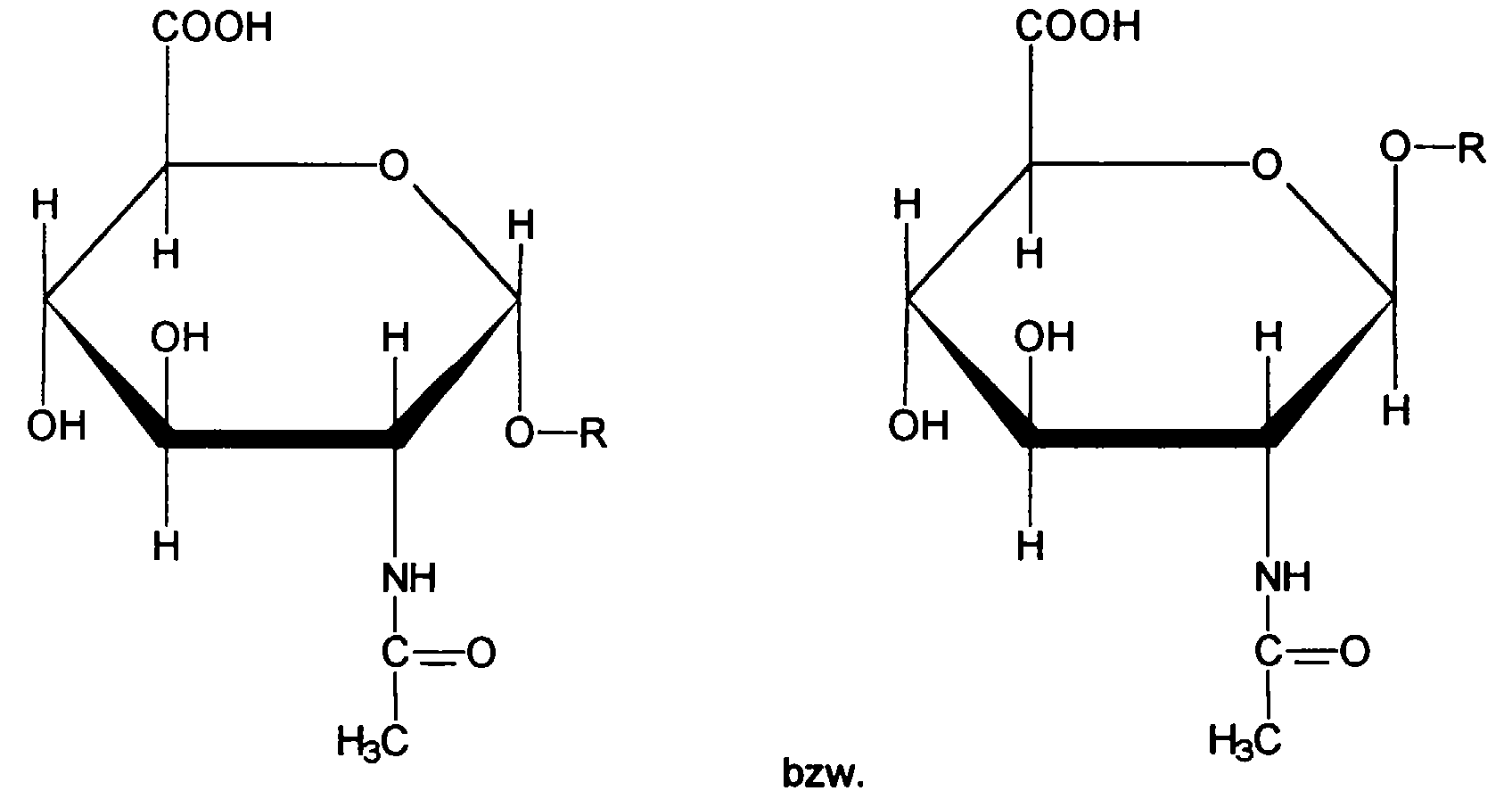
- (1) Chitin gemahlen wird
- (2) das gemahlene Chitin mit Säure und einem ersten aliphatischen Alkohol niedriger Kettenlänge, bevorzugt einer Kettenlänge kleiner als C8 versetzt wird, worauf
- (3) gegebenenfalls das so erhaltene Reaktionsprodukt durch Dialyse, bevorzugt Elektrodialyse, gereinigt wird,
- (4) ein zweiter, nicht mit dem ersten aliphatischen Alkohol identischer Alkohol, bevorzugt einer Kettenlänge von C8 und länger, unter Säurekatalyse mit dem Reaktionsprodukt umgesetzt wird, wodurch der erste aliphatische Alkohol wieder frei und
- (4a) gegebenenfalls auf destillativem Wege entfernt wird,
- (5) das Reaktionsprodukt der Oxidation unterworfen wird,
- Erfindungsgemäß ist folglich auch die Verwendung Alkyl-2-acetamido-2-desoxy-D-glucopyranosid-uronsäuren der allgemeinen Formel

- Die erfindungsgemäß erhaltenen Substanzen zeichnen sich durch hervorragende Hautfreundlichkeit, sehr gute ober- und grenzflächenaktive Wirksamkeit und Verarbeitbarkeit in kosmetische und dermatologische Zubereitungen aus.
- Auch Gemische aus α- und β-Glycosiden können erfindungsgemäß vorteilhaft sein. Jedenfalls sind dem Fachmann eine Fülle von Verfahren bekannt, welche die Anomeren zu trennen imstande sind, beispielsweise chromatographische Verfahren.
- Die erfindungsgemäßen Alkyl-2-acetamido-2-desoxy-D-glucopyranosid-uronsäuren und deren vorteilhaften Salze leiten sich formal wie auch praktisch vom Chitin ab, welches durch die Strukturformel
 ο χ
ο χ των = grch.: der Panzerrock] der Gliederfüßer (z.B. Insekten, Krebse, Spinnen) und wird auch in Stützgeweben anderer Organismen (z.B. Weichtiere, Algen, Pilze) gefunden.
- Die Verwendung von Chitinderivaten, namentlich von Chitosan, einem Hydrolyseprodukt des Chitins, in kosmetischen Zubereitungen ist an sich bekannt. Chitosan, z.B., eignet sich, besser als das ihm zugrundeliegende Chitin, als Verdicker oder Stabilisator und verbessert die Adhäsion und Wasserresistenz von polymeren Filmen. Stellvertretend für eine Vielzahl von Fundstellen des Standes der Technik: H.P.Fiedler,Lexikon der Hilfsstoffe für Pharmazie, Kosmetik und angrenzende Gebiete
 , vierte Auflage 1989, Editio Cantor, Aulendorf, S. 349, Stichwort
 Chitosan
 .
. - Auch die Verwendung anderer Zuckerderivate als oberflächenaktive Substanzen in Kosmetika, Dermatika und anderen Zubereitungen ist durchaus bekannt, beispielsweise aus den Patentanmeldungsschriften WO 93/07249, DE-OS 41 29 124, DE-OS 41 02 502, DE-OS 40 26 471 und DE OS 40 26 809.
- Gleichwohl konnte der Stand der Technik keinen Hinweis auf die vorliegende Erfindung geben.
- Erfindungsgemäß vorteilhaft wird ein Verfahren angewandt, welches sich am folgenden Reaktionsschema orientiert:

- Besonders vorteilhafte Reaktionsbedingungen sehen vor, daß
- (2) das gemahlene Chitin in der Wärme, vorteilhaft bei Temperaturen von 40 - 70° C, insbesondere ca 55° C mit Säure und einem ersten aliphatischen Alkohol versetzt wird.
- (4) ein zweiter, nicht mit dem ersten aliphatischen Alkohol identischer Alkohol, bevorzugt einer Kettenlänge von C8 und länger, unter Säurekatalyse mit dem Reaktionsprodukt umgesetzt wird, wodurch der erste aliphatische Alkohol wieder frei und
- (4a) im Vakuum auf destillativem Wege entfernt wird.
- Ein geeigneter Temperaturbereich für diesen Reaktionsschritt und für die destillative Entfernung des ersten aliphatischen Alkohols ist zwischen 80 und 100° C, bevorzugt ca. 90°C.
- Die Säurekatalyse kann über saure Ionenaustauscherharze, z.B. Amberlite IR 120, mittels Camphersulfonsäure oder Salzsäure vorgenommen werden.
- Am Ende dieses Reaktionsschrittes kann vorteilhaft eine Neutralisation, z.B. mit Natronlauge oder über basische Ionenaustauscherharze vorgenommen werden.
- Weiterhin ist von Vorteil,
- (5) das Reaktionsprodukt der Oxidation mit Pt/O2 (Adamskatalysator) zu unterwerfen.
- Erfindungsgemäß ist ein Anomerengemisch erhältlich, welches nach den dem Fachmanne geläufigen Methoden in die Anomeren aufgetrennt werden kann. Vorwiegend wird erfindungsgemäß das α-Anomere erhalten, für gewöhnlich in neunfachem Überschuß gegenüber dem β-Anomeren.
- Es kann auch von Vorteil sein, von käuflichen Alkyl-2-acetamido-2-desoxy-glucopyranosiden auszugehen und lediglich den Reaktionsschritt (5) durchzuführen gemäß dem Reaktionsschema

- Ferner hat sich herausgestellt, daß auch die an sich bekannten Alkyl-2-acetamido-2-desoxy-glucopyranoside sich hervorragend als ober- bzw. grenzflächen aktive Substanzen eignen. Erfindungsgemäß ist daher auch die Verwendung von Alkyl-2-acetamido-2-desoxy-glucopyranosiden der allgemeinen Strukturformel

- Die erfindungsgemäßen kosmetischen oder dermatologischen Formulierungen können wie üblich zusammengesetzt sein und zur Behandlung, der Pflege und der Reinigung der Haut und/oder der Haare und als Schminkprodukt in der dekorativen Kosmetik dienen. Sie enthalten bevorzugt 0,001 Gew.-% bis 10 Gew.-%, insbesondere aber 0,01 Gew.-% bis 6 Gew.-%, bezogen auf das Gesamtgewicht des Mittels, an den erfindungsgemäßen Alkyl-2-acetamido-2-desoxy-D-glucopyranosid-uronsäuren.
- Zur Anwendung werden die erfindungsgemäßen kosmetischen und dermatologischen Zubereitungen in der für Kosmetika üblichen Weise auf die Haut und/oder die Haare in ausreichender Menge aufgebracht.
- Erfindungsgemäße kosmetische und dermatologische Zubereitungen können in verschiedenen Formen vorliegen. So können sie z.B. eine Lösung, eine wasserfreie Zubereitung, eine Emulsion oder Mikroemulsion vom Typ Wasser-in-Öl (W/O) oder vom Typ Öl-in-Wasser (O/W), eine multiple Emulsionen, beispielsweise vorn Typ Wasser-in-Öl-in-Wasser (W/O/W), ein Gel, einen festen Stift, eine Salbe oder auch ein Aerosol darstellen.
- Es ist auch möglich und vorteilhaft im Sinne der vorliegenden Erfindung, die erfindungsgemäßen Alkyl-2-acetamido-2-desoxy-D-glucopyranosid-uronsäuren in wäßrige Systeme bzw. Tensidzubereitungen zur Reinigung der Haut und der Haare einzufügen.
- Die erfindungsgemäßen kosmetischen und dermatologischen Zubereitungen können kosmetische Hilfsstoffe enthalten, wie sie üblicherweise in solchen Zubereitungen verwendet werden, z.B. Konservierungsmittel, Bakterizide, Parfüme, Substanzen zum Verhindern des Schäumens, Farbstoffe, Pigmente, die eine färbende Wirkung haben, Verdickungsmittel, oberflächenaktive Substanzen, Emulgatoren, weichmachende, anfeuchtende und/oder feuchthaltende Substanzen, Fette, Öle, Wachse oder andere übliche Bestandteile einer kosmetischen oder dermatologischen Formulierung wie Alkohole, Polyole, Polymere, Schaumstabilisatoren, Elektrolyte, organische Lösemittel oder Silikonderivate.
- Insbesondere können die erfindungsgemäßen Alkyl-2-acetamido-2-desoxy-D-glucopyranosid-uronsäuren auch mit Antioxidantien kombiniert werden.
- Erfindungsgemäß können als günstige Antioxidantien alle für kosmetische und/oder dermatologische Anwendungen geeigneten oder gebräuchlichen Antioxidantien verwendet werden.
- Vorteilhaft werden die Antioxidantien gewählt aus der Gruppe bestehend aus Aminosäuren (z.B. Glycin, Histidin, Tyrosin, Tryptophan) und deren Derivate, Imidazole (z.B. Urocaninsäure) und deren Derivate, Peptide wie D,L-Carnosin, D-Carnosin, L-Carnosin und deren Derivate (z.B. Anserin), Carotinoide, Carotine (z.B. α-Carotin, β-Carotin, Lycopin) und deren Derivate, Chlorogensäure und deren Derivate, Liponsäure und deren Derivate (z.B. Dihydroliponsäure), Aurothioglucose, Propylthiouracil und andere Thiole (z.B. Thioredoxin, Glutathion, Cystein, Cystin, Cystamin und deren Glycosyl-, N-Acetyl-, Methyl-, Ethyl-, Propyl-, Amyl-, Butyl- und Lauryl-, Palmitoyl-, Oleyl-, γ-Linoleyl-, Cholesteryl- und Glycerylester) sowie deren Salze, Dilaurylthiodipropionat, Distearylthiodipropionat, Thiodipropionsäure und deren Derivate (Ester, Ether, Peptide, Lipide, Nukleotide, Nukleoside und Salze) sowie Sulfoximinverbindungen (z.B. Buthioninsulfoximine, Homocysteinsulfoximin, Buthioninsulfone, Penta-, Hexa-, Heptathioninsulfoximin) in sehr geringen verträglichen Dosierungen (z.B. pmol bis µmol/kg), ferner (Metall)-Chelatoren (z.B. α-Hydroxyfettsäuren, Palmitinsäure, Phytinsäure, Lactoferrin), α-Hydroxysäuren (z.B. Citronensäure, Milchsäure, Apfelsäure), Huminsäure, Gallensäure, Gallenextrakte, Bilirubin, Biliverdin, EDTA, EGTA und deren Derivate, ungesättigte Fettsäuren und deren Derivate (z.B. γ-Linolensäure, Linolsäure, Ölsäure), Folsäure und deren Derivate, Ubichinon und Ubichinol und deren Derivate, Vitamin C und Derivate (z.B. Ascorbylpalmitat, Mg-Ascorbylphosphat, Ascorbylacetat), Tocopherole und Derivate (z.B. Vitamin-E-acetat), Vitamin A und Derivate (Vitamin-A-palmitat) sowie Koniferylbenzoat des Benzoeharzes, Rutinsäure und deren Derivate, α-Glycosylrutin, Ferulasäure, Furfurylidenglucitol, Carnosin, Butylhydroxytoluol, Butylhydroxyanisol, Nordihydroguajakharzsäure, Nordihydroguajaretsäure, Trihydroxybutyrophenon, Harnsäure und deren Derivate, Mannose und deren Derivate, Zink und dessen Derivate (z.B. ZnO, ZnSO4) Selen und dessen Derivate (z.B. Selenmethionin), Stilbene und deren Derivate (z.B. Stilbenoxid, Trans-Stilbenoxid) und die erfindungsgemäß geeigneten Derivate (Salze, Ester, Ether, Zukker, Nukleotide, Nukleoside, Peptide und Lipide) dieser genannten Wirkstoffe.
- Die Menge der vorgenannten Antioxidantien (eine oder mehrere Verbindungen) in den Zubereitungen beträgt vorzugsweise 0,001 bis 30 Gew.-%, besonders bevorzugt 0,05 - 20 Gew.-%, insbesondere 1 - 10 Gew.-%, bezogen auf das Gesamtgewicht der Zubereitung.
- Sofern Vitamin E und/oder dessen Derivate das oder die Antioxidantien darstellen, ist vorteilhaft, deren jeweilige Konzentrationen aus dem Bereich von 0,001 - 10 Gew.-%, bezogen auf das Gesamtgewicht der Formulierung, zu wählen.
- Sofern Vitamin A, bzw. Vitamin-A-Derivate, bzw. Carotine bzw. deren Derivate das oder die Antioxidantien darstellen, ist vorteilhaft, deren jeweilige Konzentrationen aus dem Bereich von 0,001 - 10 Gew.-%, bezogen auf das Gesamtgewicht der Formulierung, zu wählen.
- Erfindungsgemäße Emulsionen sind vorteilhaft und enthalten z.B. die genannten Fette, Öle, Wachse und anderen Fettkörper, sowie Wasser und einen Emulgator, wie er üblicherweise für einen solchen Typ der Formulierung verwendet wird.
- Die Lipidphase kann dabei vorteilhaft gewählt werden aus folgender Substanzgruppe:
- natürliche, synthetische und/oder partialsynthetische Öle, wie Triglyceride der Caprin- oder der Caprylsäure, vorzugsweise aber Rizinusöl;
- Fette, Wachse und andere natürliche synthetische und/oder partialsynthetische Fettkörper, vorzugsweise Ester von Fettsäuren mit Alkoholen niedriger C-Zahl, z.B. mit Isopropanol, Propylenglykol oder Glycerin, oder Ester von Fettalkoholen mit Alkansäuren niedriger C-Zahl oder mit Fettsäuren;
- Silikonöle wie Dimethylpolysiloxane, Diethylpolysiloxane, Diphenylpolysiloxane sowie Mischformen daraus.
- gesättigte Verbindungen wie Kohlenwasserstoffe natürlichen oder synthetischen Ursprungs (Vaseline, Squalan)
- Die wäßrige Phase der erfindungsgemäßen Zubereitungen enthält gegebenenfalls vorteilhaft Alkohole, Diole oder Polyole niedriger C-Zahl, sowie deren Ether, vorzugsweise Ethanol, Isopropanol, Propylenglykol, Glycerin, Ethylenglykol, Ethylenglykolmonoethyl- oder -monobutylether, Propylenglykolmonomethyl, -monoethyl- oder -monobutylether, Diethylenglykolmonomethyl- oder -monoethylether und analoge Produkte sowie insbesondere ein oder mehrere Verdickungsmittel, welches oder welche vorteilhaft gewählt werden können aus der Gruppe Siliciumdioxid, Aluminiumsilikate, Polysaccharide bzw. deren Derivate, z.B. Hyaluronsäure, Xanthangummi, Hydroxypropylmethylcellulose, besonders vorteilhaft aus der Gruppe der Polyacrylate, bevorzugt ein Polyacrylat aus der Gruppe der sogenannten Carbopole, beispielsweise Carbopole der Typen 980, 981, 1382, 2984, 5984, jeweils einzeln oder in Kombination.
- Insbesondere werden Gemische der vorstehend genannten Lösemittel verwendet. Bei alkoholischen Lösemitteln kann Wasser ein weiterer Bestandteil sein.
- Erfindungsgemäße Emulsionen sind vorteilhaft und enthalten z.B. die genannten Fette, Öle, Wachse und anderen Fettkörper, sowie Wasser und einen Emulgator, wie er üblicherweise für einen solchen Typ der Formulierung verwendet wird.
- Gele gemäß der Erfindung enthalten üblicherweise Alkohole niedriger C-Zahl, z.B. Ethanol, Isopropanol, 1,2-Propandiol, Glycerin und Wasser bzw. ein vorstehend genanntes Öl in Gegenwart eines Verdickungsmittels, das bei ölig-alkoholischen Gelen vorzugsweise Siliciumdioxid oder ein Aluminiumsilikat, bei wäßrig-alkoholischen oder alkoholischen Gelen vorzugsweise ein Polyacrylat ist.
- Als Treibmittel für erfindungsgemäße, aus Aerosolbehältern versprühbare Zubereitungen sind die üblichen bekannten leichtflüchtigen, verflüssigten Treibmittel, beispielsweise Kohlenwasserstoffe (Propan, Butan, Isobutan) geeignet, die allein oder in Mischung miteinander eingesetzt werden können. Auch Druckluft ist vorteilhaft zu verwenden.
- Vorteilhaft können erfindungsgemäße Zubereitungen außerdem Substanzen enthalten, die UV-Strahlung im UVB-Bereich absorbieren, wobei die Gesamtmenge der Filtersubstanzen z.B. 0,1 Gew.-% bis 30 Gew.-%, vorzugsweise 0,5 bis 10 Gew.-%, insbesondere 1,0 bis 6,0 Gew.-% beträgt, bezogen auf das Gesamtgewicht der Zubereitungen, um kosmetische Zubereitungen zur Verfügung zu stellen, die das Haar bzw. die Haut vor dem gesamten Bereich der ultravioletten Strahlung schützen. Sie können auch als Sonnenschutzmittel fürs Haar oder die Haut dienen.
- Enthalten die erfindungsgemäßen Emulsionen UVB-Filtersubstanzen, können diese öllöslich oder wasserlöslich sein. Erfindungsgemäß vorteilhafte öllösliche UVB-Filter sind z.B.:
- 3-Benzylidencampher-Derivate, vorzugsweise 3-(4-Methylbenzyliden)campher, 3-Benzylidencampher;
- 4-Aminobenzoësäure-Derivate, vorzugsweise 4-(Dimethylamino)-benzoësäure(2-ethylhexyl)ester, 4-(Dimethylamino)benzoësäureamylester;
- Ester der Zimtsäure, vorzugsweise 4-Methoxyzimtsäure(2-ethylhexyl)ester, 4-Methoxyzimtsäureisopentylester;
- Ester der Salicylsäure, vorzugsweise Salicylsäure(2-ethylhexyl)ester, Salicylsäure(4-isopropylbenzyl)ester, Salicylsäurehomomenthylester,
- Derivate des Benzophenons, vorzugsweise 2-Hydroxy-4-methoxybenzophenon, 2-Hydroxy-4-methoxy-4'-methylbenzophenon, 2,2'-Dihydroxy-4-methoxybenzophenon;
- Ester der Benzalmalonsäure, vorzugsweise 4-Methoxybenzalmalonsäuredi(2-ethylhexyl)ester, - 2,4,6-Trianilino-(p-carbo-2'-ethyl-1'-hexyloxy) - 1,3,5-triazin.
- Vorteilhafte wasserlösliche UVB-Filter sind z.B.:
- Salze der 2-Phenylbenzimidazol-5-sulfonsäure wie ihr Natrium-, Kalium- oder ihr Triethanolammonium-Salz, sowie die Sulfonsäure selbst;
- Sulfonsäure-Derivate von Benzophenonen, vorzugsweise 2-Hydroxy-4-methoxybenzophenon-5-sulfonsäure und ihre Salze;
- Sulfonsäure-Derivate des 3-Benzylidencamphers, wie z.B. 4-(2-Oxo-3-bornylidenmethyl)benzolsulfonsäure, 2-Methyl-5-(2-oxo-3-bornylidenmethyl)sulfonsäure und ihre Salze.
- Die Liste der genannten UVB-Filter, die in Kombination mit den erfindungsgemäßen Alkyl-2-acetamido-2-desoxy-D-glucopyranosid-uronsäuren verwendet werden können, soll selbstverständlich nicht limitierend sein.
- Gegenstand der Erfindung ist auch die Verwendung einer Kombination der erfindungsgemäßen Alkyl-2-acetamid-2-desoxy-D-glucopyranosid-uronsäuren mit mindestens einem UVB-Filter als Antioxidans bzw. die Verwendung einer Kombination der erfindungsgemäßen Tocopheryglycoside mit mindestens einem UVB-Filter als Antioxidans in einer kosmetischen oder dermatologischen Zubereitung.
- Es kann auch von Vorteil sein, erfindungsgemäße Alkyl-2-acetamido-2-desoxy-D-glucopyranosid-uronsäuren mit UVA-Filtern zu kombinieren, die bisher üblicherweise in kosmetischen Zubereitungen enthalten sind. Bei diesen Substanzen handelt es sich vorzugsweise um Derivate des Dibenzoylmethans, insbesondere um 1-(4'-tert.Butylphenyl)-3-(4'-methoxyphenyl)propan-1,3-dion und um 1-Phenyl-3-(4'-isopropylphenyl)propan-1,3-dion. Auch diese Kombinationen bzw. Zubereitungen, die diese Kombinationen enthalten, sind Gegenstand der Erfindung. Es können die für die UVB-Kombination verwendeten Mengen eingesetzt werden.
- Gegenstand der Erfindung ist auch die Verwendung einer Kombination der erfindungsgemäßen Alkyl-2-acetamido-2-desoxy-D-glucopyranosid-uronsäuren mit mindestens einem UVA-Filter als Antioxidans bzw. die Verwendung einer Kombination der erfindungsgemäßen Tocopheryglycoside mit mindestens einem UVA-Filter als Antioxidans in einer kosmetischen oder dermatologischen Zubereitung.
- Gegenstand der Erfindung ist auch die Verwendung einer Kombination der erfindungsgemäßen Alkyl-2-acetamido-2-desoxy-D-glucopyranosid-uronsäuren mit mindestens einem UVA-Filter und mindestens einem UVB-Filter als Antioxidans bzw. die Verwendung einer Kombination der erfindungsgemäßen Tocopheryglycoside mit mindestens einem UVA-Filter und mindestens einem UVB-Filter als Antioxidans in einer kosmetischen oder dermatologischen Zubereitung.
- Kosmetische und dermatologische Zubereitungen mit einem wirksamen Gehalt an erfindungsgemäßen Alkyl-2-acetamido-2-desoxy-D-glucopyranosid-uronsäuren können auch anorganische Pigmente enthalten, die üblicherweise in der Kosmetik zum Schutze der Haut vor UV-Strahlen verwendet werden. Dabei handelt es sich um Oxide des Titans, Zinks, Eisens, Zirkoniums, Siliciums, Mangans, Aluminiums, Cers und Mischungen davon, sowie Abwandlungen, bei denen die Oxide die aktiven Agentien sind. Besonders bevorzugt handelt es sich um Pigmente auf der Basis von Titandioxid.
- Auch diese Kombinationen von UVA-Filter und Pigment bzw. Zubereitungen, die diese Kombination enthalten, sind Gegenstand der Erfindung. Es können die für die vorstehenden Kombinationen genannten Mengen verwendet werden.
- Bei kosmetischen und dermatologischen Zubereitungen zum Schutze der Haare vor UV-Strahlen gemäß der Erfindung handelt es sich beispielsweise um Shampoonierungsmittel, Zubereitungen, die beim Spülen der Haare vor oder nach der Shampoonierung, vor oder nach der Dauerwellbehandlung, vor oder nach der Färbung oder Entfärbung der Haare angewendet werden, um Zubereitungen zum Fönen oder Einlegen der Haare, Zubereitungen zum Färben oder Entfärben, um eine Frisier- und Behandlungslotion, einen Haarlack oder um Dauerwellmittel.
- Die kosmetischen und dermatologischen enthalten Wirkstoffe und Hilfsstoffe, wie sie üblicherweise für diesen Typ von Zubereitungen zur Haarpflege und Haarbehandlung verwendet werden. Als Hilfsstoffe dienen Konservierungsmittel, oberflächenaktive Substanzen, Substanzen zum Verhindern des Schäumens, Verdickungsmittel, Emulgatoren, Fette, Öle, Wachse, organische Lösungsmittel, Bakterizide, Parfüme, Farbstoffe oder Pigmente, deren Aufgabe es ist, die Haare oder die kosmetische oder dermatologische Zubereitung selbst zu färben, Elektroyte, Substanzen gegen das Fetten der Haare.
- Unter Elektrolyten im Sinne der vorliegenden Erfindung sind wasserlösliche Alkali-, Ammonium-, Erdalkali- (unter Einbeziehung des Magnesiums) und Zinksalze anorganischer Anionen und beliebige Gemische aus solchen Salzen zu verstehen, wobei gewährleistet sein muß, daß sich diese Salze durch pharmazeutische oder kosmetische Unbedenklichkeit auszeichnen.
- Die erfindungsgemäßen Anionen werden bevorzugt gewährt aus der Gruppe der Chloride, der Sulfate und Hydrogensulfate, der Phosphate, Hydrogenphosphate und der linearen und cyclischen Oligophosphate sowie der Carbonate und Hydrogencarbonate.
- Kosmetische Zubereitungen, die ein Hautreinigungsmittel oder Shampoonierungsmittel darstellen, enthalten vorzugsweise mindestens eine weitere anionische, nicht-ionische oder amphotere und Betaine oberflächenaktive Substanz bzw. oberflächenaktive Betaine, oder auch Gemische aus solchen Substanzen, ferner erfindungsgemäße Alkyl-2-acetamido-2-desoxy-D-glucopyranosid-uronsäuren im wäßrigen Medium und Hilfsmittel, wie sie üblicherweise dafür verwendet werden. Die oberflächenaktive Substanz bzw. die Gemische aus diesen Substanzen können in einer Konzentration zwischen 1 Gew.-% und 50 Gew.-% in dem Shampoonierungsmittel vorliegen.
- Liegen die kosmetischen oder dermatologischen Zubereitungen in Form einer Lotion vor, die ausgespült und z.B. vor oder nach der Entfärbung, vor oder nach der Shampoonierung, zwischen zwei Shampoonierungsschritten, vor oder nach der Dauerwellbehandlung angewendet wird, so handelt es sich dabei z.B. um wäßrige oder wäßrig-alkoholische Lösungen, die gegebenenfalls oberflächenaktive Substanzen enthalten, deren Konzentration zwischen 0,1 und 10 Gew.-%, vorzugsweise zwischen 0,2 und 5 Gew.-%, liegen kann.
- Diese kosmetischen oder dermatologischen Zubereitungen können auch Aërosole mit den üblicherweise dafür verwendeten Hilfsmitteln darstellen.
- Eine kosmetische Zubereitung in Form einer Lotion, die nicht ausgespült wird, insbesondere eine Lotion zum Einlegen der Haare, eine Lotion, die beim Fönen der Haare verwendet wird, eine Frisier- und Behandlungslotion, stellt im allgemeinen eine wäßrige, alkoholische oder wäßrig-alkoholische Lösung dar und enthält mindestens ein kationisches, anionisches, nicht-ionisches oder amphoteres Polymer oder auch Gemische derselben, sowie erfindungsgemäße Wirkstoffkombinatonen in wirksamer Konzentration. Die Menge der verwendeten Polymeren liegt z.B. zwischen 0,1 und 10 Gew.-%, bevorzugt zwischen 0,1 und 3 Gew.-%.
- Kosmetische Zubereitungen zur Behandlung und Pflege der Haut und der Haare, die erfindungsgemäße Alkyl-2-acetamido-2-desoxy-D-glucopyranosid-uronsäuren enthalten, können als Emulsionen vorliegen, die vom nicht-ionischen oder kationischen Typ sind. Nicht-ionische Emulsionen enthalten neben Wasser Öle oder Fettalkohole, die beispielsweise auch polyethoxyliert oder polypropoxyliert sein können, oder auch Gemische aus den beiden organischen Komponenten. Diese Emulsionen enthalten gegebenenfalls kationische oberflächenaktive Substanzen.
- Erfindungsgemäß können kosmetische Zubereitungen zur Behandlung und Pflege der Haare als Gele vorliegen, die neben einem wirksamen Gehalt an erfindungsgemäßen Alkyl-2-acetamido-2-desoxy-D-glucopyranosid-uronsäuren bevorzugt Wasser, noch organische Verdickungsmittel, z.B. Gummiarabikum, Xanthangummi, Natriumalginat, Cellulose-Derivate, vorzugsweise Methylcellulose, Hydroxymethylcellulose, Hydroxyethylcellulose, Hydroxypropylcellulose, Hydroxypropylmethylcellulose oder anorganische Verdickungsmittel, z.B. Aluminiumsilikate wie beispielsweise Bentonite, oder ein Gemisch aus Polyethylenglykol und Polyethylenglycolstearat oder -distearat, enthalten. Das Verdickungsmittel ist in dem Gel z.B. in einer Menge zwischen 0,1 und 30 Gew.-%, bevorzugt zwischen 0,5 und 15 Gew.-%, enthalten.
- Vorzugsweise beträgt die Menge der erfindungsgemäßen Alkyl-2-acetamido-2-desoxy-D-glucopyranosid-uronsäuren in einem für die Haare bestimmten Mittel 0,05 Gew.-% bis 10 Gew.-%, insbesondere 0,5 Gew.-% bis 5 Gew.-%, bezogen auf das Gesamtgewicht des Mittels.
- Erfindungsgemäße wäßrige kosmetische Reinigungsmittel oder für die wäßrige Reinigung bestimmte wasserarme oder wasserfreie Reinigungsmittelkonzentrate können anionische, nichtionische und/oder amphotere Tenside enthalten, beispielsweise herkömmliche Seifen, z.B. Fettsäuresalze des Natriums, Alkylsulfate, Alkylethersulfate, Alkan- und Alkylbenzolsulfonate, Sulfoacetate, Sulfobetaine, Sarcosinate, Amidosulfobetaine, Sulfosuccinate, Sulfobernsteinsäurehalbester, Alkylethercarboxylate, Eiweiß-Fettsäure-Kondensate, Alkylbetaine und Amidobetaine, Fettsäurealkanolamide und/oder Polyglycolether-Derivate.
- Kosmetische Zubereitungen, die kosmetische Reinigungszubereitungen für die Haut darstellen, können in flüssiger oder fester Form vorliegen. Sie können neben den erfindungsgemäß verwendeten Alkyl-2-acetamido-2-desoxy-D-glucopyranosid-uronsäuren bzw. deren Salzen vorzugsweise mindestens eine anionische, nicht-ionische oder amphotere oberflächenaktive Substanz oder Gemische daraus enthalten, gewünschtenfalls einen oder mehrere Elektrolyten und Hilfsmittel, wie sie üblicherweise dafür verwendet werden. Die oberflächenaktive Substanz kann in einer Konzentration zwischen 1 und 94 Gew.-% in den Reinigungszubereitungen vorliegen, bezogen auf das Gesamtgewicht der Zubereitungen.
- Kosmetische Zubereitungen, die ein Shampoonierungsmittel darstellen, enthalten neben einem wirksamen Gehalt an erfindungsgemäß verwendeten Alkyl-2-acetamido-2-desoxy-D-glucopyranosid-uronsäuren bzw. deren Salzen vorzugsweise mindestens eine anionische, nicht-ionische oder amphotere oberflächenaktive Substanz oder Gemische daraus, gegebenenfalls einen erfindungsgemäßes Elektrolyten und Hilfsmittel, wie sie üblicherweise dafür verwendet werden. Die oberflächenaktive Substanz kann in einer Konzentration zwischen 1 Gew.-% und 94 Gew.-% in dem Shampoonierungsmittel vorliegen.
- Die erfindungsgemäßen Zusammensetzungen enthalten außer den vorgenannten Tensiden Wasser und gegebenenfalls die in der Kosmetik üblichen Zusatzstoffe, beispielsweise Parfüm, Verdicker, Farbstoffe, antimikrobielle Stoffe, nückfettende Agentien, Komplexierungs- und Sequestrierungsagentien, Perlglanzagentien, Pflanzenextrakte, Vitamine, Wirkstoffe und dergleichen.
- Vorzugsweise beträgt die Menge an erfindungsgemäß verwendeten Alkyl-2-acetamido-2-desoxy-D-glucopyranosid-uronsäuren in diesen Zubereitungen 0,001 Gew.-% bis 10 Gew.-%, insbesondere 0,1 Gew.-% bis 3 Gew.-%, bezogen auf das Gesamtgewicht der Zubereitungen.
- Gegenstand der Erfindung ist auch das Verfahren zur Herstellung der erfindungsgemäßen kosmetischen Mittel, das dadurch gekennzeichnet ist, daß man in an sich bekannter Weise erfindungsgemäßen Alkyl-2-acetamido-2-desoxy-D-glucopyranosid-uronsäuren in kosmetische und dermatologische Formulierungen einarbeitet.
- Die nachfolgenden Beispiele sollen die vorliegende Erfindung verdeutlichen, ohne sie einzuschränken.
- Gemahlenes Chitin wird bei 55° C mit Salzsäure und Butylalkohol versetzt und das so erhaltene Reaktionsprodukt durch Elektrodialyse gereinigt. Das Reaktionsprodukt wird mit Stearylalkohol unter Säurekatalyse mit Camphersulfonsäure bei 90° C umgesetzt und der Butylalkohol unter Wasserstrahlvakuum bei 90° C abgezogen. das Produkt wird mit NaOH neutralisiert und das Produkt bei 60° C mit Adamskatalysator zum Endprodukt oxidiert.
- Gemahlenes Chitin wird bei 55° C mit Salzsäure und Butylalkohol versetzt und das so erhaltene Reaktionsprodukt durch Elektrodialyse gereinigt. Das Reaktionsprodukt wird mit Cetylalkohol unter Säurekatalyse mit Camphersulfonsäure bei 90° C umgesetzt und der Butylalkohol unter Wasserstrahlvakuum bei 90° C abgezogen. das Produkt wird mit NaOH neutralisiert und das Produkt bei 60° C mit Adamskatalysator zum Endprodukt oxidiert.
- Gemahlenes Chitin wird bei 55° C mit Salzsäure und Butylalkohol versetzt und das so erhaltene Reaktionsprodukt durch Elektrodialyse gereinigt. Das Reaktionsprodukt wird mit Decylalkohol unter Säurekatalyse mit Camphersulfonsäure bei 90° C umgesetzt und der Butylalkohol unter Wasserstrahlvakuum bei 90° C abgezogen. das Produkt wird mit NaOH neutralisiert und das Produkt bei 60° C mit Adamskatalysator zum Endprodukt oxidiert.
- Gemahlenes Chitin wird bei 55° C mit Salzsäure und Butylalkohol versetzt und das so erhaltene Reaktionsprodukt durch Elektrodialyse gereinigt. Das Reaktionsprodukt wird mit Dodecylalkohol unter Säurekatalyse mit Camphersulfonsäure bei 90° C umgesetzt und der Butylalkohol unter Wasserstrahlvakuum bei 90° C abgezogen. das Produkt wird mit NaOH neutralisiert und das Produkt bei 60° C mit Adamskatalysator zum Endprodukt oxidiert.
- Gemahlenes Chitin wird bei 55° C mit Salzsäure und Butylalkohol versetzt und das so erhaltene Reaktionsprodukt durch Elektrodialyse gereinigt. Das Reaktionsprodukt wird mit Tetradecylalkohol unter Säurekatalyse mit Camphersulfonsäure bei 90° C umgesetzt und der Butylalkohol unter Wasserstrahlvakuum bei 90° C abgezogen. das Produkt wird mit NaOH neutralisiert und das Produkt bei 60° C mit Adamskatalysator zum Endprodukt oxidiert.
- Gemahlenes Chitin wird bei 55° C mit Salzsäure und Butylalkohol versetzt und das so erhaltene Reaktionsprodukt durch Elektrodialyse gereinigt. Das Reaktionsprodukt wird mit Palmitylalkohol unter Säurekatalyse mit Camphersulfonsäure bei 90° C umgesetzt und der Butylalkohol unter Wasserstrahlvakuum bei 90° C abgezogen. das Produkt wird mit NaOH neutralisiert und das Produkt bei 60° C mit Adamskatalysator zum Endprodukt oxidiert.
- Gemahlenes Chitin wird bei 55° C mit Salzsäure und Butylalkohol versetzt und das so erhaltene Reaktionsprodukt durch Elektrodialyse gereinigt. Das Reaktionsprodukt wird mit Eikosylalkohol unter Säurekatalyse mit Camphersulfonsäure bei 90° C umgesetzt und der Butylalkohol unter Wasserstrahlvakuum bei 90° C abgezogen. das Produkt wird mit NaOH neutralisiert und das Produkt bei 60° C mit Adamskatalysator zum Endprodukt oxidiert.
-
(O/W-Emulsion): Gew.-% Cetyl- 2-acetamido-2-desoxy-D-glucopyranosid-uronsäure Na-salz 0.75 Sorbitanstearat 2,00 Vaseline 1,0 Paraffinöl, subliquidum 11,00 Octyldodecanol 4,00 Hydrierte Kokosfettsäureglyceride 1,00 Carbomer 2984 0,15 Glycerin 3,00 Sorbit 1,00 Panthenol 1,00 Tocopherylacetat 1,25 Bisabolol 0,10 Parfüm, Konservierungsmittel, Farbstoffe, Antioxidantien q.s. Wasser ad 100,00 -
(W/O-Emulsion): Gew.-% Stearyl-2-acetamido-2-desoxy-D-glucopyranosid-uronsäure Na-salz 0,15 PEG-7-hydriertes Ricinusöl 4,00 Wollwachsalkohol 1,50 Bienenwachs 3,00 Vaseline 9,00 Ozokerit 4,00 Paraffinöl, subliquidum 10,00 Glycerin 3,00 Sorbit 1,00 Panthenol 1,00 Tocopherylacetat 1,25 Bisabolol 0,10 Magnesiumsulfat 7 H2O 0,70 Parfüm, Konservierungsmittel, Farb stoffe, Antioxidantien q.s Wasser ad 100,00 -
(Hydrodispersionsgel): Gew.-% Cetyl-2-acetamid-2-desoxy-D-glucopyranosid-uronsäure Na-salz 0,25 PEG-8 (Polythylenglycol 400) 5,00 Ethanol 2,00 Carbomer 2984 0,70 Triglycerid, flüssig 1,50 Glycerin 4,00 Sorbit 1,00 Panthenol 0,50 Tocopherolacetat 0.50 Parfüm, Konservierungsmittel, Farb stoffe, Antioxidantien q.s Wasser ad 100,00 -
(O/W-Emulsion): Gew.-% Cetyl-2-acetamido-2-desoxy-D-glucopyranosid-uronsäure Na-salz 2,00 Glycerinmonostearat 2,00 Vaseline 1,00 Paraffinöl, subliquidum 11,00 Octyldodecanol 4,00 Hydrierte Kokosfettsäureglyceride 1,00 Carbomer 2984 0,15 Glycerin 3,00 Sorbit 1,00 Panthenol 1,00 Tocopherylacetat 1,25 Bisabolol 0,10 Parfüm, Konservierungsmittel, Farb stoffe, Antioxidantien q.s Wasser ad 100,00 -
(W/O-Emulsion): Gew.-% Stearyl-2-Acetamido-2-desoxy-D-Glucopyranosid 0.25 PEG-7-hydriertes Ricinusöl 4,00 Wollwachsalkohol 1,50 Bienenwachs 3,00 Vaseline 9,00 Ozokerit 4,00 Paraffinöl, subliquidum 10,00 Glycerin 3,00 Sorbit 1,00 Panthenol 1,00 Tocopherolacetat 1,25 Bisabolol 0,10 Magnesiumsulfat 7 H2O 0,70 Parfüm, Konservierungsmittel, Farb stoffe, Antioxidantien q.s Wasser ad 100,00 -
(Hydrodispersionsgel): Gew.-% Cetyl-2-acetamido-2-desoxy-D-glucopyranosid 0,15 PEG-8 (Polythylenglycol 400) 5,00 Ethanol 2,00 Carbomer 2984 0,70 Triglycerid, flüssig 1,50 Glycerin 4,00 Sorbit 1,00 Panthenol 0,50 Tocopherolacetat 0.50 Parfüm, Konservierungsmittel, Farb stoffe, Antioxidantien q.s Wasser ad 100,00 -
Shampoo Gew.-% Cetyl-2-acetamido-2-desoxy-D-glucopyranosid-uronsäure Na-salz 5,00 Natrium Laurylethersulfat ( 27,5 %) 25,00 Natriumchlorid q.s. Perlglanzmittel q.s. Parfüm, Konservierungsmittel, Farb stoffe, Antioxidantien q.s Wasser ad 100,00 -
Shampoo Gew.-% Stearyl-2-acetamido-2-desoxy-D-glucopyranosid-uronsäure Na-salz 4,00 Alkylpolyglucose ( 50 %) 25,00 Natriumchlorid q.s. Perlglanzmittel q.s. Parfüm, Konservierungsmittel, Farb stoffe, Antioxidantien q.s Wasser ad 100,00 -
Shampoo Gew.-% Stearyl-2-acetamido-2-desoxy-D-glucopyranosid-uronsäure Na-salz 5,00 Natrium Laurylethersulfat ( 27,5 %) 14,00 Alkylpolyglucose ( 50 %) 8,00 Natriumchlorid q.s. Perlglanzmittel q.s. Parfüm, Konservierungsmittel, Farb stoffe, Antioxidantien q.s Wasser ad 100,00 -
Gesichtsreinigungs-Waschlotion Gew.-% Stearyl-2-acetamido-2-desoxy-D-glucopyranosid-uronsäure Na-salz 5,00 Natrium cocoamphoacetate (30%) 10,00 Parfüm, Konservierungsmittel, Verdickungsmittel Farb stoffe, Antioxidantien q.s Wasser ad 100,00 -
Duschbad klar Gew.-% Palmityl-2-acetamido-2-desoxy-D-glucopyranosid-uronsäure Na-salz 5,00 Natrium Laurylethersulfat ( 27,5 %) 25,00 Alkylpolyglucose ( 50 %) 4,00 Perlglanzmittel q.s. Natriumchlorid q.s. Parfüm, Konservierungsmittel, Verdickungsmittel Farb stoffe, Antioxidantien q.s. Wasser ad 100,00
Claims (4)
- Alkyl-2-acetamido-2-desoxy-D-glucopyranosid-uronsäuren der allgemeinen Formel

- Verfahren zur Herstellung von Alkyl-2-acetamido-2-desoxy-D-glucopyranosid-uronsäuren nach Anspruch 1, dadurch gekennzeichnet, daß(1) Chitin gemahlen wird(2) das gemahlene Chitin mit Säure und einem ersten aliphatischen Alkohol versetzt wird, worauf(3) gegebenenfalls das so erhaltene Reaktionsprodukt durch Dialyse, vorzugsweise Elektrodialyse, gereinigt wird,(4) ein zweiter, nicht mit dem ersten aliphatischen Alkohol identischer Alkohol unter Säurekatalyse mit dem Reaktionsprodukt umgesetzt wird, wodurch der erste aliphatische Alkohol wieder frei und(4a) gegebenenfalls auf destillativem Wege entfernt wird,(5) das Reaktionsprodukt der Oxidation unterworfen wird.
- Verwendung von Alkyl-2-acetamido-2-desoxy-D-glucopyranosid-uronsäuren nach Anspruch 1 als oberflächenaktive und/oder grenzflächenaktive Wirkstoffe, insbesondere als waschaktive Tenside oder Emulgatoren, und wobei die Uronsäuren auch in Form ihrer Salze insbesondere als Alkalisalze, davon bevorzugt das Natriumsalz, als Ammonium-, Alkylammonium-, Dialkylammonium-, Trialkylammonium- oder Tetraalkylammoniumsalze, vorliegen können.
- Verwendung von Alkyl-2-acetamido-2-desoxy-glucopyranosiden der allgemeinen Strukturformel

Applications Claiming Priority (2)
| Application Number | Priority Date | Filing Date | Title |
|---|---|---|---|
| DE19617019 | 1996-04-27 | ||
| DE19617019A DE19617019A1 (de) | 1996-04-27 | 1996-04-27 | Alkyl-2-acetamino-2-desoxy-glucopyranosid-uronsäuren und -Derivate, ihre Herstellung sowie ihre Verwendung als Tenside in kosmetischen und pharmazeutischen Zubereitungen |
Publications (2)
| Publication Number | Publication Date |
|---|---|
| EP0808842A2 true EP0808842A2 (de) | 1997-11-26 |
| EP0808842A3 EP0808842A3 (de) | 1998-09-23 |
Family
ID=7792727
Family Applications (1)
| Application Number | Title | Priority Date | Filing Date |
|---|---|---|---|
| EP97105575A Withdrawn EP0808842A3 (de) | 1996-04-27 | 1997-04-04 | Alkyl-2-acetamido-2-desoxy-gluco-pyranosid-uronsäuren und -Derivate, ihre Herstellung sowie ihre Verwendung als Tenside in kosmetischen und pharmazeutischen Zubereitungen |
Country Status (4)
| Country | Link |
|---|---|
| US (3) | US6037460A (de) |
| EP (1) | EP0808842A3 (de) |
| JP (1) | JPH1067629A (de) |
| DE (1) | DE19617019A1 (de) |
Cited By (2)
| Publication number | Priority date | Publication date | Assignee | Title |
|---|---|---|---|---|
| WO1999037273A3 (de) * | 1998-01-22 | 1999-09-23 | Beiersdorf Ag | Kosmetische und dermatologische zubereitungen, enthaltend erhöhte elektrolytkonzentrationen |
| FR2786187A1 (fr) * | 1998-11-19 | 2000-05-26 | Univ Paris Curie | Composes du type 2-acylamino-2-deoxy-glucono-1,5-lactone, procede d'obtention, compositions les comportant et utilisations |
Families Citing this family (10)
| Publication number | Priority date | Publication date | Assignee | Title |
|---|---|---|---|---|
| DE19617019A1 (de) * | 1996-04-27 | 1997-11-06 | Beiersdorf Ag | Alkyl-2-acetamino-2-desoxy-glucopyranosid-uronsäuren und -Derivate, ihre Herstellung sowie ihre Verwendung als Tenside in kosmetischen und pharmazeutischen Zubereitungen |
| DE59905858D1 (de) * | 1998-07-16 | 2003-07-10 | Cognis Deutschland Gmbh | Verwendung von pit-emulsionen |
| FR2785797B1 (fr) * | 1998-11-12 | 2002-10-18 | Oreal | Compositions cosmetiques contenant un tensioactif ester d'alkylpolyglycoside anionique et un agent conditionneur liquide insoluble dans l'eau et leurs utilisations |
| DE19926170A1 (de) * | 1999-06-09 | 2000-12-14 | Beiersdorf Ag | Haarkosmetische Mittel mit Ubichinonen |
| US20080153963A1 (en) * | 2006-12-22 | 2008-06-26 | 3M Innovative Properties Company | Method for making a dispersion |
| US7905931B2 (en) | 2007-02-09 | 2011-03-15 | Primafuel, Inc. | Biodiesel production method and apparatus |
| DE102008024590B4 (de) * | 2008-05-21 | 2017-06-01 | Heraeus Deutschland GmbH & Co. KG | Recycling-Verfahren für Katalysatorformkörper |
| US8137527B1 (en) | 2008-07-28 | 2012-03-20 | Primafuel, Inc. | Carbon dioxide isolation and generation |
| WO2010076292A1 (en) | 2008-12-29 | 2010-07-08 | Unilever Plc | Structured aqueous detergent compositions |
| CN107011395B (zh) * | 2017-05-27 | 2020-01-03 | 湘潭大学 | 一类n-乙酰氨基葡萄糖苷类化合物 |
Family Cites Families (20)
| Publication number | Priority date | Publication date | Assignee | Title |
|---|---|---|---|---|
| US2662073A (en) * | 1951-04-27 | 1953-12-08 | Charles L Mehltretter | Gluconamides |
| US2783148A (en) * | 1952-05-27 | 1957-02-26 | American Home Prod | Alcoholized chitin, process of preparation and food products containing the same |
| US2959583A (en) * | 1959-01-23 | 1960-11-08 | Warner Lambert Pharmaceutical | Method of purifying sulfated polysaccharides |
| JPS5252882A (en) * | 1975-10-28 | 1977-04-28 | Toyo Ink Mfg Co Ltd | Surfactants |
| US4987223A (en) * | 1981-12-23 | 1991-01-22 | Choay S.A. | Derivatives of the uronic acid |
| US4533549A (en) * | 1983-01-04 | 1985-08-06 | Lasker Sigmund E | Antithrombotic agent |
| JP2565513B2 (ja) * | 1987-09-25 | 1996-12-18 | 三省製薬株式会社 | メラニン生成抑制外用薬剤 |
| JPH02273608A (ja) * | 1989-04-17 | 1990-11-08 | Taiyo Kagaku Co Ltd | 色白化粧料 |
| DE4110506A1 (de) * | 1991-03-30 | 1992-10-01 | Huels Chemische Werke Ag | Emulgatoren zur herstellung von in der kosmetik oder medizin verwendbaren oel-in-wasser-emulsionen etherischer oele |
| FR2676739B1 (fr) * | 1991-05-22 | 1996-10-11 | Stepan Europe | N-alkyl, n-acetylosylamines, leur procede de preparation et leurs utilisations notamment en tant qu'agents tensioactifs ou agents de solubilisation pour l'isolement de proteines membranaires. |
| DE4129124A1 (de) * | 1991-09-02 | 1993-03-04 | Henkel Kgaa | Milde reinigungsmittel |
| ES2116312T3 (es) * | 1991-10-08 | 1998-07-16 | Akzo Nobel Nv | Acidos glicosiduronicos (procedimiento de preparacion). |
| US5728670A (en) * | 1993-10-12 | 1998-03-17 | Lever Brothers Company, Division Of Conopco, Inc. | Enzymatically stable alkyl (alkyl glycosid) uronates as nonionic surfactants and a process for their manufacture |
| DE4338015A1 (de) * | 1993-11-08 | 1995-05-11 | Asta Medica Ag | Verwendung von D-glucopyranuronsäuren und deren Derivaten zum Einbau in pharmakologisch wirksame Peptide und deren Salze |
| FR2717176B1 (fr) * | 1994-03-10 | 1996-06-07 | Ard | Dérivés d'acide (alkyl-D-glucofuranoside)uronique, procédé et intermédiaires de préparation et leurs applications. |
| JPH07306450A (ja) * | 1994-05-11 | 1995-11-21 | Canon Inc | カメラ |
| DE19517889C2 (de) * | 1995-05-16 | 1998-12-03 | Hoechst Ag | Verfahren zur gezielten Synthese von ß-glycosidisch verknüpften N-Acetylglucosaminderivaten |
| TW389694B (en) * | 1995-08-17 | 2000-05-11 | Novartis Ag | Compositions including o-carboxyalkyl chitosan and methods of use in ophthalmics |
| DE19617019A1 (de) * | 1996-04-27 | 1997-11-06 | Beiersdorf Ag | Alkyl-2-acetamino-2-desoxy-glucopyranosid-uronsäuren und -Derivate, ihre Herstellung sowie ihre Verwendung als Tenside in kosmetischen und pharmazeutischen Zubereitungen |
| DE19634020A1 (de) * | 1996-08-23 | 1998-02-26 | Beiersdorf Ag | Herstellung von Glycoglycerolipiden, deren Verwendung als Tenside sowie kosmetische oder dermatologische Zubereitungen, solche Glycoglycerolipide enthaltend |
-
1996
- 1996-04-27 DE DE19617019A patent/DE19617019A1/de not_active Ceased
-
1997
- 1997-04-04 EP EP97105575A patent/EP0808842A3/de not_active Withdrawn
- 1997-04-22 JP JP9117410A patent/JPH1067629A/ja active Pending
- 1997-04-24 US US08/840,002 patent/US6037460A/en not_active Expired - Fee Related
-
1999
- 1999-12-23 US US09/470,775 patent/US6156326A/en not_active Expired - Fee Related
-
2000
- 2000-09-12 US US09/660,224 patent/US6387961B1/en not_active Expired - Fee Related
Cited By (5)
| Publication number | Priority date | Publication date | Assignee | Title |
|---|---|---|---|---|
| WO1999037273A3 (de) * | 1998-01-22 | 1999-09-23 | Beiersdorf Ag | Kosmetische und dermatologische zubereitungen, enthaltend erhöhte elektrolytkonzentrationen |
| US6962711B1 (en) | 1998-01-22 | 2005-11-08 | Beiersdorf Ag | Cosmetic and dermatological preparations comprising increased electrolyte concentrations |
| FR2786187A1 (fr) * | 1998-11-19 | 2000-05-26 | Univ Paris Curie | Composes du type 2-acylamino-2-deoxy-glucono-1,5-lactone, procede d'obtention, compositions les comportant et utilisations |
| WO2000031059A1 (fr) * | 1998-11-19 | 2000-06-02 | Universite Pierre Et Marie Curie (Paris Vi) | 2-acylamino-2-deoxy-glucono-1,5-lactones, procede d'obtention, c ompositions les comportant et utilisations |
| US6624190B2 (en) | 1998-11-19 | 2003-09-23 | Universite Pierre Et Marie Curie (Paris Vi) | 2-acylamino-2-deoxy-glucono-1,5-lactones, a method for the production thereof, compositions containing them, and uses thereof |
Also Published As
| Publication number | Publication date |
|---|---|
| US6037460A (en) | 2000-03-14 |
| DE19617019A1 (de) | 1997-11-06 |
| EP0808842A3 (de) | 1998-09-23 |
| US6156326A (en) | 2000-12-05 |
| US6387961B1 (en) | 2002-05-14 |
| JPH1067629A (ja) | 1998-03-10 |
Similar Documents
| Publication | Publication Date | Title |
|---|---|---|
| EP0934053B1 (de) | Kosmetische oder dermatologische mikroemulsion | |
| EP0824915B1 (de) | Verwendung von Glycoglycerolipiden als Tenside sowie kosmetische oder dermatologische Zubereitungen, solche Glycoglycerolipide enthaltend | |
| EP0770378A1 (de) | Kosmetische Zubereitungen mit einem wirksamen Gehalt an Glycosylglyceriden | |
| EP0930866B1 (de) | Kosmetische oder dermatologische gele auf der basis von mikroemulsionen | |
| EP0716847A1 (de) | Kosmetische oder dermatologische Wirkstoffkombinationen aus Zimtsäurederivaten und Flavonglycosiden | |
| DE19503423A1 (de) | Antiadhäsive Wirkstoffe | |
| EP1048292B1 (de) | Stabile Wirkstoffkombinationen mit einem Gehalt an grenzflächenaktiven Glucosederivaten und Salicylsäure | |
| EP0726273A1 (de) | Tocopherylglycoside, ihre Herstellung sowie ihre Verwendung als Tenside, als Antioxidantien sowie als der Zellalterung vorbeugender Wirkstoff in kosmetischen oder pharmazeutischen Zubereitungen | |
| US6387961B1 (en) | Alkyl 2-acetamido-2-deoxyglucopyranoside and methods of emulsifying | |
| EP1172084A2 (de) | Kosmetische und dermatologische Zubereitung zur Beseitigung vom Sebum | |
| EP1179338A1 (de) | Kosmetische und dermatologische Zubereitung mit einem Gehalt an Cyclodextrinen zur Beseitigung von Sebum | |
| EP0875239A2 (de) | Verwendung von Estern aus Fettsäuren und Di- und Oligosacchariden gegen die Adhäsion von Mikroorganismen | |
| WO1996037187A1 (de) | Kosmetische oder dermatologische zubereitungen mit einem gehalt an phytinsäure | |
| EP1214927A1 (de) | Verwendung von Folsäure und/oder deren Derivaten zur Herstellung topischer Zubereitungen | |
| DE19545107A1 (de) | Verwendung eines wirksamen Gehaltes an Adenosin in kosmetischen oder dermatologischen Zubereitungen | |
| EP0744175A2 (de) | Kosmetische oder dermatologische Zubereitungen mit einem Gehalt an alpha-Hydroxyfettsäuren | |
| EP0974338A2 (de) | Pflegende kosmetische und dermatologische Zubereitungen mit einem Gehalt an Fettsäuren | |
| EP0706786A2 (de) | Verwendung von Chlorogensäure als Antioxidans in kosmetischen, insbesondere haarkosmetischen Zubereitungen, sowie Zubereitungen, Chlorogensaüre enthaltend | |
| EP0742009A2 (de) | Gegen Bakterien, Mycota und Viren wirksame Substanzen | |
| EP0771561A2 (de) | Antimycotische, insbesondere gegen Kopfschuppen wirksame, Zubereitungen mit einem wirksamen Gehalt an aromatischen Alkoholen | |
| EP0821949B1 (de) | Schaumförmige Zubereitungen mit einem Gehalt an grenzflächenaktiven Substanzen und Elektrolyten | |
| EP0955038A1 (de) | Kosmetische und dermatologische Zubereitungen mit einem Gehalt an Ceramiden | |
| DE19615576A1 (de) | Verfahren zur Herstellung von Mono- und/oder Diglucosiden des Glabridins und deren Verwendung als antiirritativer Wirkstoff in kosmetischen und topischen dermatologischen Zubereitungen | |
| DE19540463A1 (de) | Gegen unreine Haut, leichte Formen der Akne und grampositive Bakterien wirksame Wirkstoffkombinationen aus Nitrilen und Arylverbindungen | |
| WO2002078686A1 (de) | Retinylcarbonate in kosmetika und dermatika |
Legal Events
| Date | Code | Title | Description |
|---|---|---|---|
| PUAI | Public reference made under article 153(3) epc to a published international application that has entered the european phase |
Free format text: ORIGINAL CODE: 0009012 |
|
| AK | Designated contracting states |
Kind code of ref document: A2 Designated state(s): AT BE CH DE ES FR GB IT LI NL |
|
| PUAL | Search report despatched |
Free format text: ORIGINAL CODE: 0009013 |
|
| AK | Designated contracting states |
Kind code of ref document: A3 Designated state(s): AT BE CH DE ES FR GB IT LI NL |
|
| 17P | Request for examination filed |
Effective date: 19990113 |
|
| 17Q | First examination report despatched |
Effective date: 20010516 |
|
| GRAH | Despatch of communication of intention to grant a patent |
Free format text: ORIGINAL CODE: EPIDOS IGRA |
|
| GRAS | Grant fee paid |
Free format text: ORIGINAL CODE: EPIDOSNIGR3 |
|
| STAA | Information on the status of an ep patent application or granted ep patent |
Free format text: STATUS: THE APPLICATION IS DEEMED TO BE WITHDRAWN |
|
| 18D | Application deemed to be withdrawn |
Effective date: 20030624 |