EP0808815A2 - Verfahren zur Herstellung von trimethylhydrochinon - Google Patents
Verfahren zur Herstellung von trimethylhydrochinon Download PDFInfo
- Publication number
- EP0808815A2 EP0808815A2 EP97105669A EP97105669A EP0808815A2 EP 0808815 A2 EP0808815 A2 EP 0808815A2 EP 97105669 A EP97105669 A EP 97105669A EP 97105669 A EP97105669 A EP 97105669A EP 0808815 A2 EP0808815 A2 EP 0808815A2
- Authority
- EP
- European Patent Office
- Prior art keywords
- acid
- tmhq
- trimethylhydroquinone
- isophorone
- keto
- Prior art date
- Legal status (The legal status is an assumption and is not a legal conclusion. Google has not performed a legal analysis and makes no representation as to the accuracy of the status listed.)
- Granted
Links
Classifications
-
- C—CHEMISTRY; METALLURGY
- C07—ORGANIC CHEMISTRY
- C07C—ACYCLIC OR CARBOCYCLIC COMPOUNDS
- C07C37/00—Preparation of compounds having hydroxy or O-metal groups bound to a carbon atom of a six-membered aromatic ring
- C07C37/01—Preparation of compounds having hydroxy or O-metal groups bound to a carbon atom of a six-membered aromatic ring by replacing functional groups bound to a six-membered aromatic ring by hydroxy groups, e.g. by hydrolysis
- C07C37/055—Preparation of compounds having hydroxy or O-metal groups bound to a carbon atom of a six-membered aromatic ring by replacing functional groups bound to a six-membered aromatic ring by hydroxy groups, e.g. by hydrolysis the substituted group being bound to oxygen, e.g. ether group
- C07C37/0555—Preparation of compounds having hydroxy or O-metal groups bound to a carbon atom of a six-membered aromatic ring by replacing functional groups bound to a six-membered aromatic ring by hydroxy groups, e.g. by hydrolysis the substituted group being bound to oxygen, e.g. ether group being esterified hydroxy groups
-
- C—CHEMISTRY; METALLURGY
- C07—ORGANIC CHEMISTRY
- C07C—ACYCLIC OR CARBOCYCLIC COMPOUNDS
- C07C67/00—Preparation of carboxylic acid esters
-
- C—CHEMISTRY; METALLURGY
- C07—ORGANIC CHEMISTRY
- C07C—ACYCLIC OR CARBOCYCLIC COMPOUNDS
- C07C67/00—Preparation of carboxylic acid esters
- C07C67/08—Preparation of carboxylic acid esters by reacting carboxylic acids or symmetrical anhydrides with the hydroxy or O-metal group of organic compounds
Definitions
- the invention relates to an improved process for the preparation of 2,3,5-trimethylhydroquinone by rearrangement of 4-oxo-isophorone (keto-isophorone, 3,5,5-trimethylcyclohex-2-en-1,4-dione) to give a trimethylhydroquinone diester and its subsequent saponification.
- 4-oxo-isophorone keto-isophorone, 3,5,5-trimethylcyclohex-2-en-1,4-dione
- Trimethylhydroquinone is an important starting material for the production of vitamin E.
- TMHQ trimethylhydroquinone
- an acylating agent in the presence of catalytic amounts of a protonic acid and subsequent saponification of the trimethylhydroquinone ester initially formed, which is characterized in that trifluoromethanesulfonic acid, chlorosulfonic acid, polyphosphoric acid, polyphosphoric acid or oleum or mixtures of these acids in an amount of 0.1 to 50 wt .-%, in particular 0.5 to 25 wt .-%, based on the end ion. It is preferred to use> 2 to 4 mol, in particular 2.1 to 3 mol, of one of the generally known acylating agents per mole of keto-isophorone.
- the acylating agent used according to the invention is preferably a carboxylic anhydride or an enol ester.
- a particularly preferred acid anhydride is acetic anhydride.
- Other suitable acid anhydrides are anhydrides of propionic acid, butyric acid, isobutyric acid, cyclohexane carboxylic acid, benzoic acid, chloroacetic acid, trifluoroacetic acid and trifluoromethanesulfonic acid.
- the resulting TMHQ diacetate is saponified without isolation, if appropriate after the unreacted acetic anhydride has been distilled off by adding water or dilute acid, in particular sulfuric acid, and heating the mixture to boiling. The resulting TMHQ is then filtered off.
- the TMHQ diacetate formed can also be separated off from the reaction mixture after the addition of water, hydrolyzed in dilute acid, in particular sulfuric acid in the presence of a phase mediator, and the TMHQ formed can be separated off, in particular by filtration.
- keto-isophorone for example 0.2 mol of keto-isophorone in a one-pot process to a mixture of> 0.4-0.6 mol of acetic anhydride and 0.1-50% by weight , in particular 0.5-25% by weight, based on keto-isophorone, of one of the very strong acids mentioned was added dropwise at 0-60 ° C. in the course of 1 to 3 h and then at about 25-70 ° for 1 to 7 h C warmed. Then residues of the acetic anhydride are hydrolyzed by adding a sufficient amount of water.
- Sulfuric acid preferably about 30% strength, is optionally added to the resulting suspension and heated to boiling for 1 to 5 h. Then part of the solvent is distilled off and replaced by the same amount of water, the suspension is cooled to room temperature and the trimethylhydroquinone which has precipitated is separated off.
- the precipitated trimethylhydroquinone diester can also be separated off and saponified separately.
- the trimethylhydroquinone diester z.
- 30% sulfuric acid, and a phase mediator, such as. B. n-butanol are preferred.
- a phase mediator such as. B. n-butanol and then heated to boiling for 1 to 7 h. Then distillate is removed and then the same amount of water is added to the sump.
- the then precipitated trimethyl hydroquinone is separated off and cleaned by washing.
- Example 1 The experiment of Example 1 was repeated, this time using other catalysts instead of the trifluoromethanesulfonic acid. Ifd. No. catalyst Amount of cat in (wt%) Response time temperature (h / ° C) Yield TMHQ-DA (%) 5. Chlorosulfonic acid 7 3rd 75 93 6. Oleum 65% SO 3 10th 3rd 35 94 7. Oleum 30% SO 3 8th 7 35 94
Landscapes
- Chemical & Material Sciences (AREA)
- Organic Chemistry (AREA)
- Organic Low-Molecular-Weight Compounds And Preparation Thereof (AREA)
- Nitrogen Condensed Heterocyclic Rings (AREA)
- Low-Molecular Organic Synthesis Reactions Using Catalysts (AREA)
- Pharmaceuticals Containing Other Organic And Inorganic Compounds (AREA)
- Acyclic And Carbocyclic Compounds In Medicinal Compositions (AREA)
Abstract

Description
- Die Erfindung betrifft ein verbessertes Verfahren zur Herstellung von 2,3,5-Trimethylhydrochinon durch Umlagerung von 4-Oxo-Isophoron (Keto-Isophoron, 3,5,5-Trimethylcyclohex-2-en-1,4-dion) zu einem Trimethylhydrochinondiester und dessen anschließende Verseifung.
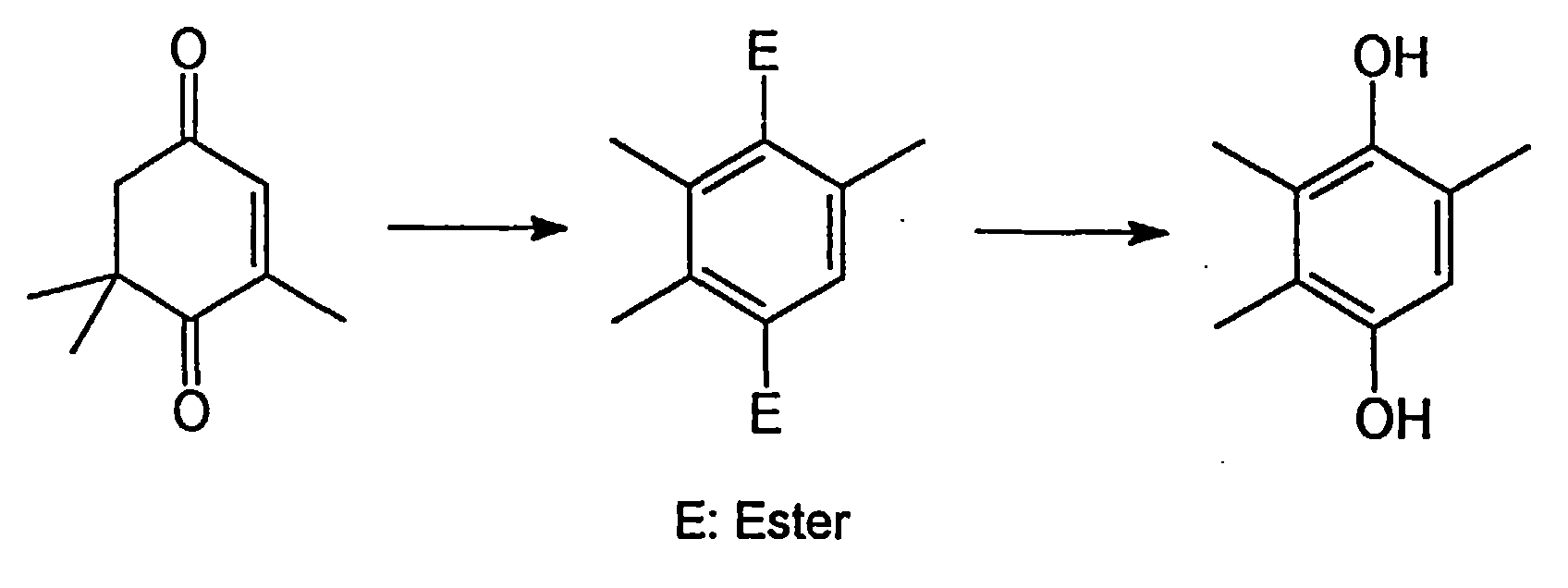
- Trimethylhydrochinon wiederum ist ein wichtiges Ausgangsprodukt für die Herstellung von Vitamin E.
- Es ist bereits bekannt (DE 26 46 172 C2), Keto-Isophoron in der Gasphase mit einem Zeolithen in das Trimethylhydrochinon umzulagern. Die Ausbeuten bei dieser Reaktion sind allerdings nur gering (50 % bei 30 % Umsatz) und damit für ein ökonomisches Verfahren unbefriedigend. In einem weiteren Verfahren (Y.A. Joe, Y.M. Goo, Y.Y. Lee Bull. Korean. Chem. Soc. 1991, 12, 253) wird die Umlagerung in 5 %-iger Lösung in Acetanhydrid durch Zugabe von fünf Äquivalenten konzentrierter Schwefelsäure durchgeführt. Trimethylhydrochinonester werden dabei mit lediglich 31 % Ausbeute erhalten, so daß auch dieses Verfahren nicht wirtschaftlich ist.
Nach einer dritten Methode (DE-OS 2 149 159) kann Keto-Isophoron in Gegenwart einer Protonensäure in Acetanhydrid zu Trimethylhydrochinondiacetat umgesetzt werden, welches anschließend zu 2,3,5- Trimethylhydrochinon verseift wird. Nachteilig an diesem Verfahren ist die Verwendung - großer Mengen an Acetanhydrid (5-10 mol/mol Ketoisophoron),
- großer Mengen der Katalysatorsäure (bis 150 mol%)
- sowie die mit maximal 66 % recht mäßige Ausbeute.
- Es wurde nun ein Verfahren zur Herstellung von Trimethylhydrochinon (TMHQ)durch Umsetzung von Keto-Isophoron mit einem Acylierungsmittel in Gegenwart katalytischer Mengen einer Protonensäure und anschließende Verseifung des zunächst gebildeten Trimethylhydrochinonesters gefunden,das dadurch gekennzeichnet ist, daß man als Protonensäure Trifluormethansulfonsäure, Chlorsulfonsäure, Polyphosphorsäure oder Oleum oder Mischungen dieser Säuren in einer Menge von 0,1 bis 50 Gew.-%,insbesondere 0,5 bis 25 Gew.-%, bezogen auf das Endion, einsetzt.
Bevorzugt verwendet man pro Mol Keto-Isophoron >2 bis 4 Mol, insbesondere 2,1 bis 3 mol eines der allgemein bekannten Acylierungsmittel. - Bei dem erfindungsgemäß verwendeten Acylierungsmittel handelt es sich vorzugsweise um ein Carbonsäureanhydrid oder einen Enolester. Insbesondere wird ein Carbonsäureanhydrid der allgemeinen Formel

- In einer bevorzugten Ausführungsform verseift man das entstandene TMHQ-Diacetat ohne Isolierung, gegebenenfalls nach dem Abdestillieren von nicht umgesetztem Acetanhydrid durch Zugabe von Wasser oder verdünnter Säure, insbesondere Schwefelsäure, und Erhitzen der Mischung zum Sieden. Das entstandene TMHQ wird anschließend abfiltriert.
- Man kann aber auch das entstandene TMHQ-Diacetat nach der Zugabe von Wasser aus dem Reaktionsgemisch abtrennen, in verdünnter Säure, insbesondere Schwefelsäure in Gegenwart eines Phasenvermittlers hydrolysieren und das entstandene TMHQ abtrennen, insbesondere durch Filtrieren.
- Als Phasenvermittler bei der Verseifung auch des isolierten Trimethylhydrochinondiesters können alle organischen Lösungsmittel Verwendung finden, die eine gewisse Mischbarkeit mit Wasser aufweisen. Besonders vorteilhaft können Essigsäure, n-Butanol und n-Butylacetat oder Mischungen der genannten Lösungsmittel eingesetzt werden.
- Zur Herstellung von 2,3,5 - Trimethylhydrochinon nach dem erfindungsgemäßen Verfahren werden in einem Eintopfverfahren beispielsweise 0,2 Mol Keto-Isophoron zu einer Mischung von >0,4-0,6 Mol Essigsäureanhydrid und 0,1-50 Gew.-%,insbesondere 0,5 - 25 Gew.-%, bezogen auf Keto-Isophoron,einer der genannten sehr starken Säuren innerhalb von 1 bis 3 h bei 0 - 60 ° C zugetropft und anschließend 1 bis 7 h auf ca. 25 - 70 ° C erwärmt. Danach werden durch Zugabe einer ausreichenden Menge Wasser Reste des Essigsäureanhydrids hydrolysiert. Zu der entstandenen Suspension gibt man gegebenenfalls Schwefelsäure, bevorzugt ca. 30 %ige, und erhitzt 1 bis 5 h zum Sieden. Anschließend wird ein Teil des Lösungsmittels abdestilliert und durch die gleiche Menge Wasser ersetzt, die Suspension auf Raumtemperatur abgekühlt und das ausgefallene Trimethylhydrochinon abtrennt.
- Man kann ebenso nach der ersten Zugabe von Wasser den ausgefallenen Trimethylhydrochinondiester abtrennen und separat verseifen. Dazu wird der Trimethylhydrochinondiester z. B. in einer ausreichenden Menge einer verdünntenSäure, bevorzugt. 30 %iger Schwefelsäure, und einem Phasenvermittler, wie z. B. n-Butanol supendiert und anschließend 1 bis 7 h zum Sieden erhitzt.
Danach wird Destillat abgenommen und anschließend dieselbe Menge an Wasser dem Sumpf zugesetzt. Das dann ausgefallene Trimethylhydrochinon wird abgetrennt und durch Nachwaschen gereinigt. - Die Erfindung wird im folgenden anhand von Ausführungsbeispielen weiter erläutert.
- Bei der erfindungsgemäßen Herstellung von 2,3,5-Trimethylhydrochinon ergeben sich erhebliche Vorteile gegenüber dem Stand der Technik:
- Die Ausbeuten sind nach dem erfindungsgemäßen Verfahren um bis zu 25 % höher als in der zitierten Literatur und liegen zwischen 85 und 90 %.
- Die benötigten Katalysatormengen liegen bei 0,1 bis 50 % gegenüber bis zu 150 % in der Literatur.
- Es werden lediglich >2 bis 4 Mol eines Carbonsäureanhydrids pro Mol Keto-Isophoron benötigt gegenüber 5 bis 10 Mol in der Literatur.
- Die Verseifung des isolierten Trimethylhydrochinondiesters mit wäßriger Säure gelingt bevorzugt in einfacher Weise in Gegenwart eines Phasenvermittlers.
- Zu einer Lösung von 61 g (0,6 mol) Essigsäureanhydrid und 0,34 g (2,3 mmol) Trifluormethansulfonsäure wurden innerhalb 1,5 h 30,5 g (0,2 mol) Keto-Isophoron (98 %) bei 30° - 40° C zugetropft. Anschließend ließ man 3 h bei 40° C ausreagieren. Nach beendeter Reaktion wurde unter Kühlung mit 125 ml Wasser versetzt, das ausgefallene Trimethylhydrochinon-diacetat abgesaugt, nachgewaschen und 14 h bei 55° C im Vakuum getrocknet.
- Ausbeute:
- 45,0 g (95 % d.Th.)
- GC:
- 94,5 % TMHQ-Diacetat
- In einer Mischung von 100 ml 30%iger Schwefelsäure und 15 ml n-Butanol wurden 43 g (0,18 mol) TMHQ-Diacetat unter Erwärmen gelöst und anschließend 4 h zum Sieden erhitzt. Danach wurde innerhalb von 45 min 80 ml Destillat abgenommen und mit 100 ml Wasser versetzt Das ausgefallene Trimethylhydrochinon wurde bei 20° C abgesaugt, nachgewaschen und 14 h bei 55° C im Vakuum getrocknet
- Ausbeute:
- 26,2 g (95 % d. Th.)
- HPLC:
- 98,5 %
- In einer weiteren Verseifung wurde anstelle des n-Butanols und der 30%igen Schwefelsäure eine Mischung von 50 ml des Destillates aus Versuch 2, 30 g Schwefelsäure und 50 ml Wasser verwendet.
- Der Versuch des Beispiels 1 wurde wiederholt, wobei diesmal nach der Reaktion 30 g einer Mischung von Essigsäureanhydrid und Essigsäure abdestilliert wurde. Die übrige Aufarbeitung erfolgte analog.
- Ausbeute:
- 45,5 g TMHQ-Diacetat (96 % d.Th.)
- Der Versuch des Beispiels 2 wurde wiederholt, wobei diesmal vor der Filtration des Produktes die Mischung auf -10° C abgekühlt wurde.
- Ausbeute:
- 26,9 g TMHQ (97 % d.Th.)
- HPLC:
- 95 %
- Der Versuch des Beispiels 1 wurde wiederholt, wobei anstelle der Trifluormethansulfonsäure diesmal andere Katalysatoren eingesetzt wurden.
Ifd. Nr. Katalysator Menge Kat in (Gew%) Reaktionszeit Temperatur (h/°C) Ausbeute TMHQ-DA (%) 5. Chlorsulfonsäure 7 3 75 93 6. Oleum 65%SO3 10 3 35 94 7. Oleum 30%SO3 8 7 35 94 - Zu einer Mischung von 61 g (0,6 mol) Essigsäureanhydrid und 3 g Oleum (65% SO3) wurden 30,5 g (0,2 mol) Keto-Isophoron innerhalb von 1,5 h bei 10 - 25° C zugetropft und anschließend 4 h auf 40° C erwärmt. Danach, wurde durch Zugabe von 90 ml Wasser hydrolysiert. Zur entstandenen Suspension gab man 47 g Schwefelsäure und erhitzte 3 h zum Sieden.
Die weitere Aufarbeitung erfolgte analog Beispiel 2. - Ausbeute:
- 27 g TMHQ (89 % d.Th.)
- HPLC:
- 98,5 %
Claims (7)
- Verfahren zur Herstellung von Trimethylhydrochinon (TMHQ)durch Umsetzung von Keto-Isophoron mit einem Acylierungsmittel in Gegenwart katalytischer Mengen einer Protonensäure und anschließende Verseifung des zunächst gebildeten Trimethylhydrochinonesters,
dadurch gekennzeichnet, daß man als Protonensäure Trifluormethansulfonsäure, Chlorsulfonsäure, Polyphosphorsäure oder Oleum oder Mischungen dieser Säuren einsetzt. - Verfahren gemäß Anspruch 1,
dadurch gekennzeichnet, daß man die Säuren in einer Menge von 0,1 bis 50 Gew.-%, bezogen auf das Endion, einsetzt. - Verfahren gemäß den Ansprüchen 1 und 2,
durch gekennzeichnet, daß man pro Mol Keto-Isophoron >2 bis 4 Mol des Acylierungsmittels einsetzt. - Verfahren gemäß Anspruch 3,
dadurch gekennzeichnet, daß man Acetanhydrid als Acylierungsmittel verwendet. - Verfahren gemäß Anspruch 1,
dadurch gekennzeichnet, daß man das entstandene TMHQ-Diacetat ohne Isolierung, gegebenenfalls nach dem Abdestillieren von nicht umgesetztem Acetanhydrid, durch Zugabe von Wasser und/oder verdünnter Säure verseift und das entstandene TMHQ abtrennt. - Verfahren gemäß Anspruch 1,
dadurch gekennzeichnet, daß man das entstandene TMHQ-Diacetat nach der Zugabe von Wasser aus dem Reaktionsgemisch abtrennt, unter Verwendung verdünnter Säure in Gegenwart eines Phasenvermittlers verseift und das entstandene TMHQ abtrennt. - Verfahren gemäß Anspruch 6,
dadurch gekennzeichnet, daß man als Phasenvermittler Essigsäure, n-Butanol oder n-Butylacetat oder deren Gemische einsetzt.
Applications Claiming Priority (4)
| Application Number | Priority Date | Filing Date | Title |
|---|---|---|---|
| DE19619387 | 1996-05-14 | ||
| DE19619387 | 1996-05-14 | ||
| DE19627977 | 1996-07-11 | ||
| DE19627977A DE19627977A1 (de) | 1996-05-14 | 1996-07-11 | Verfahren zur Herstellung von Trimethylhydrochinon |
Publications (3)
| Publication Number | Publication Date |
|---|---|
| EP0808815A2 true EP0808815A2 (de) | 1997-11-26 |
| EP0808815A3 EP0808815A3 (de) | 1998-02-04 |
| EP0808815B1 EP0808815B1 (de) | 2001-08-16 |
Family
ID=26025681
Family Applications (1)
| Application Number | Title | Priority Date | Filing Date |
|---|---|---|---|
| EP97105669A Expired - Lifetime EP0808815B1 (de) | 1996-05-14 | 1997-04-05 | Verfahren zur Herstellung von Trimethylhydrochinon |
Country Status (7)
| Country | Link |
|---|---|
| US (1) | US6063968A (de) |
| EP (1) | EP0808815B1 (de) |
| JP (1) | JPH1053548A (de) |
| CN (1) | CN1102138C (de) |
| AT (1) | ATE204251T1 (de) |
| DK (1) | DK0808815T3 (de) |
| ES (1) | ES2162147T3 (de) |
Cited By (3)
| Publication number | Priority date | Publication date | Assignee | Title |
|---|---|---|---|---|
| US5908956A (en) * | 1996-12-27 | 1999-06-01 | Daicel Chemical Industries, Ltd. | Method for producing trimethylhydroquinone diester |
| US5969176A (en) * | 1998-02-12 | 1999-10-19 | Degussa-Huls Ag | Process for the production of trimethylhydroquinone diesters and of trimethylhydroquinone |
| US6211418B1 (en) * | 1997-08-01 | 2001-04-03 | Nippon Petrochemicals Company Limited | Method for producing trimethylhydroquinone |
Families Citing this family (29)
| Publication number | Priority date | Publication date | Assignee | Title |
|---|---|---|---|---|
| DE19905685A1 (de) * | 1999-02-11 | 2000-08-17 | Degussa | Verfahren zur Herstellung von 2,3,5-Trimethylhydrochinondiestern |
| DE19951006A1 (de) * | 1999-10-22 | 2001-04-26 | Degussa | Verfahren zur Herstellung von veresterten Chromanverbindungen |
| KR100645669B1 (ko) * | 2001-10-04 | 2006-11-13 | 에스케이 주식회사 | 고수율 및 고순도로tmhq-디에스테르를 제조하는 방법 |
| DE602004014290D1 (de) * | 2003-11-07 | 2008-07-17 | Dsm Ip Assets Bv | Verfahren zur herstellung von 2,3,5-trimethylhydrochinondiacylaten |
| US7102191B2 (en) * | 2004-03-24 | 2006-09-05 | Micron Technologies, Inc. | Memory device with high dielectric constant gate dielectrics and metal floating gates |
| JP2009079024A (ja) * | 2007-09-27 | 2009-04-16 | Air Water Inc | 2−ナフトール誘導体の製造方法 |
| JP5195236B2 (ja) * | 2008-09-30 | 2013-05-08 | Dic株式会社 | 2−ナフトール誘導体の製造方法 |
| US10886250B2 (en) | 2015-07-10 | 2021-01-05 | Invensas Corporation | Structures and methods for low temperature bonding using nanoparticles |
| TWI910033B (zh) | 2016-10-27 | 2025-12-21 | 美商艾德亞半導體科技有限責任公司 | 用於低溫接合的結構和方法 |
| US10515913B2 (en) | 2017-03-17 | 2019-12-24 | Invensas Bonding Technologies, Inc. | Multi-metal contact structure |
| US10446441B2 (en) | 2017-06-05 | 2019-10-15 | Invensas Corporation | Flat metal features for microelectronics applications |
| US10840205B2 (en) | 2017-09-24 | 2020-11-17 | Invensas Bonding Technologies, Inc. | Chemical mechanical polishing for hybrid bonding |
| US11056348B2 (en) | 2018-04-05 | 2021-07-06 | Invensas Bonding Technologies, Inc. | Bonding surfaces for microelectronics |
| US10790262B2 (en) | 2018-04-11 | 2020-09-29 | Invensas Bonding Technologies, Inc. | Low temperature bonded structures |
| US11244916B2 (en) | 2018-04-11 | 2022-02-08 | Invensas Bonding Technologies, Inc. | Low temperature bonded structures |
| US11393779B2 (en) | 2018-06-13 | 2022-07-19 | Invensas Bonding Technologies, Inc. | Large metal pads over TSV |
| KR102878117B1 (ko) | 2018-06-13 | 2025-10-28 | 아데이아 세미컨덕터 본딩 테크놀로지스 인코포레이티드 | 패드로서의 tsv |
| US11011494B2 (en) | 2018-08-31 | 2021-05-18 | Invensas Bonding Technologies, Inc. | Layer structures for making direct metal-to-metal bonds at low temperatures in microelectronics |
| US11158573B2 (en) | 2018-10-22 | 2021-10-26 | Invensas Bonding Technologies, Inc. | Interconnect structures |
| US11244920B2 (en) | 2018-12-18 | 2022-02-08 | Invensas Bonding Technologies, Inc. | Method and structures for low temperature device bonding |
| WO2021236361A1 (en) | 2020-05-19 | 2021-11-25 | Invensas Bonding Technologies, Inc. | Laterally unconfined structure |
| US11264357B1 (en) | 2020-10-20 | 2022-03-01 | Invensas Corporation | Mixed exposure for large die |
| TW202243181A (zh) | 2020-12-28 | 2022-11-01 | 美商英帆薩斯邦德科技有限公司 | 具有直通基板穿孔的結構以及形成此結構的方法 |
| KR20230125309A (ko) | 2020-12-28 | 2023-08-29 | 아데이아 세미컨덕터 본딩 테크놀로지스 인코포레이티드 | 기판-관통 비아를 가지는 구조체 및 이를 형성하기위한 방법 |
| TW202618935A (zh) | 2020-12-30 | 2026-05-01 | 美商艾德亞半導體接合科技有限公司 | 具有導電特徵的結構以及形成此結構的方法 |
| US12622307B2 (en) | 2021-12-23 | 2026-05-05 | Adeia Semiconductor Bonding Technologies Inc. | Controlled grain growth for bonding and bonded structure with controlled grain growth |
| JP2025514099A (ja) | 2022-04-25 | 2025-05-02 | アデイア セミコンダクター ボンディング テクノロジーズ インコーポレイテッド | ダイレクトボンディング用膨張制御型構造体及びその形成方法 |
| US12506114B2 (en) | 2022-12-29 | 2025-12-23 | Adeia Semiconductor Bonding Technologies Inc. | Directly bonded metal structures having aluminum features and methods of preparing same |
| US12545010B2 (en) | 2022-12-29 | 2026-02-10 | Adeia Semiconductor Bonding Technologies Inc. | Directly bonded metal structures having oxide layers therein |
Family Cites Families (1)
| Publication number | Priority date | Publication date | Assignee | Title |
|---|---|---|---|---|
| UST900015I4 (en) * | 1970-10-01 | 1972-07-25 | defensive publication |
-
1997
- 1997-04-05 AT AT97105669T patent/ATE204251T1/de not_active IP Right Cessation
- 1997-04-05 EP EP97105669A patent/EP0808815B1/de not_active Expired - Lifetime
- 1997-04-05 DK DK97105669T patent/DK0808815T3/da active
- 1997-04-05 ES ES97105669T patent/ES2162147T3/es not_active Expired - Lifetime
- 1997-05-12 CN CN97104282A patent/CN1102138C/zh not_active Expired - Fee Related
- 1997-05-12 JP JP9120403A patent/JPH1053548A/ja not_active Abandoned
- 1997-05-14 US US08/855,270 patent/US6063968A/en not_active Expired - Fee Related
Cited By (5)
| Publication number | Priority date | Publication date | Assignee | Title |
|---|---|---|---|---|
| US5908956A (en) * | 1996-12-27 | 1999-06-01 | Daicel Chemical Industries, Ltd. | Method for producing trimethylhydroquinone diester |
| US6211418B1 (en) * | 1997-08-01 | 2001-04-03 | Nippon Petrochemicals Company Limited | Method for producing trimethylhydroquinone |
| US6320086B1 (en) | 1997-08-01 | 2001-11-20 | Nippon Petrochemicals Company Limited | Method for producing trimethylhydroquinone |
| US5969176A (en) * | 1998-02-12 | 1999-10-19 | Degussa-Huls Ag | Process for the production of trimethylhydroquinone diesters and of trimethylhydroquinone |
| EP1008584A1 (de) * | 1998-02-12 | 2000-06-14 | Degussa Aktiengesellschaft | Verfahren zur Herstellung von Trimethylhydrochinondiestern und von Trimethylhydrochinon |
Also Published As
| Publication number | Publication date |
|---|---|
| EP0808815A3 (de) | 1998-02-04 |
| EP0808815B1 (de) | 2001-08-16 |
| ES2162147T3 (es) | 2001-12-16 |
| US6063968A (en) | 2000-05-16 |
| ATE204251T1 (de) | 2001-09-15 |
| CN1165133A (zh) | 1997-11-19 |
| DK0808815T3 (da) | 2001-11-26 |
| CN1102138C (zh) | 2003-02-26 |
| JPH1053548A (ja) | 1998-02-24 |
Similar Documents
| Publication | Publication Date | Title |
|---|---|---|
| EP0808815B1 (de) | Verfahren zur Herstellung von Trimethylhydrochinon | |
| DE1226560B (de) | Verfahren zur Herstellung von Butylenglykoldiacetaten | |
| DE2743920C2 (de) | Verfahren zur Herstellung von dl-α-Tocopherol | |
| DE10311850A1 (de) | Verfahren zur Herstellung von Vinpocetin | |
| EP1008584A1 (de) | Verfahren zur Herstellung von Trimethylhydrochinondiestern und von Trimethylhydrochinon | |
| DE2149159A1 (de) | Verfahren zur Herstellung von Trimethylhydrochinon | |
| DE19627977A1 (de) | Verfahren zur Herstellung von Trimethylhydrochinon | |
| EP0284969A2 (de) | Verfahren zur Herstellung von Tetrahydropyran-4-carbonsaeureestern | |
| EP0498847B1 (de) | Verfahren zur herstellung von 1,4-bis-(4-hydroxybenzoyl)-benzol | |
| DE3203487A1 (de) | Verfahren zur herstellung von tocopherylacetat oder tocopherylpropionat | |
| DE3109281C2 (de) | Verfahren zur Herstellung von 7α-Acylthio-4-en-3-oxosteroiden | |
| DE1259326B (de) | Verfahren zur Gewinnung reiner Terephthalsaeure | |
| EP0573763B1 (de) | Verfahren zur Herstellung von Hydroxypivalinsäureestern | |
| DE3338547C2 (de) | Verfahren zur Herstellung von 2,2,4-Trimethyl-1,3-pentandioldiisobutyrat | |
| DE1093797B (de) | Verfahren zur Herstellung von Carbonsaeureestern | |
| DE3409208C1 (de) | Verfahren zur Herstellung von Orthoestern | |
| DE2804414A1 (de) | Verfahren zur herstellung von anthrachinon | |
| DE2162577C3 (de) | Verfahren zur Herstellung von Hydroxybenzoesäurearyle stern | |
| DE2358481A1 (de) | Verfahren zur herstellung von 2,3,5trimethylhydrochinon | |
| DE19905685A1 (de) | Verfahren zur Herstellung von 2,3,5-Trimethylhydrochinondiestern | |
| EP0095698A1 (de) | Verfahren zur Herstellung von Terephthalsäure- und Isophthalsäuredichlorid | |
| DE2059296C3 (de) | Verfahren zur Herstellung von Estern der 3-Methylflavon-8-carbonsäure mit N-tert-Aminoalkoholen | |
| AT235473B (de) | Verfahren zur Herstellung von 7-Dehydro-cholesterinestern | |
| DE1218440B (de) | Verfahren zur Herstellung alpha, beta-ungesaettigter gamma-Laktone | |
| EP0926128A1 (de) | Verfahren zur Herstellung von Methoxyessigsäureestern |
Legal Events
| Date | Code | Title | Description |
|---|---|---|---|
| PUAI | Public reference made under article 153(3) epc to a published international application that has entered the european phase |
Free format text: ORIGINAL CODE: 0009012 |
|
| AK | Designated contracting states |
Kind code of ref document: A2 Designated state(s): AT BE CH DE DK ES FR GB IE IT LI NL SE |
|
| PUAL | Search report despatched |
Free format text: ORIGINAL CODE: 0009013 |
|
| AK | Designated contracting states |
Kind code of ref document: A3 Designated state(s): AT BE CH DE DK ES FR GB IE IT LI NL SE |
|
| 17P | Request for examination filed |
Effective date: 19980707 |
|
| RAP1 | Party data changed (applicant data changed or rights of an application transferred) |
Owner name: DEGUSSA-HUELS AKTIENGESELLSCHAFT |
|
| 17Q | First examination report despatched |
Effective date: 19990607 |
|
| RAP3 | Party data changed (applicant data changed or rights of an application transferred) |
Owner name: DEGUSSA-HUELS AKTIENGESELLSCHAFT |
|
| GRAG | Despatch of communication of intention to grant |
Free format text: ORIGINAL CODE: EPIDOS AGRA |
|
| GRAG | Despatch of communication of intention to grant |
Free format text: ORIGINAL CODE: EPIDOS AGRA |
|
| GRAH | Despatch of communication of intention to grant a patent |
Free format text: ORIGINAL CODE: EPIDOS IGRA |
|
| GRAH | Despatch of communication of intention to grant a patent |
Free format text: ORIGINAL CODE: EPIDOS IGRA |
|
| RAP1 | Party data changed (applicant data changed or rights of an application transferred) |
Owner name: DEGUSSA AG |
|
| GRAA | (expected) grant |
Free format text: ORIGINAL CODE: 0009210 |
|
| AK | Designated contracting states |
Kind code of ref document: B1 Designated state(s): AT BE CH DE DK ES FR GB IE IT LI NL SE |
|
| REF | Corresponds to: |
Ref document number: 204251 Country of ref document: AT Date of ref document: 20010915 Kind code of ref document: T |
|
| REG | Reference to a national code |
Ref country code: CH Ref legal event code: EP |
|
| REF | Corresponds to: |
Ref document number: 59704271 Country of ref document: DE Date of ref document: 20010920 |
|
| REG | Reference to a national code |
Ref country code: IE Ref legal event code: FG4D Free format text: GERMAN |
|
| REG | Reference to a national code |
Ref country code: CH Ref legal event code: NV Representative=s name: BOVARD AG PATENTANWAELTE |
|
| REG | Reference to a national code |
Ref country code: DK Ref legal event code: T3 |
|
| GBT | Gb: translation of ep patent filed (gb section 77(6)(a)/1977) |
Effective date: 20011116 |
|
| REG | Reference to a national code |
Ref country code: ES Ref legal event code: FG2A Ref document number: 2162147 Country of ref document: ES Kind code of ref document: T3 |
|
| REG | Reference to a national code |
Ref country code: GB Ref legal event code: IF02 |
|
| ET | Fr: translation filed | ||
| PLBE | No opposition filed within time limit |
Free format text: ORIGINAL CODE: 0009261 |
|
| STAA | Information on the status of an ep patent application or granted ep patent |
Free format text: STATUS: NO OPPOSITION FILED WITHIN TIME LIMIT |
|
| 26N | No opposition filed | ||
| PGFP | Annual fee paid to national office [announced via postgrant information from national office to epo] |
Ref country code: IE Payment date: 20040324 Year of fee payment: 8 |
|
| PGFP | Annual fee paid to national office [announced via postgrant information from national office to epo] |
Ref country code: GB Payment date: 20040331 Year of fee payment: 8 |
|
| PGFP | Annual fee paid to national office [announced via postgrant information from national office to epo] |
Ref country code: SE Payment date: 20040402 Year of fee payment: 8 |
|
| PGFP | Annual fee paid to national office [announced via postgrant information from national office to epo] |
Ref country code: AT Payment date: 20040405 Year of fee payment: 8 |
|
| PGFP | Annual fee paid to national office [announced via postgrant information from national office to epo] |
Ref country code: ES Payment date: 20040422 Year of fee payment: 8 |
|
| PGFP | Annual fee paid to national office [announced via postgrant information from national office to epo] |
Ref country code: BE Payment date: 20040527 Year of fee payment: 8 |
|
| PG25 | Lapsed in a contracting state [announced via postgrant information from national office to epo] |
Ref country code: IT Free format text: LAPSE BECAUSE OF NON-PAYMENT OF DUE FEES;WARNING: LAPSES OF ITALIAN PATENTS WITH EFFECTIVE DATE BEFORE 2007 MAY HAVE OCCURRED AT ANY TIME BEFORE 2007. THE CORRECT EFFECTIVE DATE MAY BE DIFFERENT FROM THE ONE RECORDED. Effective date: 20050405 Ref country code: IE Free format text: LAPSE BECAUSE OF NON-PAYMENT OF DUE FEES Effective date: 20050405 Ref country code: GB Free format text: LAPSE BECAUSE OF NON-PAYMENT OF DUE FEES Effective date: 20050405 Ref country code: AT Free format text: LAPSE BECAUSE OF NON-PAYMENT OF DUE FEES Effective date: 20050405 |
|
| PG25 | Lapsed in a contracting state [announced via postgrant information from national office to epo] |
Ref country code: SE Free format text: LAPSE BECAUSE OF NON-PAYMENT OF DUE FEES Effective date: 20050406 Ref country code: ES Free format text: LAPSE BECAUSE OF NON-PAYMENT OF DUE FEES Effective date: 20050406 |
|
| PG25 | Lapsed in a contracting state [announced via postgrant information from national office to epo] |
Ref country code: BE Free format text: LAPSE BECAUSE OF NON-PAYMENT OF DUE FEES Effective date: 20050430 |
|
| BERE | Be: lapsed |
Owner name: *DEGUSSA A.G. Effective date: 20050430 |
|
| EUG | Se: european patent has lapsed | ||
| GBPC | Gb: european patent ceased through non-payment of renewal fee |
Effective date: 20050405 |
|
| PGFP | Annual fee paid to national office [announced via postgrant information from national office to epo] |
Ref country code: FR Payment date: 20060411 Year of fee payment: 10 |
|
| PGFP | Annual fee paid to national office [announced via postgrant information from national office to epo] |
Ref country code: NL Payment date: 20060413 Year of fee payment: 10 |
|
| PGFP | Annual fee paid to national office [announced via postgrant information from national office to epo] |
Ref country code: CH Payment date: 20060418 Year of fee payment: 10 |
|
| PGFP | Annual fee paid to national office [announced via postgrant information from national office to epo] |
Ref country code: DK Payment date: 20060419 Year of fee payment: 10 |
|
| REG | Reference to a national code |
Ref country code: ES Ref legal event code: FD2A Effective date: 20050406 |
|
| PGFP | Annual fee paid to national office [announced via postgrant information from national office to epo] |
Ref country code: DE Payment date: 20070423 Year of fee payment: 11 |
|
| REG | Reference to a national code |
Ref country code: DK Ref legal event code: EBP |
|
| REG | Reference to a national code |
Ref country code: CH Ref legal event code: PL |
|
| BERE | Be: lapsed |
Owner name: *DEGUSSA A.G. Effective date: 20050430 |
|
| NLV4 | Nl: lapsed or anulled due to non-payment of the annual fee |
Effective date: 20071101 |
|
| PG25 | Lapsed in a contracting state [announced via postgrant information from national office to epo] |
Ref country code: NL Free format text: LAPSE BECAUSE OF NON-PAYMENT OF DUE FEES Effective date: 20071101 |
|
| PG25 | Lapsed in a contracting state [announced via postgrant information from national office to epo] |
Ref country code: LI Free format text: LAPSE BECAUSE OF NON-PAYMENT OF DUE FEES Effective date: 20070430 Ref country code: CH Free format text: LAPSE BECAUSE OF NON-PAYMENT OF DUE FEES Effective date: 20070430 |
|
| PG25 | Lapsed in a contracting state [announced via postgrant information from national office to epo] |
Ref country code: DK Free format text: LAPSE BECAUSE OF NON-PAYMENT OF DUE FEES Effective date: 20070430 |
|
| PG25 | Lapsed in a contracting state [announced via postgrant information from national office to epo] |
Ref country code: FR Free format text: LAPSE BECAUSE OF NON-PAYMENT OF DUE FEES Effective date: 20070430 |
|
| PG25 | Lapsed in a contracting state [announced via postgrant information from national office to epo] |
Ref country code: DE Free format text: LAPSE BECAUSE OF NON-PAYMENT OF DUE FEES Effective date: 20081101 |