EP0807986B1 - Fluorhaltige Lösungsmittel für Lithiumbatterien mit erhöhter Sicherheit - Google Patents
Fluorhaltige Lösungsmittel für Lithiumbatterien mit erhöhter Sicherheit Download PDFInfo
- Publication number
- EP0807986B1 EP0807986B1 EP97107506A EP97107506A EP0807986B1 EP 0807986 B1 EP0807986 B1 EP 0807986B1 EP 97107506 A EP97107506 A EP 97107506A EP 97107506 A EP97107506 A EP 97107506A EP 0807986 B1 EP0807986 B1 EP 0807986B1
- Authority
- EP
- European Patent Office
- Prior art keywords
- fluorine
- lithium
- electrolyte system
- electrolyte
- ethers
- Prior art date
- Legal status (The legal status is an assumption and is not a legal conclusion. Google has not performed a legal analysis and makes no representation as to the accuracy of the status listed.)
- Expired - Lifetime
Links
Images

Classifications
-
- H—ELECTRICITY
- H01—ELECTRIC ELEMENTS
- H01M—PROCESSES OR MEANS, e.g. BATTERIES, FOR THE DIRECT CONVERSION OF CHEMICAL ENERGY INTO ELECTRICAL ENERGY
- H01M4/00—Electrodes
- H01M4/02—Electrodes composed of, or comprising, active material
- H01M4/36—Selection of substances as active materials, active masses, active liquids
- H01M4/60—Selection of substances as active materials, active masses, active liquids of organic compounds
-
- H—ELECTRICITY
- H01—ELECTRIC ELEMENTS
- H01M—PROCESSES OR MEANS, e.g. BATTERIES, FOR THE DIRECT CONVERSION OF CHEMICAL ENERGY INTO ELECTRICAL ENERGY
- H01M6/00—Primary cells; Manufacture thereof
- H01M6/14—Cells with non-aqueous electrolyte
- H01M6/16—Cells with non-aqueous electrolyte with organic electrolyte
- H01M6/162—Cells with non-aqueous electrolyte with organic electrolyte characterised by the electrolyte
- H01M6/164—Cells with non-aqueous electrolyte with organic electrolyte characterised by the electrolyte by the solvent
-
- H—ELECTRICITY
- H01—ELECTRIC ELEMENTS
- H01M—PROCESSES OR MEANS, e.g. BATTERIES, FOR THE DIRECT CONVERSION OF CHEMICAL ENERGY INTO ELECTRICAL ENERGY
- H01M2300/00—Electrolytes
- H01M2300/0017—Non-aqueous electrolytes
- H01M2300/0025—Organic electrolyte
- H01M2300/0028—Organic electrolyte characterised by the solvent
- H01M2300/0034—Fluorinated solvents
-
- Y—GENERAL TAGGING OF NEW TECHNOLOGICAL DEVELOPMENTS; GENERAL TAGGING OF CROSS-SECTIONAL TECHNOLOGIES SPANNING OVER SEVERAL SECTIONS OF THE IPC; TECHNICAL SUBJECTS COVERED BY FORMER USPC CROSS-REFERENCE ART COLLECTIONS [XRACs] AND DIGESTS
- Y02—TECHNOLOGIES OR APPLICATIONS FOR MITIGATION OR ADAPTATION AGAINST CLIMATE CHANGE
- Y02E—REDUCTION OF GREENHOUSE GAS [GHG] EMISSIONS, RELATED TO ENERGY GENERATION, TRANSMISSION OR DISTRIBUTION
- Y02E60/00—Enabling technologies; Technologies with a potential or indirect contribution to GHG emissions mitigation
- Y02E60/10—Energy storage using batteries
Definitions
- lithium ion batteries are given great opportunities because their energy density is about twice that of metal hydride cells and about three times higher than nickel / cadmium cells.
- Another interesting field is the use of secondary lithium ion batteries for electric traction, for example for electrically powered city cars.
- organic solvents having strongly polarizing heteroatoms such as, for example, nitrogen, oxygen or sulfur, are used for preparing aprotic electrolyte solutions [see, for example O. Popovych, RPT Tomkins, Nonaqueous Solution Chemistry, John Wiley & Sons (1981 ) or GJ Janz, RPT Tomkins, Nonaqueous Electrolytes Handbook, Vol. I (1972 ) Vol. II (1973), Academic Press, New York ].
- Typical examples of such solvents are ethers (for example, 1,2-dimethoxyethane or tetrahydrofuran), esters (for example, propylene carbonate), nitriles (for example, acetonitrile), but also lactones, sulfones, and many others.
- ethers for example, 1,2-dimethoxyethane or tetrahydrofuran
- esters for example, propylene carbonate
- nitriles for example, acetonitrile
- lactones for example, sulfones, and many others.
- highly viscous solvents such as propylene carbonate, ethylene carbonate or sulfolane (tetramethylene sulfone) are less flammable or less prone to the formation of explosive mixtures. Due to the high viscosity, the electrical conductivity of the electrolyte solutions prepared with these solvents is low, especially at lower temperatures. In addition, all other mass transfer processes in such solutions are slow in addition to the ion migration.
- solvent mixtures are generally used in the art which contain at least one strongly polar component which, due to its polarity, has a strongly dissociating effect on salts.
- An indicative measure of the dissociation capacity is the dielectric constant. Since such highly polar solvents, such as propylene carbonate or ethylene carbonate, whose dielectric constant with 67 at 25 ° C or 90 at 40 ° C in about that of the water (78 at 25 ° C), are regularly quite high viscosity, it is generally used additionally one or more low-viscosity components as "thinner".
- Typical diluents are, for example, 1,2-dimethoxyethane or dimethyl carbonate, which, however, are characterized by very low values for the dielectric constant (about 7 for 1,2-dimethoxyethane and about 3 for dimethyl carbonate).
- a serious disadvantage of the "thinner” components is their volatility and the associated ignition and explosion behavior in the case of air access. Since electrochemical applications of electrolyte solutions always associated with heating by current flow and the occurrence of errors (for example, short circuit inside or outside the electrochemical device) with the risk of ignition, this disadvantage has a very significant practical importance. For example, for 1,2-dimethoxyethane, the flash point is -6 ° C and the explosion limit is between 1.6 and 10.4 vol%.
- the rechargeable lithium batteries usually contain a compound of lithium and a metal oxide as the cathode (for example Li x MnO 2 or Li x CoO 2 ) and lithium metal as the anode, the lithium is preferably used as an intercalation compound with graphite or in combination with carbon or graphite fibers , A good overview of the development of such batteries is given by K. Brandt [ Solid State Ionics 69 (1994), 173-183, Elsevier Science BV .].
- cathode and anode compartment can be separated by a microporous separator membrane, which is such that when a defined limit temperature is exceeded by melting the pores of the current flow is interrupted automatically.
- a microporous separator membrane which is such that when a defined limit temperature is exceeded by melting the pores of the current flow is interrupted automatically.
- Suitable membranes of this type are included, for example, in the ® Celgard range of Hoechst Celanese Corporation.
- the safety of lithium batteries can be increased by overpressure switches, which react, for example, to gas evolution during overcharging, and more generally by elaborate monitoring and control electronics. Further, flame retardant phosphorus and halogen containing additives were also recommended.
- the aim of the present invention was to develop electrolyte solutions which are free from the abovementioned highly flammable and explosive low-viscosity "Thinners" and thus increase the safety of the electrolyte-containing devices, but still exhibit a viscosity and conductivity behavior that makes their practical use possible even at low temperatures.
- the invention thus provides an electrolyte system for increasing the safety of lithium batteries, which contains compounds of the formulas (I) and / or (II) in an effective amount, wherein the compounds with X are fluorine or trifluoromethyl preferred.
- Particularly preferred are fluorine-containing ethers of the formula (I), wherein R is a methyl group, X is fluorine, m 2 and n is 1 to 3, and ethers of the formula (II), wherein X is fluorine, m 2 and n is 1 to 3.
- the compounds with m equal to 2 are preferred because they can be prepared from readily available and inexpensive ethylene glycol monoalkyl ethers or ethylene glycols.
- the compounds in which X is chlorine are less preferred because they can react at high temperatures with metallic lithium with elimination of chlorine and fluorine to form the corresponding lithium halides.
- the solution according to the invention of the safety problem of secondary lithium batteries is characterized by the use of compounds of formulas (I) and / or (II) as essential Achieved component of the electrolyte system, taking advantage of their surprisingly low viscosity advantage.
- the substances according to the formulas (I) and (II) can be used as diluents for low-inflammability, high-viscosity components, for example ethylene carbonate and propylene carbonate. In this way it is possible to produce aprotic electrolyte systems which are practically barely flammable.
- the content of ethers of the formulas (I) and / or (II) is usually from 5 to 70% by volume, preferably from 20 to 50% by volume, based on the total volume of the electrolyte system.
- the partially fluorinated ethers according to the formulas (I) and (II) also improve the dissolving power for non-polar or slightly polar gases, in particular CO 2 , N 2 , N 2 O, SF 6 , SO 2 FCl or SO 2 F 2 .
- gases can be used advantageously as a protective gas in lithium batteries, since they have a positive effect on the reactions occurring at the interface negative electrode / electrolyte [see, for example JO Besenhard, MW Wagner, M. Winter; J. Power Sources, 44 (1993), 413 ].
- the viscosity of mixtures of the ethers according to the formulas (I) and (II) with propylene carbonate can be increased by adding (at least) one low-viscosity, substantially fluorinated Be lowered solvent from the group of hydro-perfluoroalkanes or hydro-perfluoroether to guarantee even at temperatures below 0 ° C, a high conductivity.
- substantially fluorinated Be lowered solvent from the group of hydro-perfluoroalkanes or hydro-perfluoroether to guarantee even at temperatures below 0 ° C, a high conductivity.
- the use of particularly easily dissociating electrolyte salts with large fluorine-containing anions such as, for example, LiN (SO 2 CF 3 ) 2 or LiC (SO 2 CF 3 ) 3, is recommended.
- the partially fluorinated ethers according to the invention act as phase mediators with respect to the added higher fluorinated solvents.
- Particularly suitable agents for lowering the viscosity are, for example, 1H-perfluorohexane (kinematic viscosity at 20 ° C: 0.55 mm 2 / s, flash point> 110 ° C) and 2,3-dihydro-perfluoro-5-methyl-pentane. These substances do not form explosive mixtures with air. This also applies to fluoroethers of the formula wherein n is 1 or 2.
- the compounds described by Formulas (I) and (II) above 200 ° C tend to thermal decomposition. It has surprisingly been found that the partially fluorinated ethers can be very effectively stabilized with very small amounts of tertiary, aliphatic amines. Already small additions of the amine on the order of 0.1 to 1.0 wt .-% with respect to the partially fluorinated ether are sufficient to raise the temperature at which the ether begins to decompose by 60 to 100 ° C. The tertiary amine should be so high-boiling that it remains mainly at temperatures above 100 ° C in the liquid phase.
- Suitable tertiary amines are, for example, tri-n-butylamine, tri-n-octylamine or 1,6-bis- (dimethylamino) -hexane.
- Aromatic amines are less suitable because of their tendency to anodize.
- the subject of our invention is therefore also a method for stabilizing compounds of the formulas (I) and (II) with tertiary, aliphatic amines.
- ROH + F 2 C CFX ⁇ RO-CF 2 -CFHX, wherein R is a primary alkyl group and X is fluorine, chlorine or perfluoroalkyl (for example CF 3 ).
- the flask After cooling and filling with argon, the flask is charged with about 1 g of lithium, then the dropping funnel with 5 ml of the argon-saturated test compound. The lithium is melted with a heating bath at 190 ° C and the ether preheated to about 100 ° C slowly added dropwise. Only the chlorine-containing ether reacts with lithium to form LiCl and LiF.
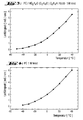
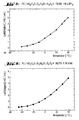
- FIGS. 1 to 6 show the conductivity as a function of temperature in the range of +40 to about -50 ° C.
- the proportions of the components are given in volume percent.
- the lithium secondary salt was used in each case in 1M concentration.
- the solvent components used are first prepared as follows:
- Ethylene carbonate (> 99%, Merck) is distilled under oil pump vacuum (boiling point 85 to 95 ° C) and over activated molecular sieve (Roth, pore size 4 Angstrom) at 150 ° C for 3 days dehydrated under a dried argon atmosphere [argon, 99.996%, company AGA, was first to remove traces of oxygen at 150 ° C over with argon W5 (mixture of 95% argon and 5% hydrogen, technical grade, AGA company) reduced copper (I) oxide (BASF) passed and then dried over activated molecular sieve] stored at 60 ° C.
- argon W5 mixture of 95% argon and 5% hydrogen, technical grade, AGA company
- reduced copper (I) oxide BASF
- Propylene carbonate (purum, Aldrich company) is in an oil pump vacuum over a 1.5 m long, mirrored Packed column distilled (boiling point 64 to 66 ° C) and stored over activated molecular sieve under a dried argon atmosphere at room temperature. After purification and drying, the residual water content of the solvents is determined by the Karl Fischer method (for example with the Mitsubishi CA 05 automatic titration unit). The water content should be less than 10 ppm.
- the fluorinated solvent component is dried for a few days over activated molecular sieve under a dried argon atmosphere at room temperature.
- the electrolyte thus prepared consists of 50% by volume of ethylene carbonate, 40% by volume of monoglycol bis-tetrafluoroethyl ether (HC 2 F 4 -OC 2 H 4 -OC 2 F 4 H) and 10% by volume of propylene carbonate and is 1 M to LiN (CF 3 SO 2 ) 2 .
- HC 2 F 4 -OC 2 H 4 -OC 2 F 4 H monoglycol bis-tetrafluoroethyl ether
- propylene carbonate is 1 M to LiN (CF 3 SO 2 ) 2 .
- the Electrolyte is characterized by a favorable low-temperature behavior up to -50 ° C without crystallization of the ethylene carbonate component with good conductivity ( FIG. 2 ), is stable in a wide "electrochemical window", behaves favorably with the intercalation of lithium in carbons and is extremely difficult to ignite.
- a solution of the imide in ethylene carbonate without addition of fluoroether is unsuitable
- the electrolyte prepared consists of 70% by volume of propylene carbonate, 30% by volume of monoglycol bis-tetrafluoroethyl ether (HC 2 F 4 OC 2 H 4 OC 2 F 4 H) and 1 M of imide [LiN (CF 3 SO 2 ) 2 ].
- the electrolyte is characterized by a favorable low-temperature behavior down to -50 ° C with good conductivity ( FIG. 3 ), is stable in a wide "electrochemical window", behaves favorably with the intercalation of lithium in carbons and is extremely difficult to ignite.
- the solvents can be mixed with one another in any ratio [ FIG.
- the electrolyte is characterized by a favorable low-temperature behavior down to -50 ° C with good conductivity ( FIG. 5 ), is stable in a wide "electrochemical window", behaves favorably with the intercalation of lithium in carbons and is extremely difficult to ignite.
Landscapes
- Chemical & Material Sciences (AREA)
- Chemical Kinetics & Catalysis (AREA)
- Electrochemistry (AREA)
- General Chemical & Material Sciences (AREA)
- Engineering & Computer Science (AREA)
- Manufacturing & Machinery (AREA)
- Secondary Cells (AREA)
Applications Claiming Priority (2)
| Application Number | Priority Date | Filing Date | Title |
|---|---|---|---|
| DE19619233 | 1996-05-13 | ||
| DE19619233A DE19619233A1 (de) | 1996-05-13 | 1996-05-13 | Fluorhaltige Lösungsmittel für Lithiumbatterien mit erhöhter Sicherheit |
Publications (2)
| Publication Number | Publication Date |
|---|---|
| EP0807986A1 EP0807986A1 (de) | 1997-11-19 |
| EP0807986B1 true EP0807986B1 (de) | 2008-11-12 |
Family
ID=7794179
Family Applications (1)
| Application Number | Title | Priority Date | Filing Date |
|---|---|---|---|
| EP97107506A Expired - Lifetime EP0807986B1 (de) | 1996-05-13 | 1997-05-07 | Fluorhaltige Lösungsmittel für Lithiumbatterien mit erhöhter Sicherheit |
Country Status (5)
| Country | Link |
|---|---|
| US (1) | US5916708A (enExample) |
| EP (1) | EP0807986B1 (enExample) |
| JP (1) | JP4469934B2 (enExample) |
| KR (1) | KR100454990B1 (enExample) |
| DE (2) | DE19619233A1 (enExample) |
Families Citing this family (49)
| Publication number | Priority date | Publication date | Assignee | Title |
|---|---|---|---|---|
| JP3492173B2 (ja) * | 1997-12-09 | 2004-02-03 | シャープ株式会社 | 非水系電池 |
| TW434923B (en) * | 1998-02-20 | 2001-05-16 | Hitachi Ltd | Lithium secondary battery and liquid electrolyte for the battery |
| TW447163B (en) * | 1998-09-11 | 2001-07-21 | Mitsui Chemicals Inc | Non-hydrolysis electrolytic liquid and secondary battery with non-hydrolysis electrolytic liquid |
| US6566015B1 (en) * | 1998-10-09 | 2003-05-20 | Denso Corporation | Non-aqueous electrolytic salt and non-aqueous electrolytic secondary battery in which it is used |
| DE19858924A1 (de) * | 1998-12-19 | 2000-06-21 | Aventis Res & Tech Gmbh & Co | Elektrolytsystem für Lithiumbatterien und dessen Verwendung sowie Verfahren zur Erhöhung |
| KR100625957B1 (ko) * | 1999-09-10 | 2006-09-20 | 삼성에스디아이 주식회사 | 리튬 이온 전지 |
| JP2001085058A (ja) * | 1999-09-20 | 2001-03-30 | Hitachi Ltd | 非水電解液及びこれを用いたリチウム1次電池及びリチウム2次電池及び電気化学キャパシタ及び高分子電解質及びこれを用いたポリマ2次電池 |
| US6939647B1 (en) | 2001-02-13 | 2005-09-06 | The United States Of America As Represented By The Secretary Of The Army | Non-aqueous electrolyte solutions and non-aqueous electrolyte cells comprising the same |
| US6924061B1 (en) | 2001-02-13 | 2005-08-02 | The United States Of America As Represented By The Secretary Of Army | Nonflammable non-aqueous electrolyte and non-aqueous electrolyte cells comprising the same |
| US6905762B1 (en) | 2001-02-13 | 2005-06-14 | The United States Of America As Represented By The Secretary Of The Army | Non-aqueous electrolyte solutions comprising additives and non-aqueous electrolyte cells comprising the same |
| US6797437B2 (en) * | 2001-12-28 | 2004-09-28 | Quallion Llc | Electrolyte system and energy storage device using same |
| US20050145821A1 (en) * | 2002-03-06 | 2005-07-07 | French Roger H. | Radiation durable organic compounds with high transparency in the vaccum ultraviolet, and method for preparing |
| DE10247675A1 (de) * | 2002-10-12 | 2004-04-22 | Solvay Fluor Und Derivate Gmbh | Verwendung von Polyfluorpolyethern |
| US7186478B2 (en) * | 2003-01-23 | 2007-03-06 | Lithium Technology Corporation | Electrochemical device |
| US7128133B2 (en) * | 2003-12-16 | 2006-10-31 | 3M Innovative Properties Company | Hydrofluoroether as a heat-transfer fluid |
| JP2006049037A (ja) * | 2004-08-03 | 2006-02-16 | Three M Innovative Properties Co | 電気化学エネルギーデバイス用非水電解液 |
| JP2006216361A (ja) * | 2005-02-03 | 2006-08-17 | Three M Innovative Properties Co | リチウム電池用電解液 |
| US7854855B2 (en) * | 2005-03-31 | 2010-12-21 | Daikin Industries, Ltd. | Electrolytic solution |
| JPWO2006115023A1 (ja) * | 2005-04-19 | 2008-12-18 | 松下電器産業株式会社 | 非水電解液、およびそれを用いた電気化学エネルギー蓄積デバイス並びに非水電解液二次電池 |
| US7691282B2 (en) | 2005-09-08 | 2010-04-06 | 3M Innovative Properties Company | Hydrofluoroether compounds and processes for their preparation and use |
| US7790312B2 (en) * | 2005-09-08 | 2010-09-07 | 3M Innovative Properties Company | Electrolyte composition |
| CN102569892B (zh) * | 2006-12-20 | 2014-10-01 | 3M创新有限公司 | 用于锂电池电解液的氟化化合物 |
| JP5321063B2 (ja) * | 2006-12-22 | 2013-10-23 | ダイキン工業株式会社 | 非水系電解液 |
| CN102017273B (zh) * | 2008-04-28 | 2014-12-31 | 旭硝子株式会社 | 二次电池用非水电解液及二次电池 |
| CN102089923B (zh) * | 2008-07-09 | 2014-08-13 | 大金工业株式会社 | 非水系电解液 |
| US20100028784A1 (en) * | 2008-07-29 | 2010-02-04 | 3M Innovative Properties Company | Electrolyte composition, lithium-containing electrochemical cell, battery pack, and device including the same |
| EP2413418A4 (en) * | 2009-03-27 | 2013-08-14 | Asahi Glass Co Ltd | ELECTROLYTE SOLUTION FOR ELECTRICAL ENERGY STORAGE DEVICES AND DEVICES FOR STORING ELECTRICAL ENERGY |
| WO2011051275A1 (en) | 2009-10-27 | 2011-05-05 | Solvay Fluor Gmbh | Lithium sulfur battery |
| JPWO2011052605A1 (ja) * | 2009-10-27 | 2013-03-21 | 旭硝子株式会社 | 二次電池用非水電解液および二次電池 |
| JP5949555B2 (ja) * | 2010-12-13 | 2016-07-06 | 日本電気株式会社 | 二次電池用正極活物質の製造方法、二次電池用正極の製造方法、及び二次電池の製造方法 |
| JP2014515168A (ja) * | 2011-04-26 | 2014-06-26 | ソルヴェイ(ソシエテ アノニム) | リチウム空気バッテリセル |
| CN104080780B (zh) | 2011-11-30 | 2018-04-13 | 索尔维公司 | 氟化的麦德鲁姆酸的衍生物、其制备方法、及其作为溶剂添加剂的用途 |
| EP2602241A1 (en) | 2011-12-07 | 2013-06-12 | Solvay Sa | Process for the manufacture of 1, 1'-difluorosubstituted dialkyl carbonates, isomers thereof and electrolyte compositions containing them |
| WO2013114946A1 (ja) * | 2012-02-03 | 2013-08-08 | 日本電気株式会社 | リチウム二次電池 |
| DE102012101670A1 (de) * | 2012-02-29 | 2013-08-29 | Jacobs University Bremen Ggmbh | Leitsalz für Lithium-basierte Energiespeicher |
| EP2667444A1 (en) | 2012-05-21 | 2013-11-27 | Solvay Sa | Use of fluorinated 2-methoxymalonic acid esters in electrolyte or solvent compositions |
| WO2014027003A1 (en) | 2012-08-14 | 2014-02-20 | Solvay Sa | Use of low concentrations of fluorinated organic compounds as solvent additives |
| US9040203B2 (en) | 2013-01-16 | 2015-05-26 | Samsung Sdi Co., Ltd. | Lithium battery |
| JP6304876B2 (ja) * | 2013-03-28 | 2018-04-04 | 本田技研工業株式会社 | リチウム空気電池 |
| WO2015078791A1 (en) | 2013-11-28 | 2015-06-04 | Solvay Specialty Polymers Italy S.P.A. | Electrolyte compositions for lithium batteries |
| EP3353844B1 (en) | 2015-03-27 | 2022-05-11 | Mason K. Harrup | All-inorganic solvents for electrolytes |
| HUE061777T2 (hu) * | 2016-07-25 | 2023-08-28 | Solvay Specialty Polymers It | Folyékony elektrolitok lítium akkumulátorokhoz |
| CN106252723B (zh) * | 2016-08-29 | 2019-03-19 | 宁德市凯欣电池材料有限公司 | 生产锂离子电池电解液的方法 |
| US10347943B2 (en) | 2016-09-14 | 2019-07-09 | Uchicago Argonne, Llc | Fluoro-substituted ethers and compositions |
| US10707531B1 (en) | 2016-09-27 | 2020-07-07 | New Dominion Enterprises Inc. | All-inorganic solvents for electrolytes |
| JP6696590B2 (ja) * | 2016-12-20 | 2020-05-20 | ダイキン工業株式会社 | 電解液、電気化学デバイス、リチウムイオン二次電池及びモジュール |
| US10868333B2 (en) | 2019-01-23 | 2020-12-15 | Uchicago Argonne, Llc | Electrolytes for lithium batteries |
| KR102874125B1 (ko) * | 2020-11-13 | 2025-10-20 | 테라와트 테크놀로지 가부시키가이샤 | 리튬 이차 전지 |
| EP4071872A1 (en) * | 2021-04-08 | 2022-10-12 | Solvay SA | Liquid electrolyte for lithium secondary batteries |
Family Cites Families (10)
| Publication number | Priority date | Publication date | Assignee | Title |
|---|---|---|---|---|
| JP2555378B2 (ja) * | 1987-10-30 | 1996-11-20 | 株式会社ネオス | 合フッ素アルコキシエタン類 |
| DE4025208A1 (de) * | 1990-08-09 | 1992-02-13 | Varta Batterie | Elektrochemisches sekundaerelement |
| DE69309861T2 (de) * | 1992-11-18 | 1997-09-11 | Mitsui Petrochemical Ind | Carbonatverbindungen, nicht wässrige Elektrolytlösungen und nicht wässrige Elektrolytlösungen enthaltende Batterien |
| CA2119959C (en) * | 1993-03-30 | 2000-03-14 | Soichiro Kawakami | Secondary battery |
| US5393621A (en) * | 1993-10-20 | 1995-02-28 | Valence Technology, Inc. | Fire-resistant solid polymer electrolytes |
| JP3304187B2 (ja) * | 1994-03-14 | 2002-07-22 | 日本電信電話株式会社 | リチウム2次電池用電解液 |
| US5529859A (en) * | 1994-04-15 | 1996-06-25 | National Research Council Of Canada | Elecrolyte for a secondary cell |
| JPH0897024A (ja) * | 1994-09-29 | 1996-04-12 | Nippon Steel Corp | トランス騒音特性に優れた積み鉄芯用方向性電磁鋼板 |
| US5714280A (en) * | 1994-11-09 | 1998-02-03 | Furukawa Denchi Kabushiki Kaisha | Lithium secondary battery |
| TW360987B (en) * | 1995-07-25 | 1999-06-11 | Sumitomo Chemical Co | Non-aqueous electrolyte and lithium secondary battery |
-
1996
- 1996-05-13 DE DE19619233A patent/DE19619233A1/de not_active Withdrawn
-
1997
- 1997-05-07 DE DE59712979T patent/DE59712979D1/de not_active Expired - Lifetime
- 1997-05-07 EP EP97107506A patent/EP0807986B1/de not_active Expired - Lifetime
- 1997-05-09 US US08/853,856 patent/US5916708A/en not_active Expired - Lifetime
- 1997-05-12 JP JP12120297A patent/JP4469934B2/ja not_active Expired - Fee Related
- 1997-05-12 KR KR1019970018149A patent/KR100454990B1/ko not_active Expired - Fee Related
Also Published As
| Publication number | Publication date |
|---|---|
| EP0807986A1 (de) | 1997-11-19 |
| JP4469934B2 (ja) | 2010-06-02 |
| DE19619233A1 (de) | 1997-11-20 |
| DE59712979D1 (de) | 2008-12-24 |
| KR970077791A (ko) | 1997-12-12 |
| KR100454990B1 (ko) | 2005-01-13 |
| JPH1050343A (ja) | 1998-02-20 |
| US5916708A (en) | 1999-06-29 |
Similar Documents
| Publication | Publication Date | Title |
|---|---|---|
| EP0807986B1 (de) | Fluorhaltige Lösungsmittel für Lithiumbatterien mit erhöhter Sicherheit | |
| EP0887874B1 (de) | Elektrolytsystem für Lithiumbatterien und dessen Verwendung sowie Verfahren zur Erhöhung der Sicherheit von Lithiumbatterien | |
| DE69609542T2 (de) | Perfluoroalkylsulfonate, -sulfonimide und -sulfonylmethide, und diese enthaltende Elektrolyte | |
| EP1153450B1 (de) | Elektrolytsystem für lithiumbatterien und dessen verwendung sowie verfahren zur erhöhung der sichernheit von lithiumbatterien | |
| DE69728041T2 (de) | Nichtentflammbare/selbstlöschende elektrolyten für batterien | |
| EP1088814A1 (de) | Fluorierte Sulfonamide als schwer entflammbare Lösungsmittel zum Einsatz in elektrochemischen Zellen | |
| DE102022130388A1 (de) | Flüssige Elektrolytzusammensetzung mit einem Salz, elektrochemische Zelle mit der Elektrolytzusammensetzung, Salz sowie Verwendung des Salzes in der elektrochemischen Zelle | |
| EP1147569B1 (de) | Elektrolytsystem für lithiumbatterien und dessen verwendung sowie verfahren zur erhöhung der sicherheit von lithiumbatterien | |
| EP2737568A1 (de) | Lithium-2-methoxy-1,1,2,2-tetrafluor-ethansulfonat und dessen verwendung als leitsalz in lithium-basierten energiespeichern | |
| DE10055811A1 (de) | Tetrakisfluoroalkylborat-Salze und deren Verwendung als Leitsalze | |
| EP1554771B1 (de) | Verwendung von polyfluorpolyethern als flammschutzmittel für batterien | |
| WO2015078791A1 (en) | Electrolyte compositions for lithium batteries | |
| EP1236732A1 (de) | Fluoralkylphosphat-Salze und Verfahren zur Herstellung dieser Substanzen | |
| EP1095942A2 (de) | Komplexsalze zur Anwendung in elektrochemischen Zellen | |
| EP3560023A1 (de) | Elektrolyt für lithium-ionen-batterien | |
| JP2019220450A (ja) | ロッキングチェア型二次電池用電解液及びロッキングチェア型二次電池 | |
| EP1048648A1 (de) | Verfahren zur Aufreinigung von Methanid-Elektrolyten (I) | |
| DE19953638A1 (de) | Fluorierte Sulfonamide als schwer entflammbare Lösungsmittel zum Einsatz in elektrochemischen Zellen | |
| EP4555566A1 (de) | Flüssige elektrolytzusammensetzung mit einem salz, elektrochemische zelle mit der elektrolytzusammensetzung, salz sowie verwendung des salzes in der elektrochemischen zelle | |
| DE102016125323A1 (de) | Elektrolyt für Lithium-Ionen-Batterien | |
| DE10055812A1 (de) | Fluoroalkylphosphat-Salze und deren Verwendung als Leitsalze | |
| EP1173416A1 (de) | Verfahren zur aufreinigung von methanid-elektrolyten (ii) | |
| DE10058264A1 (de) | Elektrolyte |
Legal Events
| Date | Code | Title | Description |
|---|---|---|---|
| PUAI | Public reference made under article 153(3) epc to a published international application that has entered the european phase |
Free format text: ORIGINAL CODE: 0009012 |
|
| AK | Designated contracting states |
Kind code of ref document: A1 Designated state(s): CH DE FR GB IT LI |
|
| 17P | Request for examination filed |
Effective date: 19980519 |
|
| RAP1 | Party data changed (applicant data changed or rights of an application transferred) |
Owner name: AVENTIS RESEARCH & TECHNOLOGIES GMBH & CO. KG |
|
| RAP1 | Party data changed (applicant data changed or rights of an application transferred) |
Owner name: AXIVA GMBH |
|
| RAP1 | Party data changed (applicant data changed or rights of an application transferred) |
Owner name: SOLVAY FLUOR UND DERIVATE GMBH |
|
| 17Q | First examination report despatched |
Effective date: 20020320 |
|
| GRAP | Despatch of communication of intention to grant a patent |
Free format text: ORIGINAL CODE: EPIDOSNIGR1 |
|
| GRAS | Grant fee paid |
Free format text: ORIGINAL CODE: EPIDOSNIGR3 |
|
| GRAA | (expected) grant |
Free format text: ORIGINAL CODE: 0009210 |
|
| RAP1 | Party data changed (applicant data changed or rights of an application transferred) |
Owner name: SOLVAY FLUOR GMBH |
|
| AK | Designated contracting states |
Kind code of ref document: B1 Designated state(s): CH DE FR GB IT LI |
|
| REG | Reference to a national code |
Ref country code: GB Ref legal event code: FG4D Free format text: NOT ENGLISH |
|
| REG | Reference to a national code |
Ref country code: CH Ref legal event code: EP |
|
| REF | Corresponds to: |
Ref document number: 59712979 Country of ref document: DE Date of ref document: 20081224 Kind code of ref document: P |
|
| PLBE | No opposition filed within time limit |
Free format text: ORIGINAL CODE: 0009261 |
|
| STAA | Information on the status of an ep patent application or granted ep patent |
Free format text: STATUS: NO OPPOSITION FILED WITHIN TIME LIMIT |
|
| 26N | No opposition filed |
Effective date: 20090813 |
|
| GBPC | Gb: european patent ceased through non-payment of renewal fee |
Effective date: 20090507 |
|
| PG25 | Lapsed in a contracting state [announced via postgrant information from national office to epo] |
Ref country code: GB Free format text: LAPSE BECAUSE OF NON-PAYMENT OF DUE FEES Effective date: 20090507 |
|
| PG25 | Lapsed in a contracting state [announced via postgrant information from national office to epo] |
Ref country code: IT Free format text: LAPSE BECAUSE OF FAILURE TO SUBMIT A TRANSLATION OF THE DESCRIPTION OR TO PAY THE FEE WITHIN THE PRESCRIBED TIME-LIMIT Effective date: 20081112 |
|
| REG | Reference to a national code |
Ref country code: FR Ref legal event code: PLFP Year of fee payment: 20 |
|
| PGFP | Annual fee paid to national office [announced via postgrant information from national office to epo] |
Ref country code: CH Payment date: 20160511 Year of fee payment: 20 Ref country code: DE Payment date: 20160504 Year of fee payment: 20 |
|
| PGFP | Annual fee paid to national office [announced via postgrant information from national office to epo] |
Ref country code: FR Payment date: 20160412 Year of fee payment: 20 |
|
| REG | Reference to a national code |
Ref country code: DE Ref legal event code: R071 Ref document number: 59712979 Country of ref document: DE |
|
| REG | Reference to a national code |
Ref country code: CH Ref legal event code: PL |