EP0807986B1 - Fluorine-containing solvent for lithium batteries with increased security - Google Patents
Fluorine-containing solvent for lithium batteries with increased security Download PDFInfo
- Publication number
- EP0807986B1 EP0807986B1 EP97107506A EP97107506A EP0807986B1 EP 0807986 B1 EP0807986 B1 EP 0807986B1 EP 97107506 A EP97107506 A EP 97107506A EP 97107506 A EP97107506 A EP 97107506A EP 0807986 B1 EP0807986 B1 EP 0807986B1
- Authority
- EP
- European Patent Office
- Prior art keywords
- fluorine
- lithium
- electrolyte system
- electrolyte
- ethers
- Prior art date
- Legal status (The legal status is an assumption and is not a legal conclusion. Google has not performed a legal analysis and makes no representation as to the accuracy of the status listed.)
- Expired - Lifetime
Links
Images

Classifications
-
- H—ELECTRICITY
- H01—ELECTRIC ELEMENTS
- H01M—PROCESSES OR MEANS, e.g. BATTERIES, FOR THE DIRECT CONVERSION OF CHEMICAL ENERGY INTO ELECTRICAL ENERGY
- H01M4/00—Electrodes
- H01M4/02—Electrodes composed of, or comprising, active material
- H01M4/36—Selection of substances as active materials, active masses, active liquids
- H01M4/60—Selection of substances as active materials, active masses, active liquids of organic compounds
-
- H—ELECTRICITY
- H01—ELECTRIC ELEMENTS
- H01M—PROCESSES OR MEANS, e.g. BATTERIES, FOR THE DIRECT CONVERSION OF CHEMICAL ENERGY INTO ELECTRICAL ENERGY
- H01M6/00—Primary cells; Manufacture thereof
- H01M6/14—Cells with non-aqueous electrolyte
- H01M6/16—Cells with non-aqueous electrolyte with organic electrolyte
- H01M6/162—Cells with non-aqueous electrolyte with organic electrolyte characterised by the electrolyte
- H01M6/164—Cells with non-aqueous electrolyte with organic electrolyte characterised by the electrolyte by the solvent
-
- H—ELECTRICITY
- H01—ELECTRIC ELEMENTS
- H01M—PROCESSES OR MEANS, e.g. BATTERIES, FOR THE DIRECT CONVERSION OF CHEMICAL ENERGY INTO ELECTRICAL ENERGY
- H01M2300/00—Electrolytes
- H01M2300/0017—Non-aqueous electrolytes
- H01M2300/0025—Organic electrolyte
- H01M2300/0028—Organic electrolyte characterised by the solvent
- H01M2300/0034—Fluorinated solvents
-
- Y—GENERAL TAGGING OF NEW TECHNOLOGICAL DEVELOPMENTS; GENERAL TAGGING OF CROSS-SECTIONAL TECHNOLOGIES SPANNING OVER SEVERAL SECTIONS OF THE IPC; TECHNICAL SUBJECTS COVERED BY FORMER USPC CROSS-REFERENCE ART COLLECTIONS [XRACs] AND DIGESTS
- Y02—TECHNOLOGIES OR APPLICATIONS FOR MITIGATION OR ADAPTATION AGAINST CLIMATE CHANGE
- Y02E—REDUCTION OF GREENHOUSE GAS [GHG] EMISSIONS, RELATED TO ENERGY GENERATION, TRANSMISSION OR DISTRIBUTION
- Y02E60/00—Enabling technologies; Technologies with a potential or indirect contribution to GHG emissions mitigation
- Y02E60/10—Energy storage using batteries
Definitions
- lithium ion batteries are given great opportunities because their energy density is about twice that of metal hydride cells and about three times higher than nickel / cadmium cells.
- Another interesting field is the use of secondary lithium ion batteries for electric traction, for example for electrically powered city cars.
- organic solvents having strongly polarizing heteroatoms such as, for example, nitrogen, oxygen or sulfur, are used for preparing aprotic electrolyte solutions [see, for example O. Popovych, RPT Tomkins, Nonaqueous Solution Chemistry, John Wiley & Sons (1981 ) or GJ Janz, RPT Tomkins, Nonaqueous Electrolytes Handbook, Vol. I (1972 ) Vol. II (1973), Academic Press, New York ].
- Typical examples of such solvents are ethers (for example, 1,2-dimethoxyethane or tetrahydrofuran), esters (for example, propylene carbonate), nitriles (for example, acetonitrile), but also lactones, sulfones, and many others.
- ethers for example, 1,2-dimethoxyethane or tetrahydrofuran
- esters for example, propylene carbonate
- nitriles for example, acetonitrile
- lactones for example, sulfones, and many others.
- highly viscous solvents such as propylene carbonate, ethylene carbonate or sulfolane (tetramethylene sulfone) are less flammable or less prone to the formation of explosive mixtures. Due to the high viscosity, the electrical conductivity of the electrolyte solutions prepared with these solvents is low, especially at lower temperatures. In addition, all other mass transfer processes in such solutions are slow in addition to the ion migration.
- solvent mixtures are generally used in the art which contain at least one strongly polar component which, due to its polarity, has a strongly dissociating effect on salts.
- An indicative measure of the dissociation capacity is the dielectric constant. Since such highly polar solvents, such as propylene carbonate or ethylene carbonate, whose dielectric constant with 67 at 25 ° C or 90 at 40 ° C in about that of the water (78 at 25 ° C), are regularly quite high viscosity, it is generally used additionally one or more low-viscosity components as "thinner".
- Typical diluents are, for example, 1,2-dimethoxyethane or dimethyl carbonate, which, however, are characterized by very low values for the dielectric constant (about 7 for 1,2-dimethoxyethane and about 3 for dimethyl carbonate).
- a serious disadvantage of the "thinner” components is their volatility and the associated ignition and explosion behavior in the case of air access. Since electrochemical applications of electrolyte solutions always associated with heating by current flow and the occurrence of errors (for example, short circuit inside or outside the electrochemical device) with the risk of ignition, this disadvantage has a very significant practical importance. For example, for 1,2-dimethoxyethane, the flash point is -6 ° C and the explosion limit is between 1.6 and 10.4 vol%.
- the rechargeable lithium batteries usually contain a compound of lithium and a metal oxide as the cathode (for example Li x MnO 2 or Li x CoO 2 ) and lithium metal as the anode, the lithium is preferably used as an intercalation compound with graphite or in combination with carbon or graphite fibers , A good overview of the development of such batteries is given by K. Brandt [ Solid State Ionics 69 (1994), 173-183, Elsevier Science BV .].
- cathode and anode compartment can be separated by a microporous separator membrane, which is such that when a defined limit temperature is exceeded by melting the pores of the current flow is interrupted automatically.
- a microporous separator membrane which is such that when a defined limit temperature is exceeded by melting the pores of the current flow is interrupted automatically.
- Suitable membranes of this type are included, for example, in the ® Celgard range of Hoechst Celanese Corporation.
- the safety of lithium batteries can be increased by overpressure switches, which react, for example, to gas evolution during overcharging, and more generally by elaborate monitoring and control electronics. Further, flame retardant phosphorus and halogen containing additives were also recommended.
- the aim of the present invention was to develop electrolyte solutions which are free from the abovementioned highly flammable and explosive low-viscosity "Thinners" and thus increase the safety of the electrolyte-containing devices, but still exhibit a viscosity and conductivity behavior that makes their practical use possible even at low temperatures.
- the invention thus provides an electrolyte system for increasing the safety of lithium batteries, which contains compounds of the formulas (I) and / or (II) in an effective amount, wherein the compounds with X are fluorine or trifluoromethyl preferred.
- Particularly preferred are fluorine-containing ethers of the formula (I), wherein R is a methyl group, X is fluorine, m 2 and n is 1 to 3, and ethers of the formula (II), wherein X is fluorine, m 2 and n is 1 to 3.
- the compounds with m equal to 2 are preferred because they can be prepared from readily available and inexpensive ethylene glycol monoalkyl ethers or ethylene glycols.
- the compounds in which X is chlorine are less preferred because they can react at high temperatures with metallic lithium with elimination of chlorine and fluorine to form the corresponding lithium halides.
- the solution according to the invention of the safety problem of secondary lithium batteries is characterized by the use of compounds of formulas (I) and / or (II) as essential Achieved component of the electrolyte system, taking advantage of their surprisingly low viscosity advantage.
- the substances according to the formulas (I) and (II) can be used as diluents for low-inflammability, high-viscosity components, for example ethylene carbonate and propylene carbonate. In this way it is possible to produce aprotic electrolyte systems which are practically barely flammable.
- the content of ethers of the formulas (I) and / or (II) is usually from 5 to 70% by volume, preferably from 20 to 50% by volume, based on the total volume of the electrolyte system.
- the partially fluorinated ethers according to the formulas (I) and (II) also improve the dissolving power for non-polar or slightly polar gases, in particular CO 2 , N 2 , N 2 O, SF 6 , SO 2 FCl or SO 2 F 2 .
- gases can be used advantageously as a protective gas in lithium batteries, since they have a positive effect on the reactions occurring at the interface negative electrode / electrolyte [see, for example JO Besenhard, MW Wagner, M. Winter; J. Power Sources, 44 (1993), 413 ].
- the viscosity of mixtures of the ethers according to the formulas (I) and (II) with propylene carbonate can be increased by adding (at least) one low-viscosity, substantially fluorinated Be lowered solvent from the group of hydro-perfluoroalkanes or hydro-perfluoroether to guarantee even at temperatures below 0 ° C, a high conductivity.
- substantially fluorinated Be lowered solvent from the group of hydro-perfluoroalkanes or hydro-perfluoroether to guarantee even at temperatures below 0 ° C, a high conductivity.
- the use of particularly easily dissociating electrolyte salts with large fluorine-containing anions such as, for example, LiN (SO 2 CF 3 ) 2 or LiC (SO 2 CF 3 ) 3, is recommended.
- the partially fluorinated ethers according to the invention act as phase mediators with respect to the added higher fluorinated solvents.
- Particularly suitable agents for lowering the viscosity are, for example, 1H-perfluorohexane (kinematic viscosity at 20 ° C: 0.55 mm 2 / s, flash point> 110 ° C) and 2,3-dihydro-perfluoro-5-methyl-pentane. These substances do not form explosive mixtures with air. This also applies to fluoroethers of the formula wherein n is 1 or 2.
- the compounds described by Formulas (I) and (II) above 200 ° C tend to thermal decomposition. It has surprisingly been found that the partially fluorinated ethers can be very effectively stabilized with very small amounts of tertiary, aliphatic amines. Already small additions of the amine on the order of 0.1 to 1.0 wt .-% with respect to the partially fluorinated ether are sufficient to raise the temperature at which the ether begins to decompose by 60 to 100 ° C. The tertiary amine should be so high-boiling that it remains mainly at temperatures above 100 ° C in the liquid phase.
- Suitable tertiary amines are, for example, tri-n-butylamine, tri-n-octylamine or 1,6-bis- (dimethylamino) -hexane.
- Aromatic amines are less suitable because of their tendency to anodize.
- the subject of our invention is therefore also a method for stabilizing compounds of the formulas (I) and (II) with tertiary, aliphatic amines.
- ROH + F 2 C CFX ⁇ RO-CF 2 -CFHX, wherein R is a primary alkyl group and X is fluorine, chlorine or perfluoroalkyl (for example CF 3 ).
- the flask After cooling and filling with argon, the flask is charged with about 1 g of lithium, then the dropping funnel with 5 ml of the argon-saturated test compound. The lithium is melted with a heating bath at 190 ° C and the ether preheated to about 100 ° C slowly added dropwise. Only the chlorine-containing ether reacts with lithium to form LiCl and LiF.
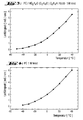
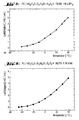
- FIGS. 1 to 6 show the conductivity as a function of temperature in the range of +40 to about -50 ° C.
- the proportions of the components are given in volume percent.
- the lithium secondary salt was used in each case in 1M concentration.
- the solvent components used are first prepared as follows:
- Ethylene carbonate (> 99%, Merck) is distilled under oil pump vacuum (boiling point 85 to 95 ° C) and over activated molecular sieve (Roth, pore size 4 Angstrom) at 150 ° C for 3 days dehydrated under a dried argon atmosphere [argon, 99.996%, company AGA, was first to remove traces of oxygen at 150 ° C over with argon W5 (mixture of 95% argon and 5% hydrogen, technical grade, AGA company) reduced copper (I) oxide (BASF) passed and then dried over activated molecular sieve] stored at 60 ° C.
- argon W5 mixture of 95% argon and 5% hydrogen, technical grade, AGA company
- reduced copper (I) oxide BASF
- Propylene carbonate (purum, Aldrich company) is in an oil pump vacuum over a 1.5 m long, mirrored Packed column distilled (boiling point 64 to 66 ° C) and stored over activated molecular sieve under a dried argon atmosphere at room temperature. After purification and drying, the residual water content of the solvents is determined by the Karl Fischer method (for example with the Mitsubishi CA 05 automatic titration unit). The water content should be less than 10 ppm.
- the fluorinated solvent component is dried for a few days over activated molecular sieve under a dried argon atmosphere at room temperature.
- the electrolyte thus prepared consists of 50% by volume of ethylene carbonate, 40% by volume of monoglycol bis-tetrafluoroethyl ether (HC 2 F 4 -OC 2 H 4 -OC 2 F 4 H) and 10% by volume of propylene carbonate and is 1 M to LiN (CF 3 SO 2 ) 2 .
- HC 2 F 4 -OC 2 H 4 -OC 2 F 4 H monoglycol bis-tetrafluoroethyl ether
- propylene carbonate is 1 M to LiN (CF 3 SO 2 ) 2 .
- the Electrolyte is characterized by a favorable low-temperature behavior up to -50 ° C without crystallization of the ethylene carbonate component with good conductivity ( FIG. 2 ), is stable in a wide "electrochemical window", behaves favorably with the intercalation of lithium in carbons and is extremely difficult to ignite.
- a solution of the imide in ethylene carbonate without addition of fluoroether is unsuitable
- the electrolyte prepared consists of 70% by volume of propylene carbonate, 30% by volume of monoglycol bis-tetrafluoroethyl ether (HC 2 F 4 OC 2 H 4 OC 2 F 4 H) and 1 M of imide [LiN (CF 3 SO 2 ) 2 ].
- the electrolyte is characterized by a favorable low-temperature behavior down to -50 ° C with good conductivity ( FIG. 3 ), is stable in a wide "electrochemical window", behaves favorably with the intercalation of lithium in carbons and is extremely difficult to ignite.
- the solvents can be mixed with one another in any ratio [ FIG.
- the electrolyte is characterized by a favorable low-temperature behavior down to -50 ° C with good conductivity ( FIG. 5 ), is stable in a wide "electrochemical window", behaves favorably with the intercalation of lithium in carbons and is extremely difficult to ignite.
Landscapes
- Chemical & Material Sciences (AREA)
- Chemical Kinetics & Catalysis (AREA)
- Electrochemistry (AREA)
- General Chemical & Material Sciences (AREA)
- Engineering & Computer Science (AREA)
- Manufacturing & Machinery (AREA)
- Secondary Cells (AREA)
Description
Im Sinne des Umweltschutzes und der Wirtschaftlichkeit ist die Entwicklung auf dem Batteriesektor eindeutig auf wiederaufladbare (sekundäre) Batterien gerichtet. Im wichtigen Sektor der mobilen Elektronik (hochwertige Camcorder, tragbare Computer, Handys und dergleichen) werden den Lithiumionen-Batterien große Chancen gegeben, weil ihre Energiedichte rund doppelt so hoch ist als die der Metallhydridzellen und etwa dreimal höher als die von Nickel/Cadmiumzellen. Ein weiteres interessantes Gebiet ist der Einsatz von sekundären Lithiumionen-Batterien für die Elektrotraktion, beispielsweise für elektrisch betriebene Stadtautos.In terms of environmental protection and economy, the development in the battery sector is clearly aimed at rechargeable (secondary) batteries. In the important sector of mobile electronics (high quality camcorders, portable computers, cell phones, and the like), lithium ion batteries are given great opportunities because their energy density is about twice that of metal hydride cells and about three times higher than nickel / cadmium cells. Another interesting field is the use of secondary lithium ion batteries for electric traction, for example for electrically powered city cars.
Problematisch ist derzeit vor allem der Sicherheitsstandard der wiederaufladbaren Lithiumbatterien, da kritische Betriebszustände wie Überladen, Überentladen oder Kurzschluß, die durchaus zur Öffnung der Zelle unter Feuererscheinung führen können, bisher häufig nur durch elektronische Überwachung vermieden werden.The problem is currently especially the safety standard of rechargeable lithium batteries, as critical operating conditions such as overcharging, over-discharging or short circuit, which can lead to the opening of the cell under fire phenomenon, are often avoided only by electronic monitoring.
Nach dem gegenwärtigen Stand der Technik verwendet man in sekundären Lithiumbatterien vor allem organische Lösungsmittel mit stark polarisierend wirkenden Heteroatomen, wie zum Beispiel Stickstoff, Sauerstoff oder Schwefel, zur Herstellung aprotischer Elektrolytlösungen [siehe zum Beispiel
Wenig entflammbar beziehungsweise wenig zur Bildung explosiver Gemische neigend sind einige schwerflüchtige, allerdings leider auch hochviskose Lösungsmittel wie Propylencarbonat, Ethylencarbonat oder Sulfolan (Tetramethylensulfon). Aufgrund der hohen Viskosität ist die elektrische Leitfähigkeit der mit diesen Lösungsmitteln hergestellten Elektrolytlösungen insbesondere bei tieferen Temperaturen gering. Außerdem sind neben der Ionenwanderung auch alle anderen Stofftransportvorgänge in solchen Lösungen langsam.Some flammable, but unfortunately also highly viscous solvents such as propylene carbonate, ethylene carbonate or sulfolane (tetramethylene sulfone) are less flammable or less prone to the formation of explosive mixtures. Due to the high viscosity, the electrical conductivity of the electrolyte solutions prepared with these solvents is low, especially at lower temperatures. In addition, all other mass transfer processes in such solutions are slow in addition to the ion migration.
Zum Erzielen hoher Leitfähigkeiten verwendet man in der Technik in der Regel Lösungsmittelgemische, die mindestens eine stark polare Komponente enthalten, welche aufgrund ihrer Polarität auf Salze stark dissoziierend wirkt. Eine orientierende Maßzahl für das Dissoziationsvermögen ist die Dielektrizitätskonstante. Da solche hochpolaren Lösungsmittel, wie zum Beispiel Propylencarbonat oder Ethylencarbonat, deren Dielektrizitätskonstanten mit 67 bei 25 °C beziehungsweise 90 bei 40 °C in etwa der des Wassers (78 bei 25 °C) entsprechen, regelmäßig auch ziemlich hochviskos sind, verwendet man im allgemeinen zusätzlich noch eine oder mehrere niederviskose Komponenten als "Verdünner". Typische Verdünner sind zum Beispiel 1,2-Dimethoxyethan oder Dimethylcarbonat, die allerdings durch sehr kleine Werte für die Dielektrizitätskonstante gekennzeichnet sind (circa 7 für 1,2-Dimethoxyethan und circa 3 für Dimethylcarbonat).In order to achieve high conductivities, solvent mixtures are generally used in the art which contain at least one strongly polar component which, due to its polarity, has a strongly dissociating effect on salts. An indicative measure of the dissociation capacity is the dielectric constant. Since such highly polar solvents, such as propylene carbonate or ethylene carbonate, whose dielectric constant with 67 at 25 ° C or 90 at 40 ° C in about that of the water (78 at 25 ° C), are regularly quite high viscosity, it is generally used additionally one or more low-viscosity components as "thinner". Typical diluents are, for example, 1,2-dimethoxyethane or dimethyl carbonate, which, however, are characterized by very low values for the dielectric constant (about 7 for 1,2-dimethoxyethane and about 3 for dimethyl carbonate).
Ein gravierender Nachteil der "Verdünner"-Komponenten besteht in ihrer Flüchtigkeit und dem damit verbundenen Zünd- und Explosionsverhalten bei Luftzutritt. Da elektrochemische Anwendungen von Elektrolytlösungen immer mit Erwärmung durch Stromfluß und beim Auftreten von Fehlern (zum Beispiel Kurzschluß innerhalb oder außerhalb des elektrochemischen Bauteils) auch mit dem Risiko der Zündung verbunden sind, kommt diesem Nachteil eine ganz erhebliche praktische Bedeutung zu. Für 1,2-Dimethoxyethan liegt zum Beispiel der Flammpunkt bei -6 °C und die Explosionsgrenze zwischen 1,6 und 10,4 Vol.-%.A serious disadvantage of the "thinner" components is their volatility and the associated ignition and explosion behavior in the case of air access. Since electrochemical applications of electrolyte solutions always associated with heating by current flow and the occurrence of errors (for example, short circuit inside or outside the electrochemical device) with the risk of ignition, this disadvantage has a very significant practical importance. For example, for 1,2-dimethoxyethane, the flash point is -6 ° C and the explosion limit is between 1.6 and 10.4 vol%.
Die wiederaufladbaren Lithiumbatterien enthalten meist eine Verbindung aus Lithium und einem Metalloxid als Kathode (zum Beispiel LixMnO2 oder LixCoO2) und Lithiummetall als Anode, wobei das Lithium bevorzugt als Intercalationsverbindung mit Graphit oder in Kombination mit Kohle- oder Graphitfasern verwendet wird. Ein guter Überblick über- die Entwicklung solcher Batterien wird von K. Brandt gegeben [
Zur Erhöhung der Sicherheit können Kathoden- und Anodenraum durch eine mikroporöse Separatormembran getrennt werden, die so beschaffen ist, daß beim Überschreiten einer definierten Grenztemperatur durch Verschmelzen der Poren der Stromfluß selbständig unterbrochen wird. Geeignete Membranen dieser Art sind beispielsweise im ®Celgard-Sortiment der Hoechst Celanese Corporation enthalten. Weiterhin kann durch Überdruckschalter, die zum Beispiel auf Gasentwicklung beim Überladen reagieren, und ganz allgemein durch eine aufwendige Überwachungs- und Steuerungselektronik die Sicherheit von Lithiumbatterien erhöht werden. Ferner wurden auch flammhemmende phosphor- und halogenhaltige Additive empfohlen.To increase the safety cathode and anode compartment can be separated by a microporous separator membrane, which is such that when a defined limit temperature is exceeded by melting the pores of the current flow is interrupted automatically. Suitable membranes of this type are included, for example, in the ® Celgard range of Hoechst Celanese Corporation. Furthermore, the safety of lithium batteries can be increased by overpressure switches, which react, for example, to gas evolution during overcharging, and more generally by elaborate monitoring and control electronics. Further, flame retardant phosphorus and halogen containing additives were also recommended.
All diese Maßnahmen können jedoch nicht ausschließen, daß beim Auftreten von Defekten die leichtflüchtige Komponente der flüssigen Elektrolytlösungen letztlich doch entflammt und in weiterer Folge zum Beispiel die negative Elektrode entzündet. In diesem Fall entsteht ein mit üblichen Mitteln kaum mehr löschbares Feuer, da zum Beispiel brennendes Lithium nicht nur mit Wasser, sondern auch mit dem in gängigen Feuerlöschern enthaltenen Stoffen (zum Beispiel Kohlendioxid) heftig reagiert.However, all these measures can not rule out that the occurrence of defects, the volatile component of the liquid electrolyte solutions but ultimately ignited and ignited, for example, the negative electrode. In this case, a fire with hardly any extinguishable by conventional means, since, for example, burning lithium violently reacts not only with water, but also with the substances contained in common fire extinguishers (for example, carbon dioxide).
In früheren Publikationen wurden bereits perfluorierte Ether und Perfluoralkane für das Elektrolytsystem von Lithiumbatterien vorgeschlagen (
Aus
Die Herstellung fluorierter Ether wurde bereits im
Aus
Nach dem gegenwärtigen Stand der Technik wird verminderte Entflammbarkeit der Elektrolytlösung vor allem durch Viskositätserhöhung der Elektrolytlösung durch Bindemittel oder Füller beziehungsweise durch die Verwendung bei Raumtemperatur praktisch fester polymerer Elektrolyte erreicht. In
All diesen gelartigen bis festen Elektrolyten ist gemeinsam, daß aufgrund ihrer hohen Viskosität die Beweglichkeit der Ionen der in ihnen gelösten Salze weitaus geringer ist als in flüssigen Elektrolytlösungen, so daß insbesondere bei tieferen Temperaturen zumindest für die meisten technischen Anwendungen nicht mehr die erforderlichen Leitfähigkeiten erreicht werden. Aus diesem Grunde haben zum Beispiel Alkalimetallbatterien mit polymeren Elektrolyten trotz jahrzehntelanger sehr intensiver Forschungstätigkeit noch immer keine wirtschaftliche Bedeutung erlangen können.All these gel-like to solid electrolytes have in common that, due to their high viscosity, the mobility of the ions of the salts dissolved in them is much lower than in liquid electrolyte solutions, so that especially at lower temperatures, at least for most technical applications, the required conductivities are no longer achieved , For this reason, for example, alkali metal batteries with polymeric electrolytes, despite decades of very intensive research activity still can not achieve economic importance.
Ziel der vorliegenden Erfindung war es, Elektrolytlösungen zu entwickeln, die frei von den obenerwähnten leichtentflammbaren und explosionsfähigen niederviskosen "Verdünnern" sind und somit die Sicherheit der elektrolythaltigen Vorrichtungen erhöhen, aber dennoch ein Viskositäts- und Leitfähigkeitsverhalten zeigen, das ihren praktischen Einsatz selbst bei tiefen Temperaturen möglich macht.The aim of the present invention was to develop electrolyte solutions which are free from the abovementioned highly flammable and explosive low-viscosity "Thinners" and thus increase the safety of the electrolyte-containing devices, but still exhibit a viscosity and conductivity behavior that makes their practical use possible even at low temperatures.
Es bestand somit ein dringender Bedarf für stabile Lösungsmittel für Lithiumzellen, die durch folgende Stoffeigenschaften gekennzeichnet sind:
- 1. Hohe thermische Stabilität.
- 2. Hoher Flammpunkt.
- 3. Niedriger Dampfdruck beziehungsweise hoher Siedepunkt.
- 4. Niedrige Viskosität.
- 5. Mischbarkeit mit batterieüblichen Lösungsmitteln, beispielsweise Ethylencarbonat, Propylencarbonat oder α,ω-Dialkyl-glykolethern.
- 6. Ausreichende Löslichkeit für fluorhaltige Lithiumleitsalze, beispielsweise LiPF6, LiN(SO2CF3)2 oder LiC(SO2CF3)3.
- 7. Hohe Stabilität gegenüber metallischem Lithium.
- 8. Gutes Lösevermögen für Kohlendioxid: CO2 beschleunigt den Aufbau von Schutzfilmen auf Lithium- oder LiCn-Anoden.
- 1. High thermal stability.
- 2. High flash point.
- 3. Low vapor pressure or high boiling point.
- 4. Low viscosity.
- 5. Miscibility with conventional battery solvents, such as ethylene carbonate, propylene carbonate or α, ω-dialkyl glycol ethers.
- 6. Sufficient solubility for fluorine-containing lithium secondary salts, for example LiPF 6 , LiN (SO 2 CF 3 ) 2 or LiC (SO 2 CF 3 ) 3 .
- 7. High stability against metallic lithium.
- 8. Good dissolving power for carbon dioxide: CO 2 accelerates the formation of protective films on lithium or LiC n anodes.
Es wurde nun überraschend gefunden, daß bestimmte Gruppen von teilfluorierten, aliphatischen Ethern die unter den Punkten 1 bis 8 genannten Anforderungen gut bis ausgezeichnet erfüllen. Es handelt sich grundsätzlich um Verbindungen, die dadurch gekennzeichnet sind, daß sie Alkylengruppen enthalten, die über Ethersauerstoff mit teilfluorierten Alkylgruppen verknüpft sind, welche außer Fluor noch Wasserstoff, Chlor und Ethersauerstoff enthalten können. Verbindungen im Sinne dieser Definition sind Ether der nachstehenden Formeln (I) und (II)
RO-[(CH2)mO]n-CF2-CFH-X (I)
worin
- R
- eine geradkettige Alkylgruppe
mit 1 bis 10 C-Atomen oder eine verzweigte Alkylgruppemit 3 bis 10 C-Atomen, - X
- Fluor, Chlor oder eine Perfluoralkylgruppe
mit 1 bis 6 C-Atomen ist, welche auch Ethersauerstoff enthalten kann, - m
eine Zahl von 2bis 6 und- n
eine Zahl von 1bis 8 ist,
X-CFH-CF2O-[(CH2)mO]n-CF2-CFH-X (II)
worin X, m und n die obengenannten Bedeutungen haben.It has now surprisingly been found that certain groups of partially fluorinated, aliphatic ethers meet the requirements mentioned under
RO - [(CH 2 ) m O] n -CF 2 -CFH-X (I)
wherein
- R
- a straight-chain alkyl group having 1 to 10 C atoms or a branched alkyl group having 3 to 10 C atoms,
- X
- Is fluorine, chlorine or a perfluoroalkyl group having 1 to 6 C atoms, which may also contain ether oxygen,
- m
- a number from 2 to 6 and
- n
- is a number from 1 to 8,
X-CFH-CF 2 O - [(CH 2 ) m O] n -CF 2 -CFH-X (II)
wherein X, m and n have the abovementioned meanings.
Gegenstand der Erfindung ist somit ein Elektrolytsystem zur Erhöhung der Sicherheit von Lithiumbatterien, das Verbindungen der Formeln (I) und/oder (II) in einer wirksamen Menge enthält, wobei die Verbindungen mit X Fluor oder Trifluormethyl bevorzugt sind. Besonders bevorzugt sind fluorhaltige Ether der Formel (I), worin R eine Methylgruppe, X Fluor, m 2 und n 1 bis 3 ist, sowie Ether der Formel (II), worin X Fluor, m 2 und n 1 bis 3 ist.The invention thus provides an electrolyte system for increasing the safety of lithium batteries, which contains compounds of the formulas (I) and / or (II) in an effective amount, wherein the compounds with X are fluorine or trifluoromethyl preferred. Particularly preferred are fluorine-containing ethers of the formula (I), wherein R is a methyl group, X is fluorine,
Im allgemeinen werden die Verbindungen mit m gleich 2 bevorzugt, weil sie aus gut zugänglichen und preiswerten Ethylenglykol-monoalkylethern oder Ethylenglykolen hergestellt werden können. Die Verbindungen, in denen X Chlor ist, sind weniger bevorzugt, weil sie bei hohen Temperaturen mit metallischem Lithium unter Abspaltung von Chlor und Fluor unter Bildung der entsprechenden Lithiumhalogenide reagieren können.In general, the compounds with m equal to 2 are preferred because they can be prepared from readily available and inexpensive ethylene glycol monoalkyl ethers or ethylene glycols. The compounds in which X is chlorine are less preferred because they can react at high temperatures with metallic lithium with elimination of chlorine and fluorine to form the corresponding lithium halides.
Die erfindungsgemäße Lösung des Sicherheitproblems von sekundären Lithiumbatterien wird durch den Einsatz von Verbindungen der Formeln (I) und/oder (II) als wesentliche Komponente des Elektrolytsystems erreicht, wobei man sich ihre überraschend niedrige Viskosität zunutze macht. Die Stoffe gemäß den Formeln (I) und (II) lassen sich als Verdünnungsmittel für schwerentflammbare, hochviskose Komponenten verwenden, beispielsweise Ethylencarbonat und Propylencarbonat. Auf diese Weise lassen sich aprotische Elektrolytsysteme herstellen, die praktisch kaum noch entflammbar sind. Der Gehalt von Ethern der Formeln (I) und/oder (II) beträgt üblicherweise 5 bis 70 Vol.-%, vorzugsweise 20 bis 50 Vol.-%, bezogen auf das Gesamtvolumen des Elektrolytsystems.The solution according to the invention of the safety problem of secondary lithium batteries is characterized by the use of compounds of formulas (I) and / or (II) as essential Achieved component of the electrolyte system, taking advantage of their surprisingly low viscosity advantage. The substances according to the formulas (I) and (II) can be used as diluents for low-inflammability, high-viscosity components, for example ethylene carbonate and propylene carbonate. In this way it is possible to produce aprotic electrolyte systems which are practically barely flammable. The content of ethers of the formulas (I) and / or (II) is usually from 5 to 70% by volume, preferably from 20 to 50% by volume, based on the total volume of the electrolyte system.
Die teilfluorierten Ether gemäß den Formeln (I) und (II) verbessern auch das Lösungsvermögen für unpolare oder wenig polare Gase, insbesondere CO2, N2, N2O, SF6, SO2FCl oder SO2F2. Diese Gase können vorteilhaft als Schutzgas in Lithiumbatterien eingesetzt werden, da sie einen positiven Effekt auf die an der Grenzfläche negative Elektrode/Elektrolyt ablaufenden Reaktionen haben [siehe zum Beispiel
Es ist bekannt, daß reaktive Verunreinigungen (zum Beispiel Wasser) schon in sehr geringen Konzentrationen drastische negative Auswirkungen auf die Funktion der Lithiumbatterien haben. In der Praxis sollte die Summe solcher Verunreinigungen 50 ppm auf keinen Fall überschreiten. Ein großer Vorteil der durch die obigen Formeln (I) und (II) definierten Produkte ist, daß sie meist so hohe Siedepunkte haben, daß Wasser und andere reaktive Verunreinigungen leicht durch Destillation vollständig abgetrennt werden können.It is known that reactive impurities (for example water), even in very low concentrations, have drastic negative effects on the function of the lithium batteries. In practice, the sum of such impurities should by no means exceed 50 ppm. A great advantage of the products defined by the above formulas (I) and (II) is that they usually have such high boiling points that water and other reactive impurities can be readily separated completely by distillation.
Die Viskosität von Mischungen der Ether gemäß den Formeln (I) und (II) mit Propylencarbonat kann durch Zugabe (mindestens) eines niedrigviskosen, weitgehend fluorierten Lösungsmittels aus der Gruppe der Hydro-perfluoralkane oder Hydro-perfluorether gesenkt werden, um auch bei Temperaturen unter 0 °C eine hohe Leitfähigkeit zu garantieren. In solchen Fällen empfiehlt sich die Verwendung besonders leicht dissoziierender Leitsalze mit großen fluorhaltigen Anionen, wie zum Beispiel LiN(SO2CF3)2 oder LiC(SO2CF3)3. Die erfindungsgemäßen teilfluorierten Ether wirken als Phasenvermittler in bezug auf die zugesetzten höher fluorierten Lösungsmittel. Besonders geeignete Mittel zur Erniedrigung der Viskosität sind beispielsweise 1H-Perfluorhexan (kinematische Viskosität bei 20 °C: 0,55 mm2/s, Flammpunkt > 110 °C) und 2,3-Dihydro-perfluor-5-methyl-pentan. Diese Stoffe bilden mit Luft keine explosionsfähigen Gemische. Dies gilt auch für Fluorether der Formel

Wie aus Tabelle 3 ersichtlich, neigen die durch die Formeln (I) und (II) beschriebenen Verbindungen oberhalb 200 °C zur thermischen Zersetzung. Es wurde überraschend gefunden, daß sich die teilfluorierten Ether mit sehr geringen Mengen an tertiären, aliphatischen Aminen sehr effektiv stabilisieren lassen. Bereits geringe Zusätze des Amins in der Größenordnung von 0,1 bis 1,0 Gew.-% bezüglich des teilfluorierten Ethers reichen aus, um die Temperatur, bei der sich der Ether zu zersetzen beginnt, um 60 bis 100 °C anzuheben. Das tertiäre Amin soll so hochsiedend sein, daß es auch bei Temperaturen über 100 °C überwiegend in der Flüssigphase verbleibt. Geeignete tertiäre Amine sind beispielsweise Tri-n-butylamin, Tri-n-octylamin oder 1,6-Bis-(dimethylamino)-hexan. Aromatische Amine sind wegen ihrer Tendenz zur anodischen Oxidation weniger geeignet.As can be seen from Table 3, the compounds described by Formulas (I) and (II) above 200 ° C tend to thermal decomposition. It has surprisingly been found that the partially fluorinated ethers can be very effectively stabilized with very small amounts of tertiary, aliphatic amines. Already small additions of the amine on the order of 0.1 to 1.0 wt .-% with respect to the partially fluorinated ether are sufficient to raise the temperature at which the ether begins to decompose by 60 to 100 ° C. The tertiary amine should be so high-boiling that it remains mainly at temperatures above 100 ° C in the liquid phase. Suitable tertiary amines are, for example, tri-n-butylamine, tri-n-octylamine or 1,6-bis- (dimethylamino) -hexane. Aromatic amines are less suitable because of their tendency to anodize.
Gegenstand unserer Erfindung ist somit auch eine Methode zur Stabilisierung von Verbindungen der Formeln (I) und (II) mit tertiären, aliphatischen Aminen.The subject of our invention is therefore also a method for stabilizing compounds of the formulas (I) and (II) with tertiary, aliphatic amines.
Primäre Alkohole reagieren mit diversen fluorhaltigen Alkenen basenkatalysiert unter Bildung von teilfluorierten Ethern [siehe
Die in Tabelle 1 gezeigten Ether mit 1H-Tetrafluorethyl-Gruppen wurden aus den entsprechenden Alkoholen und Tetrafluorethylen synthetisiert (Katalysator: KOH; Solvens: N,N-Dimethylformamid). Nach derselben Methode wurde die Verbindung CH3O(CH2)2OCF2CFClH mit Chlortrifluorethylen erhalten (Kochpunkt: 146 bis 147 °C, 1013 hPa; GC-Reinheit: 99,4 %).The ethers with 1H-tetrafluoroethyl groups shown in Table 1 were synthesized from the corresponding alcohols and tetrafluoroethylene (catalyst: KOH, solvent: N, N-dimethylformamide). By the same method, the compound CH 3 O (CH 2 ) 2 OCF 2 CFClH was obtained with chlorotrifluoroethylene (boiling point: 146 to 147 ° C, 1013 hPa, GC purity: 99.4%).
Bei der Reaktion von Alkoholen mit Hexafluorpropen unter basischen Bedingungen tritt teilweise HF-Abspaltung ein, so daß sich als Nebenprodukte auch Ether der Formel RO-CF=CF-CF3 (E/Z-Isomere) bilden. Diese Nebenreaktion läßt sich weitgehend unterdrücken, indem man die Reaktion unter hohem Druck durchführt [
∗∗) DIN 51758, Genauigkeit ± 1 °C
**) DIN 51758, accuracy ± 1 ° C
Thermoanalytische Untersuchung der Stabilität von teilfluorierten Ethern:Thermoanalytical investigation of the stability of partially fluorinated ethers:
Die thermische Stabilität von typischen teilfluorierten Ethern wurde mittels DSC (Differential Scanning Calorimetry) untersucht. Die Aufheizrate, beginnend bei 20 °C, betrug 10 °C/min.
- 1. Die thermische Zersetzung der in Tabelle 3 genannten teilfluorierten Ethern verläuft grundsätzlich exotherm.1. The thermal decomposition of the partially fluorinated ethers listed in Table 3 is basically exothermic.
- 2. Die teilfluorierten Ether lassen sich durch geringe Mengen eines tertiären Amins effizient stabilisieren.2. The partially fluorinated ethers can be efficiently stabilized by small amounts of a tertiary amine.
Leitfähigkeitsmessungen an Elektrolytsystemen, welche einen erfindungsgemäßen Ether enthalten:Conductivity measurements on electrolyte systems containing an ether according to the invention:
Die
Abkürzungen:
- EC:
- Ethylencarbonat
- PC:
- Propylencarbonat
- Imid:
- Li+[N(SO2CF3)2]-
- EC:
- ethylene
- PC:
- propylene carbonate
- imide:
- Li + [N (SO 2 CF 3 ) 2 ] -
Die Erfindung wird in den folgenden Beispielen noch näher erläutert.The invention will be explained in more detail in the following examples.
Zur Herstellung des Elektrolyten werden zuerst die verwendeten Lösungsmittelkomponenten wie folgt vorbereitet:To prepare the electrolyte, the solvent components used are first prepared as follows:
Ethylencarbonat (> 99 %, Firma Merck) wird im Ölpumpenvakuum destilliert (Siedepunkt 85 bis 95 °C) und über aktiviertem Molekularsieb (Firma Roth, Porenweite 4 Angström) bei 150 °C 3 Tage entwässert unter getrockneter Argonatmosphäre [Argon, 99,996 %, Firma AGA, wurde zunächst, um Sauerstoffspuren zu entfernen, bei 150 °C über mit Argon W5 (Gemisch aus 95 % Argon und 5 % Wasserstoff, technische Reinheit, Firma AGA) reduziertes Kupfer-(I)-oxid (Firma BASF) geleitet und anschließend über aktiviertem Molekularsieb getrocknet] bei 60 °C gelagert.Ethylene carbonate (> 99%, Merck) is distilled under oil pump vacuum (boiling point 85 to 95 ° C) and over activated molecular sieve (Roth,
Propylencarbonat (purum, Firma Aldrich) wird im ölpumpenvakuum über eine 1,5 m lange, verspiegelte Füllkörperkolonne destilliert (Siedepunkt 64 bis 66 °C) und über aktiviertem Molekularsieb unter getrockneter Argonatmosphäre bei Raumtemperatur gelagert. Nach der Reinigung und Trocknung wird der Restwassergehalt der Lösungsmittel nach der Karl-Fischer-Methode (zum Beispiel mit dem automatischen Titriergerät Mitsubishi CA 05) bestimmt. Der Wassergehalt soll unter 10 ppm liegen.Propylene carbonate (purum, Aldrich company) is in an oil pump vacuum over a 1.5 m long, mirrored Packed column distilled (boiling point 64 to 66 ° C) and stored over activated molecular sieve under a dried argon atmosphere at room temperature. After purification and drying, the residual water content of the solvents is determined by the Karl Fischer method (for example with the Mitsubishi CA 05 automatic titration unit). The water content should be less than 10 ppm.
Die fluorierte Lösungsmittelkomponente wird einige Tage über aktiviertem Molekularsieb unter getrockneter Argonatmosphäre bei Raumtemperatur getrocknet.The fluorinated solvent component is dried for a few days over activated molecular sieve under a dried argon atmosphere at room temperature.
Die Herstellung der Elektrolytlösungen findet mit der sogenannten Schlenktechnik im getrockneten Argonstrom statt, wobei die verwendeten Glasgeräte mit Schutzgasanschluß vor Gebrauch in der entleuchteten Bunsenbrennerflamme unter mehrmaligem Wechsel von Argonspülung und Ölpumpenvakuumsog von anhaftender Feuchtigkeit befreit werden.The preparation of the electrolyte solutions takes place with the so-called Schlenk technique in the dried argon stream, the glassware used with protective gas connection are freed before use in the dimmed Bunsenbrennerflamme with repeated alternation of argon flush and Ölpumpenvakuumsog of adhering moisture.
Herstellung eines Sicherheitsbatterieelektrolyten auf der Basis von Ethylencarbonat als filmbildende Komponente in Lithiumionen-Batterien.Preparation of a safety battery electrolyte based on ethylene carbonate as a film-forming component in lithium-ion batteries.
Zu 50 Vol.-% Ethylencarbonat und 10 Vol.-% Propylencarbonat werden 40 Vol.-% Monoglykol-bis-tetrafluorethylether (HC2F4OCH2CH2OC2F4H) gegeben. Dieses Lösungsmittelgemisch wird unter Rühren zu 287,1 g (1 mol) Lithium-bis-(trifluormethansulfon)-imid [LiN(CF3SO2)2, > 99,5 %, Firma 3M Company, 4 Tage im Hochvakuum bei 110 °C getrocknet] zugegeben und auf 1 Liter aufgefüllt. Der so hergestellte Elektrolyt besteht aus 50 Vol.-% Ethylencarbonat, 40 Vol.-% Monoglykol-bis-tetrafluorethylether (HC2F4-OC2H4-OC2F4H) und 10 Vol.-% Propylencarbonat und ist 1 M an LiN(CF3SO2)2. Der Elektrolyt zeichnet sich durch ein günstiges Tieftemperaturverhalten bis -50 °C ohne ein Auskristallisieren der Ethylencarbonat-Komponente bei guter Leitfähigkeit aus (
Herstellung eines Sicherheitsbatterieelektrolyten auf der Basis von Propylencarbonat mit Lithium-bis-(trifluormethansulfon)-imid [LiN(CF3SO2)2] als Leitsalz.Preparation of a safety battery electrolyte based on propylene carbonate with lithium bis (trifluoromethanesulfone) imide [LiN (CF 3 SO 2 ) 2 ] as conductive salt.
Zu 70 Vol.-% Propylencarbonat werden 30 Vol.-% Monoglykol-bis-tetrafluorethylether (HC2F4OCH2CH2OC2F4H) gegeben. Dieses Lösungsmittelgemisch wird unter Rühren zu 287,1 g (1 mol) Lithium-bis-(trifluormethansulfon)-imid [LiN(CF3SO2)2, > 99,5 %, Firma 3M Company, 4 Tage im Hochvakuum bei 110 °C getrocknet] zugegeben und auf 1 Liter aufgefüllt. Der hergestellte Elektrolyt besteht aus 70 Vol.-% Propylencarbonat, 30 Vol.-% Monoglykol-bis-tetrafluorethylether (HC2F4OC2H4OC2F4H) und ist 1 M an Imid [LiN(CF3SO2)2]. Der Elektrolyt zeichnet sich durch ein günstiges Tieftemperaturverhalten bis -50 °C bei guter Leitfähigkeit aus (
Herstellung eines Sicherheitsbatterieelektrolyten auf der Basis von Propylencarbonat mit Lithiumhexafluorophosphat (LiPF6) als Leitsalz.Preparation of a safety battery electrolyte based on propylene carbonate with lithium hexafluorophosphate (LiPF 6 ) as conductive salt.
Zu 70 Vol.-% Propylencarbonat werden 30 Vol.-% Monoglykol-bis-tetrafluorethylether (HC2F4OCH2CH2OC2F4H) gegeben. Dieses Lösungsmittelgemisch wird unter Rühren zu 151,9 g (1 mol) Lithiumhexafluorophosphat (LiPF6, > 99,9 %, Firma Merck beziehungsweise Hashimoto, kann ohne vorherige Trocknung eingesetzt werden) gegeben und auf 1 Liter aufgefüllt. Der hergestellte Elektrolyt besteht aus 70 Vol.-% Propylencarbonat, 30 Vol.-% Monoglykol-bis-tetrafluorethylether (HC2F4OC2H4OC2F4H) und ist 1 M an Lithiumhexafluorophosphat. Der Elektrolyt zeichnet sich durch ein günstiges Tieftemperaturverhalten bis -50 °C bei guter Leitfähigkeit aus (
Aus 30 Vol.-% Propylencarbonat und 70 Vol.-% Monoglykol-bis-tetrafluorethylether sowie dem bereits genannten Imid wird eine 1M-Lösung hergestellt. Leitfähigkeitsmessung siehe
Claims (7)
- An elektrolyte system for lithium batteries with increased safety characterized in that the electrolyte system of the battery contains at least a partially fluorinated ether of the formula (I)
RO-[(CH2)mO]n-CF2-CFH-X (I)
whereinR is a straight-chain alkyl group with one to ten C atoms or a branched alkyl group with three to ten C atoms,X is fluorine, chlorine or a perfluoroalkyl group with one to six C atoms which may also contain ether oxygen,m is a number from 2 to 6 andn is a number from 1 to 8,and/or of the formula (II)
X-CFH-CF2O-[(CH2)mO]n-CF2-CFH-X (II)
wherein
X, m and n have the meaning as mentioned above,
contain the constituents as above in a percentage of 5 - 70 % by volume and may contain a tertiary aliphatic amine. - The electrolyte system as claimed in claim 1 characterized in that X is fluorine or trifluoromethyl in the formulas (1) and (II).
- The electrolyte system as claimed in claim 1 or 2 characterized in that R means a methyl group, X means fluorine, m is a number of 2 and n is a number from 1 to 3 in formula (I) as well as X means fluorine, m is a number of 2 and n is a number from 1 to 3 in formula (II).
- The electrolyte system as claimed in one or several of claims 1 to 3 characterized in that the percentage of ethers in the formulas (I) and/or (II) is 20 to 50 % by volume of the whole electrolyte system.
- The electrolyte system as claimed in claim 1 characterized in that, apart from at least one ether of the formulas (I) and/or (II), ethylene carbonate and/or propylene carbonate is added to the battery.
- The electrolyte system as claimed in claim 1 characterized in that, in order to stabilize the ethers of formulas (I) and (II), a tertiary aliphatic amine is used, which has a boiling point of at least 100 °C at standard pressure and a percentage of 0.1 to 1.0 % by weight relating to the fluorine-containing ether.
- A secondary lithium battery with increased safety characterized in that the battery contains an electrolyte system as claimed in one or several of claims 1 to 6.
Applications Claiming Priority (2)
| Application Number | Priority Date | Filing Date | Title |
|---|---|---|---|
| DE19619233A DE19619233A1 (en) | 1996-05-13 | 1996-05-13 | Fluorine-containing solvents for lithium batteries with increased security |
| DE19619233 | 1996-05-13 |
Publications (2)
| Publication Number | Publication Date |
|---|---|
| EP0807986A1 EP0807986A1 (en) | 1997-11-19 |
| EP0807986B1 true EP0807986B1 (en) | 2008-11-12 |
Family
ID=7794179
Family Applications (1)
| Application Number | Title | Priority Date | Filing Date |
|---|---|---|---|
| EP97107506A Expired - Lifetime EP0807986B1 (en) | 1996-05-13 | 1997-05-07 | Fluorine-containing solvent for lithium batteries with increased security |
Country Status (5)
| Country | Link |
|---|---|
| US (1) | US5916708A (en) |
| EP (1) | EP0807986B1 (en) |
| JP (1) | JP4469934B2 (en) |
| KR (1) | KR100454990B1 (en) |
| DE (2) | DE19619233A1 (en) |
Families Citing this family (49)
| Publication number | Priority date | Publication date | Assignee | Title |
|---|---|---|---|---|
| JP3492173B2 (en) * | 1997-12-09 | 2004-02-03 | シャープ株式会社 | Non-aqueous battery |
| TW434923B (en) | 1998-02-20 | 2001-05-16 | Hitachi Ltd | Lithium secondary battery and liquid electrolyte for the battery |
| KR100605344B1 (en) * | 1998-09-11 | 2006-07-28 | 미쓰이 가가쿠 가부시키가이샤 | Non-aqueous electrolyte and non-aqueous electrolyte secondary battery |
| US6566015B1 (en) * | 1998-10-09 | 2003-05-20 | Denso Corporation | Non-aqueous electrolytic salt and non-aqueous electrolytic secondary battery in which it is used |
| DE19858924A1 (en) | 1998-12-19 | 2000-06-21 | Aventis Res & Tech Gmbh & Co | Improving the safety of lithium batteries for use in electronic devices by using an electrolyte containing a diol-derived partly-fluorinated compound |
| KR100625957B1 (en) * | 1999-09-10 | 2006-09-20 | 삼성에스디아이 주식회사 | Lithium ion battery |
| JP2001085058A (en) * | 1999-09-20 | 2001-03-30 | Hitachi Ltd | Non-aqueous electrolyte, lithium primary battery and lithium secondary battery using the same, electrochemical capacitor, polymer electrolyte, and polymer secondary battery using the same |
| US6905762B1 (en) | 2001-02-13 | 2005-06-14 | The United States Of America As Represented By The Secretary Of The Army | Non-aqueous electrolyte solutions comprising additives and non-aqueous electrolyte cells comprising the same |
| US6924061B1 (en) | 2001-02-13 | 2005-08-02 | The United States Of America As Represented By The Secretary Of Army | Nonflammable non-aqueous electrolyte and non-aqueous electrolyte cells comprising the same |
| US6939647B1 (en) | 2001-02-13 | 2005-09-06 | The United States Of America As Represented By The Secretary Of The Army | Non-aqueous electrolyte solutions and non-aqueous electrolyte cells comprising the same |
| US6797437B2 (en) * | 2001-12-28 | 2004-09-28 | Quallion Llc | Electrolyte system and energy storage device using same |
| JP2005519346A (en) * | 2002-03-06 | 2005-06-30 | イー・アイ・デュポン・ドウ・ヌムール・アンド・カンパニー | Fluorine-containing compound with high transparency in vacuum ultraviolet |
| DE10247675A1 (en) * | 2002-10-12 | 2004-04-22 | Solvay Fluor Und Derivate Gmbh | The use of polyfluoropolyethers and their mixtures as fire resistant solvents for conductive salt mixtures in reusable battery electrolytes increases the safety of the batteries, e.g. decreases the explosion risk |
| US7186478B2 (en) * | 2003-01-23 | 2007-03-06 | Lithium Technology Corporation | Electrochemical device |
| US7128133B2 (en) * | 2003-12-16 | 2006-10-31 | 3M Innovative Properties Company | Hydrofluoroether as a heat-transfer fluid |
| JP2006049037A (en) * | 2004-08-03 | 2006-02-16 | Three M Innovative Properties Co | Nonaqueous electrolyte for electrochemical energy device |
| JP2006216361A (en) * | 2005-02-03 | 2006-08-17 | Three M Innovative Properties Co | Electrolytic solution for lithium battery |
| US7854855B2 (en) * | 2005-03-31 | 2010-12-21 | Daikin Industries, Ltd. | Electrolytic solution |
| JPWO2006115023A1 (en) * | 2005-04-19 | 2008-12-18 | 松下電器産業株式会社 | Non-aqueous electrolyte, electrochemical energy storage device using the same, and non-aqueous electrolyte secondary battery |
| US7691282B2 (en) | 2005-09-08 | 2010-04-06 | 3M Innovative Properties Company | Hydrofluoroether compounds and processes for their preparation and use |
| US7790312B2 (en) * | 2005-09-08 | 2010-09-07 | 3M Innovative Properties Company | Electrolyte composition |
| WO2008079670A1 (en) | 2006-12-20 | 2008-07-03 | 3M Innovative Properties Company | Fluorinated compounds for use in lithium battery electrolytes |
| CN101584075B (en) * | 2006-12-22 | 2011-10-12 | 大金工业株式会社 | non-aqueous electrolyte |
| KR20110008172A (en) | 2008-04-28 | 2011-01-26 | 아사히 가라스 가부시키가이샤 | Non-aqueous electrolyte and secondary battery for secondary batteries |
| US8415056B2 (en) * | 2008-07-09 | 2013-04-09 | Daikin Industries, Ltd. | Non-aqueous electrolytic solution |
| US20100028784A1 (en) * | 2008-07-29 | 2010-02-04 | 3M Innovative Properties Company | Electrolyte composition, lithium-containing electrochemical cell, battery pack, and device including the same |
| WO2010110388A1 (en) * | 2009-03-27 | 2010-09-30 | 旭硝子株式会社 | Electrolyte solution for electrical energy storage devices, and electrical energy storage device |
| WO2011052605A1 (en) * | 2009-10-27 | 2011-05-05 | 旭硝子株式会社 | Nonaqueous electrolyte solution for secondary battery, and secondary battery |
| WO2011051275A1 (en) | 2009-10-27 | 2011-05-05 | Solvay Fluor Gmbh | Lithium sulfur battery |
| CN103250282A (en) * | 2010-12-13 | 2013-08-14 | 日本电气株式会社 | Positive electrode active material for secondary cells |
| WO2012146525A1 (en) | 2011-04-26 | 2012-11-01 | Solvay Sa | Lithium air battery cell |
| CN104080780B (en) | 2011-11-30 | 2018-04-13 | 索尔维公司 | Derivative, its preparation method and its purposes as solvent additive of the meldrum's acid of fluorination |
| EP2602241A1 (en) | 2011-12-07 | 2013-06-12 | Solvay Sa | Process for the manufacture of 1, 1'-difluorosubstituted dialkyl carbonates, isomers thereof and electrolyte compositions containing them |
| US10003100B2 (en) | 2012-02-03 | 2018-06-19 | Nec Corporation | Nonaqueous electrolyte with fluorine containing ether compound for lithium secondary battery |
| DE102012101670A1 (en) * | 2012-02-29 | 2013-08-29 | Jacobs University Bremen Ggmbh | Conducting salt for lithium-based energy storage |
| EP2667444A1 (en) | 2012-05-21 | 2013-11-27 | Solvay Sa | Use of fluorinated 2-methoxymalonic acid esters in electrolyte or solvent compositions |
| WO2014027003A1 (en) | 2012-08-14 | 2014-02-20 | Solvay Sa | Use of low concentrations of fluorinated organic compounds as solvent additives |
| US9040203B2 (en) * | 2013-01-16 | 2015-05-26 | Samsung Sdi Co., Ltd. | Lithium battery |
| JP6304876B2 (en) * | 2013-03-28 | 2018-04-04 | 本田技研工業株式会社 | Lithium air battery |
| WO2015078791A1 (en) | 2013-11-28 | 2015-06-04 | Solvay Specialty Polymers Italy S.P.A. | Electrolyte compositions for lithium batteries |
| US10707526B2 (en) | 2015-03-27 | 2020-07-07 | New Dominion Enterprises Inc. | All-inorganic solvents for electrolytes |
| US11329317B2 (en) | 2016-07-25 | 2022-05-10 | Solvay Specialty Polymers Italy S.P.A. | Liquid electrolytes for lithium batteries |
| CN106252723B (en) * | 2016-08-29 | 2019-03-19 | 宁德市凯欣电池材料有限公司 | The method for producing lithium-ion battery electrolytes |
| US10347943B2 (en) * | 2016-09-14 | 2019-07-09 | Uchicago Argonne, Llc | Fluoro-substituted ethers and compositions |
| US10707531B1 (en) | 2016-09-27 | 2020-07-07 | New Dominion Enterprises Inc. | All-inorganic solvents for electrolytes |
| EP3544110B1 (en) * | 2016-12-20 | 2023-12-20 | Daikin Industries, Ltd. | Electrolyte solution, electrochemical device, lithium ion secondary battery, and module |
| US10868333B2 (en) | 2019-01-23 | 2020-12-15 | Uchicago Argonne, Llc | Electrolytes for lithium batteries |
| EP4246646A4 (en) * | 2020-11-13 | 2025-01-08 | Terawatt Technology K.K. | LITHIUM SECONDARY BATTERY |
| EP4071872A1 (en) * | 2021-04-08 | 2022-10-12 | Solvay SA | Liquid electrolyte for lithium secondary batteries |
Family Cites Families (10)
| Publication number | Priority date | Publication date | Assignee | Title |
|---|---|---|---|---|
| JP2555378B2 (en) * | 1987-10-30 | 1996-11-20 | 株式会社ネオス | Synthetic Fluoroalkoxyethanes |
| DE4025208A1 (en) * | 1990-08-09 | 1992-02-13 | Varta Batterie | ELECTROCHEMICAL SECONDARY ELEMENT |
| DE69309861T2 (en) * | 1992-11-18 | 1997-09-11 | Mitsui Petrochemical Ind | Carbonate compounds, non-aqueous electrolyte solutions and batteries containing non-aqueous electrolyte solutions |
| CA2119959C (en) * | 1993-03-30 | 2000-03-14 | Soichiro Kawakami | Secondary battery |
| US5393621A (en) * | 1993-10-20 | 1995-02-28 | Valence Technology, Inc. | Fire-resistant solid polymer electrolytes |
| JP3304187B2 (en) * | 1994-03-14 | 2002-07-22 | 日本電信電話株式会社 | Electrolyte for lithium secondary battery |
| US5529859A (en) * | 1994-04-15 | 1996-06-25 | National Research Council Of Canada | Elecrolyte for a secondary cell |
| JPH0897024A (en) * | 1994-09-29 | 1996-04-12 | Nippon Steel Corp | Oriented magnetic steel plate for laminated core with excellent transformer noise characteristics |
| US5714280A (en) * | 1994-11-09 | 1998-02-03 | Furukawa Denchi Kabushiki Kaisha | Lithium secondary battery |
| TW360987B (en) * | 1995-07-25 | 1999-06-11 | Sumitomo Chemical Co | Non-aqueous electrolyte and lithium secondary battery |
-
1996
- 1996-05-13 DE DE19619233A patent/DE19619233A1/en not_active Withdrawn
-
1997
- 1997-05-07 DE DE59712979T patent/DE59712979D1/en not_active Expired - Lifetime
- 1997-05-07 EP EP97107506A patent/EP0807986B1/en not_active Expired - Lifetime
- 1997-05-09 US US08/853,856 patent/US5916708A/en not_active Expired - Lifetime
- 1997-05-12 KR KR1019970018149A patent/KR100454990B1/en not_active Expired - Fee Related
- 1997-05-12 JP JP12120297A patent/JP4469934B2/en not_active Expired - Fee Related
Also Published As
| Publication number | Publication date |
|---|---|
| US5916708A (en) | 1999-06-29 |
| DE59712979D1 (en) | 2008-12-24 |
| KR970077791A (en) | 1997-12-12 |
| DE19619233A1 (en) | 1997-11-20 |
| JP4469934B2 (en) | 2010-06-02 |
| JPH1050343A (en) | 1998-02-20 |
| EP0807986A1 (en) | 1997-11-19 |
| KR100454990B1 (en) | 2005-01-13 |
Similar Documents
| Publication | Publication Date | Title |
|---|---|---|
| EP0807986B1 (en) | Fluorine-containing solvent for lithium batteries with increased security | |
| EP0887874B1 (en) | Electrolyte for lithium batteries and its use, and method for increasing the safety of lithium batteries | |
| DE69609542T2 (en) | Perfluoroalkyl sulfonates, sulfonimides and sulfonyl methides, and electrolytes containing them | |
| EP1153450B1 (en) | Electrolyte system for lithium batteries, the use thereof and method for enhancing safety of lithium batteries | |
| DE69728041T2 (en) | NON-FLAMMABLE / SELF-EXTINGUISHING ELECTROLYTE FOR BATTERIES | |
| EP1088814A1 (en) | Fluorinated sulfonamides as highly flame-resistant solvents for use in electrochemical cells | |
| DE102022130388A1 (en) | Liquid electrolyte composition with a salt, electrochemical cell with the electrolyte composition, salt and use of the salt in the electrochemical cell | |
| EP1205480B1 (en) | Tetrakis fluoroalkylborate salts and their use as electrolyte salts | |
| EP1147569B1 (en) | Electrolyte systems for lithium batteries, the use thereof and method for enhancing the safety of lithium batteries | |
| EP2737568A1 (en) | Lithium-2-methoxy-1,1,2,2-tetrafluoro-ethanesulfonate and use thereof as conductive salt in lithium-based energy accumulators | |
| EP1554771B1 (en) | Use of polyfluoride polyethers | |
| EP1236732A1 (en) | Fluoroalkylphosphate salts and preparation thereof | |
| EP1205998A2 (en) | Electrolytes | |
| EP1095942A2 (en) | Complex salts for use in eletrochemical cells | |
| JP2019220450A (en) | Electrolytic solution for rocking chair type secondary battery, and rocking chair type secondary battery | |
| EP1048648A1 (en) | Method for the purification of methanide electrolytes | |
| WO2024012973A1 (en) | Liquid electrolyte composition comprising a salt, electrochemical cell comprising the electrolyte composition, salt, and use of the salt in the electrochemical cell | |
| EP3560023A1 (en) | Electrolyte for lithium ion batteries | |
| DE102016125323A1 (en) | Electrolyte for lithium-ion batteries | |
| DE10055812A1 (en) | Mixture used in electrolytes, primary batteries, secondary batteries, capacitors, super capacitors and galvanic cells, contains a fluoroalkylphosphate salt and a polymer | |
| DE10058264A1 (en) | Mixture used in electrolytes, primary batteries, secondary batteries, capacitors, super capacitors and galvanic cells, contains a fluoroalkylphosphate salt and a polymer |
Legal Events
| Date | Code | Title | Description |
|---|---|---|---|
| PUAI | Public reference made under article 153(3) epc to a published international application that has entered the european phase |
Free format text: ORIGINAL CODE: 0009012 |
|
| AK | Designated contracting states |
Kind code of ref document: A1 Designated state(s): CH DE FR GB IT LI |
|
| 17P | Request for examination filed |
Effective date: 19980519 |
|
| RAP1 | Party data changed (applicant data changed or rights of an application transferred) |
Owner name: AVENTIS RESEARCH & TECHNOLOGIES GMBH & CO. KG |
|
| RAP1 | Party data changed (applicant data changed or rights of an application transferred) |
Owner name: AXIVA GMBH |
|
| RAP1 | Party data changed (applicant data changed or rights of an application transferred) |
Owner name: SOLVAY FLUOR UND DERIVATE GMBH |
|
| 17Q | First examination report despatched |
Effective date: 20020320 |
|
| GRAP | Despatch of communication of intention to grant a patent |
Free format text: ORIGINAL CODE: EPIDOSNIGR1 |
|
| GRAS | Grant fee paid |
Free format text: ORIGINAL CODE: EPIDOSNIGR3 |
|
| GRAA | (expected) grant |
Free format text: ORIGINAL CODE: 0009210 |
|
| RAP1 | Party data changed (applicant data changed or rights of an application transferred) |
Owner name: SOLVAY FLUOR GMBH |
|
| AK | Designated contracting states |
Kind code of ref document: B1 Designated state(s): CH DE FR GB IT LI |
|
| REG | Reference to a national code |
Ref country code: GB Ref legal event code: FG4D Free format text: NOT ENGLISH |
|
| REG | Reference to a national code |
Ref country code: CH Ref legal event code: EP |
|
| REF | Corresponds to: |
Ref document number: 59712979 Country of ref document: DE Date of ref document: 20081224 Kind code of ref document: P |
|
| PLBE | No opposition filed within time limit |
Free format text: ORIGINAL CODE: 0009261 |
|
| STAA | Information on the status of an ep patent application or granted ep patent |
Free format text: STATUS: NO OPPOSITION FILED WITHIN TIME LIMIT |
|
| 26N | No opposition filed |
Effective date: 20090813 |
|
| GBPC | Gb: european patent ceased through non-payment of renewal fee |
Effective date: 20090507 |
|
| PG25 | Lapsed in a contracting state [announced via postgrant information from national office to epo] |
Ref country code: GB Free format text: LAPSE BECAUSE OF NON-PAYMENT OF DUE FEES Effective date: 20090507 |
|
| PG25 | Lapsed in a contracting state [announced via postgrant information from national office to epo] |
Ref country code: IT Free format text: LAPSE BECAUSE OF FAILURE TO SUBMIT A TRANSLATION OF THE DESCRIPTION OR TO PAY THE FEE WITHIN THE PRESCRIBED TIME-LIMIT Effective date: 20081112 |
|
| REG | Reference to a national code |
Ref country code: FR Ref legal event code: PLFP Year of fee payment: 20 |
|
| PGFP | Annual fee paid to national office [announced via postgrant information from national office to epo] |
Ref country code: CH Payment date: 20160511 Year of fee payment: 20 Ref country code: DE Payment date: 20160504 Year of fee payment: 20 |
|
| PGFP | Annual fee paid to national office [announced via postgrant information from national office to epo] |
Ref country code: FR Payment date: 20160412 Year of fee payment: 20 |
|
| REG | Reference to a national code |
Ref country code: DE Ref legal event code: R071 Ref document number: 59712979 Country of ref document: DE |
|
| REG | Reference to a national code |
Ref country code: CH Ref legal event code: PL |