EP0806989B1 - System zur beschichtung mit walzen - Google Patents
System zur beschichtung mit walzen Download PDFInfo
- Publication number
- EP0806989B1 EP0806989B1 EP96903568A EP96903568A EP0806989B1 EP 0806989 B1 EP0806989 B1 EP 0806989B1 EP 96903568 A EP96903568 A EP 96903568A EP 96903568 A EP96903568 A EP 96903568A EP 0806989 B1 EP0806989 B1 EP 0806989B1
- Authority
- EP
- European Patent Office
- Prior art keywords
- roll
- sled
- coating
- rolls
- pedestal
- Prior art date
- Legal status (The legal status is an assumption and is not a legal conclusion. Google has not performed a legal analysis and makes no representation as to the accuracy of the status listed.)
- Expired - Lifetime
Links
- 238000000576 coating method Methods 0.000 title claims abstract description 243
- 239000011248 coating agent Substances 0.000 title claims abstract description 238
- NJPPVKZQTLUDBO-UHFFFAOYSA-N novaluron Chemical compound C1=C(Cl)C(OC(F)(F)C(OC(F)(F)F)F)=CC=C1NC(=O)NC(=O)C1=C(F)C=CC=C1F NJPPVKZQTLUDBO-UHFFFAOYSA-N 0.000 claims description 51
- 238000000034 method Methods 0.000 claims description 25
- 239000007788 liquid Substances 0.000 claims description 19
- 239000000463 material Substances 0.000 claims description 5
- 238000005452 bending Methods 0.000 claims description 2
- 230000007246 mechanism Effects 0.000 abstract description 44
- 230000033001 locomotion Effects 0.000 abstract description 42
- 238000005259 measurement Methods 0.000 abstract description 12
- 239000002184 metal Substances 0.000 abstract description 10
- 230000004044 response Effects 0.000 abstract description 4
- 239000003973 paint Substances 0.000 description 11
- 210000003739 neck Anatomy 0.000 description 10
- 230000000712 assembly Effects 0.000 description 9
- 238000000429 assembly Methods 0.000 description 9
- 230000006378 damage Effects 0.000 description 8
- 230000008859 change Effects 0.000 description 7
- 230000008569 process Effects 0.000 description 7
- 238000011144 upstream manufacturing Methods 0.000 description 7
- 238000006073 displacement reaction Methods 0.000 description 6
- 230000009467 reduction Effects 0.000 description 6
- 239000002904 solvent Substances 0.000 description 6
- 230000008901 benefit Effects 0.000 description 5
- 239000010408 film Substances 0.000 description 5
- 229910000831 Steel Inorganic materials 0.000 description 4
- 238000013459 approach Methods 0.000 description 4
- 230000008878 coupling Effects 0.000 description 4
- 238000010168 coupling process Methods 0.000 description 4
- 238000005859 coupling reaction Methods 0.000 description 4
- 230000009977 dual effect Effects 0.000 description 4
- 239000007787 solid Substances 0.000 description 4
- 239000010959 steel Substances 0.000 description 4
- 230000001419 dependent effect Effects 0.000 description 3
- 238000013461 design Methods 0.000 description 3
- 229920002635 polyurethane Polymers 0.000 description 3
- 239000004814 polyurethane Substances 0.000 description 3
- 230000003068 static effect Effects 0.000 description 3
- 238000012546 transfer Methods 0.000 description 3
- 238000004458 analytical method Methods 0.000 description 2
- 238000011109 contamination Methods 0.000 description 2
- 238000001704 evaporation Methods 0.000 description 2
- 239000002360 explosive Substances 0.000 description 2
- 239000003517 fume Substances 0.000 description 2
- 230000013011 mating Effects 0.000 description 2
- 238000012544 monitoring process Methods 0.000 description 2
- 230000010355 oscillation Effects 0.000 description 2
- 230000002829 reductive effect Effects 0.000 description 2
- 238000005096 rolling process Methods 0.000 description 2
- CYTYCFOTNPOANT-UHFFFAOYSA-N Perchloroethylene Chemical compound ClC(Cl)=C(Cl)Cl CYTYCFOTNPOANT-UHFFFAOYSA-N 0.000 description 1
- 208000027418 Wounds and injury Diseases 0.000 description 1
- 238000004140 cleaning Methods 0.000 description 1
- 238000005260 corrosion Methods 0.000 description 1
- 230000007797 corrosion Effects 0.000 description 1
- 230000003111 delayed effect Effects 0.000 description 1
- 230000000694 effects Effects 0.000 description 1
- 230000008030 elimination Effects 0.000 description 1
- 238000003379 elimination reaction Methods 0.000 description 1
- 238000005516 engineering process Methods 0.000 description 1
- 230000008020 evaporation Effects 0.000 description 1
- 238000007654 immersion Methods 0.000 description 1
- 230000006872 improvement Effects 0.000 description 1
- 208000014674 injury Diseases 0.000 description 1
- 239000004922 lacquer Substances 0.000 description 1
- 230000000670 limiting effect Effects 0.000 description 1
- 238000004519 manufacturing process Methods 0.000 description 1
- 238000012806 monitoring device Methods 0.000 description 1
- 230000003287 optical effect Effects 0.000 description 1
- 230000036961 partial effect Effects 0.000 description 1
- 230000002441 reversible effect Effects 0.000 description 1
- 238000005070 sampling Methods 0.000 description 1
- 238000007790 scraping Methods 0.000 description 1
- 238000007767 slide coating Methods 0.000 description 1
- 239000000126 substance Substances 0.000 description 1
- 229920003051 synthetic elastomer Polymers 0.000 description 1
- 239000005061 synthetic rubber Substances 0.000 description 1
- 239000010409 thin film Substances 0.000 description 1
- 238000003466 welding Methods 0.000 description 1
Images




Classifications
-
- B—PERFORMING OPERATIONS; TRANSPORTING
- B05—SPRAYING OR ATOMISING IN GENERAL; APPLYING FLUENT MATERIALS TO SURFACES, IN GENERAL
- B05C—APPARATUS FOR APPLYING FLUENT MATERIALS TO SURFACES, IN GENERAL
- B05C1/00—Apparatus in which liquid or other fluent material is applied to the surface of the work by contact with a member carrying the liquid or other fluent material, e.g. a porous member loaded with a liquid to be applied as a coating
- B05C1/04—Apparatus in which liquid or other fluent material is applied to the surface of the work by contact with a member carrying the liquid or other fluent material, e.g. a porous member loaded with a liquid to be applied as a coating for applying liquid or other fluent material to work of indefinite length
- B05C1/08—Apparatus in which liquid or other fluent material is applied to the surface of the work by contact with a member carrying the liquid or other fluent material, e.g. a porous member loaded with a liquid to be applied as a coating for applying liquid or other fluent material to work of indefinite length using a roller or other rotating member which contacts the work along a generating line
- B05C1/0873—Controlling means responsive to conditions of the liquid or other fluent material, of the ambient medium, of the roller or of the work
- B05C1/0878—Controlling means responsive to conditions of the liquid or other fluent material, of the ambient medium, of the roller or of the work responsive to the pressure applied between two rollers, e.g. between the coating roller and a backing roller or between the coating roller and a dosing roller
-
- B—PERFORMING OPERATIONS; TRANSPORTING
- B05—SPRAYING OR ATOMISING IN GENERAL; APPLYING FLUENT MATERIALS TO SURFACES, IN GENERAL
- B05C—APPARATUS FOR APPLYING FLUENT MATERIALS TO SURFACES, IN GENERAL
- B05C1/00—Apparatus in which liquid or other fluent material is applied to the surface of the work by contact with a member carrying the liquid or other fluent material, e.g. a porous member loaded with a liquid to be applied as a coating
- B05C1/04—Apparatus in which liquid or other fluent material is applied to the surface of the work by contact with a member carrying the liquid or other fluent material, e.g. a porous member loaded with a liquid to be applied as a coating for applying liquid or other fluent material to work of indefinite length
- B05C1/08—Apparatus in which liquid or other fluent material is applied to the surface of the work by contact with a member carrying the liquid or other fluent material, e.g. a porous member loaded with a liquid to be applied as a coating for applying liquid or other fluent material to work of indefinite length using a roller or other rotating member which contacts the work along a generating line
- B05C1/0826—Apparatus in which liquid or other fluent material is applied to the surface of the work by contact with a member carrying the liquid or other fluent material, e.g. a porous member loaded with a liquid to be applied as a coating for applying liquid or other fluent material to work of indefinite length using a roller or other rotating member which contacts the work along a generating line the work being a web or sheets
Definitions
- the present invention relates to the application of coatings to the surface of sheet metal and, more particularly, to an improved roll coating system and method.
- a coating of such material can be applied to a continuous web of metal strip with a roll coater.
- the roll coater includes an applicator roll having a deformable elastic cover made of polyurethane or a hard synthetic rubber, and a relatively hard, usually steel, metering roll which picks up coating medium from a reservoir.
- the metering roll presses against the deformable cover of the applicator roll to control the thickness of the film of coating medium on the applicator roll being transferred to the moving metal strip.
- a support or backup roll supports the opposite side of the portion of the strip in contact with the applicator roll.
- the magnitude of the force between the applicator roll and backup roll necessitates the use of an intermediate roll between the applicator roll and the metering roll.
- An intermediate roll may also be used to improve appearance of the coating system.
- Such a two or three roll assembly comprised of at least an applicator roll and a metering roll is termed a coating head.
- the rolls of the coating head can be arranged with respect to a backup roll in a variety of configurations, it is particularly advantageous to align the axes of the coating head rolls along a line passing through the axis of the backup roll.
- Another popular coating layout is a three-roll V configuration, with the intermediate roll out of alignment and above the axes of the other two rolls.
- the quantity of liquid passing between the metering roll and the applicator roll is dependent both on the contact force between the rolls (the "nip pressure") and the viscous characteristics of the coating medium. That is, the quantity of liquid passing between the rolls is dependent on the magnitude of the force with which the hard steel metering roll bites into the deformable cover of the applicator roll and the viscosity of the liquid coating the rotating rolls which prevents the liquid from being completely squeezed from between the rotating rolls.
- FIGURE 11 schematically illustrates a conventional coating system 320 utilizing a plurality of rollers for applying paint or other coating to a strip 322, typically metal.
- the strip passes between a large backup roll 324 and an applicator roll 326.
- the applicator roll 326 is one of three rolls of the coating head. The axes of the three rolls are parallel and may be contained within a single inclined plane.
- a second coating head roll 328 is positioned intermediate the first applicator roll 326 and a third roll 330.
- the third coating head roll 330 picks up paint from within a pan 332 and delivers it to the second roll 328, which in turn delivers the paint to the applicator roll 326. All of the rolls are rotated about their respective axes by means not shown. The relative position and pressure between the respective rolls, as well as the viscous characteristics of the paint, determines the amount of paint which is applied to the strip 322.
- the magnitude of the pressure between the rolls is controlled by moving the rolls relative one another along a line perpendicular to and intersecting each of their axes. This movement is facilitated by a plurality of stacked linear slides mounted on linear bearings (not shown) on each longitudinal end of the rolls.
- a middle linear slide 338 mounted to the journal bearing bracket of the second applicator roll 328, is adapted to slide relative to a rail mounted on the lower linear slide 334 with the use of linear bearings.
- an upper linear slide 340 mounted to the journal bearing bracket for the third applicator roll 330, is provided with linear bearings adapted to slide on a rail mounted to the middle linear slide 338.
- the rails on which the bearings slide are not shown, but are typically precision machined rectangular cross-section rods. In older systems, stacked dove-tail slides with two load bearing surfaces were used without linear bearings.
- the entire frame 336 carrying all three applicator rolls may be displaced along the same line by a mechanism not illustrated.
- the linear slides are constructed with an elongated portion parallel to the rails, and a leg extending perpendicularly to the elongated portion on the end farthest from the backup roll.
- Linear actuators such as hand wheels or small stepper motors turning lead screws within internally threaded nuts are positioned between the respective perpendicular legs of each of the linear slides to provide relative movement therebetween.
- FIGURE 11a schematically illustrates one version of a mechanism for displacing the respective linear slides.
- a stepper motor 342 turns a threaded rod 344 which displaces an internally threaded nut 346.
- the nut 346 is rigidly coupled to the respective slide through a force measurement sensor 348.
- the coating head rolls are typically aligned at an angle with the horizontal with the applicator roll being at the highest elevation and the metering roll being at the lowest elevation.
- the linear actuators positioned between the perpendicular legs of each linear slide push the slides uphill along the respective rail.
- each linear bearing utilized by the slide will have a static resistance to rolling of approximately 5 to 7 pounds.
- the amount of force required to displace the slides increases. Since the amount of increased force required varies with the amount of corrosion or contamination, it is particularly difficult to compensate for this variable.
- Typical coating mediums include a percent solid portion and a solvent. There are large ranges of percent solids and types of solvents used, but all experience viscosity changes over time as the solvent component evaporates. Since the coating medium is loaded into a trough or coating pan in which the pickup roll is immersed, the large surface area of exposed coating medium accelerates this evaporation process. As this viscosity change can occur within a relatively short time, it is thus important to measure the viscosity of the coating medium at regular intervals and adjust other process variables accordingly.
- Some devices automatically adjust the coating process based on measurements taken of the film thickness of the applied film.
- the strip is first cured and an infrared or optical device is utilized to measure the film thickness, which is fed back into the coating process.
- an operator receives the measured data of the coated strip and guesses how to adjust the various parameters affecting the amount of coating medium applied to the strip.
- the operator's intuition on the way the coating looks, and the particular quality of that coating run are utilized to make any adjustments. This is basically an art form. Even the most experienced operator occasionally makes a poor decision given the indirect method of monitoring coating quality. Furthermore, this manual adjustment method does not lend itself to repeatability and predictability.
- the present invention provides an apparatus for applying a layer of controlled thickness onto the surface of a traveling web at an application location.
- the apparatus comprises a frame, a rail supported by the frame, and first and second roll sleds movable along and directly supported by the rail.
- a first roll is supported by the first roll sled and is journaled so as to be rotatable about a first axis.
- a second roll is supported by the second roll sled and is journaled to be rotatable about a second axis.
- the apparatus further includes a first motor coupled to the second roll sled to alter the relative distance between the first axis and the second axis.
- the first motor is mounted on either the first roll sled or the second roll sled.
- the apparatus further comprises a second motor coupled to the first sled which alters the relative distance between the first axis and the application location. The first motor and second motor are each mounted on a different one of the sleds.
- the apparatus may further comprise a coating pan supported by the frame for supplying liquid coating for application on the traveling web, a third roll sled movable along and directly supported by the rail, and a third roll supported by the third roll sled journaled so as to be rotatable about a third axis.
- a third motor may be coupled to the second roll sled to alter the relative distance between the second and third axes.
- the third motor is mounted on the third roll sled.
- the apparatus comprises a second rail supported by the frame and a traverse sled movable along and directly supported the second rail. Additionally, the first rail is supported by the transverse sled. An actuator is connected to the transverse sled by a linkage which moves the traverse sled at a first speed when one of the rolls is in proximity to the application location, and at a second, faster speed when the roll is farther from the application location.
- an apparatus for applying a layer of liquid coating of controlled thickness onto the surface of a traveling web comprises a frame, first and second roll sleds movable with respect to the frame along a line, and first and second rolls defining first and second axes, respectively.
- the first roll is supported by the first roll sled and journaled so as to be rotatable about the first axis
- the second roll is supported by the second roll sled and journaled so as to be rotatable about the second axes.
- a liquid coating application apparatus comprises a frame, a first roll sled movable with respect to the frame, a first roll defining a first axis and supported by the first roll sled, a second roll sled movable with respect to the frame, and a second roll defining a second axis and supported by the second roll sled. Both the first and second rolls define first and second ends. The first and second rolls are journaled so as to be rotatable about the first and second axes, respectively.
- the apparatus includes a first motor mounted on the first roll sled at one of either the first end or the second end of the first roll, the first motor being coupled to the second roll sled to alter the relative distance between the first and second axes.
- an apparatus for applying a controlled thickness of liquid coating onto the surface of the traveling web comprises a frame, a first roll sled movable in a direction with respect to the frame, a first roll having a first end and a second end and defining a first axis perpendicular to the direction the first roll sled moves, a second roll sled movable in the direction of movement of the first roll sled, and a second roll defining a first and second end and having a second axis perpendicular to the direction of movement of the first and second roll sleds.
- the first roll is supported and journaled for rotation about the first axis, while the second roll is journaled for rotation about the second axis.
- the first roll has a diameter one of larger than the dimension of the first roll sled in the direction of movement of the first roll sled and roughly as large as the average dimension of the first roll sled in the direction of movement (i.e. the first roll diameter is either greater than or equal to the dimension of the first roll sled in the direction of movement).
- the second roll has a diameter one of larger than the dimension of the second roll sled in the direction of movement and roughly as large as the diameter of the second roll sled in the direction of movement (i.e.
- the second roll diameter is either greater than or equal to the dimension of the second roll sled in the direction of movement).
- the dimension of either the first or second roll sled in the direction of movement is no greater than the average of the diameters of the first and second rolls.
- an apparatus for applying a controlled thickness of liquid coating onto a front and back surface of a traveling web comprises a frame, a first coating head for applying a layer of liquid coating of controlled thickness onto a front surface of the traveling web, and a second coating head for applying a layer of liquid coating of controlled thickness onto a back surface of the traveling web.
- Both the first and second coating heads comprise a first roll sled movable with respect to the frame, a first roll having a first end and a second end. The first roll defining a first axis supported by the first roll sled and journaled so as to be rotatable about the first axis.
- Each coating head includes a second roll sled movable with respect to the frame, and a second roll defining a first end and a second end.
- the second roll defines a second axis supported by the second roll sled and is journaled so as to be rotatable about the second axis.
- the apparatus further includes a traverse sled movable along the frame and connected to the first and second sleds of one of the coating heads such that movement of the traverse sled with respect to the frame causes movement of the first and second sleds with respect to the frame.
- the apparatus also includes a backup roll positioned between the first and second coating heads.
- a splice bypass device includes a bypass roll positioned between the second coating head and the backup roll. A linkage connected to the bypass roll and to the traverse sled selectively moves the bypass roll and the first coating head from an application position to a bypass position.
- an apparatus for applying a controlled thickness of liquid coating onto a traveling web comprises a frame, a first roll sled movable with respect to the frame, a first roll having a first end and a second end, a second roll sled movable with respect to the frame, and a second roll defining a first end and a second end.
- the first roll defines a first axis supported by the first roll sled and is journaled so as to be rotatable about the first axis.
- the second roll defines a second axis supported by the second roll sled and is journaled so as to be rotatable about the second axis.
- the apparatus further includes a coating pan mounted on the second roll sled.
- an apparatus for applying a layer of liquid coating of controlled thickness onto a traveling web comprising: a frame, a first coating head, a backup roll supported by the frame, a second coating head positioned opposite the first coating head from the backup roll, a backup roll scraper positioned between the first coating head and the second coating head, a traverse sled movable with respect to the frame, and a backup roll bypass device.
- Both the first and second coating heads include a first roll sled movable with respect to the frame, the first roll journaled to be rotatable about a first axis and supported by the first roll sled, a second roll sled movable with respect to the frame, and a second roll journaled to be rotatable about a second axis and supported by the second roll sled.
- Both the first and second rolls have first and second ends.
- the traverse sled is connected to the first sled and second sled of the first coating head such that movement of the traverse sled with respect to the frame causes movement of both the first sled and the second sled of the first coating head with respect to the frame.
- the backup roll bypass device includes a bypass roll, and a linkage connected to the bypass roll and to the traverse sled for selectively moving the bypass roll and the first coating head from a first position to a second position.
- the bypass roll In the first position, the bypass roll is in a backup roll contact position (i.e. the web is in contact with the backup roll), and the first coating head is in an application location.
- the bypass roll In the second position, the bypass roll is in a backup roll bypass position (i.e. the web is out of contact with the backup roll) and the first coating head is spaced from the application location.
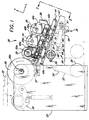
- FIGURE 1 illustrates an apparatus 20 for coating one side of a strip of metal 22.
- the strip 22 travels around a guide roll 26 and upward in the direction of arrow 24 between a large backup roll 28 and a smaller applicator roll 30.
- the strip continues to the left in the direction of arrow 32 to a second coating apparatus (not shown) which coats the opposite side of the strip.
- a second coating apparatus not shown
- the apparatus 20 comprises several major components: the main frame 29 rotationally supporting the backup roll 28; a coating head including the applicator roll 30 at an upper end; a pair of dual subframes 46 on which the coating head traverses along angled upper surfaces 47; a traverse mechanism 58 mounted to one of the subframes 46 and adapted to translate the coating head; and a coating pan lift mechanism 39 mounted to a portion of the coating head and also to a coating pan 38.
- the various components of the apparatus 20 will be described separately below.
- the coating apparatus 20 of FIGURE 1 includes three rolls positioned in series with their respective axes extending coplanar and parallel to one another and aligned so that a line perpendicular to and intersecting each of the axes will also intersect the axis 28a of the backup roll 28.
- an orthogonal coordinate frame of reference is shown in FIGURE 1 wherein the X-axis is parallel to the line which passes through the roll axes.
- the applicator roll 30 adjacent the backup roll 28 contacts an intermediate roll 34 which, in turn, contacts a metering or pickup roll 36.
- the three rolls 30, 34 and 36, the coating pan 38, and the backup roll 28 are supported by, and journaled for rotation with respect to a main frame 29.
- the coating rolls 30, 34 and 36 extend along the Z-axis and are rotatably supported about their respective axes 30a, 34a and 36a at either end by support slides, described below. It should be noted that only one side of the apparatus is shown and thus only one of the dual subframes 46 under one end of the rolls is illustrated, the other being substantially identical for supporting the opposite end of the rolls.
- the pickup roll 36 is partially submerged within a coating medium (not shown) in the coating pan 38.
- the pickup roll 36 lifts coating medium from the pan 38 and transfers it to the intermediate roll 34, which in turn transfers the coating medium to the applicator roll 30.
- the coating medium is then applied to the moving strip 22 by the applicator roll 30.
- Some excess coating medium may be transferred around the edges of the strip to the backup roll 28.
- a doctor blade 37 comprising a narrow, elongated knife, mounts underneath the backup roll 28 and is biased toward the roll to scrape this excess coating medium therefrom.
- the lift mechanism 39 is provided underneath the rolls 30, 34 and 36 and between the dual subframes 46 for raising and lowering the coating pan 38, as will be more fully described below with reference to FIGURE 5.
- the intermediate roll 34 and pickup roll 36 are relatively rigid, and may be manufactured of steel.
- the applicator roll 30 has a rigid inner core which may be manufactured of steel, it is covered with a deformable sleeve manufactured from a material such as polyurethane.
- a deformable sleeve manufactured from a material such as polyurethane.
- Various sized rolls may be used, but in the disclosed embodiment, the rolls of the coating head 30, 34, and 36 are approximately 11 inches in diameter, while the backup roll 28 is approximately 24 inches in diameter.
- the coating head comprising the three rolls 30, 34 and 36 will now be described in detail with reference to FIGURES 1-4.
- the axes 30a, 34a, 36a of the three rolls 30, 34 and 36 are aligned in series.
- Each roll is journaled for rotation about an opposed pair of mounting brackets 40.
- the mounting brackets are spaced apart and located proximate each longitudinal end of the rolls. The rolls are thus suspended between the mounting brackets 40 over a space in which the coating pan 38 and lift mechanism 39 are disposed.
- FIGURE 1 only one side of the apparatus 20 is shown in FIGURE 1. It will be understood that a similar arrangement is provided on the opposite side of the rolls.
- the mounting brackets 40 provide simple bearings for the roll necks 56, while the opposite end of each roll is driven by a motor and gear assembly (not shown) as is well known by those of skill in the art.
- the applicator roll 30 is journaled for rotation about a pair of mounting brackets 40a
- the intermediate roll 34 is joumaled for rotation about a second pair of mounting brackets 40b
- the pickup roll 36 is journaled for rotation about a pair of mounting brackets 40c.
- Each of the mounting brackets 40a,b,c forms a portion of a support sled 42a,b,c.
- sleds 42a, 42b and 42c support the mounting brackets 40 of the rolls 30, 34 and 36, respectively.
- Each of the support sleds 42a,b,c is slidably mounted over a large L-shaped traverse sled 44.
- the traverse sled 44 is slidably mounted with respect to the stationary subframe 46 of the apparatus 20.
- the subframe 46 includes the upper sloped surface 47 along which the coating head is slidably mounted.
- the support sleds 42a,b,c include at least one linear bearing 48 adapted to slide with minimum of friction over a first rail 50.
- each side of each support sled includes two linear bearings.
- the first rail 50 comprises a precision machined rectangular rod fixedly attached to the traverse sled 44.
- the traverse sled 44 includes a plurality of linear bearings 52 which travel over a second rail 54 mounted on the subframe 46. Both the first rail 50 and the second rail 54 are aligned in parallel and underneath the terminal end of the roll necks 56 of each of the rolls 30, 34 and 36.
- the linear bearings 48 and 52 preferably include cylindrical rollers positioned to contact the rails 50 and 54 along their lengths. More specifically, each support sled 42a,b,c has a length parallel to the rail 50 generally corresponding to the respective roll diameter. However, in coating systems with differing roll diameters, the length of the support sleds 42a,b,c in the direction of movement along the rail 50, the maximum length of any one sled is approximately equal to the average roll diameter. For example, a 14 inch roll may be installed in conjunction with two 7 inch rolls, and the maximum length of each of the sleds 40a,b,c is approximately 9.33 inches. The roll diameters range from about 7 inches to about 14 inches.
- each support sled 42a,b,c includes two linear bearing 48
- the rollers within the bearings must be correspondingly small, and thus must be capable of withstanding large Hertz contact stresses.
- a particularly suitable example of bearing is one of several linear carriage bearings manufactured by Schneeberger Linear Technology of Massachusetts.
- a major advantage of the present apparatus 20 is the elimination of massive linear slides for each roll.
- the support sleds 42a,b,c of the present apparatus 20 take up only a fraction of the space below each roll.
- a major cost savings is realized by the reduction in large precision machined components.
- the support sleds 42a,b,c weigh approximately 22.7 kg (50 lbs).
- the large L-shaped slides ranged from 54.4 kg (120 lbs) to between 272-318 kg (6-700) lbs for the longest beneath the applicator roll.
- vibrations may set up harmonic oscillations which coincide with the natural frequency of the system. If one of the rolls or roll necks is out of round, or as a result of hydrodynamic vibrations, the resulting oscillations can match the natural frequency and damage the machine.
- Prior attempts to alleviate this problem have concentrated on increasing the mass and rigidity of the roll supports under the assumption this would limit the vibration. However, it has been found that a more effective approach is to control the relative stiffness of the system by reducing its mass and rigidity.
- the system With a knowledge of the possible harmonics resulting from unbalanced components, one can compensate by constructing the system to have a mass and stiffness with an out-of phase natural frequency.
- the flexibility of the pedestal 100 may be adjusted to suit various systems and operating regimens. Key is the ability to customize the flexibility in relation to the various static and dynamic factors to avoid vibration within the pedestal 100 which excites the natural frequency.
- a load bearing portion of the support sleds 42a,b,c is shown in Figure 4 as pedestal 100.
- the relatively small cross-section of upstanding roll pedestals 100 permits the system stiffness to be adjusted relatively easily. Specifically, given the great weight of the rolls and potential vibratory amplitude from out of round rolls, the small cross-section of the roll pedestals 100 provides a relatively flexible response. Because of this relative flexibility, modifying the stiffness of the roll pedestals 100 by just a little produces a noticeable change in the natural frequency of the system.
- the roll pedestal 100 may be as small as 1 inch square in cross-sectional area, and is desirably less than 2 square inches in area. While the preferred cross-sectional area will vary depending on the shape of the pedestal, to ensure sufficient flexibility it is preferable that the maximum cross-sectional area of the pedestal be approximately 4 inches.
- the size of the pedestals 100 is dependant primarily on the weight of the roll supported, the maximum lateral interroll force expected, the height of the pedestal, and the cross-sectional shape of the pedestal.
- the cross-section of each roll pedestal 100 is preferably rectangular, but may also be rounded or other shapes.
- the specific shape of the pedestal 100 may be determined by a finite element analysis of stresses induced in several shapes chosen for their suitability for placing strain gauges. This will be discussed in more detail below with respect to force measurement between the rolls.
- the roll pedestal 100 may be manufactured as a separate component which can be replaced for varying the spring response of the system. This is a major advantage for users having widely varying production needs. With a replaceable roll pedestal 100, the user can buy one machine and modify it to run different speeds with different rolls.
- the strip 22 in a large coil runs out.
- the trailing edge of the first strip is spliced to a leading edge of a strip of a second coil.
- the soft applicator roll 30 must be retracted so that the rough seam does not cause damage thereto.
- the traverse mechanism 58 is provided to pull the coating head away from the strip when a seam is encountered.
- FIGURE 1 illustrates a novel traverse mechanism 58 for displacing the large traverse sled 44 along the upper inclined surface 47 of the subframe 46.
- a proximate end of a drive piston/cylinder 60 is pivotably mounted to a pivot bracket 61 fixedly attached to the subframe 46.
- the distal end 62 of the piston/cylinder 60 pivotably mounts to a pin 64 on a generally triangular shaped eccentric member 66.
- the eccentric member 66 is keyed for rotation with a shaft 68 journaled with respect to the subframe 46.
- the member 66 includes a second pin 70 to which a first end of a linkage arm 72 is rotatably journaled.
- a second end of the linkage arm 72 is rotatably journaled about a pin 74 forming part of a bracket 76 attached to the large traverse sled 44.
- the distal end 62 of the piston/cylinder 60 is retracted, with the eccentric member 66 in its farthest counter-clockwise orientation.
- the applicator roll 30 contacts the moving strip 22 to apply a coating thereto. This is termed the "head closed position.”
- the eccentric member 66 rotates in a clockwise direction.
- This causes the second pivot pin 70 to rotate with the shaft 68 in a clockwise direction.
- the rotation of the first end of the linkage arm 72 along with the second pivot pin 70 causes the second end of the linkage arm to translate to the right.
- the L-shaped sled 44 is translated to the right and downward along the second rail 54. This is termed the "head open position.”
- the distal end 62 of the piston/cylinder 60 causes the traverse sled 44, and all three rolls 30, 34, and 36 mounted thereon, to translate toward or away from the backup roll 28.
- the splice traverse mechanism 58 is designed so as to reduce the damage caused to the coating head rolls 30, 34 and 36 due to excessive impacts. More particularly, prior art coating systems utilize a piston cylinder movement mechanism, or other such actuator, that moves the coating head back and forth from the backup roll 28 at a constant travel speed, and rigid stops mounted to the fixed frame for limiting the coating head travel. At one end of travel, the sudden impact of the stops often damages the sliding parts, and at the other end of travel, the soft applicator roll is often damaged through impact with the hard backup roll. Another prior art mechanism involves a complex cam system for moving the coating head back and forth at varying rates.
- the present invention provides for a slower rate of travel of the coating head close to the backup roll 28. More particularly, with reference to FIGURE 1, extension of the distal end 62 of the cylinder 60 results in counter-clockwise rotation of the eccentric member 66. This rotation, in turn, results in the clockwise rotation of the second pin 70 coupled to the eccentric member 66.
- the second pin 70 is initially disposed in a 9 o'clock position, as illustrated in FIGURE 1, so that rotation of the eccentric member 66 results in a substantially vertical motion of the pin. As the distal end 62 extends further, the pin 70 travels toward the top of the shaft 68 until its movement includes a substantial horizontal component.
- the horizontal movement of the pin 70 is directly responsible for the horizontal movement of the linkage arm 72 and attached bracket 76.
- the coating head does not appreciably move in a horizontal direction.
- the movement of the coating head accelerates.
- the coating head quickly advances toward the backup roll 28.
- the second pin 70 approaches a point on the arc of its rotation at which there is relatively little horizontal movement.
- the applicator roll 30 rapidly approaches the backup roll 28 until the two rolls come close together, at which point the applicator roll decelerates and gently contacts the strip 22 or backup roll 28 without the use of stops.
- the reduction in impact force from this traverse arrangement greatly extends the life of the applicator roll 30 and associated components, and is less complex than prior cam mechanisms.
- Each of the support sleds 42a,b,c comprises a solid, generally rectangular housing 78, to the underside of which the linear bearings 48 are attached.
- a cover 80 is bolted to the housing and extends laterally outward therefrom.
- a stepper motor 82 is enclosed by the cover 80.
- a combined encoder/stepper motor 82 is utilized to enable monitoring of the relative sled positions.
- the rectangular housing 78 comprises a generally solid member having hollowed portions therein.
- a central hollow portion 84 encloses a gear box 86, the input of which is keyed to the output of the stepper motor 82.
- the gear box 86 encloses bevel gears journaled for rotation therein for redirecting the rotational output of the stepper motor 82 by 90°.
- An output shaft 88 of the gear box 86 causes a threaded rod 90 to rotate by virtue of a common dual female end coupling 92.
- Each threaded rod 90 extends within a linear ball screw 94 having mating internal threads.
- the linear ball screw associated with each support sled 42a,b,c is mounted on an adjacent structural member disposed up the slope of the rail 50. More specifically, as seen in FIGURE 4, the linear ball screw 94a associated with the drive mechanism for the support sled 42a for the applicator roll 30 is mounted to an upstanding portion 96 of the L-shaped sled 44.
- rotation of the threaded rod 90 of the drive mechanism within the first support sled 42a causes the applicator roll 30 to translate along the first rail 50 with respect to the traverse sled 44.
- the linear ball screw 94b associated with the drive mechanism within the support sled 42b for the intermediate roll 34 is mounted on the applicator roll support sled 42a.
- the intermediate roll 34 can be translated with respect to the applicator roll 30.
- the linear ball screw 94c is mounted to the intermediate roll support sled 42b.
- the pickup roll 36 may be translated along the first rail 50 with respect to the intermediate roll 34.
- a series of relief cavities 98 are provided in each of the structural elements within which the threaded rods 90 translate.
- the size of the roll support sleds is greatly reduced from previous designs. This necessitates a reduction in the physical size of the precision stepper motors 82.
- the motors 82 have a NEMA 23 classification which lowers their cost from previous designs.
- the reduction in motor size means a concurrent decrease in power required, which lowers the chances of a spark from the motors igniting flammable solvent fumes.
- the motors 82 are fully enclosed by the covers 80 to substantially reduce the potential for an unwanted conflagration.
- An O-ring seal 81 is provided around the lateral opening into the hollow portion 84 for this purpose.
- the motor 82 By enclosing the motors 82 thus, motors not rated for use in explosive environments may be used, considerably reducing the expense of the whole system. Desirably, the motor 82 is sealed within an explosion-proof environment as defined by the National Electric Code Requirements, Class 1, Division 1, Group 2.
- each of the support sleds 42a,b,c includes the generally rectangular housing portion 78 and upstanding vertical roll pedestal 100 to which the mounting brackets 40 are attached.
- the attachment means between the mounting brackets 40 and roll pedestal 100 includes aligned apertures 102 and a fastening bolt (not shown) insertable therein.
- the vertical roll pedestal 100 thus transmits the entire load from each of the rolls to the rectangular housing 78.
- a multi-axis force sensor 104 is provided within the roll pedestal 100. The multi-axis force sensor 104 senses forces and moments generated within the roll pedestal 100.
- the sensor 104 monitors roll forces in the X direction between the strip 22 braced by the backup roll 28 and applicator roll 30.
- the force can be measured as torque, or bending moment, as the desired line of force extends through the roll axis preventing a direct in-line measurement.
- the measured quantity can be converted into the correct nip pressure at the point of coating application with knowledge of such other parameters as roll diameter and hardness, for instance.
- the multi-axis force sensor 104 may comprise strain gages, torsion sensors, or any other suitable types of sensors known to those in the art.
- the multi-axis sensor 104 desirably comprises a plurality of individual strain gauges affixed at specific locations and orientations on or within cavities formed in the pedestal 100.
- the individual strain gauges are custom fitted to the pedestal 100.
- Such strain gauges are available from a variety of force sensor manufacturers, such as Cooper Instruments of Warrenton, VA, or Omega Engineering of Stamford, CT.
- the particular sensor vendor may choose one shape of the pedestal as being more suitable than others for placing the strain gauges. Given the particular shape, a finite element analysis may be conducted based on varying rolls and coating systems to determine the cross-sectional shape of the pedestal. In most cases, the total height of the pedestal 100 is between approximately 5.08-6.35 cm (2.0-2.5 inches), and the maximum height of the pedestal 100 is desirably less than 10.16 cm (4 inches). This shorter pedestal 100 height is made possible by the use of a multi-axis sensor 104 defining an envelope with a height of less than 10.16 cm (4 inches), and preferably less than 6.35 cm (2.5 inches).
- One particular advantage of the smaller pedestal height is the ability to retrofit a new coating head to an existing coating frame.
- Many old coating heads utilized stacked dovetail slides which are shorter in height than stacked slides with linear bearing and rails.
- the total height of the assembly becomes so great that it is impossible to place a conventional force sensor, with a housing of between 127 and 178 mm (5 and 7 inches) in height, between the slide and rolls, because of the fixed roll height with respect to the frame.
- pedestals of less than 102 mm (4 inches) and preferably between 51-64 mm (2.0-2.5 inches) are contemplated. By using such a small sensor 104 and pedestal 100, older dovetail-type frames may be reused when updating the coating head.
- the forces between each pair of rolls 30, 34 and 36 and between the applicator roll 30 and backup roll 28 can be determined. More particularly, the sensor 104 positioned within the roll pedestal 100 of the third support sled 42c senses forces between the intermediate roll 34 and pickup roll 36. The sensor 104 mounted in the roll pedestal 100 of the second support sled 42b senses forces between the applicator roll 30 and intermediate roll 34, and between the intermediate roll 34 and pickup roll 36. Combining information gathered from the sensors 104 in the second and third support sleds 42b,c, the absolute forces between the applicator roll 30 and intermediate roll 34 can be determined.
- the output from the sensor 104 within the first support sled 42a provides information about forces between the backup roll 28 and applicator roll 30, and between the applicator roll 30 and intermediate roll 34.
- the absolute component of force between the backup roll 28 and applicator roll 30 can be solved for.
- conventional angular position monitoring devices (not shown) associated with each of the stepper motors 82 convey the exact position of the respective support sleds 42a,b,c.
- One aspect of force measurement which is utilized to improve the performance of the coating apparatus 20 is the measurement of shear forces in the Y-axis between the applicator roll 30 and moving strip 22.
- the shear forces are dependent upon the nip pressure, the speed of the rolls, and the viscosity.
- knowledge of the Y component of force between the roll and the strip allows one to accurately calculate the viscosity of the coating medium.
- the viscosity of the coating medium can be continuously monitored and the process adjusted accordingly throughout a coating run. This is a vast improvement over delayed feedback methods of the prior art.
- the viscosity depends on several other factors, which are of lessor importance.
- the surface of the applicator roll 30 travel in the opposite direction as the moving strip 22 to ensure proper transfer of the coating medium from the applicator roll at the point of contact with the surface of the metal strip.
- the relative direction of movement of the applicator roll 30 and strip 22 is a factor to be taken into account when utilizing the measured Y component of force to determine coating medium viscosity.
- Another substantial benefit to the present force measurement configuration is the ability to accurately and regularly check the hardness of the cover of the applicator roll 30.
- the roll 30 is moved and a measurement of the nip pressure in the X direction is combined with knowledge of the distance change between the axes of the applicator roll 30 and the backup roll 28.
- the position of the force sensor 104 between the roll 30 and the associated linear bearings greatly increases the reliability of the force measured over prior methods. As a coating run progresses, the changing hardness of the roll cover is thus reliably monitored for input into a control algorithm.
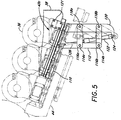
- the improved mechanism 39 for displacing the coating pan 38 is described.
- the coating pan 38 is supported by a pan lift bracket 110.
- the pan lift bracket includes a downwardly depending leg 112 having a pair of pivot pins 114a,b.
- a pair of linkage arms 116a, 116b are journaled at one end to the pivot pins 114a,b and at the other end to a pair of pivot pins 118a, 118b fixed with respect to a generally vertically disposed moving bracket 120.
- the moving bracket 120 rigidly attaches to an inner surface of the third support sled 42c at mounting plate 121.
- the coating pan 38 was not coupled to the movement of the pickup roll 36, and thus there was a danger of the roll neck 56 contacting the coating pan.
- the moving bracket 120 translates with it.
- the entire linkage of the pan lift mechanism 108 translates with the pickup roll 36.
- the maximum height of the coating pan 38 is set so that the upper edge of the pan cannot contact the roll neck 56.
- a piston/cylinder 122 is pivotably attached at a first end 124 to a lower portion of the moving bracket 120.
- a distal end 126 of the piston/cylinder 122 is pivoted to swivel around a shoulder bolt which is rigidly mounted with respect to the coating pan bracket 110.
- a piston/cylinder is the preferred embodiment, other means for raising and lowering the coating pan, such as manual hand wheels or stepper motors, may be substituted.
- Extension and retraction of the distal end 126 of the piston/cylinder 122 causes the coating pan 38 to be raised or lowered. More specifically, the pan lift mechanism shown in solid line in FIGURE 5 is in a position wherein the coating pan 38 is raised so that the pickup roll 36 is immersed in the coating medium in the pan.
- the distal end 126 of the piston/cylinder 122 is fully extended.
- the retracted position of the mechanism is shown in phantom. Specifically, in the retracted position, the distal end 126 has been retracted causing the coating pan bracket 120 to lower, thus removing the pickup roll 36 from immersion in the coating medium.
- the coating pan 138 By virtue of the pivoting mount of the piston cylinder 122 to the moving bracket 120, the coating pan 138 not only lowers but pivots slightly away from the backup roll 28. This enables the interior of the coating pan 38 to be easily accessed for cleaning, or re-filling with coating medium.
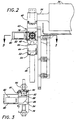
- FIGURE 2 shows the upper edge of the coating pan 38 adjacent the roll neck 56.
- the extension of the distal end 126 of the piston/cylinder 122 is, at all times, relative to the lower end of the moving bracket 120, and the full extension of the distal end 126 can be set below that which the edge of the coating pan 38 contacts the roll neck 56 of the pickup roll 36.
- the size of the rolls 30, 34 and 36 may be modified, or the coating head converted from 2 to 3 rolls, in which case the roll neck 56 of the pickup roll 36 may be displaced downward.
- the present invention thus provides a fail safe arrangement to preclude lift mechanism-to-coating pan contact.
- an apparatus 130 for coating strip 131 is shown which is similar to the coating apparatus 20 of FIGURE 1, but which eliminates the large traverse sled 44.
- the apparatus 130 comprises a backup roll 132, and a diplaceable coating head including an applicator roll 134, an intermediate roll 136, and a pickup roll 138.
- the rolls 134, 136 and 138 are similar in most respects to the rolls 30, 34, and 36 described previously, with the exception that the intermediate roll 136 has a larger diameter than the adjacent two rolls.
- the axes of the rolls are located along the line which passes through the center of the backup roll 132.
- the pickup roll 138 may be raised as indicated by the upper dashed line positions for different coating mediums which may require the intermediate roll 136 to be immersed in the coating pan and function as the pickup rolL
- Each of the rolls 134, 136 and 138 are mounted for rotation on support sleds 140a, 140b and 140c, respectively.
- a plurality of linear bearings 142 attached to the support sleds 140 provide relatively frictionless sliding movement over a sloped rail 144.
- a short traverse sled 146 is provided uphill from the first support sled 140a on the rail 144.
- the traverse sled 146 has a linear bearing 148 adapted to slide along the rail 144.
- Each of the support sleds 140a,b,c are similar to the support sleds 42 previously described with reference to the embodiment of FIGURE 1.
- each of the support sleds includes a stepper motor, a gear box and a threaded rod adapted for mating with a linear ball screw mounted to an adjacent structural element located uphill along the rail 144.
- the first and second support sleds 140a,b include linear ball screws 150a,b.
- a third linear ball screw 152 is mounted to one end of the traverse sled 146.
- the threaded rod of the first support sled 140a extends within the ball screw 152 to affect relative movement between the first support sled 140a and the traverse sled 146.
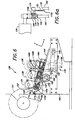
- a piston/cylinder 156 is pivotably mounted to a pivot bracket 158 affixed to the subframe 160 of the apparatus 130.
- the distal end 162 of the piston/cylinder 156 is pivotably mounted to a first end 164 of a crank 166.
- the crank 166 is keyed to rotate with a shaft 168 journaled with respect to the frame 160.
- a second end 170 of the eccentric member 166 pivotably attaches to one end of a bent linkage member 172.
- the opposite end of the linkage member 172 is pivotably attached to a central point 174 on the traverse sled 146.
- FIGURE 6a illustrates the particular bent shape of the linkage member 172.
- the lower end preferably includes a swivel connection point 173a comprising a ball sized to swivel within a socket formed in the second end 170 of the eccentric member 166.
- the linkage member 172 extends upward in a vertical plane until approximately the height of the linear bearing 142 of the traverse sled 146, at which point the linkage member 172 turns laterally toward the traverse sled 146 at a bend 175.
- a second swivel connection point comprises a ball 173b which fits within a socket formed at the central point 174 on the traverse sled 146.
- the member 172 is bent in this manner, and the second ball 173b connected at the central point 174 directly over the rail 144, so as to avoid imposing moments on the traverse sled 146.
- the ball and socket couplings at either end of the linkage member 172 provide rotational freedom about more than one axis to prevent binding as the odd-shaped linkage member transmits forces and motions between the traverse sled 146 and eccentric member 166.
- other coupling configurations providing more than one axis of rotation are contemplated.
- an arcuate upper edge 172a of the linkage member 172 provides a structural relief precluding contact between the linkage member and the laterally extending stepper motor cover associated with the first support sled 140a.
- the modified traverse mechanism 154 permits very repeatable repositioning, yet creates a leverage geometry that theoretically may cause an intense multiplication of input force from the piston/cylinder 156. Indeed, improper adjustment of the position of the applicator roll 30 by an operator can cause a significant interference between the applicator and backup rolls upon traversing the applicator roll into the coating position.
- the first swivel connection point 173a ( Figure 6a) is designed to break loose at a predefined load to prevent equipment damage. The connection is also designed to be captured and permit enough movement to relieve the load without allowing a large unexpected recoil which might result in injury.
- the distal end 162 of the piston/cylinder 156 is in a retracted position wherein the crank 166 is rotated as far as it will go in the counter-clockwise direction. Extension of the distal end 162 causes the crank 166 to rotate clockwise about the axis of the shaft 168. The second end 170 of the crank 166 thus rotates clockwise causing the bent linkage member 172 to translate away from the backup roll 132.
- the entire assembly of the traverse sled 146, and three support sleds 140a,b,c are caused to translate in the X direction along the rail 144 away from the backup roll 132.
- the coating head must be retracted from contact with the strip or damage is caused to the deformable cover on the applicator roll 134.
- FIGURE 7 illustrates the vertical arrangement of the sleds 140 with respect to the single rail 144.
- the single rail 144 mounted on the subframe 160 guides both the roll support sleds 140a,b,c and traverse sled 146. This substantial reduction in machined parts results in a large cost saving to the overall machine.
- FIGURE 8 shows a slightly modified version of a pan lifting mechanism 176.
- the moving bracket 178 is angled slightly to extend downward from the third support sled 140c in a direction perpendicular to the rail 144 until an elbow bend 180 approximately midway along its length, whereupon the bracket extends vertically downward.
- the operation of the mechanism 176 is as described previously with respect to the lift mechanism 39 of FIGURE 1.
- FIGURE 9 illustrates a system 190 for coating both sides of a strip 192 of metal.
- the system generally comprises a frame 194 having a first coating assembly 196 attached to a first subframe 195 for coating one side of the strip 192, and a second coating assembly 198 attached to a second subframe 197 for coating the opposite side of the strip.
- Both the first coating assembly 196 and second coating assembly 198 are substantially similar to the coating apparatus 130 shown and described with reference to FIGURES 6-8. That is, the coating assemblies 196, 198 each comprise coating heads including three aligned rolls 200 mounted on support sleds 202 arranged to sled on rails 204.
- the strip 192 passes between the first coating assembly 196 which coats one side of the strip 192, and a backup roll 206.
- a doctor blade 208 is positioned to scrape excess paint from the lower portion of the backup roll 206.
- the strip 192 continues left in the direction of arrow 210 over the applicator roll of the second coating assembly 198 which coats the opposite side of the strip 192. In this manner, both sides of the strip 192 are coated.
- the terminal end of the strip is spliced with the leading end of a second strip so as to maintain the continuity of the coating process.
- the welded or mechanically joined splice is relatively rough and may damage the applicator rolls of the coating assemblies 196, 198.
- the first coating assembly 196 is retracted from the backup roll 206 to prevent the strip from contacting the applicator roll of the first coating assembly 196 and a lift roll 212 is raised to lift the strip 192 from contacting the applicator roll of the second coating assembly 198.
- the lift roll 212 assumes the solid line position shown in FIGURE 9, and when a rough splice passes through the system 190, the lift roll 212 assumes the position shown in phantom.
- An important aspect of the present invention is the coupling of the mechanism 214 for raising and lowering the lift roll 212 to the traverse mechanism for the first coating assembly 196. In this way, both the lift roll 212 and the coating head of the first coating assembly 196 may be actuated simultaneously when a splice seam passes through the system 190.
- the mechanism 214 comprises a piston/cylinder 216 pivotably mounted at a lower end to a pivot bracket 218 secured to and pivotably mounted at an upper end to a lift roll support 220.
- the lift roll support 220 comprises a rigid member capable of supporting the lift roll 212 for rotation, and is pivotably mounted with respect to the frame 194 on a shaft 222. Raising and lowering of the actuating end 224 of the piston/cylinder 216 causes the lift roll support 220 to rotate with the shaft 222. In this manner, the lift roll 212 can be displaced from the lower solid line position to the upper dashed line position of FIGURE 9.
- An eccentric member 226 is keyed or otherwise rotatably secured to the shaft 222.
- a linkage bar 228 pivotably mounts to an outer extension 230 of the eccentric member 226.
- the opposite end of the linkage arm 228 is pivotably attached to a short traverse sled 232 arranged to slide on the rail 204 and comprising a portion of the first coating assembly 196.
- the traverse sled 232 is analogous to the traverse sled 146 described above with reference to FIGURE 6.
- the linkage arm 228, by virtue of its pivoting connection to the extending portion 230 of the eccentric member, displaces the traverse sled 232, and coating head of the first coating assembly 196, downward along the rail 204 away from the backup roll 206.
- This displacement is linked to simultaneous elevation of the lift roll 212 which lifts the strip 192 out of contact with the second coating assembly 198. Linking the movement of these two components simplifies the operational steps taken when a splice passes through the system.
- the combination of the lift roll 212 and second coating assembly 198 provides both a coarse and fine adjustment of the wrap angle of the strip 192 around the applicator roll 200 of the second coating assembly. More particularly, the lift roll 212 may be positioned at two or more discrete elevations to coarsely set the wrap angle around the applicator roll 200. Then, if the wrap angle must be finely adjusted, the coating head of the second coating assembly 198 may be displaced along the rail 204. The precise movement provided by the stepper motors, threaded rods and linear ball screws allows for practically infinite adjustment of the wrap angle around the applicator role of the second coating assembly 196.
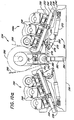
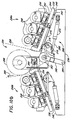
- FIGURES 10a and 10b illustrate a further embodiment of a U-wrap coating system 234 incorporating the inventive aspects herein.
- U-wrap coaters are special one-side coaters which enable coating with one of two coating heads. Switching from one coating head to another may be desired to change the coating medium, for example.
- the system 234 comprises a lower frame assembly 236 having rails 238 mounted on upper angled surfaces 240.
- the rails 238 provide a guide for linear bearings 242 of L-shaped sled members 244 of first and second coating assemblies 246a, 246b.
- the coating assemblies 246a,b are substantially similar to the apparatus 20 described with reference to FIGURES 1-5.
- both of the coating assemblies 246a,b include a coating head having a plurality of aligned rolls 248 mounted on support sleds 250 having linear bearings 252 for sliding on a rail 254 provided on the L-shaped sled member 244. Both applicator rolls 248a are positioned adjacent a central backup roll 256.
- the strip 258 travels between the backup roll 256 and the coating head of the upstream coating assembly 246a, clockwise around a lower movable bypass or turn roll 262, and between the backup roll 256 and the coating head of the downstream coating assembly 246b in the direction of arrow 260.
- the lower turn roll 262 extends in the Z-direction at least the width of the roll and is journaled for rotation about an upper portion of a pair of swing arms 282, one of which is visible.
- a doctor blade 264 is mounted to the frame assembly 236 for scraping excess coating medium off the lower portion of the backup roll 256 for reasons discussed above.
- the doctor blade 264 is mounted directly underneath the backup roll 256 in a space between two large supporting brackets (not numbered).
- Both the first and second coating assemblies 246a,b incorporate traverse mechanisms 266 similar to the traverse mechanism 58 shown in FIGURE 1. More particularly, each of the traverse mechanisms includes a crank 268 mounted to a shaft 270, the crank being rotated by a piston cylinder 272. A linkage arm 274 couples the rotation of the crank 268 with the linear movement of the L-shaped sled members 244 along the rails 238.
- the coating assemblies 246a,b are utilized for coating the strip 258 at any one time.
- the upstream coating assembly 246a is coating the strip 258, the excess paint left on the backup roll 256 is scraped off by the doctor blade 264 underneath the backup roll.
- the strip 258 can pass around the turn roll 262 and contact the backup roll 256 in the direction of a curing oven. No excess coating medium will be applied to the reverse side of the strip 258 by the backup roll 256.
- An opposite end 280 of the linkage bar 278 is pivotably attached to the swing arms 282 which rotate about a shaft 284. Clockwise rotation of the second eccentric member 276 upon extension of the actuator of the piston/cylinder 272 causes the linkage bar 278 to be displaced to the right, thus swinging the arms 282 toward the shaft 270. This, in turn, causes the turn roll 262 to displace the strip 258 away from contact with the backup roll 256, as seen in FIGURE 10b.
- the upstream coating assembly 246a is retracted from proximity to the backup roll 256 when the second coating assembly 246b is in operation, and the movement of the upstream coating assembly 246a is coupled to the movement of the strip 258 so that the strip "bypasses" the backup roll. Excess paint on the backup roll 256 is then allowed to travel around to be scraped off by the doctor blade 264.
Landscapes
- Coating Apparatus (AREA)
Claims (19)
- Vorrichtung (20) zum Aufbringen einer Schicht einer flüssigen Beschichtung mit einer gesteuerten Dicke auf die Oberfläche einer sich bewegenden Bahn mit;
einem Rahmen (29),
mindestens einem ersten Walzenschlitten (42c), der entlang einer Linie bezüglich des Rahmens (29) beweglich ist,
einer ersten Walze (36), die eine erste Achse (36a) definiert und vom ersten Walzenschlitten (42c) getragen wird und so gelagert ist, daß sie um die erste Achse (36a) drehbar ist,
mindestens einem zweiten Walzenschlitten (42b), der entlang der Linie beweglich ist,
einer zweiten Walze (34), die eine zweite Achse (34a) definiert und vom zweiten Walzenschlitten getragen wird und
so gelagert ist, daß sie um die zweite Achse (34a) drehbar ist, und
mindestens einem dritten Walzenschlitten (42a), der entlang der Linie beweglich ist, und einer dritten Walze (30), die eine dritte Achse (30a) definiert, wobei keiner der Walzenschlitten (42a, 42b, 42c) einen anderen der Walzenschlitten trägt. - Vorrichtung (20) nach Anspruch 1, welche zusätzlich ein erstes Untergestell (100c), das sich von dem ersten Tragschlitten (42c) aus erstreckt, wobei das erste Untergestell (100c) die erste Walze (36) trägt, und ein zweites Untergestell (100b) aufweist, das sich von dem zweiten Tragschlitten (42b) aus erstreckt, wobei das zweite Untergestell (100b) die zweite Walze (34) trägt.
- Vorrichtung (20) nach Anspruch 2, welche weiter einen ersten Kraftsensor (104c) und einen zweiten Kraftsensor aufweist, wobei der erste Kraftsensor am ersten Untergestell (100c) angebracht ist und der zweite Kraftsensor (104b) am zweiten Untergestell (100b) angebracht ist.
- Vorrichtung (20) nach Anspruch 3, wobei das erste Untergestell und das zweite Untergestell (100b, 100c) jeweils eine maximale Höhe von weniger als 10,16 cm (vier Zoll) aufweisen.
- Vorrichtung (20) nach Anspruch 4, wobei das erste Untergestell und das zweite Untergestell (100b, 100c) jeweils eine Höhe aufweisen, die zwischen 5,08 - 6,35 cm (2,0 - 2,5 Zoll) liegt.
- Vorrichtung (20) nach Anspruch 1, welche weiter einen von dem Rahmen (29) getragenen Beschichtungstiegel (38) aufweist.
- Vorrichtung (20) nach Anspruch 6, welche weiter einen Querschlitten (44) aufweist, der entlang einer zweiten Linie beweglich ist, wobei der erste Schlitten (42c) und der zweite Schlitten (42b) von dem Querschlitten (44) getragen werden.
- Vorrichtung (20) nach Anspruch 1, welche weiter ein drittes Untergestell (100a) aufweist, das sich vom dritten Walzenschlitten (42a) aus erstreckt, wobei die dritte Walze von dem dritten Untergestell (100a) getragen wird.
- Vorrichtung nach Anspruch 8, welche weiter einen dritten Kraftsensor (104a) aufweist, der an dem dritten Untergestell (100a) angebracht ist.
- Vorrichtung (20) nach Anspruch 8, wobei der erste Kraftsensor (104c) zwischen dem ersten Walzenschlitten (42c) und der ersten Walze (36) angebracht ist und wobei der zweite Kraftsensor (104b) zwischen dem zweiten Walzenschlitten (42b) und der zweiten Walze (34) angebracht ist.
- Vorrichtung (20) nach Anspruch 7, welche weiter eine Betätigungseinrichtung (60) aufweist, die durch eine Verbindung mit dem Querschlitten (44) verbunden ist, welche den Tragschlitten (44) mit einer ersten Geschwindigkeit bewegt, wenn sich eine der Walzen (30, 34, 36) in der Nähe eines Aufbringungsorts befindet, und welche ihn mit einer zweiten, höheren Geschwindigkeit bewegt, wenn sich die eine der Walzen weiter vom Aufbringungsort entfernt befindet.
- Verfahren zum Aufbringen einer Schicht einer Flüssigkeitsbeschichtung mit einer gesteuerten Dicke auf die Oberfläche einer sich bewegenden Bahn mit den Schritten:Aufbringen der Flüssigkeitsbeschichtung auf eine Aufnahmewalze (36), die von einem entlang einer Linie beweglichen ersten Tragschlitten (42c) getragen wird,Übertragen des flüssigen Beschichtungsmaterials auf eine Zwischenwalze (34), die zwischen der Aufnahmewalze (36) und einer Aufbringungswalze (30) angeordnet ist, und dann Übertragen des flüssigen Beschichtungsmaterials von der Zwischenwalze (34) auf die Aufbringungswalze (30), wobei die Zwischenwalze (34) die Aufnahmewalze (36) berührt und die Aufbringungswalze die Zwischenwalze berührt, wobei die Aufbringungswalze von einem entlang der Linie beweglichen dritten Tragschlitten getragen wird und wobei die Zwischenwalze von einem entlang der Linie beweglichen zweiten Tragschlitten getragen wird,Übertragen des flüssigen Beschichtungsmaterials von der Aufbringungswalze (30) auf einen die Aufbringungswalze (30) berührenden beweglichen Streifen.
- Verfahren nach Anspruch 12, weiterhin aufweisend:Anbringen eines Kraftsensors (104c) zwischen der Aufnahmewalze (36) und dem ersten Tragschlitten (42c),Anbringen eines Kraftsensors (104a) zwischen der Aufbringungswalze (30) und dem dritten Tragschlitten (42a)Messen der auf jeden der Tragschlitten (42a, 42b, 42c) ausgeübten Kraft unter Verwendung des Kraftsensors (104a, 104b, 104c).
- Verfahren nach Anspruch 13, wobei das Messen der auf jeden Tragschlitten (42a, 42b, 42c) ausgeübten Kraft das Messen einer Kraft zwischen der Aufnahmewalze (36) und der Zwischenwalze (34) aufweist.
- Verfahren nach Anspruch 14, wobei das Messen der auf jeden Tragschlitten (42a, 42b, 42c) ausgeübten Kraft das Messen einer Kraft zwischen der Zwischenwalze (34) und der Aufbringungswalze (30) aufweist.
- Verfahren nach Anspruch 15, wobei das Messen der auf jeden Tragschlitten (42a, 42b, 42c) ausgeübten Kraft das Messen einer Kraft zwischen der Aufbringungswalze (30) und dem beweglichen Streifen aufweist.
- Verfahren nach Anspruch 12, wobei das Messen der auf jede der Walzen (30, 34, 36) ausgeübten Kraft das Messen einer auf jeden Walzenschlitten (42a, 42b, 42c) ausgeübten Axialkraft aufweist.
- Verfahren nach Anspruch 17, wobei die Axialkraft parallel zu der Linie gemessen wird.
- Verfahren nach Anspruch 12, wobei das Messen der auf jede der Walzen (30, 34, 36) ausgeübten Kraft das Messen einer auf jeden Walzenschlitten (42a, 42b, 42c) ausgeübten Biegekraft aufweist.
Applications Claiming Priority (3)
| Application Number | Priority Date | Filing Date | Title |
|---|---|---|---|
| US08/378,305 US5743964A (en) | 1995-01-24 | 1995-01-24 | Roll coating system |
| US378305 | 1995-01-24 | ||
| PCT/US1996/000742 WO1996022839A1 (en) | 1995-01-24 | 1996-01-19 | Roll coating system |
Publications (2)
| Publication Number | Publication Date |
|---|---|
| EP0806989A1 EP0806989A1 (de) | 1997-11-19 |
| EP0806989B1 true EP0806989B1 (de) | 2002-06-26 |
Family
ID=23492583
Family Applications (1)
| Application Number | Title | Priority Date | Filing Date |
|---|---|---|---|
| EP96903568A Expired - Lifetime EP0806989B1 (de) | 1995-01-24 | 1996-01-19 | System zur beschichtung mit walzen |
Country Status (5)
| Country | Link |
|---|---|
| US (1) | US5743964A (de) |
| EP (1) | EP0806989B1 (de) |
| AU (1) | AU4761296A (de) |
| DE (1) | DE69622019D1 (de) |
| WO (1) | WO1996022839A1 (de) |
Cited By (2)
| Publication number | Priority date | Publication date | Assignee | Title |
|---|---|---|---|---|
| EP2644283B1 (de) | 2012-03-27 | 2015-07-08 | Achenbach Buschhütten GmbH & Co. KG | Auftragwerk |
| WO2025247841A1 (en) * | 2024-05-27 | 2025-12-04 | Bobst Italia S.P.A. | A coating module including an adjustment system for obtaining a desired coating, and coating machine with such coating module |
Families Citing this family (33)
| Publication number | Priority date | Publication date | Assignee | Title |
|---|---|---|---|---|
| CA2332365C (en) * | 1998-05-19 | 2007-07-17 | Eugene A. Pankake | Pressure feed coating application system |
| US7559990B2 (en) * | 1998-05-19 | 2009-07-14 | Eugene A Pankake | Coating apparatus and method |
| US20090295098A1 (en) * | 1999-05-18 | 2009-12-03 | Pankake Eugene A | Coating apparatus and method |
| US6521044B1 (en) | 1999-11-12 | 2003-02-18 | Lsp Industries, Inc. | Roller apparatus for applying lubricant to sheet metal stock |
| US6821345B2 (en) * | 1999-11-12 | 2004-11-23 | Lsp Industries, Inc. | Roller coater apparatus |
| US6532448B1 (en) | 1999-11-19 | 2003-03-11 | Insightful Corporation | Contest server |
| DE10042503A1 (de) * | 2000-08-30 | 2002-03-14 | Roland Man Druckmasch | Rotationsdruckmaschine |
| DE10223666B4 (de) * | 2002-05-28 | 2006-06-14 | Windmöller & Hölscher Kg | Farbwerksaufbau bei Flexodruckmaschinen |
| US7125577B2 (en) * | 2002-09-27 | 2006-10-24 | Surmodics, Inc | Method and apparatus for coating of substrates |
| ITMO20020271A1 (it) * | 2002-09-27 | 2004-03-28 | Syfal Spa | Apparecchiatura per la regolazione del posizionamento |
| EP1410849A1 (de) * | 2002-10-18 | 2004-04-21 | Solipat Ag | Bearbeitungsanlage für Warenbahnen, beinhaltend eine modulare Einrichtung zum Auftragen von Fluiden auf Warenbahnen |
| DE10337594B4 (de) * | 2003-08-16 | 2006-03-23 | Siempelkamp Maschinen- Und Anlagenbau Gmbh & Co. Kg | Trennmittelauftragsvorrichtung |
| AT500487B1 (de) * | 2004-07-01 | 2006-01-15 | Voest Alpine Ind Anlagen | Bandbeschichtungseinrichtung |
| US7823531B2 (en) * | 2005-04-11 | 2010-11-02 | Paperchine Inc. | Control apparatus |
| ITPC20050038A1 (it) * | 2005-06-30 | 2007-01-01 | Nordmeccanica Spa | Macchina per accoppiare film di diversi materiali in piu' strati e relativo metodo |
| ITMI20060534A1 (it) * | 2006-03-23 | 2007-09-24 | Techint Spa | Macchina semplificata per l'applicaszione continua di prodotti di protezione su un nastro metallico |
| EP2139612A4 (de) * | 2006-10-06 | 2011-11-23 | Jaru Invest As | Walzbeschichtungssystem für bahnförmige substrate |
| ITPC20070001A1 (it) * | 2007-01-19 | 2008-07-20 | Nordmeccanica Spa | Gruppo per il prelievo,il dosaggio e la spalmatura di adesivo,in particolare per macchine accoppiatrici |
| US9364349B2 (en) | 2008-04-24 | 2016-06-14 | Surmodics, Inc. | Coating application system with shaped mandrel |
| JP5453999B2 (ja) * | 2008-08-26 | 2014-03-26 | Jfeスチール株式会社 | ロール式コーター装置および塗装金属帯の製造方法 |
| KR101005912B1 (ko) * | 2009-11-27 | 2011-01-06 | 한국기계연구원 | 나노 웹을 위한 보강재 라미네이팅 장치 및 이에 의한 나노 웹 및 의류 원단 |
| US9827401B2 (en) | 2012-06-01 | 2017-11-28 | Surmodics, Inc. | Apparatus and methods for coating medical devices |
| MX351261B (es) | 2012-06-01 | 2017-10-06 | Surmodics Inc | Aparato y método para recubrir catéteres con globo. |
| US11090468B2 (en) | 2012-10-25 | 2021-08-17 | Surmodics, Inc. | Apparatus and methods for coating medical devices |
| US9283350B2 (en) | 2012-12-07 | 2016-03-15 | Surmodics, Inc. | Coating apparatus and methods |
| CN106622841A (zh) * | 2016-12-28 | 2017-05-10 | 江苏大力神科技股份有限公司 | 一种彩涂底涂装置 |
| CN108126862A (zh) * | 2018-03-08 | 2018-06-08 | 瑞迈智能系统(东莞)有限公司 | 一种带钢辊涂机 |
| WO2020112816A1 (en) | 2018-11-29 | 2020-06-04 | Surmodics, Inc. | Apparatus and methods for coating medical devices |
| US11819590B2 (en) | 2019-05-13 | 2023-11-21 | Surmodics, Inc. | Apparatus and methods for coating medical devices |
| US12496612B2 (en) | 2021-01-08 | 2025-12-16 | Surmodics, Inc. | Coating application system and methods for coating rotatable medical devices |
| CN216323035U (zh) * | 2021-11-02 | 2022-04-19 | 江苏时代新能源科技有限公司 | 一种涂布装置及涂布系统 |
| CN114160360B (zh) * | 2021-12-16 | 2025-08-26 | 南京卓能机械设备有限公司 | 施胶结构双脱开装置 |
| CN118649830B (zh) * | 2024-08-20 | 2024-10-18 | 广州雅策锐设备制造有限公司 | 一种极片涂布装置及方法 |
Family Cites Families (37)
| Publication number | Priority date | Publication date | Assignee | Title |
|---|---|---|---|---|
| US3019336A (en) * | 1956-06-25 | 1962-01-30 | American Can Co | Method of and apparatus for measuring coating amounts |
| GB1068848A (en) * | 1964-07-27 | 1967-05-17 | Cotton Silk & Man Made Fibres | Continuous application of substances to travelling materials |
| US3397675A (en) * | 1967-03-13 | 1968-08-20 | West Virginia Pulp & Paper Co | Coating apparatus |
| US3530823A (en) * | 1968-12-16 | 1970-09-29 | Joseph Giordano | Apparatus for coating test panels |
| DE2343431C3 (de) * | 1973-08-29 | 1979-04-19 | Achenbach Buschluetten Gmbh, 5910 Kreuztal | Vorrichtung zum kontinuierlichen Beschichten von bandförmigem Behandlungsgut |
| GB1492962A (en) * | 1974-02-19 | 1977-11-23 | Alcan Res & Dev | Method and apparatus for applying coating compositions to strip material |
| US3989937A (en) * | 1974-11-01 | 1976-11-02 | Formica Corporation | Interactive roll gap-reverse roll speed control of the applicator of a material treater |
| US4177304A (en) * | 1977-03-17 | 1979-12-04 | Beloit Corporation | Method of coating both sides of a travelling web |
| DE2729523C2 (de) * | 1977-06-30 | 1979-03-15 | Hoechst Ag, 6000 Frankfurt | Entwicklungseinrichtung zur Entwicklung von Diazokopiermaterial nach dem Halbfeuchtverfahren |
| US4354449A (en) * | 1978-07-03 | 1982-10-19 | The Black Clawson Company | Two sided coater |
| USRE31695E (en) * | 1978-07-03 | 1984-10-02 | The Black Clawson Company | Two sided coater |
| JPS599735Y2 (ja) * | 1978-08-25 | 1984-03-27 | レンゴ−株式会社 | 付着ロ−ルへの転移物の付着幅及び付着位置を自動制御する装置 |
| US4182259A (en) * | 1978-10-04 | 1980-01-08 | The Dow Chemical Company | Apparatus for measuring coating thickness on an applicator roll |
| US4251566A (en) * | 1978-10-12 | 1981-02-17 | Champion International Corporation | Gum thickness regulator |
| JPS5938823B2 (ja) * | 1979-01-30 | 1984-09-19 | 東洋製罐株式会社 | 円筒物外周面塗工機の調整法および装置 |
| US4246301A (en) * | 1979-07-02 | 1981-01-20 | Beloit Corporation | Web coater |
| US4282275A (en) * | 1980-01-14 | 1981-08-04 | The Mead Corporation | Coating method apparatus for capsular coatings |
| DE3029048C2 (de) * | 1980-07-31 | 1982-08-26 | M.A.N.- Roland Druckmaschinen AG, 6050 Offenbach | Vorrichtung zum Messen der Vorspannung zweier gegeneinander angestellter Zylinder |
| US4360538A (en) * | 1981-03-19 | 1982-11-23 | Molins Machine Company, Inc. | Glue machine automatic rider roll |
| JPS5814970A (ja) * | 1981-07-17 | 1983-01-28 | Nisshin Steel Co Ltd | 金属帯状材料の連続塗装方法 |
| DE3205911C2 (de) * | 1982-02-19 | 1985-12-05 | Küsters, Eduard, 4150 Krefeld | Vorrichtung zum gleichmäßigen Auftragen geringer Flüssigkeitsmengen auf eine laufende Textilbahn |
| JPS59142148A (ja) * | 1983-02-03 | 1984-08-15 | Komori Printing Mach Co Ltd | 印刷物ニス塗り装置 |
| KR870013854A (ko) * | 1983-05-25 | 1987-09-11 | 쥬우가이토 고오교오 가부시기가이샤 | 코우팅기의 사용에서 코우팅량을 자동적으로 조절하는 장치 |
| US4569864A (en) * | 1983-06-30 | 1986-02-11 | Acumeter Laboratories, Inc. | Roll coating applicator and adhesive coatings and the like and process of coating |
| US4704296A (en) * | 1984-09-28 | 1987-11-03 | Magna-Graphics Corporation | Web coating method and apparatus |
| US4945772A (en) * | 1988-11-30 | 1990-08-07 | Westvaco Corporation | Method of roll nip load measurement |
| US4957770A (en) * | 1989-01-27 | 1990-09-18 | Measurex Corporation | Coating weight measuring and control apparatus and method |
| US5340611A (en) * | 1989-07-25 | 1994-08-23 | J. M. Voith Gmbh | Process for coating travelling webs |
| DE3927329A1 (de) * | 1989-08-18 | 1991-02-21 | Jagenberg Ag | Vorrichtung zum beschichten einer um eine gegenwalze gefuehrten materialbahn |
| DE4001735A1 (de) * | 1990-01-22 | 1991-07-25 | Windmoeller & Hoelscher | Vorrichtung zum verfahren von wellen lagernden lagerboecken |
| DE4032318A1 (de) * | 1990-05-15 | 1991-11-21 | Windmoeller & Hoelscher | Vorrichtung zum auftragen fluessiger medien auf eine bahn |
| FI87492C (fi) * | 1990-06-12 | 1993-01-11 | Valmet Paper Machinery Inc | Foerfarande och anordning foer maetning och reglering av bestrykningsmaengden |
| JPH0466155A (ja) * | 1990-07-04 | 1992-03-02 | Sumitomo Metal Ind Ltd | ロールコーティング装置 |
| EP0465898B1 (de) * | 1990-07-10 | 1996-09-25 | Johannes Zimmer | Einrichtung zum Auftragen von fliessfähigen Substanzen und für sonstige pressend erfolgende Bearbeitungen von Flächen und Verfahren zur Verwendung der Einrichtung |
| FI88063C (fi) * | 1990-10-12 | 1993-03-25 | Valmet Paper Machinery Inc | Anordning foer dosering av bestrykningsmedel pao ett roerligt underlag |
| US5310573A (en) * | 1991-10-23 | 1994-05-10 | Kawasaki Steel Corporation | Method of controlling thickness of coated film on web-like member by roll coater |
| US5413806A (en) * | 1993-02-01 | 1995-05-09 | Hunter Engineering Company, Inc. | Strip coating machine with thickness control |
-
1995
- 1995-01-24 US US08/378,305 patent/US5743964A/en not_active Expired - Lifetime
-
1996
- 1996-01-19 DE DE69622019T patent/DE69622019D1/de not_active Expired - Lifetime
- 1996-01-19 EP EP96903568A patent/EP0806989B1/de not_active Expired - Lifetime
- 1996-01-19 AU AU47612/96A patent/AU4761296A/en not_active Abandoned
- 1996-01-19 WO PCT/US1996/000742 patent/WO1996022839A1/en not_active Ceased
Cited By (3)
| Publication number | Priority date | Publication date | Assignee | Title |
|---|---|---|---|---|
| EP2644283B1 (de) | 2012-03-27 | 2015-07-08 | Achenbach Buschhütten GmbH & Co. KG | Auftragwerk |
| EP2644283B2 (de) † | 2012-03-27 | 2018-06-27 | Achenbach Buschhütten GmbH & Co. KG | Auftragwerk |
| WO2025247841A1 (en) * | 2024-05-27 | 2025-12-04 | Bobst Italia S.P.A. | A coating module including an adjustment system for obtaining a desired coating, and coating machine with such coating module |
Also Published As
| Publication number | Publication date |
|---|---|
| AU4761296A (en) | 1996-08-14 |
| US5743964A (en) | 1998-04-28 |
| WO1996022839A1 (en) | 1996-08-01 |
| DE69622019D1 (de) | 2002-08-01 |
| EP0806989A1 (de) | 1997-11-19 |
Similar Documents
| Publication | Publication Date | Title |
|---|---|---|
| US5743964A (en) | Roll coating system | |
| US4704296A (en) | Web coating method and apparatus | |
| EP2499385B1 (de) | Drehrollensystem mit abtriebsverhinderung | |
| CN210333165U (zh) | 一种涂胶辊与刮刀配合装置 | |
| EP2035159B1 (de) | Walzenhalter und walzbeschichtungsvorrichtung | |
| US7497104B2 (en) | Rolling stand, and method for determining the rolling force in a rolling stand | |
| CA1215535A (en) | Precision roll coater | |
| US4899691A (en) | Precision positioning system for a coater | |
| AU754887B2 (en) | A method and an apparatus for locking the rollers in a printing unit | |
| DE4412682C2 (de) | Vorrichtung zum Vermessen exzentrisch umlaufender Werkstücke | |
| US4102511A (en) | Turret for winders and unwinders | |
| EP0230429B1 (de) | Steinsäge | |
| US4226660A (en) | Doctor blade for labeling machine | |
| US4407621A (en) | Self-adjusting turning roll assembly | |
| US5009159A (en) | Printing unit | |
| US3750924A (en) | Web tensioner and guide system | |
| JP3796831B2 (ja) | 真空蒸着装置 | |
| EP1611961B1 (de) | Bandbeschichtungseinrichtung | |
| US4315478A (en) | Doctor blade for labeling machine | |
| JPH06335651A (ja) | 帯状体の両面同時塗装方法 | |
| CA2230874C (en) | Steering, tensing and driving a revolving casting belt using an exit-pulley drum for achieving all three functions | |
| FI84029B (fi) | Vinkelkompensationsanordning foer schaberblad. | |
| CN119409003A (zh) | 一种具有调偏功能的双辊传输装置 | |
| JPH0466155A (ja) | ロールコーティング装置 | |
| JPS63171666A (ja) | 平板コ−タ− |
Legal Events
| Date | Code | Title | Description |
|---|---|---|---|
| PUAI | Public reference made under article 153(3) epc to a published international application that has entered the european phase |
Free format text: ORIGINAL CODE: 0009012 |
|
| 17P | Request for examination filed |
Effective date: 19970822 |
|
| AK | Designated contracting states |
Kind code of ref document: A1 Designated state(s): DE GB IT |
|
| 17Q | First examination report despatched |
Effective date: 19990607 |
|
| GRAG | Despatch of communication of intention to grant |
Free format text: ORIGINAL CODE: EPIDOS AGRA |
|
| GRAG | Despatch of communication of intention to grant |
Free format text: ORIGINAL CODE: EPIDOS AGRA |
|
| GRAH | Despatch of communication of intention to grant a patent |
Free format text: ORIGINAL CODE: EPIDOS IGRA |
|
| GRAH | Despatch of communication of intention to grant a patent |
Free format text: ORIGINAL CODE: EPIDOS IGRA |
|
| GRAA | (expected) grant |
Free format text: ORIGINAL CODE: 0009210 |
|
| AK | Designated contracting states |
Kind code of ref document: B1 Designated state(s): DE GB IT |
|
| REG | Reference to a national code |
Ref country code: GB Ref legal event code: FG4D |
|
| REF | Corresponds to: |
Ref document number: 69622019 Country of ref document: DE Date of ref document: 20020801 |
|
| PG25 | Lapsed in a contracting state [announced via postgrant information from national office to epo] |
Ref country code: DE Free format text: LAPSE BECAUSE OF FAILURE TO SUBMIT A TRANSLATION OF THE DESCRIPTION OR TO PAY THE FEE WITHIN THE PRESCRIBED TIME-LIMIT Effective date: 20020927 |
|
| PLBE | No opposition filed within time limit |
Free format text: ORIGINAL CODE: 0009261 |
|
| STAA | Information on the status of an ep patent application or granted ep patent |
Free format text: STATUS: NO OPPOSITION FILED WITHIN TIME LIMIT |
|
| 26N | No opposition filed |
Effective date: 20030327 |
|
| PG25 | Lapsed in a contracting state [announced via postgrant information from national office to epo] |
Ref country code: IT Free format text: LAPSE BECAUSE OF NON-PAYMENT OF DUE FEES Effective date: 20100119 |
|
| PGRI | Patent reinstated in contracting state [announced from national office to epo] |
Ref country code: IT Effective date: 20110616 |
|
| PGFP | Annual fee paid to national office [announced via postgrant information from national office to epo] |
Ref country code: GB Payment date: 20120718 Year of fee payment: 17 |
|
| PGFP | Annual fee paid to national office [announced via postgrant information from national office to epo] |
Ref country code: IT Payment date: 20120720 Year of fee payment: 17 |
|
| GBPC | Gb: european patent ceased through non-payment of renewal fee |
Effective date: 20130119 |
|
| PG25 | Lapsed in a contracting state [announced via postgrant information from national office to epo] |
Ref country code: GB Free format text: LAPSE BECAUSE OF NON-PAYMENT OF DUE FEES Effective date: 20130119 |
|
| PG25 | Lapsed in a contracting state [announced via postgrant information from national office to epo] |
Ref country code: IT Free format text: LAPSE BECAUSE OF NON-PAYMENT OF DUE FEES Effective date: 20130119 |