EP0806579A2 - Palier axial à auto-alignement - Google Patents
Palier axial à auto-alignement Download PDFInfo
- Publication number
- EP0806579A2 EP0806579A2 EP97107718A EP97107718A EP0806579A2 EP 0806579 A2 EP0806579 A2 EP 0806579A2 EP 97107718 A EP97107718 A EP 97107718A EP 97107718 A EP97107718 A EP 97107718A EP 0806579 A2 EP0806579 A2 EP 0806579A2
- Authority
- EP
- European Patent Office
- Prior art keywords
- sliding
- bearing
- sliding surface
- bearing part
- axial
- Prior art date
- Legal status (The legal status is an assumption and is not a legal conclusion. Google has not performed a legal analysis and makes no representation as to the accuracy of the status listed.)
- Withdrawn
Links
Images
Classifications
-
- F—MECHANICAL ENGINEERING; LIGHTING; HEATING; WEAPONS; BLASTING
- F16—ENGINEERING ELEMENTS AND UNITS; GENERAL MEASURES FOR PRODUCING AND MAINTAINING EFFECTIVE FUNCTIONING OF MACHINES OR INSTALLATIONS; THERMAL INSULATION IN GENERAL
- F16C—SHAFTS; FLEXIBLE SHAFTS; ELEMENTS OR CRANKSHAFT MECHANISMS; ROTARY BODIES OTHER THAN GEARING ELEMENTS; BEARINGS
- F16C23/00—Bearings for exclusively rotary movement adjustable for aligning or positioning
- F16C23/02—Sliding-contact bearings
- F16C23/04—Sliding-contact bearings self-adjusting
-
- F—MECHANICAL ENGINEERING; LIGHTING; HEATING; WEAPONS; BLASTING
- F04—POSITIVE - DISPLACEMENT MACHINES FOR LIQUIDS; PUMPS FOR LIQUIDS OR ELASTIC FLUIDS
- F04D—NON-POSITIVE-DISPLACEMENT PUMPS
- F04D29/00—Details, component parts, or accessories
- F04D29/04—Shafts or bearings, or assemblies thereof
- F04D29/041—Axial thrust balancing
- F04D29/0413—Axial thrust balancing hydrostatic; hydrodynamic thrust bearings
-
- F—MECHANICAL ENGINEERING; LIGHTING; HEATING; WEAPONS; BLASTING
- F04—POSITIVE - DISPLACEMENT MACHINES FOR LIQUIDS; PUMPS FOR LIQUIDS OR ELASTIC FLUIDS
- F04D—NON-POSITIVE-DISPLACEMENT PUMPS
- F04D29/00—Details, component parts, or accessories
- F04D29/04—Shafts or bearings, or assemblies thereof
- F04D29/046—Bearings
- F04D29/0465—Ceramic bearing designs
-
- F—MECHANICAL ENGINEERING; LIGHTING; HEATING; WEAPONS; BLASTING
- F16—ENGINEERING ELEMENTS AND UNITS; GENERAL MEASURES FOR PRODUCING AND MAINTAINING EFFECTIVE FUNCTIONING OF MACHINES OR INSTALLATIONS; THERMAL INSULATION IN GENERAL
- F16C—SHAFTS; FLEXIBLE SHAFTS; ELEMENTS OR CRANKSHAFT MECHANISMS; ROTARY BODIES OTHER THAN GEARING ELEMENTS; BEARINGS
- F16C17/00—Sliding-contact bearings for exclusively rotary movement
- F16C17/04—Sliding-contact bearings for exclusively rotary movement for axial load only
-
- F—MECHANICAL ENGINEERING; LIGHTING; HEATING; WEAPONS; BLASTING
- F16—ENGINEERING ELEMENTS AND UNITS; GENERAL MEASURES FOR PRODUCING AND MAINTAINING EFFECTIVE FUNCTIONING OF MACHINES OR INSTALLATIONS; THERMAL INSULATION IN GENERAL
- F16C—SHAFTS; FLEXIBLE SHAFTS; ELEMENTS OR CRANKSHAFT MECHANISMS; ROTARY BODIES OTHER THAN GEARING ELEMENTS; BEARINGS
- F16C33/00—Parts of bearings; Special methods for making bearings or parts thereof
- F16C33/02—Parts of sliding-contact bearings
- F16C33/04—Brasses; Bushes; Linings
- F16C33/043—Sliding surface consisting mainly of ceramics, cermets or hard carbon, e.g. diamond like carbon [DLC]
-
- F—MECHANICAL ENGINEERING; LIGHTING; HEATING; WEAPONS; BLASTING
- F16—ENGINEERING ELEMENTS AND UNITS; GENERAL MEASURES FOR PRODUCING AND MAINTAINING EFFECTIVE FUNCTIONING OF MACHINES OR INSTALLATIONS; THERMAL INSULATION IN GENERAL
- F16C—SHAFTS; FLEXIBLE SHAFTS; ELEMENTS OR CRANKSHAFT MECHANISMS; ROTARY BODIES OTHER THAN GEARING ELEMENTS; BEARINGS
- F16C33/00—Parts of bearings; Special methods for making bearings or parts thereof
- F16C33/02—Parts of sliding-contact bearings
- F16C33/04—Brasses; Bushes; Linings
- F16C33/06—Sliding surface mainly made of metal
- F16C33/10—Construction relative to lubrication
- F16C33/1025—Construction relative to lubrication with liquid, e.g. oil, as lubricant
- F16C33/106—Details of distribution or circulation inside the bearings, e.g. details of the bearing surfaces to affect flow or pressure of the liquid
- F16C33/107—Grooves for generating pressure
-
- F—MECHANICAL ENGINEERING; LIGHTING; HEATING; WEAPONS; BLASTING
- F16—ENGINEERING ELEMENTS AND UNITS; GENERAL MEASURES FOR PRODUCING AND MAINTAINING EFFECTIVE FUNCTIONING OF MACHINES OR INSTALLATIONS; THERMAL INSULATION IN GENERAL
- F16C—SHAFTS; FLEXIBLE SHAFTS; ELEMENTS OR CRANKSHAFT MECHANISMS; ROTARY BODIES OTHER THAN GEARING ELEMENTS; BEARINGS
- F16C33/00—Parts of bearings; Special methods for making bearings or parts thereof
- F16C33/02—Parts of sliding-contact bearings
- F16C33/04—Brasses; Bushes; Linings
- F16C33/16—Sliding surface consisting mainly of graphite
-
- F—MECHANICAL ENGINEERING; LIGHTING; HEATING; WEAPONS; BLASTING
- F05—INDEXING SCHEMES RELATING TO ENGINES OR PUMPS IN VARIOUS SUBCLASSES OF CLASSES F01-F04
- F05C—INDEXING SCHEME RELATING TO MATERIALS, MATERIAL PROPERTIES OR MATERIAL CHARACTERISTICS FOR MACHINES, ENGINES OR PUMPS OTHER THAN NON-POSITIVE-DISPLACEMENT MACHINES OR ENGINES
- F05C2203/00—Non-metallic inorganic materials
- F05C2203/08—Ceramics; Oxides
-
- F—MECHANICAL ENGINEERING; LIGHTING; HEATING; WEAPONS; BLASTING
- F05—INDEXING SCHEMES RELATING TO ENGINES OR PUMPS IN VARIOUS SUBCLASSES OF CLASSES F01-F04
- F05C—INDEXING SCHEME RELATING TO MATERIALS, MATERIAL PROPERTIES OR MATERIAL CHARACTERISTICS FOR MACHINES, ENGINES OR PUMPS OTHER THAN NON-POSITIVE-DISPLACEMENT MACHINES OR ENGINES
- F05C2203/00—Non-metallic inorganic materials
- F05C2203/08—Ceramics; Oxides
- F05C2203/0865—Oxide ceramics
- F05C2203/0882—Carbon, e.g. graphite
Definitions
- the invention relates to an axial bearing which is used to absorb axial forces which occur in particular in pump motors.
- axial bearing which is used to absorb axial forces which occur in particular in pump motors.
- plain bearings are used, in which there is a liquid intermediate layer between the moving and the stationary plain bearing part.
- This intermediate layer ensures stable and largely wear-free operation of the plain bearing and is itself formed by the funded agent that washes around the motor rotor. Since the pumps mentioned above are mostly used for the conveyance of water, this lubricating liquid layer is formed by the water between the two bearing parts.
- plain bearings are preferred to roller bearings because they are characterized by high resilience, smooth running and almost wear-free operation.
- such plain bearings have a smaller construction volume and a lower manufacturing price.
- Ceramics and coal are used as materials.
- Above-mentioned thrust bearings are constructed so that one plain bearing part rotates and the other stands still.
- a ceramic sliding washer is used as the rotating slide bearing part.
- the stationary slide bearing part is made of coal, and several grooves can be machined in the radial direction for better lubrication.
- FIG. 1 a shows a cross-section of the ceramic sliding washer used as a sliding bearing part, which has the same flat sliding surface as the carbon sliding bearing part.
- the object of the invention is to provide a thrust bearing consisting of two slide bearing parts, which is characterized by a substantially reduced sliding surface, which adjusts itself automatically to the required sliding surface size if required, with increased axial forces due to wear-related enlargement.
- the axial bearing according to the invention stands out from the axial bearing used hitherto in that the sliding surface of one sliding bearing part forms a distance, in particular a gap, to the sliding surface of the other sliding bearing part on the outer and / or inner edge or between these edges.
- Such an axial bearing has the advantage that there is a smaller contact area between the opposing sliding surfaces than in the case of an axial bearing of the previous type. Because of the resulting lower friction between the sliding surfaces, a reduction in the tendency of the bearing to lock is achieved. The reduction in the contact area has a particularly positive effect if the pump has been idle for a long time and the bearing has dried out.
- the gap formed on the outer and / or inner edge of the sliding surface additionally causes in the axial bearing according to the invention an easier penetration of the lubricating liquid between the sliding surfaces of the axial bearing, whereby overall less wear is achieved compared to the original axial bearing.
- the axial bearing is advantageously constructed in such a way that the sliding surfaces of the two sliding bearing parts lie against one another in an annular line of contact before they are used.
- This ring-shaped line of contact can be increased by wear depending on the axial force acting up to a maximum possible ring-shaped contact area.
- the axial bearings according to the invention can be used universally for a wide variety of pumps, since the required contact surface is set automatically depending on the axial load. Only under maximum load will the wear be so great that there is a contact surface during operation of the bearing that is as large as that of the original thrust bearings. This maximum contact area is dimensioned such that no further significant wear can be determined even in long-term test pumps.
- the plain bearing parts are preferably designed so that one has a lower wear resistance than the other.
- ceramics and resin-impregnated coal are chosen as materials. With this choice of material, the intended automatic wear will essentially only take place with the plain bearing part made of coal. Accordingly, as in the original axial bearing according to the prior art, a rotating, flat, annular sliding disk made of ceramic is used as a sliding bearing part.
- the fixed plain bearing part is made of coal and has a modified sliding surface.
- the advantages can be seen in particular in the fact that the sliding surface is like the original bearing, for which good empirical values are available, the contacting surface parts are plane-parallel to each other, the contact surface only reaches the size required by the self-adjustment and this reduces the tendency to block, in the worst case a maximum contact area is available, in the running-in phase of the bearing no increased current consumption can be measured and in the end such a bearing according to the invention can be produced very inexpensively.
- the sliding surface of the sliding bearing part is made of carbon, based on the entire diameter of the sliding surface, conical, convex or concave.
- the material thickness of the slide bearing part made of carbon in relation to the slide bearing back surface, drops in a uniform slope with a constant slope from the inner edge of the slide bearing to the outer edge. This has the effect that the contact surface increases during wear of the thrust bearing from the inside to the outside.
- the sliding surface of the plain bearing part made of coal e.g. provided with a large radius, so that, again based on the entire diameter, there is a convex sliding surface of the bearing.
- this design has the advantage that the line of contact adjusts to a larger area more quickly due to wear and tear, without the axial position of the sliding bearing part changing significantly.
- the change in position due to automatic wear is about 1-2 mm.
- a gap is formed on the outer edge of the sliding surface and the contact surface increases due to wear from the inside to the outside.
- the sliding surface concave.
- the gap forms on the inner edge of the sliding surfaces and the contact surface increases from the outside inwards.
- the sliding surface of the sliding bearing part made of carbon is conical, convex or concave between the inner edge and the outer edge of the sliding surface.
- the sliding surface between the inner and outer edge shows the greatest material thickness.
- the contact area then increases in both directions, starting from a line of contact.
- a gap is formed on both the inner and the outer edge of the sliding surface.
- the material thickness is greatest at the inner and outer edge of the sliding surface and the two opposing sliding surfaces form a distance or gap between the inner and outer edge.
- the contact area increases from two annular contact lines.
- sliding surface geometries presented here can be manufactured. Furthermore, it is possible to produce other sliding surface geometries which are not presented here and which also have a locally variable sliding surface thickness.
- an axial bearing can be produced in which not only one but both slide bearing parts have one of the slide surface geometries described above.
- an embodiment of the thrust bearing is possible in which the wearing plain bearing part does not stand still and the other plain bearing part rotates, but, conversely, the wearing plain bearing part rotates and the more wear-resistant part stands still.
- the embodiment is preferred in which the plane shape of the rotating ceramic bearing part is maintained. So here only the sliding surface of the stationary plain bearing part made of coal is modified.
- the thrust behavior of the thrust bearing is identical to that of the original thrust bearing, the tendency of the pump to lock is significantly reduced and the bearing exhibits improved dry running and wear behavior. In the worst circumstances, the sliding surface of the bearing originally used can be restored by the self-adjustment of the thrust bearing.
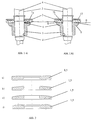
- the axial bearings shown in Figures 1 a) and 1 b) consist of an annular planar plain bearing part 1, which is made of ceramic and thus has a very high wear resistance.
- This slide bearing part 1, which is designed as a sliding disk, is connected in a rotationally fixed manner to the shaft 3 via a holder 2 and rotates with the shaft 3 about the axis of rotation 4.
- a bush-shaped plain bearing part 5 is used as a counter bearing to the above-mentioned plain bearing part 1, to which a flange 6 is formed, the one lateral surface of which is the sliding surface of the counter bearing.
- This plain bearing part 5 is made of resin-impregnated carbon, which has a lower wear resistance than ceramic.
- the slide bearing part 5 contains an opening 11 for the play-free rotatable reception of the shaft 3 and is connected in a rotationally fixed manner to a holder, not shown, for example that of a motor shaft.
- both slide bearing parts 1 and 5 have plane-parallel sliding surfaces and the contact surface corresponds to the maximum ring surface 7a, which is given by the inner and outer diameter of the carbon sliding bearing part 5 .
- Figure 2 a) shows a cross section of the flat sliding surface of the ceramic sliding bearing part 1 or the carbon sliding bearing part 2 according to the prior art.
- Figure 1 b shows a thrust bearing according to the invention.
- the sliding surface of the carbon sliding bearing part 5 has a conical shape in which the material thickness, based on the sliding bearing rear surface 9, decreases from the inner edge to the outer edge.
- the sliding surface formed in this way forms an angle ⁇ of 1 to 10 degrees, in particular 5 degrees, with the flat sliding surface of the ceramic sliding bearing part 1, which lies in a plane perpendicular to the axis of rotation 4.
- the two sliding surfaces of the sliding bearing parts 1 and 5 lie against one another only at an annular contact line 7b.
- this line of contact 7b will become an annular from the inner to the outer edge of the sliding surface Increase the contact area. This enlargement takes place automatically as a function of the axially acting force due to wear of the sliding surface of the carbon plain bearing part 5.
- FIG. 2 c) shows the cross section of a sliding surface which, based on the entire diameter, is convex due to a large radius.
- this convex shape has the advantage that a larger contact surface is achieved more quickly due to wear and therefore the relative wear-related displacement of the two slide bearing parts relative to one another, based on the sliding surface rear sides 9 and 10, is less.
- Figure 2 d shows the cross section of a sliding surface that is only convex between the inner edge and the outer edge. Viewed in cross-section, this geometry has the greatest height between the two bearing edges. Here, too, the contact area will increase faster than with the conical design under heavy axial loads.
Landscapes
- Engineering & Computer Science (AREA)
- General Engineering & Computer Science (AREA)
- Mechanical Engineering (AREA)
- Chemical & Material Sciences (AREA)
- Ceramic Engineering (AREA)
- Oil, Petroleum & Natural Gas (AREA)
- Physics & Mathematics (AREA)
- Fluid Mechanics (AREA)
- Structures Of Non-Positive Displacement Pumps (AREA)
- Sliding-Contact Bearings (AREA)
Applications Claiming Priority (2)
| Application Number | Priority Date | Filing Date | Title |
|---|---|---|---|
| DE19618767 | 1996-05-10 | ||
| DE1996118767 DE19618767A1 (de) | 1996-05-10 | 1996-05-10 | Selbsteinstellendes Axiallager für Hochdruckkreiselpumpen |
Publications (2)
| Publication Number | Publication Date |
|---|---|
| EP0806579A2 true EP0806579A2 (fr) | 1997-11-12 |
| EP0806579A3 EP0806579A3 (fr) | 1998-09-09 |
Family
ID=7793889
Family Applications (1)
| Application Number | Title | Priority Date | Filing Date |
|---|---|---|---|
| EP97107718A Withdrawn EP0806579A3 (fr) | 1996-05-10 | 1997-05-12 | Palier axial à auto-alignement |
Country Status (2)
| Country | Link |
|---|---|
| EP (1) | EP0806579A3 (fr) |
| DE (1) | DE19618767A1 (fr) |
Cited By (8)
| Publication number | Priority date | Publication date | Assignee | Title |
|---|---|---|---|---|
| EP1201931A3 (fr) * | 2000-10-23 | 2005-06-08 | TM.P. S.p.A. Termomeccanica Pompe | Palier à glissement pour une pompe centrifuge |
| DE102005019984A1 (de) * | 2005-04-27 | 2006-11-09 | A. Friedr. Flender Ag | Gleitlagerung |
| WO2007031662A1 (fr) * | 2005-09-16 | 2007-03-22 | Renault S.A.S. | Boite de vitesses pour vehicule automobile pourvue d'une butee axiale hydrodynamique, et butee axiale hydrodynamique associee |
| DE102011075227A1 (de) * | 2011-05-04 | 2012-11-08 | BSH Bosch und Siemens Hausgeräte GmbH | Axiallager für einen elektrischen Antrieb |
| CN102878105A (zh) * | 2012-07-16 | 2013-01-16 | 晋州市水泵厂 | 潜水泵用自动调心式止推轴承 |
| DE102016007862A1 (de) | 2016-06-29 | 2018-01-04 | Wilo Se | Axiales Gleitlager |
| CN107795510A (zh) * | 2017-11-24 | 2018-03-13 | 湖州三井低温设备有限公司 | 一种多级低温潜液泵轴向力平衡机构 |
| CN113339313A (zh) * | 2021-07-08 | 2021-09-03 | 哈尔滨电气动力装备有限公司 | 轴封式核主泵奇数非对称径向瓦间隙的离心式调整方法 |
Families Citing this family (4)
| Publication number | Priority date | Publication date | Assignee | Title |
|---|---|---|---|---|
| DE10028951A1 (de) * | 2000-06-16 | 2002-01-03 | Grundfos As | Axialgleitlager für eine Nasslaufkreiselpumpe |
| DE10140613A1 (de) * | 2001-08-18 | 2003-03-06 | Pierburg Gmbh | Naßläuferpumpe |
| DE102016202417A1 (de) * | 2016-02-17 | 2017-08-17 | Bühler Motor GmbH | Kreiselpumpe |
| DE102016006271B4 (de) | 2016-05-25 | 2026-05-21 | Wilo Se | Axialfehlerausgleich mittels Ausgleichsmasse |
Family Cites Families (6)
| Publication number | Priority date | Publication date | Assignee | Title |
|---|---|---|---|---|
| US2953416A (en) * | 1957-09-17 | 1960-09-20 | Garrett Corp | Thrust bearing construction |
| US3090655A (en) * | 1960-10-14 | 1963-05-21 | Gen Motors Corp | Thrust bearing |
| FR1531092A (fr) * | 1967-07-12 | 1968-06-28 | Skf Kugellagerfabriken Gmbh | Palier de butée, en particulier pour fusées d'essieu |
| FR2126511A5 (fr) * | 1971-02-09 | 1972-10-06 | Commissariat Energie Atomique | |
| DE3140017A1 (de) * | 1981-10-08 | 1983-04-28 | Flender A F Gmbh Co Kg | Axiale hydrodynamische gleitlagerung |
| JPH01176812A (ja) * | 1987-12-28 | 1989-07-13 | Taiho Kogyo Co Ltd | モータ用軸受装置 |
-
1996
- 1996-05-10 DE DE1996118767 patent/DE19618767A1/de not_active Withdrawn
-
1997
- 1997-05-12 EP EP97107718A patent/EP0806579A3/fr not_active Withdrawn
Cited By (15)
| Publication number | Priority date | Publication date | Assignee | Title |
|---|---|---|---|---|
| EP1201931A3 (fr) * | 2000-10-23 | 2005-06-08 | TM.P. S.p.A. Termomeccanica Pompe | Palier à glissement pour une pompe centrifuge |
| DE102005019984A1 (de) * | 2005-04-27 | 2006-11-09 | A. Friedr. Flender Ag | Gleitlagerung |
| WO2007031662A1 (fr) * | 2005-09-16 | 2007-03-22 | Renault S.A.S. | Boite de vitesses pour vehicule automobile pourvue d'une butee axiale hydrodynamique, et butee axiale hydrodynamique associee |
| FR2891034A1 (fr) * | 2005-09-16 | 2007-03-23 | Renault Sas | Boite de vitesses pour vehicule automobile pourvue d'une butee axiale hydrodynamique, et butee axiale hydrodynamique associee. |
| CN103503284A (zh) * | 2011-05-04 | 2014-01-08 | Bsh博世和西门子家用电器有限公司 | 用于电力驱动装置的轴向轴承 |
| DE102011075227A1 (de) * | 2011-05-04 | 2012-11-08 | BSH Bosch und Siemens Hausgeräte GmbH | Axiallager für einen elektrischen Antrieb |
| US20140072459A1 (en) * | 2011-05-04 | 2014-03-13 | Michal Kalavsky | Axial bearing for an electric drive |
| US9702370B2 (en) | 2011-05-04 | 2017-07-11 | Bsh Hausgeraete Gmbh | Axial bearing for an electric drive |
| CN102878105A (zh) * | 2012-07-16 | 2013-01-16 | 晋州市水泵厂 | 潜水泵用自动调心式止推轴承 |
| CN102878105B (zh) * | 2012-07-16 | 2015-04-22 | 晋州市水泵厂 | 潜水泵用自动调心式止推轴承 |
| DE102016007862A1 (de) | 2016-06-29 | 2018-01-04 | Wilo Se | Axiales Gleitlager |
| CN107795510A (zh) * | 2017-11-24 | 2018-03-13 | 湖州三井低温设备有限公司 | 一种多级低温潜液泵轴向力平衡机构 |
| CN107795510B (zh) * | 2017-11-24 | 2024-03-22 | 湖州三井低温设备有限公司 | 一种多级低温潜液泵轴向力平衡机构 |
| CN113339313A (zh) * | 2021-07-08 | 2021-09-03 | 哈尔滨电气动力装备有限公司 | 轴封式核主泵奇数非对称径向瓦间隙的离心式调整方法 |
| CN113339313B (zh) * | 2021-07-08 | 2022-07-22 | 哈尔滨电气动力装备有限公司 | 轴封式核主泵奇数非对称径向瓦间隙的离心式调整方法 |
Also Published As
| Publication number | Publication date |
|---|---|
| EP0806579A3 (fr) | 1998-09-09 |
| DE19618767A1 (de) | 1997-11-13 |
Similar Documents
| Publication | Publication Date | Title |
|---|---|---|
| EP0158242B1 (fr) | Palier radial à contact lisse | |
| DE1675076C2 (de) | Hydrodynamisches Lager zur Aufnahme axialer und radialer Belastungen | |
| DE1525198C3 (de) | Hydrodynamisches Gleitlager | |
| DE2624849C3 (de) | Selbstdruckerzeugendes Radialgleitlager | |
| DE69007079T2 (de) | Buchse für Ölfilmlager. | |
| DE69929554T2 (de) | Lagervorrichtung mit sphärischen Lagerflächen | |
| WO2000043688A1 (fr) | Disque de butee d'un engrenage planetaire | |
| DE4303050B4 (de) | Gleitringdichtung | |
| DE1525193A1 (de) | Ausbildung und Zuordnung von Lagerteilen | |
| DE10158768B4 (de) | Radialkolbenpumpe | |
| DE4222225A1 (de) | Gleitlager für eine Drehanoden-Röntgenröhre | |
| EP4067706B1 (fr) | Bague d'étanchéité | |
| DE4214936A1 (de) | Zapfentyp-spurwaelzlager | |
| DE102016205896A1 (de) | Lager und Lageranordnung | |
| EP0001406A1 (fr) | Trépan à molettes | |
| DE102012016983B4 (de) | Wälzlager mit Wälzlagerkäfig | |
| EP3434917A1 (fr) | Dispositif palier destiné au logement d'un arbre de transmission | |
| DE19618767A1 (de) | Selbsteinstellendes Axiallager für Hochdruckkreiselpumpen | |
| DE2731313A1 (de) | Flexible dichtung und dichtungskonstruktion | |
| DE1286344B (de) | Radialwaelzlager | |
| EP1717466A2 (fr) | Palier lisse avec un entrefer divergeant dans la zone d'extrémité | |
| DE3925404A1 (de) | Trockengasdichtung mit ruecklaufentlastung | |
| EP2535606B1 (fr) | Agencement de palier axial | |
| DE102019212217A1 (de) | Anlaufelement für ein hydrodynamisches Axiallager und hydrodynamisches Axiallager | |
| DE2612252A1 (de) | Selbstdruckerzeugendes gleitlager |
Legal Events
| Date | Code | Title | Description |
|---|---|---|---|
| PUAI | Public reference made under article 153(3) epc to a published international application that has entered the european phase |
Free format text: ORIGINAL CODE: 0009012 |
|
| AK | Designated contracting states |
Kind code of ref document: A2 Designated state(s): DE FR GB IT |
|
| PUAL | Search report despatched |
Free format text: ORIGINAL CODE: 0009013 |
|
| AK | Designated contracting states |
Kind code of ref document: A3 Designated state(s): DE FR GB IT |
|
| 17P | Request for examination filed |
Effective date: 19980911 |
|
| 17Q | First examination report despatched |
Effective date: 19991228 |
|
| STAA | Information on the status of an ep patent application or granted ep patent |
Free format text: STATUS: THE APPLICATION HAS BEEN WITHDRAWN |
|
| 18W | Application withdrawn |
Withdrawal date: 20000621 |