EP0806561B1 - Heizelementsteuerschaltung mit veränderlichem Widerstand assoziiert mit einem Sensor zur Erfassung von Sauerstoff in Abgasen - Google Patents
Heizelementsteuerschaltung mit veränderlichem Widerstand assoziiert mit einem Sensor zur Erfassung von Sauerstoff in Abgasen Download PDFInfo
- Publication number
- EP0806561B1 EP0806561B1 EP97107132A EP97107132A EP0806561B1 EP 0806561 B1 EP0806561 B1 EP 0806561B1 EP 97107132 A EP97107132 A EP 97107132A EP 97107132 A EP97107132 A EP 97107132A EP 0806561 B1 EP0806561 B1 EP 0806561B1
- Authority
- EP
- European Patent Office
- Prior art keywords
- heater
- control circuit
- measurement resistor
- path
- circuit according
- Prior art date
- Legal status (The legal status is an assumption and is not a legal conclusion. Google has not performed a legal analysis and makes no representation as to the accuracy of the status listed.)
- Expired - Lifetime
Links
- QVGXLLKOCUKJST-UHFFFAOYSA-N atomic oxygen Chemical compound [O] QVGXLLKOCUKJST-UHFFFAOYSA-N 0.000 title claims description 9
- 239000001301 oxygen Substances 0.000 title claims description 9
- 229910052760 oxygen Inorganic materials 0.000 title claims description 9
- 239000007789 gas Substances 0.000 title description 8
- 238000005259 measurement Methods 0.000 claims description 33
- 230000004913 activation Effects 0.000 claims description 8
- 238000002485 combustion reaction Methods 0.000 claims description 4
- 239000000523 sample Substances 0.000 description 18
- 238000010586 diagram Methods 0.000 description 4
- 238000000034 method Methods 0.000 description 3
- 238000012544 monitoring process Methods 0.000 description 3
- 101100102627 Oscarella pearsei VIN1 gene Proteins 0.000 description 2
- 230000003197 catalytic effect Effects 0.000 description 2
- 230000000694 effects Effects 0.000 description 2
- 238000002347 injection Methods 0.000 description 2
- 239000007924 injection Substances 0.000 description 2
- 101100263704 Arabidopsis thaliana VIN3 gene Proteins 0.000 description 1
- -1 VIN2 Proteins 0.000 description 1
- 230000002547 anomalous effect Effects 0.000 description 1
- 239000003990 capacitor Substances 0.000 description 1
- 238000006243 chemical reaction Methods 0.000 description 1
- 238000010276 construction Methods 0.000 description 1
- 238000001514 detection method Methods 0.000 description 1
- 230000006866 deterioration Effects 0.000 description 1
- 239000000446 fuel Substances 0.000 description 1
- 238000010438 heat treatment Methods 0.000 description 1
- 230000001939 inductive effect Effects 0.000 description 1
- 230000001052 transient effect Effects 0.000 description 1
Images

Classifications
-
- F—MECHANICAL ENGINEERING; LIGHTING; HEATING; WEAPONS; BLASTING
- F02—COMBUSTION ENGINES; HOT-GAS OR COMBUSTION-PRODUCT ENGINE PLANTS
- F02D—CONTROLLING COMBUSTION ENGINES
- F02D41/00—Electrical control of supply of combustible mixture or its constituents
- F02D41/02—Circuit arrangements for generating control signals
- F02D41/14—Introducing closed-loop corrections
- F02D41/1438—Introducing closed-loop corrections using means for determining characteristics of the combustion gases; Sensors therefor
- F02D41/1493—Details
- F02D41/1494—Control of sensor heater
Definitions
- the present invention relates to a control circuit for a heater with variable resistance associated with a sensor for detecting oxygen in exhaust gases, particularly for an internal combustion engine of a motor vehicle.
- control circuit comprising:
- Oxygen sensors or lambda probes are normally used in motor-vehicle catalytic converters for measuring the quantity of oxygen present in the exhaust gases.
- Lambda probes operate correctly only if their temperature is high enough. At normal running speeds this is ensured by the high temperature of the exhaust gases.
- a heater associated with the sensor Upon starting, the activation of a heater associated with the sensor generates an additional quantity of heat such as to heat the sensor quickly and limit emissions.
- the electrical resistance of the heater is of the type which is variable positively with temperature (the PTC type). Its value increases progressively from a minimum upon activation to a much higher steady value when the temperature of the gases has stabilized.
- the current absorbed by the heater at the starting stage may consequently even be one order of magnitude higher than that absorbed in the steady state. Naturally this current also depends upon the supply voltage (the battery voltage).
- the functionality of the heater can be monitored by accurate detection of the current passing through the measurement resistor associated with the heater and the functionality of the probe can thus be deduced for a subsequent adjustment operation, if necessary. (Compare with DE-A-35 17 252, Fig. 3 or 6)
- the current measurement has to be particularly accurate but this conflicts with two contrasting requirements relating to the resistance of the measurement resistor.
- this resistor has to have a very low resistance.
- the voltage drop in a measurement resistor with low resistance would be a few mV giving rise to large measurement errors, which also arise because of the offset and drift which are not negligible in comparison with the useful signal.
- An object of the present invention is to provide an improved control circuit for a heater with variable resistance associated with an oxygen sensor, which overcomes the problems outlined above and which, in particular, is suitable for enabling the sensor to operate at the most uniform possible temperature, to ensure precise and reliable measurements.
- the measurement resistor can be of an optimal size since the current flowing in the heater passes through this resistor only after it has substantially reached the steady value.
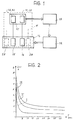
- Figure 1 shows, in the form of a block diagram, a system 11 for controlling the emissions of a motor-vehicle internal combustion engine 12.
- the system 11 operates in association with a fuel-injection system 13 and a catalytic converter 14. It comprises a sensor 15 for detecting oxygen in the exhaust gases (a lambda probe) associated with an electric heater 16 and an electronic control unit 17 including a microprocessor 18.
- the lambda probe 15 can provide signals indicative of the quantity of oxygen present in the exhaust gases.
- the electronic unit 17 uses these signals to regulate the injection system 13 so as to achieve an optimal air-fuel ratio.
- the probe 15 is mounted in the converter 14 together with the electric heater 16.
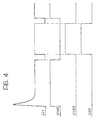
- This heater comprises a resistor Rr1 (see Figure 3) having a first terminal connected to one pole of a direct-current voltage source, for example, the positive pole of the motor-vehicle battery.
- the electronic unit 17 comprises a control circuit 19 associated with the heater 16 and connected to the other terminal of the heater resistor Rr1 in order to control the connection of this resistor to earth.
- the resistance of the resistor Rr1 is variable positively with temperature.
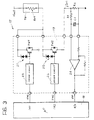
- Figure 2 shows three curves I, II and III, representing the current Ir1 in the resistor Rr1 as functions of time T for three possible values of the resistance of this resistor which correspond to different dissipation levels, for example, of 5W, 12W and 18W, respectively.
- the current Ir1 varies progressively from a maximum upon activation of the heater to a steady minimum value which is lower than the maximum value by almost one order of magnitude.
- a control circuit 19 has the purpose of monitoring the current Ir1 in the resistor Rr1 of the heater 16.
- This circuit which is connected to a terminal of a measurement (shunt) resistor Rs of which the other terminal is earthed, comprises an amplifier 20 connected to the measurement resistor Rs and switching devices 21, 22 driven by the microprocessor 18.
- the amplifier 20 is an operational amplifier and its inputs are connected to the measurement resistor Rs by means of a low-pass filter including a resistor Rf and a capacitor Cf.
- the output of the amplifier 20 provides a signal indicative of the current Ir1 at an analog/digital conversion input A/D of the microprocessor 18.
- the switching devices 21, 22 comprise, for example, two transistors PW1 and PW2 associated with respective driver circuits 23, 24.
- the transistors PW1 and PW2 are preferably of the PowerMOS type and their drains are connected to the resistor Rr1 of the heater 16.
- the source of PW1 is connected directly to earth whereas the source of PW2 is connected to earth through the measurement resistor Rs.
- the respective inputs of the driver circuits 23 and 24 are connected to corresponding output terminals IN1 and IN2 of the microprocessor 18.
- a Zener diode may advantageously be interposed between the drain and the gate of each transistor PW1 and PW2 for protection against overvoltages which may be generated owing to inductive effects in the heater supply lines.
- the switching devices 21 and 22, suitably driven by the microprocessor 18, can define two different routes for the connection of the resistor Rr1 to earth.
- the resistor Rr1 is connected to earth through PW1
- the resistor Rr1 is connected to earth through PW2 and the measurement resistor Rs.
- the resistor Rs detects the current Ir1 flowing in the heating resistor Rr1.
- the strategy for the control of the heater 16 provides for the microprocessor 18 to make the transistor PW1 conductive temporarily upon activation.
- the microprocessor 18 has associated storage in which a predetermined time period long enough for the heater 16, and hence the lambda probe 15, to reach the steady state, is defined.
- the microprocessor 18 After activation and when the time period stored has elapsed, the microprocessor 18 switches the switches 21 and 22, cutting off PW1 and making PW2 conductive. In this situation, the current Ir1 flowing in the heater 16 passes through the transistor PW2 and the measurement resistor Rs and the microprocessor 18 can acquire, at its input A/D, a signal indicative of the level of the current Ir1.
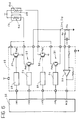
- Figure 4 shows examples of curves of the signals VIN1, VIN2 for driving the transistors PW1 and PW2, of the current Ir1, and of the output voltage VOP of the operational amplifier 20.
- the transistor PW1 is of a size such as to withstand the maximum transient intensity of Ir1 which may occur with variations of the type of heater, as well as with variations of the supply voltage Vbat and of the initial temperature.
- the transistor PW2 on the other hand, can be of a size such as to withstand the maximum intensity of the current Ir1 when the heater 16 has reached a steady temperature.
- the measurement resistor Rs is in turn of a size such that the operational amplifier 20 is in its optimal operating conditions in the steady state.
- the timing of the switchings described above provides for the transistor PW1 to be cut off before the transistor PW2 becomes conductive.
- the current Ir1 in the heater 16 is cut off temporarily before and after the acquisition of the current value Ir1. This has no appreciable effect on the temperature of the lambda probe, however.
- the heater has a high thermal inertia in comparison with the very short switching times of the transistors PW1 and PW2.
- the interruption of the current in the heater in the switching stages can, however, be avoided, by making PW2 conductive before PW1 is cut off and then making PW1 conductive before PW2 is cut off.
- the examples of curves of the signals shown in Figure 5 correspond to this method of operation.
- the variant of Figure 6 relates to a situation in which provision is made for the use of a further lambda probe, indicated 25 in Figure 1, for controlling emissions.
- a second heater 28 is now provided, associated with the second lambda probe 25 and including a resistor Rr2, the resistance of which is also of the PTC type.
- the resistor Rr2 has a terminal connected to the battery.
- the control circuit of the two lambda probes which is indicated 29 in Figures 1 and 6, comprises a first portion identical to the circuit 19 described above for controlling the heater 16 and the switches 21, 22 and an additional portion for monitoring the current Ir2 in the heater 28 associated with the second lambda probe.
- the circuit 29 is connected to a microprocessor 32 similar to the microprocessor 18 which, in addition to the input A/D and the output terminals IN1 and IN2, has two further output terminals IN3 and IN4 for two further switches 30, 31 associated with the heater 28 (Rr2).
- the currents Ir1 and Ir2 are monitored alternately with time sharing by the microprocessor 32 and the two heaters 16 and 28 are controlled alternately.
- the driving structure is thus duplicated in comparison with that of the circuit 19 of Figure 3, whereas there is advantageously only one circuit portion for detecting the currents.
- the microprocessor 32 can in fact arrange for the current Ir1 or Ir2 of one of the two heaters to flow through the measurement resistor Rs at a time, when its intensity is to be acquired.
- the switches 30, 31 may comprise transistors PW3 and PW4 and respective driver circuits 33, 34.
- the transistors PW3 and PW4 are also advantageously of the PowerMOS type and have their drains connected to the resistor Rr2 of the heater 28.
- the source of PW3 is connected directly to earth, whereas the source of PW4 is connected to earth through the shunt resistor Rs.
- the drivers 33 and 34 are in turn interposed between the gates of PW3 and PW4 and the output terminals IN3 and IN4 of the microprocessor 32.
- the microprocessor 32 is arranged in a manner such that, for each activation of the heaters, PW1 and PW3 are made conductive in succession and PW2 and PW4 are kept cut off. Then, without any change in the conditions of the transistors PW3 and PW4, PW1 is cut off and PW2 is made conductive, after sufficient time for the heater 16, and hence the lambda probe 15, to reach a steady temperature.
- the current Ir1 flowing in the heater 16 now passes through the transistor PW2 and the measurement resistor Rs.
- the microprocessor 32 then acquires the level of the current Ir1 and then returns the transistors PW1 and PW2 to the initial conditions to allow the current Ir1 to flow directly to earth.
- PW3 is cut off whilst PW4 is made conductive.
- the current Ir2 which flows in the heater 28 now passes through the transistor PW4 and the measurement resistor Rs and the microprocessor 32 acquires the intensity of the current Ir2.
- the transistors PW3 and PW4 are then returned to the initial conditions, enabling the current Ir2 to flow directly to earth.
- the microprocessor 32 can be programmed suitably to acquire the values of the currents Ir1 and Ir2 periodically, repeating the sequence described above.
- the currents Ir1 and Ir2 flowing in the heaters 18 and 26 are also interrupted temporarily before and after reading without a significant effect on the temperature.
- the circuit 29 which performs the function of controlling and monitoring the currents Ir1 and Ir2 of the two heaters 16 and 28 may be formed in a single custom-made integrated circuit.
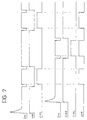
- Figure 7 shows examples of the curves of the driver signals VIN1, VIN2, VIN3 and VIN4, of the currents Ir1 and Ir2, and of the output voltage VOP of the operational amplifier 20 for the circuit of Figure 6.
- the transistor PW3 is of a size such as to withstand the maximum intensity of Ir2 which may occur with variations of the supply voltage and of the initial temperature.
- the transistor PW4, on the other hand, is of a size such as to withstand the maximum intensity of the current Ir2 when the heater 28 is in the steady state.
- the measurement resistor Rs is in turn of a size such that, in the steady state, the operational amplifier 20 is in optimal operating conditions both for the heater 16 and for the heater 28.
- the microprocessor 18 or 32 can detect any deterioration of the heater 16 or 28 upon the basis of the values acquired for the current Ir1 and/or Ir2. It can also implement a strategy for de-activating the heater 16 or 28 in optimal running conditions, increasing the life and reliability thereof.
Landscapes
- Engineering & Computer Science (AREA)
- Chemical & Material Sciences (AREA)
- Combustion & Propulsion (AREA)
- Mechanical Engineering (AREA)
- General Engineering & Computer Science (AREA)
- Measuring Oxygen Concentration In Cells (AREA)
- Combined Controls Of Internal Combustion Engines (AREA)
- Investigating Or Analyzing Materials By The Use Of Fluid Adsorption Or Reactions (AREA)
Claims (10)
- Steuerschaltung für ein Heizelement (16, 28) mit veränderlichem Widerstand, assoziiert mit einem Sauerstoffsensor (15, 25), insbesondere für einen Kraftfahrzeugverbrennungsmotor, umfassend:dadurch gekennzeichnet, daß sie:einen Meßwiderstand (Rs), der mit dem Heizelement (16, 28) im wesentlichen in Serie geschaltet werden kann, undeine mit dem Meßwiderstand (Rs) verbundene Detektoreinrichtung (20) zur Bereitstellung eines Signals (VOP), welches auf den im Widerstand (Rs) fließenden Strom schließen läßt,Schaltvorrichtungen (PW1, PW2; PW3, PW4) zur Steuerung der Verbindung des Heizelements (16, 28) mit einer Gleichspannungsquelle (Vbat) und der Verbindung des Meßwiderstands (Rs) mit der die Quelle (Vbat) und das Heizelement (16, 28) umfassenden Versorgungsschaltung, undeine Steuervorrichtung (18, 32), welche derart zum Steuern der Schaltvorrichtungen (PW1, PW2; PW3, PW4) eingerichtet ist, daß der Meßwiderstand (Rs) bei jeder Aktivierung des Heizelements (16, 28) für eine im voraus festgelegte Zeitspanne von der Versorgungsschaltung des Heizelements (16, 28) abgetrennt bleibt und der Meßwiderstand (Rs) danach mit der Versorgungsschaltung des Heizelements (16, 28) verbunden wird, umfaßt.
- Steuerschaltung nach Anspruch 1, zur Steuerung einer Mehrzahl von Heizelementen (16, 28) mit veränderlichem Widerstand, jeweils assoziiert mit einem Sauerstoffsensor (15, 25), dadurch gekennzeichnet, daß sie einen einzigen Meßwiderstand (Rs) umfaßt und daß die Schaltvorrichtungen (PW1, PW2; PW3, PW4) mit den Heizelementen (16, 28) und dem Meßwiderstand (Rs) derart verbunden sind, daß der Meßwiderstand (Rs) gezielt der Reihe nach mit jedem der Heizelemente (16, 28) in Serie geschaltet werden kann.
- Steuerschaltung nach Anspruch 2, dadurch gekennzeichnet, daß eine Anschlußklemme des oder jedes Heizelements (16, 28) mit einem Pol der Spannungsquelle (Vbat) verbunden ist und die andere Anschlußklemme mit dem anderen Pol der Quelle über einen ersten oder zweiten Pfad verbunden ist, wobei der erste Pfad einen elektronischen Schalter (PW1; PW3) und der zweite Pfad einen zweiten elektronischen Schalter (PW2; PW4) und den Meßwiderstand (Rs) umfaßt.
- Steuerschaltung nach Anspruch 3, dadurch gekennzeichnet, daß die Steuervorrichtung (18, 32) eingerichtet ist, bei jeder Aktivierung des Heizelements oder der Heizelemente (16, 28) die anfängliche Verbindung des oder jedes Heizelements (16, 28) mit dem zweiten Pol der Spannungsquelle über den assoziierten ersten Pfad (PW1; PW3) herbeizuführen, und nach der im voraus festgelegten anfänglichen Zeitspanne die Verbindung des oder jedes Heizelements (16, 28) mit dem zweiten Pol der Spannungsquelle über den assoziierten zweiten Pfad (PW2, Rs; PW4, Rs) herbeizuführen.
- Steuerschaltung nach Anspruch 4, dadurch gekennzeichnet, daß die Steuervorrichtung (18, 32) eingerichtet ist, die Schalter (PW1, PW2; PW3, PW4) derart zu steuern, daß die Verbindung des oder jedes Heizelements (16, 28) mit dem zweiten Pol der Spannungsquelle über den assoziierten ersten Pfad (PW1; PW3) getrennt wird, bevor die Verbindung über den assoziierten zweiten Pfad (PW2, Rs; PW4, Rs) ermöglicht wird.
- Steuerschaltung nach Anspruch 4, dadurch gekennzeichnet, daß die Steuervorrichtung (18, 32) eingerichtet ist, die Schalter (PW1, PW2; PW3, PW4) derart zu steuern, daß die Verbindung des oder jedes Heizelements (16, 28) mit dem zweiten Pol der Spannungsquelle über den assoziierten ersten Pfad (PW1; PW3) getrennt wird, nachdem die Verbindung über den assoziierten zweiten Pfad (PW2, Rs; PW4, Rs) ermöglicht wurde.
- Steuerschaltung nach einem der Ansprüche 2 bis 6, dadurch gekennzeichnet, daß die mit dem oder jedem Heizelement (16, 28) assoziierten ersten und zweiten Schalter (PW1, PW3; PW2, PW4) PowerMOS-Transistoren sind.
- Steuerschaltung nach einem der vorhergehenden Ansprüche, dadurch gekennzeichnet, daß die Detektoreinrichtung einen mit dem Meßwiderstand (Rs) verbundenen Differentialverstärker (20) umfaßt.
- Steuerschaltung nach Anspruch 8, dadurch gekennzeichnet, daß der Verstärker (20) mit dem Meßwiderstand (Rs) mittels eines Tiefpaßfilters (Rf, Cf) verbunden ist.
- Steuerschaltung nach einem der vorhergehenden Ansprüche, dadurch gekennzeichnet, daß die Steuervorrichtung einen Mikroprozessor (18, 32) umfaßt.
Applications Claiming Priority (2)
| Application Number | Priority Date | Filing Date | Title |
|---|---|---|---|
| IT96TO000378A IT1285863B1 (it) | 1996-05-08 | 1996-05-08 | Circuito di controllo per un riscaldatore a resistenza variabile associato ad un sensore di ossigeno nei gas di scarico. |
| ITTO960378 | 1996-05-08 |
Publications (2)
| Publication Number | Publication Date |
|---|---|
| EP0806561A1 EP0806561A1 (de) | 1997-11-12 |
| EP0806561B1 true EP0806561B1 (de) | 2000-06-07 |
Family
ID=11414619
Family Applications (1)
| Application Number | Title | Priority Date | Filing Date |
|---|---|---|---|
| EP97107132A Expired - Lifetime EP0806561B1 (de) | 1996-05-08 | 1997-04-30 | Heizelementsteuerschaltung mit veränderlichem Widerstand assoziiert mit einem Sensor zur Erfassung von Sauerstoff in Abgasen |
Country Status (7)
| Country | Link |
|---|---|
| US (1) | US5970785A (de) |
| EP (1) | EP0806561B1 (de) |
| CN (1) | CN1145866C (de) |
| BR (1) | BR9700672A (de) |
| DE (1) | DE69702226T2 (de) |
| ES (1) | ES2147413T3 (de) |
| IT (1) | IT1285863B1 (de) |
Families Citing this family (4)
| Publication number | Priority date | Publication date | Assignee | Title |
|---|---|---|---|---|
| EP1790979A1 (de) * | 2005-11-24 | 2007-05-30 | Consultatie Implementatie Technisch Beheer B.V. | Elektronischer Detektor für chemische Spuren |
| US20080099333A1 (en) * | 2006-10-26 | 2008-05-01 | Nair Balakrishnan Nair Vijayak | Control circuit for multiple oxygen sensor heater elements |
| US8014930B2 (en) * | 2008-10-30 | 2011-09-06 | GM Global Technology Operations LLC | System and method for determining oxygen sensor heater resistance |
| JP6214975B2 (ja) * | 2013-09-10 | 2017-10-18 | 日本特殊陶業株式会社 | 負荷駆動装置及びセンサ制御装置 |
Family Cites Families (12)
| Publication number | Priority date | Publication date | Assignee | Title |
|---|---|---|---|---|
| US4520653A (en) * | 1983-08-29 | 1985-06-04 | Ford Motor Company | Circuits for obtaining a voltage reading from a sensing element |
| JPS60235047A (ja) * | 1984-05-07 | 1985-11-21 | Toyota Motor Corp | 内燃機関用ヒ−タ付酸素センサの温度制御方法 |
| JPS60239664A (ja) * | 1984-05-14 | 1985-11-28 | Nissan Motor Co Ltd | 酸素センサの加熱装置 |
| JPH07122627B2 (ja) * | 1987-12-16 | 1995-12-25 | 日本電装株式会社 | 酸素濃度センサ用ヒータの制御装置 |
| US5055269A (en) * | 1989-03-06 | 1991-10-08 | Bacharach, Inc | Temperature limited catalytic gas detector apparatus |
| US4993392A (en) * | 1989-04-24 | 1991-02-19 | Toyota Jidosha Kabushiki Kaisha | Apparatus for controlling heater for heating oxygen sensor |
| US5182519A (en) * | 1990-10-22 | 1993-01-26 | Mitsubishi Denki Kabushiki Kaisha | Heater control device for an air-fuel ratio sensor |
| DE4128385A1 (de) * | 1991-08-27 | 1993-03-04 | Bosch Gmbh Robert | Verfahren und vorrichtung zur ueberwachung der funktionsfaehigkeit einer sauerstoffmesssonden-heizung |
| DE4221922C1 (de) * | 1992-07-03 | 1994-01-13 | Bosch Gmbh Robert | Wärmetönungssensor |
| US5454259A (en) * | 1993-08-02 | 1995-10-03 | Toyota Jidosha Kabushiki Kaisha | Failure detecting apparatus in temperature controller of air-fuel ratio sensor |
| US5392643A (en) * | 1993-11-22 | 1995-02-28 | Chrysler Corporation | Oxygen heater sensor diagnostic routine |
| DE4344961B4 (de) * | 1993-12-30 | 2004-05-06 | Robert Bosch Gmbh | Auswertevorrichtung für das Signal einer Sauerstoffsonde |
-
1996
- 1996-05-08 IT IT96TO000378A patent/IT1285863B1/it active IP Right Grant
-
1997
- 1997-04-30 EP EP97107132A patent/EP0806561B1/de not_active Expired - Lifetime
- 1997-04-30 DE DE69702226T patent/DE69702226T2/de not_active Expired - Lifetime
- 1997-04-30 ES ES97107132T patent/ES2147413T3/es not_active Expired - Lifetime
- 1997-05-06 BR BR9700672A patent/BR9700672A/pt not_active Application Discontinuation
- 1997-05-07 CN CNB971111472A patent/CN1145866C/zh not_active Expired - Fee Related
- 1997-05-08 US US08/853,163 patent/US5970785A/en not_active Expired - Lifetime
Also Published As
| Publication number | Publication date |
|---|---|
| ES2147413T3 (es) | 2000-09-01 |
| ITTO960378A1 (it) | 1997-11-08 |
| IT1285863B1 (it) | 1998-06-24 |
| US5970785A (en) | 1999-10-26 |
| DE69702226T2 (de) | 2000-10-12 |
| EP0806561A1 (de) | 1997-11-12 |
| CN1145866C (zh) | 2004-04-14 |
| BR9700672A (pt) | 1998-09-01 |
| ITTO960378A0 (it) | 1996-05-08 |
| DE69702226D1 (de) | 2000-07-13 |
| CN1183586A (zh) | 1998-06-03 |
Similar Documents
| Publication | Publication Date | Title |
|---|---|---|
| JP4295900B2 (ja) | 排気ガスセンサ用ヒータ制御装置 | |
| KR970004673B1 (ko) | 전기적 부하 활성화 및 모니터 장치와 그 방법 | |
| US7536244B2 (en) | Failure diagnostic apparatus and method for an air-fuel ratio sensor | |
| JP4209736B2 (ja) | エンジン制御装置 | |
| US9752958B2 (en) | Load drive apparatus and sensor control apparatus | |
| EP1916403A1 (de) | Steuerschaltung für mehrere Sauerstoffsensorheizelemente | |
| US11635472B2 (en) | Load driving device | |
| JP5069796B2 (ja) | センサ・エレメントの機能可能性の検査装置 | |
| JPH05222993A (ja) | 誘導性負荷を駆動するシステム | |
| EP0806561B1 (de) | Heizelementsteuerschaltung mit veränderlichem Widerstand assoziiert mit einem Sensor zur Erfassung von Sauerstoff in Abgasen | |
| US6468478B1 (en) | Oxygen concentration sensor element impedance detecting apparatus and method | |
| US10837941B2 (en) | Electronic control unit | |
| US9739823B2 (en) | Diagnostic circuit and method for the operation of a diagnostic circuit | |
| US5836156A (en) | Driving device of sensors and actuators | |
| JP6276172B2 (ja) | 負荷駆動装置 | |
| US5929328A (en) | Method for checking the function of the electrical heater of a lambda probe in the exhaust line of an internal combustion engine | |
| KR20050071501A (ko) | 전기 드라이브의 과전류 검출 방법 | |
| US20020164815A1 (en) | Drive circuit and drive method for a gas sensor | |
| US11935338B2 (en) | Automotive electronic control unit | |
| US7116110B1 (en) | Sensorless protection for electronic device | |
| KR970010979B1 (ko) | 산소센서의 히터저항을 이용한 폐회로 공연비 제어시스템 | |
| JP4545215B2 (ja) | 排気ガスセンサ用ヒータ制御装置 | |
| JP2546395B2 (ja) | 酸素センサのヒータ制御故障診断装置 | |
| JPH09242592A (ja) | 誘導負荷駆動装置の異常検出装置 | |
| KR200154465Y1 (ko) | 자동차의 아이들 스피드 조절 엑추에이터 |
Legal Events
| Date | Code | Title | Description |
|---|---|---|---|
| PUAI | Public reference made under article 153(3) epc to a published international application that has entered the european phase |
Free format text: ORIGINAL CODE: 0009012 |
|
| AK | Designated contracting states |
Kind code of ref document: A1 Designated state(s): DE ES FR GB SE |
|
| 17P | Request for examination filed |
Effective date: 19980418 |
|
| RAP3 | Party data changed (applicant data changed or rights of an application transferred) |
Owner name: MAGNETI MARELLI S.P.A. Owner name: STMICROELECTRONICS S.R.L. |
|
| GRAG | Despatch of communication of intention to grant |
Free format text: ORIGINAL CODE: EPIDOS AGRA |
|
| 17Q | First examination report despatched |
Effective date: 19990707 |
|
| GRAG | Despatch of communication of intention to grant |
Free format text: ORIGINAL CODE: EPIDOS AGRA |
|
| GRAH | Despatch of communication of intention to grant a patent |
Free format text: ORIGINAL CODE: EPIDOS IGRA |
|
| GRAH | Despatch of communication of intention to grant a patent |
Free format text: ORIGINAL CODE: EPIDOS IGRA |
|
| GRAA | (expected) grant |
Free format text: ORIGINAL CODE: 0009210 |
|
| AK | Designated contracting states |
Kind code of ref document: B1 Designated state(s): DE ES FR GB SE |
|
| REF | Corresponds to: |
Ref document number: 69702226 Country of ref document: DE Date of ref document: 20000713 |
|
| REG | Reference to a national code |
Ref country code: ES Ref legal event code: FG2A Ref document number: 2147413 Country of ref document: ES Kind code of ref document: T3 |
|
| ET | Fr: translation filed | ||
| PLBE | No opposition filed within time limit |
Free format text: ORIGINAL CODE: 0009261 |
|
| STAA | Information on the status of an ep patent application or granted ep patent |
Free format text: STATUS: NO OPPOSITION FILED WITHIN TIME LIMIT |
|
| 26N | No opposition filed | ||
| REG | Reference to a national code |
Ref country code: GB Ref legal event code: IF02 |
|
| REG | Reference to a national code |
Ref country code: FR Ref legal event code: PLFP Year of fee payment: 19 |
|
| PGFP | Annual fee paid to national office [announced via postgrant information from national office to epo] |
Ref country code: GB Payment date: 20150324 Year of fee payment: 19 Ref country code: SE Payment date: 20150324 Year of fee payment: 19 Ref country code: FR Payment date: 20150319 Year of fee payment: 19 |
|
| PGFP | Annual fee paid to national office [announced via postgrant information from national office to epo] |
Ref country code: ES Payment date: 20150408 Year of fee payment: 19 Ref country code: DE Payment date: 20150319 Year of fee payment: 19 |
|
| REG | Reference to a national code |
Ref country code: DE Ref legal event code: R119 Ref document number: 69702226 Country of ref document: DE |
|
| GBPC | Gb: european patent ceased through non-payment of renewal fee |
Effective date: 20160430 |
|
| REG | Reference to a national code |
Ref country code: FR Ref legal event code: ST Effective date: 20161230 |
|
| PG25 | Lapsed in a contracting state [announced via postgrant information from national office to epo] |
Ref country code: DE Free format text: LAPSE BECAUSE OF NON-PAYMENT OF DUE FEES Effective date: 20161101 Ref country code: GB Free format text: LAPSE BECAUSE OF NON-PAYMENT OF DUE FEES Effective date: 20160430 Ref country code: FR Free format text: LAPSE BECAUSE OF NON-PAYMENT OF DUE FEES Effective date: 20160502 |
|
| PG25 | Lapsed in a contracting state [announced via postgrant information from national office to epo] |
Ref country code: SE Free format text: LAPSE BECAUSE OF NON-PAYMENT OF DUE FEES Effective date: 20160501 |
|
| REG | Reference to a national code |
Ref country code: ES Ref legal event code: FD2A Effective date: 20180507 |
|
| PG25 | Lapsed in a contracting state [announced via postgrant information from national office to epo] |
Ref country code: ES Free format text: LAPSE BECAUSE OF NON-PAYMENT OF DUE FEES Effective date: 20160430 |
|
| PG25 | Lapsed in a contracting state [announced via postgrant information from national office to epo] |
Ref country code: ES Free format text: LAPSE BECAUSE OF NON-PAYMENT OF DUE FEES Effective date: 20160501 |