EP0803232A2 - Elément de retenue pour une prothèse dentaire - Google Patents
Elément de retenue pour une prothèse dentaire Download PDFInfo
- Publication number
- EP0803232A2 EP0803232A2 EP97105901A EP97105901A EP0803232A2 EP 0803232 A2 EP0803232 A2 EP 0803232A2 EP 97105901 A EP97105901 A EP 97105901A EP 97105901 A EP97105901 A EP 97105901A EP 0803232 A2 EP0803232 A2 EP 0803232A2
- Authority
- EP
- European Patent Office
- Prior art keywords
- crown
- primary
- holding element
- primary crown
- element according
- Prior art date
- Legal status (The legal status is an assumption and is not a legal conclusion. Google has not performed a legal analysis and makes no representation as to the accuracy of the status listed.)
- Granted
Links
Images
Classifications
-
- A—HUMAN NECESSITIES
- A61—MEDICAL OR VETERINARY SCIENCE; HYGIENE
- A61C—DENTISTRY; APPARATUS OR METHODS FOR ORAL OR DENTAL HYGIENE
- A61C5/00—Filling or capping teeth
- A61C5/30—Securing inlays, onlays or crowns
-
- A—HUMAN NECESSITIES
- A61—MEDICAL OR VETERINARY SCIENCE; HYGIENE
- A61C—DENTISTRY; APPARATUS OR METHODS FOR ORAL OR DENTAL HYGIENE
- A61C13/00—Dental prostheses; Making same
- A61C13/08—Artificial teeth; Making same
- A61C13/083—Porcelain or ceramic teeth
-
- A—HUMAN NECESSITIES
- A61—MEDICAL OR VETERINARY SCIENCE; HYGIENE
- A61C—DENTISTRY; APPARATUS OR METHODS FOR ORAL OR DENTAL HYGIENE
- A61C13/00—Dental prostheses; Making same
- A61C13/225—Fastening prostheses in the mouth
-
- A—HUMAN NECESSITIES
- A61—MEDICAL OR VETERINARY SCIENCE; HYGIENE
- A61C—DENTISTRY; APPARATUS OR METHODS FOR ORAL OR DENTAL HYGIENE
- A61C5/00—Filling or capping teeth
- A61C5/70—Tooth crowns; Making thereof
-
- A—HUMAN NECESSITIES
- A61—MEDICAL OR VETERINARY SCIENCE; HYGIENE
- A61C—DENTISTRY; APPARATUS OR METHODS FOR ORAL OR DENTAL HYGIENE
- A61C8/00—Means to be fixed to the jaw-bone for consolidating natural teeth or for fixing dental prostheses thereon; Dental implants; Implanting tools
- A61C8/0048—Connecting the upper structure to the implant, e.g. bridging bars
-
- A—HUMAN NECESSITIES
- A61—MEDICAL OR VETERINARY SCIENCE; HYGIENE
- A61C—DENTISTRY; APPARATUS OR METHODS FOR ORAL OR DENTAL HYGIENE
- A61C13/00—Dental prostheses; Making same
- A61C13/08—Artificial teeth; Making same
- A61C13/09—Composite teeth, e.g. front and back section; Multilayer teeth
Definitions
- the invention relates to a holding element for a removable denture according to the features specified in the preamble of claim 1.
- Dentures anchored on double crowns do not yet fully meet the modern requirement profile with regard to biocompatibility and aesthetics.
- joining techniques - laser welding or gluing - can replace corrosive solder alloys and biocompatible dental alloys or pure titanium are available for frameworks, specific ones remain There are compromises with the double crown holding element, and it is particularly important to note the corrosion between the female and male dies, the adhesive behavior and the visible metal edges of primary crowns.
- the space required for veneered secondary crowns requires a high removal of hard substance from natural pillars. If, in addition, even larger corrections have to be made for a different insertion direction of the abutment teeth, there is a conflict of goals between the aesthetics of the dentures and the vital maintenance of the tooth. Furthermore, a visible metal edge of the primary crown is inevitable if a slight retraction of the gingiva occurs due to a subgingival preparation margin. For periodontal prophylactic reasons, the primary crown can only be covered and covered by the secondary crown up to the equigingival level. Patients also experience a disfiguring appearance after removing the denture, especially due to the visible metal-colored primary crowns.
- Such prostheses adhere so firmly that when they are removed the periodontium is unphysiologically stressed or can no longer be removed by the patient himself. Furthermore, saliva in the joint gap acts as a corrosive medium between the metallic surfaces. Almost all implant systems today offer pure titanium abutments. If the primary crown and / or secondary crown are also not made of pure titanium, corrosion may occur in the gap between the female and male. Perimplant soft tissue is particularly sensitive to this severely restricted biocompatibility, because it consists of poor quality scar tissue. A passive fit of wide-span greens with double crowns is a challenge to precision, which is associated with demanding and time-consuming dental technology and clinical work steps.
- the object of the invention is to eliminate the difficulties shown with a holding element of the type mentioned with little effort.
- the holding element should require little manufacturing effort and high wear resistance and a largely constant adhesive force between the contact surfaces or corresponding surfaces of the double crowns should be ensured.
- the holding element according to the invention is characterized by a functionally appropriate construction and enables the setting of an at least approximately constant holding force for the dentures with little manufacturing effort.
- the primary crown is made of ceramic, at least in the area of the contact surfaces, and the tissue friendliness, hardness, corrosion resistance and color of the dental ceramic are used in an advantageous manner.
- the all-ceramic primary crown serves as a cylindrical, parallel-walled or conical patrix and the highly polished ceramic surface shows a high level of biocompatibility with the peri-implant soft tissue and low plaque affinity.
- the primary crown is adhesively attached to the tooth or an implant attachment, adhesive or cement in particular being used as the attachment means.
- the network can be appropriately standardized and carried out industrially.
- the industrial production of the ceramic primary crown not only ensures high precision, it also achieves considerable manufacturing advantages.
- the prefabricated and standardized primary crown is either attached to the tooth or an implant.
- the primary crown is expediently designed as a rotationally secured titanium abutment of an implant and provided with the all-ceramic surface. There is therefore no problem of corrosion between the ceramic and the titanium abutment, as is the case between dental alloys and titanium.
- the bond between titanium abutment and ceramic is expediently achieved by conventional methods, namely the surface conditioning of the titanium using the Silicoter, Rocatec or Kevloc method. The surface conditioning of the ceramic is carried out according to the manufacturer's instructions in order to obtain a functionally reliable composite composite between titanium and ceramic.
- the composite material produced in this way is characterized by an increased life expectancy.
- the dental technician expediently individually grinds the ceramic surface of the primary crown and in particular of the titanium-ceramic abutment so that a common insertion direction of several holding elements of a prosthesis can be achieved with high precision.
- the secondary crown and / or matrix consists of a dental alloy, pure titanium or fine gold.
- the matrix is manufactured in the dental laboratory, in particular automatically made of fine gold, in the electroplating machine.
- the fine gold is applied directly to the ceramic surface and preferably electroplated.
- the direct electroplating ensures a high degree of fit between the female and male.
- This precision fit and the ceramic / fine gold material combination create a tribological system that has high wear resistance and a constant adhesive force between the female and male. It should also be emphasized that the adhesive force and the precise fit of the matrix are practically independent of the manual skill of the dental technician.
- the matrices are glued into the prosthesis framework intraorally in a particularly expedient manner, so that a highly precise and tension-free fit of the prosthesis on several holding elements is ensured.
- the saliva film acts as an additional adhesive component in a particularly expedient manner in the joint gap between the primary and secondary crowns, a tribological system being defined practically independently of the materials used.
- a negative pressure is created which is compensated for by capillary gaps.
- the flow resistances dependent on the gap width counteract a separation of the two crowns.
- the adhesion of the saliva film also works.
- the layer thickness of the saliva film in the joint gap is only about 5 ⁇ m ubiquitously. This very small gap joint advantageously increases the physical phenomena of the capillary flow resistance and the Adhesive effect of the saliva.
- the saliva also acts as a lubricant in the tribological system.
- the fine gold Due to the low surface roughness of the ceramic, the fine gold also acts as a solid lubricant. Fricative mechanical friction between the surfaces of the ceramic male and the fine gold female can thus be completely neglected.
- the holding element according to the invention the holding mechanism explained is ensured in a particularly expedient manner by the perfect fit of the directly electroplated die in combination with the material properties of fine gold. A difficult adjustment of the friction by the dental technician is therefore not necessary.
- the holding element proposed according to the invention for a removable denture ensures low plaque retention, simple handling for the patient, constant withdrawal forces, freedom from wear, biocompatibility and low dental and clinical work.
- the all-ceramic primary crown is adhesively attached to teeth or implant abutments or is already applied industrially to the abutment.
- the secondary crown is made conventionally from dental alloys, electroformed gold or pure titanium.
- the all-ceramic primary crown prevents cold welding to the metallic secondary crown. Even high masticatory forces do not lead to an increase in the pulling force for removing the partial denture when the secondary crown is made of fine gold. Corrosion in the joint gap is also avoided.
- the excellent tissue friendliness and low plaque affinity of dental ceramics enable permanently healthy periodontal or perimplant conditions. The unmasking of the patient after the prosthesis is removed is alleviated by the tooth-colored primary crowns made of ceramic.
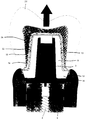
- the drawing shows an axial longitudinal section of an abutment 2 which is fastened on an implant body 6 by means of a screw 4.
- a fully ceramic male or primary crown 8 is firmly connected to the abutment 2.
- the surface 10 of the primary crown 8 is highly polished.
- a grinding wheel is expediently used, which is preferably glued with corundum paper. This manufacturing step ensures an exact and highly polished outer contour of the all-ceramic primary crown.
- the surface 10 of the primary crown 8 is conical, the cone angle being predefined in accordance with the requirements.
- the surface 10 of the primary crown 8 can be cylindrical in the context of the invention. To machine the primary crown, it is fixed in a clamping device with the help of its press channel.
- the primary crown 8 is adhesively attached to the metal abutment 2. Conventional milling devices can also be used to process the ceramic surface, with a roller covered with sandpaper being clamped.
- the thin-walled, all-ceramic primary crown which is individually intended for a natural tooth, is highly fragile until it is finally cemented in the mouth, and a viscous cementation composite can lead to breakage of the crown if it is forced too far.
- a galvanic cap is therefore placed on the primary cap during the adhesive attachment during manufacture. The displacement of the fastening composite creates tensile stresses in the ceramic, which, however, are expediently transferred to the form-fitting galvanic cap and are therefore reduced.
- the primary crown 8 also advantageously contains a step 14 with an enlarged outer diameter in the area of the gingiva 12. This creates sufficient cervical space for veneering the secondary structure.
- the holding element also contains a die or secondary crown 16 which is connected to a frame 18 of the removable denture and which is preferably designed as a cap.
- the framework 18 also carries a veneer 20 in a known manner.
- the secondary crown is made from dental alloys, electroformed gold or pure titanium. If the secondary crown consists of fine gold, the joining gap 24 has a width of the order of 5 ⁇ m.
- the secondary crown 16 is produced by directly electroplating fine gold onto the primary crown 8.
- the outer contour of the all-ceramic primary crown 8 is preferably provided with a layer of conductive material, in particular silver conductive lacquer.
- the galvanization of the secondary crown is subsequently carried out in a further process step. This creates a fine gold cap, which has a layer thickness of 0.1 to 0.2 mm. The layer thickness is specified by specifying the electroplating time and current strength as required.
- This galvanic cap is subsequently separated from the primary crown, the conductive material, in particular the conductive silver varnish, being expediently removed by briefly acting with high-percentage nitric acid.
- direct electroplating onto the standardized and industrially prefabricated primary crown ensures a considerable simplification of the manufacturing process and high precision.
- connection of the secondary crown 16 to the framework 18, in particular of pure titanium or Cr-Co-Mo, takes place intraorally in a particularly expedient manner via an adhesive connection.
- This joining technique guarantees an absolutely passive fit of the prosthesis, especially with several implant pillars.
- the framework 18 is finished with conventional prosthetic and veneering resin.
- the glued-in galvanic caps or secondary crowns 16 are thereby given an additional marginal strength, so that canting during insertion is tolerated without damage.
Landscapes
- Health & Medical Sciences (AREA)
- Oral & Maxillofacial Surgery (AREA)
- Dentistry (AREA)
- Epidemiology (AREA)
- Life Sciences & Earth Sciences (AREA)
- Animal Behavior & Ethology (AREA)
- General Health & Medical Sciences (AREA)
- Public Health (AREA)
- Veterinary Medicine (AREA)
- Orthopedic Medicine & Surgery (AREA)
- Chemical & Material Sciences (AREA)
- Engineering & Computer Science (AREA)
- Ceramic Engineering (AREA)
- Dental Prosthetics (AREA)
- Dental Preparations (AREA)
- Dental Tools And Instruments Or Auxiliary Dental Instruments (AREA)
Applications Claiming Priority (2)
| Application Number | Priority Date | Filing Date | Title |
|---|---|---|---|
| DE19616618 | 1996-04-25 | ||
| DE19616618A DE19616618A1 (de) | 1996-04-25 | 1996-04-25 | Halteelement für einen herausnehmbaren Zahnersatz |
Publications (3)
| Publication Number | Publication Date |
|---|---|
| EP0803232A2 true EP0803232A2 (fr) | 1997-10-29 |
| EP0803232A3 EP0803232A3 (fr) | 1998-04-08 |
| EP0803232B1 EP0803232B1 (fr) | 2002-07-31 |
Family
ID=7792466
Family Applications (1)
| Application Number | Title | Priority Date | Filing Date |
|---|---|---|---|
| EP97105901A Expired - Lifetime EP0803232B1 (fr) | 1996-04-25 | 1997-04-10 | Elément de retenue pour une prothèse dentaire |
Country Status (3)
| Country | Link |
|---|---|
| EP (1) | EP0803232B1 (fr) |
| AT (1) | ATE221345T1 (fr) |
| DE (2) | DE19616618A1 (fr) |
Cited By (4)
| Publication number | Priority date | Publication date | Assignee | Title |
|---|---|---|---|---|
| EP1044658A1 (fr) * | 1999-03-05 | 2000-10-18 | Hawe Neos Dental Dr. H. v. Weissenfluh SA | Matrice |
| EP1607063A1 (fr) * | 2004-06-17 | 2005-12-21 | Unor AG (Unor SA) (Unor Ltd) | Connexion pour une prothèse amovible |
| WO2007019386A1 (fr) * | 2005-08-03 | 2007-02-15 | Provisional Implant Technology, Llc | Couronne provisoire pour implants dentaires |
| US9770218B2 (en) | 2015-04-20 | 2017-09-26 | Provisional Implant Technology, Llc | Method of making a radiographic guide and a surgical stent/guide for dental implants |
Families Citing this family (4)
| Publication number | Priority date | Publication date | Assignee | Title |
|---|---|---|---|---|
| CH694571A5 (de) † | 1999-06-21 | 2005-04-15 | Dcs Forschungs & Entwicklungs | Verfahren zur Herstellung eines Zahnersatzes und eines Zahnersatzteiles, Material für ein Zahnersatzteil und Zahnersatzteil. |
| DE20304649U1 (de) | 2003-03-21 | 2003-06-12 | Siladent-Technik GmbH, 38644 Goslar | Zahnprothetische Anordnung |
| USD734465S1 (en) | 2013-11-01 | 2015-07-14 | Provisional Implant Technology Llc | Provisional dental implant |
| USD733886S1 (en) | 2013-11-01 | 2015-07-07 | Provisional Implant Technology, Llc | Provisional dental implant |
Family Cites Families (5)
| Publication number | Priority date | Publication date | Assignee | Title |
|---|---|---|---|---|
| DE3839837A1 (de) * | 1988-11-25 | 1990-05-31 | Lauks Nikola | Vorrichtung zur befestigung eines zahnersatzes an einem menschlichen kiefer |
| DE3840399C2 (de) * | 1988-11-30 | 1997-12-18 | Hornig Wolfgang | Verfahren zur Herstellung von metallischen Zahnersatzteilen |
| DE4015008A1 (de) * | 1990-05-10 | 1991-11-14 | Koerber Karlheinz | Konus-doppelhuelse zur verankerung von zahnersatz |
| DE4017838C1 (en) * | 1990-06-02 | 1991-12-12 | Abc-Zahntechnik Bienenstein + Soehne Gmbh, 5354 Weilerswist, De | Fastener for releasable dental prosthesis - has rotary moulded with external thread, or peripheral grooving, rigidly fixed in secondary part bore |
| DE9100081U1 (de) * | 1991-01-05 | 1991-03-28 | Wall, Giselher, Dr., 8730 Bad Kissingen | Zahntechnisch-prothetische Halbpassungen als Schichtkörper mit korrosionswidriger Oberflächenausrüstung der Funktionsflächen |
-
1996
- 1996-04-25 DE DE19616618A patent/DE19616618A1/de not_active Ceased
-
1997
- 1997-04-10 EP EP97105901A patent/EP0803232B1/fr not_active Expired - Lifetime
- 1997-04-10 AT AT97105901T patent/ATE221345T1/de not_active IP Right Cessation
- 1997-04-10 DE DE59707831T patent/DE59707831D1/de not_active Expired - Lifetime
Cited By (4)
| Publication number | Priority date | Publication date | Assignee | Title |
|---|---|---|---|---|
| EP1044658A1 (fr) * | 1999-03-05 | 2000-10-18 | Hawe Neos Dental Dr. H. v. Weissenfluh SA | Matrice |
| EP1607063A1 (fr) * | 2004-06-17 | 2005-12-21 | Unor AG (Unor SA) (Unor Ltd) | Connexion pour une prothèse amovible |
| WO2007019386A1 (fr) * | 2005-08-03 | 2007-02-15 | Provisional Implant Technology, Llc | Couronne provisoire pour implants dentaires |
| US9770218B2 (en) | 2015-04-20 | 2017-09-26 | Provisional Implant Technology, Llc | Method of making a radiographic guide and a surgical stent/guide for dental implants |
Also Published As
| Publication number | Publication date |
|---|---|
| DE19616618A1 (de) | 1997-11-06 |
| EP0803232B1 (fr) | 2002-07-31 |
| EP0803232A3 (fr) | 1998-04-08 |
| ATE221345T1 (de) | 2002-08-15 |
| DE59707831D1 (de) | 2002-09-05 |
Similar Documents
| Publication | Publication Date | Title |
|---|---|---|
| DE102004027959B4 (de) | Zahnimplantat und Verfahren zu dessen Herstellung | |
| EP1450722B2 (fr) | Implant dentaire c ramique | |
| EP0319717B1 (fr) | Pivot radiculaire | |
| CH694571A5 (de) | Verfahren zur Herstellung eines Zahnersatzes und eines Zahnersatzteiles, Material für ein Zahnersatzteil und Zahnersatzteil. | |
| DE102012201092A1 (de) | Zahntechnisches Implantatsystem | |
| DE102012108153A1 (de) | Rohling und Verfahren zur Herstellung einer Dentalrestauration durch substraktive Bearbeitung | |
| EP0803232B1 (fr) | Elément de retenue pour une prothèse dentaire | |
| EP0842643B1 (fr) | Implant dentaire en deux parties comportant une couche métallique galvanisée | |
| EP2742905B1 (fr) | Implant dentaire | |
| DE202007019234U1 (de) | Verbindungselement für abnehmbare Zahnprothese | |
| DE202008007189U1 (de) | Abutment für ein Schraubimplantat in einem Kieferknochen | |
| EP0870478A1 (fr) | Elément d'ancrage dentaire en céramique à haute résistance | |
| EP0898943B1 (fr) | Partie prothétique dentaire | |
| DE102007025164A1 (de) | Verfahren und Vorrichtungen zum Erstellen eines Modells eines Patientengebisses | |
| DE19835778A1 (de) | Verankerung für herausnehmbaren Zahnersatz an Kronen oder Brücken | |
| DE3535266A1 (de) | Dentale verankerung | |
| DE19956424B4 (de) | Zahntechnische Horizontalschraube | |
| DE4120132C2 (de) | Zahnersatz | |
| DE10337462B4 (de) | Verbindungsvorrichtung | |
| DE102004043200B4 (de) | Zahnprothese zum Einsetzen im Bereich einer Zahnlücke | |
| EP0664106A2 (fr) | Système de restauration de dents endommagées | |
| DE19624864C2 (de) | Restaurationsstift | |
| DE19526523C1 (de) | Implantat für den Zahnwurzelersatz aus Glaskeramik, faserverstärktem Kohlenstoff oder Titan und Zahnfachabformwerkzeug hierzu | |
| EP4082476A1 (fr) | Système d'implant dentaire | |
| DE19754256A1 (de) | Implantatgestützte Zahnprothese und Verfahren zu ihrer Herstellung |
Legal Events
| Date | Code | Title | Description |
|---|---|---|---|
| PUAI | Public reference made under article 153(3) epc to a published international application that has entered the european phase |
Free format text: ORIGINAL CODE: 0009012 |
|
| AK | Designated contracting states |
Kind code of ref document: A2 Designated state(s): AT BE CH DE DK ES FR GB IT LI NL SE |
|
| PUAL | Search report despatched |
Free format text: ORIGINAL CODE: 0009013 |
|
| AK | Designated contracting states |
Kind code of ref document: A3 Designated state(s): AT BE CH DE DK ES FR GB IT LI NL SE |
|
| RAP1 | Party data changed (applicant data changed or rights of an application transferred) |
Owner name: FRIATEC AKTIENGESELLSCHAFT |
|
| RHK1 | Main classification (correction) |
Ipc: A61C 5/08 |
|
| 17P | Request for examination filed |
Effective date: 19980430 |
|
| RAP1 | Party data changed (applicant data changed or rights of an application transferred) |
Owner name: FRIADENT GMBH |
|
| GRAG | Despatch of communication of intention to grant |
Free format text: ORIGINAL CODE: EPIDOS AGRA |
|
| 17Q | First examination report despatched |
Effective date: 20010928 |
|
| GRAG | Despatch of communication of intention to grant |
Free format text: ORIGINAL CODE: EPIDOS AGRA |
|
| GRAG | Despatch of communication of intention to grant |
Free format text: ORIGINAL CODE: EPIDOS AGRA |
|
| GRAH | Despatch of communication of intention to grant a patent |
Free format text: ORIGINAL CODE: EPIDOS IGRA |
|
| GRAH | Despatch of communication of intention to grant a patent |
Free format text: ORIGINAL CODE: EPIDOS IGRA |
|
| GRAA | (expected) grant |
Free format text: ORIGINAL CODE: 0009210 |
|
| AK | Designated contracting states |
Kind code of ref document: B1 Designated state(s): AT BE CH DE DK ES FR GB IT LI NL SE |
|
| PG25 | Lapsed in a contracting state [announced via postgrant information from national office to epo] |
Ref country code: NL Free format text: LAPSE BECAUSE OF FAILURE TO SUBMIT A TRANSLATION OF THE DESCRIPTION OR TO PAY THE FEE WITHIN THE PRESCRIBED TIME-LIMIT Effective date: 20020731 |
|
| REF | Corresponds to: |
Ref document number: 221345 Country of ref document: AT Date of ref document: 20020815 Kind code of ref document: T |
|
| REG | Reference to a national code |
Ref country code: GB Ref legal event code: FG4D Free format text: NOT ENGLISH Ref country code: CH Ref legal event code: EP |
|
| GBT | Gb: translation of ep patent filed (gb section 77(6)(a)/1977) |
Effective date: 20020731 |
|
| REF | Corresponds to: |
Ref document number: 59707831 Country of ref document: DE Date of ref document: 20020905 |
|
| PG25 | Lapsed in a contracting state [announced via postgrant information from national office to epo] |
Ref country code: SE Free format text: LAPSE BECAUSE OF FAILURE TO SUBMIT A TRANSLATION OF THE DESCRIPTION OR TO PAY THE FEE WITHIN THE PRESCRIBED TIME-LIMIT Effective date: 20021031 Ref country code: DK Free format text: LAPSE BECAUSE OF FAILURE TO SUBMIT A TRANSLATION OF THE DESCRIPTION OR TO PAY THE FEE WITHIN THE PRESCRIBED TIME-LIMIT Effective date: 20021031 |
|
| ET | Fr: translation filed | ||
| NLV1 | Nl: lapsed or annulled due to failure to fulfill the requirements of art. 29p and 29m of the patents act | ||
| PG25 | Lapsed in a contracting state [announced via postgrant information from national office to epo] |
Ref country code: ES Free format text: LAPSE BECAUSE OF FAILURE TO SUBMIT A TRANSLATION OF THE DESCRIPTION OR TO PAY THE FEE WITHIN THE PRESCRIBED TIME-LIMIT Effective date: 20030130 |
|
| PLBE | No opposition filed within time limit |
Free format text: ORIGINAL CODE: 0009261 |
|
| STAA | Information on the status of an ep patent application or granted ep patent |
Free format text: STATUS: NO OPPOSITION FILED WITHIN TIME LIMIT |
|
| 26N | No opposition filed |
Effective date: 20030506 |
|
| PGFP | Annual fee paid to national office [announced via postgrant information from national office to epo] |
Ref country code: GB Payment date: 20100324 Year of fee payment: 14 |
|
| PGFP | Annual fee paid to national office [announced via postgrant information from national office to epo] |
Ref country code: FR Payment date: 20100506 Year of fee payment: 14 |
|
| PGFP | Annual fee paid to national office [announced via postgrant information from national office to epo] |
Ref country code: IT Payment date: 20100427 Year of fee payment: 14 Ref country code: DE Payment date: 20100430 Year of fee payment: 14 Ref country code: AT Payment date: 20100422 Year of fee payment: 14 |
|
| PGFP | Annual fee paid to national office [announced via postgrant information from national office to epo] |
Ref country code: CH Payment date: 20100426 Year of fee payment: 14 Ref country code: BE Payment date: 20100423 Year of fee payment: 14 |
|
| BERE | Be: lapsed |
Owner name: *FRIADENT G.M.B.H. Effective date: 20110430 |
|
| REG | Reference to a national code |
Ref country code: DE Ref legal event code: R119 Ref document number: 59707831 Country of ref document: DE |
|
| REG | Reference to a national code |
Ref country code: DE Ref legal event code: R119 Ref document number: 59707831 Country of ref document: DE |
|
| REG | Reference to a national code |
Ref country code: CH Ref legal event code: PL |
|
| GBPC | Gb: european patent ceased through non-payment of renewal fee |
Effective date: 20110410 |
|
| REG | Reference to a national code |
Ref country code: AT Ref legal event code: MM01 Ref document number: 221345 Country of ref document: AT Kind code of ref document: T Effective date: 20110410 |
|
| REG | Reference to a national code |
Ref country code: FR Ref legal event code: ST Effective date: 20111230 |
|
| PG25 | Lapsed in a contracting state [announced via postgrant information from national office to epo] |
Ref country code: FR Free format text: LAPSE BECAUSE OF NON-PAYMENT OF DUE FEES Effective date: 20110502 Ref country code: BE Free format text: LAPSE BECAUSE OF NON-PAYMENT OF DUE FEES Effective date: 20110430 Ref country code: CH Free format text: LAPSE BECAUSE OF NON-PAYMENT OF DUE FEES Effective date: 20110430 Ref country code: LI Free format text: LAPSE BECAUSE OF NON-PAYMENT OF DUE FEES Effective date: 20110430 |
|
| PG25 | Lapsed in a contracting state [announced via postgrant information from national office to epo] |
Ref country code: GB Free format text: LAPSE BECAUSE OF NON-PAYMENT OF DUE FEES Effective date: 20110410 Ref country code: IT Free format text: LAPSE BECAUSE OF NON-PAYMENT OF DUE FEES Effective date: 20110410 Ref country code: AT Free format text: LAPSE BECAUSE OF NON-PAYMENT OF DUE FEES Effective date: 20110410 |
|
| PG25 | Lapsed in a contracting state [announced via postgrant information from national office to epo] |
Ref country code: DE Free format text: LAPSE BECAUSE OF NON-PAYMENT OF DUE FEES Effective date: 20111031 |