EP0802518A2 - Panneau d'affichage avec prismes trilatérales et période d'exhibition des images programmées - Google Patents
Panneau d'affichage avec prismes trilatérales et période d'exhibition des images programmées Download PDFInfo
- Publication number
- EP0802518A2 EP0802518A2 EP97890071A EP97890071A EP0802518A2 EP 0802518 A2 EP0802518 A2 EP 0802518A2 EP 97890071 A EP97890071 A EP 97890071A EP 97890071 A EP97890071 A EP 97890071A EP 0802518 A2 EP0802518 A2 EP 0802518A2
- Authority
- EP
- European Patent Office
- Prior art keywords
- prisms
- pinion
- prism
- driven gear
- toothless
- Prior art date
- Legal status (The legal status is an assumption and is not a legal conclusion. Google has not performed a legal analysis and makes no representation as to the accuracy of the status listed.)
- Withdrawn
Links
Images




Classifications
-
- G—PHYSICS
- G09—EDUCATION; CRYPTOGRAPHY; DISPLAY; ADVERTISING; SEALS
- G09F—DISPLAYING; ADVERTISING; SIGNS; LABELS OR NAME-PLATES; SEALS
- G09F11/00—Indicating arrangements for variable information in which the complete information is permanently attached to a movable support which brings it to the display position
- G09F11/02—Indicating arrangements for variable information in which the complete information is permanently attached to a movable support which brings it to the display position the display elements being secured to rotating members, e.g. drums, spindles
- G09F11/025—Indicating arrangements for variable information in which the complete information is permanently attached to a movable support which brings it to the display position the display elements being secured to rotating members, e.g. drums, spindles the members being rotated simultaneously, each face of the member carrying a part of the sign
Definitions
- the present invention relates to a device for a gear transmission during a rotational movement of illustrated, three-sided prisms, which together form an advertising screen, and in particular to an advertising screen with three-sided prisms and programmed display time of the images, the prisms having at least one in engagement with each other Gear pair are drivable.
- Illuminated advertisements that are lit and extinguished bring dynamism to the display of the advertisement. Regardless of whether it is backlighting of the illustrated board or whether it is illuminated from the front by outside lighting or whether it is a light label composed of light tubes, the illusion of moving images or texts becomes timed by firing sequences of the neighboring, shining ones or illuminated areas. Even better dynamic effect is obtained with large, multi-part screens composed of a series of flat television screens, which are used for mass performances in squares, in stadiums, halls and for television spectacles, with each television screen only one element of the complete picture or text message is shown.
- Fixed-sided double-sided advertising screens simultaneously provide two pieces of information, one from each side, for observers coming from the opposite direction. For those observers who do not move with respect to the advertising screen, it is desirable that it rotates through 180 ° about its central axis and in this way that it is shown two pieces of information in succession at the desired time interval.
- Large advertising screens are to be divided into segments, each of which can usually rotate about its axis at the same time, which is to be solved by a circular motion transmission system.
- a better effect is achieved if each segment of the flat, two-sided diaphragm is replaced by a three-sided prism with three imaged areas.
- the supporting axis is arranged in its central axis, which is connected to a drive system via a gear.
- the combination of rotating, three-sided row prisms is also known, so that all first prism sides together form the first side of the large advertising screen, which has a total of three images, which can be changed in succession by the rotation of the prismatic elements.
- This can be used for three different advertising messages or for a message whose three images are linked in terms of content, and this can be repeated continuously.
- Multi-part advertising screens from a row of the three-sided prisms with the one-way rotation mode always show the same order after three pictures on their illustrated pages. They are equipped with various drive systems combined with gearboxes of the rotary motion, mostly in an electromechanical version. Three-sided row prisms can usually or simultaneously less often be rotated one by one by a third of the full circle, so that the new image is shown by rotating all the prisms.
- the setting in the position to display the entire image takes as long as the rotation of a prism and therefore the exchange of the image is satisfactorily quick.
- the standstill of the rows of prisms when the first image is displayed is always the same as the standstill of the same row when the second or third image is displayed, so that this cycle can be repeated as desired by further rotation.
- the one and the other variant have in common that the duration of the image display when the prisms are stationary is completely the same, no matter which of the three images is shown, this being not changed on repetition.
- a first such example according to EP-A 0 202 469 under the title "Driving Device for Signs” shows a drive system with a gear transmission primarily for three-sided prismatic screens.
- This embodiment provides that at least one of the screens has two toothed rollers, one of which is adapted to be in connection with the toothed belt due to the power transmission from the operating unit of the previous screen and the other is adapted to be is connected to the second toothed belt, which is used to transmit the operating force to the next screen.
- This example of the technical solution according to EP-A 0 202 469 thus has the essential property that two toothed rollers are firmly connected to each other for each screen, so that one is relatively not relative to the other when it is set in the exact position after being replaced can move and thanks to this fact they can be coupled and released from the shaft in a moment.
- the complexity of the construction increases the risk of damage because of the large number of elements, which leads to a price increase of the entire facility in relation to the use of the less expensive solutions, with different downtimes or different combinations thereof not being achievable with this training.
- a second example can be found in GB-A 2134301, in which the problem of the illustrated part of the image is emphasized on each side of the prismatic screen and the usual solution to the problem by sticking new images on all three sides of the prismatic screen elements as a loss of time and multiple, complicated work is looked at.
- the solution to the problem in this known embodiment provides that at least one of the three sides of the prismatic element of the screen, and preferably each, arranged in the radial direction, has portable elements to which new illustrated, flat surfaces can be easily removed and attached can be easily exchanged.
- the problem of the display time during the standstill of one of the three images is not considered here.
- a third example is the patent application PCT / DE93 / 01008 with the priority DE G 921 44 44.6, in which the technical solution to the problem of the multi-part advertising screen provides a modular screen for matrix-like advertising boards with a large total area.
- the electromechanical device for driving the square plate elements consists of a series of elements which are connected in a chain to form an endless band with 8 elements each, which are visible on the front illustration.
- the interchangeability of the images on the module of a total of 64 elements is achieved, which comprises the entire advertising screen in 2 sets of 4 endless bands with 8 visible elements each.
- the advantage of such a solution is the large number of interchangeable images on a chain-like, rotating element.
- the duration of the image display during the standstill of the facility is also not taken into account here.
- the problem with such advertising screens with three-sided prisms therefore generally lies in the complexity and too long duration of the entire operation of changing the content of the imaged areas, because the change is to be made on each of the three sides of the rotating prism.
- the precision and accuracy of the composition of the neighboring picture elements is the goal because of the visual effect. This is intended to be achieved in the assembly operations of changing individual illustrated surfaces on the prisms or the entire prisms, which requires structural interventions on the part of the device for transmitting the rotational movement and an adjustment of the relative position of the axes of rotation of the adjacent elements.
- the present invention now aims to find solutions which can achieve a significant difference in the duration of the display of one image in relation to the other, so that the dynamics of the content of the advertisement message, in accordance with the content of each image, is achievable.
- Some solutions with different combinations of changing the image rotation and arresting rhythm should also be offered and these solutions should be easy to use and reliable.
- the present invention aims to achieve programmed breaks in the otherwise uninterrupted rotational movement of the illustrated three-sided prisms, wherein the gear transmission of the rotational movement from the drive system to the central axis of the three-sided prism can be selected, as in the case of similar solutions of the same type .
- the advertising screen with three-sided prisms and programmed display time of the images, the prisms being drivable via at least one meshing pair of gears is essentially characterized in that at least in the system of power and movement transmission from the drive machine to the prisms there is a pair of incompletely toothed gears and that the idle time of the prisms is proportional to the rotation time of the toothless arc on one of the gears.
- This system according to the invention differs significantly from those known systems which are constructed as gear pairs which enable the normal, uninterrupted rotational movement without a break and in which are required for this reason Breaks in a rotation cycle must be programmed by additional devices for temporary interruption of the drive system.
- the basic difference and advantage of the design according to the invention is that only one pair of gearwheels is required here, which simultaneously solves the transmission of the circular movement and the programmed pause through the construction properties of the toothing according to the invention without the need for an additional device for interrupting operation.
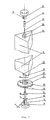
- a structurally particularly simple embodiment which is an easy assembly of an advertising screen according to the invention or a simple change of the prisms containing the image components to be displayed, is preferably designed so that the upper base of the three-sided prism in the center of gravity of the triangular base has an upper support of the prism with an axis and an axis pin on which a tube covering made of an elastic Material is placed that the above, mounted on the frame bearing has a slot and a blind hole of the same length for receiving the pin of the axis with the attached pipe lining and that the lower base of the three-sided prism in the middle of a fixed, lower support of the prism with an axis, which is pressed into a blind bore of a hub on the upper side of the gear, while on its lower side the axis is attached, on the pin of which the pipe lining is also placed and stored in the lower bearing.
- the gear pair (4, 5) By using the gear pair (4, 5) with partial toothing, various combinations of short and long breaks when the gear is stationary can be achieved.
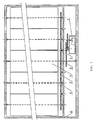
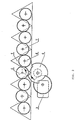
- the pinions (see examples in Fig. 4) are selected according to the desired rhythm of the image rotation in accordance with the content of the advertisement that is displayed. For each new combination, the pinion (4) can simply be replaced, while the driven gear (5) remains the same. The pinion (4) should be replaced in the position in which it is not in engagement with the driven gear (5) (standstill phase of the prisms) when the drive system is switched off. The new pinion (4) can be arranged in the place of the previous one, no matter in which position this allows the pivoting due to the lack of teeth. All prisms (1) in the row that the multi-part screen (Fig. 1 and 2) are connected by tooth transmission via intermediate gears (7), so that the prisms (1) rotate simultaneously in one direction.
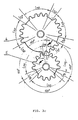
- the pinion (4) has two identical toothed arches (l zp ) over the entire length of the circumference, so that the two toothless parts (l n1p and l n2p ) have significantly different lengths.
- the aspect ratio of these toothless parts becomes proportional to the idle time of the driven gear, which is identical to the display time of the individual image on the advertising screen.
- the driven gear (5) is attached via the hub (18) to the lower support (15) of the three-sided prism (1), which is to be rotated by a third circle or by 120 ° 3a, the lengths of the toothed arc (l zg ) of the driven gear (5) and the pinion (4) should be set so that they remain engaged until the rotation is achieved by a third of a circle.
- the toothing of the minimum arc length (l ng ) was omitted in three places at equal intervals by one third of the circle, and only to the extent that it was possible to resume the operation without collision and tooth collision.
- the pinion (4) has three toothed arches (l zp ) of the same length over the entire circumference, one (l n1P ) of the three toothless arches on the entire circumference is significantly shorter than the other two arches (l n2p and l n3p ), which are the same.
- both gearwheels like the pinion (4) and the driven gearwheel (5), have the same number of toothed arches of the same length and with the driven gearwheel bearing the axis of the three images (A, B and C), three-sided prism, the repetition of the same image (e.g.
- image B) always has the same duration. Which of the pictures will have the shortest downtime and the others the longer one depends on the starting position. It is therefore important that the image that corresponds to the content shown is selected for the shortest downtime.
- the shortest toothless part of the pinion (l np ) should be set up so that the engagement with the driven gear (5) does not appear when this selected image (B) is displayed.
- the initial position of the gearwheel in engagement should therefore be taken into account when setting up the new, three-sided, illustrated prisms.
- n is the Number of segments of the toothed arches on the gear circumference. It is interesting to determine the idle time of the driven gear (5) for the individual image if we know the geometry of the pinion (4) and the driven gear (5) and the available number of revolutions of the pinion (4).
- the pinion and the driven gear in the pair of gears are coupled according to the condition of the invention in such a way that the driven gear (5) stands still during the rotation of the pinion (4) along the length of the toothless arc and the length of the determined image on the three-sided prism (1) issued to observers.
- the above formula enables the downtime (t pan ) of the desired images (A or B or C) to be calculated, depending on the length of the toothless sheet (l np ) on the circumference of the pinion or, conversely, the length of the toothless sheet for the required downtime at the given number of revolutions (n p ) of the pinion.
- the construction of the mounting kit shows that this can be done by removing the axle (12) from the upper and lower fixed bearings. After setting up the axis of the new prism in the upper and lower bearing, holding the gear (6) so that it does not rotate during this operation, the first surface of the prism (1) with the neighboring prisms should be turned by pivoting this prism to be arbitrated.
- the upper cylindrical bearing (8) of the axle is, just like the lower, solved in such a way that it has a slot (9) of such width (s) that the pin of the axle (12) can be pulled through it which the pipe covering (11) of the uniform cross-section is firmly attached.
- the tube covering (11) is deformed on the two side surfaces at the contact point, but it comes back to the initial shape with a uniform cross section due to the elasticity.
- the pin (12) of the axis of the three-sided prism (1) can rotate easily. First remove the axle from the upper bearing and then in the same way from the lower bearing. When setting up the new prism, first insert the lower journal into the lower bearing and then the upper journal into the upper bearing.
- the surface of the new prism should be finished with the corresponding surface of the neighboring prism and therefore the new prism should be rotated slightly in the required direction until it is exactly positioned.
- the plug (16) of the lower support (15) of the prism in the blind bore (17) within the hub (18) of the plug holder with respect to that stationary, driven gear (5) rotated. Since the plug (16) and the hub (5) are connected in a fixed (overlappable) manner, the exact position of the prism is constantly maintained. This procedure is to be repeated in sequence, with all prisms being changed in sequence until the complete new image is finished.
- the system can be used in the context of various advertising or information screens for outdoor installation and in closed rooms, as well as for various other systems in which simple changes to downtimes and rotations are programmed should be, whereby the operation of the drive system should not be interrupted.
- the advertising screen with the possibility of programming the display time of the images, which do not depend on the type of drive machine and energy with which the drive machine is fed, is particularly suitable for applications in the areas without electrical energy.
- the screen can be operated by an alternative energy source, e.g. Solar, wind and water wave energy.
- this screen according to the invention is a simple and functional system, applicable both in populated and in unpopulated areas.
Landscapes
- Physics & Mathematics (AREA)
- General Physics & Mathematics (AREA)
- Engineering & Computer Science (AREA)
- Theoretical Computer Science (AREA)
- Displays For Variable Information Using Movable Means (AREA)
- Devices For Indicating Variable Information By Combining Individual Elements (AREA)
Applications Claiming Priority (2)
| Application Number | Priority Date | Filing Date | Title |
|---|---|---|---|
| HRP960184 HRP960184A2 (en) | 1996-04-19 | 1996-04-19 | Advertisment display with three-sided prisms and programmed timing for picture display by means of a pair of partly toothed gears |
| HR960184 | 1996-04-19 |
Publications (2)
| Publication Number | Publication Date |
|---|---|
| EP0802518A2 true EP0802518A2 (fr) | 1997-10-22 |
| EP0802518A3 EP0802518A3 (fr) | 1999-01-27 |
Family
ID=10946391
Family Applications (1)
| Application Number | Title | Priority Date | Filing Date |
|---|---|---|---|
| EP97890071A Withdrawn EP0802518A3 (fr) | 1996-04-19 | 1997-04-17 | Panneau d'affichage avec prismes trilatérales et période d'exhibition des images programmées |
Country Status (2)
| Country | Link |
|---|---|
| EP (1) | EP0802518A3 (fr) |
| HR (1) | HRP960184A2 (fr) |
Cited By (2)
| Publication number | Priority date | Publication date | Assignee | Title |
|---|---|---|---|---|
| KR20020060629A (ko) * | 2002-04-16 | 2002-07-18 | 이한수 | 간판의 다 화면 전환장치 |
| EA033025B1 (ru) * | 2017-06-07 | 2019-08-30 | Сералы Сеитжапарович Тюлендиев | Динамическая рекламная установка (варианты) |
Family Cites Families (3)
| Publication number | Priority date | Publication date | Assignee | Title |
|---|---|---|---|---|
| DE168890C (fr) * | ||||
| US1865725A (en) * | 1931-06-18 | 1932-07-05 | Raves Mfg Co Ltd | Advertising sign |
| US3365825A (en) * | 1966-02-11 | 1968-01-30 | Hyman Neigher | Display signs |
-
1996
- 1996-04-19 HR HRP960184 patent/HRP960184A2/hr not_active Application Discontinuation
-
1997
- 1997-04-17 EP EP97890071A patent/EP0802518A3/fr not_active Withdrawn
Cited By (2)
| Publication number | Priority date | Publication date | Assignee | Title |
|---|---|---|---|---|
| KR20020060629A (ko) * | 2002-04-16 | 2002-07-18 | 이한수 | 간판의 다 화면 전환장치 |
| EA033025B1 (ru) * | 2017-06-07 | 2019-08-30 | Сералы Сеитжапарович Тюлендиев | Динамическая рекламная установка (варианты) |
Also Published As
| Publication number | Publication date |
|---|---|
| EP0802518A3 (fr) | 1999-01-27 |
| HRP960184A2 (en) | 1998-02-28 |
Similar Documents
| Publication | Publication Date | Title |
|---|---|---|
| EP1445672B1 (fr) | Mécanisme pour montrer la phase de la lune | |
| DE3639660A1 (de) | Vorrichtung zum sichtbarmachen von reklame- bzw. werbekundgebungen und -hinweisen | |
| DE69307623T2 (de) | Werbeschild aus mehreren Tafeln, mit dem mehrere Botschaften zusammengestellt werden können, die einzeln ausgewählt und angezeigt werden | |
| CH677415A5 (en) | Publicity panel providing successive display images - uses adjacent triangular elements each side face carrying respective strip section of display image | |
| DE69104088T2 (de) | Anzeigeeinrichtung. | |
| DE2030140C3 (de) | Vorführungsvorrichtung | |
| EP0381295A1 (fr) | Dispositif d'affichages d'images et affiches transparentes | |
| DE3733575A1 (de) | Anzeigeelement | |
| EP4016197B1 (fr) | Affichage des phases de la lune | |
| DE835065C (de) | Variator | |
| DE4011251C2 (fr) | ||
| DE69821620T2 (de) | Anzeigeeinheit | |
| DE102023003303B3 (de) | Verkleidungsteil für ein Kraftfahrzeug | |
| DE8813522U1 (de) | Insbesondere als Reklamegerät verwendetes Schaugerät zur Darstellung von Bildern, Texten od. dgl. | |
| WO1992022886A1 (fr) | Installation a placards publicitaires alternes | |
| DE69827990T2 (de) | Steuerungseinrichtung, insbesondere für Informationsanzeigevorrichtungen mit auswechselbaren Tafeln | |
| DE19944424A1 (de) | Bildanzeigevorrichtung für veränderliche Informationen | |
| DE69403563T2 (de) | Drehbare Anzeigevorrichtung | |
| EP0146754A1 (fr) | Dispositif de visualisation optique des indications de prix, des inscriptions, des images à grande surface | |
| DE461524C (de) | Vorrichtung zum Vorfuehren von Reklameanzeigen, -bildern o. dgl. auf absatzweise vor eine Schauoeffnung gefuehrten und beleuchteten Tafeln | |
| WO2001033533A1 (fr) | Dispositif de representation d'une image composee de plusieurs elements d'image | |
| DE7016041U (de) | Vorrichtung zur veraenderlichen darbietung von werbemitteln. | |
| DE294558C (fr) | ||
| DE213894C (fr) | ||
| DE102012111524B3 (de) | Fallblattanzeige |
Legal Events
| Date | Code | Title | Description |
|---|---|---|---|
| PUAI | Public reference made under article 153(3) epc to a published international application that has entered the european phase |
Free format text: ORIGINAL CODE: 0009012 |
|
| AK | Designated contracting states |
Kind code of ref document: A2 Designated state(s): AT DE DK FR GB IT |
|
| AX | Request for extension of the european patent |
Free format text: SI PAYMENT 970421 |
|
| PUAL | Search report despatched |
Free format text: ORIGINAL CODE: 0009013 |
|
| AK | Designated contracting states |
Kind code of ref document: A3 Designated state(s): AT DE DK FR GB IT |
|
| AX | Request for extension of the european patent |
Free format text: SI PAYMENT 970421 |
|
| STAA | Information on the status of an ep patent application or granted ep patent |
Free format text: STATUS: THE APPLICATION IS DEEMED TO BE WITHDRAWN |
|
| 18D | Application deemed to be withdrawn |
Effective date: 19991102 |